86 357 résultats
Folio. 12 Bände mit jahrgangsweise gebundenen gedr. Kurrenden, Circularen, Kundmachungen, Ständischen Patenten, und sonstigen Drucken, Abschriften u. ä. in deutscher, einzelne Schriftstücke teilweise in lateinischer oder französischer Sprache. Zus. über 5000 SS. auf über 2500 Bll. (davon ca. 1400 SS. weiß, über 460 SS. (Falt-)Tabellen(-Formulare) und Formulare, 9 SS. Kupferstiche mit einer Landkarte und Banknoten, 1 S. lithogr. Textillustration und 2 SS. Stempel-Abb.). Die Schriftstücke zumeist Folio. In blauen Papiereinband mit Titel- und Rückenschild. Von besonderem Interesse sind die beiden jüngsten Bände, die das Revolutionsjahr 1848 und seine Folgen betreffen, mit einigen politischen Aufrufen ("An die Arbeiter") und historisch wertvollen Dokumenten zu aktuellen politischen Vorkommnissen: der Flucht Ferdinands I. vor den Ausschreitungen von Wien nach Innsbruck, seine Kundmachung des ersten österr. Reichstags, Ferdinands spätere Abdankung sowie den Beginn der Regierungszeit Franz Josephs. Ebenso dokumentiert ist die Vermählung Kaiser Franz Josephs und Elisabeths sowie die Geburt ihrer ersten Tochter Sophie Frederika. - Größtenteils betreffen die eingebundenen Schriftstücke den amtlichen Verkehr, Organisation, Umstrukturierungen, Steuer-, Gesetzes- und Vorschriftenänderungen sowie Ankündigungen von öffentlichem Interesse zu den Themen (Land-)Wirtschaft, Finanzen, Gesundheitswesen, Brand- und Unwetterkatastrophen, Soziales und das kaiserliche Haus während der Regierungszeit von Franz I., Ferdinand I. und Franz Joseph. In diesen Rubriken werden etwa die Kultivierung von Erdäpfeln und Maulbeerbäumen für die Seidenraupenzucht, die Borkenkäferplage, eine Vogelfangbeschränkung zwecks Insektenschutz, Viehseuchen wie Milzbrand, Mutterkornvergiftung durch sog. "Brandkorn", Epidemien wie Ruhr und Cholera, eine "Blutegeltaxe", die Wiederbelebung Scheintoter, die Versorgung der Armen und die Explosion des Pulverturms in Mainz 1857 besprochen. Dazwischen finden sich auch einige hs. Kurrenden, Briefe, Tabellen und Kopien. - Bei den eingebundenen Druckschriften handelt es sich um informative Aufsätze wie im vierten Band die lithogr. "Gemeinnützliche leichtfassliche Belehrung über Schutzmittel gegen die Flammen" des Ritters Johann Aldini mit einer Textillustrationen zu Schutzkleidung aus Asbest und Metallgewebe, die "Vorschrift über die Kuhpockenimpfung" (in Bd. VI: Wien, k. k. Hof- und Staats-Aerarial-Druckerei, 1836) oder amtliche Veröffentlichungen. - Die Kupferstiche zeigen "neue" Banknoten (zu 5, 10, 500 und 1000 Gulden), "Cassa-Anweisungen" (zu 10, 25, 50, 100, 500, 1000 Gulden) und eine kleine Landkarte Aufhams. - Als Verfasser sind nebst den österreichischen Kaisern die aktiven Regierungspräsidenten, Kanzler, Hofräte, Amtmänner, Minister, Sekretäre, Bankdirektoren und ausländische Vertragspartner genannt: Johann Edler v. Dornfeld, Aloys Gf. von Ugarte, Johann Talatzko Ritter v. Gestetitz, Adrian Nikolaus Frh. von Barbier, Joseph Edler von Wayna, Ant. Fr. Gf. Mittrowsky v. Mittrowiz u. Nemischl, Franz Frh. von Pillersdorf, Joh. Limbeck Ritter v. Lilienau, August Langin Fst. v. Lobkowicz, Karl Gf. Inzaghy, Graf Weissenwolf, Rudolph Fst Kinsky, Philipp Frh. v. Strbensky, Gf. v. Bombelles, Gf. v. Fossombroni, Fürst von Metternich, De Sambuy, Sommaruga, Schwarzenberg, Stadion, Krauß, Bach, Cordon, Bruck, Thinnfeld und Kulmer u. v. a. m. - Neben Steuer-, Lehen-, Zoll- und Mautbestimmungen auch verschiedenste Normen aller Stände, Berufssparten, staatl.-organisatorische Einteilungen (z. B. für das Postwesen) und finanzielle Leistungen wie Pensionen, Staatsobligationen und Lotterieanleihen betreffend. - Einbände und innen stellenweise etwas (stock-)fleckig, die Schriftstücke an den Rändern teilweise leicht lädiert, wenige gedr. Schreiben und hs. Briefe mit hs. Adressen verso und papiergedeckten. Siegeln. Zahlreiche Schriftstücke mit Vermerken in Tinte, Blei oder Rotstift.
8vo. Two volumes: 432, 8,(1), 45, 32, (1), 33, (1), 18 pp. (2), III, 47, (1), 114, 64, (1) 154, 83 (47 + 36) pp. With ms. table of content for each volume to the rear flyleaves. Bound in contemporary half calf with giltstamped title "Doctrine de Saint-Simon", volume no., and ornaments to spine. Marbled covers. All edges yellow. This interesting collection assembles texts by some of the principal figures of Saint-Simonianism, including Barthélemy Prosper Enfantin, Armand Bazard, and Hippolyte Carnot. The longest individual text in the collection is Carnot’s "Doctrine de Saint-Simon. Exposition. Première année. 1828-1829" (Paris, au Bureau de l’Organisateur, 1831). This work opens the first volume of the collection, where it is followed by P. Enfantin and A. Bazard, "Religion Saint-Simonienne. Lettre à M. le Président de la Chambre des deputés" (Paris, Everat, n. y.); H. Carnot Doctrine, "Saint-Simonienne. Résumé général de l'exposition faite en 1829 et 1830" (Paris, Globe, 1831); J. Reynaud, "De la Société Saint-Simonienne" (Paris, au Bureau de la Revue Encyclopédique, 1832); P. Enfantin and others, "Religion Saint-Simonienne. À tous" (Paris, à la librairie Saint-Simonienne, 1832); and A. de Courdemanche, "Est-ce légalement que le gouvernement à fait supendre l'exercice du culte saint-simonien?" (Paris, Everat, n. y.). The second volume begins with the anonymous text "Aux industriels. Lettres sur la législation dans ses rapports avec l'industrie et la propriétre" (Paris, Globe, 1831), followed by J. Lechevalier, "Religion Saint-Simonienne. Enseignement central" (Paris, Everat, 1832); P. Enfantin, "Religion Saint-Simonienne. Réunion générale de la famille. Séances des 19 et 21 novembre 1831" (Paris, Everat, 1831), and É. Barraut, "1833, Ou l'année de la mère" (Lyon, Durval, 1833). - Binding somewhat rubbed, corners bumped. Occasional foxing. The first text of the second volume shows strong browning to the first pages.
Broadside, measuring 550 × 355 mm, printed to recto and verso, with decorative header. Revolutionary broadside reproducing the text of a foundational document of the Third Communist International, which was presented and confirmed at the constitutional first Congress of the Comintern on 2-6 March 1919. Later known as the "Manifesto of the Communist International", the document calls upon the proletarians of the world to rally around Lenin's principles for the revolutionary struggle against the bourgeois regimes and was signed by all delegates of the Congress. The text of the manifesto was written by Leo Trotsky, who personally presented and declaimed the text at the meeting of the Congress. It was printed in "Pravda" following the Congress, and evidently broadsides such as these were sent to local cells of the Bolshevik Party and to various provincial Soviets to bolster support for Bolshevik policies. - With an article by Lenin printed in the third column verso, a short speech on the occasion of the Congress entitled "Zavoevannoe i zapisannoe" ("Conquered and recorded") by Lenin (mistakenly signed "P. Lepin" by the printer). - Old creases; some fraying to upper edge and one tiny hole at fold, with no loss to text; otherwise very good, printed on sturdy white paper. A scarce survival which we are unable to trace in either Russian or Western institutions.
Folio (222 x 348 mm). 11, (1) pp. Sewn. First edition: the official publication of the letter patent that founded the Vienna Stock Exchange in 1771. "The foundation of such a public trading floor had been suggested as early as 14 August 1761 in an offical decree, but the project was not realized. It was not until Maria Theresa's enactment published on 1 August 1771 that the change came about" (cf. Czeike I, 427). Baltzarek, Die Geschichte der Wiener Börse (1973).
Small folio (320 x 185 mm). 2 block books containing more than 1000 rubbings of antique and modern Chinese coins dating from the 3rd century BC to the 17th century AD. Ca. 80; 110 pp. Paper wrappers sewn with silk and cord, stored together in a modern cardboard portfolio. An extensive historical catalogue of Chinese coins, probably rubbed from a museum or a very substantial private collection, including hole (cash) coins, sword coins, shoulder, ox-yoke, yan state knife coins, spade and bridge coins, etc., captioned in Chinese. The coins date from the Chow dynasty (544-519 BC), Fein, Tsin and Han dynasties (255-200), bridge money ca. 2356 and 2255 BC, with the sword coins dating from the Chi dynasty. Also includes prints taken from the coins' moulds, including one for general Tsung-Kwang-fu (1st century), coins from North Chow (558-581 BC), etc. The second volume comprises more recent coins from the Ching dynasties up to the 17th century AD. Each page shows between 2 and 20 rubbings, dynasties given in English, dates, frequent annotations in Chinese. Very fine laid paper; the slightly sturdier paper used for the wrappers is watermarked "GC & Co. 1877". Some dog-earing and duststaining; traces of use, but generally well preserved.
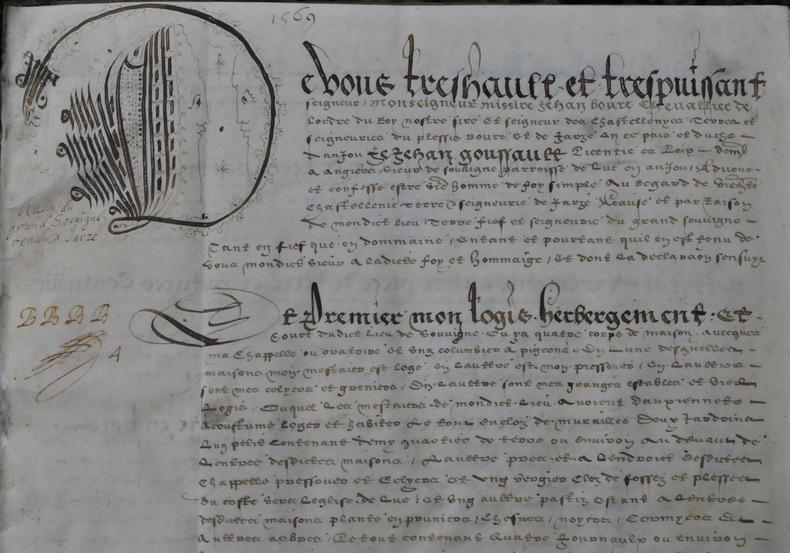
156946404968, 1569 ; grand in-4, cartonnage de l’époque recouvert de soie à motif de rayures, étiquette manuscrite. (cartonnage ancien) 20 ff. non chiffrésDocument soigneusement calligraphié sur peau de vélin avec en tête des parties 5 belles initiales cadelées ornées de visages.Le sieur Goussault fait allégeance à son suzerain, Jehan Bouré, afin d’entrer en possession du domaine du Grand Souvigné à Lué (aujourd’hui Lué-en-Baugeois).“De vous très haut et très puissant seigneur, Monseigneur missire Jehan Bouré chevalier de l'ordre du roy notre sire et seigneur des chastelleynies terres et seigneuries du Plessis Bouré et de Jarzé en et pais et duché d'Anjou. Je Jehan Goussault licencié es loix – dem. à Angiers, sieur de Souvigné paroisse de Lué en Anjou,(...) et confesse estre vostre homme de foy simple au regard devôtre chastellenie terre et seigneurie de Jarzé de céans et par raison de mondict lieu terre fief et seigneurie du Grand Souvigné tant en fief que en dommaine entant et pourtant qu'il en est tenu de louer mondict sieur a ladicte foy et hommaige et dont la declaration s'ensuyt.”Suit la description du bien en commençant par le bâti constitué de quatre corps de maison, d’une chapelle ou oratoire, d’un colombier, logement du métayer, granges, grenier, pressoir et divers autres bâtiments, vergers de pruniers, noyers, etc. Suit, sur 4 pages, la description des terres, en 18 item : prés, cultures, maisons des fermiers. Suivent les “hommaiges qui me sont dus a cause de mondict fief de Souvigné”. “En premier demoiselle Marguerite Moreau fille du defunct noble somme René Moreau (...) fief, domaine et seigneurie (...) de La Perraudière (...) ” puis une liste en 19 item listant les tierces parties en indivis (5 pages et demi).“S’ensuivent les cens rentes et debvoirs dudict fief de La Perraudière” 2 pp. et demi de cens et rente. en 6 item. Puis “Andrée la Gouesloue est ma femme (...) ” qui verse annuellement à son mari neuf sols tournois de revenus provenant de son bien de La Viennière. Jehan Poullain, François Besnard et Françoise du Plessis pour son domaine de La Burelière lui versent également une rente. La situation de damoiselle Françoise du Plessis et la description du domaine de La Burelière (à Tiercé) occupe une page, suivie de 4 pp. et demie énumérant les terres et dépendances de ce domaine en 15 item. Suit la liste des “choses tenues tant à foy et hommaige” attachés au domaine de La Burelière ainsi que les “cens et debvoirs” attachés à ce domaine qui donne une liste de 32 familles concernées. Enfin, “S’ensuivent les cens rentes et debvoirs” payés à la seigneurie de Souvigné avec la liste des 22 personnes ou familles concernées.Le document porte 9 signatures parmi lesquelles celle de Goussault, d’un certain M. de La Fontaine, ainsi qu’un timbre sec aux armes du duché d’Anjou. Quelques annotations postérieures dans les marges (noms des domaines concernés). Bords de la toile recouvrant le cartonnage usagés.
4to. (21) pp., final blank page. With woodcut title border. - Bound with 18 other works. Together 574 pp. With several engraved and woodcut illustrations, frontispieces, vignettes, and borders; 2 title-vignettes printed in red and black. 18th century full vellum with gilt spine-label and handwritten spine-title. All edges sprinkled red. Fine sammelband comprising Latin, Italian, and French publications from the 16th and 18th centuries. Includes the first edition of Bartolini's epic promotion of Emperor Maximilian I as a potent leader in a military campaign against the Ottoman Empire. Dedicated to the prominent German humanist and imperial councillor Konrad Peutinger. The attractive woodcut border was presumably carried out by Hans Weiditz, who illustrated several Grimm & Wirsung productions. - Furthermore, the present volume contains observations on Pierre Danet's "Magnum Dictionarium latino-gallicum" by the Italian lexicographer Facciolati, a eulogy for the Italian surgeon Pier Paolo Molinelli (1702-64), several numismatic essays, including a treatise on Hebraic shekels, and a dissertation on Utricularia, a genus of carnivorous plants. - Contains individually: II: Facciolati, Jacopo. Animadversiones criticae in primam litteram latini lexici, cui titulus Magnum dictionarium latino-gallicum [...]. Padua, Johannes Manfré, 1731. - III: Panigarola, Francesco. Oratione fatta dal r.do padre Panicarola nel duomo di Milano [...]. Rome, Antonio Blado, 1584. - IV: Roberti, Giovanni Battista. Orazione funebre a Pietro Paolo Molinelli [...]. Bologna, Lelio dalla Volpe, 1765. - V: Giacco, Bernardo Maria. Orazione funebre [...] nella morte del Signor Duca D. Gaetano Argento, Presidente del S.R.C. di Napoli [...]. Bologna, Longhi, (1738). - VI: Battarra, Giovanni Antonio. Per l'apertura della cattedra di filosofia del Seminario di Rimino [...]. Cesena, Ascanio Faber, 1763. - VII: Amati, Pasquale. Dissertazioni tre [...] sopra alcune lettere del signor dottor Bianchi di Rimini, e sopra la moderna iscrizion savignanese, e il Rubicon degli antichi. Faenza, presso l'archi Impress. Camerale, e del S. Ufizio, 1761. - VIII: Mariotti, Agostino. Augustini Mariotti Romani Presbyteri S.T.D. De nummo Neptuni argenteo incuso commentariolus [...]. Rome, Benedict Franzesi & Cajetan Paperi, 1762. - IX: Mariotti, Agostino. Epistola qua C.V. Paschali Magnonio auctori dissertationis de veris Posidoniae & Paesti originibus commentariolum de nummo Neptuni Argenteo incuso dono mittit sive ad commentariolum mantissa. Rome, Hermathenaeus, 1764. - X: Calvet, Esprit Claude Francois. Dissertation sur un monument singulier des utriculaires de Cavaillon. Où l'on éclaircit un point intéressant de la navigation des anciens [...]. Avignon, J. J. Niel, 1766. - XI: Ayrmann, Christoph Friedrich. Dissertatio de nummis Ateulae regi Attilae male attributis [...]. Gießen, Eberhard Heinrich Lammers, 1739. - XII: Gradenigo, Giovanni Girolamo. Dissertatio de siclo argenteo Hebraeorum [...]. Rome, Hermathenaeus, 1766. - XIII: Farsetti, Tommaso Giuseppe. Seriola ad M. Antonium Grimanum V. P. e Sexvirum Collegio. Venice, Angelo Jeremia, 1766. - XIV: Becelli, Giulio Cesare. Lettera ammonitoria del signor Giulio Cesare Becelli gentiluomo veronese a Lelio commediante che sta in Parigi. Venice, Francesco Argenti, [1736]. - XV: Noghera, Giovanni Battista. Bandiera al vento, ossia l'autore de' Pregiudizj intronizzato. Cicalamento primo. Venice, Remondini, 1757. - XVI: [Ceva, Tommaso]. Osservazioni intorno all'esposizione de riti cinesi fatta alla Sagra Congregazione. No place or date. - XVII: Pianetti, Pietro. Logices, methaphysices, ac physices generalis [...]. Velletri, Caesar Sartorius, 1766. - XVIII: Picchioni, Julius. E logica, metaphysica [...]. Ibid., 1766. - XIX: Angelo da Cesena. Religionis cappuccinorum et sacrae eloquentiae lectoris opera omnia in quinque partes distributa [...]. Pars prima. Tomus primus [...]. Bonn, Archi, 1754. - Contemporary manuscript list of contents to second flyleaf. Of the 21 registered works 19 are still present in this volume. Paper occasionally browned; slight foxing and dampstaining in places. An extraordinarily well-preserved anthology combining a remarkably diverse set of early modern works. I: VD 16, B 570. BM-STC German 66. Not in Adams, Ebert, Proctor, Dodgson/Campbell. - III: Edit 16, CNCE 25512. Not in BM-STC Italian.
4to. (16), 528 (but: 518) pp. Contemporary full calf with giltstamped spine and spine-label. All edges sprinkled red. First edition of the standard work on the history of the Azores. Describes the discovery and characteristics of each island of the archipelago and gives an account of the most prominent Azorean families, including the author's own. In addition, this seminal work includes chapters on the Canaries, Cape Verde Islands and Madeira, as well as references to Brazil and the Americas. The section on Madeira includes an account of the introduction of sugarcane from Sicily and the development of the industry. - Prepared by the Jesuit priest António Cordeiro (1641-1722), a native of Terceira, who derived much of his material from the 16th century "Saudades da Terra" by the historian Gaspar Frutuoso (ca. 1522-91). - Pagination jumps from 327 to 338, text remaining continuous. - Extremities slightly rubbed; small portion of calf torn off each board near lower margin. Repaired tear to lower margin of pp. 11f. - Not seen at auction since 2004. De Backer/S. II, 1436. Leclerc 632. Innocencio I, 114, 546. Sabin I, 16759. Streit XVII, 5789. Gay 3008. Palha 3890. Samodães, 889 ("very rare"). Ernesto do Canto, 79. Auvermann, 229.
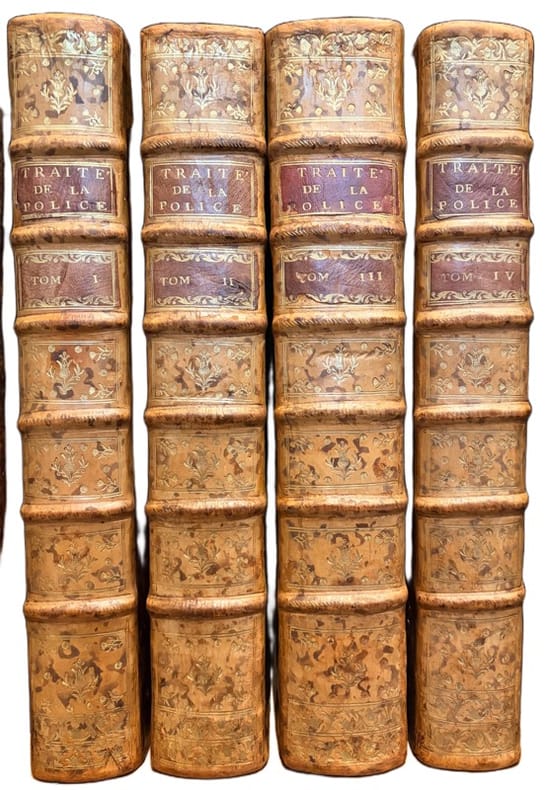
172244903A Paris, chez Jean & Pierre Cot; Michel Brunet ; Jean-François Hérissant, 1722-1738. 4 vol. in-folio de 19 ff.n.ch. 648-13 pp. 8 plans ; 5 ff.n.ch. (649 à) 1496-19 pp. ; 4 ff.n.ch. 1088-9 pp. ; 16 ff.n.ch. 794-XXXIX pp. 2 plans ; veau havane, dos orné à nerfs, pièces de titre et de tomaison en maroquin rouge (reliure de l'époque).
16 pp. Original stample-stitched printed red wrappers. 16mo (158:110 mm). This copy from the library of Lev Borisovich Bernstein (1877-1962), a Russian activist and historian who lived in Paris from the early 1900s and was in close contact with many revolutionary figures, including Maxim Gorky. - Small ex-libris stamp of the collector L. B. Bernstein to title page, as well as stamp of the Geneva "Vpered" group. - Front wrappers with old crease; else very good. Not in the Bernstein and Souvarine catalog (Dekker & Nordemann, 1980). KVK, OCLC show ten copies.
Albumen print, titled and numbered "7349" in the lower edge of the negative. 101 x 147 mm. Impressive document of a fire at the oil field owned by Branobel, the company operated by the brothers Ludvig and Robert Nobel which in the late 19th century produced fifty percent of the world's oil. - The Russian photographer Ermakov trained as a military topographer and took part in the Russo-Turkish War before setting up his photographic business in Tbilisi. He travelled extensively as far as Iran and took part in several archaeological expeditions in the Caucasus, leaving a series of unique photographs.
4 volumes. 4to. 608 pp. (4), 609-1344 pp. (4), 1345-1968 pp. (4), 1969-2893, (3) pp. Contemporary half calf. Printed in double columns. Marbled endpapers. First and only edition. A vast and indispensable source for the study of anarchist thought, written by a collective of authors and published under the general editorship of Sébastien Faure (1858-1942), one of the major figures in the history of twentieth century anarchism in France. It covers a wide range of subjects in the field of philosophy, sociology, politics, economics, etc.; entries are arranged alphabetically, e.g. architecture, commerce, commune, communism, competition, Darwinism, church, élite, child, fable, interest, justice, language, metaphysics, morals, mutiny, nation, parliament, reformatories, revolution, etc. - A fine set. Extremely rare. OCLC 637849065.
Folio (220 x 349 mm). (8), 20, 808, (40) pp. Title-page printed in red and black. With 63 engraved plates, mainly double-page, including additional title and portrait of the author by Pingeling, and 9 engraved vignettes. Contemporary full vellum with manuscript title to spine. First edition. - One of the most finely illustrated German books of the Baroque era: "a copious, methodical encyclopedia" (Jähns) of all aspects of the Baroque military, "stands out as one of the defining, principal works of its time". The beautifully designed, vivid engravings depict recruitment, soldiers exercising, pipers, drummers, court-martial and execution, army surgery, the General Staff in the Map Room, fencing, equestrian vaulting, cannons, a Danse Macabre, etc. - Plates numbered A-Rrrr (listed at end). Occasional light browning, spotting and waterstaining. New front pastedown and flyleaf. Old ownership removed from half-title (repaired). Binding somewhat rubbed with upper hinge barely splitting. - Provenance: from the collection of Thomas Fremantle, 3rd Baron Cottesloe (1862-1956), commander of the Territorial Army and president of the Society for Army History Research (purchased from E. Parsons, London, 28 October 1922, £4/4s). Jähns 1455. Lipperheide Qda 1. Marini 227. Jordan 1213.
12mo. (4), 381, (1) pp. With engr. title page and 20 near-page-sized emblematic engravings in the text. - (Bound with) II: The same. Monita politico-moralia et icon ingeniorum. Ibid., 1664. (4), 171, (1) pp. With engr. title page and woodcut vignette at the end. Contemporary blindstamped brown calf with ms. spine title. Edges sprinkled in red. First editions. Bound first is a rare book of emblems showing "symbolic tapestries": "20 numbered 'peristromata' each with a motto, as of page 308; they are within baroque borders, very likely after emblems in Saavedra's book" (Landwehr). Fredro (c. 1620-79) was a Polish historian and palatine of Podolia (cf. Jöcher II, 735). "His works [...] are full of interesting details both on war and politics; while the vigour and conciseness of his style have procured for him the name of the 'Polish Tacitus'" (Enc. Britannica, 8th ed.). - Occasional browning and slight waterstains; binding rubbed with insignificant worming. Old handwritten ownership at beginning of preface. I: VD 17, 1:068380E. Praz 341. Landwehr-German 293. Estreicher XVI, 312. - II: VD 17, 23:285229B. Estreicher XVI, 308f.
8vo. 3 vols. XXII, 320, (2) pp. XVI, 446, (2), 29, (1) pp. XII, 479, (1) pp. With on efolding plate, printed on both sides. Contemporary blue paper boards, vol. 2 reinforced at spine with similar paper, vol. 3 in similar blue paper wrappers. First and only edition of this early standard work on Russian trade, agriculture, industry, and produce. Also treats geography, topography, and statistics, culture, ethnography, and the settlement history of Russia (such as that of the Kamchatka Peninsula) and the navigation of the Northeast Passage. Vol. 1 covers the Russian provinces located towards the Black Sea; vol. 2: the middle and northern provinces of European Russia; vol 3: the provinces on the Kaspian Sea and in Siberia. - Browned throughout due to paper; some brown- and waterstaining. Bindings rubbed; vol. 3 untrimmed. Rare. Kress p. 5510. Recke/Napiersky I, 609. Not in Humpert or Goldsmiths'.
4to. (10), 178 pp. With several woodcut vignettes. Later boards with giltstamped spine label. Stored in a somewhat foxed slipcase. Rare dissertation by Goethe's father, a legal treatise on the law inheritance according to Roman and German law. The poet Johann Wolfgang Goethe was very proud of his father's thesis and praises it in his autobiography. Johann Caspar Goethe had studied law in Gießen for four years before continuing his education in Leipzig, then serving at the Wetzlar superior court and earning his doctorate in Gießen with the present dissertation. The poet Goethe would later follow in his father's footsteps and closely repeat his education. - Some browning near the beginning, otherwise a very clean and crisp copy of this very rare work. Provenance: from the estate of the Frankfurt lawyer Wilhelm A. Schaaf (1929-2015). Kippenberg I, 3404.
Small 8vo. 96 pp. With woodcut arms of Portugal to title-page. Contemporary limp vellum with handwritten spine title, lacking ties. Exceedingly rare Portuguese edition of the slim treatise on the "art of artillery" by the Genovese artillerist de la Isla, who served in the Spanish Armada. First published in Spanish in 1595/96 by Madrigal in Madrid ("Iesus. Breve tratado del arte de artillería, geometría y artificios de fuego"). The first edition to appear in Portugal was one with Spanish text in 1609 (Lisbon, Vicente Alvarez). To provide a textbook for the training of engineers and artillerymen in Portugal, it was translated and reissued in the present edition by José Homem de Menezes. - Bookplate of the Portuguese architect and collector José Maria Nepomuceno (1836-95) to front pastedown; his stamp to verso of title-page. Later in the collection of Thomas Fremantle, 3rd Baron Cottesloe (1862-1956), commander of the Territorial Army and president of the Society for Army History Research. - Light waterstain throughout with some red discoloration of the upper margin from the red top edge. Never seen at auction; no library copies of the Portuguese edition traceable anywhere; not in OCLC/WorldCat. Trindade, Catalogo da livraria do José Maria Nepomuceno (Lisbon 1897), p. 123, no. 898 (this copy, "muito raro"). Palau 121967 (note). Cf. Cockle 670 (1595 ed.).
[3], 4-32 pp. Stapled green wrappers. Small 8vo. First Russian edition of what appears to be a collection of shorter essays drawn from the works of Karl Kautsky, including his 1891 "The Class Struggle (The Erfurt Program)", which the Social Democrats adopted as their political program, as well as shorter pieces published in Kautsky's Marxist journal "Neue Zeit". Published as part of the "Library of the Russian proletarian," a series intended to be smuggled into the Russian Empire. The publisher, Georgi A. Kuklin (1880-1907), is a curious figure worthy of further study: having fled to London at the age of 21, he later founded his own progressive reading library in Geneva and published the above-mentioned series, as well as publishing a valuable bibliography of Russian revolutionary texts before his early death. - Stamp of a non-existing library with duplicate mark and pencil marks to front wrapper and title. A good copy. KVK, OCLC show copies at the Swiss National Library, Geneva, IISG, Yale and Kansas.
4to. (8), 248, 120 pp. Title-page printed in red and black. - (Bound with) II: Böckler, Johann Heinrich / Binder, Friedrich. Civitas maritima [...]. Strasbourg, Simon Paulli, 1664. (2), 21, (1) pp. - (Bound with) III: Rhetz, Johann Friedrich / Weger, Albert. Disputatio juridica, de jure portuum, vom Recht der Meer-Haven [...]. Frankfurt an der Oder, no printer, 1671. (64) pp. Modern boards, spine with gilt lettered label. First and only edition. An important book on the maritime laws of the Hanseatic League (Hanse), the commercial confederation of Northern European cities, Lübeck, Hamburg, Visby, Riga, and many other German, Swedish, Baltic and Dutch cities (including Zutphen in the Netherlands). It includes the text of the maritime laws as agreed in "Der erbahren Hanse-Stadte Schifs-Ordnung und See-Recht" (1614), here printed in double columns in German and Latin on pp. 1-76. This is followed by Kuricke's commentary and by a discourse on marine insurance. Kuricke was a jurist and secretary of the city of Danzig and the author of a valuable and voluminous history of that city, "Der Stadt Dantzig historische Beschreibung" (1687). - A few repairs to title, tiny and neat. A fine copy, bound with two contemporary dissertations on naval law. VD 17, 1:020124N. Goldsmiths' 1843. - II: VD 17, 23:237193P - III: VD 17, 12:166186H.
8vo. A total of 746 pp. Contemporary marbled boards, neatly rebacked with calf spine; gilt black spine label. Lassalle's major economic work and his other writings from 1863, the year in which he initiated the ADAV (Allgemeiner Deutscher Arbeiterverein), the first socialist party in Germany. Includes several works on the proceedings before the Berlin Criminal Court where Lassalle was accused of having endangered the public peace. Lassalle argued that he had only brought science to the workers: "Socialism as a principle is the result of scientific thought. It is the working classes who represent this scientific principle, while the idle classes resist it". - Contains: I) Herr Bastiat-Schulze von Delitzsch der ökonomische Julian, oder: Capital und Arbeit. Berlin, Reinhold Schlingmann, 1864. IX, (1), 269, (1) pp. Lassalle's principal work, in which he sets out his economic tenets. A vigorous and sometimes brusque polemic against Schulze-Delitzsch, the leader of the German co-operative movement, the book presents one of the most vehement attacks on classical liberal theory, here represented by Frédéric Bastiat. - II) Die Wissenschaft und die Arbeiter. Eine Vertheidigungsrede vor dem Berliner Criminalgericht [...]. Zürich, Meyer & Zeller, 1863. 53, (3) pp. - III) Der Lassallesche Criminalprozess. Zweites Heft. Die mündliche Verhandlung nach dem stenographischen Bericht. Zürich, Meyer & Zeller, 1863. 52 pp. IV) Der Lassallesche Criminalprozess. Drittes Heft: Das Urtheil erster Instanz [...]. Zürich, Meyer & Zeller, 1863. 79, (1) pp. - V) Die indirecte Steuer und die Lage der arbeitenden Klassen. Eine Vertheidigungsrede vor dem K. Kammergericht zu Berlin [...]. Zürich, Meyer & Zeller, 1863. (2), 136 pp. - VI) Offenes Antwortschreiben an das Central-Comité zur Berufung eines Allgemeinen Deutschen Arbeiter-Congresses zu Leipzig. 2. Aufl. Zürich, Meyer & Zeller, 1868. 35, (1) pp. - VII) Arbeiterprogramm. Ueber den besondern Zusammenhang der gegenwärtigen Geschichtsperiode mit der Idee des Arbeiterstandes. Zürich, Meyer & Zeller, 1863. (4), 44 pp. - VIII) Die Feste, die Presse und der Frankfurter Abgeordnetentag. Drei Symptome des öffentlichen Geistes. Eine Rede [...]. Düsseldorf, Schaub, (1863). 38 pp., final blank. - IX) Macht und Recht. Offnes Sendschreiben. Zürich, Meyer & Zeller, 1863. 15, (1) pp. - Occasional browning and foxing. All but one in first editions.
8vo (157 x 215 mm). 24 pp. Original printed wrappers. Rare second pamphlet edition. Lenin's influencial treatise promoting the idea of the "Soviet" (workers' council) rather than parliamentary democracy during a period when the future form of governance was still undecided. It was first published in 1917 in the newspaper "Rabochiy" and saw an English translation the same year. - Partly uncut. A few marginal flaws, not affecting text. Shelfmark label to upper cover. Lenin, Collected Works XXV, 227-243. OCLC 18467760.
Folio (210 x 326 mm). 2 vols. in one. 31, (1) pp. (2), 392 pp. Recent blue wrappers with printed label to upper cover. First edition of the report of the Royal Commission to inquire into "the origin, objects, constitution, customs, and usages of the London Stock Exchange, and the mode of transacting business therein". The Commission had been appointed in 1877 following complaints arising "from a Select Committee report on foreign loans which suggested that the Exchange did not appreciate the dangers which attached to the markets' manipulation of loans and had not demonstrated an interest in dealing with them" (Swinson, Regulation of the London Stock Exchange). The Commission broadly supported the conduct of the Exchange, which thus managed to escape political oversight and to remain an autonomous, self-regulated body. - An old hand has repaginated pp. 263-689. Command 2157 and 2157-I.
8vo. 3 vols. XXXII, 462, (2) pp. VIII, 623, (1) pp. VIII, 783, (1) pp. All volumes bound in contemporary half calf over marbled boards with gilt spines (though vol. 3 slightly larger and bound differently). First edition. - The author's major book on economics. Lueder served as professor of history and politics at the Brunswick Carolinum; he was among the first to teach Smithian economics in Germany and hence played an important role in the transition of German economics from mercantilism to liberalism. While the present work is largely a paraphrase of Smith's "Wealth of Nations", it has been observed that Lueder deserves a place in the history of economic literature on his own account for his numerous corrections of and additions to Smith's work, particularly where geographical, ethnographical, agricultural and statistical issues are discussed, and for his emphasis on the influence of moral and intellectual factors on industrial development. - Two old (ca 1920s) library stamps on titles erased, slightly affecting paper but without loss of text, showing that the three books have formed a set for almost a century. Humpert 7672. Kress B.4225. Goldsmiths' 17851. Menger c.85. Not in Vanderblue.
48 pp. Original staple-stitched green printed wrappers. 8vo. Scarce Russian edition of Marx's article "Wage Labor and Capital", first published in Geneva in 1883 in Leo Deitsch's translation and here presented in an 1894 translation by one "B. K.". Originally printed in the Neue Rheinische Zeitung in 1849, Marx's article was one of his first attempts to analyze the flaws inherent to the capitalist market and the dangers of labor commodification. It is now seen as an important preparatory work to "Das Kapital" (1867). Also contains Engels's 1891 preface. The publisher, Georgi A. Kuklin (1880-1907), is a curious figure worthy of further study: having fled to London at the age of 21, he later founded his own progressive reading library in Geneva and published the series "Library of the Russian proletarian" as well as publishing a valuable bibliography of Russian revolutionary texts before his early death. - Wrappers lightly soiled; stamp of a Russian bookstore in Paris and a non-existing library (with duplicate stamp). Of this edition, KVK, OCLC show the copies at the Swiss National Library, Bern, Zurich, UC London, Staatsbibliothek zu Berlin, Glasgow University, and six copies in the United States.
8vo. XXIII, (1), 619, (5) pp. Somewhat later full red cloth with giltstamped red spine label. First Czech edition, translated from the fourth German edition by Theodor Smeral and Ludvik Tošner. Edited by Lev Winter. - Stamp of the "Akademický Feriální Klub" of Litovel (Littau) to title page. A good, unmarked copy. Rare: a single copy in America (Los Angeles Public Library); OCLC lists only two additional copies, both in German research libraries. OCLC 21126356; 914729107.