Muter, Mela - eigentl. Maria Melania Mutermilch, geb. Klingsland - 1876 Warschau ? Paris 1967Antiquariat.de

48 790 résultats
EN-165o.J. Bleistift, auf bräunlichem Velin mit Fragment eines Wasserzeichens, zweifach mit Bleistift signiert ?Muter?. Blattgröße 32,9:19,9 cm. Verso: Figürliche Skizzen. Bleistift. - Vorzeichnung für das Gemälde ?Cubist nude (c.1919)?, das in folgenden Ausstellungen präsentiert wurde: Mela Muter 1876-1967. Retrospektiv-Ausstellung, Galerie Gmurzynska, Köln 1967; Pionnieres. Artistes dans le Paris des années folles, Paris, Musée du Luxembourg, 2022. - Die akzentuierte, eckig-kubistische Ausführung lässt eine Entstehungszeit um 1919 vermuten, da die Künstlerin sich in dieser Zeit mit den Arbeiten von Albert Gleizes (1881-1953) und Gino Severini (1883-1966) auseinandersetzte, die sie persönlich kennengelernt hatte.
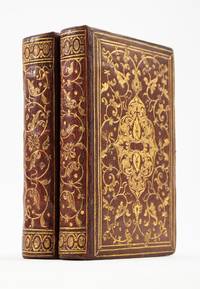
1568ST20921Lutetia Paris: Robert Estienne II 1568. 128 x 87 mm. 5 x 3 1/2". Two volumes. <br/> LOVELY CONTEMPORARY RED MOROCCO GILT covers with large central azured arabesque surrounded by curling vines with azured leaves smooth spines with similar vines head and foot of spines with egg-and-dart roll similar to one used by Claude de Picques second volume with faint blind lettering to spine all edges gilt perhaps with some minor early restorations but if so then done with such care as to preclude certainty. Housed in modern suede-lined calf-backed clamshell boxes with magnetic closures. Printer's device on titles and final page decorative initials and headpieces. Front pastedown of volume I with ex-libris of Georgios Arvanitidis. Renouard 171:1; Schreiber 239; Darlow & Moule 4633; Adams B-1670. See: Verron "Les Reliures de l'Entrée de Charles IX à Paris 1572 . . . réalisées par Claude Picques" in Bulletin du Bibliophile 2014 no. 2 pp. 282-98. Just a touch of rubbing to extremities front hinge of second volume open but everything quite tight text with occasional mild browning small spots trivial smudges or tiny worm trails but A BEAUTIFUL COPY clean and fresh internally and the bindings tight and lustrous with very bright gilt<br/> <br/> With exceptional visual appeal these two precious volumes shining with gilt and containing the Greek New Testament from the renowned Estienne family of printers are of special interest because of their typography their bindings and their provenance. With the expressed goal of printing Greek texts from manuscripts in the royal library at Fontainebleau François I established the post of royal printer in Greek in 1539 appointed Robert Estienne I 1503-59 to the position in 1542 and commissioned the renowned Claude Garamond to cut a new Greek font for this project. To design the type the King called on his own celebrated calligrapher Angelo Vergecio who produced in collaboration with Garamond three different sizes of what came to be called the Royal Types or "grecs du roi." According to Schreiber "These cursive Greek types are universally acknowledged as the finest ever cut." In 1548 and 1549 Robert Estienne issued the press' first Greek Testament known as the "O mirificam" edition for the opening of the dedication to the king in 16mo or "pocket" format using the smaller font of Garamond's "grecs du roi." In 1550 Robert a Protestant moved to Geneva while his son Robert II 1533-70 a Catholic remained in Paris and took over as the royal printer in Greek. Our 1568 Testament--the only one issued by the son--is a reprinting of the "O mirificam" edition but expanded with the critical apparatus from the 1550 folio edition issued by the father. Schreiber notes that our edition is interesting from a typographical point of view as it contains an even more minute version of the already small grecs du roi type for the Table of Chapters. The exceptionally pretty volumes are done in the style of royal binder Claude Picques fl. 1539-78 and employ a decorative roll very similar to one that appears on the spine of the vellum bindings Picques did for "L'Entrée de Charles IX à Paris" 1572. Our volumes once graced the library of Constantinople collector Georgios Arvanitidis 1876-1953 whose library included a number of Estienne Greek editions. They were later in the distinguished library of Frederick B. Adams 1910-2001 director of the Pierpont Morgan Library from 1948-69 and then president of the prestigious Association Internationale de Bibliophilie from 1974-83. And they were featured in the celebrated 1929 Gumuchian catalogue of 398 historically exceptional bindings as item #71. Robert Estienne II unknown
181040869Philadelphia: C. and A. Conrad and Co. of Philadelphia; Somervell and Conrad of Petersborough; Bonsal Conrad and Co. of Norfolk; and Fielding Lucas Jr. of Baltimore. Printed by John Binns 1810. Text: 8vo 8 1/2 x 4 3/4 inches. Atlas: 4to 10 1/2 x 11 inches. Text: 2 1-277 5 1-65 1 1-53 1 1-87 1. 492 pp. Engraved frontispiece portrait of Pike Letterpress Title Deposit Statement To the Public To the President Pike's Expeditions Part I-III Appendices to Parts I-III. Atlas: 6 engraved maps 5 of which are folding. 3 folding tables. Text volume in contemporary tree calf expertly re-backed to style spine in six gilt-ruled compartments with gilt calf lettering-piece in second gilt date in sixth and blind center tool in rest. Atlas volume in contemporary quarter calf with tips over original blue paper boards with printed paper label spine in seven gilt-ruled compartments with gilt red morocco lettering-piece in second gilt date in sixth and blind center tool<br/> <br/> One of the most important of all American travel narratives; Pike's account contains the first maps to incorporate geographical knowledge of the Southwest based on first-hand exploration. It is a milestone in the mapping of the American West. Wheat Here in the rarest and most desirable form with the plates and maps in a quarto atlas.<br/> <br/> Pike's narrative along with that of Long and Lewis and Clark is one of the most significant early books on the exploration of the American West. As such it is a cornerstone of Western Americana. In particular Streeter felt its "description of Texas is excellent." Hill gives the following summary of its contents: "In 1805 Pike was given the difficult assignment of conducting a reconnaissance of the upper Mississippi region. He was ordered to explore the headwaters of that river to purchase sites from the Indians for further military posts and to bring a few influential chiefs back to St. Louis for talks. The trip was only moderately successful as a mission to the tribes but Pike was able to convey important geographical information to President Jefferson and other Washington officials. On Pike's second expedition 1806-1807 he was assigned to explore the headwaters of the Arkansas River then proceed south and descend the Red River from its source. Pike and his men were taken into custody by a Spanish patrol and Pike was able to observe many areas in New Mexico Chihuahua and Texas. His book created interest in the Southwest and stimulated the expansionist movement in Texas." The atlas volume consists of the following maps plus three tables: 1. "Falls of St. Anthony." 2. "Map of the Mississippi River from its Source to the Mouth of the Missouri laid down from the notes of Lieutn Z. M. Pike by Anthony Nau. Reduced and Corrected by Astronomical observations of Mr. Thompson at its source; and of Captn. M. Lewis where it receives the waters of the Missouri." 3. "The First Part of Captn. Pike's Chart of the Internal Parts of Louisiana. 40 miles to the inch by Anthony Nau." 4. "Map of the Internal Provinces of New Spain. The outlines are from the Sketches of but corrected and improved by Captain Zebulon M. Pike who was conducted through that Country in the year 1807 by Order of the Commandant General of those Provinces." 5. "A Chart of the Internal Part of Louisiana. Including all hitherto unexplored Countries lying between the River La Platte of the Missouri on the N: and the Red River on the S: the Mississippi East and the Mountains of Mexico West; with a part of New Mexico and the Province of Texas. By Z. M. Pike Captn U. S." 6. "A Sketch of the Vice Royalty Exhibiting the several Provinces and its Approximation to the Internal Provinces of New Spain." Tables: 1. "Recapitulation of Furs and Peltries Fond du Lac department Marks and Numbers as per margin. North West Company 1804-5." 2. "Abstract of the number &c. of the Nations of Indians residing on the Mississippi and its confluent streams from St. Louis Louisiana to its source including Red lake and Lower Red river." 3. "A Statistical Abstract of the nations of Indians who inhabit that part of Louisiana visited by captain Z. M. Pike in his tour of discovery in that country in the years 1806 and 1807."<br/> <br/> Bradford 4415. Braislin 1474. Field 1217. Graff 3290. Hill 1357 2004. Howes P373 "Best Issue." Jones 743. Rittenhouse 467. Sabin 62836. Schwartz and Ehrenberg p.225. Streeter sale 3125. Streeter Texas 1047C. Wagner-Camp 9:1. Wheat Transmississippi 297 298 299. C. and A. Conrad, and Co. of Philadelphia; Somervell and Conrad of Petersborough; Bonsal, Conrad, and Co. of Norfolk; and Fieldi unknown
EN-135o.J. Kaltnadelradierung, 1922, auf Japan, mit Bleistift signiert ?Beckmann?. Darstellungsgröße 21,4:32,7 cm, Blattgröße 29,8:43,8 cm. Herrlich frischer, kräftiger und gratiger Druck mit vollem Rand, von vorzüglicher Erhaltung! Eines von 50 Exemplaren auf Japan, von denen ein Teil von Günther Franke auf ?x/XV? nummeriert wurde. Erschienen bei R. Piper & Co., München, 1922. Provenienz: Galerie Wirnitzer, Baden-Baden, Kat.: Querschnitt, VII, 1981, Nr. 13, Abb. S. 19; Privatsammlung, Süddeutschland. Literatur: Hofmaier 239, Ba (von Bd); Beckmann Liste 218; Glaser 213; Gallwitz 209. - James Hofmaier erwähnt einen Abdruck der Edition mit einer Aufschrift von fremder Hand, dass bei Beckmanns ?Strand? ein Küstenabschnitt der Nordseeinsel Wangerooge dargestellt sei. [2 Warenabbildungen]
pp. [iv], v-viii, 9-186. 9" x 6". Black and white detailed illustrations. Decorated endpapers. "Dean of the Philadelphia Dental College, Simeon Hayden Guilford, A.M., D.D.S., Ph.D. (1841-1919) undertook the first course in orthodontia for undergraduates, for which he wrote [this] the first text, which was ultimately printed in four editions and several foreign languages. One of the few dentists of his era to receive formal training in dentistry, his broad education, combined with his determination to expand the horizons of dentistry - and particularly orthodontics - earned him a distinguished place in orthodontic history" Milton B. Asbell, AJODO, March 1998. "Leads the student step by step from the simplest beginnings to the more complicated and difficult work of practical treatment. To this end, the underlying principles of the art are first elucidated, after which the principal methods employed are explained, and lastly the correlation of principles and methods is shown in their practical application to typical cases. In Part III, the different forms of irregularity, together with a variety of plans for their correction, are arranged under such headings and in such order as to be readily referred to in seeking aid for cases that occur in office practice." - v. Moderate wear to publisher's dark blue cloth brightly lettered in gilt upon backstrip. Prior owner's details, dated 1891, upon first blank leaf. Binding intact. Gentle tanning to contents which are lightly soiled through use. Creasing to pages 92 and 161-164. No dust jacket, apparently as issued. A well preserved copy of this landmark work. Book
Signed and dated [2012] by Lee Kuan Yew, without inscription, upon title page. "Lee Kuan Yew's name is nearly synonymous with modern Singapore. Prime Minister for 31 years from 1959 to 1990, he was in the public eye for over 60 years as a revolutionary leader who steered Singapore to independence, as a determined Prime Minister who transformed the country, and finally as an elder statesman. This book picks up from his memoirs of 2000 as Lee engages a group of journalists over issues that a younger, more critical population has raised." - dust jacket. Clean, bright and unmarked with very light wear. Unopened DVD inside back board. A wonderful memento of this extraordinary statesman. Book
EN-010o.J. Holzschnitt, 1923, auf Japan, mit Bleistift signiert. Darstellungsgröße 22,3:14,9 cm, Blattgröße 51,8:35 cm. Provenienz: Nachlass Günther Franke, München, seither in Familienbesitz. Literatur: Hofmaier 258, III B b; Glaser 229; Gallwitz 223.- Tadelloser, tiefschwarzer Abdruck mit breitem Rand, rechts und links mit dem Schöpfrand. Abweichend von den Angaben bei Hofmaier auf Japan statt auf Velin gedruckt; eines der fünf bei Hofmaier erwähnten nicht nummerierten Exemplare, erschienen neben der Auflage von nur 35 nummerierten Drucken.
FH-497o.J. Farbholzschnitt, Tokyo 1915, auf chamoisfarbenem Japan-Bütten, im Stock monogrammiert, bezeichnet und datiert ?FC Tokyo 1915?, mit Bleistift signiert ?F. Capelari ? und undeutlich bezeichnet. Darstellungsgröße 26,5:20,4 cm, Blattgröße 28:21 cm.
EN-112o.J. Lithographie, 1921, auf cremefarbenem Bütten, mit Bleistift betitelt und nummeriert ?Clelia / 5/13? sowie signiert und datiert ?Christian Schad / 21?. Darstellungsgröße 14,5:8,3 cm, Blattgröße 29,7:22,9 cm. - Von aller größter Seltenheit! - Provenienz: Galleria del Levante, München; Kunsthandel Marion Grcic-Ziersch, München. - Die Zeitung ?Main Echo? veröffentlichte am 06.01.2012 von Stefan Reis die Besprechung einer Ausstellung in der Aschaffenburger Galerie Viola ?Seltene Lithographien und Radierungen von Christian Schad ? Dabei ein verschollen geglaubtes Porträt von 1921?. An späterer Stelle heißt es: ?Die 1921 entstandene Lithographie ?Clelia? gilt als Schads graphisches Hauptwerk der 20er Jahre. In einer Auflage von 15 Exemplaren gedruckt, galt sie Jahrzehnte lang als verschollen, bis sie nun in der aufgelösten Sammlung entdeckt wurde. (Dabei handelt es sich um eine Sammlungsauflösung, die auf Vermittlung des Christian- Schad-Archivs in Rottach-Egern zustande kam).
EN-146o.J. Lithographie, 1922, auf chamoisfarbenem Velin mit Wasserzeichen: Johann Wilhelm, mit Bleistift bezeichnet ?1. Druck?, signiert, datiert und bezeichnet ?Erich Heckel 22 / Probe?. Darstellungsgröße 49:38,3 cm, Blattgröße 64,5:50,2 cm. - Von großer Seltenheit! Eines von drei bekannten Exemplaren des ersten Zustandes. - Provenienz: Sammlung Hermann Gerlinger, Würzburg, Lugt 6032. - Literatur: Annemarie und Wolf-Dieter Dube, Erich Heckel: Das graphische Werk, Bd. 2: Radierungen, Lithographien, New York 1965, WVZ-Nr. L 270 I a (von III b); Renate Ebner, Andreas Gabelmann, Erich Heckel. Werkverzeichnis der Druckgraphik, Bd. 2: 1914-1968, München 2021, WVZ-Nr. 784 L I a (von III b); Heinz Spielmann (Hrsg.), Die Maler der Brücke. Sammlung Hermann Gerlinger, Stuttgart 1995, S. 312, SHG-Nr. 480 (m. Abb.); Hermann Gerlinger, Katja Schneider (Hrsg.), Die Maler der Brücke. Bestandskatalog Sammlung Hermann Gerlinger, Halle/Saale 2005, S. 222, SHG-Nr. 502 (Abb. S. 223). - Austellungen: Schleswig-Holsteinisches Landesmuseum, Schloss Gottorf, Schleswig (Dauerleihgabe aus der Sammlung Hermann Gerlinger, 1995-2001); Kunstmuseum Moritzburg, Halle an der Saale (Dauerleihgabe aus der Sammlung Hermann Gerlinger, 2001-2017); Buchheim Museum, Bernried (Dauerleihgabe aus der Sammlung Hermann Gerlinger, 2017-2022); Erich Heckel, Einfühlung und Ausdruck, Buchheim Museum, Bernried, 2020/2021, (Abb. S. 292). [2 Warenabbildungen]
3892Watercolour and gouache on vellum signed 'Gablle Fontaine'. An exceptionally large scale work by this talented but apparently unrecorded artist probably executed in the 1830s or early 1840s. The composition includes roses bi-colour pinks/carnations morning glory dahlias auriculas flowering quince or prunus hollyhock plums and peaches. In addition a clouded yellow and two red admiral butterflies are shown. unknown books
3892Watercolour and gouache on vellum signed 'Gablle Fontaine'. An exceptionally large scale work by this talented but apparently unrecorded artist probably executed in the 1830s or early 1840s. The composition includes roses bi-colour pinks/carnations morning glory dahlias auriculas flowering quince or prunus hollyhock plums and peaches. In addition a clouded yellow and two red admiral butterflies are shown. unknown
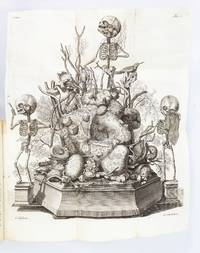
1417ST20185Amsterdam: Joannes Wolters then Jansson-Waesberg 1701-14; 1715-16. FIRST EDITIONS. 224 x 168 mm. 8 3/4 x 6 1/2". 4 p.l. 62 pp. 1 leaf errata; 2 p.l. 98 pp.; 2 p.l. 70 pp.; 1 p.l. 55 pp.; 1 p.l. 54 pp. 2 p.l. 30 pp. 1 leaf 92 pp. 2 leaves 44 pp. 4 leaves 68 pp. 8 leaves 72 pp. 1 leaf errata 12 leaves 78 pp. 10 parts in one volume. <br/> Contemporary stiff vellum smooth spine with ink titling yapp edges. WITH 42 ENGRAVED PLATES as called for by Norman six of these folding. Text in Latin and Dutch. Blake 395; Garrison-Morton 389; Heirs of Hippocrates 627; Jeremy Norman's HistoryofMedicine.com 623; Norman 1875. Vellum lightly soiled front pastedown slightly defective but the original unsophisticated binding in perfect order. Final plate with small hole due to adhesion to facing page minor damage done to image a few other trivial imperfections a couple of negligible marginal tears a faint ink stain across the top inch of text a tiny burn hole but AN UNUSUALLY BRIGHT CLEAN COPY INTERNALLY with all the important plates in exceptionally fine condition.<br/> <br/> Scarce when seen bound from its original 10 parts as here this work describes the memorable "Anatomical Treasure" of Dutch physician and anatomist Frederick Ruysch being illustrated by surrealistic charmingly macabre engravings depicting "fantastic dream-like concoctions constructed of human anatomical parts." History of Medicine Described by Norman as "probably the most original artist in the history of anatomical preparations" Ruysch 1638-1731 "enjoyed making up elaborate three-dimensional emblems of mortality from his specimens" which included fetal skeletons and preserved organs. Heirs to Hippocrates says that "the engraved illustrations deserve special mention for their whimsical almost surrealistic quality: quaintly posed skeletons surrounded by stuffed monsters strange reptiles dried plants and sea creatures." According to Norman "Ruysch's methods allowed him to prepare organs such as the liver and kidneys and keep entire corpses for years. He used a mixture of talc white wax and cinnabar for injecting vessels and an embalming fluid of alcohol made from wine or corn with black pepper added. Using his injection methods Ruysch was the first to demonstrate the occurrence of blood vessels in almost all tissues of the human body thereby destroying the Galenic belief that certain areas of the body had no vascular supply. He was also the first to show that blood vessels display diverse organ-specific patterns." Ruysch's dioramas were displayed in his home museum in Amsterdam which was open to the public; visitors included Tsar Peter the Great of Russia who purchased the collection in 1717 for the foundation of Russia's first public museum the St. Petersburg Kunstkammer. Unfortunately the Russian climate was not kind to the fragile constructions and all deteriorated over time; the dramatic plates here are the best record we have of this unique collection. Joannes Wolters, then Jansson-Waesberg unknown
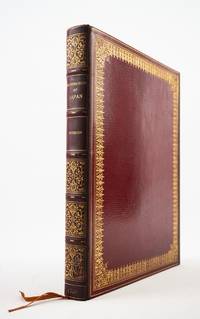
1822ST20877London: Printed for R. Ackermann 1822. First English Edition. 300 x 235 mm. 11 3/4 x 9 1/2". xvi 325 1 pp.Translated by Frederic Shoberl. <br/> Imposing contemporary crimson straight-grain morocco gilt covers with filigree frame with densely massed scrolling fleurons raised bands spine gilt in compartments with radiating viny scrolls surrounded by leaves and annular dots marbled endleaves all edges gilt. WITH 13 HAND-COLORED PLATES in etching and aquatint many after Japanese artworks one folding. Bookplate removed from front flyleaf. Bookseller's ticket of J. L. Thompson & Co Kobe Japan on front pastedown. Abbey Travel 557; Tooley 489; Martin Hardie "English Coloured Books" pp. 113-14. See also E. F. Strange "Japanese Illustration" pp. xxiii-xxiv. Spine and fore-edge of upper board slightly darkened a few minute flakes to lowest spine compartment but the binding extremely well preserved with very lustrous boards. Final 10 leaves slightly creased one repaired marginal tear but still A FINE COPY INTERNALLY exceptionally bright smooth and entirely fresh and clean.<br/> <br/> This generously proportioned production illustrated with 13 vibrant colored plates is a rare European account of Japan during the period in which the country was "closed" to the west offered here in its first English edition. Originally published in French in 1820 "Illustrations of Japan" is comprised of a history and description of the Tokugawa shogunate which Titsingh had translated from the Japanese plus Titsingh's own observations on the language customs and ceremonies of the Japanese people. The present English edition is accompanied by plates in etching and aquatint enhanced with hand coloring. Our author Dutch diplomat Isaac Titsingh 1745-1812 spent 14 years in Nagasaki for the Dutch East India company and between 1779-84 he served as trade director-cum-ambassador travelling to Edo now Tokyo for audiences with the shogun and other high officials in the shogunate. Unlike most of his Western contemporaries Titsingh was open-minded and curious about the people he encountered engaging with their art and culture; in fact art historian and Victoria & Albert Museum keeper Edward F. Strange tells us that Titsingh is the earliest known European collector of Japanese prints of which a number appear in the present volume. Our publisher Rudolph Ackermann 1764-1834 made his living issuing sumptuously illustrated books such as the present volume and was an early adopter of color aquatint and lithography technologies; Hardie writes that he was "the great presiding genius before whose magic wand so many pictorial books sprang into existence." In very attractive period morocco this is a particularly appealing copy of the work free of the foxing and offsetting that often plague copies of this and other large-format color illustrated books. Printed for R. Ackermann unknown
EN-031o.J. Lithographie, 1923, auf cremefarbenem Kupferdruckpapier, mit Bleistift signiert und nummeriert. Darstellungsgröße 36,8:54,8 cm, Blattgröße 48,5:61,7 cm. Nr. 11 von 20 Exx. In jeder Hinsicht einwandfreies Exemplar dieses prominenten Blattes! Literatur: Riester 79, hier abweichend 1924 datiert; Ausst. Katalog: Karl Hubbuch 1891-1979. Karlsruhe/Berlin/Hamburg 1981/82, Nr. 95, Abb. 167.
EN-032o.J. Lithographie, um 1924, auf Kupferdruckpapier, mit Bleistift nummeriert, betitelt und signiert. Darstellungsgröße 37:36 cm, Blattgröße 50:43,5 cm. Nr. 9 von 25 Exx. - Vorzüglich erhaltenes Exemplar und sehr guter Abdruck! Literatur: Riester 81; Ausst. Katalog: Karl Hubbuch, 1891-1979. Karlsruhe/Berlin/Hamburg, 1981/82, Nr. 150, Abb. S. 173.
EN-030o.J. Lithographie, 1923, auf Kupferdruckpapier, mit Bleistift nummeriert, betitelt, signiert und mit Widmung. Darstellungsgröße 39:35,5 cm, Blattgröße 51:69 cm. - Mit leichten Papierstauchungen in den Außenrändern. Nr. 3 von 25 Exx., sehr guter Abdruck! Literatur: Riester 69, Abb. S. 42; Ausst. Katalog: Karl Hubbuch, 1891-1979. Karlsruhe/Berlin/Hamburg, 1981/82, Nr. 92, Abb. S. 153.
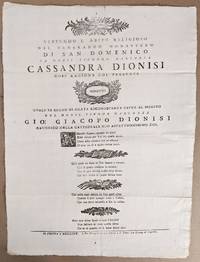
1235<p>Rare Series of Twenty-Four Festival Broadsides Celebrating the Accomplishments and Appointments of Members of the Dionisi Family of Verona During the Middle Years of the Eighteenth Century. Including celebratory broadsides commemorating civil appointments ordinations taking of religious habits by the women of the family retirements and funerals for the Dionisi of Verona.</p> <br /> <p>The format of the twenty-four broadsides is folio four are printed on silk and one in gold ink. There is one duplicate in the collection. Each is illustrated with a large engraved cartouche at the top of the sheet and printer's ornaments in the body of the text. The quality of the paper is uniformly very good and the condition of the collection is excellent. </p> <br /> <p>Gabriello Dionisi or Dionigi as it sometimes appears 1718-1808 was the patriarch of the family and Captain of the Guard for the Lago di Garda. This was an important civil position responsible for protecting the cities along Lake Garda from potential conflicts coming from Austria in the north and the west from Milan and is celebrated in a number of broadsides in the collection. His brother Giovan Francesco a noted lawyer and judge in Verona in is feted in two examples in the collection. Gabrielo's daughters and nieces Cassandra Maria Teresa Origa and Maria Eleonaro are celebrated for entering the Convent of San Domenico and the Monastery of Maria the Virgin One of the broadsides is dedicated to Monsignor Dionisio Dionisi and in another the Marchese Ottaviano Dionisi is recognized for his tenure as Captain of the Guard for Lake Garda. Many of the poems are composed by Giovan Francesco Dionisi and others by Antiono Maroadi Stefano Trimeloni Gio. Battista Turazza Gio. Battista Conte Anton Maria Pedrotti and Alessandro Bonifazio. </p> <br /> <p>This is a unique collection which documents the lives of the men and women of the Dionisi Family during the second half of the eighteenth century. It provides an insight into manner in which noble families took responsibilities for their community and church and celebrated individuals for their contributions to the society in which they lived. Women are celebrated as mothers novitiates and leaders of convents and the men as soldiers lawyers poets and priests. As a collection this group of broadsides offers scholars significant access to a ruling family of Verona one with a distinguished history.</p> . unknown
194967462ABParis., La Bibliotheque Francoise., 1949. 34,5 x 27,4 cm. 161 (1) S., 3 Blatt. OFranzösische Interimsbrochur in marmorierter OHalbleinen-Einbandecke, in marmoriuertem OPapp-Schuber., 67462AB Tirée a 320 exemplaires. Umschlag etwas stockig, sonst sehr gutes und frisches Exemplar.
EN-130o.J. Öl auf Leinwand, um 1920, auf Keilrahmen, unsigniert. 50:40 cm.- Randdoubliert, mit restaurierter Fehlstelle im Bereich der Kopfbedeckung. Auf dem Keilrahmen bezeichnet ?Model Frau Tillmann? und ?Portrait Ruth?. Provenienz: Privatsammlung, Köln. Literatur: Ausstellungskatalog: August Sander und die Kunstszene der 20er Jahre im Rheinland, Köln, Josef-Haubrich-Kunsthalle und Kunsthalle zu Kiel, 2000, Kat. Nr. 283, Abb. 91, S. 85. - Abelen porträtierte Frau Tillmann mit ihrem von einer Lederkappe verdecktem Kurzhaarschnitt und Felljacke möglicherweise als Pilotin eines offenen Automobils, unbedingt aber als emanzipierte Frau der Weimarer Republik.
EN-134o.J. Kaltnadelradierung, 1918, auf Japan, mit Bleistift betitelt ?Straße in Frankfurt a/M? und signiert ?Beckmann?. Darstellungsgröße 23,3:29,2 cm. Blattgröße 33:36 cm. Herrlich frischer, kräftiger und gratiger Druck mit vollem Rand und Blindstempel der Marées Gesellschaft, von vorzüglicher Erhaltung! Eines von 40 Exemplaren der Vorzugsausgabe auf Japan, vor der Verstählung der Platte. Blatt 14 aus der Mappe ?Gesichter?. München, Verlag der Marées Gesellschaft R. Piper, 1919. Provenienz: Privatsammlung, Frankfurt am Main. Literatur: Hofmaier 134 II, Aa (von Bb); Beckmann Liste 118; Glaser 115; Gallwitz 105. - Dargestellt ist vermutlich die Darmstädter Landstraße im Frankfurter Stadtteil Sachsenhausen (vergleiche das Ölbild von 1917, Göpel 195, seitenverkehrt und mit einigen Abweichungen). [2 Warenabbildungen]
181910-G1819. Öl, auf festem braunem Papier, verso signiert und datiert ?M. Wentzel ad. natur. Wien 1819.?. 25:34,6 cm. Das in einem delikaten Kolorit und einer fein ausgewogenen Lichtführung gestaltete Stilleben entstand während Wentzels Aufenthalt in Wien, der durch die Datierung auf der Rückseite des Bildes sicher für 1819 angenommen werden darf.
EN-005o.J. Kaltnadelradierung, 1918, auf Japan, mit Bleistift betitelt, datiert und signiert. Darstellungsgröße 25,1:29,4 cm, Blattgröße 31,1:37 cm. Eins von 40 Exx. der Vorzugsausgabe auf Japan. Blatt 6 aus der Mappe ?Gesichter?. München, Verlag der Marées Gesellschaft R. Piper, 1919. Literatur: Hofmaier 128, IV, B, a (von b). - Herrlich frischer Abzug mit dem Blindstempel der ?Marées Gesellschaft? und von vorzüglicher Erhaltung!
EN-124o.J. Radierung, 1922, auf Kupferdruckpapier, mit Bleistift betitelt, signiert und datiert ?Fohse?, ?Dix 22?. Darstellungsgröße 34,6:27,9 cm, Blattgröße 40:32,5 cm. Provenienz: Sammlung Albert van Loock, Brüssel (geb. 1917), Sammler und Kunsthändler, Lugt 3751. Literatur: Karsch 22/II, Abb. S. 45. Blatt 6 der 6-Blatt-Folge ?Radierwerk III?. Dresden, Dresdner Verlag 1922, erschienen in 50 nummerierten und signierten Exemplaren als elfte Mappe der Graphischen Reihe. Das hier vorliegende Exemplar ist nicht nummeriert und der Titel des Blattes ?Vohse? ist mit ?Fohse? von Dix abweichend geschrieben. - Otto Dix wird mit der Technik der Kaltnadelradierung populär, als er beginnt, den späten Expressionismus ? ein experimentelles Zwischenspiel ? aufzugeben und sich einem grotesk-realistischen Stil zuzuwenden. Die Radierung ?Vohse? entsteht 1922, zwei Jahre nachdem er die Technik der Kaltnadelradierung für sich entdeckt hat. Mit einer flinken Linie und einem ironischen Blick skizziert Dix die alternde Schönheit und liefert den Beweis für sein feines Auge für ?echte? Menschen. (Freya Mühlhaupt, Otto Dix. Das graphische Werk. Berlin 2001, S. 17).