48 778 résultats
EN-107o.J. Lithographie, 1921, auf cremefarbenem Bütten mit Fragment des Wasserzeichens: JW(hatman), im Stein datiert und mit der Werknummer ?1921 / 30?, mit Bleistift nummeriert ?20/100?, mit blauer Tinte signiert ?Klee?. Darstellungsgröße 25,6:17,7 cm, Blattgröße 29:21,7 cm. Der Umschlag des Heftes mit leichten Gebrauchsspuren. - Selten! - Literatur: Kornfeld 80; Söhn HDO 50404-1. - Als Beilage erschienen zur Vorzugsausgabe in 100 nummerierten Exemplaren zu: DER ARARAT: Glossen, Skizzen und Notizen zur neuen Kunst. München, Goltzverlag, 2. Jg., Viertes Heft, April 1921, Ss. 125-154, 3 Bll. Anzeigen. Rot und schwarz gedruckter Umschlag mit Fadenheftung nach einem Entwurf von Toni Wendling. Mit Texten von J.W. von Goethe, Henri Rousseau, Oskar Wilde, Alfred Kerr, Mac Neill Whistler, Diderot, Charles Baudelaire, Emil Zola, G. Apollinaire, Paul Klee u. a. zum Thema ?Kritik? und A. Vollard, P.E. Küppers, Paul F. Schmidt. Mit 15 Abbildungen nach Kandinsky, Chagall, Archipenko, George Grosz, Carl Mense, Walter Lindgens, T. Parzinger und Edwin Scharff. [3 Warenabbildungen]
EN-159o.J. Feder in Schwarz, um 1932, auf festem, strukturiertem Papier, mit Bleistift signiert ?J Mammen?, verso am oberen Rand bezeichnet ?Die dicke Sängerin?, am unteren Rand bezeichnet ?Chansonette?. Blattgröße 47,1:34,9 cm. ? Insgesamt leicht gebräunt, der rechte Blattrand mit kleinem Einriss. - Provenienz: Jeanne-Mammen-Gesellschaft; Fischer Fine Art, London, dort 1980 vom Vorbesitzer erworben. - Literatur: Döpping/Klünner Z 282; abgeb. in: Der Querschnitt, Heft 9, Jg. 12, September 1932, S. 631.
15465968Venice: Cornelio Adelkind for Daniel Bomberg 1546. First edition. Very Good/First printed edition editio princeps of the 11th century commentary on portions of the pentateuch by the Bulgarian poet and Talmudist Tobiah ben Eliezer. Published by the house of the seminal printer of Hebrew books Daniel Bomberg under the supervision of his scholar-in-residence extraordinaire Cornelio Adelkind. Venetian law at this time limited Hebrew publishing to Gentile printers. Bomberg a protestant from Antwerp entered this lucrative market and with Adelkind's help became its prime exponent until his death in 1549. . Folio 32 cm; 93 leaves. Text in Hebrew. Title within architectural border reproduced in Amram "Makers of Hebrew Books in Italy" p. 215 also in the Jewish Museum's 1989 exhibition catalogue "Gardens and Ghettos: the Art of Jewish Life in Italy" page 50. Some section headings within ornamental borders. Bound in c19 or c20 dark red crushed morocco ruled in gilt and decorated with arabesques on both boards; spine with raised bands and compartments tooled and titled in gilt; green polished leather doublures with red crushed morocco dentelles bordered in pointillé accented with arabesques; green moiré free endleaves. Edges gilt. Binding not signed. Joints and crown adroitly reinforced with Japanese paper; corners somewhat worn down. Occasional contemporary notes in manuscript in text; brief stain on leaf mem-tet and lightly along the bottom edge of leaves nun-bet and nun-gimmel. Text otherwise pristine. Title page light possibly washed. Old library ink stamps from an institution in Warsaw on title page. Red morocco ex-libris of mining magnate and philanthropist Adolph Lewisohn 1849-1938. References: Adams T-766; BM Italian 674; Steinschneider 7304 #1; Amram 215 illustration and 222. Cornelio Adelkind for Daniel Bomberg hardcover books
EN-161o.J. Farblithographie, um 1930/32, auf chamoisfarbenem Velin, mit Bleistift bezeichnet ?P./A 4?, zweifach signiert ?J. Mammen? sowie betitelt ?Siesta?. Darstellungsgröße 44,5:35,3 cm, Blattgröße 52,3:37,7 cm. Vereinzelte winzige Stockfleckchen sowie im Passepartoutausschnitt minimal gebräunt. - Eines von nur sieben bekannten Exemplaren und somit sehr selten! - Provenienz: Atelier der Künstlerin; Sammlung Prof. Dr. Stanislaw Karol Kubicki, Berlin (1926-2019). - Literatur: Döpping/Klünner D 23, PA 4. Entstanden für den mit Fritz Gurlitt geplanten Zyklus ?Lieder der Bilitis?.
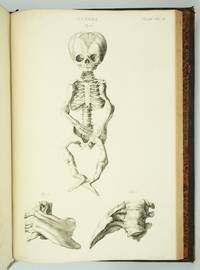
1793ST20586Lugduni Batavorum Leyden: S. & J. Luchtmans 1793 1827 1835. FIRST EDITION A COMPLETE SET. 525 x 350 mm. 20 3/4 x 14". Four volumes. <br/> First two volumes in contemporary cat's paw calf volumes III and IV in contemporary flamed calf raised bands spines gilt in compartments with central fleuron one red and one black morocco label. WITH 206 ENGRAVED ANATOMICAL PLATES all with guards. Front pastedowns with bookplate of Harvard Medical School Library; library shelf markings in white at bottom of spines; bookseller's ticket of Schönhof & Mueller Foreign Books Boston. Bibliotheca Walleriana 8549; Choulant pp. 312-13; Larousse XIX vol. 14 p. 171. Lucas L. Boer Peter L. J. Boek Andries J. van Dam and Roelof-Jan Oostra "History and highlights of the teratological collection in the Museum Anatomicum of Leiden University The Netherlands " American Journal of Medical Genetics Part A Volume 176 no. 3 2018 pp. 618-37.<br /> Shallow chips across the tail of first two volumes covers variably abraded one noticeably so corners somewhat worn partially with boards showing through vague additional signs of wear but the bindings solid and retaining much of their original appeal; plates in first two volumes with faint overall browning either because of paper stock or because of contact with guards a handful of trivial tears but all in all an extremely pleasing set the plates in volume IV very clean and bright and the plates elsewhere and the wide-margined text clean and fresh throughout.<br/> <br/> This is an extremely scarce complete set of a very substantially proportioned anatomical work with more than 200 striking giant folio engravings that emphasize birth defects and that range from clinically cheerless to heartbreaking. A physician and professor of anatomy at Leyden Eduard Sandifort 1742-1814 was commissioned by the University and the city council to publish this account of the school's anatomical collections with a focus on pathological anatomy including especially congenital abnormalities. After the publication of the first two volumes in 1793 the third and fourth were issued following Sandifort's death by his son Gerard 1779-1848 who followed in his father's professorial footsteps in Leyden. The first second and fourth volume are illustrated with copperplate engravings which Larousse tell us make this book "one of the most beautiful works of this genre" though "beautiful" needs to be understood here to mean "convincing" or "compelling" rather than aesthetically appealing. The first volume concludes with nine full-size depictions of skulls; the illustrations in the second and fourth are of a more affecting nature consisting of malformed bodies and body parts damaged or destroyed by disease and birth defects. The engravings of the conjoined twins in these volumes are especially powerful--consisting of poignant even haunting images showing undeserving victims of pronounced congenital defects though some are softened with a touch of the fanciful in their presentation. The thoroughness and accuracy of the work is so great that it remains of scholarly value even today. A recent study by Dutch curators and anatomical scholars Lucas L. Boer Peter L. J. Boek Andries J. van Dam and Roelof-Jan Oostra used "Museum Anatomicum" as a guide to identify and re-diagnose the University's historic teratological collections noting that "many historically made diagnoses could not be improved upon after re-diagnosing the specimens with contemporary dysmorphological knowledge actually confirming that these old collectors were perhaps the first dysmorphologists and can be seen as true pioneers in the field of teratology." Although single volumes and incomplete sets of this work come on the market with some regularity we have been able to trace only five complete sets at auction since 1872. And ours especially fresh and wide-margined in pleasing contemporary calf is a particularly attractive specimen. S. & J. Luchtmans unknown
18312996Paris, Charles Gosselin, 1831 (imprimerie de Cosson) ; deux tomes in-8 réemboités dans une reliure romantique d'époque, plein veau glacé bronze, dos à nerfs plats décorés, fleurons romantiques dorés entre-nerfs, palette décorative dorée en pied, plats ornés d'un grand décor romantique à la plaque gravée, toutes tranches dorées, liseré bordeaux en bord des plats et des coiffes replié plus largement à l'intérieur avec roulette dorée et filet doré sur les coupes ; tome I ; (4) ff. (faux-titre, au verso Oeuvres de Victor Hugo et nom d'imprimeur, titre avec une vignette de Tony Johannot gravée sur bois par Porret, préface datée de mars 1831), 404 pp. ; tome II ; (1) f. (absence du faux-titre, titre avec une autre vignette de Tony Johannot gravée sur bois par Porret), 536 pp., fautes de pagination : les pages 491 et 495 sont paginées par erreur 391 et 395.
EN-136o.J. Lithographie, 1925, auf Velin, mit schwarzer Kreide betitelt ?La Fenêtre sur la Ville 1910? und signiert ?R Delaunay?. Darstellungsgröße 54,5:42 cm, Blattgröße 63,4:47,2 cm. Mit dem Trockenstempel ?Atelier R. Delaunay, 19 B Malesherbes, Paris? in der rechten unteren Blattecke. Mit Restaurierungen in den Blatträndern. Literatur: Loyer/Perussaux 4. ? Eines von 60 geplanten Exemplaren. Die Lithographie entstand in freier Nachempfindung der Gemälde ?Fenêtre sur la Ville? von 1910 und ?Les Fenêtres simultanées sur la Ville? von 1911.
EN-039o.J. Lithographie, 1920, auf Bütten mit Wasserzeichen: Steigender Löwe und anhängenden Buchstaben ?JvZ?, mit Bleistift signiert. Darstellungsgröße 13,9:6 cm, Blattgröße 43,5:30,7 cm. Nr. 28 von 30 Exx. aus einer Sonderauflage ohne rückseitige typographische Bezeichnung! Provenienz: Stuttgarter Kunstkabinett, 35. Auktion, 23./24. Mai 1960, Kat. Nr. 1054. Literatur: Kornfeld 77, II A (von B), Von dieser Lithographie gibt es: 30 Exx. der Sonderauflage (s. o.), 600 Exx. erschienen in: Deutsche Graphiker der Gegenwart (darin enthalten: 100 Exx. einer Luxusausgabe) sowie 6 bekannte Probedrucke des 1. Zustandes; Söhn HDO 108-7. Erschienen in: Deutsche Graphiker der Gegenwart. Hrsg. v. Kurt Pfister. Leipzig, 1920, Blatt 10 (von 30); Katalog: German Expressionist Prints and Drawings. Los Angeles, County Museum of Art, 1989, Nr. 1498 m. Abb.
EN-167o.J. Kaltnadelradierung, um 1929, mit starkem Wischton und Deckweißhöhungen der Gesichter, auf cremefarbenem Bütten mit Wasserzeichen: F M Head, mit Bleistift signiert ?Rolf Nesch?. Darstellungsgröße 44,7:33,3 cm, Blattgröße 63,7:51,5 cm. - Von größter Seltenheit! - Provenienz: Privatsammlung, Hamburg. - Literatur: Helliesen/Sorensen 371, Abb. 9. Im Gegensatz zu dem im Werkverzeichnis beschriebenen und abgebildeten Exemplar, das zusätzlich mit einer farbigen Monotypie gedruckt wurde, handelt es sich bei dem hier beschriebenen Blatt um ein Exemplar aus der Auflage von 1972, die von Hartmut Frielinghaus nur in Schwarz gedruckt wurde. - In einer mit der Maschine geschriebenen Notiz heißt es: ?Die 3 Töchter von Max Sauerlandt am Flügel?. Radierung, um 1929, Kaltnadel auf Zink: von der erhaltenen Platte, ein Geschenk von Rolf Nesch an Frau Alice Sauerlandt, hat Hartmut Frielinghaus 1972 in monochromer Fassung für die Familie Sauerlandt und für einen Freund etwa 8-10 Probedrucke gemacht; auf 3 dieser Drucke hat Nesch die Gesichter der Frauen mit Weiß gehöht, weil sich das alte Zink der Platte nicht mehr in gewünschtem Maß an diesen Stellen reinwischen ließ, um das Inkarnat vorzustellen.? - Prof. Dr. Max Sauerlandt (1880-1934) war Direktor des Museums für Kunst und Gewerbe in Hamburg von 1919- 1934 und hatte sich im November 1929 sehr für den Erwerb eines Gemäldes von Rolf Nesch eingesetzt. [2 Warenabbildungen]
612-Eo.J. Aquarell über Bleistift, auf cremefarbenem Velin. 16,1:12,5 cm. Provenienz: C. G. Boerner, Düsseldorf, 1976, Kat. 67, Nr. 101; Sammlung MWD im Doppelkreis; Privatbesitz Rheinland. Vergleichsliteratur: Stoll, Ölbilder B, 4, S. 511/12; I. Koszinowski/V. Leuschner, Ludwig Emil Grimm. Zeichnungen und Gemälde. 2 Bde. Marburg, 1990, Bd. 1, Ö 52, Farbtaf. S. 208 u. Abb. S. 404. Bei diesem Aquarell handelt es sich um eine Vorstudie für das 1841 entstandene Gemälde ?Die Mohrentaufe? im Besitz der MHK Neue Galerie, Kassel. Das Modell für die weibliche Hauptfigur des Gemäldes war Hedwig von Münchhausen, die 1845 den österreich. Feldmarschallleutnant Otto von Scholley geheiratet hatte. Ihre Schwester Agnes von Münchhausen hatte 1837 Grimms Schwager Ludwig Hassenpflug nach dem Tode von dessen erster Frau geheiratet. Grimm hat sie auf einer weiteren - 1839 entstandenen - aquarellierten Bleistiftzeichnung porträtiert. Diese wurde bei Galerie Bassenge, Berlin, Auktion vom 1.06.2012, Nr. 6400 versteigert.
002-Io.J. Bleistift, auf Bütten mit Wasserzeichen: Vogel auf Dreiberg im Kreis, links unten bezeichnet und datiert ?Olevano den 11ten Sept. 24.?. 26,7:38,3 cm. Verso: Vier Studien einer stehenden jungen Frau. Bleistift. Die Studien auf der Rückseite der Zeichnung scheinen nach vorne durch. Horizontale Mittelfalte, vereinzelte kleine Stockflecken. In der bisher einzigen umfassenden Ausstellung der italienischen Landschaften von Heinrich Reinhold, waren 5 Zeichnungen vom Sommer 1824 zu sehen, die alle Landschaften bei Olevano darstellen (vgl. Ausst. Katalog: Heinrich Reinhold (1788-1825). Italienische Landschaften. Gera 1988, Nrn. 159-163, Abb. Ss. 243-247). Einen vergleichbaren Landschaftsausschnitt in der Serpentara mit dem kleinen Wäldchen, den wir hier vorstellen, hat Reinhold bereits 1821, von nahezu demselben Standort aus, gezeichnet (vgl. op. cit. Nr. 75, Abb. S. 161).
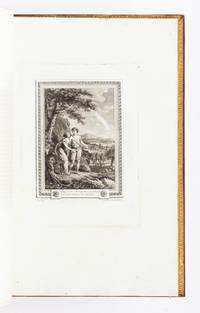
1786ST19671Paris: Chez l'Auteur Veuve Hérissant et Barrois l'aîne 1786-93. First Edition with these Illustrations. 485 x 340 mm. 19 x 13 1/2". Three volumes. <br/> ELEGANT RED STRAIGHT-GRAIN MOROCCO BY BOZERIAN signed in gilt on front free endpaper covers framed by gilt fillets double raised bands separated by a strip of black morocco tooled with gilt chain spine gilt in compartments with a rose or a musical instrument at center turn-ins with gilt arches roll Culot 18 green endpapers all edges gilt. 147 FINE ILLUSTRATIONS AFTER DESIGNS BY JEAN-JACQUES-FRANÇOIS LE BARBIER: three engraved title pages four vignettes 66 tailpieces and 74 leaves of plates including frontispiece portrait of Gessner engraved by Alix Baquoy Dambrun de Longueil et al. ALL IN FIRST STATE those in volumes I and III with original tissue guards. A Large Paper Copy. Cohen-de Ricci 433; Ray 39. For the binding: Culot "Jean Claude Bozerian" roulette #18. ◆Just a hint of rubbing to upper joint of first volume small indent to front cover of volume II occasional mostly marginal mild foxing more frequent in volume II but QUITE A FINE SET clean and fresh internally with beautiful impressions of the engravings and enormous margins in lustrous bindings with few signs of wear.<br/> <br/> This is a sumptuous set approaching 20 inches tall that epitomizes the best in 18th century French book arts: a Large Paper Copy of a book that in Ray's opinion "represents one of the happiest of all collaborations between artist and writer"--all of this in a graceful binding by the preeminent Paris atelier of the day. Gessner 1730-88 was a painter and poet from Zurich who hoped to renew the ancient genre of the eclogue. In his imagined neoclassical world all the shepherdesses are beautiful virtuous and sensitive and the shepherds are always honest and respectful. This struck a chord with illustrator Jean-Jacques-François Le Barbier 1738-1826 who wrote in the dedication "the charm of Gessner's poems filled my imagination and transported it to the happy centuries of the world's innocence." It also inspired him to collaborate with Gessner on this present work. Le Barbier 1738-1826 was one of the first great French neoclassical illustrators and this work is both an important early success in that style and in Ray's words the "most sustained and accomplished series of illustrations" by the artist. Most of Le Barbier's designs for this work are set in the classical world--the exception being "Le Mort d'Abel" based on the story of Cain and Abel in the Bible. There are nymphs fauns and other fantastical creatures mingling with humans in bucolic settings. While Le Barbier illustrates many love scenes they are romantic and wistful rather than passionate; he was a master of nudes but those depicted here seem innocent rather than erotic. As Ray says "Le Barbier's emphasis is on simplicity and naturalness. We are in a different world from the witty gallantry and sophisticated sentiment of the rococo pastoral illustrations." The engravings are characterized by the clarifying use of softly radiant light and by a restrained animation and the book as a whole is "a work of harmonious distinction which admirably realizes the ideals of its author and illustrator." Ray The elegant binding by Bozerian is notable for its refinement and it continues the motif of noble simplicity set by author and illustrator. Jean-Claude Bozerian 1762-1840 was the elder of the Bozerian brothers François is referred to as "le jeune" and was active in Paris from 1795 to about 1810. He began his career in Lyon as an apprentice bookseller printer and bookbinder eventually deciding to focus on the latter craft. Marriage to the widow of binder Pierre Boulier allowed him to establish a binding workshop in Paris where he was joined by his brother. His bindings were soon much in demand by French bibliophiles who appreciated their superior materials tasteful design and flawless execution. A rich man by age 50 he decided to retire and enjoy his leisure turning his business over to his nephew Lefebvre. Gessner's "Oeuvres" typically appears in quarto; Large Paper Copies like this one are very rare especially with all of the plates in first state which according to Cohen-de Ricci is recognizable by the lack of numbering to the plates and their appearance on bluish paper. It would seem next to impossible to imagine a book with margins as wide as are seen here. Chez l'Auteur, V[eu]ve Hérissant et Barrois, l'aîne unknown
- RARISSIMO PRIMO STATO DI SEI, dalla PRIMA EDIZIONE delle CARCERI - Acquaforte, bulino, tinta allo zolfo e bruniture, firmata in lastra in basso a destra. Tavola della PRIMA edizione delle 'Carceri'. Esemplare nel primo stato di sei secondo Robison. Magnifica prova, impressa su carta vergata coeva con filigrana "cerchio e giglio, margini di circa 8 mm, in ottimo stato di conservazione.Le 'Carceriì in prima edizione sono di eccezionale rarità. Secondo un censimento fatta da Andrew Robison, solo 16 esemplari completi dell'opera in prima tiratura sono noti nelle raccolte pubbliche di tutto il mondo.Senza dubbio la serie più nota e celebrata fra le opere del Piranesi. La serie è databile intorno al 1745, e comprendeva quattordici tavole, includendo il frontespizio che portava il titolo di Invenzioni Capric di Carceri all’acquaforte datte in luce da Giovanni Buzard in Roma, mercante al Corso. Una seconda stesura delle stesse, subito successiva, recava il titolo con il nome dell’editore giustamente corretto in Bouchard. E’ fuori di dubbio che l’idea, assolutamente innovativa, per la realizzazione di questa opera nasce da un collegamento molto stretto con la serie denominata Prima Parte di Architetture non solo per la vicinanza di tempo che intercorre tra i due lavori, ma proprio per il preciso intendimento ideologico che l’artista aveva in quel periodo in fatto di architettura. La serie venne ripubblicata dopo ben quindici anni, nel 1761, ampiamente riveduta e corretta. Il Piranesi non era nuovo a ripensamenti e variazioni sulle proprie opere, ma molto interessante è analizzare il motivo che lo indusse a riproporre, cambiandolo nella forma, questo importante lavoro. Le esperienze archeologiche condotte nello studio che porterà alle Antichità Romane (1756), le polemiche con architetti e le loro teorie del periodo, la consapevolezza di aver affinato ancora la propria tecnica stilistica, e il variato concetto architettonico lo indussero a mettere mano alle Carceri. E’ con questa nuova ed arricchita sapienza incisoria che l’artista va a ripescare le vecchie lastre, e dopo la rielaborazione, le ripresenta nel pieno della figura polemica e della lotta ideologica in fatto di architettura che in quegli anni conduceva. La riproposizione della serie rappresenta per il Piranesi un aspetto ben preciso, ovvero ripresentare, rinforzandolo, il messaggio polemico e di polemica architettonica già affrontato quindi anni prima. Lo scardinamento degli spazi e della prospettiva, della logica e di tutti i principi comuni affermati nei trattati, rottura totale con le leggi tradizionali e gli insegnamenti accademici dell’architettura. Due sono le tavole aggiunte nella seconda edizione, che quindi comprende il frontespizio e quindici lastre. Notevoli le differenze stilistiche tra il corpus dell’opera e le due nuove lastre, dove notevoli sono la complessità di struttura e di composizione architettonica, che dimostrano il cambiamento avvenuto in seguito allo studio archeologico dei grandi monumenti romani.Di diverso aspetto l’effetto emotivo che suscita la visione delle singole opere che compongono la serie, che con il loro aspetto malinconico costituiscono un elemento di perenne richiamo, di inesausta vitalità, e di estrema modernità. I ponti sospesi, le reti, i ballatoi, le scale e quanto altro presente nelle Carceri sono stati esame di numerosi studi, che una copiosa letteratura ha colto sin dal romanticismo, dando loro una grande popolarità, esaltandone le molteplici reazioni emozionali che le stesse conferivano. - THE VERY RARE FIRST STATE, from the FIRST EDITION of CARCERI -Etching, engraving, sulphur tint and burnishing, 1750, signed at lower right. From the Carceri set, from the first edition, first issue. Example in the first state of six described by Robison, from the contemporary roman edition.A magnific impression, printed with black ink on contemporary laid paper with "encircled fleur de lys" watermark, with small margins (about 8 mm), very good condition.The first edition of 'Carceri' is absolutely rare. According with Andrew Robison, there are only 16th complete set of the first edition and first issue preserverd in the libraries.Undoubtedly these is the best known and most celebrated series among the works by Piranesi. The series, datable around 1745, consisted of fourteen plates, with the title page bearing the title Invenzioni Capric di Carceri all’acquaforte datte in luce da Giovanni Buzard in Roma, mercante al Corso. In the second issue, immediately subsequent, the title presents the publisher’s name rightly corrected in Bouchard. There is no doubt that the innovative idea of this work comes from a very close connection with the series titled Prima Parte di Architetture not only for the proximity of the dates, but also because both the series reflect the Piranesi’s precise ideology on architecture.The series was re-published fifteen years later , in 1761. Robison 38 I/VI, Hind 12, Focillon 35.
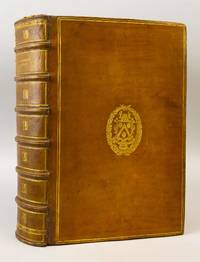
1572ST14214bBasileae: Ex officina Heruagiana per Eusebium Episcopium 1572. 385 x 250 mm. 15 1/4 x 10". 18 p.l. 744 pp. 16 leaves; 368 pp.; 218 pp. 13 leaves.Edited by Hieronymus Wolf and Vincentius Opsopäus. <br/> IMPOSING CONTEMPORARY CALF COVERS WITH GILT FRENCH FILLET BORDER CENTRAL COAT OF ARMS OF JACQUES AUGUSTE DE THOU as a bachelor within a laurel wreath raised bands spine gilt in double-ruled compartments with de Thou's cipher at center older repairs to front joint and to two-inch tear on front cover. Printer's device on title and final pages. Dibdin I 478. ◆Front joint with three-inch crack at tail a little fraying at head of spine a few minor marks to cover but the binding still sturdy the leather lustrous and the gilt bright. Leaves a shade less than bright due to paper quality with a dozen or so quires a little browned isolated paper defects to margins additional trivial imperfections otherwise a fine copy internally clean and fresh with comfortable margins.<br/> <br/> This Latin and Greek edition of the works of Demosthenes and Aeschines fourth century B.C. Greek orators and rivals comes from the illustrious collection of French historian bibliophile and statesman Jacques-Auguste de Thou who assembled one of the greatest libraries of his day. Our binding bears the arms and cipher used by de Thou as a bachelor; after his marriage in 1587 he combined his arms with those of his wife in his supralibros and incorporated her initials in the cipher. Demosthenes 384-322 B.C. was as famous an orator in the ancient world as Homer was a poet and though he wrote no books his many speeches had considerable political importance in his time were recorded and collected and have been much analyzed by generations of students of language and rhetoric. Often printed as here with the works of Demosthenes were the three extant orations of Aeschines ca. 390-314 B.C. He was the arch-enemy of Demosthenes and one can see in Aeschines' public life and orations a concerted attempt to discomfit his rival. In his oration "Against Ctesiphon" for example Aeschines argues that a crown intended for Demosthenes to honor his services to Athens ought not to be awarded. As an orator he was possessed of a learned and impassioned eloquence but in comparison with Demosthenes he lacked taste judgment and moral authority. A pupil of Melanchthon and a major scholar of the period Hieronymus Wolf 1516-80 came to prominence according to Sandys with his editions of Suidas of Isocrates beginning in 1570 and of Demosthenes. For the text here he relied on a manuscript in the Augsburg Library the codex Augustanus primus. Jacques-Auguste de Thou 1553-1617 served French kings Henri III and Henri IV negotiated the Edict of Nantes one of the earliest decrees of religious tolerance in Europe and produced a history of contemporary France noted by modern historians for its scientific and detached approach but condemned in his day for its objective view of Protestantism. A devoted bibliophile and scholar he amassed a library of more than 9000 volumes by the time of his death. Bindings from his collection continue to be very actively sought after. Ex officina Heruagiana, per Eusebium Episcopium unknown
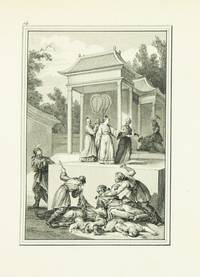
1788ST20889Paris: Chez l'Auteur 1788 1788. FIRST EDITION. 565 x 400 mm. 22 1/4 x 15 3/4". 50 leaves. Two separately published works bound in one. <br/> Modern retrospective calf-backed tan paste paper boards smooth spine profusely gilt with a repeating pattern of grape vines red morocco label lettered in gilt vellum tips. ENGRAVED THROUGHOUT WITH A TOTAL OF 48 FULL-PAGE ILLUSTRATED PLATES each accompanied by either one or two plates of engraved text. SHEETS UNCUT AND UNFOLDED the first work printed only on the recto; the second with three sheets printed on both sides. Reed and Dematté China on Paper 20 21; Cohen-de Ricci 479. Edges and lower corners slightly worn but the binding with only just minor signs of use; free endpaper in front and back with vertical crease one sheet with an early marginal repair isolated inconsequential faint spotting but still AN EXTREMELY FINE COPY the wide-margined sheets exceptionally fresh and bright and with strong impressions of the engravings.<br/> <br/> This pair of lavishly illustrated fully engraved works produced by a talented French engraver after earlier Chinese artworks are here presented in an enormous volume made up of uncut and unfolded sheets. According to Benzit Parisian engraver and print seller Isidore Stanislas Henri Helman 1743 - ca. 1809 "stands out among the engravers of the end of the 18th century" and his skill is evident in the two works bound together here. The first is a pictorial history of the Chinese emperors from the earliest mythical rulers to the Northern Song dynasty 960-1126. It is based on the Dijian Tushuo composed in 1573 to educate the Ming-dynasty Wanli Emperor 1563-1620 who had ascended to the throne at the age of nine. In accordance with its didactic aims it presents the very best and worst of imperial behavior and the original handwritten album was published as a block-printed book to great popularity. Two centuries later the Qing-dynasty Qianlong Emperor 1711-99 commissioned a Western-style edition of the famous work which was executed by two French artists the Jesuit painter Jean-Denis Attiret and the engraver Charles-Nicolas Cochin II. The enterprising Helman was able to see the Attiret-Cochin book in the collection of French statesman Henri Léonard Jean Baptiste Bertin 1720-92 and having had great success with a previous reproduction of a Chinese work Conquêtes de l'Empereur de la Chine ca. 1783 he created the present reproduction. The second work the life of Confucius was also reproduced from plates in Bertin's collection. The source material in this case was the biography of Confucius assembled by the Jesuit Joseph-Marie Amiot 1718-93 as part of his informational series on China meant to educate missionaries. Amiot was a correspondent of Bertin and had sent him the biography and accompanying album of drawings which were based on the Shenji tu Illustrated Traces of the Sage a popular Confucian work throughout the Ming and Qing dynasties. Helman selected 24 scenes from each creating books that balance serene scenes of mountainous landscapes and temples with dramatic fight scenes and dragons. The quality of the engravings is excellent with delicate linework creating faint wisps of smoke and subtle shadows. These two works apparently both published in 1788 were released in several formats. The format here with the engravings laid out on the recto of large uncut sheets appears at auction very infrequently: we have been able to trace only two copies of both works in this format since 2004 and neither in such fine condition as the present example. Chez l'Auteur unknown
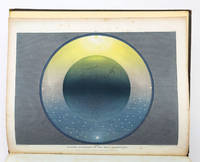
1846ST19286London: Printed by Catchpool & Trent for Simpkin Marshall & Co 1846. FIRST EDITION. 320 x 255 mm. 12 1/2 x 10". xiii 3 96 pp. <br/> Publisher's original blind-decorated dun-colored cloth gilt titling to upper cover smooth spine newer endpapers. WITH 11 COLOR ENGRAVINGS after Frost by W. P. Chubb & Son printed in oil colors by George Baxter all with original tissue guards. Front free endpaper with small ink signature of John Hill. See: Francis Reid "Isaac Frost's 'Two Systems of Astronomy' 1846: Plebeian Resistance and Scriptural Astronomy" in "The British Journal for the History of Science" Vol. 38 No. 2 Jun. 2005 pp. 161-177. Cloth rather spotted corners bumped but the binding solid with no wear to joints or hinges. A few spots of foxing to title page half of the tissue guards with overall very faint foxing/browning the illustrations with minor foxing at edges and in margins but the images themselves clean and bright and all in all a really excellent copy the text wide-margined and quite clean and fresh and the plates with rich coloring.<br/> <br/> Illustrated with beautiful color plates this anti-Newtonian work promotes a view of the universe based on the backward-looking beliefs professed by a Protestant sect known as the Muggletonians. Named after co-founder Lodowicke Muggleton the Muggletonians emerged in London in 1651 based on the claims of two tailors who professed to be the "Last Witnesses" described in the Book of Revelation. Rejecting the new directions in philosophical reason Muggletonians believed in a purely scriptural interpretation of the universe. According to E. P. Thompson's 1994 "Witness Against the Beast" the Muggletonians had curious notions quite contrary to other Protestant denominations: they believed that the soul is mortal that Jesus and God are one and the same that Heaven was left without divine supervision from Jesus' death until the day of judgment that Heaven resides six miles above the Earth that God stands between five and six feet tall and other unconventional things. Although the sect initially avoided both worship and evangelizing during the 19th century some followers became more outspoken about their beliefs and even published books appealing to the general public. Our author Isaac Frost 1793-1858 was a prominent Muggletonian and successful owner of a brass foundry who along with his brother Joseph invested large sums to promote their belief system--the present work being an especially notable example. Divided into two main sections the text first describes the Newtonian system of heliocentric astronomy and then turns to Frost's scriptural interpretation and geocentric views. As Reid tells us "According to Frost Scripture clearly states that the Sun the Moon and the Stars are embedded in a firmament made of congealed water and revolve around the Earth that Heaven has a physical reality above and beyond the stars and that the planets and the Moon do not reflect the Sun's rays but are themselves independent sources of light. Our book was apparently written as a reaction against the lecturers who expressed Newtonian astronomy--which was often for them and their audiences simply shorthand for heliocentrism." The 11 plates that illustrate these extraordinary ideas are the work of George Baxter a pioneering printer who revolutionized color printing techniques by combining metal engravings with woodblock printing using oil-based inks to produce high-quality affordable prints. The plates here are appropriately ethereal and otherworldly utilizing a beautiful palette with subtle gradations and esoteric figures to create memorable pseudo-scientific imagery. Although this work appears at auction with some regularity it is almost always incomplete no doubt because the attractiveness of its plates encourages harvesting. Useful price comparisons include a complete copy said to be in fine condition selling for £7500 in 2016 and six loose prints from the book fetching £6875 in 2015. [Printed by Catchpool & Trent for] Simpkin, Marshall, & Co unknown
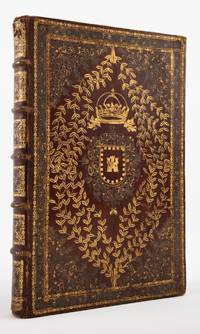
1714ST20995Naples: Bernardo-Michele Raillard 1714. 343 x 223 mm. 13 1/2 x 8 3/4". 6 p.l. CCLXIX 15 pp. <br/> IMPOSING CONTEMPORARY BROWN MOROCCO EXUBERANTLY GILT covers with painted and gilt frames of floral rolls central panel with elaborate volute cornerpieces large central lozenge formed by myriad leafy gilt vines enclosing a coat of arms containing a three-turreted castle topped by a crown held up by two putti raised bands spine compartments framed by floral roll painted and gilt daisy centerpiece tulip cornerpieces all edges gilt. The Academy's engraved device on title page and 75 ENGRAVED PLATES of scientific instruments and experiments. DSB 9:3; Dibner Herald of Science 82 first edition. Joints with modern wear one short crack at top of rear joint head of spine a bit wormed corners and extremities somewhat rubbed gilt a bit rubbed in spots difficult to tell if some of the decoration is dark because painted or is now missing gilt a couple of leaves slightly browned in the text bed occasional minor foxing more pronounced on a couple of quires other trivial imperfections but an excellent copy--quite clean and fresh internally--in a solid binding still bright with gilt.<br/> <br/> Given its binding and provenance this is a uniquely desirable copy of a significant scientific work: our stately Neapolitan edition of the "Essays on Natural Experiments" is offered here in very animated morocco bearing the arms of the man who paid for its printing and to whom the book is dedicated. That remarkable patron Caesare Michelangelo d'Avalos Marquis of Pescara and Vasto prince of Isernia and Francavilla 1667-1729 was a true Renaissance man who took Machiavelli's "The Prince" as inspiration. He was both a wily political conspirator and a generous patron of the arts and sciences. His palace at Vasto was renowned for the beauty of its furnishings for its splendid art gallery and for its impressive library overseen by the humanist scholar Alessandro Berti. The present volume was a worthy addition to that library with its glowing dedication and its regal binding extravagantly gilt but so tastefully composed that it never crosses the line into ostentatious. <br /> First printed in 1666 "Essays" was produced by the Accademia del Cimento the most significant expression of post-Galilean scientific progress in Italy. Founded in 1657 as the first organization formed for the sole purpose of making scientific experiments the Accademia occupies a singular position in the history of the development of science. Prince Leopold of Tuscany the last exceptional member of the Medici family and his brother Ferdinand who followed the Medici family tradition of patronizing the arts and sciences provided the support free-thinking direction and financial patronage for the Academy. A well-equipped laboratory and an apparently inexhaustible supply of apparatus and materials helped to make the work of the 10 scientists associated with the Academy more sustained and broader in scope than anything that had come before it. W. E. K. Middleton "The Experimenters" According to Thorndike among many other subjects the experiments described here "were concerned with air pressure and freezing; or they aimed to prove that water was incapable of compression and that there was no such thing as lightness or positive levity. Some experiments were magnetic and others electric the latter being chiefly performed with amber. Other subjects investigated were the change of colors in fluids the motion of sound and projectiles." Although no author is given by name the title page of the 1666 first edition indicated that this account was written by the secretary to the academy Lorenzo Magalotti 1637-1712. A pupil of Viviani and a friend of Boyle Magalotti was celebrated for his highly finished colorful almost dramatic descriptions of experiments. DSB notes "He has the distinction . . . of having written the best scientific prose in Italian after that of Galileo.". Bernardo-Michele Raillard unknown
179728174Birmingham England 1797. Oblong quarto. 7 1/2 x 11 inches. 143 engraved plates 13 folding on laid paper priced throughout in manuscript. Period calf-backed marbled paper covered boards<br/> <br/>Provenance: W. G. & Co. inscription on front endpaper<br/> <br/>A rarely encountered pattern book or trade catalogue of 18th century English furniture hardware including drawer pulls keyholes hinges locks castors bolts watch stands and more.<br/> <br/>By 1770 over thirty different brass foundries operated in Birmingham England making it the epicenter of furniture hardware design in the last quarter of the 18th century. At roughly the same period trade catalogues like the present began to be issued by both furniture and hardware makers alike. Although most of the brass foundry trade catalogues of this early period have no indication of the foundry the present pattern book is inscribed W. G. & Co. on the front pastedown. In all nearly 1000 designs are shown on the 143 plates from rather simple hinges and hooks to incredibly ornate pulls knockers watchstands etc. Although no engravers's names are identified it has been suggested that the foundries themselves produced such plates utilizing the talents of their own craftsmen who by their very occupation would have been highly skilled at etching on metal. Such pattern books "illustrate the beginning of what was then a new movement in the conditions of the crafts namely the growth of the organised factory as a means of production and distribution as compared with the earlier limitation of these functions to the efforts of individuals" Young.<br/> <br/>Cf. Hummel Charles F. "Samuel Rowland Fishers Catalogue of English Hardware." Winterthur Portfolio Vol 1 1964: 188-197; cf. Symonds R. W. "An Eighteenth-Century English Brassfounders Catalogue." Magazine Antiques Feb. 1931: 102-105; Young W. A. comp. Old English pattern books of the metal trades: a descriptive catalogue of the collection in the V&A Museum. London: HMSO 1913. unknown books
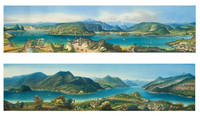
185020181Italy 1850. Pair of views gouache over faint etched line black gouache border. Period gilt and faux bois frames. Two splendid panoramic views of Lake Como and Lake Maggiore.<br/> <br/>Catering to the foreigners flocking to the region on The Grand Tour this pair of hand-painted prints beautifully depict the famed picturesque lakes with rich bands of blue highlighting the water and sky with the surrounding hills and mountains dotted with luxurious villas. In the view of Lake Maggiore we see from a very high vantage point the Borromean Islands: Isola Bella Isola Madre and Isola dei Pescatoriwith their extraordinary gardens. The view of Lake Como looks north up the lake towards Switzerland from above Bellagio which occupies the point at which the lake divides in two. The paintings are clearly intended as a pair the images being almost identical in size with matching black painted margins. The prints are as issued with black labels covering the original printed titles. unknown books
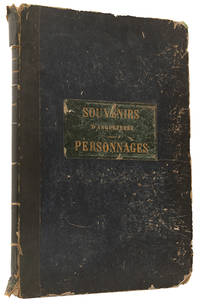
105420c. 1850 . Folio 52 x 35 cm; an album of 38 pencil and watercolour plates all in colour except one interior scene in pencil inscribed and dated throughout 37 mounted on paper including one advertisement by Smith's one loose 14 blank pages at rear slight browning and fading throughout decorated endpapers; bound in nineteenth century morocco backed marbled boards spine gilt ruled and lettered green morocco label gilt lettered on upper board worn at extremities frayed; overall an attractive album.<br /> An unusual and amusing album of period pencil and watercolour plates. The numerous plates depict furniture street scenes including protests with placards a variety of costumes including military uniforms theatrical and various trades all English.<br /> c. 1850 hardcover
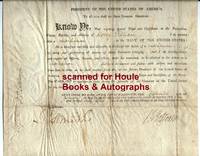
18092221587<p>RARE MIDSHIPMAN APPOINTMENT</p><p>"Th: Jefferson" Partly-printed vellum DS as president 1 page 10" x 10 1/2" January 16 1809. President Jefferson issues a naval appointment for Henry Pilliam. In part: "That reposing special Trust and Confidence in the Patriotism Valour Fidelity and Abilities of Henry Pilliam I do appoint him a midshipman in the Navy of the United States." Neatly signed at the conclusion by President Jefferson and countersigned by Secretary pf the Navy Robert Smith. The document bears an embossed Navy Department seal to the upper left. Intersecting folds overall wrinkling and light staining otherwise fine condition. Such appointments by Thomas Jefferson are quite scarce as he and the Republican party opposed a strong navy. However as Jefferson's term neared its conclusion the naval forces were beginning to grow out of necessity in order to protect the maritime interests of the United States as merchant vessels were  frequently being interfered with during their voyages on the high seas. Ultimately these disputes would culminate in the War of 1812 during President Madison's administration. A desirable and well-preserved example of a Jefferson appointment. Very good.</p> unknown books
18092221587<p>RARE MIDSHIPMAN APPOINTMENT</p><p>"Th: Jefferson" Partly-printed vellum DS as president 1 page 10" x 10 1/2" January 16 1809. President Jefferson issues a naval appointment for Henry Pilliam. In part: "That reposing special Trust and Confidence in the Patriotism Valour Fidelity and Abilities of Henry Pilliam I do appoint him a midshipman in the Navy of the United States." Neatly signed at the conclusion by President Jefferson and countersigned by Secretary pf the Navy Robert Smith. The document bears an embossed Navy Department seal to the upper left. Intersecting folds overall wrinkling and light staining otherwise fine condition. Such appointments by Thomas Jefferson are quite scarce as he and the Republican party opposed a strong navy. However as Jefferson's term neared its conclusion the naval forces were beginning to grow out of necessity in order to protect the maritime interests of the United States as merchant vessels were frequently being interfered with during their voyages on the high seas. Ultimately these disputes would culminate in the War of 1812 during President Madison's administration. A desirable and well-preserved example of a Jefferson appointment. Very good.</p> unknown
51-7064Paris: chez le Rouge 1777-1779. Oblong folio. 47 x 32cm. 98 engraved plates; some fold-outs. Later half goatskin binding.This compilation includes 4 of the 21 cahiers with 98 of the 491-493 plates in the full set. The 4 cahiers are complete in themselves: .Included are: 6e cahier. Serrail et jardins du grand seigneur includes Richard's Trianon gardens.7e cahier. Jardins anglo-chinois with Tableau de la plantation générale de tous les arbres . par Richard jardinier de la Reine et Le Rouge .8e cahier. Jardins anglo-chinois includes German and Austrian gardens.9e cahier. Jardins anglo-chinois.References: Met Museum: 46.52.21.3;SKB.3312 Brunet III.998 Jardins anglais only Guilmard 260.96; Veronique Royet Bibliothèque nationale de France Elisabetta Cereghini Odile Faliu Bernard Korzus Georges Louis Le Rouge: Les jardins anglo-chinois. Connaissance et Memoires Bibliothèque nationale de France Inventaire du fonds français; graveurs du dix-huitième siècle 15 Paris 2004 cat. no. 49-77 ill.; . Victoria and Albert Museum Department of Prints and Drawings and Department of Paintings Accessions 1953 London: HMSO 1963.Berlin Staatliche Museen Katalog der Ornamentstich-Sammlung der Staatlichen Kunstbibliothek Berlin Berlin and Leipzig 1936-39 3312. J. Dixon Hunt and M. Conan ed.s Tradition and Innovation in French Garden Art: Chapters of a New History Philadelphia: University of Philadelphia Press 2002 p. 115.OCLC Number / Unique Identifier:243866240; OCLC Number / Unique Identifier:1268266935.Other bibliographic references: • Berlin Staatliche Museen Katalog der Ornamentstich-Sammlung der Staatlichen Kunstbibliothek Berlin Berlin and Leipzig 1936-39 3312.• J. Dixon Hunt and M. Conan ed.s Tradition and Innovation in French Garden Art: Chapters of a New History Philadelphia: University of Philadelphia Press 2002 p. 115. [Paris: chez le Rouge, 1777-1779] unknown
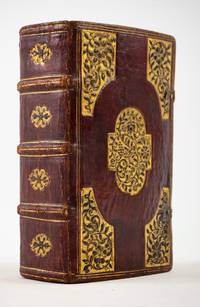
1622ST20888Munich: N. Henricus 1622. First Edition in German. 160 x 100 mm. 6 1/4 x 4". 16 p.l. 699 3 pp. Translated from the Latin by Sebastian Äntzenhover. <br/> UNUSUAL AND QUITE BEAUTIFUL CONTEMPORARY GERMAN DARK RED MOROCCO GILT covers with gilt fillet border central panel with onlaid corner pieces and centerpiece of black morocco stamped in relief to an Ottoman-inspired design of flowering vines raised bands spine panels with gilt centerpiece two leather straps with silver clasps and catches all edges gilt. Title page with engraving of the Tower of Babel. Top half inch of title page cut away to remove owner inscription. VD17 12:103845E; USTC 2019170. A touch of bowing to boards spine a little crackled joints and extremities a bit rubbed occasional small round marginal marks apparently made with wax! and presumably meant to indicate textual importance other trivial imperfections but an excellent copy clean and fresh in an unrestored binding with lustrous boards glistening with gilt.<br/> <br/> This rare work on sinning through the use of wicked words is offered here in a lovely binding that is quite out of the ordinary for its time and place and that may well have a very noble provenance. "Spiritual Tongues: That is a Salutary Treatise Concerning the Poisonous Tongue of Man--How to Guard Against and Remedy It" is an examination of the sins committed through speaking written by Munich Jesuit Johannes Pelecyus 1545–1623 and first printed in Latin in 1620. Pelecyus addresses the evils of gossip slander indiscretion cursing mocking and other injurious speech. The first part of the work is a general overview of the topic from a theological standpoint while the second part is a more practical guide to types of harmful speech and specific remedies for avoiding and correcting these offenses. Pelecyus concludes with a poem "The Devil's Disease and its Remedy." The binding here is remarkable in terms of its material makeup and the conjectural origin of its design. In the first part of the 17th century morocco was not commonly used by German binders who preferred sturdier pigskin particularly for treatises like this which could be expected to see much use poisonous tongues have long been a fact of life and in need of being frequently read about. Morocco was generally reserved for presentation copies or ceremonial liturgical works. In addition to the material the decoration here is unusually lavish for a text of this sort with onlays gilt adornment and silver clasps that required time and skill from the artisan and considerable expense for the patron. Significantly the lovely relief centerpiece design on the boards here also appears on the covers of a Book of Hours originally created for Holy Roman Emperor Maximilian I 1459-1519. That volume was later acquired by another similarly named owner Duke Maximilian I of Bavaria and is now to be found in the Bavarian State Library: shelfmark BSB 2 L.impr.membr. 64. It is certainly well within the realm of possibility that our later Maximilian 1573-1651 could have owned the present poisoned tongue volume and had it dressed in its elaborate morocco attire in imitation of the original binding design on the emperor’s prayer book. Whoever was responsible for the binding they surely did extremely fine work and no doubt for an elite clientele. One other curious feature of this volume is the series of round wax dollops made in the margins which an owner the fastidious second Maximilian has used to mark passages of interest in the text. While they don't materially affect the value of the volume they are intriguing in that they inevitably call up images for us of a careful early reader systematically marking with some kind of unknown implement the parts of the text that seemed important. "Spiritual Tongues" is a rare work: USTC and OCLC find just four copies outside Germany none of them in North America and we could trace just one copy sold at auction. N. Henricus unknown
EN-139o.J. Holzschnitt, 1919, auf sehr feinem cremefarbenem Japan-Bütten, mit Bleistift signiert ?Lyonel Feininger?. Darstellungsgröße 17,3:22 cm, Blattgröße 30,5:41 cm. Brillanter Druck mit dem vollen Rand. - Provenienz: Galerie Wirnitzer, Baden-Baden, Kat. Querschnitt II, 1976, Nr. 20 m. Abb; Privatsammlung, Süddeutschland. - Literatur: Prasse W 192, II (v. II); Söhn HDO 72724-1. ? Veröffentlicht unter dem Titel ?Lehnstedt? in ?Die Schaffenden?, Euphorion-Verlag, Berlin, 8. Jahrgang, 2. Mappe (1932). [2 Warenabbildungen]