15 990 résultats
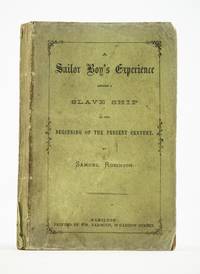
1867ST20572Hamilton Scotland: W. Naismith 1867. FIRST EDITION. 168 x 106 mm. 6 1/2 x 4 1/4". vii 183 pp. <br/> In the very rare original green paper wrappers. Spine cocked wrappers somewhat soiled spine with paper beginning to lift along the bottom inch of the rear joint other minor exterior defects but the volume solid and internally in excellent condition. QUITE A GOOD COPY of a fragile inexpensively produced volume one would expect to find in shambles.<br/> <br/> Told in the form of letters drawn from the author's actual correspondence as well as his contemporary journals this first-hand account by a young sailor of the transatlantic slave trade in the years 1800-04 brings those horrific voyages vividly to life. At the same time the author writing in direct unvarnished prose makes it clear he is at least as much an observer of difficult sea life in general as he is concerned with the abolition of a great evil. In the preface Robinson 1786-1875 explains his reasons for publishing this record of his time aboard a slave ship: "I have heard so many gross misstatements respecting West Indian slavery and the horrors of the 'Middle Passage' that I formed the resolution should time be allowed me to give the result of my own experience . . . in order to disabuse the minds of many well-meaning people." He is rightly aware that some readers may be offended by unconvincing apology in an account encumbered with naïveté : "It is doubtless the opinion of many that I put myself into a wrong position and incurred blame and obloquy by entering into this obnoxious trade at all. It may be so; I will not dispute the matter. I certainly did not feel myself comfortable or at home in the service. But let it be remembered in my favour that the trade was then a lawful one; whilst at the same time I was induced to enter it by what is called an accidental circumstance . . . and an irresistible desire for a seafaring life so completely carried me away that it became a matter of perfect indifference to me where the ship went if not to the bottom provided I was aboard of her--or in what trade engaged if not a pirate." As indicated the letters originating in various ports in England West Africa and the West Indies depict a harsh life at sea for all involved but most especially for the wretches who made up the ship's cargo. An accident on board nearly cost Robinson his foot and ended his career at sea just a year before in his words "the united voice of a generous and philanthropic people" passed the Emancipation Bill into law ending British participation in the slave trade. The phrasing here makes it clear our narrator had his heart mostly in the right place. This is a very rare book which is not surprising for a pocket-sized work from a provincial press near Glasgow issued in insubstantial paper wrappers. OCLC records just two copies in libraries both in the UK while RBH and ABSA seem to list no copies at auction except the present one. W. Naismith unknown
1936015728Paris EDITION ORIGINALE. Tirage à 1012 exemplaires numérotés. Un des 35 sur Hollande van Gelder mis dans le commerce, second papier après vingt-cinq Japon . Bel exemplaire relié à l'époque : demi-maroquin noir à coins et filets or, dos à nerfs et pièce de titre rouge et lettre or, tête dorée, couverture et dos conservés. 1936 fort in-8 Broché Edition originale
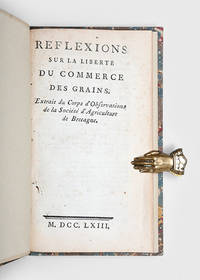
17631730471763. Grain policy in the ancien régime First edition of this exceptionally scarce economic tract on the grain trade. We trace only two institutional copies worldwide: at the University of Chicago and the BnF. The recent spine label attributes this work to Louis Paul Abeille 1719-1807 an early convert to physiocracy and a friend of Quesnay and Mirabeau. Abeille served as secretary of commerce under Louis XV & XVI from 1769-83. A series of subsistence crises brought concerns over public access to grain to the forefront of French economic debate in the mid-18th century. In the absence of public granaries government policy was to regulate more strictly the distribution of grain by private commercial interests but periodic subsistence crises revealed the inadequacy of this policy. Over the next decade the physiocrats continued to promote deregulation of the grain trade which contributed to spiralling prices and the Flour War of 1775. The attribution to Abeille is presumably based on his publication in 1760 of the Corps d'observations de la Société d'agriculture de commerce et des arts établie par les États de Bretagne années 1757 & 1758 which brought him to the attention of Quesnay and Mirabeau in Paris. Abeille was the secretary of the Agricultural Society of Brittany a learned society for agricultural improvement. Duodecimo 159 x 92 mm. Recent marbled paper boards gilt label to spine edges sprinkled red. Minor foxing and browning: a very good copy. Not in Black Goldsmiths' or Kress. hardcover
1823PHO-2335Paris, Ponthieu, Lesage, Gide fils, 1823. 2 volumes in-8, xlix, [1]. 344 ; [4], 407 pp., relié demi basane époque, dos lisse orné avec pièce de titre et tomaison, coiffes abimées, petits manques au dos, coins usés, frottements, manque la mappemonde Chadenat, n°1196. - Forbes, n°569. - Sabin, n°73149.
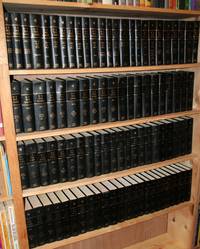
006865New York : Commerce Clearing House 1913-1986 1986. Hardcover. Fine/No Jacket. 91 volumes ; A nearly complete run from 1913-1986 ; almost 75 years of tax litigation history ; At head of title: CCH./ Published: Chicago IL : CCH Incorporated / Accompanied by separately numbered Consolidated volumes vol. 1 1913/1929-v. 5 1917/1940 published 1938-1940 which make available in permanent bound form the opinions originally reproduced and reported in the publisher's "court decisions" division of Standard federal tax service./ "The fifth vol. of the consolidated vols. presents court decisions handed down under the excess profits tax statutes which were effective from 1917 to 1921."--Foreword to v. 5 ; LC: KF6280.A2; HJ3251.A39; Dewey: 343/.73/0402643 ; OCLC: 3157871 ; ISSN: 0277-402X; Other format's ISSN: 1084-0125; National Library: 011150635; LCCN: 37-1000 ; without vols. for 79-2 80-2 81-83 84-1 and duplicates of 74 & 75-1 ; As published in book form we must point out that this set can be used without electricity computers or the internet! ; A fine first impression for anyone entering a law office ; or could make a great stage prop ; FINE <br/> <br/> New York : Commerce Clearing House, 1913-1986 hardcover
184433797London: William Clowes and Sons 14 Charing Cross For Her Majesty's Stationery Office 1844. Folio. 13 1/8 x 7 7/8 inches. First edition. a-b2 B-Z4. i-x 1-176. 186 pp. Diplomatic messages with the USA on pages 19-144. One full-page engraved map titled "Route of the Egyptian Army under Ahmed Pasha on a Slaving Expedition February 1843" by Standidge and Co. p. 169. Later black half morocco binding over black cloth with five raised bands forming six compartments on spine with gilt-lettered title in second and fourth compartments and date in sixth with the binder's ticker of Monastery Hill Bindery on back pastedown<br/> <br/> Important documents letters and reports regarding Great Britain's efforts to curtail the African slave trade across the globe including over 100 pages of diplomatic cables with the USA.<br/> <br/> "Class D. Correspondence" referred to diplomatic letters between the Foreign Office and nations that had not signed treaties with Great Britain regarding the slave trade. Every year from 1830 to 1859 this correspondence was presented to both Houses of Parliament and published: this is the annual compendium covering the year 1843. And though the importation of slaves was illegal in the United States at that time there is a considerable amount of American-British interaction. Great Britain had abolished slavery in toto throughout its colonies in 1834 after the passage of the Abolition Act of 1833. It had been home to a powerful abolition movement that held influence in government for some time prior. Great Britain's economy had grew less dependent on slavery than its rivals like the US were and slave revolts on its far-flung colonies had been costly to put down. Those reasons coupled with domestic religious and social sentiment had led the British Empire to take action. Insistent British diplomatic correspondence is included here with other key major powers who had not yet signed on to trying to halt the slave trade. The present work covers contacts with Central America Equator New Granada Peru various consulates in the United States the Barbary States Egypt Turkey Crete Albania and Muscat. Much detail is provided about individual ships involved in the trade. William Clowes and Sons, 14, Charing Cross, For Her Majesty's Stationery Office unknown
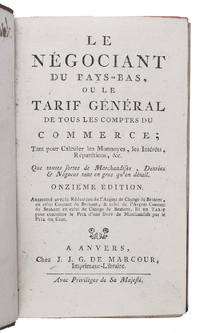
178095L94ST53226Antwerp 1780. 12mo. Johannes Judocus Gerardus de Marcour Contemporary mottled tanned sheepskin gold-tooled spine with olive title-label red edges. XXIII 1 543 1 pp. Corrected and augmented eleventh edition of a handbook for merchants and traders in the Southern Netherlands here in a French edition but also available in Dutch Den Nederlandschen negociant . All editions appear to be very rare. It consists of numerous tables giving information for the conversion of monetary units weights and measures.The privilege p. XXIV is issued in the name of Maria Theresa who died in 1780 and De Marcour was active from 1764 to 1797. The many unnumbered editions no doubt confused publishers who probably numbered their editions to follow the highest number they had seen: the University of Kansas has a ninth edition Liege 1784 the Hendrik Conscience library a ninth Antwerp De Marcour 1792; ; and there is a tenth Antwerp Grangé 1798.With some early 19th-century annotations on endpapers. Spine slightly rubbed one leaf party detached but otherwise in very good condition.l Groote Vijftig jaar boekdrukkunst te Antwerpen p. 31; Anet 3 copies; STCV 1 of the same copies; WorldCat 2 of the same copies. unknown
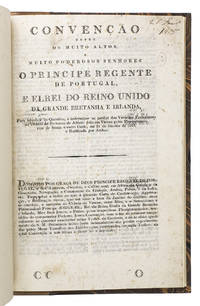
ABC_48887Lisbon: Na Impressão Regia 1815. Modern half calf marbled paper sides with the title and year of publication lettered in gold on the spine. Small folio ca. 28.5 x 18 cm. With the text printed in two columns in Portuguese on the left and in English on the right. Very rare first Portuguese edition of this treaty between Portugal and the United Kingdom of Great Britain and Ireland concerning the indemnification of Portuguese subjects for certain detained slave trade vessels as a result of British actions undertaken in pursuit of the abolition of the slave trade. "Britain agreed to pay compensation for the several Portuguese slavers detained brought before and condemned by British courts on the ground of illegal slave-trading along the African coast prior to 1814" J.P. van Niekerk "British Portuguese and American judges in Adderley Street ." pp. 22-23. Another edition of this same treaty in 8 pages was printed in the same year in Rio de Janeiro with the complete imprint including the place of publication.The present bilateral treaty comprising three articles printed in two columns in Portuguese and English was drafted on 21 January 1815 during the Congress of Vienna a series of international diplomatic meetings held in Vienna from September 1814 to June 1815 concerning the new layout of the European political and constitutional order after the downfall of the French Emperor Napoleon Bonaparte. The signatories of the present treaty were plenipotentiary at the Congress of Vienna formally this treaty was concluded between the Prince Regent of Portugal - future King John VI 1767-1826 - and the King of Great Britain and Ireland George III 1738-1820 as mentioned in the title.A more detailed description is available upon request.With the book plate of "Biblioteca de Hariberto de Miranda Jordão Filho" mounted on the front pastedown. The text leaves with a vague horizontal and vertical fold in the centre a manuscript annotation "21 Janeiro 1815" in brown ink in the upper outer corner of the first page some foxing. Otherwise in good condition.l Gauz Portuguese and Brazilian books in the JCB 815/10; Porbase 3240734 1 copy; WorldCat 1042407673 12791342 38346960 4 copies; cf. Camargo & Moraes Bibl. da Impressão Régia do Rio de Janeiro I 428; Rodrigues 735 & 737 Rio de Janeiro ed.; for more context relating to the treaty: Lesaffer R. "Vienna and the Abolition of the Slave Trade" Oxford Public International Law online via: https://opil.ouplaw.com/page/498; Niekerk J.P. van "British Portuguese and American judges in Adderley Street: the international legal background to and some judicial aspects of the Cape Town Mixed Commissions for the suppression of the transatlantic slave trade in the nineteenth century Part 1" in: The Comparative and International Law Journal of Southern Africa Vol. 37 No. 1 March 2004 pp. 1-39. online via: https://journals.co.za/doi/pdf/10.10520/AJA00104051_114. Na Impressão Regia, unknown
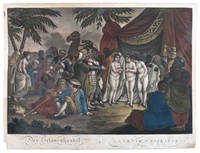
1800I7DD3T6LJ6QQNo place 1800. 27 x 40 cm. Aquatint in contemporary hand colour engraved by "J. L. T." after "J. R. P." Three partly exposed women before a large tent being advertised and inspected by several men dressed in fine oriental garb. On the left is another woman whose price is under discussion while the background shows date palms and two dromedaries.Rather severe water stains and a few small holes in the blank margin; some scuff marks in the image; trimmed closely with loss to lower left corner. A very appealing print. Rare. unknown
18372A Paris, Chez Pissot, 1775. Two volumes. Together three volumes bound in one. x, 306 pp.; (4), 236 pp.; 184, (2) pp. 8vo. Contemporary speckled calf, spine richly gilt, raised bands and label with gilt lettering. First work: Kress 7071; Goldsmiths 11256; Einaudi 344; Higgs 6259; INED 276. First edition in bookform, first published in the Nouvelles Ephémérides Économiques, and published in a very limited number of copies. Famous physiocratic polemic between Baudeau and Necker, here both present.'Doctrinaire économiste, l'un des plus fervens sectateurs de cette école, et l'un de ceux qui en ont le mieux exposé les principes' (Blanqui, p. 420). The work was written following the publication of Necker's Sur la législation et le commerce des grains presenting, in magnificent style, the arguments of the Physiocrats against Necker's theories. Baudeau criticizes Necker for his preference of industry over agriculture, for his Colbertism and his preferential attitude towards commerce in luxury goods. Baudeau advocates a return to the economics of Sully, protests against the protectionist laws of the new government and argues that free trade in corn will cause a price reduction rather than raise the price of bread.Second work: Kress 7144; Goldsmiths 11267; Higgs 6260; INED 3372; not in Einaudi; Lichtenberger, Socialisme au XVIIIe siècle, pp. 305-310. First edition: although the title-page indicates that this is the second edition, it is in reality the first edition, with the errata-leaf at the end of volume two and the errata uncorrected.Necker condemned the physiocratic doctrine of free trade and was in favour of government control.
1768PHO-2449Paris, Chez DEBURE père, 1768, 3 volumes in-folio (sur 4) (35x26cm), 3ff.-XXX-347pp., 1f.-348pp.-767pp., X-627pp.-2ff., plein veau glacé lavallière, dos à nerfs, caissons ornés de fleurons dorés, pièces de titre et de tomaison en maroquin rouge et vert, plats frappés aux armes de Dominique de la Rochefoucauld dans un triple encadrement doré, toutes tranches dorées, double filet doré sur les coupes, frise intérieure, doublures et gardes de papier marbré (reliure de l'époque). Épidermures, coiffes abimées, coins usés certains avec manque, charnières fendillées, quelques cahiers brunis, très petite mouillure marginale au tome 2 sur quelques feuillets.
1959015858Copenhague L'Internationale situationniste 1959 In-4 Broché, couverture à rabats
221218Genève, Jean-Léonard Pellet, 1780 10 vol. in-8 et 1 atlas in-4, veau fauve marbré, dos lisse orné, pièce de titre et de tomaison de maroquin rouge et vert, tranches marbrées, demi-veau fauve marbrée, dos lisse orné, tranches rouges pour l'atlas (reliure de l'époque). Restaurations sur certains plats, quelques épidermures. Coiffe absente et coins usés pour l'atlas. Quelques rousseurs.
18559A Paris, Chez la Veuve Estienne et Fils, 1741. 3 volumes. (8), xxvii, (1), 544 pp., (545)-1140 numbered columns; (4) pp., 1772 numbered columns; (4) pp., 1316, 684 numbered columns. Folio. Contemporary marbled calf, spines gilt with raised bands, red labels with gilt lettering. Kress 4584; Goldsmiths 7819; not in Einaudi; not in INED. Jacques Savary (1622-1690) was for some time director of the French Royal Domains, and later became general business agent to the Duke of Mantua. He had such sound notions about commerce and was so successful in his operations that Colbert appointed him in 1670 in the "Conseil de la Reforme", which was to reform and refine the rules of commercial practice. The "Commercial Code" of 1673 resulting from it was called after him "Code Savary". He was then also pressed to write down and publish all his commercial knowledge, which pressure led to the publication of the famous Le parfait Négociant (1675). It taught everything a merchant should know, but only his left papers revealed to the world the immense and universal knowledge on commerce Savary possessed. The dictionary was immensely successful and covers all aspects of commerce and trade as well as legal and historical matters. Deals among others with: trading cities throughout the world, their manufactures, operation of foreign trade, trading companies (including a short history of the South Sea Company), banking (including an account of John Law's Bank), bookkeeping, etc. etc. The dictionary was the first of its kind to appear in Europe, and has furnished the principal part of the material for most of the dictionaries that were to follow. The project was sponsored by the French government who justly considered that such a dictionary, if well executed, would be of national importance. Hence a considerable, and indeed the most valuable portion of the work is compiled from memoirs sent to the author, by order of government, by the inspectors of manufactures in France and by the French consuls in foreign countries (see: McCulloch, p. 61). The dictionary is preceded, in volume one, with an elaborate, long (upto column 544) separate essay on the "État général du commerce de l'Europe" (and followed by the other continents Africa, Asia and the Americas). - Very small damage to head of spines of volumes 1 and 2.
26145A Paris, Chez la Veuve Estienne et Fils, 1741. With nice head- and tailpieces. 3 volumes. (8), xxvii, (1), 544 pp., (545)-1140 numbered columns; (4) pp., 1772 numbered columns; (4) pp., 1316, 684 numbered columns. Folio. Contemporary marbled calf, spines gilt with raised bands, red labels with gilt lettering, red edges, joints, head and foot of spine and some corners repaired. Kress 4584; Goldsmiths 7819; not in Einaudi; not in INED. Jacques Savary (1622-1690) was for some time director of the French Royal Domains, and later became general business agent to the Duke of Mantua. He had such sound notions about commerce and was so successful in his operations that Colbert appointed him in 1670 in the "Conseil de la Reforme", which was to reform and refine the rules of commercial practice. The "Commercial Code" of 1673 resulting from it was called after him "Code Savary". He was then also pressed to write down and publish all his commercial knowledge, which pressure led to the publication of the famous Le parfait Négociant (1675). It taught everything a merchant should know, but only his left papers revealed to the world the immense and universal knowledge on commerce Savary possessed. The dictionary was immensely successful and covers all aspects of commerce and trade as well as legal and historical matters. Deals among others with: trading cities throughout the world, their manufactures, operation of foreign trade, trading companies (including a short history of the South Sea Company), banking (including an account of John Law's Bank), bookkeeping, etc. etc. The dictionary was the first of its kind to appear in Europe, and has furnished the principal part of the material for most of the dictionaries that were to follow. The project was sponsored by the French government who justly considered that such a dictionary, if well executed, would be of national importance. Hence a considerable, and indeed the most valuable portion of the work is compiled from memoirs sent to the author, by order of government, by the inspectors of manufactures in France and by the French consuls in foreign countries (see: McCulloch, p. 61). The dictionary is preceded, in volume one, by an elaborate, long (upto column 544) separate essay on the "État général du commerce de l'Europe" (and followed by other essays on the continents of Africa, Asia and the Americas). Ooii -Vviv in volume three with a wormtrack in the upper outer blank margin.
in -16. cc 107, ---12, 30. Pergamena coeva. Aritmetics, matematic, geometry, trade, economy, change, cambio. Computing accountancy. in cassetto a-b
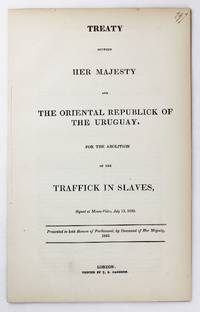
18426316London: T.R. Harrison 1842. Near fine. 38pp. stitched. Very minor bumps to top edge of first leaf light dust-soiling to outer leaves. A very rare treaty between Queen Victoria’s Britain and the “Oriental Republick of the Uruguay†printed in both English and Spanish in two parallel columns throughout. According to the text the parties were “mutually animated by a sincere desire to co-operate for the utter extinction of the barbarous Traffick in Slaves.for the special purpose of immediately attaining this object so far as relates to the total and final abolition of the Slave Trade of the Oriental Republick of the Uruguay.†The treaty is comprised of fourteen original articles plus three annexes totaling forty-six additional articles and four additional articles at the end covering a host of issues pertaining to the suppression of the slave trade. These issues included enforcement procedures the establishment of “Mixed Courts of Justice†“Regulations in respect to treatments of liberated negroes†and much more. With regard to slaves found on international vessels the two nations hoped for “permanent good treatment and a full and complete emancipation according to the humane intentions of the Parties of the Treaty.â€<br /> <br /> The present treaty was part of a larger effort by the British Crown to put an end to the transatlantic slave trade in the first half of the 19th century; at this same time Britain had reached terms on a similar treaty with the Republic of Texas and other nations. The document is signed at the end in type by J.H. Mandeville and Jose Ellauri representatives of the two countries who originally signed the treaty at Montevideo on July 13 1839; the present work was “Presented to both Houses of Parliament by Command of Her Majesty†in 1842 likely due to bureaucratic delays. Uruguay would have been an important ally for Great Britain in monitoring the seas against the transatlantic slave trade given its position opposite the South Atlantic Ocean from West Africa. OCLC records just a single physical copy of this treaty at the University of Arizona.<br /> <br /> Cundall 2854. T.R. Harrison unknown
10833Collection complète, du n° 1 (été 1924) au n° 29 (printemps 1932). Nous joignons l'Index des années 1924-1928, paru sous forme de tiré-à-part joint au n° 22 (Hiver 1929). TOUS LES NUMEROS FONT PARTIE DU TIRAGE SUR VELIN PUR FIL LAFUMA (2e papier dont le nombre d'exemplaires est compris entre 150 et 300) et sont tous en bon ou très bon état. // Le n° 1 porte la mention manuscrite " Exemplaire sur Lafuma ", apposée par Auguste Morel qui a également signé cet exemplaire de ses initiales ; ce détail fait de cet exemplaire une belle pièce joycienne puisque dans ce premier numéro de " Commerce " paraît la première traduction en français d'un extrait d'ULYSSE de Joyce - traduction justement due au même Auguste Morel et à Valery Larbaud. // Rare et belle collection sur grand papier.
19422091502135500375Manzhou Yingkou Chamber of Commerce 1942. Soft Cover. Fine. Number of pages: 2 2 23 364 118p Size: 16x22cm Manzhou Yingkou Chamber of Commerce paperback
19422091502135500132Yingkou Chamber of Commerce 1942. Soft Cover. Fine. Number of pages: 2 2 23 364 118p Size: 16x22cm Yingkou Chamber of Commerce paperback
53K000002L7EUnited States Department of Comm. unknown_binding. Like New. . No writing or tears United States Department of Comm unknown
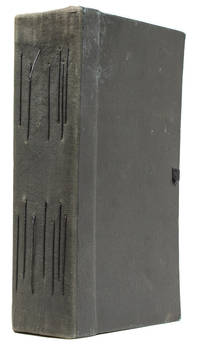
1900263502Lyon France: J. Bouvard & Cie 20 Rue Lafont 1900. 14 thick card sheets with samples centrally mounted vertically to recto and verso some sheets quite thick to accommodate larger epaulets each with manuscript notations of name size etc. 11-3/4 x 6-3/4 inches. Black cloth album with the printed label of "J. Bouvard et Cie Fabrique de Dorures Soireries Ornaments d'Eglise" to front paste-down. Some wear commensurate with age and use spotting and thumbsoiling apparently complete with all samples backing possibly restored at an early date. 14 thick card sheets with samples centrally mounted vertically to recto and verso some sheets quite thick to accommodate larger epaulets each with manuscript notations of name size etc. 11-3/4 x 6-3/4 inches. This very unusual French sample book contains a large range of epaulets and sequin samples with a few lettering and star samples. J. Bouvard & Cie 20, Rue Lafont unknown
028941Detailed manuscript archive pertaining to this vessel owned by Ichabod Goodwin 1794-1882 merchant and businessman of Portsmouth and Governor of New Hampshire1. The archive consists of correspondence bills receipts and documents pertaining to the <i>Morning Glory</i> and her voyage to California Washington Territory and Vancouver on what proved to be a particularly ill fated voyage. 42 letters 73 pages mainly quarto 164 bills receipts etc. 28 legal documents 112 pp. from England Esquimault Victoria Vancouver British Columbia Port Townsend and Steilacoom Washington Territory San Francisco Peru etc. <br />The <i>Morning Glory</i> H. H. Hobbs masterwas engaged in coastal trade between Peru and the Northwest Coast of Washington Territory and Vancouver British Columbia. She was on a return voyage to Callao with a cargo of lumber for the South American market when disaster struck as related in the following letter from Hobbs to Ichabod Goodwin: <p> San Francisco June 13 1858 </p><p> "Hon. I Goodwin </p><p> Dear Sir </p><p> I am very sorry to have to inform you that I have met with a great misfortune with the ship. I was beating out of the straits of Fucu Straits of Juan de Fuca and struck a sunken rock that lays about one half mile off the race rocks. At half past 12.00 P.M. on May 30th while in the act of tacking ship. This rock is not down on any charts not even those of the British man of war it has 10 feet draft at low water. The ship remained on the rock from half past twelve until eight in the morning when she rolled over on her beam ends and slid off. The rock was very steep for the ship struck bows on and at the Break of the forcastle there was five fathoms of water and at the stern there was eleven fathoms. The ship made no water from the time she struck until five in the morning when she commenced making water very fast and by the time we had been off the rock an hour the ship was entirely full after we found that we could not make any impression on the water for we had our hands pumping the water gained two feet on us the crew refused to proceed to sea I wanted to bring the ship to San Francisco as I know there were no conveniences north of this port where the ship could be repaired. But as the crew would not work but all refused to work the Ship I was obliged to make for the first port. I brought the ship into the harbour of Esquimault where all of the British men of war lay. </p><p> I came down to San Francisco to see the Underwriters Agent to see what I should do with the ship and he will not consent to let me bring the ship down as she is consequently I have been obliged to get a steam pump to take up to pump the ship out and also a diver if we can stop the leak with a diver who has a submarine armour we will use the steam pump. I return by the first steamer that leaves for Victoria. Messrs Flint & Peabody will furnish me with funds. ." </p><p> The collection goes on to detail the progress of the vessels repairs in an effort to reach San Francisco the nearest place where the proper repair of the ship could be completed. However while attempting to bring the vessel from Victoria to San Francisco the ship encountered a violent gale and was run onto the beach at Port Townsend Washington Territory in hopes that the leak could be reached and repaired while partially exposed. </p><p> Hobbs at length made temporary repairs and set sail for San Francisco in September 1859: </p><p> Port Townsend Sept. 26 1859 </p><p> Hon I. Goodwin </p><p> Dear Sir </p><p> I have just received yours of August 17th. I am now on the point of sailing for San Francisco I have got the leak stopped so that ten minutes pumping will do for twenty four hours. I have been obliged to sell some of the cargo of lumber to raise funds to disburse the ship. payable in ten days after the arrival of the ship in San Francisco. The parties who advance the money were not able to advance the necessary funds until the arrival of the steamer from San Francisco consequently I was obliged to sell the lumber to pay off labourers I do not know how I will raise the money to disburse the ship in San Francisco I am now of your opinion that it would have been for the Interest of all concerned to have abandoned the ship in Victoria. I shall be ready for sea tomorrow and will not be over ten or fourteen days getting to San Francisco." </p><p> The Morning Glory was eventually taken to Mare Island put in dry dock and was thoroughly overhauled: </p><p> Mare Island Nov. 19th 1859 </p><p> "Honble I Goodwin </p><p> Dear Sir </p><p> The survey that I had held on the ship estimated that the cost of repairing on the ship would come less than thirty thousand dollars so under this survey I could not abandon. The repairs were all recommenced by Mr. Hanscom and he says that the ship will be as good as before. We have put in a lower piece of stern and forward piece of Keel of California live oak. The ship is now on the dock and will of next Thursday. The Knees are to be refastened and the stantions in the lower hold kneed also. </p><p> P.S. We did not find the ship injured near as much as we expected every one here says that she is the strongest and most thorough built ship that has ever been on the dock." </p><p> This highly detailed archive documents virtually everything that went into and out of the vessel upon this voyage. It details aspects of Northwest Coast maritime commerce maritime law insurance and salvage construction and other costs and the economics of the coastal trade at the time. </p><p> 1. <i>American National Biography </i>vol. 9 pp. 269-271 </p><p> <i>Dictionary of American Biography</i> volume IV pp. 408-409 </p><p><i> Who Was Who in America </i>Historical Volume p. 210 </p> books
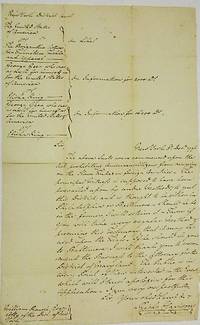
179635853New York 1796. Single page 9-1/2" x 15-3/4" entirely in manuscript. Headed with names of three cases pending in the New York District Court followed by Harison's letter to Rawle. Old folds with a pinhole at a fold intersection no text loss. Short fold split expertly repaired. Very Good.<br/><br/> Harison 1747-1829 was President Washington's appointee in 1789 as the first United States Attorney for the District of New York. He served until 1801 when Edward Livingston succeeded him. His correspondent William Rawle was Washington's appointee as U.S. Attorney for Pennsylvania. Rawle was founder and first president of the Historical Society of Pennsylvania president of the Pennsylvania Abolition Society and a highly respected writer on governmental matters.<br/> The Slave Trade Act of 1794 passed by the Third Congress and signed by President Washington was the first American regulation of the international slave trade. It prohibited Americans from trading in slaves to any foreign country. Harison had brought several cases under the Act as noted in this Letter: The United States vs. The Brigantine Active; and two by George Geer for himself and the USA vs. Elisha King. Harison explains "The above Suits were commenced upon the Act prohibiting American Citizens from carrying on the Slave Trade in foreign Countries." <br/> Harison's problem: "The principal witness is supposed to have been prevailed upon by undue Methods to quit this District is thought to be either in Philadelphia or Baltimore." If he's in Philadelphia "I will esteem it a Favor if you will take every regular Method of procuring his Testimony." If he's in Baltimore please "recommend the Business to the Attorney for the District of Maryland. The Public is in every Point of View interested in the Event." Diligent research has uncovered no additional information on these cases. unknown books
1900263502Lyon France: J. Bouvard & Cie 20 Rue Lafont 1900. 14 thick card sheets with samples centrally mounted vertically to recto and verso some sheets quite thick to accommodate larger epaulets each with manuscript notations of name size etc. 11-3/4 x 6-3/4 inches. Black cloth album with the printed label of "J. Bouvard et Cie Fabrique de Dorures Soireries Ornaments d'Eglise" to front paste-down. Some wear commensurate with age and use spotting and thumbsoiling apparently complete with all samples backing possibly restored at an early date. 14 thick card sheets with samples centrally mounted vertically to recto and verso some sheets quite thick to accommodate larger epaulets each with manuscript notations of name size etc. 11-3/4 x 6-3/4 inches. This very unusual French sample book contains a large range of epaulets and sequin samples with a few lettering and star samples. J. Bouvard & Cie 20, Rue Lafont unknown books