184 824 résultats
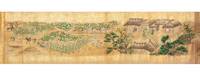
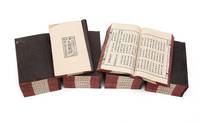
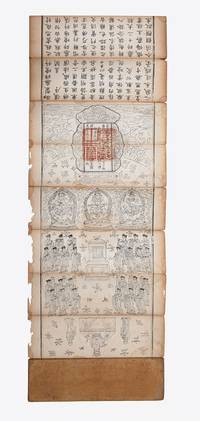
10529Two & one-half woodcut illus. 44 sheets each folded into multiple pages. Oblong small 8vo 89 x 288 mm. orig. stiff boards in concertina format one loose. Beijing: Nei fu 內府 1617.<br /> <br> <br> <br /> <br /> A very scarce bilingual — Tibetan and Chinese — Buddhist scripture published at the Ming Imperial Household in Beijing. Ours is one of two known copies judging by WorldCat 1202247985. Our book is dedicated to Bhaiá¹£ajyaguru the healing Buddha. This Buddha “has a body more brilliant than the sun which was the color of lapis lazuli vaiá¸Å«ryamaṇi and possessed the power to heal illness and physical deformities†The Princeton Dictionary of Buddhism pp. 108-09. <br /> <br> <br> The Ming court periodically asserted sovereignty over Tibet and several Ming emperors Wanli among them patronized Tibetan Buddhism by printing Tibetan-language scriptures in Beijing.<br /> <br> <br> The title given in the Preface authored by the palace eunuch Zheng Li é„利 is enigmatic. In the cartouche that follows the illustrations at the beginning of the book the title is given as Yaoshi shier dayuan tanchang fayi 藥師åäºŒå¤§é¡˜å£‡å ´æ³•å„€ Dharma Ritual for the Site of Enlightenment with the Twelve Vows of the Healing Buddha. The twelve vows of Bhaiá¹£ajyaguru invoked in the title are:<br /> <br> <br> 1. The vow to brightly illuminate his own body and the bodies of others;<br /> <br> <br> 2. The vow to use his power to quicken the enlightenment of sentient beings;<br /> <br> <br> 3. The vow to have sentient beings satisfy their wants and not suffer from poverty;<br /> <br> <br> 4. The vow to firmly establish all sentient beings in the course of the Great Vehicle;<br /> <br> <br> 5. The vow to have all sentient beings live morally and to embrace the three sets of precepts;<br /> <br> <br> 6. The vow to fully enhance the spiritual capacities of those who are lacking them;<br /> <br> <br> 7. The vow to free all sentient beings from the myriad sicknesses to make them at ease mentally and physically and to have them experience peerless perfect enlightenment;<br /> <br> <br> 8. The vow to transform females into males;<br /> <br> <br> 9. The vow to liberate all sentient beings from the entrapments of MÄra and mistaken non-Buddhist paths and from the dense forest of incorrect thinking and evil views arisen based on ignorance of cause-and-effect to induce correct cognition;<br /> <br> <br> 10. The vow to liberate all sentient beings from the unexpected misfortune of robbery evil rulers and so forth;<br /> <br> <br> 11. The vow to have all hungry and thirsty human beings gain excellent nutrition;<br /> <br> <br> 12. The vow that the poor who lack clothing will be given fine garments Digital Dictionary of Buddhism.<br /> <br> <br> The Preface is dated 1599 Wanli jihai whereas the cartouche is dated 1617 Wanli dingsi.<br /> <br> <br> Our book appears to lack the final leaf of the illustration at the end. However a comparison with the digitized copy originally held at the Berlin State Library which is the only other copy that we know of lacks even the first leaf of this illustration. Ours is thus the more complete copy. The Berlin copy was evacuated to Silesia during the Second World War and was then taken to Krakow when that region became part of Poland. It is still in Krakow.<br /> <br> <br> We believe that our book comes from the collection of Japanese sinologist Kanda Nobuo 神田信夫 1921-2003.<br /> <br> <br> Fine copy; some tears in the margins with no loss of text and some marginal dampstaining as well as the aforementioned possible loss of half an illustration at the end. One board is loose. Preserved in a modern hantao. unknown
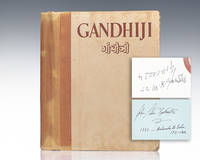
1944149272Bombay: Keshav Bhikaji Dhawale October 2 1944. First unabridged edition of this tribute to Gandhi with introductions by Gandhi and Jawaharlal Nehru and a biographical essay by Albert Einstein. Quarto original publisher's half cloth patterned endpapers illustrated with black and white photographs and tipped-in color plates frontispiece. Boldly signed by Mahatma Gandhi on the half-title page. Association copy additionally signed by John Kenneth Galbraith opposite the copyright page "John Kenneth Galbraith 1987 -- Ambassador to India 1961-1963." Although he remains best known as an iconoclast in the field of economics John Kenneth Galbraith was very active in Democratic Party politics serving in the administrations of Franklin D. Roosevelt Harry S. Truman John F. Kennedy and Lyndon B. Johnson. During his time as an adviser to President John F. Kennedy Galbraith was appointed United States Ambassador to India from 1961 to 1963. Kennedy considered India to be important not just in its own right but also because an Indian diplomat always served as the chief commissioner of the International Control Commission ICC. Thus Galbraith came to be involved in American policy towards Southeast Asia from his perch as an ambassador in New Delhi. During his tenure in India Galbraith developed close ties with Prime Minister Jawaharlal Nehru and engaged deeply with the political and cultural life of the country. He expressed admiration for India’s experiment in democratic socialism and non-alignment and he frequently drew comparisons between Nehru’s political legacy and that of Mahatma Gandhi. While Galbraith did not interact directly with Gandhi—who had been assassinated in 1948—he often invoked Gandhian ideals in his reflections on India’s development and its moral role in the post-colonial world. His writings and diplomatic efforts emphasized the importance of non-violence civil society and moral leadership themes closely associated with Gandhi’s philosophy. In very good condition. A wonderful association copy very rare and desirable signed by Gandhi and even more so with the addition of Galbraith's signature. Published in 1944 to both commemorate Mahatma Gandhi’s 75th birthday and support the Kasturba Gandhi National Memorial Fund Gandhiji: His Life and Work contains essays by various contemporaries examining Gandhi’s political career social reform efforts and influence on Indian society as well as a curated selection of Gandhi’s own writings including speeches and letters. Although Gandhi generally declined to participate in birthday commemorations he wrote a preface for this volume citing its charitable purpose. As a mid-career publication released during Gandhi’s lifetime the book reflects the contemporary reception of his work and offers early interpretations of his role in the Indian independence movement. "Generations to come it may be will scarce believe that such a one as this ever in flesh and blood walked upon this earth" Albert Einstein On Gandhi. Keshav Bhikaji Dhawale hardcover
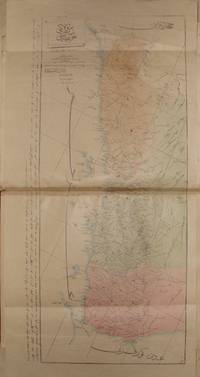
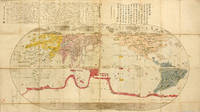
000150<p><strong>126 × 59 cm.</strong> Paper mounted on <strong>thick cloth</strong>. Text in <strong>Ottoman Turkish</strong> printed in a <strong>European-style typeface</strong>.</p><p>Depicting the <strong>northern Ottoman territories</strong> extending from the <strong>Caspian Sea</strong> to the <strong>eastern regions of Austria</strong>.</p><p>An <strong>early wall map</strong> printed under <strong>Ottoman authority</strong> in <strong>Üsküdar Scutari</strong>.</p> the Imperial engineering ground forces, Muhendishane
000444<p>Üsküdar: Mühendishane-i Berr-i Hümâyun<br />Imperial / Royal School of Military Engineering<br />c. 1840s</p><p>Rare Ottoman administrative atlas produced at the Mühendishane-i Berr-i Hümâyun in Üsküdar the principal Ottoman military and cartographic institution of the 19th century.</p><p>Folio 40 × 28 cm later hard cover binding.<br />Illustrated by Yümnî with thirty-nine 39 hand-colored double-page maps most signed in the stone by Yümnî. The maps are titled dated and carry printing details with the majority accompanied by Ottoman Turkish descriptive text.<br />Printed in the 1840s shortly after the establishment of the Ottoman telegraph network this atlas is possibly the earliest comprehensive administrative atlas printed in Üsküdar reflecting the modern vilayet system of the Tanzimat era.<br />Condition: Very good. All maps complete and well preserved. Scarce.</p><p>List of Maps 39</p><p>Arabistan Arabian Peninsula – 56 × 47 cm<br />Trablusgarb ve Tunus Libya and Tunisia – 56 × 39 cm<br />Trablusgarb Libya – 56 × 40 cm<br />Mısır Eyalet-i Mumtazası Territory of Egypt – 56 × 46 cm<br />Yemen – 69 × 33 cm<br />Hicaz Hejaz – 56 × 39 cm<br />Ankara<br />Sivas<br />Ma'mûretülaziz<br />Diyarbakır<br />Bitlis<br />Erzurum<br />Van<br />Musul Mosul – 56 × 39 cm<br />Bağdad Baghdad – 56 × 39 cm<br />Basra – 55 × 39 cm<br />Zor Mutasarrıflığı part of Mesopotamia<br />Halep Aleppo<br />Adana<br />Konya<br />Kıbrıs Cyprus<br />Cezâ'ir-i Bahr-i Sefîd Aegean Islands Vilayet<br />Aydın<br />Biga Mutasarrıflığı<br />İzmit Mutasarrıflığı ve Hüdavendigâr Vilayeti<br />Trabzon<br />Kastamonu<br />Bulgaristan Eyalet-i Mumtazası Territory of Bulgaria<br />Rumeli-i Şarkî Eastern Rumelia – 56 × 39 cm<br />Bosna Bosnia<br />Kosova Kosovo<br />Manastır Monastir / Bitola<br />İşkodra Vilayet of Shkodër<br />Yanya Janina / Ioannina<br />Selanik Thessaloniki<br />Edirne<br />İstanbul<br />Bahr-i Siyâh Boğazı Black Sea Strait<br />Kal'a-i Sultâniyye Boğazı Dardanelles</p><p>Significance<br />A highly important and scarce example of Ottoman state-sponsored military and administrative cartography documenting the Empire's territorial organization across Anatolia the Arab provinces North Africa the Balkans and the Straits during a key phase of modernization and infrastructural reform.<br />This atlas stands alongside the earliest telegraph-era Ottoman mapping projects and represents the mature output of the Mühendishane cartographic tradition.</p> MuhendisHane-i Berr-i Humatun (The Royal school of military engneering) hardcover
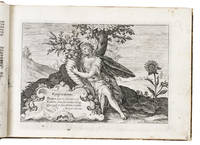
1614ABC_48468Utrecht 1614. Oblong folio ca. 18.5 x 26.5 cm. for Crispijn van de Passe Later half calf decorated paper sides gold-tooled spine and red sprinkled edges. With a full-page plate of Flora embracing the cornucopia in a landscape with an epigram by Arnoldus Buchelius in a cartouche in the left hand corner engraved by Simon van de Passe after Crispijn van de Passe 2 different frontispieces both appearing twice of ideal gardens full of flowers and 174 full-page engraved plates of flowers fruits fruit trees and medicinal plants mainly by Crispijn van de Passe the Younger 3 by his brother Willem van de Passe. 2 parts in 1 volume the first in 4 sections. 26 pp. 118 engraved ll.; 1 1 blank pp. 61 engraved ll. Very rare first Dutch edition of this famous book on horticulture including beautifully engraved plates of flowers organised according to the season in which they bloom and frontispieces showing the ideal garden. The work was first published in Latin under the following title: Hortus floridus in quo rariorum & minus vulgarium florum icones . without text published in Arnhem by Jan Jansz. in 1614. The expertly engraved plates were also sold separately and were constantly updated and amended by adding various details insects other animals or simply different numbers to meet demand. While the present first Dutch edition contains short explanations of the plates on separate typographical leaves the same information was only added to the Latin version of the work in its second edition 1616 - the corresponding text then appearing on the verso of each engraved plate. The text was written by Arnoldus Buchelius or Aernout van Buchel 1565-1641 a Dutch scholar and humanist from Utrecht who is now most known for specialising in genealogy and heraldry.This Dutch edition was soon followed by English and French editions. The Hortus floridus including translations was considered without question the most popular florilegium ever published An Oak Spring Flora and "Blunt calls this the most celebrated and influential of the early florilegia and one of the finest Hunt.The emphasis of the plates is on the common garden flowers with a preponderance of spring bulbs. The book was intended to provide inspiration for garden lovers who were invited to colour the black and white copperplate engravings themselves according to the colours they found in their own gardens. The introduction is enlarged with details on how to colour the plates. Many of the flowers shown are tulips hyacinths crocuses and other bulb plants mirroring the new enthusiasm and passion for bulbs which eventually led to the tulip mania of the years 1636-37 when contract prices for some bulbs reached extraordinarily high levels leading to the first recorded speculative bubble in history.As the plates were printed then modified and assembled at different times between 1614 and 1617 almost no two copies are the same - consisting of various numbers of plates with different title pages and prefaces. Our copy seems to be a practically complete copy of the Dutch edition containing an unmatched number of plates the only plate not present in this copy which is sometimes included in others is the engraved plate frontispiece of the Latin quotation from Matthew 6 Cognoscite lilia in part 2. The four sections of part 1 include 113 plates of flowers including the 99 that are called for in the preface organised per season: spring: 41; summer: 20; autumn: 26; winter: 12. The extra plates are as follows: 1: an addition to spring with plate 42 = second copy of plate 2 of summer 2: 12 plates depicting tulips numbered 43-54 and 3: an addition to autumn: a plate depicting two metal cylinders for growing flowers 1 with a tulip not found in any other copy consulted but possibly called for by Nissen "Garten Instruments".The second part includes 61 plates depicting 120 numbered depictions of fruits fruit trees and medical plants. This part included in most copies of the Latin edition and in some of the Dutch edition had been published already by Crispijn van de Passe the Elder around 1600-1604 when he was in Cologne in association with the publisher Hans Woutneel.The quality of the engravings is exceptionally fine and delicate representing real masterpieces of horticultural art executed by a leading family of engravers and publishers in the first half of the Dutch Golden Age.With a 19th-century round stamp with double eagle and the initials "H.C.P.S.G." and a red stamp "Ex libris J. Visser Rotterdam" on the title page with the red ex libris stamp also on the divisional title page of the second part. Lacking the engraved plate frontispiece of the Latin quotation from Matthew 6 Cognoscite lilia in part 2. The binding is very slightly rubbed the bottom outer corner of the back board is slightly damaged the typographical leaves are slightly soiled the head margin of the title page is cut short and restored with paper lightly foxed some very slight foxing and/or soiling throughout mainly to the outer edges of the margins some small marginal tears some restored in several leaves plate 44 spring with a repaired tear plate 43/44 in part 2 is repaired in the head margin. The verso of 45 plates show minute pricked holes in the leaf following the outlines of the depicted flowers and plants as a way of tracing the images on another leaf of paper or possibly another copperplate. Otherwise in good condition.l Franken 1881 no. 1346; Hunt no. 199; Nissen BBI no. 1494; Oak Spring Flora 12; Saunders Picturing Plants pp. 36-37; Savage The Hortus Floridus in: Transactions Bibiogr. Society Second series IV 1923 pp.181-206; Segal Flowers and Nature 1990 pp. 165-166; Soultrait 17th century 226; STCN 308020359 3 copies incl. 1 incomplete; USTC 1022789 4 copies incl. 1 incomplete; 3 the same as STCN; cf. Veldman Crispijn de Passe and his Progeny 1564-1670: a century of print production 2001 pp. 205-212. ABE CAT Art History unknown
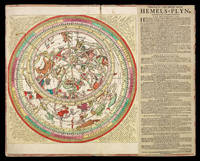
17221992Amsterdam: Jochem Hasebroek c1722. 500 by 630mm. 19.75 by 24.75 inches. Large engraved celestial chart by Stampioen with a rotating printed paper ring volvelle or rete on an off-centre axis to indicate the part of the sky visible at any date and time and to make a variety of celestial calculations all for the Netherlands' latitude of 52 degrees. With letterpress instructions by Calman on a separate slip at the right. The sky image 33 cm in diameter; the whole chart with the letterpress slip as mounted 49 x 61.5 cm. A string with a bead serves as a pointer for aligning the scales in the stationary and rotating parts. Coloured by a contemporary hand and mounted on contemporary boards covered with marbled paper apparently by the publisher so that it can be folded in half for carrying. The chart is here in its third state but we have located no complete example of any earlier version. The Boerhaave Museum in Leiden has the chart without volvelle or instructional text published by Doncker but the 1664 edition described in Doncker's advertisement clearly included the volvelle and instructional text. Perhaps the surviving chart is the 1684 version mentioned but not seen by Bierens de Haan who provides neither a detailed description nor a source for his information. They and the present version printed from Doncker's plate c1722 seem to have appeared only as separate publications hence their great rarity. The circular border around the sky image and the outer part of the volvelle include scales with several kinds of data so that the chart can be used for various purposes. One can use the string to align the time in the volvelle with the date in the border of the chart so that the part of the sky visible at that moment appears inside the volvelle. The chart with its volvelle scales and string can also be used to calculate times for the rising and setting of constellations at various dates or to calculate the present time based on the position of the stars. Fifty-three constellations are numbered quarter by quarter 15 9 14 and 15 with a Dutch key identifying them in each corner. Calman's instructional text printed letterpress on a separate slip 495 by 185 cm and mounted to the right of the chart itself describes the different scales etc. then presents nine "proposals" giving examples of the use of the chart. If the volvelle is turned with 12 midnight to the right the boards can be folded to each other like a portfolio protecting the chart and making it easier to carry. It may have been published in this form for the only other copy located at the Adler Planetarium in Chicago is similarly mounted. The marbled paper covering the portfolio similar to Wolfe 33-35 was common in the Netherlands in the late seventeenth and early eighteenth centuries. In the plate of the star chart itself is engraved "Auct. J. Stampioen. 't Amsterdam by Iochem Hasebroek" but Hasebroek's name is larger and in a different style than the rest of the lettering and one can see traces of an earlier name under it. Although the older name cannot be deciphered one can see that "Hendrick Doncker" would fit with traces of the h and Do and marks where the ascenders to the d k and k would have been making it clear that the present chart is printed from Doncker's original plate. Calman advertised his Amsterdam boarding school for calligraphy mathematics etc. in 1722 and Hasebroek 1682- 1756 is recorded as a sea chart publisher and instrument maker from 1714 to 1743. Koeman IV p. 5 no location noted; cf. p. 153; Warner Sky Explored p. 260 no. 1c no location noted; cf. p. 247; Alder Planetarium on-line database A-259; cf. Bierens de Haan 4516 1684 ed. not seen: see his Bouwstoffen II pp. 386 & 429 note 5; E.O. van Keulen et al. "In de Gekroonde Lootsman" item 4 & illustration between pp. 64 & 65 1680/1696 Vooght/Van Keulen ed.; not in BMC Printed Maps; Zinner Astron. Instrumente; NCC/Picarta; OCLC WorldCat. Jochem Hasebroek, hardcover
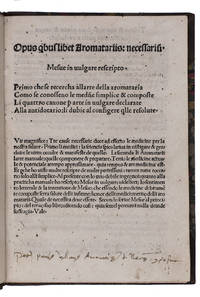
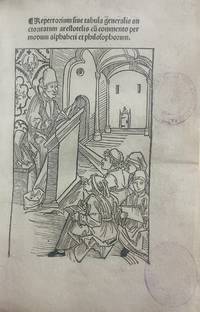
1500LALAD7L9DY67Napels or Venice 1500. Half calf over marbled boards ca. 1900 gold-tooled spine gold-tooled red spine label red sprinkled edges. 4to 14.5 x 19.8 cm. Rare and almost unobtainable first edition of a digest of medical prescriptions taken from the works of the highly-regarded Arabic physician Mesue the younger also known as Masawaih al-Mardini including "a kind of general manual for apothecaries and perfumers" Duveen. All recipes are in Italian while the main title and the headings are in Latin. The literature records only two copies world-wide at the British Library and the University of Wisconsin the later formerly the Duveens. In fact the copy in the British Library is incomplete lacking the final leaf Copinger erroneously describes its endleaf as a final integral blank leaf.With a contemporary owner's inscription on the title page. With a restored tear in the final leaf not affecting the text some brown specks on the title page and an insignificant water stain along the lower edge of the final gathering but altogether in excellent condition.l BM STC Italian p. 739; Copinger 4011 BM copy; Duveen 651 Duveen copy; EDIT 16 CNCE 50479 BM copy; GW M23031 same 2 copies; ISTC im00521400 same 2 copies; Klebs 228 note; Proctor 7427 BM copy; USTC 842290 same 2 copies. hardcover
193816060JBurbank: Warner Brothers Pictures 1938. Original 322 page private in-studio conductor’s score printed in purple ink used by Erich Wolfgang Korngold in recording his musical score for the classic film Robin Hood. With occasional annotations and markings by Korngold in pencil. Additionally each musical sequence is marked with red pencil for recording. This score was presented to Hal Wallis the producer of the film with a large remarkable two page Korngold written inscription: “To Hal Wallis with many thanks in friendship and admiration Erich Wolfgang Korngold Hollywood 4.18.1938â€. On the facing second page Korngold has written out the first bars of music for six of the film’s musical themes “Robin Hood†“Robin Hood’s Companyâ€â€Lady Marian†Lionheart England†“Sir Guy†“Love Themeâ€. Beneath which Korngold has written “One minute - one page†--â€One hour - a million of notes†The genning of each sequence is marked in print CONDUCTOR. Beautifully bound in dark green Niger leather with gilt-stamping. The volume measures 10 1/2 inches wide by 12 1/2 inches tall. It is enclosed in a custom clamshell full linen cloth box. Hal B. Wallis 1899-1986 was one of Hollywood’s greatest film producers whose additional accomplishments include the films Casablanca The Maltese Falcon Yankee Doodle Dandy Dark Victory and many others. The resulting film has come down to us as one of Hollywood’s greatest classics and stars Errol Flynn Olivia de Havilland Claude Rains and Basil Rathbone. Korngold won the Academy Ward for Best Original Score for The Adventures of Robin Hood. The American Film Institute chose Robin Hood as number eleven in its list of the top 25 best American film scores. This score is included in any of the serious lists of the greatest film scores of all time. Warner Brothers Pictures hardcover books
193816060JBurbank: Warner Brothers Pictures 1938. Original 322 page private in-studio conductor’s score printed in purple ink With occasional annotations and markings in pencil. Additionally each musical sequence is marked with red pencil for recording. This score was presented to Hal Wallis the producer of the film with a large remarkable two page Korngold written inscription: “To Hal Wallis with many thanks in friendship and admiration Erich Wolfgang Korngold Hollywood 4.18.1938â€. On the facing second page Korngold has written out the first bars of music for six of the film’s musical themes “Robin Hood†“Robin Hood’s Companyâ€â€Lady Marian†Lionheart England†“Sir Guy†“Love Themeâ€. Beneath which Korngold has written “One minute - one page†--â€One hour - a million of notes†The beginning of each sequence is marked in print CONDUCTOR. Beautifully bound in dark green Niger leather with gilt-stamping. The volume measures 10 1/2 inches wide by 12 1/2 inches tall. It is enclosed in a custom clamshell full linen cloth box. Hal B. Wallis 1899-1986 was one of Hollywood’s greatest film producers whose additional accomplishments include the films Casablanca The Maltese Falcon Yankee Doodle Dandy Dark Victory and many others. The resulting film has come down to us as one of Hollywood’s greatest classics and stars Errol Flynn Olivia de Havilland Claude Rains and Basil Rathbone. Korngold won the Academy Ward for Best Original Score for The Adventures of Robin Hood. The American Film Institute chose Robin Hood as number eleven in its list of the top 25 best American film scores. This score is included in any of the serious lists of the greatest film scores of all time. Warner Brothers Pictures hardcover
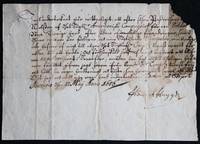
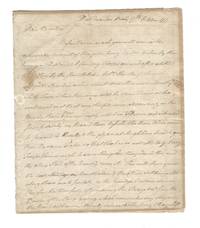
03009040 items 47 pages various sizes ranging from small sheets to folio in Dutch both High and Low Swedish and English the documents have various condition issues damp-stains old tape stains soiling tears and loss associated with over three hundred years of neglect but they are generally legible. <br /><p>The collection of documents and papers offered here pertain to the earliest European settlers on the Delaware River – the colony of New Sweden and one family of settlers in particular the Nilsson family- Jonas Nilsson and his children. These settlers Swedes Finns and Dutch constituted the majority of the population on the South River as they called the Delaware before the Quaker "invasion" that began with John Fenwick's group in 1675 and culminated with William Penn's 23 ships in 1681-1682. The bulk of the papers in this collection date from two periods when the colony was in transition: first from Swedish to Dutch control and then from Dutch to English control. Paper and documents from New Sweden are exceedingly rare many of the records generated by the colony simply did not survive. Most of the materials which did survive have been housed in institutions for generations if not centuries. Collections such as this one essentially the three hundred plus year old Nilsson family papers simply do not appear in the market. </p><p> The collection contains the signatures and marks of many "ancient Swedes." The collection contains a document bearing what is only the second known signature of one of them: "Laurentius Caroli Lutheran minister" Pastor Lars Carlsson Lock. The collection also includes documents signed by Hendrick Coleman one of the leaders of the "Long Finn Rebellion" the first armed insurrection against the English in America. </p><p> For many historians the colony of New Sweden 1638-1655 is perceived as an insignificant blip in American colonial history. One of the reasons is that few records have survived in America for the Swedes Finns and Dutch who were the first permanent European settlers in the region. Between 1637 and 1656 Sweden equipped thirteen passenger voyages for the South Delaware River which departed with about 800 prospective settlers. Eleven vessels and some 600 passengers reached their intended destination. </p><p> The present collection of documents relates to one of those settlers Joen Jonas Nilsson and his family. Nilsson arrived in the New World on the fourth ship in 1643. Nilsson like many of his fellow settlers was illiterate so while there is no correspondence the collection contains the sort of documents and papers that deal with aspects of everyday life legal matters land disputes and other matters mainly involving his neighbors in Kingsessing in what is now present day Philadelphia. The collection documents what daily life was like over 300 years ago in the lost colony of New Sweden and gives a picture of conditions and domestic life facing the first settlers in the mid-Atlantic over 300 years ago. </p><p> <b>Biographical Sketch of Joen Jonas Nilsson 1620-1693 </b> </p><p>"Jonas Nilsson from Skaraborg County Sweden came to New Sweden as a soldier in 1643 and married Gertrude daughter of Sven Gunnarsson. His seven sons used the patronymic Jonasson which evolved into Jones. Their family in 1671 included Nils b. 1655 Judith b. 1658 Gunilla b. 1661 Måns b. 1663 Anders b.c. 1666 Christina b. 1668 and John b.1670. Subsequent children were Peter Jonas Brigitta and Jonathan. Jonas Nilsson died in October 1693 at the age of 73. Lovelace's patent to Jonas Nilsson dated 18 May 1672 named Hans Månsson Peter Andersson widow Dalbo Anders Boon and Mr. Otto Ernest Cock as owners of land adjoining his several parcels." </p><p>Craig Peter Stebbins "<i>1671 Census of the Delaware</i>" page 21 Philadelphia: Genealogical Society of Pennsylvania 1999 </p><p>Joen Nilsson was one of the many soldiers accompanying Governor Printz on the Fourth Expedition to New Sweden. Nilsson of Skåning hundred Skaraborg län would later become better known under the name of Jonas Nilsson. Born in 1621 Jonas was a tailor by trade. He was an imposing character reported to be six and a half feet tall. He began his voyage to New Sweden from Stockholm in September 1642. After arriving at Fort Christina 15 February 1643 he was one of many men assigned to help build Fort Elsborg where he was subsequently stationed. Nilsson served governor Printz faithfully as a soldier and also served the colony as a tailor for eleven years until 1653. But when Printz returned to Sweden in 1653 Nilsson did not go with him. He obtained his discharge and became a Freeman. After Governor Rising arrived in 1654 Nilsson was able to secure passage to Sweden to collect the moneys due him. New Sweden was essentially a barter economy where the currency consisted of beaver skins half-beaver skins and sewant. To collect real money for one's services it was necessary to go to Sweden. Most of the settlers in New Sweden owed money to the New Sweden Company and had no incentive to return. Before he left Nilsson signed the Freemen's Loyalty Oath on June 9 1654 and married Gertrude Svensdotter in 1654. She was the daughter of Sven Gunnarson and was born in 1636 in Sweden she immigrated to New Sweden in 1639 on the ship <i>Kalmar Nyckel</i>. Jonas left his young bride in mid-July 1654 to return to Sweden on the ship <i>Eagle</i>. He collected the back wages due him and returned to New Sweden on the <i>Mercurius </i>which arrived in March 1656.Meeting the ship were his wife Gertrude and his eldest son Nils who was born during his absence. Nilsson then became one of the first settlers in Kingsessing where he established an Indian trading post on Kingsessing Creek southwest of the Schuylkill River in present day West Philadelphia. Kingsessing was a Swedish village on the north bank of a creek known as Minqua Kill or Kingsessing there were four households in this village when the 1671 census was taken- one was Nilsson's. </p><p> Nilsson was a friend protector and business advisor of Armegot Printz daughter of the former governor Johan Printz Jonas was a witness to her sale of a church bell to the Swedish church on 24 May 1673. </p><p> In Philadelphia near the present day 77th and Laycock streets stood a house built by Jonas Nilsson c. 1650s. Nilsson for some years before building this house had dwelt in a cave the site of which is still preserved in the side of the hill which slopes from the front door of the cottage to what was originally the bank of a navigable creek. Ships from the Delaware brought up merchandise to the front door of the cottage and the cave the first home of Jonas Nilsson where he reared his eleven children became a storehouse for the goods brought up for his trade with the Indians. The old house with its two rooms and garret was hardly larger than a packing box. The ground floor room had an immense fireplace walled up which extended almost the entire width of the room and nearly to the ceiling which was scarcely more than seven feet high. George Washington later sat in front of that fireplace. Sessions of court were held wherever a building was available and the old Jonas Nilsson cottage was one of the earliest places in America where trial by jury was held. A trail that led to the house from the direction of Tinicum Island has appeared on maps of the city from the very beginning as Jones's Lane. Nilsson's home and trading post was the center of trade with the Minquas Indians arriving from the west via the Great Minquas trail. Nilsson made his fortune by bartering and trading goods for furs with the Minquas. </p><p> Jonas Nilsson lived for his entire married life in Kingsessing West Philadelphia where he raised his family of eleven children. Besides his trade with the Indians he was a successful farmer on his tract of 200 acres. He also acquired an additional 270 acres of land at nearby Aronameck from Peter Yocum land which he divided among his three eldest sons. Each of Nilsson's sons took the patronymic Jonasson which evolved into Jones. </p><p> Jonas's wife Gertrude was a formidable woman. Her outspoken criticism of defamatory remarks by the English against the Swedes was at least once the subject of court notice. Her father Sven Gunnarson and her brothers – the Svenson's which later evolved into Swanson- were later to play a unique role in the early history of both Philadelphia and Pennsylvania. </p><p> In August 1639 the Swedish government needing settlers for its New Sweden colony sent word to the governors of Elfsborg Dalsland and Varmland to capture deserted soldiers and others who had committed some slight misdemeanor and to send them to America. Among the "convicts" rounded up in this effort was Sven Gunnarsson. When the Swedish War Ship the <i>Kalmar Nyckel</i> left Goteborg in September 1639 he was aboard with his pregnant wife and two small children. Initially in New Sweden Sven was stationed at the Fort Christina plantation where he was found in 1644 working on the New Sweden tobacco farm and his son Sven still a boy was herding cattle at the same location. By 1654 Sven Gunnarsson and his family had moved to Kingsessing. In October 1654 he was finally granted freedom from his servitude and joined other freemen residing at Kingsessing now West Philadelphia Here he was known as Sven the Miller as he operated the first gristmill built in New Sweden on the present Cobbs Creek. </p><p> Being a freeman in New Sweden was like being a peasant under the tyrannical rule of Governor Johan Printz. Like other freemen Sven was required to work without pay at Printz's Printzhof plantation whenever the Governor demanded was prohibited from trading with the Indians and forced to buy all necessities at the company store. Like other freemen he fell heavily into debt. Another such freeman Lasse Svensson the Finn and his wife Carin had their plantation seized by Printz who renamed it Printztorp Both Lasse the Finn and his wife were forced to live without shelter in the woods. Both perished leaving several impoverished children. </p><p> It was not surprising; therefore that Sven Gunnarsson was one of the 22 freemen who signed a petition of grievances that they submitted to Governor Printz in the summer of 1653. Printz called it a "mutiny" and returned to Sweden. </p><p> Sven the Miller fared better under Governor Rising 1654-1655. He even volunteered to help defend Fort Christina against the Dutch invasion on August 31 1655. A pitched battle was averted when Rising decided to surrender the colony. Conditions proved to be even better under Dutch rule. Stuyvesant allowed the Swedes living north of the Christina River to organize their own government. That government known as the Upland Court treated Sven Gunnarsson well. </p><p> After the Dutch takeover of New Sweden Sven Gunnarsson moved with his family across the Schuylkill to Wicaco a former Indian settlement where Sven's 1125-acre plantation embraced what would become the future City of Philadelphia. On May 5 1664 the Dutch Governor Alexander D'Hinoyossa granted him and his three sons' acres at Wicaco which was confirmed 31 May 1671 by a grant from Governor Francis Lovelace after the territory came under English rule. Here on his land the first log church at Wicaco now Gloria Dei Church was built by 1677. The last known reference to Sven occurs in the Upland Court minutes of 13 November 1677 where he withdrew a lawsuit after the defendant settled out of court. And he appeared on the list of tydables in the court's jurisdiction as living with his son Anders. Sven Gunnarsson died about 1678 and probably was one of the first to be buried at the Wicaco church. </p><p>In the spring of 1683 Sven's three sons agreed to provide the northern part of Wicaco for William Penn's planned new city to be called Philadelphia. The sons who had adopted the patronymic Svensson which evolved into the anglicized Swanson were left with 230 acres apiece. Sven Svensson Swanson was the eldest son of Sven Gunnarsson he was born in Sweden. He was a Wicaco Church warden and a justice on the Upland court in 1681-82 and was elected to the Pennsylvania Assembly in 1683. They sold William Penn the land upon which the city of Philadelphia was laid out. </p><p>"Having promised in July 1681 to lay out a "large town or city in Pennsylvania" William Penn drew up his specifications for his town. He named his cousin William Crispin 1627-1681 and Nathaniel Allen d. 1692 and John Bezar d. 1684 two Quakers from the western part of England as his commissioners and instructed them to set aside 10000 acres on the best site for a port along the Delaware… William Penn's commissioners however were not able to acquire enough land to carry out many of Penn's plans because the Swedish Dutch and English inhabitant's had already taken up most of the river frontage along the west bank of the Delaware from New Castle to the Falls opposite present day Trenton New Jersey. The commissioners concluded that the best site for William Penn's town was a few miles north of the mouth of the Schuylkill River on land patented by the Swanson family and in the spring of 1682 they obtained 300 acres of river frontage from the Swansons … in which to lay out his capital city."1 </p><p>"One of William Penn's most important and most difficult tasks was to lay out his capital city. Originally he wanted to set aside 10000 acres for Philadelphia but since all of the choicest riverfront property along the western bank of the Delaware was already patented William Penn's commissioner's had to settle for a much smaller site. In early 1682 they bought a tract extending a mile along the Delaware River from three Swedes the Swanson brothers of Wicaco. Dissatisfied with this cramped area William Penn acquired a mile of river frontage on the Schuylkill from two other Swedes Peter Cock and Peter Rambo parallel to his frontage on the Delaware. This gave him a rectangle of 1200 acres stretching two miles in length from east to west between the two rivers and one mile in width from north to south. Within this rectangle Surveyor-General Thomas Holme plotted his famous grid plan of the city."2 </p><p>Records prove that Sven also had two daughters including Gertrude Svensdottar who was born in Sweden in 1638 and who married Jonas Nilsson in 1654 she died in Kingsessing in 1695 survived by eleven children. </p><p>Jonas Nilsson died October 23 1693 and is buried at Gloria Dei Old Swedes Church Burial Ground in Philadelphia. </p><p><b> Brief History of New Sweden</b> </p><p> In March 1638 two ships <i>Kalmar Nyckel</i> and <i>Fogel Grip</i> brought to the Delaware River twenty-three Swedish soldiers and two officers to establish the first and only Swedish colony in the New World. They built a fort on the shore of a small river emptying into the Delaware which stream they named Christina Kill after their queen. The site was the first permanent settlement in the entire Delaware River Valley including Delaware New Jersey and Pennsylvania and is now within the boundaries of the present city of Wilmington Delaware. Having bought from the Indians a tract of land on the western side of the Delaware extending from Sanikan Trenton New Jersey to Cape Henlopen at the mouth of Delaware Bay they claimed this territory for their country calling it New Sweden. </p><p> In 1640 a second expedition arrived with supplies and new colonists their first governor Peter Hollandaer and the first clergyman Rev. Reorus Torkillus. Another expedition arrived in 1641 and a fourth in 1643 bringing a new governor Johan Printz. </p><p> Printz started at once to extend his domain building small forts on the eastern or New Jersey side of the Delaware at Tinicum near the present site of Philadelphia at Upland Chester Pennsylvania and at the mouth of the Schuylkill River. More ships came and more colonists the forests were cleared farms cultivated a village Christinahamn was laid out behind Fort Christina their first establishment. </p><p> Johan Printz ruled New Sweden with despotic power. Military leader as well as civil governor lawgiver chief judge and head of all the colony's activities he was supreme over the whole Delaware Valley south of Sanikan. He was "a man of brave size weighing over 400 pounds" headstrong tyrannical rough violent overbearing arrogant and arbitrary but an intelligent man a brave soldier a strict disciplinarian an able administrator. In all he was a colonial governor whose achievements have been overshadowed by aspects of his character and conduct. He monopolized the fur trade driving out English who came from New Haven and Dutch who came from New Amsterdam seeking to establish trading posts and settlements. By successive expeditions the colony increased to nearly 400 people. </p><p> Pieter Stuyvesant Dutch governor of New Amsterdam built a fort at Sandhook New Castle Delaware called Casimir. Printz's successor Johan Rising in 1653 captured it and again gave Sweden the control of the whole valley. This so angered the Dutch in Holland that in 1655 they sent a warship to New Amsterdam where it was joined by six others. With 300 fighting men Stuyvesant came down from Manhattan took his fort back again and after a ten days' bloodless siege captured Fort Christina as well. Thus New Sweden disappeared from the map and a Dutch province took its place. </p><p> The collection consists of documents bills receipts legal documents pertaining to Joen Jonas Nilsson. </p><p> The earliest dated documents in the collection date from 1656 when Nilsson returned to New Sweden aboard the <i>Mercurius</i>. Traveling aboard along with the 130 colonists was Hendrick Huygen the Dutch supercargo of the Swedish expedition. Huygen was the nephew of Peter Minuit the legendary early director of New Netherland and purchaser of Manhattan who had also offered his services to the Swedish government and had guided the first Swedish expedition in 1637 and had decided where to plant the Swedish flag. Huygen had served as commissary to the colony of New Sweden and had earlier left the colony briefly his return on the <i>Mercurius</i> resulted in one of the first rifts between the Dutch and the Swedes after the Dutch takeover of the colony. The collection includes a document pertaining to Nilsson dated May 17 1656 signed by Huygen while aboard the <i>Mercurius.</i> </p><p>The rift began in March 1656: "…A shipload of 130 Swedes and Finns arrived on the South River expecting to join the Swedish colony. Dutch authorities decided that the settlers "for grave reasons" were an unwelcome addition and ordered the ship the <i>Mercurius</i> to return to Sweden. Meanwhile the commander of the river reported that some of the remnant Swedes had proved "troublesome or very dangerous" namely by holding "secret intelligence with the savages." To prevent more unrest the council ordered the troublemakers to New Amsterdam twelve soldiers on the Delaware and any Swedes who had not taken the oath to do so or face deportation. Hendrick Huygen … had helped the Swedes many times before. Although he tried to resolve the dispute in "a friendly conference" the Dutch commander detained him as "a traitor and enemy of his state." Huygen appealed to the council for permission to settle the colonists temporarily at an uninhabited place until a resolution could be obtained from the home governments. He did not wish them to be dispersed through the Dutch colony for fear that families would be separated and that "they must altogether be deprived of their worship of God and live under a foreign nation whose language and manners are not known to them." </p><p> While Huygen negotiated at Manhattan and Stuyvesant's council continued to insist that the Swedes leave after a stop at New Amsterdam for supplies some Swedes Finns and Indians boarded the <i>Mercurius</i> and sailed it past Fort Casimir contrary to orders and landed up river. Whether it was an effort by the Swedes to liberate their country people or just some of the goods on board the Dutch reacted quickly to restore order. They suspected that "some of the principal men of the Swedes were at the bottom of it and that also most of the other Swedes who had taken the oath of loyalty had in their opinion been stirred up or misled." With the additional soldiers and the warship <i>de Waagh</i> the Dutch eventually drove off the Swedish ship and concentrated on resolving the "differences jealousies and dissensions" that flourished along the Delaware between Indians Swedes and Dutch. </p><p> The <i>Mercurius</i> affair heightened Dutch suspicions that the Swedes were not to be trusted. When the council appointed a vice-director to oversee the Delaware region of New Netherland it instructed him to keep the Swedes and Indians out of Fort Casimir as much as possible and to prohibit "the free people especially the Swedes" from spending the night inside without his knowledge and consent. In general "he must look well after the Swedes who still are there" weed out any "who are not well affected towards the Honble Company and our native country" and "with all possible politeness make them leave … to prevent any more dissatisfaction." From the Swedes perspective they were the conquered living among the conquerors. They remained hopeful that the States General would return the colony to Sweden. In the meantime they asserted their rights and remained a close-knit community."3 </p><p>The Dutch were persuaded to grant the Swedes and Finns a measure of self-government north of the Christina River. And in August 1656 the Swedes own law courts were approved. This first court consisted of Olof Stille Mats Hansson Peter Cock and Peter Rambo. The collection includes some very early legal documents before these and other early court members pertaining to legal cases involving Jonas Nilsson when the court was in session at Kingsessing in September 1665 and at Upland. </p><p>The collection includes a document dated 5 September 1665 signed by Laurentius Carels 1624-1688. Carels was one of the first settlers of Delaware County Pennsylvania and one of the first Swedish Lutheran clergymen in New Sweden. As was typical among Swedish ministers he generally used a Latinized version of his name Laurentius Caroli Lockenius. He is listed in historical records under several different names most commonly Lars Carlsson Lock. This document bears only the second known signature of Lock. The only other signature of Lock's appears on a 1662 letter to Peter Stuyvesant. </p><p> Lars Carlsson was born in Sweden in 1624. In September 1647 at the age of 23 Lars Carlsson sailed from Göteborg to New Sweden arriving in early 1648. He subsequently adopted the surname Lock from his place of origin Lockerud near Mariestad in Skaraborg County Sweden. In the colony he replaced the veteran minister John Campanius. He was based at a church on Tinicum Island built by Johan Printz the governor of New Sweden. At the start of his ministry he served about 200 members. Pastor Lock is believed to have been the author of the July 27 1653 Settlers' Petition to Governor Printz This is because Lock was one of the few settlers who was literate and served as the scrivener he is also believed to have composed the July 7 1654 Settlers' Supplemental Complaint against Printz. These complaints lead to the return of Printz to Sweden. The Swedish colony of New Sweden ended during the summer of 1655. The Swedish settlement was incorporated into Dutch New Netherland on September 15 1655. The Swedish settlers were allowed to retain a pastor of their confession. Reverend Lars Lock remained but the other pastors returned to Sweden. His congregation was widely scattered extending from the Schuylkill River on the north to the Christina River on the south. </p><p>His role as the only minister on the Delaware River did not end until 1677 when the Swedish settlers living northeast of Darby Creek built a new log church at Wicaco present day Philadelphia now Gloria Dei Old Swedes' Church and invited Jacob Fabritius to be their pastor. Jacob Fabritius a native of Grosglogau in Silesia had arrived in New York in 1669 to serve the Dutch Lutheran churches along the Hudson River. Lars Carlsson Lock continued to serve in the pulpits of both the Tinicum church and the Crane Hook church until his death at Upland Creek in September 1688. </p><p>There are a series of documents from 1673 which seem to involve legal questions involving land. Various Swedes are mentioned in these documents including Peter Jegoe Jan Claasen and Anders Svensson Bonde Bonde was one of Nilsson's Kingsessing neighbors he lived on Boon's Island. Anders Svensson born in 1620 in Sweden came to New Sweden in 1639-40 on the <i>Kalmar Nyckel</i> having been hired in Gothenburg as laborer at a wage of five guilders per month. Later adopting the surname of Bonde "farmer" in Swedish he was promoted on 1 May 1643 to the position of gunner. He would have served alongside Jonas Nilsson who was also a soldier. In 1653 he returned to Sweden with Governor Printz only to return to America again on the <i>Mercurius</i> in 1656. Nilsson sailed along with him on the return voyage. By 1660 he had married a woman named Anna parents not identified who had been born in Nya Kopparberget Ljusnarsberg parish Örebro län. Under English rule the second syllable of his surname was dropped so that the surname became "Boon" in most civil records. </p><p>The collection also includes a document dated 1677 which comprise accounts for Jonas Nilsson's services assisting William Tom the High Sheriff for the Delaware in making peace with the Indians: </p><p>"Mr. William Tom Debt </p><p>To Jonas Nielson </p><p>For expenses of wyne & beare by yr order att ye time when the Indians had killed 2 Christians and you made peace wth them att Kingsess…" </p><p>The document lists the various amounts and the costs of brandy and other spirits as well as gun powder and one canoe Nilsson seeks payment of the amount from the estate of William Tom deceased. </p><p>Dated 9 13th 1677. </p><p> William Tom came to New Castle in 1664 with John Carr's company. In 1671 he was the High Sheriff for the Delaware and owned considerable property. While under house arrest for debt he wrote his will 3 January 1677/8 and died that month leaving his entire estate after payment of debts to his godson Richard Cantwell. When the estate was finally settled 22 February 1682/3 nothing was left for Richard. </p><p>There is a document in the collection dated Wikako May 7 1680 concerning Jonas Nilsson and the church at Wicaco now Gloria Dei Old Swedes Church in present day Philadelphia. The document is signed by Jacob Fabritius the minister of the Wicaco Church and also by Sven Gunnarsson and his son Sven Svensson with their "marks". Gunnarsson and Svensson were respectively Nilsson's father and brother in law. These two men owned the land upon which present day center city Philadelphia is located. Their last name was anglicized to Swanson with the arrival of the English. Sven Svensson Swanson sold 300 acres of land to William Penn. </p><p>Sven Gunnarsson who was sent to America for punishment arrived in New Sweden with his wife and several small children on the Kalmar Nyckel in 1640. After becoming a freeman he settled in Kingsessing and was one of the freemen signing the 1653 complaint against Governor Printz. Before 1664 he moved with his three sons to Wicaco where according to Peter Stebbins Craig he died "circa 1678." But Gunnarsson was still alive in May of 1680 as evidenced by this document. He had two known daughters Gertrude who married Jonas Nilsson and a daughter who married Peter Månsson son of Måns Svensson Lom and moved to Cecil County Maryland. His three sons were Sven Svensson born in Sweden Olle Svensson born on the Kalmar Nyckel in 1640 and Anders Svensson born in New Sweden in 1644. </p>Sven Svensson Swanson was a Wicaco church warden Sven Svensson was the eldest and sole surviving son of Sven Gunnarsson in 1693 when the Census of Swedes on the Delaware was taken. He was born in Sweden and his wife Catherine parents not identified was born near Stockholm. Svensson was a justice on the Upland court in 1681-82 and was elected to the Pennsylvania Assembly in 1683. His will of 21 July 1696 proved 8 October 1696 named four daughters: Birgitta who in 1693 was married to Sven Bonde; Margaret born 1671; Barbara 1674; and Catharine 1682. His only known son Lars Svensson died unmarried by 1693. Sven's widow Catharine was allegedly 92 years old when she was buried 19 August 1720. <p>The collection also includes a copy of a portion of Jonas Nilsson's will the sheet has been trimmed along the left edge. Peter Stebbins Craig states in his 1693 Census of the Swedes on the Delaware that: "Jonas Nilsson being "very sick of body" signed his will on 14 Jan. 1691 and died in October 1693." In it Nilsson notes how his lands in Kingsessing and in Aronameck were to be divided amongst his wife and children. The text is in English and likely dates from January 1691 Nilsson indicates in the first sentence that he was "verie sick and weak of bodie" the document was signed and sealed in the presence of Robert Longshore. </p><p>Robert Longshore who was one of Nilsson's Kingsessing neighbors was an Englishman and deputy surveyor for William Penn. Robert Longshore became part of the Swedish community when he married Margaret Cock born 1667 the daughter of Peter Larsson Cock. In 1693 their household of four included two children: Euclid and Alice Elsa. Longshore died intestate and letters of administration were issued to his widow Margaret on 12 March 1694/5. </p><p>There are two copies of an undated document circa 1670-1671 concerning Jonas Nilsson signed by Hendrick Coleman with his mark Jan Gustafsson and one other individual. Hendrick Andersson Coleman was a Finn of Swedish ancestry. He gained considerable notoriety as one of the principal figures accused in the Long Finn Rebellion. Coleman was the principal accomplice of Marcus Jacobson the "Long Finn" who urged the Swedes and Finns to take up arms against the English. The Long Finn rebellion was the first insurrection against the English in America. On August 2 1669 the governor issued an order for his arrest noting that Henry Coleman well versed in the Indian language had abandoned his plantation including cattle and corn and was hiding in the woods with the Indians. He was arrested and fined 930 guilders. Coleman is reputed to have married the daughter of an Indian chief. In 1671 he resided at Carkoen's Hook Kingsessinga but moved in 1675 with Peter Larsson alias Putcan to a 100 acre tract on the northwest side of Mill Darby Creek opposite Carkoen's Hook. After the death of his brother Lars Hendrick moved to Gloucester County to live on the farm he inherited. He died about 1697 survived by his wife Anna and one daughter also named Anna. </p><p>a. Coleman is found in Kingsessing on: "A 1671 List of the Inhabitants from Matiniconk Island to New Castle. New York Historical Manuscripts Dutch Volumes XX-XXI Delaware Papers English Period p. 306 </p><p>Johan Gustafsson was from the Kinnekulle area Skaraborg lan came to New Sweden in 1643 as a soldier under Governor Printz. on the same ship as Jonas Nilsson. Printz' successor Governor Rising promoted him to the position of a gunner and as such he was stationed at Fort Trinity New Castle in 1655 when Captain Sven Skute surrendered the fort to the Dutch. </p><p>Another undated document is signed by Anders Homman the trumpeter of New Sweden and Carl Anderson for whom no information can be found. </p><p>Anders Andersson Hommann was born December 1620 in Sollentuna parish Stockholm lan Anders Hommann came to New Sweden on the <i>Swan</i> in 1643 as a soldier. Effective march 1 1648 he was promoted to the position of trumpeter. After the surrender of New Sweden he chose to remain in America and married Catharine parents unknown who was born in Finland. He was one of the original patentees of Carkoens Hook in Kingsessing and served as constable of the Upland court 1678-80. On 26 March 1684 Anders Anderson of "Carkas Hook" was granted 150 acres on Repaupo Creek in Gloucester County New Jersey. Frequently thereafter this creek was called Trumpeter's Creek or Hoeman's Creek after its first resident. He had eight known children: Matthias Lars Rebecca Olof Peter Anders Michael and Birgitta most of whom were living at home in 1693 when the census was taken. Anders was buried in the old Glebe burial ground at Upland Chester on 9 September 1700. His will left his entire estate to his son Matthias who was charged with the duty of maintaining his mother Catharine during the remainder of her life. Carl Anderson may have been a son of Anders. </p><p>There is an undated document circa 1656-1679 concerning Jonas Nilsson Kingsessing and one of his neighbor's there Peter Andersson. Peter Andersson came to New Sweden as a farm hand in 1640. In 1671 his family included his wife Gunilla a son Anders Petersson b. 1657 and probably daughters not yet identified. Peter died circa 1679 after which his son adopted the surname Longacre Långåker in Swedish meaning long field. Peter Andersson's patent issued by Governor Nicolls on 1 Jan. 1667/8 mentioned that Peter Andersson's land obtained from Peter Rambo adjoined lands owned by Sven Gunarsson Anders Dalbo and Jonas "Sweer" which must be an alias for Jonas Nilsson. The document is signed by Nilsson and Andersson with their marks. The document may also bear the signature of Andersson's wife Gunilla. </p><p>There is an undated document in the collection signed by Olle Svensson and mentioning two individuals for whom I can find no information Hakan Jenk and Hendrick Andris Dalbo. John Olleson Svensson Swanson was one of the sons of Sven Gunarsson. Although Olle Svensson "Wolla Swanson" was still carried on the 1693 tax list he had died in the summer of 1692. Born on the <i>Kalmar Nyckel</i> in 1640 Olle had married Lydia Ashman daughter of Robert Ashman and sister of Lasse Cock's wife. Olle served as justice on the Upland court 1673-1680. In 1693 all of his children still lived at home with their mother Lydia: John 1668; Swan; Maria; Birgitta; Lydia 1680; Catharine; and Judith 1688. </p><p>The collection contains an undated document concerning Jonas Nilsson and two of the most venerable of the "ancient Swedes": Peter Rambo and Peter Cock. It is signed at the end by Jonas Nilsson with his mark. </p><p>Peter Gunnarsson Rambo heads the list of the 1693 Census of the Swedes on the Delaware. Peter Rambo a revered citizen of New Sweden was from Hisingen near Gothenburg and had arrived in New Sweden on the second voyage of the <i>Kalmar Nyckel</i> in 1639-40. Employed initially as a farm hand at ten guilders a month Peter sent part of his wages home to his father Gunnar Petrsson. On 1 November 1644 Peter Rambo became a freeman and settled in Kingsessing. In 1653 he joined other freemen in signing the complaint against Governor Printz. Under Governor Rising's rule he served on the Council of New Sweden. He also served on the court under Swedish Dutch and English rule for 29 years. On April 7 1647 Peter Rambo married Brita Mattsdotter from Vasa. By 1669 they had moved to a 300 acre plantation at Passyunk. They had four sons and four daughters one of whom died at the age of eight. Two other daughters married Anders Bengtsson and Peter Mattson. The third married daughter has not been identified; she died by August 1694. Peter Rambo's wife died 12 October 1693 and Peter himself was buried on 29 January 1698 at the age of 85. </p><p>Peter Larsson Cock was born at Bångsta Turinge parish Stockholm län in 1610 and adopted the surname of Kock meaning "cook" in Swedish in 1641 when having been sent as an imprisoned soldier to New Sweden he became the cook on the ship. On the same voyage was Måns Svensson Lom with his wife two "almost grown up daughters" and a small son. Peter's wife Margaret whom he married in 1643 was likely one of these daughters. They had thirteen children one of whom died young. There were six sons. Three daughters married sons of Peter Rambo three others married Anders Petersson Longacre Robert Longshore and Bengt Bengtsson. After becoming a freeman Peter Cock settled on an island at the mouth of the Schuylkill River. In July 1651 he witnessed two Indian affidavits confirming that the Swedes were owners of the land on which Stuyvesant had built Fort Casimir his name being erroneously copied as Peter Bock instead of Kock. Governor Printz accused him of illegally trading guns with the Indians and after Cock had been exonerated by the jury sentenced him to three months of hard labor anyway. This incident was one of the grievances in the freeman's 1653 complaint against Printz which Peter Cock signed. Under Governor Rising Cock served as a judge on the court a position that he retained under Dutch and English rule until succeeded by his eldest son Lars in 1680. Frequently called upon to handle negotiations with the Indians Peter Cock also won favor with the English by capturing Marcus Jacobsson the instigator of the "Long Finn Rebellion" of 1669. Peter Cock died at his island which he called "Kipha" 10 November 1687. His widow Margaret who had been born in Roslagen Sweden was buried 13 February 1703 at the age of 77. During the 18th century the family surname evolved into Cox. </p><p>The collection has an undated document likely circa 1690-93 in English headed: <i>"An accompt of what goods and moneys that Jonas Nielsons children have taken from him at severall times as followeth</i>:" The document lists silver and pieces of Spanish Gold various textiles a silver spoon livestock and two guns as well as their respective values which Nilsson's children Gunilla Andrew Jones and John Jones had "taken" at "severall times." </p><p>And lastly there is a small manuscript note dating from circa 1693 headed: <i>A List of papers belonging to ye Executors of Jonus Nelson</i> </p><p>It is an inventory likely including many of the papers in the present collection of Jonas Nilsson's papers at the time of his decease. </p><p>"15 – papers in duch or sweads & some English out of use </p><p> One deed of peeter yocom for land 130 acres </p><p> On pattin from York </p><p> On will of Jonus Nelson & administration </p><p> One deed of 270 acres of Land sind & delivered to Neils Jones </p><p> 2 inventory paper </p><p> On ragod note of som goods took </p><p> One noat in ye custody of Margrot Longshor ordered to deposit by Jonas Nelson of som goods took from Kingsesing now dd to Justa Gustison </p><p>A noat of part of ye occupants mony dd to gustevso </p><p>A petition to ye …ward one </p><p>A paper of survey of Lands </p><p>On pass in sweads suposod </p><p>Two tax receipts </p><p>Two quitrent receipts </p><p>Two papers in dutz or swead </p><p>On atzon in demand one paper" </p> <p>1. Soderland Jean R. ed. William Penn and the Founding of Pennsylvania: A Documentary History </p><p>Philadelphia: University of Pennsylvania 1983 p. 82 </p><p>2. Soderland Jean R. ed. William Penn and the Founding of Pennsylvania: A Documentary History </p><p>Philadelphia: University of Pennsylvania 1983 p. 204 </p><p>3. Williams James H. The Fall of New Sweden: Political Takeovers Cultural Makeovers 2004 http://www.mceas.org/Williams.pdf </p> <p>References: </p><p>Craig Peter Stebbins 1671 Census of the Delaware </p><p>Philadelphia: Genealogical Society of Pennsylvania 1999 </p><p>Craig Peter Stebbins The 1693 Census of the Swedes on the Delaware Family Histories of the Swedish Lutheran Church Members Residing in Pennsylvania Delaware West New Jersey & Cecil County Md. 1638-1693 </p><p>Winter Park Florida: SAG Publications Studies in Swedish American Genealogy 3 1993 </p><p>Craig Peter Stebbins and Williams Kim-Eric eds. Colonial Records of the Swedish Churches in Pennsylvania Volume 1 The Log Churches at Tinicum Island and Wicaco 1646-1696 </p><p>Philadelphia: Swedish Colonial Society 2006 </p><p>Gehring Cahrles T. trans. And ed. New York Historical Manuscripts Dutch Columes XVIII-XIX Delaware Papers Dutch Period A Collection of Documents Pertaining to the Regulation of Affairs on the South River of New Netherland 1648-1664 </p><p>Baltimore: Clearfield Company 2000 </p> <p>Gehring Charles T. ed. New York Historical Manuscripts Dutch Volumes XX-XXI Delaware Papers English Period A Collection of Documents Pertaining to the Regulation of Affairs on the Delaware 1664-1682 </p><p>Baltimore: Genealogical Publishing Co. Inc. 1977 </p> books
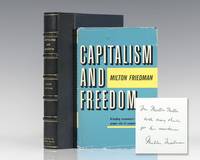
196287436Chicago: University of Chicago Press 1962. First edition of Friedman's magnum opus. Octavo original blue cloth. Association copy inscribed by the author on the front free endpaper to colleague and friend "For Merton Miller with many thanks for his assistance Milton Friedman." Fine in a very good dust jacket with light rubbing. Housed in a custom half morocco clamshell box. An exceptional association linking these two Nobel Prize-winning economists and giants in the field as Friedman revolutionized economic theory with his free-market free-from-government principles and Miller changing the way markets assess a company's value. "Friedman a laissez-faire economist and professor at the University of Chicago is considered one of the leading modern exponents of liberalism in the 19th-century European sense. In Capitalism and Freedom he argued for a negative income tax or guaranteed income to supersede centralized bureaucratized social welfare services which in his view are inimical to the traditional values of individualism and useful work" Britannica. Selected by the Times Literary Supplement as one of the "hundred most influential books since the war". It also placed tenth on the list of the 100 best non-fiction books of the twentieth century compiled by National Review and on Time Magazine's top 100 non-fiction books written in English since 1923. University of Chicago Press hardcover books
1787 + 1790. 4to. Leaves measuring 19 x 15,5 cm. Both works bound together in one simple, but very nice nice full vellum binding (19,7 x 16,5 cm). Very well preserved. Occasional minor browning or soiling. Overall very nice indeed. Haldorsson: 91 ff. Written in a beautiful, steady hand, in easily legible Icelandic script, in dark brown ink throughout. Illustrated and beautifully illuminated in blue, green, red, and yellow. 22 lines to a page (occasionally 21 or 23). Catchwords and running titles. Title written in blue, yellow, red, and brown ink, within a hand-painted ornamental border in yellow, blue, and red. Verso of title-page with a hand-painted ornamental border in yellow, blue and red, within which a large miniature illustration in brown ink, with title (Luc. 2. v. 11. 13) and four lines of text underneath inserted into ""frame"". Text and illustration also within a hand painted frame, in red. The insterted ""plate"" measures 14 x 8,7 cm. Hand-painted opening header to preface, large hand-painted initial and ornamental vignette to end of preface, all three in multiple colours. Opening of text in red paint, with a large initial in red and yellow. First line of each new chapter painted in either red, blue, green or yellow, same as ""AMEN"" at the end of each. The end of the text with a large half-page crest-like vignette with birds and flowers painted in red, blue, yellow, and green. The two leaves with ""Nijars=Psalmur"" at the end with hand-painted opening header, large opening initial, and large vignette at the end. In all ca. 60 large hand-painted multi-coloured initials throughout, in different sizes, measuring roughly, in cm 6x5 (9)" 5x5 (5) 4x4 (24) " 3x3(or 2,5) (21). 1 blank leaf between the two works. Meisner/Svevus: 95 ff. (including full-page illustrations). Written in a beautiful, steady hand, in easily legible Icelandic script, in brown ink throughout. Illustrated and beautifully illuminated in blue, green, red, yellow, and black. 23 lines to a page (occasionally 22). Catchwords. Title written in red, blue, and brown within an elaborately illustrated ornamental border in red, yellow, green, and black. Verso of title-page with a large miniature illustration in brown ink, with title (Luc. 2. Cap V. 7) and three lines of text underneath, within a handpainted ornamental border in red, yellow, green, and black. The miniature measures 11,5 x 7 cm. Hand-painted opening header to preface in red an black and large illustrated intial in red, green, yellow, and black. Each new section with a large, elaborately painted multi-coloured initial. First section with a large, elaborate end-vignette, followed by an illuminated leaf with a large ornamental border (almost in Grolier-style) in red, blue, yellow, and green, inside which a miniature in brown ink, from Luc 2. Cap, with two lines of text above and three underneath. Miniature itself measuring 4,3x5,5 cm. Verso blank. Next section with multi-coloured header, large opening initial, several large initials, and large end-vignette. One leaf with ""Inneleg"" with red and green header, large initial, and pretty end-vignette, followed by an illuminated leaf with an ornamental border in red, yellow, and green, inside which a miniature in brown ink, from Joh. II. v. 25. 26, with three lines of text underneath. Miniature itself measuring 11x7 cm. Verso blank. Following opening with an ornamental border in black, green, red, and yellow, a large opening initial, large, elaborate initials, and large end-vignette, followed by a leaf with a hand-painted ornamental border in yellow, black, green, and red, within which a large miniature illustration in brown ink has been inserted, with two lines of text above. The insterted ""plate"" measures 11 x 9 cm. Next opening with hand-painted ornamental header in black, green, and red, large opening initial, several elaborate initials, and a crowned end-vignette in red, blue, green, and yellow, followed by a full-page miniature-painting in blue, red, green, yellow, black and brown ink. Verso blank. Following section opening with a large initial, with several large, elaborate initals, and ending with a red ornamental vignette, followed by an illuminated leaf with a large ornamental border in red, black, yellow, and green, inside which a miniature (of Jesus on the closs) in brown ink with touches of red and yellow from Esaiae 53. v. s., with four lines of text underneath. Miniature itself measuring 10 x 7 cm. Verso blank. Final section with red, green, and black header, large opening initial, several elaborate, large initials, first line of each new section in red, as well as ""AMEN"" at the end, and half-page end-vignette in red, green, yellow, and black. In all 46 large, multi-coloured initials, most of them measuring approximately, in cm, 7-9 x 6-8 (35), some a bit smaller - 6x6 (7), 5x5 (3), and 4 x 3,5 (1). 6 miniature illustrations in all. One blank leaf at the end.
162718927Frankfurt: Matthaeus Merian 1627. First edition. Hardcover. Very good. Matthaeus Merian. Oblong folio leaves: 20.6 by 31.2 cm; plates: 10 to 11.5 by 14.5 to 15.5 cm. Engraved titlepage borders without letterpress; 231 of 233 engraved plates printed on the rectos with no printed text depicting biblical scenes from the Old and New Testaments lacks Gen. XIX: Lot and his daughters after the destruction of Sodom and Gomorrah; Exod. VIII & IX: The plague of frogs. Recent marbled calf lightly rubbed at extremities bordered in blind; gilt-tooled spine with raised bands gilt lettering pieces. Occasional light stains and smudges especially at the outermost leaves and almost entirely restricted to the blank margins; old mostly marginal repairs and reinforcement of tears to about 30 leaves Matt. IV plate with loss of about 10 words of manuscript text. Protected by wide margins the plates are clean fresh and bright with relatively few minor blemishes. Housed and protected in a custom luxurious modern leather clamshell box.<br /> <br /> Rare suite of biblical illustrations printed before letter perhaps as proofs comprising 231 of 233 engraved plates from the Icones Biblicae of Matthaeus Merian the elder 1593-1650. The engravings are printed on large paper and lack any printed text. They are preceded by a leaf of the engraved title borders to the first part in which the central cartouche which would have contained a letterpress title and imprint is here blank. Neat manuscript annotations appear throughout: atop each engraving is a brief title along with a notation of the biblical book and chapters; beneath each engraving are six-lines of rhyming verse in German; at the top corners are leaf numbers in Arabic numerals. All are penned in black ink in the same old cursive German hand. The engraved title leaf is not included in the manuscript foliation. The first three leaf numbers and several others among the first 23 leaves are obscured by wear or later marginal repairs. The foliation ends at leaf 233 and is discontinuous where one would expect to find numbers 15 and 38 corresponding to the missing plates noted above. As noted by Wütrich only four of the 233 plates are signed by Merian all in the New Testament series. Each of these signed plates appears in our suite: Matthaei I. - page 7; Johannis VIII. - page 65; Matthaei XXVII. - page 101; Apocalyps. IX. - page 145 header titles and page numbers from the first edition.<br /> <br /> The first editions were published at Frankfurt in four parts between 1625 and 1627. The Pentateuch series was published in 1625. The second part illustrating the Old Testament books from Joshua to Kings appeared in 1626. These first two series were published under the name of Merian's father-in-law the printer and bookseller Johann Theodor de Bry 1561-1623 whose heirs retained title to the business. The third part illustrates the remainder of the Old Testament and Apocrypha; the fourth the New Testament. These last two parts were published in 1627 under the engravers's own name. Verses in Latin German and French accompany each plate in the three Old Testament series the French verses being omitted in the 1627 New Testament series.<br /> <br /> While the eminent Swiss draughtsman and engraver Matthaeus Merian is best known for his topographical depictions of the German speaking lands which appeared in the Theatrum Europaeum his novel selection of biblical stories and innovative stylistic approach revealed in the present series of plates proved highly influential ushering in a new age of copperplate engraving in Bible illustration. Merian broke with the century-long tradition of woodcuts which had accompanied countless editions of Luther's German Bible. Even as he drew on the Bible illustrations of Jost Amman Hans Holbein Virgil Solis and Tobias Stimmer Merian greatly expanded the traditional iconographic and compositional repertoire. The Old Testament alone contains 23 prints depicting stories that had never before been the subject of an engraver. While earlier New Testament woodcuts focused on the Book of Revelation Merian now provided a rich series of plates to illustrate the Gospels and Acts of the Apostles as well.<br /> <br /> Merian had an obvious preference for crowd scenes and battles along with some of the novelistic features of the Old Testament such as Jacob's lentil dish Solomon and Shulamit in the Song of Songs or the apocryphal story of the Dragon in Babylon. Merian sometimes provides local color from his home town of Basel as in his depiction of Solomon's Temple Consecration in which despite the baroque redesign the Basel Cathedral with the old choir is easily recognizable. The costumes and gestures of Merian's biblical characters display a baroque fantasy of the ancient Near East as reflected in the theater of his day; in depicting cities and buildings however Merian generally prefers to follow contemporary models. In individual cases such as Bathsheba's Bath he succumbed to the temptation as an engraver and artist to show off his skills in a magnificent fashionable palace and garden complex. All-in-all Merian's engravings initiated a development in Bible illustration "that led further and further away from the didactic Reformation purpose of Bible pictures to purely artistic-representational purposes and finally ended in the well-known pathos of the German Romantic Nazarenes" Schmidt.<br /> <br /> In the first few decades after their appearance these Bible plates were widely copied throughout Europe especially in the Netherlands and France Poortman. The first folio Bible to use Merian's copper plates to illustrate the text was published by the heirs of Lazarus Zetzner at Strasbourg in 1630. Subsequent editions of the "Merian Bible" were published at Frankfurt where Merian had taken over his father-in-law Johann de Bry's business. For over a century as Merian's heirs continued to publish new editions this would become "the most widespread German illustrated Bible in southern Germany Basel and Alsace primarily in wealthy households" Schmidt. After the demise of the Merian publishing house in 1727 the bookseller Philip Heinrich Hütter acquired the copper plates which he used to illustrate a Catholic Bible edition published at Frankfurt in 1740 Poortman.<br /> <br /> A very notable instance of transposing Merian's biblical engravings into another context occurs in the famous and oft-reprinted Amsterdam Haggadah the ritual for the Jewish Passover meal first published in 1695. The engravings were made by Abraham ben Jacob a former Protestant preacher who converted to Judaism. Introducing skills he had earlier acquired when working outside the Jewish community Abraham ben Jacob "widened the scope of Jewish book illustration" Rosenau and introduced new elements into the traditional iconography of the Haggadah. "He chose many of the same incidental scenes as had appeared in the Venice Haggadot 1599-1604 but he drew them afresh basing his work on the biblical pictures in the Icones Biblicae by Matthew Merian" EJ. Among them was the image of the Temple of Solomon in Jerusalem. As Merian used a wide variety of prototypes Rosenau suggests that the two free-standing columns Jachin and Boaz depicted at the front porch of the Temple in Merian's engraving and Abraham ben Jacob's adaptation may have ultimately been derived from the woodcuts which accompany Estienne's Bible Paris 1540 based upon the scholarship of Franciscus Vatablus.<br /> <br /> In Das druckgraphische Werk von Matthaeus Merian d. Ae. 1993 L. H. Wüthrich describes a "Spezialausgabe ohne Drucktext" complete with 233 biblical engravings located in Darmstadt at the Hessische Landesbibliothek 31/643. This "separate edition without text or a series of proofs" which he describes has three notable features: 1 an undated first edition title page of the second part Pars II of the Old Testament which has been "corrected. by crossing out or shaving" to read "Pars I"; 2 the first edition title page of the New Testament series dated 1627; 3 an engraving of the The Fall of Man probably after Johann Theodor de Bry which later appears in Gottfried's Chronicle part 1 1629/1630 but which differs from that found in most copies of the first edition Wütrich 1a. The copies containing this plate after de Bry Wütrich 1aa. were likely printed in 1626. Further research perhaps locates only one other suite of Merian plates without text at the Herzog August Bibliothek Wolfenbüttel catalogued under two call numbers: the Old Testament series dated 1626-1627 comprising 157 leaves including an engraved title A: 30.1 Geom. 2 "Ausg. ohne Text von Ps. 1 und 2." = VD17 23:289608V and the New Testament series dated 1627 comprising 78 leaves including an engraved title A: 30.1 Geom. 3 "Ausg. ohne Text" = VD17 23:655618H. The catalogue entry for the Old Testament series references Wütrich's "Spezialausgabe ohne Drucktext." Surprisingly the key images provided for this entry illustrate the same three notable features of the "Spezialiausgabe" which Wütrich located at Darmstadt !. Our suite of plates is provided with a single blank engraved title leaf the one used for the first series of the Old Testament plates which lacks any letterpress. The third plate which depicts the Fall of Man is here in Merian's style and is the image more commonly found in the first printings Wütrich 1a.<br /> <br /> In the first edition of the Icones Biblicae the title page notes "Mit Versen und Reymen in dreien Sprachen geziert und erkläret Durch Johann Ludwig Gottfried" decorated and described with verses and rhymes in three languages by Johann Ludwig Gottfried. In the first three parts of Icones Biblicae Gottfried's German verses are in four lines with a rhyme scheme of ABBA. In the fourth part the New Testament the German verses are modified to six lines with a rhyme scheme of AABCCB. The manuscript verses in German which accompany each of the 231 plates in our suite differ from both of these formats being composed in six lines of iambic hexameter with a rhyme scheme of ABABCC. To give a sense of how these versions differ the four lines of the German printed verses which accompany the first plate The Creation may be compared with the following transcript of the written verses which describe this scene in our set.<br /> <br /> in the first edition of Merian's Bilderbibel<br /> <br /> Im Anfang Gott Erschuff den Himmel und die Erden<br /> Die Wasser und das Meer das Liecht der Sternenschein<br /> Die Vögel Fisch Gewürm alle Thier groß und klein<br /> Warauß sein Gütigkeit und Kraft erkant mag werden.<br /> <br /> the hand of anonymous versifier<br /> <br /> Im Anfang schuff der Herr den Himmel und die Erden<br /> Das Licht die Sonn den Mond die Sternen und das Meer<br /> Gras Bäume Laub und Kraut und was genannt mag werden<br /> Von Thieren Vögel Fisch in ihrem grosen Heer<br /> Nur durch ein einig Wort: Ich kan hieraus erkennen<br /> O Gott! dein ew'ge Krafft und dich den Schöpffer nennen.<br /> <br /> Watermark: flambeau surrounded by garland<br /> <br /> Provenance: laid-in typed description on a half-sheet bearing the early twentieth-century letterhead of Harry A. Levinson Rare Books: "There appears to be no record of another such copy of proofs before letter." References: L. H. Wüthrich Das druckgraphische Werk von Mattaeus Merian d. Ae. Basel: Bärenreiter 1993 vol. 3 p.16: "Spezialausgabe ohne Drucktext;" Enc. Jud. 2nd ed. 8:215; W. C. Poortman Bijbel en Prent 's-Gravenhage 1986 2:56-59; H. Rosenau Vision of the Temple London: Oresko 1979 pp. 135; 146f. Ph. Schmidt Die Illustration der Lutherbibel Birsfelden/Basel 1977 pp. 304-329; VD17 23:289608V and 23:655618H. [Matthaeus Merian] hardcover
19612110502151004207open crotch 1961. Soft Cover. Fine. Number of books: 33 open crotch? paperback
NY43<p>Yamazaki Kinbe Edo et Asana Yahei Osaka 5th year of the Tenmei period 1785.</p><p>Large wood-engraved map of 165 x 91 cm 65 x 358 inches entirely hand-colored at the time. Red ink stamp in the bottom. Folded and preserved in a modern blue cloth protection case. Very good condition.</p><p><b>First edition of this superb and rare map of the World published in Japan in 1785 showing the progress of the Japanese geographical and cartographical knowledge at the end of the 18th century.</b></p><p><i>Nagakubo Sekisui</i> é•·ä¹…ä¿èµ¤æ°´ 1717-1801 is the most famous Japanese cartographer of the end of the 18th century.</p><p>This map presents a lot of information: at the top right a cartouche encloses a text in classical Chinese by <i>Katsuragawa Hoshu</i>1751-1809 famous doctor at the Shogun court knowing Dutch and passionate about sciences and European cartography.</p><p>At the top left another cartouche presents 70 lines of text in Japanese written by the author of the map with explanations as for the contribution of Dutch science to the theory of the geographic illustration of the spherical earth. At the bottom left in a third cartouche appear the name of the author: <i>Nagakubo Sekisui</i> and the names of the editors of the map: <i>Yamazaki Kinbe</i> Edo and <i>Asana Yahei</i> Osaka.</p><p>At first sight the map seems to be a simplified copy of the very famous map of the world that Matteo Ricci 1552-1610 had presented in 1602 to the Ming emperor Shenzong.</p><p>After the triumph of Protestantism in the middle of the 16th century the Catholic Church tries to react and send missionaries first Jesuits in the Far East in order to convert the inhabitants of these empires to Christianity. Ricci leaves Rome in 1577 and via Lisbon arrives in China in 1583. He has the idea that conversion needs to be carried out through a demonstration of the superiority of the European sciences. The Chinese consider themselves in the middle of the earth China = middle empire which has a square shape. Ricci quickly learns Chinese and with the help of the first converts publishes two editions of maps of the world: in 1584 and in 1600. No copy of these maps has survived. He bases his judgment on European sources: <i>Clavius Ortelius Ramusio Piccolomini Ptolemy</i> etc. He disrupts the conventions of the time. In order to avoid deception he illustrates China and Japan in the middle of these maps and rejects the American continent to the Far East. However even this trick displeases the Chinese mandarins who still believe that their country represents 75% of the earth. In 1601 Ricci arrives in Beijing and draws a third augmented edition which he presents to the emperor. Of this edition 7 copies printed in Beijing in 1602 have survived.</p><p>The Jesuits had also sent some copies of this map to Japan where the Portuguese religious were also exercising their missionary activity. Until their first contacts with the Europeans the Japanese were dependent on the knowledge imported from China.</p><p><b>Matteo Ricci's map has had a considerable influence in Japan. Our copy proves that Nagakubo Sekisui was largely inspired by it.</b></p><p>Comment on this map of the world by Nagakubo Sekisui:</p><p>Nagakubo draws his map like Ricci in an oval shape.</p><p>He uses different colors for the continents and copies the details of Europe Africa Central Asia and the two Americas. However compared to Ricci he considerably improves the illustration of Japan and South-East Asia. In accordance with the Chinese customs Ricci's map was covered with long explanatory comments. Nagakubo deletes most of them and keeps only a few. He divides the equator into 72 units each representing 5° of longitude but only draws 12 arches each corresponding to 30°. The illustration of longitudes corresponding to a spherical Earth was still new in Japan.</p><p>This map comprises a very interesting detail: it illustrates two imaginary islands: <i>Kinshima</i> 金島 the golden island in the east in the Pacific at the same latitude as Kyoto and <i>Ginshama</i> 銀島 the silver island pretty far from Ezo now Hokkaido. These imaginary islands have played an important role because the Spanish first then the Dutch have sailed in vain during all 17th century in the Pacific searching for them. These islands aren't illustrated on Ricci's map but they are present on old maps representing Japan.</p><p><u>Texts printed on the map</u>:</p><p>The map generally keeps the Chinese characters invented by Ricci in 1602 but Nagabuko often transforms them into Japanese characters. As the pronunciation of Chinese characters is different in China and Japan a lot of names are difficult to interpret today and require imagination.</p><p><u>Text n°1</u> placed just south of the equator at the longitude of California 95 characters in Chinese: <i>"This median line divides the Earth into two parts of equal dimensions. All that is above this line is called the Boreal Region and on the contrary all that is below this line is called Austral Region. The adjoining regions of this zone have seasons that last a month and a half. So around the equator each year there are eight seasons: two springs two summers two autumns and two winters. The four seasons north and south of this line are always the opposite. When in north this is spring in south this is autumn. The reason of this phenomenon can be explained by the proximity or distance from the solar light."</i></p><p><u>Text n°2</u> placed on different latitudes: 1. 65° and -65° cold zone; 2. 40° and -40° cold zone; 3. On the equator torrid zone.</p><p><u>Text n°3</u> tropic of Capricorn and tropic of Cancer: yellow road é“黄 equator: red road é“赤.</p><p><u>Text n°4</u> Brazil on the map: <i>"The inhabitants of this country don't build houses. They dig the earth and live in caverns. They like to eat human flesh. However they eat only men and not women. Their clothes are made from birds' feathers." </i></p><p><u>Text n°5</u> inscriptions on the French territory: <i>Nahara</i> Navarre <i>Marusenia</i> Marseille <i>Goariya</i> Gaul. France is phonetically designated by the three characters 拂郎察 <i>Fu Lang Cha</i>.</p><p><b>Very beautiful map of the World very rare published in 1785 entirely hand-colored at the time in the editor's workshop very well preserved.</b></p><p>References: Nanba M. Muroga N. and Unno K. <i>Old maps in Japan</i> 1976 p.15; Cortazzi H. <i>Isles of Gold: Antique Maps of Japan</i> 1984 p. 35.</p><p><br /></p><p><u>Français</u><br /></p><p>Yamazaki Kinbe Edo et Asana Yahei Osaka 5e année de la période Tenmei 1785.</p><p>Grande carte de 165 x 91 cm gravée sur bois entièrement coloriée à la main à l'époque. Tampon à l'encre rouge dans le bas. Repliée et préservée dans un étui de protection de toile bleu moderne. Très bon état de conservation.</p><p><b>Première édition de cette superbe et rare carte du Monde publiée au Japon en 1785 qui montre l'état d'avancement des connaissances géographiques et cartographiques japonaises à la fin du XVIIIe siècle.</b></p><p><i>Nagakubo Sekisui</i> é•·ä¹…ä¿èµ¤æ°´ 1717-1801 est le plus célèbre cartographe japonais de la fin du XVIIIe siècle.</p><p>La présente carte contient une multitude d'informations : en haut à droite un cartouche comporte un texte en chinois classique de <i>Katsuragawa Hoshu</i> 1751-1809 médecin célèbre à la cour de Shogun connaissant le hollandais et passionné par les sciences et la cartographie européennes.</p><p>En haut à gauche un autre cartouche présente 70 lignes de texte en japonais écrites par l'auteur de la carte avec des explications quant à la contribution de la science hollandaise à la théorie de l'illustration géographique de la terre sphérique. En bas à gauche dans un troisième cartouche apparaissent le nom de l'auteur : <i>Nagakubo Sekisui</i> et les noms des éditeurs de la carte : <i>Yamazaki Kinbe</i> Edo et <i>Asana Yahei</i> Osaka.</p><p>A première vue la carte apparait comme une copie simplifiée de la très célèbre carte du monde que Matteo Ricci 1552-1610 avait présentée en 1602 à l'empereur Ming Shenzong. </p><p>A la suite du triomphe du protestantisme au milieu du XVIe siècle l'église catholique tente de réagir et envoie des missionnaires d'abord jésuites en Extrême-Orient afin de convertir les habitants de ces empires au christianisme. Ricci quitte Rome en 1577 et en passant par Lisbonne arrive en Chine en 1583. L'idée lui vient que la conversion doit s'effectuer par une démonstration de la supériorité des sciences européennes. </p><p>Les Chinois se considèrent alors au milieu de la terre Chine = empire du milieu de forme carrée. Ricci apprend rapidement le chinois et à l'aide des premiers convertis publie deux éditions de cartes du monde : en 1584 et en 1600. Aucun exemplaire de ces cartes n'a survécu. Il se base sur des sources européennes : <i>Clavius Ortelius Ramusio Piccolomini Ptolémée</i> etc. Il bouleverse les conventions de l'époque. Afin d'éviter la déception il illustre la Chine et le Japon au milieu de ses cartes et rejette le continent américain à l'extrême est. Cependant même cette astuce mécontente les mandarins chinois qui croient encore que leur pays représente 75 % de la terre. En 1601 Ricci arrive à Pékin et dessine une troisième édition améliorée qu'il présente à l'empereur. De cette édition 7 copies imprimées à Pékin en 1602 ont survécu.</p><p>Les jésuites avaient aussi envoyé quelques copies de cette carte au Japon où les religieux portugais effectuaient leur activité de missionnaires. Jusqu'aux premiers contacts avec les européens les japonais étaient tributaires des connaissances importées de Chine. </p><p><b>La carte de Matteo Ricci a eu une influence considérable au Japon. Notre exemplaire prouve que Nagakubo Sekisui s'en est largement inspiré.</b></p><p>Commentaire sur la présente carte du monde de Nagakubo Sekisui :</p><p>Nagakubo dessine sa carte comme Ricci sous une forme ovale. </p><p>Il utilise des couleurs différentes pour les continents et copie les détails de l'Europe de l'Afrique de l'Asie Centrale et des deux Amérique. Cependant par rapport à Ricci il améliore considérablement l'illustration du Japon et de l'Asie du Sud-est. Selon les habitudes chinoises la carte de Ricci était couverte de longs commentaires explicatifs. Nagakubo en supprime la plupart et n'en conserve que quelques-uns. Il divise l'équateur en 72 unités chacune représentant 5° de longitude mais ne dessine que 12 arcs chacun correspondant à 30°. L'illustration des longitudes correspondant à une Terre sphérique était encore une nouveauté au Japon.</p><p>La présente carte comporte un détail très intéressant : elle illustre deux iles imaginaires : <i>Kinshima</i> 金島 l'île d'or à l'est dans le Pacifique à la même latitude que Kyoto et <i>Ginshama</i> 銀島 l'île d'argent assez loin d'Ezo aujourd'hui Hokkaido. Ces îles imaginaires ont joué un rôle important car les Espagnols d'abord et les Hollandais ensuite ont vainement navigué pendant tout le XVIIe siècle dans le Pacifique à leur recherche. Ces îles ne sont pas illustrées sur la carte de Ricci mais elles sont présentes sur d'anciennes cartes représentant le Japon.</p><p><u>Textes imprimés sur la carte</u> :</p><p>La carte garde en général les caractères chinois inventés par Ricci en 1602 mais Nagakubo les transforme souvent en caractères japonais. Comme la prononciation des caractères chinois s'effectue de façon différente en Chine et au Japon beaucoup de noms sont difficiles à interpréter aujourd'hui et nécessitent de l'imagination. </p><p><u>Texte n°1</u> situé juste au sud de l'équateur à la longitude de la Californie 95 caractères en chinois : " <i>Cette ligne médiane divise la Terre en deux parties de dimensions identiques. Tout ce qui se trouve au-dessus de cette ligne s'appelle Région Boréale et à l'inverse tout ce qui se trouve au-dessous de cette ligne s'appelle Région Australe. Les régions limitrophes de cette zone ont des saisons qui durent un mois et demi. Donc autour de l'équateur chaque année il y a huit saisons : deux printemps deux étés deux automnes et deux hivers. Les quatre saisons au nord et au sud de cette ligne sont toujours le contraire. Lorsqu'au nord c'est le printemps au sud c'est l'automne. La raison de ce phénomène s'explique par la proximité ou l'éloignement de la lumière solaire. "</i></p><p><u>Texte n°2</u> situé à des latitudes différentes : 1. 65° et -65° zone froide ; 2. 40° et -40° zone froide ; 3. Sur l'équateur zone torride.</p><p><u>Texte n°3</u> tropique du Capricorne et tropique du Cancer : route jaune é“黄 équateur : route rougeé“赤.</p><p><u>Texte n°4</u> le Brésil sur la carte : " <i>Les habitants de ce pays ne construisent pas des maisons. Ils creusent la terre et habitent dans des cavernes. Ils aiment manger de la chaire humaine. Cependant ils ne mangent que les hommes et pas les femmes. Leurs vêtements sont fabriqués à partir de plumes d'oiseaux. </i>"</p><p><u>Texte n°5</u> les inscriptions sur le territoire de la France : <i>Nahara</i> Navarre <i>Marusenia</i>Marseille <i>Goariya</i> la Gaule. La France est désignée phonétiquement par les trois caractères拂郎察 <i>Fu Lang Cha</i>.</p><p><b>Très belle carte du Monde d'une grande rareté publiée en 1785 entièrement coloriée à la main à l'époque dans l'atelier de l'éditeur dans un très bon état de conservation.</b></p><p>Références : Nanba M. Muroga N. et Unno K. <i>Old maps in Japan</i> 1976 p.15 ; Cortazzi H. <i>Isles of Gold : Antique Maps of Japan</i> 1984 p. 35.</p>
1796ABC_49403Various places including Saudi Arabia and Yemen 1796. Contemporary or slightly later half black morocco marbled boards. Small folio ca. 19 x 30.5 cm. English manuscript on watermarked paper. With a loosely inserted manuscript map titled A Chart shewing the Track of HMS Ship Myrtle of the Bay of Biscay and Portugal and a hand-coloured manuscript signal chart. A detailed description of the voyage of the East India company vessel the Swift from 1794-1795 featuring visits to both Saudi Arabia and Yemen. Twelve pages of observations are dedicated to Jeddah alone witnessed at the height of the influx of pilgrims during the Hajj followed by a description of Mocha also Mokha in Yemen. Other ports visited include those of Brazil South Africa India the Nicobar Islands Malaysia and Sri Lanka.Jeddah the author says "has a very pleasant appearance as you approach it from the sea . The houses are all of stone of the coral kind." However as the Swift had arrived in the midst of the Hajj and its crew found provisions difficult to acquire as thousands of pilgrims poured into Jeddah: "It is astonishing the number of Mahometans arriving from all parts of the world to attend the yearly ceremony at Mecca called Hadgi from thence to Medina." Several accounts are given of particular Muslim practices through occasionally somewhat confused British eyes: "When near Geddah all the Pilgrims going their first journey altered their dress assuming what is called the Ihhram a piece of linnen ! which is wrapped round the loins leaving the rest of the body naked in this state they proceed through the rest of the pilgrimage till they have visited the Kaaba at Mecca; the other garment they are then suffered to wear is a cloth of linen over their shoulders. . Some of them carry a trade of muslins and some other little articles which if they are not robbed by the Bedouins wild Arabs they make out tolerably well . The landing of the pilgrims with their wives and household utensils would have been an excellent view for the inimitable Hogarth."The Swift appears to be one of the ships which accompanied the Suffolk a 64-gun ship to escort a convoy to India under the command of Captain Peter Rainier 1741-1808 later Admiral of the Blue and namesake of Mount Rainier. This particular voyage was in itself notable as a trial for the implementation of a citrus diet for sailors to ward off scurvy which was ultimately successful and became Admiralty policy the following year. On the first page of the account we find the following: "The beer being expended ordered the Company to be served wine mixed with 1oz of sugar and oz of lemon juice to every pint it was very nice tipple."The boards show mild traces of use. With a few small smudges on some of the leaves. Otherwise in excellent condition. hardcover
156532099Antwerp: John Laet 1565. Five books in one volume. A VERY RARE COMPLETE COPY the First Edition of Historia ecclesiastica gentis Anglorum translated into English. Provenance: Montanus 1602 -- Sir Roger Twysden 1648 and Sir John Saunders Sebright armorial bookplate. With woodcut device on titlepage woodcut armorial dedication to Queen Elizabeth woodcut plate of St. Augustin with Elbert King of Kent in anno 596 woodcut plate of King Oswald uniting the Umbrian kingdoms halfpage woodcut of Elbert building St. Paul's and with many large and handsome woodcut initials all throughout. The woodcuts are possibly by Arnaud Nicolai. Small 4to 188 x 140 mm in antique three-quarter russia over marbled boards the spine with raised bands ruled in gilt one compartment gilt lettered gilt dating at the tail gilt lined back and cornerpieces. 1-6 >1-4 #1-4 192 9 pp. A truly excellent survival of a book rarely found complete. The text-block is especially fresh and well preserved crisp and very clean. The blanks date from the time of the binding but the text is otherwise wholly complete and original the binding is handsome though its age is evident and there was restoration some time ago to the hinges the front of which is also strengthened from within. VERY RARE FIRST EDITION IN ENGLISH OF THE FIRST AND GREATEST WORK OF ENGLISH HISTORY BY THE FATHER OF ENGLISH HISTORY. RARE IN COMPLETE STATE when one reads the catalogue entries of copies in even some of the worlds most prestigious institutions one finds descriptions of missing signatures facsimile titles or entire sections excised to be quite the norm. This copy but for its probable early 19th century blank flies and endpapers is wholly intact and in a truly exceptional state of preservation.<br> The Venerable Bede's title of "The Father of English History" is well deserved. He was England’s greatest historian in the Middle Ages. His greatest work is the Historia Ecclesiastica here in its first English edition. It is an ecclesiastical history of the English people. Bede begins with Caesar’s invasion in 55 BCE and St. Alban’s martyrdom in Roman Britain tracks the spread of Christianity following St. Augustine’s mission to England in 597 and provides an account of critical events such as the Council of Whitby which decided that Roman rather than Celtic Christian customs would be followed in Britain.<br> Bede drew on the many manuscripts in the Jarrow monastery’s outstanding library and correspondents provided him materials. He was a diligent scholar and properly credited his sources. To the benefit of historical scholarship Historia Ecclesiastica spread widely throughout Europe in the Middle Ages with some 160 manuscripts still surviving. Not long after his death he became known as the Venerable Bede. His was one of the first printed history books published in Latin in Strasbourg about 1475. Highly popular on the Continent and in Britain it was reprinted in 1500 1506 and 1514.<br> Due to its strong association with Catholicism this first translation into the English tongue was published in Antwerp as the book was then prohibited in England as traitorous. Stapleton was educated in Oxford where he became a fellow in 1553. On Queen Elizabeth’s accession he left England to study theology in Louvain and Paris. His translation of Bede was his first of many fine works. Stapleton used Bede’s history to remind the reader that “we Englishmen also these many hundred of years kept and preserved sound and whole the precious perle of right faith and belefe†and he admonished that “after we forsooke the first paterne off the Christen faith delievered to us we have fallen in to plenty of heresies.†He added that the Venerable Bede a most reliable source describes many miracles that occurred in Britain under the true faith. Stapleton's translation has been called an "enduring contribution to this sparkling collection of recusant prose" -DNB <br> This is also a copy of fine and established provenience. It was formerly owned by the renown historian and antiquary Roger Twysden whose ownership signature is dated 1648. Having been caught up in civil war strife Twysden retired to his seat Roydon Hall and devoted himself to his study and writings particularly on early English histories and monasticism. His collection passed to Sir John Sebright who sold the main portion at auction in 1807. Much of Twysden's collection later passed to Sir John Sebright whose fine engraved armorial plate is afixed to the front paste-down. The present binding was likely made while the book was in Sebright's possession. <br> Contrary to the implications of Stapleton's edition of Bede Twysden's Historical vindication of the Church of England 1657 argued that it was the Church of England rather than Rome which had held fast to the true faith and that the pope's powers over England gained gradually over the centuries had been submitted to voluntarily out of love not duty for the archbishop of Canterbury had no mediate superior but only Christ and God see Jessup Sir Roger Twysden pp. 192-5. Completed in 731 Bede's Historia ecclesiastica gentis Anglorum is 'probably one of the most popular history books in any language and has certainly retained it popularity longer than any rival. The enthusiasm shown for his writings in the eighth century by English missionaries on the Continent such as Boniface Lul and others led to the spread of knowledge of his works not only in England but also in western Europe . . . . From then on as the spread of his manuscripts shows the History became popular all over western Europe and 160 of them survive today in spite of all the wars and other dangers to which manuscripts are always subject' Colgrave & Mynors p. xvii. It was first printed c. 1475 at Strasbourg PMM 16. 'Bede provided for over a thousand years and to a large extent still provides nearly all the knowledge available of the early history of England. His Historia is the only work other than parts of the Bible which has been read by every English generation from his own day to the present. It has the power to move and to convey something of the personality of its author to a degree which has called forth not only admiration but a kind of affection' Oxford DNB. John Laet hardcover
14913742Nürnberg Nuremberg: Peter Wagner 1491. First edition. Spine rubbed with minor wear to corners. Bound in a later half-leather binding spine with gilt fillets; buckram-covered boards. Bookplate of Joseph Prill presumably the German theologian and scholar 1852-1935 on the inner front board. Spine rubbed with minor wear to corners. First and last leaves reinforced probably at the time the present binding was made. 19th-century shelf marks and pencil annotations on the pastedown; old collection stamp on the title page and the date "1490" added in pencil. Occasional early marginal annotations throughout. Some light browning mostly marginal. Complete and internally sound overall a very good copy. Title page with full page woodcut illustration. Title page with full page woodcut illustration. First edition. Spine rubbed with minor wear to corners. Bound in a later half-leather binding spine with gilt fillets; buckram-covered boards. 4to. a-m8 n10 = 106 unnumbered leaves. <p><br /> One of only three incunable editions transmitted under the name of Bede combining a late medieval scholastic core with a humanist Ciceronian addendum.<br /> <p><p><br /> The Repertorium auctoritatum Aristotelis traditionally attributed to Bede the Venerable is an alphabetically arranged florilegium of philosophical auctoritates. It consists of brief excerpts drawn primarily from Aristotle each accompanied by a short explanatory or paraphrastic comment. Conceived as a practical tool for reference and instruction it was well suited to late medieval scholastic teaching and preaching. The attribution to Bede is made explicit on the opening page which states "a reverendissimo et venerabili Beda presbitero edita" a formulation that contributed to the work's long-standing acceptance under his authorship. <br /> <p><p><br /> The title page is illustrated with a full-page woodcut depicting a scholastic lecture scene showing a master reading at a lectern before a group of students visually underscoring the book's pedagogical function. The main scholastic compilation is followed by the appended Auctoritates Ciceronis introduced separately and preceded by a dedicatory epistle to Sebald Schreyer by Peter Danhauser and the volume concludes with a short Latin poem functioning as a conventional closing piece.<br /> <p><p><br /> The Aristotelian material is presented without distinction between authentic and spurious works a feature characteristic of medieval Aristotelian transmission. Aristotle is treated as a unified authority without philological discrimination. Alongside him the compilation draws extensively on other philosophical auctoritates notably Boethius Avicenna Averroes and Porphyry with Seneca also cited particularly in moral contexts. In later manuscript and printed traditions Senecan material becomes increasingly prominent.<br /> <p><p><br /> The present Nuremberg edition printed by Peter Wagner was prepared under the direction of Peter Danhauser of Nuremberg an editor and organizer of learned texts active in the 1490s and connected with the humanist and scholarly circles of Nuremberg and Vienna including Hartmann Schedel Conrad Celtis and Sebald Schreyer see Worstbrock. In this edition Danhauser appended the humanist Auctoritates Ciceronis to the scholastic Repertorium. This Ciceronian section is introduced by the standard preface praising Cicero as studii humanitatis maximus cultor taken verbatim from Albrecht von Eyb's Margarita poetica and is preceded by a dedicatory epistle addressed to Sebald Schreyer church administrator of St. Sebald and a prominent Nuremberg patron. In the dedication Danhauser presents the Ciceronian excerpts as a moral and pedagogical aid for students and young readers and frames the addition as a humanist offering connected to Schreyer's cultural and bibliophilic activity. The Repertorium was later reissued without the Ciceronian appendix and continued to circulate independently into the sixteenth century.<br /> <p><p><br /> Bede the Venerable ca. 673-735 an Anglo-Saxon monk of Wearmouth-Jarrow was among the most influential scholars of the early Middle Ages best known for the Historia ecclesiastica gentis Anglorum and numerous biblical and chronological works. Modern scholarship has demonstrated that the attribution of the Repertorium to Bede is untenable: its reliance on Aristotelian texts Arabic commentators such as Avicenna and Averroes and later scholastic authorities places its composition firmly in the late Middle Ages. The work is therefore regarded as Pseudo-Bede.<br /> <p><p><br /> This book is one of only three known incunable editions transmitted under the name of Bede the Venerable. According to the Incunabula Short Title Catalogue ISTC these comprise the Historia ecclesiastica gentis Anglorum and two editions of the Repertorium: the present first edition which includes the appended Auctoritates Ciceronis and the later Cologne edition issued by Quentell in 1495. Although the Repertorium is now recognized as a pseudo-Bedan work it nonetheless belongs to this strictly delimited incunable corpus and occupies a defined position within the earliest printed tradition of works attributed to Bede offering a clear example of late medieval scholastic compilation with a limited humanist overlay.<br /> <p><p><br /> Scarce. ISTC records 45 surviving copies of which only four are held in the United Kingdom Glasgow University Library; British Library; Wellcome Collection imperfect; Bodleian Library Oxford and three in the United States Southern Methodist University Bridwell Library; University of Rochester Rush Rhees Library; Library of Congress. With the exception of the present copy no other example appears to have been offered for sale according to Rare Book Hub RBH.<br /> <p><p><br /> References: ISTC ib00294000; Goff B-294; HC 2733 = H 1926; GW 3757; Klebs 164.1; Grabmann M. 2022. Methoden und Hilfsmittel des Aristotelesstudiums im Mittelalter Der Text des Neusatzes folgt der Ausgabe »Sitzungsberichte der Bayerischen Akademie der Wissenschaften« Philosophisch-historische Abteilung Jahrgang 1939 Heft 5 Verlag der Bayerischen Akademie der Wissenschaften München 1939. Boer Verlag; Worstbrock F. J. 2015. Deutscher Humanismus 1480-1520 Verfasserlexikon. Walter de Gruyter De Gruyter<br /> <p>. [Peter Wagner] unknown
187355762Hertford: Printed by Stephen Austin and Sons 1873. Hardcover. g to vg-. Quarto. 11 1/4 x 8 3/4". 7 1 12pp. Period full pebbled green morocco with elaborate gilt tooling and ruling on covers. 7 pages of text in English left to right followed by 12 pages in Persian right to left. Lavishly decorated binding with Islamic motifs produced by the publisher Stephen Austin and Sons. Each page contains elaborate decorative borders in gilt along with either red or purple framing the text. Title page includes a printed image of the Qajar Dynasty coat of arms with the Lion and Sun motif.<br /> <br /> This extremely scarce text printed in both English and Persian was presented by a delegation of the Anglo-Jewish Association to Nasar al-Din 1831-1896 the fourth Shah of Qajar Iran during an audience at Buckingham Palace on June 24th 1873. An exceedingly lavish copy of the bound text was gifted to the Shah which included the Qajar Dynasty coat of arms inlaid to the middle of the front cover and was signed by the members of the delegation in the area following the end of the Persian text. According to contemporary reporting in the Jewish Chronicle the English text was translated into Persian by a Syd Abdullah. Our book is one of a very limited but unknown number of additional copies of this bilingual text likely printed for the members of the delegation and/or other members of the Shah's entourage. It is possible than less than 10 of these additional copies were produced and we have currently only been able to confirm one other extant copy.<br /> <br /> The Shah's visit to the United Kingdom was part of his European tour of that year which was significant in that it marked the first time a modern Persian monarch had traveled to the continent. On numerous stops in various cities throughout Europe the Shah was presented with Jewish appeals from local representatives of their respective communities advocating for the improvement of the conditions of the Jews in Iran. Most notably in addition to the British Jewish delegations in June the Shah met with a member of the Rothschild family likely Baron Alphonse de Rothschild and Adolphe Crémieux head of the Alliance Israélite Universelle in Paris in July.<br /> <br /> On the 24th of June two delegations of prominent members of the British-Jewish community visited the Shah at Buckingham Palace for the same purpose. The first group consisted of members of the Board of Deputies of British Jews comprising Sir Moses Montifiore Joseph Meyer Montefiore Morris S. Oppenheim and Sir Joseph Sebag-Montefiore. The second delegation who presented this text was from the Anglo-Jewish Association and comprised Sir Julian Goldsmid Sir John Simon Baron George de Worms Frederick David Mocatta Reuben David Sassoon and Herbert G. Lousada. <br /> <br /> In the text here presented to the Shah the delegation of the Anglo-Jewish Association states that advocacy on behalf of our "brethern-in-faith" in promoting their "moral social and intellectual well-being" is the organization's aim. Presented is a list of eight grievances on behalf of the Jewish community of Iran relating to their systemic religious legal and economic persecution in the country often originating in the long held pervasive Islamic belief in the ritual impurity of Jews. Ideas for increased civil rights and economic opportunities for Jews are advanced in the text with specific remedies for some these issues proposed especially in regard to taxation and prejudice in the judicial system. The history of anti-Semitic persecution in Europe and the subsequent emancipation of Jews in the modern period is held up as an example for an enlightened ruler. Jewish contributions to broad social improvements and economic success in their respective countries is discussed as a positive result of such changes. The text extolls their "industry energy and integrity" as well as "their loyal devotion to their sovereign and their country. There is scarcely a trade profession or art in which they do not excel; and in the various spheres of intellectual distinction the countries of Europe derive a considerable portion of their renown from the activity and perseverance of their Jewish citizens." The tone of the text consistently appeals to the just enlightened and modern nature of the Shah and draws a clear lineage of rule between Cyrus the Great of the ancient Persian Empire liberator of the Jews and the then current monarchy of Iran.<br /> <br /> Bilingual text in English and Persian.<br /> <br /> Binding with some rubbing to extremities especially corners. Minor scratches and stains to the back cover. Interior with some smudging to the endpapers. Ex-libris ink stamps at the bottom of the interior covers. Starting after the eigth page in between the two sections. Binding in good interior in very good- condition overall. Ex-libris ink stamps of Dr. Eugen Meyer. A card with printed text 'Ex-libris Eugen Meyer' and some notes in ink below laid in. Meyer served as a district Rabbi in Zweibrücken Germany.<br /> <br /> Title text in Persian:<br /> Øيدا شاهنشاه خورشید کلاه Ùلك بارگاه جهان پناه که٠امن Ùˆ امان نوشیروان زمان وارث ملك سليمان مولى الملوك العرب والعجم سلطان البر Ùˆ البØر خد يوكشور ستان اعني اعلیٰ Øضرت قدر قدرت ØاÙظ شریعت غÙرا Ùˆ ناصر ملت بیضا السلطان ابن السلطان الخاقان ابن الخاقان ناصر الدین شاه قاجار<br /> <br /> Bibliographic sources:<br /> The Jewish Chronicle London No. 222 June 27th 1873;. Printed by Stephen Austin and Sons hardcover
14292Paris, Charles L'Angelier, 1550.
1777BB002<p>CLINTON George First Governor of New York State 1777-1795 1801-1804; also 4th Vice-President of the United States 1805-1812 under Thomas Jefferson and James Madison.<br /></p><p>"Kingston laid in ashes by the Enemy" . <br /></p><p>8vo 7-3/4 x 6-1/2 inches 1-1/2 pages on laid paper with integral address leaf remnants of wax seal some fading to text and signature scattered minor<br /></p><p>It should be noted that Clinton was sworn in as New York's first governor on 9th July 1777 shortly after Kingston was established as its first capitol 20th April 1777. Thus the burning of Kingston and change of capitol to eventually Albany was a consequence of the War for Independence. <br /></p><p>Remarkable handwritten manuscript explaining that the British troops arrived at Kingston before his own re-enforcements whereupon 1000 men burned the town and immediately returned to their ships warning that a similar fate awaits the settlements along the shore and that forage and property should be moved from the path of the enemy reminding him to take the sleigh from the barn as it is all the personal property that remains to him after the destruction in Kingston noting that the enemy is advancing up the river to Saugerties with Tryon commanding on the east side and Vaughn on the west.<br /></p><p>Transcript</p><p><i>Head Quarters Hurley 17th October 1777</i></p><p><i>Dear Brother</i></p><p><i>"Before this can reach you you will receive the – disagreeable account of Kingston being laid in ashes by the Enemy. They landed before my troops arrived after a little opposition by the few militia Cols Pawling & Snyder could collect and marched about 1000 Men immediately up to Town - where they were told by some Tories who continued in it that my People were advancing on the Hurley Road & they immediately set it in Flames and extracted precipitately on Board their Vessels tho their Orders were to proceed to Hurley & the adjacent Neighborhoods to give them the same Fate so that tho I was not able to get my Troops Time enough to save Kingston they saved this and the other Parts of the Country near it. This will show you the Fate New Windsor & the other settlements along shore are to partake on the Enemy's Return down. Therefore the Necessity of removing the Forage &c from the Banks of the River among which remember my Slay in the Barn as it is now the only moveable Property I have left the Best being removed to Kingston shared its Fate tho indeed a great share of Property has been saved out of Town. The enemy sailed up the River this Morning as high as Saghertyes burning along Shore as they go. When they go a little higher I will follow them. They have Parties on both Sides of the River. Tryon commands those on the East & Vaughan on the West Side of the River.</i></p><p><i>Yours Sincerely</i></p><p><i>Geo Clinton</i></p><p>On Friday evening 16 October 1777 a British fleet commandeered by James Wallace and John Vaughn the latter on board the 'Friendship' which had anchored near Easopus Island the day before came into the mouth of Rondout Creek and engaged the gallery "Lady Washington". Shortly after noon the British landed on Rondout Creek and the Cove above Columbus Point. Vaughn personally led the march capturing and forcing a negro to lead them into town without meeting resistance. The troops went through the streets in parties led by Tories setting the whole place on fire in response to the occasional resistance lodged by residents from within their houses. There was looting and vandalism. Meanwhile part of the fleet went a bit up the River and creek to destroy landings and sloops. By the time George Clinton arrived into Kingston the whole town was ablaze and the British party had set out to return to their ships.</p><p>In a letter on 18 October penned at Little Britain NY in response to this letter his brother B. Genl. James Clinton writes:</p><p><i>D'r Brother</i></p><p><i>Yours of yesterday's Date I have just received. I am sorry for the Loss of Kingston &c. </i><i>Five of the Enemy's Shipping Returned Down the River last night without Doing any Damage Except fireing Some Cannon and small arms at our men and wounding one of ours on Board of a Ferry Boat…"</i></p><p>The war became personal for the governor specially after what had happened to Kingston. In a letter to William Smith @ 31 October 1777 his sentiments and commitment are laid bare:</p><p><i>"The Cruelties as well Cowardice with which this Warr has been conducted ag't us must I think be sufficient at this late Hour to convince every Man that all connection with Great Britain is at an End…"</i></p><p>Reference: <b><i>Public Paper of George Clinton</i></b> First Governor of New York War of the Revolution Series. New York: Wynkoop Hallenbeck Crawford Co. 1900. Volume II pp. 457-459. Our letter of 17 October 1777 appears to be unknown to the editors of the Clinton papers although they do list and transcribe the 18th October response by his brother James. Consequently our letter appears to be the only firsthand account by the governor of New York on the actual burning of Kingston an event historically reenacted locally each year within Ulster County.</p> Autograph Letter Signed, “Geo Clintonâ€, written to his brother Gen. James Clinton in New Windsor (“Dear Brotherâ€), from books
1825BB116<b>GRIMM</b> Jacob 1785-1863 and <b>GRIMM</b> Wilhelm 1786-1859. <br /><i><b>Kinder- und Haus-M</b></i><i><b>ä</b></i><i><b>rchen</b></i>. <br />Berlin: G. Reimer 1825. <br />Seven page illustrations by Ludwig Emil Grimm 1790-1863 comprising scenes from Mary's Child Hansel & Gretel Cinderella Little Red Riding Hood Sleeping Beauty Snow White and the Goose Girl.<br />Thick 12mo. iv 316 pp.; early 3/4 red leather marbled boards. The spine title misspelt "Hans Märchen" instead of "Haus".<br /><br />This is the very rare <b>first "Kleine Ausgabe"</b> i.e. <i>Popular Edition</i> of Grimm's fairy tales <b>intended specifically for children</b> <b>to read themselves</b>. Inspired by the success of Cruikshank's popular English edition the Grimms released this version comprising a selection of 50 of their most popular tales in pocket-size format omitting the critical apparatus of earlier editions and adding illustrations. <br />The earliest version of their Fairy Tales 1812-1815 was chiefly philological and unillustrated; the next edition 1819 was re-edited and written for parents to read these stories aloud to the child. G. Reimer hardcover
6984Japan: early mid-Edo.<br/> <br/> The theme of the four seasons of rice cultivation has had an extensive presence within Japanese art and literature. These two luxury festive scrolls beautifully depict the year-long cycle of rice growing in Japan along with the ancillary activities that took place during the year in the countryside including falconry growing vegetables and fruits seasonal festivals ways of relaxation and the annual tribute of rice to the fiefdom lord. The activities shown on these scrolls have much in common with Brueghel paintings and vividly depict country life.<br/> <br/> We learn from the labels and handwriting on the original box protecting these two scrolls that they were once owned by two prominent women members of the famous Nabeshima family. The first owner was Teiju in 1699-1752 wife of Muneshige Nabeshima 1687-1755 fifth lord of the Hizen Kashima han Hizen Kashima fiefdom. The later owner was Tokusei in or Kashioka 1798-1877 widow of Naonori Nabeshima 1793-1826 ninth lord of the same fiefdom. Tokusei in was particularly interested in the development of agriculture of the fiefdom and invented the form of brocading known as Saga nishiki. An educated woman she was also a book collector and her library is now kept intact in the Yutoku Inari Shrine in Kashima City in Saga Prefecture. Written on one of the old labels on the box is: “Shiki no kosaku†“Rice Cultivation through the Four Seasonsâ€.<br/> <br/> This type of scroll was oftentimes produced as part of a wealthy bride’s dowery as a symbol of a good harvest and therefore good fortune to the new couple. Another label on the original box states in trans.: “scroll of images of our territory.â€<br/> <br/> The scrolls are very richly painted with copious clouds of gold flakes at top and bottom throughout. On both scrolls the actual images of the ground and background have gold-heightened effects kinsunago or “golden sand†or have been painted with gold. The folds and borders of the figures’ clothes are heightened with gold and silver giving extra nuance. The coloring and detail of each person’s face and clothing is quite refined and subtle with very delicate and highly detailed tiny brush strokes. We also note that the crowns of the trees have been carefully painted to depict every individual leaf. Clearly the artist was highly accomplished and went to great lengths to create these scrolls.<br/> <br/> SCROLL ONE: The first scroll covers all aspects of spring and summer activities. The first scene is clearly early spring with the plum trees in blossom. The farmers are preparing the unhulled grains of “seed rice†from last year’s harvest to germinate in preparation for planting this year’s crop. Everyone from the very young to old is participating. Many animals including horses and cows are in evidence. The next scene shows farmers “waking up†the dry paddies by tilling the soil. The following scene later in the spring with cherry blossoms in full bloom shows the farmers removing the weeds from the dry field and in an adjacent flooded paddy planting the rice seeds in the now-prepared seed beds. In the magnificent landscape shown behind we see a waterfall demonstrating the freshness of the water soon to flood the fields. Next we see the farmers planting the seedlings in another paddy now flooded. The farmers are supported by a band of musicians who are standing in the adjacent paddy celebrating the all-important transplantation ritual.<br/> <br/> During the summer water must be continually added to the fields. In the next extended scene we see a farmer using a hand-cranked hydraulic device to lift water to the paddies and other farmers tending and weeding the fields during a wind-driven rainstorm. The way the artist subtly depicts the rain reveals his great skills.<br/> <br/> The following scene shows a number of farmers and locals celebrating the summer growing period by dancing and playing musical instruments in front of a shrine. They have offered mochi to the shrine praying for rain and hoping for a good harvest.<br/> <br/> The next several scenes show the farmers growing and harvesting vegetables and beans and picking fruit from large orchards. We see a samurai passing through with his entourage en route to visit the fiefdom lords.<br/> <br/> SCROLL TWO: The second scroll begins by showing more of country life. Farmers are shown delivering vegetables and a group of samurai are engaged in falconry accompanied by a considerable entourage. Geese attracted by the now harvested fields fly by clearly intended as the prey of the falcons. There are several farmers fishing by the river and another group is resting after the day’s work drinking water. We can sense they are all waiting for the crucial rice harvest.<br/> <br/> Now the autumnal harvest season arrives with a wonderful and complex scene of farmers cutting the rice stalks in the drained fields with sickles. The gathered stalks are bundled into tight sheaves and hung upside-down to dry. Now we see the dried sheaves loaded onto boats for transport. The now-empty paddies are filled with birds picking at the remaining rice kernels. We also see two fishermen catching fish in the river. <br/> <br/> In the next scene the sheaves are stacked before being transported by horse human and oxen to another area where the sheaves are further dried. In the following scene quite complex we see the rice stalks being processed to separate the rice grains from the shells and then dehusked. The next scene shows the grains of rice laid out on mats to dry. Samurai and farmers are having their own separate picnics celebrating the harvest. We also see a blind musician being escorted by two friends a fish monger and a firewood merchant going to the celebration shown next.<br/> <br/> The next scene depicts an elaborate harvest festival with farmers proceeding to a shrine to give thanks. They are observed by many spectators. The maple trees have turned color to brilliant reds and oranges. Finally we see farmers carrying their share of taxable rice to the warehouse where they will present the rice to the heads of the village who are recording the farmers’ annual tributes in a ledger book. Many rice bales are in evidence.<br/> <br/> In fine and fresh condition. There is a minor loss of image at the end of the second scroll where two sheets of paper are joined. Occasional minor worming and discoloration. unknown
6984Japan: early mid-Edo. The theme of the four seasons of rice cultivation has had an extensive presence within Japanese art and literature. These two luxury festive scrolls beautifully depict the year-long cycle of rice growing in Japan along with the ancillary activities that took place during the year in the countryside including falconry growing vegetables and fruits seasonal festivals ways of relaxation and the annual tribute of rice to the fiefdom lord. The activities shown on these scrolls have much in common with Brueghel paintings and vividly depict country life. We learn from the labels and handwriting on the original box protecting these two scrolls that they were once owned by two prominent women members of the famous Nabeshima family. The first owner was Teiju in 1699-1752 wife of Muneshige Nabeshima 1687-1755 fifth lord of the Hizen Kashima han Hizen Kashima fiefdom. The later owner was Tokusei in or Kashioka 1798-1877 widow of Naonori Nabeshima 1793-1826 ninth lord of the same fiefdom. Tokusei in was particularly interested in the development of agriculture of the fiefdom and invented the form of brocading known as Saga nishiki. An educated woman she was also a book collector and her library is now kept intact in the Yutoku Inari Shrine in Kashima City in Saga Prefecture. Written on one of the old labels on the box is: "Shiki no kosaku" "Rice Cultivation through the Four Seasons". This type of scroll was oftentimes produced as part of a wealthy bride's dowery as a symbol of a good harvest and therefore good fortune to the new couple. Another label on the original box states in trans.: "scroll of images of our territory." The scrolls are very richly painted with copious clouds of gold flakes at top and bottom throughout. On both scrolls the actual images of the ground and background have gold-heightened effects kinsunago or "golden sand" or have been painted with gold. The folds and borders of the figures' clothes are heightened with gold and silver giving extra nuance. The coloring and detail of each person's face and clothing is quite refined and subtle with very delicate and highly detailed tiny brush strokes. We also note that the crowns of the trees have been carefully painted to depict every individual leaf. Clearly the artist was highly accomplished and went to great lengths to create these scrolls. SCROLL ONE: The first scroll covers all aspects of spring and summer activities. The first scene is clearly early spring with the plum trees in blossom. The farmers are preparing the unhulled grains of "seed rice" from last year's harvest to germinate in preparation for planting this year's crop. Everyone from the very young to old is participating. Many animals including horses and cows are in evidence. The next scene shows farmers "waking up" the dry paddies by tilling the soil. The following scene later in the spring with cherry blossoms in full bloom shows the farmers removing the weeds from the dry field and in an adjacent flooded paddy planting the rice seeds in the now-prepared seed beds. In the magnificent landscape shown behind we see a waterfall demonstrating the freshness of the water soon to flood the fields. Next we see the farmers planting the seedlings in another paddy now flooded. The farmers are supported by a band of musicians who are standing in the adjacent paddy celebrating the all-important transplantation ritual. During the summer water must be continually added to the fields. In the next extended scene we see a farmer using a hand-cranked hydraulic device to lift water to the paddies and other farmers tending and weeding the fields during a wind-driven rainstorm. The way the artist subtly depicts the rain reveals his great skills. The following scene shows a number of farmers and locals celebrating the summer growing period by dancing and playing musical instruments in front of a shrine. They have offered mochi to the shrine praying for rain and hoping for a good harvest. The next several scenes show the farmers growing and harvesting vegetables and beans and picking fruit from large orchards. We see a samurai passing through with his entourage en route to visit the fiefdom lords. SCROLL TWO: The second scroll begins by showing more of country life. Farmers are shown delivering vegetables and a group of samurai are engaged in falconry accompanied by a considerable entourage. Geese attracted by the now harvested fields fly by clearly intended as the prey of the falcons. There are several farmers fishing by the river and another group is resting after the day's work drinking water. We can sense they are all waiting for the crucial rice harvest. Now the autumnal harvest season arrives with a wonderful and complex scene of farmers cutting the rice stalks in the drained fields with sickles. The gathered stalks are bundled into tight sheaves and hung upside-down to dry. Now we see the dried sheaves loaded onto boats for transport. The now-empty paddies are filled with birds picking at the remaining rice kernels. We also see two fishermen catching fish in the river. In the next scene the sheaves are stacked before being transported by horse human and oxen to another area where the sheaves are further dried. In the following scene quite complex we see the rice stalks being processed to separate the rice grains from the shells and then dehusked. The next scene shows the grains of rice laid out on mats to dry. Samurai and farmers are having their own separate picnics celebrating the harvest. We also see a blind musician being escorted by two friends a fish monger and a firewood merchant going to the celebration shown next. The next scene depicts an elaborate harvest festival with farmers proceeding to a shrine to give thanks. They are observed by many spectators. The maple trees have turned color to brilliant reds and oranges. Finally we see farmers carrying their share of taxable rice to the warehouse where they will present the rice to the heads of the village who are recording the farmers' annual tributes in a ledger book. Many rice bales are in evidence. In fine and fresh condition. There is a minor loss of image at the end of the second scroll where two sheets of paper are joined. Occasional minor worming and discoloration. hardcover books
1094021 vols. of 24; see below. Small folio 305 x 197 mm. orig. dark brown wrappers edges dyed red lower fore-edges with titles volume numbers & number of parts in manuscript stitched. Hà Ná»™i: Linh Quang Tá»± Bà Äá 1929.<br /> <BR> <BR> A very rare set of the woodblock-printed Sutra of the Heap of Jewels Skt. MahÄratnakÅ«á¹a SÅ«tra T. 0310 from northern Vietnam here in 21 volumes our set lacks Vols. 1 13 & 20. We identify only one other surviving copy in the Institute of Sino-Nôm Studies in Hanoi Viện nghiên cứu Hán Nôm AC.666/1-24. We do not know if that set is complete.<br /> <BR> <BR> “The MahÄratnakÅ«á¹a SÅ«tra is not a single Buddhist work but a large collection of forty-nine works which in its present Chinese form was compiled in the T’ang dynasty by Bodhiruci a South Indian Brahman and illustrious Tripiá¹aka master who arrived in China in 693†K. Priscilla Pedersen “Notes on the RatnakÅ«á¹a Collection†Journal of the International Association of Buddhist Studies 3.2 1980 p. 60.<br /> <BR> <BR> In 1926 the first year of the Bảo Äại reign a meeting was held among the high-ranking monks of modern-day Hanoi to continue a project left behind in 1917 by the deceased abbot of the Linh Quang Tá»± éˆå…‰å¯º temple which was to carve a set of woodblocks for printing the MahÄratnakÅ«á¹a SÅ«tra or the Sutra of the Heap of Jewels. Led by Bhiká¹£u Thông Mệnh 通命 of the Äà o Xuyên tá»± 桃å·å¯º temple and Bhiká¹£u Thanh Thứ æ¸…æ• of the Linh Sóc tá»± éˆæœ”寺 temple the project was very much a product of its time. Rather than merely reprinting the Sutra as it was already known to Vietnamese Buddhists the monks were delighted to discover — and incorporate into their edition — two further versions of the text one being from the Japanese Buddhist Canon held at the colonial Bác cổ trÆ°á»ng åšå¤å ´ i.e. l’École française d’Extrême-Orient in Hanoi the other being a Chinese copy brought by Bhiká¹£u Tâm Trà 心智. The three versions — referred to as the “southern version†nam bổn å—本 the “northern version†bắc bổn 北本 and the “Japanese version†nháºt bổn 日本 — were carefully compared and collated by the editors whose notes at the end of each chapter list all textual variants down to the page and line numbers Preface transcribed in Phạm Lê Huy “Nihon no kanyaku DaizÅkyņ日本ã®æ¼¢è¨³å¤§è”µçµŒ RiterashÄ« shi kenkyÅ« リテラシーå²ç ”究 14 2021 p. 97.<br /> <BR> <BR> The resulting edition of the Sutra of the Heap of Jewels despite the traditional-seeming xylographic form and the use of Sinographs which were being quickly replaced by the Latin-based quốc ngữ after the abolition of the civil service exams in 1919 is therefore a product of its time enabled by the forces of colonial modernity and partaking in the Buddhist revival movements that were to unfold over the next few decades across the Asiatic world.<br /> <BR> <BR> The carving of the 1300 woodblocks for this Sutra was an expensive affair and the final volume ends by listing the names affiliations and contributions of over 100 donors mostly monks and nuns of various temples who had contributed to its making. Their donations ranged from 300 Indochinese piastre from Bhiká¹£u Tâm Trà himself to one piastre the contribution of many nuns placed at the end of the list. The woodblocks were kept — and might still be kept — at the Linh Quang Tá»± temple in Hanoi which based on a recent count preserves about 2600 woodblocks to this day Nguyá»…n Tuấn CÆ°á»ng et al. “Buddhist Print Culture in Nineteenth-Century Northern Vietnam†Journal of Vietnamese Studies 13.3 2018 pp. 74–75.<br /> <BR> <BR> Finally a note on Vietnamese books in general. Despite the country’s long history of Buddhist and Confucian learning woodblock-printed books published within Vietnam are far fewer in number than their Chinese or Japanese counterparts. This scarcity was due to the high cost of domestic production. According to the estimate of Kathlene Baldanza as late as the 19th century “the labor cost of printing in Vietnam was five to ten times higher than in China. Even ink and brushes were more expensive to produce in Vietnam.†Extensive international trade between northern Vietnam and southern China — where plentiful numbers of books were printed at very low costs — meant that “it was generally cheaper to purchase books from China than to buy them locally†“Publishing Book Culture and Reading Practices in Vietnam†Journal of Vietnamese Studies 13.3 2018 pp. 10–11. Beyond the limited cases of official and temple-based publishing Vietnamese publishers were pushed toward niche genres such as Sino-Vietnamese dictionaries ritual manuals or morality books. Regardless of genre woodblock-printed books from Vietnam are very difficult to find today outside a few major collections such as the Institute of Sino-Nôm Studies in Hanoi and l’École française d’Extrême-Orient in Paris. We will not focus on the massive destruction of the nation’s cultural heritage during its long war of independence in the post World War II period.<br /> <BR> <BR> Fine and fresh set.<br /> <BR> <BR> ⧠Yuenan Hannan wenxian ziliaoku 越å—漢喃文ç»è³‡æ–™åº« Academia Sinica. unknown