184 824 résultats
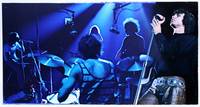
19703038Los Angeles: Elektra Records 1970. first edition. Very Good. STUNNING ORIGINAL DYE-TRANSFER PRODUCTION PHOTOGRAPH used in the preparation of the cover for the band’s first—and only—live album issued during Jim Morrison’s lifetime. With important provenance. Original vintage color dye-transfer print 12 x 23 inches dry-mounted to Bainbridge Bristol Board with visible period blue art-department retouching along the upper and lower edges; accompanied a backing board signed and inscribed in 1975 by Bob Heimall the art director/designer for the album to music-industry executive Stephen Dessau: “To: Stephan sic P. Dessau as in Nassau / Happy Holiday Diamond Studs! / Remember – your sic in over your head! / Bob Heimall ’75â€.<br /> <br /> Issued by Elektra on July 20 1970 Absolutely Live was the Doors’ first live album and the only one released during Jim Morrison’s lifetime; Morrison would be dead in Paris less than a year later on July 3 1971. As such the album occupies a singular place in the group’s history: the sole contemporaneous live statement through which audiences could hear the Doors officially present themselves as a concert act while Morrison was still alive. Compiled by producer Paul A. Rothchild from performances recorded in 1969 and 1970 including material from the Aquarius Theatre and Felt Forum the album captured the band in the form for which many admirers considered them most powerful—improvisatory theatrical blues-driven and unstable in the best sense. It also contained the first full official release of “Celebration of the Lizard†among the most mythic and elusive works in the Doors canon.<br /> <br /> The present dye-transfer print with extremely rich color preserves the underlying live image taken by photographer Frank Lisciandro used in the preparation of the cover prior to the addition of typography and logo design. Morrison – in a superimposed image taken at an earlier date – appears at right isolated at the microphone with the remaining members of the band receding into a saturated blue stage space behind him. The image possesses the nocturnal theatricality appropriate to the band at this moment while the object itself retains the physical traces of period record-cover manufacture: board mount hand retouching and signs of studio handling.<br /> <br /> Contemporary and later accounts held that Elektra initially favored a grainy bluish rear-view stage image from the Aquarius Theatre performances but judged it insufficiently exciting for commercial use. A different earlier more conventionally iconic image of Morrison was then incorporated into the final design. Morrison is said to have hated the final version. By 1969–70 his appearance had changed markedly: heavier bearded and far removed from the lean black-leather rock-star persona through which he had first entered the popular imagination. The dispute reflected a deep struggle over who would determine Morrison’s public image at the end of the Doors’ great period: Morrison himself or the commercial machinery that preferred the older myth.<br /> <br /> Provenance: From the art director for the album Bob Heimall to music-executive Stephen P. Dessau. With an additional CBS memorandum dated 1979 identifying Dessau as Director of Product Management East Coast Epic/Portrait/CBS Associated Labels and a copy of the album.<br /> <br /> Los Angeles: Elektra Records 1970. Original vintage color dye-transfer print 12 x 23 inches. Only the most trivial wear with absolutely no fading - the colors are superbly rich. A remarkable survival. Elektra Records unknown
178063128Head Quarters Bergen County NJ 1780. Folio one page approximately 125 words in part: "I perceive . that you had collected about two hundred Cattle more and that a further number might be obtained . I cannot of right command the services of the militia . let the commanding officers know how distressed the Army has been and is likely to be for provisions and that it will be rendering splendid service to us and distressing the enemy to remove the Cattle from those parts of the Coast which furnish the New York Markets." Very good. Browned one small piece detached one word of text easily repaired. After Washington's victory at Monmouth June 1778 during which battle Forman had served as an advisor to Charles Lee the war settled into stalemate with Washington's army in New Jersey and the British forces content to remain in New York both sides keeping an eye on each other while trying to provide for their soldiers the American forces suffering deprivation similar to that of Valley Forge. Meanwhile on the day this letter was written word reached Washington of the complete rout of Horatio Gates and his troops at Camden South Carolina opening Virginia to British invasion from the South. Bolstered by American victories at Kings Mountain Oct. 1780 and Cowpens Jan. 1781 and the depletion of Cornwallis's army at its victory over Nathaniel Green at Guilford Court House Washington in conjunction with his French allies moved south to envelop Yorktown earning the British surrender in October 1781 effectively ending the war. General David Forman 1745-1797 born and raised in Monmouth County New Jersey was appointed colonel of a New Jersey regiment that reinforced Washington at New York in June 1776. After suppressing a loyalist uprising later that year during which time he earned the nickname "Devil David" he was chosen to lead a regiment in the Continental army and in 1777 was commissioned brigadier general to lead the New Jersey militia commanding that force in the battle of Germantown Oct. 1777. Disagreements with the New Jersey legislature led to his resignation from that command and he spent the rest of the war running listening posts especially along the coast of New Jersey providing Washington with intelligence on the movements of the British fleet and army a service he was providing at the time of this letter. see DAB Tench Tilghman 1744-1786 born and raised in Talbot County Maryland graduated from the precursor to the University of Pennsylvania in 1761 taking up a mercantile business until the outbreak of the revolution. After serving briefly as a captain in the army he joined Washington as a volunteer and served continuously as an aide-de-camp to the general for the balance of the war. "The amount of secretarial work in addition to military duties that he performed for Washington was prodigious" DAB and he was granted a regular commission of lieutenant-colonel in 1781. After the victory at Yorktown Tilghman was chosen by Washington to carry the announcement of the surrender of Cornwallis to the Continental Congress. Provenance: When recently purchased the letter was in an old frame and removal revealed an autograph note inside the backing included here as follows: "This letter was bought by me about 1860 of Miss Brown residing at 92 Columbus Street Albany New York. She was a sister of an old minister of St. Peters Church. This Miss Brown was a client of Orlando Meads and myself and found this letter in a barrel in the garret of the home occupied by her sister at Manalapan New Jersey formerly owned by General David Forman. signed Dexter Reynolds / Albany Sept. 7 1902. Presented to my son Marcus T. Reynolds." A newly discovered Washington letter shedding light on the general's relationship to state militias and his concerns for providing for his troops while disrupting the supply lines of the British. Not in Fitzgerald or the Founders Online from the National Archives which lists 57 other Washington letters to Forman 1777-1782 showing a gap from 24 July 1780 to 17 May 1781 and two others post-war. 9836. <br/><br/> unknown books
20132081502111903553Gaku en 2013. Soft Cover. Fine. The book is in fine condition. Gaku en paperback
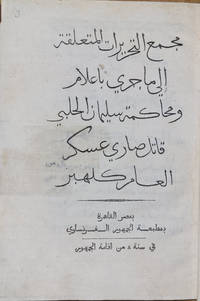
1800000228<p><strong>EGYPT – NAPOLEONIC PERIOD – ARABIC PRINTING</strong> <em>A Compilation of the Decisions Relating to the Condemned Criminal and the Judgments Passed upon Him the Killer of the Commander-in-Chief the Renowned Kléber</em></p><p>Cairo: <strong>مطبعة الجمهور الÙرنساوي</strong> Press of the French Republic <strong>Year 8 of the Republic</strong> 1800–1801.</p><p>Rare and historically significant <strong>Arabic imprint produced during the French occupation of Egypt</strong> documenting the <strong>trial judgment and execution of SulaymÄn al-ḤalabÄ«</strong> the assassin of <strong>General Jean-Baptiste Kléber</strong> Commander-in-Chief of French forces in Egypt.</p><p>This work constitutes the <strong>official Arabic-language publication of judicial decrees and legal decisions</strong> issued by the French military authorities in Cairo following the assassination of Kléber in June 1800. It was intended for circulation among the Arabic-speaking population serving both as a legal record and as an instrument of political communication and authority.</p><p>Printed at the <strong>Press of the French Republic in Cairo</strong> one of the earliest European-operated printing presses in Egypt the book forms part of the pioneering Napoleonic effort to employ <strong>Arabic typography for governance law and propaganda</strong>. The text reflects the adaptation of French revolutionary legal concepts into Arabic juridical language making it a landmark in the history of <strong>Arabic legal printing</strong>.</p><p>The publication corresponds to a French counterpart titled <em>Traduction Arabe des pièces relatives à la procédure et au jugement de Soleyman el-Haleby</em> confirming its role within a bilingual documentary corpus produced by the occupation authorities.</p><p><strong>Historical Significance</strong></p><ul><li>Primary source for the <strong>assassination of Kléber</strong> one of the most consequential events of the Egyptian Expedition</li><li>Early example of <strong>state-sponsored Arabic printing</strong> under European colonial rule</li><li>Key document in the history of <strong>Franco-Arabic legal translation</strong></li><li>Important witness to the emergence of <strong>modern political and legal Arabic print culture</strong></li></ul><p><strong>Rarity</strong></p><p>Extremely scarce. Arabic imprints from the <strong>French Egyptian press 1798–1801</strong> are notably rare and judicial publications relating specifically to the Kléber assassination are seldom encountered on the market. Examples are held in a small number of institutional collections; private ownership is exceptional.</p><p><strong>References</strong></p><p>Cf. Galland <em>Imprimerie arabe du Caire</em>; Napoleon in Egypt bibliographies; WorldCat records under variant French and Arabic titles.</p> Press of the French Republic hardcover
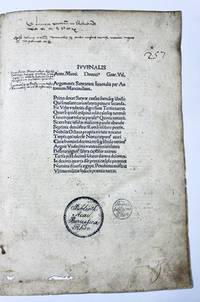
1497898Nurnberge: Antonium Koberger 1497. Folio 30.8 x 21.5 cm. Signatures : A8a–z8&6. This copy is bound in its original blind stamped half pigskin over wooden boards lacking clasps. . This copy has been densely annotated by a German humanists circa 1511. This is an important edition with three commentaries from the end of the 15th century by great figures of Italian humanism and following the Venetian edition o. •On the title page two references to Italian miscellanea of the end of the 15th century: one to the freedom of poets to slander which refers to Pietro Crinito’s De honestis disciplinis lib. 20 ca. IX and the other to a complicated passage of Juvenal explained in chapter 33 of the Miscellanea of Ange Politien Expositio hujus carminis Juvenalis scilicet occidit miseros Crambe repetita magistros in Miscellaneis ca. 33 This chapter of the Miscellanea explains the very graphic proverb Occidit miseros Crambe repetita magistros which appears in Juvenal’s Satire VII v. 154 which can be translated literally by “It is from this cabbage unceasingly re-served that unhappy masters die†to denounce the repetition to which masters are forced.<br /> <br /> Hain; 9711; CIBN; J-368; IGI; 5601; IBP; 3322; Kotvan; 743; Arnoult; 938a; Zehnacker; 1378; Goff; J664; ISTC online Provenance: 1.German reader early 1510s. 2. Transfer stamp †Vend. ex bibl. acad. Rhen.†“Sold by the Prussian Academy Library†former library of the University of Bonn the stamp “Bibliotheca Accademiae Borussicae Rhenanae†was apparently used in the period 1818-1828. 3. 17th century owner note on title page with reference to the in-12 Juvenal-Perse published in Amsterdam with Farnabius’ notes in 1631. 4. Marquis Giuseppe Terzi of Bergamo 1790-1819. It does not appear in the catalogs of the sales held in Paris between March 11 and 23 1861. 5 Joseph Nève lawyer and bibliophile from Brussels 1857-1940 6. The book is later in the collection of Jean-Baptiste Colbert de Beaulieu 1905-1995 ex-libris. 7. It is then in the collection of Jean Stefgen Joinvillele Pont 1927-2017 bookplate. <br /> <br /> A copy profusely annotated up to satire 6 by a German reader in the first decade of the sixteenth century as indicated by the diacritical sign above the u’s its spelling Yason for Jason apoptegmata without ‘h’. This incunabulum is found in its interesting first binding Rhenish half pigskin stamped and bound over wooden boards<br /> <br /> .Our German reader most likely annotated the work while it was still in quires and disbound but maybe sewnindeed some notes aredeepin the inner margin. The work was probably annotated before being bound which caused some minimal trimming of the outside marginal notes.<br /> <br /> The sources used by the annotator display a strong knowledge in Rhenish humanism around 1511. This reader was obviously educated in a circle close to the young Beatus Rhenanus and most likely Jakob Wimpfeling at the crossroads of classical and Christian culture. His reading is indeed a mixture of Italian philological and historical commentaries and works of northern humanism Reisch Erasmus. Several notes reveal the use of a series of editions published in Strasbourg in 1511: the Hymni heroici tres of Jean-François Pico de la Mirandole with the annotation of Beatus Rhenanus the collection of ps. Bérose published by Grüninger with a text of pseudo Xénophon. Our anonymous reader reads Erasmus’ Adages in an edition by Schürer c. 1511 and the Praise of Folly the first editions of which also date from 1511 Paris Gilles de Gourmont and then M. Schürer. XXI v. <br /> <br /> The annotator also has recourse to contemporary Italian encyclopedias Enneades by Sabellico Commentarii by Volaterranus to which he adds the reading of Reisch’s Margarita philosophica the jewel of northern humanism the editio princeps dates from 1504. The annotator refers to a passage of this work Book VII chapter VII where Atlas is presented as the inventor of astronomy note on f. CXIIIr: “Atlantem caeliferum fuisse negat Lucrecius. Lege invenies in Margarita ex Plinio li 7 ca 2†etc. These readings and references to the editions of 1511 make us think that the annotator plausibly followed a university course held in Strasbourg around 1511 always in the close circles frequented by Beatus Rhenanus. <br /> <br /> The humanist commentary here focuses on word radicals lexiconand context the annotator mobilizes printed commentaries with little interest in figures. He shows a predilection for natural history Pliny and Solinus very much in demand and Roman history in general the annotator resorts as well to Suetonius as to modern commentaries such as Philippe Béroalde and Sabellico see page 58 of this catalogue whose Enneads he quotes several times f. XXIV v for example.<br /> <br /> This erudite reader sometimes commits approximations in his references: he confuses for example a title of the pseudo-Xenophon with a collection of the pseudo-Beroses. A long quotation of a passage that he attributes to Philippo Beroaldus the Elder on f. XXVIIr comes in fact from the Annotationes centum and not from his commentary on Suetonius see Anthony Grafton “On the Scholarship of Politian†Journal of the Warburg 1977 p. 166. He recopies from memory incorrectly on f. VI a licentious epigram by Martial book VI 67 & notes in the margin still on this verse but this time about eunuchs: “Martialis / Cur tantium eunuchos uxor tua Caelia quaeris / Pannice vult futui Caelia non parere.†The annotator also has recourse to the vast Latin poetic heritage: Ovid and Seneca on f. II Vide Ovidium Transformationum… Vide Senecam in Agammemnone; Horace Satire VI I on f. XVr. Also to some poets of late Latinity like Sidoine Apollinaire through an incunabula edition 1498 with commentary. He also gives some suggestions for corrections to the text: f. LIX r to the lemma “caldum†he refers to the Attic Nights of Aulu Gelle: “emendatius caldus haud … quam calidum apud Gellium caldam saepeponitur li 19 ca 4″.Some other notes are:•A reference to the practice of hunts venationes in the circus under Domitian with an anecdote of a certain Maevia descended the pointrine naked in the arena f. V r. It reproduces the words of an ancient scholiast of Juvenal: †Alia indignatio in mulierum impudentiam quae temporibus Domitiani descendebant in venationes et pugnas theatrales †words of the scholiast of Juvenal.on the title page two references to Italian miscellanea from the end of the 15th century. Antonium Koberger unknown
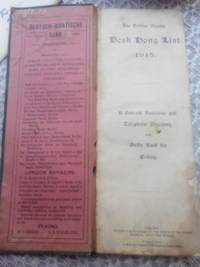
59<p>Many wears especially at book spine.</p> The Peking Gazette hardcover
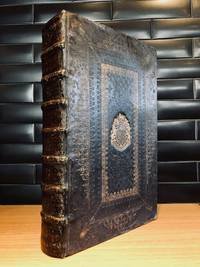
17177186Oxford: John Baskett 1717. First Edition Thus. Royal binding in full morocco. Very Good. John Sturt. Two volumes in one. Large stout folio. Double column with columns separated by double rule. Text ruled in red and title pages printed in red and black. Engraved vignette title pages for Old and New Testaments the latter dated 1716. With the engraved additional general title page by cartographer and renowned illustrator John Sturt 1658–1730. With striking copper-engraved vignette head- and tail-pieces and many engraved historiated initials. Complete with Apocrypha.<p>Marbled endpapers. All edges gilt. Bound in contemporary full black morocco rebacked with original elaborate gilt-tooled spine neatly laid-down gilt-tooled arms of King George II featuring the motto "Most Noble Order of the Garter" as centerpieces and his monogram in spine compartments raised bands and gilt-decorated borders. Only moderate wear to the splendidly complete royal binding. First edition of the monumental illustrated "Vinegar Bible" with additional title page engraved by John Sturt including the vignette of a church interior featuring the figures of Moses Aaron et al. per Darlow and Moule. According to the DNB Sturt "specialized in miniature work and it was said that he could engrave the creed on a silver penny but could also work on a large scale and in 1692 he produced a notable engraving of Britannia the royal first capital ship of England printed on four sheets". Presented in a handsome King George II armorial binding. Carter notes that " . Bibles with the royal arms may have come from one of the Royal Chapels - but they may equally have come from any loyal parish church" ABC p. 157. That said a limited print run coupled with the high cost of Baskett's elaborate opus would suggest the former.<p>In 1709 printer John Baskett secured the exclusive royal patent to print Bibles in England. Of those he and his family published this is the most magnificent being a triumph of legible elegant type that contributes to an easy readability accessible today. Alas a typographical error in the running head of Luke XX among other typos rendered the parable of the vineyard as the "parable of the vinegar" overshadowing Baskett's magnificent achievement.<p>A scarce and stately copy of a high spot in 18th-century printing. DARLOW & MOULE 736-B "the engravings differ considerably from those in A". John Baskett unknown
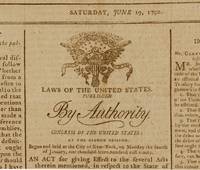
179052510New York: John Fenno no. 41 Broad-Street near the Exchange 1790. First edtion. Softcover. Fine. Two leaves folio 16.25 by 10 in. Edges slightly trimmed; a touch of mild foxing else a fine crisp copy. Housed in linen clamshell box with gilt paper label at spine and previous owner's dediction pasted to inside cover.<br /> <br /> The first known published appearance of Jewish support for the newly elected president of the United States George Washington. One week after Washinton's inauguration Levi Sheftall on behalf of the newly reorganized Savannah Hebrew Congregation wrote him an elegant and effusive letter of congratulation. This letter along with Washington's reply was published for the first time by the United States Gazette:<br /> <br /> "Sir We have long been anxious of congratulating you on your appointment. and of testifying our unbounded confidence in your integrity and unblemished virtue. Your unexampled liberality and extensive philanthropy have dispelled that cloud of bigotry and superstition which has long as a veil shaded religion -- unrivetted the fetters of enthusiasm -- enfranchised us with all the privileges and immunities of free citizens and initiated us into the grand mass of legislative mechanism. May the great Author of worlds grant you all happiness and a continuance of guardianship to that freedom which under the auspices of heaven your magnanimity and wisdom have given these States."<br /> <br /> Washington's reply is undated but addressed "To the Hebrew Congregation of the City of Savannah." After accepting their congratulations he extends this hope: "May the same wonder-working Deity who long since delivering the Hebrews from their Egyptian Oppressors planted them in the promised land -- whose providential agency has lately been conspicuous in established these United States as an independent nation -- still continue to water them with the dews of Heaven and to make the inhabitants of every denomination participate in the temporal and spiritual blessings of that people whose God is Jehovah. George Washington." <br /> <br /> Provenance: old entry of . Hopkins at top margin first leaf trimmed. Six weeks later <br /> <br /> References: Enc. Jud. first ed. 1972 vol. 16; Evans Amer. Bibl. vol. 8; From the Ends of the Earth Judaica Treasures of the Library of Congress. John Fenno, no. 41 Broad-Street, near the Exchange unknown
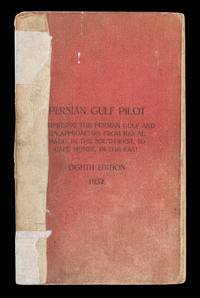
193215952London: Published for the Hydrographic Department Admiralty J.D. Potter Agent for the Sale of Admiralty Charts 145 Minories E.C.3 1932 additions to 1936. 4to 245 by 150mm 4 i-ii 2 iii-xxx 328pp 2 charts 26 plates numerous manuscript annotations in red and black ink text from the annual supplements tipped in throughout the work red buckram boards title to upper board spine strengthened with old cloth. A detailed pilot of the Arabian Gulf with extensive manuscript annotations and additional text and views of Dubai and Abu Dhabi from the 1936 supplement. The present work is the eighth edition of a pilot first published according to the 'advertisement' in 1864 from the remarks and surveys of Commander Charles Constable and Lieutenant Arthur Stiffe. Constable and Stiffe served in the Indian Navy and travelled through the Middle East between 1857-1860 conducting hydrographic surveys. The pilot also shows the influence of Commander Banes-Bruck who had conducted the first systematic survey of Arabian waters while stationed in the Gulf as a member of the Indian Navy in the 1820s. This eighth edition has been compiled by "Commander G. C. Glen D.S.O. O.B.E. R.N. and contains the latest information received in the Hydrographic Office". Published in the same year as oil was discovered in Bahrain the pilot captures the Gulf just before the boom that would transform it into a region of immense global importance. Even before the Middle Eastern oil trade began its rapid expansion however its waters remained an important thoroughfare for European trade and travel with a constant flow of British ships through the Suez canal. The pilot begins with a number of introductory sections explaining how it is to be used and outlining the updates made to the latest edition. There follows a list of illustrations a glossary of terms from various local languages including Arabic Hindustani and Persian and general information about the use and composition of Admiralty charts. The main body of the pilot systematically describes the Persian Gulf from all approaches with information about its marine features political and administrative divisions trade navigational routes and potential hazards from shoals to pirates. Although most of the pilot's 328 pages are dominated by text there are regular illustrations and maps found throughout. These views are different from the typical Admiralty charts being far less technical and some even reproductions of popular watercolours. They nonetheless indicate the profile of the land as well as significant topographical features and important anchorages. The maker assures the ready of the accuracy of the information provided in the pilot since "It is most difficult to get trustworthy information from the Arabs and but the little that they impart can be relied upon". The present edition of the Persian Gulf Pilot is extremely rare. We have been able to trace only five institutional examples: the British Library National Maritime Museum United Nations Library University of Chicago Library and State Library of New Soth Wales. Furthermore we have been unable to trace any editions of the pilot appearing at auction. Published for the Hydrographic Department, Admiralty, J.D. Potter, Agent for the Sale of Admiralty Charts, 145, Minories, E.C.3, hardcover
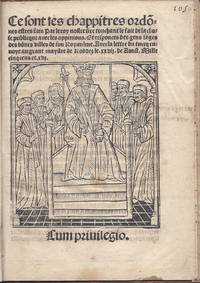
15161704S.l.: s.n. 1516. First edition. Title page with large woodcut illustration showing the King on his throne surrounded by the delegates. In Bastarda type with two floral woodcut initials. In later hard paper. Gilt title vignette on spine damaged. Concise marginal notes and page-numbers in ink by a contemporary hand throughout. Trimming of the leaves slightly affects the glosses with no effect to legibility otherwise the margins are wide. Title page crinkled at the upper right corner with a small tear that only affects the margin. Narrow inkblot to the lower margin throughout. B4 with two light brown stains C1 crinkled at lower corner. Bookplates on the inner front panel G. J. Arvanitidi; Antoine Mouradian. Overall in very good condition. First edition. Title page with large woodcut illustration showing the King on his throne surrounded by the delegates. In Bastarda type with two floral woodcut initials. In later hard paper. Gilt title vignette on spine damaged. 20 p. <p><br /> A bibliographically unrecorded early sixteenth-century French book about royal ordinances regarding the commonwealth along with the French translation of Sultan Selim I's letter of conquest fethname addressed to the Grand Master of Rhodes. <br /> <p><p><br /> The first and major part of the book presents nine concepts of orders of Francis I 1494-1547 King of France from 1515 until his death regarding the commonwealth chose publique. The drafts concern such topics as the commerce of spices and drugs wool cloth and other goods chapter 1-4 the weights and equivalents of coins and the recognized foreign currencies chapter 5 the recognized units of measures chapter 6 the regulation of the extravagance of clothing chapter 7 the inn trade chapter 8 and the money that goes to Rome for obtaining Bulls chapter 9. <br /> <p><p><br /> The second section comprises the responses to the aforementioned concepts of the representatives of the Good Cities Bonnes Villes Provence and Dauphiné who had been previously assembled in Paris by the order of the King in March 1516. In most cases they requested a delay of reply to discuss the matters with those who they were representing.<br /> <p><p><br /> The third section presents the grievances and requests delivered to the King by the delegates regarding the provincial councils conciles provinciaux the prolixity of the trials the tariffs the public officers the superior courts cours souveraines the land taxes tailles and the abuse and plunder by the soldiers crossing the kingdom. <br /> <p><p><br /> These sections were recorded and written down by the court clerk Jean Hesselin Seigneur of Girodon. Hesselin mentions himself twice p. 14 and 17 once by name p. 14 within the text.<br /> <p><p><br /> The final part is the French translation of the Ottoman Sultan Selim I's fethname letter of conquest sent on 27 August 1516 from Aleppo to Fabrizio del Carretto 1455-1521 Grand Master Magnus Magister of the Knights Hospitaller in Rhodes between 1513 and 1521. The fethname accordingly to its genre details Selim's expedition and the conquest and emphasizes the power and grandeur of the Sultan and his army. <br /> <p><p><br /> Selim I 1470-1520 ascended the throne as the Sultan of the Ottoman Empire in 1512. He is remembered for the enormous expansion of the Empire during his reign thus raise the Ottomans to the leaders of the Muslim world. Selim's most notable deed was the conquer of the Mamluk Sultanate which included Levant Hejaz and Egypt in 1516 and 1517 at the Battles of Marj Dabiq and Ridaniya.<br /> <p><p><br /> The Battle of Marj Dabiq near Aleppo took place on August 24 1516 where Selim defeated the Mamluk Sultan Al-Ashraf Qansuh al-Ghuri. This was a decisive victory of the war between the Ottoman Empire and the Mamluk Sultanate which ended in the conquest of much of the Middle East. Such an expansion of the Ottoman territory was a clear threat to Rhodes which was the nearest Christian possession to the coast of Asia halfway between Constantinople and Egypt. At the time the Grand Master in Rhodes was the Italian admiral Fabrizio del Carretto 1455-1521; Grand Master from 1513 to 1521 for a short interlude of a course of fifty-five years of Frenchmen serving as the supreme heads of the Order. Selim announced his victory and forecasted his threat to del Carretto in a fethname presented here in French translation however eventually he did not have the time to conduct the campaign against Rhodes. It was his successor Suleiman I who conquered the island in 1522 thus gained control over the eastern Mediterranean for the next centuries. By the time of the siege the commander of the Order was again a Frenchman Grand Master Philippe Villiers de L'Isle-Adam 1464-1534. Suleiman allowed him and the surviving knights to leave unmolested and eventually the Hospitallers were quartered permanently on Malta in 1530.<br /> <p><p><br /> To the best of our knowledge the original fethname has not survived and we could not trance any other printed version or edition of the French translation. We could find one surviving copy of a Spanish translation of Selim's letter which was addressed to Pope Leo X titled Carta de nuevas grandes buenas y ciertas embiada a nuestro s. padre Leon X de las cosas que han passado en Levante entre el gran turcho y el gran solda Valencia Juan Viñao 1517; Norton 1256 IB 11215 USTC 344377 kept at Cambridge University Library F151.d.8.12.<br /> <p><p><br /> Provenance: Bookplate of Georgios Arvanitidis 1876-1953 a noted Constantinopolitan collector of books on Turkish and Greek history. Bookplate with the motto "On abuse du vrai" of Antoine Mouradian.<br /> <p><p><br /> Ref.: Bibliographically unrecorded.<br /> <p><p><br /> Bibl.: Setton K. M. Hazard H. W. ed.: A History of the Crusades. Vol. 3. Wisconsin: The University of Wisconsin Press 1975. pp. 332-335. Pedani-Fabris M. P.: Ottoman Fetihnames. The Imperial letters announcing a Victory. In: Tarih İncelemeleri Dergisi 13 1998. 181-192. <br /> <p>. [s.n.] unknown
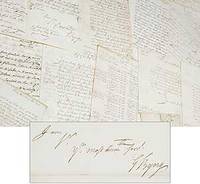
17183874591718. Unbound. Near Fine. A remarkable archive of 24 letters from Admiral of the Fleet George Byng sent to Rear Admiral George Delaval who commanded the Blue Squadron under Byng’s command along with associated documents from George Saunders and Josiah Burchett Secretary of the Admiralty relating to the British naval campaign of 1718 in the Mediterranean culminating in the Battle of Cape Passaro Sicily on the 11th August. A mix of quarto and folio sheet with many folded once to form four pages. Each letter is Signed by Byng with one signed twice. Despite their age the letters are near fine or better with only light wear and housed in a custom cloth chemise with printed labels.<br /> <br /> The Battle of Cape Passaro resulted in the defeat of the Spanish by the British Fleet under Sir George Byng four months before the War of the Quadruple Alliance. The Spanish refused to re-embark their army from the Sicilian mainland. Despite war not having been formally declared Byng correctly anticipated approval from home and attacked and routed the Spanish fleet thwarting their ambitions to take Italy and Sicily.<br /> <br /> The subject matter of the letters is concerned with supplies day-to-day naval matters and continuing hostilities against the Spanish and includes details of several rendezvous for meeting up in the event of separation owing to bad weather. Common problems are mentioned such as desertion and shortage of food and more particularly wine. The earliest is dated May 17th concerning the mobilization of troops and pressed men for the campaign. The letter of May 29th regards the Line of Battle detailing ships ordnance and men commanders and formation and pennants and the signals to be used. On July 3rd Byng gives orders to oppose the landing of the Spanish in Italy with a warrant order of operations to “take sink burn or destroy†the King of Spain’s ships; the last of the series dates from the December 9th from the Admiralty office not by Byng congratulating Delaval on his safe arrival at Spithead and requesting him to escort the fireship Griffin to Deptford. Byng sent mail from on board his ship the Barfleur whilst at sea and also from the Admiralty office in London.<br /> <br /> Byng was sent on subsequent diplomatic missions on behalf of England to negotiate with Italian princes and states and was instrumental in the acceptance of the terms of the Quadruple Alliance by Spain. In 1718 Byng was already a respected member of the establishment having supported the accession of William and Mary at the Glorious Revolution contributed to the burning of the French fleet at Vigo and leading the bombardment squadron during the capture of Gibraltar. He was rewarded with a knighthood and a regular promotion. After the success of 1718 this included membership in the Privy Council admittance to the Order of the Bath and the title of Viscount Torrington which his descendants still bear today. In 1727 Byng was made First Lord of the Admiralty and the Royal Naval College at Portsmouth was founded in his memory.<br /> <br /> Delaval also had a distinguished naval and diplomatic career from a young age with victory at the Battle of Malaga in 1704 and missions to Spain and Portugal as well as his promotion to Rear Admiral and leadership of The Blue Squadron. He is perhaps best known for rebuilding his ancestral seat the celebrated Seaton Delaval Hall in Northumberland now a National Trust property with architect Sir John Vanbrugh.<br /> <br /> It is important to note that Admiral George Byng should not be confused with his fourth son John Byng also present at the Battle of Cape Passaro as a 13 years old who built a respectable career as a naval officer and became an Admiral but was court-martialed and shot by firing squad on 14 March 1757.<br /> <br /> A remarkable collection of letters from the First Lord of the Admiralty during the reign of King George II. <br /> <br /> A detailed list of the correspondence is available upon request. unknown
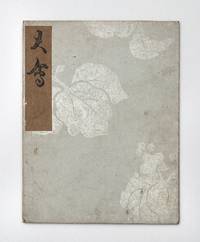
1117114 pages of text & two pages forming paste-downs of varying shades of pale pink & cream gofun biki torinoko mica-printed paper all printed with mica patterns endpapers printed with mica patterns of plum flowers on branches & autumnal weeds bound in two “quires†& sewn together. Small 4to 240 x 180 mm. orig. pale gray semi-stiff wrappers with mica woodblock-printed designs of hydrangea leaves orig. printed label on upper cover. Saga near Kyoto: about 1608 or shortly thereafter.<br /> <BR> <BR> An ultimate luxury copy tokusei bon 特製本 in very fine condition with mica-printed text leaves and covers using paper of shades of pale pink cream and gray. This is the second time we have handled a copy of a KÅetsu utai bon in the most luxurious state of three.<br /> <BR> <BR> This is one of the series of 100 Noh plays produced at the famous private press in Saga just north of Kyoto. These sumptuous luxury editions were printed for the wealthy and enlightened merchant Suminokura Soan 1571-1632 in collaboration with his calligraphy teacher KÅetsu a leading cultural figure of his day famous as an artist potter lacquerer and connoisseur. These books are amongst the most remarkable printed works created in Japan or anywhere else; their design is far in advance of anything produced in the West. Issued in limited numbers they were intended for private distribution to an elite audience friends and acquaintances of the creators who formed the patrons of the Saga artistic community.<br /> <BR> <BR> Printed with movable type on luxurious thick paper the books have according to Hillier a modernity in design matched only by the works of William Blake and the French artists’ books of the late 19th and early 20th centuries. They reveal the beauty of native Japanese calligraphy. The movable type is based on the calligraphy of KÅetsu.<br /> <BR> <BR> This series of mostly chants from Noh plays comprises “small pamphlet-size books each of about twelve or thirteen sheets whose outstanding feature is the decoration invariably of mica-printed patterns on stained or dyed paper which is of a distinction that immediately links them with the collaborative scroll works by KÅetsu and SÅtatsu and which has led to their being called KÅetsu-bon…These designs resulting from a sophisticated adaptation or distortion of natural forms are notable examples of one of the unique contributions of Japan to world art…<br /> <BR> <BR> “But decoration apart these No booklets are remarkable in other ways. An unusually thick and opaque kind of paper was used no doubt made specially for these editions and contrary to normal practice it was printed on both sides of the sheet. This ruled out the normal construction of a book whereby the sheets printed on one side only were folded in two and bound at the loose edges. The majority of the KÅetsu-bon were made up by an entirely different method. A number of sheets usually six in this copy three in the first “quire†and two in the second the outer leaves used as paste-downs were placed flat one above the other and the batch was then folded in two; two such sections would form a complete book. The binding again was unusual. The outer covers though printed first as a single sheet invariably with a mica-printed design were cut in two and each given a folded turnover along one edge in which one batch of the folded sheets was lodged. The two halves were then sewn together through the turn-overs of the two halves of the cover brought together at the inner edge. This is a binding method unique to Japan and is known as Yamato-toji or recchÅsÅ…<br /> <BR> <BR> “These KÅetsu-bon represent an astonishing leap forward to something entirely unprecedented in the history of the illustrated or decorated book. This was the first time a book had been conceived as a single unified work of printed decorative art…not until we come to William Blake’s Prophetic Books do we encounter anything remotely comparable and the creation in the West on any appreciable scale of books composed as homogeneously decorated printed works of art did not occur until the appearance of the French livres d’artiste in the late nineteenth and early twentieth centuries.â€â€“Hillier The Art of the Japanese Book pp. 51-54.<br /> <BR> <BR> The KÅetsu utai bon were produced in three levels of luxury. The finest such as our example has mica patterns or images printed on the text leaves and covers before the text was printed with movable type. The next level also had mica-printed covers but employed papers of different colors with no mica printing on the text pages. The least luxurious version used only cream-colored text paper and had mica patterns printed on the covers.<br /> <BR> <BR> The covers of our copy are mica-printed with images of bamboo and with backgrounds of sprinkled mica. Each of the five sheets with text exhibits different mica-printed images including grass adorned with dew in the field Japanese pampas grass plum blossoms on branches and waves.<br /> <BR> <BR> The movable type characters are based on the calligraphy of Hon’Ami KÅetsu 1558-1637; this type is called hiragana majiri a combination of kanji and kana accompanied by dashes next to each syllable. These dashes are the notations for the pitches to be sung. The notes are not written as specifically as they are in Western sheet music. If the dash goes up the pitch is raised; if it is straight the same pitch is continued; and if it goes down the pitch is lowered.<br /> <BR> <BR> A very fine and fresh copy preserved in a wooden box. These KÅetsu utai bon are very rare on the market especially when in excellent condition like our example. Covers a bit dusty and a few unimportant marks.<br /> <BR> <BR> ⧠Fischer et al. The Art of Hon’Ami Koetsu Japanese Renaissance Master pp. 174-75–“The deluxe editions of utai-bon that were printed at the Saga presses where Koetsu and Suminokura Soan collaborated to produce classics of earlier Japanese literature were intended for amateur connoisseurs like themselves. The thick paper mica-printed motifs and carved wood type were all part of an artistic whole meant to complement the aesthetic pleasure of the utai vocal performance.†Murase Tales of Japan. Scrolls and Prints from the New York Public Library pp. 157-59. unknown
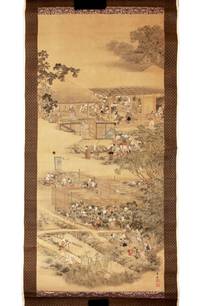
6951Japan: ca. 1840-50. Two large and fine paintings in hanging scroll format depicting all the steps in the production of the finest Uji tea by the Kanbayashi family to be sent to the Tokugawa shogun in Edo. These scrolls are of very great beauty and complexity and were surely painted by a master artist see below. The production and drinking of tea in Japan has a long and rich history extending back to the Nara period 710-94 when tea was brought back by diplomatic missions from China. Emperor Saga was served tea in 815 and afterwards ordered the establishment of several tea plantations near the capital of Kyoto. It was soon discovered that Uji a village located south of Kyoto was the ideal location to produce excellent tea leaves due to its rich soil and high-quality water. It became Japan's first major tea-producing region and has maintained its reputation for superior tea. In the 15th century the cultivation and production of tea in Uji underwent several transformations: the technique was introduced of covering young tea buds shielding them from the sun during the last weeks before plucking to improve their flavor ooishita saibai; and the quality of the tea was steadily improved through careful processing. Various shoguns including Hideyoshi Toyotomi 1536-98 and Ieyasu Tokugawa 1543-1616 supported the tea growers and processors in Uji. By the early 17th century an annual procession to celebrate the Shogunate's acquisition of its annual stocks of tea from Uji - Ochatsubo dochu "Travelling of the Shogun's Tea Jar" - was formalized as an official ritual event akin to political theater and thereby reinforcing Tokugawa authority. A delegation - Uji saichashi "Uji tea-picking envoy" including a "Tea Specialist" sukiya gashira and two subordinate "Tea Monks" chabozu - was sent with empty jars by the shogun each spring to observe the harvest and participate in the processing and selection of the tea leaves for the shogun. After many laborious steps of processing and selection as we shall see the tea leaves were placed in large jars. A few of these jars were sent as an offering to the Imperial Court Chatsubo shinken in Kyoto and the remainder were carried to Edo Castle in the autumn. The round-trip procession was a highly elaborate and publicized event. When the envoys returned to Edo the leaves were ground and made into powdered green tea for consumption at formal events at Edo Castle. During the last part of the 16th century and early years of the 17th century members of the Kanbayashi or Kamibayashi family found favor with several shoguns and eventually served as exclusive suppliers to the shoguns and the great daimyo the company established in 1558 still exists as Kanbayashi Shunsho honten and is affiliated with Coca-Cola. The family was given the honorific title of On cha todori "president of the Uji tea industry" and was also known as On mono chashi or Omono chashi "tea suppliers to the imperial family and shogun and leading nobility". They were allowed to wear samurai clothing and carry swords. Our scrolls beautifully depict all the steps of harvesting processing selecting and packing the tea leaves for transportation to the shogun in Edo. SCROLL ONE: This is composed of five different scenes. The first depicts two men erecting poles at the sides of a tea field preparing to cover the tea bushes shielding them with netting from the sun. Across the river the second image shows a member of the Kanbayashi family with sword at hip discussing the current crop with an employee who has a ledger book in front of him. They are being served tea while another employee is showing the just-harvested leaves. Behind them we see several women picking through the plucked leaves searching for impurities. The next scene is splendid: it shows many women harvesting the young tea leaves from the bushes which have been covered by netting supported by poles. It is a "beehive" of activity with about ten women working assisted by young men carrying the leaves away in buckets. A woman in the background is taking a break and nursing her child. The fourth scene shows another member of the Kanbayshi family leading a group of workers to the fields. A senior assistant is carrying a flag with the Kanbayashi family symbol. The final scene offers valuable information regarding the steps of processing. We see a large roofed building and on the right side is the heating room where steam is produced to heat the harvested leaves. To the left is a room where the actual steaming of the leaves is taking place. The leaves are then spread out in bins and cooled by women using fans. Further to the left we see men sifting to separate the smallest and finest leaves from stems and larger leaves. The final product is being weighed on a scale and placed into fine wooden boxes. The "story" of this first scroll with five scenes has been artfully constructed starting at the bottom and weaving its way upwards. The brushwork is highly refined and detailed: the faces showing a wide range of expression the leaves individually painted and the coloring extremely subtle. SCROLL TWO: This is also composed of five scenes. The first at bottom shows Kanbayashi employees further drying the leaves and placing them into large flat baskets which are carried to the next room. On top of the basket is a piece of paper describing the quality of the leaves. Yet another sifting and inspection of leaves takes place. The next scene upstairs shows a group of women spreading the leaves over a large table and picking through the leaves by hand again removing any impurities. These leaves are then passed to two inspectors for further review. The third scene shows several women yet again examining the leaves and removing further impurities this time with chopsticks. They turn and present the trays holding the leaves to a high-level Kanbayashi employee for approval. In turn the trays are then presented to the representatives from the shogun who are carrying swords and wearing masks and official attire. They use chopsticks to further cull undesirable leaves. In the background are large jars holding tea in a storage room. The fourth scene is that of a tea ceremony room where members of the Kanbayashi family and government officials are meeting and conducting a tasting. The final scene at the top of the scroll shows a formal room with government officials observed by other members of the delegation presumably the "Tea Specialist" and the two "Tea Monks" packing the tea in small envelopes and placing them in large jars. In the back is a beautiful garden. We can attribute with some confidence these hanging picture scrolls to Kagaku Ozawa fl. 1840-50 painter draftsman and poet in Kyoto. He was a follower of Kazan Yokoyama 1781-1837. The two scrolls are in fine and fresh condition preserved in a wooden box. The second scroll suffers from minor worming. ❧ Much of our description is based on the wonderful article by Prof. Taka Oshkiri "The Shogun's Tea Jar: Ritual Material Culture and Political Authority in Early Modern Japan" in The Historical Journal Cambridge Univ. Press 59 2016 pp. 927-45. hardcover books
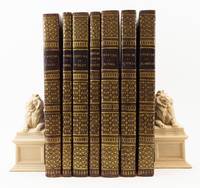
1800ST17757London: William Miller; T. M'Lean; William Bulmer 1800-18. 370 x 270 mm. 14 1/2 x 10 1/2". Seven volumes. <br/> Uniformly bound in stately contemporary dark burgundy straight-grain morocco covers with gilt palmette-and-wheat-sheaf border inner frame of blind-stamped grapevine raised bands spine compartments densely gilt with repeating botanical tools gilt lettering gilt-rolled turn-ins all edges gilt. Two engraved titles with hand-colored vignettes not included in plate count and 356 FULL-PAGE HAND-COLORED PLATES FEATURING COSTUMES OCCUPATIONS AND SOCIAL INTERACTION OF VARIOUS NATIONS. Volume I-III V and VI with text in French as well as English. Front pastedown with armorial bookplate of Edward Gordon Douglas-Pennant 1st Baron Penrhyn. Abbey Life 430; Abbey Travel 71 244 370 373 532 533. Joints and extremities lightly rubbed one board with a couple of faint scratches two rear boards with neat older repairs to short tears at tail edge but the bindings quite sound and most attractive on the shelf. Flyleaves a little foxed minor offsetting from plates to text leaves occasionally more pronounced but never offensive isolated minor marginal foxing to plates otherwise very fine WITH CLEAN BRIGHT PLATES.<br/> <br/> This is a collection of major early 19th century color plate books with well-drawn and richly-colored engravings in bindings that make a handsome appearance on the shelf. All of these works have appealing plates where the costumes of the various social strata are carefully and colorfully delineated. And two of the volumes--those showing British costumes and the book on Chinese punishments--contain in addition a good deal of diverting background detail that serves as a revealing context for each of the costumes depicted. The content of each of the volumes is worth noting. With a few exceptions the plates in the "Costumes of China" portray ordinary working-class men and women toiling at their trades. We see a bookseller with his wares spread out on a mat women sewing and embroidering a butcher a fisher a barber a man with a "magic lantern" show and a "man striking a small gong during an eclipse" an ancient ritual that the author tells us he was privileged to witness on 17 November 1789. The "Punishments of China" volume is filled with almost gleefully painful depictions of all degrees of disciplinary action from the relatively minor twisting of the ears or chaining to an iron pole to the humiliating ordeal of the wooden collar to methods of execution by beheading or by crucifixion using a cord. The opulent and brightly colored costumes in Dalvimart's volume on Turkey are mostly those of the ruling classes although also represented is a wide variety of native dress from the many regions of the vast Turkish empire of the day which included Bosnia Albania Syria Egypt and parts of Greece. It is particularly interesting to contrast the clothing of the very heavily veiled Turkish and Egyptian women with the much more relaxed style of the Greek women and the nearly immodest garb of the female Bedouin. We also are shown a eunuch an odalisque from the harem a grand vizier various royal functionaries and government officials all splendidly attired. The Russian costumes based on engravings done by C. W. Müller at the request of Empress Catherine the Great are focused on the ethnic dress of the empire's many holdings. The Laplanders and Finns wear clothing that would look familiar to most Europeans but the Mongols in their Oriental dress would be quite exotic. The clothing of the northern tribes such as the Kamchatkans Aleutians Koriaks and Tungoosi will impress the modern reader with their similarity to the traditional dress of Native American and First Nation peoples. The Tchutski woman is even depicted naked to display her tattoos. Bertrand de Moleville's Austrian costumes also illustrate the native dress of the empire's citizens but the illustrations here are less fashion plates than romanticized scenes: peasant couples are shown courting and dancing; Croatian women gossip beside a stream; and a wild-haired Bohemian gypsy whose "profession is not hard to guess" from her state of "déshabillé" flees with her naked and no doubt illegitimate child. Pyne's "Costumes of Great Britain" is one of the most highly praised works in this set and for good reason: the simple working men and women of Britain it depicts are always shown going about their daily tasks in the midst of a well-realized scene. The woman selling "salop" a hot morning beverage is seated at her cart with its urn judiciously located by the watchman's stall surrounded by customers including soldiers and a woman with her market basket. A fireman with an ax and a torch hurries toward his engine company while they unwrap their hose. The potter is at his wheel the tanner is cleaning skins and the bill-sticker posts the winning lottery numbers. The clothing while carefully detailed is almost secondary to the depictions of everyday life. The "Military Costumes of Turkey" illustrates the official regalia "uniform" is much too drab a word for these outfits worn by officers in various regions of the empire. Perhaps the most intriguing plate here is that of the Ladle Bearer a post that was also illustrated in "Costumes of Turkey." What appears to be a man with a giant spoon is in fact the holder of an important military position equivalent to the color-bearer in a western army. We are told that the loss of its ladles is the greatest disgrace that can befall a Turkish regiment: if the two great ladles the size of a grown man that are borne into battle at the head of the troops are captured the regiment must be disbanded and formed anew. Former owner Edward Gordon Douglas-Pennant 1st Baron Penrhyn 1800-86 was a leading figure in the Welsh slate industry; he owned the Penrhyn Quarry the largest slate quarry in the world at the end of the 19th century. He was known for his paternalistic attitude to his employees creating the "model village" of Llandegai to house the quarry workers. It was notable for having "no corrupting alehouse." He was ruthless enough to fire 80 men in 1868 because they did not vote for his son George who was running for a seat in Parliament. Single volumes from this set appear with frequency in the marketplace; full sets show up much less often; sets as handsome and well preserved as the present are rarely seen. William Miller; T. M'Lean; William Bulmer unknown
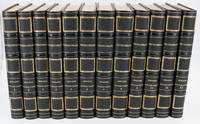
184991066Paris: EugèneVictor Penaud frères 1849. Fine. With plates from the first illustrated edition and a letter by Chateaubriand: ""but I am dead utterly dead"" Eugène Victor Penaud frères Paris 1849-1850 ; 14 avril 1839 lettre manuscrite 13.7 x 21.2 cm 12 volumes reliés et une lettre signée Rare and sought-after first edition first issue with exceptionally added plates from the first illustrated edition published that same year. 34 full-page engravings after Demoraine Gagnier Staal and engraved by F. Delannoy. Includes the subscribers list and the foreword which will be removed for the second issue when the remainder of this edition was bought by another publisher Dion-Lambert. It also features the pagination error in volume two: page 164 instead of 364. With a scribal letter by the author bearing his autograph signature. One page written in black ink on a leaf. Slightly darkened at the upper edge with occasional foxing and the usual folds. Black half-morocco bindings flat spines with double gilt fillets and double blind-stamped compartments black paper boards slight superficial rubbing to some boards marbled paper pastedowns and endpapers sprinkled edges; contemporary bindings. Sparse foxing. Exceptional prophetic and macabre letter by François-René de Chateaubriand. Signed with the authors faltering hand this apparently unpublished letter was penned by his secretary. Black half-morocco bindings flat spines with double gilt fillets and double blind-stamped compartments black paper boards slight superficial rubbing to some boards marbled paper pastedowns and endpapers sprinkled edges; contemporary bindings. Sparse foxing. You will recognise the hand of Pilorge whom I employ to replace my own suffering from gout. I shall read your recollections with the greatest pleasure but as for me I am dead utterly dead and if I were required to write a single word in a paper I would sooner be buried a thousand feet underground. I am done with life; it would be a sweet thing indeed to rise again if only to be of some use to you Rest assured that no one will take a more genuine interest nor share more wholeheartedly in your success than I shall. Entirely yours from the depths of my grave Chateaubriand 14 April 1839. This letter was dictated by the author to his secretary who provided invaluable assistance in the very preparation of the Mémoires: Having remained in Chateaubriands service for twenty-five years Hyacinthe Pilorge was the principal hand behind the transcription of the Mémoires doutre-tombe. His task was to make a legible copy of Chateaubriands texts progressively transcribing everything his master wrote or dictated. Chateaubriand revised and corrected from these copies and when the newly written pages became excessively amended Pilorge would write a new copy. Pilorge was tasked in 1840 of transcribing the first complete copy of the Mémoires doutre-tombe. For many years this manuscript served as the reference text. It comprised over four thousand pages assembled by quires and kept in cardboard folders with each leaf designed to be corrected moved or replaced at will. Once this monumental task was completed in 1841 Chateaubriand set his work aside for some time. Yet thanks to its highly adaptable structure the Mémoires doutre-tombe continue to stand as a living evolving work a perpetual work in progress. Bibliothèque nationale de France The recipient of the letter is the author of Souvenirs which Chateaubriand here declines to promote. The writer speaks as though from beyond the grave almost ten years before his actual death: as for me I am dead utterly dead and if I were required to write a single word in a paper I would sooner be buried a thousand feet underground. I am done with life; it would be a sweet thing indeed to rise again if only to be of some use to you. These masterful lines carry the humour so often encountered in the pages of the Mémoires which André Lebois describe EugèneVictor Penaud frères hardcover
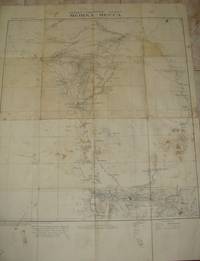
000041<p><strong>Paper on cloth 114 × 89 cm.</strong><br /><em>The British Expedition in the Arabian Hejaz during the First World War – Arab Revolt Medina–Mecca.</em><br />Reprint of the first provisional issue with large corrections. Published by the Survey of Egypt for the Arab Bureau under authority of the War Office November 1916.</p><p>This map is a collection of sketches compiled by Egyptian pilgrimage officers and members of the Sharif's forces. An attempt was made to verify the information using local native sources but without success. The coastline is derived from Admiralty charts. The Jedda–Taif area is taken from G.S.G.S. sources.</p><p>Some light staining but generally in good condition.</p>
000059<p><strong>Huda Sha'rÄwÄ« 1879–1947</strong><br /><strong>Collection of 19 Photographs</strong></p><p>A group of <strong>nineteen individual photographic prints of varying sizes</strong> depicting <strong>Huda Sha'rÄwÄ«</strong> the pioneering Egyptian feminist leader nationalist and founder of the Egyptian Feminist Union.</p><ul><li><strong>Four photographs are signed by Huda Sha'rÄwÄ«</strong> including <strong>two dedicated and signed in Paris to Majd ed-Din Nasif</strong>.</li><li>Approximately <strong>fourteen are studio photographs</strong> taken predominantly in <strong>Paris</strong> with several examples from <strong>Cairo</strong>.</li><li>One notable photograph shows Sha'rÄwÄ« in <strong>Egyptian local dress</strong> <strong>signed by the photographer Lekegian Cairo</strong>.</li></ul><p>The photographs document Sha'rÄwÄ« in both European and Egyptian contexts reflecting her transnational life and public persona during the early twentieth century.</p><p><strong>Biographical Note:</strong><br />Huda Sha'rÄwÄ« June 23 1879 – December 12 1947 was a leading figure in Egyptian feminism and nationalism. Born into a wealthy family in Minya she was the daughter of Muhammad Sultan the first president of the Egyptian Representative Council. Raised in the seclusion of an upper-class harem she married her cousin Ali Pasha Sha'rÄwÄ« at the age of thirteen. A later separation allowed her to pursue formal education and develop an early sense of independence. Educated in Quranic studies Arabic Turkish and Islamic subjects she also wrote poetry in Arabic and French. Her memoir <em>Harem Years: The Memoirs of an Egyptian Feminist 1879–1924</em> remains a key source for understanding her life and era.</p>
18000008<p><strong>printed leaf</strong> <strong>10 lines in Ottoman Turkish</strong>. Undated and without place of printing but apparently printed at the <strong>Imprimerie Nationale Cairo</strong> during the <strong>French Expedition to Egypt</strong>.</p><p>The document is a <strong>proclamation</strong> concerning <strong>Napoleon Bonaparte's reply</strong> to a letter from the Ottoman Sultan <strong>Selim III</strong> stating that <strong>Napoleon and Selim are allies</strong> that <strong>no force can disturb their alliance</strong> and that <strong>all victories on both sides are the result of this alliance</strong>.</p> Divan du Caire (the Napoleonic committee in Cairo)
1931001618London: The Golden Cockerel Press 1931. 7 6-268pp 4. Original half pigskin and buckram over boards by Sangorski and Sutcliffe raised bands spine in six panels title in gilt to second panel cockerel device to fifth t.e.g. remainder untrimmed. Spine very slightly rubbed usual light foxing to cloth covers internally bright and clean and signed by Eric Gill to title 'Eric G' within a small illustration of a ball and chain attached to the foot of the cockerel vignette on the title page. Number three hundred and seventy-two of five hundred copies on paper with another twelve on vellum. Now housed in a drop back box made by Temple Bookbinders. The Four Gospels is widely regarded as one of the best private press books. Cave and Manson 78; Chanticleer 78 "a flower among the best products of English romantic genius"; A Century for the Century 26; Gill 285. Signed by Illustrator. First Thus. Half Pigskin and Buckram. Very Good. Illus. by Gill Eric. Folio. Private Press. The Golden Cockerel Press Hardcover
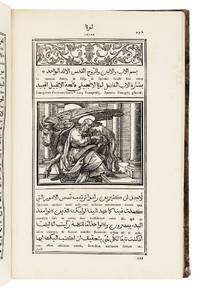
65425Romae Rome: In Typographia Medicea 1591. FIRST EDITION. Folio 32.25 x 21.25 cm. pp.9-4621 colophon. Full 18th-century marbled vellum spine with gilt rules gilt decoration and red morocco label. With 149 text woodcuts by Leonardo Parassole c.1570-c.1630 after Antonio Tempesta 1555-1630 their monograms appearing on a number of the illustrations. The woodcuts are remarkable examples of Tempesta's work notable for their clarity of composition and their didactic narrative of the episodes depicted. Old bibliographical remark in Latin to verso of final leaf. From a German private collection. Some partial browning due to paper stock and occasional light foxing generally a very handsome copy. First edition of the Gospels in Arabic and Latin - a landmark cultural encounter. In 1584 the last year of the papacy of Gregory XIII who had constantly endeavoured to effect a union between the Church of Rome and the eastern Christians Cardinal Ferdinando de' Medici the brother and later the successor of the Grand Duke of Tuscany founded a printing press in Rome with a vast selection of oriental types cut by the French typographer Robert Granjon. Run by a versatile orientalist Giovan Battista Raimondi the press had various aims. One was to produce propaganda which would attract the eastern Christians to Roman Catholicism. Another was to corner the publishing market in an area where typography was prohibited and to make a financial profit from the sale in the east of books printed in Arabic. The third aim was to further European knowledge and to provide good editions of Arabic versions of certain standard non-religious texts. These included the writings of Avicenna al-Idrisi's geographical compendium al-Tusi's adaptation of Euclid's text on geometry and various works on Arabic grammar and syntax. The first major publication was the 1591 edition of the Gospels. This copy has an interlinear Latin translation but the work was also issued solely in Arabic. It contains 149 fine woodcut illustrations made by Leonardo Parasole mainly after designs by one of the best known Florentine artists of his day Antonio Tempesta who owed much of his fame to the frescoes he painted in the Vatican and in a number of Roman palaces. The woodcut in the Gospel of St Mark of the presentation of the head of John the Baptist to Salome Mark 6:28 by a man in Turkish dress reminds us of the common association between the great enemy of Christendom in the sixteenth century and the ancient heathens. The Arabic text is printed in Robert Granjon's famous large fount generally considered the first satisfactory Arabic printing type; as all early printed editions of the Arabic Gospels it is based on the Alexandrian Vulgate cf. Darlow/M. 1636. The Latin version is by Leonardo Sionita. The work begins with page 9 without a title-page or any preliminary matter at all: "the intended prefatory matter was apparently never published" Darlow/M.; these first eight pages were not supplied until the 1619 re-issue. Brunet 1122-1123 Romae [Rome]: In Typographia Medicea, 1591. hardcover
20202081502111906507Hoo shubbansha 2020. Soft Cover. Fine. The book is in fine condition. Hoo shubbansha paperback
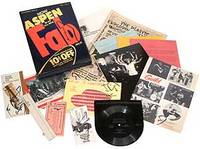
1966349700New York: Aspen 1966. Unbound. Near Fine. The Pop Art Issue." Designed by Andy Warhol and David Dalton. Complete see below. Both the front and the inside front cover of the box are Signed and eight other pieces in the box have been Signed by Warhol a couple of them are Inscribed including: the Ten Trip Ticket Book the movie flip book the Pop-Art Paint card folder the Guild Instruments flyer the Folk Music on Vanguard pamphlet the tabloid newspaper a cardboard divider and the 33 1/3 flexi-disc acetate recording containing the song "Loop" written by John Cale and credited to the Velvet Underground one of the first commercially available recordings by the band. Additional contributors include Willem de Kooning Roy Lichtenstein Claes Oldenburg Ernest Trova Kenneth Noland Gerald Laing Jasper Johns James Rosenquist Lou Reed and Timothy Leary. The box designed to look like a box of detergent is a little crushed as usual with two corners torn some offsetting at the bottom of the box very good with contents fine. Further details available upon request. Aspen unknown
19662777San Francisco 1966. First edition. Very Good. One-of-a-Kind Beatles Images Portend the End of an Era. This original contact sheet of rare 1966 images of The Beatles was discovered by artist photographer musician and Beatles enthusiast Dave Seabury at a garage sale near San Francisco in the late 1980s. These photos which we have on offer were taken at the Fab Four's final concert at Candlestick Park on August 29 1966. <br /> <br /> The story of how these images were discovered is almost as fascinating as the images themselves. Seabury frequented garage sales for years inquiring about Grateful Dead or Beatles photos and never had any luck. On one fateful day the seller said "Yeah there are some Beatles pictures in that box over there." Marks In the box Seabury found a contact sheet with 73 black-and-white images of The Beatles taken by someone who clearly had privileged access to the band. The photos were close-up and deeply moving however there was no date on the photos and no photographer stamp. <br /> <br /> Seabury recalls that every once in a while he'd take out these photos and think "These are really great they deserve some attention." Then many years later he read Joel Selvin's article in the San Francisco Chronicle about The Beatles' last concert at Candlestick Park which included Jim Marshall's famous photos. After looking at the pictures Seabury thought "Those shirts look familiar." He quickly pulled out his Beatles contact sheet and voilà they were wearing the same shirts. Seabury said "That's when I realized the photos on my contact sheet were taken at Candlestick in 1966." Marks<br /> <br /> In 2015 Seabury began his quest to find the photographer. With the 50-year anniversary of The Beatles' final concert on the horizon he said "I contacted all The Beatles collectors I could find. I just kept coming up zero." Marks At the same time Seabury a photographer in his own right was working on a photo exhibition and concert to be called "Lost and Found Beatles." Scheduled to open on the 50th anniversary of the Candlestick show at The Reclaimed Room Gallery in San Francisco he started a Kickstarter campaign to raise the money to turn the contact sheet images into prints. It was a labor of love.<br /> <br /> When the pictures were finally printed Seabury realized that rather than the usual stock photos taken at concerts these images were unusually pensive and intimate. Unbeknownst to their fans at the time John Paul George and Ringo had a secret - they had recently decided that this would be their last live concert together. Amidst 25000 screaming fans the photographer was able to capture what The Beatles knew that this was the end of an era.<br /> <br /> When the "Lost and Found Beatles" show opened on September 29 2016 the identity of the photographer was still a mystery. At the exhibition closing party professional collector Derek Taylor realized that a photo in the exhibit looked familiar. He explained ". the way Lennon's hair was tousled. I just knew I'd seen that photo before like something I'd bought. A few weeks later I happened to be looking for a record and boom that Lennon photo an 8-by-10 falls out." Taylor flipped the photo over and saw a stamp that read "Photo: Eric Weill." Marks Mystery solved. <br /> <br /> Eric Weill who struggled with bipolar disorder for most of his life died in 2006. He was well known for his photos of Bob Dylan and for claiming to be the Zodiac killer on a call-in radio show in 1969. Ethan Byxbe nephew of Weill described his uncle as "a professional photographer. whose news photo called 'The First Hippie Riot' from 1968 is in the collection of the Smithsonian." One of Weill's acquaintances explained that "Eric was just one of those guys who showed up everywhere with a camera." Marks <br /> <br /> Seabury was eager to meet Weill's nephew his only living relative and explains "When I finally connected with Ethan and explained everything to him he was totally blindsided. He was like 'Whoa wait a minute. You published his photos' And I said 'Look man. I want to meet with you. I cede all rights to these photos to you.'" Byxbe was grateful for Seabury and explained "thanks to Dave's project people can enjoy some of my uncle Eric's photographs and he can get credit for some of the work he did. I think he would be happy about that." Marks <br /> <br /> Though the mystery was solved it was still not clear how the contact sheet ended up in a garage sale. Ethan Byxbe believes that "The bulk of my uncle's material was stolen right under our noses. When I was a little kid in the 1970s my grandmother had hired some older neighborhood kids to help her clean up her garage.There were several milk crates full of original negatives and photographs including most of The Beatles' material. I had a bad feeling about them and said 'Grandma maybe you should put Eric's pictures in a closet or something.' She said 'Oh no they're fine.' She was very trusting. And sure enough after they left I checked the garage and the milk crates with Eric's original materials were gone. They had taken everything." Byxbe remembers another theft that occurred years later. He said "My uncle was living in an old 1930s milk truck. People would be in and out of the truck visiting him and one time someone ripped off much of what he had left. Between those two incidents most of his photographic materials that I knew about were gone." Marks Byxbe does not know when the contact sheet was stolen but he assumes that's how it started its journey to a garage sale in Northern California.<br /> <br /> This original contact sheet would be a thrilling addition to any Beatles collection. Weill memorialized one of the most significant turning points in the history of the world's greatest band by inviting the observer into The Beatles' souls and capturing a moment that the audience was not aware of at the time - the beginning of their separation.<br /> <br /> Also part of this lot is a poster-size image of the contact sheet 46x61 cm 18"x24" as well as a poster a flier and 6 postcards promoting the "Lost and Found Beatles" exhibition presented by Seabury in 2016.<br /> <br /> Provenance: From the collection of Dave Seabury artist photographer and musician. <br /> <br /> Contact sheet with 73 photographs by Eric Weill. 21.5x27.5 cm 8½x11". Numerous small creases and surface skratches short closed tear to bottom edge; very good. Poster-size image of the contact sheet 46x61 cm 18x24" and a poster a flier and 6 postcards promoting the "Lost and Found Beatles" exhibition included. <br /> <br /> References:<br /> <br /> Kevin Courrier. Artificial Paradise: The Dark Side of The Beatles' Utopian Dream. New York: Bloomsbury Press 2008.<br /> <br /> Ana Leorne. "The story of The Beatles' last official concert which took place in San Francisco 55 years ago the Fab Four played Candlestick Park." SFGATE. August 25 2021.<br /> <br /> Ben Marks. "A Garage Sale Find of Rare Beatles Photos Took a Collector on a Magical Mystery Tour." Collectors Weekly. March 8 2018.<br /> <br /> Jordan Runtagh. "Remembering Beatles' Final Concert." Rolling Stone. August 29 2016. unknown
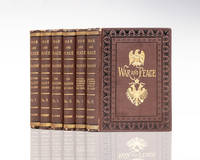
1886149532New York: William S. Gottsberger Publisher 1886. First edition in English of Tolstoy's masterpiece a pillar of world literature. Octavo six volumes in the publisher's original pictorial brown cloth stamped in gilt and black brown coated endpapers with the cursive imprint in each part. Translated by Clara Bell. In near fine condition. Housed in two custom marbled slipcases. An exceptional set of Tolstoy's masterpiece one of the finest we have seen. Widely considered the greatest novel ever written War and Peace is at once an epic of the Napoleonic Wars a philosophical study and a celebration of the human spirit. Tolstoys genius is seen clearly in the multitude of characters in this massive chronicleall of them fully realized and equally memorable. Out of this complex narrative emerges a profound examination of the individuals place in the historical process one that makes it clear why Thomas Mann praised Tolstoy for his Homeric powers and placed War and Peace in the same category as the Iliad: "To read him . . . is to find ones way home . . . to everything within us that is fundamental and sane." "There remains the greatest of all novelists--for what else can we call the author of War and Peace" Virginia Woolf. William S. Gottsberger, Publisher hardcover
1800ABC_48443The Netherlands 1800. Splendid late 18th-century ca. 1790 gold-tooled red morocco sewn on 4 supports with a smooth spine bound by the so-called Second Dissertation Bindery Leiden ca. 1780-ca. 1794; Storm van Leeuwen IIA pp. 350-358 with 4 closing loops on the front board 1 top edge 2 fore-edge 1 bottom edge connecting to 4 closing knotted buttons on the back board. Both boards show 3 gold-tooled floral frames built up from 2 different rolls with small corner pieces in between the inner frame with 4 larger floral corner pieces and a large lozenge shaped centrepiece built up from multiple impressions of 5 different floral and animal stamps. Further with a gold-tooled spine and board edges gilt edges and marbled endpapers. Large 4to. With 162 signatures on 160 vellum or paper cuttings mostly vellum including 2 cuttings with 2 signatures each mostly from the 17th century some from the 18th century and a few from the early 19th century. Further with one large printed coat of arms of the Wassenaer family on the verso of the title-page an engraving ca. 9.5 x 7 cm showing the house of Jacob Cats on the verso of leaf 34 and with 19 printed coats of arms on the versos of several leaves 16 depicting a coat of arms with the name of the family below and 3 blank shields. The title page headings and captions all in a very neat late-18th-century or early 19th-century cursive script written in Dutch using brown ink. Remarkable collection of 162 signatures of mainly 17th-century 16th- to early 19th century Dutch and international prominent people - from statesmen like Stadtholder Maurice of Orange Count of Nassau etc. and Grand Pensionary of Holland Johan de Witt 1625-1672 royals like King Philip II of Spain 1527-1598 and William III of Orange Stadtholder of the Dutch Republic and later King of England Scotland and Ireland 1650-1702 and government officials like "Griffier" to the States General François Fagel 1629-1746 the most important clerk of the Dutch Republic's government to authors poets and scholars like P.C. Hooft 1581-1627 and Nicolaas Tulp 1593-1674. For each individual mentioned in the present work their signature - on a separate vellum or paper cutting mounted on the recto of the leaf - appears next to a short biographical description. Some biographical descriptions are more extensive than others but two names appear without any further information. The first is Caspar Clotterbooke leaf 30 who is listed as a secretary for the council of the States of Holland in the 18th century 1778. He was born in The Hague in 1720 held several high positions in the councils of Haarlem and the States of Holland as a representative of that city and died childless in 1817. The second is Hendrik Nobel who is listed in the second part among royals statesmen military commanders scholars and others. He lived from 1568 to 1649 and was appointed as "bewindvoerder" administrator or governor of the Rotterdam Chamber of the Dutch East India Company VOC. In two cases one cutting contains two signatures - those of Johan van Hoorn and Abraham van Riebeek appear together as well as those of Adriaan Valkenier and Johannes Thedens; all four were Governor General of the Dutch East Indies resp. from 1704-9 1709-13 1737-41 and 1741-43. In the case of William III two signatures are included for one single individual - the first is his signature as Prince of Orange and the second is his signature as King of England Scotland and Ireland "William R.". The work was bound by the so-called Second Dissertation Bindery in Leiden which was active at the end of the 18th-century between ca. 1780-1794 Storm van Leeuwen. The work was most likely produced as an album with blank leaves to be used as a notebook or scrapbook album of some sort at a later date. The paper used in the album is clearly watermarked throughout for example a lion within a crowned medallion pro patria eiusque libertate countermarked J. Honig & Zoonen. The firm Honig or Honigh Zaandam the Netherlands was active from the late 17th century until the late 19th century but was known as J. Honig & Zoonen during the 18th century. The paper is most likely contemporary to the binding. While several of the cuttings containing signatures are also dated - as part of the signature itself or separately added - these dates represent the exact or otherwise approximate date the particular signature was produced. The majority of the signatures can be traced back to the 17th century but were probably cut from official hence the vellum documents to be sold as collector's items around the beginning of the 19th century.The present work was part of the collection of A.M. van den Broek 1932-1995 an antiquarian book print and art collector from Haarlem. His collection mainly contained works focussed on Haarlem and its surroundings. The present work includes 7 signatures from prominent Haarlem representatives in the "Commons" the council of the States of Holland during the 17th- and 18th centuries.The binding shows very slight signs of wear two scratches on the front board some rubbing along the spine and closing knotted buttons on the back board the gutter of the first and second front flyleaves is slightly exposed without affecting the integrity of the binding. Further with some minor offsetting on the blank versos of the leaves from the signature cuttings. Otherwise in very good condition. A remarkable collection of signatures from mainly 17th century prominent Dutch and international statesmen and other famous people.l Cf. for the binding: Storm van Leeuwen IIA pp. 350-358. hardcover