184 822 résultats
Very Good Turkish, Ottoman (1500-1928) Original manuscript book of the registers of the conjurations sessions by the first Turkish spiritualist group. 20x15 cm. In Ottoman script (Turkish with Arabic letters). [154] p., several hand-drawn ills. Group has Bedri Ruhselman, (1898-1960), Albert Braun, (Violinist and Ruhselman's violin teacher of German origin), Hans Ianma (Violin teacher), Hasan Saadeddin Bey, (Turkish spiritualist), and Doctor Zühdü Riza Bey, (Turkish musician, Kemençe teacher, a friend of Sadeddin Arel). Dr. Bedri Ruhselman (1898-1960), the founder of NeoSpiritism and "the Experimental New Spiritism". Ruhselman's point of view and a new perspective to the concepts such as creation, spirit, afterlife, birth incarnation, and rebirth-reincarnation are pioneers in the Early Turkish Republican period. Ruhselman's empirical perspective on "afterlife", one of the most important and primary subjects of theology, has made important contributions to spiritism, out of the classical standpoint. (Source: Ruhselman and his metaphysical vision, Kestel). Albert Braun was Ruhselman's violin teacher and his friend. It's said this early spiritualist group is the pioneer and elitist of Neo-Spiritualism in Turkey. He is considered a Mission Medium, a very rare category within spiritual mediumship. By definition, every medium has a varying degree of ability to tune in to spiritual "frequencies". But not all "reception" (coming from those frequencies) convey a meaningful message (sometimes if any). While mediumship is a gift (meaning that; one either has it or not); very few mediums are actually knowledgeable in spiritual matters. They simply transfer what they capture from their sensitive channels. And once in a while, mainstream media picks on certain mediums, especially when he/she delivers sensational predictions (i.e. Edgar Cayce). Bedri Ruhselman's both interest and gift was manifested since his early childhood. He was conducting spiritual sessions when he was only 12 years old. While continuing his musical education in the Prague Conservatory, in the 1920s, he studied the pioneers of classic spiritualism like Allen Kardec, Gustave Geley, Charles Richet, Leon Denis, William Crooks and become experienced in hypnotism and spiritual sessions. He also completed his medical education and graduated as a medical doctor. In 1950 by establishing Metapsychic Investigations and Scientific Research Society, he gifted an institutional identity to Neo-Spiritualism. His true duty started in 1958 by means of spiritual sessions with a guide being from higher spiritual plans which identified itself as "The Master". Ruhselman and his carefully selected mediums received a vast amount of knowledge via these sessions during a few months. That body of knowledge has been compiled as a book, which Ruhselman never claimed any ownership (stating that it's purely a gift from the higher spiritual plan). The plan has instructed that; the book was only to be released in the future - to be identified by a certain sign. That point alone commends recognition for pure selfless devotion towards undertaken duty. If the ego was in play; one would usually do anything for fame or at least to cash on the subject. But Ruhselman completes his true duty and hands over the book for safekeeping without ever mentioning one word about the content. He passes away a few months after (1960). (Source: Indication23). This manuscript includes their registers of the conjurations sessions with some illustrations which have "table order" of the sessions at a house in Sisli, Istanbul. In the illustrations, given the locations of the goods in the room like piano, wardrobe, chair, etc. Registers including the sessions between the years of 1935-1936. Scripts were written by M. Zühdü Pektas mostly, by various fountain pens with blue and black inks. Some registers are taken by a pencil. An extremely rare stylish manuscript. Unpublished.
Very Good Greek, Modern (post 1453) Original decorative cloth bdg. with Dante's portrait gilt on front board and spine. Black cloth with red decorative borders. Gilt on spine with Greek letters 'Dantou o Paradeisos [.] Metaphrasis Konstantinou Mousourou', and gilt publisher's name in English on lower. A small etiquette on lower spine. Some little wormholes on cloth and several pages. Pages are partly opened, uncut and untrimmed. Slightly faded on cloth's board. A stamp on first page. Otherwise a very good copy. Roy. 8vo. (23 x 16 cm). In Greek (Modern). [xiv], 334 p. 14 p. 'prologos' by Musurus. Konstantinos Mousouros, also known as Kostaki Musurus Pasha, was an Ottoman Greek diplomatic official of the Ottoman Empire who served as ambassador to Greece, Austria, Great Britain, Belgium, and the Netherlands. He was born in 1807 in Constantinople (Istanbul) to a distinguished Phanariote family. His brother, Pavlos Mousouros, also became a diplomat. Mousouros became the first ambassador of the Ottoman Empire to the newly independent Kingdom of Greece in 1840, a position he kept until 1848. In 1847-48 he was a central figure in the events known as Mousourika (??????????), which led to his temporary recall and the breakdown of relations between the two states. On his return to Athens he survived an assassination attempt, leading to his transfer to Vienna. In 1850 he took up the post of Ottoman ambassador to the Great Britain and Ireland, which he kept for 35 consecutive years, until his retirement in 1885. During the same period, he also served as ambassador to the Netherlands (1861-77) and Belgium (1861-75). In 1876-78, he was ex officio a member of the short-lived Senate of the Ottoman Empire. Well educated, in 1883 Mousouros translated Dante's Divine Comedy into ancient Greek. He was married and had a son, Stephanos Mousouros, who later became Prince of Samos. (Wikipedia). He is known as the first translator of Dante's Divine Comedy into modern Greek. Musurus Pasha had an intellectual identity. One of the most important occupations of Musurus Pasha in the last years was the translation of Dante's Divine Comedy from Italian to Greek. Being able to translate a work of Italian classics and masterpieces of western literature should be an indication of Musurus Pasha's performance and intellectual dimension. Due to negative statements about Muhammad and Ali in Dante's work, the book was not allowed to be published within the Ottoman Imperial borders. Despite this, Musurus Pasha asked him to be permitted to publish his translation, but it was not accepted. (Source: Bir Tanzimat diplomati Kostaki Musurus Pasa, (1807-1891)., NURDAN SAFAK). Dante's Divine Comedy, originally called Comedia, and later christened Divina by Giovanni Boccaccio, is widely considered the most important poem of the Middle Ages and the greatest literary work in the Italian language. This is only 'Paradiso' book from the set. It's signed and inscribed by Musurus Pasha with a dedication in French to Monseigneur Auguste Bonetti as "A la grandeur Monseigneur Bonetti, Hommage de veneration, Musurus". Bonetti was, in 1887, after the appointment of Monsignor Rotelli to the Vatican Ambassador to Paris, the new Constantinople patriarch appointed by Rome for him. First Greek Edition. Extremely rare.
Very Good Turkish, Ottoman (1500-1928) Handsome fine contemporary brown half-leather bindings. Six raised bands to spine, title, and issue numbers gilt lettered, floral decorations in compartments. 4to. (30 x 24 cm). In Ottoman script (Old Turkish with Arabic letters) and French. All pages with illustrations in text or full-page illustrations, all numbers with an Islamic numbering system, reversed collation, with two title pages: Ottoman recto and in French verso, numbers 35, 41, 44, 45 with title pages in color. Rare poster is coming with the set inside the volumes as a supplement to the magazine. Extremely rare togetherness of the complete set of 130 issues of the Ottoman Turkish-French satirical magazine "Kalem", richly illustrated with thousands of attractive illustrations and cartoons, started its publication life with the end of Sultan Abdulhamid II's repression regime in 1908. The collection provides an invaluable resource, reflecting the changes in society after the Second Constitutional Revolution in New Ottoman State. The magazine was published weekly in 130 numbers between 21 August 1324 (3 September 1908) and 16 June 1327 (29 June 1911), starting immediately after the Second Ottoman Constitutional Revolution. The magazine was a mixture of satire and a saloon magazine, focusing on politics, social life, and revolution. The only continuously running part of the magazine was Haftalik Dedikodu (Weekly Gossip). The founders of the magazine were Salah (Selah) Cimcoz (1875-1947), a Turkish politician, lawyer, and owner of Kalem Newspaper, and Celal Esat Arseven (1876-1971) a Turkish painter, writer, and parliamentarian. He was the first to introduce the history of art and urbanistic architecture to Turkey. Duman 1080.; Only one complete copy survive in institutions worldwide in OCLC 472569754 (Bibliothèque nationale de France, BnF). (Source: References: Tobias Heinzelmann, Die Balkankrise in der osmanischen Karikatur).
Very Good Turkish, Ottoman (1500-1928) Contemporary quarter leather binding with gilt decorations without title lettering. Demy 8vo. (22 x 14 cm). In Ottoman script (Old Turkish with Arabic letters). Seven different books and tractates (nine works) in one volume: (235, [1] p., 24 p., 143 p., 80 p., [6], 71 p., 84 p., 22 p.). Two leaves are torn from the hinge in the first book but not missing, one tractate is trimmed by margins, the board's extremities are worn, overall a good volume including multiple books. First editions (except for one) of these exceedingly rare poetic tractates collected together contemporarily in one handsome volume, reflecting early Ottoman poetic pleasure, including thematic mystic and erotic poetry mostly printed in the early 19th century. This volume includes the multiple works of Enderunlu Fazil and Sünbülzâde Vehbi, which are the earliest erotic and homosexual poems that seem to have been concealed by adding Keçecizâde's works to the beginning and the end of the volume. "Defter-i ask" [i.e. The book of love] by Fazil, in which he tells about his own romances, is a masnavi of 438 couplets. It begins with a description of divine love and tells the story of the poet's romances, which he fell into only to regret and repent afterward. "Hubannâme" [i.e. The book of beautiful young men] consists of 796 couplets with various titles and it has a mystical analysis of beauty in the first chapter. After an introduction that gives geographical information that may be considered novel for its period, it describes the beauties of male bodies of many countries from India to America. This style is unique and the first in Turkish / Ottoman literature. In the work titled "Zenannâme" [i.e. The book of women], which is a masnavi of 1101 couplets, women of various nations are described. The poet indicated in the introduction of his work that he does not want to talk about women, and that he has no orientation towards women. Enderunlu Fazil was an Ottoman poet who depicted the beauty of men from various lands of the Ottoman Empire. He achieved fame through his erotic works, which were published posthumously. Among his most famous works is The Book of Women, which was banned in the Ottoman Empire. The book describes the advantages and disadvantages of women from different nations. Fazil was born in Acre into an Arab family originally of Medina. He spent his early years in Safed in Ottoman Palestine. His grandfather Zahir al-Umar and father Ali Tâhir were both executed (in 1775 and 1776, respectively ) for participating in a rebellion. After his father's death, Fazil moved to Istanbul. There, he was admitted to the Enderun palace school (thus taking on the name Enderuni or Enderûnlu), but was expelled in 1783 as a result of his love affairs with other men there. In 1799, he was exiled to Rhodes because of his satirical writings and was only allowed to return to Istanbul after becoming blind. He spent the rest of his life there, ill and bedridden. Other books in the volume: Manzumetü'l-müsemma be-mihnet-kesan, Ceride-i Havadis Matbaasi, Ist., AH 1269 = AD 1853. 235 p., 1 portrait of Keçecizâde. Lithography. Özege 13354.; Two copies are located in OCLC 57242940 - 51281526. This work is a social satire type masnavi in which Izzet Molla was exiled to Kesan, telling of the troubles he suffered there, and his pardon and returns to Istanbul. Destar-i hayâl., Osman Nevres Efendi (1820-1876), Matbaa-i Âmire, Ist., AH 1289 = AD 1872. 24 p., Özege 3899. First and Only Edition. This rare work is a masnavi consisting of six stories. Defter-i ask, Hubannâme, Zenânnâme and Sevkengîz., Enderuni Fazil (1757-1810) and Sümbülzâde [or Sünbülzâde] Vehbi, (1718-1809)., Darü't-Tibaatü'l-Âmire, Ist., AH 1253 = AD 1837., 143 p. (pp. 1-20 Defter-i ask; pp. 22-55 Hubânnâme; pp. 56-111 Zenânnâme; pp. 112-143 Sevkengîz.). Özege 18902. First Edition. Tuhfe-i Dilkes Nâli, Yusuf Nabi [sic] [Nâlî, Muhammed b. Osman el-Konevî, (For more info please visit our website)
Very Good Turkish, Ottoman (1500-1928) Original black cloth. Title lettered gilt on spine with traditional decorations. Roy. 8vo. (24 x 17 cm). In Ottoman script (Old Turkish with Arabic letters. [1], 334 p., 17 numerous woodcut plates with tissue papers. The attractive illustrations show important Islamic buildings in the region, portraits of locals, and views of the cities. Occasionally foxing on some pages and tissue papers, some notes on the blank pages in pencil. Otherwise a very good copy. Exceedingly rare first Turkish edition of this eye-witness travel account of American explorer and diplomat Schuyler's two-volume "Notes of a Journey in Russian Turkistan, Khokand, Bukhara, and Kuldja", describing the fall of the Khiva Khanate, Muslim life in Central Asian cities, and detailed geographical survey Kyrgyzstan, Kazakhstan, Tajikistan. Schuyler's account gives detailed information on the Russian steppe and the Volga River before proceeding to Central Asia proper, with chapters on the Syr Darya, daily life in Tashkent, bazaars and trade, Samarkand, the Zarafshan Valley, and Hodjent (present-day Khujand, Tajikistan) and Kurama (a mountain range in present-day Tajikistan and Uzbekistan); Khokand, Bukhara, Issyk Kul (in present-day Kyrgyzstan) and Semiretch (present-day Semirech'e, Kazakhstan), and Kuldja (in present-day China), and concludes with chapters on Russian administration, Russian foreign policy in Asia, and the Khivan Campaign of 1873, in which Russia conquered the Khivan Khanate. Eugene Schuyler was an American diplomat, explorer, author, and scholar who was one of the first foreigners invited by the Russian government to see Russia's newly conquered territories in Central Asia. In 1873, while serving as the secretary of the American legation in Saint Petersburg, Schuyler made an eight-month trip through lands then little known to outsiders. He gathered extensive geographical information and wrote an account of his travels for the National Geographic Society and a lengthy confidential report for the U.S. Department of State. He was critical of the Russian treatment of the Tartars but otherwise saw the Russian presence in Central Asia as benign. (Source: World Digital Library). Very rare, couldn't be found in the registers of auctions and catalogs in recent years. Özege 14488.; Karatay TM, II, 725.; MKAHTBK, II, 1372.; Tarâzî 253.; Ihsanoglu, pp. 228-229. OCLC 24092745, 777711224, 13040444.
Very Good Turkish, Ottoman (1500-1928) Original full dark brown leather bdg. Decorated borders on boards, five compartments on the spine, second lettered gilt in the title. Cr. 8vo. (19 x 14 cm). In Ottoman script (Old Turkish with Arabic letters). 294 p., 17 folded engraved plates, and richly engraved illustrations. Early edition of this extremely rare encyclopedic book of the first comprehensive Ottoman engineering including the firsts in Ottoman literature of science, especially on various subjects of modern physics and mechanics, cartography, map making, surveying, arrangement of army camps, construction of pulleys, cannon shooting, etc. This book was written by Hüseyin Rifki, who was the chief professor of the Mühendishâne [i.e. Ottoman Engineering School] and was assigned to Medina, Arabia in 1816 to repair the holy buildings in Medina, Arabia. Another important aspect of the book is that it contains the ratios between the measurements used in various European countries before the meter system and the Ottoman measurements, as well as French measures and scales. Early typographic imprint on European paper with a watermark. Hüseyin Rifki translated the ancient mathematician Euclid's book Elements, in which he laid the foundations of geometry, from the English original of the English mathematician John Bonnycastle (1760-1821) in 1789, into Turkish with the name of "Usul-i Hendese", together with Selim Efendi, a converted English engineer. He was appointed as "Engineering-i Berri-i Hümâyûn Serhocasi" [i.e. The Chief Professor of the Engineering School] after the Code of Engineers was put into effect in 1806. He served as the chief teacher between 1806 and 1816. He was sent to the Balkans in 1816 and then was assigned to repair the holy buildings in Medina, Arabia. He died in 1817, just after returning from Mecca to Medina. Özege 12620.; TBTK 14349.; This edition is not located in OCLC.
Very Good Turkish, Ottoman (1500-1928) Original manuscript autograph handwritten document sealed 'Hüsrev Mehmed' sent to (and responded by) Serkâtib Mustafa. Written in special paper with 'ahar'. 39x21 cm. In Ottoman script. Slightly tear on folded place and slightly stains. Otherwise a very good manuscript paper. The document was written in accordance with the Ottoman state correspondence tradition prior to modernization. However, it is an indication of modernization that it is written to the serkâtib of Humâyûn (head clerk of the Ottoman / Turkish court) and not to the Sultan directly. The importance of this document is that it has many hints of modernization movements of the last period of Empire, depiction of the division of the first modern Ottoman army (Asakir-i Mansure-i Muhammediye) that's before one year of Egyptian Campaign by Koca Husrev Pasha and before eight years of proclamation of Reform (Tanzimat) and after only 22 years of Turkish Magna Carta (Sened-i Ittifak). Husrev Pasha was 'serasker' (commandant and head) of Assakir-i Mansure-i Muhammediye Army in that year. Husrev's text starts as 'Devletlü, inayetlü, atufetlü, oglum.." in 'Elqab'. In the Ottoman diplomacy, first person who used 'oglum' [i.e. my son] in elqab of the documents was Koca Hüsrev Pasha. (Source: Osmanli Arsiv Belgeleri, Orhan Sakin). Koca Hüsrev Pasha (Khosrew Pasha) was an Ottoman Kapudan Pasha ("Grand Admiral") of the Ottoman Navy and statesman who reached the position of Grand Vizier rather late in his career, between 2 July 1839 and 8 June 1840 in the reign of Abdülmecid I. However, during the 1820s, he occupied key administrative roles in the fight against regional warlords, the reformation of the army, and the reformation of Turkish attire. In 1801, Hüsrev Pasha commanded the 6,000 Ottoman troops who assisted the British in removing the French from Rashid (Rosetta). For this, he was made governor of Egypt Eyalet (province), in which position he was charged with assisting Hüseyin Pasha in the killing or imprisoning the surviving leaders of the Mamluks. Many of these were freed by or fled with the British, while others held Minia between Upper and Lower Egypt. [.] He was later made governor again by Muhammad Ali for 2 days [.] After Diyarbekir and Salonica, in 1806 he was governor of Bosnia Eyalet, before being reappointed as governor of Salonica in 1808. Hüsrev Pasha held the rank of Kapudan Pasha of the Ottoman Navy from 1811 to 1818. He was then appointed governor of the Eyalet of Trabzon twice, during which time he conducted for the Black Sea region of Turkey the struggle the central Ottoman state was waging against local feudal rulers (Derebeys). During the Greek War of Independence, he was appointed Kapudan Pasha again in the end of 1822. In 1826, Husrev Pasha played vital roles both in the Auspicious Incident (the annihilation of the Janissary Corps in 1826) and in the formation of the new "Mansure Army" modeled after those of European Powers. Appointed as seraskier (commander the army) of the Mansure in May 1827, Husrev reformed and disciplined the corps. Himself ignorant of modern military methods, he assembled a staff of foreign experts and other personnel to assist him, the "Seraskeriye", which constituted the first staff in Ottoman history. Due to his early championing of military reform and virtual control over the new Ottoman army, Husrev was able to install many of his protégés in senior military positions. Husrev Pasha was also instrumental for the near-abandonment of the turban and the adoption of the fez as a universal headgear for Muslim men of the Ottoman Empire (excluding the religious classes) under Sultan Mahmud II. (Wikipedia). Möltke talks about him in famous book includes his personal letters as 'he is more powerful than sultan'. Following the suppression of the Janissaries in 1826, Sultan Mahmud II transferred the functions of the old Agha of the Janissaries to the seraskier.
Very Good Turkish, Ottoman (1500-1928) Original lithographed proclamation on thin paper. (40x29 cm). In Ottoman script (Old Turkish with Arabic letters). 35 lines on one page. Heavily stained paper, slightly chipped extremities, overall a good copy. Extremely rare copy of this superb lithographed propaganda proclamation by the Russian naval forces, distributed to the "libertarian Ottoman nation", probably in Ottoman cities like Sinop, Trabzon, and Constantinople, against the Germans during World War I, written on July 5, 1917, in Sevastopol. It's printed from the original manuscript copy in a primitive riq'a script, translated into Ottoman script by probably the Russian army. Although the year is written as Hijri (1333) in the document, the day and month are specified as Gregorian. Interesting propaganda text in this proclamation prepared by the Russian government during the July Days and in a very complicated period between the February Bourgeois Democratic Revolution and the iconic October Revolution in 1917, against the counter-propaganda activities of Germany (such as Tovarish) and other Allied Powers during World War I. The text, translated into Ottoman Turkish, briefly tells that "the Russian nation is freed from the captivity of the tsars and has chosen to live in peace with soldiers, workers and peasants altogether" and the Ottoman nation and army should not cooperate with Germany. The document, prepared in the days when Russia's Galician Offensive began, predicts that the Russian army will undoubtedly be victorious on this front and that later also libertarian America will join the war on the side of the Allied Powers. SUPPORT BY THE US NAVY (AMERICAN CONNECTION) The defeats and losses at the battlefronts of the First World War, not least mounting economic pressures and food shortages at home, steadily reduced the authority of the tsarist government. When Nicholas II abdicated on 15 March 1917, the creation of a provisional government failed to stabilize the situation. A wave of political activity followed across Russia. Unsurprisingly, Sevastopol did not remain immune from such developments. On 19 March elections for a soviet (council) of deputies took place in the city. At the same time, sailors' committees were formed on the ships of the Black Sea Fleet, commanded by Vice Admiral Alexander Kolchak. Alexander Vasilyevich Kolchak (1874 -1920) was an Imperial Russian admiral, military leader, and polar explorer who served in the Imperial Russian Navy and fought in the Russo-Japanese War of 1904-1905 and the First World War. During the Russian Civil War of 1917-1922, he established an anti-communist government in Siberia - later the Provisional All-Russian Government - and became recognized as the "Supreme Leader and Commander-in-Chief of All Russian Land and Naval Forces" by the other leaders of the White movement from 1918 to 1920. His government was based in Omsk, in southwestern Siberia. Bending to the demands of the crews, on 13 May Kolchak ordered the renaming of battleships with imperial names such as Imperator Alexander III, which became the Volya (Will). By the early summer, discipline within the Black Sea Fleet was fast breaking down. On 20 June a delegation from the United States navy, headed by Rear Admiral James H. Glennon, visited Sevastopol, an important port of call on a tour of naval bases to determine how best to support the Russian war effort against Germany. This American support on June 20, probably, reflects the content which included the American sympathy in the document. In this situation, this document might be prepared by Kolchak and his supporters around him. The complete English translation of the text is below: Proclamation to the Ottoman nation by the libertarian Russian navy: This dreadful warfare, which has been going on for three years has shed the blood of the nations and destroyed their properties. Is this necessary? The Russian nation is freed from the captivity of the sultans (tsars). Russ
Very Good Turkish Paperback. 12mo. (17 x 12 cm). In Turkish. 110 p. Signed and inscribed by Sait Faik Abasiyanik. Extremely rare signed and inscribed first edition. Sait Faik was one of the greatest Turkish writers of short stories and poetry and considered an important literary figure of the 1940s. He created a brand new style in Turkish literature and brought new life to Turkish short story writing with his harsh but humanistic portrayals of labourers, fishermen, children, the unemployed, and the poor. His stories focused on the urban lifestyle and he portrayed the denizens of the darker places in Istanbul. He also explored the "...torments of the human soul and the agony of love and betrayal...". (Source: Wikipedia).
Very Good Turkish, Ottoman (1500-1928) In contemporary fine black 1/3 leather bdg. Decorated gilt to spine. Roy. 8vo. (23 x 16 cm). In Ottoman script (Old Turkish with Arabic letters). 112 p. Extremely rare first edition of this Nabi's first-hand account of Mecca, Medina and the Hejaz during his pilgrimage in the late 17th century. This is the most celebrated literary pilgrimage narrative written in Ottoman Turkish. Nabi (1642-1712) was one of the prominent Ottoman poets and is considered a foremost exponent of the didactic trend (hikem-i tarz) in Ottoman Turkish literature. Nabi, whose given name was Yusuf, was born in Urfa (then known as Ruha) in 1052/1642. In 1082/1671 he took part in the Ottoman military campaign in Poland, in the retinue of Müsahib Pasha, (1640-1686). Having spent thirteen years in Istanbul, Nabi desired to go on a pilgrimage to Mecca. He was personally ready to undertake a journey to the Hijaz and to set down an eloquent account of his journey, the experience of his lifetime. Accordingly, having achieved a position of good standing with his patrons, Müsahib Mustafa Pasha and Mehmed IV, Nabi revived his longstanding desire to perform the hajj. In 1089/1678, at around 37 years of age, he set out in a small private caravan from Istanbul, passing through Konya, Urfa, Damascus, Jerusalem and Cairo, where he joined the main Egyptian pilgrimage caravan. The work, which is one of the most successful examples of Ottoman insa (artistic prose), includes historical, sociological, geographical and autobiographical information. In his preliminary remarks, Nabi indicates that he had received governmental help for his journey. He relates that he first obtained leave for the hajj from his patron Musahib Mustafa Pasha, and then submitted a qasida to Mehmed IV, describing the sacred places. The sultan provided Nabi a letter of recommendation addressed to Abdurrahman Pasha (d. 1691), governor of Egypt, ordering him to enable Nabi to make a comfortable journey. Nabi traveled in a small private caravan, since the caravan extended its route to Nabi's homeland, Urfa, and spent about fifty days there. It appears that he generally followed the usual route of the pilgrimage caravan from Istanbul to Damascus, passing through Scutari, Kartal, Gebze, Hersek, Iznik, Eskisehir, Seyitgazi, Aksehir, Ilgin, Ladik, Konia, Eregli, Adana, Misis bridge, Payas, Antioche, Aleppo (with a long detour to Urfa (Edessa) and back to Aleppo via Aintab), Hama, Hims and the Kuteyfe strait. He was fascinated with the splendid architecture of the buildings, the bazaars and the mosques built side by side by Kurdish and Circassian rulers and the Nile when he arrived in Cairo. Nabi gives a general description of the city of Cairo, the Nile, the two reservoirs of the city, parklands, the Ahram hills and the immediate neighborhood of the city. In Mecca, Nabi visited the sacred sites enthusiastically and performed the hajj on 77 January 1679. He gives a moving account of his experience as a pious emotional pilgrim. It appears that Nabi stayed in Mecca for more than twenty days. Immediately after 1 Muharrem 1090/12 February 1679, he set out for Medina, presumably in the Damascus caravan. While in Medina, Nabi served at the tomb of the Prophet by lighting the candles since his name was on the honorary list of attendants who were determined by the central government to serve the sanctuaries in Mecca and Medina. Nabi regards these services as a testimony to the legitimacy of Ottoman rule. He summarizes his journey of return from Medina to Damascus and to Istanbul in a few general words. Özege 21267.; Not in OCLC.
1940mon0000034813Consolidated Book Publishers 1940T. paperback. Very Good. in x in x in. Very nice vinage paperback with no writing. Consolidated Book Publishers paperback
1915EEZZ3132London: William Heinemann, Philadelphia: J.B. Lippincott (1915). 29,5 x 23,5 cm. XV, 147 (1) S. Mit 12 Farbtafeln (ikl. Frontispiz) unter betitelten Seidenhemdchen auf schwerem braunem Papier montiert, 20 Schwarzweißbilder im Text., Titelbl. in Rot und Schwarz gedruckt. Gedruckt auf handgeschöpftem Hadernpapier. Nr. 140 von 525 num. Exemplaren. Orig.-Ganzpergamentband, mit Rücken- u. Deckelillustration in Goldprägung, Kopfgoldschnitt. Vorsatzpapiere leicht stockfleckig, ansonsten sehr gut erhalten, der Einband in sehr gutem Zustand. Die Jahresangabe auf dem Titelbl. verso. ?Rackham wird gewöhnlich nicht im Zusammenhang mit Dickens in Erinnerung bleiben, doch seine Illustrationen des Weihnachtsmärchens (1915) waren überaus erfolgreich, denn er verstand es, die Tradition von 'Phiz' und Cruikshank in den Bildern des viktorianischen London in seinen eigenen Stil zu integrieren, und gleichzeitig in den Geisterszenen Raum für seine Fantasie zu finden. Hier entwickelt er auch sein besonderes Talent für Scherenschnitte, das unter Illustratoren selten ist? (Hudson, Arthur Rackham, S. 106). Riall 124 f; Rota 169. - Erste Ausgabe mit den Illustrationen von Rackham, im Druckvermerk vom Künstler signiert u. numeriert.
191258474[London, Cambridge University Press, 1912]. Gr.-8°. S. (425-)460, Späterer OKart.-Bd.
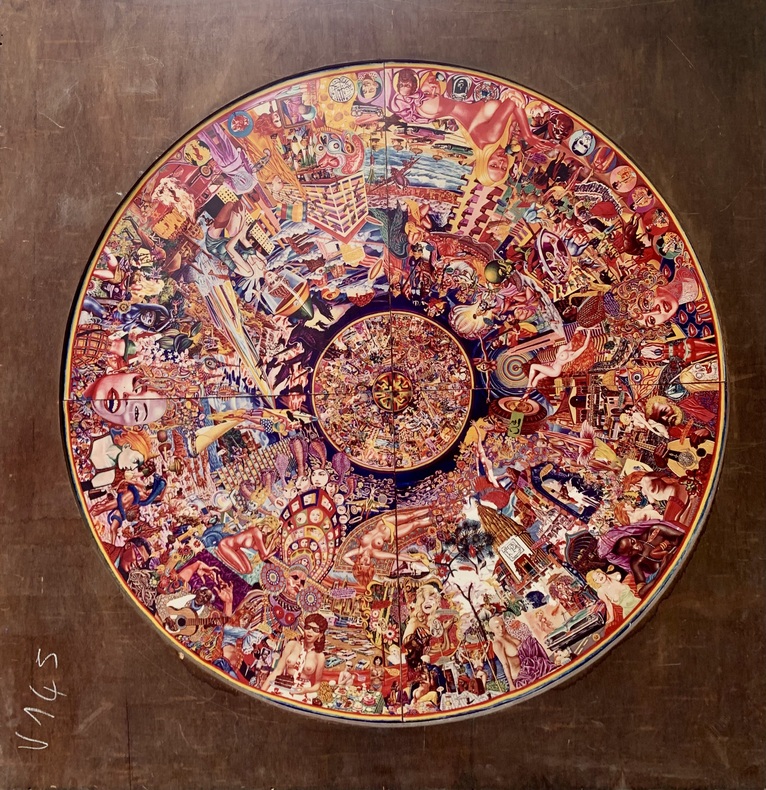
awd-1157Important tirage photographique en couleurs monté dans un encadrement carré en bois, ajouré en cercle au centre. Très rare épreuve, peut-être tirée pour un essai de couleurs lors de la commercialisation d’une affiche en 1969. Mentions Mati Klarwein, Grain of Sand, Robert Crandall Assoc., 1968 sur le côté avec échelles chromatiques, petits manques de pigmentation dans la partie basse (111,5/117,2 cm dans un cadre de 122/122 cm).
1916000483<p>Istanbul: TanÄ«n 1916.<br />Book. As new. Hardcover. 8vo over 7¾–9¾ in.<br />An official report issued by the Ottoman Fourth Army under Jamal Pasha concerning the proceedings of the Supreme Court Martial Tribunal convened at ʿĀliyah Aley Lebanon established to prosecute alleged Arab separatists and Pan-Arabist movements in Syria and Egypt during the First World War.<br />The report claims that the names of prominent Arab nationalists were discovered by the Ottoman authorities among documents seized from the French Embassy in Beirut reportedly placed under the safekeeping of the American Embassy following the outbreak of war. These documents formed the evidentiary basis for the tribunal's investigations.<br />125 pages of Arabic text accompanied by over 50 facsimile plates issued as a supplement reproducing original documents and correspondence between the accused Arab nationalists and other related parties examined by the tribunal.<br />Preserved in a modern hardcover binding.<br />A significant and controversial contemporary Ottoman publication providing rare primary documentation on wartime military justice Arab nationalist movements and Ottoman intelligence practices during the final years of the empire.</p><p>An important Arabic political and legal work presenting the Arabic version of La Vérité sur la Question Syrienne addressing the investigations and proceedings of the Ottoman Martial Law Tribunal DÄ«wÄn al-Ḥarb al-Ê¿UrfÄ« convened in ʿĀliyah Aley during the First World War.<br />The work constitutes a contemporary defense and documentary clarification of political accusations brought against Syrian and Lebanese figures shedding light on:<br />Ottoman wartime judicial procedures<br />political repression and accusations of separatism<br />and the broader Syrian Question in the late Ottoman period.<br />As the original Arabic edition this publication is a key primary source for the study of Ottoman military justice Arab political movements and Syro-Lebanese intellectual history during the final years of Ottoman rule.<br />A scarce and historically significant work particularly sought after in collections relating to the Arab provinces of the Ottoman Empire World War I Middle Eastern politics and constitutional and legal history.</p> Tanine hardcover
1943337630Clonmel: The Greyhound and Sporting Press Ltd. 1943. First Edition. Softcover. Mixed binding with the early volumes in the original stiff card wrappers. Wrappers have wear and tear as age with some loss. Later volumes bound in gilt blocked cloth. A good set only with some boards damp stained and two with damp damaged pages. Physical description; 60 volumes. Contents; Volume X Section I June - December 1931 ; XXI May 1943 ; v. XXI April 1943 ; v. XXI June 1943 ; v. XXII July1943 ; v XXII August 1943 ; v. XXII September 1943 ; v. XXII October 1943 ; v. XXII November 1943 ; v. XXII December 1943 ; v. XXII February 1944 ; v. XXII April 1944 ; v. XXII May 1944 ; v. XXII June 1944 ; v. XXIII July 1944 ; v. XXIII August 1944 ; v. XXIII September 1944 ; . XXIII October 1944 ; v. XXIII December 1944 ; v. XXIII January 1945 ; v. XXIII February 1945 ; v. March 1945 ; v. XXIII April 1945 ; v. XXIV July 1945 ; v. XXIV August 1945 ; v. XXIV September 1945 ; v. XXIV November 1945 ; v. XXIV October 1945 ; v. XXIV May - June 1946 ; v. XXV Section II January - June 1947 ; v. XXVI section I July - December 1947 ; v. XXVI Section II January - June 1948 ; v. XXVII Section II January - June 1949 ; v. XXVII Section I July - December 1949 ; v. XXVIII Section I July - December 1949 ; v. XXVIII Section II. January-June 1950 ; v. XXIX Section I July - December 1950 ; v. XXIX Section II January - June 1951 ; v. XXX Section I. July -December 1952 ; v. XXX Section II January - June 1952 ; v. XXXI section I July - December 1952 ; v. XXXII July '53 - June '54 ; v. XXXIII July '54 - June ' 55 ; v. XXXIV July '55 - June '56 ; v. XXXV July '56 - June '57 ; v. XXXVI July '57-June '58 ; v. XXXVII July '58 - June '59 ; v. XXXVIII July '59 - June '60 ; v. XXXIX July '60 - June '61 ;v. XXXX July 61 -June '62 ; v. XLI July '62 - June '63 ; v. XLII July '63 - June '64 ; v. XLIII July 64 - June '65 ; v. XLIV July '65 - June '66 ; v. XLV July '66 - June '67 ; v. XLVI July '67 - June '68 ; v. 47 July 1968 - June 1969 ; v. 48 July - December '69 ; v. 77 January - December 1998 ; v. 78 January - December 1999. Subjects; Irish Greyhounds. Stud books. Clonmel: The Greyhound and Sporting Press, Ltd. paperback
1917261279UK: The Socialist Party of Great Britain 1917. First Edition. Softcover. Near fine set in the original stiff-card wrappers; edges very slightly dust-dulled and toned. Remains particularly and surprisingly well-preserved; tight bright clean and especially sharp-cornered. Physical description; 300 issues approximately. Subjects; The Socialist Standard. Socialist Periodicals. The Socialist Party - Great Britain. 20th century periodicals. UK: The Socialist Party of Great Britain paperback
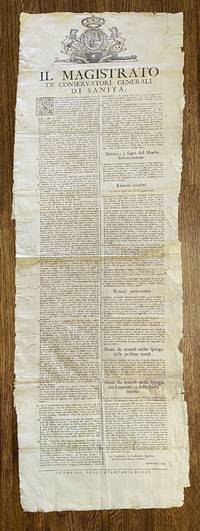
17444109Turin Italy: Stamperia Reale 1744. Very good. Huge letterpress broadside 1070 x 360 mm printed on 2 1/2 folio sheets edges untrimmed. A few sections underlined and annotated in a contemporary hand in the left blank margin worn; paper extensions mainly in the right margin; prominent horizontal central fold other folds reinforced on verso with occasional lost of one or two letters. A remarkable survival preserved in mylar L-sleeve backed with lig-free board. GIGANTIC APPARENTLY UNRECORDED BROADSIDE ISSUED BY THE STATE MAGISTRATE WARNING AGAINST THE 1744 "CATTLE PLAGUE" EPIDEMIC IN NORTHERN ITALY A FLIMSY ATTEMPT AT GOVERNMENTAL MANAGEMENT AND DISEASE CONTROL. <br /> <br /> The disease described herein was almost certainly RIDERPEST a highly contagious viral infection which can produce a 100% death rate among herds the colloquial term "cattle plague" is a misnomer because sheep and goats can also be afflicted by it. <br /> <br /> The 1744 outbreak had been observed in The Netherlands in the months before our broadside was printed but the Magistrate mentions only the reports from Franche Comté. While the devating consequences of cattle plague in The Netherlands are well researched its effects in Italy at this same time are not well-known probably due to the comparatively low survival rate of contemporary documentation. <br /> <br /> Indeed no other copy of our broadside can be found. Here the Magistrate of the Conservatory General of Health gives warning signs of the infection and preventative measures against its spread including mandatory "lazarettos" quarantine areas for livestock. The "nature and the signs" of the disease is addressed along with a dubious and ineffectual attempt at a remedy which involved cold water salt vinegar pepper and camphor; "Rimedi preservativi" prophylactic measures are recommended and steps for "fumigating" i.e. disinfecting livestock and their owners are given. <br /> <br /> The urgency of Magistrate's is justified: less than 30 years earlier through circuitous trade routes cattle plague had spread like wildfire even the most remote regions of Eastern and Western Europe and Britain. Such trade networks had become larger and more sophisticated in order to supply food to growing urban centers.<br /> <br /> Throughout history outbreaks of cattle plague led to severe economic crisis: the resulting famine inflation civil unrest and overall moral decay destabilized societies with crippling effect as had been seen in The Netherlands in the first outbreak of 1713-1720. Wherever and whenever cattle plague emerged religious figures government officials technocrats and the public wrested with the meaning and consequences of these disasters.<br /> <br /> Students and scholars of socio-economics in the Early Modern era would do well do incorporate primary sources of veterinary history in their research.<br /> <br /> NB: Interested parties are advised that this huge broadside will be shipped folded. Stamperia Reale unknown
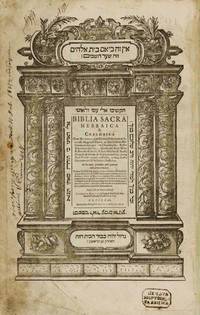
161948847Basel: Ludwig König 1619. First editions. Hardcover. Good. Seven parts in two volumes folio biblical texts and commentary in four parts continuously foliated; two supplemental sections each with separate foliation; Tiberias 1620 with separate pagination here bound after the second part - Vol. 1: 6 title and prelims 1-228 1 sect. title 234-441 1 blankff.; 6 sect. title and prelims 2 blank 114 2 blankpp. Vol. 2: 442-946; 8 Targum Yerushalmi; last leaf unfoliated; 67 Masora 1 blankff. Largely arranged in two columns of biblical texts in square font surrounded by commentaries in rabbinic Rashi font; text reads from right to left. This copy with collective Latin title surrounded by biblical quotations in Hebrew set within elaborate woodcut architectural borders. Hebrew sectional titles set within the same woodcut borders for the second and fourth parts with a plain letterpress half-title for the Five Megillot. The third sectional title for the Latter Prophets is lacking as are the Ashkenazi Haftarot readings not found in all copies. Apart from these lacks the Rabbinic Bible collates complete despite numerous errors in foliation throughout as per the detailed notes in Prijs Die Basler hebräischen Drucke. Opening word of each biblical book set in large one-third to one-half page cartouche vignettes with elaborate woodcut borders and surrounding letterpress Hebrew text. Main Latin title dated 1619 with the editor's Latin preface to the reader appearing at the verso. Jewish date chronogram for the second section Former Prophets dated 5378 1618/1619. Early twentieth-century black cloth boards worn at extremities gilt-lettered spine. Title moderately soiled re-inforced at gutter; neat old repairs to corners and fore-edge of title and next three leaves; old Russian stamp at bottom margin title manuscript entry in Russian along fore-edge dated 1837; intermittent mild to moderate marginal dampstains largely confined to corners and embrowning throughout both volumes somewhat more heavily in the first especially throughout Tiberias; top right corner of the opening leaf in vol. 2 repaired with loss of about 12 words surrounding title cartouche recto and some text in 9 lines of the commentary at the verso. Overall a good set with a notable chain of provenance. <br /> <br /> Sixth Rabbinic Bible in Hebrew: Mikra'ot Gedolot edited by Johann Buxtorf I 1565-1629 professor of Hebrew at the University of Basel and the foremost Christian Hebraist of his era with the assistance of the Jewish scholars Abraham Braunschweig who served as the principal corrector and Mordechai Gumplin of Posen. This was "a truly audacious undertaking for his time" Burnett From Christian Hebraism to Jewish Studies as no Christian scholar had yet attempted to edit the entire biblical corpus including the Aramaic versions Targumim and masoretic notes. Based mainly on the third Rabbinic Bible published by Daniel Bomberg at Venice in 1546-1548 the editor has carefully incorporated elements from two other Venetian editions. At the verso of the Latin title Buxtorf provides a detailed bibliographical excursus on the earlier Venetian editions and offers a tribute to Bomberg's industry by reprinting the colophon of the second Venetian Rabbinic Bible 1524-1525 at the conclusion of the masoretic appendix with text by the Hebrew grammarian and lexicographer Elijah Levita 1468 or 1469-1549 and a new introduction by Abraham Braunschweig. The design of the sectional titles and separate book title vignettes closely model those of the Venetian editions. "Buxtorf did not plan simply to reprint one of the existing Venice editions but rather to assemble the best features of them all into one work" and "to provide theologians with what he considered the most important tools for interpreting the Old Testament" Burnett. Buxtorf served in an official capacity as Basel's Hebrew censor charged with the oversight of all Jewish printing in the city and insuring that "no 'blasphemies' or slurs against Christians or Christianity appear in any book printed in Basel" Burnett. He carefully edited the Jewish commentaries in the Rabbinic Bible in accordance with this mandate "and removed many words and phrases which had escaped the attention of earlier censors" Burnett. <br /> <br /> The Rabbinic Bible contains the vocalized Masoretic text of the Hebrew Scriptures with accents and a vocalized Targum an Aramaic paraphrase of the biblical text: Onkelos for the Pentateuch; Jonathan b. Uzziel for the Prophets; and Targum Hagiographa for the Writings. The Hebrew and Aramaic versions are printed in square characters and presented in facing columns at the center of each page. The Jerusalem Targum of the Pentateuch appears as an appendix. In addition to the Aramaic paraphrases the Rabbinic Bible includes a massive scholarly apparatus of biblical commentaries by Rashi Ibn Ezra Baal ha-Turim Jacob b. Asher R. David Kimchi Radak R. Levi b. Gershon Ralbag Saadia Gaon and R. Isaiah along with the Masora a corpus of critical notes on the external form of the Biblical text compiled by Jewish scholars from late antiquity through the medieval era. As frequently occurs a copy of Buxtorf's work on the textual history of the Hebrew Bible Tiberias the 1620 first edition is bound-in. This work was made possible by the publication in 1538 of Elijah Levita's Masoret ha-Masoret a commentary on the Masora which Buxtorf translated into Latin for his own private use in 1593. "Buxtorf was concerned with the integrity of the consonantal text and the origin and integrity of the vowel points and accents of the Hebrew Bible from the very beginning of his scholarly career" and while he had earlier published a long excursus on the age of the vowel points and accents in his 1609 Thesaurus Grammaticus "Tiberias is Buxtorf's fullest and most impressive work on the history of the biblical text" Burnett. Intended as a reference work for Christian students and scholars interested in studying the Masora Buxtorf was also keen to refute the view advanced by Levita that the Hebrew vowel points were early medieval innovations. Our folio version of Tiberias was intended to accompany the Rabbinic Bible and has the same architectural borders at the title. König also published a quarto edition in the same year but only the folio version includes a critical commentary on the Masora in which Buxtorf proposes various corrections to the Masoretic notes. <br /> <br /> As noted at the title Buxtorf's faithful study and tireless labor studio fido et labore indefesso yielded notably long-lasting results: "The Basel rabbinical Bible became a standard tool for research among Christian scholars and would remain so. until the end of the nineteenth century" Burnett. A vast array of early modern scholars including Protestants like Johannes Drusius and John Selden as well as Roman Catholics like Robert Bellarmine and Andreas Masius owned a copy or two of the Rabbinic Bible. "Johannes Buxtorf's thoroughly censored "Christian" version of the Rabbinic Bible Basel 1618-19 only made it easier for Hebraists to own copies of their own" Burnett Christian Hebraism in the Reformation Era p.163.<br /> <br /> A note on the date of publication: "The actual printing began between the mid-August and mid-September of 1618. According to the colophon production ended on the 24 of Ab 5379 = August 4 1619 but since this date also appeared on the colophon of the Bomberg Biblia rabbinica edition of 1524-25 reprinted unchanged in the 1546-48 and 1568 editions it is suspect. Prijs suggested that the probable completion date was sometime during Ab of 5379 between July 12 and August 10 of 1619" Burnett. <br /> <br /> Provenance: from the library of acclaimed theologian and biblical scholar Brevard Childs with his entry at the free endpaper in the second volume. The earlier bookplate of judge Samuel Heller with his motto in Hebrew: Mi-kol melamdai hiskalti from all my teachers I have learned appears at the front paste-down. An old blue ink-stamp in Hebrew characters makes occasional appearances the text: Bet ha-Midrash ha-Gadol Minsk The Great Synagogue of Minsk. A Russian entry dated 1837 appears at the fore-margin of the main title along with an old ink stamp in Russian at the bottom margin the last word of which reads "Rabbina" References: Biblia Sacra: Burnett 7. Cowley 87. Darlow & Moule 5120 bound with the 1665 second edition of Tiberias cf. 5093. Davidson Otsar ha-shirah vol.1 p.406 no.8954. Prijs 219. Steinschneider 423 423b. VD17 23:675325G. S. Burnett Christian Hebraism in the Reformation Era Leiden: Brill 2012 p.163. Tiberias: Burnett 111. Prijs 222a. For detailed analyses of both works see: S. Burnett From Christian Hebraism to Jewish Studies Leiden: Brill 1996 pp.169-239 chaps. 6 & 7.<br /> <br /> Full Latin title: Biblia Sacra Hebraica & Chaldaica cum Masora quae critica Hebraeorum sacra est Magna & Parva ac selectissimis Hebraeorum interpretum commentariis Rabbi Salomonis Jarchi R. Abrahami Aben Esrae R. Davidis Kimchi R. Levi Gerson R. Saadie Gaon R. Jeschajae & Notis ex authore quem Baal Turim vocant collectis quibus textus grammaticè & historicè illustratur. In his nunc primum post quatuor editiones Venetas textus Chaldaicus qui Targum dicitur à deformitate punctationis & pravitate vocum innumeratum vindicatus; loca in Masora transposita deficientia pugnantia numeris depravata subsidio diversorum exemplarium & Concordantiarum Hebraicarum quantum fieri potuit reposita restituta & conciliata sunt ut in praefatione amplius declarabitur. Studio fido & labore indefesso Johannis BuxtofI linguae sanctae in Academia Basileensi Professoris Ord. Basileae: Sumptibus & typis Ludovici König 1619.<br /> <br /> Collation vol. 1 Rabbinic Bible: ital.a6 a-z8 A-E8 F4 G-Z8 Aa-Hh8 Ii9 Ii10 blank; 1 blank :3 1 blank A-N4 O5.<br /> <br /> Collation vol. 2 Rabbinic Bible: Kk-Rr8 Kk1 lacks Ss6 Tt10 Vv-Zz8 AA-PP8 QQ-TT6 VV9 VV10 blank XX-ZZ8 Aaa-Nnn8 Ooo3 Ooo4 blank PppTtt8 Vuu3 Vuu4 blank Xxx-Zzz8 AAaa-EEee8 8 A-G8 H6 I5 I6 blank. Ludwig König hardcover
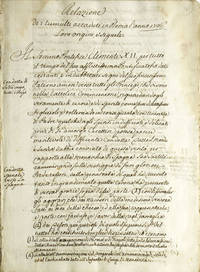
1736257005Rome 1736. 59 pp. in all on laid paper. 4to all with one exception approx. 27 x 20 cm. Provenance: Frederick North 5th Earl of Guilford 1766-1827; library of Sir Thomas Phillipps ex Ms. 7544; with H.P. Kraus. 59 pp. in all on laid paper. 4to all with one exception approx. 27 x 20 cm. Following the acquisition of the Kingdom of Naples and the Two Sicilies by the Bourbons of Spain in 1736 the conquering Spanish troops returning through Rome and Papal States provoked anti-Spanish riots in March of 1736. The following 6 manuscripts each in a different contemporary hand all from the collection of Sir Thomas Phillips and comprising Phillips Ms. 7544 relate to those events. They are as follows:<br /> <br /> 1 CONTI Antonio attributed to. "Relazione dei tumulti accaduti on Roma l'anno 1736. Loro origine e sequele." 13 pp. on 7 leaves.<br /> 2 "Sopra il tumulto populare seguito in Roma il 13 Marzo 1736." 6 2 blank pp. on rectos of 7 leaves. <br /> 3 "Se domanda se un Popolo si solleva tumultiamente nel Domnio altrui contro una nazione con offesa del Sovrano di essa ottenuto il perdona generale ." 4pp. on two leaves.<br /> 4 Same text as above with minor differences e.g. "amnistà" for "perdona". 4 pp. 21.5 x 15 cm.<br /> 5 Manuscript Letter fair copy headed "Sigl. Mio" 2 Giuglio 1736" beginning: "Non potevate far cosa pui grata all mia amicizia che commnicarmi la lettera trasmessa da Roma ."12 4 blank pp. Docketed on final page: "Relazione dei tumulti seguiti in Roma l'anno 1736 per i scrivi Austrici contro i Spagnuoli"<br /> 6 Manuscript Letter fair copy headed "Sigl. Mio". 15 pp. N.p. n.d. <br /> <br /> From the collection of Thomas Phillips 1792-1872. "His collection of over 60000 manuscripts was an outstanding achievement in the annals of bibliophily" ODNB and such was the scale that over 100 years passed after his death until the last tranche of the papers were finally sold in 1977 to H.P. Kraus.<br /> <br /> The attribution would seem to be based on a manuscript of the same title in the University of Chicago Special Collections Library v. OCLC: 154339939. unknown
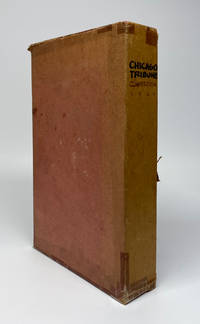
192311036Chicago: The Tribune Company 1923. First Edition. Hardcover. Fine/fine. Large quarto 103pp. followed by 281 full-leaf plates. A crisp clean lovely copy about fine with the rear inner hinge just starting and two tiny and inexplicable tape mends to a rear blank. Touch of foxing to the edges. In the publisher’s notoriously fragile burlap binding with absolutely no repairs. In the rare dust jacket about fine with a few mild scrunches to the crown but no notable tears or chips. In what appears to be the publisher’s original box with hand-written title. Box with a number of partial cracks and some tape mends but still rather sound and complete. A very important volume of architectural history as this 1922 competition drew contestants from some of the most innovative firms in the field all of whom were working just after the widespread use of steel frame technology which allowed for the safe construction of buildings more than a few storeys tall. Among the entrants were Eliel Saarinen whose design was perceived by many to be the best Walter Gropius Adolf Loos Bertram Goodhue and many others. The winning entry conceived by Howells and Hood still stands today; an imposing neo-Gothic skyscraper at 435 N. Michigan Avenue. When the book is found in commerce it is almost always rebacked as the fragile burlap binding was absolutely no match for the heft of the coated paper used for the nearly 300 plates. Similarly burlap bindings have a tendency to destroy dust jackets which is why we’ve only even encountered one other copy in a jacket. As this copy was hardly ever taken out of its box it has been spared the seemingly inevitable fate of its brethren. An important volume of modern Architectural history genuinely rare in this condition. The Tribune Company hardcover
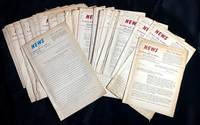
195142943New York American Council for Judaism 1951. 1st edition. Original stapled pages. "News" is 8.5"x11" and generally 4 single sided leaves. Press releases are legal size 8.5"x14" 2-4 single sided leaves each. Approximately 160 leaves total. <br> News is subtitled "Highlights of the Yiddish and Hebrew Press. A weekly Digest prepared by the Publicity and Research Departments American Council for Judaism." Maurice Spector is listed as Publicity Directory though the OCLC listing indicates Bill Gottlieb as editor perhaps for earlier or later issues <br> Each issue of the NEWS is headed with the warning "This is not for release - for your information only." <br> <br> Some headlines from the NEWS often quoting the Zionist press when it shines poorly on Zionism include: <br> -Nationalist-Zionist Education Endangers Judaism<br> - To the Rescue of Yiddish<br> - The Sin of the Histadrut<br> - Treatment of the Arab Minority in Israel<br> - And Now it is Israel's Turn to Use the Hostage Weapon.<br> - The Religious Bloc is Powerful for Reasons that aren't Religious<br> - We Want Peace Unity Discipline-But on our Own Terms.<br> - Israel's Election Campaign Opens.Here in America<br> <br> Some headlines from the press releases include: American council for Judaism Calls NCRAC Action Partisan: <br> -Declares Zionism and Jewish Nationalism Responsible for Creating 'Dual Loyalties' Issue<br> - Carroll Binder Warns Minority Pressure Blocs Endanger U.S. National Interests<br> - President Truman Say American Council for Judaism Deeply Rooted in U.S. Traditions of Individual Rights<br> - Zionist Pressure Seek Change of Judaism Values from Universal Religion to Status of Tribal Cult Rabbi Charges<br> - Dorothy Thompson Warns Zionism's Viewing All Jews as Members of a Jewish Nation" Seeking Privileged Minority Status in U.S. Gives Aid to Antisemitism<br> - Cause of DP's Pleaded at American Council for Judaism's Annual Meeting: Leading Social Workers Charges Pro-Israel Pressures Deprived Many Thousands of Sanctuary<br> - U. S. Culture Infiltration Seen as world Zionism Aim<br> - Israel has No Rights Authority Over Lives of U.S. Jews Rosenwald Says: Assumptions in Ben-Gurion's Knesset Speech Rejected by Head of American Council for Judaism<br> <br> "The American Council for Judaism ACJ is an organization of American Jews committed to the proposition that Jews are not a national but a religious group adhering to the original stated principles of Reform Judaism as articulated in the 1885 Pittsburgh Platform. In particular it is notable for its historical opposition to Zionism. Although it has since moderated its stance on the issue it still advocates that American Jews distance themselves from Israel politically and does not view Israel as a universal Jewish homeland.<br> The rabbis of Reform Judaism had opposed Zionism prior to World War I supporting freedom democracy and equal rights for Jews in the countries where they lived. The influential American Jewish Committee was also anti-Zionist until 1918 when it shifted to a non-Zionist platform until the 1967 Six-Day War. The Central Conference of American Rabbis of the Reform movement declared itself officially neutral on Zionism in 1937.<br> In 1942 a split within the Reform movement occurred due to the passage of a resolution by some rabbis endorsing the raising of a 'Jewish Army' in Palestine to fight alongside the Allies of World War II. The American and British general staffs opposed placing Jews in segregated armed forces.The founders of the American Council for Judaism regarded the potential segregation of Jews to be a highly regressive and harmful measure.<br> The ACJ was founded in June 1942 by a group of leading Reform rabbis including six former presidents of the Central Conference of American Rabbis and the president of the Hebrew Union College as well as laymen who opposed the creation of a religiously segregated Jewish Army to fight alongside the Allies and the new political direction of some in their movement including but not limited to on the issue of Zionism as redefined by the Biltmore Program in May 1942.The leading rabbis included Louis Wolsey Morris Lazaron Abraham Cronbach David Philipson and Henry Cohen but their most vocal representative for a time became Elmer Berger who became the council's Executive Director.<br> The ACJ described itself as anti-nationalist and followed a universalist interpretation of Jewish history and destiny. According to its statement of principles the ACJ supported the 'rehabilitation' of Palestine and did not support political Zionism. It also declared that 'Jewish nationalism tends to confuse our fellowmen about our place and function in society and diverts our own attention from our historic role to live as a religious community wherever we may dwell.' The ACJ's leaders felt that they represented the views of a majority of American Jews and began a large membership drive. By 1946 it had numerous local chapters throughout the United States and regional offices in Richmond Chicago Dallas and San Francisco.<br> During World War II the council was active in opposing Zionism. In 1944 it protested the formation of the Jewish Brigade by the British Army which was composed of Palestinian Jews led by British-Jewish officers.it stated that.'Americans of the Jewish faith are and always have been in the American armed forces. The flag of Americans of the Jewish faith is the Stars and Stripes.'<br> While protesting the White Paper of 1939 which imposed strict limits on Jewish immigration to Palestine and land purchases in the country it also opposed 'Zionist nationalism' and urged American Jews to 'organize in strength out of deep concern for oppressed Jews everywhere behind a non-nationalistic program to deal with the total Jewish problem.' <br> It declared that 'Beyond the abrogation of the White Paper lies the need for a basic solution. That solution we believe can come only when there is world wide recognition of the rights of Jews to full equality. It can come in Palestine only when the pretensions to Jewish Statehood are abandoned and we seek instead freedom of migration opportunity based on incontestable rights and not on special privilege.<br> We look forward to the ultimate establishment of a democratic autonomous government in Palestine wherein Jews Moslems and Christians shall be justly represented; every man enjoying equal rights and sharing equal responsibilities; a democratic government in which our fellow Jews shall be free Palestinians whose religion is Judaism even as we are Americans whose religion is Judaism.'<br> Following World War II with the question of Palestine's future being considered the ACJ continued to support a joint Jewish-Arab state rather than a Jewish state in Palestine and opposed dispossessing the Arabs who were then living in Palestine.<br> The presidency of the ACJ was accepted by the well-known philanthropist Lessing J. Rosenwald who took the lead in urging the creation of a unitary democratic state in Mandatory Palestine in American policy-making circles. Rosenwald testified before the Anglo-American Committee of Inquiry in 1946 urged the creation of a unitary Jewish-Arab state in Palestine and allowing Jewish immigration to Palestine to continue only upon 'renunciation of the claim that Jews possess unlimited national right to the land and that the country shall take the form of a racial or theocratic state' and said that the United States and other UN member states should allow more Jewish immigration to solve the European-Jewish refugee problem.<br> It later endorsed the Committee of Inquiry's recommendations including that Palestine become neither a Jewish or Arab state and the admittance of 100000 Jewish refugees into Palestine. In addition it opposed the establishment of a Jewish state anywhere else in the world not just in Palestine. The ACJ's official position was that European Jews should be rehabilitated by restoring their civil political and economic security. <br> During the Jewish insurgency in Palestine a campaign against the British by Jewish underground groups in Palestine the Haganah Irgun and Lehi the ACJ opposed what it viewed as Jewish terrorism. Following the King David Hotel bombing it issued a statement calling for American Jews to 'repudiate the perpetrators of those outrages and those leaders of Jews in and out of Palestine whose incitement is equally responsible.' In a statement Lessing Rosenwald called for the American Jewish community to condition any further assistance to the Yishuv Palestinian Jewry on the end of violence.<br> After the State of Israel declared independence in 1948 the ACJ continued its anti-Zionist campaign.<br> Its position was that to American Jews Israel was not the state or homeland of the Jewish people but merely a foreign country. In December 1948 Lessing Rosenwald urged that the US condition friendship with Israel on Israel building an inclusive Israeli nationalism confined to its own borders and inclusive of its Muslim and Christian citizens rather than Jewish nationalism.<br> The ACJ switched its focus to battling what it viewed as its primary foe-the political influence of Zionism upon American Jewry. In addition to supporting a network of religious schools committed to Classical Reform Judaism the Council fought American-Jewish fundraising for Israel and agitated against the merging of Zionist fund-raising organizations with local Jewish community boards provided financial aid to Jews emigrating from Israel and to Palestinian refugees and enjoyed friendly relations with the Eisenhower State Department under John Foster Dulles. <br> The ACJ also vocally supported the efforts of William Fulbright to have the lobbyists for Israel in the United States legally registered as foreign agents. In 1955 the ACJ's head Elmer Berger advocated the complete assimilation of Jews into American life by switching the Jewish Sabbath from Saturday to Sunday creating a new menorah to 'reflect the appreciation of American Jews of the freedom of life in the United States' and for the interpretation of the holiday of Sukkot 'to be broadened to take on meaning to all citizens of an industrial society.'<br> In 1957 the Union of American Hebrew Congregations now known as the Union for Reform Judaism denounced the American Council for Judaism. In a statement the UAHC alleged that the ACJ misrepresented classical Reform Judaism undermined the unity of the Reform movement questioned the national loyalty of Jews who supported Zionism aided antisemites and 'played directly into the hands of Arab propagandists'.<br> Jewish intellectuals who at one time or another passed through the Council included David Riesman Hans Kohn Erich Fromm Hannah Arendt Will Herberg Morrie Ryskind Frank Chodorov and Murray Rothbard. Among the notable gentile friends of the council were Dorothy Thompson Norman Thomas Freda Utley Arnold J. Toynbee and Dwight Macdonald. The ACJ was particularly influential in San Francisco Philadelphia Houston Chicago Baltimore Washington D.C. Atlanta and Dallas" Wikipedia.<br> SUBJECTS: Zionism and Judaism -- Periodicals. Jews -- United States -- Sionisme -- Aspect religieux -- Judai¨sme -- Pe´riodiques. Juifs -- E´tats-Unis. OCLC: 12373966. OCLC lists only 3 holdings worldwide HUC UTexas Wisc Hist all in the midwest and none at any Ivy League institution.<br> Toning to edges pencilled institutional numbers to cover corner margins some original corner staples removed paper strong Good Condition solid. Rare and important especially as much of Liberal Progressive and Secular American Jewry rethinks its relationship to Israel and Zionism in light of the present Israel-Gaza war. B Zion2-3-5-'l. New York, American Council for Judaism unknown
1967List2885Sheffield United Kingdom 1967. 20 x 30 inch poster on heavy cardstock. Some staining and scuffing pinholes and some tears at edges fine contrast; overall excellent. A poster advertising Stevie Wonder at Sheffield’s Mojo Club in October 1967. Wonder would have been just seventeen at the time though he had already dropped “Little†from his stage name. The Mojo Club in working-class Sheffield was the project of brothers Peter and Geoff Stringfellow; the pair had previously worked as promoters and were preternaturally talented having booked the Beatles for April of 1962 shortly before the release of “Love Me Doâ€.1 Stevie Wonder would be the last live act at the Mojo as it was shut down by the city three days later on October 10.<br /> <br /> 1 Steve Walker “The King Mojo Club†2020 https://www.kingmojostory.com. unknown
1973568755San Diego California: Community Congress Press 1973. Softcover. Near Fine. First edition. Complete in six volumes. Octavos. Stapled printed and unprinted wrappers. Overall near fine with some light spine toning a bit of light edgewear and a small indentation and some discoloration on rear wrap of Part #5. The first of Acker's three six-volume novels preceded only by her poetry collection Politics written in parts and issued separately in very limited numbers and consequently very difficult to find complete and in original form. A wonderful copy. Community Congress Press) unknown
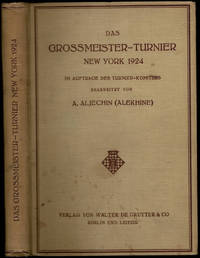
1925C2887<p>xx3373 ad pages with diagrams plates and tables. Octavo 8 1/4" x 5 3/4" bound in original publisher's light brown cloth with brown lettering to spine and cover. Forward by Herman Helms. Inscribed by Alexander Alekhine. Bibliotheek Bibliotheca van der Linde-Niemeijeriana: 5367 First German edition. First published in English.</p><p>Personal dedication from the former world chess champion Alexander Alekhine to Tarrasch: "Mr. Doctor Tarrasch with the highest respect from the author. Paris 14/2 1925."</p><p>New York 1924 was an elite chess tournament held in the Alamac Hotel in New York City from March 6 to April 18 1924. It was organized by the Manhattan Chess Club. The competitors included world champion Jose Raul Capablanca and his predecessor Emanuel Lasker. Nine other top players from Europe and America were also invited. Emanuel Lasker met Alexander Alekhine Efim Bogoljubow Geza Maroczy Richard Reti Savielly Tartakower and Frederick Yates in Hamburg. They steamed with the SS Cleveland on February 28 1924 and joined Capablanca Frank Marshall Dawid Janowski and Edward Lasker in New York. The tournament was played as a double round robin with each player meeting every other one twice. Emanuel Lasker got $1500 for his first prize generous payment for expenses and still complained. Capablanca gained $1000 compensation for costs and an extra fee. Everyone expected World Champion Capablanca to win and wondered how Lasker the 55 year old dethroned lion would perform. Lasker ran away with the tournament scoring a phenomenal 80% against the elite of the chess world. Brilliancy prizes went to Reti for his win over Bogoljubow Marshall for his win over Bogolijubow and to Capablanca for his win over Lasker. There are some mistakes but this is probably the best tournament book written rivaled only by Bronstein's Zurich 1953.</p><p><strong>Condition:</strong></p><p>With a personal dedication from Alekhine to Tarrasch on title Lightly soiled light rubbing to spine ends some toning to pages spine head rubbed covers soiled else very good.</p> Walter de Gruyter and Company hardcover