184 822 résultats
1980KOS01600432TBD 1980. Soft Cover. Fine. KOS01600432 TBD paperback
5326London William Little 1843 i.e. 1842. 1st Edition . Hardcover. . ~ ~ NOTE: THE PRICE OF THIS BOOK IS CURRENTLY REDUCED! ~ ~ . The paper's first 34 issues bound in one volume. Imperial folio. Paginated consecutively. Pp. vi 554. Illustrated throughout. HARDCOVER bound in the original publisher's half calf and marbled boards spine decorated lettered and dated in gilt sides gilt ruled; binding rubbed & chafed in places worn in places restored in places withal a good binding; few closed tears without loss at bottom of leaves. In a very good condition. Overall a well preserved tightly bound clean presentable copy. ~ FIRST EDITION. The paper's first issue first complete volume first complete year. Published as a volume with Title Preface and Index in 7 January 1843. Rare survivor a landmark in the history of journalism. The Illustrated London News was the world's first illustrated weekly newspaper. The first issue 16 pages with 32 woodcuts appeared on Saturday 14 May 1842 marking a revolution in journalism and news reporting. Completely exceeding the publishers' expectations it had to be reprinted several times that day; the issue went through five reprints and sold 26000 copies; the present issue is of the fourth printing. Issues 4-8; 10-16; 18-20; 24; 27; 28; 30; 34 are first reprint; issue no. 2 is 3rd reprint; no. 9 is 2nd reprint. Five issues later it was time for jubilation: "Probably in the whole annals of Newspaper History the triumphant success of 'The Illustrated London News' is without a parallel; it has received from the public a welcome warmer and wider than we could anticipated even in the buoyant enthusiasm of our first ambition. From the length and breadth of the Empire we have received the most flattering testimonials." The present volume contains all first 34 issues and a Supplement. Each issue is stamped at bottom with the legendary red Tax Stamp. Also present is Issue no. 15 a rare collectible in itself which appeared with the erroneous header "No. 10 July 16" instead of "No. 15 August 20". It is neatly corrected here by contemporary hand. Y-1 <br/> <br/> London, William Little, 1843 (i.e. 1842). hardcover
In-folio, 57 ll., 1bl.; engraved title and 51 full-page engraved plates, giving geodetic and cosmographic instruments and measurements; woodcut ornate initials and tailpieces, large Aldus anchor woodcut device at the end. Bound in contemporary cartonnage (reliure d'attente), with weak hinges; occasional light foxing, light dampstain at the bottom of the last leaves. Despite the title the work includes 50 full-page engravings, of which the last 7 are a supplement by Scala and are especially devoted to architecture and perspective.
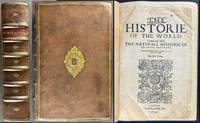
16341634SSLondon: Printed by Adam Islip 1634. 2nd edition in english. Leather-bound Hardcover. Very Good /no dj as issued. 2nd edition in English Very Good<br /> --- --- --- <br /> London printed by Adam Islip 1634 second English edition two Volumes bound in One 13.5" x 9"'<br /> Vol I 58 614 pages plus 42 pages Index for Tombe I; Vol II 632 pages plus 82 pages Index for Tombe II 2.<br /> Two volumes in one bound in modern full calf decorated papered boards six raised bands to spine gilt lettering and decorations on spine and front and back board.<br /> Elaborate woodcut printers device on title page woodcut initials head and tailpieces copious indexes of both volumes small piece of paper on final sheet saying that the previous issue had a lengthy Errata sheet which is no longer required as the errors have been corrected for this edition.<br /> Faint ownership inscription on top of the title page dated 1647.<br /> <br /> The Historie of the World was first translated into English by Philemon Holland in 1604. The original work of Pliny was published two years before he perished at Pompeii during the eruption of Mount Vesuvius in 79 CE.<br /> <br /> Gaius Plinius Secundus or Pliny the Elder was a Roman author naturalist scientist and naval and army commander of the early Roman Empire. He wrote several works and was dedicated to study in his life. <br /> <br /> The work is in good to very good condition overall. There is some marginal toning. There are some restored marginal losses to prelims and concluding leaves. There is very light intermittent spotting. There may be a few minor imperfections or faint marks to be expected with age. ---- ---- ---- <br /> The Historie of the World was first translated into English by Philemon Holland in 1604. The original work of Pliny was published two years before he perished at Pompeii during the eruption of Mount Vesuvius in 79 CE.<br /> <br /> Gaius Plinius Secundus or Pliny the Elder was a Roman author naturalist scientist and naval and army commander of the early Roman Empire. He wrote several works and was dedicated to study in his life. <br /> <br /> The work is in good to very good condition overall. There is some marginal toning. There are some restored marginal losses to prelims and concluding leaves. There is very light intermittent spotting. There may be a few minor imperfections or faint marks to be expected with age. Printed by Adam Islip hardcover
2110502150903393Not Available N.A. Soft Cover. Fine. Number of books: 180 Not Available paperback
19182091502135420922Not Available 1918. Soft Cover. Fine. Number of books: 2 Not Available paperback
19842091502135709245Sequel document follow-up meeting 1984. Soft Cover. Fine. The book is in fine condition. Sequel document follow-up meeting paperback
20062091502135308943Tokyodoshuppan 2006. Soft Cover. Fine. Number of books: 14 Tokyodoshuppan paperback
19392080502106917620Not Available 1939. Soft Cover. Fine. The book is in fine condition. Not Available paperback
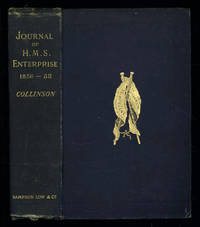
1889035576London: Sampson Low Marston Searle & Rivington. 1889. 1st Edition 1st Printing. Hardcover. Good/No Jacket. 8vo - over 7¾ - 9¾" tall. Good. Publishers cloth embossed with gilt lettering and emblem to upper cover. Front hinge cracked. Gift inscription in contemporaneous hand to free front endpaper. A touch of foxing. Two of the maps have a dog-eared fore-edge where they have not been folded quite flush with the page edges. Illustrated with tissue-guarded colour frontispiece of the ship tissue-guarded portrait of the author and 6 fold-out maps. xi i 531pp 32pp of publishers ads to rear. FIRST EDITION of the posthumously published journal by the captain who came closest to the site where Franklin's expedition ended. "In 1849 Collinson was appointed to command an expedition for the relief of Sir John Franklin by way of the Bering Strait; he himself had command of the Enterprise and with him was Commander Robert Le Mesurier McClure in the Investigator. The two ships sailed together from Plymouth on 20 January 1850 but unfortunately separated in the neighbourhood of Cape Horn and did not meet again. The Enterprise passed Point Barrow Alaska on 21 August but the ice forced Collinson to return south and winter in Hong Kong. In 1851 he was again hampered by ice and in 1852 was frozen in at Cambridge Bay for the winter. In 1853 the Enterprise was caught in the ice at Camden Bay and there passed a third winter. She reached Point Barrow on 8 August 1854 after being shut up in the Arctic entirely on her own resources for upwards of three years. Of the many who had searched for Franklin Collinson came closest to the place where the expedition had ended. Collinson's addition to geographical knowledge on this Arctic trip was very considerable and would have been tantamount to the discovery of the north-west passage had this not been already actually achieved by the men of the Investigator" DNB. Arctic Bibliography 3351; Hill 337; Ricks p 68; Tourville 986. <br/> <br/> Sampson Low, Marston, Searle, & Rivington. hardcover
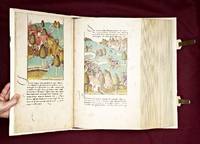
ST12206Lucerne: Faksimile Verlag 1985. No. 1 OF 980 COPIES. 391 x 273 mm. 15 3/8 x 10 3/4". 1035 pp. in the facsimile. Two volumes including commentary volume in German. <br/> Stately replica blind-stamped pigskin covers with multiple floral frames small rampant lion stamped in black ink on each central panel raised bands brass and leather clasps. WITH NUMEROUS LARGE MINIATURES depicting battles sieges assaults floods fires and the burning of two unfortunates at the stake. In mint condition.<br/> <br/> The Great Burgundian Chronicle also called the "Zürcher Schilling" after the author and after Zürich where it is kept is the most original and thorough book from the period on the Burgundian Wars between the Swiss Confederation and Charles the Bold. It was executed around 1480 in the tradition of the Bern chronicles begun by Konrad Justinger in 1420 and it is the most comprehensive of all chronicles ever carried out by Schilling. The Great Burgundian Chronicle gives a unique witness as the expression of a genuine patriot and does so without the heavy censorship that characterizes later "official" versions of the text. One of the most important features of the manuscript's illustrations is the landscape in which the events take place. It hardly ever corresponds to topographic reality but is rather based on the artist's imagination. The viewer sees the depicted scenes from above being treated to fanciful versions of little towns villages and castles all carefully inserted into a lovely but imaginative landscape of rolling hills. Faksimile Verlag unknown
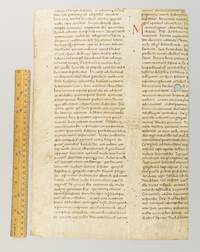
ST12778-0083Italy late 11th or early 12th century. 413 x 285 mm. 16 1/4 x 11 1/8". Double column 47 lines of text in a pleasing early gothic hand. <br/> One two-line initial "M" in red. With a few lines of marginal notes in a later 16th century hand. ◆Probably lacking a line or two at the head as well as half of one column scattered light stains with a few darker stains in one corner touching the text but still legible scattered small wormholes one half-inch hole affecting a few words of text and yet a remarkably clean leaf the remaining text entirely legible.<br/> <br/> The text here in a very good hand is on the death of Saint Martin of Tours. While it is more likely from a Lectionary with the reading for Martinmas November 11 it could be from a separate copy of Sulpicius. The fourth century founder of French monasticism Martin of Tours is celebrated as the Soloman of shawls. One of the most beloved episodes of his early life is a the tale that demonstrates the sensible limits of charity: instead of heedlessly surrendering his cloak to a shivering beggar he encounters he sagely divides it in two so that both he and the object of his benevolence will be warm. The script here has many lingering features of Carolingian minuscule and this fact plus the grand size of the leaf combine to give it very considerable antique beauty. unknown
1552V48030Basel: H. Froben 1501-1563 1552. Hardcover. Very Good. Large Froben printer's device on titlepage historiated woodcut initials throughout. . Four Volumes in One large folio bound in blind-stamped pigskin dated 1564 with initials I.D.F.H. on bevelled wooden boards with metal clasps lacking one clasp each board has 16 small marginal panels of biblical scenes and four larger central stamps of Justice Fortitude etc with legends under each spine on four raised double bands with MS title and shelf mark "Basilius 39" some small worm holes tips worn. Title page catalogue 6 787pp with colophon "Basiliae apud Hier. Frobenium et Nic. Episcopium anno M.D.LI" 1551 21pp index 3pp blank with large Froben device on last page. Bookplate with coronet initials dated 1913 inscription "Ex bibliotheca Johannis Mathon Lugd. Bat." with MS devices on free endpaper & another inscription on titlepage. Collated complete &4 a-z A-M6 N8 O-Z Aa-Ss6 Tt8 Vv-Xx6 with pagination continuous each of 4 vols has divisional titlepage see Adams B340. Crisp and clean throughout but with quite extensive worming of pages near front and back of book. NB large heavy book so extra shipping/postage costs. H. Froben (1501-1563) hardcover
177244162Five maps and one engraving all fldg The author was Colonel of Foot and Commodore of the Expedition in the Frigate La Boudeufe and the Store-Ship L'Etoile from the title page. Bougainville Nov.121729-Aug 31 1811 was a French Admiral and expolorer who circumnaviagated the globe in a scientific expedition. This is the travel log of that journey which proved to be very popular when it was published especially his observations on Tahitian society. J. Nourse hardcover
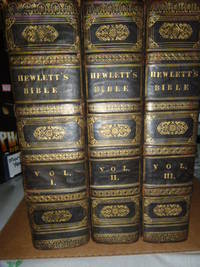
18118713London: London: Printed for Longman Hurst Rees Orme & Co.; F.C. & J. Rivington; Lackington Allen & Co; J. Mawman; Sherwood Neeley and Jones; & Wilson & Son 1811-1812 First Editions 3 vols thick 4to ill. 1811 Three thick quarto volumes uniformly bound in original black full leather raised gilt spines gilt borders moderate shelf wear marbled end-papers. The hinges are all solid and contents are clean and near fine. Illustrated with numerous engraved plates. Volume one begins with a Prolegomena on the Authenticity and Inspiration of the Old Testament The Translators to the Readers Addenda et Corrigenda The Various Editions of the Bible and Parts Thereof in English since the year 1526 History of the Present Authorised Translation of the Bible Essays on the Jewish Coins Weights and Measures and The Calendar of the Jews and the Old Testament from Genesis to Esther. Volume Two continues the Old Testament from Job to Zechariah plus the Apocryphal books. Volume Three contains a 143 page Concise History of the Jews from the Time of Their Re-establishment by Ezra and Nehemiah after the Babylonish Captivity to the Destruction of Jerusalem by the Romans: forming a Connection Between the History of the Old and New Testament; a fold-out Map of Canaan Palestine Judea or The Holy Land; The New Testament of our Lord and Saviour Jesus Christ: Translated out of the Original Greek and with the Former Translations Diligently Compared and Revised by His Majesty's Special Command; and Indexes. A near fine copy by antiquarian standards of this very scarce Bible. London: Printed for Longman, Hurst, Rees, Orme, & Co.; F.C. & J. Rivington; Lackington, Allen, & Co; J. Mawman; Sher hardcover
193522072New York Limited Editions Club LEC 1935 HB NODJ ISSUED 1935 1st Edition THUS Fine/F- NODJ tiny rub extremities spine book Cover BOUND IN Original FULL BLUE MOROCCO Decorated Leather with LAVISH Gold Gilt Embossing on Front back & Spine Reddish cloth covered SLIPCASE Has MUCH Rub Wear & some paper Adhereing to it & Staining but iS INTACT with No Tears Good - cond. ONLY Slipcase Copy #204 of a limited run of 1500 copies for the Limited Editions Club. It's signed by Alice Hargreaves the real life inspiration for Carroll's "Alice". in Plastic Mylar clear Cover For Protection 212 pages Small octavo Illustrations Re-engraved by Frederic Warde Alice refused to sign other editions of the Alice books in her lifetime written by Carroll for her when she was young Alice Liddell but she was convinced with the help of monetary compensation and an advanced age to sign here. A rare opportunity to acquire one of the most famous children's books ever published here signed by the subject of the books. . First Thus. Hard Cover. Very Good/No Jacket. New York, Limited Editions Club LEC hardcover
19390001440DENVER COLORADO CO. Very Good. 1939. On offer is a sensational scrapbook and homage to magic and magicians in pre-World War II America. Jack Fleming of Denver Colorado beginning as early as 1939 through 1947 collects ephemera broadsides business cards photographs and clippings and much much more nearly filling a lovely large folio sized scrapbook. Jack was a teenage magician using his real name and several stage names including PEAWADI THE MAGICIAN. Items include letters from local organizations boys and girls clubs school events etc. thanking him for performing local news articles about his performances and much more regarding his own entertaining. The first page of the scrapbook has a pamphlet program of "The Colorado Society of Magicians" promoting its "First Annual Houdini Memorial Program". The program is dated 1943. It is a single fold 4 panel program. The inside has a page filled with portraits of 10 Colorado Society Magicians and 5 "Florence Kesslers Dancers". Much of the scrapbook is an homage to Houdini whom he obviously idolized but also other huge names like Scarne who trained GIs how to avoid card sharks and dice cheats. The scrapbook also contains a very rare broadsheet of The Welles Mercury Wonder Show "ORSON WELLES THE MAGNIFICENT - The Mercury Wonder Show for Service Men" which was carefully tipped in at its upper corners but otherwise the broadsheet is loose. The broadsheet is in very good condition and has a shallow vertical crease across its entire length probably folded at one point and it has several horizontal creases from where it is folded to lay flat and safely in the scrapbook. There are no chips or tears to the broadsheet. A copy of this broadsheet was sold at a 2002 Swann Galleries Auction Sale Number 1949 - Lot 241 as part of the MAGIC - THE MANNY WELTMAN HOUDINI COLLECTION. Swann states: Scarce playbill for Welles and his bag of tricks listing the various acts and setting them off with amusing vignettes 21 1/2 x 6 inches sight size; matted and framed. Np 1943 Estimate $2000-3000 - sold for $1600. Collectors of 20th Century magic will be thrilled with the depth and breadth of this young man's abilities and interests in the world of magic. The scrapbook is 11.5" x 15.5" has illustrated vinyl covers spiral bound. 42 of its 48 pages 24 leaves have items on them. Some are loose. Overall VG.; Folio - over 12" - 15" tall; KEYWORDS: MAGIC MAGICIANS HOUDINI SCARNE PRESTIDIGITATION SLEIGHT OF HAND CARD TRICKS ORSON WELLES MERCURY WONDER SHOW MERCURY THEATER WORLD WAR II WWII AMERICANA HANDWRITTEN MANUSCRIPT DOCUMENT LETTER AUTOGRAPH DIARY JOURNAL LOG KEEPSAKE WRITER HAND WRITTEN DOCUMENTS SIGNED LETTERS MANUSCRIPTS HISTORICAL HOLOGRAPH WRITERS DIARIES JOURNALS LOGS AUTOGRAPHS PERSONAL MEMOIR MEMORIAL PERSONAL HISTORY AMERICANA antiquité contrat vélin document manuscrit papier Antike Brief Pergament Dokument Manuskript Papier oggetto d'antiquariato atto velina documento manoscritto carta antigüedad hecho vitela documento manuscrito . unknown
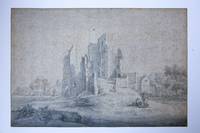
65233View on the ruins of the ""Huis ter Kleef"" a castle near Haarlem.Shepherds with dogs in front of the ruins. Birds flying in the sky above the ruins. Dated and signed below 1649 Maas or Maes. The date seems original but the signature doesn't. In a sale catalog from 2010 lot. 587 it is considered as a drawing by a young Nicholaes Maes 1634-1693 who in 1650s was beginning with his apprenticeship at Rembrandt's.On the bottom right corner are traces of what seems to be a collector's mark stamped in black ink fashioned as a ramping animal a lion in profile turned towards the left. not in Lugt.See R. van 't Zelfde 'Josua Breckerveld 1644-1700' Delineavit et Sculpsit 23 juli 2001 p. 11-17 illustrated. Drawing on paper in pen with brown ink washed in grey with some highlights in white. Total: 270 x 404 mm. Pasted down on cardboard an operation that is contributing to the spreading of foxing especially on the top region. The drawing was probably divided into two pieces from a notebook and recomposed by pasting it down on a wide cardboard. On the back another date was added in pen and brown ink ""1885."" and might refer to the pasting down the kind of cardboard would be consistent with that period. Other more recent numbers on the backing in pencil. Possibly the drawing was pasted down due to a minor defect of the paper located on the shirt of the sitting shepherd. The hole has been repaired from the backing and the lacuna was filled in with pencil. This area extends for less than 5 mm. unknown
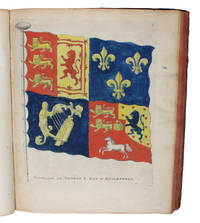
171951669Amsterdam, David Mortier, 1719-18. 4to. Contemp. full calf. Spine defective, lacking leather at upper and lower compartment and frontcover detached from spine. Front free endpaper gone. The first two title-pages printed in red/black and both with an engraved vignette with a portrait of Erasmus. (4),82"(2),94"(2),24,(12) pp. Vol I: 1 large folded engraved plate and 1 textengraving. - Vol. II: 34 textengravings (1/2-page a. full-page) + 21 engraved plates (4 large and folded). - ""Les Pavillons"": 90 engraved plates of flags. The first flag ""Pavillon de George I"" is handcoloured. (Last printed leaf numbered 101 because the 90 engraved plates is counted as pages !). Complete. Light marginal browning, a few leaves with small closed tears.
180645128London, W. Bulmer and Co., 1806. 4to. No wrappers as extracted from ""Philosophical Transactions"" 1806 - Part II. Pp. 239-268. Having also the titlepage to the volume (Part II, 1806). A faint bit of soiling to outer right margin of the first 2 leaves, otherwise clean and wide-margined.
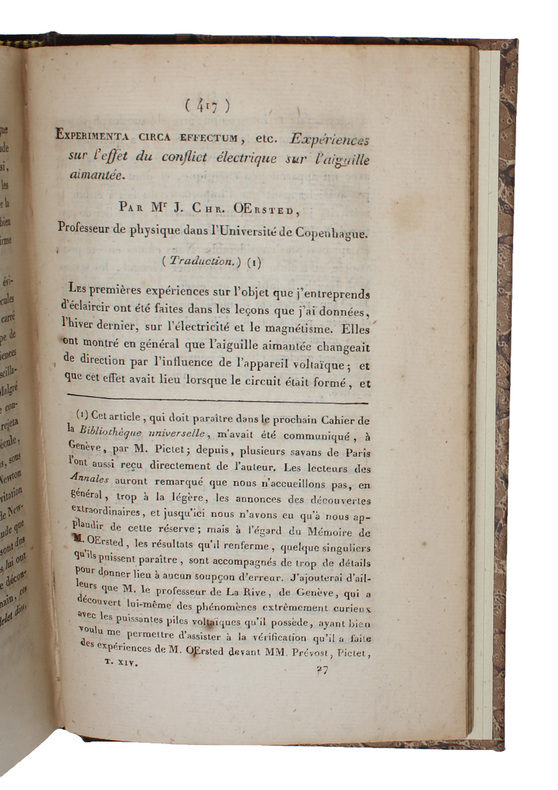
182035260Paris, Crochard, 1820. Recent hcloth. Some repairs to inner margin of titlepage to ""Annales"". In ""Annales de Chimie et de Physique, Par MM. Gay-Lussac et Arago"" Tome XIV pp. 417-25. The whole volume present: 448 pp. and 3 folded engraved plates.
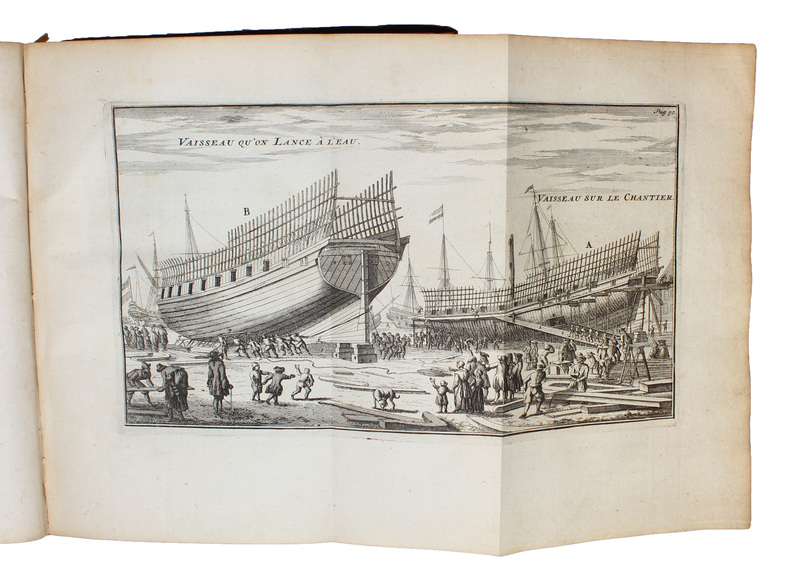
171951669Amsterdam David Mortier 1719-18. 4to. Contemp. full calf. Spine defective lacking leather at upper and lower compartment and frontcover detached from spine. Front free endpaper gone. The first two title-pages printed in red/black and both with an engraved vignette with a portrait of Erasmus. 482;294;22412 pp. Vol I: 1 large folded engraved plate and 1 textengraving. - Vol. II: 34 textengravings 1/2-page a. full-page 21 engraved plates 4 large and folded. - "Les Pavillons": 90 engraved plates of flags. The first flag "Pavillon de George I" is handcoloured. Last printed leaf numbered 101 because the 90 engraved plates is counted as pages !. Complete. Light marginal browning a few leaves with small closed tears. <br/><br/><em>A classic on shipbuilding finely illustrated with construction drawings and nautical instruments and equipment. It is the first edition in French of Allard's "Nieuwe Hollandse Scheeps-bouw" first published in 1695. Polak notes that though known as 'L'Allard français' it was more than a straightforward translation being augmented with chapters by Witsen and van Eyk and with plates representing vessels and nautical instruments as well as the flags of the maritime nations. </em> hardcover
180645128London W. Bulmer and Co. 1806. 4to. No wrappers as extracted from "Philosophical Transactions" 1806 - Part II. Pp. 239-268. Having also the titlepage to the volume Part II 1806. A faint bit of soiling to outer right margin of the first 2 leaves otherwise clean and wide-margined. <br/><br/><em>First printing of this important paper relating Flinder's observations on the ship "Investigator" when exploring the coast of Australia. IN THE PAPER THE NAME "AUSTRALIA" APPEARS PROBABLY FOR THE FIRST TIME IN A SCIENTIFIC MEMOIR p. 247.The name Australia was popularised by Matthew Flinders who pushed for the name to be formally adopted as early as 1804. When preparing his manuscript and charts for his 1814 A Voyage to Terra Australis he was persuaded by his patron Sir Joseph Banks to use the term Terra Australis as this was the name most familiar to the public. Flinders did so but allowed himself the footnote:"Had I permitted myself any innovation on the original term it would have been to convert it to Australia; as being more agreeable to the ear and an assimilation to the names of the other great portions of the earth." In the paper offered he used the name "Australia" as early as 1806."Captain Matthew Flinders RN 16 March 1774 - 19 July 1814 was one of the most successful navigators and cartographers of his age. In a career that spanned just over twenty years he sailed with Captain William Bligh circumnavigated Australia and encouraged the use of that name for the continent which had previously been known as New Holland. He survived shipwreck and disaster only to be imprisoned for violating the terms of his scientific passport by changing ships and carrying prohibited papers. He identified and corrected the effect upon compass readings of iron components and equipment on board wooden ships and he wrote what may be the first work on early Australian exploration A Voyage to Terra Australis."Wikepedia </em> unknown
182035260Paris Crochard 1820. Recent hcloth. Some repairs to inner margin of titlepage to "Annales". In "Annales de Chimie et de Physique Par MM. Gay-Lussac et Arago" Tome XIV pp. 417-25. The whole volume present: 448 pp. and 3 folded engraved plates. <br/><br/><em>First French translation and the first translation of Oersted's epoch-making announcement in his Latin pamphlet "Extperimenta circa effectum conflictus electrici in acun magneticam. Hafniæ 1820" privately printed in a very small number and only distributed to colleques in Europe. This discovery and confirmation of the connection between 2 forces electricity and magnetism must be considered one of the happiest events in the history of science both with regard to scientific and practical results. - "From the moment that Ørsted's discovery became known it created an enormous sensation. The results communicated were so astounding that they were received with a certain distrust but they were stated with such accuracy that it could hardly be permitted to entertain any doubts. In the course of a short time the treatise was translated into all the chief languages." Kirstine Meyer. - Dibner:61 - PMM: 282 - Horblitt: 3 b. - Sparrow: 152. </em> hardcover
Very Good Turkish, Ottoman (1500-1928) Original wrappers. Foolscap 8vo. (18 x 13 cm). In Ottoman script (Old Turkish with Arabic letters). 112 p. On the first page, written 'copies without seals are fake', and this copy is with a seal. Slightly faded and chipped on extremities. Foxing on first pages. Uncut marginal extremities Otherwise a good copy. Exceedingly rare first edition of the first Ottoman voyage to Cape of Good Hope and first-hand travel account of the Ottoman qadi Abubakr Effendi (1814-1880) of South Africa and Mozambique, who was sent in 1862 by Sultan Abdulaziz at the British Queen Victoria's request in order to teach and assist the Muslim community of the Cape Malays. The presence of the Muslim population in South Africa dates back to the 16th century, South Africa and the Cape of Hope have become a colony of Western countries such as Portugal, the Netherlands, and the United Kingdom. The Ottoman Empire was interested in the Far East, Javanese, and South African regions in the 16th century and then tried to establish a relationship. The direct relationship between the Ottoman Empire and South Africa in the 19th century, upon the request of the Muslim people and England, was formed through Abubakr Effendi. The Muslims in conflict with various religious issues have found the remedy by consulting a scholar from the Ottoman Empire through England. After all, Abubakr Effendi reached Cape Town in 1862 and tried to resolve the conflicts among the Muslim people. (Abubakr Effendi: An Ottoman Scholar in South Africa in the Nineteenth Century: Yilmaz, Yusuf). "Abubakr Efendi was sent to Cape Town by Ottoman Sultan Abdulaziz. When chaos reigned in the Islamic society because of the imams who declared themselves as leaders in the region, Muslim leaders in Cape of Good Hope conveyed their letters to the Queen of England in 1862 declaring that they needed a religious leader. Since they had not been educated for years, they had forgotten their Java language and could not read their own books. They sent a letter to the Queen of England, informing them that help could be sought from the Ottoman court, the center of Muslim countries in the period. The issue was refused in the Parliament and the Ottoman Ambassador Musurus Pasha was offered it to the Ottoman Sultan. Abubakr Effendi's mission was to prevent Muslims in Cape of Good Hope to clash with each other and teaching them authentic Islamic knowledge free of superstition. Although Abubakr Efendi had some Arabic translators in his service, he still learned English and African languages in a short time and wrote books in order to benefit the Muslims there. On the fifteenth day he set foot on the continent, he opened a madrasah called the "Ottoman School" and enrolled three hundred students in twenty days. He traveled to Mauritius and Mozambique. He wrote his famous book 'Bayan al-Din' (a sort of catechism) in Afrikaan in Arabic letters. Then he married Rukiye Hanim, but they divorced after a while since they had to communicate by using an English and Arabic dictionary. Then he married James Cook's nephew Tahota Saban Cook. In his memoir, Ömer Lütfi wrote down all the travels of Abubakr Efendi for two years. Abubakr Efendi stayed in South Africa for 22 years and died there." (140 yillik miras: Güney Afrika'da Osmanlilar: Uçar, Ahmet). Abubakr Efendi first traveled to London and then to South Africa by a ship with his assistant Omar Lutfi. He established the first Ottoman School in Cape Town and then wrote his work Bayan Al-Din in Afrikaans with Arabic letters and distributed it to the Muslim population of South Africa. Four printed copies in OCLC: 427674106 (Three copies); 635151131 (One copy). Özege 22397. First Edition. Extremely rare.