53 307 résultats
17502420Augsburg: Johann Jacob Haid & son 1750. Six tall narrow folio-sized engravings with etching platemarks 400 x 207 mm. sheets 435 x 277 mm. deckle edges numbered 1-6 in the plate at lower right imprint at lower right I. Haid et filius excudit A. V. Augustae Vindelicorum. Upper edges archivally tipped to mats. Fine. Rare suite of six rococo engravings reproducing Watteau's designs for a folding screen. This apparently unrecorded issue bearing the imprint of the Augsburg print-publisher Johan Jakob Haid and his son Johann Elias Haid is a re-issue of the plates which first appeared in 1729 with the signature of Jacob Wangner and the imprint of the heirs of Jeremias Wolff. OCLC locates a single copy of the Wolff issue at the Bibliothèque nationale de France photographs of the engravings are reproduced in the BnF online catalogue which misspells the artist's name as "Wagner". Wangner's engravings were based on the almost equally rare suite of six plates after Watteau commissioned by Jean Julienne and engraved by Crépy fils Louis Crépy in 1728. For the present issue the engraver's signatures barely visible in the BnF images were removed. The title appears at the foot of the first plate. Each engraving presents a central figure or scene set within a frame of delicate rococo allegorical and ornamental design. Three show the Comédie italienne figures of Pierrot/Gilles Harlequin and Columbina a woman playing the lute on a rug-bedecked stage a pair of allegorical figures flanking an awning above and at bottom the smiling visage of a Commedia dell'Arte character of the opposite sex. The remaining pastoral scenes of courtship or douceur de vie are set within naturalistic elements two with streams flowing over a dripping shell-shaped basin or ledge under which a ghostly face can be dimly discerned. Two painted screens based on these designs were sold at Sotheby's London on Feb. 12 2008 and again on 28 Oct. 2010 with the addition of a third painting from the series. I locate no other copies of the issue with the Haid imprint. On the Wolff issue cf. W. Augustyn "Augsburger Buchillustration im 18. Jahrhundert" in Augsburger Buchdruck und Verlagswesen 1997 p. 820 citing E. Isphording Gottfried Bernhard Göz 1708-1774 1997 pp. 35 ff. On the Crépy engravings cf. Guilmard Maitres ornemanistes p.145; Dacier & Vauflart 159-163; E. de Goncourt Catalogue Raisonné de l'Oeuvre . d'Antoine Watteau 1875 p. 224 nos. 309-314; G. Glorieux À l'enseigne de Gersaint: Edme-François Gersaint marchand d'art sur le Pont Notre Dame 1694-1750 2002 pp. 190 & 192; Mark Millard Collection: French Books no. 170.35 5 of the 6 plates. Johann Jacob Haid & son unknown books
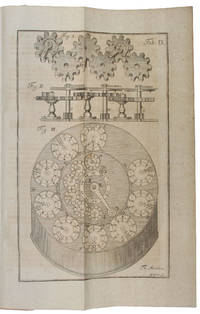
172735955Leipzig: Christoph Zunkel and Bernhard Christoph Breitkopf, 1727-1739. Folio. (372x239mm). Two parts in one volume. Contemporary vellum, two cuts in spine, modern slip case. Provenance: Book plates of Arnaud de Vitry and Andras Gedeon. Stamps to half-title and title-page, from Stadtbibliothek Augsburg - sold as duplicate. First part: (14], 200, (4) pp. and 45 plates, numbered I-XLIII (plate III with volvelle). Second part: (12), 100, (94) pp. and 40 plates on 36 sheets, numbered I-XL. All plates intact. An exceptionally fine copy.
172735955Leipzig: Christoph Zunkel and Bernhard Christoph Breitkopf 1727-1739. Folio. 372x239mm. Two parts in one volume. Contemporary vellum two cuts in spine modern slip case. Provenance: Book plates of Arnaud de Vitry and Andras Gedeon. Stamps to half-title and title-page from Stadtbibliothek Augsburg - sold as duplicate. First part: 14 200 4 pp. and 45 plates numbered I-XLIII plate III with volvelle. Second part: 12 100 94 pp. and 40 plates on 36 sheets numbered I-XL. All plates intact. An exceptionally fine copy. <br/><br/><em>The scarce first edition of the of the eighth and tenth volumes each volume being a complete work in itself of Leupold's magnificent ten-volume "Theatrum Machinarum" - one of the first encyclopedias of technology being the most complete and the most extensively illustrated work on mechanical engineering published hitherto. Complete sets of Leupold's Theatrum are virtually never found and Ferguson stated in his bibliography of technology that he had never seen a complete set. Each volume is complete in itself. The eighth volume is of particular interest in the history of computers as it deals mainly with calculating machines. This volume contains detailed descriptions of the calculating machines of Schott 1668 Grillet 1673 Leibniz 1674 Poleni 1709 and Leupold himself. The tenth volume is a supplement to the series published after Leupold's death by Ernst Scheffler. It deals with odometers gyrometers step counters and other devices for the measurement of distances. This volume is furthermore of importance because it contains the 90 page general index to the entire series. Hook & Norman: Origins of Cyberspace no. 6 volume 8 only.Honeyman Sale lot 1997 volume 7 and 8.Macclesfield Sale lot 1242 volume 8 only.Ferguson: Bibliography of the History of Technology pp.45-46.Wolf: A History of Science Technology & Philosophy in the 18th Century pp.657-8. </em> hardcover
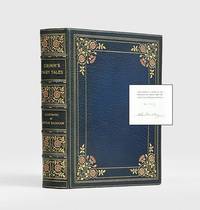
1909187099London: Constable and Company 1909. Bound with an onlay design in homage to Briar Rose Signed limited edition number 327 of 750 signed by Rackham this copy in a fine Bayntun-Rivière binding. Rackham's first version of Grimm's Fairy Tales published in 1900 had no signed limited edition. This is a revised and enlarged edition with some new illustrations as well as others redrawn and coloured. As noted by Rodney Engen "Rackham greatly loved fairy tales and had collected his many favourites over the years. The Brothers Grimm held a special place in his collections since they represented his love of all things German and contained the elements of the grotesque which fascinated him throughout his career". Quarto 274 x 219 mm. Colour frontispiece and 39 plates all tipped in and with tissue guard captioned in red black and white illustrations to text illustrated title page printed in red and black. Finely bound by Bayntun-Rivière in later 20th-century dark blue crushed morocco spine lettered in gilt compartments decorated and boards framed with gilt briar and red morocco onlay roses gilt rose and briar detail to turn-ins marbled endpapers edges gilt. Gift inscription contemporaneous to binding to first blank. Binder's blanks foxed else fine. Riall p. 97. Engen Arthur Rackham 2002. hardcover
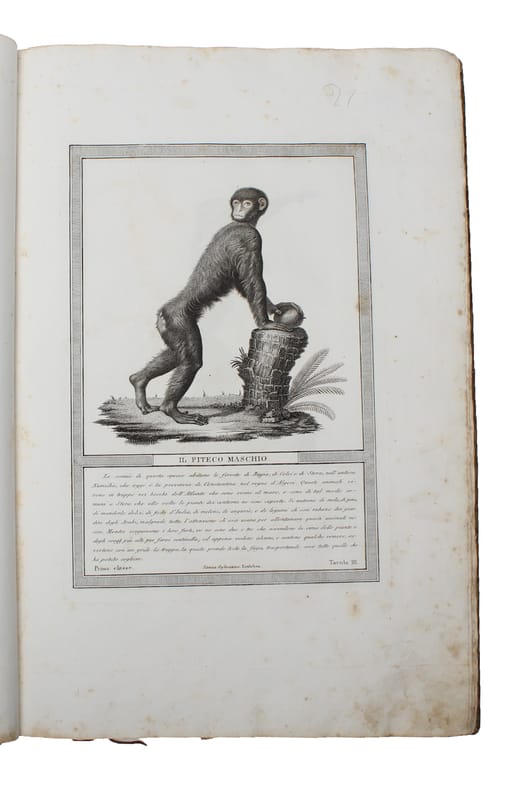
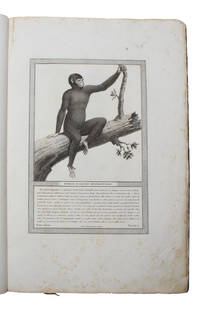
182232794Milano, P. Hugues, 1822. Folio. 48x32,5 cm. Bound in one cont. hcalf, richly gilt back and title-label with gilt lettering. (Title-label a little torn). Lightly rubbed along edges and spine ends, but good. Engraved ornamental title-page (printed in brown). 6 engraved leaves with text and 4 plates with descendt-line, skeletons etc., 17 printed leaves of text, 25 engraved leaves with text (Indices and text). And in all 89 fine stipple-engraved plates (4 separately numb. + I-LXX + I-XV). Plates with engraved frame and at bottom engraved text in Italian.A large uncut copy with broad margins. Scattered marginal brownspots, a few tears to margins, images clean and bright.
182232794Milano P. Hugues 1822. Folio. 48x325 cm. Bound in one cont. hcalf richly gilt back and title-label with gilt lettering. Title-label a little torn. Lightly rubbed along edges and spine ends but good. Engraved ornamental title-page printed in brown. 6 engraved leaves with text and 4 plates with descendt-line skeletons etc. 17 printed leaves of text 25 engraved leaves with text Indices and text. And in all 89 fine stipple-engraved plates 4 separately numb. I-LXX I-XV. Plates with engraved frame and at bottom engraved text in Italian.A large uncut copy with broad margins. Scattered marginal brownspots a few tears to margins images clean and bright. <br/><br/><em>Scarce title-issue of this important and perhaps the largest monograph on primates apes and monkeys from the 19th century by the French painter Nicholas Henri Jacob. The original issue was published in 2 parts 1812-14. This title-issue has a reset title-page a new dedication and the text beneath the image is in Italian. The illustrations in these splendid stipple-engravings are the same.The plates depict apes monkeys and lemurs from the Old World and The New World in 5 Classes: 1. Genere; Orang; Pithecus. 2. Genere. Babbuino. 3. genere. Guenone; Cercopithecus. 4. Genere. Sapajù; Cebus. 5. genere. Sapajù-Sagoino; Callithrix.- Part II: Famiglia. I Maki; Lemures.Wood p. 402. - BMC NH II:916 but with the year 1823 "This is the same as the original from 1812 except in the setting of the title-page of the dedication and of the translations of the introduction." - Nissen. 2080. </em> unknown
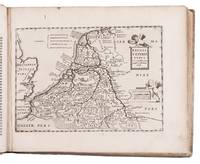
1660KBQE72K0ZFOJAmsterdam 1660. Oblong 4to ca. 23 x 28 cm. Jacob Aertsz. Colom Contemporary vellum sewn on 4 supports laced through the joints with shelf mark labels of the Oudheidkamer Twente mounted on the spine and back board. With an engraved allegorical title page by Experiens Sillemans and 50 full-page numbered engraved plates 47 maps and 3 plates containing 117 portraits of the Counts of Brabant Flanders and Holland. 2 4 14 223 2 1 blank pp. Enlarged Dutch edition of an attractive atlas of the Seventeen Provinces roughly corresponding to present-day the Netherlands and Belgium containing all 50 maps and plates. The work was compiled and published by the ambitious Amsterdam map- and globe maker printer and publisher Jacob Aertsz. Colom 1600-1673. Like Willem Jansz. Blaeu Colom began his career by publishing pilot guides and maritime atlases a field in which few dared to compete with Blaeu before branching out into terrestrial atlases. The maps and portraits in this second Dutch edition were printed from the plates of the first Dutch edition 1635 but the accompanying text has been revised and expanded.The descriptions were derived from the text written by Reinier Telle for Abraham Gooss Nieuw Nederlandtsch Caertboeck 1616 which itself was largely based on Lodovico Guicciardinis classic Beschryvinghe van alle de Nederlanden 1612. In addition to general maps of the Netherlands depicting both the Roman period and the 17th century and of the Seventeen Provinces the work contains numerous detailed maps of individual regions and cities together with their surrounding areas. These include among others the Meierij of s-Hertogenbosch Bergen op Zoom Breda Valkenburg and Dalhem Mechelen the diocese of Liège Namur the Veluwe Zutphen the island of Dordrecht Delfland six maps of newly reclaimed polders Bijlmermeer Purmer Wormer Heerhugowaard Diemermeer and Zijpe the three historic regions of Frisia Eastergoa Westergoa and Zevenwouden and Walcheren.The engraved portrait plates comprise two sheets containing respectively 40 and 38 portraits of the Dukes of Brabant and the Forestiers of Flanders and a third with 39 portraits of the Counts of Holland.With the library stamp of the Oudheidkamer Twente on the front flyleaf. The work has been recased with the endpapers restored the vellum is slightly soiled and stained. Restored tears in the head and foot margins of the title page the maps have not been bound in order the margins of map 31 have been trimmed without affecting the image map 45 with a water stain in the lower outer corner. Otherwise in good condition.l Koeman Col 5; V.d. Krogt Koeman's Atlantes Neerlandici IIIB 365:02 pp. 635-637; Shirley British Library T.COLM-1a; STCN 853365954; Tiele Bibl. 262; USTC 1845771. hardcover
1846229581846-1847. Boston Med. Surg. J. 35/ 1-26. - Boston David Clapp August 1846 to February 1847 8° 2 8 544 IV pp. 1/4-leather and marbled boards; Small brown stains on 5 pages and some browning of text leves; fine copy. First Edition! Read Before the Boston Society of Medical Imporvement Nov. 9th. 1846 an abstract having been previously rea before the American Academy of Arts and Sciences Nov. 3rd. 1846. Communicated for the Boston Medical and Surgical Journal. VERY RARE - Sir William Osler him only on his deathbed on Dec. 1919 was able to incorporate into his collection. "When this long-looked-for volume arrived in Dec. 1919 towards the end of his last illness Sir Wm. Osler asked that the following note be inscribed in it: "All things come to him who waits - but it was a pretty close shave this time! . a blastoderm from which the enormus literature has developed." Content relating to Anaesthesiology: 1 Smilie E.R.: Insensibility produced by the inhalation of the vapor of the ethereal solution of opium. Letter p.263 28.Okt. 1846. 2 Bigelow H.J.: Insensibility during Surgical Operations produced by Inhalation. Read before the Boston Society of Medical Improvement Nov. 9th. 1846 an abstract having been previously read before the American Academy of Art and Sciences Nov. 3rd. 1846. p.309; with editorial note "Operations without pain" on p. 324. - Garrison & Morton No.5651: "The first published description of ether anesthesia. John Collins Warrren performed the operation and William Morton delivered the anesthetic. 'Bigelow a surgeon witnessed the operation and left an excellent account in the above paper'." 3 Flagg J.F.: The inhalation of an ethereal vapor to prevent sensibility to pain during surgical operations p.356. 4 Peirson A.L.: Surgical operations with the aid of the "new gas" p.362. 5 Warren J.C.: Inhalation of Ethereal Vapor for the Prevention of Pain in surgical Operations p.375. - ".stands out in literature of surgical anesthesia as fundamental and truly epoch making". Osler 6 Bigelow H.J.: Insensibility during surgical operations produced by inhalation p. 379. - Letter in reply to Flagg p. 356. 7 Ellsworth P.W.: The discoverer of the effects of sulphuric ether p. 397. 8 Flagg J.F.: Inhalation of sulphuric ether p. 407. - Reply to Bigelow p.379. 9 Parkman S.: Inhalation of ehtereal vapor. Painless reduction of a dislocated shoulder joint p.409. 10 Peirson A.L.: Sequel to Dr. Peirson's operations p.410. 11 Editorial: Insensibility during surgical operations produced by inhalation p.413. 12 Mansfield J.D.: The inhalation of ethereal vapor &c. p.424. 13 Wallace W.C.: Remarks on the the inhalation of ether previous to surgical operations p.435. 14 "A Correspondent who has no Property in Patent Rights": Are inventions in surgery and in chemistry legitimate subjects for patents p.436. 15 Editorial: Apparatus for inhaling the new gas p. 440. 16 "N.Y. Correspondence": Letheon in New York p. 442. 17 B. T.E.: Insensibility produced by ethereal inhalation p. 445. 18 Cox A.L.: Experiments with the letheon in New York p. 445. 19 "N.Y. Correspondence": Insensibility during surgical operations p.464. 20 "A Physician": Ethereal vapor p.472. 21 Kimball H.: Use of the letheon; seventeen teeth extracted p.489. 22 "Claudian": The patent "Letheon" p. 514. 23 "N.Y. Journal of Med. and Collat. Sciences": Insensibility during surgical operations by inhalation p. 518. 24 "N.Y. Correspondence": Letheon in New York p. 520. 25 Editorial: Insensibility by inhalation of the letheon p. 542. Osler 1357; Cushing B 380; Fulton & Stanton Anesthesia IV1; Keys p. 29; Cole Anesthesia pp.32-42; Duncum pp.99-120. Garrison & Morton No.5651 hardcover
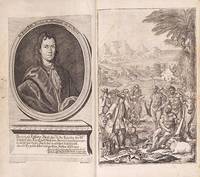
173928620The Hague: Depens de la Compagne 1739. 2 volumes 12mo. Titles printed in red and black. 12 224; 4 254pp. Half titles. Later full polished calf spine gilt with raised bands marbled endpapers. In a modern slipcase.<br/> <br/>First French edition of Behren's account of Jacob Roggeveen's 1721-22 Pacific voyage.<br/> <br/>The first French edition of Behren's German account of Jacob Roggeveen's 1721-22 Pacific voyage which provided important impetus for further exploration for the great Southern Continent. The author was a sergeant and commander of marines on the voyage. Contemporary accounts of Roggeveen's explorations were first published in Dutch in 1728 and in German beginning in 1735. This French translation was based on the Frankfurt and Leipzig editions of 1737. Behrens' scarce narrative tells the story of one of the most significant of the Dutch voyages ranking with those of Le Maire Schouten and Tasman. Roggeveen set out to rediscover the part of Terra Australis which Quiros had led the exploring world to believe existed but in fact added substantially to the Dutch record of Polynesian discoveries with Easter Island and Samoa described here for the first time. "Roggewein's is the first certified account of contact with Easter Island and its great stone images as well as the last of the great Dutch circumnavigations" Cox. "Though some attribute the translation to Charles de Brosses Chareles Pierre Claret Fleurieu believed that the style of language revealed the efforts of a non-native speaker. With the text often more a paraphrasing of the German version than a direct translation Fleurieu and others credit Behrens himself with the translation" Hill.<br/> <br/>European Americana 739/21; Sabin 4379; Hill 99; Cox I p.51; Borba de Moraes p.95; Howgego R63. Depens de la Compagne unknown books
1739WRCAM48796The Hague: Aux depens de la Compagnie 1739. Two volumes. 12224; 4254pp. Half titles. 12mo. Later polished calf gilt spine gilt with raised bands leather labels marbled endpapers. Minor shelf wear joints slightly rubbed. A clean near fine copy. In a buckram slipcase. The first French edition of Behrens' REISE DURCH DIE SÜD-LÄNDER UND UM DIE WELT an account of Jacob Roggeveen's 1721-22 Pacific voyage which provided important impetus for further exploration for the great Southern Continent. "Roggewein's is the first certified account of contact with Easter Island and its great stone images as well as the last of the great Dutch circumnavigations" - Cox. <br> <br> The author was a sergeant and commander of marines on the voyage. Contemporary accounts of Roggeveen's explorations were first published in Dutch in 1728 and in German beginning in 1735. This French translation was based on the Frankfurt and Leipzig edition of 1737. "Though some attribute the translation to Charles de Brosses Charles Pierre Claret Fleurieu believed that the style of language revealed the efforts of a non-native speaker. With the text often more a paraphrasing of the German version than a direct translation Fleurieu and others credit Behrens himself with the translation" - Hill. EUROPEAN AMERICANA 739/21. SABIN 4379. HILL 99. COX I p.51. BORBA DE MORAES p.95. HOWGEGO R63 for Roggeveen. Aux depens de la Compagnie hardcover books
19311717561931. CHERNIKHOV Yakov. Osnovy sovremennoj architektury: eksperimental'no-issledovatel'skie raboty / J.G. Tchernikhov - Les bases de l'architecture contemporaine: essai de recherches expérimentales / J.G.Tschérnikhow - Die Grundlagen der modernen Architektur: erfahrungsmässige - experimentelle Forschungen / J.G. Tschernichow. 96 pp. illustrated with 46 photographically reproduced colour plates and numerous black and white designs. Folio 304 x 206 mm. bound in original boards. Leningrad: Izdanie Leningradskogo Obscestva Architektorov 1931. Second enlarged edition the first edition had only 5 plates. A fine copy of this rare treatise by the legendary Soviet architect Yakov Chernikhov whose books are among the most visually striking of all Russian avant-garde books. One of the few copies we have seen that has not needed to be rebacked. Incredibly rare with OCLC listing no copies in the U.S. Getty Research Institute Russian Modernism 129. hardcover
1732WRCAM55846London: Printed for D. Midwinter and A. Ward. 1732. 2214197-40016 of 24pp. plus seven plates including frontispiece. Lacks the final four leaves of the index. 12mo. Contemporary calf rebacked with original backstrip laid down. Light shelf wear corners worn. Contemporary bookplate and presentation inscriptions see below. One plate torn lacking the lower left quarter of the sheet repaired with blank paper. One page with early manuscript marginalia. Scattered light foxing. About very good. A remarkable association copy connecting two significant members of the Revolutionary generation who were also united by family intermarriage and whose friendship was riven by their divergent loyalties during the American Revolution. This copy bears the bookplate of Francis Hopkinson 1737-91 signer of the Declaration of Independence author and poet composer judge and Pennsylvania government official. The ANB calls him "arguably the most versatile American of the revolutionary generation." This book was given to Hopkinson by the noted minister Jacob Duché who would shortly thereafter marry Hopkinson's sister and who famously broke with the cause of liberty during the Revolution. <br> <br> A front fly leaf bears the presentation inscription "The Present of Mr. Jacob Duché Junr. to Francis Hopkinson December 1757." The same hand has signed the titlepage with the names of Jacob Duché and Francis Hopkinson and the date 1757. On that page Duché's name has been crossed out indicating that the inscriptions are likely in the hand of Duché and that he crossed out his own name on the titlepage when he gave the book to Francis Hopkinson. Jacob Duché and Francis Hopkinson had a long and complicated friendship dating back at least to their college days at the College of Philadelphia later the University of Pennsylvania. In 1760 three years after giving him this book Duché married Hopkinson's sister Elizabeth. Francis Hopkinson was a prolific author and musician and published forty poems before the Revolution. A copy of HUDIBRAS Samuel Butler's famous satirical poem on English politics would have been a welcome and influential gift. "During the Revolution Hopkinson wrote a number of ballads and essays poking fun at the British cause and the Loyalists. 'The Birds the Beasts and the Bat' written in Hudibrastic verse served to ridicule those persons who tried to take both sides during the Revolution" - ANB. <br> <br> It is impossible not to believe that one of those targets of Hopkinson's ridicule was the gifter of the present edition of HUDIBRAS his brother-in-law Jacob Duché. Duché 1738- 98 born into a wealthy Philadelphia family was only twenty-two years old when he married Elizabeth Hopkinson. He would go on to become a prominent minister and religious leader in Philadelphia noted for his well- written sermons and essays. In 1774 he was asked to serve as the chaplain to the Continental Congress and he therefore gained political prominence as well displaying an apparent zeal for liberty. Duché resigned his official position with the Congress in October 1776 having concluded that the Declaration of Independence - signed just three months earlier by his friend and brother-in-law - would not serve as a tool for reconciliation with England. When the British captured Philadelphia Duché was imprisoned by General Howe and came to a permanent change of heart regarding the revolutionary cause. In 1777 he wrote a rash letter to George Washington urging that Washington undo the Declaration of Independence and negotiate a peace. The publication of the letter destroyed Duché's career and "those whose hearts had thrilled to Duché's eloquence now cursed him as a traitor and even Hopkinson wrote him a burning letter of protest" DAB. Duché and his family soon exiled themselves to London. The conclusion of the Revolutionary War did not provide Duché with an opportunity to return to the United States - anti-Loyalist sentiments were still too raw. It was not until 1792 having by then taken up the tenets of Swedenborgianism that Duché and his family finally returned to Philadelphia where he lived the rest of his life. <br> <br> Francis Hopkinson's bookplate was engraved by the noted artist and engraver Henry Dawkins one of the early engravers in the colonies. Dawkins was born in England but came to New York City in 1754. He found work engraving bookplates maps and music in New York and then in Philadelphia before returning again to New York in 1774. He was arrested there in 1776 and charged with counterfeiting paper money apparently not for the first time for which he was jailed. Later that year he petitioned the New York Provincial Congress for release but the record of Dawkins's life ends there and we do not know what became of him. <br> <br> This is a later edition of Samuel Butler's famous epic poem first published in three parts in London beginning in 1663. An edition containing all three parts together was first published in 1684. This edition contains seven engravings by William Hogarth. In the present edition parts two and three have separate titlepages and that of part three bears the imprint "printed for B. Motte. The text is continuous despite the pagination. <br> <br> A remarkable volume - a gift of youthful friendship inspirational to a signer of the Declaration of Independence whose long and close friendship with his brother-in-law would become a casualty of conflicting loyalties during the American Revolution. ESTC N17078. DAB IX pp.220-23; V 476-77. ANB 11 pp.190-92; 7 pp.4-5. Printed for D. Midwinter and A. Ward... unknown books
1817D12811Milano: P. Hugues 1817. Hardcover. Very Good. Contemporary half black and green morocco gilt-stamped lettering and ornament direct in spine compartments 5 raised bands; folio 455x300mm; leaves printed on the recto only with wide margins; consisting of engraved illustrated title-p. I-VI engraved text and illustrations 3 scimie dell' antico continente prima classe orang I-IX 2 seconda classe babbuino X-XVII 2 terza classe guenone XVIII-L 3 scimie del nuovo continente quarta classe sapaju LI-LX 2 quinta classe sapaju-sagoino LXI-LXX LXXI-LXXXVIII text 2 indice 6 dei lemuriani ossia maki propriamente detti genere maki I-VIII 2 genere indri IX-X 2 genere loris XI-XIII 2 genere galago XIV 2 genere tarsiere XV XVI indice. Collates complete with printed and engraved text and a grand total of 85 very fine -- and very charming -- engraved plates of monkeys most of whom will remind you of someone you know. Spine tips and edges of boards discreetly renewed; some light scuffing along spine and joints. Marginal browning; a few tiny worm holes to last few leaves; otherwise nice and bright. Bookplates of Cecilia Barbosa de Moura. <br/><br/>An important early monograph on primates including orangutans baboons guenons sapajous lemurs indris loris galagos tarsiers. P. Hugues hardcover books
1817D12811Milano: P. Hugues 1817. Hardcover. Very Good. Contemporary half black and green morocco gilt-stamped lettering and ornament direct in spine compartments 5 raised bands; folio 455x300mm; leaves printed on the recto only with wide margins; consisting of engraved illustrated title-p. I-VI engraved text and illustrations 3 scimie dell' antico continente prima classe orang I-IX 2 seconda classe babbuino X-XVII 2 terza classe guenone XVIII-L 3 scimie del nuovo continente quarta classe sapaju LI-LX 2 quinta classe sapaju-sagoino LXI-LXX LXXI-LXXXVIII text 2 indice 6 dei lemuriani ossia maki propriamente detti genere maki I-VIII 2 genere indri IX-X 2 genere loris XI-XIII 2 genere galago XIV 2 genere tarsiere XV XVI indice. Collates complete with printed and engraved text and a grand total of 85 very fine -- and very charming -- engraved plates of monkeys most of whom will remind you of someone you know. Spine tips and edges of boards discreetly renewed; some light scuffing along spine and joints. Marginal browning; a few tiny worm holes to last few leaves; otherwise nice and bright. Bookplates of Cecilia Barbosa de Moura. <br/><br/>An important early monograph on primates including orangutans baboons guenons sapajous lemurs indris loris galagos tarsiers. P. Hugues hardcover
5252Fine engraved frontis. port. of Klein & 28 engraved plates. 3 p.l. incl. frontis 233 1 pp. one leaf of ads. 8vo fine cont. polished calf spine nicely gilt red morocco lettering piece on spine. Paris: C.J.B. Bauche 1754. bound with: -. Doutes ou Observations de Mr. Klein.sur la Revûe des Animaux faite par le premier Homme sur quelques Animaux des Classes des Quadrupedes & Amphibies du systême de la Nature de M. Linnaeus. Et des Remarques sur les Crustacés sur les Animaux qui ruminent & sur la Vie de l'Homme comparée avec celle des Animaux. One folding engraved plate. 2 p.l. 108 pp. 8vo. Paris: J.B. Bauche 1754. I. First edition in French 1st ed. in Latin: Danzig 1734 and enlarged. This is "one of the earliest monographic treatments of the sea urchins. It includes descriptions illustrations and a classification of both recent and fossil sea urchins.Although altered and enlarged this work was a major source of information on the Echinoidermata for zoologists and paleontologists throughout the eighteenth century and remained a point of departure in discussions by such early nineteenth century authors as James Parkinson."-D.S.B. VII p. 401. II. First edition in French 1st ed. in Latin: Leipzig 1743. This work summarizes Klein's feelings about taxonomic methods. His method was based entirely on external characteristics such as the number and position of limbs and the mouth. He vigorously opposed any method including the Linnaean system based on characters not visible externally. Klein 1685-1759 a leading marine zoologist "had many and diverse interests in natural history besides sea urchins. He developed a botanical garden in Danzig founded and directed a naturalist's society there made extensive collections and published about two dozen monographs including studies of birds fishes reptiles and invertebrates other than the sea urchins particularly the mollusks."-D.S.B. The attractive frontispiece depicts Klein standing in front of his natural history cabinet. A very fine and pretty copy. unknown books
5252Fine engraved frontis. port. of Klein & 28 engraved plates. 3 p.l. incl. frontis 233 1 pp. one leaf of ads. 8vo fine cont. polished calf spine nicely gilt red morocco lettering piece on spine. Paris: C.J.B. Bauche 1754. <br/> <br/> bound with:<br/> <br/> —. Doutes ou Observations de Mr. Klein…sur la Revûe des Animaux faite par le premier Homme sur quelques Animaux des Classes des Quadrupedes & Amphibies du systême de la Nature de M. Linnaeus. Et des Remarques sur les Crustacés sur les Animaux qui ruminent & sur la Vie de l’Homme comparée avec celle des Animaux. One folding engraved plate. 2 p.l. 108 pp. 8vo. Paris: J.B. Bauche 1754.<br/> <br/> I. First edition in French 1st ed. in Latin: Danzig 1734 and enlarged. This is “one of the earliest monographic treatments of the sea urchins. It includes descriptions illustrations and a classification of both recent and fossil sea urchins.Although altered and enlarged this work was a major source of information on the Echinoidermata for zoologists and paleontologists throughout the eighteenth century and remained a point of departure in discussions by such early nineteenth century authors as James Parkinson.â€â€“D.S.B. VII p. 401. <br/> <br/> II. First edition in French 1st ed. in Latin: Leipzig 1743. This work summarizes Klein’s feelings about taxonomic methods. His method was based entirely on external characteristics such as the number and position of limbs and the mouth. He vigorously opposed any method including the Linnaean system based on characters not visible externally. <br/> <br/> Klein 1685-1759 a leading marine zoologist “had many and diverse interests in natural history besides sea urchins. He developed a botanical garden in Danzig founded and directed a naturalist’s society there made extensive collections and published about two dozen monographs including studies of birds fishes reptiles and invertebrates other than the sea urchins particularly the mollusks.â€â€“D.S.B. <br/> <br/> The attractive frontispiece depicts Klein standing in front of his natural history cabinet. <br/> <br/> A very fine and pretty copy. unknown
51-5969Nuremberg: Peter Conrad Monath 1719. Folio. 21.5 x 34.3cm. Contemporary catspaw calf rebacked preserving original gilt-tooled spine with red morocco label marbled edges; Dutch patterned endpapers front free endpaper replaced with handmade marbled paper. Half-title engraved portrait of the author engraved frontispiece title printed in red and black 23 engraved plates one double-page engraved map small hole with loss of a few letters to final 4 leaves of index Mendelssohn I p.842 folio 345 x 210mm. .FootnotesSCARCE FIRST EDITION of "one of the first works in German devoted entirely to the Cape region of South Africa. Aware of the conflicting information promulgated by many Europeans Kolb recorded his voyages in part 'to oblige the learned and curious part of the world with a useful and entertaining history of a country and people of whom we have had hitherto such various and uncertain accounts'" Howgego. Kolbe 1675-1726 lived at the Cape from 1705 till 1713 and based his account on first hand experience.FIRST EDITION. Kolbe lived and worked at the Cape from 1705 till 1713 and decribes in his Caput bonae spei hodiernum South Africa and the Cape of Good Hope including its geography climate flora and fauna followed by an interesting and accurate account of the Hottentots based on the author's first hand experience recording their language religion education and customs. This edition was followed by the French edition Description du Cap de Bonne-Esperance. Amsterdam 1742.OCLC Number / Unique Identifier:51407544: Physical Description:18 846 82 pages 17 unnumbered leaves of plates 1 folded : illustrations map portrait ; 34 cmProvenance: Lavington bookplate. Nuremberg: Peter Conrad Monath, 1719. unknown
3022New York and San Francisco: Associated American Artists and Tamarind Lithography Workshop 1965. LANDAU'S RAREST AND MOST IMPORTANT GRAPHIC SERIES. This is a suite of 10 haunting and enigmatic original lithographs by Jacob Landau each one justified and signed in pencil by the artist. From an edition of 20 sets printed on fine BFK Rives wove paper this is set 20/20. Additionally signed by Landau in the colophon. Furthermore this is an outstanding association copy with Landau's signed presentation inscription to Sylvan and Lilyan Cole. Sylvan Cole 1918-2005 was the most important dealer in American prints of his or any generation and as director of Associated American Artists he published and sold many of Landau's prints. Lilyan was his second wife. "I did a suite of lithographs called Charades I associated the name Charades with what Goya had called Caprichos riddles puzzles. He also did a series called Proverbs where he picked up on sayings that were common in the land but dealt with them in mysterious puzzling ways. And I dealt with what came out of my obsessions things that I did not fully understand. Fear of death for instance and a sort of frustrated feeling of love. These are obsessions that manifest themselves in various ways and images. The reason they seem to appeal to others is because apparently other people share some of the same obsessions. Thats where the archetypal aspect comes in." --Jacob Landau. Folio. FINE AND BRIGHT WITH NO DEFECTS. Housed in the original cloth folding case by Schuberth Bookbindery of San Francisco. An outstanding item. Since all of the lithographs are signed most sets have been broken up. This set however was in Sylvan Cole's private collection from the day it was presented to him by the artist until his death in June 2005. IMPORTANT NOTE: During March 2006 hundreds of prints represented as being from "the Sylvan Cole collection" were sold at public auction. In fact ALL of these items were from his leftover gallery inventory not his private collection. As far as I know the few items I offer from Sylvan's collection are the ONLY items anywhere on the market which are actually from his private collection which he kept in his apartment not his gallery. I acquired them all directly from Sylvan my uncle mainly in spring 2005. <br/><br/> New York and San Francisco: Associated American Artists and Tamarind Lithography Workshop, 1965 hardcover
04706Sussex: 1933. A Wonderful Pen and Ink Drawing from Arthur Rackham's Little Red Riding Hood.<br/><br/>RACKHAM Arthur artist. "Put the cake and the little pot of butter upon the bread-bin and come and lie down with me." Sussex 1933. <br/><br/>Original pen-and-ink drawing signed "A Rackham" on lower left-hand corner for the full-page drawing on page 275 in the The Arthur Rackham Fairy Book. London: George G. Harrap & Co. Ltd. 1933. <br/><br/>Image size: 4 3/8 x 6 1/8 inches; 112 x 157 mm. Matted framed and glazed 15 7/8 x 13 5/8 inches; 404 x 346 mm.<br/><br/>This wonderfully executed pen and ink drawing depicts the moment when Little Red Riding Hood sees the wolf dressed up as her Grandmother. The wolf is in her Grandmother's bed and tells Little Red Riding Hood to "Put the cake and the little pot of butter upon the bread-bin and come and lie down with me". Of course the rest is history !!<br/><br/>The wolf is dressed in a mop cap wearing glasses and hiding behind the curtains of the bed. Grandmother's slippers are sitting neatly on the floor by the bed and next to the bed there is a candle and a bowl on a small table. Little Riding Hood is dressed in her riding hood holding some flowers she has picked for her Grandmother and carrying a large basket with the pot of butter sticking out of it.<br/><br/>As always Rackham has created a moment in time - one which is universally recognized.<br/><br/>"Little Red Riding Hood" is a European fairy tale about a young girl and a Big Bad Wolf. Its origins can be traced back to the 10th century to several European folk tales including one from Italy called The False Grandmother Italian: La finta nonna later written among others by Italo Calvino in the Italian Folk Tales collection. The best known versions were written by Charles Perrault and then later by Jacob and Wilhelm Grimm. Arthur Rackham chose the original Charles Perrault version.<br/><br/>The Moral of the Story. Children especially attractive well bred young ladies should never talk to strangers for if they should do so they may well provide dinner for a wolf. [Sussex]: , 1933 unknown books
19002613551900. Pen and ink on paper 8 pp. stapled booklet chapters I-VII and 2 pp. on single sheet portions of chapters XII-XV. 4to. Light toning. Pen and ink on paper 8 pp. stapled booklet chapters I-VII and 2 pp. on single sheet portions of chapters XII-XV. 4to. Draft Outline of Riis' Autobiography. The autograph outline of the first seven chapters of Riis's autobigraphy The Making of an American 1902 as well as outlines for parts of chapters twelve through fifteen. The opening chapters recount stories from Riis's boyhood in Denmark meeting his future wife Elizabeth Gortz and his arrival in America. "The story commences on a bridge over the river Nibs on the outskirts of the ancient town of Ribe which is on the Danish north seacoast. A boy & girl have met .". unknown books
171752850Frankfurt and Leipzig: Samuel Tobias Hocker 1717. Hardcover. Good to very good condition. Bound in full vellum with handwritten lettering on spines. Octavo. Vol. I.: 24 incl. frontispiece 580pp. 8 432 383 1pp. Franckfurter Juden Ehverlöbniß und Hochzeit. Vol. II.: 8 358 1pp. 30 320pp. 447 1 192pp. plus two registers and a supplement 1717 38 48 1 60pp. Frontispiece and ten copper plate engravings some folding. Part two and three published in 1714 part four in three parts published in 1717 with two chapters published in 1716 see below. Speckled edges. Decorative initials head- and endpiece woodcuts.<br /> <br /> Jewish oddities introducing curiosities and memorable events of Jews in "all four parts" of the world in the last few centuries particularly of Jews scattered in Germany. Contains a complete Frankfurt Jewish Chronicle with memorable events relating to Jews living in Frankfurt for centuries including several elucidating engravings. Part two includes the chapter XXV "about Jews in Frankfurt regarding marriage vows and wedding" on six pages. Part four in three chapters of which the last includes the apparel regiment for Frankfurt Jews and a chapter on the celebration on the occasion of the birth of the Crown Prince of Jews in Frankfurt and Prague both 1716 both with separate title pages and frontispieces but continuous pagination.<br /> <br /> Though not addressed to a particular Jewish community most of the information was gathered in Frankfurt with several texts copied by Schudt in Hebrew and Yiddish that are not recorded in elsewhere e.g. a Selicha authored by Rabbi Shmuel Schotten Katz after the great fire in the Jewish Quarter of Frankfurt in 1711 the Purim play "Ahasuerus-Spiel" most copies of the play were burnt following a rabbinical decree; thanks to Schudt the text was preserved two versions of women's incantations for childbirth regulations of the Jewish community forbidden luxuries among others. <br /> <br /> Schudt's writings are considered a landmark in the history of modern anti-Semitism mainly due to a chapter dedicated entirely to describing the Jewish body its shape colors and smells promulgating racist anti-Semitism in Europe. <br /> <br /> Schudt's book features several copperplate engravings. The most prominent of these is an image of the Judensau Jews' Sow which first appeared in medieval sculptures found in churches throughout Germany starting in the 14th century and then was subsequently depicted in woodblock and copperplate engravings. Schudt's version of this notorious anti-Semitic image is an elaborate construction taking motifs from three or more predecessors presenting a panoply of negative anti-Semitic tropes including: the blood libel ritual murder the devil's association with the Jewish people Jews "sucking and eating the wealth" from the allegorical pig and their belief in the absolution of sin through the sacrifice of the Azazel during the holiday of Yom Kippur. He includes descriptive text to elucidate the images.<br /> <br /> The main part of this folk art image shows three Jewish figures one sitting backwards atop the sow holding its tail facing the devil while another Jew kneels behind the pig eating its excrement encouraged by the devil. A third Jew is lying on his back suckling the sow's milk. On the other side of the sow a high priest stands with the Azazel goat.<br /> <br /> Additional engravings depict Jacob blessing Joseph's sons another two festive processions held in Jewish communities in Germany in 1716 for the birth of Leopold Johann son of the Holy Roman Emperor Carl VI and a portrait of Johann Jacob Schudt among others. Some of the engravings are placed into the text.<br /> <br /> With elaborate inscription inked to verso of front free endpaper. Text in German Gothic script. Some wear with light staining of lower edge of back cover of Vol. I more extensive on back cover of Vol. II here with some light staining of spine and rubbing of bindings. Some water staining in lower edges of last 200 pages of volume one not affecting text. Volume one with light erosion at bottom foredge corner of some 200 pages not affecting text. Volume two with some light fraying of lower foredge corner of Vol. II. Johann Jacob Schudt studied theology Wittenberg and then orientalism Hamburg under Ezra Edzardi. Devoted to Jewish history he published several works but is best known for his "Jüdische Merckwürdigkeiten" in three parts first published in 1714 with part IV a supplement volume published in 1717 containg the fourth part in three chapters.<br /> <br /> Schudt's standing in the Jewish community of Frankfurt he taught here at the gymnasium he had been educated at deteriorated with the publication of the "Oddities." Though he had published "Judaeus Christicida" on his own in 1703 suggesting corporal as well as spiritual punishment for the crucifixion the writings in "Jewish Oddities" repeats many of the anti-Semitic tropes found in Johann Andreas Eisenmenger two volumes under the title "Entdecktes Judentum" Judaism Unmasked first published in 1711. Eisenmenger's then was banned after several complaints by the Jewish bankers Oppenheimer and Wertheim only to be republished three years later.<br /> <br /> Schudt's "Jewish Oddities" however is still considered a fundamental source for Jewish history especially in Frankfurt documenting details of Jewish life their language prayers holidays dress and customs not found in other sources. Samuel Tobias Hocker hardcover
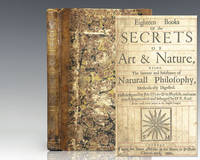
1270831660: Printed for Simon Miller at the Starre in St. Pauls Church-yard London. First edition in English of Reade's 17th century adaptation of Johann Jacob Wecker's De secreti libri xvii Book of Secrets of 1582. Folio bound in three quarter polished calf over marbled boards with gilt titles and ruling to the spine woodcut printer's device to the title woodcut head and tailpieces and initials numerous woodcut diagrams in the text. In near fine condition. Lacking the engraved frontispiece title page supplied. Exceptionally rare. Based on Swiss physician and philosopher Johannes Jacob Wecker’s De secreti libri xvi Book of Secrets first published in 1582 Eighteen Book of the Secrets of Art & Nature was conceived as ‘an Encyclopaedia of Arts and Sciences interwoven with facetious Conceits to recreate the fancy’. The compiler Dr R. Read or Reade gives a long list of ‘Authors made use of in this Treatise’ which adds Culpeper Digby Galileo Harvey Hobbs Lady Howard and Platt to those used by Wecker. He has also inserted his own name between Rondolet and Rhasis. Wecker's original list remains one of the most unusual assortments of authors ever assembled. As is seen in other 16th and 17th century Books of Secrets every imaginable topic of natural science natural magic arts trades sports and pastimes is included with a substantial compilation of recipes experiments and observations extracted from classical medieval and contemporary authors. Books of Secrets constituted one of the most popular genres in early modern scientific publishing and supplied a great deal of practical information to an emerging new middle-class readership leading some historians to link them with the emerging secularistic values of the early modern period and to see them as contributing to the making of an age of how-to. Wing W1236; ESTC R12839; Eamon 134. Printed for Simon Miller at the Starre in St. Pauls Church-yard hardcover
178625988Ephrata: The Cloister 1786. First edition 4to pp. 6 250 2; printed in black letter throughout; engraved vignette pasted on title page; prelims and terminals waterstained small tear in the lower margin of title not touching letterpress old ownership signature at the top of the title page of Christian Stauffer 1736-1808 and a 30-line poem also presumably by him on the final blank leaf as well as a few marginal annotations; contemporary full calf front cover detached but present; the whole in a new cloth clamshell box. An abstract of the diary of the Brotherhood which had been kept by Brother Lamech and continued and edited by Brother Jaebez Agrippa i.e. Johan Peter Miller. Brother Lamech has been identified as Jacob Gass by Seidensticker First Century of German Printing in America p. 117. Evans 19558: "This biography of Johann Conrad Beissel the founder of the Ephrata Community is the principal source of information regarding that remarkable institution. Brother Agrippa is Johann Peter Miller; and Brother Lamech's secular name is said to be Jacob Gass. An English translation was printed in Lancaster Pennsylvania in 1890." Howes G76 identifying this as the second issue of three with the title page seal pasted on. <br/><br/> [The Cloister] hardcover books
178625988Ephrata: The Cloister 1786. First edition 4to pp. 6 250 2; printed in black letter throughout; engraved vignette pasted on title page; prelims and terminals waterstained small tear in the lower margin of title not touching letterpress old ownership signature at the top of the title page of Christian Stauffer 1736-1808 and a 30-line poem also presumably by him on the final blank leaf as well as a few marginal annotations; contemporary full calf front cover detached but present; the whole in a new cloth clamshell box. An abstract of the diary of the Brotherhood which had been kept by Brother Lamech and continued and edited by Brother Jaebez Agrippa i.e. Johan Peter Miller. Brother Lamech has been identified as Jacob Gass by Seidensticker First Century of German Printing in America p. 117. Evans 19558: "This biography of Johann Conrad Beissel the founder of the Ephrata Community is the principal source of information regarding that remarkable institution. Brother Agrippa is Johann Peter Miller; and Brother Lamech's secular name is said to be Jacob Gass. An English translation was printed in Lancaster Pennsylvania in 1890." Howes G76 identifying this as the second issue of three with the title page seal pasted on. [The Cloister] unknown
198385437Limited Editions Club. As New. 1983. Hardcover. FREE UPGRADE to Courier/Priority Shipping Upon Request - IN STOCK AND IMMEDIATELY AVAILABLE FOR SHIPMENT - AS NEW THE TEXT BLOCK IS PRISTINE CLEAN UNMARKED AND IN EXCELLENT CONDITION - - Corresponds to ASIN: B002FKB6RE. SIGNED BY AUTHOR ILLUSTRATOR AND BY ROBERT PENN WARREN WHOSE POEM IS INCLUDED. LIMITED EDITION; NUMBERED COPY. -- with a bonus offer-- . Limited Editions Club hardcover