SCHOEBERL FREDERIC.MareMagnum

54 276 résultats
Cm. 27, pp. (8) 136 + (2) con l'indice delle tavole. Una carta geografica all'antiporta e 36 belle tavole fuori testo all’acquatinta con coloritura coeva. Solida legatura ottocentesca in mezza pelle con ampie punte, dorso liscio con titoli in oro. Sguardie marmorizzate. Esemplare pulito ed in ottimo stato di conservazione. Celebre opera che illustra il percorso alpino tra Ginevra e Milano. Molto affascinanti le vedute che riguardano il Monte Rosa, il Sempione e i suoi ponti, Crevola, Val d’Ossola, Villa d’Ossola, Baveno, il Lago Maggiore, Arona, Sesto. ecc. Edizione celebrata da tutte le bibliografie alpine, di viaggio e di storia locale del norditalia. Cfr. almeno Fiammetta Olschki (viaggi in Italia) n. 608. Non comune, soprattutto quando completa di tutte le tavole e ben conservato come il presente esemplare.
In-8, brossura orig. Di questa famosa rivista mensile illustrata, ca. 100 pagine ogni numero, offriamo una raccolta di 48 annate complete, dal 1952 (Anno I della “Nuova Rivista di Cucina”) al 1999. Segnaliamo inoltre che 10 annate hanno in più un “Numero Speciale” e precisamente: 1986 (Supplemento al n. 10) - 1988 (Speciale di Primavera) - 1990, 1991, 1992, 1993, 1994, 1995, 1998 (Speciale di Natale) e 1999 (Speciale di Natale + un ulteriore Supplemento). "La Cucina Italiana" è dal 1929 il più autorevole mensile di gastronomia e di cultura alimentare, e di più lunga tradizione in Italia e nel resto del mondo. E’ ricchissimo non solo di ricette ma anche di rubriche, segnalazioni di nuove tendenze, novità di cucina e consigli per la casa. In questa importante raccolta, solo pochi fascicoli hanno lievi mancanze al dorso, altrimenti è tutta ben conservata, e 11 annate (dal 1952 al 1963 - tranne il 1958) sono contenute in un cofanetto editoriale in tela rossa.
Rara carta raffigurante lo Stato di Milano ad opera di Gaetano Bianchi. L’incisione segue il modello inaugurato dalla carta del Frattino del 1703, presentando rispetto a questa degli ornati completamente differenti, si veda ad esempio: il decorativo cartiglio in cui si trova iscritto il titolo od ancora la parte riservata alla dedica al Marchese de l’Isle. Affascinante coloritura coeva all’acquerello.Bibliografia: Motta, p. 12
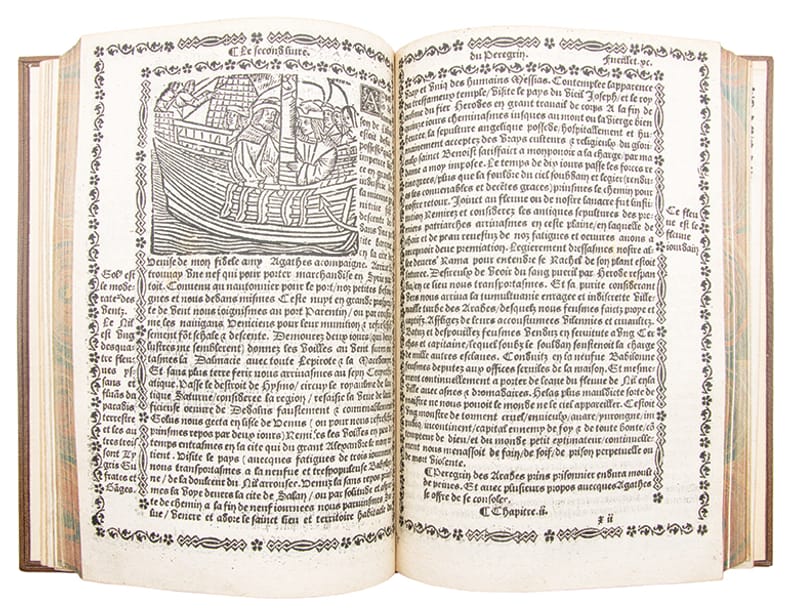
39224Petit in-4° (195 x 132 mm), maroquin taupe sur ais de bois orné d'un riche décor Renaissance estampé à froid, dos à 4 nerfs prolongés, orné de compartiments garnis d'un motif de filets en croisillon, plats entièrement revêtus dun décor estampé de trois encadrements délimités de triples filets gras, alternant fleurons et entrelacs, réservant un cartouche central, coiffes ciselées, roulettes sur les coupes et les chasses, pièce de titre au noir, tranches dorées sur marbrures (reliure néo-Renaissance signée de Gruel), (6), CCxxiiii (i.e. 214) feuillets, tous inscrits dans une double roulette de motifs d'entrelacs, vrilles de vigne et fleurettes, page de titre imprimée en rouge et noir, lettrines, deux bois d'illustrations gravés dans le texte. On les vend a Paris / en la rue neufve nostre dame / a lenseigne de sainct Jehan baptiste / pres saincte Geneviesve des ardans par Denys Janot. 5 juillet 1535.
In-24 p. (mm. 101x70), p. pergamena coeva, 608 pp.num., 16 cc.nn., titolo al frontespizio entro cornice decorata, testo in carattere corsivo. Dedica a Gio. Battista Minardi. Al fine: Tavola dei Capitoli e una Tavola degli argomenti sopra i Capitoli. Rarissima edizione, assai ricercata, nonostante le scorrettezze tipografiche, poichè rappresenta la prima delle sole tre edizioni della "Commedia" pubblicate nel Seicento, insieme a quelle stampate a Venezia e a Padova nel 1629. Si tratta di un numero di edizioni assai esiguo rispetto ai secoli precedenti, che denota una tendenza regressiva della fortuna dell’opera dantesca, destinata a perdurare fino agli inizi del XVIII secolo. In questa edizione, che segna il ritorno all’essenzialità tipografica, essendo priva di commenti e illustrazioni, compare per la prima volta il titolo "Visione" in luogo di Divina Commedia, che vuole significare “il complesso delle cose da lui vedute nel mistico suo viaggio” (Scartazzini, Enciclopedia Dantesca,II,2154). Cfr. De Batines,I, pp. 101-102: “A senso del de Romanis questo titolo di "Visione", dal Volpi giudicato fantastico, si addice al Poema di Dante forse meglio che quel di "Commedia"” - Mambelli,53. Corto del margine super.; 1 carta (pp. 95/96) molto ben restaurata per angolo infer. mancante (incluse alcune lettere del testo, qui sapientemente trascritte a mano), altrim. esemplare ben conservato.
La carta del de Jode rappresenta la prima ristampa estera del mitico rilievo cartografico della penisola di Giacomo Gastaldi, edito a Venezia nel 1561. La carta del Gastaldi ebbe subito un incredibile successo e dopo il 1567, anno della morte del cartografo piemontese, iniziarono subito le ristampe, riduzioni, derivazioni e contraffazioni, che continuarono fino al 1600. Gerard de Jode, editore e cartografo con fervente attività in Anversa, già nel 1568 realizza una carta in 4 fogli di derivazione “gastaldiana”; nel 1578 l’editore fiammingo pubblica la prima edizione del suo celebre Speculum Orbis Terrarum, dove inserisce una riduzione della carta dell’Italia. L’atlante, che nella sua prima stesura risulta essere di incredibile rarità, venne successivamente ristampato nel 1593 dal figlio Cornelis, con alcune varianti nel testo e nel numero delle tavole. Incisione in rame, intagliata dai fratelli Johoannes o Lucas van Deutecum, lievi pieghe di carta centrali, piccolo strappo restaurato, nel complesso in ottimo stato di conservazione. Bibliografia Borri pp. 51-52, 48; Perini pp. 30-32; Almagià p. 27. De Jode’s map represents the first foreign reissue of the great carthographic analysis of the peninsula of Giacomo Gastaldi, published in Venice in 1561. Gastaldi’s map was immediately appreciated and after 1567, the year of its author’s death, it was reprinted under many circumstances: reissues, reductions, copies and fakes, until 1600. Gerard de Jode, publisher and cartographer of Antwerp, had already realized, in 1568, a map in four sheets whose inspiration was clearly Galtaldi’s; in 1578 the Flemish publisher printed the first edition of his famous Speculum Orbis Terrarum, where a reduction of the map of the peninsula was included. The atlas, whose first edition is extremely rare, has benne afterwards reissued by the son Cornelis in 1593, with some changes in the text and the numre of plates. Copper engraving, engraved by the brothers Johoannes or Lucas van Deutecum, light ceintral paper folds, small tear perfectly repaired, otherwise in good condition. Bibliografia Borri pp. 51-52, 48; Perini pp. 30-32; Almagià p. 27. R. Borri "L'Italia nelle antiche carte…" (2011), scheda 54; Perini pp. 30-32; Almagià p. 27.
18346131Zum Gebrauch als Vorlegeblätter für Landschaftszeichner, lithographirt von L[udwig Joseph] Kuntz u. Fr[iedrich] Eisenlohr. Mit 21 Kreidelithographien auf aufgewalztem Japan auf 20 Tafeln. Karlsruhe, Verlag der P. Wagner'schen Lithographie, 1834. Groß-Querfolio (63,5 x 48,2 cm). Lithogr. Orig.-Umschlag auf braunem Papier (nur Vorderseite).
28-EFo.J. Bleistift, auf Bütten mit Wasserzeichen: bekrönter Wappenschild mit Adler und den Initialen ?GM?, rechts unten von fremder Hand bezeichnet ?Viterbo (durchgestrichen) Perugia?. 21,1:30,1 cm. - Leicht fleckig und mit zwei Knickfalten.
18227686CBMilano, Presso F. Artaria, 1822. Kl.-4°. XI, 175, (5) S. Mit gest. Titel, 30 kol. Aquatinta-Tafeln (meist nach Lory, gest. von Landini und Fumagalli) und 1 gef. Karte. Lederband der Zeit mit reicher Rücken-, Deckel- und Innenkantenvergoldung sowie dreis. Goldschnitt. + Wichtig: Für unsere Kunden in der EU erfolgt der Versand alle 14 Tage verzollt ab Deutschland / Postbank-Konto in Deutschland vorhanden +, 7686CB|7686CB_2|7686CB_3|7686CB_4 [4 Warenabbildungen]
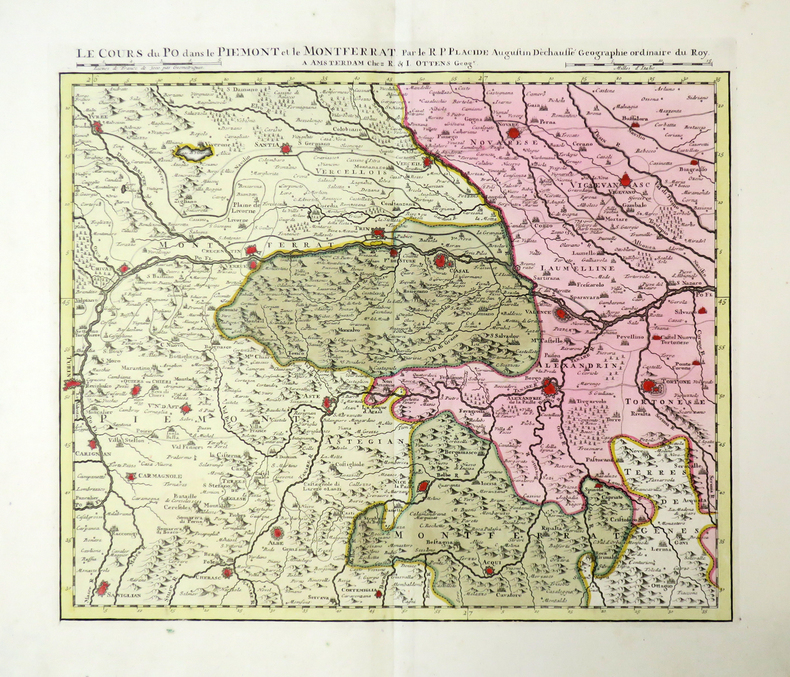
1735LBW-4481Amsterdam, R. & I. Ottens, [circa 1735]. En 5 feuilles pouvant être jointes pour former une carte de 0,42 x 2,48 m.
In-4 gr. (mm. 339x225), mz. pergam. settecentesca con ang., pp. CLV, incluso il frontespizio figurato; corredato nel t. da numerose grandi incisioni su legno e al colophon, entro elaborata cornice, marca tipografica pure xilografata. "Prima rara edizione" del terzo libro dell'architettura. Uscito nello stesso anno del IV (primo pubblicato), contiene i rilievi delle antichita' romane, in particolare del Pantheon, e di costruzioni romane ad Ancona, Benevento, Spello, Verona, Pola; a questi vengono affiancati rilievi e progetti delle più moderne architetture come quelli del Bramante e del Peruzzi per S. Pietro. Il libro si conclude con un interessante saggio sull'architettura egiziana. Cfr. Fowler 308 - Schlosser p. 406. Prime 6 cc. sapientemente restaur. al marg. bianco infer. per manc. (in 1 anche di un piccolo tratto della figura) e ultime 3 cc. al margine interno; con tracce d’uso ma discreto esemplare.
013-Io.J. Aquarell, über Bleistift, auf Velin, links unten signiert und bezeichnet ?Blaschnik fe Roma.?. 29,5:22 cm. Vermutlich Vorzeichnung für eine Lithogaphie. Bei unserer Darstellung der Innenseite des berühmten Vesta-Tempels von Tivoli handelt es sich sicher um eine sehr seltene Wiedergabe des Motivs ? für gewöhnlich wurde die Außenseite des Tempels, entweder von der gegenüberliegenden Bergseite oder von unten vom Tal her, zusammen mit der Schlucht und den Wasserfällen, von den Malern der Zeit wiedergegeben. Blaschnik jedoch zeigt den Tempel vom Garten des Gasthauses aus, das sich auch heute noch dort befindet.
1830151-W1830. Bleistift, auf chamoisfarbenem Velin, rechts unten bezeichnet und datiert ?Sorrento am 25. Juli 1830? und von einer anderen Hand ?im Hause der Gr(äfin) v(on) E(gloffstein). 18,3:24,1 cm. - Verso: Porträt der Karoline Lauska. Bleistift, rechts unten bezeichnet ?Frau Lauska?. Minimal fleckig. Im Juli 1830 reiste Julie von Egloffstein in Begleitung des Malers Fr. Preller d.Ä. (1804-1878) von Rom über Neapel nach Sorrent, wo sie einige Gemälde und Zeichnungen schuf. Unsere Ansicht ist von dem Haus aus gemalt, in dem die Künstlerin sich während ihres Sorrenter Aufenhaltes aufhielt. Das rückwärtige Bild zeigt ein Porträt der 1794 in Berlin geborenen Malerin Karoline Ermeler, die den Musiker F.I. Lauska (/1764-1825) geheiratet hatte. Sie war eine Schülerin von J.C.H. Kretschmar (1769-1847) und von W. von Schadow (1788-1862). Lauska bereiste Italien drei Mal, sicher 1829-1830. Möglich ist, daß sich Lauska ebenfalls 1830 in Sorrent aufhielt, wo dann Egloffstein das Porträt gemalt haben könnte. Ungewöhnlich ist bei diesem Porträt nicht nur die Wahl der Porträtansicht, sondern auch, daß es sich um eines jener seltenen Porträts einer Künstlerin handelt, das von einer Künstlerin gemalt wurde.
0816-Bo.J. 3 zeitgenössisch gouachierte Lithographien, nach Raffael, auf festem Bütten, auf Untersätze montiert, 2 Blätter rechts unten signiert und ?1851? datiert. Je ca. 53:75 cm. Von leuchtender Farbigkeit und sehr schöner Erhaltung.
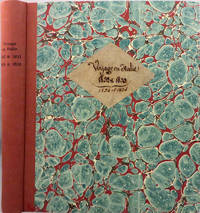
183227396n.p.: Original Manuscript 1832 1833 1834 1835. Original Manuscript in French of the travels by General Despans-CubiÄres to Italy over the course of four years. The text includes significant considerations of military affairs the mention and discussion of famous personages as well as historical observations and political affairs . 4to the manuscripts now bound into a binding of terra-cotta paper over marbled boards with a hand-calligraphed label to the upper cover and the titles in black to the spine panel. 534 pp. A fine and beautifully preserved collection of manuscripts written over four years. A UNIQUE AND INTERESTING MANUSCRIPT BY ONE OF THE MOST FAMOUS GENERALS IN ALL OF FRENCH HISTORY. 'Amédée Louis de CubiÄres was the illegitimate son of the Marquis Louis Pierre de CubiÄres page to Louis XV and squire to Louis XVI then in 1815 of Louis XVIII by Madame Guesnon de Bonneuil née Michelle Sentuary.<br> He served in the Austerlitz Prussian and Polish campaigns being mentioned in dispatches at Austerlitz and wounded at Jena 1806. Promoted to lieutenant on 30 November 1806 he received the cross of the Légion d'honneur at Eylau 1807. Aide-de-camp to general Morand from 12 January 1808 he followed him in the Austrian campaign of 1809 the French invasion of Russia in 1812 and the 1813 German campaign. He fought with distinction at Eckmühl and rose to captain at Essling 7 June 1809. He assisted at the battle of Wagram 6 July 1809 and had three horses shot from under him at the battle of Borodino. Napoleon I of France made him an officer of the Légion d’honneur in reward for his good conduct in the 1813 campaign in which he had become chef de bataillon promoted 3 October 1813.<br> On Napoleon's return from Elba in 1815 colonel de CubiÄres was made colonel Å• la suite to the 1st Light Infantry Regiment of which the titular colonel was Beurnonville. According to Jolyet Napoleon reviewed this regiment on the day after his arrival back in Paris on 21 March and asked who was its commander. CubiÄres replied "Sir it is colonel de Beurnonville ; but he is ill." Napoleon replied "Beurnonville is not sick - it is you colonel CubiÄres who shall nevertheless take command of the 1st Light Infantry". In 1815 Despans-CubiÄres fought with his regiment at Waterloo and was wounded at Quatre-Bras and at Mont-Saint-Jean.<br> According to Jolyet CubiÄres was "the most valiant soldier and the best man-of-war that I have known. With this he brought a remarkable beauty a brilliant spirit and a generous and independent love".<br> Promoted to commander of the Légion d’honneur 21 March 1831 he was made commander-in-chief of the French troops which landed at Ancona in the Papal States 9 February 1832 to occupy the town in reprisal for Austrian intervention at Bologna. Returning to France in 1837 with the rank of lieutenant-general he next became Minister for War in the 1839 transitional government 31 March-13 May 1839 then in Adolphe Thiers's second cabinet 1 March-29 October 1840. He attached his name to Paris's fortifications to the decision to write a history of all France's regiments since Francis I and to the organisation of the chasseurs of Vincennes. Made a peer of France on 7 November 1839 he took part in the discussions of the Chambre des pairs on taxes and roads before being raised to grand officer of the Légion d’honneur on 27 April 1840.<br> When the 1844 novel The Count of Monte Cristo was published - according to Librairie Générale Française 1995 its character of Fernand Mondego was inspired by general Despans-CubiÄres. On 17 August 1852 he won a decree of rehabilitation at the Court of Appeal at Rouen after an earlier trial on charges of corruption and was allowed to retire as a général de division on 1 January 1853 Original Manuscript hardcover
59-BFo.J. Bleistift, auf chamoisfarbenem Velin. 25,4:44 cm. - Verso: Baumlandschaft. Bleistiftskizze. - Ränder geringfügig vergilbt und kleinem Einriß am Unterrand. [2 Warenabbildungen]
In-8, brossura orig. (tracce d'uso), pp. 423. "Prima edizione". Cfr. CLIO,V, p. 3505. Al gesuita Francesco Pellico il Gioberti aveva dedicato il più noto dei suoi scritti, il "Primato morale e civile degli italiani", pubblicato nel 1843. Il presente testo è una confutazione all'opera giobertiana, in cui l'A. difende la sua Congregazione e ribatte le considerazioni filosofiche ma anche reali dimostrate nel "Primato..". Il ns. esemplare è quello inviato a Gioberti dal Padre Pellico, con sua firma manoscritta "il tuo Pellico Sac. G.". Il Gioberti, non solo lo lesse ma lo sottolineò e lo chiosò a matita per tutta la sua estensione e volle, poi a penna, annotare l'ultima carta e il recto della brossura posteriore ed infine allegare un foglio manoscritto (aderente al verso del piatto anteriore) che contiene numerosi nominativi con indirizzi, probabilmente persone con le quali era in rapporto a Parigi. Uniamo anche alcune lettere che testimoniano che l'antico possessore lo acquistò nel 1854 dal nipote di Gioberti (cioè due anni dopo la morte del "grande italiano"). L'acquirente, studente del primo anno di Legge, precisa: "mi costò 10 fran. che economizzerò non andando per questi due mesi al Caffè a far colazione". Con qualche fiorit. ma certamente un buon esemplare. Di particolare importanza per l’appartenenza sopra descritta.
145-Io.J. Bleistift, auf Velin, rechts unten bezeichnet und datiert ?Villa Borghese 24. Januar à Roma 1838?. 33,3:47,7 cm. Provenienz: Sammlung Franz Meyer. Die ganz im Geiste der Romantik stehende Zeichnung besticht durch eine zarte und sichere Zeichenführung. Die Datierung lässt zudem den Schluss zu, dass Wagner eine weitere Reise nach Italien im Jahr 1938 unternahm.
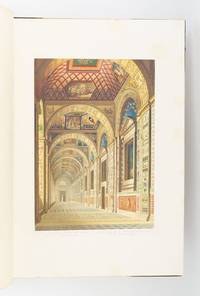
1854ST19418London: Thomas McLean 1854. New Edition "largely augmented by numerous plates plain and colored. 578 x 406 mm. 22 3/4 x 16". 4 p.l. comprising an engraved title page printed dedication preface and list of plates; xvi 76 pp. all of the text in the second work inlaid to size. Two related works a large folio plate volume and a quarto text volume bound in one volume. <br/> Decorative contemporary dark brown half morocco marbled paper sides broad decorated raised bands spine elaborately gilt in compartments featuring a very large and complex lozenge composed of antique tools as well as large scrolling cornerpieces marbled endpapers all edges gilt joints possibly but not certainly with very expert repairs. First work with illustrated title page and 56 LARGE-FOLIO PLATES NINE OF THEM ATTRACTIVE CHROMOLITHOGRAPHS original tissue guards. Avery Architectural Library p. 414 citing the edition of 1844. Corners and portions of the board rather rubbed and chafed some occasional light foxing and other trivial imperfections internally but still quite an attractive copy the text and plates clean and pleasing the binding completely solid with joints only slightly worn and the spine quite well preserved.<br/> <br/> This volume combines a visual survey of major decorative art of the Italian Renaissance with a scholarly account of the same the latter text published in quarto and here inlaid to the giant folio size of the plate volume. The plates picture some of the best wall decorations and architectural elements of palaces and churches constructed in Italy in the 15th and 16th centuries. Works of Raphael in Rome are featured here in particular the decoration of the loggias of the papal apartments at the Vatican and of the Villa Madama. The three chromolithographs of the loggias are little short of magnificent. Also included are the wall treatments of the Ducal Palace and Palazzo Te both in Mantua by Raphael’s pupil the mannerist painter Giulio Romano. Among churches pride of place is given to the elaborately decorated Carthusian monastery the Certosa of Pavia by Ambrogio da Fassano and others. The plates are for the most part adapted from the work of two German architects Thürmer and Gutensohn executed two decades previously and completed and explicated by Gruner. The final two plates display in brilliant color many small sections of the previous black and white plates the idea being that purchasers should try their hands at coloring using this elaborate and colorful chart as a guide an early owner seems to have made a tentative effort in that direction with some success in plates 20 and 44. Wilhelm Heinrich Ludwig Gruner 1801-81 was an art historian specializing in the Italian Renaissance and a designer of great houses gardens and furniture who came to England to advise Prince Albert the German consort of Queen Victoria on his decorative projects. The second part of the present volume contains an essay comparing Roman and Renaissance wall painting. Its author called J. J. Hittorff on the title page was Jacques Ignace Hittorff 1792-1867 an architect and archaeologist and the first person to argue that ancient statuary had been brightly colored. Thomas McLean unknown
1800409761800. Depicting couples from various regions with accoutrements as named in each lower margin unsigned. Image size: 10 1/2 x 8 3/4 inches. Sheet size: 13 3/8 x 10 3/8 inches The group consists: 1. Di Pesco Costanza Contado di Molise 2. Paese di Sessano Provincia Contado di Molise 3. Massagronica Provincia si Chiete Abruzzo Citra 4. Passe di Monte Aldiero Provincia d'Aquila. This group of watercolours showcases couples from various mountainous villages in the Abruzzo and Molise regions of Italy. Dressed in traditional garb each couple's attire highlights the distinct differences in the dress across this region to the east of Rome as well and the delicately ornate clothing of the time complete with bright colours intricate patterns and fascinating accessories. Each couple is beautifully captured in gauche executed with delicate brushwork and vivid colours that bring the characters to life capturing the essence of each couple's culture and lifestyle. The drawings offer a glimpse into Italy's rich and diverse heritage presenting a window into the customs and traditions of its people through their traditional clothing and accessories. unknown
In-8 p. (mm. 220x165), cartonato rustico settecentesco, tit. ms. al dorso, pp.num. 404, cc.nn. 14 (di Indice) incluso il bel frontespizio figur. che porta al verso il ritratto dell'A. in ovale, inc. su legno; con l'aggiunta di 2 carte (segnate S, fra "S"6 e "S"7) che raffigurano la parte superiore di due torri e di altre 2 carte (segnate X, fra "V"8 e "X"1) che riportano la pianta dei bagni di Diocleziano. L'opera è illustrata nel t. da 90 xilografie di dettagli architettonici, piante e diagrammi. Inoltre, all’inizio del ns. esemplare figurano 2 carte contenenti: endecasillabi di Pagani Paganini e una seconda dedica di Cosimo Bartoli al Signore Cosimo de Medici, duca di Firenze et di Siena (non citate nelle bibliografie). Cfr. Fowler Collection,9: "First quarto edition of Bartoli's translation (la I, in folio è del 1550). The title is within a reduced copy of the architectural woodcut border of the title page of the 1550 folio edition. The illustrations are also reduced and reversed copies of the same edition" - Cicognara,376. Nel ns. esemplare, corto del marg. super., il frontespizio è stato restaur. per piccole manc. al marg. infer. bianco; lievi aloni o fiorit. interc. nel t. ma certamente un buon esemplare.
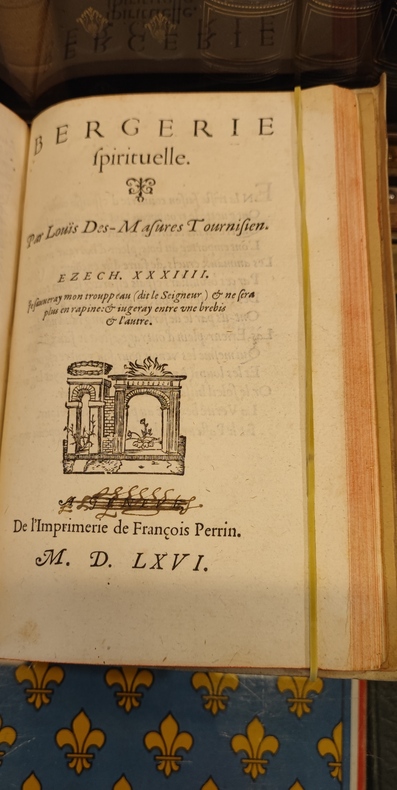
15663484A Genève, de l'Imprimerie de François Perrin, 1566. Petit in-8 (18,5 x 12 cm), 272 pp., 46 pp., 12 pp., vélin à recouvrement, à la bradel, pièce de titre maroquin rouge (relié vers 1900) Edition originale de cet Ouvrage rare, surtout avec "Bergerie spirituelle et "Eclogue spirituelle", également en édition originale. Cantiques mis en musique. Texte agrémenté de Quelques bandeaux, culs-de-lampe et lettres ornées
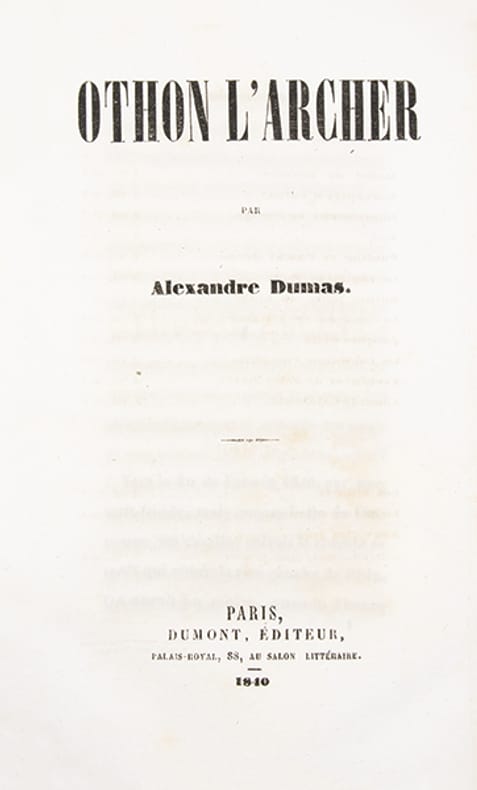
387672 ouvrages reliés en un volume in-8 (200 x 124 mm), demi-veau moucheté à petits coins, dos à 4 faux-nerfs plats ornés d'un large décor romantique à froid de roulettes, filets et grand fer central, pièces de titre de maroquin orange, plats de papier "coulée romantique", tranches jaunes (reliure de l'époque).
in-folio (mm 460x320), leg. coeva in mezza pelle e angoli, tit. in oro lungo il dorso, armi non identificate coronate e con serto d'alloro impresse in oro al piatto anteriore. Comprende: 1 foglio a stampa con titolo e indice della serie; 30 vedute dis. e lit. dall'artista, di eccezionale livello artistico e di grande finezza (varie di Roma e Napoli, nonchè di Pisa, Firenze, Venezia, Lago Maggiore, Tivoli, Parma, etc.). J.B.Isabey (pittore, miniatore e litografo, Nancy 1767 - Paris 1855) fu artista assai reputato e quotato. Viaggiò in Italia nell'aprile-giugno del 1822 e ne trasse le 30 presenti impressioni poi riportate in lito al suo ritorno a Parigi. Esemplare con arrossature, più accentuate su 4 tavole.. Cfr. Benezit, V, p.730. Cremonini, L'Italia nelle vedute, n.95..
La carta è incentrata sullo studio della via che Traiano fece costruire per arrivare a Brindisi, che costituiva il prolungamento della via Appia, che da Roma arrivava a Benevento. Passando per l’antica Gnathia (Egnazia), importante porto commerciale della Roma Imperiale, la strada, chiamata Traiana, assunse anche il nome di Egnazia. La mappa, ideata da Giuseppe Galasso è opera dal geometra Pietro Chiariotti, sullo stile di quelle del cartografo napoletano Benedetto Marzolla. La carta copre gran parte della regione, sino a Paestum, parte del Molise sino a Larino ed una piccola porzione di Puglia e Basilicata. Curiosa la forma rotonda. Acquarello policromo su carta, pieghe di carta, in ottimo stato di conservazione. La carta è incentrata sullo studio della via che Traiano fece costruire per arrivare a Brindisi, che costituiva il prolungamento della via Appia, che da Roma arrivava a Benevento. Passando per l’antica Gnathia (Egnazia), importante porto commerciale della Roma Imperiale, la strada, chiamata Traiana, assunse anche il nome di Egnazia. La mappa, ideata da Giuseppe Galasso è opera dal geometra Pietro Chiariotti, sullo stile di quelle del cartografo napoletano Benedetto Marzolla. La carta copre gran parte della regione, sino a Paestum, parte del Molise sino a Larino ed una piccola porzione di Puglia e Basilicata. Curiosa la forma rotonda. Acquarello policromo su carta, pieghe di carta, in ottimo stato di conservazione.