24 761 résultats
19002111902160201143Shinshu Ueda Town Japan Linguistics Joint Stock Company 1900. Soft Cover. Fine. Number of books: 1 Shinshu Ueda Town Japan Linguistics Joint Stock Company paperback
19972080502106907340Not Available 1997. Soft Cover. Fine. The book is in fine condition. Not Available paperback
91484ABo.J. 25,5x23 cm. Leporello mit 24 (je 12) erotischen farbigen Aquarellen auf Seide, montiert auf Karton. Einband mit Goldstickereien auf Seide. Seidenbezug an den Deckeln beschabt und bestossen.
In-8° (cm 15,3x9,3), pp. (8),mezza 336; 1 folding plate representing the plan do the prison where Spinola was imprisoned in Japan. On title page a woodcut with the monogram of Compagnia di Gesù and the “motto” “pulcra ut –luna- electa ut –sol-”. The binding is contemporary half vellum with gilty title on spine, and yellow edges. The dedication is dated Roma 1628 and it refers to the first edition. This bioghrapy of father Spinola is an account of the missionary voyage he made through Portugal, Brasil, Portorico, England, Lisboa, China and eventually Japan, where he wished to die (from page 97 to the end). He died in Nagasaki in 1622, afer being persecuted and imprisoned. Two ink stamps on title page, few restoration on blank margins.
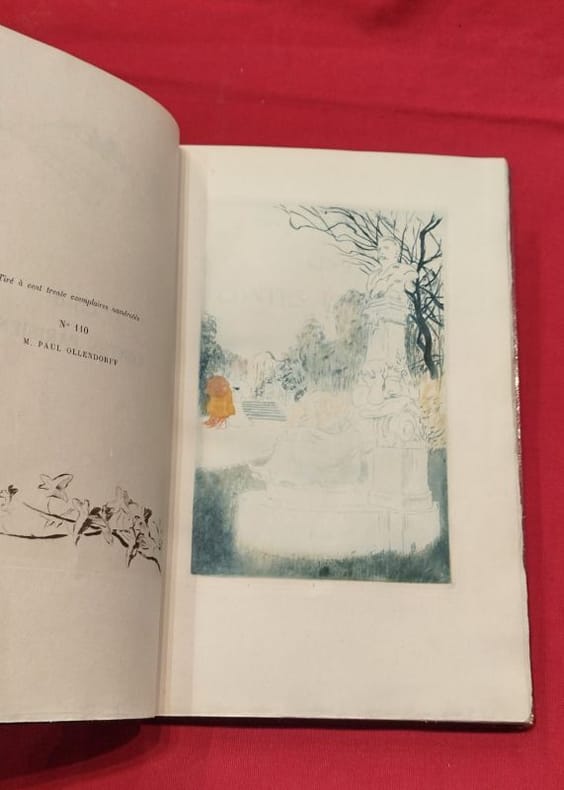
1905118686Pour les cent bibliophiles 1905 plein maroquin Paris, Pour les cent bibliophiles, 1905, 1 volume grand in-8 de 180x285 mm environ, 97 pages, (2) ff. (table, achevé d'imprimé), tirage à 130 exemplaires numérotés, exemplaire nominatif, sur papier japon. Complet du frontispice et des cinq eaux-fortes à pleine page, nombreuses eaux fortes in-texte. Reliure signée de Salvador David, plein maroquin rouge, dos à cinq nerfs portant titres et date dorés, triple encadrement sur les plats, tranche de tête dorée, double filet doré sur les coupes, belle frise dorée sur les chasses, gardes marbrées, couvertures et dos d'origine. Menus frottements sur les mors, léger effacement des filets d'encadrement du premier plat (quelques millimètres), coins inférieurs légèrement courbés, sinon très bel exemplaire, bon état général.
167864619Amsterdam, Jacob van Meurs u. Joannes, van Someren, 1678. Fol. Mit illustr. Kupfertitel, Drucktitel in Rot u. Schwarz m. Druckermarke, einer doppelblattgr. Kupferkarte u. 19 doppelblattgr. Kupfertafeln. Mod. Ldr. m. Rückenverg. u. goldgepr. Rückenschild.
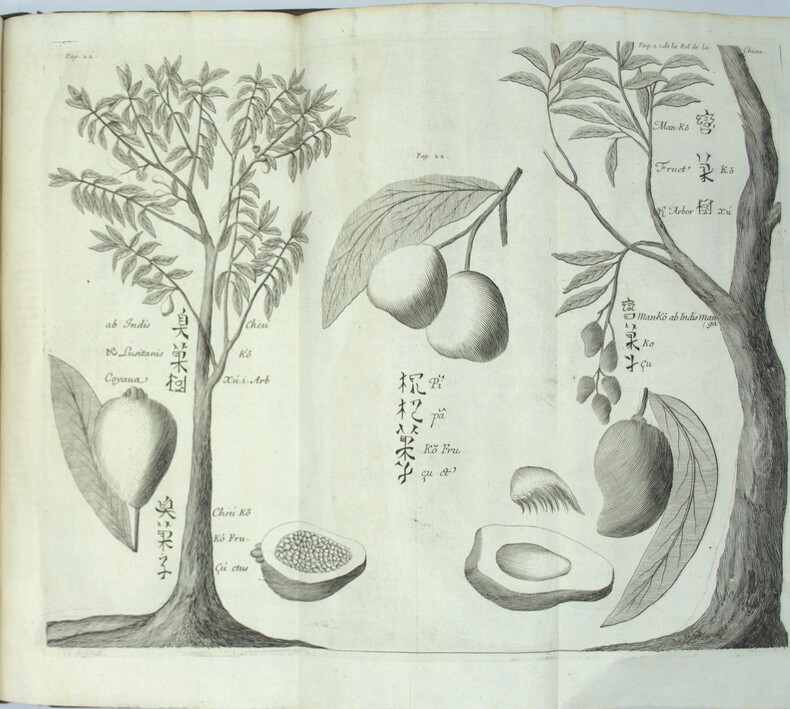
1663PHO-2278A Paris, chez Jacques Langlois, 1663-1666 3 parties en 1 volumes in-folio (38x25cm). Veau tacheté époque, dos à nerfs ornés avec pièce de titre en maroquin et tomaison, tranches jaspées rouges. Réparations au dos et coins, mouillure, quelques rousseurs, réparation au titre, renforcement à la carte. Complet de ses relations de voyage selon Brunet & Camus
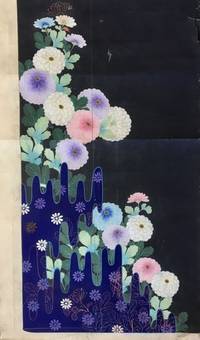
181956897Kyoto Japan: Marubeni Shoten Design Dept. Keimeikai Textile & Dyeing Studio Tanioka Shoten Design Dept. ca. 1918-1945. Folio. 61 original hand-painted inked and pencil designs with a few on a lightly toned but quality semi-translucent paper the majority on thick paper stock and still others with two pieces carefully pasted together with contiguous designs sized from 9 x 15 in. up to 19.25 x 38.5 in. with 13 of the pieces larger the larger size a number of them sized 18 x 32 in. and many in the 14.25 x 15.5 in. size colour painted; the majority feature the design studio chop or crest at lower corners throughout many w/ annotations in margins several w/ change orders neatly annotated or even the title of the design and still many others w/ Roman numeric inventory codes in margins as well two still retaining original small silk samples many with creasing or minor tears & edgewear or creasing to fore-edges a few w/ small & large closed tears while others show some creasing and thumbing from continued use still an exceptional group of manuscripts. This superb archive of 61 original hand-painted kimono designs furnishes an exceptional visual array of Taisho- and early Showa-era Japanese motifs and styles. A number of the designs evoke traditional Japanese Ukiyo-e woodblock prints with deep vivid colours and well rendered illustrations. Many of these designs incorporate floral patterns including Kiku Chrysanthemum Botan Mon Peony Pattern Manju Kiku Marigolds Japanese Irises Morning Glory Cockscomb Ivy Dahlias and many other botanical motifs. In addition there are many illustrating ornately embroidered designs austere bamboo mushrooms and intriguing landscapes some with a small portion fully painted in with brilliant colouring while the outline of the kimono fills out the drawing. Two of the designs still features their original small attached silk kimono sample more reminiscent of Western Design houses which often attached their chosen fabric samples to their clothing designs. A few of the designs are executed on translucent thin paper for the kimono draper to transfer the design to white silk or other fabrics via some type of carbon paper process. Another of the designs has been executed on a stunning silver metallic paper with palm or bamboo leaf fronds executed in vivid blues & browns. Some feature a nearly surrealist quality while several others include illustrations of doves or chickens. Two of the designs incorporate Art Deco representations of Chinese Junks and Japanese sailing vessels typical of the 1930’s prior to World War II. In the Taisho Era a new era opened for textile designers working with Kyoto drapers and department stores with many having trained at new art colleges and then working in the design studios of Marubeni Keimeikai Textile & Dyeing Studio and others. The Tachiki Artist design studio designs on thin translucent paper include one with designer stamp of character embedded within a skull. Some appear to have two different date stamps for the Marubeni Shoten Design and some are unsigned or stamped. The Taisho- and Showa-era kimonos featured brighter colours more groundbreaking designs as Japan’s designers embraced traditional dress and transformed it into a new garment equally appealing to the “Moga†or brazen “Modern Girl.†The designer notes include instructions to “leave a little more space between the fans;†“Drop the little fan crest;†“too much white bush clover†on the pine cones and even that Matsuo Taishichi had ordered a design for “clothes for paying a visit for a young person.†The Marubeni Shoten originated with Chubei Itho who began in 1858 as a salesman for linen cloth and by 1872 had opened his drapery store Benchu in Senba Osaka. By 1918 Chubei Itoh had expanded the business into Osaka and deciced to merge with Itochu Shoten Ltd. becoming Marubeni Shoten with their own drapers shops and many contracts with department stores. Later by the mid-1950s Marubeni merged with the company that operated the Takashimaya Dept. Store Chain all the while preserving their design studio and artists. See: Yuko Fukatsu-Fukuoka The Evolution of Yuzen-dyeing Techniques and Designs After the Meiji Restoration 2004; Arisa Shinko Tomikawa Hand Painted Kyo Yuzen Atelier “Arisa†A Brief Introduction 2020; Annie Van Asche Japanese Kimono Fashion of the Early Twentieth Century Textile Society of America Symposium Proceedings 2000; Our History Our Roots Marubeni Corporation 2020. Marubeni Shoten Design Dept., Keimeikai Textile & Dyeing Studio, Tanioka Shoten Design Dept., hardcover
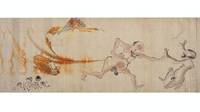
10939Ten vividly rendered scenes. Scroll 265 x 6150 mm. gold-flecked inner front endpaper outside covered with a fine silk floral-patterned brocade fabric. Japan: mid-Edo.<br /> <BR> <BR> Flatulence humor has a long history in Japan: he-gassen å±åˆæˆ¦ “fart competitions†or hÅhi-gassen 放å±åˆæˆ¦ “fart fights†have been depicted in the country’s art since the Heian era 794-1185. Our scroll contains ten explicit scenes:<br /> <BR> <BR> 1. Before the competition naked men drink cold water to induce flatulence.<br /> <BR> <BR> 2. The competition begins with naked rather well-endowed men frolicking farting with such force that a heavy game table is knocked over.<br /> <BR> <BR> 3. One man is farting on another who is defending himself with a fan.<br /> <BR> <BR> 4. Three men are farting with serious intent.<br /> <BR> <BR> 5. Seven men are farting at each other one of whom is defending himself with a makeshift shield. Another is retching. One competitor has gathered his gas in a bag and is carrying it to the action. Another man is enjoying the power of a competitor’s wind as he is being blown into the air.<br /> <BR> <BR> 6. One man is farting and his opponent is ducking away from the wind.<br /> <BR> <BR> 7. A man is farting and has knocked down his opponent by the wind’s force.<br /> <BR> <BR> 8. Six men are competing with uncertain results.<br /> <BR> <BR> 9. One man is defending himself with a fan and an onlooker is entertained by the activities.<br /> <BR> <BR> 10. The final scene depicts five men at the conclusion of the competition sitting peacefully sipping a liquid porridge and eating raw chestnuts.<br /> <BR> <BR> At the end we find text stating this was created in the mid-Edo period and was the property of the Fukuda family of Awa province today’s Tokushima Prefecture. Beforehand it had been owned by Inokuma Nobuo shrine master of Shirotori jinja in Shashu province today’s Kagawa Prefecture. With one seal of the Fukuda family and another that we cannot identify.<br /> <BR> <BR> In fine condition carefully rebacked with some mending. unknown
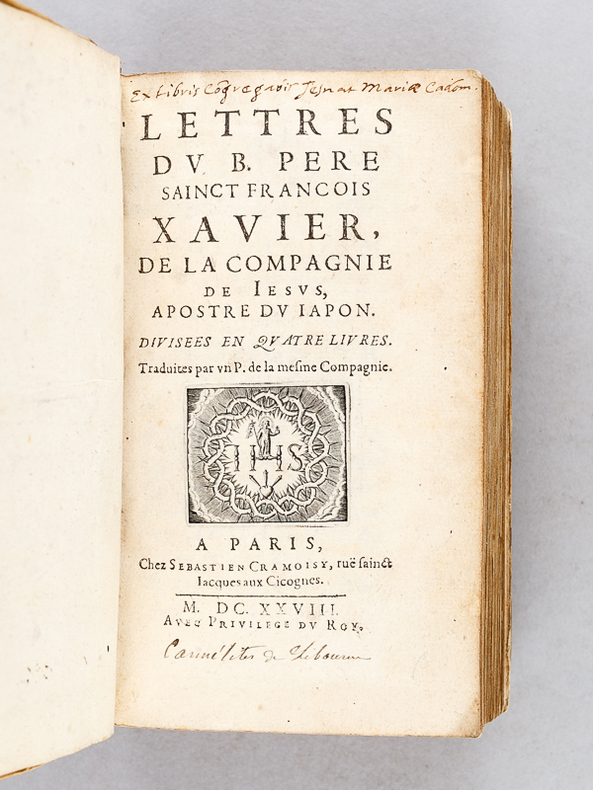
162855012Traduites par un P. de la mesme Compagnie, 1 vol. fort in-8 reliure de l'époque plein vélin blanc à lacets, Chez Sebastien Cramoisy, Paris, 1628, 20 ff., 907 pp., 11 ff. n. ch.. Rappel du titre complet : Lettres du B. Père Sainct François Xavier, de la Compagnie de Iesus, Apostre du Iapon [ Lettres du B. Père Saint François Xavier de la Compagnie de Jésus, Apostre du Japon ] [ Edition originale de la traduction française - First edition of the french translation]
189733852ABBoston, Millet, 1897. Folio. 382pp. With 10 coloured flower collotypes by K. Ogawa, 30 coloured albumen photographs by K. Tamamura and numerous photogr. text-illustrations. Orig. coloured patterned cloth bindings with paper label to front cover.
19952110502151001996Gakuseisha 1995. Soft Cover. Fine. Number of books: 73 boxes 76 books Gakuseisha paperback
19902091202133206396Kuresushuppan 1990. Soft Cover. Fine. Number of books: 9 books in total Kuresushuppan paperback
1897186729Tokyo: 1897. The dress of the classical Japanese nobility An attractive manuscript copy of this rare treatise on Heian-period ceremonial attire. Only one other copy is known held by the National Archives of Japan. The copyist Ishimoto Shuen was an artist-historian whose research focused on ancient clothing. She was named as one of the most accomplished artists in Tokyo by a 1916 broadside. Shozoku shokushikimoku otherwise known as Shozoku imon or in the case of the other known copy Kinpi shozoku imon introduces over 40 examples of different types of clothing worn throughout Japanese history and manuscript captions explain their features. The clothing ranges from kanmuri headwear to ceremonial leather belts sekitai swords fans and ritual omigoromo robes. Different examples of each are given depending on the season and the rank of the person who was permitted to wear certain colours and designs. According to the colophon the text was first found in the collection of Ise Sadatake 1718-1784 a samurai and notable historian of court etiquette. A copy was made in 1772 then another in 1856 and finally this example in 1897. Ishimoto Shuen was the protégé of the famous academic and Shinto scholar Kosugi Sugimura. The pair produced a number of books and hanging scrolls depicting Heian-period and earlier court dress especially in the late 1890s. Ishimoto's ownership signatures and seal are on the first and final pages. The illustrations in this copy are in a slightly different layout to the other surviving example although the colours are more vivid. Quarto 264 x 190 mm with 26 leaves of mica-infused paper. Manuscript text and watercolour illustrations throughout. Original blue paper wrappers renewed white thread fukuro-toji binding. A little rubbed and creased wrappers with scattered patches of discolouration contents bright with very minor wormholing: a very good example. hardcover
2081402109400016West Japan Cultural Association N.A. Soft Cover. Fine. Number of pages: 66 books Size: 22-38cm Number of books: 66 books West Japan Cultural Association paperback
188015604ABJapan, ca. 1880. 25 : 260 cm 9 scenes on paper mounted on paper scroll. Cloth binding.
192918203[Paris, Coulouma et Vernant], 1929 ; 2 tomes in-8 carré, brochés, chemise-étui, pièce de titre (emboîtage moderne) ; 46 gravures libres au burin, coloriées de Jean Dulac, y compris les deux couvertures rempliées.
188641442Tokyo, , 1886. 20 planches.BIGOT (Georges Ferdinand). Le Jour de l'an au Japon par G. Bigot. S.l.n.d. 11 planches.2 suites en 1 album in-folio (477 x 335 mm) cousu à la japonaise.
1936015728Paris EDITION ORIGINALE. Tirage à 1012 exemplaires numérotés. Un des 35 sur Hollande van Gelder mis dans le commerce, second papier après vingt-cinq Japon . Bel exemplaire relié à l'époque : demi-maroquin noir à coins et filets or, dos à nerfs et pièce de titre rouge et lettre or, tête dorée, couverture et dos conservés. 1936 fort in-8 Broché Edition originale
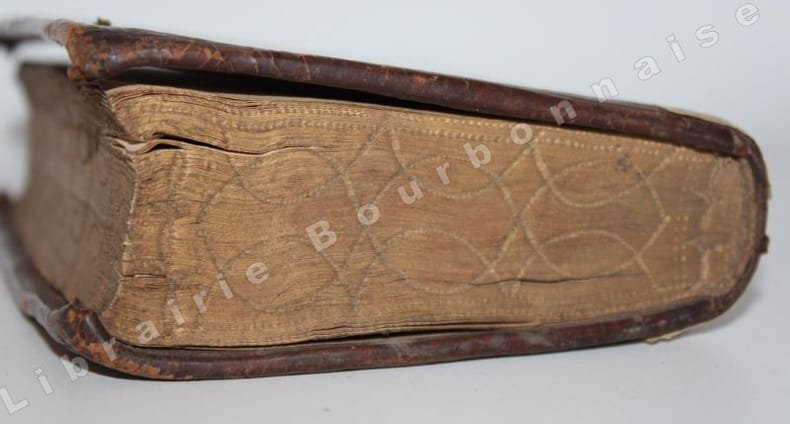
13014[Venise], s.n., s.d. ; [1588] ; in-16. 461 pp.-12 ff. (table). Plein veau brun, dos à nerfs fleurons à froid entre les nerfs, encadrement de filets et roulette à froid sur les plats avec fleurons aux angles et un fleuron doré au centre ors effacés). Tranches dorées guillochées. Trous de vers aux coins inf. Pâles mouillures. Étiquette papier ancienne sur le dos avec titre manuscrit. Reliure de la fin du XVIe siècle.
1294-Co.J. Farblithographie, 1900, auf cremefarbenem Japan, mit Stempel der Druckerei Koshiba Tokyo, mit Bleistift signiert ?Orlik?. Darstellungsgröße 24,1:11,9 cm, Blattgröße 31,9:23,4 cm. Blatt 6 der Mappe ?Aus Japan?. Literatur: Ausst. Emil Orlik. Kaiser-Wilhelm-Museum, Krefeld, 1901, 146; Ausst. Emil Orlik zum 50. Todestag am 28. Sept. 1982. Museum der Stadt Bad Hersfeld, 1982, 35; Galerie Glöckner, Köln, 1980, 89; Galerie Glöckner, Köln, 2007, 89; S. Balemi, Reisephotographie in Ostasien und europäische Reisebilder in Wissenschaft, Kunst und Alltag von ca. 1860 bis 1914/18. Locarno, 2003, Abb. 52; Setsuko Kuwabara, Emil Orlik und Japan. Frankfurt/Main, 1987, L-6; E. Otto (hrsg.), Emil Orlik Leben und Werk 1870-1932. Prag, Wien, Berlin, Wien, München, 1997, S. 129; O. Rychlik, Emil Orlik. Prag Wien Berlin. Ausst. im Jüdischen Muse-um Wien, Wien 1997, IV/37; Emil Orlik. Sein graphisches Werk. Kunsthandlung Voigtländer-Tetzner, Frankfurt/Main, 1910, 202; Wie ein Traum! Emil Orlik in Japan, hrsg. P. Voss-Andreae, o. J., 25, Abb. S. 79.
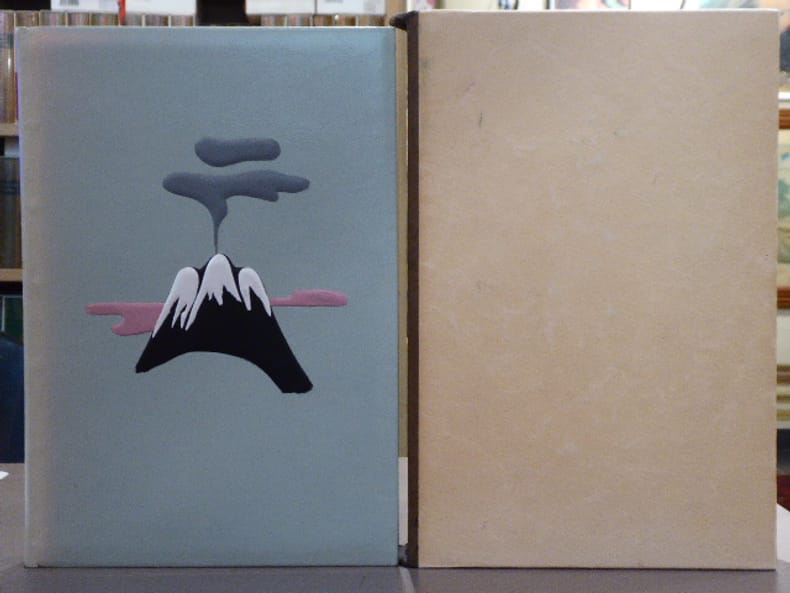
649866Gallimard NRF Paris 1927 In-4 ( 285 X 195 mm ) de 223 pages, plein chagrin vert tendre, dos lisse orné de filets dorés et noirs, volcan mosaïqué en noir, gris blanc et rose ( Mont Fuji ) au centre des plats, tête dorée, couvertures et dos conservés, étui bordé ( Reliure signée de Michel MARTIN-BRES ). Edition illustrée de 29 gravures à l'eau-forte en couleurs de FOUJITA. Un des 20 exemplaires tirés sur Japon Impérial ( N°IV ). Carteret, IV, 332 : "Édition recherchée et très cotée." Dos éclairci, livre en parfait état.
15757Tokyo, Internal Shuppan, 1978. In-plano, 11 pl., une page de titre et une plaquette de présentation de (12) pp., le tout sous boîtier de toile noir, titre sur large vignette rouge contrecollée.
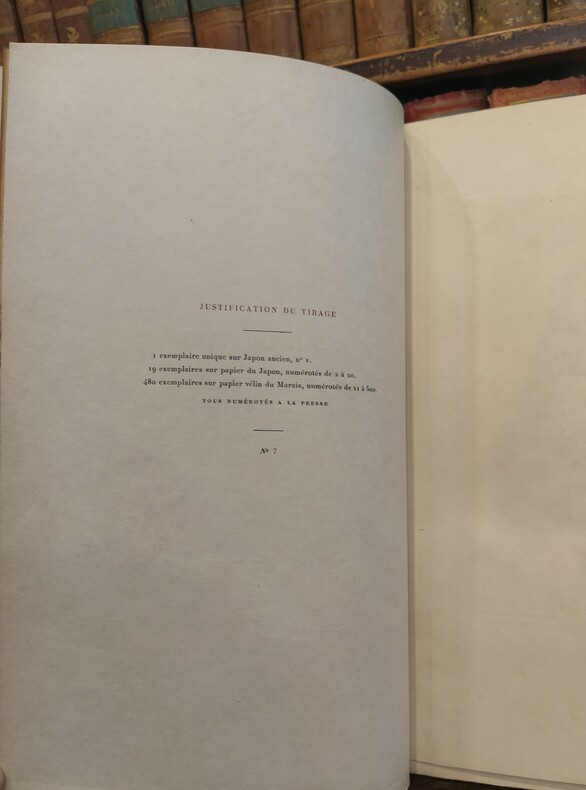
19083406Paris, A. Blaizot, 1908. In-4 (29 x 20 cm), bradel demi-maroquin à coins, dos lisse, tête dorée, non rogné, couverture et dos conservés (reliure signée Kauffmann-Horclois). Edition originale posthume, illustrée d'un portrait de J. Barbey d'Aurévilly gravé à l'eau-forte par Noyon, d'après une photographie. Soixante-deux reproductions en fac-simile de dédicaces autographes. Tirage limité à 500 exemplaires numérotés, celui-ci un des 19 sur papier Japon, N°7, avec le portrait en deux états. Bel exemplaire. Quelques rousseurs sur la couverture.
Amsterdam, Herman Uttwerf, 1758, 3 tomos, 17,5 x 10,5 cm., plena piel de época, lomos cuajados, frontis grabado + 2 h. + LXX págs. + 1 h. + 312 págs. = 4 h. + 416 págs. = 3 h. + 379 págs. + 8 h. y un total de 13 mapas grabados plegados. (Durante más de un siglo la obra de Kaempfer fue la principal fuente de conocimiento occidental de Japón, zarpó en mayo de 1690 como médico de una embajada holandesa en Japón donde permaneció dos años visitando Tokio, Nagasaki, único puerto japonés abierto a los extranjeros, Kokura, Osaka, Kyoto y la corte real en Jedo. Su obra es un relato de la historia japonesa, sus viajes, el estado político de Japón y el estado del comercio holandés allí. Contiene dos apéndices que tratan del té japonés, fabricación de papel & c.). [Contemporary mottled calf gilt. With half-titles, frontispiece & 13 folding engraved maps. Ex-Libris of Mr Maynon de Farcheville. For more than a century Kaempfer's work was the chief source of western knowledge of Japan. Kaempfer set sail in May 1690 as physician to a Dutch embassy to Japan. He stayed for two years, visiting Tokyo, Nagasaki - the only Japanese port open to foreigners - Kokura, Osaka, Kyoto and the royal court at Jedo. His work is an account of Japanese history, his travels, the political state of Japan and the state of Dutch trade there. The two appendices deal with Japanese tea, paper manufacture &c. and with a voyage made to Japan by the English in 1673. Sir Hans Sloane acquired Kaempfer's manuscripts on his death and saw to their translation. Kaempfer's The History of Japan was first published, in English, in 1727-1728].