[JAPAN] CRASSET, JeanBiblio.com
24 760 résultats
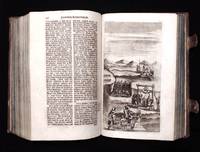
1738018990Augsburg: Franz Antoni Alger 1738. First Edition. Hardcover. Nineteenth century signature to front fly leaf and early signature to title some very light staining in various places throughout mostly only visible in margins; expected soiling to binding. A clean and attractive Near Fine example. Quarto 8-1/2" x 12-1/2" with two parts bound together in contemporary blind-stamped pigskin over wooden boards clasps lacking but catches present title on spine label stamped in blind; 24 534 2 559 1 pages. Title in red and black engraved head- and tail-pieces and initials. Illustrated with 9 engraved plates. The First German Edition of this history of the Jesuit Mission in Japan. While Christianity in Japan flourished for a brief period in the mid 1500s the religion was banned in 1620 and existed only underground. The Catholic church took some exception to Crasset's work saying that he "attributed the origin of the persecution of 1597 to the imprudence of the friars in making their religious ceremonies too public" Catholic Encyclopedia IV 468. <br/><br/> Franz Antoni Alger hardcover
19572110502150901164Not Available 1957. Soft Cover. Fine. Number of books: 102 Not Available paperback
168010841Amsterdam Jacob de Meurs 1680 -in-folio plein-veau 2 parties reliées en un volume, reliure plein veau havane (binding full calfskin) in-folio (359 x 240mm), dos à nerfs (spine with raised bands) décoré or (gilt decoration) filets or (gilt line) et filets à froid (blind-stamping line decoration), entre-nerfs à compartiments or à fleuron central dans un encadrement d'un filet or et un filet perlé or avec rinceaux aux angles, titre frappé or (gilt title), pièce de titre sur fond rouge-foncé (label of title) avec filet or (label of title with gilt line), coiffes anciennement restaurées mais proprement (head and tail of the spine restored), dos frotté avec manques de dorure, plats décorés à froid (cover blind-stamping) d'un double filet à froid en encadrement, angles et charnières anciennement restaurées (corners and joints renovated), toutes tranches lisses (all edges smoothes), orné d'un Titre frontispice gravé (with 1 engraved frontispiece) papier restauré en marge + une gravure en bas de la page de titre + 25 gravures hors-texte (full page engraving) en noir sur 26 (manque la gravure page 222/223 "le temple de Dayro" dont j'ai mis une photocopie à la place) et 70 gravures in-texte en noir + lettrines et fronts de chapitres gravés sur bois en noir (engraved initials and head-pieces), la gravure : "Le Chateau d'Osacca" qui devait se trouver initialement page 220/221 à été reliée page 120/121 avec la gravure du "palais de Dayro à Miaco", autre erreur : le relieur à inséré la gravure : " Entrée des Ambassadeurs à Mia" page 138/139 alors qu'il aurait du la placer page 138/139 de la 2ème partie ou c'était sa place, présence d'une tache brune claire n'empéchant a aucun moment la compréhension du texte de la page 63 à la page 70 sur une surface de 3 centimètres carrés environ, réparation ancienne du bas de la page 79/80 une partie du texte de la page 80 est manuscrit à l'encre brune, quelques reparations anciennes en bas de page n'atteignant pas le texte ou au dos de certaines gravures mais n'atteignant jamais la gravure, très rares et légères rousseurs (rares and lights redness marks), (4 p. de préface + 227 + 8 pages de tables + un page blanche) + (146 + 6 pages de tables) Pages avec Approbation & Privilège du Roy, 1680 Amsterdam Jacob de Meurs Editeur,
1880132599Sn (Yokohama) 1880 In-4 à l’italienne 36 x 27 cm. 50 photographies 26,5 x 20 cm. contrecollées en 25 planches, serpentes. Marges brunnie. Des accrocs de motifs laqués au premier plat.
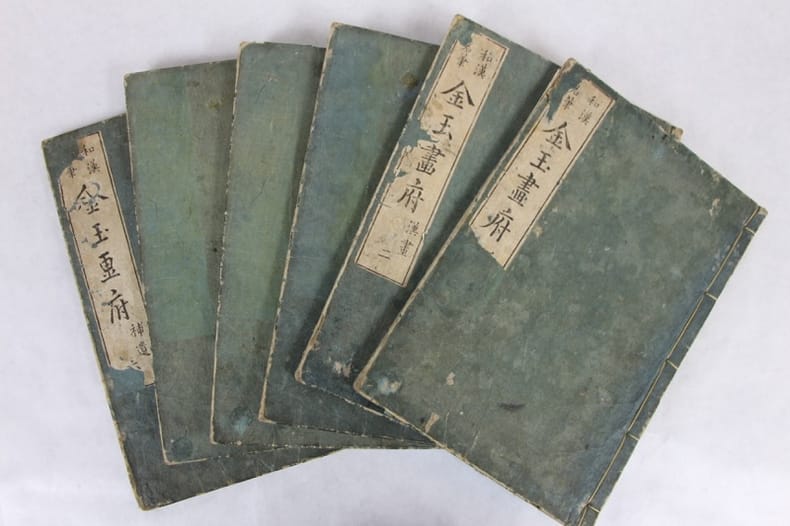
1770135640Hosaki Jogwanken 1770 6 volumes 26,5 x 18,5, Reliure japonaise d’origine, étiquettes d’origine petits manques pour 3 volumes, 236 pp. de gravures en noir. Légère humidité éparse, plus marquée pour un volume. Quelques attaques de vers.. Manque le 21ème feuillet du premier volume. Au 6ème volume, un frontispice avec le titre Jimbutsu no Bu. Gwafu Hoï, supplément de Gafu, puis quelques pages d’introduction non signée.
48 vol. reliures diverses en demi-percaline bordeaux ou marron ou demi-toile rouge, (Messager de la Société de Marie, Apôtre de Marie, Marianiste et Présence Marianiste), couvertures conservées, Institut Sainte Marie, Nivelles, puis Paris et Colmar, 1904-1987 ; Le Messager de la Société de Marie [1897-1902 : 3 Tomes - Complet Suivi de :] L'Apôtre de Marie. Echo des Oeuvres et des Missions de la Société de Marie (Série suivie complète du n° 1 de Mai-Juin 1904 au dernier numéro n° 398 de Août-Octobre 1958 puis série suivi complète de "Marianistes", Nouvelle série de l'Apôtre de Marie, du n°1 de Novembre 1958-janvier 1959 au dernier numéro n° 54-55 d'août-décembre 1969, puis série complète de "Présence marianiste" du n° 1 de janvier-février 1970 au n°52 de numéro de Juillet-Septembre 1987, en 45 volumes reliés ) [ Exceptionnel ensemble, souvent illustré, relatant les progrès des missions marianistes en Europe, Amérique, Afrique, et surtout au Japon - Important and scarce review referring to Marianist missions in the entire world, with focus on american or japanese missions in Urakami, Tokyo, etc. ] La Revue "l'Apôtre de Marie", qui fait suite aux 3 tomes de la revue "Le Messager de la Société de Marie", laquelle fut interrompue par les expulsions de 1903, se consacre plus particulièrement à la présentation de l'oeuvre missionnaire des marianistes. "Echo des Oeuvres et des Missions de la Société de Marie" puis "Organes des Missions et des Oeuvres", elle propose un panorama tout à fait remarquable et passionnant des développements de ces missions dans le monde entier : par exemple au Mexique (Durango...), en Europe (Autriche, Espagne, Belgique, Italie, Suisse...), avec une prédilection pour l'Amérique et l'Asie. On remarque ainsi les nombreux articles consacrés aux missions d'Asie, celles de Chine et surtout aux missions du Japon (Urakami, Tokyo, ...) ainsi qu'aux missions développées aux Etats-Unis (Dayton, Cleveland, Colombus, Erie, Chicago, Honolulu aux Iles Sandwich futur Hawaï, etc.). Les comptes-rendus de mission, ou les visites pastorales des supérieurs en Asie ou en Amérique sont souvent illustrés et font l'objet d'articles du plus grand intérêt. La revue devient "Marianiste" de 1959 à 1969 puis "Présence Marianiste" à partir de 1970. Etat très satisfaisant (dos frottés et qq. petits accrocs sur certains dos n'affectant pas le texte, anciens cachets et cotes de bibliothèques religieuse en dos) pour cet ensemble très rare, rassemblant l'intégralité de cette impressionnante série suivie des numéros du "Messager de la Société de Marie" et de la revue 'l'Apôtre de Marie" de 1897 à 1987. Français
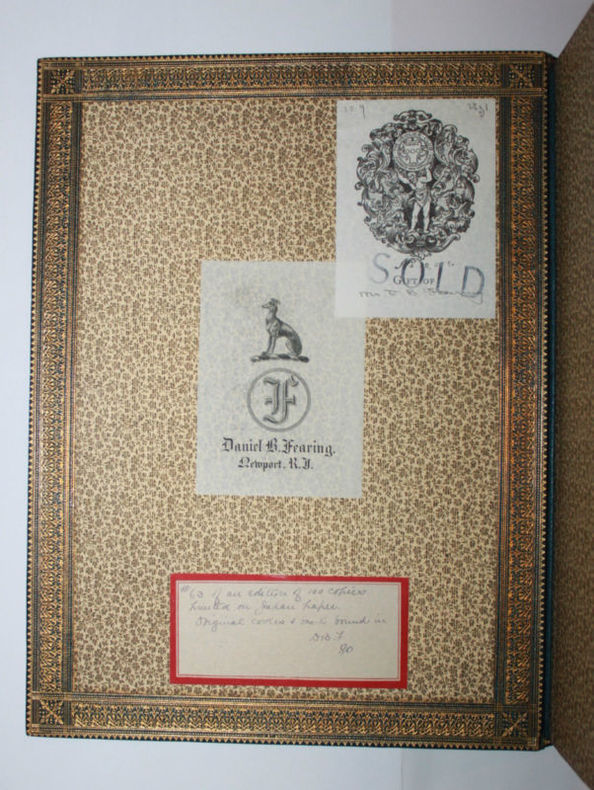
1888AMO-890Illustrations en couleurs d'après Paul Avril. Paris, Maison Quantin, 1888 [achevé d'imprimer le 7 novembre 1887]. 1 volume grand in-8 (30 x 23 cm), IV-163-(2) pages. Illustrations en couleurs courant dans le texte. Tirage en bleu, noir, rouge, rose, violet, or, argent, cuivre, etc. Reliure de l'époque plein maroquin bleu-vert sombre janséniste, dentelle dorée en encadrement intérieur des plats, tête dorée, relié sur brochure, non rogné, couvertures conservées, doublure et gardes de papier fleuri noir et or (reliure américaine signée BRADSTREET'S). Maroquin assombri sur le pourtour sinon très bel exemplaire. Quelques légères épidermures atténuées, sans conséquence. ÉDITION ORIGINALE. EXEMPLAIRE SIGNÉ AUTOGRAPHE PAR OCTAVE UZANNE. Tirage à 2.200 exemplaires numérotés dont 2.000 exemplaires sur vélin de Hollande, 100 exemplaires sur grand papier du Japon et 100 exemplaires sur Japon du format du volume. CELUI-CI, UN DES 100 EXEMPLAIRES DE TÊTE SUR GRAND PAPIER DU JAPON. Provenance : De la bibliothèque du bibliophile américain Daniel B. Fearing. Don de Daniel B. Fearing au Grolier Club de New-York (ex libris). Vendu ensuite par le Grolier Club (cachet). Collection Bertrand Hugonnard-Roche (avec monogramme autographe BHR, 2010).
0818-Co.J. Kaltnadelradierung mit Aquatinta, ca. 1901/02, auf Van Gelder Zonen-Bütten, rechts unten signiert ?Orlik?. 23,9 x 16 cm, Blattgröße 32,6 x 26,5 cm.- Prachtvoller Druck mit breitem Rand. Literatur: Eugen Otto, Emil Orlik Leben und Werk 1870-1932 Prag Wien Berlin, Verlag Christian Brandstätter, S. 137 mit Abb.; Glöckner 1992, 105.
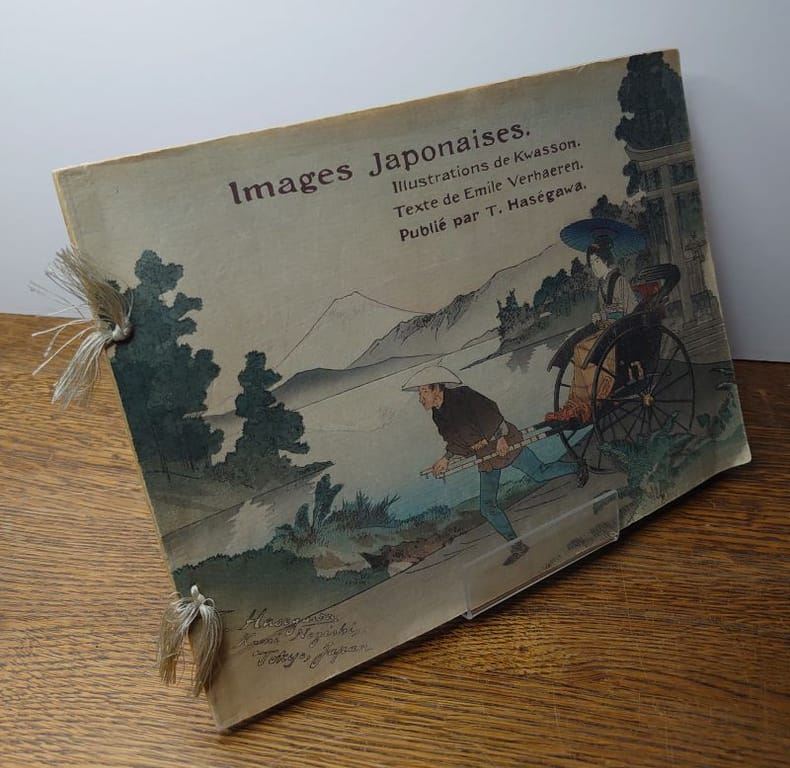
8186Tokyo, Japan, T[akejiro] Haségawa. [l'éditeur Hasegawa a déménagé à l'adresse de Tokyo indiquée sur la couverture (Kami Negishi) vers 1911. Cette impression date donc d'après 1911 (même si le colophon japonais indique la date de 1896 et l'ancienne adresse de Tokyo, 10 Hiyoshicho). Hasegawa a probablement réutilisé les blocs de bois du colophon pour faire des économies.]. Réf : Frédéric A. Sharf, Takejiro Hasegawa Meiji Japan's Preeminent Publisher of Wood-block-illustrated Crepe-paper Books, 1974, voir page 77. 27,5 x 20,5 cm. In-8° oblong. Broché, couture japonaise. Réédition de 6 poèmes de Verhaeren (l'originale est de 1896). Bel ouvrage japonisant dont les poèmes sont imprimés sur fond d'estampes dues à Kwasson, pseudonyme de Munetaro [ou Sôtaro] Suzuki. Au nombre de 14, elles couvrent chacune 2 ff. pliés à la japonaise doublés d'un f. de papier vergé, en plus des deux estampes illustrant les plats de couverture. Les exemplaires présentent de légères variantes de couleurs ou technique (quelques-uns sont parfois partiellement gaufrés comme le notre), résultat du procédé artisanal employé. Petites déchirures à la pliure du premier et dernier feuillet.
8186Tokyo, Japan, T[akejiro] Haségawa. [l'éditeur Hasegawa a déménagé à l'adresse de Tokyo indiquée sur la couverture (Kami Negishi) vers 1911. Cette impression date donc d'après 1911 (même si le colophon japonais indique la date de 1896 et l'ancienne adresse de Tokyo, 10 Hiyoshicho). Hasegawa a probablement réutilisé les blocs de bois du colophon pour faire des économies.]. Réf : Frédéric A. Sharf, Takejiro Hasegawa Meiji Japan's Preeminent Publisher of Wood-block-illustrated Crepe-paper Books, 1974, voir page 77. 27,5 x 20,5 cm. In-8° oblong. Broché, couture japonaise. Réédition de 6 poèmes de Verhaeren (l'originale est de 1896). Bel ouvrage japonisant dont les poèmes sont imprimés sur fond d'estampes dues à Kwasson, pseudonyme de Munetaro [ou Sôtaro] Suzuki. Au nombre de 14, elles couvrent chacune 2 ff. pliés à la japonaise doublés d'un f. de papier vergé, en plus des deux estampes illustrant les plats de couverture. Les exemplaires présentent de légères variantes de couleurs ou technique (quelques-uns sont parfois partiellement gaufrés comme le notre), résultat du procédé artisanal employé. Petites déchirures à la pliure du premier et dernier feuillet.
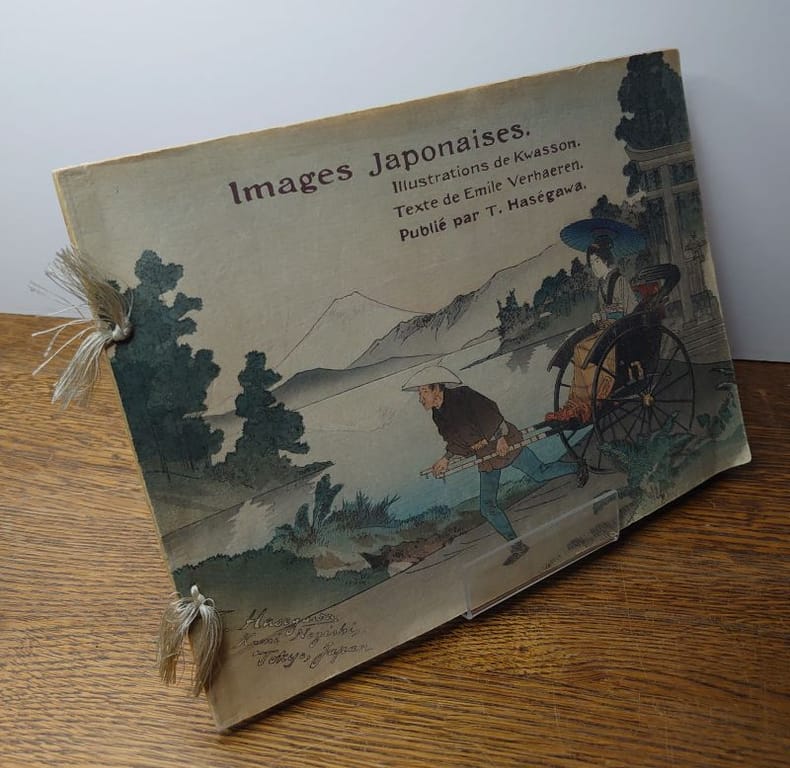
8590Tokyo, Japan, T[akejiro] Haségawa. [l'éditeur Hasegawa a déménagé à l'adresse de Tokyo indiquée sur la couverture (Kami Negishi) vers 1911. Cette impression date donc d'après 1911 (même si le colophon japonais indique la date de 1896 et l'ancienne adresse de Tokyo, 10 Hiyoshicho). Hasegawa a probablement réutilisé les blocs de bois du colophon pour faire des économies.]. Réf : Frédéric A. Sharf, Takejiro Hasegawa Meiji Japan's Preeminent Publisher of Wood-block-illustrated Crepe-paper Books, 1974, voir page 77. 27,5 x 20,5 cm. In-8° oblong. Broché, couture japonaise. Réédition de 6 poèmes de Verhaeren (l'originale est de 1896). Bel ouvrage japonisant dont les poèmes sont imprimés sur fond d'estampes dues à Kwasson, pseudonyme de Munetaro [ou Sôtaro] Suzuki. Au nombre de 14, elles couvrent chacune 2 ff. pliés à la japonaise doublés d'un f. de papier vergé, en plus des deux estampes illustrant les plats de couverture. Les exemplaires présentent de légères variantes de couleurs ou technique (quelques-uns sont parfois partiellement gaufrés comme le notre), résultat du procédé artisanal employé. Petites déchirures à la pliure du premier et dernier feuillet.
8590Tokyo, Japan, T[akejiro] Haségawa. [l'éditeur Hasegawa a déménagé à l'adresse de Tokyo indiquée sur la couverture (Kami Negishi) vers 1911. Cette impression date donc d'après 1911 (même si le colophon japonais indique la date de 1896 et l'ancienne adresse de Tokyo, 10 Hiyoshicho). Hasegawa a probablement réutilisé les blocs de bois du colophon pour faire des économies.]. Réf : Frédéric A. Sharf, Takejiro Hasegawa Meiji Japan's Preeminent Publisher of Wood-block-illustrated Crepe-paper Books, 1974, voir page 77. 27,5 x 20,5 cm. In-8° oblong. Broché, couture japonaise. Réédition de 6 poèmes de Verhaeren (l'originale est de 1896). Bel ouvrage japonisant dont les poèmes sont imprimés sur fond d'estampes dues à Kwasson, pseudonyme de Munetaro [ou Sôtaro] Suzuki. Au nombre de 14, elles couvrent chacune 2 ff. pliés à la japonaise doublés d'un f. de papier vergé, en plus des deux estampes illustrant les plats de couverture. Les exemplaires présentent de légères variantes de couleurs ou technique (quelques-uns sont parfois partiellement gaufrés comme le notre), résultat du procédé artisanal employé. Petites déchirures à la pliure du premier et dernier feuillet.
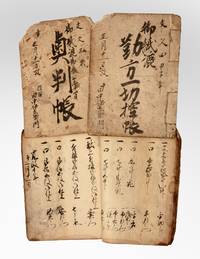
1094998 folding leaves. Small 4to 283 x 205 mm. orig. wrappers orig. stitching with two other documents described below. N.p.: 1852-67.<br /> <BR> <BR> In the 19th century papermaking mills in villages were common throughout Japan. This manuscript a copy kept by the mill owner Tanaka Izaemon records the business activities in 1864 of his papermaking activities. We have been unable to determine where he operated but we find in the two accompanying documents the village names Shiraki ç™½æœ¨æ‘ Yamanaka å±±ä¸æ‘ and Tateyama ç«‹å±±æ‘ all rather common place names. This manuscript provides the names of the employees their lengths of employment monetary and tax matters etc.<br /> <BR> <BR> The second manuscript 22 folding leaves 284 x 206 mm. is entitled on upper wrapper “1863. On kami suki on hÅkÅ baibai. Okuhan chÅ. ShÅgatsu JÅ«ichi nichi aratame. Tanaka Izaemon†文久三年. 御紙漉御奉公売買. 奥判帳. æ£æœˆå一日改. ç”°ä¸ä¼Šå·¦è¡›é–€ “1863. Papermaking. Wages for Employees. Review. Tanaka Izaemonâ€.<br /> <BR> <BR> The third manuscript 45 folding leaves 281 x 22o mm. has no title but is concerned with the sale of papermaking permits from one owner to another details of ownership official forms and contracts hÅkÅnin ukejÅ with employees wages living provisions etc.<br /> <BR> <BR> In very good condition. Each manuscript has suffered from hungry mice “horse bites†in Japanese but the texts are very largely untouched. unknown
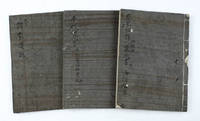
1573393 manuscript volumes neatly written in black and red ink. Original wrappers with later string ties. Wrappers damaged with a little loss in places. Some worming. Still overall very good. 19 x 13.5cm. These three volumes are a collection of manuscripts written in the late Edo period probably the 1860s. Most of the original documents on which the manuscripts were based were written shortly after the arrival of the American delegation led by Commodore Matthew Perry in July 8 1853 June 3 in Japanese calendar. These documents written in the face of this national crisis were mostly driven by the patriotic fervour of the authors. They show a variety of thoughts about the threat from the foreign powers. None of these were published at the time and only Watanabe Kazan’s Shinki-ron was published in modern times. <br> <br>Kazan wrote his treatise inspired not by the arrival of Perry but by the Edo government’s hostile treatment of the American merchant ship Morrison in 1837. <br> <br>Titles and short synopses of these works follow: <br> <br>Volume 1: Chiyoda mondō Questions and Answers in Chiyoda 千代田問答 1853; Momijiyama shinrei-ki紅葉山神靈記 Message from the Holy Spirit in Momijiyama <br> <br>The author of Chiyoda mondō is unknown. The word "Chiyoda" in Chiyoda mondō is the name of the area where the Edo Castle sat and refers to the god in the Tōshōgū Shrine in Momijiyama next to the western part of the Edo Castle. This document is difficult to read but it appears to explain how a group of mysterious people or possibly divine spirits tell stories related to Japan's national affairs in 1853 discussing the country's national defence against foreigners and the situation regarding Christianity. <br> <br>In Momijiyama shinrei-ki the anonymous author who was an attendant to the group of the high government officials visiting the Tōshōgū Shrine in Momijiyama fell asleep and in his dream a Holy Spirit appeared and told him the necessity of enhancing the coastal defence in the face of the American expansion. <br> <br>Volume 2: Daimyō shoka kengi 大名諸家建議 Proposals from War Lords and Various People <br> <br>This manuscript is a collection of proposals and opinions expressed by Daimyō war lords and the retainers of the Edo government on the subject of Japan's foreign policy after the arrival of the American delegation led by Commodore Perry which requested trade with Japan. The Daimyō discuss how to deal with the crisis in terms of such issues as trade and coastal defence. Some even proposed possible war with the American fleet. The daimyo some of whom were high-rank officials of the Edo government included Shimadu Nariakira島津斉彬 1809-58 Maeda Nariyasu 前田斉泰 1811-84 Matsudaira Shungaku 松平春嶽 1928-90 Tokugawa Yoshinobu 徳川慶喜 1837-1913 Ii Naosuke 井伊直弼 1815-60 Nabeshima Naomasa 鍋島直正 1815-71 and the retainers included Inoue Saburōemon 井上三郎右衛門 - and Katsu Rinsuke 勝麟助 1823-99. Katsu became a capable mediator when the Edo castle was surrendered peacefully to the new Meiji government in 1868. <br> <br>Volume 3: 海防備言 Kaibō bigen Words on Coastal Defence. Habu Kumagorō 土生熊五郎- Rifujutsui 嫠不恤緯 Widow Does Not Worry the Shortage of Weft the latter a Chinese expression referring to strong patriotism; Watanabe Kazan 渡辺崋山 1793-1841 Shinki-ron愼機論 Essay on Attention to an Opportunity 1838; Hakura Morochika羽倉用九 1790-1862 Gakaisho 畫灰書 Drawing in Ash and Gasuisho畫水書 Drawing in Water 1854; Fujimori Kōan 藤森弘庵 1799-1862 Kaibō biron 海防 備論Treatise on Coastal Defence 1853 <br> <br>Habu Kumagorō was a Confucian scholar in Wakayama. He proposed the developing the land of Ezo 蝦夷 Hokkaido. Rifujutsui discusses such topics as the advance of the Russians to Siberia and the necessity of developing Hokkaido as well as the art of war. <br> <br>Watanabe Kazan was a chief retainer of the Tahara Domain eastern part of present Aichi Prefecture Confucian scholar and also famous as a painter. Shinki-ron criticises the xenophobic foreign policy of the Edo government. <br> <br>Hakura Morochika was a Confucian scholar in Osaka. After the arrival of Perry he discussed the measures against foreign enemies. In Gakaisho a collection of historical essays Hakura objected to trade with America in the form of an answer to the sovereign message from America seeking trade with Japan. He also wrote an answer to the sovereign message from Russia but he was more sympathetic to the Russians because they sought trade through the official channel in Nagasaki while the American delegate in the military fleet came to Uraga in a threatening manner. In Gasuisho also Hakura mentions the harmful effects of Christianity. <br> <br>Fujimori Kōan was a Confucian scholar of the Ono Domain in present Ono City Hyogo Prefecture. In his later life he opened a private school in Edo and wrote the comprehensive treatise on Japanese coastal defence Kaibō biron after the arrival of Perry. . unknown
20042092902141400200Yoshikawakobunkan 2004. Soft Cover. Fine. Number of books: 54 Yoshikawakobunkan paperback
20132080502106917736Not Available 2013. Soft Cover. Fine. The book is in fine condition. Not Available paperback
178223766Nürnberg, Christoph Weigel und Schneider, 1782. Nach der 1773 in Lemgo im Nachlaß der Brudertochter gefundenen Handschrift. Vorliegende überarbeitete, gekürzte und ergänzte Ausgabe beruht auf der von Dohm herausgegebenen Ausgabe: Engelbert Kaempfers Geschichte und Beschreibung von Japan, Lemgo, 1777 und 1779. Die Ergänzungen beruhen auf den in Breslau herausgekommenen kritischen und philosophischen Bemerkungen über Japan und die Japaner. Mit 7 ausklappbaren Kupferkarten. 8°, ca. 19,2 x 11,4 cm, 7 Bl., 350 S., 1 Bl. Verlagsanzeige, roter Farbschnitt, Original-Halblederband. Inhalt: Vorrede / Anzeige und Erklärung der Kupfer / Erklärung der vorkommenden japanischen Münze / Reise von Batavia über Siam nach Japan / Geographie, Naturgeschichte und Einwohner von Japan / Politische Verfassung des japanischen Reichs / Von der Religionsverfassung und den verschiedenen Sekten in Japan / Beschreibung von Nangasacki / Vom Handel der Ausländer nach Japan, und besonders von der Verfassung der Holländer / Allgemeine Reisenachrichten von Japan / Erste Reise des Verfassers nach Jedo und wieder zurück / Zweite Hofreise. Tafel I: Schwimmende Dörfer, oder bewohnte Kähne der Siamer / Tafel II: die zwei Höfe des Berklams Tempel / Tafel III: eine Mia oder Sintos Tempel / Tafel IV: der Tempel des Tensjo Daisin zu Isje (nur zur Hälfte erhalten) / Tafel V: Aufzug der Holländischen Gesandschaft / Tafel VI: Prospect vom Schloß, Stadt und Hafen Muru / Tafel VII: der (kaiserliche) Audienzsaal. Die Vorrede dieser Ausgabe ist erweitert - gegenüber der Ausgabe in der Staats- und Stadtbibliothek, Augsburg. Name auf Titelblatt: F. Lichtewitz oder Lichtewick ?. Engelbert Kaempfer (geboren 16. September 1651 in Lemgo; gestorben 2. November 1716 in Lieme) deutscher Arzt und Forschungsreisender. Im Zuge einer fast zehnjährigen Forschungsreise (1683 bis 1693) die ihn schließlich 1690 - 1692 nach Japan führte, sammelte er zahlreiche Kenntnisse zur Geographie, Natur, Gesellschaft, Religion, Politik, Verwaltung sowie den Wissenschaften und Künsten der bereisten Regionen. 1. Auflage dieser Ausgabe. Rücken mit Einriß, Einband berieben und bestoßen, Tafel IV nur zur Hälfte vorhanden, Seiten vereinzelt fleckig, S. 293 mit Tintenfleck, sonst gut erhalten
1916SB-13568Tokyo, Kobunsha, 1916. 15, (546) pp. Green clothbound (original) volume with gold-embossed title along spine and blind-tooled publisher's mark on front. Illustrated endpaper with floral ornamentation. Famous study of Russian Orientalist, Sinologist and scholar of Japanese Studies Otto Julius Rosenberg (1888 - 1919) on a system of classification of Chinese characters. Rosenberg studied from 1906 to 1911 at the Institute of Oriental Studies of the University of St. Petersburg, lectured by, among others, the founder of the Russian school of Indology, Sergei Oldenburg (1863 - 1934). During a study stay in Bonn in 1909, Rosenberg befriended Hermann Jacobi (1850-1937), the greatest Indologist and Sanskrit scholar of that time. As part of an internship at the Department of Oriental Languages (SOS) at the Friedrich-Wilhelms-Universität two years later, he also befriended the German linguist and scholar of Japanese studies, Rudolf Lange (1850 - 1933). From 1912 to 1916 he studied Buddhist Literature and Tradition at the University of Tokyo. Here Rosenberg became acquainted with the then leading Buddhist Scholars of Japan. In the course of this stay, he explored the school of Zen Buddhism as one of the first Western scientists and also became an expert for Japanese and Chinese characters used in the writing of Chinese and Japanese. In 1924, his work "The problems of Buddhist philosophy" was published in German. Based on ideas of Russian Sinologist and Buddhologist Vasily Vasilyev (1818 - 1900), Rosenberg developed a method of classification of Chinese and Japanese characters. He published the results of his research in a dictionary which was published in English and Japanese and which formed the basis of the so-called "Four Corner Method", which is still employed today in the creation of Chinese and Japanese dictionaries. This volume is extremely rare and, according to the world's largest bibliographic database, WorldCat, it is only found in six libraries worldwide. The copy offered here was purchased from a Japanese private collection.
90853aaf13 leaves of Japanese washi paper (every leaf consists of 2 folded leaves) with 14 fullpage woodblock color printed illustrations (of which 6 are double page illustrations), second leaf cut open at the fold, in fine conditions and fresh, original japanese paperbinding, slightly worn.
2080402107100283Not Available N.A. Soft Cover. Fine. Number of books: 20 Not Available paperback
1887687074 8vo vol. (25,4 x 17,7 cm), original japanese fukuro toji bindings under common blue cloth-clad slipcase, Published by Iwamoto Shun, Meiji 20 [ 1887 ], 39, 40, 36, 37 leaves
1904353246Tokyo: K. Ogawa 1904. Illustrated with photos by Ogawa. 177 ff. 1 vols. Oblong folio. Publisher's decorated green silk-covered boards with titles and decorations in gold embroidery fine silk-backed endpapers decorated with gold inner hinges strengthened bound at the spine with cream ribbon in Japanese style. Green calf backed folding box. Illustrated with photos by Ogawa. 177 ff. 1 vols. Oblong folio. K. Ogawa unknown
53661Osaka: Darumaya Shoten Taisho 11 1922. Two vols. 30; 32 pp. With 48 hand-coloured woodblock plates each showing 5 or more coloured masks most w/ identifying numbers and occasional text. Uniformly bound leporello accordion-style in bright orange covers w/ printed title labels in red & black on front covers illustrated endpapers slight shelfwear very slight rubbing to fore-edges w/ original green silk folding case woodblock printed label on front cover preserving 1 of 2 original bone clasps at side some soiling edgewear rubbing to fore-edges NF/VG- set. First edition of this remarkably scarce and stunning catalogue of Japanese Noh theatre masks many offering the titles and origins of the masks. Noh performers carefully choose their masks because traditionally it has been believed that they are more spiritual than merely a prop to change the actor’s appearance. The types of masks represented in these beautifully printed colour woodblock plates -- many highlighted in hand colouring -- encompass the Okina Old man masks the oldest of these types of masks; Jo Elders masks used when the actor is portraying a spirit; Onna-men woman masks which tend to be the most popular and varied with beautiful young woman masks mature and middle-aged women masks and those representing the very old; Otoko-men Men masks; along with the fantastical Kishin Demons and Onryo Ghosts & Spirits masks. The Kishin masks represented here are distinguishable as the long-nosed Tengu goblins as well as the Tobide portraying demons and savages. Noh masks are often considered to be very valuable heirlooms and many have been handed down from generation to generation within the same family or school of performers. Worldcat locates 4 copies 3 complete copies at Cornell National Library of Australia & Waseda Univ. Library; National Diet copy has only vol. I. Darumaya Shoten, unknown
1913141271913 P., L'Edition d'Art H. Piazza, 1913, 1 vol. petit in-4° (237 x 175) relié plein maroquin cerise, dos lisse avec auteur et titre dorés et petite illustration mosaïquée représentant un scarabée, plat supérieur orné dune grande mosaïque dorée, crème et marron représentant une Apsara dansant reprise au plat inférieur, filet noir sur les coupes, tête dorée, doublures et gardes de box gris, encadrement des doublures de maroquin cerise orné de deux jeux de filets dorés avec fleurons en écoinçons, doubles gardes de papier marbré, couverture et dos illustrés conservés, étui bordé, (RENE KIEFFER), de 179 pp. - (3) ff. (table, justificatif et achevé d'imprimer). Dos très légèrement foncé, petit défaut de cuir sur le coin supérieur gauche du plat inférieur et petites taches sur les plats, parfait état par ailleurs dans une somptueuse reliure dart personnalisée de René Kieffer.
20798[Lyon], Aux Editions de l’Arbalète, [25 dessins (nus féminins) à la mine de plomb, reproduits en offset, précédés d’un texte de Marc Barbezat [...] achevé d’imprimer sur la presse à bras de Marc Barbezat le 3 novembre 1943]. Tirage à 505 exemplaires : 5 sur vieux Japon numérotés A à E ; 500 sur vélin blanc numérotés 1 à 500 ; in-4° raisin (334 x 265 mm) en feuillets sous couverture crème rempliée, étui-portefeuille en vélin rigide à dos carré (reliure éditeur) ; [20] pp. non chiffrées et 25 planches.