6 262 résultats
18252452Paris, Anselin et Pochard, 1825. In-8 de VIII-63 pp., 1 tableau replié, demi-chagrin bleu, couverture imprimée et dos conservés (reliure moderne).
Carta geografica raffigurante le legazioni ecclesiastiche della regione, tratta dall’Orbe Cattolico di Girolamo Petri. L'Orbe Cattolico ossia Atlante Geografico Storico Ecclesiastico fu pubblicato a Roma in 3 volumi nel 1858-1859. Le mappe di grande formato sono finemente incise e ben colorate. È senza dubbio una delle opere più finemente incise ed eleganti della metà del XIX secolo. Ogni mappa mostra le varie diocesi, ognuna delle quali è contraddistinta da colori vivaci che ne segnano la sede, e altre città importanti. Sebbene le caratteristiche geografiche siano chiaramente espresse, le mappe sono volutamente piuttosto scarne di dettagli, in modo da non sminuire visivamente il loro scopo, che è quello di mostrare le divisioni ecclesiastiche. Nel creare l'atlante, Petri ha sottolineato di aver attinto solo alle "fonti più attendibili", comprese le mappe degli archivi vaticani e delle diocesi d'oltremare L'atlante fu pubblicato in un numero molto limitato di esemplari ad uso esclusivo dei cardinali e degli amministratori di alto rango, il che ne spiega la grande rarità odierna. Girolamo Petri (1806 - 1871) fu una figura importante nell'amministrazione della Chiesa cattolica romana durante il regno di Pio IX. Nacque a Onano (Viterbo, Lazio), figlio di un funzionario vaticano che in seguito divenne governatore di Frascati. Il lavoro di Petri fu svolto in un periodo in cui la Chiesa era sotto assedio in Europa, ma, al contrario, aveva grandi ambizioni di espansione all'estero, in particolare in Asia e in Africa. La metà del XIX secolo fu un periodo di grandi cambiamenti a Roma. L'atlante faceva senza dubbio parte degli ultimi sforzi del Vaticano per comprendere e controllare la sua vasta influenza in tutto il mondo, resuscitando il concetto popolare di province ecclesiastiche diffuso nelle opere di Nicolas Sanson e altri cartografi del XVII secolo. La Calcografia Nazionale (Istituto per la Grafica) conserva ancora 135 rami di questo rarissimo atlante. Incisione in rame, coloritura coeva, in ottimo stato di conservazione. Bibliografia Walter Goffart, Historical Atlases: The First Three Hundred Years, 1570-1870 (Chicago, 2003), p. 427-8; J.A.B. Jongeneel, Philosophy, Science, and Theology of Mission in the 19th and 20th Centuries: A Missiological Encyclopedia (1995), p. 264. A very rare map showing the dioceses of Catholic organization, taken from L'Orbe Cattolico by Girolamo Petri. L’Orbe Cattolico ossia Atlante Geografico Storico Ecclesiastico’ was published in Rome in 3 volumes in 1858-1859. The large-format maps are finely engraved and beautifully colored. The atlas is a testament to the artistry of the engravers and the relative indifference of the publisher to the commercial success of the work. It is without question one of the most finely engraved and elegant works of the mid-19th Century. Each map shows the various dioceses, which are each distinguished by their own bright colors, marking their seats, as well as other major towns. While key geographical features are expressed throughout, the maps are otherwise intentionally rather sparing of detail, so as not to visually detract from their purpose, which is the show the ecclesiastical divisions. In creating the atlas, Petri noted that he drew only upon the “most trusted sources”, including maps from the Vatican archives and overseas dioceses. The atlas was by far and away the finest ecclesiastical atlas created during the 19th Century, featuring exceptionally beautiful examples of thematic cartography. The uncommonly beautiful atlas was published in only a very small number of examples for the exclusive use of Cardinals and high-ranking administrators, accounting for the great rarity today. Petri who was commissioned by Pope Pius XI thus created during a time when the Church was under siege within Europe, but, conversely, while it had major ambitions for expansion overseas, particularly in Asia and Africa. The mid-19th Century was a period of dramatic change in Rome. The atlas was no doubt part of the Vatican's last-ditch efforts to understand and control its vast influence around the world, resurrecting the popular concept of ecclesiastical provinces popularized in works by Nicholas Sanson and others during the 17th Century. The Calcografia Nazionale still preserves 135 copperplates of this extremely rare atlas. Bibliografia Walter Goffart, Historical Atlases: The First Three Hundred Years, 1570-1870 (Chicago, 2003), p. 427-8; J.A.B. Jongeneel, Philosophy, Science, and Theology of Mission in the 19th and 20th Centuries: A Missiological Encyclopedia (1995), p. 264.
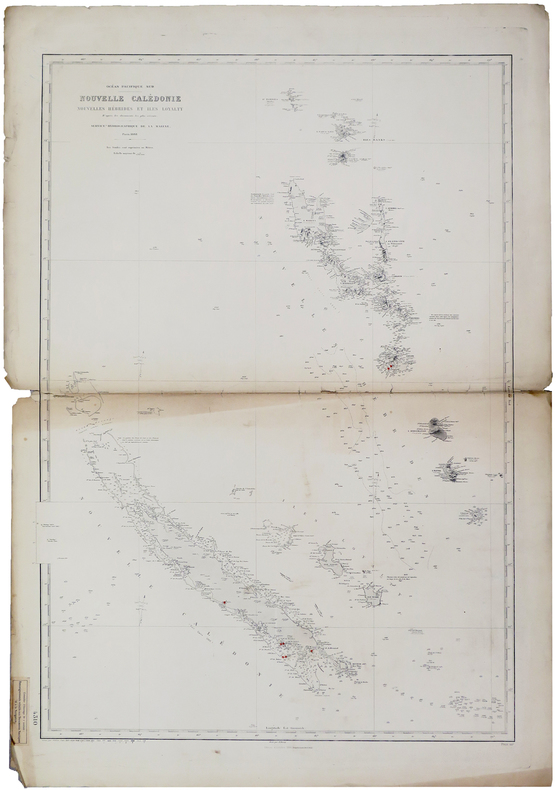
1888LBW-6011Paris, Service Hydrographique de la Marine, 1888-1909. 943 x 654 mm.
298 pages including index. Compiles all available references relevant to the environmental aspect of the Nanaimo River Estuary. Summarizes pertinent information and provides lists on plant and animal life, to provide readers with some idea of the ecological characteristics. Contents include topics such as: Geology; Economic Geology; Surficial Geology; Climatology; Hydrology; Oceanography; Invertebrate Biology; Invertebrate Fisheries Resource; Flora; Wildlife; Land and Water Use; Pollution; plus an extensive Bibliography. Includes a variety of maps. Report of the Estuary Working Group, Department of the Environment, Regional Pacific Region. Clean and unmarked with moderate wear. Binding sound. A wonderful reference. Book
xiv, 403 p. "A record of missionary work among the Indian tribes of the Northern Pacific Coast of our country and of the wonderful transformation in character and conditions which the introduction of the blessed Gospel has brought about." - Preface. List of illustrations includes twenty-seven black and white plates, two of which (at pages 144 and 208) are not present, although there is no evidence they ever were. New front and back endpapers applied over originals. Narrow opening in binding at half-title page. Somewhat above-average wear to maroon cloth covered boards adorned with gilt lettering and photo of author. LOWTHER 1611, TOURVILLE 1128, AMTMANN 3501, RICKS p.75, SMITH 2135, MATTHEWS 295, TOD & CORDINGLEY p.85. Book
93 pages plus 8 pages of wonderful vintage ads. Features: My Bear Hunt in the B.C. Rockies - Part I, by E. Ashmead-Bartlett; Thrilling stories of the Air, with amazing crash photos; A Doctor in the Holy Land - Dr. H.J. Bailey in Palestine - Gaza and Nablus; Facing Death for Cinema Thrills - some hairbreadth escapes of well-known motion-picture stars, related by themselves, with photos; Tales of the Service - part IV - Tossed into the Bog - a true tale by a Customs Officer from the West Coast of Scotland; The Pirate of the Pacific - Count von Luckner - with photos; A Woman's Journey Across Africa - part V of Eva J. Jordan's 4,000 mile honeymoon trip across the dark continent; Beyond the Law - part IV, by Emmett Dalton, the sole survivor of the Dalton Gang; Exploring the Ice-Wilds of Eastern Karakoram - Part IV, by Fanny Bullock Workman and William Hunter Workman - with photos by the authors; The Drover Dempster - A.A. Beattie relates a deadly drive of 500 miles in Australia; The Disappearing Island - Helen Darbishire describes Ocean Island in the South Pacific - built entirely of phosphates - with nice photos; "Lionel - Because of the Lions" - Mrs. Fred Maturin (Edith Porch) explains how she came to name a lonely station near the Congo, on the Cape-to-Cairo Railway; The Water Miracles of India - how the engineer has wiped out India's famine scourge and reclaimed millions of acres of land by the erection of vast irrigation works - with great photos; Photo of 28-lb lobster; Photo of French school-children in war zone wearing gas masks; Photo of a Mormon Church in Salt Lake City converted into an auto shop; photo of the quaint circumcision garb worn in Uganda. Nostalgic back cover ad by the Haywood Tire & Equipment Co. of Indianapolis proves that the tire repair business was booming in 1918! Full-page ad inside back cover boasts that the Newell Pharmacal Co. can banish the smoking habit in 48 to 72 hours. Small ad for Emblem motorcycles and bicycles. Moderate wear. Unmarked. Binding intact. A sound copy of this excellent vintage issue. Book
Abundant black and white illustrations and reproductions of photos. Features: The Six Skulls - Part I - Sequel to "In the Grip of the Hip Sings" - the twenty-five year persecution of Walter G. Patterson who, while a young man in Butte, Montana, was compelled to join a lawless Chinese tong; An Amazing Voyage - The escape from Spain of a number of interned German officers; A Flying Man in South America - Part VI - The adventures of John G. Barron, who spent 2.5 years giving flying exhibitions in South America, often to people who had never before seen an aircraft; The Child of Terbeeke - How a child saved a British Battalion from annihilation; Humours of the East African Campaign; Panton's Feud - how aviators and artillery co-operate at the Front; On the Borders of Tibet - Part V - Photo-illustrated account of the author's two years wanderings in these wild lands of wilder people; A Bandit's Bride - Part III - The strange story of Pancho Villa's wife, with photos, including photo of Villa and Zapata on horseback in Mexico City in 1915 when they practically controlled Mexico; Railway Building in the Wilderness - Part I - Construction of the Grand Trunk Pacific through the Canadian Rockies, with great photos; The Faithful Lover - The history of William Anderson and Catherine Burthe; Photo of Mashukwlumbwe tribesmen with hair spikes over two feet tall!; Ten-page investment ad for the Sugar Cane By-Products Co., which apparently sought to solve the shortage of wood pulp by using sugar cane; and more. pp. 8 [ads], [3], 388-472, 8-24 [ads]. Unmarked with light wear. A quality vintage copy of this wonderful issue. Book
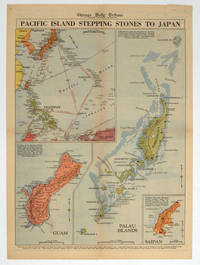
1944208880Chicago.: Chicago Daily Tribune. 28 September1944. Colour pictorial map on a single newspaper leaf archivally laid down on linen 50 x 39.2 cms; 59.3 x 43.3 cms sheet including captions faint toning to fold lines very good condition. Vivid colour maps of the Palau Islands Guam and Saipan in the Marianas and an inset location map published in the "Chicago Daily Tribune" in September 1944 months after the landing of US and Allied Forces in the offensive against the Japanese during the Pacific War. . Chicago Daily Tribune. unknown
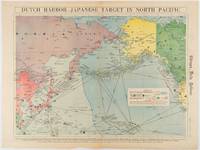
1942180751Chicago.: Chicago Daily Tribune. Friday June 51942. Printed colour map on a single newspaper leaf 37.5 x 53.2 cm; 44.7 x 59.8 cm sheet inset legend marginal browning and at the folds some undulation of paper and tide mark along lower section but in remarkably bright very good condition. Strategic map published in the Chicago Daily Tribune "The World's Greatest Newspaper" on June 5th 1942 two days after the Japanese attack on Dutch Harbor the site of the US army and navy bases in the Aleutians and as it transpired at the outset of the Battle of MIdway. The owner and proprietor of the Tribune Robert McCormick was staunchly against the United States entering the war and had firm views once it had occurred that American resources should not be used defending the British Empire. Famously the Tribune published the "Victory Program" Roosevelt’s military plan to prepare the United States for possible entry into World War II and was subject to prosecution for an alleged violation of the Espionage Act relating to the newspaper’s front-page account of the Battle of Midway 4-7 June 1942. It became an important test case for the limits of free speech and censorship during war-time. <br> <br>The Legend shows territorial Control of Ocean Areas marking Japanese Naval and Air bases as of 1941 and "according to latest reports" those established in the first six months of 1942. Also shown are pre-war sovereignties as at the bombing of Pearl Harbour on December 7th 1941. The Anson Archipelago is shown but a question mark "indicates islands etc. whose existence or give position is doubtful…". . Chicago Daily Tribune. unknown
8vo., First Edition; handsomely bound in full dark red crushed morocco, sides with gilt frame border, back with raised bands, second and fourth compartments lettered and ruled in gilt, all other compartments tooled in gilt, gilt top, uncut, red silk marker, a most attractive copy ideal as a gift or for presentation. The author served as Deputy Chief of Naval Intelligence during WWII. His emphasis on psychological warfare made a considerable impact upon Japanese morale well before the first atom bomb. Enser, p.233.
8vo; 2 volumes, xvi, 536; viii, 576pp, illus, 2 engraved frontispieces, 6 fine engraved plates (of idols, tombs, etc) with tissue guards, 2 maps (one folding), facsimile. contemporary 1/2 calf with marbled boards, joints cracking, but firm (one re-enforced), clean, very good set. A picture of this book is available upon request by email. Cox ii, P502 (referring to the later 1830 issue): "One of the earliest instances of ethnological research by a missionary, and valuable for its information on the mythology, traditions, customs, etc of the south sea islanders while still little sophisticated by Europeans. . . . The publication of this work went far to redeem the character of missionaries in the eyes of some who had thought of them all as ignorant and narrow-minded". An important contribution. Judd 60. Day (Pacific Island Literature, 100 basic books) 40: 'A more intesting book we have never perused. The work was used as source material by Herman Melville'.
Carta della Nuova Zelanda del Capitano Cook, tratta dal "Compendio della storia generale dei viaggi" tradotta dal lavoro di Prevost "Historie generale des voyages". L'opera in sette volumi è dedicata ai viaggi di Cook e altri viaggiatori nell'emisfero australe ed è stampata a Venezia da Vincenzo Formaleoni.Acquaforte, solite pieghe di carta, in ottimo stato di conservazione. Map of New Zealand by Captain Cook, taken from the "Compendio della storia generale dei viaggi" Italian translation of the Prevost's work "Historie generale des voyages". The seven-volume work is dedicated to Cook and other travelers in the southern hemisphere and is printed in Venice by Vincenzo Formaleoni.Very good condition with usual traces of original binding folds.
01-0066San Francisco Calif.: Southern Pacific Railroad 1962. Map. Blueprint. 31.5 x 133 inches. Scale 1 inch = 1000 feet. April 1955 revised to Feb. 1962. With index to industries showing names and location. San Francisco, Calif.: Southern Pacific Railroad, 1962. unknown
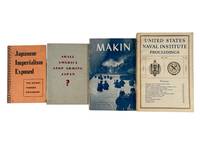
1939214021939. Various authors and issuers group of wartime pamphlets and periodicals 1939-1945 documenting American interpretations of Japanese expansionism prewar economic policy debates and U.S. military operations in the Pacific Theater. The material operates in Cultural/Representational Mode illustrating how military governmental and institutional publications framed Japanese imperial strategy and justified American military response while also presenting technical and battlefield analysis intended for both military and informed civilian audiences. These works collectively offer insight into wartime messaging strategic interpretation and the evolving American understanding of Pacific conflict from prewar trade tensions through active combat operations.<br /> Four printed works issued between 1939 and 1945 including Shall America Stop Arming Japan 1939; Japanese Imperialism Exposed: The Secret Tanaka Document 1942; United States Naval Institute Proceedings Vol. 69 No. 485 May 1943; and Makin U.S. War Department 1944. Staple-bound and softcover formats illustrated with photographs maps charts and technical diagrams. Shall America Stop Arming Japan presents statistical charts detailing American exports of strategic materials noting that Japan sourced significant percentages of copper scrap iron and petroleum from the United States accompanied by arguments advocating embargo. Japanese Imperialism Exposed reproduces the controversial Tanaka Memorial describing a proposed sequence of territorial conquest beginning with China and extending across Asia and the Pacific. Makin issued by the War Department's Historical Division provides a detailed narrative of the U.S. Marine assault on Makin Atoll with photographs of tanks infantry movement and captured terrain alongside fold-out maps showing defensive positions and invasion routes. United States Naval Institute Proceedings includes articles analyzing naval aviation logistics and strategic doctrine with photographic illustrations of aircraft such as the XLRQ-1 seaplane glider and PV-1 Ventura patrol plane as well as discussions of wartime and postwar naval policy.<br /> Together these publications trace the progression of American engagement with Japan from economic and diplomatic tension to full-scale military conflict combining advocacy intelligence interpretation and operational reporting. The juxtaposition of prewar policy argument with wartime combat analysis and technical discussion demonstrates the range of printed materials used to inform persuade and document during the Pacific War. These works support research into wartime propaganda military strategy and the informational frameworks through which the United States understood and prosecuted the war against Japan. Light wear to spines and edges with minor toning to pages; overall very good condition. A cohesive grouping illustrating the intersection of policy debate ideological framing and battlefield documentation in World War II print culture. unknown
1945213921945. U.S. military operations in the Pacific Theater during World War II photograph and newspaper archive 1941-1945 documenting the Battle of Iwo Jima and the attack on Pearl Harbor. The archive pairs soldier-taken snapshots with official U.S. Navy and press photographs showing how combat equipment and battlefield conditions. The featured original snapshots contain handwritten notations en verso identifying dates specific locations soldiers and equipment.<br /> <br /> The archive comprises 39 silver gelatin photographs ranging from roughly 3.5 x 5 to 6 x 8 inches together with original wartime front pages of the Honolulu Star-Bulletin covering the attack on Pearl Harbor the fall of Italy and the Allied invasion of Europe. Images include amphibious landings on the black sand beaches of Iwo Jima with landing craft advancing under naval bombardment; U.S. Navy battleships destroyers and landing craft firing on shore defenses; and aerial scenes of dogfights and bombing runs. Close-up battlefield images depict the wreckage left in the wake of combat including destroyed landing craft craters from naval artillery and Japanese fortifications. Several photographs focus on the role of air power with images of Japanese aircraft under attack U.S. planes engaging in dogfights and B-29 Superfortresses bombing enemy positions. A particularly striking image captures a Japanese bomber scoring a direct hit on the USS Yorktown with billowing smoke rising from the carrier. Handwritten notations on some images identify U.S. servicemen locations such as Mount Suribachi and captured Japanese positions. The series of larger military-produced photographs and newspaper clippings have inscriptions on verso identifying locations and vessels depicted as well as the name tag "K .Benden." Among these are portraits of American soldiers posing at key strategic points inspecting captured bunkers and standing beside wrecked aircraft. <br /> <br /> Reconnaissance images show terrain and fortified positions; ground-level views show cratered landscapes wrecked landing craft and captured Japanese fortifications. One image shows the USS West Virginia during the Pearl Harbor attack with fire damage and crew visible; another shows a Japanese aircraft striking the USS Yorktown. Other photographs show servicemen near Mount Suribachi inspecting bunkers and beside wrecked aircraft. Many images carry printed captions within the negatives; others have handwritten verso annotations identifying locations dates vessels and personnel including one marked "K. Benden." Light wear minor edge creasing and occasional surface marks; overall in very good with strong image clarity. unknown
28030401San Francisco 1937 G.P.O. A large poster on stiff board 33 x 48 cm. white with black ink b.w. photo and aircraft English & mostly Chinese text time tables for departing air craft and schedule. OBSCURE ITEM LIMITED EDITION OF 500 This lovely period poster was printed September 30 1937 in a LIMITED EDITION OF 500 only copies per the colophon at the bottom of the poster. CONDITION: The poster is very clean and obscure. There are 2 very tiny mended closed tears in the right and lower margin else this is a very clean nice copy of a rare item. There is almost no surface soil and a small bump to lower right corner again none of this invades the text at all and can be matted out in a frame. The "CHINA CLIPPER" an early Pan-Am aircraft is shown flying over the city of San Francisco just above Fisherman's Wharf and other piers and North Beach Russian Hill the tower and downtown in the background. The text informs the Chinese community about the new air mail service drop off locations times of pickup and the like. Nicely executed. QUITE SCARCE . unknown
1884GC10-643Leipzig, Verlag Fedrinand Hirt, 1884. original Leinenband, gr.-8?, 262 SeitenMit vielen Illustrationen nach Zeichnungen des Verfassers und einer Karte. und X (10) Seiten, Zustand: Einband etwas fleckig, innen sehr guter Zustand
18653621262(Batavia, Koninkl. Natuurkundig Vereeniging in Ned. Indie, 1851-1865). Zusammen etwa 680 S. mit einigen Tabellen, 2 Tafeln, 21 mehrfach gefalteten, teils farbigen Tafeln mit zahlreichen Abbildungen und Karten, separat 1 mehrfach gefaltetee und auf Leinen gezogene farbige Karte in Tasche. Hlwd der Zeit mit Rückenvergoldung. Gr.-8vo. (etwas beschabt, Vorsätze und Tasche etwas fleckig, einige Bl. mit kleinen Randläsuren und Fehlstellen ohne Textverlust, einige Bl. bzw. Tafeln staubrandig und fingerfleckig).
190710701Paris, Dunod et Pinat, 1907 ; in-8, broché ; (4), 305, (3) pp., grande planche dépliante (profils en long des 3 projets), figures et 11 planches hors-texte dont 2 plans et 9 photographies, couverture brique imprimée.
- EDIZIONE ORIGINALE, COLORITURA COEVA -Decorativa mappa dell'arcipelago Tonga tratta dal "Nuovo Atlante Geografico Universale delineato sulle ultime osservazioni", edito a Roma dal 1792 fino al 1801, opera che la Calcografia Camerale commissionò al Cassini al fine di sostituire l’ormai obsoleto "Mercurio Geografico".I primi ad approdare alle isole Tonga furono J. Lemaire e W. C. Schouten, ai quali questo gruppo di isole non si presentò ospitale, per il carattere degli abitanti (1616). Migliore accoglienza incontrarono nel 1643 Abel Tasman, che toccò il solo gruppo meridionale, e Samuel Wallis nel 1767. Il Cook, che vi approdò nel 1773, vi si trovò tanto bene, che le chiamò "Le isole degli Amici" (Friendly Islands); quando vi tornò nel 1777 vi indugiò quasi due mesi, mantenendo sempre ottimi rapporti con quegli abitanti. Le isole settentrionali furono scoperte nel 1781 dallo spagnolo F. A. Mourelle.Giovanni Maria Cassini, Chierico Regolare Somasco fu geografo e cartografo, ma anche intagliatore di architetture e prospettive - uno dei migliori discepoli di Giovanni Battista Piranesi - Cassini fu uno degli ultimi sferografi italiani del Settecento ed i suoi globi ebbero una notevole diffusione, come pure questo "Nuovo Atlante Geografico".Incisione in rame, coloritura coeva dei contorni, leggere bruniture, per il resto in ottimo stato di conservazione. FIRST EDITION, CONTEMPORARY OUTLINE COLOUR -The Italian painter and engraver, Giovanni Maria Cassini, produced this attractive map of the Tonga Islands, with Cook's tracks decoratively traced between them. Tonga became known as the Friendly Islands because of the hospitable reception given to Captain James Cook on his first visit in 1773.Published in: Nuovo atlante geografico universale delineato sulle ultime osservazioni. Roma, Calcografia camerale, 1792-1801.Cassini was geographer and cartographer but he was also good at engraving architectural items and perspectives – he was one of the best disciples Giovanni Battista Piranesi had. Moreover, Cassini was one of the last artists to engrave spheres in the XVIII century and his globes were quite famous and widespread, and realized the most important Italian Atlas of the XVIII century; his maps always bear a cartouche, extremely rich in colours and details. Copperplate with fine original hand colour, some foxing, otherwise in very good condition.
- EDIZIONE ORIGINALE, COLORITURA COEVA -Decorativa mappa dell'arcipelago Tonga tratta dal "Nuovo Atlante Geografico Universale delineato sulle ultime osservazioni", edito a Roma dal 1792 fino al 1801, opera che la Calcografia Camerale commissionò al Cassini al fine di sostituire l’ormai obsoleto "Mercurio Geografico".L'arcipelago è costituito da due distinti gruppi di isolette vulcaniche: quello delle Isole Sopravento (o del Vento), a Sud, che include Tahiti, Moorea, Maiao, Mehetia, Tetiaroa; quello delle Sottovento, a Nord, che comprende Raiatea, Huahine, Bora-Bora, Maupiti, Tahaa, e gli atolli Scilly e Bellingshausen. Già scoperte nel 1607 da P. Fernandes Queirós, furono riscoperte da S. Wallis nel 1767 e chiamate Isole della Società da J. Cook nel 1769, in onore della Royal Society.L'Isola di Natale deve il suo nome al capitano inglese William Mynors, che avvistò l'isola nel Natale del 1643 a bordo della nave Royal Mary.Giovanni Maria Cassini, Chierico Regolare Somasco fu geografo e cartografo, ma anche intagliatore di architetture e prospettive - uno dei migliori discepoli di Giovanni Battista Piranesi - Cassini fu uno degli ultimi sferografi italiani del Settecento ed i suoi globi ebbero una notevole diffusione, come pure questo "Nuovo Atlante Geografico".Incisione in rame, coloritura coeva dei contorni, leggere bruniture, per il resto in ottimo stato di conservazione. FIRST EDITION, CONTEMPORARY OUTLINE COLOUR -The Italian painter and engraver, Giovanni Maria Cassini, produced this attractive map of the Tonga Islands and Christmas Island.The Society Islands are a group of islands located in the Pacific Ocean and part of French Polynesia. It includes Bora Bora, Tahiti, Moorea, Taha'a and Huahine. The archipelago is suspected to have been named by Captain James Cook supposedly in honour of the Royal Society, the sponsor of the first British scientific survey of the islands; however, Cook himself stated in his journal that he called the islands Society "as they lay contiguous to one another."Christmas Island was first discovered on in 1615 by Captain John Milward of the East India Company ship, and it was named Christmas Island on 25 December 1643.Cassini was geographer and cartographer but he was also good at engraving architectural items and perspectives – he was one of the best disciples Giovanni Battista Piranesi had. Moreover, Cassini was one of the last artists to engrave spheres in the XVIII century and his globes were quite famous and widespread, and realized the most important Italian Atlas of the XVIII century; his maps always bear a cartouche, extremely rich in colours and details. Copperplate with fine original hand colour, some foxing, otherwise in very good condition.
1st separate edition, 16mo (small) 39 pages. Includes portrait ; 15 cm. 1 of 100 copies printed. "Reprinted in 100 copies from the anniversary number of the Jewish tribune, Portland, Oregon, December 19, 1913" [from the Title page verso]. Henry Ward Beecher ( 1813 1887) was an American Congregationalist clergyman, social reformer, and speaker, known for his support of the abolition of slavery, his emphasis on God's love, and his 1875 adultery trial . Several of his brothers and sisters became well-known educators and activists, most notably Harriet Beecher Stowe, who achieved worldwide fame with her abolitionist novel Uncle Tom's Cabin ..Over the course of his ministry, he...grew interested in social reform, particularly the abolitionist movement. In the years leading up to the Civil War, he raised money to purchase slaves from captivity and to send riflesnicknamed Beecher's Biblesto abolitionists fighting in Kansas and Nebraska . After the war, Beecher supported social reform causes such as women's suffrage and temperance. He also championed Charles Darwin's theory of evolution, stating that it was not incompatible with Christian beliefs . Beecher's long career in the public spotlight led biographer Debby Applegate to call her biography of him The Most Famous Man in America (Wikipedia, 2019) . OCLC: 17882630. OCLC lists 14 copies worldwide. Light wear, about Very Good- Condition. (KH-8-54)
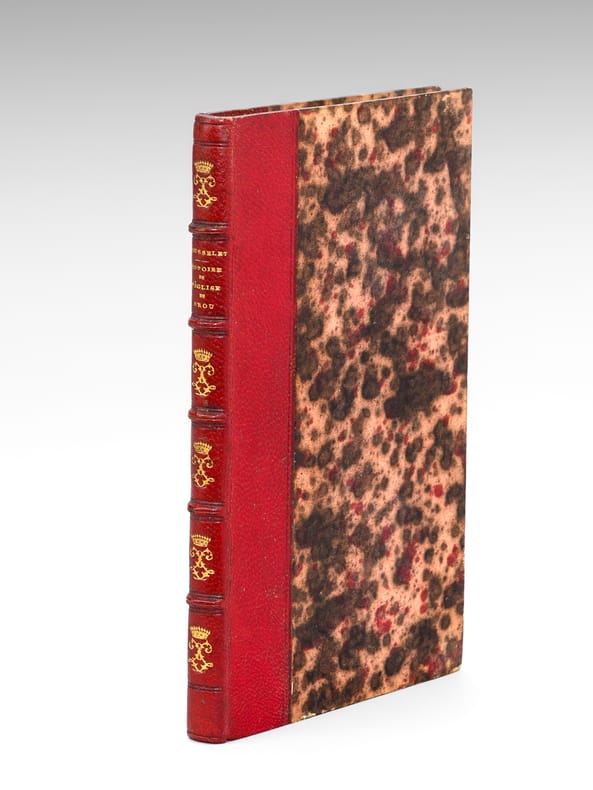
1806665231 vol. in-12 reliure demi-maroquin rouge, dos à 5 nerfs ornés (chiffres LL entrelacés surmontés d'une couronne), toutes tranches peignées, Chez P. F. Bottier, A Bourg, s.d. [ 1806 ], 1 f. blanc, 143 pp.
18063025Edinburgh, A. Constable, 1806. In-8 de VII-232-LXI pp., cartonnage de l'époque.
awd-1023Paris, Mercure de France, 1999. In-8 br., couverture imprimée à rabats, 350 pp.