Charles PEGUYBiblio.com

48 390 résultats
190753285Paris: les Cahiers de la Quinzaine 1907. Fine. les Cahiers de la Quinzaine Paris 1907 13 x 19 cm relié First edition one of 12 numbered copies on Whatman paper the only large paper copies A fine well-margined copy handsomely bound. les Cahiers de la Quinzaine unknown
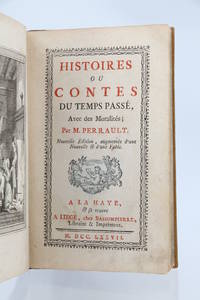
177786384à La Hayeet se trouve à The Hague Liège: Chez Bassompierre libraire & imprimeur A La Haye et se trouve à 1777. Fine. Chez Bassompierre libraire & imprimeur A La Haye et se trouve à à La Hayeet se trouve à The Hague Liège 1777 11.60 x 17.30 cm un volume relié Charming edition illustrated with a frontispiece a framed title and 9 half-page illustrations reproducing vignettes by Fokke after De Sève - with the final illustration for L'Adroite Princesse newly added. Complete with the Épître dédicatoire by P. Darmancour Charles Perrault to 'La Grande Mademoiselle' Anne-Marie d'Orléans cousin of Louis XIV. Half-sheep binding smooth spine ruled in gilt and a diagonally stamped gilt title. Beige paper boards speckled edges. Small paper defect in the margin of page 75 scattered foxing a small brown stain affecting the illustration of Cinderella. A name written in ink in the lower margin of page 21. This edition contains eight famous tales by Perrault: Le Petit Chaperon Rouge Little Red Riding Hood Les Fées The Fairies La Barbe Bleue Bluebeard La Belle au bois dormant Sleeping Beauty Le Chat Botté Puss in Boots Cendrillon Cinderella Riquet à la Houppe Ricky of the Tuft and Le Petit Poucet Hop-o'-My-Thumb as well as The Clever Princess or Finette by his niece Marie-Jeanne L'Héritier de Villandon wrongly attributed to Perrault. The collection ends with La Veuve et ses deux filles by Marie Leprince de Beaumont. Cohen 789; Brunet Supplément II 206 ; Provenance: Henry Betrand library blind stamp on verso of frontispiece. Chez Bassompierre, libraire & imprimeur, A La Haye, et se trouve à hardcover
191153287Paris: les Cahiers de la Quinzaine 1911. Fine. les Cahiers de la Quinzaine Paris 1911 13 x 19 cm relié First edition one of 14 numbered copies on Whatman the only deluxe paper issue. Bound in navy blue half morocco with corners spine with five raised bands date gilt at foot marbled paper boards blue paper endpapers and pastedowns original wrappers and spine preserved top edge gilt uncut. Elegant binding signed Alix. A very handsome copy entirely uncut and perfectly established. les Cahiers de la Quinzaine hardcover
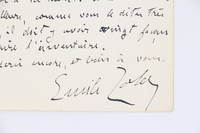
188279111Médan 1882. Fine. Médan 1er décembre 1882 13.60 x 21.40 cm 2 pages sur un double feuillet - enveloppe jointe Autograph letter signed by Emile Zola - apparently unpublished - written in black ink on a double sheet and addressed to Léon Carbonnaux department head at Bon Marché. Folds inherent to mailing. Envelope included. Only two letters from Léon Carbonnaux to Emile Zola are known: they can be consulted in the digitized preparatory file for Au bonheur des dames made available online by the Bibliothèque nationale de France. However we know from this same file which contains a long section entitled ""Notes Carbonnaux"" that this department head at Bon Marché provided Zola with a significant amount of information particularly about employee customs their remuneration and especially inventory techniques. The two men probably met when Emile Zola eager for information about the workings of department stores conducted field research in February and March 1882. Very important unpublished letter shedding new light on the pre-original publication of Au bonheur des dames. In his biography of Emile Zola Henri Mitterrand writes: ""Even before the novel was completed Zola gave an extract to Panurge in November; and on November 23 1882 Gil Blas announced its imminent publication in its columns."" Our letter discussing precisely this alleged pre-publication in Panurge attests that it was simply a joke and thus contradicts Henri Mitterrand: ""But your letter surprises and saddens me somewhat. How could you have been taken in by Panurge's stupid joke Did you not notice that the entire issue is a 'farce' Not one of the articles is authentic they are parodies and very poorly done ones at that."" Indeed reading the said extract cannot fool the assiduous reader of Zola despite the introduction that the journalists wrote: ""After Nana and Pot-Bouille those epics of elegant vice and bourgeois vice M. Emile Zola wanted to create one of honesty: Au bonheur des Dames which will appear shortly is a reassuring painting of innocence and virtue; the greatest success is assured for this new work whose characters move in the setting of a large novelty store; Parisian high commerce will not long await its observer and painter. We thank Emile Zola for having kindly cut out especially for Panurge a few pages from his still unpublished work and we are proud to give the public first an extract from this work of such high morality and such powerful interest."" Panurge no. 4 of October 22 1882 The sentences of this false Zolian text are exaggeratedly long and Panurge took the liberty of endowing the novel with a male main character Denis Mouret an amalgam of Denise the true heroine of the book to appear and Octave Mouret. One can think that it is a text composed from elements of Pot-Bouille the previous volume of Rougon Macquart where Octave - future owner of Bonheur des Dames - exercised the function of clerk before his meteoric social rise: ""For already more than two months he had been attached to the 'silks and furs' department; he arrived in the morning at seven o'clock to return home his day finished only at nine o'clock in the evening when all of Paris buzzed strangely with a feverish animation of pleasure and enjoyment and on his way back he followed gawking the great crowded boulevards where blazed the cafés full of girls and where on the asphalt at theater doors the crowd jostled with here and there in the vague rumor of trampling and pressing the roguish intonation of the cries of program vendors and ticket sellers."" Panurge In his letter of November 30 1882 Léon Carbonnaux - reading the extract from Panurge - had reproached Zola for his errors: ""Nowhere except at the Fabriques de France near Les Halles does one arrive at 7 a.m. It's at the earliest 7:30 but more often 8 a.m. and even then. There is no silk and fur counter at the Louvre. . It is so easy for you to be accurate that errors of this kind especially if t unknown
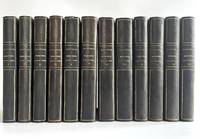
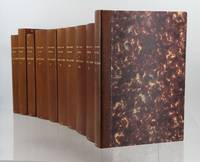
184985139Paris: Dion-LambertEugène et Victor Penaud frères 1849. Fine. Dion-Lambert Eugène et Victor Penaud frères Paris 1849 - 1850 13.50 x 22 cm 12 volumes reliés First edition. The original wrappers preserved bear the publisher's label from Dion-Lambert slip pasted over the former address but the title pages show the address of Penaud frères. Dion-Lambert acquired the remaining stock of the edition and put it back on sale. The list of subscribers as well as the foreword were removed for the reissue. The back cover also preserved bears on the verso: Typographie E. et V. Penaud frères. Full dark green shagreen binding 20th century in the spirit of a contemporary binding of the edition. Smooth spine decorated with 2 gilt frames. Boards decorated with a wide frame of multiple fillets. Top edge gilt. Original wrappers and spine preserved. Binding executed on the original sheets the paper therefore remains uncut. This copy shows some recurring dampstains as follows: Volume 1 from p.95 to 238 pale dampstain at lower right corner then at mid-page. Volume 2 pale dampstain at upper left corner throughout. In volume 4 from p.5 to 192 dampstain at lower margin right corner. Volume 5 pale dampstain yellow halo at mid-page throughout more or less pronounced. Volume 6 Dampstain at mid-page over the first third then small stains in upper margin. Volume 7 pale dampstain in upper margin at right corner from beginning to p. 150 resuming from p. 230 to 300. Volume 9 scattered dampstains at mid-page then in corners in the margin. Volume 12 dampstain on the first 2 leaves in upper margin at corner then resuming on several leaves. Most of these stains show a yellow halo without serious consequence. Scattered foxing. Fine copy of the first edition of one of the most important texts of French literature with the rare original wrappers preserved. Dion-LambertEugène et Victor Penaud frères hardcover
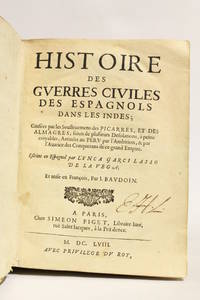
165885173à Paris: Chez Simeon Piget 1658. Fine. Chez Simeon Piget à Paris 1658 17 x 23.50 cm 2 tomes reliés en un volume Second French edition bringing together these two texts by Garcilaso de la Vega first published in Spanish in 1650. Frontispiece depicting in the foreground the landing of Spanish troops on American territory and in the background the indigenous population besieged in the heart of a burning city. In the lower section a banner bears the inscription ""Quid non mortalia pectora cogis auri sacra fames"" taken from Virgil's Aeneid and translated by Molière as ""O execrable hunger for gold to what lengths do you not force men's hearts to go"". Work decorated with headpieces and historiated initials. Contemporary full vellum binding smooth spine decorated at head with a pen-and-ink title almost faded. One corner slightly bumped title page skillfully restored at inner margin pale dampstain to lower margin on final gatherings. Bookplate of the Nordkirchen family pasted on front pastedown. Manuscript ownership inscription on title page with initials ""E. H. L."". Natural son of a conquistador and an Inca princess raised in two different cultures Garcilaso de la Vega 1539-1616 offers a unique vision of Inca civilization by rejecting a Euro-centric view. While in his Royal Commentary first published in France in 1633 de la Vega traced the history of the Inca rulers he here proposes an account of the conflicts that animated the Spanish colonists after their arrival in Peru. His aim is to convey the upheaval caused by these internecine wars both for the indigenous people and for the Spanish. In his address to the reader de la Vega explains that the Inca rulers had succeeded in founding an empire where ""Moral Political & Military Virtues"" reigned; the arrival of the colonists and the execution of Atahualpa - the last independent emperor - disrupts the established order and is seen as the expression of ""Ambition"" and ""Avarice"" of these ""new Hosts"". De la Vega presents these events in the form of a true epic seeking to show the reader ""the various effects in this History wonderfully entertaining & where the Author endeavors to make the principal ones among those who were the true Actors play their role on this Stage"". A continuation of his first major work on the History of the Incas Kings of Peru the History of the Civil Wars of the Spanish in the Indies offers the reader a vast panorama of Peruvian history in the few years following the conquest. Handsome copy of this work of major importance in the historiography of the Spanish conquest of Peru. Chez Simeon Piget hardcover
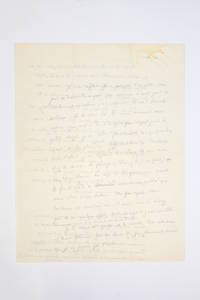
194060684Paris 1940. Fine. Paris s. d. 3 ou 4 juin 1940 20.90 x 26.90 cm 2 pages sur un feuillet Touching handwritten letter signed by Georges Bataille to Denise Rollin 37 lines in pencil small water stain in the top right not affecting the text. Georges Bataille tries to reassure his companion Denise Rollin: Je t'en supplie. Il ne faut pas t'inquiéter mais pas du tout. I beg you. You must not worry not at all. She moved to Vézelay where Bataille would soon join her. He stayed in Paris where the bombings did not disrupt Parisian lives at all: Tu n'imagines point à quel point les petits dégâts qu'on voit paraissent insignifiants à côté de la place intacte qu'il y a de tous les côtés. Pendant toute l'alerte j'ai déjeuné bien tranquille avec mon chef de service de passage à Paris il vit au front You have no idea how insignificant the little damage you see seems next to the square untouched on all sides. Throughout the alert I had a very quiet lunch with my head of service passing through Paris he lives on the front Bataille did not give up his job as librarian at the National Library. Suffering from tuberculosis he was not sent to the front and he took the opportunity to write several texts at that time such as Madame Edwarda and Le Coupable. Further on he mentions a visit: Un peu après Henri Michaux est venu me voir A little after Henri Michaux came to see me The two men had participated in the magazine Mesures and both had in common being separate from the surrealist nebula. In both of their respective works there is a violent independence and the same tension towards spirituality a form of mysticism. Bataille had attended the seminary in his youth and Michaux pleasantly said of him: Il donne l'impression d'un séminariste sortant furtivement d'une pissotière. He gives the impression of a seminarian surreptitiously coming out of a public urinal. After this almost trivial news Bataille embarks on an analysis of his feelings: Ce que tu me dis dans ta lettre c'est pour moi ce qui délivre c'est comme la nudité tout ce qui se déchire entre toi et moi. Mais encore une fois je ne me suis jamais senti aussi près de toi. What you tell me in your letter is for me what delivers it is like nudity everything that is torn apart between you and me. But once again I have never felt so close to you. He asks his correspondent: il faut me dire tout. C'est très doux que j'aie vu où tu es que je connaisse les chemins que tu prendras les ponts par où tu passeras. you must tell me everything. It is very sweet that I have seen you where you are that I know the roads you will take the bridges over which you will pass. Sensuality is never far from the author's feelings: Dis-moi aussi quelle chambre tu as: pour que je songe à toi dans cette chambre et à tout ce qui arrivera là quand nous serons de nouveau ensemble. Also tell me which room you have: so that I may think of you in that room and all that will happen there when we are together again. From this and past sensualities there remain the fruits that are the children. Denise Rollin left for Vézelay in the company of her son Jean nicknamed Bepsy: Tu ne me dis rien de ta vie avec Bepsy . Bepsy est-il plus calme: moi aussi je l'ai entendu crier dans tes bras. You don't tell me anything of your life with Bepsy . Is Bepsy calmer: I too heard him screaming in your arms. Bataille thanks Rollin: Pour Sylvia je t'ai une immense reconnaissance de m'avoir aidé à changer. For Sylvia I am immensely grateful to you for helping me change. Sylvia Bataille was the first wife of Georges Bataille. They were separated in 1934 but did not divorce until 1946. From this relationship for the author: Il ne reste que Laurence et la nécessité d'envisager les choses sans heurt This only thing that remains is Laurence and the need to consider things smoothly Laurence was the daughter born of this marriage in 1930. She joined Bataille Rollin and Bepsy in 1943 when h unknown
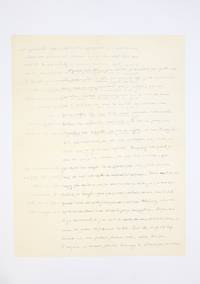
194060700s. l. 1940. Fine. s. l. s. d. circa 1940 20.90 x 26.90 cm 2 pages sur un feuillet Autograph letter signed from Georges Bataille to Denise Rollin 40 lines in black ink two pages on one leaf. George Bataille and Denise Rollin's relationship lasted from the autumn of 1939 to the autumn of 1943 and left behind it a short but passionate correspondence. This letter dates from the early days of their connection but already reveals Bataille's agonies: Perhaps I was too happy with you for some months even though suffering did not wait long to interrupt at least for a time a happiness that was almost a challenge. A passionate lover Bataille moved from exultation to the deepest doubt and even offered his lover a potential way out of their relationship: If you can't take it me any more I beg you don't deceive yourself any longer: tell me it's me and not some foible I could have avoided and which is easily repairable. He would rather be sac- rificed on the altar of their love than have a relationship that was bland and flavorless: Understand me when I tell you that I don't want everything to get bogged down that I would really rather suffer than see a sort of shaky mediocrity as a future for you and me. Earlier in the letter he turns to humor to tear him away from his worries: I hardly dare make you laugh by telling you that I've lost weight so that my trousers occasionally fall down because I've not yet gotten into the habit of tightening my belt to the new notch. Then he goes back to pleading: I write to you like a blind man because that is what you make me when you talk to me the way you do when you leave or when you phone you make me fall into a darkness that is almost unbearable. He then tries to get a grip on himself: there are moments I'm ashamed of doubting you and being afraid or of stupidly losing my head. Finally hemmed in by all his doubts as a lover Bataille tried to find some respite in talking about the family that he had made up with Denise and her son Jean alias Bepsy: If you write me tell me how Bepsy's doing which is perhaps the only thing that you can tell me that doesn't touch something painful in me. Although Bataille's life as a writer is well known in these years little is known about his private life. And it is not the least paradox of his very revealing work that it only tells the minimum of his private affairs and usually the worst of it. M. Surya G. Bataille la mort à l'uvre. When Georges Bataille met Denise Rollin in 1939 he had just lost his lover Colette Peignot to tuberculosis. His friends had abandoned him and war had just been declared. This sentimental and social chaos however does not affect Bataille as much as the tumultuous relationship he took up with Denise Rollin who was a friend of Cocteau Breton Prévert and a muse of painters Kisling and Derain. Their romance lasted four years and left very few details of their sentimental life during this period of Occupation except what Bataille is willing to tell us in his novel Le Coupable The Guilty partly inspired by this passionate and painful relationship. In a 1961 interview Bataille looked back on this time: ""Le Coupable is the first book that gave me a kind of satisfaction an anxious one at that that no book had given me and that no book has given me since. It is perhaps the book in which I am the most myself which resembles me the most. because I wrote it as if in a sort of quick and continuous explosion."" The letters addressed by Bataille to Denise during this period contain the seeds of the feelings that explode in Le Coupable as in all of Bataille's work. His writing is an ebb and flow of love and suffering between ecstasy and disappointment calm and energy mixing familiar and formal tones compliments and reproaches. The letters are often impossible to date with precision as they all proceed from the same movement of ecstatic flagellation. In 1943 Georges Bataille found a house i unknown
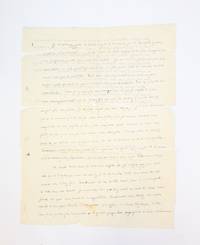
194360661s. l.: S. n. 1943. Fine. S. n. s. l. s. d. circa 1940-1943 207 x 270 cm 2 pages sur un feuillet Fine and long autograph letter signed by Georges Bataille to Denise Rollin unpublished torn in five pieces not affecting readability 34 lines in black ink on one leaf. Both frequenting Parisian intellectual and artistic circles Georges Bataille and Denise Rollin met during 1939. She was notably the friend of Cocteau Prévert and Breton. Bataille described her thus in his notebooks for Le Coupable: « une illusion aussi fragile qui se dissiperait au moindre souci au moindre relâchement de l'inattention. » ""an illusion so fragile that it would dissipate at the slightest worry at the slightest relaxation of inattention."" Few details remain about their relationship since Georges Bataille's private life particularly during this period is not well documented. The profound feelings that Denise Rollin provoked in Bataille appear in this letter: « Maintenant je n'aspire plus qu'à une chose c'est à vous prouver que je n'appartiens plus qu'à vous que je suis rivé à vous . » ""Now I aspire to only one thing which is to prove to you that I belong only to you that I am bound to you . "" The absolute nature of this love is such that Bataille is ready for anything: « . que vous le sachiez à tel point que si je ne devais plus avoir d'autre moyen qu'une profanation pour vous le prouver je ferais devant vous cette profanation. » ""that you know it to such a degree that if I were to have no other means than a profanation to prove it to you I would commit this profanation before you."" Yet he feels guilty: « Je ne peux pas parler de l'état auquel je suis arrivé je suis trop agité. Je sens j'espère que c'est absurde. J'ai honte même de tant souffrir et de vous ennuyer avec ma souffrance quand vous seule êtes malade. » ""I cannot speak of the state I have reached I am too agitated. I feel I hope it is absurd. I am even ashamed to suffer so much and to trouble you with my suffering when you alone are ill."" The previous year he had lost his companion to tuberculosis. Helpless before illness he admits: « . moi je ne peux pas vous guérir je ne peux même pas vous soigner . » ""I cannot cure you I cannot even care for you . "" Only Denise Rollin would be capable of soothing him: « Tout était noir auparavant . ce que je souffre et que vous pouvez si facilement guérir chaque fois que vous le voudrez . » ""Everything was dark before . what I suffer and which you can so easily cure whenever you wish . "". Abandoned to the throes of anguish Bataille admits: « Je suis tellement fou en ce moment et de cela je veux vous parler que je ressens comme une complicité et une perfidie de tous pour me faire mal comme si vous vous prêtiez au jeu pour que je sois encore plus désespéré . » ""I am so mad at this moment and I want to speak to you about this that I feel like a complicity and perfidy of everyone to hurt me as if you were lending yourself to the game so that I would be even more desperate . "" On the verge of paranoia he begs Rollin: « La seule chose dont je veux vous supplier . c'est de ne plus douter sans cesse de moi comme vous l'avez fait. » ""The only thing I want to beg of you . is to no longer constantly doubt me as you have done."" Yet he understands: « . il y avait en moi et dans mon passé de quoi vous paraître insupportable . » ""there was in me and in my past enough to seem unbearable to you . "" He offers her a solution: « Ce qui m'apaiserait le plus si vous m'écriviez ce serait que vous me disiez que vous me croyez que vous voulez bien que je sois votre chose. » ""What would soothe me most if you were to write to me would be for you to tell me that you believe me that you are willing for me to be your thing."" S. n. unknown
193766823Paris: Plon 1937. Fine. Plon Paris 1937 13.50 x 19.50 cm relié First edition one of 20 numbered copies on Japan head print. Binding half morocco anthracite corners smooth back adorned with cold boxes golden date tail guards and contreplats of marbled paper guards and eggplant paper tidbits covers and back preserved gilded head witnesses elegant binding signed Honnelitre . Rare and beautiful copy of all perfectly established margins of this novel which was adapted to the cinema in 1967 by Robert Bresson. Plon unknown
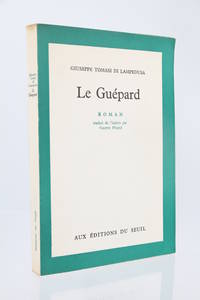
195986664Paris: Seuil 1959. Fine. Seuil Paris 1959 14.50 x 21.50 cm broché First edition in French one of 150 numbered copies on vélin neige paper reserved for bibliophiles of Sélections Lardanchet the only deluxe copies. A small area of sunning at head of spine extending slightly onto the back board. Rare and handsome copy of this masterpiece magnificently adapted for cinema by Luchino Visconti Palme d'Or at Cannes in 1963 with Claudia Cardinale Burt Lancaster and Alain Delon as the principal actors. Rare and fine copy. Seuil unknown
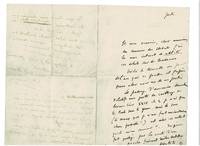
186075622s. l. Paris 1860. Fine. s. l. Paris s. d. 5 ou 12 janvier 1860 13.60 x 21 cm deux pages sur un feuillet remplié Autograph letter signed by Gustave Flaubert addressed to the archaeologist Charles-Ernest Beulé. Two pages written in black ink on a folded sheet. The recipient of this letter added nine handwritten lines a draft of his future response following Flaubert's letter. This letter has been transcribed and reproduced on the website of the Flaubert Centre at the University of Rouen. The transcriber of this missive notes: ""Are the lines written under the signature by Beulé or by Flaubert himself The handwriting resembles his. Stéphanie Dord-Crouslé suggests that Flaubert may have gone to see Beulé and written these elements under his dictation in response to the questions posed."" This hypothesis seems unlikely to us given that we know Charles-Ernest Beulé's response to this letter itself digitized by the Flaubert Centre and dated February 10 1860. This response does not seem to us to suggest a visit by Flaubert to Beulé. It seems more likely to us that Beulé inscribed under Flaubert's letter a draft of his future response of February 10 1860 which would only be an elegant reformulation of his notes. Handsome and important testimony to the colossal research that Flaubert undertook for the writing of Salammbô. ""Begun in 1857 the novel appeared in 1862 a period when Antiquity was coming back into fashion and when Carthage was 'au goût du jour' ""in vogue"" thanks to the recent excavations by Charles-Etienne Beulé at Byrsa 1859 and in the Punic ports."" Vanessa Padioleau ""Flaubert et Carthage : Salammbô roman polymorphe"" ""Flaubert and Carthage: Salammbô polymorphic novel"" in Revue Flaubert n° 9 2009 It is therefore to one of the specialists on the subject that Flaubert addresses his questions commenting on his recent reading of Ammianus Marcellinus: ""J'ai appris dans ce même Ammien que les Carthaginois ont pris Thèbes en Egypte . Qu'est-ce que cela veut dire Ce passage est je crois peu connu "" ""I learned in this same Ammianus that the Carthaginians took Thebes in Egypt . What does this mean This passage is I believe little known"" Flaubert's task is no small one: at the time nothing or almost nothing was known about the period of the Mercenary Revolt which extended over two years from 240 to 238 BC. He then begins painstaking work basing his research on the texts of the great historians of Antiquity which he reads in Latin in the original. The letter we offer shows his great mastery of it: ""J'ai appris dans ce même Ammien que les Carthaginois ont pris Thèbes en Egypte livre xvii ch. iv. 'Hanc inter exordia pandentis se late Carthaginis improviso excursu duces oppressere Poenorum'"" ""I learned in this same Ammianus that the Carthaginians took Thebes in Egypt book xvii ch. iv. 'At the time when Carthage was beginning its wide expansion the generals of the Phoenicians conquered it by a surprise attack'"". Despite this most thorough research the gate of Carthage would receive only a very brief description in the final version of Salammbô. unknown
187762711Paris 1877. Fine. Paris 9 mai 1877 13.50 x 20.50 cm 2 pages sur un feuillet remplié Autograph letter signed by Gustave Flaubert addressed to Léon Cladel. Envelope attached. Some underlinings and manuscript corrections by the author. Minor water stains. Three small restorations using adhesive on the second page as well as two fold marks inherent to the letter's folding for mailing. Amusing letter in which Gustave Flaubert whose literary renown is well established offers his support to his friend Léon Cladel who is struggling to have one of his works published. The ""master"" - this is how Léon Cladel addresses his colleague - begins this letter with enthusiasm: ""I started your book yesterday at 11 o'clock; it was finished this morning at 9!"" The ""book"" in question is L'Homme de la Croix-aux-Bufs which Flaubert had agreed to re-read for his friend on April 30; he had indeed requested the manuscript deposited with the publisher Georges Charpentier: ""Cladel wrote to me to say that he wished me to read pardon the subjunctive the novel in sheets which is with you. So send it to me or bring it to me."" Letter of May 3 1877. Léon Cladel very close to Gustave Flaubert seems to have shared with him the fears of the publisher Édouard Dentu regarding the publication of his work: ""And first of all Dentu must be mad to be afraid to publish it."" As a seasoned veteran of the ruthless world of publishing Flaubert positions himself as a professional and declares: ""Nothing in it is reprehensible either politically or morally. What he told you is a pretext"" This question of moral reprehension echoes the famous trial brought against the author of Madame Bovary. Like an enthusiastic literary critic Flaubert compliments his colleague: ""I find your book to be a real book. It is very well done very careful very masculine. & I know what I'm talking about my good man."" As a scrupulous reader he nevertheless allows himself a few remarks on Cladel's manuscript ""I have two or three small criticisms to make trivial matters - or rather advice to submit to you."" before reconsidering: ""Sometimes there are pretensions to archaism and naivety. It is an excess of good."" Flaubert's attitude here is almost paternal and in any case benevolent: aware of his friend's abilities he wishes to encourage him and see the publication of his work succeed: ""But once again be content & sleep soundly - or rather don't sleep - and often create similar works."" The benevolent writer also mentions in this letter another publisher Georges Charpentier: ""As for Charpentier to whom I will return your sheets on Friday - the day when I dine at his house I am going to give him a vigorous talking-to & in all conscience without exaggeration & without lies."" Charpentier who has been publishing Flaubert since 1874 has become a close friend of the writer with whom he maintains a rich correspondence. In this month of May 1877 he has just published Trois contes which was for Cladel the occasion for a moving celebration of his master in Letters: ""Where the devil did you get that gleaming brush with which you paint your canvases the small ones like the large ones and that sobriety that certain Latins would envy you To be at once Chateaubriand and Stendhal and moreover Flaubert."" This admiration is reciprocal and Flaubert feels for this ""true artist"" an unfeigned esteem: ""The ending is simply sublime! - & of the greatest effect."" He will reiterate a few weeks later his compliments: ""It is worked chiseled delved into. Observation in your case takes nothing away from poetry; on the contrary it brings it out."" Indeed Cladel will establish himself as the true heir to the Flaubertian style much more so than Zola who will precisely reproach him for ""working his prose relentlessly"" and ""striving to render perfect each sentence he writes."" It is finally Édouard Dentu who will publish the manuscript of L'Homme de la Croix-aux-Bufs; Cladel will moreover offer a copy enriche unknown
188845137Paris: Paul Ollendorff 1888. Fine. Paul Ollendorff Paris 1888 12.50 x 19.50 cm relié First edition one of 100 numbered copies on Hollande paper the only large paper copies after 5 on Japan paper Half black morocco Bradel binding by Alfred Farez active from 1909 to 1930 gilt date at foot of spine marbled pastedowns and endpapers A fine copy in a handsome binding. Paul Ollendorff unknown
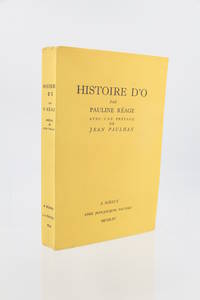
195480495Sceaux: Jean-Jacques Pauvert 1954. Fine. Jean-Jacques Pauvert Sceaux 1954 12 x 19 cm broché Histoire d'O Story of O Jean-Jacques Pauvert Sceaux 1954 12 x 19 cm original wrappers First edition one of 480 numbered copies on Vergé paper ours being one of the few ""hors commerce"" advance copies the only deluxe paper after 20 copies on Arches and 100 others on Vergé for the press. Our copy is complete with the rare vignette drawn and engraved by Hans Bellmer in sanguine and present on about 200 copies only. Preface by Jean Paulhan. Beautiful copy of this masterpiece of erotic literature. Jean-Jacques Pauvert unknown
191765739London New York Toronto Melbourne: Cassell and Company 1917. Fine. Cassell and Company London New York Toronto Melbourne 1917 13.50 x 20.50 cm reliure de l'éditeur Second issue printed in March-April 1917 one month after the first edition published in February of the same year. Publisher's red cloth. Exceptional inscribed copy signed by H.G. Wells to André Citroën: To André Citröen who has to do his share in making a new world out of a very shattered old one. From H. G. Wells. The inscription echoes the chapter of the book entitled New arms for old ones in which Wells describes the armament factory created by Citroën to remedy the French artillery weakness. Reconverted at the end of the war the factory will become the first Citroën automobile manufacturer. A superb testimony to the early friendship between the industrialist André Citroën and the writer H.G. Wells who in this very work dedicates a chapter to the new ammunition factory devised by Citroën as well as to the social progress he brings to his some thirteen thousand munitionnettes. War and the Future a work of propaganda written at the heart of the First World War brings together diverse observations on the ongoing conflict highlighting the radical change that the new armament technologies are bringing to the art of warfare. Wells states his theory of a new world scientific and technical order which already ran through his science-fiction masterpieces at the end of the last century War of the Worlds The Time Machine. As for Citroën having understood the crucial importance of the artillery in modern warfare he made a bet in 1915 to compete with the power of the Krupp armament factories. Abandoning his automobile factory project during the war he builds at his own cost an immense industrial complex on the Quai de Javel which produced 23 million shells for the allied forces. War and the Future bears the marks of Wells' admiration for Citroën whom he met the year before during his tour of Europe for the writing of this book: He is a compact active man in dark clothes and a bowler hat with a pencil and a notebook conveniently at hand. He talked to me in carefully easy French and watched my face with an intelligent eye through his pince-nez for the signs of comprehension page 141. The writer contrasted the immobility of the Front which he visited in 1916 to the incredible dynamism of the Citroën factory a veritable temple of modern industry which he describes as The busy sheds of Paris struck me as being the most living and active things in the entire war machine page 139. These few hours spent with this pioneer of military engineering had a considerable impact on the writer who saw him as an innovator speeding up the construction of the modern world. As the war ended Citroën brought an end to the production of weapons and founded the famous Citroën company making the factory his first automobile manufacturer. As with other personalities such as Joséphine Baker or Rudolph Valentino H. G. Wells became a regular customer of Citroën cars and remained a fervent admirer of the genius that was its founder. Produced at the start of the 20th century Wells' superb handwritten inscription to Citroën on the work that celebrates his visionary talents testifies to the admiration of a man who dreamed of the future for those who made it happen. Cassell and Company hardcover
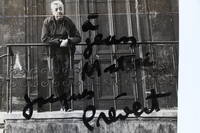
195577442s. l. Paris 1955. Fine. s. l. Paris s. d. 1955 18.70 x 27 cm une photographie Original collage produced on an original photograph portrait of Robert Doisneau enriched with a handwritten presentation signed by Jacques Prévert Paris 1955 18.7 x 27 cm one photographOriginal photograph in contemporary silver print showing Jacques Prévert in front of the pediment of a church on which the poet glued an old engraving depicting a bird and which he enriched with a signed handwritten presentation to his friend Jean Mattei. Prévert also using paint reddened the end of his cigarette. Stamp of the Doisneau studio in Montrouge on the back of the picture. One central fold. On this rare photograph reproduced in the book Rue Jacques Prévert by Robert Doisneau the poet poses in front of the Catéchismes chapel of the Église Saint-Jacques-Saint-Christophe de la Villette situated in the 19th arrondissement in Paris. Jean Mattei dedicatee of this work was Chagall and André Gide's doctor and lived in Saint-Paul-de-Vence. unknown
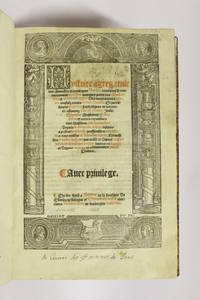
152956658à Paris: Chez Galliot du Pré 1529. Fine. Chez Galliot du Pré à Paris 1529 21 x 31.50 cm relié Extremely rare first edition featuring a full-page engraving on the verso of leaf aiiii showing a scene where the author kneeling offers his work to Louise de Savoie mother of François Ier in the presence of an important assembly. Title page in red and black text entirely ruled and set in 49 lines. Half brown sheep binding spine with six raised bands set with gilt fillets compartments underlined with cold-stamped fillets gilt roulette and double gilt fillet at foot brown paste-paper boards all edges speckled red. Very small wormhole on the final gatherings affecting the text in places without concern dampstain in the upper right corner throughout the work small yellow stains not affecting the text on verso of leaf vii. Manuscript ink ownership inscription in the lower portion of the title page reading ""du couvent des ff. Minimes de Paris"". Several manuscript annotations of the period as well as several marginal manicules. The first recorded history of the duchy of Anjou this work is placed under the patronage of Louise de Savoie who was its duchess. The frontispiece essentially centered on female figures shows them as veritable icons allegories of Knowledge and Wisdom. Alongside Louise de Savoie two other women dominate the crowd: Judith on the left and Esther on the right. Together they form a new trinity united under the motto from the Book of Proverbs ""the wise woman builds a house"". By furthermore nicknameing Louise de Savoie ""Pallas"" after the Greek goddess of Knowledge Jehan de Bourdigné inaugurates a history of Anjou constructed along two axes: the importance of historians' work and the place of this work in a historiography oscillating between medieval and Renaissance material. Bourdigné thus establishes himself as a true defender of historians and their work and presents them as the ""valiant and warlike knights who for renown battle continually against death and accomplish so much through their prowess that renown obtains victory"". At a time when history was part of belles-lettres and was not truly recognized as an independent discipline it is remarkable that historians should be thus considered. Bourdigné's work is rich in detail and apt to awaken the reader's interest. It is notable to observe that he borrows from the medieval historical manner by proposing a narrative in the form of chronicles: rich in novelistic details with historical precision sometimes neglected but nevertheless demonstrating true erudition. Indeed he explains in the prologue that his decision to write annals and chronicles is not insignificant this approach allowing him according to his view to ""have experience of cases that occurred in times past as if we had been present when they had produced their effect"". This book thus plays a pivotal role in Angevin and more broadly Gallican historiography by linking two historical manners: the medieval one represented by chronicles and that which was born in the Renaissance stemming from a humanist logic advocating a more linear narrative less inclined to subjectivity. A work on Angevin history but also more generally on Gallican history this work is celebrated by Bertoldi in his Angevins célèbres for its ""many precious details"" of which Bourdigné becomes the ""eyewitness"". Very rare first edition of the very first history of the duchy of Anjou. Chez Galliot du Pré hardcover
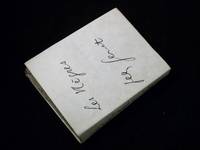
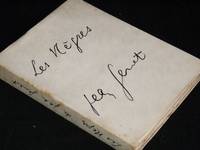
195838387Décines Décines-Charpieu: Marc Barbezat 1958. Fine. Marc Barbezat Décines Décines-Charpieu 1958 15.50 x 20.50 cm broché First edition one of 32 numbered copies on Japon nacre paper the tirage de tête. A fine copy. Marc Barbezat unknown
195841929Décines Décines-Charpieu: Marc Barbezat 1958. Fine. Marc Barbezat Décines Décines-Charpieu 1958 15 x 19.50 cm relié sous étui First edition one of 32 numbered copies on nacré Japon the tirage de tête. Bound in full embossed khaki leather smooth spine without lettering the title of the work and the author's name in gilt on the front cover reproducing the calligraphy of the original wrapper publishers name and place in gilt on the back cover likewise reproducing the calligraphy of the rear wrapper endpapers and pastedowns of wood-grain effect almond paper wrappers and spine preserved top edge gilt; slipcase covered with wood-grain effect almond paper echoing the binding and bearing on the covers the same features as the binding. A few small spots of foxing on the spine and upper edge slightly affecting the boards internally very clean. A rare copy spectacularly and perfectly presented. Marc Barbezat hardcover
195866731Paris: Gallimard 1958. Fine. Gallimard Paris 1958 14.50 x 21.50 cm broché First edition one of 35 numbered copies on Hollande the tirage de tête. A nice copy. Gallimard unknown
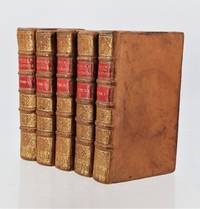
172882468A Londres London: Chez Théodore Le Gras 1728. Fine. Chez Théodore Le Gras A Londres London 1728 9.50 x 17 cm 5 volumes reliés Chez Théodore Le Gras à Paris 1728 12° 95x17cm 2 p. xvij 7 p. 346 pp.; 2 p. ij 376 pp.; 2 p. ij 387 pp.; 6 p. 392 pp.; 6 p. 404 pp. 5 volumes bound. First edition of this famous description of West Africa. 78 full-page engraved plates: - volume 1: 5 maps 2 plates and 1 folding plan - volume 2: 6 maps 17 plates and 4 folding plans - volume 3: 2 maps and 13 plates - volume 4: 5 maps 8 plates and 3 folding plans - volume 5: 3 maps and 9 plates First edition of this famous description of West Africa. Illustrated with 78 full-page engraved plates. Contemporary beige calf spine elaborately gilt 19th century red leather title and volume pieces all red edges. Joints and spine-ends very skillfully restored. An old strip of white paper hiding the name of a former owner on each volume. Based on the memoirs of André Brue director of the Senegal Royal Company this study contains interesting details on commercial companies in Mauritania Senegal Guinea Gambia and Sierra Leone customs of the inhabitants religious beliefs natural history etc. Many passages concern the slave trade. Jean-Baptiste Labat 1663-1738 more commonly known as Father Labat was a Dominican missionary botanist explorer ethnographer military man landowner engineer and writer. A staunch defender of slavery he played an important role in the sugar cane industry in the French West Indies. He is known for developing a type of brandy to cure fever which after some improvements became rum. Museum of Art and History Le Havre Chez Théodore Le Gras hardcover
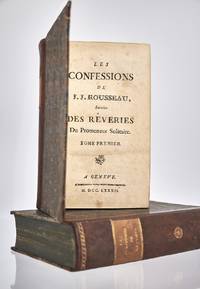
178275964à Genève Geneva: S. n. 1782. Fine. S. n. à Genève Geneva 1782 12 x 19 cm 2 volumes reliés Rare and genuine posthumous first edition of the first six books of the Confessions the remaining volumes not appearing until 1789. Several other editions were issued shortly thereafter but the evidence provided by the commentary published in the June 1782 issue of the Journal Helvétique clearly establishes that this separately printed edition known as the ""large type"" issue is indeed the very first F. Michaux ""L'Édition originale de la première partie des 'Confessions' de J.-J. Rousseau"" in Revue d'Histoire littéraire de la France 35th Year No. 2 1928 pp. 250-253. Contemporary half calf bindings flat spines tooled with gilt fillets and decorated with beige morocco title and volume labels marbled paper boards all edges blue. A handsome copy of this seminal text of the autobiographical genre preserved in a contemporary binding. S. n. hardcover
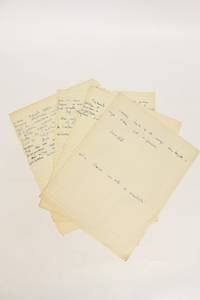
1952698341952. Fine. s. d. 1952 - 12 feuillets Autograph manuscript of 12 pages on squared sheets written in blue ink with numerous passages underlined. A previously unpublished set of reflections by Jean-Paul Sartre on social structure and bourgeois ideology probably written in 1952 as part of a projected screenplay on the revolutionary period. This series of interior dialogues on the nature of individual and collective power constitutes an early draft of the ideas later developed in his 1960 masterpiece Critique of Dialectical Reason. Through the example of the French Revolution and the Terror Sartre questions the role of the citizen and of property drawing on the writings of Kant Marx Rousseau Hobbes Saint Paul and Luther. This group of leaves shows numerous similarities in both content and form with two manuscripts dating from before 1953 now preserved at the University of Austin Texas the manuscript entitled Liberty Equality Harry Ransom Humanities Research Center collection and at the University of Ottawa the manuscript Screenplay / Joseph Le Bon . A reference in our manuscript to a study by Jean Vialatoux on Hobbes reissued in 1952 further supports its dating to that year. Throughout these pages one recognizes Sartres characteristic note-taking style composed of striking assertions and flashes of thought attacking social systems and structures: for the bourgeois can derive the sacred only from himself One is sacred insofar as one is the slave of the sovereign who defends each of his slaves against the other slaves . It is an opportunity for the philosopher to deploy numerous lines of reasoning and syllogisms and for the reader to follow in detail the course of his intellectual process: What then is the sovereign in relation to me 1/ My own will but alienated. It is returned to me as other. That is to say I re-interiorize it in the form of command duty and law. Example: I own and cultivate my land. I give my right to the sovereign. He confirms me in this possession . Through a series of tests applied to ideological assertions Sartre analyses the phenomenon of the devolution of power and the place of individual will thereby dismantling the mystique of the State of which Hobbes was the great theorist. The early 1950s correspond to a period of great productivity for the writer who stages his scandalous play The Devil and the Good Lord and mobilizes for the release of Henri Martin imprisoned for his action against the Indochina War. In 1952 he devotes himself to biographical projects with the publication of his Saint Genet and also begins work on an unfinished screenplay about the life of a little-known revolutionary the Montagnard Joseph Le Bon intended to be a sort of filmed philosophical biography rethinking the data emphasized by the historiography of the Revolution Philippe Gilles Construction du personnage et argumentation philosophique sur un scénario inédit de Jean-Paul Sartre the drafts of which are now preserved at the Universities of Ottawa and Austin. These handwritten notes probably form part of a body of reflections preliminary to the writing of this screenplay with substantial sections devoted to an anthropological and particularly innovative approach to the Terror aiming to understand the emergence of violence in History in the manuscript the germ of Terror : There is terror when pessimism turns into optimism without the original conception of man being changed. Then Evil becomes a parasitic thicket to be cleared away in order to recover the good. Evil is negating. Otherwise if we start from the idea that Man is metaphysically evil as the result of a free act from which one cannot return there is pessimism and not terror. Beyond the revolutionary period addressed in a few pages this manuscript reflects the underlying concerns and internal debate of Sartrean philosophy between individual and collective real and ideal sovereign and masses. unknown
194781881Paris: Gallimard 1947. Fine. Gallimard Paris 1947-1976 12 x 19 cm 10 volumes brochés sous chemises-étuis Each volume in its first edition: one of 30 numbered copies on Pur fil paper for the first one of 14 numbered copies on Hollande for the second and third one of 36 numbered copies on Hollande from the fourth to the ninth one of 35 numbered copies on Hollande for the tenth and last. Each work is presented in a brown half morocco slipcase smooth spine slightly sunned gilt date at the foot of spine marbled paper boards wood-like paper inside. A very nice complete set in 10 volumes and a very rare collection of first editions. There were only 14 copies ever printed on Hollande paper of the second and third volumes meaning that there are possibly only 14 complete sets in existence. Gallimard hardcover