Stephane MALLARMEBiblio.com
48 402 résultats
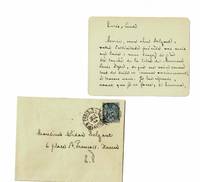
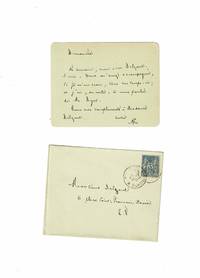
189476276Paris 1894. Fine. Paris 11 mars 1894 11.40 x 8.80 cm une carte recto et une enveloppe Autograph card signed by Stéphane Mallarmé addressed to Alidor Delzant written on the recto in black ink. Envelope attached. Alidor Delzant was a lawyer collector and bibliophile. Friend of the Goncourts he devoted a work to them and was the secretary and testamentary legatee of Edmond. Card written upon return from a trip to Oxford during which Mallarmé gave a lecture on aesthetics: "".j'ai du reste à vous parler de M. Dyer."" "".I have moreover to speak to you about M. Dyer."" Louis Dyer friend of Delzant is an Oxford alumnus and was then professor of Greek at Harvard. Through Delzant's intermediary he had offered hospitality to Mallarmé who did not know him before his lecture but this card attests that the two men finally met. unknown
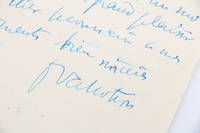
191787019Honfleur 1917. Fine. Honfleur 9 Juillet 1917 13.50 x 18 cm deux pages sur double feuillet Autograph letter dated and signed by Félix Vallotton 17 lines in black ink. Fold marks inherent to postal handling. With painters Henri Lebasque and René Piot Félix Vallotton traveled from June 7 to 23 1917 to Champagne and Argonne to make sketches and develop his ideas for paintings. Despite difficulties and delays of which he complains he would manage to propose four of his canvases to the Exhibition of War Painters organized by the Army Museum: ""Ruins at Souain"" ""The Church of Souain in Silhouette and Crater at Souain Evening"" ""The Bolante Plateau the Gruerie Wood the Paris Kiln"" ""Fire on the First Boche Lines and Senegalese Soldiers at Camp Bailly"" Subject to very brief deadlines by the French State Félix Vallotton rails against the lack of time granted to him: ""Lebasque me dit que le délai d'envoi expire le 20 de ce mois; C'est bien court ! N'y aurait-il pas moyen de prolonger un peu."" Lebasque tells me that the submission deadline expires on the 20th of this month; That's very short! Wouldn't there be a way to extend it a little. because his canvases are not quite finished: ""J'ai en train plusieurs toiles et il faut qu'elles sèchent et les envoyer et encadrer. S'il est possible de gagner ne fut-ce que quelques jours cela me rendrait grand service."" I have several canvases in progress and they need to dry and be sent and framed. If it's possible to gain even just a few days that would be of great service to me. unknown
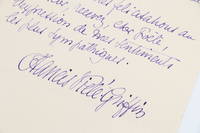
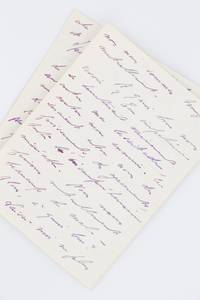
189684130Nazelles: S. n. 1896. Fine. S. n. Nazelles 4 Septembre 1896 13 x 20.50 cm une page Autograph letter signed by Francis Viélé-Griffin 23 lines in violet ink from his property in Nazelles in Indre-et-Loire addressed to Edouard Ducoté poet bibliophile and editor of the review l'Ermitage since 1895. Fold mark inherent to mailing. A perfectionist Francis Viélé-Griffin postpones sending a poem he had promised to the review l'Ermitage not yet judging it completely accomplished: "". ce scrupule est seul cause de mon retard et vous me le pardonnerez aisément."" ""this scruple alone causes my delay and you will easily forgive me."" He finds the quality of the previous issue of the review excellent and particularly praises the verses of his colleague Stuart Merrill: "". les vers de Merrill sont délicieux n'est-ce pas "" ""Merrill's verses are delightful aren't they"" and congratulates Edouard Ducoté. Intimate of Stéphane Mallarmé friend of André Gide Paul Valéry Francis Jammes Emile Verhaeren Francis Viélé-Griffin is an American symbolist poet writing in French. He becomes with Gustave Kahn one of the principal theorists of free verse. S. n. unknown
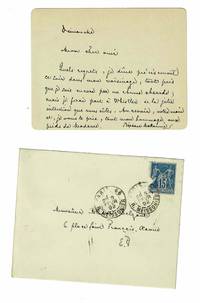
189276345Paris 1892. Fine. Paris 7 février 1892 11.40 x 8.80 cm une carte et une enveloppe Autograph letter signed by Stéphane Mallarmé addressed to Alidor Delzant written on the recto in black ink. Envelope included. Alidor Delzant was a lawyer collector and bibliophile. Friend of the Goncourts he devoted a work to them and was Edmond's secretary and testamentary legatee. ""Quels regrets je dîne précisément ce soir dans mon voisinage tout pris que je sois encore par un rhume absurde ; mais je ferai part à Whistler de la jolie intention que vous eûtes."" ""What regrets I am dining precisely this evening in my neighborhood taken as I still am by an absurd cold; but I will inform Whistler of the lovely intention you had."" unknown
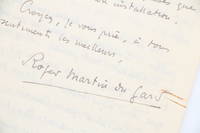
193387920Cassis 1933. Fine. Cassis 27 Juin 1933 13.50 x 21.50 cm trois pages et demi sur un bifeuillet Autograph letter dated and signed by Roger Martin du Gard 58 lines in black ink on a double sheet to the manager of his château du Tertre located in the Perche. While vacationing in Cassis: ""having fled this year with my wife the mists of the Perche"" Roger Martin du Gard has just learned from his wife who returned hastily to their château du Tertre that torrential rains have severely affected their property: ""Disaster in the house. the ceiling is nothing but a sieve it rains as much inside as outside. The terraces are starting to leak again from all sides. everything is affected: paintings wallpaper electrical conduits. What should I do"" The writer urges his correspondent to contact without delay the contractor whom he holds responsible for the defective work that caused this new damage: ""But the fact remains that all this is the contractor's fault and that it is unacceptable. I cannot accept having every two years ceilings and paintings to redo wallpaper to replace."" and against whom he wishes to initiate legal proceedings: ""The waterproofing of the terraces is the essential condition for this type of work and I think I am within my rights in taking action against the contractor. I therefore ask you to do urgently everything you deem necessary certain that you will take your own share of responsibility in this unfortunate affair."" To facilitate the renovation work the irritated father of the Thibaults warns his interlocutor that part of his family will inhabit the damaged château: ""There will therefore always be someone at the end of the line without you needing to route your correspondence through Cassis. I regret it but you must put yourself in my place and understand that I cannot accept this state of affairs."" unknown
190084131s. l. Paris: S. n. 1900. Fine. S. n. s. l. Paris 31 Mai 1900 13 x 20.50 cm une page Autograph letter signed by Francis Viélé-Griffin 15 lines in violet ink from his Parisian residence addressed to Edouard Ducoté poet bibliophile and editor of the review l'Ermitage since 1895. Fold mark inherent to mailing. To please the poetess Julia Daudet Francis Viélé-Griffin took the liberty of imposing verses on Edouard Ducoté for his review: "". je vous ai recommandé ces vers pour complaire à un souhait de madame Daudet je n'en ai pas pris connaissance ; mais reste songeur."" ""I recommended these verses to you to comply with a wish of Madame Daudet I have not read them; but remain thoughtful."" which the editor of l'Ermitage finds poor. Intimate of Stéphane Mallarmé friend of André Gide Paul Valéry Francis Jammes Emile Verhaeren Francis Viélé-Griffin is an American symbolist poet writing in French. He becomes with Gustave Kahn one of the principal theorists of free verse. S. n. unknown
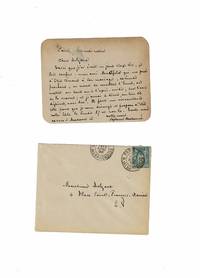
189676279Paris 1896. Fine. Paris 15 avril 1896 11.40 x 8.80 cm une carte recto et une enveloppe Signed autograph card from Stéphane Mallarmé addressed to Alidor Delzant written on the recto in black ink. Envelope included. A small water stain affecting the beginning of the card without hindering readability. Alidor Delzant was a lawyer collector and bibliophile. Friend of the Goncourts he devoted a work to them and was Edmond's secretary and testamentary legatee. ""Voici que j'écris un jour trop tôt je suis confus : mon ami Muhlfeld qui me prie d'être témoin à son mariage ce lundi prochain."" ""Here I am writing a day too early I am confused: my friend Muhlfeld who asks me to be witness at his wedding this coming Monday."" ""On the 20th of this month also spring-like he signs the municipal register as witness at the wedding of Lucien Muhlfeld one of the leading figures of La Revue blanche and all this fine company dines in evening dress at La Tour d'Argent enlivened by the laughter of Misia and the Natanson brothers."" Jean-Luc Steinmetz unknown
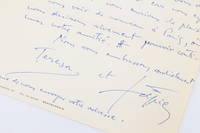
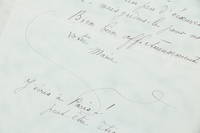
196984394Barcelone Barcelona 1969. Fine. Barcelone Barcelona 8 Juillet 1969 21.50 x 27.50 cm une feuille une enveloppe Autograph letter dated and signed by Antoni Tàpies addressed to his close friend art critic Georges Raillard the greatest French specialist of his work 16 lines in blue ballpoint pen from Barcelona. Fold marks inherent to the letter's mailing envelope included. Having directed the French Institute of Barcelona from 1964 to 1969 Georges Raillard befriended and collaborated with numerous Spanish and Catalan artists including Joan Miro and Antoni Tapies whose biographies he would also write. The Catalan artist regrets not being able to participate in the farewell dinner organized by his friends Georges and Alice Raillard but does not despair of seeing them again soon in order to maintain their friendship: ""En réalité c'est pour vous dire un simple au revoir car nous espérons que bientôt nous aurons le plaisir de vous voir de nouveau à Paris où nous désirons vivement pouvoir continuer notre amitié."" ""In reality it is to say a simple goodbye as we hope that soon we will have the pleasure of seeing you again in Paris where we keenly wish to be able to continue our friendship."" unknown
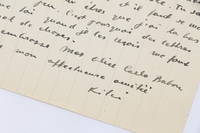
194083069s. l.: S. n. 1940. Fine. S. n. s. l. 17 octobre 1940 17.50 x 25.50 cm une feuille Autograph letter signed by Moïse Kisling addressed from his exile in Lisbon to Carlo Rim 30 lines in black ink deeply imbued with melancholic memories of his Provence which he cruelly misses: ""Ta lettre du 5. m'a donné envie de la sentir pour découvrir un peu d'ail pour sentir le mistral et toute la couleur du pays. Elle m'a apporté un peu d'arôme du pays."" ""Your letter of the 5th. made me want to smell it to discover a bit of garlic to feel the mistral and all the color of the country. It brought me a little aroma of the country."" Moïse Kisling questions his friend about fishing : "". elle ne doit pas être bonne en ce moment - nous allons vers novembre. Mais quelque fois la mer est bonne à cette époque. Parle-moi du poisson - quelle sacrée différence de ceux d'ici ! ah ! merde alors ! "" "". it must not be good right now - we're heading towards November. But sometimes the sea is good at this time. Tell me about the fish - what a damn difference from those here! ah! damn it then!"" and appears unenthusiastic about the idea of going to the United States to exhibit his works even further removed from his beloved Provence: ""Quand je serai dans le pays de dollars et j'en gagnerai sûrement je te commanderai des longues chroniques sur beaucoup de pages. Tu seras obligé de me raconter tous les potins du pays et tu prendra comme collaboratrice Alice."" ""When I am in the land of dollars and I will surely earn some I will commission from you long chronicles on many pages. You will be obliged to tell me all the gossip of the country and you will take Alice as collaborator."" The painter confesses to a certain melancholy linked to his retreat: "". toi aussi tu me manque vieux - du coup je deviens sentimentale. Tu sais Ici c'est la solitude complète et il faut se mettre à table pour écrire aux êtres que j'ai la bas pour s'oublier un peu. C'est pourquoi des lettres de gars comme toi quand je les reçois me font oublier pas mal de choses."" "". I miss you too old friend - so I'm becoming sentimental. You know Here it's complete solitude and one must sit at the table to write to the people I have back there to forget oneself a little. That's why letters from guys like you when I receive them make me forget quite a few things."" Folds inherent to posting. Carlo Rim was a Provençal writer author notably of ""Ma belle Marseille"" a caricaturist a filmmaker: ""Justin de Marseille"" ""L'armoire volante"" ""La maison Bonnadieu"" and was notably the friend of Fernandel Raimu and Marcel Pagnol but also of Max Jacob and André Salmon whom he met in Sanary. S. n. unknown
1826774711826. Fine. 1826 18.50 x 24 cm une feuille rempliée Autograph letter signed addressed to the painter Jean-Pierre Granger and dated April 24 1826 one page written in black ink with the correspondent's address on the verso. 15 lines in a beautiful slanted handwriting on a folded sheet. The celebrated Empire painter recommends to his colleague: ""a young man who seems very interesting to me and too young to enter my studio. Dear Grand Diable please do me the favor of taking good care of him in yours and when he has spent some time copying if it does not inconvenience you I will take him back with pleasure and well on his way."" Jean-Pierre Granger was first a pupil of Jean-Baptiste Regnault before joining Antoine-Jean Gros in Jacques-Louis David's studio. In 1800 he became laureate of the first Rome Prize for history painting with Antiochus renvoie son fils à Scipion Paris École nationale supérieure des beaux-arts while his fellow student Jean-Dominique Ingres received the second prize. unknown
193586294Paris 1935. Fine. Paris 24 Août 1935 15 x 19 cm deux pages sur un double feuilet une enveloppe Autograph letter signed by Marie Laurencin addressed to Marcelle Montclar 27 lines written in black ink on blue-green paper envelope included. Folds inherent to mailing a red ink stain in the lower left margin of the envelope. Marie Laurencin announces her upcoming departure for Lausanne and mentions the happy events she is experiencing and wishes to share with Marcelle Montclar: ""Je sais que tout ce qui m'arrive d'agréable vous touche. Tous les dramaturges m'ont télégraphié leur joie. Cela m'a fait plaisir. J'aime le théâtre les interprètes. . On m'offre en Suisse dans un endroit que je ne connais pas un petit pavillon de garde. Ce sont des poètes qui m'ont écrit "". Je vous raconterai et vous montrerai des épitres de nos amis. De ceux-là un peu d'écoeurement me vient. Mais gardons-le pour nous."" I know that everything pleasant that happens to me touches you. All the playwrights have telegraphed me their joy. It pleased me. I love the theater the performers. . I am offered in Switzerland in a place I do not know a small guard pavilion. It is poets who have written to me "". I will tell you and show you letters from our friends. From those ones a little disgust comes to me. But let us keep it between us. unknown
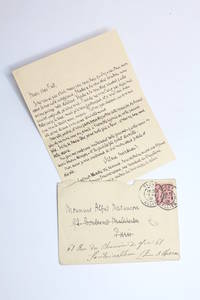
190673674Vichy 1906. Fine. Vichy 10 août 1906 11.60 x 18 cm une feuille Moving autograph letter signed by Octave Mirbeau addressed to the playwright and founder of the Revue Blanche Alfred Natanson when he had just lost his father. 18 lines in black ink on a folded sheet envelope included. ""Mon cher Fred Je ne vous ai pas écrit ; mais vous savez bien qu'il n'y a pas dans mon cur la moindre indifférence. Thadée a dû vous dire combien nous avions partagé votre douleur. Thadée a dû vous dire souvent quelle amitié profonde j'ai pour vous. Peut-être ne vous l'ai-je pas exprimée telle que je la sens mais je la sens fortement et je voudrais bien que vous la sentiez aussi un peu. C'est un gros chagrin que de ne plus être aimé de ceux qu'on aime véritablement. Vous allez partir ; et vous faîtes bien de quitter cette maison où durant plus de six mois vous avez assisté à l'horrible agonie de votre pauvre père. Tâchez de travailler pour notre joie à tous. et revenez avec une belle uvre."" ""My dear Fred I have not written to you; but you know well that there is not the slightest indifference in my heart. Thadée must have told you how much we shared your grief. Thadée must have told you often what deep friendship I have for you. Perhaps I have not expressed it to you as I feel it but I feel it strongly and I would very much like you to feel it too a little. It is a great sorrow to no longer be loved by those one truly loves. You are going to leave; and you do well to quit this house where for more than six months you witnessed the horrible agony of your poor father. Try to work for all our joy. and return with a beautiful work."". Mirbeau was particularly close to the group of the Revue Blanche since its launch in Paris in 1891. But it was since the Dreyfus affair that his intimate and lasting friendship with the Natanson brothers Thadée Alexandre and Alfred was strengthened. After aesthetic disagreements about Art Nouveau and the Nabis Mirbeau finally reunited with Thadée around 1900 in a now common inclination for the young Nabis painters of the Revue Blanche Bonnard Vallotton and Vuillard. The Revue Blanche played an essential role in France as confirmed by historian Paul-Henri Bourrelier: ""Most of the most prominent writers painters musicians politicians and intellectuals of the late 19th and early 20th centuries collaborated with it or were associated with it. Created financed and directed by the three Natanson brothers young Polish Jews with the enthusiastic complicity of their classmates from the Condorcet lycée La Revue blanche quickly became a place of debate on all subjects that stirred France. It waged political battles under the impulse of anarchists like Fénéon Mirbeau; socialists such as Blum G. Moch Péguy; Dreyfusards and founders of the League of Human Rights like Reinach and Pressensé."" unknown
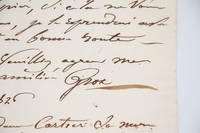
189476272Paris 1894. Fine. Paris 12 février 1894 11.40 x 8.80 cm une carte recto-verso et une enveloppe Autograph letter signed by Stéphane Mallarmé addressed to Alidor Delzant written on both sides in black ink. With envelope. Alidor Delzant was a lawyer collector and bibliophile. A friend of the Goncourts he devoted a work to them and served as secretary and testamentary legatee to Edmond. Mallarmé mentions a future stay in Oxford and thanks Delzant for having recommended him to a friend: "".vous songez si j'ai été touché de la lettre de Monsieur Louis Dyer de qui me voici connu tout de suite et comme anciennement à travers vous. Je lui réponds avant que je ne fasse si heureux sa connaissance. Hôte je ne pourrai l'être M. Powell qui a eu l'initiative de ma conférence m'ayant de longue date offert son toit pendant mon bref séjour à Oxford."" "".you can imagine how touched I was by the letter from Monsieur Louis Dyer through whom I find myself known immediately and as if from long ago through you. I am writing back to him before I have the pleasure of making his acquaintance. I will not be able to be a host as M. Powell who initiated my lecture has long since offered me his roof during my brief stay in Oxford."" Mallarmé would indeed give a lecture on aesthetics on March 1st 1894 at Oxford the text of which was published in 1895 under the title Oxford Cambridge. La musique et les lettres. unknown
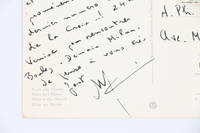
197379134Venise Venice 1973. Fine. Venise Venice 25 mai 1973 14.80 x 10.40 cm une carte postale Autograph postcard signed by Maurice Béjart addressed to André-Philippe Hersin written in black ink pen on the verso of a color photographic reproduction of the Viale alla Chiesa in Venice on which two monks reading appear. ""Brother Maurice and brother A. Philippe walk while reading the latest issue of Les Saisons de la Croix.! 24 hours in Venice to meet Boulez. Tomorrow Milan. I think of you very much - M."" Journalist dance critic and editor-in-chief of Les Saisons de la danse Hersin was a great defender of Béjart's choreographic style and devoted laudatory articles to him in his review as well as monographic fascicles on his work. unknown
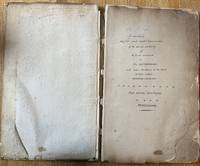
1773028953America 1773. Manuscript. Good. folio 5 ff. 163 5 pp. original manuscript bound in contemporary vellum front cover with title inked in early hand; binding darkened stained and rubbed with vellum cracked and peeling over spine. Sewing loosening; a number of leaves separated. Pages age-toned with minor offsetting edges of first few leaves tattered with the lower portion of title leaf chipped away. Apparently unpublished 18th century American manuscript dealing with natural religion the nature of prophecy and revelation and the definition of "real Christianity" vs. "Orthodoxy." The author seems to have been at least contemplating publication as a preliminary advertisement offers the usual disclaimer regarding a work "never intended. for the Eye of the Public" that might yet "accidentally fall into private Hands" of "Strangers." That advertisement is signed "W. D." with "America 1773." Supplied below in a slightly smaller finer lettering; text on p. 112 refers in passing to "this 28th Dec.r 1773." References to "modern" or current events are slim to nonexistent; but Liebnitz appears unfavorably. The author also cites more approvingly Drs. Clarke Sherlock and Burnet - along with "Machiavel" on the nature of governments. Gil Blas is mentioned as a history that might be viewed as truth by the credulous ages hence; Shaftesbury Voltaire and Locke are treated of in the last pages. The text is reasonably but not excessively erudite there are occasional forays into Greek and Latin; the work's tone is often combative with the author's negative opinions of much Jewish philosophy and doctrine bluntly expressed. <br /> books
00005422Rockville MD: By the Authors Unpaginated an early book guide to book collecting no date- from the famous bookdealers. Prices are fairly dated. By the Authors paperback
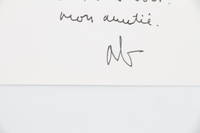
199279494Paris: S. n. 1992. Fine. S. n. Paris 18 Aout 1992 14.50 x 10.50 cm une feuille une enveloppe Signed manuscript card of 16 lines by Alphonse Boudard on a visiting card to his great friend and companion of well-watered lunches the Brussels journalist André Tillieu who was like Alphonse Boudard a great friend of Georges Brassens but also of Louis Nucéra. A year 92 added in blue ballpoint pen in the upper right corner of the card to specify the date. Envelope included. ""Vieux merci mille et une fois pour tes petits mots et les articles découpés dans la Presse belge. Avec mon éditeur ça voir le jour moins vite ! On ne peut être partout. meilleure santé à ta femme et bonnes vacances tout de même. A partir de demain je rejoins la rue Smolett à Nice et son champion cycliste écrivain Louis Nucéra. Au 42 . telef 92.04.10.95 si tu descends par là on sera content de te voir. mon amitié. AB."" ""Old friend thank you a thousand and one times for your little notes and the articles cut from the Belgian Press. With my publisher it sees the light less quickly! One cannot be everywhere. better health to your wife and good holidays nonetheless. Starting tomorrow I'm joining rue Smolett in Nice and its champion cyclist writer Louis Nucéra. At 42. phone 92.04.10.95 if you come down that way we'll be happy to see you. my friendship. AB."" André Tillieu from Brussels very close friend and biographer of Georges Brassens maintained an epistolary correspondence with Alphonse Boudard for almost thirty years from 1972 until the latter's death in 2000. The cheeky Parisian writer very quickly showed him his friendship considering him as one of the rare critics to understand him perfectly to the point of clearly explaining in his chronicles what he himself expressed only incompletely and sometimes confusedly in his books. André Tillieu thus became part of the small circle of true friends of Alphonse Boudard along with le Gros Georges Georges Brassens le Niçois Louis Nucéra and René Fallet with whom he loved to share hearty well-watered meals and cycling trips. As death gradually took away his best friends André Tillieu would remain one of Alphonse's very last pals. S. n. unknown
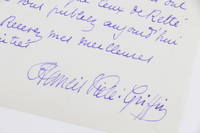
190479022Paris 1904. Fine. Paris s. d. septembre 1904 12.40 x 16.80 cm 8 pages sur 2 doubles feuillets Autograph letter signed ""Pauline"" from Renée Vivien addressed to Natalie Clifford Barney and written in purple ink on two double sheets with violet letterhead and address of 23 avenue du Bois de Boulogne. Transverse folds inherent to posting. A very beautiful and lengthy breakup letter addressed to the Amazon after her impromptu summer 1904 visit to Bayreuth to attempt to win Renée back: "". Les heures passées à Bayreuth étaient de la douceur : et c'est pourquoi je suis revenue."" ""The hours spent in Bayreuth were sweet: and that is why I returned."" The lexical field of death is omnipresent in this missive as if to better emphasize the definitive character of her decision: ""Pourquoi t'acharner à vouloir ranimer vainement les choses mortes Natalie Tu ne l'as point compris : ce que je cherchais auprès de toi c'était le souvenir et rien d'autre. On ne revit point l'autrefois. Tu dois le sentir comme moi-même. . Je souriais à mon passé. Il est doux parce qu'il est mort. Et toi tu veux galvaniser ce cadavre et le rendre odieux."" ""Why persist in trying to vainly revive dead things Natalie You have not understood: what I sought with you was memory and nothing else. One cannot relive the past. You must feel it as I do myself. . I smiled at my past. It is sweet because it is dead. And you you want to galvanize this corpse and make it odious."" The Muse of violets here reveals her suffering and disappointment pleading with Natalie twice: ""Laisse-moi ne plus revenir."" ""Let me not return again."" A veritable funeral oration for extinguished love this letter is very illuminating as to each one's way of loving: ""Nous nous sommes mal comprises. Je voulais un peu de rêve : tu m'offres la réalité."" ""We have misunderstood each other. I wanted a little dream: you offer me reality."" For this is what separates Renée - the dreamy and quasi-platonic poetess - and Natalie - the carnal and fickle lover: ""Ne sens-tu donc pas ne comprends-tu donc pas que je n'ai plus aucun désir d'amour Je suis lasse infiniment ; je ne voulais qu'un peu de douceur. Et tu m'offres la vie et les frissons que sais-je tout dont je ne me soucie point. Les joies charnelles Mais je les possède mon amie me les donne ma chair est satisfaite et au-delà. Je ne cherche point cela : je ne désire point cela. Ces choses m'excèdent venant de toi. J'espérais que assouvie de ton côté tu ne me demanderais que ce que je te demande : un peu de rêve lassé ; un peu de compréhension un peu de regret. Mais nous nous sommes trompées mutuellement. . Cherche un amour de chair chez une autre ."" ""Do you not feel do you not understand that I no longer have any desire for love I am infinitely weary; I wanted only a little sweetness. And you offer me life and thrills what do I know everything I care nothing about. Carnal joys But I possess them my friend gives them to me my flesh is satisfied and beyond. I do not seek that: I do not desire that. These things excess me coming from you. I hoped that satiated on your side you would ask of me only what I ask of you: a little weary dream; a little understanding a little regret. But we have deceived each other mutually. . Seek carnal love with another ."" It was at the end of 1899 and through the intermediary of Violette Shillito that Renée Vivien - then Pauline Tarn - made the acquaintance of Natalie Clifford Barney ""cette Américaine plus souple qu'une écharpe dont l'étincelant visage brille de cheveux d'or de prunelles bleu de mer de dents implacables"" ""this American more supple than a scarf whose sparkling face shines with golden hair sea-blue pupils implacable teeth"" Colette Claudine à Paris. Natalie who had just lived a summer idyll with the scandalous Liane de Pougy who had initiated her into sapphism paid only discrete attention to this new acquaintance. Renée however was totally capt unknown
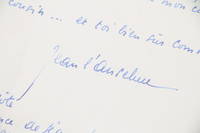
195588334s. l. 1955. Fine. s. l. s.d. ca 1955 21 x 27 cm une feuille Autograph letter signed one page by Jean L'Anselme addressed to his friend the poet Charles Dobzynski 23 lines in blue ink in which he discusses the project of an anthology of proletarian poetry where Charles Dobzynski could appear although the latter no longer considers himself to be regarded as a proletarian poet. Central creases inherent to folding for posting. Jean L'Anselme returns to his classification of so-called ""proletarian"" poets: ""No mystification it is indicated in my presentation that some of the poets presented have since transcended the proletarian condition but that the texts which are published nevertheless represent the testimony of a period of their existence."" who appear in his anthology soon to be published and which deserves some enlightening clarifications because Charles Dobzynski no longer seems to see himself as a proletarian-poet: ""One can very well announce in the preliminary lines with a few words your current situation if you so desire. One can even make you disappear completely if you demand it which would cause me some sorrow."" Jean L'Anselme will soon be a member of the C.N.E.: ""I will moreover have the opportunity to meet you shortly at the C.N.E. since I have made an application to enter - Abraham and Guillevic are my sponsors and as on the other hand Jouglet happens to be my cousin I will find myself among family. Sponsors! cousin. and you of course as a brother."" Jean L'Anselme is not a little proud to announce to his friend humorously the birth of his son: ""I announce to you the birth of Jean-Philippe which puts me in the ranks of the respectable."" unknown
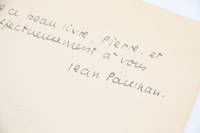
194586493Paris: S. n. 1945. Fine. S. n. Paris 27 Mai 1945 14 x 21.50 cm une page recto verso Laudatory autograph letter signed by Jean Paulhan 22 lines in black ink on Nrf letterhead addressed to Pierre Seghers congratulating him on the beauty of his latest collection entitled ""Le domaine public"" which the poet had recently sent him. Fold mark inherent to envelope insertion. Jean Paulhan does not hide his admiration for certain poems contained in this collection and the style that emerges from it: ""Ah j'aime bien aussi ma vérité et dans tous vos poèmes cette solennité tant pis c'est le mot cette solennité simple dont personne ne saurait dire d'où elle sort. il faut bien qu'elle ait toujours été là avec cette allure de grande personne de trop grande presque personne."" ""Ah I also love my truth and in all your poems this solemnity too bad that's the word this simple solemnity of which no one could say where it comes from. it must have always been there with this bearing of a great person too great almost a person."" He concludes this laudatory missive with: ""Merci de ce beau livre Pierre et affectueusement à vous."" ""Thank you for this beautiful book Pierre and affectionately yours."" S. n. unknown
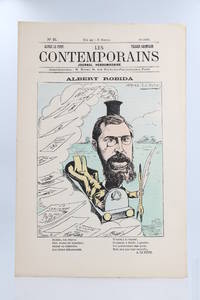
188079318Paris: Au bureau du Journal ""Les contemporains"" 1880. Fine. Au bureau du Journal ""Les contemporains"" Paris s. d. 1880 20 x 29.50 cm en feuilles First edition of this issue of the magazine founded by writer Félicien Champsaur and illustrator Alfred Le Petit consisting of two folded sheets. Handsome copy. On the first a color woodcut depicting Albert Robida by Alfred Le Petit. On the following text by Félicien Champsaur in first edition titled ""Albert Robida"". Au bureau du Journal ""Les contemporains"" unknown
189874340Paris: Imprimerie Champenoispour CH. MassonH. Piazza 1898. Fine. Imprimerie Champenois pour CH. Masson H. Piazza Paris Février 1898 31 x 27 cm une feuille et une serpente Rare original colour lithograph executed by Albert-Émile Artigue for L'Estampe Moderne series no. 10 published in February 1898. One of 50 deluxe proofs printed on Japon with wide margins artist's signature within the stone publisher's blindstamp depicting a child's profile in the lower margin numbered stamp of the deluxe issue on the verso; the print is preceded by a captioned tissue guard with the artist's name the title and an excerpt from the work; with additional plain tissue guard. Lithograph inspired by an excerpt from Emile Zola's novel La Faute de l'abbé Mouret reproduced on the tissue guard of the print. A magnificent French monthly publication issued between May 1897 and April 1899 L'Estampe Moderne comprises original chromolithographs which unlike other periodicals such as Les Maîtres de l'Affiche and as specified on the tissue guards were created expressly for the journal by each artist. In all 100 prints were published encompassing the major artistic movements of the late 19th century: Symbolism Art Nouveau the Pre-Raphaelites Orientalism and the Belle Époque. Each issue of four plates was printed in 2000 copies sold at 3.50 francs and 100 on Japon paper offered at 10 francs. Henri Piazza also planned an exclusive printing of the utmost luxury: 50 copies on Japon with wide margins and 50 in black on China paper at the considerable price of 30 francs. This large-format print is superbly printed on the most prestigious of papers: Japon. Thick silky satin-finished and pearly it elevates each sheet into a work of art in its own right. Its exceptional capacity for ink absorption and affinity with colour make it the ideal medium for these splendid lithographs. The interest of French collectors in artistic posters intensified at the beginning of the 1890s. Octave Uzanne to describe this craze coined the term affichomanie. The poster originally popular and pasted up on the streets of the capital then became an art object its ephemeral support transformed into something precious and destined for preservation. Piazza resolved to remove the poster from its advertising purpose and elevate it to the rank of a work of art in its own right on a par with the deluxe illustrated book. In this way he assembled a prestigious collection of entirely original works by the most prominent European artists of the time: Georges de Feure Eugène Grasset Henri Detouche Emile Berchmans Louis Rhead Gaston de Latenay Lucien Lévy-Dhurmer Gustave-Max Stevens Charles Doudelet Hans Christiansen Henri Fantin-Latour Steinlen Ibels Engels Willette Henri Meunier Evenepoël Bellery-Desfontaines Charles Léandre etc. A handsome copy. Imprimerie Champenoispour CH. MassonH. Piazza unknown
191675947s. l. 1916. Fine. s. l. s. d. vers 1916-1918 12.40 x 17 cm 2 pages sur un feuillet remplié Autograph letter signed by Georges Auric addressed to Bolette Natanson. Two pages written in black ink on a folded sheet. Folds inherent to mailing. Beautiful poetic letter with Rimbaldian influences: ""Alchimistes Rimbaud ! Eclair ouvre le ciel de mon adolescence ! Je me sens poète et c'est bien le moment de m'arrêter !"" ""Alchemists Rimbaud! Lightning opens the sky of my adolescence! I feel like a poet and this is the right moment to stop!"" Auric mentions a concert he must give at Mme Japy de Beaucourt's who held a salon in honor of the review directed by Ricciotto Canudo Montjoie ! : ""Je dois jouer - encore ! vendredi chez Mme J. de B. non point n'est ce pas Mme Jean de B mais Mme Canudo de Beaucourt"" ""I must play - again! Friday at Mme J. de B.'s not isn't it Mme Jean de B but Mme Canudo de Beaucourt"". He adds: ""Montjoie et Canudo gras et bête italboche."" ""Montjoie and Canudo fat and stupid Italian."" Having moved in artistic circles since her earliest childhood - she was the daughter of Alexandre and niece of Thadée Natanson creators of the famous Revue Blanche - Bolette Natanson 1892-1936 became friends with Jean Cocteau Raymond Radiguet Georges Auric Jean Hugo and Colette. Passionate about fashion she left Paris for the United States with Misia Sert close friend of Coco Chanel and was hired at Goodman. With her husband Jean-Charles Moreux they created the gallery Les Cadres on boulevard Saint-Honoré in 1929 and frequented numerous artists and intellectuals. Their success was immediate and they multiplied projects: creating the fireplace for Winnaretta de Polignac decorating the château de Maulny designing Baron de Rothschild's private mansion creating frames for industrialist Bernard Reichenbach and finally creating the storefront for Colette's beauty institute in 1932. Bolette Natanson also framed works by her prestigious painter friends: Bonnard Braque Picasso Vuillard Man Ray André Dunoyer de Segonzac etc. Despite this meteoric rise she took her own life in December 1936 a few months after her father's death. unknown
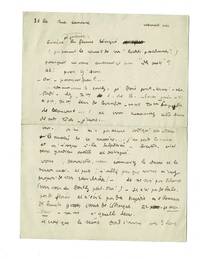
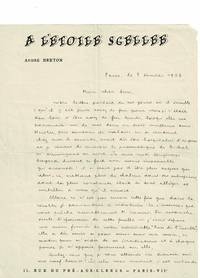
195375729Paris 1953. Fine. Paris 8 janvier 1953 21 x 27 cm 1 pages et quelques lignes sur un feuillet Unpublished handwritten signed letter from André Breton addressed to critic Charles Estienne; one page and a few lines in black ink on a paper from the à l'étoile scellée gallery. Two transverse folds from having been sent a small corner missing in the upper right margin. Very beautiful letter giving an account of the death of one of André Breton's dearest friends and of his quarrel with Albert Camus. Breton tells his friend about the death of the Surrealist Czech artist Jindich Heisler: Your letter spoke of those days where it seemed that there was only just enough fire to live: on Monday there was far from enough fire when it reached me: one of my two or three best friends Heisler taken suddenly unwell on his way to mine on Saturday had to be hospitalised urgently and I had just received the pneumatic from Bichat telling me of his death. The event no less inconceivable than accomplished left me distraught for a long time: there was no-one more exquisite than he putting more warmth into everything he did the most constant of which was to lighten and embellish those whom he loved. The two poets were indeed very close: Heisler participated alongside Breton in the launch of Néon in 1948 and supported him during a period of depression accompanying him with other friends to the Île de Sein. The beginning of 1953 was overshadowed by the death of Jindich Heisler 4 January. Loyal among the faithful he lived entirely for Surrealism according to Breton who pays tribute to his activity as a leader: This is how he was between 1948 and 1950 the soul of Néon and until his last moments the greatest bearer of projects that as if by magic his talent gave him the means to achieve. Henri Béhar André Breton In this letter laden with pain Breton suddenly makes reference to L'Homme révolté by Albert Camus published two years earlier: Come on it is not yet the time in the rebellion that I will succeed in introducing the measure that M. Camus kindly preaches to us. The two writers met in New York at the end of March 1946 when Camus was invited to the United States for a conference tour as a representative of Combat. The two agree on the best way to preserve the testimony of certain men free from ideological distortions. They dream of a kind of pact by which people of their calibre would commit to not join any political party to fight against the death penalty to never claim any credit whatsoever. ibid. With other intellectuals they founded the Rassemblement démocratique révolutionnaire RDR in 1948; but the idyll ended a couple of years later in the autumn of 1951 when Camus published Lautréamont et la banalité an extract from his Homme révolté which was published later. Breton was extremely hurt and responded to him in an article entitled Sucre jaune in Arts: This article . testifies to the part of Camus for the first time for an indefensible moral and intellectual position. . He only wants to see a guilty adolescent in Lautréamont whom he - in his capacity as an adult - must discipline. He goes as far as to find him in the second part of his work: Poésies a deserved punishment. According to Camus Poésies would be but a mass of laborious banalities . It could still be worse if the destitution of these views did not intend to promote the most suspect thesis in the world which is that absolute revolt can generate only the taste for intellectual enslavement. This is a completely gratuitous ultra-defeatist statement which must incur even more contempt than its false demonstration. Thus two years later Breton still holds out against Camus' crime of lese-majesty towards that which Breton constructed as the father of surrealism but even more this allusion to Camus' pacifist philosophy bearing witness to the incompatibility between a thought of moderation and a poetry of revol unknown
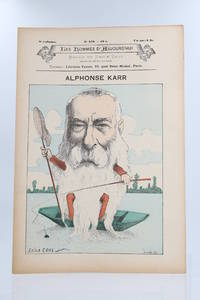
188879317Paris: Léon Vanier 1888. Fine. Léon Vanier Paris s. d. circa1888 20 x 29.50 cm en feuilles First edition of this issue of the magazine consisting of two folded sheets. Handsome copy. On the first a color woodcut depicting Alphonse Karr by Emile Cohl. On the following text by Pierre and Paul in first edition titled ""Alphonse Karr"". Léon Vanier unknown