Andre BRETONBiblio.com

48 402 résultats
193865954Services photographiques The New York Times 1938. Fine. Services photographiques The New York Times 18 janvier 1938 17.20 x 13 cm une photographie Original photograph contemporary silver halide print on crumière paper taken at the surrealist exhibition in Paris in 1938. Wide World Photos Services photographiques The New York Times imprinted on the verso. This picture depicts the object Cadavre exquis by André Breton which was exhibited in the room adjacent to the main room at the exhibition and surrounded by paintings by René Magritte and sculptures by Hans Arp. Stencilled inset glued on the back of the picture: International Surrealism Exhibition 1938 opens at the Beaux-arts gallery. Paris. What to think of this curious chest of drawers on a woman's legs Photo NYT Paris Fre. 18.1.38 DB. Services photographiques The New York Times unknown
192086986Paris: Mercure de France 1920. Fine. Mercure de France Paris 1920 13 x 19 cm broché First edition in French one of 525 numbered copies on laid paper the only deluxe copies announced along with 25 hors commerce copies. Handsome copy. Mercure de France unknown
191675943s. l. 1916. Fine. s. l. s. d. vers 1916-1918 12.40 x 17 cm 2 pages sur un feuillet remplié Signed autograph letter from Georges Auric addressed to Bolette Natanson. Two pages written in black ink on a folded sheet. Deletions and underlinings. Fold marks inherent to mailing. Very fine letter in which the composer dissertates on friendship: ""I simply wanted to tell you this important thing. I recommend that you not invite Florent Schmitt nor any 'artist'. Otherwise I declare myself incapable of resisting the vision of these evil geniuses. For more than ever people disgust me except you naturally. I would like to press a button and destroy Humanity. Then we will be at peace and I will tell you the truth about Art and the truth about all the things in which you have faith."" Auric also evokes music in this letter: ""Only Ravel's waltzes are noble and sentimental."" Having evolved from her earliest childhood in artistic circles - she is the daughter of Alexandre and the niece of Thadée Natanson the creators of the famous Revue Blanche - Bolette Natanson 1892-1936 befriended Jean Cocteau Raymond Radiguet Georges Auric Jean Hugo and Colette. Passionate about couture she left Paris for the United States with Misia Sert great friend of Coco Chanel and was hired at Goodman. With her husband Jean-Charles Moreux they created in 1929 the gallery Les Cadres on boulevard Saint-Honoré and frequented numerous artists and intellectuals. Their success was immediate and they multiplied projects: the creation of Winnaretta de Polignac's fireplace the decoration of the château de Maulny the layout of baron de Rothschild's private mansion the creation of frames for industrialist Bernard Reichenbach and finally the realization of Colette's beauty institute storefront in 1932. Bolette Natanson also framed the works of her prestigious painter friends: Bonnard Braque Picasso Vuillard Man Ray André Dunoyer de Segonzac etc. Despite this meteoric rise she took her own life in December 1936 a few months after her father's death. unknown
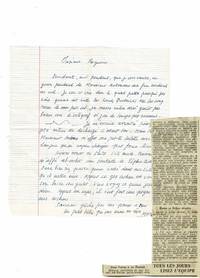
195976351Réalmont 1959. Fine. Réalmont s. d. cachet postal 1959 16.90 x 17.70 cm un feuillet une coupure de presse une enveloppe Delightful likely unpublished handwritten letter signed by an enigmatic Marijo a chambermaid by trade who in a Rabelaisian tone and a long string of puns writes from a hotel in Réalmont Tarn to the hussar Roger Nimier at his Paris office at La N.R.F. 20 lines on a squared sheet. Though the letter is unmistakably by Antoine Blondin it is unlikely to be in his hand and one of his companions probably lent his own to this farcical piece. The writer disguised as Marijo a distinctly illiterate maid recounts her sexual exploits with ""Monsieur Antouane"". A fine example of the anarchic and mischievous spirit that guided the not always steady but always inebriated steps of Antoine Blondin and of the boisterous and fraternal friendship that bound him to Roger Nimier. In a humorous and delightfully offbeat tone Blondin composes in a wildly phonetic and approximate spelling a pornographic tale told from the point of view of a hotel maid in whose establishment he is staying. Here follows the text faithfully transcribed with all its errors: the maid recounts to her ""Monsieur Rogeais Nimier"" an inebriated evening with ""Monsieur Antouane Blondin"" at a hotel: ""ce grand pendard . me fout sondard en cul. Je vous et cris à quat patte passqui pas raie quessa dit Latte les Saints Quetaires ou les cinq terres de mon peti cul. Je messe culse mai genêt pas beau cou d'ortograf si j'ai du temps pet rarement"". Roger Nimier his drinking and feasting companion is kept informed of his friends adventures through the witty turns of phrase Blondin puts in the mouth of this illiterate maid: ""Hyères souar ou Pluto Sète nuids Monsieur Antouane m'affet absorbet une bouteille de Pépère aide sic ! Onna bien riz parce queue cetté dans ma titte chatte qu'il mella mise"". Playing the bohemian and the carefree spirit Blondin ultimately embraced his image as a jovial rascal a poet fond of drink and merriment: ""Sannan pêche pas con panse à vous. Un petit têtre qui vous susse en rêve"" heor shesigns at the end of the letter. Speaking of the deep friendship he bore Roger Nimier and of the so-called myth of the Hussards Blondin told Emmanuel Legeard: Its the Hussards who are an invention. A Sartrian invention. In reality the story is this: my friend Frémanger who went into publishing had only one author Jacques Laurent and only one employeeme. Laurent wrote and I tied up the parcels of books. So we knew each other we were friends and moreover. moreover Roger Nimier was my best friend. I saw Nimier every day. I saw him every day for thirteen years. But Laurent and Nimier never saw each other. They had very different outlooks. We were brought together only once. We met on rue Marbeuf at the Quirinal for lunch. We talked about Italian wines and how to cook pasta. For two hours. Blondin encloses a newspaper clipping of one of his LÉquipe articles on a car race along with a card from the Hôtel-Restaurant Noël Galinier in Réalmont on which is written the menu of his meal: Ecrevisses / Saumon / Côtelettes dagneau / Cèpes / Conneries. Vins: Pas identifiés. Envelope included. The writer of Frances carnal spirit reveals through this letter to his closest friend a facet of his singular and complex inner world. unknown
194084633Perpignan 1940. Fine. Perpignan juillet 1940 21 x 27 cm deux pages sur un feuillet Autograph letter by Jean Cocteau signed with his famous star addressed to his great love the actor Jean Marais. Dated by the author July 1940. One and a half pages in black ink on a sheet. Two small marginal tears not affecting the text. Traces of transverse folds inherent to posting. Magnificent love letter from Cocteau to Marais who formed one of the most legendary artistic couples of the 20th century. Against the backdrop of defeat and German Occupation their unbreakable bond is embodied in this letter from the writer with its desperate accents. Published in the Lettres à Jean Marais 1987 p. 157. This missive from a love-stricken Cocteau was written shortly after the Armistice of June 22 1940 marking the end of the French defeat. Marais mobilized had joined the front in May 1940 while Cocteau had taken refuge in Perpignan. Communication in these troubled times proved difficult: ""Mon Jeannot j'attends toujours ta réponse mais avec une confiance absolue. Ce n'est pas pour rien que notre étoile nous a rapprochés l'un de l'autre et sans doute fallait-il que mes lettres ne t'arrivent pas et que je souffre de mon silence"" ""My Jeannot I am still waiting for your response but with absolute confidence. It is not for nothing that our star brought us closer to one another and no doubt it was necessary that my letters not reach you and that I suffer from my silence"" ""Tu es né chef je suis né chef. Et sous notre étoile rien de ce que nous . ne peut s'annexer ni se perdre. Le principal est de se taire et d'attendre. entre guillemets : les choses ont une manière à elles d'arriver."" C'est à nous de le savoir et de les laisser faire ."" ""You were born a leader I was born a leader. And under our star nothing of what we . can be annexed or lost. The main thing is to remain silent and wait. in quotation marks: things have their own way of happening."" It is up to us to know this and let them do so ."" The Cocteau - Marais partnership would soon return to Paris and endure the torments of the German occupation which would ban the revival of their scandalous play Les Parents terribles which had enjoyed great success in 1939. unknown
180785018Varsovie Warsaw 1807. Fine. Varsovie Warsaw 27 novembre 1807 18.60 x 23 cm Trois pages sur une double feuille Autograph letter signed by Marshal Davout then Governor General of Poland addressed to his wife Aimée Leclerc sister-in-law of Pauline Bonaparte. Three pages in black ink on a double sheet with his autograph address on the verso as well as the stamp of the Grande Armée and a broken wax seal armorial with the cipher ""LD"" on grand mantle and Marshal's batons under crown. Tears from opening affecting two words on the third page. After Davout's brilliant personal victory at Auerstedt the battles of Jena Eylau and Friedland which ended the war against the fourth coalition Davout reaps the fruits of his success. Covered with honors and benefits by the Emperor he enjoys his vast lands as the new Governor General of Poland. Benefiting from Napoleon's generosity which makes him the most endowed marshal of the Empire Davout intends to acquire the Hôtel de Monaco on rue Saint-Dominique previously occupied by the ambassador of the Sublime Porte: ""Tu as dû recevoir déjà les 300.000 F que l'empereur me fait donner précisément pour faire l'acquisition d'un hôtel à Paris. Ainsi ce nouveau bienfait de mon souverain ne pouvoit venir plus à propos"" ""You must have already received the 300000 F that the emperor gives me precisely to acquire a hotel in Paris. Thus this new benefit from my sovereign could not come more opportunely"". He entrusts the purchase and furnishing to his dear wife Aimée Leclerc: ""je m'en repose sur ma petite Aimée pour cette acquisition je çais qu'elle partage mes goûts"" ""I rely on my little Aimée for this acquisition I know that she shares my tastes"" . ""Je le trouverai d'autant plus beau que ce sera ma chère Aimée qui l'aura embelli et qui en aura fait une des plus belles habitations des environs de Paris"" ""I will find it all the more beautiful because it will be my dear Aimée who will have embellished it and made it one of the finest residences in the environs of Paris"" . Having no less than 18% of the Polish territories taken back from Prussia Davout writes to her wanting to sell a mill that was part of the ancient principality of Lowicz west of Warsaw in order to cover the expenses of his Parisian purchase. Also taking advantage of the inalienability attached to the Emperor's donations Davout plans to protect his wife's château at Savigny sur Orge by using the funds given by the Emperor to pay its debts. ""Je viens de recevoir ta lettre de Savigny. Celle que tu m'annonces m'avoir écrit la veille ne m'est point parvenue ma chère amie ainsi tes craintes se sont réalisées et le commissionnaire l'aura perdue. Tu me dis que si mon projet étoit d'acheter un hôtel le moment seroit assez favorable. Tu as dû recevoir déjà les 300.000 F que l'empereur me faitt donner précisément pour faire l'acquisition d'un hôtel à Paris. Ainsi ce nouveau bienfait de mon souverain ne pouvoit venir plus à propos ; je m'en repose sur ma petite Aimée pour cette acquisition je çais qu'elle partage mes goûts et qu'elle donnera la préférence à un hôtel propre qui n'exigera pas une grande représentation à un autre qui en exigerait une. Nous passerons certainement la plus grande partie de notre tems à ton Savigny leur château à Savigny-sur-Orge dans l'actuel département de l'Essonne. Je le trouverai d'autant plus beau que ce sera ma chère Aimée qui l'aura embelli et qui en aura fait une des plus belles habitations des environs de Paris. Je désire vivement voir terminer l'agraire du moulin je compte et j'en regarde la vente comme à peu près certaine. Ces 106.000F deveront peut être employés suivant les intentions de l'empereur pour faire partie du fief. Ton intention est-elle que devant 540.000F sur Savigny on emploie les fonds qui provienderont de la principauté de Lowicz à payer cette somme Dans cette supposition Savigny ferait partie du fief et ne pourroit jamais être aliéné. Cependant à la jalousie que mont unknown
1901716591901. Fine. 23 octobre 1901 9.80 x 15.50 cm une feuille Autograph letter from painter Pascal Dagnan-Bouveret requesting his correspondent's assistance in finding a position for a young clerk. 3 pages on a folded sheet. Trained in the studios of Alexandre Cabanel and Jean-Léon Gérôme Dagnan-Bouveret received the second Prix de Rome. Of naturalist inspiration he devoted himself to religious painting and had a prolific career as a portraitist at the end of his life. He received prestigious commissions from the Countess of Béarn and the New York Frick family. unknown
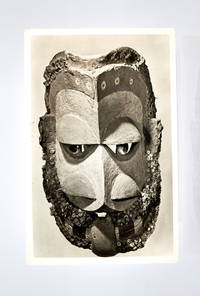
195875712Amsterdam 1958. Fine. Amsterdam 1958 13.90 x 8.90 cm une carte postale Autograph signed postcard addressed to Jean Schuster Amsterdam 1958 13.9 x 8.9 cm a postcard Handwritten postcard signed by André Breton addressed to Jean Schuster written in blue ballpoint pen on the back of a postcard reproducing a black and white photography of a Melanesian mask preserved at the Tropenmuseum in Amsterdam and which André Breton designates under the highly significant qualifier friend responsible for showing his affection to Jean Schuster. This grid pattern of canals and the tulip tiling leaves us in great indecision. . This country is decidedly very beautiful. His wife Elisa Breton added a few lines of a Surrealist tone following the main text: Elisa in Amsterdam comes from a gingerbread tin and a potential twisting from antiquarians. Jean Schuster 1929-1995 joined the Surrealist group in 1947. Close to Benjamin Péret and André Breton he will become Breton's executor. unknown
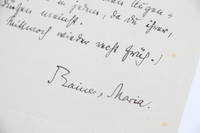
191886607Munich 1918. Fine. Letter to a Young Artist Munich Sonntag dimanche 3 novembre 1918 14.40 x 18.50 cm 2 pages et demi sur un bifeuillet enveloppe jointe Autograph letter in German signed by Rainer Maria Rilke to actress Else Hotop to whom he writes under her stage name Elya Maria Nevar. 2 1/2 pages written on a bifolium watermarked Sackleinen. Autograph envelope enclosed addressed to Else Hotop bearing postmarks dated November 3 1918.Published in Freundschaft mit Rainer Maria Rilke 1946 p. 35. A precious piece of Rilkes correspondence reflecting the delights of an enchanted afternoon spent during WW1 with the actress Elya Nevar one of his most fervent admirers. The truly active and creative period of young Elyas and Rainer-Marias attachment to each other is the beginning of their friendship with the discovery of the unknown the surprise of affinities that are revealed and finally what is so important in friendship as in love this intimacy that begins during a Bavarian autumn while the tumult of war rumbles in the distance Marcel Brion. This letter belongs to the beginnings of his relationship with the young Elya Nevar guardian of his solitude during Rilkes troubled Munich period where he experienced an inspiration crisis between The Notebooks of Malte Laurids Brigge and the Duino Elegies. We are just a few days away from the end of WW1. After brief encounters the previous year Rilke had rediscovered Elya Else Hotop during the summer of 1918 on the theater stage. Every evening he came to admire the actress nineteen years his junior who played the role of a medieval princess in a piece inspired by a 15th-century epic poem. She borrowed her characters stage name Elya by which Rilke addresses her. Their correspondence began a few weeks earlier after an intensely poetic note by Elya who greatly admired his Book of Hours 1905: she regards him as THE poet indestructible admirable and accepts everything from him including his indifference Rilke Catherine Sauvat. Romantic and cerebral the poet makes up for his absences with a beautiful declaration of affection in this letter: even if I was put off by many things from the intention of writing to you immediately at your first letter my attention has been close to you at many moments and it is so whenever you think you need it dear child. In spite of this they would spend moments together which soothed Rilke afflicted by a deep creative crisis and affected by the war years.I would have asked you to send me the book with your notes but look: when I got home late at night it was on my table. And since youre already familiar with the language of seals in our exchanges: you who are sincerely attentive. His mention of seal language alludes to one of their ritual Wednesday afternoon meetings at Rilkes house; the poet had gifted Elya a removable seal which could alternatively house a set of ten double-sided sigils engraved with symbols and written captions: We spent an afternoon playing like children drafting the twenty seals on a sheet of drawing paper and Rainer Maria wrote the text underneath in his delicate handwriting. The book with my notes mentioned by Rilke above was sealed with a sigil depicting an ancient mask with the inscription Lift it up! she later recalled. True to her art the actress had chosen the actors mask as her symbol. Rilke himself had a fascination for seals; he used the greyhound coat of arms inherited from his Czechoslovakian grandfather to seal his correspondence; and toward the end of his life living in Muzot he wished for these same arms to appear on his tombstone and accompany him into eternity. The poet was grateful for this delightfully quaint activity alongside his medieval princess fond of his eminently medieval Book of Hours: What you have written about the previous Wednesday this Wednesday so richly ours has gladdened my heart. As Marcel Brion observes it was in he unknown
18480008767circa 1848-9. Fine. 8.5 x 14.5 cm / 11 x 17.5 cm; <br/><br/>Having already accepted Texas as its 29th state in 1845 the U.S.A. in The Treaty of Guadalupe Hidalgo 2 February 1848 acquired 6 additional territories including Californa which eventually acquired statehood. This map was the recto of leaf 378/379 in probably a then-new history textbook. It is the same map with the identifier DLMW148 on the ImageBase of Virginia Tech University. This hand-colored in outline map shows the old boundaries and the new boundaries of Texas Upper California and Mexico and eastward to the Mississippi River and the Gulf of Mexico. unknown
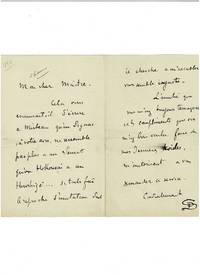
1894755111894. Fine. s. d. 23 janvier 1894 22.60 x 17.50 cm 2 pages sur un double feuillet déplié Autograph letter signed by Paul Signac addressed to Camille Pissarro written in black ink over two pages and signed with the artists monogram. This letter was transcribed in the article by Pierre Michel and Christian Limousin entitled ""Octave Mirbeau et Paul Signac - Une lettre inédite de Signac à Mirbeau"" in Cahiers Octave Mirbeau no. 16 March 2009 pp. 202-210. ""Mon cher Maître Cela vous ennuirait-il sic d'écrire à Mirbeau qu'un Signac à votre avis ne ressemble pas plus à un Seurat qu'un Hokousai à un Hiroshigé. si toutes fois sic le reproche d'imitation dont il cherche à m'accabler vous semble injuste. L'amitié que vous m'avez toujours témoignée et les compliments que vous avez bien voulu faire de mes toiles m'autorisent à vous demander ce service. Cordialement. PS"" A fine letter in which Paul Signac seeks the support of his master Camille Pissarro after a scathing critique published by Octave Mirbeau in L'Echo de Paris. In this article featured on the front page of L'Echo de Paris of 23 January 1894 Octave Mirbeau spares Signac no harshness: « M. Signac a voulu continuer Seurat. Je ne puis me faire à sa peinture. Je ne méconnais pas ses qualités mais elles disparaissent sous l'amoncellement de ses défauts. Ce qu'on admettait de Georges Seurat . on le comprend moins chez M. Signac qui n'en est que l'adepte trop complaisant et trop littéral. Et puis cette continuelle sécheresse me choque. M. Signac fait la nature immobile et figée. Jamais le vent n'a secoué la surface inerte de ses mers ni tordu les branches de ses pins ni animé l'éternelle fixité de ses nuages la raideur cartonnée de ses ciels. Il ignore le mouvement la vie l'âme qui est dans les choses. . Il serait peut-être temps pour notre joie que M. Signac voulût bien nous donner du Signac. Je crois qu'il le peut.» Why this obsession with Seurat « At the beginning of 1894 the position of Mirbeau Geffroy Pissarro and a few others was to consider that Neo-Impressionism had in fact died in 1891 with the passing of Seurat. Their retrospective view of this artistic venture led them to think that it was not a continuation of Impressionism by new scientific means but a reaction against it even a liquidation of the movement.» Cahiers Octave Mirbeau. Pissarros reply to Signac also transcribed by Michel and Limousin was not long in coming: it « l'ennuirait d'écrire ce que vous me demandez à Mirbeau et cela pour plusieurs raisons. . Premièrement parce que je suis en froid avec lui vous le savez bien. Deuxièmement parce que pour vous-même il ne sied pas de discuter l'opinion d'un critique même étant persuadé d'être dans le vrai et si vous voulez franchement ma façon de penser et que je suis heureux d'avoir l'occasion de vous exprimer je trouve que la méthode même est mauvaise. Au lieu de servir l'artiste l'ankylose et le glace. Si je vous ai fait des compliments cette année c'est parce que j'ai trouvé vos dernières toiles mieux que celles que vous aviez exposées aux Indépendants mais je suis loin de trouver que vous êtes dans la voie qui convient à votre tempérament essentiellement peintre et si jusqu'à présent je ne vous ai rien dit à ce sujet c'est parce que j'étais sûr de vous être désagréable et somme toute mes convictions peuvent ne pas être partagées par vous. Réfléchissez mûrement et voyez si le moment n'est pas venu de faire votre évolution vers un art plus de sensation plus libre et qui serait plus conforme à votre nature.» « Disheartened and deprived of the authority of a master revered by the critic Signac was left to devise himself without delay the reply to address to Mirbeau . » ibid. This response took the form of a long letter written the same day as the one offered here and now preserved at the Harry Ransom Center at the University of Austin Texas: « Je reconnais hautement que c'est Seurat qui a insta unknown
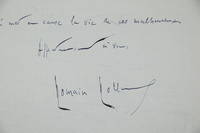
193386894Lucerne: S. n. 1933. Fine. The Reichstag fire seen by the foremost of pacifists S. n. Lucerne 18 Août1933 14 x 21.50 cm une page recto verso Autograph letter signed and dated by Romain Rolland 26 lines in blue ink denouncing the accusation by the Hitler regime of the participation of Bulgarian communist militants in the Reichstag fire. Georges Dimitrov head of the Comintern bureau for Western Europe is in Berlin in February 1933. On the night of February 27 the Nazi regime then in power for only a month takes advantage of the criminal arson of the Reichstag to impute responsibility to communist militants and the left-wing opposition. On March 9 Dimitrov is arrested with five of his companions including Tanev and Popov. After a long trial in Leipzig and a public counter-trial organized by German communist Willy Münzenberg Dimitrov is acquitted. Fold inherent to postal dispatch. Romain Rolland fully committed himself to the defense of his Bulgarian comrades incriminated by the Third Reich: ""Enclosed copy of the response I am addressing to the Reichsgerichtanwalt of Leipzig. I have made use of the indications provided by the international commission of inquiry on the Reichstag fire from which I received a detailed letter."" despite his precarious state of health: ""No I am not recovered. My health is still very poor but I could not leave unanswered this insidious letter from the Reichsgeritchanwalt which calls into question the lives of these unfortunates."" Tireless pacifist militant and scourge of imperialisms Romain Rolland also supports the liberation struggle of autonomist movements: ""For the Indo-Chinese it is very difficult to find available funds - which are lacking to come to the aid of the oppressed of Europe. Is there not a way that the International Commission of Amsterdam which is currently in the Far East could stop on the return in Indo-China."" Very beautiful letter from an intellectual engaged in the struggle against all imperialisms and dictatorial regimes. S. n. unknown
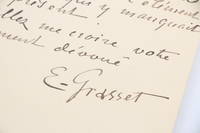
190286544Paris 1902. Fine. Paris s. d. ca 1902 11.50 x 9 cm une carte recto verso Autograph signed postcard from Eugène Grasset addressed to the painter Henri Jules Ferdinand Bellery-Desfontaines 18 lines written in black ink from his Parisian home on boulevard Arago. Fine copy. Eugène Grasset regrets having missed his fellow painter: ""J'ai beaucoup regretté m'être trouvé absent lors de votre visite."" I much regretted being absent during your visit. and compliments his friend on one of his latest productions: "".du lustre que vous avez composé et dont je vous fais mon compliment sincère. Cette reproduction enrichira mon prochain article d'un élément intéressant et qui y manquait jusqu'à présent."" .of the chandelier which you have composed and for which I offer you my sincere compliment. This reproduction will enrich my next article with an interesting element that was missing until now. unknown
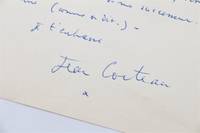
195483066s. l.: S. n. 1954. Fine. S. n. s. l. 27 avril 1954 21 x 27 cm une feuille Autograph letter signed by Jean Cocteau president of the jury of the 1954 Cannes festival which was held from March 25 to April 9 addressed to his friend Carlo Rim 17 lines in blue ink : ""cette étrange foire d'empoigne à laquelle j'essayai de donner quelque grâce"" ""this strange free-for-all to which I tried to give some grace"" Jean Cocteau further praises Carlo Rim's impartiality and clairvoyance: ""Je dois te dire ma reconnaissance pour ton oeil qui savait voir au dessus du lieu."" ""I must tell you my gratitude for your eye which knew how to see above the place."" and denounces the struggles of influence troubling and surrounding the awarding of prizes of which he bore the brunt : ""Le plus drôle c'est que ma dernière tentative de justice dérangeait encore de combinés - l'entourage de Clément ""The funniest thing is that my last attempt at justice still disturbed some schemes - Clément's entourage"" This refers to René Clément who was competing that year with Monsieur Ripois il n'y est pour rien espérant un scandale publicitaire annulé par le prix spécial. Les petits copains que tu connais dirent qu'on m'avait téléphoné de ordres sic."" ""he has nothing to do with it hoping for a publicity scandal cancelled by the special prize. The little friends you know said that I had been telephoned orders."" Satisfied to be rid of this cumbersome burden Jean Cocteau nonetheless advises his friend Carlo Rim jury member to be vigilant for the next edition of the festival: ""Le jeu n'étant pas la chandelle. L'année prochaine ouvre ""l'oeil"" sur le travail de mon successeur. il aura bonne mine comme on dit."" ""The game not being worth the candle. Next year keep an 'eye' on my successor's work. He will look good as they say."" In his letter Jean Cocteau mentions René Clément who was competing that year with ""Monsieur Ripois"" which thus obtained to the great joy and instigation of René Clément's entourage the grand jury prize ""Gate of Hell"" by Teinosuke Kinugasa winning the grand prize. Fold marks inherent to postal mailing. Provenance: from the Carlo Rim collection. Carlo Rim was a Provençal writer author notably of ""Ma belle Marseille"" a caricaturist a filmmaker: ""Justin de Marseille"" ""L'armoire volante"" ""La maison Bonnadieu"" and was notably the friend of Fernandel Raimu and Marcel Pagnol but also of Max Jacob and André Salmon whom he met in Sanary. S. n. unknown
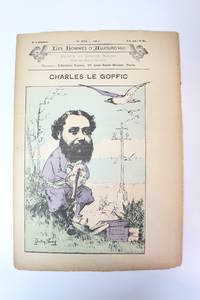
188873943Paris: Léon Vanier 1888. Fine. Léon Vanier Paris s. d. circa 1888 20 x 29.50 cm en feuilles First edition of this issue of the magazine consisting of two refolded sheets. Inevitable minor lacks of no consequence to the margins of the sheets. On the first a color woodcut representing Charles Le Goffic by Gaston Noury. On the following ones text by Charles Maurras in first edition entitled ""Charles Le Goffic"". Léon Vanier unknown
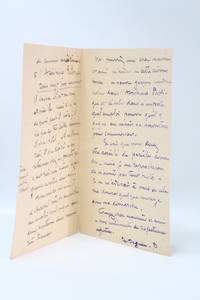
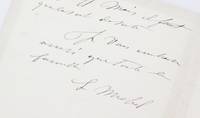
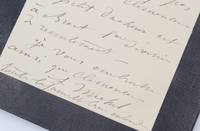
188783960s. l. Paris 1887. Fine. s. l. Paris 19 novembre 1887 11.30 x 17.70 cm 1 pages 1/2 sur un bifeuillet Autograph letter signed by Louise Michel addressed to Lucien Barrois; one and a half pages written in black ink on a bifolium of white paper with black border. Transverse folds inherent to mailing. ""Chauvière et d'autres amis communs vous prient bien de tâcher que Clemenceau recommande au professeur qui a la chaire de Russe au Collège de France et à la Sorbonne notre ami Gregorieff comme aide. Il paraît qu'avec un mot de Rochefort et de Clemenceau il serait immédiatement accepté ."" ""Chauvière and other mutual friends earnestly ask you to try to have Clemenceau recommend our friend Gregorieff as assistant to the professor who holds the Russian chair at the Collège de France and at the Sorbonne. It appears that with a word from Rochefort and Clemenceau he would be immediately accepted ."" The novelist P. Gregorieff had given some Russian lessons to Louise Michel. Moving letter testimony to the unfailing devotion of the former Communard. unknown
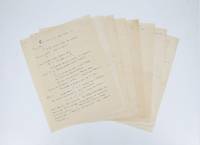
1930822781930. Fine. s. d. 21.40 x 27.20 cm 9 pages sur 8 feuillets ""In the end 5 hours of work for example to produce - per man - all that is necessary to man."" Complete unpublished autograph manuscript in French by Antoine de Saint-Exupéry. 9 pages on 8 leaves in black ink. Traces of horizontal and vertical folds. A small piece of paper missing in the center of two leaves. Exceptional unpublished manuscript by Saint-Exupéry to be compared with his political and economic reflections in Carnets 1989 p. 43. Personally affected by the 1929 crisis Saint-Exupéry the self-taught writer writes passionately about the economy and puts forward reform strategies. The manuscript features a lot of mathematical formulas and equations along with remarks To make the ideas clear about what is happening today p. 1 on the national economic system and the labor market. These unpublished pages testify to Saint-Exupéry's great intellectual curiosity his insatiable need for innovation in all fields of knowledge: mechanics technology politics economics. Saint-Exupéry writes on capitalist reform as he was an outspoken critic of the system which he later personified in The Little Prince businessman character. He develops theories where the State becomes the only employer banker and overall production manager: If the State pays all the salaries including those of the administrations and considers itself as owner of all the products nothing to be changed within the capitalist system in the sense that it can pay to the administrations special bonuses returning in their salaries and according to the quality as well as the quantity. He pays an amount X. He sells having taxed his stocks so that they express Y. His reflection is directly related to the stock market crash that bankrupted the Aéropostale the pioneering airline company where Saint-Exupéry had displayed his talents as an aviator-writer. One also remembers the splendid lines from Terre des Hommes on the value of work: The greatness of a profession is perhaps above all to unite men: there is only one true luxury and that is human relations. Concerned about a better distribution of wealth he develops throughout the pages several labor market and pension system theories halfway between Keynes and Marx. The writer was well aware of the value of labor having himself spent long hours on his aircrafts' mechanics. He details his views on the duration of a working day In the end 5 hours of work for example to produce per man all that is necessary to man. With little work and it is possible to supply men with everything that is and can with the increase of luxury become necessary to them and makes calculations on savings pensions purchasing power. His novels and personal writings contain numerous references to labor and hopes for a more equal human community: Saint-Exupéry was also a man of his time passionate about modernity especially technical innovation who constantly tried to reflect on all the problems that arose from it. Hence the countless notebooks notes and scattered sheets of paper that he constantly filled in and carried in his pockets and trunks with which he might one day have written a book. Jean-Claude Perrier Rare manuscript from a true Humanist a talented artist aviator novelist political and economic thinker. Saint-Exupéry tries to build a harmonious social order and lay the theoretical groundwork for an ideal society. unknown
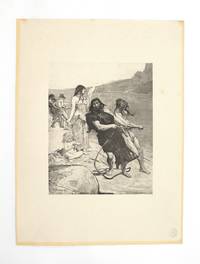
189874617Paris: Imprimerie Champenoispour CH. MassonH. Piazza 1898. Fine. Imprimerie Champenois pour CH. Masson H. Piazza Paris Décembre 1898 25 x 31.50 cm une feuille Rare original lithograph executed by Fernand Cormon for L'Estampe Moderne series number 20 published in December 1898. One of 50 deluxe proofs printed on China paper with wide margins signed by the artist and dated in the plate publisher's dry stamp representing a child's profile in the lower margin mounted on a sheet of laid paper with the numbered deluxe edition stamp on the verso some foxing. Lithograph inspired by an extract from Vamireh roman des temps primitifs by Joseph-Henri Rosny. Magnificent French monthly publication edited between May 1897 and April 1899 L'Estampe moderne consists of original chromolithographs which unlike other journals such as Les Maîtres de l'Affiche and as stipulated on the tissue guards were created specially by each artist for the journal. Thus 100 prints appeared in total covering the major artistic movements of the late nineteenth century: Symbolism Art Nouveau Pre-Raphaelites Orientalists and Belle Époque. Each issue of four prints was printed in 2000 copies sold for 3.50F and 100 on Japan paper offered at 10F. Henri Piazza also planned a confidential deluxe printing: 50 copies on Japan paper with wide margins and 50 in black on China paper at the considerable price of 30F. This print of handsome format is superbly printed on one of the most prestigious papers: China paper. ""Despite all its qualities China paper too insubstantial owes its reputation not to its own beauty but rather to its particular affinity with printing ink. Its texture smooth and soft at once is more apt than any other to receive a beautiful impression. This property makes China paper sought after for printing engravings."" Anatole France. The interest of French collectors in artistic posters grew at the beginning of the 1890s. Octave Uzanne to qualify this fever invented the term ""affichomanie"". The poster originally popular and pasted on the streets of the capital then became an art object and its ephemeral medium became precious and destined for preservation. Piazza decided to remove the poster from its advertising vocation and elevate it to the rank of a complete work of art on the same level as the luxury illustrated book. He thus composed a prestigious collection of entirely original works by the most prominent European artists of the moment: Georges de Feure Eugène Grasset Henri Detouche Emile Berchmans Louis Rhead Gaston de Latenay Lucien Lévy-Dhurmer Gustave-Max Stevens Charles Doudelet Hans Christiansen Henri Fantin-Latour Steinlen Ibels Engels Willette Henri Meunier Evenepoël Bellery-Desfontaines Charles Léandre etc. A handsome copy. Imprimerie Champenoispour CH. MassonH. Piazza unknown
189874616Paris: Imprimerie Champenoispour CH. MassonH. Piazza 1898. Fine. Imprimerie Champenois pour CH. Masson H. Piazza Paris Décembre 1898 25 x 31.50 cm une feuille et une serpente Rare original lithograph in shades of grey and sepia executed by Fernand Cormon for L'Estampe Moderne series number 20 published in December 1898. One of 50 deluxe proofs printed on Japan paper with wide margins laid paper mounted on Japan paper signed by the artist and dated in the plate publisher's dry stamp representing a child's profile in the lower margin numbered deluxe edition stamp on the verso; engraving preceded by a tissue guard captioned with the artist's name the title and an extract from the work. Lithograph inspired by an extract from Vamireh roman des temps primitifs by Joseph-Henri Rosny reproduced on the tissue guard of the print. Magnificent French monthly publication edited between May 1897 and April 1899 L'Estampe moderne consists of original chromolithographs which unlike other journals such as Les Maîtres de l'Affiche and as stipulated on the tissue guards were created specially by each artist for the journal. Thus 100 prints appeared in total covering the major artistic movements of the late nineteenth century: Symbolism Art Nouveau Pre-Raphaelites Orientalists and Belle Époque. Each issue of four prints was printed in 2000 copies sold for 3.50F and 100 on Japan paper offered at 10F. Henri Piazza also planned a confidential deluxe printing: 50 copies on Japan paper with wide margins and 50 in black on China paper at the considerable price of 30F. This print of handsome format is superbly printed on the most prestigious of papers: Japan paper. Thick silky satined and pearlescent it contributes to making each page a work in its own right. Its quality of ink absorption and its affinity with colors also make it the ideal medium for these very beautiful lithographs. The interest of French collectors in artistic posters grew at the beginning of the 1890s. Octave Uzanne to qualify this fever invented the term ""affichomanie"". The poster originally popular and pasted on the streets of the capital then became an art object and its ephemeral medium became precious and destined for preservation. Piazza decided to remove the poster from its advertising vocation and elevate it to the rank of a complete work of art on the same level as the luxury illustrated book. He thus composed a prestigious collection of entirely original works by the most prominent European artists of the moment: Georges de Feure Eugène Grasset Henri Detouche Emile Berchmans Louis Rhead Gaston de Latenay Lucien Lévy-Dhurmer Gustave-Max Stevens Charles Doudelet Hans Christiansen Henri Fantin-Latour Steinlen Ibels Engels Willette Henri Meunier Evenepoël Bellery-Desfontaines Charles Léandre etc. A handsome copy. Imprimerie Champenoispour CH. MassonH. Piazza unknown
188583964s. l. Paris 1885. Fine. s. l. Paris 6 février 1885 11.10 x 17.60 cm 1 page 1/2 sur un bifeuillet Autograph letter signed by Louise Michel addressed to Lucien Barrois; one and a half pages written in black ink on a bifolium of white paper with black border. Transverse folds inherent to mailing. A trace of glue on the second sheet where Louise Michel had probably pasted a letter from her cousin. News of Louise Michel's little cousin Lucien Dacheux: ""Je reçois une lettre de mon petit cousin Dacheux qui me demande de remercier encore pour lui Clemenceau et lui. Je le fais moi-même de tout coeur. N'oubliez pas de le dire à Clemenceau. Le petit Dacheux est à Brest 1ère division de recrutement. . Clemenceau serait en droit de dire que je suis bien ennuyeuse mais montrez lui la lettre du petit si on pouvait obtenir qu'il ait un peu d'instruction. Je ne sais pas s'ils peuvent avoir des leçons. Y a-t-il une école je ne sais rien de tout cela dans la division où il est."" ""I receive a letter from my little cousin Dacheux who asks me to thank Clemenceau and him again on his behalf. I do so myself wholeheartedly. Don't forget to tell Clemenceau. Little Dacheux is in Brest 1st recruitment division. . Clemenceau would have the right to say that I am quite bothersome but show him the little one's letter if we could obtain that he have a little education. I don't know if they can have lessons. Is there a school I know nothing of all that in the division where he is."" Moving letter testimony to the unfailing devotion of the former communard. unknown
196486531Piozzo Italie Piozzo: S. n. 1964. Fine. S. n. Piozzo Italie Piozzo 7 Octobre 1964 21 x 27 cm une page et demie une enveloppe Moving autograph letter dated and signed by Jacques-Henri Lartigue 26 lines in blue ballpoint pen addressed from Piozzo in Italy to his friend Jane Willemetz who has just lost her husband the librettist lyricist and screenwriter Albert Willemetz. Fold mark inherent to the mailing. Envelope included. The photographer overwhelmed by the deaths of their close friends feels overcome by melancholy: ""How far from Paris I feel today. too far to come and embrace you. You know that I am grieving! ."" He cannot stop thinking about recently departed friends: ""First my Sacha! after Jean Cocteau! And now our wonderful charming and luminous Albert! How many irreplaceable friends! "" and attempts to comfort Jane Willemetz: ""But I do not want to speak to you today and only to embrace you with all my great affection. You and yours."" S. n. unknown
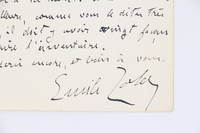
188279111Médan 1882. Fine. Médan 1er décembre 1882 13.60 x 21.40 cm 2 pages sur un double feuillet - enveloppe jointe Autograph letter signed by Emile Zola - apparently unpublished - written in black ink on a double sheet and addressed to Léon Carbonnaux department head at Bon Marché. Folds inherent to mailing. Envelope included. Only two letters from Léon Carbonnaux to Emile Zola are known: they can be consulted in the digitized preparatory file for Au bonheur des dames made available online by the Bibliothèque nationale de France. However we know from this same file which contains a long section entitled ""Notes Carbonnaux"" that this department head at Bon Marché provided Zola with a significant amount of information particularly about employee customs their remuneration and especially inventory techniques. The two men probably met when Emile Zola eager for information about the workings of department stores conducted field research in February and March 1882. Very important unpublished letter shedding new light on the pre-original publication of Au bonheur des dames. In his biography of Emile Zola Henri Mitterrand writes: ""Even before the novel was completed Zola gave an extract to Panurge in November; and on November 23 1882 Gil Blas announced its imminent publication in its columns."" Our letter discussing precisely this alleged pre-publication in Panurge attests that it was simply a joke and thus contradicts Henri Mitterrand: ""But your letter surprises and saddens me somewhat. How could you have been taken in by Panurge's stupid joke Did you not notice that the entire issue is a 'farce' Not one of the articles is authentic they are parodies and very poorly done ones at that."" Indeed reading the said extract cannot fool the assiduous reader of Zola despite the introduction that the journalists wrote: ""After Nana and Pot-Bouille those epics of elegant vice and bourgeois vice M. Emile Zola wanted to create one of honesty: Au bonheur des Dames which will appear shortly is a reassuring painting of innocence and virtue; the greatest success is assured for this new work whose characters move in the setting of a large novelty store; Parisian high commerce will not long await its observer and painter. We thank Emile Zola for having kindly cut out especially for Panurge a few pages from his still unpublished work and we are proud to give the public first an extract from this work of such high morality and such powerful interest."" Panurge no. 4 of October 22 1882 The sentences of this false Zolian text are exaggeratedly long and Panurge took the liberty of endowing the novel with a male main character Denis Mouret an amalgam of Denise the true heroine of the book to appear and Octave Mouret. One can think that it is a text composed from elements of Pot-Bouille the previous volume of Rougon Macquart where Octave - future owner of Bonheur des Dames - exercised the function of clerk before his meteoric social rise: ""For already more than two months he had been attached to the 'silks and furs' department; he arrived in the morning at seven o'clock to return home his day finished only at nine o'clock in the evening when all of Paris buzzed strangely with a feverish animation of pleasure and enjoyment and on his way back he followed gawking the great crowded boulevards where blazed the cafés full of girls and where on the asphalt at theater doors the crowd jostled with here and there in the vague rumor of trampling and pressing the roguish intonation of the cries of program vendors and ticket sellers."" Panurge In his letter of November 30 1882 Léon Carbonnaux - reading the extract from Panurge - had reproached Zola for his errors: ""Nowhere except at the Fabriques de France near Les Halles does one arrive at 7 a.m. It's at the earliest 7:30 but more often 8 a.m. and even then. There is no silk and fur counter at the Louvre. . It is so easy for you to be accurate that errors of this kind especially if t unknown
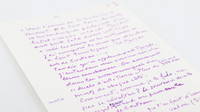
198086791s. l.: S. n. 1980. Fine. S. n. s. l. s. d. ca 1980 14.50 x 21 cm 1 page Manuscript note with corrections by Philippe Soupault 22 lines in purple ink on a sheet bearing at the top this inscription: ""p.14 bis"" recalling the creation on May 18 1917 at the Théâtre du Châtelet in Paris of the famous ballet Parade by Sergei Diaghilev's Ballets Russes on a text by Jean Cocteau music by Erik Satie and scenography by Pablo Picasso. This work being inspired by Georges Seurat's painting Circus Sideshow. The co-author with André Breton of the surrealist manifesto ""Les champs magnétiques"" relegates the ballet to the rank of distraction for rear-guard shirkers completely unconscious of the historical stakes of the moment: ""C'était l'année de la bataille de Verdun le Tout-Paris les snobs et les embusqués parlaient d'un ballet ""russe"" intitulé Parade 1 dont Erik Satie disait : ""Picasso a créé les décors et les costumes et j'ai composé la musique et Cocteau a écrit trois lignes. Et Parade est de Cocteau."""" It was the year of the Battle of Verdun all of Paris the snobs and draft dodgers were talking about a ""Russian"" ballet titled Parade 1 of which Erik Satie said: ""Picasso created the sets and costumes and I composed the music and Cocteau wrote three lines. And Parade is by Cocteau."". Philippe Soupault is outraged by such indifference to the fate of the valorous Poilus in the trenches: ""Tandis qu'on applaudissait Parade j'entendais mes voisins revivre leurs cauchemars. On annonçait dans les communiqués des ""duels d'artillerie"". Plus de trois cents mille morts de chaque côté. Comment comme je le fis ne pas se révolter Le souvenir de cette révolte surgit en moi en prononçant le nom de Cocteau."" While they were applauding Parade I heard my neighbors reliving their nightmares. The communiqués announced ""artillery duels"". More than three hundred thousand dead on each side. How as I did not to revolt The memory of this revolt surges in me upon pronouncing Cocteau's name. Fascinating and acerbic memories from the last living historical surrealist concerning the revolutionary ballet ""Parade"" likening it to a preoccupation of idle bourgeois neglecting the hecatombs of the Great War. S. n. unknown
190379583Tahiti Tahiti 1903. Fine. Tahiti Tahiti 7 & 9 novembre 1903 12 x 19.80 cm 6 pages sur 3 feuillets Double autograph letter signed by Victor Segalen addressed to Emile Mignard. Six pages written in black ink on three lined sheets. Transverse folds inherent to the mailing angular tear to the first sheet without loss of text some restorations using paper strips. Emile Mignard 1878-1966 also a doctor and native of Brest was one of Segalen's closest childhood friends whom he met at the Jesuit college Notre-Dame-de-Bon-Secours in Brest. The writer maintained an abundant and very regular correspondence with this friend in which he described with humor and intimacy his daily life in all four corners of the globe. It was at Mignard's wedding on February 15 1905 that Segalen met his wife Yvonne Hébert. Fine letter on love conjugated in past present and future tenses. Segalen announces to his friend the marriage of a past acquaintance: « Une se marie qui nous eût été chère mon cher petit. Car c'est d'elle que tu voulais me parler n'est-ce pas : Alice épouse ou épousera un juge de Châteaulin. Pendant ma fièvre à San Francisco m'avait obsédé l'idée qu'elle serait peut-être un jour ma femme ; alors qu'au départ nous étions certes sans une arrière-pensée. » ""One is marrying who would have been dear to us my dear little one. For it is of her that you wanted to speak to me isn't it: Alice marries or will marry a judge from Châteaulin. During my fever in San Francisco I was obsessed with the idea that she might perhaps one day be my wife; whereas at the outset we were certainly without any ulterior motive."" Despite his currently unstable sentimental life he declares solemnly: « J'ai confiance forcément pour nous en l'avenir. Elle viendra cette Désirée que nous attendons tous les deux. Alors nous serons plus forts plus dignes d'Elle. Chaque « mieux » constaté en moi-même je le leur reporte en offrande. » ""I have confidence necessarily for us in the future. She will come this Desired One that we both await. Then we will be stronger more worthy of Her. Each 'better' that I note in myself I offer to them as an offering."" This ""Desired One"" Victor would find in the person of Yvonne Hébert precisely met through Emile Mignard and whom he would marry on June 2 1905. A few weeks after their meeting he would offer her a copy of his thesis inscribed with a very fine autograph inscription that echoes our letter: ""For my beloved fiancée my Yvonne. For the one I have always sought. In gratitude for Her and in certainty of infinite affection. April 5 1905"". But let us return to Tahiti where Dr. Segalen after having lived several quasi-marital relationships has made resolutions: « Complètement affranchi des Tahitiennes j'ai trouvé bien plus intelligent au lieu de m'asservir au sexe faible de m'en servir sans plus de sentimentalité. Je dois avouer que Tahiti ne m'offre à vrai dire aucun type de femme vraiment et totalement désirable. » ""Completely freed from Tahitian women I found it much more intelligent instead of enslaving myself to the weaker sex to use them without further sentimentality. I must admit that Tahiti truly offers me no type of woman really and totally desirable."" He is even indignant at the behavior of newly arrived Europeans: « C'est ainsi d'ailleurs que le comprend mon médecin de division le Dr Michel du Protet le croiseur qui nous gère. Sitôt débarqué il m'a demandé « des femmes ». J'ai pu noter de sang froid et repu moi-même les ruts terribles et comiques d'un état-major qui vient de faire 15 jours de mer. Papeete n'ayant pas de ces Maisons Hospitalières que. ils ont failli violer quantité d' « honnêtes femmes ». Ainsi de même étions-nous sans nous en rendre compte à notre arrivée à Nouméa. » ""This is moreover how my division doctor understands it Dr. Michel from the Protet the cruiser that manages us. As soon as he disembarked he asked me for 'women'. I was able to note coldly and sated mys unknown
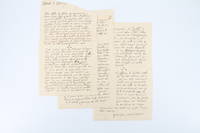
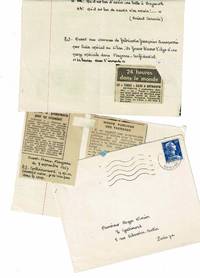
195776354Laval: s. n. 1957. Fine. s. n. Laval 11 septembre 1957 17 x 12.90 cm 2 feuillets avec coupures de presse contrecollées Amusing press review commented by Antoine Blondin addressed to Roger Nimier at his Parisian office at the N.R.F. Blondin sends his lifelong friend newspaper clippings from local papers which he pastes on squared sheets. Envelope included. Beautiful manifestation of the anarchist and zany spirit that guided the steps not often steady but always soaked of Antoine Blondin and of the fraternal and thunderous friendship that united him with Roger Nimier. The star of sports journalism prepares for Nimier a collection of news items taken from Ouest France Mayenne: Feeding his own reputation as a ribald and wine-soaked bohemian he sends the story of a memorable drinking bout that he could easily have been the cause of: ""He mistakes the gendarmerie for a tavern . Camille Paumelle 36 years old yesterday evening invited a chance acquaintance to drink a 'good bottle' and led him. towards the gendarmerie"" reads the press clipping. Blondin adds ""P.S.: Contrary to what one might think I am not involved in this affair"". On the same sheet Blondin pastes a clipping about a ""public mounting of bulls . Cow having the most beautiful udder"" and adds: ""P.S. contrary to what one might think I am not involved in this affair either."" He pastes on a second sheet a newspaper clipping titled ""24 hours around the world"" and parodies it as ""24 hours in the vile world"". The press clipping continues thus: ""The 'Times' magazine which had published on its last page a large photo of French-made tanks transported by special train to Lebanon has been seized in Beirut""; Blondin adds ""As for the French-made charms transported by special train to Lebanon they will soon be the subject of a special page in Mayenne-Confidential"". Regarding the deep friendship that Blondin showed to Roger Nimier and the myth of the Hussards the author declared to Emmanuel Legeard who was interviewing him: ""It's the 'hussards' who are an invention. A 'Sartrean' invention. In reality the story is my friend Frémanger who had launched into publishing who had only one author that was Jacques Laurent and only one employee that was me. Laurent wrote and I tied up the packages of books. So we knew each other we were friends and on the other hand. on the other hand Roger Nimier was my best friend. Nimier I saw him every day. I saw him every day for thirteen years. But Laurent and Nimier didn't frequent each other at all. They had very different conceptions. We were brought together only once. We met on rue Marbeuf at the Quirinal for lunch. We discussed Italian wines and the cooking of noodles. For two hours."" s. n. unknown