Andre BRETON - (Guillaume APOLLINAIRE)Biblio.com
48 390 résultats
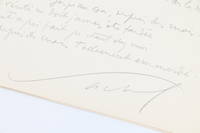
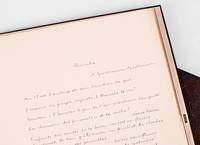
1917642691917. Fine. circa 1917-1918 22.30 x 27.60 cm une feuille sous chemise et étui A remarkable autograph poem of youth by André Breton dedicated to Guillaume Apollinaire entitled «Décembre». 20 verses in ink on vergé d'Arches paper composed in December 1915. This manuscript was copied between March 1917 and the beginning of 1918. This poem is presented in a chemise and case with paper boards decorated with abstract motifs the spine of the chemise in green morocco pastedowns and endpapers of beige suede a sheet of flexible plexiglass protecting the poem case lined with green morocco piece of green paper with caption «poème autographe» to bottom of upper cover of case the whole by Thomas Boichot. Key poem of the author's pre-Dadaist period it formed part of the set of 7 manuscript poems by Breton known as coll. X. in the uvres complètes d'André Breton volume I in La Bibliothèque de la Pléiade Gallimard 1988 p. 1071. Thiese poems of his juvenilia are carefully copied out in black ink on watermarked vergé paper. The small collection was addressed to his circle of friends and writers most notably including Valéry Apollinaire Théodore Fraenkel and his brother in arms André Paris. They were later published in his first collection Mont de piété which appeared in June 1919 published by Au Sans Pareil established not long before by his friend René Hilsum. The precise dating of this set of autograph poems is made possible by the composition of the final poem in the set «André Derain» written on 24 March 1917 which provides a definitive terminus post quem. An earlier version of the poem «Age» dedicated to Léon-Paul Fargue appears in our collection under its original name «Poème». Dated by the author 19 February 1916 the day of his 20th birthday and composed 10 days previously according to his letters it was not retitled and reworked until its publication in July 1918 in Les Trois Roses. Judging by the similarities to things published before this last poem the seven autograph poems were probably written during 1917 or at the beginning of 1918 while Breton was doing his residency in Val-de-Grâce and where significantly he made the acquaintance of Louis Aragon. The poems that make up Mont de piété represent a rare and valuable insight into his youthful influences at the dawn of his joining the Dada movement and his discovery of automatic writing. Quite short and sometimes sibylline one detects Symbolist highlights borrowed from Mallarmé whom he rediscovered at poetry mornings in the théâtre Antoine and the Vieux-Colombier accompanied by his schoolfriend Théodore Fraenkel. During the first month of the War Breton also dedicated himself to Rimbaud plunging into Les Illuminations the only work he carried with him in the confusion and haste that followed the outbreak of war. From his readings of Rimbaud were born the poems «Décembre» «Age» and «André Derain» while he borrowed Apollinaire's muse Marie Laurencin to whom he dedicated «L'an suave». The author's poetic inheritance was particularly marked by Paul Valéry with whom he corresponded from 1914. Valéry played a considerable role in the writing of the poems of Mont de piété with the advice he gave the young poet. Admiring his disciple's audacity who addressed each of these poems to him he characterized the poem «Façon» 1916 thus: «The theme language scope meter everything is new in the style the manner of the future» Letter of June 1916 uvres complètes d'André Breton vol. I in La Bibliothèque de la Pléiade Gallimard 1988 p. 1072. These essential buds of Breton's youth were written between his seventeenth and twenty-third year. Taken by surprise in Lorient by the declaration of war he became a military nurse serving in several hospitals and on the front during the Meuse offensive. In Nantes he met Jacques Vaché who inspired him to undertake a project of collective writing as well as encouraging him to have illustrated the future col hardcover
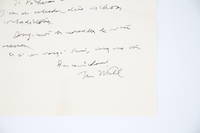
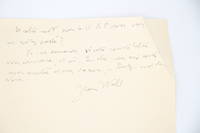
193977527Paris 1939. Fine. Paris 9 mai 1939 13.50 x 21.10 cm 1 page sur un feuillet enveloppe jointe double Signed autograph letter from Jean Wahl addressed to Marc Barbezat one page written in black ink on a sheet. Envelope included. Transverse fold inherent to the mailing. Jean Wahl was Marc Barbezat's examiner for the philosophy baccalaureate examination and it was then that the two men became friends. In 1940 shortly after writing this letter Barbezat would found the journal L'Arbalète to which the philosopher would contribute by entrusting his very first poems to his young protégé. This journal would later become a publishing house that would notably publish the first and scandalous texts of Jean Genet. Letter in response to a request from Marc Barbezat who had undoubtedly asked Wahl for a text: ""I definitely cannot send you anything of mine."" He mentions Marcel Raymond and gives Balacheff's address. unknown
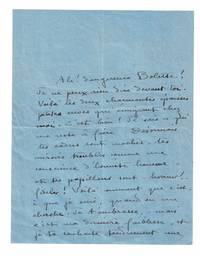
193574179s. l. Paris 1935. Fine. s. l. Paris s. d. circa 1935 17.70 x 22.50 cm 2 pages sur un feuillet Beautiful autograph letter signed by Colette addressed to her friend Bolette Natanson. Two pages written in ink on blue paper. Transverse creases inherent to the folding of the missive. This letter was probably addressed to Bolette following a gift made to her ""old friend"": ""Ah! dangerous Bolette! I can say nothing in front of you. Here are the two charming thick little vessels that emigrate to my home."" This is an opportunity for Colette very pleased with this new gift to humorously devalue the designer's previous works: ""From now on your frames are ugly your mirrors troubled like an honest man's conscience and your butterflies are - horror! - faithful!"" The famous ""butterflies"" naturalized and enclosed in glass frames are visible in several photographs of the writer in her home. Having evolved since her earliest childhood in artistic circles - she is the daughter of Alexandre and niece of Thadée Natanson the creators of the famous Revue Blanche - Bolette Natanson 1892-1936 became friends with Jean Cocteau Raymond Radiguet Georges Auric Jean Hugo and also Colette. Passionate about sewing she left Paris for the United States with Misia Sert great friend of Coco Chanel and was hired by Goodman. With her husband Jean-Charles Moreux they created in 1929 the gallery Les Cadres on boulevard Saint-Honoré and frequented numerous artists and intellectuals. Their success was immediate and they multiplied projects: the creation of the fireplace for Winnaretta de Polignac the decoration of the château de Maulny the arrangement of Baron de Rothschild's private mansion the creation of frames for industrialist Bernard Reichenbach and finally the realization of Colette's beauty institute storefront in 1932. Bolette Natanson also framed the works of her prestigious painter friends: Bonnard Braque Picasso Vuillard Man Ray André Dunoyer de Segonzac etc. Despite this meteoric rise she would end her life in December 1936 a few months after her father's death. unknown
194587985Paris 1945. Fine. Paris s.d.ca 1945 20.50 x 27 cm quatre pages Ironic autograph poem signed by Sacha Guitry 18 stanzas on two leaves titled: ""Eclatante vérité sortie de la bouche adorée de Lana et que j'ai mise en vers pour la faire sourire"" ""Dazzling truth from Lana's adored lips that I put into verse to make her smile"". The poem signed Sacha and running 24 lines with the title contains one deletion and two additions and probably dates from 1945 the year of Sacha Guitry and Lana Marconi's marriage: ""Je suis ici dans ma maison. Ce n'est pas sans raison Que j'en tiens le pari Car je me fie aux apparences. . Et ma maison est dans Paris Qui lui se trouve en France. Quant à la France elle est bel et bien dans l'Europe. . Oui oui enfin l'Europe est dans le monde Et quant au monde il est jusqu'au cou dans la merde. . C'est ce qui fait qu'étant chez moi Je suis depuis des mois tellement emmerdé ! "" ""I am here in my house. / It is not without reason / That I hold the wager / For I trust appearances. / . / And my house is in Paris / Which is located in France. / As for France it is quite clearly in Europe. / . / Yes yes finally Europe is in the world / And as for the world it is up to its neck in shit. / . / That's what makes it so that being at home / I have been so screwed for months!"" To this poem we add: its autograph draft in pencil and containing numerous corrections with on the verso a draft title page for his work ""Elles et toi"". All on one leaf recto verso. Also present is a page of autograph notes concerning Lana Marconi dealing with sums of money: ""Lana a reçu 65 pièces de 20 $ et 18.500"" ""Lana received 65 pieces of $20 and 18500"" accounts but also buried in these pecuniary concerns verses. Introduced to Sacha Guitry by Arletty the actress Lana Marconi of Romanian origin was the fifth and last wife of the great man of theater. Nicknamed by him ""Mon cher renard"" ""My dear fox"" she shared Sacha Guitry's life from 1945 and married him on November 25 1949. This made him say with great humor: « Les autres furent mes épouses vous vous serez ma veuve » ""The others were my wives you will be my widow"" and « Ces belles mains fermeront mes yeux et ouvriront mes tiroirs » ""These beautiful hands will close my eyes and open my drawers"". The actress created seven plays and acted in twelve films by Sacha Guitry and only worked with him as director. Amusing manuscript ensemble by Sacha Guitry concerning his last wife Lana Marconi. unknown
191177520Paris 1911. Fine. Paris Lundi 11 septembre 1911 13.50 x 18 cm 5 pages sur un double feuillet et un feuillet libre Autograph letter signed by Pierre Louÿs addressed to Georges Louis. Five pages written in violet ink on a double leaf and a loose leaf. A press article pasted on the recto of the single leaf. Transverse creases inherent to posting. Fine letter addressed to his brother Georges Louis with whom Pierre Louÿs maintained a very intimate relationship and whom he considered as his own father. The question of the real identity of Pierre Louÿs's father still fascinates biographers today: ""His father Pierre Philippe Louis . had married in 1842 Jeanne Constance Blanchin who died ten years later after giving him two children Lucie and Georges. In 1855 he remarried Claire Céline Maldan and from this union was born in 1857 a son Paul; then in 1870 our writer who received the first names Pierre Félix. This late birth the differences in character between father and son the former's disaffection toward the latter the profound intimacy that always reigned between Louÿs and his brother Georges all this has led certain biographers and critics to suspect that the latter was in reality the writer's father. The exceptionally intimate and constant relationship that Pierre and Georges maintained between themselves all their lives could be an argument in this sense. Of course no irrefutable proof has been discovered and none will probably ever be discovered. Nevertheless certain letters . are quite disturbing. In 1895 for example Louÿs writes seriously to his brother that he knows the answer to ""the most poignant question"" he could ask him a question he has had ""on his lips for ten years."" The following year in the full triumph of Aphrodite he thanks Georges effusively and ends his letter with this sentence: ""Not one of my friends has a FATHER who is to him what you are to me."" Arguing from the close intimacy of Georges and Claire Céline during the year 1870 and the jealousy that the father never ceased to show toward his younger son Claude Farrère did not hesitate to conclude in favor of Georges Louis. And what to think of this dedication by Louÿs to his brother on a deluxe paper copy of the first edition of Pausole: For Georges his eldest son / Pierre."" Jean-Paul Goujon Pierre Louÿs Pierre Louÿs comments in this letter on Thomas Edison's visit to Paris: ""Edison is in France. Toward the end of last month a journalist questioned him. I regret not having kept the article."" The writer then launches into a true dialogue from his memories of said article paraphrasing the inventor in the manner of a witness who himself attended the interview: ""To the simple question ""Are you pleased with your trip"" Edison answered with amiable phrases and immediately on his own he brought the conversation to the subjects: Monoplane. War. He said I only repeat from memory the sense of what I read: He said in substance: ""You are not yet enthusiastic enough about the value of your new weapon: it is formidable. You take aeroplanes for scouts. Say first: combatants. From the heights where the monoplane evolves easily today there is an effective military power but especially an incalculable moral power."" He explained himself thus: ""Give grenades to an aviator who will drop them. Even if they are not very dangerous even if they rarely hit their target the entire enemy army will scatter like a flock of sheep under the flight of the eagle. Five six grenades falling from the sky will provoke panic terror. Nothing is frightening for a crowd like a peril that comes from above."" "" This ""remarkable interview"" related by the writer who finds that ""the theory is correct"" underlines the visionary character of Edison who seems here to relate the facts of the coming First World War. The erudite Pierre Louÿs illuminates this theory of ""Edison the prophet"" with his classical culture: ""It agrees with the old phrases about the limits of b unknown
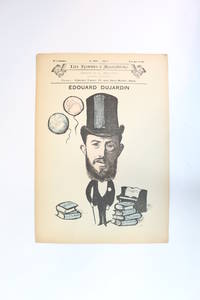
188873938Paris: Léon Vanier 1888. Fine. Léon Vanier Paris s. d. circa 1888 20 x 29.50 cm en feuilles First edition of this issue of the review consisting of two folded sheets. Minor marginal tears of no consequence to the sheets. On the first a color woodcut depicting Edouard Dujardin by Louis Anquetin. On the following text by Théodore de Wyzewa in first edition titled ""Edouard Dujardin"". Léon Vanier unknown
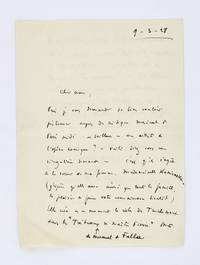
192883188s. l. 1928. Fine. s. l. 9 mars 1928 13.50 x 18.50 cm une feuille recto-verso Autograph letter signed by Berthold Mann written in black ink 28 lines requesting his friend's intervention to find for his young sister-in-law from the Opéra Comique a position in an upcoming theatrical production : ""Cher ami puis-je vous demander de bien vouloir pistonner auprès du critique musical de Paris midi - ou d'ailleurs - une artiste de l'Opéra comique - voilà direz-vous une singulière demande - c'est qu'il s'agit de la soeur de ma femme mademoiselle Kamienska j'espère qu'elle aura ainsi que toute la famille le plaisir de faire votre connaissance bientôt. Elle crée en ce moment le rôle de Truchement en espagnol : Trujaman dans les ""Tréteaux de maître Pierre"" de Manuel de Falla"" dont la répétition générale était cet après-midi. Elle a eu beaucoup de succès dans ce rôle important et difficile à tenir. Par ailleurs elle est très artiste très musicienne mais très effacée et ne demande jamais rien pour elle-même. J'ai pensé que si vous touchiez de près à quelque critique théâtral vous pourriez lui faire obtenir une mention favorable. Je n'ai pas de nouvelles de Claude qui mdit me maudire par ce que je lui en donne pas des miennes. et je suis débordé par un tas de travaux qui n'avancent pas. Excusez encore mon importunité j'spère avoir le plaisir de vous voir bientôt et vou serre amicalement les mains. Berthold Mann."" ""Dear friend may I ask you to kindly put in a word with the music critic of Paris midi - or elsewhere - for an artist from the Opéra comique - there you will say is a singular request - it's that it concerns my wife's sister mademoiselle Kamienska I hope that she as well as the whole family will have the pleasure of making your acquaintance soon. She is currently creating the role of Truchement in Spanish: Trujaman in Manuel de Falla's ""Tréteaux de maître Pierre"" whose dress rehearsal was this afternoon. She has had much success in this important and difficult role to sustain. Moreover she is very artistic very musical but very self-effacing and never asks for anything for herself. I thought that if you were closely connected to some theatrical critic you could help her obtain a favorable mention. I have no news from Claude who must curse me because I don't give him any of mine. and I am overwhelmed by a pile of work that is not progressing. Excuse my importunity again I hope to have the pleasure of seeing you soon and I shake your hands in friendship. Berthold Mann."" Central fold mark inherent to placing in envelope small folds in right margin of the letter not touching the text. unknown
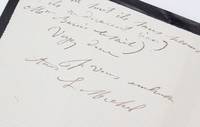
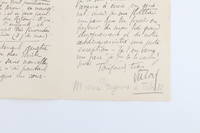
188583963s. l. Paris 1885. Fine. s. l. Paris 16 juillet s. d. ca 1885 13.40 x 21.10 cm 1 page 1/2 sur un bifeuillet Autograph letter signed by Louise Michel addressed to Lucien Barrois; one and a half pages written in black ink on a bifolium of white paper with black border. Transverse folds inherent to posting. Mrs. Vernier will be released from prison thanks to Louise Michel's assistance: ""elle sort le mois prochain et elle le mérite bien elle vous est bien reconnaissante. Remerciez Clémenceau Lafont et Clovis Hugues avec Laguerre peut-être tous les quatre qui ont apostillé la demande."" ""she is released next month and she well deserves it she is very grateful to you. Thank Clémenceau Lafont and Clovis Hugues with Laguerre perhaps all four who endorsed the request."" A moving letter testimony to the unwavering devotion of the former Communard. unknown
190379530Tahiti Tahiti 1903. Fine. Tahiti Tahiti 20 & 25 juillet 1903 10 x 15.50 cm 7 pages sur 2 doubles feuillets Autograph letter signed by Victor Segalen addressed to Emile Mignard. Seven pages written in black ink on two double sheets. Transverse folds inherent to mailing. Emile Mignard 1878-1966 also a physician from Brest was one of Segalen's closest childhood friends whom he met at the Jesuit college Notre-Dame-de-Bon-Secours in Brest. The writer maintained an abundant and regular correspondence with this friend in which he described with humor and intimacy his daily life in the four corners of the globe. It was at Mignard's wedding on February 15 1905 that Segalen met his wife Yvonne Hébert. Long letter describing July 14th in Tahiti and the amorous customs of Tahitian women. « Ce n'est pas un 14 Juillet qu'on célèbre aussi ; mais cette mémorable journée dure 8 jours. C'est horriblement Européanisé ; n'importe c'est un prétexte à s'extérioriser et pendant de longues promenades de garden-party à se frôler à des tas de jeunes corps souples légèrement ambrés de par leur hérédité semi-canaque. » ""It's not just a July 14th that we celebrate; but this memorable day lasts 8 days. It's horribly Europeanized; no matter it's a pretext to express oneself and during long walks garden parties to brush against heaps of young bodies supple lightly amber-colored through their semi-Kanaka heredity."" Here we detect the importance of racial purity ideas in Victor Segalen who would extend in Les Immémoriaux and in his novella entitled La Marche du feu his theories concerning miscegenation according to him the final fruit of colonial conquest. He does not however seem to apply to himself the ethnographic principles he develops and expands as is his habit on his sexual adventures with the natives: « Car j'ai quitté pour un temps la Vahiné Tahitienne pur-sang comme beaucoup trop lointaine de notre race. » ""For I have left for a time the pure-blooded Tahitian Vahiné as much too distant from our race."" Since his arrival in Tahiti in January 1903 Segalen had indeed maintained a relationship with a young Tahitian named Mara. Their relationship had come to an end: « Ma première épouse » ""My first wife"" Mara « ayant été expédiée dans son île - et y étant restée - j'ai hospitalisé durant une quinzaine une petite fille perdue noceuse éreintée de spasmes d'alcool et de phtisie prochaine. . Puis je l'ai elle aussi expédiée aux Pomotou où elle avait comme maîtresse de négociant une situation beaucoup plus stable à posséder. » ""having been sent to her island - and having remained there - I gave shelter for a fortnight to a lost little girl dissolute exhausted by spasms alcohol and impending consumption. . Then I too sent her to the Pomotou where she had as a merchant's mistress a much more stable situation to possess."" This passage also proves to be a precious document concerning the sexual customs of Tahitian women: « Je n'ai trouvé qu'une seule fois en rentrant chez elle un canaque couché dans son lit. Je lui en ai fait doucement l'observation : elle m'a répondu que j'avais une demi-heure de retard qu'elle était persuadée que je l'avais moi aussi trompée et tenait à me le rendre immédiatement ; et qu'enfin elle ne s'était pas mise nue pour se donner à lui mais avait gardé sa chemise ce qui est ici une marque de haute décence. Je n'avais donc absolument rien à dire. » ""I found only once upon returning to her place a Kanaka lying in her bed. I gently made the observation to her: she replied that I was half an hour late that she was convinced I had also deceived her and wanted to return it to me immediately; and that finally she had not undressed to give herself to him but had kept her chemise which is here a mark of high decency. I therefore had absolutely nothing to say."" Segalen nevertheless deplores the lack of docility and the emancipation of the local female population made possible by the presence of co unknown
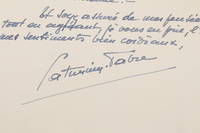
195581448s. l. 1955. Fine. s. l. 10 Janvier 1955 21 x 27 cm une feuille Humorous autograph letter dated and signed addressed to filmmaker and screenwriter Carlo Rim 17 lines in blue ink presenting his wishes for the beginning of 1955. Fold marks inherent to postal handling a small tear at the head of the letter at the fold level. Saturnin Fabre lavishes praise on the resistance of humor cinema embodied by Carlo Rim's achievements against the eroticization of cinema: "". in 1954 a year when cinema was placed under the sign of Lollobrigida's thighs and Martine Carol's milk boxes you remained one of the last talented authors a survivor of the funny ones. You stayed afloat!"" Carlo Rim was a Provençal writer ""Ma belle Marseille"" a caricaturist a filmmaker and was notably the friend of Fernandel Raimu and Marcel Pagnol but also of Max Jacob and André Salmon whom he met in Sanary. unknown
191287926Pau: S. n. 1912. Fine. S. n. Pau 1912 13.50 x 20.50 cm quatre pages sur un bifeuillet Autograph letter signed by the dandy count 46 lines written in black ink recto-verso on Hotel de France de Pau letterhead addressed to a poet friend. Fold marks inherent to postal handling. The poet expresses surprise at his friend's reproaches: ""Pourquoi parlez-vous du mal que je pourrais vous faire . Alors il faudrait bien essayer pour ne pas vous désobéir mais il me semble que je m'y mettrai sans conviction."" Why do you speak of the harm I could do to you. Then I would have to try so as not to disobey you but it seems to me I would do so without conviction. and leans rather toward a misunderstanding of his words: ""Est-ce donc ainsi que vous avez interprété ma grande dirai-je ma belle lettre à Lapauze elle a droit aux anthologies Mais dans ce cas elle serait comminatoire. Si elle l'est ce n'est pas pour vous."" Is this how you interpreted my great I would say my beautiful letter to Lapauze it deserves to be anthologized But in that case it would be threatening. If it is it is not meant for you. But the poet-count-dandy does not hold it too much against her: ""En attendant ce qui est certain c'est que je réciterai vos poèmes inédits à l'inauguration du musée Ingres."" In the meantime what is certain is that I will recite your unpublished poems at the inauguration of the Ingres museum. S. n. unknown
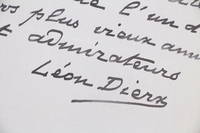
191086640Paris 1910. Fine. Paris 29 Octobre 1910 11 x 15 cm deux pages sur un double feuillet Autograph letter dated and signed addressed to Judith Gautier 21 lines in black ink on a double sheet paying homage to her for her election to the Académie Goncourt; Judith Gautier being thus the first woman writer to join the prestigious Goncourt jury in 1910. Léon Dierx considers this to be nothing but just and lucid recognition of his friend's literary talents: ""En choisissant Judith Gautier le si naturellement digne et admirable écrivain elle sest grandement honorée et je vous prie de lui transmettre les chaleureuses félicitations de l'un de vos plus vieux amis et admirateurs."" In choosing Judith Gautier that so naturally worthy and admirable writer she has greatly honored herself and I ask you to convey to her the warm congratulations of one of your oldest friends and admirers. unknown
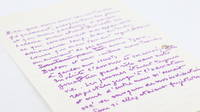
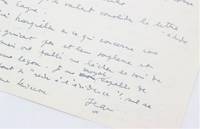
198086825s. l.: S. n. 1980. Fine. S. n. s. l. s. d. ca 1980 14.50 x 21 cm 1 page Autograph note with deletions by Philippe Soupault 18 lines in purple ink on a sheet discussing the different attitudes of his surrealist friends toward love. Some deletions and a cigarette burn hole on the sheet. All the surrealists did not adopt the same behavior regarding the amorous feelings that moved them: ""Nous étions très discrets en ce qui concernait nos expériences amoureuses. Sauf bien entendu Louis qui nous tenait régulièrement au courant de ses amours. . Mes amis Tzara Breton et moi-même nous tenions à garder nos secrets."" ""We were very discreet regarding our amorous experiences. Except of course Louis who regularly kept us informed of his loves. My friends Tzara Breton and myself insisted on keeping our secrets."" He also reveals the importance of feelings in surrealism and the central place of Woman: ""En vérité l'amour et ses conséquences jouaient un grand rôle dans notre vie. Les femmes étaient toujours respectées jusqu'à l'adoration et nul d'entre nous n'aurait osé se moquer de nos inclinations même si elles étaient fugitives."" ""In truth love and its consequences played a great role in our life. Women were always respected to the point of adoration and none of us would have dared mock our inclinations even if they were fleeting."" Interesting memories from the last living historical surrealist concerning the loves of the surrealists and their veneration for Woman. S. n. unknown
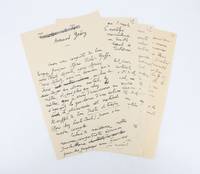
192786545s. l.: S. n. 1927. Fine. S. n. s. l. s. d. 1927 14 x 22.50 cm 4 pages Complete autograph manuscript unsigned by Francis de Miomandre entitled ""Armand Godoy"" 4 numbered leaves written in black ink. Biographical manuscript with corrections and additions concerning his friend the Cuban poet of French expression Armand Godoy and notably about his latest work ""Triste et tendre"" published by Emile-Paul. ""Yet another conquest of beautiful French language. After Viélé-Griffin after Stuart Merrill after Moréas after Milosz here is a man who has chosen ours instead of his native idiom."" The friends Francis de Miomandre and Armand Godoy collaborated on several poetry reviews and even wrote together. For Armand Godoy the great inspiration was Charles Baudelaire: ""A.G.'s worship of Baud. merges with that of poetry itself. With profound intuition A.G. divined that there was an eternally flowing source. And he plunged into it. It was B. who revealed to him the terrible beauty of inner life."" Fine manuscript extensively corrected by Francis de Miomandre on this Cuban poet conquered by the French language. S. n. unknown
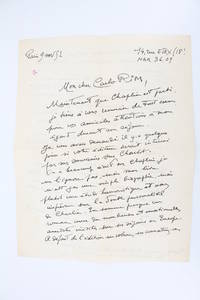
195280572s. l. 1952. Fine. s. l. 9 Novembre 1952 21 x 27 cm une feuille Very fine autograph letter signed by Cami addressed to his friend the Provençal writer caricaturist and filmmaker Carlo Rim who was notably the friend of Fernandel Raimu and Marcel Pagnol but also of André Salmon and Max Jacob 41 lines in black ink from his Parisian home evoking the joy of his fraternal friendship recovered with Charlie Chaplin thanks to him. Cami thanks Carlo Rim for allowing him to regain the good graces of Charlie Chaplin with whom he had quarreled after 35 years of friendship and he proposes in the same breath to the Marseillais filmmaker a biography project about his friend Chaplin as well as a film adaptation project of his latest published work: ""Mon cher Carlo Rim Maintenant que Chaplin est parti je tiens à vous remercier de tout coeur pour vos amicales attentions à mon égard durant son séjour. Je vous avais demandé il y a quelques jours si votre éditeur serait interessé par mes souvenirs sur Charlot. On a beaucoup écrit sur Chaplin je ne l'ignore pas mais mon livre n'est pas une simple biographie mais plutôt une étude humoristique et assez imprévue sur la double personnalité de Charlie. En somme presque un roman avec de nombreuses et sensationnelles anecdotes inédites sur ses séjours en Europe. A défaut de l'édition en volume ne connaitriez-vous pas une revue cinématographique susceptible de faire paraître mes souvenirs romancés en feuilleton D'autre part je viens de terminer un roman comique intitulé ""TON TOIT EST A TOI"" tout à fait rêvé comme sujet pour une adaptation cinématographique. Cela intéresserait peut-être davantage votre éditeur et vous même en qualité de cinéaste. Je serai très heureux si ce roman vous plaisait de travailler en amicale collaboration avec vous. Encore une fois merci pour vos invitations aux réceptions chaplinesques. Grâce à vous Charlie avec qui j'étais un peu en froid depuis notre désaccord sur ""Verdoux"" m'a accueilli à bras ouverts. Et nous avons pu évoquer avec émotion nos 35 ans d'amitié. Avec ma reconnaissance croyez-moi toujours votre Camicalement dévoué Cami. Veuillez je vous prie transmettre à votre charmante femme mon très sympathique souvenir."" ""My dear Carlo Rim Now that Chaplin has left I want to thank you wholeheartedly for your friendly attentions toward me during his stay. I asked you a few days ago if your publisher would be interested in my memories of Charlot. Much has been written about Chaplin I'm well aware but my book is not a simple biography but rather a humorous and quite unexpected study of Charlie's double personality. In sum almost a novel with numerous sensational unpublished anecdotes about his stays in Europe. Failing publication in volume form might you know of a film magazine likely to publish my fictionalized memoirs as a serial Furthermore I have just finished a comic novel entitled 'TON TOIT EST A TOI' perfectly suited as a subject for film adaptation. This might interest your publisher and yourself as a filmmaker more. I would be very happy if this novel pleased you to work in friendly collaboration with you. Once again thank you for your invitations to the Chaplinesque receptions. Thanks to you Charlie with whom I was somewhat on bad terms since our disagreement over 'Verdoux' welcomed me with open arms. And we were able to evoke with emotion our 35 years of friendship. With my gratitude believe me always your devotedly Cami. Please I beg you convey to your charming wife my very sympathetic regards."" unknown
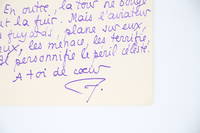
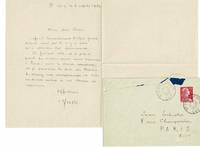
195676379Saint-Cirq-Lapopie 1956. Fine. Saint-Cirq-Lapopie 9 octobre 1956 13.50 x 18 cm 1 page sur un double feuillet et une enveloppe Autograph letter signed by André Breton addressed to Jean Schuster; one page written in black ink on a double sheet of white paper. Envelope included. The writing of this letter coincides with the publication date of the very first issue of the journal Le Surréalisme même: ""At last! Considering the closed object let us say that there is nothing left but to await events."" Breton then at his house in Saint-Cirq-Lapopie plans to return to Paris for this occasion: ""This was necessary - and the great cold of the morning - to bring us back to Paris: we will be there Friday and I will stop by the Musset in the evening."" Jean Schuster 1929-1995 joined the Surrealist group in 1947. Close to Benjamin Péret and André Breton he would become the latter's literary executor. unknown
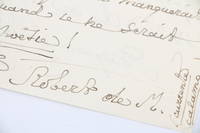
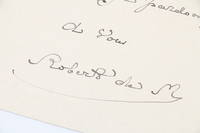
191087879s. l.: S. n. 1910. Fine. S. n. s. l. 1910 18 x 11.50 cm une feuille recto verso Autograph signed card from the dandy count 9 lines written in black ink addressed to a friend on cardboard paper: ""Chère amie C'était donc pour ""Femina ! "" Je devrais vous en vouloir moi qui avais prononcé contre ce lieu les formules exécratoires ! Enfin. je pardonne à vous ! A vous Robert de M. 910."" Dear friend So it was for ""Femina!"" I should hold it against you I who had pronounced execratory formulas against this place! Well. I forgive you! Yours Robert de M. 910. S. n. unknown
195083936s. l. 1950. Fine. s. l. 4 février 1950 21 x 27 cm une page sur un feuillet Autograph letter signed ""Jean"" and with a small star addressed to his English translator Marie Hoeck one page in blue ink on a sheet of fine white paper. Transverse folds inherent to posting. On the verso notes by the translator in ballpoint pen. Jean Cocteau is overworked by several projects: ""I have finished the mixtures of sounds and music for Orphée. I will probably finish the images for Les Enfants Terribles next week. . I do not speak to you of Léone because I look at her feel her steep myself in her - but alas my English allows me nothing more than to breathe in her light ink."" He shares with his translator his great fatigue: ""Then relaxation and fatigue - for fatigue only manifests itself in rest. . I am quite at ease concerning your springs. They do not creak and their flexibility is perfect. Mine nearly gave way on me the evening in Brussels. It is a lesson. I thought myself capable of the impossible. One must ""face the facts"" no one can do it."" unknown
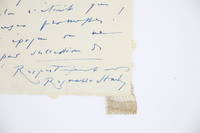
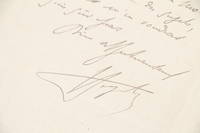
192577543Paris 1925. Fine. Paris 14 décembre 1925 10.60 x 15.70 cm une page sur une carte lettre Signed autograph note by Reynaldo Hahn addressed to Madame Serge André and written on a white paper letter-card in blue ink. Central fold inherent to the mailing. Dominique André is a poetess novelist and playwright. She notably published under the pseudonym Claude Isambert. Reynaldo Hahn declines an invitation from his friend: ""Est-ce possible chère Madame ! Vous m'invitez à goûter ! Hélas je ne pense pas aller nulle part dans la journée ! Un soir à l'Escargot d'Or on avait projeté de se voir : Lacretelle devait me faire signe - que sais-je "" ""Is it possible dear Madame! You invite me for afternoon tea! Alas I don't think I'm going anywhere during the day! One evening at the Escargot d'Or we had planned to see each other: Lacretelle was supposed to let me know - what do I know"" unknown
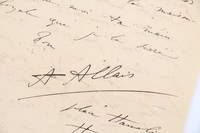
189588099Honfleur: s. n. 1895. Fine. s. n. Honfleur s.d. ca 1895 14 x 22 cm une page recto verso Autograph letter signed addressed to a journalist friend at Figaro illustré 28 lines in black ink. Fold mark inherent to envelope insertion a lack to upper corner of the letter without any damage to the text. Alphonse Allais must do a favor for his friend: ""Un peu de patience mon cher Abel un peu de patience. Sitôt rentré à Paris ma première démarche sera pour ton parapluie que je choisirai en soir gorge-pigeon et manche d'argent."" A little patience my dear Abel a little patience. As soon as I return to Paris my first errand will be for your umbrella which I will choose in pigeon-throat evening silk with a silver handle.; he therefore also allows himself to solicit the kindness of his correspondent: ""Et bien envoie-moi le n° du Figaro illustré d'il y a un mois ou deux où il y avait des choses de Toulouse-Lautrec."" Well then send me the issue of Figaro illustré from a month or two ago where there were things by Toulouse-Lautrec. He concludes his letter with a sententious: ""Donne-moi ta main loyale que je la serre. Ton Alphonse Allais. Bonjour aux amis."" Give me your loyal hand so I may shake it. Your Alphonse Allais. Greetings to friends. s. n. unknown
193977531Paris 1939. Fine. Paris 24 décembre 1939 13.40 x 20.80 cm 1 page 1/2 sur un feuillet enveloppe jointe double Autograph letter signed by Jean Wahl addressed to Marc Barbezat one and a half pages written in black ink on a sheet. On the attached envelope one can see that the mail was redirected to another address as Marc Barbezat had just been mobilized. Transverse folds inherent to mailing and two corner folds. Jean Wahl was Marc Barbezat's examiner for the philosophy baccalaureate exam and it was then that the two men became friends. In 1940 shortly after writing this letter Barbezat would found the magazine L'Arbalète to which the philosopher would contribute by entrusting his very first poems to his young protégé. This magazine would later become a publishing house that would notably publish Jean Genet's first and scandalous texts. ""J'ai conservé de la soirée passée avec votre amie et vous un souvenir délicieux en redonnant à ce mot un peu usé sa valeur. Ce qui prouve que même de cette horrible époque on peut conserver d'excellents souvenirs. . Et cette note pour la NRF dont vous m'aviez parlé "" ""I have kept a delicious memory of the evening spent with your friend and you giving this somewhat worn word back its value. Which proves that even from this horrible period one can retain excellent memories. . And what about that note for the NRF you had mentioned"" Attached is a press clipping evidently extracted from the Nouvelle Revue Française of December 1939. unknown
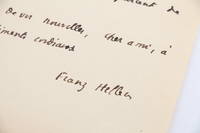
192886536Paris: S. n. 1928. Fine. S. n. Paris 19 Août Juillet 1928 13.50 x 21 cm une feuille une enveloppe Autograph letter dated and signed by Franz Hellens addressed to André Malraux 21 lines in black ink. Fold marks inherent to postal handling. We include an envelope addressed to Franz Hellens and written by André Malraux which probably contained the response to our letter. Franz Hellens responds to a request for information made by André Malraux: ""Je n'ai pas oublié le renseignement que vous m'avez prié de vous procurer au sujet du Voyage au Congo. Voici la réponse que j'ai reçu de la compagnie belge maritime du Congo. Ce n'était pas du tout ce que j'avais demandé"" ""I have not forgotten the information you asked me to obtain regarding the Journey to Congo. Here is the response I received from the Belgian maritime company of Congo. It was not at all what I had requested"" and will attempt to learn more in order to help his friend: ""Je vais écrire autre part et tâcher d'obtenir une réponse précise à ma question. Patientez donc quelques jours encore."" ""I will write elsewhere and try to obtain a precise answer to my question. Please wait a few more days."" Franz Hellens mentions the forthcoming publication at Grasset of his next work: ""Brun m'a envoyé copie signée du contrat. Il m'écrit que le livre pourra paraître en janvier prochain. J'aurai voulu octobre mais enfin."" ""Brun sent me a signed copy of the contract. He writes to me that the book will be able to appear next January. I would have wanted October but well."" and inquires about André Malraux's book in progress: ""Et vos Conquérants Je suis bien impatient de lire le tout."" ""And your Conquerors I am quite eager to read it all."" S. n. unknown
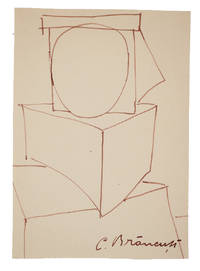
1937761711937. Fine. s. d. ca 1937 9 x 12.90 cm un dessin Eva original drawing signed ca 1937 9 x 129 cm one drawing Original drawing signed by Constantin Brâncui in brown ink on cream paper from the collection of Ion Alexandrescu a stone mason who worked with the sculptor in 1937-1938 on the creation and installation of the monumental ensemble at Târgu Jiu and more specifically on The Door of the Kiss and The Table of Silence. Brâncui's preparatory drawings for his sculptures are extremely rare as opposed to most of the few drawings by the artist seen on auctions which are mainly figurative women and anatomical studies. We submitted this unpublished work to renowned Brâncui specialist Dr Doïna Lemny who authenticated and dated it with precision. As an honorary curator of the Musée National d'Art Moderne Georges-Pompidou in Paris where she was in charge of the Brâncui collection for thirty years she is the author of numerous monographs and essays on the artist. She provided the drawing's analysis: This small drawing traced in ink with a quick hand on small paper calls out by the novelty of the composition of geometric forms: two superimposed cubes supporting an oval head framed in a square acquire a caryatid posture supporting an architrave clearly drawn at the top of the figure. The quick firm line indicates the artist's intention to note elements for a more complex composition that he would have intended to make. Although undated this drawing can be related to two other similar compositions made on 3 November 1937. The first of the same size 9 x 13 cm bears the title Eva and is enriched on the reverse with a drawing of the Kiss and a message addressed to Ion Alexandrescu. The second is larger 22 x 32 cm and has the same composition as our drawing but with proportions that more explicitly evoke a female figure see opposite. In these two other drawings Brâncui indicates the materials he plans to use for this future set of sculptures: wood in Romanian: lemn and plaster gips. The drawing we offer is untitled and does not bear indications regarding the materials but is in coherent with the tangible research of the other two compositions and could be a stylisation of the original drawing for a more abstract sculpture project. The interest in this biblical female figure crossed Brâncui's artistic career. As early as 1916 he sculpted a curvaceous Africanising wooden figure to which he gave the title Ève. Reworking it he finally created a more totemic sculpture in 1921: Adam and Eva. As a ""constructed"" work Adam and Eve already announced Brâncui's intention to take up the theme of the original woman mother and protector who is here pruned of male attributes and made into an elevation of primary and matrix forms: the block the egg and the surface. Provenance: collection of the stone mason Ion Alexandrescu friend and close collaborator of the Romanian sculptor. unknown
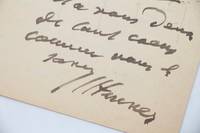
189485070s. l.: S. n. 1894. Fine. S. n. s. l. s. d. 26 Mars1894 10.50 x 17 cm quatre pages sur un double feuillet Autograph letter signed by Jean-Jacques Henner to his friend Emile Durand-Gréville 49 lines in black ink four pages on a double sheet. Fold marks inherent to mailing. A manuscript note concerning the recipient's name and the date of the letter at the head of the first sheet. ""Mon cher ami vous avez eu tort de ne pas emporter cette feuille. Elle est à nous ainsi que tout ce qui peut nous faire plaisir. Ce ne sera jamais en d'aussi bonnes mains. Je voulais aller voir madame Madame Durand Gréville hier après midi mais je me suis laissé aller à travailler chez moi. Je suis bien découragé et bien troublé en ce moment et je ne sais plus où j'ai la tête. Exposer pour m'entendre dire c'est toujours la même chose ce n'est pas la peine et je voudrais tant faire un pas non tant pour les autres mais pour moi. Venez donc quand vous voudrez vous emporterez votre feuille de croquis. A j'en serai bien heureux c'est par hasard que je ne l'ai pas jeté comme tant d'autres. Tou à vous deux de tout coeur comme vous le savez."" ""My dear friend you were wrong not to take this sheet. It belongs to us as well as everything that can give us pleasure. It will never be in better hands. I wanted to visit Madame Durand Gréville yesterday afternoon but I let myself get carried away working at home. I am very discouraged and troubled at the moment and I no longer know where my head is. To exhibit only to be told it's always the same thing is not worth it and I would so like to take a step forward not so much for others but for myself. Come whenever you wish you will take your sketch sheet. Ah I would be so happy it's by chance that I didn't throw it away like so many others. All yours both with all my heart as you know."" French translator of Ivan Turgenev close friend of Jean-Jacques Henner Emile Durand-Gréville became an important and recognized art critic conducting numerous studies in museums and galleries. He was also interested in the emerging field of meteorology. S. n. unknown
189985096Brest 1899. Fine. Brest 3 Octobre 1899 11 x 17 cm 1 page et demi sur un feuillet double Autograph letter dated and signed by Victor Segalen addressed to Emile Mignard one and a half pages 24 lines written in black ink on a double sheet. Traces of transverse folds inherent to postal delivery. Trace of white paper tab. Emile Mignard 1878-1966 also a doctor from Brest was one of Segalen's closest childhood friends whom he met at the Jesuit college Notre-Dame-de-Bon-Secours in Brest. The writer maintained with this companion an abundant and regular correspondence in which he described with humor and intimacy his daily life in the four corners of the globe. It was at Mignard's wedding on February 15 1905 that Segalen met his wife Yvonne Hébert. It was in 1899 that Victor Segalen's first nervous disorders manifested themselves which would only worsen as he advanced in age. Worried about his already failing health his friends and relatives wanted to hear news of him which sometimes exasperated him: ""Faire comprendre à Mlle D. qu'il me serait extrêmement pénible de répondre à ses lettres qui ne pourraient être que de condoléances.autant celles d'amis comme toi me seraient apaisantes autant des consolations féminines même bien intentionnées je n'en doute pas me seraient insupportables."" Make Miss D. understand that it would be extremely painful for me to respond to her letters which could only be of condolence.while those from friends like you would be soothing to me feminine consolations even well-intentioned I have no doubt would be unbearable to me. Victor Segalen thus declares his profound intimacy with Emile Mignard with whom he had undertaken that same year a cycling tour in Brittany and to whom he confided fully. Fleeing certain relationships he desired to maintain despite his illness his privileged friendship with the latter: "". ne reviendrai qu'après un détour dont je ne prévois pas la durée. Mais j'ai le temps et le désir d'avoir de tes nouvelles."" .will only return after a detour whose duration I cannot foresee. But I have the time and desire to hear from you. Knowing his friend to be understanding and respectful of his reserve the convalescent Victor Segalen did not wish to elaborate further on the illness that was already consuming him: ""Tu sens que je ne puis en écrire plus long n'ayant en ce moment pas le choix des sujets mais tu ne m'en voudras j'en suis sûr pas."" You feel that I cannot write at greater length not having at this moment a choice of subjects but you will not hold it against me I am sure. Autograph letters by Victor Segalen are extremely rare. unknown