Auguste de FORBINBiblio.com
48 402 résultats
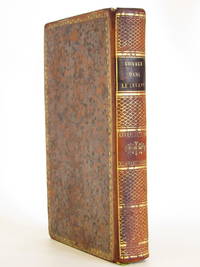
181962765Delaunay 1819. Fine. Delaunay 1819 12 x 20 cm relié Second edition published the same year as the first by the same publisher. Large folding plan of the Holy Sepulchre at rear. The large and famous atlas published in only 325 copies and sold separately is absent. At rear explanation of the 78 lithographed plates in colors that compose the atlas. Contemporary full brown sheep binding with porphyry grain. Smooth spine decorated with 4 compartments with grotesque cross-hatching and a central ornament. Framing frieze on boards. Chocolate morocco title-label. Spine uniformly faded. Small lacks to joints at head. A slight lack at foot. Upper joint split narrowly at tail for 8 cm and for 5cm along the lower joint. Trace of pale dampstain on half-title title page and preliminary leaves. 3 corners bumped. Appointed in 1816 as Director General of the Louvre museum Forbin obtained leave from Louis XVIII to finally realize his youthful dream a journey to the Levant. Embarking on several ships he first visited Milos Athens Constantinople Ephesus then finally arrived at Saint Jean d'Acre continuing to Jerusalem Gaza Damietta. He also visited Egypt and its principal sites: Cairo Luxor Thebes Rosetta and Alexandria. He acquired numerous antiquities that would enrich the Louvre's collections. Beyond the classic and picturesque narrative of the journey this Voyage au Levant is characterized by its aesthetic and artistic vision; Forbin was above all a man of art and he would work extensively in France for museums reorganizing the Louvre's collections creating the Luxembourg museum and that of Versailles. In the Dictionnaire des orientalistes Frédéric Hirzel writes: ""Le voyage au Levant du Comte de Forbin remains one of the finest achievements of the Voyages pittoresques of the early nineteenth century. Unlike some of his predecessors such as the Comte de Choiseul-Gouffier the text here is a true narrative."" Delaunay hardcover
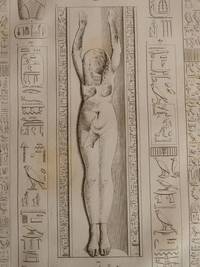
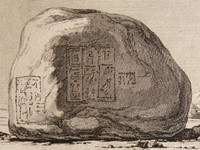
180329772Paris: Didot 1803. Fine. Didot Paris 1803 39.50 x 54 cm une feuille Original print folio taken from Travels in Upper and Lower Egypt Vivant Denon. Board decorated with an engraving subdivided into eight figures and described by the author: No.1 The eastern face of the obelisk which was before the temple of Luxor see Plate L No. 1. I should desiré have time to draw the four sides which differ between them except for the First figures of the summit which is probably a kind of protocol of the dedication of the monument; I thought it would be advantageous to have this inscription to add further to those that we have that are obelisks in Rome and elsewhere. The work of these is such a franchise we must believe that the Egyptians had a particular caliber tools for cutting granite; whole sculpture is hollow and relief two inches deep and a wonderful conservation. No.2 This fragment is the torso of a colossal statue in white marble placed inside one of the gates of the great temple of Karnak; He has the distinction of having a belt in which is going dagger in Eastern way: I put at the bottom the small inscription on the medallion that adorns this belt. No.3 Registration taken on the doorpost of a small temple in black granite monolith which are the remains to Apollinopolis parva or Kus. This fragment if we can read it the usage of these small shrines; the letter A indicates the beginning of registration which extends in a straight line to the letter B and continues with the letter C to a D No. 3a that the monument is broken; perfection of these hieroglyphics is such either by the drawing style; either by the precision of the execution that but we thought it only fragment in Egypt there would be no reason to doubt that the nation that was formerly inhabited had not known the arts and do had turned their perfection in a high degree. No. 4 An inscription found at Thebes on a fragmented statue. No.5 A major figure in low relief on the ceiling of the room where the celestial planisphere in the small apartment which is on the great temple of Tentyra see map board CXXX No. 1; this figure takes all the diameter of the ceiling of this room; though fragmented as we can see it still offers a good rolling contour and well proportioned; his feet preserved are the most beautiful style; it has no attribute except a necklace I have often seen in the figures of Isis; Curly hair is shaped corkscrew; the two side entries are accurate. No. 6 A monumental inscription engraved deeply and carefully on the rock of granite is from the island of Philée see the view board LXXII No. 3 and the situation in the card letter L board LXX. There were several species of these entries; the few that were only run; others who were monumental like these engraved nearly an inch deep: these inscriptions were probably consecrations or dedications. This extraordinary rock that nature had given the form of a gigantic siege and to which we had added the job of a staircase into the mass was perhaps dedicated to the five deities whose images are plotted above registration. No. 7 A similar entry as above engraved on the upper arm of the Colossus reversed which is near the Memnoniura at Thebes see Plate XLII No. 5 and board XLV No. 2. This inscription which is carved an inch deep and has more than 4 feet tall is no more effect on the total mass of such a gigantic figure number tattooed on the arm of someone alive. If it were possible to read this dedication it can be all questions aplaniroit and leveroit all doubts about the situation of statues palaces tombs and temples of Memnon and Ossimandue. Light foxing marginal tear otherwise good condition. Published for the first time in two volumes an atlas of engravings Didot in 1802 the 'Journey to the Lower and Upper Egypt proved so successful that it was translated in 1803 into English and German and a few years later in Dutch and Italian among others. Almost all boards are designed by De Didot hardcover
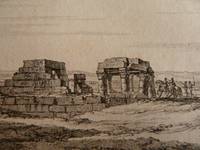
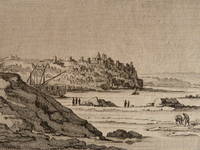
180329711Paris: Didot 1803. Fine. Didot Paris 1803 40 x 54 cm une feuille Original print folio taken from Travels in Upper and Lower Egypt Vivant Denon. Board composed of three views as described by the author: No.1 ruins of a temple near Chnubis seven or eight hundred yards from the walls of the city: this little monument like the Hermitage the edge of the desert has a very imposing character; a sanctuary of ancient times was surrounded after a rotating gallery which was completed by two portals that are destroyed. Desired I should make more views because all its aspects were equally noble and picturesque; nudity soil round the monument leaves no doubt about the isolation in which he was all the time and there ought not to look for the existence of a lost city in the mists of time. No. 2 View of the ruins of Ombos capital of the prefecture of the same name built in a theatrical situation overlooking the Nile and the entire region of the valley; debris out of its monuments still lavishly bricks and shards of its particular buildings: you can see right into the wall of his circumvallation with a door that is still understood; the only time I've encountered this life: the two piers which served probably entrance to the enclosure of the great temple can be seen behind built on shaky ground or reported had foundations that were going down to the level of the river; the temple very conveniently located was to produce the most impressive when it was surrounded by all its accessories effect; ruin is still admirable. I never saw that to have to regret not being able to make a view that could give an idea of its splendor. On the left on a mound of red bricks which are the remains of the ancient city we perceive some factories which are the homes of Arab pastoralists who live miserably on the sumptuous ruins of ancient dwellings. I regretted not being able to find within its walls if there would have remnants of some basins where auroient fed crocodiles that we adored in Ombos. No.3 view of the ruins of Chnubis one of the cities whose remains though many are arguably the least idea of his plan and the layout of its buildings; it will probably have been built or rebuilt at various times: we see very small monuments close to the large and also treated in detail. I saw Chnubis twice and both in the most inconvenient manner see the newspaper Volume II page 170. The ruins are right small forms and could belong to very small monuments; which the ends is a group of two figures side by side and granite reversed: where the two isolated characters is a parapet surrounding a basin around which was a gallery columns. There is still water in the location where we see a hunter who shoots a gun on one of the birds that were in the swamp. The monument to the men on horseback is a gallery of two species of high columns at two periods however united by the same flowerbed: seroient is the remains of a temple which we would have done increases Nearby are two parallel doors less large and that belonged to another monument all beautifully covered many hieroglyphics; but there was more particular in the ruins of this city is the great wall of unbaked bricks whose monuments are still enceints; we see everything left an opening which was probably a door which can follow the line along the second plane; is behind the Libyan chain; in front of the Nile landscape changes before which there had a dock which there are some ruins. Very discrete foxing two tiny marginal holes a tiny trace of angular creases otherwise good condition. Published for the first time in two volumes an atlas of engravings Didot in 1802 the 'Journey to the Lower and Upper Egypt proved so successful that it was translated in 1803 into English and German and a few years later in Dutch and Italian among others. Almost all boards are designed by Denon who also engraved himself a few including portraits of the inhabitants of Egypt who still kept the freshness of sk Didot hardcover
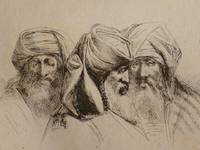
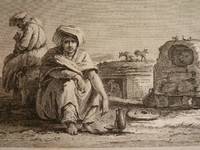
180329754Paris: Didot 1803. Fine. Didot Paris 1803 40.50 x 54 cm une feuille Original print folio taken from Travels in Upper and Lower Egypt Vivant Denon. Board composed of three views as described by the author: No.1 Serpents which psyllids use to their juggling; when irritated they stand as shown in this figure their throat swells expands collapses; moreover they are neither bad nor dangerous: we can see in the newspaper Volume I page 211 use of that modern psyllids. Pliny says that the tomb of their king Psyllus still subsisted in his time; He added that psyllids guérissoient bite with their simple saliva or by touch alone at least they publioient. The same author these people were cut to pieces by Nasamons neighbors who seized their homes; but some escaped the general defeat; and his time there that still had these old psyllids were going down. No.2 Three heads of Arabs. I thought that a sequence of heads of the various nations that inhabit Egypt pouvoit interested curiosity of observers; these heads drawn quickly and without having to ask the characters maintained the simplicity of nature they may have lost auroient gaining more over; difficult to read in light of such sketches who has not seen the models I was determined to burn myself these heads with the same freedom with which they were drawn. These three characters were brothers the richest and most powerful Kéné very reasonable and very intelligent; they were very attached to us and we were coming continuously communicate their ideas about their personal conduct and advise us on what might we be more advantageous: I was going to their house every day and I ate there several times familiarly arriving at mealtime; no interpreter we were able to agree and establish us joy and cordiality: the middle one I loved her more told me to be more free device it was necessary that we establish a relationship: I proposed it to be his father; he accepted with emotion and ranking from that time to his duty he took the excuse to send me anytime few flirtations like fruit until they were rare perfumes exquisite coffee and that we could not find elsewhere; acceptoit it back with a lot of grace things of no value always telling me that I ought to him that protection and tenderness. The delicate spirit dictates the right tone and the same ways as in Africa in the most popular courses of Europe. No.3 heads merchants of Mecca I have drawn Cosseir; their turbans in yellow and red silk with long fringes and coiffent a patriarchal way and give them all to actually imposing air; they add to the ordinary dress of Muslim Beniche a wide long wool wide black and white stripes. Some foxing mainly marginal otherwise good condition. Published for the first time in two volumes an atlas of engravings Didot in 1802 the 'Journey to the Lower and Upper Egypt proved so successful that it was translated in 1803 into English and German and a few years later in Dutch and Italian among others. Almost all boards are designed by Denon who also engraved himself a few including portraits of the inhabitants of Egypt who still kept the freshness of sketches taken on the spot our 104-111 . Two dozen writers have also collaborated on the creation of which Baltard Galen Reville and other etchings. Dominique Vivant Baron Denon says Vivant Denon born in Givry January 4 1747 and died in Paris April 27 1825 is a writer author diplomat and French administrator. At the invitation of Bonaparte he joined the expedition to Egypt in shipping from May 14 1798 on the frigate ""La Juno."" Protected by French troops he had the opportunity to travel the country in all directions in order to gather the material that was the basis for his artistic work and the most important literary. It supports in particular General Desaix in Upper Egypt which he refers to numerous sketches ink wash and other drawings in pen black chalk or chalk. He draws constantly usually on his knee standing or on horseback and Didot hardcover
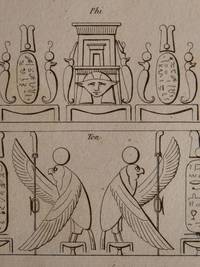
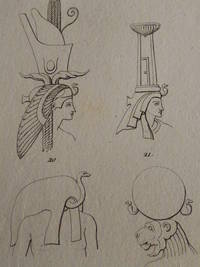
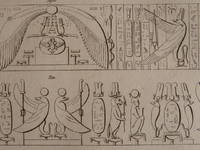
180329769Paris: Didot 1803. Fine. Didot Paris 1803 39 x 54 cm une feuille Original print folio taken from Travels in Upper and Lower Egypt Vivant Denon. Board decorated with an engraving subdivided into 10 figures and described by the author: Strips of different iconic Egyptian temples. No.1 hieroglyphics that decorate the exterior cornice of the nave of the great temple of Tentyra; this ornament repeating toured this part of the monument. The middle figure is the head of Isis with its attributes; it is found repeatedly throughout this temple which was dedicated to him probably. The two big birds head vulture without feathers leaving a kind of egg that serves as the body: this bird is often repeated in all kinds of attitudes in ceilings wings spread holding in the paws the sort of stick with the palm as seen here before; He also accompanied the heroes and kings in the bas-reliefs depicting the victories and triumphs and then seems a protective spirit. No. 2 is the inner frieze of the temple near the island of Philée see Plate LXXII No. 1. No.3 Friesland Typhonium of Tentyra see Plate XXXVIII No. 3 or the temple dedicated to Isis winner of Typhon the evil genius or the west wind; it has a head of an old fat body and shape to that of a child a tail that is magnifying and that is as long as the legs; it's still wearing the same ornament: one that makes him laying is a deity of the same kind; the head at the same time the character of the dog the pig and the crocodile; he's hanging breasts like the Egyptian women a big belly and legs of a lion: this figure also repeated the other and accompanying for the most part seemed to me to be the deity of the temple Hermontis see Plate CXX No. 4. Are frequent figures of these two gods as amulets pulp colored glass and porcelain: I reported that I designed life-size see pl XCVI No. 37 and 38. . They were highly revered either for good in that waited for either the evil that pouvoit fear or also for two causes; because I think the emblem of the two winds that produce flooding and can make or insufficient or too large. It is assumed that the figure is in the middle of these two monsters sitting on a lotus flower blooming half is that of Isis or the good god who got these two formidable gods water balance which bloom lotus in the channels when the flood is perfect. No. 4 is the ornament of the frieze of small temple of the Isle of Philée; the effect in nature is as rich and enjoyable: Egyptian artists with a special art successfully combined the meaning of the emblem in tasteful decoration. No. 5 is still in evidence; it is the decoration of the interior base of the middle room of the small temple which is located behind the great temple of Tentyra see plan Tentyra board XL No. 1. This decoration is the lotus in three moments of the development of the flowering of this plant. The hawk is taken on an altar to Osiris or the sun; the other side of the moon; ibis on a lotus another emblem of the flood or the entry into the channels of the Nile; because the lotus did report that channel since only grows in stagnant water and is never found in the river current. No. 6 ornament of the inner frieze of Typhonium Apollinopolis magna a small temple located near the big temple See Plate LVII No. 1 he must have the same meaning as above No. 3 . There are three more figures that given the repeated use most often when it comes to flooding I should think be vessels of holy water or offerings of Nile water during its growth. No. 7 Rich and lovely frieze decorating the open room that is near the one where the celestial planisphere in the small apartment on the great temple of Tentyra see map p. CXXX No. 1 letter C. The globe is at the center must be the sun from which the beam of light coming down on earth I was so often the case make sure that opinion on these two figures I believe able to give as irrevocable: this sort of rain triangular cells decorates the doorway of almos Didot unknown
180329699Paris: Didot 1803. Fine. Didot Paris 1803 40.50 x 54 cm une feuille Original print folio taken from Travels in Upper and Lower Egypt Vivant Denon. Board composed of two views as described by the author: No.1 The remains of a coated near Etfu dock; two staircases were going down the Nile; none other ruins will accompany this fragment which however indicate the ancient neighborhood of a city since the stairs announce that dock still had a purpose other than to retain water; the river barefoot abutment of this construction and currently happening behind. This interesting in itself but offering little fragment picturesque forms I thought I should add a group of young characters called Goubli or beyond or Barabra which is the generic name for all the peoples of Egypt which are beyond the cataracts; their costume for men is the absolute nudity what they add a piece of cloth or cotton cloth they roam at will on what they want to cover their person; their hair long enough though frizzy curly and still curly long way to ancient Egyptian figures; they anoint their hair with oil of cedar they like the smell and at the same time prevents the inconvenience of vermin which would otherwise be an indestructible établiroit way in impossible to comb hair. Women and children wear two earrings in each ear one above and one below necklaces with fringes formed small leather thongs completed by grains of colored glass; a belt of the same material finished well and that happens to them until the middle of the thighs enough to calm their modesty until they become marriageable. Women beyond are well made are round and firm muscles have thin skin cool touch and it has particular merit appreciated by men whose love is palpable and voluptuousness any material which calculate and evaluate the physical and are buying in women beyond the summer pleasures kind of luxury we still acquainted for clothes: the Russians are building their homes for winter Italians for the summer Orientals like Kamchadals believe they need a winter home and a home for the time of great heat. No. 2 A view of the last pyramids one hundred and thirty leagues from those of Giza near a village built in the desert beyond Etfu; this pyramid much smaller than the others constructed masses more divided did not put the same weather resistance or belongs to an earlier era; collapsed in all its parts it seems more than a pile of rubble that however we see that have been shaped and placed on the regular bases. To give some interest in this view if dry by itself I added the house taken from life too an Arab farmers on the edge of the desert family; I wanted to give the image of this monotonous tranquility that is not distracted by the shock of no novelty; This calm that leaves a long time between each life event; that tranquility where everything succeeds peacefully in the soul where little by little becomes a feeling an emotion a habit that becomes a principle where finally the lightest impression is analyzed; so that in conversation with this species of men we are astonished to find him in the most delicate distinctions and the finest sense next to the most absolute ignorance. Some sections of earthen walls which they add a straw cover sufficient to their homes. The factory is in the middle is a dovecote built in terracotta in the sun; it is divided into small boxes in the interior for each family of pigeon; the door is round; this is what is seen below the loft; there is a small opening in the middle to let the air; it is applied every night to put the colony safe against the jackals. To the right is the barn lower smaller because he has no inner division; left the main apartment the women where one fears a cold night when removed; above are dogs which are nothing in the friendly society living apart as defensive allies; a deer a hawk which are also free partners; chickens and pigeons are the only domestic: the bardaks which are the pots to drink Didot hardcover
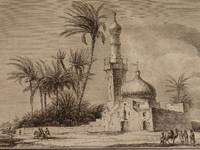
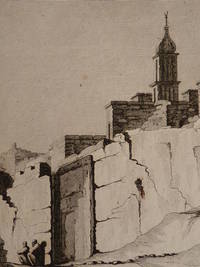
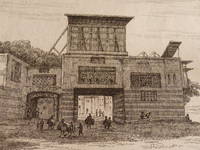
180329631Paris: Didot 1803. Fine. Didot Paris 1803 40.50 x 54 cm une feuille Original print folio untrimmed extracted Travellers in Lower and Upper Egypt Vivant Denon. Board composed of two views as described by the author: No.1 View of a mosque with its minaret. Each province has its own particular taste in these kinds of monuments Moorish architecture having no fixed rules or principles lightness and elegance are the only laws and consequently the productions are infinitely varied; the superabundant ornaments are never inconsistent and keep them a harmony that is never devoid of grace. These domes were built very quickly are raised with regularity by masons who have only a few tools and employ these constructions as plaster supported by some small pieces of wood. The minaret has no other purpose than to do perceive by far the mosque in which he holds and to bring this gallery where imams every four hours call the Muslim faithful to prayer singing hymns to Yahweh and his prophet. Each mosque there is a tank a basin for washing and whenever possible a small enclosure with trees for prayer in the shade. One shown here is located at the southern end of Rosetta; Smoke can be seen on the right is perpetually produced by a coal factory which is a rare commodity in the country: the import of wood which in peacetime is Syria Rosetta is an article particular trade in this city. No.2 view of a portion of the port of Rosetta. Mills that are represented owned by the Franks and most built by them are a mix of buildings that look more like our homes as the fourteenth century Eastern factories of other cities of Egypt; where is the pavilion that belonged to the house Varsi where was housed General Menou. The stage shown was that of the swearing in of the government of the country in the hands of the general: the blows distributed leftover Eastern practice generally set aside for the crowd ennobling function and warn the weak presence power and the distance in which it is considering it. We never arrived in a village the sheikh our honor not should order a distribution which did not cease at our requisition and when it believed that on the evidence of his respect was to sufficiently demonstrated. Right the Nile where we see an armed sloop and in the background the island of Varsi. Light foxing otherwise good condition. Published for the first time in two volumes an atlas of engravings Didot in 1802 the 'Journey to the Lower and Upper Egypt proved so successful that it was translated in 1803 into English and German and a few years later in Dutch and Italian among others. Almost all boards are designed by Denon who also engraved himself a few including portraits of the inhabitants of Egypt who still kept the freshness of sketches taken on the spot our 104-111 . Two dozen writers have also collaborated on the creation of which Baltard Galen Reville and other etchings. Dominique Vivant Baron Denon says Vivant Denon born in Givry January 4 1747 and died in Paris April 27 1825 is a writer author diplomat and French administrator. At the invitation of Bonaparte he joined the expedition to Egypt in shipping from May 14 1798 on the frigate ""La Juno."" Protected by French troops he had the opportunity to travel the country in all directions in order to gather the material that was the basis for his artistic work and the most important literary. It supports in particular General Desaix in Upper Egypt which he refers to numerous sketches ink wash and other drawings in pen black chalk or chalk. He draws constantly usually on his knee standing or on horseback and sometimes even under enemy fire. After a journey of 13 months during which he draws thousands of drawings Vivant Denon returned to France with Bonaparte and became the first artist to publish the story of the expedition. The 141 boards that accompany his diary retrace its entire journey from the coast of Corsica to the pharaonic monuments of Upper Egypt. Bon Didot hardcover
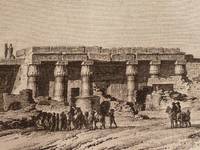
180329695Paris: Didot 1803. Fine. Didot Paris 1803 40 x 54 cm une feuille Original print folio taken from Travels in Upper and Lower Egypt Vivant Denon. Board composed of two views as described by the author: No.1 View Apollinopolis magna Etfu taken from west to east of the temple on hills that dominate and where we see everything both its external development and some parts of its interior. I made a trip of more than fifty leagues in the thought of adding this drawing to your collection to make known to complete this magnificent building; and yet arrived at Etfu I was at the time to leave without being able to draw it by the inability to withstand the heat of the sun that it was necessary that I should be exposed to this view. I have the intelligence of Baltard citizen for making the imperfect sketch I had done as I had been tormented by my eyes glare éprouvoient liveliness of the day and those in my blood Boiling occasioned me every moment: this print is one of many obligations that I have at Baltard citizen who is on loan to the execution of my work with accuracy a zeal and friendship which equaled the talent that it was so easy to put it. In the development of this great monument we can see right into the front door; between two large stones advancing two piers on the doorframe which were coming against arguably support the heads of two statues in the shape of caryatids; the four long niches before which had to be obelisks as I'm allowed to think by repeating the same niches behind obelisks that I found to Philée; on the walls of moles three orders of hieroglyphics becoming ever more gigantic and ending up having twenty-five feet of proportion; courtyard decorated with a gallery of columns with two terraces leading to two doors through which we reach the stairs going up to the platforms of moles; in the courtyard modern buildings which are part of the village of Etfu which we perceive the other party beyond the temple; from under the porch which I made the drawing pl. LVII No. 1; following probably contains different apartments and the sanctuary of the temple buried and now cluttered with garbage except for a few gaps that serve as store built on the platform of the temple houses; the leveling a wall of circumvallation decorated inside as outside countless hieroglyphics executed with a sought care; while the left side of the print Arab tombs encountered on the road to Etfu NSHS; the Nile in the third level and in the background the Arabian chain; on the front of the mound of rubble under which are the remains of the ancient city of Apollinopolis; and the group of figures the frugal meal of an Arab family. No.2 view of the situation of the temple of Apollinopolis magna taken several leagues; This temple built on a hill in the middle of the valley looks like a fortress well placed to control the country. Marginal foxing marginal tear skilfully restored with a piece of Filmoplast otherwise good condition. Published for the first time in two volumes an atlas of engravings Didot in 1802 the 'Journey to the Lower and Upper Egypt proved so successful that it was translated in 1803 into English and German and a few years later in Dutch and Italian among others. Almost all boards are designed by Denon who also engraved himself a few including portraits of the inhabitants of Egypt who still kept the freshness of sketches taken on the spot our 104-111 . Two dozen writers have also collaborated on the creation of which Baltard Galen Reville and other etchings. Dominique Vivant Baron Denon says Vivant Denon born in Givry January 4 1747 and died in Paris April 27 1825 is a writer author diplomat and French administrator. At the invitation of Bonaparte he joined the expedition to Egypt in shipping from May 14 1798 on the frigate ""La Juno."" Protected by French troops he had the opportunity to travel the country in all directions in order to gather the material that was the basis for his artistic work and the mo Didot hardcover
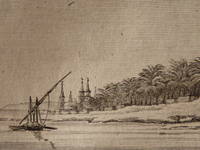
180329657Paris: Didot 1803. Fine. Didot Paris 1803 40.50 x 54 cm une feuille Original print folio untrimmed extracted Travellers in Lower and Upper Egypt Vivant Denon. Board composed of two views as described by the author: No.1 A karavanseray. See the explanation I gave another board XXVII No. 1 The dum palm Hene and the date palm joined the Arab style of the building give this one a print Oriental aspect which I thought we sauroit me will provide the table. In a country where everything is extraordinary the reader sometimes likes to surprise the traveler in circumstances which seem most real to him for the very reason that they are the least important and unexpected; these are portraits done quickly without having to ask the model is: they hit truth and they still have all the grace. It is in the same thought as I drew a sheet # 2 a district of the city of Girgeh where I put as I happened to see a kiachef surrounded by the splendor of his house: Presidents' walk Bdtonniers riding walking in front of him to ward off those who would approcheroient; he is followed by his Mamelukes. It is these kinds of scenes with the portrait of where they are going who acquainted the physiognomy of a country. For a player to hear a good traveler he must walk with him the traveler can say: When I was there that's what I faw; this is the tree under which I was sitting species; this is a house of a particular country. The corner of a street at random gives more the idea of such a city as drawing to claim its main buildings; is often better acquainted with a character quoting him a sentimental word distributed except by making a long and pompous eulogy. Foxing otherwise good condition. Published for the first time in two volumes an atlas of engravings Didot in 1802 the 'Journey to the Lower and Upper Egypt proved so successful that it was translated in 1803 into English and German and a few years later in Dutch and Italian among others. Almost all boards are designed by Denon who also engraved himself a few including portraits of the inhabitants of Egypt who still kept the freshness of sketches taken on the spot our 104-111 . Two dozen writers have also collaborated on the creation of which Baltard Galen Reville and other etchings. Dominique Vivant Baron Denon says Vivant Denon born in Givry January 4 1747 and died in Paris April 27 1825 is a writer author diplomat and French administrator. At the invitation of Bonaparte he joined the expedition to Egypt in shipping from May 14 1798 on the frigate ""La Juno."" Protected by French troops he had the opportunity to travel the country in all directions in order to gather the material that was the basis for his artistic work and the most important literary. It supports in particular General Desaix in Upper Egypt which he refers to numerous sketches ink wash and other drawings in pen black chalk or chalk. He draws constantly usually on his knee standing or on horseback and sometimes even under enemy fire. After a journey of 13 months during which he draws thousands of drawings Vivant Denon returned to France with Bonaparte and became the first artist to publish the story of the expedition. The 141 boards that accompany his diary retrace its entire journey from the coast of Corsica to the pharaonic monuments of Upper Egypt. Bonaparte then appointed Director General of the Central Museum of the Republic which became the Napoleon Museum and the Royal Louvre and arts administrator. In 1805 Vivant Denon revival project of the Vendome column which had been suspended in 1803 then organizes expeditions across Europe to raise imperial works of art which are plundered to be carried away to the Louvre. In 1814 Louis XVIII confirmed as head of the Louvre one wing of which still bears his name today. It is considered a great precursor of museology art history and Egyptology. Didot hardcover
180329696Paris: Didot 1803. Fine. Didot Paris 1803 40 x 54 cm une feuille Original unshaved full-page etching from the Imperial edition of the Description de l'Égypte or Recueil des observations et recherches faites en Égypte pendant l'expédition française publié par les ordres de Sa Majesté l'Empereur Napoléon le Grand A Collection of the observations and research carried out in Egypt during the French expedition published on the orders of his Majesty the Emperor Napoleon the Great'.Produced between February 1802 and 1830 on the orders of Naopleon Bonaparte and published between 1809 and 1828 1000 copies were printed and distributed to institutions on vergé paper with an 'Égypte ancienne et moderne' watermark visible when held up to the light. Light marginal spotting not touching image otherwise in very fresh fine condition. An engraving from the Description de l'Egypte one of the masterpieces of French printing and the birth of a new field: Egyptology. A gigantic survey of Egypt at the time of Bonaparte's conquests in 1798 and 1799 the work is divided into 13 volumes of engravings making up 892 plates of which 72 colored as well as presenting the splendors of the Egypt of the Pharaohs in 9 volumes. The other volumes discuss natural history and present a fascinating portrait of Coptic and Islamic Egypt as it was seen by Bonaparte's Eastern Armies. The Egyptian campaign' militarily a disaster demonstrates through the engravings of the Description d'Egypte the scientific success it nonetheless became thanks to the 167 expert members of the Commission of the Sciences and Arts of the Institut d'Egypte Egyptian Institute who followed Napoleon's army. The Institut gathered together in Egypt the mathematician Monge the chemist Berthollet the naturalist Geoffroy Saint-Hilaire as well as numerous artists engineers architects and doctors. They were tasked with re-discovering modern and ancient Egypt and displaying its natural treasures as well as the know-how of its inhabitants.This edition the so-called Imperial edition of the plates for the Description de l'Egypte was printed in four large formats two of which were specially created for it and christened Moyen-Egypte and Grand-Egypte. A special press was built to print it the process extending over 20 years from 1809 to 1829. The Imperial edition proved so popular that a second edition this time in black and white and without the Egypte ancienne et moderne watermark known as the Royal Edition was published during the Restoration by the printing house of C.-L.-F. Panckoucke Paris.The engravings of the Description d'Egypte owe a great deal to Baron Dominique-Vivant Denon illustrator diplomat collector and later Director of the Musée Napoléon the Louvre. His exploration of the South of Egypt gave Bonaparte the idea of sending the experts of the Institut there thus creating a faithful and complete portrait of the area. This was the research gathered together from 1802 in the mammoth Description de L'Egypte.Denon embarked on this story of archeological exploration at the age of 51 reaching first Alexandria and then Cairo before exploring Upper Egypt. Along with the members of the Institut d'Egypte the Natural History Museum's painter H.J. Redouté brother of Pierre-Joseph Redouté author of Roses the mineralogist Dolomiue and the draughtsman Joly Denon then explored the Nile Delta and Lower Egypt. When however he joined the 21st Light Infantry Regiment as it marched across Upper Egypt in pursuit of the retreating Mameluks in November 1798 he found himself the only civilian. In the very midst of the battle itself he reeled off sketches of the works of art that peppered his path right up to the threshold of the Sudan. He said that he had crossed a country that is apart from its name entirely unknown to Europeans and therefore everything was worth describing Voyages dans la Basse et la Haute Egypte pendant les campagnes de Bonaparte en 1798 e Didot unknown
180329697Paris: Didot 1803. Fine. Didot Paris 1803 40 x 54 cm une feuille Original unshaved full-page etching from the Imperial edition of the Description de l'Égypte or Recueil des observations et recherches faites en Égypte pendant l'expédition française publié par les ordres de Sa Majesté l'Empereur Napoléon le Grand A Collection of the observations and research carried out in Egypt during the French expedition published on the orders of his Majesty the Emperor Napoleon the Great'.Produced between February 1802 and 1830 on the orders of Naopleon Bonaparte and published between 1809 and 1828 1000 copies were printed and distributed to institutions on vergé paper with an 'Égypte ancienne et moderne' watermark visible when held up to the light. Light marginal spotting not touching image otherwise in very fresh fine condition. An engraving from the Description de l'Egypte one of the masterpieces of French printing and the birth of a new field: Egyptology. A gigantic survey of Egypt at the time of Bonaparte's conquests in 1798 and 1799 the work is divided into 13 volumes of engravings making up 892 plates of which 72 colored as well as presenting the splendors of the Egypt of the Pharaohs in 9 volumes. The other volumes discuss natural history and present a fascinating portrait of Coptic and Islamic Egypt as it was seen by Bonaparte's Eastern Armies. The Egyptian campaign' militarily a disaster demonstrates through the engravings of the Description d'Egypte the scientific success it nonetheless became thanks to the 167 expert members of the Commission of the Sciences and Arts of the Institut d'Egypte Egyptian Institute who followed Napoleon's army. The Institut gathered together in Egypt the mathematician Monge the chemist Berthollet the naturalist Geoffroy Saint-Hilaire as well as numerous artists engineers architects and doctors. They were tasked with re-discovering modern and ancient Egypt and displaying its natural treasures as well as the know-how of its inhabitants.This edition the so-called Imperial edition of the plates for the Description de l'Egypte was printed in four large formats two of which were specially created for it and christened Moyen-Egypte and Grand-Egypte. A special press was built to print it the process extending over 20 years from 1809 to 1829. The Imperial edition proved so popular that a second edition this time in black and white and without the Egypte ancienne et moderne watermark known as the Royal Edition was published during the Restoration by the printing house of C.-L.-F. Panckoucke Paris.The engravings of the Description d'Egypte owe a great deal to Baron Dominique-Vivant Denon illustrator diplomat collector and later Director of the Musée Napoléon the Louvre. His exploration of the South of Egypt gave Bonaparte the idea of sending the experts of the Institut there thus creating a faithful and complete portrait of the area. This was the research gathered together from 1802 in the mammoth Description de L'Egypte.Denon embarked on this story of archeological exploration at the age of 51 reaching first Alexandria and then Cairo before exploring Upper Egypt. Along with the members of the Institut d'Egypte the Natural History Museum's painter H.J. Redouté brother of Pierre-Joseph Redouté author of Roses the mineralogist Dolomiue and the draughtsman Joly Denon then explored the Nile Delta and Lower Egypt. When however he joined the 21st Light Infantry Regiment as it marched across Upper Egypt in pursuit of the retreating Mameluks in November 1798 he found himself the only civilian. In the very midst of the battle itself he reeled off sketches of the works of art that peppered his path right up to the threshold of the Sudan. He said that he had crossed a country that is apart from its name entirely unknown to Europeans and therefore everything was worth describing Voyages dans la Basse et la Haute Egypte pendant les campagnes de Bonaparte en 1798 e Didot unknown
180329690Paris: Didot 1803. Fine. Didot Paris 1803 40 x 54 cm une feuille Original unshaved full-page etching from the Imperial edition of the Description de l'Égypte or Recueil des observations et recherches faites en Égypte pendant l'expédition française publié par les ordres de Sa Majesté l'Empereur Napoléon le Grand A Collection of the observations and research carried out in Egypt during the French expedition published on the orders of his Majesty the Emperor Napoleon the Great'.Produced between February 1802 and 1830 on the orders of Naopleon Bonaparte and published between 1809 and 1828 1000 copies were printed and distributed to institutions on vergé paper with an 'Égypte ancienne et moderne' watermark visible when held up to the light. Light marginal spotting not touching image otherwise in very fresh fine condition. An engraving from the Description de l'Egypte one of the masterpieces of French printing and the birth of a new field: Egyptology. A gigantic survey of Egypt at the time of Bonaparte's conquests in 1798 and 1799 the work is divided into 13 volumes of engravings making up 892 plates of which 72 colored as well as presenting the splendors of the Egypt of the Pharaohs in 9 volumes. The other volumes discuss natural history and present a fascinating portrait of Coptic and Islamic Egypt as it was seen by Bonaparte's Eastern Armies. The Egyptian campaign' militarily a disaster demonstrates through the engravings of the Description d'Egypte the scientific success it nonetheless became thanks to the 167 expert members of the Commission of the Sciences and Arts of the Institut d'Egypte Egyptian Institute who followed Napoleon's army. The Institut gathered together in Egypt the mathematician Monge the chemist Berthollet the naturalist Geoffroy Saint-Hilaire as well as numerous artists engineers architects and doctors. They were tasked with re-discovering modern and ancient Egypt and displaying its natural treasures as well as the know-how of its inhabitants.This edition the so-called Imperial edition of the plates for the Description de l'Egypte was printed in four large formats two of which were specially created for it and christened Moyen-Egypte and Grand-Egypte. A special press was built to print it the process extending over 20 years from 1809 to 1829. The Imperial edition proved so popular that a second edition this time in black and white and without the Egypte ancienne et moderne watermark known as the Royal Edition was published during the Restoration by the printing house of C.-L.-F. Panckoucke Paris.The engravings of the Description d'Egypte owe a great deal to Baron Dominique-Vivant Denon illustrator diplomat collector and later Director of the Musée Napoléon the Louvre. His exploration of the South of Egypt gave Bonaparte the idea of sending the experts of the Institut there thus creating a faithful and complete portrait of the area. This was the research gathered together from 1802 in the mammoth Description de L'Egypte.Denon embarked on this story of archeological exploration at the age of 51 reaching first Alexandria and then Cairo before exploring Upper Egypt. Along with the members of the Institut d'Egypte the Natural History Museum's painter H.J. Redouté brother of Pierre-Joseph Redouté author of Roses the mineralogist Dolomiue and the draughtsman Joly Denon then explored the Nile Delta and Lower Egypt. When however he joined the 21st Light Infantry Regiment as it marched across Upper Egypt in pursuit of the retreating Mameluks in November 1798 he found himself the only civilian. In the very midst of the battle itself he reeled off sketches of the works of art that peppered his path right up to the threshold of the Sudan. He said that he had crossed a country that is apart from its name entirely unknown to Europeans and therefore everything was worth describing Voyages dans la Basse et la Haute Egypte pendant les campagnes de Bonaparte en 1798 e Didot unknown
180329745Paris: Didot 1803. Fine. Didot Paris 1803 40.50 x 54 cm une feuille Original unshaved full-page etching from the Imperial edition of the Description de l'Égypte or Recueil des observations et recherches faites en Égypte pendant l'expédition française publié par les ordres de Sa Majesté l'Empereur Napoléon le Grand A Collection of the observations and research carried out in Egypt during the French expedition published on the orders of his Majesty the Emperor Napoleon the Great'.Produced between February 1802 and 1830 on the orders of Naopleon Bonaparte and published between 1809 and 1828 1000 copies were printed and distributed to institutions on vergé paper with an 'Égypte ancienne et moderne' watermark visible when held up to the light. Light marginal spotting not touching image otherwise in very fresh fine condition. An engraving from the Description de l'Egypte one of the masterpieces of French printing and the birth of a new field: Egyptology. A gigantic survey of Egypt at the time of Bonaparte's conquests in 1798 and 1799 the work is divided into 13 volumes of engravings making up 892 plates of which 72 colored as well as presenting the splendors of the Egypt of the Pharaohs in 9 volumes. The other volumes discuss natural history and present a fascinating portrait of Coptic and Islamic Egypt as it was seen by Bonaparte's Eastern Armies. The Egyptian campaign' militarily a disaster demonstrates through the engravings of the Description d'Egypte the scientific success it nonetheless became thanks to the 167 expert members of the Commission of the Sciences and Arts of the Institut d'Egypte Egyptian Institute who followed Napoleon's army. The Institut gathered together in Egypt the mathematician Monge the chemist Berthollet the naturalist Geoffroy Saint-Hilaire as well as numerous artists engineers architects and doctors. They were tasked with re-discovering modern and ancient Egypt and displaying its natural treasures as well as the know-how of its inhabitants.This edition the so-called Imperial edition of the plates for the Description de l'Egypte was printed in four large formats two of which were specially created for it and christened Moyen-Egypte and Grand-Egypte. A special press was built to print it the process extending over 20 years from 1809 to 1829. The Imperial edition proved so popular that a second edition this time in black and white and without the Egypte ancienne et moderne watermark known as the Royal Edition was published during the Restoration by the printing house of C.-L.-F. Panckoucke Paris.The engravings of the Description d'Egypte owe a great deal to Baron Dominique-Vivant Denon illustrator diplomat collector and later Director of the Musée Napoléon the Louvre. His exploration of the South of Egypt gave Bonaparte the idea of sending the experts of the Institut there thus creating a faithful and complete portrait of the area. This was the research gathered together from 1802 in the mammoth Description de L'Egypte.Denon embarked on this story of archeological exploration at the age of 51 reaching first Alexandria and then Cairo before exploring Upper Egypt. Along with the members of the Institut d'Egypte the Natural History Museum's painter H.J. Redouté brother of Pierre-Joseph Redouté author of Roses the mineralogist Dolomiue and the draughtsman Joly Denon then explored the Nile Delta and Lower Egypt. When however he joined the 21st Light Infantry Regiment as it marched across Upper Egypt in pursuit of the retreating Mameluks in November 1798 he found himself the only civilian. In the very midst of the battle itself he reeled off sketches of the works of art that peppered his path right up to the threshold of the Sudan. He said that he had crossed a country that is apart from its name entirely unknown to Europeans and therefore everything was worth describing Voyages dans la Basse et la Haute Egypte pendant les campagnes de Bonaparte en 179 Didot unknown
180329645Paris: Didot 1803. Fine. Didot Paris 1803 40.50 x 54 cm une feuille Original unshaved full-page etching from the Imperial edition of the Description de l'Égypte or Recueil des observations et recherches faites en Égypte pendant l'expédition française publié par les ordres de Sa Majesté l'Empereur Napoléon le Grand A Collection of the observations and research carried out in Egypt during the French expedition published on the orders of his Majesty the Emperor Napoleon the Great'.Produced between February 1802 and 1830 on the orders of Naopleon Bonaparte and published between 1809 and 1828 1000 copies were printed and distributed to institutions on vergé paper with an 'Égypte ancienne et moderne' watermark visible when held up to the light. Light marginal spotting not touching image otherwise in very fresh fine condition. An engraving from the Description de l'Egypte one of the masterpieces of French printing and the birth of a new field: Egyptology. A gigantic survey of Egypt at the time of Bonaparte's conquests in 1798 and 1799 the work is divided into 13 volumes of engravings making up 892 plates of which 72 colored as well as presenting the splendors of the Egypt of the Pharaohs in 9 volumes. The other volumes discuss natural history and present a fascinating portrait of Coptic and Islamic Egypt as it was seen by Bonaparte's Eastern Armies. The Egyptian campaign' militarily a disaster demonstrates through the engravings of the Description d'Egypte the scientific success it nonetheless became thanks to the 167 expert members of the Commission of the Sciences and Arts of the Institut d'Egypte Egyptian Institute who followed Napoleon's army. The Institut gathered together in Egypt the mathematician Monge the chemist Berthollet the naturalist Geoffroy Saint-Hilaire as well as numerous artists engineers architects and doctors. They were tasked with re-discovering modern and ancient Egypt and displaying its natural treasures as well as the know-how of its inhabitants.This edition the so-called Imperial edition of the plates for the Description de l'Egypte was printed in four large formats two of which were specially created for it and christened Moyen-Egypte and Grand-Egypte. A special press was built to print it the process extending over 20 years from 1809 to 1829. The Imperial edition proved so popular that a second edition this time in black and white and without the Egypte ancienne et moderne watermark known as the Royal Edition was published during the Restoration by the printing house of C.-L.-F. Panckoucke Paris.The engravings of the Description d'Egypte owe a great deal to Baron Dominique-Vivant Denon illustrator diplomat collector and later Director of the Musée Napoléon the Louvre. His exploration of the South of Egypt gave Bonaparte the idea of sending the experts of the Institut there thus creating a faithful and complete portrait of the area. This was the research gathered together from 1802 in the mammoth Description de L'Egypte.Denon embarked on this story of archeological exploration at the age of 51 reaching first Alexandria and then Cairo before exploring Upper Egypt. Along with the members of the Institut d'Egypte the Natural History Museum's painter H.J. Redouté brother of Pierre-Joseph Redouté author of Roses the mineralogist Dolomiue and the draughtsman Joly Denon then explored the Nile Delta and Lower Egypt. When however he joined the 21st Light Infantry Regiment as it marched across Upper Egypt in pursuit of the retreating Mameluks in November 1798 he found himself the only civilian. In the very midst of the battle itself he reeled off sketches of the works of art that peppered his path right up to the threshold of the Sudan. He said that he had crossed a country that is apart from its name entirely unknown to Europeans and therefore everything was worth describing Voyages dans la Basse et la Haute Egypte pendant les campagnes de Bonaparte en 179 Didot unknown
180329750Paris: Didot 1803. Fine. Didot Paris 1803 40.50 x 54 cm une feuille Original unshaved full-page etching from the Imperial edition of the Description de l'Égypte or Recueil des observations et recherches faites en Égypte pendant l'expédition française publié par les ordres de Sa Majesté l'Empereur Napoléon le Grand A Collection of the observations and research carried out in Egypt during the French expedition published on the orders of his Majesty the Emperor Napoleon the Great'.Produced between February 1802 and 1830 on the orders of Naopleon Bonaparte and published between 1809 and 1828 1000 copies were printed and distributed to institutions on vergé paper with an 'Égypte ancienne et moderne' watermark visible when held up to the light. Light marginal spotting not touching image otherwise in very fresh fine condition. An engraving from the Description de l'Egypte one of the masterpieces of French printing and the birth of a new field: Egyptology. A gigantic survey of Egypt at the time of Bonaparte's conquests in 1798 and 1799 the work is divided into 13 volumes of engravings making up 892 plates of which 72 colored as well as presenting the splendors of the Egypt of the Pharaohs in 9 volumes. The other volumes discuss natural history and present a fascinating portrait of Coptic and Islamic Egypt as it was seen by Bonaparte's Eastern Armies. The Egyptian campaign' militarily a disaster demonstrates through the engravings of the Description d'Egypte the scientific success it nonetheless became thanks to the 167 expert members of the Commission of the Sciences and Arts of the Institut d'Egypte Egyptian Institute who followed Napoleon's army. The Institut gathered together in Egypt the mathematician Monge the chemist Berthollet the naturalist Geoffroy Saint-Hilaire as well as numerous artists engineers architects and doctors. They were tasked with re-discovering modern and ancient Egypt and displaying its natural treasures as well as the know-how of its inhabitants.This edition the so-called Imperial edition of the plates for the Description de l'Egypte was printed in four large formats two of which were specially created for it and christened Moyen-Egypte and Grand-Egypte. A special press was built to print it the process extending over 20 years from 1809 to 1829. The Imperial edition proved so popular that a second edition this time in black and white and without the Egypte ancienne et moderne watermark known as the Royal Edition was published during the Restoration by the printing house of C.-L.-F. Panckoucke Paris.The engravings of the Description d'Egypte owe a great deal to Baron Dominique-Vivant Denon illustrator diplomat collector and later Director of the Musée Napoléon the Louvre. His exploration of the South of Egypt gave Bonaparte the idea of sending the experts of the Institut there thus creating a faithful and complete portrait of the area. This was the research gathered together from 1802 in the mammoth Description de L'Egypte.Denon embarked on this story of archeological exploration at the age of 51 reaching first Alexandria and then Cairo before exploring Upper Egypt. Along with the members of the Institut d'Egypte the Natural History Museum's painter H.J. Redouté brother of Pierre-Joseph Redouté author of Roses the mineralogist Dolomiue and the draughtsman Joly Denon then explored the Nile Delta and Lower Egypt. When however he joined the 21st Light Infantry Regiment as it marched across Upper Egypt in pursuit of the retreating Mameluks in November 1798 he found himself the only civilian. In the very midst of the battle itself he reeled off sketches of the works of art that peppered his path right up to the threshold of the Sudan. He said that he had crossed a country that is apart from its name entirely unknown to Europeans and therefore everything was worth describing Voyages dans la Basse et la Haute Egypte pendant les campagnes de Bonaparte en 179 Didot unknown
180329701Paris: Didot 1803. Fine. Didot Paris 1803 40 x 54 cm une feuille Original unshaved full-page etching from the Imperial edition of the Description de l'Égypte or Recueil des observations et recherches faites en Égypte pendant l'expédition française publié par les ordres de Sa Majesté l'Empereur Napoléon le Grand A Collection of the observations and research carried out in Egypt during the French expedition published on the orders of his Majesty the Emperor Napoleon the Great'.Produced between February 1802 and 1830 on the orders of Naopleon Bonaparte and published between 1809 and 1828 1000 copies were printed and distributed to institutions on vergé paper with an 'Égypte ancienne et moderne' watermark visible when held up to the light. Light marginal spotting not touching image otherwise in very fresh fine condition. An engraving from the Description de l'Egypte one of the masterpieces of French printing and the birth of a new field: Egyptology. A gigantic survey of Egypt at the time of Bonaparte's conquests in 1798 and 1799 the work is divided into 13 volumes of engravings making up 892 plates of which 72 colored as well as presenting the splendors of the Egypt of the Pharaohs in 9 volumes. The other volumes discuss natural history and present a fascinating portrait of Coptic and Islamic Egypt as it was seen by Bonaparte's Eastern Armies. The Egyptian campaign' militarily a disaster demonstrates through the engravings of the Description d'Egypte the scientific success it nonetheless became thanks to the 167 expert members of the Commission of the Sciences and Arts of the Institut d'Egypte Egyptian Institute who followed Napoleon's army. The Institut gathered together in Egypt the mathematician Monge the chemist Berthollet the naturalist Geoffroy Saint-Hilaire as well as numerous artists engineers architects and doctors. They were tasked with re-discovering modern and ancient Egypt and displaying its natural treasures as well as the know-how of its inhabitants.This edition the so-called Imperial edition of the plates for the Description de l'Egypte was printed in four large formats two of which were specially created for it and christened Moyen-Egypte and Grand-Egypte. A special press was built to print it the process extending over 20 years from 1809 to 1829. The Imperial edition proved so popular that a second edition this time in black and white and without the Egypte ancienne et moderne watermark known as the Royal Edition was published during the Restoration by the printing house of C.-L.-F. Panckoucke Paris.The engravings of the Description d'Egypte owe a great deal to Baron Dominique-Vivant Denon illustrator diplomat collector and later Director of the Musée Napoléon the Louvre. His exploration of the South of Egypt gave Bonaparte the idea of sending the experts of the Institut there thus creating a faithful and complete portrait of the area. This was the research gathered together from 1802 in the mammoth Description de L'Egypte.Denon embarked on this story of archeological exploration at the age of 51 reaching first Alexandria and then Cairo before exploring Upper Egypt. Along with the members of the Institut d'Egypte the Natural History Museum's painter H.J. Redouté brother of Pierre-Joseph Redouté author of Roses the mineralogist Dolomiue and the draughtsman Joly Denon then explored the Nile Delta and Lower Egypt. When however he joined the 21st Light Infantry Regiment as it marched across Upper Egypt in pursuit of the retreating Mameluks in November 1798 he found himself the only civilian. In the very midst of the battle itself he reeled off sketches of the works of art that peppered his path right up to the threshold of the Sudan. He said that he had crossed a country that is apart from its name entirely unknown to Europeans and therefore everything was worth describing Voyages dans la Basse et la Haute Egypte pendant les campagnes de Bonaparte en 1798 e Didot unknown
180329779Paris: Didot 1803. Fine. Didot Paris 1803 40.50 x 54 cm une feuille Original unshaved full-page etching from the Imperial edition of the Description de l'Égypte or Recueil des observations et recherches faites en Égypte pendant l'expédition française publié par les ordres de Sa Majesté l'Empereur Napoléon le Grand A Collection of the observations and research carried out in Egypt during the French expedition published on the orders of his Majesty the Emperor Napoleon the Great'.Produced between February 1802 and 1830 on the orders of Naopleon Bonaparte and published between 1809 and 1828 1000 copies were printed and distributed to institutions on vergé paper with an 'Égypte ancienne et moderne' watermark visible when held up to the light. Light marginal spotting not touching image otherwise in very fresh fine condition. An engraving from the Description de l'Egypte one of the masterpieces of French printing and the birth of a new field: Egyptology. A gigantic survey of Egypt at the time of Bonaparte's conquests in 1798 and 1799 the work is divided into 13 volumes of engravings making up 892 plates of which 72 colored as well as presenting the splendors of the Egypt of the Pharaohs in 9 volumes. The other volumes discuss natural history and present a fascinating portrait of Coptic and Islamic Egypt as it was seen by Bonaparte's Eastern Armies. The Egyptian campaign' militarily a disaster demonstrates through the engravings of the Description d'Egypte the scientific success it nonetheless became thanks to the 167 expert members of the Commission of the Sciences and Arts of the Institut d'Egypte Egyptian Institute who followed Napoleon's army. The Institut gathered together in Egypt the mathematician Monge the chemist Berthollet the naturalist Geoffroy Saint-Hilaire as well as numerous artists engineers architects and doctors. They were tasked with re-discovering modern and ancient Egypt and displaying its natural treasures as well as the know-how of its inhabitants.This edition the so-called Imperial edition of the plates for the Description de l'Egypte was printed in four large formats two of which were specially created for it and christened Moyen-Egypte and Grand-Egypte. A special press was built to print it the process extending over 20 years from 1809 to 1829. The Imperial edition proved so popular that a second edition this time in black and white and without the Egypte ancienne et moderne watermark known as the Royal Edition was published during the Restoration by the printing house of C.-L.-F. Panckoucke Paris.The engravings of the Description d'Egypte owe a great deal to Baron Dominique-Vivant Denon illustrator diplomat collector and later Director of the Musée Napoléon the Louvre. His exploration of the South of Egypt gave Bonaparte the idea of sending the experts of the Institut there thus creating a faithful and complete portrait of the area. This was the research gathered together from 1802 in the mammoth Description de L'Egypte.Denon embarked on this story of archeological exploration at the age of 51 reaching first Alexandria and then Cairo before exploring Upper Egypt. Along with the members of the Institut d'Egypte the Natural History Museum's painter H.J. Redouté brother of Pierre-Joseph Redouté author of Roses the mineralogist Dolomiue and the draughtsman Joly Denon then explored the Nile Delta and Lower Egypt. When however he joined the 21st Light Infantry Regiment as it marched across Upper Egypt in pursuit of the retreating Mameluks in November 1798 he found himself the only civilian. In the very midst of the battle itself he reeled off sketches of the works of art that peppered his path right up to the threshold of the Sudan. He said that he had crossed a country that is apart from its name entirely unknown to Europeans and therefore everything was worth describing Voyages dans la Basse et la Haute Egypte pendant les campagnes de Bonaparte en 179 Didot unknown
180329632Paris: Didot 1803. Fine. Didot Paris 1803 40.50 x 54 cm une feuille Original unshaved full-page etching from the Imperial edition of the Description de l'Égypte or Recueil des observations et recherches faites en Égypte pendant l'expédition française publié par les ordres de Sa Majesté l'Empereur Napoléon le Grand A Collection of the observations and research carried out in Egypt during the French expedition published on the orders of his Majesty the Emperor Napoleon the Great'.Produced between February 1802 and 1830 on the orders of Naopleon Bonaparte and published between 1809 and 1828 1000 copies were printed and distributed to institutions on vergé paper with an 'Égypte ancienne et moderne' watermark visible when held up to the light. Light marginal spotting not touching image otherwise in very fresh fine condition. An engraving from the Description de l'Egypte one of the masterpieces of French printing and the birth of a new field: Egyptology. A gigantic survey of Egypt at the time of Bonaparte's conquests in 1798 and 1799 the work is divided into 13 volumes of engravings making up 892 plates of which 72 colored as well as presenting the splendors of the Egypt of the Pharaohs in 9 volumes. The other volumes discuss natural history and present a fascinating portrait of Coptic and Islamic Egypt as it was seen by Bonaparte's Eastern Armies. The Egyptian campaign' militarily a disaster demonstrates through the engravings of the Description d'Egypte the scientific success it nonetheless became thanks to the 167 expert members of the Commission of the Sciences and Arts of the Institut d'Egypte Egyptian Institute who followed Napoleon's army. The Institut gathered together in Egypt the mathematician Monge the chemist Berthollet the naturalist Geoffroy Saint-Hilaire as well as numerous artists engineers architects and doctors. They were tasked with re-discovering modern and ancient Egypt and displaying its natural treasures as well as the know-how of its inhabitants.This edition the so-called Imperial edition of the plates for the Description de l'Egypte was printed in four large formats two of which were specially created for it and christened Moyen-Egypte and Grand-Egypte. A special press was built to print it the process extending over 20 years from 1809 to 1829. The Imperial edition proved so popular that a second edition this time in black and white and without the Egypte ancienne et moderne watermark known as the Royal Edition was published during the Restoration by the printing house of C.-L.-F. Panckoucke Paris.The engravings of the Description d'Egypte owe a great deal to Baron Dominique-Vivant Denon illustrator diplomat collector and later Director of the Musée Napoléon the Louvre. His exploration of the South of Egypt gave Bonaparte the idea of sending the experts of the Institut there thus creating a faithful and complete portrait of the area. This was the research gathered together from 1802 in the mammoth Description de L'Egypte.Denon embarked on this story of archeological exploration at the age of 51 reaching first Alexandria and then Cairo before exploring Upper Egypt. Along with the members of the Institut d'Egypte the Natural History Museum's painter H.J. Redouté brother of Pierre-Joseph Redouté author of Roses the mineralogist Dolomiue and the draughtsman Joly Denon then explored the Nile Delta and Lower Egypt. When however he joined the 21st Light Infantry Regiment as it marched across Upper Egypt in pursuit of the retreating Mameluks in November 1798 he found himself the only civilian. In the very midst of the battle itself he reeled off sketches of the works of art that peppered his path right up to the threshold of the Sudan. He said that he had crossed a country that is apart from its name entirely unknown to Europeans and therefore everything was worth describing Voyages dans la Basse et la Haute Egypte pendant les campagnes de Bonaparte en 179 Didot unknown
180329735Paris: Didot 1803. Fine. Didot Paris 1803 40 x 54 cm une feuille Original unshaved full-page etching from the Imperial edition of the Description de l'Égypte or Recueil des observations et recherches faites en Égypte pendant l'expédition française publié par les ordres de Sa Majesté l'Empereur Napoléon le Grand A Collection of the observations and research carried out in Egypt during the French expedition published on the orders of his Majesty the Emperor Napoleon the Great'.Produced between February 1802 and 1830 on the orders of Naopleon Bonaparte and published between 1809 and 1828 1000 copies were printed and distributed to institutions on vergé paper with an 'Égypte ancienne et moderne' watermark visible when held up to the light. Light marginal spotting not touching image otherwise in very fresh fine condition. An engraving from the Description de l'Egypte one of the masterpieces of French printing and the birth of a new field: Egyptology. A gigantic survey of Egypt at the time of Bonaparte's conquests in 1798 and 1799 the work is divided into 13 volumes of engravings making up 892 plates of which 72 colored as well as presenting the splendors of the Egypt of the Pharaohs in 9 volumes. The other volumes discuss natural history and present a fascinating portrait of Coptic and Islamic Egypt as it was seen by Bonaparte's Eastern Armies. The Egyptian campaign' militarily a disaster demonstrates through the engravings of the Description d'Egypte the scientific success it nonetheless became thanks to the 167 expert members of the Commission of the Sciences and Arts of the Institut d'Egypte Egyptian Institute who followed Napoleon's army. The Institut gathered together in Egypt the mathematician Monge the chemist Berthollet the naturalist Geoffroy Saint-Hilaire as well as numerous artists engineers architects and doctors. They were tasked with re-discovering modern and ancient Egypt and displaying its natural treasures as well as the know-how of its inhabitants.This edition the so-called Imperial edition of the plates for the Description de l'Egypte was printed in four large formats two of which were specially created for it and christened Moyen-Egypte and Grand-Egypte. A special press was built to print it the process extending over 20 years from 1809 to 1829. The Imperial edition proved so popular that a second edition this time in black and white and without the Egypte ancienne et moderne watermark known as the Royal Edition was published during the Restoration by the printing house of C.-L.-F. Panckoucke Paris.The engravings of the Description d'Egypte owe a great deal to Baron Dominique-Vivant Denon illustrator diplomat collector and later Director of the Musée Napoléon the Louvre. His exploration of the South of Egypt gave Bonaparte the idea of sending the experts of the Institut there thus creating a faithful and complete portrait of the area. This was the research gathered together from 1802 in the mammoth Description de L'Egypte.Denon embarked on this story of archeological exploration at the age of 51 reaching first Alexandria and then Cairo before exploring Upper Egypt. Along with the members of the Institut d'Egypte the Natural History Museum's painter H.J. Redouté brother of Pierre-Joseph Redouté author of Roses the mineralogist Dolomiue and the draughtsman Joly Denon then explored the Nile Delta and Lower Egypt. When however he joined the 21st Light Infantry Regiment as it marched across Upper Egypt in pursuit of the retreating Mameluks in November 1798 he found himself the only civilian. In the very midst of the battle itself he reeled off sketches of the works of art that peppered his path right up to the threshold of the Sudan. He said that he had crossed a country that is apart from its name entirely unknown to Europeans and therefore everything was worth describing Voyages dans la Basse et la Haute Egypte pendant les campagnes de Bonaparte en 1798 e Didot unknown
180329767Paris: Didot 1803. Fine. Didot Paris 1803 40.50 x 54 cm une feuille Original unshaved full-page etching from the Imperial edition of the Description de l'Égypte or Recueil des observations et recherches faites en Égypte pendant l'expédition française publié par les ordres de Sa Majesté l'Empereur Napoléon le Grand A Collection of the observations and research carried out in Egypt during the French expedition published on the orders of his Majesty the Emperor Napoleon the Great'.Produced between February 1802 and 1830 on the orders of Naopleon Bonaparte and published between 1809 and 1828 1000 copies were printed and distributed to institutions on vergé paper with an 'Égypte ancienne et moderne' watermark visible when held up to the light. Light marginal spotting not touching image otherwise in very fresh fine condition. An engraving from the Description de l'Egypte one of the masterpieces of French printing and the birth of a new field: Egyptology. A gigantic survey of Egypt at the time of Bonaparte's conquests in 1798 and 1799 the work is divided into 13 volumes of engravings making up 892 plates of which 72 colored as well as presenting the splendors of the Egypt of the Pharaohs in 9 volumes. The other volumes discuss natural history and present a fascinating portrait of Coptic and Islamic Egypt as it was seen by Bonaparte's Eastern Armies. The Egyptian campaign' militarily a disaster demonstrates through the engravings of the Description d'Egypte the scientific success it nonetheless became thanks to the 167 expert members of the Commission of the Sciences and Arts of the Institut d'Egypte Egyptian Institute who followed Napoleon's army. The Institut gathered together in Egypt the mathematician Monge the chemist Berthollet the naturalist Geoffroy Saint-Hilaire as well as numerous artists engineers architects and doctors. They were tasked with re-discovering modern and ancient Egypt and displaying its natural treasures as well as the know-how of its inhabitants.This edition the so-called Imperial edition of the plates for the Description de l'Egypte was printed in four large formats two of which were specially created for it and christened Moyen-Egypte and Grand-Egypte. A special press was built to print it the process extending over 20 years from 1809 to 1829. The Imperial edition proved so popular that a second edition this time in black and white and without the Egypte ancienne et moderne watermark known as the Royal Edition was published during the Restoration by the printing house of C.-L.-F. Panckoucke Paris.The engravings of the Description d'Egypte owe a great deal to Baron Dominique-Vivant Denon illustrator diplomat collector and later Director of the Musée Napoléon the Louvre. His exploration of the South of Egypt gave Bonaparte the idea of sending the experts of the Institut there thus creating a faithful and complete portrait of the area. This was the research gathered together from 1802 in the mammoth Description de L'Egypte.Denon embarked on this story of archeological exploration at the age of 51 reaching first Alexandria and then Cairo before exploring Upper Egypt. Along with the members of the Institut d'Egypte the Natural History Museum's painter H.J. Redouté brother of Pierre-Joseph Redouté author of Roses the mineralogist Dolomiue and the draughtsman Joly Denon then explored the Nile Delta and Lower Egypt. When however he joined the 21st Light Infantry Regiment as it marched across Upper Egypt in pursuit of the retreating Mameluks in November 1798 he found himself the only civilian. In the very midst of the battle itself he reeled off sketches of the works of art that peppered his path right up to the threshold of the Sudan. He said that he had crossed a country that is apart from its name entirely unknown to Europeans and therefore everything was worth describing Voyages dans la Basse et la Haute Egypte pendant les campagnes de Bonaparte en 179 Didot unknown
180329741Paris: Didot 1803. Fine. Didot Paris 1803 40 x 54 cm une feuille Original in folio engraving untrimmed from Vivant Denon's Voyage dans la Basse et la Haute Egypte. Plate composed of 2 views described by the author as follows: No. 1. View of Ajaccio small town that became famous for being the birthplace of a great man; I have represented our arrival there see the Journal volume II page 341. No. 2. View of Fréjus from the Aix gate side; I have represented the moment when the two frigates bringing Bonaparte back to France enter the port of this town; an event that belongs to history and will become through it a more lasting monument than the Roman amphitheatre whose ruins can be seen in the foreground of the print. Some foxing otherwise fine condition. First published in two volumes including an atlas of engravings by Didot in 1802 the 'Voyage dans la Basse et la Haute Égypte' was so successful that it was translated as early as 1803 into English and German then a few years later into Dutch and Italian among others. Almost all the plates are drawn by Denon who also engraved a small number himself notably portraits of Egyptian inhabitants which have retained all the freshness of sketches taken from life nos 104-111. Some twenty engravers also collaborated in creating the etchings including Baltard Galien Réville and others. Dominique Vivant Baron Denon known as Vivant Denon born in Givry on January 4 1747 and died in Paris on April 27 1825 was a French engraver writer diplomat and administrator. At Bonaparte's invitation he joined the Egyptian expedition embarking on May 14 1798 aboard the frigate ""La Junon"". Protected by French troops he had the opportunity to travel throughout the country in all directions gathering material that served as the basis for his most important artistic and literary work. He particularly accompanied General Desaix to Upper Egypt from which he brought back numerous sketches ink washes and other drawings in pen black stone or red chalk. He drew relentlessly most often on his knee standing or even on horseback and sometimes even under enemy fire. After a 13-month journey during which he drew several thousand sketches Vivant Denon returned to France with Bonaparte and became the first artist to publish an account of this expedition. The 141 plates accompanying his Journal retrace his entire journey from the coasts of Corsica to the pharaonic monuments of Upper Egypt. Bonaparte then appointed him director general of the central museum of the Republic which became the Napoléon museum then the royal museum of the Louvre and administrator of the arts. In 1805 Vivant Denon relaunched the Vendôme column project which had been suspended in 1803. He then organized expeditions throughout imperial Europe to amass art objects which were plundered to be taken to the Louvre. In 1814 Louis XVIII confirmed him as head of the Louvre one wing of which still bears his name today. He is considered a great precursor of museology art history and Egyptology. Didot unknown
180329748Paris: Didot 1803. Fine. Didot Paris 1803 40.50 x 54 cm une feuille Original unshaved full-page etching from the Imperial edition of the Description de l'Égypte or Recueil des observations et recherches faites en Égypte pendant l'expédition française publié par les ordres de Sa Majesté l'Empereur Napoléon le Grand A Collection of the observations and research carried out in Egypt during the French expedition published on the orders of his Majesty the Emperor Napoleon the Great'.Produced between February 1802 and 1830 on the orders of Naopleon Bonaparte and published between 1809 and 1828 1000 copies were printed and distributed to institutions on vergé paper with an 'Égypte ancienne et moderne' watermark visible when held up to the light. Light marginal spotting not touching image otherwise in very fresh fine condition. An engraving from the Description de l'Egypte one of the masterpieces of French printing and the birth of a new field: Egyptology. A gigantic survey of Egypt at the time of Bonaparte's conquests in 1798 and 1799 the work is divided into 13 volumes of engravings making up 892 plates of which 72 colored as well as presenting the splendors of the Egypt of the Pharaohs in 9 volumes. The other volumes discuss natural history and present a fascinating portrait of Coptic and Islamic Egypt as it was seen by Bonaparte's Eastern Armies. The Egyptian campaign' militarily a disaster demonstrates through the engravings of the Description d'Egypte the scientific success it nonetheless became thanks to the 167 expert members of the Commission of the Sciences and Arts of the Institut d'Egypte Egyptian Institute who followed Napoleon's army. The Institut gathered together in Egypt the mathematician Monge the chemist Berthollet the naturalist Geoffroy Saint-Hilaire as well as numerous artists engineers architects and doctors. They were tasked with re-discovering modern and ancient Egypt and displaying its natural treasures as well as the know-how of its inhabitants.This edition the so-called Imperial edition of the plates for the Description de l'Egypte was printed in four large formats two of which were specially created for it and christened Moyen-Egypte and Grand-Egypte. A special press was built to print it the process extending over 20 years from 1809 to 1829. The Imperial edition proved so popular that a second edition this time in black and white and without the Egypte ancienne et moderne watermark known as the Royal Edition was published during the Restoration by the printing house of C.-L.-F. Panckoucke Paris.The engravings of the Description d'Egypte owe a great deal to Baron Dominique-Vivant Denon illustrator diplomat collector and later Director of the Musée Napoléon the Louvre. His exploration of the South of Egypt gave Bonaparte the idea of sending the experts of the Institut there thus creating a faithful and complete portrait of the area. This was the research gathered together from 1802 in the mammoth Description de L'Egypte.Denon embarked on this story of archeological exploration at the age of 51 reaching first Alexandria and then Cairo before exploring Upper Egypt. Along with the members of the Institut d'Egypte the Natural History Museum's painter H.J. Redouté brother of Pierre-Joseph Redouté author of Roses the mineralogist Dolomiue and the draughtsman Joly Denon then explored the Nile Delta and Lower Egypt. When however he joined the 21st Light Infantry Regiment as it marched across Upper Egypt in pursuit of the retreating Mameluks in November 1798 he found himself the only civilian. In the very midst of the battle itself he reeled off sketches of the works of art that peppered his path right up to the threshold of the Sudan. He said that he had crossed a country that is apart from its name entirely unknown to Europeans and therefore everything was worth describing Voyages dans la Basse et la Haute Egypte pendant les campagnes de Bonaparte en 179 Didot unknown
180329666Paris: Didot 1803. Fine. Didot Paris 1803 40.50 x 54 cm une feuille Original unshaved full-page etching from the Imperial edition of the Description de l'Égypte or Recueil des observations et recherches faites en Égypte pendant l'expédition française publié par les ordres de Sa Majesté l'Empereur Napoléon le Grand A Collection of the observations and research carried out in Egypt during the French expedition published on the orders of his Majesty the Emperor Napoleon the Great'.Produced between February 1802 and 1830 on the orders of Naopleon Bonaparte and published between 1809 and 1828 1000 copies were printed and distributed to institutions on vergé paper with an 'Égypte ancienne et moderne' watermark visible when held up to the light. Light marginal spotting not touching image otherwise in very fresh fine condition. An engraving from the Description de l'Egypte one of the masterpieces of French printing and the birth of a new field: Egyptology. A gigantic survey of Egypt at the time of Bonaparte's conquests in 1798 and 1799 the work is divided into 13 volumes of engravings making up 892 plates of which 72 colored as well as presenting the splendors of the Egypt of the Pharaohs in 9 volumes. The other volumes discuss natural history and present a fascinating portrait of Coptic and Islamic Egypt as it was seen by Bonaparte's Eastern Armies. The Egyptian campaign' militarily a disaster demonstrates through the engravings of the Description d'Egypte the scientific success it nonetheless became thanks to the 167 expert members of the Commission of the Sciences and Arts of the Institut d'Egypte Egyptian Institute who followed Napoleon's army. The Institut gathered together in Egypt the mathematician Monge the chemist Berthollet the naturalist Geoffroy Saint-Hilaire as well as numerous artists engineers architects and doctors. They were tasked with re-discovering modern and ancient Egypt and displaying its natural treasures as well as the know-how of its inhabitants.This edition the so-called Imperial edition of the plates for the Description de l'Egypte was printed in four large formats two of which were specially created for it and christened Moyen-Egypte and Grand-Egypte. A special press was built to print it the process extending over 20 years from 1809 to 1829. The Imperial edition proved so popular that a second edition this time in black and white and without the Egypte ancienne et moderne watermark known as the Royal Edition was published during the Restoration by the printing house of C.-L.-F. Panckoucke Paris.The engravings of the Description d'Egypte owe a great deal to Baron Dominique-Vivant Denon illustrator diplomat collector and later Director of the Musée Napoléon the Louvre. His exploration of the South of Egypt gave Bonaparte the idea of sending the experts of the Institut there thus creating a faithful and complete portrait of the area. This was the research gathered together from 1802 in the mammoth Description de L'Egypte.Denon embarked on this story of archeological exploration at the age of 51 reaching first Alexandria and then Cairo before exploring Upper Egypt. Along with the members of the Institut d'Egypte the Natural History Museum's painter H.J. Redouté brother of Pierre-Joseph Redouté author of Roses the mineralogist Dolomiue and the draughtsman Joly Denon then explored the Nile Delta and Lower Egypt. When however he joined the 21st Light Infantry Regiment as it marched across Upper Egypt in pursuit of the retreating Mameluks in November 1798 he found himself the only civilian. In the very midst of the battle itself he reeled off sketches of the works of art that peppered his path right up to the threshold of the Sudan. He said that he had crossed a country that is apart from its name entirely unknown to Europeans and therefore everything was worth describing Voyages dans la Basse et la Haute Egypte pendant les campagnes de Bonaparte en 179 Didot unknown
180329704Paris: Didot 1803. Fine. Didot Paris 1803 40 x 54 cm une feuille Original unshaved full-page etching from the Imperial edition of the Description de l'Égypte or Recueil des observations et recherches faites en Égypte pendant l'expédition française publié par les ordres de Sa Majesté l'Empereur Napoléon le Grand A Collection of the observations and research carried out in Egypt during the French expedition published on the orders of his Majesty the Emperor Napoleon the Great'.Produced between February 1802 and 1830 on the orders of Naopleon Bonaparte and published between 1809 and 1828 1000 copies were printed and distributed to institutions on vergé paper with an 'Égypte ancienne et moderne' watermark visible when held up to the light. Light marginal spotting not touching image otherwise in very fresh fine condition. An engraving from the Description de l'Egypte one of the masterpieces of French printing and the birth of a new field: Egyptology. A gigantic survey of Egypt at the time of Bonaparte's conquests in 1798 and 1799 the work is divided into 13 volumes of engravings making up 892 plates of which 72 colored as well as presenting the splendors of the Egypt of the Pharaohs in 9 volumes. The other volumes discuss natural history and present a fascinating portrait of Coptic and Islamic Egypt as it was seen by Bonaparte's Eastern Armies. The Egyptian campaign' militarily a disaster demonstrates through the engravings of the Description d'Egypte the scientific success it nonetheless became thanks to the 167 expert members of the Commission of the Sciences and Arts of the Institut d'Egypte Egyptian Institute who followed Napoleon's army. The Institut gathered together in Egypt the mathematician Monge the chemist Berthollet the naturalist Geoffroy Saint-Hilaire as well as numerous artists engineers architects and doctors. They were tasked with re-discovering modern and ancient Egypt and displaying its natural treasures as well as the know-how of its inhabitants.This edition the so-called Imperial edition of the plates for the Description de l'Egypte was printed in four large formats two of which were specially created for it and christened Moyen-Egypte and Grand-Egypte. A special press was built to print it the process extending over 20 years from 1809 to 1829. The Imperial edition proved so popular that a second edition this time in black and white and without the Egypte ancienne et moderne watermark known as the Royal Edition was published during the Restoration by the printing house of C.-L.-F. Panckoucke Paris.The engravings of the Description d'Egypte owe a great deal to Baron Dominique-Vivant Denon illustrator diplomat collector and later Director of the Musée Napoléon the Louvre. His exploration of the South of Egypt gave Bonaparte the idea of sending the experts of the Institut there thus creating a faithful and complete portrait of the area. This was the research gathered together from 1802 in the mammoth Description de L'Egypte.Denon embarked on this story of archeological exploration at the age of 51 reaching first Alexandria and then Cairo before exploring Upper Egypt. Along with the members of the Institut d'Egypte the Natural History Museum's painter H.J. Redouté brother of Pierre-Joseph Redouté author of Roses the mineralogist Dolomiue and the draughtsman Joly Denon then explored the Nile Delta and Lower Egypt. When however he joined the 21st Light Infantry Regiment as it marched across Upper Egypt in pursuit of the retreating Mameluks in November 1798 he found himself the only civilian. In the very midst of the battle itself he reeled off sketches of the works of art that peppered his path right up to the threshold of the Sudan. He said that he had crossed a country that is apart from its name entirely unknown to Europeans and therefore everything was worth describing Voyages dans la Basse et la Haute Egypte pendant les campagnes de Bonaparte en 1798 e Didot unknown
180329770Paris: Didot 1803. Fine. Didot Paris 1803 40 x 54 cm une feuille Original unshaved full-page etching from the Imperial edition of the Description de l'Égypte or Recueil des observations et recherches faites en Égypte pendant l'expédition française publié par les ordres de Sa Majesté l'Empereur Napoléon le Grand A Collection of the observations and research carried out in Egypt during the French expedition published on the orders of his Majesty the Emperor Napoleon the Great'.Produced between February 1802 and 1830 on the orders of Naopleon Bonaparte and published between 1809 and 1828 1000 copies were printed and distributed to institutions on vergé paper with an 'Égypte ancienne et moderne' watermark visible when held up to the light. Light marginal spotting not touching image otherwise in very fresh fine condition. An engraving from the Description de l'Egypte one of the masterpieces of French printing and the birth of a new field: Egyptology. A gigantic survey of Egypt at the time of Bonaparte's conquests in 1798 and 1799 the work is divided into 13 volumes of engravings making up 892 plates of which 72 colored as well as presenting the splendors of the Egypt of the Pharaohs in 9 volumes. The other volumes discuss natural history and present a fascinating portrait of Coptic and Islamic Egypt as it was seen by Bonaparte's Eastern Armies. The Egyptian campaign' militarily a disaster demonstrates through the engravings of the Description d'Egypte the scientific success it nonetheless became thanks to the 167 expert members of the Commission of the Sciences and Arts of the Institut d'Egypte Egyptian Institute who followed Napoleon's army. The Institut gathered together in Egypt the mathematician Monge the chemist Berthollet the naturalist Geoffroy Saint-Hilaire as well as numerous artists engineers architects and doctors. They were tasked with re-discovering modern and ancient Egypt and displaying its natural treasures as well as the know-how of its inhabitants.This edition the so-called Imperial edition of the plates for the Description de l'Egypte was printed in four large formats two of which were specially created for it and christened Moyen-Egypte and Grand-Egypte. A special press was built to print it the process extending over 20 years from 1809 to 1829. The Imperial edition proved so popular that a second edition this time in black and white and without the Egypte ancienne et moderne watermark known as the Royal Edition was published during the Restoration by the printing house of C.-L.-F. Panckoucke Paris.The engravings of the Description d'Egypte owe a great deal to Baron Dominique-Vivant Denon illustrator diplomat collector and later Director of the Musée Napoléon the Louvre. His exploration of the South of Egypt gave Bonaparte the idea of sending the experts of the Institut there thus creating a faithful and complete portrait of the area. This was the research gathered together from 1802 in the mammoth Description de L'Egypte.Denon embarked on this story of archeological exploration at the age of 51 reaching first Alexandria and then Cairo before exploring Upper Egypt. Along with the members of the Institut d'Egypte the Natural History Museum's painter H.J. Redouté brother of Pierre-Joseph Redouté author of Roses the mineralogist Dolomiue and the draughtsman Joly Denon then explored the Nile Delta and Lower Egypt. When however he joined the 21st Light Infantry Regiment as it marched across Upper Egypt in pursuit of the retreating Mameluks in November 1798 he found himself the only civilian. In the very midst of the battle itself he reeled off sketches of the works of art that peppered his path right up to the threshold of the Sudan. He said that he had crossed a country that is apart from its name entirely unknown to Europeans and therefore everything was worth describing Voyages dans la Basse et la Haute Egypte pendant les campagnes de Bonaparte en 1798 e Didot unknown