[VOCAL MUSIC - 18th Century - English]Biblio.com
78 250 résultats
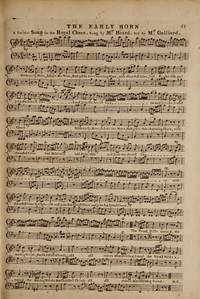
41155Folio. 19th half black leather with marbled boards spine in compartments gilt with titling gilt. Engraved throughout with the exception of the ninth songsheet which is typeset. <br /> <br /> Provenance<br /> Evan Charles Sutherland-Walker 1835-1914 with his armorial bookplate to front pastedown.<br /> <br /> Contains 25 songs including works by Arne Bride Dibdin Clarke Galliard Handel Harington Hook Jackson Leveridge Selby Smith and others. With occasional ornamentation filling out of chords and corrections in contemporary manuscript. <br /> <br /> 1. Clark. "The Broom on Cowdenknows" "When Summer comes the Swains on Tweed". London ca. 1780. 1f. recto music verso blank pp. BUC p. 1075. Jeremiah Clarke ca. 1743-1809 English composer violinist and organist; his published works all printed in London consist of songs and keyboard sonatas with instrumental accompaniment. <br /> <br /> 2. Dibdin. "While the Lads of the Village . Sung by Mr. Bannister." "J.W." printed to foot of music. London: John Welcker ca. 1775. 1f. recto music verso blank pp. BUC p. 1078. Charles Dibdin 1745-1814 English composer dramatist poet actor singer and entertainer wrote many songs.<br /> <br /> 3. Arne. "Water Parted from the Sea . Sung by Mr. Tenducci in Artaxerxes." London ca. 1765. 1f. recto music verso blank pp. BUC p. 57. Alfred Thomas Augustine Arne 1710-1778 an English composer violinist and keyboard player was "the most significant figure in 18th-century English theatre music." Peter Holman and Todd Gilman in Grove Music Online<br /> <br /> 4. Jackson. "Delia . Sung by Mr. Squibb at Marybone! Gardens. Set to Music by Mr. Wm. Jackson of Exeter." London ca. 1770. 1f. recto music verso blank pp. BUC p. 552. William Jackson 1730-1803 an English composer and organist wrote a number of songs canzonets etc. "His best music is to be found in his secular vocal works where he demonstrates an ability to blend a natural melodic style with a sensitivity to text." Richard McGrady in Grove Music Online<br /> <br /> 5. Galliard. "The Early Horn . A Fav'rite Song in the Royal Chace. Sung by Mr. Beard. Set by Mr. Galliard." London ca. 1737. 1f. recto music verso blank pp. Paginated 31 at upper outer corner. BUC p. 358. John Ernest Galliard ca. 1687-1749 German composer and oboist "certainly played a significant role in London's musical life in the first half of the 18th century." Roger Fiske revised by Richard G. King in Grove Music Online<br /> <br /> 6. Smith. "Zoreb and Zaida . Sung by Mr. Morgan." London ca. 1770. 1f. recto music verso blank pp. JISC one copy only at Oxford University.<br /> <br /> 7. Handel. "Let me Wander . L'Allegro Il Penseroso." London: Printed for J. Bland No. 45 Holborn ca. 1790. 1f. recto blank verso music pp. HWV 55. BUC p. 433. George Frideric Handel 1685-1759 English composer of German birth was "one of the greatest composers of his age." Anthony Hicks in Grove Music Online<br /> <br /> 8. Handel. "L'Allegro il Penseroso ed il Moderato Or Let the Merry Bells." London: Bland ca. 1790. 1f. recto music verso blank pp. HWV 55. BUC p. 433.<br /> <br /> 9. Bride. "The Joy-Inspiring Horn . A Favorite Hunting-Song. Set by Mr. Bride." London: R. Falkener ca. 1775. i blank 2 i blank pp. BUC p. 135. Typeset with an arrangement for two German flutes in score on the second page. Tear extending from lower margin into three systems of music; small loss to lower outer corner of first page of music; imprint trimmed but possibly the Falkener edition where the imprint appears at the foot of the second page of music. OCLC 43123680.<br /> <br /> 10. Handel. "Sung by Mr. Beard in Alexander's Feast" "Happy happy pair". London ca. 1740. i blank 2 i blank pp. HWV 75. Not in BUC.<br /> <br /> 11. Leveridge. "The Roast Beef Cantata." London ca. 1770. 4 pp. BUC p. 1026. Richard Leveridge 1670-1758 English bass and composer was "a leading singer on the London stage and a popular composer of songs." Olive Baldwin revised by Thelma Wilson in Grove Music Online<br /> <br /> 12. "The Camp Medley" "The Lark was up the Morn was grey". London: Longman & Broderip ca. 1780. BUC p. 595. 4 pp. With trill markings in contemporary manuscript.<br /> <br /> 13. "The Banks of the Dee A favorite Song" "It was summer". London: Bland ca. 1780. 1f. recto music verso blank pp. BUC p. 549 other editions. <br /> <br /> 14. "He Stole my Tender Heart Away . A Favorite Song" "The Fields were green". London ca. 1780. 1f. recto music verso blank pp. BUC p. 334. <br /> <br /> 15. Hook. "The Favorite Song Sung by Miss Brown in the Scheming Lieutenant" "Beneath a green shade". London: CST handstamp Charles and Samuel Thompson ca. 1775. 1f. recto music verso blank pp. JISC two copies at the British Library and the National Library of Scotland. James Hook 1746-1827 was a noted English composer whose songs were "regularly performed at the main London pleasure gardens." Pamela Gairl in Grove Music Online<br /> <br /> 16. "Social Pow'rs . A Favourite Song" "Come now all ye Social Pow'rs". London: Printed for J. Bland No. 45 Holborn ca. 1785. 1f. recto music verso blank pp. BUC p. 208.<br /> <br /> 17. "The Invitation Sung at Marybone Gardens by Mrs. Vincent. Mr Lowe. Miss Davis. Mr Raworth. and Mr Taylor" "Come ye party Jangling Swains". London ca. 1766. 1f. recto music verso blank pp. BUC p. 209. <br /> <br /> 18. Selby. "The Chace of the Hare . A New Hunting Song." 1f. recto music verso blank pp. BUC p. 940. Minor loss to flute line.<br /> <br /> 19. "Fair Hebe. Sung by Mr. Beard at Ranelagh Gardens" "Hebe I left with a cautious Design". London ca. 1750. 1f. recto music verso blank pp. BUC p. 324. With "Fair Hebe" in contemporary manuscript to blank verso. <br /> <br /> 20. Harington. "Air. by Mr. Harington of Bath" Gentle Airs sweet Joys impart". London ca. 1780. 1f. recto music verso blank pp. BUC p. 446. Henry Harington 1727-1816 English composer physician and author was a leading contemporary composer of glees catches and duets.<br /> <br /> 21. Arne. "The favourite Hymn of Eve. In the Oratorio of Abel" "How Chearful along the gay Mead". London ca. 1755. 1f. recto music verso blank pp. JISC one copy only at Oxford University. <br /> <br /> 22. "The Cotillon" "Hail Politeness pow'r divine". London: Rd. B__e ca. 1770. 1f. recto music verso blank pp. BUC p. 416.<br /> <br /> 23. Arne. "The Echoing Horn in Thomas & Sally." London: Printed and sold by S. Phillips in St. Martins Court ca. 1765. 1f. recto music verso blank pp. BUC p. 45. <br /> <br /> 24. Arne. "Hebe . Set by Dr. Arne" "When forc'd from dear Hebe". London: Walsh 1752. 1f. recto music verso blank pp. BUC p. 47 <br /> <br /> 25. "Anna A Particular Favourite Irish Song. Sung by Miss Catley - and - Mr. Leoni." "Shepherds I have lost my Love". London: I. F.entum ca. 1775. 1f. recto music verso blank pp. BUC p. 943.<br /> <br /> Bound with: <br /> Clark. Eight Songs with Instrumental Parts in Score Composed by Jeremiah Clark Organist in Birmingham Opera Seconda. London: Printed for the Author and Sold by Messrs. Straight & Skillern Music Engravers and Printers in St. Martins Lane near Charing Cross ca. 1775. 1f. recto title verso blank 34 pp. Engraved throughout. BUC p. 94. RISM C2618 and CC2618 two copies in the U.S. at Cornell University and the Library of Congress. <br /> <br /> Index in pencil to front free endpaper. <br /> <br /> Binding worn rubbed and bumped. Slightly worn; occasional minor imperfections including small tears soiling and stains. unknown
3 theatre bills. Folio (c. 220 x 355 mm). Announcing the performances of "Don Ranudo de Colibrados" and Kotzebue's "Der arme Poet" on Dec. 27, as well as the "Lästerschule" on Dec. 28. 12. (Iffland playing Don Ranudo, Lorenz Kindlein, and the Baron); Shakespeare's "Merchant of Venice" on Dec. 29 (Iffland in the role of Shylock); and, finally, of Goldoni's "Der gutherzige Polterer" (Iffland's translation, with him playing Morhof) and Kotzebues "Der häusliche Zwist" (Dec. 30). - Iffland, who had created a sensation in 1782 as the first "Moor" in Schiller's "Die Räuber", gave his final performance in Weimar in the last days of December 1812. Goethe, who had previously succeeded in bringing the actor to Weimar in 1796, attended all performances and was Iffland's host on Dec. 28. A few days before Iffland's arrival, Goethe had written to Zelter: "It is probably one of the rarest of phenomena, and one, I think, that has never occurred with any other nation, that the greatest actor should generally select for himself parts, which are intrinsically unworthy of him, though, by his acting, he knows how to invest them with the highest momentary value" (12 Dec.) A few weeks after his departure, Goethe wrote: "Iffland's presence was a great delight to me. I gave myself up to the pure enjoyment of his talent, endeavoured to understand everything as he gave it, and did not trouble myself about what he gave [...] Thus I have greatly admired Iffland's way of throwing life into dead plays, - nay, his creation out of nothing [...] In addition, I thought it remarkable, that Iffland, who, in his written plays, aims at the most ample breadth, in his acting, conjures up again the conciseness and terseness of plays that are extemporized. How different our stage would seem, if he had not been forced to take this roundabout way [...]" (15 Jan. 1813). - Somewhat brownstained and wrinkled; slight edge defects; traces of folds and sewing. Numbered at the upper edge by a contemp. hand: "21"; "33"; "37".
3 vol. in-8, pp. XIV, (2), 411, (3); XIV, (2), 214, (2); 6 ff. nn. ( per errore num XIV, il primo bianco), (2), 216+207; bella leg. coeva in vitello moucheté, titolo su duplice tassello e ricchi fregi in oro ai dorsi. Con una tav. di musica notata inc. in rame e ripieg. f.t. nel terzo vol. Il primo vol. è dedicato dall'autore a Gius. Niccolò D'Azara, gli altri due recano la dedica dello stampatore a Carlo Caprara. Prima edizione (la seconda apparve a Venezia nel 1785) di questa famosa ed importante storia del dramma musicale italiano dal Medioevo al Metastasio. La seconda parte del III vol. contiene le ''Osservazioni (dell'Arteaga) intorno ad un Estratto del tomo secondo della presente opera...colle Repliche (di Vincenzo Manfredini) fatte a queste Osservazioni...''. «Appena pubblicata, l'opera ebbe una vasta risonanza e suscitò numerosi consensi e dissensi... Al di là del carattere baldanzosamente polemico di certi giudizi dell'A. e del tono libellistico assunto dalla controversia, quest'opera ha una notevole importanza come documento degli sviluppi del pensiero riformatore sull'opera settecentesca...» (cfr. Diz. Biogr. Ital., 4, pp. 352 e segg.). Fu presto tradotta in tedesco (Lipsia 1789) e compendiata in francese. Stefano Arteaga nacque in Spagna nel 1747, entrò giovanissimo nella Compagnia di Gesù che, però, abbandonò nel 1769 dopo essersi rifugiato in Italia; studiò a Bologna, dove frequentò il grande musicista padre G.B. Martini; morì nel 1799 a Parigi . Esempl. in ottimo stato (l'anomalia di numerazione del terzo vol. è stata riscontrata in altri esemplari).. Palau 17871; Sommervogel I, 589, 1. RISM I, p. 98. Eitner I, 212. Fétis I, 150. Non in Hirsch..
19, 11 SS. Marmorierter Halblederband mit goldgepr. Deckelschildchen. Folio. Erste Ausgabe. - An den Rändern leicht gebräunt. - Mit Exlibris Pierre Bergé am vorderen Innendeckel und wiederholtem Naßstempel von Jeremy P. S. Montagu, retired curator of Oxford's Bate Collection of Historical Instruments. Bach Werk-Verzeichnis, 1056. - Hoboken, S. 127.
1 S. 4to. An einen namentlich nicht genannten Verleger: "Für beifolgendes kleine Mscpt, welches ich Eur. Wohlgeboren zum Druck anbiete, habe ich eine besondere Vorliebe, indem es ein Erzeugniß, froher, glücklicher Stunden ist, welche vorigen Sommer im freundlichen Grünthal im sächs. Erzgebirge, gefeiert wurden, wo die dortgen Freunde: G. u. R. mich aufmunterten, dem frohen Beisammensein, ein Andenken zu weihen. Dieses kleine Musikstück, welches dem musikal. Standpunkte meiner neuen Freunde entsprechen musste, möchte ich 'Abendempfindung' nennen […]".
2 SS. 4to. An den Verleger Carl Friedrich Peters (1779-1827) in Leipzig: "Mein letztes Schreiben vom 16ten nebst der an Sie abgesandten Manuscripten werden Ihnen gut zu gekommen seyn, und ich sehe Ihrer Antwort darauf entgegen. Heute bin ich so frey Ihnen anzuzeigen dass Wessel et Com., auch Verleger des Duetts für Violin und Violoncello ist, welche Sie die Güte haben werden auf dem Titel zu bemerken, ferner bemerke Ihnen dass ich noch einige kleine Fehler in dem Duo für Clavier und Violin von A. Bohner gefunden habe welche Ihnen hiermit anzeigen, und bitte gefälligst zu ändern wie folgt […]". - Bohrer wurde 1799 Musiker beim Münchner Hoforchester, mit dem er zahlreiche Konzertreisen durch Europa unternahm. 1832 folgte er einer Berufung als Erster Cellist und Konzertmeister nach Stuttgart. Bohrer komponierte unter anderem Stücke für Cello.
256:203 mm. Depicting Bowie onstage as John Merrick in "The Elephant Man". - Bernard Pomerance's play opened on 29 July 1980 at the Denver Centre of Performing Arts for a week-long run with Bowie in the role of John Merrick. Afterwards, the show continued on to Chicago, and then the Broadway stage. The wooden model is based on one Merrick made of St Phillip's Church, which he could see from his hospital room. - A few surface marks and defects, but overall in fine condition.
Edizione originale. Esemplare in ottime condizioni. Proveniente dalla collezione Giampiero Mughini. Rarissimo opuscolo promozionale dello spettacolo «La veglia dei lestofanti», interamente curato nel layout da Paladini, e impreziosito da otto notevolissimi disegni delle scene dell’architetto Antonio Valente. Prima messinscena italiana dell’«Opera da tre soldi [Die Dreigroschenoper]» di Brecht e Weill, nella traduzione di Alberto Spaini e Corrado Alvaro, musica di Adolfo Del Vecchio, scene di Valente, costumi di Anita Pittoni e naturalmente regia di Bragaglia. Bella fotografia del Bragaglia a piena pagina, foto e approfondimenti sulla prima donna Emilia Vidali, foto degli altri attori (Arturo Falconi, Camillo Pilotto, Lidia Simoneschi, Sara Guarnieri, Juliane Begagli, Hisa Harl e Adele Carlucci) e anche del maestro Del Vecchio. Una sola copia in Iccu (Padova), assente dai repertori consultati.
Calling card format, 1 page, 60:42 mm (in wooden frame). In French, to an unidentified recipient, requesting him to attend a concert. - The memorial plaque in bronze was made for the occasion of the unveiling of two Debussy memorials in Paris and Saint-Germain-en-Laye. The engraving on reverse reads: "CLAUDE DEBUSSY | 1862-1918 | CETTE MÉDAILLE | A ÉTÉ FRAPPÉE | A L'OCCASION | DE L'ÉRECTION | DES MONUMENTS DE | CLAUDE DEBUSSY | A PARIS | ET A St-GERMAIN-EN-LAYE".
Zus. 36 SS. Kl.-8vo bis gr.-8vo. An den Musikschriftsteller u. -kritiker Max Kalbeck. - Alexander von Fielitz studierte Klavier, Komposition und Dirigieren als Schüler Julius Schulhoffs, E. Kretschmers und Karl Bancks. Seit 1884 Theaterkapellmeister in Zürich, 1885/86 in Lübeck, übersiedelte Fielitz nach Italien, wo er als freischaffender Komponist in Rom und auf Capri lebte. Seit 1901 unterrichtete er am Sternschen Konservatorium in Berlin und dirigierte 1904 am Theater des Westens. 1905 ging er als Lehrer an das Ziegfeld-Konservatorium nach Chicago, leitete dort seit 1906 das Symphonieorchester und kehrte 1908 an das Sternsche Konservatorium zurück, dessen Leitung er 1915 übernahm.
in-folio, ff. (6, compreso antiporta inc.), pp. 240. Legatura coeva m.pelle, titolo su tassello al dorso, piatti in carta marmorizz. Bell'antiporta allegorico a soggetto musicale (firmato Manfredi sculp.), titolo in rosso e nero, armi imperiali in testa alla dedica del traduttore Alessandro Manfredi, iniziali istoriate e fregi tipografici, 35 pagine di musica interamente incise in rame e numerose notazioni musicali in silografia n.t. Prima ed unica edizione in italiano di questo classico trattato di teoria musicale e armonia, magnificamente impresso, (pubblicato in latino a Vienna nel 1725 col titolo "Gradus ad Parnassum". L'opera, in forma di dialogo tra un maestro (Palestrina) e l'autore, diede grande fama al compositore austriaco (1660-1741) e si pose come base per tutti gli studi teorici sul contrappunto; "è un vero trattato generale di composizione, poiché non si occupa solamente dello stile contrappuntistico severo, ma anche di quello libero, nella prassi del tempo" (Encicl.Musica, III,59). Bellissimo figurato del Settecento emiliano. Ottimo esemplare.. RISM B VI, 340-41; MGG IV, 1164; Eitner IV, 106; Fétis III, 360-2: "Cet ouvrage, devenu classique, est aujourd'hui, la seule production de Fux généralement connue dans le monde musical"; Gregory-Bartlett II, 39; Hirsch I, 187; Olschki, Choix VIII, 10957. Non in Wolffheim..
Oblong folio (ca. 250 x 315 mm). 4 pp. on bifolium. Sketches for the four-act opera "Cinq-Mars", premiered at the Opéra-Comique on 5 April 1877, with a a libretto by Paul Poirson and Louis Gallet, loosely adapted from Alfred de Vigny's historical novel. The manuscript includes 130 measures on systems of 9, 4 and 2 staves, with a few pencil additions. Gounod indicated the vocal lines with rare words and some accompanying sketches. The largest part of the manuscript comprises the ensemble "Marie, Reine!" (quartet and choir), larghetto 3/4, gathering Marie de Gonzague, Cinq-Mars, De Thou and Father Joseph, plus a choir (top, tenors and basses), while the final page features a choir, that "follows the song" ("à Marion"), and ends with a ritornello. - Although it received a lukewarm welcome at its premiere, the opera was revived by the Leipzig Opera in 2017. - Minor marginal flaws.
4to. ½ p. Bifolium with integral address panel. To Ignaz Moscheles, thanking for sending him a piano reduction. - Slightly browned, and small damage to edges.
Large 4to. 2 pp. on 2 ff. With autogr. address. To the German music critic, writer, poet, and amateur composer Richard Pohl (1826-96), discussing the musical arrangement of Carl Maria von Weber's festive cantata.
243394Paris, G. Brandus, Dufour ; Jules Renouard, Leipzig, F. Hofmeister, Londres, Barthès et Lowell, 1856 2 parties en un vol. in-4, XIII pp.,169 pp., un f. n. ch. d'errata, avec 5 planches hors texte, [2] ff. n. ch., 124 pp. de musique notée, veau azur, lisse orné de pointillés, filets, grecques et fleurons dorés, encadrement de double filet à froid sur les plats, armes rau centre du plat supérieur dans un encadrement de pointillés dorés avec bandeaux et fleurons en écoinçon, hachuré doré sur les coupes, tranches dorées, guirlande dorée en encadrement sur les contreplats, gardes de soie ivoire (reliure de la fin du XIXe). Dos insolé et passé, des piqûres sur les plats.
Zusammen 9¼ SS. auf 12 Bll. Meist (qu.-)8vo. An den Organisten Franz Schütz: "Maestro di Pedalo! Das nennt man 'sich kreuzende Post'. Blöd - nicht wahr? Kommen Sie nicht mal nach S'burg? Warum hat man Sie dieses Jahr nicht aufgefordert? Ich finde das widerlich - da werden wohl die dortigen Ona'nisten gestänkert haben, weil sie nicht so viel können wie der Schütz! Wenn Sie an mich noch einmal den Verdacht äussern, dass der Einspruch des Herrn J. über allgemeine Interessen der Gesellschaft der Musikfreunde gestellt wurde, dann hau ich Ihnen einen harten Gegenstand an den Kopp!" (23. VII. 1939). - "[...] Am 5. V. verließ ich nach der Electra Wien, fuhr nach München, von hier 2 Tage später nach Berlin, und am 11. begann die Nordlandreise [...] Leider werde ich nun Ihre 'Missa' am 17. XII. nicht machen können, da ich erst ein oder zwei Tage vor meinem Philharmonischen am 20. aus Berlin, Mannheim und dem Rheinland zurückkomme [...]". (4. 7. 1941). - "Müssen Sie nun auch noch den Versuch unternehmen, mich zu verärgern? Wie können Sie nur so mir nichts dir nichts behaupten, ich hätte meine Einstellung zu Ihnen einer Korrektur unterzogen? Wissen Sie denn nicht, was ich alles in Wien für Sie gemacht habe? Welche Laufereien - welche Unterhaltungen? Nein: Sie scheinen's nicht zu wissen. Daß Sie mich in den letzten Wiener Tagen nicht mehr erreichen konnten, lag wahrscheinlich nur an den überhetzten Abreisevorbereitungen für die Schweiz (Pass- und Nationalbank- und Schlafwagenplätzegelaufe, und was deren Dinge noch mehrere sind), die sich in den 2-3 Tagen abspielten. Ich hätte Ihnen Konkretes auch garnicht [sic] mitteilen können, denn überall, wo ich eine Lanze für Sie zu brechen versuchte, ließ man mich auf Granit beißen [...]" (16. IX. 1947). - Drei Briefe mit schwarzem Trauerrand und im linken Rand gelocht (unbedeutende Buchstabenberührung); eine Karte mit stärkeren Randläsuren.
1 S. Qu.-12mo (76:97 mm). Zwei Takte aus seiner im Jahr zuvor uraufgeführten Oper "Violanta".
Oblong 8vo. 1 p. Ten bars "for two sopranos" with interlinear text ("Veilchen schön. Veilchen blau. Veilchen schön. Veilchen blau. Wo soll ich dich finden?"). - Mounted on cardboard.
Folio. Score (2 ff., 7 pp.) and voices (3, 3, 3, 3 pp.). Cream-coloured silk binding with cover title; all edges gilt. Calligraphical fair copy: "Motette für die kirchliche Confirmationsfeier seiner königlichen Hoheit des Kronprinzen von Hannover componirt nach Worten der heiligen Schrift für Sopran, Alt, Tenor und Bass (Chor)", op. 73 ("Wer mich bekennet vor den Menschen [...]"). In contrast with the title, the present handwritten copy is for Soprano I, Soprano II, Tenor, and Bass. Written for Crown Prince Ernst August of Hanover (1845-1923) and dedicated to his mother Maria. Friedrich Kücken, a student of Simon Sechter and Jacques Fromental Halévy, is remembered as one of the 19th century's foremost Lied composers. - Likely unpublished.
½ S. auf Doppelblatt. 8vo. An seinen Sohn Robert in Betreff eines bevorstehenden Besuchs: "Es sieht nicht aus als sollte der Rest meiner Münchener Errungenschaft, ein vollausgebildeter Kater, bis übermorgen von mir weichen; auch ist die Witterung dem Nachzügler keineswegs hold. Rebus sic stantibus stelle ich Dir anheim mich nächsten Sonntag in meiner Klausur zu besuchen. Macht es Dir nicht zu viel Mühe so bringe mir Nachricht üb[er] Hrn. Rocke's Befinden. Wenn er z[u] Hause wird er dir etwas für mich mitgeben. Die üppige Gegend wird Dich nicht hindern ½ Dzd. Canon's zu ersinnen. | Dein verclausulierter | VLachner". - Bei Hrn. Rocke wird es sich um den Schauspieler und Tenor Leopold Rocke (1818-89) gehandelt haben. - Die obere Hälfte von Bl. 1 mit einer gestochenen Ansicht des Königssees. Etwas angestaubt, fleckig und knittrig.
1 S. 4to. "Mon cher Monsieur Moron, un picard d'Abbeville (nommé M. Acker) qui a une fort bonne voix de basse, vient de me venir trouver désirant beaucoup d'étudier à votre Ecole. C'est un tout jeune homme, d'une trés bonne conduite et dont ou m'a donne des bons renseignements. Je ne veut pas préjuger votre jugement, mais il me semble qu'il […]". - Der spätere Musikdirektor der kaiserlichen Kapelle Napoleons erhielt seine musikalische Ausbildung an der Sängerschule der Kathedrale zu Abbeville (vgl. MGG VIII, 670f.).
4 SS. auf Doppelblatt. 8vo. An den Leipziger Verleger Hermann Härtel (1803-75), geschrieben während eines Kuraufenthalts in Bad Ems. Nach dem vergeblichen Versuch, Chopin für sich als Ehemann zu gewinnen, beendete Lind 1849 ihre Opernkarriere. Offenbar ist sie danach erst einmal auf Kur gegangen, zunächst nach Schlangenbad, wie sie schreibt, dann sei sie für "5 Wochen in Ems gewesen" und beabsichtige nun, nach Meran weiterzureisen. Bei Härtel, dessen Schreiben sie "durch Mme Mendelssohn Bartholdy" erreicht habe, bedankt sie sich für ein zugesandtes Goethe-Porträt. "Sie haben wohl recht geehrter Herr Doktor da Sie vermuthen daß es eine Freude für mich war die Mme Mendelssohn zu sehen! - es sind sehr wenige Wesen auf der Welt zu welchen ich mich so hingezogen fühle als gerade zu ihr, und niemals werde ich den Genuß vergessen die Wittwe unseres unsterblichen 'Felix' so lieben und achten zu können und zu gleicher Zeit dem Himmel danken daß Er, der reinste Mensch den ich jemals getroffen - gerade die Einzige Frau gefunden, die recht würdig war, ein solches Wesen durch's kurze Leben zu begleiten!" - Jenny Lind verband mit Mendelssohn Bartholdy eine innige Freundschaft, vielleicht sogar Liebesbeziehung. Liest man diese Briefe an Härtel, wird in jedem Fall deutlich, daß es sich bei Lind um mehr als nur einfache Zuneigung gehandelt haben muß.
8vo and oblong 12mo. Together 12½ pp. on 4 bifolia and 4 single leaves. With 2 autograph envelopes, one of which mounted to the letter. About Malherbe's activities within his professional radius as archivist of the Paris opera: providing tickets and recommendations, archival issues, as well as on his achievements in the field of publications, musical arrangements, and compositions. - Three letters to a "Maître": a presentation letter to his just-published "Histoire de l’Opéra-Comique: la seconde salle Favart", and a reminder to reserve box seats for the dress rehearsal of Reyer's opera "Salammbô": "Vous m'avez promis une cinquième loge pour la répétition général de Salammbô, on ma demandant de vous le rappeler [...]" (8 May 1892). With congratulations on a promotion to a higher rank within the Légion d’honneur. Facetiously, Malherbe cites the famous caricaturist Amédée Noé's words on a similar occasion: "A l'un de ses amis qui dans la hiérarchie de la Légion d'Honneur passait de grade d'officier à celui de commandeur, Cham écrivait, dit-on: 'Je fait comme ta croix, Je te saute au cou!' [...]" (1 Jan. 1892). Further, Malherbe writes that he was unable to obtain a requested recommendation from General Édouard Hardÿ de Périni for a young lady. A reference from the theatre director Pedro Gailhard would be best, and the Ministry of Public Education, too, could easily obtain one from the Ministry of War. Also, Malherbe discusses autographs of Berlioz: "Il suffit que le ministère de l'Instruction publique le demande au ministère de la guerre: c'est un simple échange de bons procédés entre deux service administratifs [...]" (19 July, no year). - Three letters to the pianist Louise Filliaux-Tiger, about decorations awarded by the Légion d’honneur: "Il convient donc de n'en trier nulle vanité, et, en cette matière comme en bien d'autre, mieux être que paraître [...]" (30 March 1900). On the matter of how to correctly collect autographs in albums or volumes, with a contact to Malherbe's bookbinder. Malherbe asks for news of the Polish pianist Paderewski: "Vous savez que je n'ai toujours pas eu de nouvelles de Paderewski. Où cache-t-il? [...]" (21 Aug. 1902). Malherbe could not see the Madame personally, as he wanted to show her an arrangement he made for a tune of the soprano Delphine Ugalde: "Car entre nous l'harmonie et l'accompagnement en étaient pitoyables; j'ai repris la mélodie en le travaillant d'une manière un peu plus raffinée [...]" (21 July 1903). - To the Belgian musician Gaston Knosp, asking for an appointment in connection with Bizet's opera "Don Procopio", which shortly before had its first production in Malherbe's revised version at the Salle Garnier in Monte Carlo: "Votre lettre est arrivée à la Bibliothèque, alors que je me trouvais dans le midi, occupé à monter l'opéra de Bizet, Don Procopio [...]" (13 March 1906). - One letter to a friend, concerning opera tickets (24 June 1910). - One printed letterhead of the "Théâtre National de L'Opéra", one lettercard with printed vignette.
3 SS. auf Doppelblatt. 8vo. Launige Zeilen an einen Freund über aktuelle Ereignisse, u. a., dass er von seinem Freund Michael Dumont versetzt worden sei, der ihn eigentlich anlässlich der Teilnahme an einer Papierfabrikantenversammlung hatte besuchen wollen. Dem Adressaten sendet er ein Exemplar von den "Charakterstücken f. Pf." (wohl Op. 105 von 1840) als "ein öffentliches Zeichen meiner freundschaftlichen Hochachtung [...] Vermagst Du über den Inhalt etwas Günstiges zu sagen, so thue es, mindestens im Interesse des Verlegers". Eine amüsante Passage nimmt Wagner aufs Korn: "Unsre Kunstkneipe schlendert so fort in der alten Manier u. wagnert recht wacker. Am 18ten war der Holländer u. am 20ten der Tannhäuser. Dafür nun soll am 27ten der Lohengrin gegeben werden. Das Publicum stöhnt u. seufzt u. das Orchester reißt sich aus Verzweiflung alle Haare aus u. wird täglich glatzköpfiger [...]." Marschner hatte die Opern wohl selbst in Hannover einstudiert, wo er Generalmusikdirektor am Königlichen Hoftheater war. - Einige Einrisse fachmännisch restauriert.
8vo. Together 10 pp. on 6 bifolia and 3 single sheets. To the cellist and conductor Achille Kerrion (1868-1939) with thanks, regards and congratulations to him and the whole orchestra, as well as praise for his sister, the singer Stéphanie Kerrion: "Votre lettre me trouve à Paris, que je travers & de suite, je vous exprime ma parfaite gratitude & toutes mes chaleureuses amitiés! Votre soeur est une très remarquable artiste que [!] c'est avec reconnaissance que je la remercie! à tous les musiciens de l'orchestre mes plus amicables félicitations [...]" (Paris, 15 Oct. 1896). - To Antonin Périvier (1847-1924), director of the literary periodical "Gil Blas", suggesting his friend, Ernest Laroche from Bordeaux, for a position at the journal: "Cher grand ami, plus d'une sollicitation vous parviendra au sujet de votre nouveau journal! Passez à un homme très précieux: mon ami Ernest Laroche, de Bordeaux; il peut remplir un poste absolument utile et devenir un collaborateur tout à fait nécessaire [...]" (Paris, 6 Nov. 1902). - To a friend about writing to the influential music journal "Le Ménestrel", and with congratulations for his performance in his opera "Thaïs", which premiered in 1894: "Cher ami merci! J'écris au Ménestrel, allez y je vous en prie demain lundi. Très à vous & félicitations à votre diction [?] de Thais [...]" (Égreville, 22 Aug., no year). - To a friend with congratulations on his success, hoping it will last for a long time: "Je suis enchanté de vous savoir satisfait et je n'ai que à vous souhaiter la continuation de vos succès! [...]" (Paris, January 1890). - Hoping that a reunion will not take place as long as he is out of town: "Pourra que la réunion n'ait pas lieu pendant que je serai absent & loin! [...]" (no place, 11 Aug. 1900). - Setting the date and time for a visit: "Je vous attendrai chez moi (46 rue du Général Foy) le Lundi 30 avril à 9h ¼ précise du matin [...]" ([Paris], 21 April, no year). - The visiting cards send regards and congratulations, and express his disappointment at an answer from Kerrion. - All but 2 letters with strips of paper mounted on verso.