Azaïs (Hyacinthe).Livre Rare Book
78 250 résultats
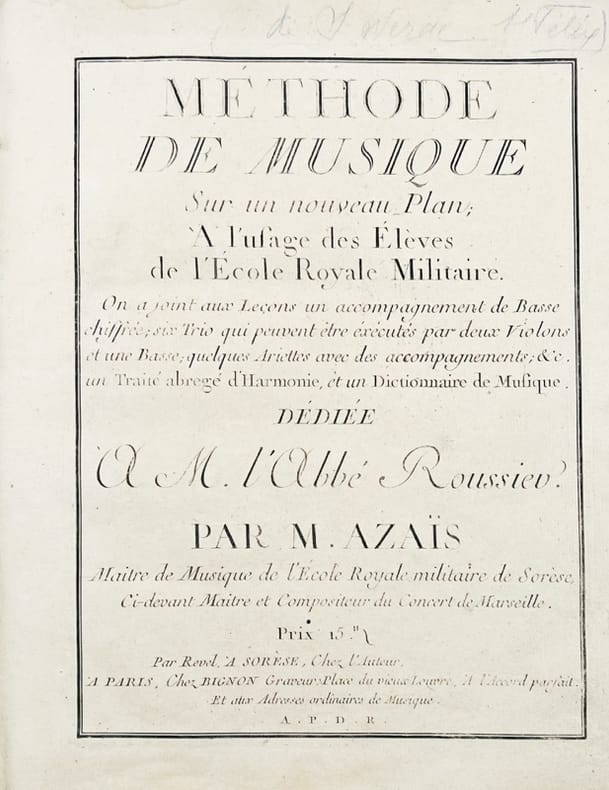
177644574Sorèze, chez l'auteur, Paris, Bignon, sans date, (1776). In-folio de (4)-173 pp. de musique notée, basane marbrée, dos orné à nerfs, tranches rouges (reliure de l'époque).
Small 8vo. 1 p. Bifolium with integral address panel. To his friend, the Hungarian born pianist Stephen Heller (1814-88): "Mon cher Heller / J'ai cherché dans toute la rue de Laval sans pouvoir trouver M. de Vesma [?] qui a eu la bonté de m'écrire ce matin et que je voudrais bien voir avant son déport pour la campagne. Savez vous son adresse numérotée?"
I: 8 SS. auf 4 Bll. 4to. - II: 17½ SS. auf 12 Bll. Wendet sich das erste Manuskript - die "Vorhalle" - expressis verbis an "m[eine] l[ieben] Z[uhörer]", so kommen diese im zweiten Manuskript - betitelt mit "Als Vorwort | Anmerkungen u. Excurse" - als Adressat nicht vor, dürften aber dennoch, Tonfall und Duktus zufolge, dieser gewesen sein. - Beide Manuskripte dürften nicht vollständig sein oder einen jeweils in sich abgeschlossenen Teil einer Serie darstellen, die als solche nicht überliefert ist. - Die "Vorhalle" stellt eine weit ausholende Einleitung zur "Geschichte derjenigen Kunst" dar, "die die Meister v. Ihnen als Lebenszweck erwählt"; als Vorwort bietet einen nicht minder weitläufigen Überblick über Vokalmusik, Philosophie der Musik, Versuche zur Gliederung der Musik in geschichtliche Epochen (nach F. W. Marpurg, vgl. S. 9) u. a. m. - Der aus Butschowitz (Mähren) gebürtige Musiker und Musikpädagoge, der als "einer der besten Pianisten seiner Zeit" gilt (MGG IV, 276) erfuhr seinen Klavier- und Kompositionsunterricht durch Anton Halm und Ignaz von Seyfried und wurde 1833 Professor am Konservatorium der Gesellschaft der Musikfreunde, wo er bis 1856 als Klavierpädagoge wirkte. Fischhof gilt als "Meister der klassischen Wiener Klavierschule [...] er trat besonders als Interpret Bachs, Beethovens, Mendelssohn Bartholdys und Chopins hervor. Seine umfangreiche Musikbibliothek mit Manuskripten und Autographen war vor allem für die Bach- und Beethovenforschung von Bedeutung" (DBE). Zu Fischhof vgl. (Auswahl) die entspr. Artikel in ADB, NDB, ÖBL, MGG, Riemann, Wininger und Wurzbach.
Small 8vo. ¾ p. on bifolium. Writing as censor, Grétry approves the printing of two scores by Muzio Clementi: "P.S. No. 26. J'ai vu par ordre de Monseigneur le garde des sceaux des simphonies a grand orquestre composés par Muzio Clementi No. 1 et 2 et je crois qu'on peut en permettre la gravure et la publication a M. Imbault etant le premier qui les publient en France [...]". Not in G. de Froidcourt (ed.), La correspondance générale de Gretry (1962).
in-8 (175x125), pp.(16), 669, (7), leg. antica in velluto porpora, tagli rossi. Musica annotata impressa in rosso e nero in tutto il volume. Una delle prime edizioni di uno dei fondamentali trattati di musica sacra, voluta da Palestrina che ebbe da Papa Gregorio XIII l'incarico di regolare e unificare le musiche e i toni dei cori. Fu il giovane Guidetti (1532-1592) a redigere con quello scopo il presente trattato, grazie alla profonda sua conoscenza delle fonti manoscritte di musica sacra. (La prima ediz. fu pubblicata nel 1582, e venne ristampata sino al 1874). Assai raro così ben conservato.. Wolffheim II, 2300. Eitner, IV, 417..
2½ SS. auf Doppelblatt. 4to. Mit eh. Adresse (Faltbrief). An seinen ihm freundschaftlich verbundenen Verleger Tobias Haslinger: "Also der letzte Tag in diesem Jahr wo ich Ihnen schreibe, um Ihnen Alles Gute fürs Neuejahr zu wünschen, und mir zugleich auch was davon. Wir sind Alle wohl und wünschen Ihnen ein Gleiches. Ich meldete dem Chelard, daß Sie selbst an ihn nach München schreiben würden. Den Abnehmer auf die zwei Kleinigkeiten, die er hier für die Milder [d. i. die Sopranistin Anna Milder-Hauptmann, 1785-1838] schrieb, hab ich ihm in London schon verschafft. Die mitgetheilte Nachricht, daß Sie keine Zahlung für mich an Herrn v. Beer leisten könnten, kommt mich recht der Quere; ich dachte wenigstens daß Sie 4- bis 500 fl 20 gr für mich erlegen würden; wenn es mich auch gerade nicht so sehr genirt, so ist es mir doch höchst unangenehm, Geld dahin schiken [sic] zu müßen, wo ich welches zu erhalten hoffte. Es geht mich zwar nichts an, allein ich habe bemerkt, daß Sie seit einiger Zeit entsetzlich viel auf Einmal verlegen und in allen Fächern; sollte das vortheilhaft für Sie seyn? Besonders bei allen diesen kritischen Epochen; verzeihen Sie mir diese Bemerkung, als ächter Kaufmann werden Sie dieses besser einsehen als ich; es war nur so ein Gedanke von mir. Die Fantasie und das Rondo habe ich dieser Tage erhalten […] P.S. Jos. Czerny verlangte ein neues Manuscript von mir und frug zugleich bei mir an, ob es war sey, daß ich niemandem andern als ihnen ein Werk von mir überlassen dürfte! - Sie hätten ihm dieses gesagt! […]". - Mit kleinem Ausschnitt der Verschlußmarke auf Bl. 2 (kein Textverlust) und Eingangsvermerk aus der Hand Haslingers.
8vo. 4 pp. on bifolium. In Swedish, to a "Lotte". - Some minor spots. Together with a letter from her husband Otto Goldschmidt (1829-1907) to the publishing house of List & Franke, asking to send the orchestra part of Robert Schumann's "Requiem für Mignon". - Provenance: Castle Skottorp. Previously Bukowski's, November 26, 1892, no. 578.
Titel, 6 SS. auf 2 gefalt. Bögen. Qu.-Folio. "Componirt und der Frau Gräfin Nina Apraxin gewidmet von Fürst Metternich". - Der Sohn des berühmten österreichischen Staatskanzlers Klemens Wenzel Fürst von Metternich diente 1855 als Legationssekretär in Paris, 1856 als österreichischer Gesandter und bevollmächtigter Minister am Dresdner Hof. 1859-71 war er Botschafter in Paris, wo er am Hof Napoleons III. mit seiner Gattin Pauline gesellschaftlich eine bedeutende Rolle spielte und vergeblich versuchte, Frankreich im Deutschen Krieg auf die Seite Österreichs zu ziehen; nach dem Sturz des Zweiten französischen Kaiserreichs sicherte er die Flucht Kaiserin Eugénies nach England. Als Komponist pflegte er vor allem die Tanzmusik für Klavier. "In harmonischem Zusammenwirken mit seiner populären Frau nahm der musikalisch sehr begabte Fürst in seiner noch über zwei Jahrzehnte währenden Wiener Periode ein kulturelles Mäzenatentum wahr" (ÖBL VI, 250). - Gering angestaubt.
Edizione originale. Più che buon esemplare, con alcune lacerazioni marginali senza perdite, che interessano entrambe le carte, e qualche sparso segno del tempo in copertina. Rarissima edizione stampata in pochi esemplari — «tiratura di 100 copie» per Cammarota — in occasione delle onoranze nazionali a Marinetti. Dedicatoria in testa alla copertina «A Benedetta autrice di “Forze Umane” omaggio futurista». Tra i pochi spartiti che Mix ebbe modo di pubblicare in vita — e che rappresentano i vertici sperimentali toccati dalla musica futurista — questo è il più rappresentativo, costituendo anche imprescindibile tassello di «marinettiana». Da una nota interna si apprende che la serie dei «profili sintetici musicali» fu «eseguita dall’autore nelle principali città d’Italia nella tournée del Nuovo Teatro Futurista (gennaio 1924)». Cammarota, Futurismo, 328.6
fotografia originale di dimensioni 10,3 X 14,5 cm circa, incollata su un cartoncino rigido (anch'esso originale) di dimensioni: 11 x 16,5 cm circa. Nella parte inferiore del cartoncino è stampato l'indirizzo e il nome del grande fotografo francese NADAR (pseudonimo di Gaspard-Félix Tournachon).Sul margine inferiore del cartoncino, a penna blu, è altresì presente l'autografo del famoso compositore ritratto nella foto (Franz Liszt). STATO DI CONSERVAZIONE: La fotografia presenta qualche superficiale e lieve incisione (maggiormente visibili in trasparenza), angoli del cartoncini leggermente consumati ma, nel complesso, un buon esemplare. Documento da collezione, di notevole pregio e rarità.
Un volume (22x30 cm) di 9 fogli su carta pesante. Manoscritto musicale con note musicali e testi in rosso e nero. ANTIPORTA multicolore dipinta, doppia inquadratura dorata contenente fregi a foglie, stemma policromo di Pio VII sorretto da un angelo e titolo “PIO VII P.O.M. dicatum. Anno salutis MDCCCVI”. Pagina di titolo in rosso e nero inquadrato con firma Paulus Mei e Script. Cap. P., con fregio floreale a colori. Capilettera figurati disegnati a penna. Al foglio 6 “In Festum SS. Apostolorum…”. Testimone in seta verde. Legatura in tutta pelle rosso scura, cornice a colonna floreale dorata ai due piatti, e angoli con coppa; al centro dei piatti grande stemma papale di PIO VII con anche fregi floreali. Un numero abraso al piatto anteriore. Tagli dorati; retro dei piatti con carta disegnata. Raro manoscritto musicale confezionato dal cappellano corale Paolo Mei (che morì nel 1816). Il Dizionario dei Cappellani Cantori della Basilica di San Pietro scrive “non si conosce la data esatta di ammissione”, ma questo manoscritto dimostra che risale almeno al 1806. Esposto alla Mostra “La rilegatura d'arte antica pontificia” (Museo civico di Albano, 1988), p.9 del catalogo.
in-folio, pp. (35), 359. Leg. coeva in cuoio, i piatti adorni di varie bordure di filetti concentiche, e fregio floreale al centro (restauri alle cuffie ed agli angoli, tassello con titolo al dorso più recente). Numerosi capilettera xilografici, alcuni istoriati, altri ornati su fondo nero criblé; impresso con eleganza in grande carattere tondo. Ottima edizione latina di Guarino da Verona dei ''Moralia'' di Plutarco di Cheronea (46-120 d.C.). Nonostante il titolo, il testo comprende questioni di religione, politica, letteratura, fisica e medicina, tra cui il dialogo sul problema della Provvidenza, quello sulla musica e «sulla faccia che si vede nella luna». I nove libri delle «Questioni conviviali» riguardano ognuno 10 problemi posti in banchetti con amici. Bell'esemplare su carta forte, con chiose ms. coeve nei margini (alone nel margine alto degli ultimi ff.).. BM, French Books 357. Adams P 1637. RISM B VI, 660..
Edizione originale. Ottimo esemplare (contenute normali lacerazioni a testa e piede del sottile dorso). Raro reperto del compositore italo-egiziano, le cui marce furono usate per musicare i balli plastici di Depero.Numero editoriale 1391. L’edizione raccoglie la «Marcia funebre per un uccellino», la «Marcia nuziale per un coccodrillo» e la «Marcia militare per le formiche». Lo spartito è datato in fine «dicembre 1920». -- «La compagnia di Van Doesburg, molto interessata alla musica d’avanguardia italiana, restò poi in contatto con Rieti e accolse con entusiasmo la partitura delle ‘Tre marcie’ che il compositore le inviò da Roma. Il 23 settembre 1922, nel corso di una serata dada organizzata da Tzara all’Hotel Furstenhof di Wiemar, in occasione del congresso d’artisti d’avanguardi, Nelly eseguì così al piano le ‘Tre marcie’ di Rieti davanti a un gruppo di dadaisti e costruttivisti, di cui faceva parte anche il futurista Vasari, riportando un grande successo» (Lista). Cammarota, Futurismo, 399.1; Lista, Dada in italia, p. 125
“[...] Le mie numerose occupazioni mi impediscono dapprima di assicurarmi se ci fosse possibile di scorrere il numero considerevole di opere che ci vengono inviate dai compositori che desiderano farle rappresentare nel nostro teatro; allorché me ne sono potuto occupare, il Sig. Bruehl mi ha detto che era già stato impegnato a dare quella del Caraffa [Michele Carafa], che è lo stesso soggetto arrangiato a Parigi per il teatro Feydeau, e che vi aveva di conseguenza rinviato il vostro poema, mettendovi al corrente della ragione che vi ho ora esposta e che ci mette nell’impossibilità di accettare la preferenza che ci avete accordato. Sono infinitamente spiacente [...]”. Spontini lavorò per oltre vent’anni al servizio dell’imperatore Federico Gugliemo III dirigendo la musica di corte e del teatro reale. La lettera è inviata al violinista e compositore tedesco Ferdinand Fränzl (1767-1833).
8vo. ¾ p. on bifolium. To Edgar Luis at Innsbruck, regarding the impossibility to come to Vienna in April, and with his best wishes for a concert. - On headed paper.
In-4°, (10cc), 46pp, 1carta ripiegata; 38pp, 4 carte di tavola, due ripiegate; 55pp, due carte di tavv, 16pp, 12pp, una carta ripiegata; 56pp, una carta ripiegata; 16pp, una carta ripiegata. Prima edizione, buone condizioni, legatura in pergamena con titolo manoscritto al dorso. La prima prefazione è di Dilherr, la seconda dell’autore. Poggendorff, II, col. 1133; Houzeau & Lancaster. Astronomie (1964 ed.), 9322, NUC pre-1956, NT In-4° (10cc), 46pp, 1 folded table; 38pp, 4 tables, two folded; 55pp, two folded tables; (2), 16pp, 12pp, one folded table; 56pp, one folded table; 16pp, one folded table. First edition, good copy, contemporary vellum binding, manuscript title at the spine. The first preface is by Dilherr, the second by the author The initial foreword is by Dilherr, the second one by the author. Poggendorff, II, col. 1133; Houzeau & Lancaster. Astronomie (1964 ed.), 9322, NUC pre-1956, NT"
95 albums 33 tours des années 1955 à 1980s, répartis en 9 boîtiers à disques de 34x34x5,5 cm chacun. Liste des albums de disques contenus dans cet ensemble, généralement édités par E.S. l'Encyclopédie Sonore Hachette, sauf mention : William Shakespeare - drames et tragédies romaines ; comédies ; tragédies ; la tragédie du roi Richard II , par le T.N.P. ; 400e anniversaires de la naissance de William Shakespeare ( l'avant-scène théâtre ) ; Daniel Sorano : Shylock ou le marchand de Venise (disques Adès) ; compte des mille et une nuits ; le roman de renart, par Bourvil (Emidisc) ; la chanson de Roland ; le roman de renard (par D. Sorano, Georges Wilson, etc.) ; Chartres (Decca) ; François Villon par Serge Reggiani et Pierre de Ronsard par André Reybaz (disques Adès) ; François Villon, poèmes dits par Alain Cuny (disque Festival) ; Rabelais, extraits de Gargantua et Pantagruel , Montaigne, Les Essais (extraits) ; Poètes du XVIe siècle (anthologie sonore de la Pléiade) ; Rabelais, les mirifiques aventures de Grangousier, Gargantua et Pantagruel, par Jacques Fabbri, Michel Galabru et Claude Pieplu (éditions Lucien Adès) ; Cervantès, les aventures de Don Quichotte de la Manche, par Gérard Philipe et Jacques Fabbri (Petit Ménestrel) ; Blaise Pascal, pensées dites par Pierre Fresnay (Festival) ; Visages de Pascal ; Madame de Sévigné, ses plus belles lettres (Véga) ; le monde musical de Racine (O.R.T.F.) ; Corneille, Cinna (disques Pléiade ) ; Rodogune ( SSB sélections sonores Bordas) ; Nicomède ( SSB ) ; Racine, Les Plaideurs ; La Fontaine, Fables Choisies mises en vers, premier fablier + deuxième fablier + troisième fablier ; Visages de La Fontaine, par les comédiens du théâtre national populaire ; Racine, Les Plaideurs ; Racine, Esther ; Molière, Le médecin malgré lui, par Fernandel (Decca) ; Dom Juan, par la Comédie-Française , Georges Descrières et Jacques Charon (EMI) ; Georges Dandin (Adès) ; l'étourdi ou les contre-temps (Lumen) ; le médecin malgré lui, par la Comédie-Française (la voix de son maître) ; aimer Molière, par la Comédie-Française (EMI) ; Molière en 1930, par la Comédie-Française (EMI) ; le malade imaginaire, par la Comédie-Française (EMI) ; les précieuses ridicules ; le médecin malgré lui ( SSB ) ; les précieuses ridicules ( SSB ) ; Rousseau, Les Confessions, par Pierre Fresnay ; Goethe, Werther ; Voltaire, Extraits ; Marivaux, les fausses confidences (pat Madeleine Renaud et J._L. Barrault) ; Diderot, le neveu de Rameau, par Pierre Fresnay (l'Avant-Scène) ; Lesage, scènes de la vie de Gil Blas ; Musset, les caprices de Marianne ( SSB ) ; théâtre romantique ; Lamartine, textes réunis ; Musset, Pages choisies (Poésies + comédies et proverbes + confession d'un enfant du siècle) ; Gérard Philipe joue Musset (extraits - disques Adès ) ; Émile Zola, pages choisies ; Alfred de Vigny, pages choisies ; Victor Hugo, pages choisies ; Hernani (SSB) ; Ecce Homo ; Les pauvres gens (disques Pléiade) ; Hugo, Pauca Meae ; Les Misérables (Petit Ménestrel) ; Chateaubriand témoin de l'histoire, textes réunis ; Flaubert, Madame Bovary (Pléiade) ; Rimbaud ; Baudelaire ; Verlaine Rimbaud ( Adès ) ; Mérimée, Colomba ; Hector Malot, Sans famille (Philips) ; Théophile Gautier, le capitaine Fracasse ; Scènes de la vie de Pasteur ; George Sand, La mare au diable ; Maupassant, Le parapluie ; Flaubert, un coeur simple ; Anatole France, Pages choisies ; Mussy, vigny , par Michel Vitold et Francis Huster (Adès) ; Charles Baudelaire, Gérard de Nerval, dits par Jean Desailly et jean Vilar (Adès) ; Paul Valéry, Stéphane Mallarmé, dits par Jean Vilar et Pierre Bertin (Adès) ; Hugo dit par Georges Wilson et Lamartine dit par Jean Topart (Adès) ; Les cinq sous de Lavarède (Musidisc) ; Walter Scott, Ivanhoé ; Visages de Mérimée ; Proust, pages choisies ; Saint-Exupéry, pages choisies ; Le Petit Prince (avec J.-L. Trintignant, Grand prix Charles Cros 1971 - Philips) ; Charles Péguy, textes choisis (Adès) ; Romain Rolland, Pages choisies ; Paul Claudel, pages choisies ; Roger Martin du Gard, Pages choisies ; Paul Valéry, Pages choisies ; Charles Péguy, Pages choisies ; J.-H. Rosny, La Guerre du Feu ; Le Petit Prince (par Gérard Philippe, Disques Festival) ; Saint-Exupéry (Disques Festival, Grand prix du disque Charles Cros 1955) ; Charles Péguy, cinq prières dans la cathédrale de Chartres ( Grand Prix charles Cros 1962) ; Proust, Une soirée dans le monde (Decca) Etat très satisfaisant (des mentions d'ex libris ms. sur certains albums, bon état par ailleurs). Prix pour l'ensemble. Un ensemble peu courant, avec des interprétations notamment par la Comédie Française ou le Théâtre National Populaire (T.N.P.). Au total, 18 albums relatifs au moyen-âge et au XVIe, 25 relatifs au XVIIe, 6 au XVIIIe, 32 au XIXe et 14 au XXe. Poids total de 33 Kg Français
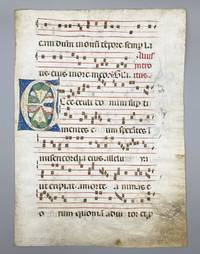
12522Arezzo: Second Master of the Cortona Antiphonaries 1260. <p> This fragment belongs to the Common of Saints section of A CHOIR BOOK PRODUCED FOR THE FRANCISCAN CONVENT AT CORTONA. The initials' whimsical decoration and color palette match those of a group of codices realized in the same Arezzo workshop by at least three collaborating artists. The distinctive "muted pinkish ochre" and "ribbon of parchment tinted with egg white" inserted between the letters and their internal ornamentation Degl'Innocenti Gambuti tr. identifies our fragment's decoration as THE WORK OF THE SECOND MASTER OF THE CORTONA ANTIPHONARIES responsible for at least four other choir books still preserved between Cortona and Arezzo.<br /> The leaf offers two alternative chants and part of a third to be sung as Introit of the Mass celebrated on the feast of a generic group of martyrs. The decorated E on the recto marks the beginning of the Introit antiphon Ecce oculi domini super timentes which continues on the verso with the verse Exsultate justi in domino rectos. The decorated L marks the beginning of the alternative Introit antiphon Loquetur dominus pacem in plebem followed by the first few letters of the verse Benedixisti domine terram tuam avertisti. The first two lines of music on the recto are the final portion of the Introit verse Benedicam dominum in omni tempore which originally concluded a third optional chant.<br /> In very good condition some traces of adhesive to the top left and right margins of the recto bottom right corner of the verso mildly soiled and with a natural flaw in the vellum not affecting the text.<br /> ¶Degl'Innocenti Gambuti "Sulle tracce di una scuola miniatooria aretina" in I codici miniati medievali della biblioteca comunale e dell'accdemia etrusca di Cortona 44-6; Passalacqua I codici liturgici miniati dugenteschi nell'Archivio Capitolare del Duomo di Arezzo 97-8.</p> Second Master of the Cortona Antiphonaries] unknown
[2] Bll. (Schmutztitel, Titel), 183 S. Quer-Folio. Pappband der Zeit. Ecken bestossen. Inhalt leicht fleckig. Verlangsangabe Schmutztitel überklebt. Rücken beschabt. RISM B/BB 523; Hoboken 1, 146.
Folio. ½ p. "Receipt for fl. 45 C.M. (forty-five guilders convention coinage) which I have received in cash for a manuscript by Mich. Haydn (first mass) from the Imperial and Royal Court Library" (transl.). Diabelli had studied composition under Michael Haydn in Salzburg. The "Missa in honorem Sanctissimae Trinitatis [D-Dur] à 5 Voci: 2 Sop., Alto, Ten. è Basso conc., 2 Violini, Viola, 2 Clarini, [Violoncello], Tympano con Organo" (MH 1), composed in 1754 by the 17-year-old Haydn, was acquired by the Court Library in 1842; its successor, the Austrian National Library, still preserves the 80-page manuscript, shelfmarked Mus.Hs.15589 Mus. - Old registration marks. Folded horizontally; slight duststaining to margins.
2 SS. auf gefalt. Doppelblatt mit papiergedecktem Siegel und Adresse (Faltbrief). 8vo. Launiger Brief an den Musiker Friedrich Wieck (1785-1873), Vater und Lehrer der Pianistin Clara Wieck (bald: Schumann), die der Adressat zum Zeitpunkt dieses Schreibens nach Tunlichkeit von ihrem Verlobten, seinem ehemaligen Schüler Robert Schumann zu trennen suchte: "Verehrtester Freund! Clara-beglückter Vater! Ich grüße Sie und Ihr Fräulein Tochter auf das Innigste, und das ist mir sehr fatal - denn wenn ich bei Ihnen in Leipzig wäre so braucht ich nicht erst zu schreiben und zu grüßen; dann brauchte ich bloss die Ohren zu spitzen. Berlin gähnt jetzt ungeheuer. Wegen des Instrumentes beim alten Behrend habe noch nichts wirken können. Soll's denn 24 oder 22 fr'dor kosten. Herr Gott ich vergesse aber ganz - ich habe die Ehre Ihnen meinen Freund und Landsmann den H. Assessor [August] Lemke aus Danzig vorzustellen, der ein guter Dilettant (Klavier u. Cello) und Universitätsfreund von Rob. Schumann ist. Gönnen Sie ihm das beneidenswerthe Glück (ich ärgere mich) Ihre Clara zu hören, dann braucht er auf seiner Ferner-Reise nicht weiter Clavierspielen zu hören. [...] Dies ist die Karte für Mlle. Clara Wieck, die ich vergessen habe abzugeben, wie Sie sich von der Treppe warfen Mittags um 12 Uhr wo Sie einen Studenten belangen wollten". - Leicht knittrig. Truhn, Schüler von Ries und Zelter, übernahm 1835 die Kapellmeisterstelle am Stadttheater in Danzig, wo er außerdem als Musiklehrer wirkte. "Nach seiner Rückkehr nach Berlin (1837) widmete sich Truhn in erster Linie publizistischer Tätigkeit [...] Truhn hat sich als Komponist, Dirigent, Schriftsteller und Organisator große Verdienste um das Musikleben in Berlin, Danzig, Elbing und Riga erworben. Unter seinen Kompositionen ragen neben Chor- und Bühnenwerken vor allem zahlreiche Lieder hervor, welche seinerzeit sehr beliebt und verbreitet waren. Eine bemerkenswerte Rolle fiel Truhn als weitblickendem Organisator des Männerchorwesens zu (Gründer u.a. der Neuen Liedertafel in Berlin). Seine schriftstellerischen Arbeiten weisen ihn als seriösen Kritiker aus" (MGG XIII, 851).
184818838Boston: Elias Howe. Very Good- with No dust jacket as issued. 1848. First Edition. Softcover. Original True First Edition. This is NOT a facsimile ebook or modern reproduction. RARE very limited presenceon World Cat in this original format. A 53 page booklet not counting first free endpaper and title page numbered from 59 through 111 112 being the reverse unnumbered page and index. Sequential pagination continues from Book No. 1 and through to books 3 & 4. Yellow wraps bound at the spine. Corner from title page lower right missing moderate edge and corner wear overall. All pages present and free from marks save ffep with pencil ownership name. This copy has been professionall rebound with acid free materials - stab sewn and a black cloth band wrapped around the spine end of the booklet reproducing the original binding. . Elias Howe paperback
163829189Romae, Typus Manelphi Malephi, (1638) (Colophon). Small 8vo. Near cont. full calf w. richly gilt back. Gilt lettering on boards (""CANTORA"" on front-board, ""MAGIORA"" on back-board). W. one intact and one partly preserved clasp. All edges gilt. Spine cracked, lower capital lacking leather, extremities a bit worn. Beautiful engr. t-p. (of procession). Printed in red and black throughout. About 2/3 of pp. w. musical notes, woodcut initials. T-p. mounted. About 10 leaves repaired w. (fairly small) loss of notes and text added in neat hand. A few leaves w. small marginal loss, affecting a few letters. (8), 444 pp.
Romae, Typus Manelphi Malephi, (1638) (Colophon). Small 8vo. Near cont. full calf w. richly gilt back. Gilt lettering on boards (""CANTORA"" on front-board, ""MAGIORA"" on back-board). W. one intact and one partly preserved clasp. All edges gilt. Spine cracked, lower capital lacking leather, extremities a bit worn. Beautiful engr. t-p. (of procession). Printed in red and black throughout. About 2/3 of pp. w. musical notes, woodcut initials. T-p. mounted. About 10 leaves repaired w. (fairly small) loss of notes and text added in neat hand. A few leaves w. small marginal loss, affecting a few letters. (8), 444 pp.
Very Good Turkish, Ottoman (1500-1928) Original manuscript autograph ijazatnama [i.e. License, or diploma for assent] signed by Ali Haydar Gürbüzler written for famous Turkish mevlevi poet Aasf Halet Çelebi, (1907-1958). 18x11,5 cm. In Ottoman script (Turkish with Arabic letters). 8 lines. It starts with "Huve". Dated November 20, 1928. A short qasida on verso signed by 'Mustafa'. Ali Haydar Gürbüzler, known as Ahiskali Ali Haydar Efendi [i.e. Ali Haydar Efendi of Meshketia], the Turkish lawyer, lecturer, professor, clergyman, the mystic is also the last sheikh of the Ismet Efendi Lodge located in the district of Çarsamba, Fatih, in Istanbul. Asaf Halet Çelebi [or, Asef], (1907-1958), was a Turkish mystical poet. Although not very widely known, due to his erudite and often foreign-influenced style, he is considered to be Turkey's first surrealist poet. In his youth Çelebi was still influenced by Ottoman court literature, but starting from 1937 he adopted Western poetic styles and techniques, such as free-form verse. In his poems one finds themes originating in the cultures of Persia and India. As a librarian, Çelebi had a lot of time and opportunity to read, and his readings stood at the base of his poetic work. An often recurring theme of his poems is philosophical ideas which he found, for instance, in Buddhism. From there he took names and terms with vast philosophical connotations, such as Siddhartha and Mara, which, for the non-initiated, created an obstacle in understanding his work, although he did provide explanations in his prose. "Edîb-i Rusen-zamir Asaf Halet bey efendi oglumuza, haz-i viran (?) imtihan(?)-i hayat ve mehatira(?) Mazhar-i ihtiram olduklari daima görülmelidir ki herkes sevke gelsin de onlarin ? olmaga çalissin. Saban (?) Asef Halet bey oglumuzun anane-i(?) ilm u feng(?), Siir ve edebiyat ve musikiye intisabini gördügümde kendisinin feyz ve kemalatinin azadiyatini (?) cenab-i feyyaz görmeden tezrii'(?) ve niyaz ile bu mahalli imza eylerim, fi 7 cemaziyelevvel? Sene 1347 - fi 20 tesrin-i sani sene 1928. El fakir el-hakir'ül-ibad Haydar [i.e. Naqshbandiyya shaykh -Hâlidî shaykh Haydar Efendi of Meshketia -Ahiskali Haydar Efendi)].".