108 944 résultats
1573Paris Meurisse 390 photographies originales, format 13cm x 17cm, tirage argentique, couvrant la période de 1914 jusqu'en 1917, rassemblées en dix classeurs modernes.
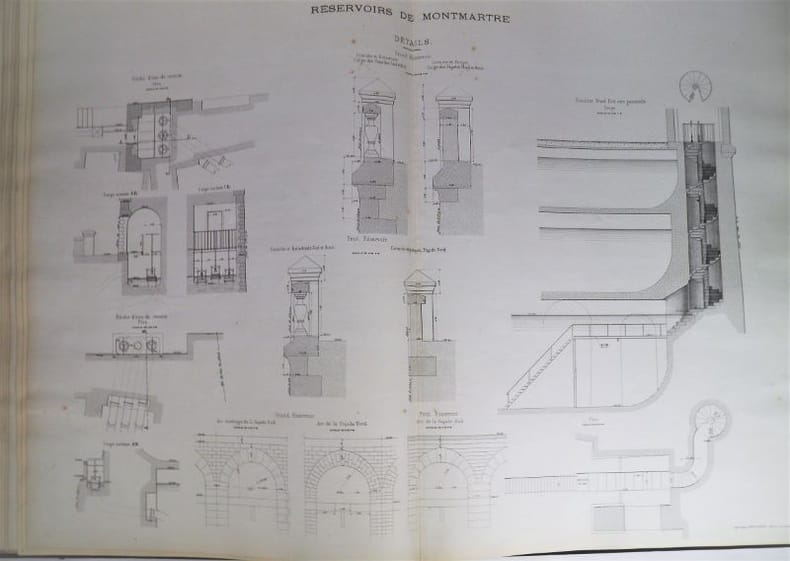
2356Paris, Imprimerie Autog. Aost & Gentil, sans date [1889]. In-Plano – 49 x 65 cm. Reliure de l’époque en demi-chagrin bleu marine à coins, triples filets à froid en encadrement des plats de toile, titre, dates et blason parisien dorés sur le premier plat. Exemplaire entièrement monté sur onglets. 1 f. bl. ; 2 planches doubles + 4 planches (6 photographies originales), 1 p. (titre), 3 p. (texte autographié imprimé), 19 planches doubles (plans, coupes, façades et détails). ALPHAND ; HUET ; BECHMANN ; DIET ; JOURNET ; DUTOIT ; VILLE DE PARIS (auteurs). Entrepreneurs : LAZIES (maçonnerie). MATHELIN et GARNIER (Fontainerie). Rare et important ouvrage illustré de 6 photographies originales, dont 2 sur double page, et de 19 planches doubles, techniques et architecturales, témoignant de l’ampleur des travaux effectués à Montmartre à la fin du XIXe siècle, afin d’améliorer l’alimentation en eau d’un quartier en pleine croissance démographique. En effet, les sources naturelles présentes sur les flancs de la butte qui alimentèrent longtemps de nombreuses fontaines ne suffisaient plus : il fallait donc aller capter de l’eau de rivières (ce que permet dès 1834 une machine hydraulique édifiée à Saint-Ouen), la monter au sommet – au moyen d’une pompe à vapeur -, et enfin la stocker, d’où la construction en 1835 d’un château d’eau qui fonctionnera jusqu’en 1927. A partir de 1887, sous la houlette d’Adolphe Alphand, Directeur des Travaux de la Ville de Paris, sont entrepris deux chantiers de grande envergure. Le premier est la construction de deux réservoirs (un « grand » et un « petit »), dotés d’une capacité totale de 11 000 m3, dont la conception est confiée aux ingénieurs Bechmann et Journet et les plans sont dressés par l’architecte Diet (photographies 4 et 5). L’ouvrage occupe l’emplacement de l’ancien pressoir à raisins de l’abbaye des Dames de Montmartre, rue Azaïs, sur une colline sableuse à environ 128 m d’altitude. La nature du sol complexifie énormément les travaux, d'autant que l'usage du béton pour les fondations, d'un coût prohibitif, est exclu. Les deux concepteurs ont donc misé sur la pression de l'eau contenue dans les réservoirs pour stabiliser le banc de sable présent à cet endroit. Néanmoins, une partie de ce sable (avec les gravats) fut évacuée par des wagonnets tirés par une locomotive à vapeur (photographie 3), tandis que l'on imaginait d'ingénieux systèmes pour garantir l'étanchéité de l'édifice. Le sous-sol, les murs et le sol sont donc réalisés en meulière, les voûtes de la couverture en briquettes, et les piliers intérieurs en maçonnerie de brique de Bourgogne. Autre contrainte : la proximité du Sacré-Cœur (édifié à partir de 1886), qui requiert une harmonisation du style décoratif du bâtiment avec l’architecture néo-byzantine de la basilique (photographie 6), et là intervient le calcaire blanc des carrières de Souppes-sur-Loing et Château-Landon. Le second chantier de cette même année 1887 est celui de la nouvelle usine de relevage (ou élévatoire) Saint-Pierre, qui alimente à la fois le château d’eau et le réservoir. Ce dernier, définitivement opérationnel en 1889, pourvu de respectivement deux et trois étages, distribue l’eau dans les quartiers bas de Montmartre encore de nos jours. Les deux premières photographies, sur doubles pages, prises en 1886 et 1889, attestent de la transformation du paysage de la butte lorsque les réservoirs sont achevés.
188129268Paris, G. Masson, 1881. Un vol. au format in-folio (473 x 338 mm) de 1 f. bl., 2 ff. n. fol., [34] photographies et 1 f. bl. Reliure moderne de demi-cartonnage gris-perle à l'imitation de chagrin, dos lisse orné de triples filets dorés et en noir, pièce de titre de maroquin marine, titre doré.
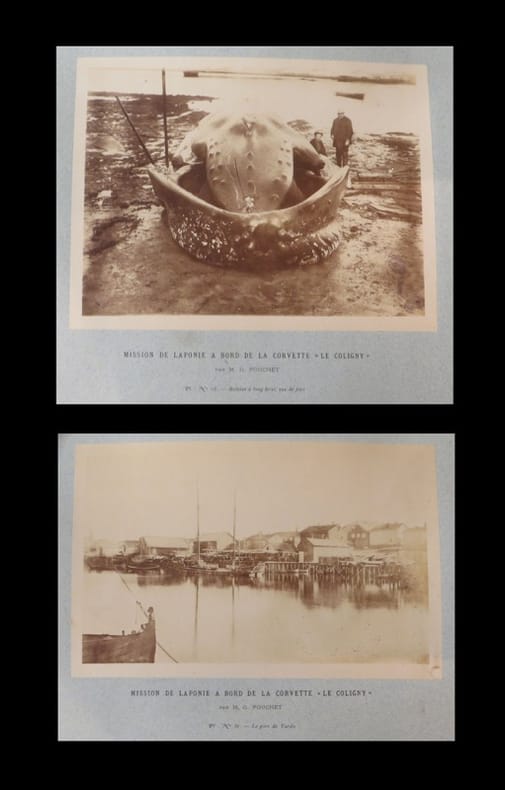
1881292681881. Paris G. Masson 1881. Un vol. au format in-folio 473 x 338 mm de 1 f. bl. 2 ff. n. fol. 34 photographies et 1 f. bl. Reliure moderne de demi-cartonnage gris-perle ˆ l'imitation de chagrin dos lisse ornÂŽ de triples filets dorÂŽs et en noir piÂce de titre de maroquin marine titre dorÂŽ. Edition originale d'une insigne raretÂŽ. Exemplaire revÂtu d'un envoi autographe signÂŽ de Georges Pouchet en tÂte de la page de titre. L'ouvrage est constituÂŽ de 34 sur 34 superbes photographies originales tirÂŽes sur papier albuminÂŽ contrecollÂŽes sur carton fort avec lÂŽgende imprimÂŽe en marge infÂŽrieure de chacune et montÂŽes sur onglet. ''Titulaire de la chaire d'anatomie comparÂŽe du MusÂŽum national d'histoire naturelle de Paris Georges Pouchet 1833-1894 se spÂŽcialise dans l'ÂŽtude des cÂŽtacÂŽs et l'ocÂŽanographie. De 1870 ˆ 1894 il passe plusieurs mois par an ˆ parcourir les mers du Nord ou encore ˆ ÂŽtudier les espÂces marines. Ë chacune de ses expÂŽditions il rapporte de nouveaux spÂŽcimens dont plusieurs cÂŽtacÂŽs mais aussi de nombreux tÂŽmoignages sur le paysage marin''. BÂŽnÂŽdicte Percheron. Table : Lodingen - Hammerfest - Vadsš - Klubben - Jarfjord - Kištfjord - Fjeldaal - Bugšfjord - Klosterfjord - Thorgatten - Bergen - etc. Ensemble en bel ÂŽtat. b42961 unknown
Außergewöhnliche Sammlung bestehend aus den 22 ersten Jahrgängen (1864-1885) der »Photographischen Correspondenz«, ein Korpus, der bis auf die wenigen fehlenden Beilagen die Blütezeit dieser bis 1971 erscheinenden, inauguralen Zeitschrift für Fotografie abbildet; dazu die Jge. 25 (1888) und 35 (1898). - Seit den frühen 1850er-Jahren war die Entwicklung der Fotografie in Fachperiodika umfänglich dokumentiert und befördert worden. In Frankreich (ab 1851), England und Österreich (ab 1854), den USA (1858) und Deutschland (ab 1860) waren Zeitschriften erschienen, doch keine wurde so früh so maßgeblich wie die Wiener »Photographische Correspondenz« für den deutschsprachigen Raum. Auch international ragte die Zeitschrift heraus. So hielt etwa der belgische Pionier der Fotoforschung Désiré van Monckhoven schon 1870 in einem Brief an Hg. Ludwig Schwank fest: „(…) wir haben im Französischen kein Journal, welches so getreu und complet die allenthalben gewonnenen Resultate der photographischen Forschungen reassumiert wie die photographische Correspondenz und ich glaube, dass in England selbst keines dieselbe übertrifft.“ (Starl, S. 85). - Die reichhaltigen Bildbeigaben, mehrheitlich Porträts, Genrebilder und Stilleben, aber auch einige Landschaften und Stadtszenerien (u.a. 2 Aufnahmen von Hermann Hochfeldt der Wiener Aspern-Brücke, 1865), bestanden zunächst v.a. aus Originalabzügen (deren 41 wurden in die Jge. 1-10 aufgenommen), die auf rückseitig oft mit Anzeigen bedruckten, starken Kartons aufgeklebt wurden. Sie stammten hauptsächlich aus Wiener Ateliers, z.B. von Ludwig Angerer, Fritz Luckhardt und Josef Székely. In der Folge wurden gedruckte Wiedergaben von Fotos dominant, wobei bereits etablierte Vervielfältigungsverfahren mit ökonomischen Nutzen für Ateliers und den Handel vorrangig Berücksichtigung fanden, z.B. Aubeldruck, Heliogravüre, Lichtdruck (u.a. die Albertotypie), Lithographie, Kupferätzung, Pigmentdruck, Reliefdruck, Silberdruck, Similigravüre, Woodburydruck und Zinkographie. Das Gros der Edeldrucke lieferten, neben den Wiener Ateliers, Werkstätten mit internationalem Renommee, wie Joseph Albert, Carl Aubel, Karl Klietsch, Charles Reutlinger, Lewis Rutherfurd und Walter Woodbury. - Die Texte der Zeitschrift verhandeln fototechnische und fotochemische Neuerungen, geben Anleitungen für Berufsfotografen, behandeln Drucktechniken, sowie wissenschaftliche, wirtschaftliche und ästhetische Aspekte der Fotografie. „Fixed to ideals of craftmenship, the magazine focused on composition, lightning, posing, and the different genres of photography. Fine Art was discussed in its practical aspects, from the discussion of printing processes to questions of the copyright for photographs.“ (Sachsse) Beiträger waren die Herausgeber, allesamt führende Exponenten der »Photographischen Gesellschaft in Wien«, heimische Fotografen wie Ludwig Angerer oder J. Löwy, oder Wissenschafter wie Ernst Mach, aber auch ausländische Fachleute, wie Friedrich Bruckmann, Louis-Alphones Davanne, Emilie Vogelsang, oder die Genannten. - Zustand: Jg. 4 (aus der Bibl. d. DÖAV) mit Stempel auf Titelbl.) ist nur als Textbd. vorhanden, die 12 Beil., wovon 4 Or.-Fotos, fehlen. Bindung aufgrund der Verwendung starker Montagekartons stellenweise gelockert, Vordergelenk von Jg. [?] gebrochen, Einbände teils etwas berieben und an den Kanten teils bestoßen, einige Tafeln im Zuge des Bindens beschnitten und mit leichtem Textverlust der Bildlegenden, einige Jahrgänge teils etwas stockfleckig, ansonsten kompakter Satz dieser fotohistorisch ausnehmend bedeutenden Zeitschrift. - Seltenheit: Die »Photographische Correspondenz« wurde nur für Mitglieder der Wiener Phonographischen Gesellschaft hergestellt (142 im Jahr 1864, ca. 500 um 1900), darüber hinaus wurden für verwandte Institutionen bzw. Inserenten einige wenige Tausch- und Belegexemplare gefertigt. Da die aufwändigen „artistischen Beilagen“ teuer waren, wird die Auflage wohl nur wenige hundert Exemplare betragen haben (vgl. Starl, S. 87). Gemäß JAP (1950ff.) und Auktionspreise online (ca. 1988ff.) sind größere Konvolute von Jahrgängen noch nie zur Auktion gelangt. - Literatur: Tim Starl: »Diese Zeitschrift ist für historische Studien sehr aufschlußreich.« Die Photographische Korrespondenz von 1864-1922. In: Michael Ponstingl, Hg.: Die Explosion der Bilderwelt. Die Photographische Gesellschaft in Wien 1861-1945. Publikation anlässlich der gleichnamigen Ausstellung in der Albertina, Wien (17. Juni bis 2. Oktober 2011). Wien: Brandstätter 2011, Ss. 80-93. - Otto Hochreiter/Tim Starl: Der zweite Durchblick. Bildbeigaben der »Photographischen Correspondenz« (1864-1971). Ausstellungskatalog Museum moderner Kunst, Wien, Juli/August 1984. Wien: 1984 (mit zahlr. Abb. v. Bildbeigaben; nennt im Vorwort vorliegenden Satz als Leihgabe). - Rolf Sachsse: Photographische Correspondenz. In: John Hannavy, Ed.: Encyclopedia of Nineteenth Century Photography. New York: 2007, p. 1095.
- Nadar, Paris 1862, Photographie : 5,1x8,5cm / Carton : 6,3x10,3cm, une photographie. - Photographic portrait of Charles Baudelaire with his hands in his pockets Nadar | Paris 1862 | Photograph: 5.1 x 8.5 cm / Cardboard: 6.3 x 10.3 cm | one photograph Extremely rare original photograph showing Charles Baudelaire on albumen paper, contemporary print in carte de visite format, mounted on a board from the Nadar workshop, 35 boulevart (sic) des Capucines; "Photographic portrait for us taken by Nadar. Taken the same day as the previous one, same dimensions, same clothes. The waistcoat is still unbuttoned but Baudelaire hides his hands in the pockets of his trousers. Seen face on, he seems more troubled and sadder than in the previous attempt." (Ourousof, 1896) "Another carte de visite from the same day as the previous no. 41 [...] a contemporary albumen print found in the Musée d'Orsay collections (Provenance: from the Braive collection, then the Marie-Thérèse and André Jammes collection, 1991, acquired by the Musées Nationaux with the support of the Heritage fund [...] Musée d'Orsay, fiche 39389) (S. Plantureux, Charles Baudelaire ou le rêve d'un curieux). This photo, taken in 1862, was sold between 1862 and 1871, as evidenced by the photographer's address on the back of the board. Only two of Baudelaire's poses seem to have been retained from this session. "If photography is allowed to replace art in some of its functions, it will soon have replaced or corrupted it altogether, thanks to the natural alliance it will find with the multitude of nonsense" wrote Charles Baudelaire in the Salon de 1859. We know of only fifteen different photographic portraits of Baudelaire, taken between 1855 and 1866 (three sessions at Nadar, three at Carjat and one at Neyt), for some of which there remains only one copy. Baudelaire and Nadar met in 1843 and their friendship endured until the poet's death in 1867. The photographer shot a total of seven portraits of his friend between 1855 and 1862. The two men, full of admiration for one another, paid each other moving tributes in their respective works: Baudelaire dedicated "Le rêve d'un curieux" "The dream of a curious man" (in Les Fleurs du Mal) to the photographer, who dedicated to him, in addition to the photographic caricatures and portraits, an unvarnished work titled Charles Baudelaire intime: le poète vierge (1911). Extremely rare and beautiful copy of this little-known photograph of Baudelaire by the most important French photographer of the 19th century. [FRENCH VERSION FOLLOWS] Rarissime photographie originale représentant Charles Baudelaire sur papier albuminé, tirage d'époque au format carte de visite, contrecollée sur un carton de l'atelier Nadar 35 boulevart (sic) des Capucines?: «?Portrait photographique à nous communiqué par Nadar. Fait le même jour que le précédent, mêmes dimensions avec même costume. Le gilet est toujours déboutonné, mais Baudelaire cache ses mains dans les poches de son pantalon. Vu de face, il paraît plus souffrant et plus triste qu'à la précédente épreuve.?» (Ourousof, 1896) «?Autre carte de visite du même jour que le n°4.1 précédent [...] un tirage d'époque albuminé se trouve dans les collections du Musée d'Orsay (Provenance?: collection Braive puis collection Marie-Thérèse et André Jammes, 1991, acquis par les Musées Nationaux avec le concours du fonds du Patrimoine [...] musée d'Orsay, fiche 39389)?» (S. Plantureux, Charles Baudelaire ou le Rêve d'un curieux). Ce cliché, réalisé en 1862, a été commercialisé entre 1862 et 1871, comme en témoigne l'adresse du photographe au dos du carton. Seules deux poses de Baudelaire semblent avoir été retenues lors de cette séance. «?S'il est permis à la photographie de suppléer l'art dans quelques-unes de ses fonctions, elle l'aura bientôt supplanté ou corrompu tout à fait, grâce à l'alliance naturelle qu'elle trouvera dans la sottise de la multitude?» écrivait Charles Baudelaire dans le Salon de 1859. On ne
- s.l. (Paris) s.d. (1907), 28,7x20,4cm, une photographie contrecollée sur carton. - Photographic portrait of Colette stretched out on a lion's skin [Paris 1907] | 28,7 x 20,4 cm | one photograph mounted on a board Rare and superb original photograph in contemporary albumen print mounted on a board showing Colette languidly stretched out on a lion skin and covered with a leopard skin. We have not been able to find any other copy of this photograph in international public collections including in the albums of the Bibliothèque Nationale de France (French national library). One similar photograph with a late dedication to Maurice Chevalier, went up for sale in 2008. A very beautiful and scandalous photograph of Colette, just separated from Willy, who performed a mime show in the Parisian music-halls creating scandal with her nudity. [FRENCH VERSION FOLLOWS] Rare et grande photographie originale en tirage albuminé d'époque, contrecollée sur carton, représentant Colette languissamment allongée sur une peau de lion et recouverte d'une peau de léopard. Nous n'avons pu trouver aucun autre exemplaire de cette photographie dans les collections publiques y compris dans les albums de la Bibliothèque nationale de France. Une photographie similaire, dédicacée tardivement à Maurice Chevalier, est passée en vente en 2008. Très beau et sulfureux cliché de Colette, tout juste séparée de Willy, qui se produisait comme pantomime dans les music-halls parisiens, créant le scandale par sa nudité.
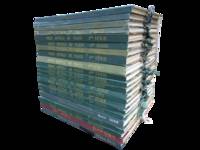
192718838ABParis, Arts et métiers graphiquees, 1927 - 1939. 31 : 24 cm. Mit vielen, teils farbigen, teils montierten Tafeln und Abbildungen. Farbig illustrierte Origiginal Umschläge, in Leinendecken und Leinen-Schubern. Nummer 1 - 68 (alles) in 11 Schubern.
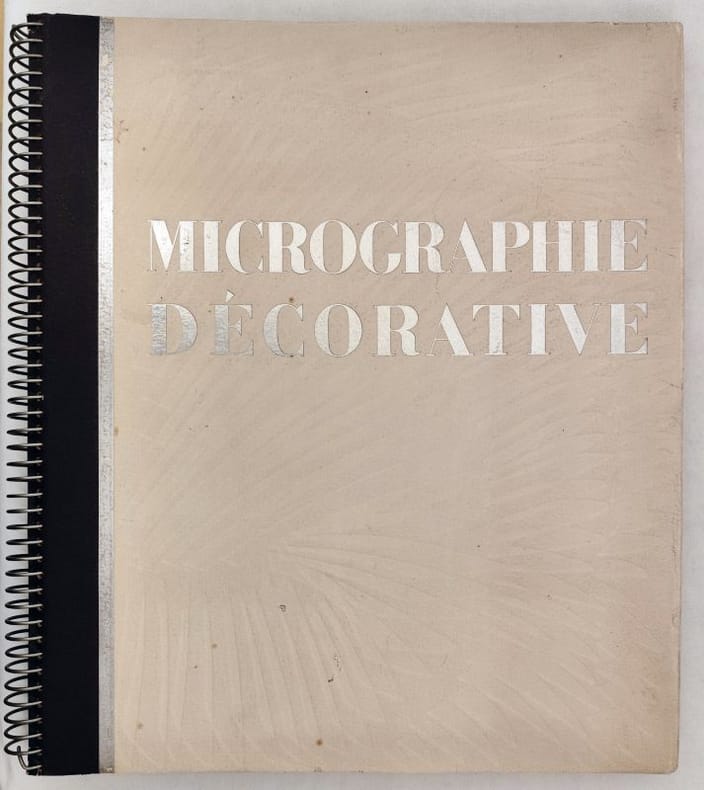
1931105687Paris chez l'Auteur 1931 425x380mm, 10 pages non paginées, 20 planches numérotées en chiffres romains et leurs serpentes, 4 pages non paginées. Reliure spirale, couvertures en carton fort recouvertes de papier gaufré évoquant les reliefs d'une cristallisation, frappé argent sur le plat.
22413Images et poèmes présentés par Armand Simon. Mons (Belgique), Éditions de « Haute Nuit », 1948, petit in-4, en feuilles, sous couvertures illustrées rempliées. Édition originale de cet album de photographies originales. Tirage unique à 126 exemplaires. 11 feuillets de texte et 25 tirages photographiques originaux en noir et blanc, toutes au format 30 x 16,5 cm. Membre du Groupe Surréaliste en Hainaut, aux côtés d'Achille Chavée, Fernand Dumont et Armand Simon, Marcel Lefrancq (1916-1974) publia des photographies dans L'Invention collective, dans les publications du Surréalisme révolutionnaire puis dans la revue Cobra. *Aux Mains de la lumière* est le seul album qu'il réalisera. Il est rare en premier tirage comme c’est le cas ici, un second sera réalisé vers le milieu des années 80 par son fils à partir des négatifs retrouvés. Références : - Marcel-G. Lefrancq, catalogue d'exposition, Charleroi, Palais des Beaux-Arts, 1982. - Marcel-G. Lefrancq, Aux Mains de la lumière, Musée de la photographie, Charleroi, 2003.
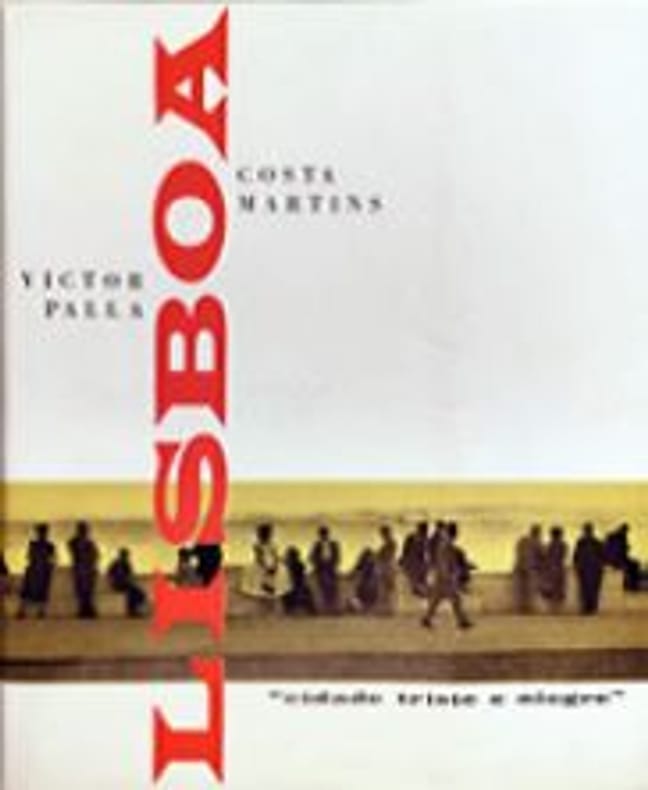
104928Lisbonne à compte d'auteur 1959, 289x237mm, 180 p. (en partie chiffrées 1 à 152 pour les photographies, I à XII pour le cahier de texte, 20p. non chiffrées pour les légendes des images, 1ffnc pour la table des textes, 3 ff noirs non chiffrés entre les pages 10-11, 126-127, 142-143), pages de garde photographiques, pleine percaline noire, jaquette photographique.
196548080Arnsberg and Dortmund Germany: Arbeitsgemeinschaft Gestaltendes Handwerk 1965. First edition. Hardcover. Near fine condition. Duodecimo 6 1/8 x 8 1/2". Unpaginated app. 100 leaves each three volumes. Original screw-bolted brown cloth with gray lettering on spines. Text printed to handmade paper in variant colors: black brown gray blue cream yellow green burnt Sienna and umbra photographs printed to glossy white paper. With lists of full and associate members of the workshop at front printed in white on black paper.<br /> <br /> Complete catalog of "Werkstattporträt Workshop Portrait" in three volumes a joint venture of the Project Group Creative Crafts for the Districts of Arnsberg and Dortmund Germany from 1961 to 1965. Participants of this project included craftsmen and women from the fields of pottery weaving embroidery bookbinding lathe work carpentry photography painting and sculpting. An extraordinary project presenting a state-of-the-art view of craftsmanship and art in Eastern Westfalia in the 1960s illustrated with 309 b/w photographs.<br /> <br /> Albert Renger-Patzsch participated in this project not only as a photographer see portrait 10 but provided one-hundred and forty-five of the three hundred and eleven photographs of works of other participants including portrait photographs for the catalogs "Werkstattportrait." Renger-Patzsch had worked as press photographer for the Chicago Tribune before publishing his title 'Crassula" with the Auriga-Verlag in the series 'Die Welt der Planze' in 1924. He had his first museum exhibition in 1927. His second book "Die Welt ist schön" became his best-known publication. During the 1930s he remained in Germany and made photographs for the German industy and in advertising. His archive was destroyed during W.W.II. In 1944 he moved to Wamel North Rhine-Westfalia and lived there for the rest of his life.<br /> <br /> The catalog is structured in twenty-nine chapters 0-271 introducing artists and craftsmen and women including one introductory chapter with eight photographs and a final chapter with six photographs. The object of the project was to further the exchange of knowledge and experience collaboration in research shared leisure time and visits of the workshops and studios of participants. Regional and national exhibitions and publications were arranged to help find buyers for the created work. The introductory chapter includes lists of full members and associate members.<br /> <br /> Each of the twenty-seven workshop portraits includes an introductory leaf for the respective participant describing the workshop or studio and the career including particulars about the techniques and material used by the artist with captions on the objects captured in eight b/w offset reproductions of photographs by Albert Renger-Patzsch and others on verso. Each set of photographs includes a portrait of the respective artist. Following each set of photographs a page with contact information of the artist and photo-credits for the work displayed.<br /> <br /> The final chapter is entitled "Workshop Portrait." It includes a brief description of the workshop taking place from April 1961 to December 1965 six b/w photographs of workshop exhibits and a list of all participants with contact information. The last page of this chapter an address by Walter Römhildt states the conclusion of this project and announces the continuation of publications of the series "werkstattforum" at his new office the "Beratungsstelle für Handwerksform bei der Handwerkskammer Hannover." Participants of the project "werkstattportait" will automatically receive those publications. <br /> <br /> Content with participating artists:<br /> <br /> portrait 0: Introduction of the project with photos by Renger-Patzsch 9 <br /> portrait 1: Hildegard Bäumer weaver Siegen photos by Renger-Patzsch 6 and Foto-Besser Siegen 3<br /> portrait 2: Ignatius Geitel Glass painter Bochum with Klischees by Titze & Lorenz Gelsenkirchen 9<br /> portrait 3: Karl Josef Hoffmann sculptor Attendorn with photos by Renger-Patzsch 9<br /> portrait 4: Anneliese Kretschmer photographer Dortmund photos by Anneliese Kretschmer 9<br /> portrait 5: Udo Dickerhoff carpenter Bochum photos by Renger-Patzsch 8 Sabine Renger 1 and Christian Bathe Münster 1; with two transparencies.<br /> portrait 6: Ingeborg and Bruno Asshoff potters Bochum photos by Renger-Patzsch 10 Dagmar Korn Düsseldorf 2 and Helmut Hering Dortmund 2<br /> portrait 7: Martha Wurm embroider Wattenscheid photos by Photo-Soeding J. Müller Soest 11<br /> portrait 8: Otto Pickhan turner Mollseifen photos by Renger-Patzsch 9<br /> portrait 9: Irmgard Timmermann weaver Soest photos by Photo-Soeding J. Müller Soest 9 H. Musmann Lage 1 and Renger-Patzsch 1<br /> portrait 10: Albert Renger-Patzsch photographer Wamel photos by Sabine Renger Wamel 1 Renger-Patzsch 11 Klischees by Titze & Lorenz Gelsenkirchen; <br /> portrait 11: Andrea Böhm picture weaver Lüdenscheid w/o photo-credits 10<br /> portrait 12: Päule Jelich goldsmith Iserlohn photos by Schmidt Lueg Iserlohn 11 and Foto Melchers Herne 1 <br /> portrait 13: Wolfgang Kruse turner Hamm photos by Schmidt Lueg Iserlohn 10<br /> portrait 14: Wolfgang Kreutter sculptor Dödesberg photos by Bert Brösel Siegen 1 Heidersberger Wolfsburg 2 Schmidt Lueg Iserlohn 9 <br /> portrait 15: Marianne Proll bookbinder Hagen photos by A. Bach Hagen 6 Renger-Patzsch 8 <br /> portrait 16: Heinz Abendroth metal smith Dortmund photos by Rolf Schmieding Dortmund 9 Dinstühler Dortmund 1; <br /> portrait 17: Liesel Bellmann sculptor Dortmund photos by Gerd Schlitzer Dortmund 4 W. von Frankenberg Dortmund 1 Rolf Schmieding Dortmund 3 and Heller Telgte 1 w/o credit 3<br /> portrait 18: Karl Jlling metal smith Mallar photos by Renger-Patzsch 10 <br /> portrait 19:Dieter Pieper goldsmithLüdenscheid photos by Werkstätten Carl Golderer Pforzheim 24 <br /> portrait 20: Marieluise Quade painter and graphic designer Lüdenscheid photos by Carl Huth Lüdenscheid 2 w/o credits 7<br /> portrait 21: Waldemar Wien sculptor Kierape 1 photos by Renger-Patzsch 13<br /> portrait 22: Christel Humpert potter Bochum photos by Renger-Patzsch10<br /> portrait 23: W. K. A. Weisheit carpenter Plettenberg-Oesterau photos by Renger-Patzsch 9<br /> portrait 24: Günter Hülshoff potter Rosemarie Hülshoff batik both Wangern photos by Renger-Patzsch 14<br /> portrait 25: Josef Severin metal smith Anröchte/Krs. Lippstadt photos by Renger-Patzsch 6 and Sabine Renger 4 <br /> portrait 26: Gisela Lohse weaver Hagen photos by Renger-Patzsch 11 <br /> portrait 27: Johannes Scharfenstein carpenter Meschede photos by Renger-Patzsch 10 and Foto-Zwietasch Kornwestheim 1<br /> "werkstattportrait" with Klischees by Tietze & Lorenz Gelsenkirchen 6<br /> <br /> Text in German. Minor wear overall with some red underlining of text in Römhildt address on last page. Translation of werkstattportrait 10: <br /> <br /> "Albert Renger-Patzsch born on June 22m 1897 graduated at the Humanistic Gymnasium studied chemistry until the preliminary examination after that he became the head of the photography department of the Folkwang Publisher in Hagen and Darmstadt. Since 1925 independent photographer in Bad Harzburg; first exhibition at Kestner-Gesellschaft in Hannover in 1925; first publication: "Die Halligen" in 1927 worked from 1929–1944 in Essen after that in Wamel near Soest. Following his title "Die Welt ist schön" he published monographs of cities and architecture books on marked-off landscapes and other topics. Renger=Patzsch works are in the collections of the MOMA New York the Eastman House in Rochester the Gernsheim Collection in London the Copper-Engraving Collection of the National Library in Paris and the Photo-Museum in Dresden. He was awarded the David Octavius Hill Medal of the G.D.L. in 1957 the Culture-Award of the German Society for Photography Cologne in 1960 and the Golden Society Medal of the Vienna Photographic Society in 1961. Renger-Patzsch is seen as the father of "Neue Sachlichkeit" in photography. In his book "Die Welt ist schön" he introduces a program with the goal to deter photography from engaging in a race with painting and reflect on its own medium. His notion that photography based on its mechanical structure is better suited to do justice to an object portrait it as an artistic individual pertains to large fields of photography today. Arbeitsgemeinschaft Gestaltendes Handwerk hardcover
122459aafLondon, Reeve & Co., (John Edward Taylor, Printer), 1863 - 1867, lg. in-8vo, 6 volumes with each 24 tipped-in original photogr. mounted on stiff white leaves with yellow frame (albumin prints), overall a fine original, complete set, original contemporary clothbound, spine with gilt title & publisher, covers with gilt central piece and blindpressing (binder’s ticket in vol. V: Bound by Westleys & Co. London).
111678aafPartenkirchen, o.J., um 1878, Imp.-folio (68x51 cm), Mit 20 Fotografien (27x39 cm) von Bernhard Johannes auf bedrucktem Karton montiert u. mit montierter Legende. 2 Bll. Widmung u. Vorwort u. 20 Bll. Erläuterungen, in blindgeprägter Or.-Lwd-Mappe mit goldgeprägtem Deckeltitel u. Schliessbändern.
In-4°; pp. (12), 85, (3), frontespizio stampato in rosso e nero. Legatura in cartonato coevo. Esemplare di dedica, inviato al chimico Giovan Battista Mazzacurati. Prima edizione rara. Opera di notevole importanza per la scoperta dei sali d'argento come sostanze fotosensibili, studio scientifico che aprì la strada alla nascita della fotografia. In questo studio, fondamentale per la storia della luminescenza, Beccari prende in rassegna una quantità straordinaria di sostanze luminescenti, organiche e inorganiche, che fu il primo a sottoporre a osservazione al fine di classificarli, fornendo un moderno metodo di classificazione della luminescenza secondo il sistema dell'eccitazione. I suoi esperimenti che approfondirono la conoscenza circa i fosfori, che godono della facoltà di diventare luminosi dopo l'esposizione al sole, e i loro effetti sul cloruro d'argento, contribuirono in maniera sostanziale allo sviluppo della tecnica dell'impressione fotografica. I materiali fosforescenti vengono infine considerati corpi elettrici, secondo un'associazione derivante dal nascente interesse per l'elettricità. Jacopo Bartolomeo Beccari (1682-1766) fu il primo professore ad avere una cattedra di chimica in Italia, a Bologna, ed è considerato a tutt’oggi il fondatore della moderna chimica italiana. È anche noto per la sua scoperta del glutine nei cereali. (JACOPO BARTOLOMEO BECCARI), De quamplurimis phosphoris nunc primum detectis commentarius, Bologna, Laelius a Vulpe, 1744 In-4 °; pp. (12), 85, (3), title page printed in red and black. Contemporary hardcover binding. Copy with dedication sent to the chemist Giovan Battista Mazzacurati. Rare first edition. Work of considerable importance for the discovery of silver salts as photosensitive substances, a scientific study that paved the way for the birth of photography. In this study, fundamental for the history of luminescence, Beccari reviews an extraordinary quantity of luminescent substances, organic and inorganic, which he was the first to put under observation in order to classify them, providing a modern method of classification of luminescence according to the excited state of a system. His experiments which deepened the knowledge about phosphors, which have the ability to become luminous after exposure to the sun, and their effects on silver chloride, contributed substantially to the development of the photographic impression technique. Finally, phosphorescent materials are considered electrical bodies, according to an association deriving from the rising interest in electricity. Jacopo Bartolomeo Beccari (1682-1766) was the first professor to have a chair of chemistry in Italy, in Bologna, and is still considered the founder of modern Italian chemistry. He is also known for his discovery of gluten in corn. Only 500 copies printed. Canterzani, p. 123, n. 14:"Di questa non comune edizione furono impressi 500 esemplari". E. Bequerel, La lumiére, ses causes et ses effects, 1868, I, p. 26; Harvey, History of Luminescence, pp. 156-158, 324-327; Partignon, III.339, Provenzal, Bio bibliografia di Chimici Italiani, pp. 27-29; Weeks, Discovery of the elements, p. 514; cf Beach, E. F., "Beccari of Bologna", in Journ. His. Med. 16 (1961), pp. 354-373; Quagliarello, Chimica biologica in "Un secolo di progresso scientifico italiano", Roma, 1939.
- S.n. , Paris [à la prison de la Conciergerie] s.d. [6 mai 1892], Cliché : 11,7x16,9 cm / Carton : 16,1x21,9 cm, une photographie. - [PHOTOGRAPH] Unique photographic portrait dated and signed by Ravachol as known to this day s. n. | Paris [at the Conciergerie prison] s. d. [6 May 1892] | photo: 11.7 x 16.9 cm / board: 16.1 x 21.9 cm |a photograph "Jugez-moi, messieurs les jurés, mais si vous m'avez compris, en me jugeant jugez tous les malheureux dont la misère, alliée à la fierté naturelle, a fait des criminels, et dont la richesse, dont l'aisance même aurait fait des honnêtes gens?!" "Judge me, gentlemen of the jury, but if you have understood me, in judging me, judge all the unfortunate people whose misery, united with natural pride, have made criminals, and for whom wealth, for whom affluence would have made honest people!" Superb original photographic portrait of Ravachol taken by Alphonse Bertillon, contemporary print on albumen mounted on bristol board. Extremely rare handwritten caption signed by the most famous of the French anarchists, written in his hesitant and naive handwriting, at the bottom of the photo: "1er mai 1892 Koningstein [sic] Ravachol" "1st May 1892 Koningstein [sic] Ravachol". The spelling Koningstein chosen by Ravachol differs from his father's surname (Königstein). This variation confirmed by the Maintron (Biographical dictionary of the social and labour movement) is found in particular in a piece of his writing by hand dated 13 April 1892 and kept at the Conciergerie. "?Un certain Varinard des Cotes a tracé son portrait graphologique. Il crut pouvoir noter l'absence d'orgueil et de vanité, la droiture et la loyauté des convictions" "A certain Varinard des Cotes drew his graphological portrait. He believed he could note the absence of pride and vanity, the righteousness and loyalty of convictions". (Ramonet et Chao, Guide du Paris rebelle, 2008). We have not been able to find any other copy of this photograph in international public collections or on sale at auction. Autographs of the "Christ de l'anarchie" "Christ of anarchy" are extremely rare. We know only of this unique, signed photograph of Ravachol with the exception of the one mentioned in the Conciergerie surveillance reports: "Le nommé Ravachol nous a fait voir sa photographie sur le recto de laquelle il a inscrit ces mots?: «?à tous ceux que j'ai aimé. Mon cur sera toujours près de vous, ma dernière pensée sera pour vous. Tous mes baisers" "The named Ravachol showed us his photograph on the front of which he wrote these words: "To all those whom I have loved. My heart will always be near you, my last thought will be for you. All my love". Signed Ravachol. He intended to send this photograph to his brother, along with a letter summarised as follows: "Comme vous le voyez, je suis souriant sur ma photographie, vous pourrez donc en déduire que mon sort n'est pas si triste que vous le pensez. Il ne me manque qu'une chose?: la liberté. Du reste je ne fais aucune différence entre ma vie en prison et celle que je menais auparavant. Toutes les deux ne sont que souffrance. Le vrai bonheur n'existera pour moi que lorsque je verrai la réalisation de mes projets, si cela ne se peut, je préfère la mort. J'envisage ces deux points le sourire aux lèvres?." "As you can see, I am smiling in my photograph, so you can assume that my fate is not as sad as you might think. I miss only one thing: freedom. Otherwise, I notice no difference between my life in prison and the one I led before. Both know only suffering. True happiness will only exist for me when I see my projects realised, if that is not possible, I prefer death. I consider these two points with a smile on my lips". (8 May 1892). We were un able to identify this photo and have found no other trace of it since this report. For that matter, we are not certain that this photograph still exists. Like ours, it was taken during a sitting at the Conciergerie prison on 6 May 1892 during which several po
17187CB2017. 140 x 104 cm / 55 1/8 x 41 in Digital Photographie. Large format digital photograph. Original Pigment Druck. Archival pigment print on paper (Harman Fine Art Matt Cotton Textured). Die Versandkosten für Kunstwerke und mehrbändige Werke können von den Standard-Versandkosten abweichen. Sehr gut erhalten, gerahmt. Mint condition, framed.
190777332s. l. (Paris) s. d. [1907] | 28.70 x 20.40 cm | une photographie contrecollée sur carton
192958921ABMünchen, Transmare und Kurt Wolff, 1929. 4to. 17 S., 1 Bl. Mit 60 photogr. Tafeln. Orig.-Leinwand mit Orig.-Umschlag.
1908063640Paris: F. Contet 1908-1937. Various. Hardcover. Very Good/No Jacket as Issued. Complete 22-Volume Set. Very rare to find the entire series. Volume 1-3 descriptions presumably by F. Contet. Volume 4-16 descriptions by J. Vacquier. Volume 17-22 descriptions by Paul Jarry. Volume 1-47912-22 first editions 17 out 22 volumes. Titles and dates are as follows - Volume 1: Le Temple et le Marais Tome I 1908. Volume 2: Le Temple et le Marais Tome II 1909. Volume 3: Le Faubourges Saint-Germaine Tome I 1910. Volume 4: Le Faubourges Saint-Germaine Tome II 1910. Volume 5: Le Ministere de la Marine; Ancien Garde-Meuble de la Couronne 4th Edition 1922. Volume 6: Le Faubourg Saint-Honore Tome I 3rd Edition 1920. Volume 7: Le Farbourges Saint-Germain Tome III 1912. Volume 8: L'Hotel Lambert 3rd Edition 1921. Volume 9: La Place Vendome 1913. Volume 10: Le Quartier Saint Paul 2nd Edition 1920. Volume 11: Le Faubourg Saint-Honore Tome II 1923. Volume 12: Le Faubourg Saint-Germain Tome IV 1920. Volume 13: Le Faubourg Saint-Germain Tome V 1921. Volume 14: La Nouvelle-France Ou Le Faubourg Poissonniere 1922. Volume 15: Le Quartier Saint-Avoye 1923. Volume 16: Le Faubourg Saint-Germain Tome VI 1924. Volume 17: Le Quartier du Palais-Royal 1926. Volume 18: Les Porcherons ou le Faubourg Montmartre 1928. Volume 19: Le Quartier Saint-Antoine 1929. Volume 20: Le Temple et le Marais Tome III 1930. Volume 21: Le Quartier de Luxembourg 1934. Volume 22: L'lle Saint-Louis 1937. Marbled boards with quarter cloth bindings. 3 dual cloth ribbon ties on each folio. Loose-leaf. B&W plates photographs. Stickers cover original titles on volume 22. Volume 17 20 21 are ex-library on and inside front covers as well as on first few pages. Volume 1 and 2 have titles handwritten on their spines. Volume 18 21 and 22 have new bindings as well as titles handwritten on spines. Volume 6 and 8 have a ribbon torn along fore-edge. Multiple boards have spots of fading and/or rubbing. Several spines have minor fraying tears to cloth and some staining. Many of the inner spines are cracked or broken but still holding together. Age-toning in multiple books. Overall the set is in very good condition. Due to this series's size and/or weight additional shipping may be needed. No international shipping. A highly collectible series filled with attractive photographs! Full refund if not satisfied. F. Contet hardcover
1894103248BBParis, Photo-Club de Paris, 1894. Folio (40 x 30 cm.). 3, (5) S., 56 Tafel in Héliogravure, [2] Bl. OKart. mit OU.
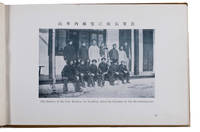
1912ABC_47646Shanghai: Commercial Press Limited 1912. Original publisher's orange-brown pictorial cloth marbled endpapers. Oblong 8vo 15 x 22.5 cm. 160 black-and-white photographic illustrations all protected by tissue paper guards. First and only edition of a very rare work with photographic illustrations of the Chinese Revolution of 1911 with captions in Chinese and English. It was published specifically for circulation in the West and consists of 14 parts. The present work contains the first 4. However any volume in this series is exceptionally rare as we have not been able to find another copy in sales records of the past 100 years.The Chinese Revolution of 1911 is an important event in Chinese history as it resulted in the establishment of the Republic of China. The Revolution was preceded by decade of revolts since Chinese citizens had already been dissatisfied with the rule of the Qing dynasty 1636-1912 for some time. The Revolution started in October 1911 with the Wuchang Uprising after which similar revolts broke out across the country. The Qing court then initiated negotiations with the revolutionaries. Both parties came to the agreement that the emperor who was just 6-years old had to abdicate in February 1912. Revolutionary statesman Sun Yat-Sen 1866-1925 became the first provisional president.The present work offers an authentic pictorial record of the first revolts. The work contains numerous portraits of important leaders of the Revolution and members of the Qing court grim photographic illustrations of the battlefields in Wuchang now the Wuchang District of Wuhan and Hankow or Hankou and images of the attack on Nanking now Nanjing including the preparations and the aftermath.The binding shows very slight signs of wear the gutters of the front and back endpapers are weakened causing the binding to be wobbly but the boards are still attached. The tissue paper between the photographic illustrations has browned throughout. Otherwise in very good condition.l WorldCat 891342401 2 copies. Commercial Press, Limited, hardcover
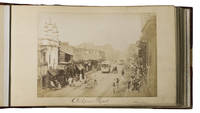
1874ABC_46925Calcutta 1874. Contemporary gold-tooled half red morocco brown cloth sides. Oblong 8vo. With 33 mounted sepia albumen prints ca. 15/15.5 x 10.5/11 cm all captioned. Manuscript title and captions of the pictures in English written in brown ink in a neat 19th-century cursive hand. Photograph album containing 33 albumen prints of buildings important places views and people in Calcutta in the 1870s. The album opens with some architectural photographs including the governor's house the new market the post office St. Paul's cathedral and the high court. Also included are views of roads and streets that are still important today such as Benting Street Chilpore Road Russell Street and Strand Road and 5 albumen prints of the B.Y. Docks. The album also contains views near Kalighat and Barnatore especially of the landscape but also of a Hindu temple. The album concludes with some photographs of people living in Calcutta showing beggars carpenters palki bearers a barber ending the album with a group of Rohillas.The album includes a photograph of the statue of Sir James Outram unveiled in Calcutta on 22 May 1874 an all photographs seem likely to have been made soon after that.Binding a little worn and scuffed endpapers a little dust-soiled some leaves marginally slightly dust-soiled some leaves slightly browned some occasional foxing paper of the last photograph slightly damaged not affecting the image some images a little faded but overall in good condition. A highly interesting album showing life in Calcutta in the 1870s.l For dating the statue of Sir James Outram: Catalogue of the sculpture of J.H. Foley in: Dublin Historical Record 32 3 1979 pp. 108-116. hardcover
189042492, , Ca 1870-1890. Album grand in-folio oblong, demi-chagrin à coins (reliure de l'époque).
50158Dhouailly et Cie, Paris, 2001