66 616 résultats
1½ SS. auf Doppelblatt. Gr.-8vo. "Bei uns, da is a Staarenhäusl, | Die Staarl habn dir halt a G'schwatz | Die kümmern si um d'Welt koa Kreisl - | Grad untauf hockt a schwarze Katz [...]". - Der aus München stammende Jurist war u. a. mit Paul Heyse und Emanuel von Geibel befreundet, gehörte mit ihnen der Künstlergruppe "Das Krokodil" an "und zählte zu den führenden Persönlichkeiten der Münchner Kulturszene" (DBE). Mitarbeiter der "Fliegenden Blätter", verfaßte er u. a. Reisebeschreibungen, wurde aber vornehmlich durch seine von Franz von Kobell beeinflußten humorvollen Mundartdichtungen bekannt.
2 SS. auf Faltbogen. Folio. Beginn des Manuskripts zu Webers Erzählung "Die Tapferkeit des Genies" über den Eisenbahnpionier George Stephenson: "Mit Recht messen die Engländer nur demjenigen die vollen Ehren eines Erfinders zu, der einen fruchtbringenden Gedanken nicht allein empfing, sondern ihn auch verkörperte, nutzbar in das Leben führte. Mehr aber als Erfinder, zum Schöpfer einer neuen Kulturepoche wird der, aus dessen Hirn und Hand eine große Erfindung vollendet, als brauchbares Werkzeug der Civilisation hervorging [...]". - Der wenige Monate nach der Uraufführung des "Freischütz" geborene (und nach dem Titelhelden benannte) Sohn des Komponisten Carl Maria von Weber wirkte während seines Studiums als Konstrukteur in der Borsig'schen Lokomotivfabrik, wurde später Lokomotivführer und übernahm anschließend die Leitung verschiedener Eisenbahngesellschaften. 1852 trat er in den Sächsischen Staatsdienst ein, 1870-78 war er als Hofrat in Wien tätig, bevor er ins preußische Handelsministerium berufen wurde. Seine im technischen Milieu angesiedelten Novellen waren beim zeitgenössischen Publikum auch wegen seines gesellschaftlichen und sozialen Engagements sehr beliebt. - Auf Trägerpapier montiert.
15¼ SS. auf 4 Doppelbll. Folio. Fadengeheftet. Der erste Teil dieser Erzählung wurde am 9. II. 1841 im Prager Unterhaltungsblatt "Bohemia" veröffentlicht. - Der Jurist Schuselka war einer der bekanntesten österreichischen Persönlichkeiten der Märzrevolution 1848. Ab 1839 hatte er, "der schon seit seiner Studentenzeit journalistisch tätig war, die Laufbahn eines freien Schriftstellers [ergriffen], vorerst v. a. als Mitarbeiter bei Zeitungen. Zu Beginn der 40er Jahre wandte er sich ganz der politischen Publizistik zu [...] Schuselka zählte im Vormärz wegen der polemischen Schärfe seiner gegen die Politik Metternichs und gegen die nichtddeutschen Nationalitäten des Habsburgerreiches gerichteten Schriften zu den bekanntesten liberalen Schriftstellern" (ÖBL XI, 380). Als Vertreter der großdeutschen Linken spielte er seine bedeutendste Rolle im Wiener Oktoberaufstand von 1848, wo er an der Spitze des Sicherheitsausschusses stand. Nach der Übergabe Wiens ging er nach Kremsier, wo er im Reichstag der Führer der Opposition wurde. 1850 wurde er nach seiner Rückkehr aus Wien ausgewiesen. - Mit eh. Korrekturen und Tilgungen. Teilweise etwas braun- und leicht stockfleckig.
1 S. (12 Zeilen). Kl.-4to. "Wenn Bauern Hopfe, Wein und Gerste fechsen, | So ernten sie nicht nur die Sonnenkraft, | Denn Nacht und Mond auch wirkt in den Gewächsen, | Und jeder Saft bedingt den Anti-Saft [...]". - Mit kleinen Ausrissen am rechten Rand.
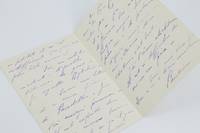
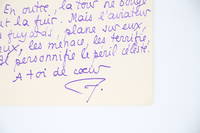
190679014Villa Clos fleuri Nice Nice 1906. Fine. Villa Clos fleuri Nice Nice 3 mars 1906 12.40 x 16.80 cm 3 pages sur un double feuillet Autograph letter signed ""Pauline"" by Renée Vivien addressed to Natalie Clifford Barney and written in violet ink on a double sheet with violet letterhead the Parisian address on the letterhead crossed out. Transverse folds inherent to mailing. Fine letter evoking Renée Vivien's execration for Nice: ""Ici un soleil insolent d'ignobles bâtisses des gens Je regrette Mytilène . Mon Dieu entre Nice et Paris il n'y a pas de différence bien marquée quelques oranges de plus ici des palmiers d'opéra comique - une illusion de chaleur c'est tout."" ""Here an insolent sun ignoble buildings people I miss Mytilene . My God between Nice and Paris there is no marked difference a few more oranges here comic opera palm trees an illusion of warmth that's all."" The evocation of Mytilene where the two lovers had traveled the previous summer continues in this missive: ""Encore une lettre de ce vieux filou de Paradellis Je l'ai envoyé promener Il est capable de faire main basse sur tout ce qu'il y a dans la maison "" ""Another letter from that old rogue Paradellis I sent him packing He's capable of making off with everything in the house "" It was Passagisti Paradellis who rented a villa on site with a two-year lease to Renée and Natalie. ""The villa had been tastefully furnished. Collections of rare porcelain mother-of-pearl inlaid furniture a dining room with high-backed armchairs."" J.-P. Goujon Tes blessures sont plus douces que leurs caresses In this letter the Violet Muse also gives the key to one of the characters in Une femme m'apparut whose revised version had just appeared: ""Dis à Madame Mardrus pas de ma part de la tienne ! que Doriane c'est elle telle qu'elle s'est révélée à moi un jour dans l'ardeur et dans la tristesse."" ""Tell Madame Mardrus not from me from you! that Doriane is her as she revealed herself to me one day in ardor and in sadness."" The work whose rewriting had nevertheless tried the poetess is here devalued by the latter: ""En somme je n'aime pas ce volume ou plutôt il m'est indifférent ce qui est plus triste encore "" ""In sum I don't like this volume or rather it is indifferent to me which is even sadder "" It was at the end of 1899 and through the intermediary of Violette Shillito that Renée Vivien - then Pauline Tarn - made the acquaintance of Natalie Clifford Barney ""cette Américaine plus souple qu'une écharpe dont l'étincelant visage brille de cheveux d'or de prunelles bleu de mer de dents implacables"" Colette Claudine à Paris. Natalie who had just lived through a summer idyll with the scandalous Liane de Pougy who had initiated her into sapphism paid only discreet attention to this new acquaintance. Renée on the other hand was completely captivated by the young American and would relate this love at first sight in her autobiographical novel Une Femme m'apparut: ""J'évoquai l'heure déjà lointaine où je la vis pour la première fois et le frisson qui me parcourut lorsque mes yeux rencontrèrent ses yeux d'acier mortel ses yeux aigus et bleus comme une lame. J'eus l'obscur prescience que cette femme m'intimait l'ordre du destin que son visage était le visage redouté de mon avenir. Je sentis près d'elle les vertiges lumineux qui montent de l'abîme et l'appel de l'eau très profonde. Le charme du péril émanait d'elle et m'attirait inexorablement. Je n'essayai point de la fuir car j'aurais échappé plus aisément à la mort."" ""Winter 1899-1900. Beginning of the idyll. One evening Vivien is invited by her new friend to Mme Barney's studio Natalie's mother 153 avenue Victor-Hugo at the corner of rue de Longchamp. Natalie ventures to read verses of her composition. When Vivien tells her she loves these verses she replies that it is better to love the poet. A response quite worthy of the Amazon."" J.-P. Goujon op. cit. Two ye unknown
190679014Villa Clos fleuri [Nice] 3 mars 1906 | 12.40 x 16.80 cm | 3 pages sur un double feuillet
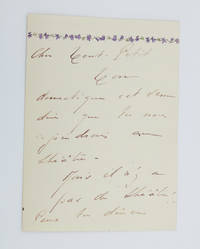
190679017s. l. Paris 1906. Fine. s. l. Paris s. d. ca 1906 11.50 x 15.90 cm 4 pages sur un double feuillet Autograph letter signed ""Paul"" from Renée Vivien addressed to Natalie Clifford Barney and written in black ink on a double sheet bordered with violets. Baroness Hélène de Zuylen has added a small manuscript message signed at the end of the letter: ""Paule a raison vous êtes un être charmant et féerique !"" ""Paule is right you are a charming and fairy-like being!"" Transverse folds inherent to mailing. ""Cher Tout-Petit Ton domestique est venu dire que tu nous rejoindrais au théâtre. Mais il n'y a pas de théâtre ! Peux-tu dîner avec nous jeudi ou vendredi Si dans la soirée de jeudi tu n'es libre qu'après le dîner viens nous rejoindre à n'importe quelle heure. Donne-moi un petit coup de téléphone pour me dire ce que tu feras et si je dois te faire chercher et à quelle heure Dis à tes cheveux que je les aime."" ""Dear Little One Your servant came to say that you would join us at the theater. But there is no theater! Can you dine with us Thursday or Friday If on Thursday evening you are only free after dinner come join us at any hour. Give me a little telephone call to tell me what you will do and if I should have you collected and at what time Tell your hair that I love it."" It was at the end of 1899 and through Violette Shillito that Renée Vivien - then Pauline Tarn - made the acquaintance of Natalie Clifford Barney ""cette Américaine plus souple qu'une écharpe dont l'étincelant visage brille de cheveux d'or de prunelles bleu de mer de dents implacables"" ""this American more supple than a scarf whose sparkling face shines with golden hair sea-blue eyes implacable teeth"" Colette Claudine à Paris. Natalie who had just experienced a summer idyll with the scandalous Liane de Pougy who initiated her into sapphism paid only discreet attention to this new acquaintance. Renée on the other hand was totally captivated by the young American and would relate this coup de foudre in her autobiographical novel Une Femme m'apparut: « J'évoquai l'heure déjà lointaine où je la vis pour la première fois et le frisson qui me parcourut lorsque mes yeux rencontrèrent ses yeux d'acier mortel ses yeux aigus et bleus comme une lame. J'eus l'obscur prescience que cette femme m'intimait l'ordre du destin que son visage était le visage redouté de mon avenir. Je sentis près d'elle les vertiges lumineux qui montent de l'abîme et l'appel de l'eau très profonde. Le charme du péril émanait d'elle et m'attirait inexorablement. Je n'essayai point de la fuir car j'aurais échappé plus aisément à la mort. » ""I evoked that already distant hour when I saw her for the first time and the shiver that ran through me when my eyes met her deadly steel eyes her sharp blue eyes like a blade. I had the obscure prescience that this woman was giving me destiny's order that her face was the dreaded face of my future. I felt near her the luminous vertigo that rises from the abyss and the call of very deep water. The charm of peril emanated from her and attracted me inexorably. I did not try to flee her for I would have escaped death more easily."" « Hiver 1899-1900. Débuts de l'idylle. Un soir Vivien est invitée par sa nouvelle amie dans l'atelier de Mme Barney mère de Natalie 153 avenue Victor-Hugo à l'angle de la rue de Longchamp. Natalie s'enhardit à lire des vers de sa composition. Comme Vivien lui dit aimer ces vers elle lui répond qu'il vaut mieux aimer le poète. Réponse bien digne de l'Amazone. » ""Winter 1899-1900. Beginning of the idyll. One evening Vivien is invited by her new friend to the studio of Mme Barney Natalie's mother 153 avenue Victor-Hugo at the corner of rue de Longchamp. Natalie grows bold enough to read verses of her own composition. When Vivien tells her she loves these verses she replies that it is better to love the poet. A response quite worthy of the Amazon."" J.-P. Goujon Tes blessures sont plus douces qu unknown
190679017s. l. [Paris] s. d. [ca 1906] | 11.50 x 15.90 cm | 4 pages sur un double feuillet
19761886Paris Gallimard 1976 1 vol. broché in-12, broché, 192 pp. Edition originale. Exemplaire du service de presse enrichi d'un envoi de l'auteur. Bande éditeur conservée. Bon état.
19761886Paris Gallimard 1976 1 vol. broché in-12, broché, 192 pp. Edition originale. Exemplaire du service de presse enrichi d'un envoi de l'auteur. Bande éditeur conservée. Bon état.
52292o.J. Wien, Waldheim für den Wiener Männergesangverein, 1881, 45 x 29 cm. Mit Holzschnittillustration am Kopf und typographischer Bordüre..
1979101730Paris Hachette, coll. "L'échappée belle" 1979 1 vol. broché in-8, broché, couverture à rabats, 212 pp., index. Envoi à Jean Mauriac, signé Christina. Bon état.
1979101730Paris Hachette, coll. "L'échappée belle" 1979 1 vol. broché in-8, broché, couverture à rabats, 212 pp., index. Envoi à Jean Mauriac, signé Christina. Bon état.
19561980Paris Synthèses 1956 1 vol. broché plaquette in-8, agrafée, 27 pp. Édition originale formée par le tiré à part à 207 exemplaires numérotés de cette étude parue dans la revue Synthèses (n° 122). Double envoi de Francis Ponge et de René de Solier. Bon état.
19561980Paris Synthèses 1956 1 vol. broché plaquette in-8, agrafée, 27 pp. Édition originale formée par le tiré à part à 207 exemplaires numérotés de cette étude parue dans la revue Synthèses (n° 122). Double envoi de Francis Ponge et de René de Solier. Bon état.
1 S. 4to. Veröffentlicht in Altenbergs "Nachfechsung", erschienen 1916 bei S. Fischer in Berlin. - "Ich habe ihn also ›betrogen‹ mit seinem ›besten‹ Freunde. | Eines Sonntag Vormittags, mein Töchterchen und ich ›rüsteten‹ gerade zu einer Landpartie, da erschaute ich ihn, in seinem Büro nebenan sitzend, für uns arbeitend. Plötzlich legte er den Kopf in die Hände und weinte. | Ich sagte zu meinem 9-jährigen heiß geliebten Töchterchen: | Es wird ein Gewitter kommen, wir bleiben heute zu Hause, die neuen Frühlingshüte, die uns der liebe Papa gekauft hat, sollen nicht ruiniert werden wegen nichts und wieder nichts!" - In der gedruckten Fassung erschaut die Erzählerin nicht "ihn" sondern "meinen Gatten". - Das Motiv bzw. die Figur des "Töchterchens" spielte im Werk von Peter Altenberg eine zentrale Rolle. - Auf Briefpapier des Wiener Graben-Hotels. - Horizontale Faltspur. - Ehemals gerahmt und im Passepartoutausschnitt etwas gebräunt.
322 SS. auf 162 num. Bll. Geheftet. Gr.-4to (ca. 240 x 280 mm). Textbuch für eine Aufführung des Theaters an der Wien mit dessen Stempel, mehreren Unterschriften und kl. Korrekturhinweisen am Titel. - Nach der erfolgreichen Aufnahme seines dramatischen Erstlings "Die Teufel im Frack" "schritt Görlitz auf der eingeschlagenen Bahn mit reißender Schnelligkeit vorwärts, und haben sich seine Stücke auf allen Bühnen Deutschlands und Oesterreichs Bühnenrecht erworben" (Brümmer, Dt. Dichterlex.). Karl Millöcker gelang es mit der gleichnamigen Operette zu Görlitz' Librettofassung erstmals, das Interesse des Wiener Publikums auf sich zu ziehen.
8 SS. auf 8 Bll. 4to. Die drei "Originalberichte", wie es im Untertitel heißt, sind "Die Einigung der Tschechen", "Das untergeschobene Kind" und "Aus einer kleinen Residenz" und erschienen in "Wippchens russisch-japanischer Krieg und andere Beiträge Wippchens zur Geschichte des 20 Jahrhunderts" (Berlin, J. Demcker, 1904, S. 126 ff.). - Mit zahlreichen eh. Korrekturen und Redaktionsvermerken sowie mehreren Papierüberklebungen.
Titel und 30 nunm. SS. auf 15 Bll. Pappband. 8vo. Wie auf dem Titel weiter vermerkt "gestochen und verlegt von Severin Buemann, Kupferstecher und Hylograph [...] Favoritenstrasse Schaumburgergrund No. 78 in Wien". - Handschriftliches Vorabexemplar zur Erlangung des Imprimatur mit entsprechendem Zensurvermerk. - Buemann (1808-1848) "besaß eine große Gewandheit im Zeichnen u. zählte zu den besten Xylographen Wiens in einer Zeit, als diese Kunst erst in Aufnahme kam [...] Schöne Proben seines seltenen Talentes in der Holzschneidekunst hat die Theaterzeitung von Adolf Bäuerle, Jahrgang 1845, aufzuweisen" (Wurzbach, s. v.). - Beiliegend ein hs. Entwurf des Vortrags eines nicht identifizierten Verfassers, der gleichfalls um Imprimatur ansucht: "In folge hohen Erlasses des Herrn Statthalters vom 24. d. M. Zahl 6481 ist der Vortrag gestattet" (4 SS. auf Doppelblatt. 4to).
Titel, 6 SS. Tinte auf blau gedr. Notenpapier mit dekorativer Bordüre. Geheftet. Qu.-4to. Zwei Humoresken für Klavier ("Allegro assai" bzw. "Allegro") mit Widmung: "Svému príteli J. Bayerovi. Dve humoresky pro piano slozil Ludvík Procházka". - Der böhmische Pianist Procházka studierte 1854/55 bei Smetana und parallel an der Universität Jus (1863 promoviert zum Dr. jur.). Der Mitbegründer des Sängervereins "Hlahol" wurde 1863 Sekretär der musikalischen Sektion des Künstlervereins "Umelecká beseda" sowie Chorleiter von dessen Gesangverein. Er initiierte 1871 den Musikverlag "Hudební matice" und 1877 den Kammermusikverein "Jednota pro komorní hudbu". 1870 gründete er das musikalische Wochenblatt "Hudební listy", das er bis 1872 redigierte. 1873-75 war er Redakteur der Zeitschrift "Dalibor", in der er seinen Freund Smetana und seinen Nationalstil verteidigte. Sein Interesse galt ferner der slawischen Volksmusik: er harmonisierte und edierte zahlreiche Volkslieder und -tänze. - Von ansprechender Erhaltung.
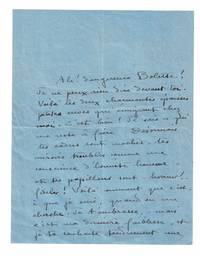
193574179s. l. Paris 1935. Fine. s. l. Paris s. d. circa 1935 17.70 x 22.50 cm 2 pages sur un feuillet Beautiful autograph letter signed by Colette addressed to her friend Bolette Natanson. Two pages written in ink on blue paper. Transverse creases inherent to the folding of the missive. This letter was probably addressed to Bolette following a gift made to her ""old friend"": ""Ah! dangerous Bolette! I can say nothing in front of you. Here are the two charming thick little vessels that emigrate to my home."" This is an opportunity for Colette very pleased with this new gift to humorously devalue the designer's previous works: ""From now on your frames are ugly your mirrors troubled like an honest man's conscience and your butterflies are - horror! - faithful!"" The famous ""butterflies"" naturalized and enclosed in glass frames are visible in several photographs of the writer in her home. Having evolved since her earliest childhood in artistic circles - she is the daughter of Alexandre and niece of Thadée Natanson the creators of the famous Revue Blanche - Bolette Natanson 1892-1936 became friends with Jean Cocteau Raymond Radiguet Georges Auric Jean Hugo and also Colette. Passionate about sewing she left Paris for the United States with Misia Sert great friend of Coco Chanel and was hired by Goodman. With her husband Jean-Charles Moreux they created in 1929 the gallery Les Cadres on boulevard Saint-Honoré and frequented numerous artists and intellectuals. Their success was immediate and they multiplied projects: the creation of the fireplace for Winnaretta de Polignac the decoration of the château de Maulny the arrangement of Baron de Rothschild's private mansion the creation of frames for industrialist Bernard Reichenbach and finally the realization of Colette's beauty institute storefront in 1932. Bolette Natanson also framed the works of her prestigious painter friends: Bonnard Braque Picasso Vuillard Man Ray André Dunoyer de Segonzac etc. Despite this meteoric rise she would end her life in December 1936 a few months after her father's death. unknown
193574179s. l. [Paris] s. d. [circa 1935] | 17.70 x 22.50 cm | 2 pages sur un feuillet
1¾ SS. auf Doppelblatt. Gr.-4to. "In 68 Nächten des Jahres 1923 gelangen mir am Refraktor (Objektiv Merz von 18,6 cm Durchmesser) der hiesigen städtischen Sternwarte [...] 110 Beobachtungen von 43 kleinen Planeten und zwar von [folgen die Namen derselben]. Insgesamt wurden hier bis Ende 1923 von Brünnow, Robert Luther und mir 4519 Beobachtungen von 297 kleinen Planeten angestellt, darunter 2035 Beobachtungen der 24 von meinem Vater entdeckten Planeten. Nachdem ich in dem Planeten 1922 NA die seit 1873 verschollene Aethra erkannt zu haben glaubte, habe ich mich bemüht, dieselbe bis zum Verschwinden in der Abenddämmerung zu verfolgen [...]". - Der Sohn des Astronomen Robert Luther studierte in Bonn, Berlin und Leipzig Astronomie und Mathematik, wurde 1883 promoviert ("Ueber die Bahn des Planeten Amalthera") und begab sich nach einem Jahr Assistenz an der Bonner Sternwarte 1885 als stellvertretender Observator nach Hamburg. "Dort seit 1889 Observator, ging er 1892 als Adjunkt seines Vaters nach Düsseldorf und übernahm 1900 die Leitung der Sternwarte. Luther setzte mit der Beobachtung kleiner Planeten das Lebenswerk des Vaters fort und veröffentlichte u. a. 'Beobachtungen der Helligkeitsmaxima & -minima des Planeten 433 Eros' (1931)" (DBE).
52773o.J. Paris, 1960 (?), 8° und Quer-8°. 15 Blatt, teils lose eingelegt auf farbigem Papier.
191177520Paris 1911. Fine. Paris Lundi 11 septembre 1911 13.50 x 18 cm 5 pages sur un double feuillet et un feuillet libre Autograph letter signed by Pierre Louÿs addressed to Georges Louis. Five pages written in violet ink on a double leaf and a loose leaf. A press article pasted on the recto of the single leaf. Transverse creases inherent to posting. Fine letter addressed to his brother Georges Louis with whom Pierre Louÿs maintained a very intimate relationship and whom he considered as his own father. The question of the real identity of Pierre Louÿs's father still fascinates biographers today: ""His father Pierre Philippe Louis . had married in 1842 Jeanne Constance Blanchin who died ten years later after giving him two children Lucie and Georges. In 1855 he remarried Claire Céline Maldan and from this union was born in 1857 a son Paul; then in 1870 our writer who received the first names Pierre Félix. This late birth the differences in character between father and son the former's disaffection toward the latter the profound intimacy that always reigned between Louÿs and his brother Georges all this has led certain biographers and critics to suspect that the latter was in reality the writer's father. The exceptionally intimate and constant relationship that Pierre and Georges maintained between themselves all their lives could be an argument in this sense. Of course no irrefutable proof has been discovered and none will probably ever be discovered. Nevertheless certain letters . are quite disturbing. In 1895 for example Louÿs writes seriously to his brother that he knows the answer to ""the most poignant question"" he could ask him a question he has had ""on his lips for ten years."" The following year in the full triumph of Aphrodite he thanks Georges effusively and ends his letter with this sentence: ""Not one of my friends has a FATHER who is to him what you are to me."" Arguing from the close intimacy of Georges and Claire Céline during the year 1870 and the jealousy that the father never ceased to show toward his younger son Claude Farrère did not hesitate to conclude in favor of Georges Louis. And what to think of this dedication by Louÿs to his brother on a deluxe paper copy of the first edition of Pausole: For Georges his eldest son / Pierre."" Jean-Paul Goujon Pierre Louÿs Pierre Louÿs comments in this letter on Thomas Edison's visit to Paris: ""Edison is in France. Toward the end of last month a journalist questioned him. I regret not having kept the article."" The writer then launches into a true dialogue from his memories of said article paraphrasing the inventor in the manner of a witness who himself attended the interview: ""To the simple question ""Are you pleased with your trip"" Edison answered with amiable phrases and immediately on his own he brought the conversation to the subjects: Monoplane. War. He said I only repeat from memory the sense of what I read: He said in substance: ""You are not yet enthusiastic enough about the value of your new weapon: it is formidable. You take aeroplanes for scouts. Say first: combatants. From the heights where the monoplane evolves easily today there is an effective military power but especially an incalculable moral power."" He explained himself thus: ""Give grenades to an aviator who will drop them. Even if they are not very dangerous even if they rarely hit their target the entire enemy army will scatter like a flock of sheep under the flight of the eagle. Five six grenades falling from the sky will provoke panic terror. Nothing is frightening for a crowd like a peril that comes from above."" "" This ""remarkable interview"" related by the writer who finds that ""the theory is correct"" underlines the visionary character of Edison who seems here to relate the facts of the coming First World War. The erudite Pierre Louÿs illuminates this theory of ""Edison the prophet"" with his classical culture: ""It agrees with the old phrases about the limits of b unknown