Robert de MONTESQUIOUBiblio.com
66 614 résultats
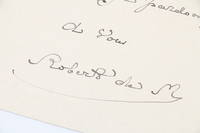
191087879s. l.: S. n. 1910. Fine. S. n. s. l. 1910 18 x 11.50 cm une feuille recto verso Autograph signed card from the dandy count 9 lines written in black ink addressed to a friend on cardboard paper: ""Chère amie C'était donc pour ""Femina ! "" Je devrais vous en vouloir moi qui avais prononcé contre ce lieu les formules exécratoires ! Enfin. je pardonne à vous ! A vous Robert de M. 910."" Dear friend So it was for ""Femina!"" I should hold it against you I who had pronounced execratory formulas against this place! Well. I forgive you! Yours Robert de M. 910. S. n. unknown
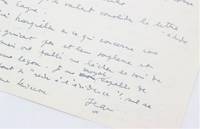
195083936s. l. 1950. Fine. s. l. 4 février 1950 21 x 27 cm une page sur un feuillet Autograph letter signed ""Jean"" and with a small star addressed to his English translator Marie Hoeck one page in blue ink on a sheet of fine white paper. Transverse folds inherent to posting. On the verso notes by the translator in ballpoint pen. Jean Cocteau is overworked by several projects: ""I have finished the mixtures of sounds and music for Orphée. I will probably finish the images for Les Enfants Terribles next week. . I do not speak to you of Léone because I look at her feel her steep myself in her - but alas my English allows me nothing more than to breathe in her light ink."" He shares with his translator his great fatigue: ""Then relaxation and fatigue - for fatigue only manifests itself in rest. . I am quite at ease concerning your springs. They do not creak and their flexibility is perfect. Mine nearly gave way on me the evening in Brussels. It is a lesson. I thought myself capable of the impossible. One must ""face the facts"" no one can do it."" unknown
1 S. Gr.-4to. Decadenz ist Ascendenz: Wenn die Menschen einmal so überempfindlich, so patologisch impressionabel, so hysterisch reaktionsfähig sein werden, daß sie bei einer zugeschlagenen Thüre in Ohnmacht fallen werden, werden Alle sich wenn auch allmälig es angewöhnen, Thüren vornehm-leise zu schließen!
4 SS. auf Doppelblatt. 4to. Beschreibung von Aufbau und Konzept seiner im Jahr darauf bei Göbhardt erschienenen "Ideen zur Physik": "Die ganze Schrift zerfällt in 2 Bände, deren jeder 25 bis 28 Bogen enthalten wird. - Das erste Buch die mystische und physische Ansicht des Himmels und die Theorie der Weltgese[t]ze in allen Erscheinungen des Himmels nachgewießen - das innere Wesen des Sonnensystems insbesondere [...] Der zweite Band beginnt mit dem zweiten Buch, welches sich mit den Ideen über die Entwicklung der Erde und der lebendigen Wesen beschäftigt [...] Man erwarte nicht, in dieser Schrift bloß eine Nachbildung der neuesten Systeme zu finden: es dürfte jeden ein eigner und unbefangnerer Geist daraus ansprechen [...]". - C. J. H. Windischmann wirkte seit 1818 als Professor der Philosophie an der damals neugegründeten Universität Bonn und lehrte auch Enzyklopädie und Geschichte der Medizin an der Medizinischen Fakultät. "In seinen Publikationen behandelte er medizinische, naturphilosophische und philosophische Themen; 1804 erschien von ihm eine Übersetzung des 'Timaios' von Platon. Im romantischen Geist der Zeit verstand Windischmann die historische Betrachtung zugleich als Gegenwartsanalyse und Zukunftsprognose [...] und setzte sich für eine Verbindung der Medizin mit der Philosophie und Theologie ein" (DBE).
Large 8vo. ½ p. "Nur ein poetisch Feuerwerk | War, Publikum! mein Augenmerk. | Doch ärgerst du dich an den Strophen, | Als kämen sie aus schwarzem Herzen, | So geh' ich dir zu Leib' im Ernst, | Damit du Spaß verstehen lernst". - First published in: Musenalmanach, ed. by Wendt, 1832. - Somewhat browned and with stronger damages to edges.
1 S. (20 Zeilen) auf Doppelblatt. 8vo. "Ein Denkspruch ward an heil'ger Stätte | Dem armen Knaben mitgegeben, | Zum Leitstern für das ganze Leben: | 'Nicht, daß ich's schon ergriffen hätte, | Ich jag ihm nach' [...]".
Titel und 24 SS. auf 12 Bll. Gr.-8vo. Fadengeheftet. Traktat in Versen über das Wesen der Freigeisterei, erschienen im "Teutschen Merkur" (1773, Bd. 3., SS. 3-38). - "Brüderchen! laßt uns fein christlich leben, | Wir müssen uns doch einmal drein ergeben! | Je länger ihr's verschiebt, je saurer köm[m]t's euch an; | Doch jung gewohnt, ist alt gethan. | In meinem Lenz hab' ich den Wollustknechten | Auch zugesehn, wie sie zu Nächten, | Mit Antivestalinen zechten. | Die Vögel waren überall, | Im Kaffeehaus, im Schauspiel, auf dem Ball, | Nur in der Kirche nicht. Sie brachten sich zu mästen | Und wohl zu thun, ihr faules Leben hin, | Und hatten oft, so boshaft war ihr Sinn, | Die lieben schwarzen Herrn zum Besten. | Was kömmt heraus? Der böse böse Tod, | Mit seinem krachenden Gerippe | Mit seiner fürchterlichen Hippe, | Stellt sich am frühen Morgenroth | Den starken Geistern gegenüber [...]". - Bl. 1 verso mit einem hs. Besitzeintrag: "Aus dem Besitz der Familie Merz. Tischlergesell Eustach Merz aus Steinbach in Baden arbeitet die Jahre um 1800 in Poskal b. Prag. Seit 1802 Launer Bürger u. Tischlermeister".
8vo. 112, (4) pp. with colour-printed or blindstamped decorative borders. Contemporary full calf. Glanz probably assembled the present album on the occasion of a visit to the German artists' association "Ponte Molle Society" on 18 March 1843. The Society, a humorous artists' club based at the Palazzo Serlupi near the Pantheon, was a popular venue for German artists and Rome travellers, offering art exhibitions, events, and a well-stocked library. In 1845 it metamorphosed into the more serious-minded "Deutscher Künstlerverein". The most prominent contributor to this album is the Viennese painter and engraver Carl Rahl (1812-65), who had been living in Rome since 1836 and was closely involved with the Ponte Molle Society, serving as its "People's Tribune" in 1840/41. After his return to Vienna in 1850, Rahl became professor at the academy. A precursor to Makart, he championed a drastic and colourful eclecticism which exerted an enormous influence on the painters of Vienna's Ringstrasse era (cf. Thieme/Becker XXVII, 570). Glanz, the owner of the album, is identified in the full-page entry of Johann Christian Reinhart (p. 97; Rome, 25 March 1843): "At the same time, dear Mr. Glanz, I wish you a happy and enjoyable journey" (transl.). - The contributors are, in the order of their entries: 1) Alexius Fedor Geyer (Berlin); 2) Adam Bamelmayr; 3) Friedrich Strache (Vienna); 4) Robert Salemann (Reval); 5) Heinrich Wilhelm (Heidelberg); 6) Eduard Schwab (Mähren); 7) Ivanoff (St Petersburg); 8) Peter Petersen (Copenhagen); 9) Alexandre Reuben (Paris); 10) Christian Friderik Holbeck (Copenhagen); 11) Carl Mayer (Vienna); 12) Hermann Schievelbein (Berlin); 13) Peter Raadfig (Copenhagen); 14) Carl Adolf Senff (Halle); 15) Gustav W. Palm (Stockholm); 16) Wilhelm Achtermann (Prussia); 17) Constantin Schmidt (Mainz/Rhein); 18) Carl Rahl; 19) Theodor Naphtali (Berlin); 20) Wilhelm Matthiae; 21) Louis Vogel (Hildburghausen); 22) J. M. Scharff (Hütteldorf near Vienna); 23) Adolf Dressler (Berlin); 24) Jan Thienen; 25) (pseud.) "Caspar Hauser" (Basel); 26) Wilhelm Seiffert (Wroclaw); 27) Heinrich Im Hof (Uri). - Spine and front hinge professionally repaired; slight brownstaining to interior fleckig.
Titel und 2 SS. (64 Takte: 30 Takte Polka, 34 Takte Trio) Noten auf Doppelblatt. Qu.-Gr.-8vo. Der Titel auf der 1. Recto-Seite. - Unterer Rand mit starken Läsuren und einem kl. Ausriss.
4to. 1 f. epigraph ("Cuantas cabezas tantos pareceres"), 1 f. calligraphic title in red and black, 48 pp. Contemporary orange boards. Autograph transcript of unpublished poetry written in his early days.
¾ S. Gr.-4to. Das 1919 erstmals veröffentlichte Gedicht (Leipzig, Insel), wohl in einer recht späten Abschrift: "Ich lag in dir noch unverzweigt, | Du tiefer Felsen einer Nacht; | So kalt wie Stein und trostesarm [...]". - Auf Velin-Papier mit Wasserzeichen "Extra strong". - Mit kleinen Randläsuren; leicht knittrig und gering fleckig.
Folio. 19 ff. of thick dark cardboard. With 7 pen-and-ink drawings and 7 photographs. Contemporary brown calf with brass corner fittings. All edges gilt. The splendid album celebrating the 25th anniversary of the women's shelter and retirement home, which was established in 1883 and rebuilt in 1906/07 after plans by Karl Holzer. It begins with a portrait photograph of Archduchess Marie Valerie, who functioned as the institution's patron in 1903. The portrait is followed by a history of the building on ff. 2-5. Seven pen-and-ink drawings on ff. 6-12 show an exterior view, the hall, parlour with hall, dining hall, bedroom, kitchen and garden front, while ff. 13-19 show seven photographs of the main front, dining hall, parlour, hall with staircase, kitchen, chancery and the old building existing until 1906/07. - The album describes the history of the women's home, tracing its existence back to 1881, when several Viennese women joined to found an association aiming at providing single elderly, poor but educated women with affordable flats and meals in a Viennese home for women. - Located near Schönbrunn, the shelter in the Frauenheimgasse today is operated by the Catholic relief and social service organisation Caritas. - Lacks the clasp. Binding slightly rubbed and a little cracked near the upper joint. Flyleaves somewhat waterstained, cardboard leaves rubbed at the edges.
192577543Paris 14 décembre 1925 | 10.60 x 15.70 cm | une page sur une carte lettre
1¾ SS. auf 2 Bll. 4to. Typoskript der RAVAG-Sendung "Bretter, die die Welt bedeuten". - Der Sohn des Polizeijuristen Viktor G. (kaiserlicher Rat und nach seiner Pensionierung Prinzenerzieher bei Coburg und Lobkowitz) nahm Schauspielunterricht bei Max Reinhardt, war hernach viele Jahre an tschechisch-deutschen Provinztheatern zu sehen und erhielt 1938 Auftrittsverbot, wurde verhaftet und zum Wehrdienst eingezogen. Nach Kriegsende auf - mit Ausnahme der Staatsoper - annähernd allen Wiener Bühnen zu sehen, wurde Gerhard 1964 ständiges Mitglied der Wr. Volksoper. Zudem wirkte er in mehreren Filmen mit und war seit 1932 auch regelmäßig im Hörfunk zu hören. 1978 wurde ihm der Berufstitel eines Professors verliehen. - Lili Marberg (1876-1962) gehörte von 1911 bis 1950 dem Wiener Burgtheater an. Seit 1936 auch Ehrenmitglied, spielte sie zunächst in Stücken Wedekinds, Hauptmanns und Ibsens, später vorwiegend Königinnen und mütterliche Frauen und galt weithin als vorzügliche Charakterdarstellerin. Zu ihren Hauptrollen zählten Desdemona, Hedda Gabler und Helena in "Vor Sonnenaufgang". Ihre einzige Filmrolle war die des Fräulein Munk in Walter Reischs "Silhouetten" (1936).
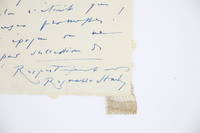
192577543Paris 1925. Fine. Paris 14 décembre 1925 10.60 x 15.70 cm une page sur une carte lettre Signed autograph note by Reynaldo Hahn addressed to Madame Serge André and written on a white paper letter-card in blue ink. Central fold inherent to the mailing. Dominique André is a poetess novelist and playwright. She notably published under the pseudonym Claude Isambert. Reynaldo Hahn declines an invitation from his friend: ""Est-ce possible chère Madame ! Vous m'invitez à goûter ! Hélas je ne pense pas aller nulle part dans la journée ! Un soir à l'Escargot d'Or on avait projeté de se voir : Lacretelle devait me faire signe - que sais-je "" ""Is it possible dear Madame! You invite me for afternoon tea! Alas I don't think I'm going anywhere during the day! One evening at the Escargot d'Or we had planned to see each other: Lacretelle was supposed to let me know - what do I know"" unknown
189588099s. n. | Honfleur s.d. (ca 1895) | 14 x 22 cm | une page recto verso
192886536S. n. | Paris 19 Août Juillet 1928 | 13.50 x 21 cm | une feuille + une enveloppe
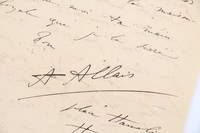
189588099Honfleur: s. n. 1895. Fine. s. n. Honfleur s.d. ca 1895 14 x 22 cm une page recto verso Autograph letter signed addressed to a journalist friend at Figaro illustré 28 lines in black ink. Fold mark inherent to envelope insertion a lack to upper corner of the letter without any damage to the text. Alphonse Allais must do a favor for his friend: ""Un peu de patience mon cher Abel un peu de patience. Sitôt rentré à Paris ma première démarche sera pour ton parapluie que je choisirai en soir gorge-pigeon et manche d'argent."" A little patience my dear Abel a little patience. As soon as I return to Paris my first errand will be for your umbrella which I will choose in pigeon-throat evening silk with a silver handle.; he therefore also allows himself to solicit the kindness of his correspondent: ""Et bien envoie-moi le n° du Figaro illustré d'il y a un mois ou deux où il y avait des choses de Toulouse-Lautrec."" Well then send me the issue of Figaro illustré from a month or two ago where there were things by Toulouse-Lautrec. He concludes his letter with a sententious: ""Donne-moi ta main loyale que je la serre. Ton Alphonse Allais. Bonjour aux amis."" Give me your loyal hand so I may shake it. Your Alphonse Allais. Greetings to friends. s. n. unknown
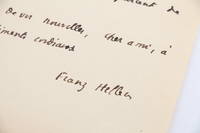
192886536Paris: S. n. 1928. Fine. S. n. Paris 19 Août Juillet 1928 13.50 x 21 cm une feuille une enveloppe Autograph letter dated and signed by Franz Hellens addressed to André Malraux 21 lines in black ink. Fold marks inherent to postal handling. We include an envelope addressed to Franz Hellens and written by André Malraux which probably contained the response to our letter. Franz Hellens responds to a request for information made by André Malraux: ""Je n'ai pas oublié le renseignement que vous m'avez prié de vous procurer au sujet du Voyage au Congo. Voici la réponse que j'ai reçu de la compagnie belge maritime du Congo. Ce n'était pas du tout ce que j'avais demandé"" ""I have not forgotten the information you asked me to obtain regarding the Journey to Congo. Here is the response I received from the Belgian maritime company of Congo. It was not at all what I had requested"" and will attempt to learn more in order to help his friend: ""Je vais écrire autre part et tâcher d'obtenir une réponse précise à ma question. Patientez donc quelques jours encore."" ""I will write elsewhere and try to obtain a precise answer to my question. Please wait a few more days."" Franz Hellens mentions the forthcoming publication at Grasset of his next work: ""Brun m'a envoyé copie signée du contrat. Il m'écrit que le livre pourra paraître en janvier prochain. J'aurai voulu octobre mais enfin."" ""Brun sent me a signed copy of the contract. He writes to me that the book will be able to appear next January. I would have wanted October but well."" and inquires about André Malraux's book in progress: ""Et vos Conquérants Je suis bien impatient de lire le tout."" ""And your Conquerors I am quite eager to read it all."" S. n. unknown
Vier Strophen mit zusammen 16 Zeilen auf 1 S. 4to. "Wie kann ich anders, als in ewigem Gedenken | Dein Bildnis hegen in verzichtgezwungener Seele. | Ob auch dein Weg den meinen stets verfehle, | Ob auch nicht Treue mir das Schicksal hielt, | Muss ich doch meiner Treue ewiges Blühn dir schenken [...]". - Grete Meisel-Hess zählt mit ihren Romanen und Novellen "zu den trefflichsten geistigen Vorkämpferinnen der modernen Frauenbewegung" (Wiener Bilder, Nr. 20 [1901], S. 8).
48526o.J. München, um 1921, Blattgr. 17,5 x 13 cm. Plattengr.: 8,2 x 7,4 bzw. 2,5 x 7 cm.
188689382Sans nom d'éditeur | Sans lieu d'édition s. d. [1888] | 11.2 x 17.7 cm | Une page sur un feuillet
189985096Brest 3 Octobre 1899 | 11 x 17 cm | 1 page et demi sur un feuillet double
189985096Brest 1899. Fine. Brest 3 Octobre 1899 11 x 17 cm 1 page et demi sur un feuillet double Autograph letter dated and signed by Victor Segalen addressed to Emile Mignard one and a half pages 24 lines written in black ink on a double sheet. Traces of transverse folds inherent to postal delivery. Trace of white paper tab. Emile Mignard 1878-1966 also a doctor from Brest was one of Segalen's closest childhood friends whom he met at the Jesuit college Notre-Dame-de-Bon-Secours in Brest. The writer maintained with this companion an abundant and regular correspondence in which he described with humor and intimacy his daily life in the four corners of the globe. It was at Mignard's wedding on February 15 1905 that Segalen met his wife Yvonne Hébert. It was in 1899 that Victor Segalen's first nervous disorders manifested themselves which would only worsen as he advanced in age. Worried about his already failing health his friends and relatives wanted to hear news of him which sometimes exasperated him: ""Faire comprendre à Mlle D. qu'il me serait extrêmement pénible de répondre à ses lettres qui ne pourraient être que de condoléances.autant celles d'amis comme toi me seraient apaisantes autant des consolations féminines même bien intentionnées je n'en doute pas me seraient insupportables."" Make Miss D. understand that it would be extremely painful for me to respond to her letters which could only be of condolence.while those from friends like you would be soothing to me feminine consolations even well-intentioned I have no doubt would be unbearable to me. Victor Segalen thus declares his profound intimacy with Emile Mignard with whom he had undertaken that same year a cycling tour in Brittany and to whom he confided fully. Fleeing certain relationships he desired to maintain despite his illness his privileged friendship with the latter: "". ne reviendrai qu'après un détour dont je ne prévois pas la durée. Mais j'ai le temps et le désir d'avoir de tes nouvelles."" .will only return after a detour whose duration I cannot foresee. But I have the time and desire to hear from you. Knowing his friend to be understanding and respectful of his reserve the convalescent Victor Segalen did not wish to elaborate further on the illness that was already consuming him: ""Tu sens que je ne puis en écrire plus long n'ayant en ce moment pas le choix des sujets mais tu ne m'en voudras j'en suis sûr pas."" You feel that I cannot write at greater length not having at this moment a choice of subjects but you will not hold it against me I am sure. Autograph letters by Victor Segalen are extremely rare. unknown
1 S. 4to. "Die Saite bin ich, die erklingt, | und süß des Hörers Seele rührt | nur wenn der Meister sie berührt | daß voll der Ton zum Herzen dringt. || Ich bin die amsel, welche schlägt | aus voller Brust, doch unbewusst | in frischer Frühlingsmorgenluft | so wie ihr's Gott in's Herz gelegt [...] [es folgen 16 Zeilen]. - Eichert ließ sich 1893 von seiner Tätigkeit im Eisenbahndienst pensionieren und veröffentlichte frei-religiöse politische Lyrik; nach seiner Konversion wandelte er sich zum katholischen Publizisten und politischen Lyriker der "Christlichen Volkserneuerung". Von 1894 bis 1906 war er Herausgeber des "Volksblatts für Stadt und Land" sowie der "Flugschriften des katholischen Schulvereins", seit 1906 der literarischen Monatszeitschrift "Gral". Eichert war eines der führenden Mitglieder in der katholischen Erneuerungsbewegung. - Mit einigen unbed. Einr. (keine Buchstabenberührung).