66 616 résultats
192487768Le Clos-Marie (Roscoff) 30 Août 1924 | 21 x 27.50 cm | 1 page recto verso
4to. 3 pp. on bifolium. 15 stanzas with 6 lines each. Together with an albumen silver print (85 x 54 mm, matted). Three pages on a bifolium, handwritten by Dumas entirely in French. "Alex. Dumas" is printed in an unknown hand at bottom right corner of top page. The albumen print pictures Dumas sitting down with his hands resting on cane. - Paper has been reinforced with archival material on verso at folds. Toning throughout, a bit darker at edges. "19B" has been written in pencil on the lower left corner of top page. Image has some speckling and slight buckling, but remains very attractive.
2 SS. Kl.-4to. Wohl die Druckvorlage zu einem der seit 1925 von Wellesz gestalteten Radiovorträge über musikgeschichtliche Themen: "Im Laufe der letzten Jahre ist es wohl auch dem der Musikübung Fernerstehenden erkennbar geworden, dass diese Kunst in mannigfacher Weise durch die bei den Schwesternkünsten aufgezeigten Strömungen berührt wurde. Es ist nicht zu vermeiden, dass diese Veränderungen unter diesem oder jenem Schlagwort zusammengefasst werden, das immer nur einem Teil des Wesenhaften gerecht werden kann. Jedenfalls aber zeigt sich als stärkstes Merkmal in der Musik der letzten Jahre - mag es sich um eine Oper, ein Konzertstück, einen Tanz, einen Song handeln - der Wille zu knapper preziser [!] Gestaltung, zur Vermeidung des Episodenhaften, zur Vermeidung des formlos Ausströmenden. Es ist nun hier der Versuch gemacht, an Hand einiger Grammophonplatten einen kleinen Überblick über Musikstücke zu geben, in denen etwas von dem Geist der neuen Zeit zum Ausdruck kommt. Man war dabei an die ungemein kleine Zahl der in den Katalogen der führenden Gesellschaften vorkommenden Aufnahmen von Werken moderner Musiker gebunden. Man wird leicht erkennen, dass nicht alles sich gleichermaßen gut auf der Platte abhören lässt; gerade Wirkungen, die im Konzertsaal besonders gut klingen, versagen auf der Platte, und umgekehrt. So wird es in Zukunft sicherlich dazu kommen, dass sich eine eigene Orchestrationstechnik für mechanische Aufnahmen herausbilden wird. Ansätze dazu sind bereits bei jenen Kompositionen bemerkbar, die auf Bestellung einiger deutscher Sender eigens für die Zwecke des Rundfunks komponiert wurden". - Mit einer redaktionellen Bemerkung an den Setzer in blauem Farbstift und der Erweiterung des Titels von "Musik" zu "Moderne Musik"; gleichfalls recto eine Bleistiftnotiz zum Schriftgrad ("Gar[a]mond") und rechts oben die Numerierung "2"; ein kleiner Stecknadeldurchstich.
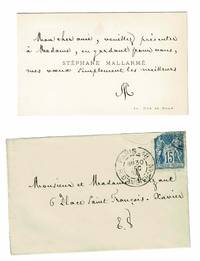
189276335Paris: S. n. 1892. Fine. S. n. Paris 30 décembre 1892 10.40 x 6.30 cm une carte de visite et son enveloppe Signed autograph visiting card from Stéphane Mallarmé addressed to Alidor Delzant. Envelope included. Alidor Delzant was a lawyer collector and bibliophile. Friend of the Goncourts he devoted a work to them and was Edmond's secretary and testamentary legatee. ""Mon cher ami veuillez présenter à Madame en gardant pour vous mes voeux simplement les meilleurs."" ""My dear friend please present to Madame while keeping for yourself my simply best wishes."" S. n. unknown
189276335S. n. | Paris 30 décembre 1892 | 10.40 x 6.30 cm | une carte de visite et son enveloppe
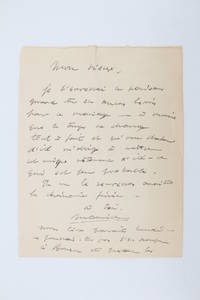
190080760s. l. 1900. Fine. s. l. s. d. ca 1900 14.70 x 18.90 cm Une page et 1/2 sur un feuillet Autograph letter signed by Maurice Leblanc to an unknown recipient whom he addresses as ""Mon vieux""; one and a half pages written in black ink on a sheet. Transverse folds inherent to mailing. The letter concerns the loan of a garment: ""Je t'enverrai ce pardessus quand tu en auras besoin pour ce mariage - à moins que le temps ne change tout à fait et qu'une chaleur d'été m'oblige à mettre cet unique vêtement d'été - ce qui est peu probable. Tu me le renverras aussitôt la cérémonie finie."" ""I'll send you this overcoat when you need it for this wedding - unless the weather changes completely and summer heat forces me to wear this only summer garment - which is unlikely. You'll send it back to me as soon as the ceremony is over."" Maurice Leblanc also mentions the release of one of his works ""Mon livre paraît lundi - ne pourrais-tu pas t'en occuper à Rouen et presser les libraires de faire leurs commandes et de t'arranger pour n'en point manquer "" ""My book comes out Monday - couldn't you take care of it in Rouen and press the booksellers to place their orders and arrange not to run out"" before concluding his letter: ""Tout le monde va bien. Chez Geo c'est affolant. On s'en va à Bordeaux du 21 avril au 4 mai."" ""Everyone is well. At Geo's it's frantic. We're going to Bordeaux from April 21 to May 4."" unknown
190080760s. l. s. d. [ca 1900] | 14.70 x 18.90 cm | Une page et 1/2 sur un feuillet
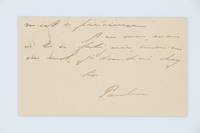
190078898s. l. Paris 1900. Fine. s. l. Paris s. d. ca 1900 9.50 x 5.60 cm une carte rédigée des deux côtés Autograph manuscript card signed ""Pauline"" and addressed to Natalie Clifford Barney written in black ink on both sides. ""Repose-toi aujourd'hui chérie. Je suis inquiète de toi et cela me rend affreusement triste. Repose-toi bien n'est-ce pas Mon si fragile bonheur sois très prudente et ménage ta jolie santé frêle qui m'est si précieuse. A ce soir mais si tu es fatiguée envoie-moi un mot je viendrai chez toi."" ""Rest today darling. I am worried about you and it makes me terribly sad. Rest well won't you My so fragile happiness be very careful and take care of your pretty frail health which is so precious to me. Until tonight but if you are tired send me a word I will come to you."" It was at the end of 1899 and through Violette Shillito that Renée Vivien - then Pauline Tarn - made the acquaintance of Natalie Clifford Barney ""this American more supple than a scarf whose sparkling face shines with golden hair sea-blue eyes and implacable teeth"" Colette Claudine à Paris. Natalie who had just lived a summer idyll with the sulfurous Liane de Pougy who had initiated her into sapphism paid only discreet attention to this new acquaintance. Renée however was totally captivated by the young American and would relate this love at first sight in her autobiographical novel Une Femme m'apparut: ""I evoked the already distant hour when I saw her for the first time and the shiver that ran through me when my eyes met her eyes of mortal steel her sharp blue eyes like a blade. I had the obscure presentiment that this woman was giving me destiny's order that her face was the dreaded face of my future. I felt near her the luminous vertigo that rises from the abyss and the call of very deep water. The charm of peril emanated from her and attracted me inexorably. I did not try to flee her for I would have escaped death more easily."" ""Winter 1899-1900. Beginning of the idyll. One evening Vivien is invited by her new friend to Mme Barney's studio Natalie's mother 153 avenue Victor-Hugo at the corner of rue de Longchamp. Natalie ventures to read verses of her own composition. When Vivien tells her she loves these verses she replies that it is better to love the poet. A response quite worthy of the Amazon."" J.-P. Goujon Tes blessures sont plus douces que leurs caresses Two years of unequal happiness followed punctuated by Natalie's recurring infidelities and Renée's pathological jealousy whose letters oscillated between passionate declarations and painful mea culpa. ""Renée Vivien is the daughter of Sappho and Baudelaire she is the flower of evil 1900 with fevers broken flights sad voluptuousness."" Jean Chalon Portrait d'une séductrice In 1901 came an important rupture that would last almost two years; Renée despite Natalie's solicitations and the intermediaries she sends to win her back resists. ""The two friends saw each other again and it was in August 1905 the pilgrimage to Lesbos which constituted a disappointment for Natalie Barney and remained without consequence. . The spring was definitively broken. The two former friends ceased to see each other from 1907 and Vivien died without their having met again."" J.-P. Goujon Ibid. Precious and very rare card from Sappho 1900 to the Amazon. unknown
190078898s. l. [Paris] s. d. [ca 1900] | 9.50 x 5.60 cm | une carte rédigée des deux côtés
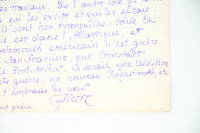
190777513Tamaris Tamaris-sur-mer 1907. Fine. Tamaris Tamaris-sur-mer 19 juin 1907 13.50 x 20.50 cm 4 pages sur un double feuillet Autograph letter signed by Pierre Louÿs addressed to Georges Louis. Four pages written in purple ink on a double sheet. Envelope included. Fine letter addressed to his brother Georges Louis with whom Pierre Louÿs maintained a very intimate relationship and whom he considered as his own father. The question of Pierre Louÿs's real paternal identity still fascinates biographers today: ""His father Pierre Philippe Louis . had married in 1842 Jeanne Constance Blanchin who died ten years later after giving him two children Lucie and Georges. In 1855 he remarried Claire Céline Maldan and from this union was born in 1857 a son Paul; then in 1870 our writer who received the first names Pierre Félix. This late birth the differences in character between father and son the first's disaffection toward the second the profound intimacy that always reigned between Louÿs and his brother Georges all this has led certain biographers and critics to suspect that the latter was in reality the writer's father. The exceptionally intimate and constant relationship that Pierre and Georges maintained between them throughout their lives could be an argument in this sense. Of course no irrefutable proof has been discovered and none will probably ever be discovered. Nevertheless certain letters . are quite troubling. In 1895 for example Louÿs writes seriously to his brother that he knows the answer to 'the most poignant question' he could ask him a question he has had 'on his lips for ten years.' The following year in the midst of Aphrodite's triumph he thanks Georges effusively and ends his letter with this sentence: 'Not one of my friends has a FATHER who is to him what you are to me.' Arguing from the close intimacy of Georges and Claire Céline during the year 1870 and from the jealousy that the father never ceased to show toward his younger son Claude Farrère did not hesitate to conclude in favor of Georges Louis. And what to think of this dedication by Louÿs to his brother on a Japan paper copy of the first edition of Pausole: To Georges his eldest son / Pierre."" Jean-Paul Goujon Pierre Louÿs Written from Tamaris where the writer is on vacation and attempting to buy Psyché this fine letter forms a veritable ode to literature and bibliophilia. Louÿs ""fills two pages of letter on this question"" and indeed writes: ""When I leave I always lock everything up so that my maids don't browse through my books in my absence which would be disastrous. I unfortunately have book titles that could sometimes tempt them. . What to do Leave you the keys I would certainly do so if I were leaving for six months but for a short absence. . I don't have duplicates and . the key to my study locks up my desk which is the soul of the house."" Georges very quickly transmitted to his brother the love of books and texts and the latter recalls here this profound spiritual communion: ""When I look at my library I constantly regret that you don't benefit from it more. I would always like to unite it with yours and that the day when your life is free you would only have to leave your bedroom to take from my place what you desire."" Although happy to take some leave he misses his brother: ""That's somewhat what prevents me from loving Biarritz it's that I see there a threat of such complete separation for us both. . I couldn't follow you there and I would only see you one or two months a year; that frightens me. My wish would be that we choose two small adjoining houses near Paris. . But it's not time to speak of it."" This sentimental reverie of a future together quickly gives way to a long passage concerning international politics and the game of European alliances. Georges is then Director of Political Affairs at the Quai d'Orsay and the two brothers naturally discuss this subject: ""The circle of alliances built in recent unknown
190777513Tamaris 19 juin 1907 | 13.50 x 20.50 cm | 4 pages sur un double feuillet
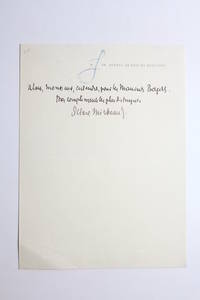
189773703s. l. Paris 1897. Fine. s. l. Paris 1897 13.50 x 18.30 cm une feuille Autograph letter signed by Octave Mirbeau. 2 lines in black ink on a folded sheet letterhead paper ""68 avenue du bois de Boulogne"". ""Alors Monsieur entendu pour les Mauvais Bergers"". The Mauvais bergers corresponds to Octave Mirbeau's tragedy a social drama performed at the Renaissance Theatre on December 15 1897 with Sarah Bernhardt and Lucien Guitry in the leading roles. unknown
189773703s. l. [Paris] [1897] | 13.50 x 18.30 cm | une feuille
4 SS. auf Doppelblatt. 4to. Während seiner Zeit als Rhetorikschüler verfasster Monolog des Moses, in dem dieser die Aufgabe, die Israeliten nach Kanaan zu führen, auf seinem Totenbett dem Josua überträgt: "Approche, o mon fils! Vous recevois les derniers paroles et la bénediction de Moïse, au moment du trépas. C'est au nom du Dieu de Jacob que je te parle: prosterne toi devant sa volonté suprême, et sois digne des grands desseins, qu'il a sur toi. Josué, ma mort approche, je le sais: déja nous touchons aux frontières de Canaan, Dieu ne me permet pas de les franchir. Je l'ai entendue, sa voix divine, je l'ai entendue sur le mont Sinaî, il me disait: 'o Moïse tu ne passeras pas le Jourdain! Le voila: ne vois-tu pas le fleure couler à nos pieds? c'est ici qu'est marqueée ma tombe! Que la volonté de Dieux soit accomplie! Je n'emporte qu'un regret, c'est de ne pouvoir moi même conduire nos tribus dans les Champs de Canaan, et de n'avoir pas [...] baisé cette terre sacrée [...]". - Mit eh. Korrekturen des Schriftstellers und Hochschulprofessors Jean-Louis Laya (1761-1833).
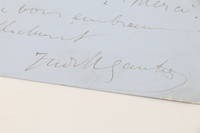
191080835Alger Algiers 1910. Fine. Alger Algiers s. d. ca 1910 13.70 x 18 cm 4 pages sur un double feuillet Autograph letter signed by Judith Gautier addressed to Céleste Chrétien her housekeeper. Four pages written in black ink on a double sheet. Transverse folds inherent to mailing. Judith Gautier here discusses the visit of her friend the musician Chalmers Clifton - whom she liked to nickname Charmeur - to Dinard: ""Voici les dernières instructions : le voyageur arrivera dimanche soir à 7 heures 20. Il faudra le prendre à la gare vous ou Francis et le conduire tout droit à la maison qu'il ne connait pas. Il apporte des draps au cas où il n'y en aurait pas. Il les donnera pour qu'on fasse le lit et on le conduira tout de suite à Michelet pour dîner il faudra prévenir pour qu'on garde un dîner. . Mr Clifton est un très jeune américain tout à fait charmant et qui a l'air d'une demoiselle. Soignez-le bien."" ""Here are the final instructions: the traveler will arrive Sunday evening at 7:20. You or Francis will need to meet him at the station and take him straight to the house which he doesn't know. He is bringing sheets in case there aren't any. He will give them so the bed can be made and he will be taken immediately to Michelet for dinner you must warn them to save a dinner. . Mr. Clifton is a very young American who is quite charming and looks like a young lady. Take good care of him."" unknown
191080835Alger s. d. [ca 1910] | 13.70 x 18 cm | 4 pages sur un double feuillet
Fahnenabzug für Heft 1/1963 der Neuen Rundschau (Erstdruck, vgl. dazu Grützmacher II/D.6). 2 SS. Gr.-4to. Beiliegend eine Portraitpostkarte mit eh. Widmung und U. (dat. 1. VI. 1962). Aus der Sammlung des Theologen Hermann Dembowski (1928-2012).
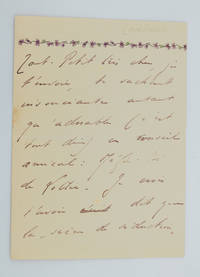
190679012s. l. Paris 1906. Fine. s. l. Paris s. d. ca 1906 11.50 x 15.90 cm 4 pages sur un double feuillet Autograph letter by Renée Vivien addressed to Natalie Clifford Barney and written in violet ink on a double sheet bordered with violets. Transverse folds inherent to mailing. Interesting letter of warning against the opportunist ""Lottie"": ""Tout-Petit très cher je t'envoie te sachant insouciante autant qu'adorable c'est tout dire ce conseil amical : Méfie-toi de Lottie. Je crois t'avoir dit que la « scène de séduction » chez moi était très savamment préparée et combinée. Lottie a besoin d'argent. Elle en cherche avec âpreté. Elle me demande maintenant une « lettre d'introduction » pour Lugné-Poë. et moi qui ne le connais pas ! Elle « t'embêtera » . c'est le mot cru le seul qui convient Elle est exaspérée contre moi parce que je n'ai pas succombé et surtout parce que je ne lui donnerai pas d'argent. Si elle m'en avait demandé loyalement franchement au nom des jours d'autrefois j'aurais cédé mais cette comédie amoureuse me répugne Je te le répète : Méfie-toi Ne la vois point si cela t'est possible."" ""Very dear Little One I send you knowing you to be as carefree as you are adorable which says everything this friendly advice: Beware of Lottie. I believe I told you that the 'seduction scene' at my place was very cleverly prepared and planned. Lottie needs money. She seeks it eagerly. She now asks me for a 'letter of introduction' to Lugné-Poë. and I who don't know him! She will 'bother you'. that's the crude word the only one that fits She is exasperated with me because I did not succumb and especially because I will not give her money. If she had asked me loyally frankly in the name of days gone by I would have given in but this amorous comedy disgusts me I repeat: Beware Do not see her if it is possible for you."" Charlotte ""Lottie"" Stern Countess Venturini was an actress also known by the name of Yorska and a close friend of Sarah Bernhardt. Alice Pike Barney Natalie's mother painted a very beautiful profile of her in pastel entitled ""Vamp of 1900"" and today preserved at the Smithsonian American Art Museum in Washington. The Jacques Doucet library holds eighteen autograph letters that she addressed to Natalie Clifford Barney. It was at the end of 1899 and through the intermediary of Violette Shillito that Renée Vivien - then Pauline Tarn - made the acquaintance of Natalie Clifford Barney ""cette Américaine plus souple qu'une écharpe dont l'étincelant visage brille de cheveux d'or de prunelles bleu de mer de dents implacables"" Colette Claudine à Paris. Natalie who had just lived through a summer idyll with the scandalous Liane de Pougy who had initiated her into sapphism paid only discreet attention to this new acquaintance. Renée on the other hand was completely captivated by the young American and would relate this love at first sight in her autobiographical novel Une Femme m'apparut: ""J'évoquai l'heure déjà lointaine où je la vis pour la première fois et le frisson qui me parcourut lorsque mes yeux rencontrèrent ses yeux d'acier mortel ses yeux aigus et bleus comme une lame. J'eus l'obscur prescience que cette femme m'intimait l'ordre du destin que son visage était le visage redouté de mon avenir. Je sentis près d'elle les vertiges lumineux qui montent de l'abîme et l'appel de l'eau très profonde. Le charme du péril émanait d'elle et m'attirait inexorablement. Je n'essayai point de la fuir car j'aurais échappé plus aisément à la mort."" ""Winter 1899-1900. Beginning of the idyll. One evening Vivien is invited by her new friend to Mme Barney's studio Natalie's mother 153 avenue Victor-Hugo at the corner of rue de Longchamp. Natalie ventures to read verses of her composition. When Vivien tells her she loves these verses she replies that it is better to love the poet. A response quite worthy of the Amazon."" J.-P. Goujon Tes blessures sont plus douces que leurs caresses Two year unknown
190679012s. l. [Paris] s. d. [ca 1906] | 11.50 x 15.90 cm | 4 pages sur un double feuillet
Folio. Title, 30 pp. Brown ink on 12-stave paper, 4 systems of 3 staves per page. Sewn. Louis Drouet dedicated his arrangement of melodies from Donizetti's opera "Belisario" (1836) for flute and piano to his daughter Lina Drouet. The piece was intended to be performed as a "morceau de salon". - Often referred to as the "Paganini of the flute", Louis Drouet was one of the most celebrated flautists of his time. The son of an expatriate French barber in Amsterdam was an autodidact before entering the Paris conservatory at the age of seven. At 16, he was first flutist and teacher of Louis Bonaparte, then King of Holland. An international career as a flute virtuoso followed. Among his stage partners and friends was Felix Mendelssohn. In 1840, Drouet was appointed director of music by Ernest I, Duke of Saxe-Coburg-Gotha. - The title written in a different hand. Some foxing and browning; tears to the fold of the title-leaf.
Small folio (212 x 316 mm). Manuscript on paper. 140 ff. Contemporary half calf with giltstamped spine labels. Marbled endpapers. A very rare manuscript copy of this work which its author had not intended for publication (or could not afford to have printed). Fournel, in his "Bibliographie Saint-Simonienne", placed the total number of such manuscript copies prepared at 60 (erroneously giving a date of 1811). The text was first printed in 1858 in a collection with the "Physiologie religieuse d’Enfantin" (Paris & Leipzig, Masson), and then again in the following year within Volume II of the "Œuvres choisies", with a list of some 30 known recipients of the original "Mémoire". - This work was planned as part of a series of studies based on the work of Vicq d'Azyr, Cabanis, Bichat, and Condorcet, the four scholars who had supposedly done most to study the human mind. The author proposes that his "Mémoire" be copied and criticized before being presented to the learned societies. It is an attempt to develop a positive social science which would study man as a species rather than as an individual; physiology would thus be elevated to the rank of the natural sciences. Saint-Simon believed that society could be understood by examining its underlying natural laws, the resulting social science would supposedly be capable of constructing a perfect society. His arguments for the scientific organization of society have been seen as "the first example of pure socialism [...] understood as an economic system in which production is entirely carried on in common and the fruits of labour distributed according to some ideal standard" (R. T. Ely). - Bookplate of the anthropologist and ethnographer Ernest Théodore Hamy (1842-1908), founder of the Musée d’Ethnographie du Trocadéro. Some repairs to the first two leaves, otherwise a very well preserved specimen. Mazzone 29. Walch p. 28 (listing MS 578 at the Museum d'Histoire Naturelle) and no. 82 (mentioning copies in the Bibliothèque de l'Arsenal and the Bibliothèque Thiers). Fournel p. 13 (misdated "1811"). Dolléans & Crozier 6. Stammhammer I, 214, 53. Booth p. 24-30.
1982101726Paris Robert Laffont 1982 1 vol. broché in-8, broché, couverture illustrée, 373 pp. Envoi de l'auteur à Jean Mauriac.
24 Zeilen auf 1 S. Gr.-8vo. "Tiefer Schlummer senkt sich nieder; | Auf die Stirnen qualbefreit | Träufelt ihren Balsam wieder | Trösterin Vergessenheit. | Träume schweben von den Hügeln, | Streuen über Busch und Haus | Mit den bunten Falterflügeln | Tausendfache Wunder aus [...]".
8 SS. auf 4 Bll. 4to. Wohl humoristisch zu verstehender Bericht über eine fiktive Beichte des französischen Kaisers: "Ich beichte und bekenne daß ich seit meinem Kadetstande in Lion das letztemahl bey der beichte war, daß ich als Consul und General in Italien gelogen und betrogen, zu Egipten meine Religion verleignet, in Deutschland als Kayser die Kirchen bestohlen. Den Papst seine Länder beraubt und halte ihn als Geisl, in Östreich habe ich Ehebruch begangen Unschuld verführet und geschändet; in Spanien den König und seinen Söhnen dem Volke beraubt, die Krone mit Gewalt genohmen und geblindert [d. i. geplündert]. In Russland verlohr ich durch des Teufels Verblendung eine Armeé, ergriff die Flucht und wurde dabey ein Mordbrenner [...]". - Auf diesen knapp vierseitigen Text sieben Strophen zu je acht Zeilen umfassende Gedicht "Tänze Napoleons": "Napoleon der große Mann! | So klein er sonst im Ganzen, | Kamm [!] auch die seltne Laun an, | Mit Rußland eine zu danzen [!] [...]". - Am letzten Blatt finden sich einige Notizen von Napoleons Daten. - Etwas angestaubt und fleckig und mit kleinen Randläsuren.