66 616 résultats
1 S. Qu.-kl.-4to. Wohl fiktiver und humoristisch zu verstehender Bericht über den günstigen Absatz französischer Erzeugnisse auf der Leipziger Michaelismesse, die tatsächlich von erheblicher Bedeutung für den Absatz Lyoner Seidenwaren nach Ost- und Südosteuropa war: "Ich berichte Ihnen meine Herren! daß die Leipziger Michaelsmesse für mich sehr günstig ausfiel - indem ich alle Waaren so gut angebracht habe, daß mir davon nichts als die Muster übrig blieben. Die österreichische-Russische-Preußische und Schwedische Kaufleute kamen in solcher Mänge - daß sie sogar die deutschen Waaren für französische na[h]men. Daher bin ich gezwungen meine Herren! Sie zu ersuchen so viel als möglich französische Waaren aufzubringen - und mir aufs schnellste nachzusenden - indem ich Hof[f]nung habe, selbe auf der Franckfurter Messe wieder anzubringen - denn die Kaufleute folgen mir auf dem Fuße nach [...]".
13 SS. (inkl. Titel) auf 4 Bll. Tinte auf Papier. 8vo. Zeitgenössische Broschur. Anthologie von Kalendersprüchen (Natur- und Witterungsereignisse, Verrichtungen etc.) für jeden Tag des Jahres, sämtlich im Stil von "Jurende's vaterländischem Pilger", der bis zu seiner Einstellung 1852 in seinem Kalenderteil eine eigene Spalte für den "Naturkalender" führte, "wo jedem Tage eine kleine Bemerkung [...] beygegeben ist" (Jahrb. der Literatur 1818.4, Anzeige-Blatt S. 76). Es scheint hier ein Entwurf für den Naturkalenderteil des Jahrgangs 1836 vorzuliegen, der aber noch redaktionell umfassend bearbeitet und umgestellt worden wäre. Nicht signiert, jedoch am hinteren Innendeckel von späterer Sammlerhand bezeichnet und im Schriftbefund stimmig. Eine Tätigkeit des jungen Rollett als Kalenderspruchlieferant wäre bislang nicht bekannt; 1835/36 war der Badener Arztsohn noch Schüler am Wiener Piaristengymnasium. - Der Vormärz-Lyriker Rollett wurde wegen revolutionärer Gesinnung polizeilich verfolgt, floh 1845 nach Deutschland und später in die Schweiz. 1854 vorübergehend nach Österreich zurückgekehrt, promovierte er 1857 in Gießen zum Dr. phil. und studierte später Pharmazie in Wien. Rollett gehört neben Moritz Hartmann und Hermann Jellinek zu den bekannteren Vertretern der Bewegung "Junges Österreich" und bekannte sich zum Deutschkatholizismus. - Broschur etwas angestaubt und mit Randläsuren.
1860640961860. Fine. s. d. circa 1860 20.60 x 27.60 cm un feuillet remplié DUMAS Alexandre Naïs et Chloé. Unpublished handwritten sapphic poem signed by Alexandre Dumas N. d. c. 1860 206 x 276 cm one folded leaf Autograph manuscript poem signed by Alexandre Dumas bearing the title Naïs et Chloé 84 verses in black ink on a blue folded leaf of paper. A few tiny tears without damage to the text invariably produced when a leaf of paper is folded. A very rare manuscript of a long unpublished poem depicting the love of Naïs and Chloé the writing of which is motivated by the admiration and tribute paid by Alexandre Dumas to one of the greatest figures of ancient poetry Sappho. A prolific novelist Dumas rarely tried his hand at poetry; Naïs et Chloé by its length constitutes a hapax in the literary production of this writer. The text remains unpublished to this day and is here enhanced by the elegant calligraphy of its author. The poem is made up of 21 quatrains among which stands a remarkable insertion of the most famous verse by Sappho to the beloved woman the title of which is preserved in the very body of the text. This embedding is part of the verve with which Dumas defends the poetic and evocative force of the writing of Sappho whom he elevates to the rank of the star of the world of Poetry: Il est au sein des mers s'appuyant à l'Asie Entre l'heureuse Smyrne et la sombre Lemnos Une île aux bois fleuris chers à la Poésie A qui Venus donna le doux nom de Lesbos. Quand du chantre divin la voix fut étouffée Que du nom d'Euridice elle eut frappé l'écho Le flot roula tête et la lyre d'Orphée Sur la rive où plus tard devait naître Sapho Sapho naquit la lyre en ses mains fut remise Les sons qu'elle en tira jusqu'à nous sont venus. Translated with conscientious care by the author the poem borrowed from Sappho in which that most famous verse emerges this one I say is equal to the gods is found in several places in Dumas' work particularly in the chapter entitled les vers saphiques of San Felice and in a collection of articles dedicated to the great female figures where she sits alongside Joan of Arc and Margaret of Anjou. For Dumas it is a matter of remaining faithful to the written verses and rendering their sensuality often blurred by previous translators: The translations of these two poets often appear to lack not only ancient color but are inadequate in their lesbian ardor Les étoiles du monde Galerie historique des femmes les plus célèbres de tous les temps et de tous les pays. Above and beyond this translation Dumas is imbued with the lyricism of Sappho without losing his own romantic vein and he paints the sapphic love of Naïs and Chloé in an erotic light: Oh seule palpitante échevelée et nue Une main sur ma gorge et l'autre. Oh ma Naïs Serre moi dans tes bras et sois la bien venue Car à force d'amour. tiens. tiens je te trahis Et l'on n'entendit plus alors dans la nuit sombre Que le bruit des baisers répétés par l'écho Car Nais et Cloé se taisaient et dans l'ombre Clinias s'enfuyait en maudissant Sapho. The poem testifies to the continuous interest that the authors of the late 19th century showed toward sapphism and to the personage of the reader-voyeur here embodied by Cleinias whose most famous occurrence remains Zola's Nana. Exceptional and long autograph sapphic poem by Alexandre Dumas. $ 10 000 unknown
186064096s. d. [circa 1860] | 20.60 x 27.60 cm | un feuillet remplié
- s.d. (circa 1860), 20,6x27,6cm, un feuillet remplié. - DUMAS Alexandre Naïs et Chloé. Unpublished handwritten sapphic poem signed by Alexandre Dumas N. d. (c. 1860), 20,6 x 27,6 cm, one folded leaf Autograph manuscript poem signed by Alexandre Dumas bearing the title "Naïs et Chloé," 84 verses in black ink on a blue folded leaf of paper. A few tiny tears without damage to the text, invariably produced when a leaf of paper is folded. A very rare manuscript of a long unpublished poem depicting the love of Naïs and Chloé, the writing of which is motivated by the admiration and tribute paid by Alexandre Dumas to one of the greatest figures of ancient poetry, Sappho. A prolific novelist, Dumas rarely tried his hand at poetry; "Naïs et Chloé," by its length, constitutes a hapax in the literary production of this writer. The text remains unpublished to this day and is here enhanced by the elegant calligraphy of its author. The poem is made up of 21 quatrains, among which stands a remarkable insertion of the most famous verse by Sappho, "to the beloved woman," the title of which is preserved in the very body of the text. This embedding is part of the verve with which Dumas defends the poetic and evocative force of the writing of Sappho, whom he elevates to the rank of the "star of the world" of Poetry: "Il est au sein des mers s'appuyant à l'Asie Entre l'heureuse Smyrne et la sombre Lemnos Une île aux bois fleuris chers à la Poésie A qui Venus donna le doux nom de Lesbos. Quand du chantre divin la voix fut étouffée Que du nom d'Euridice elle eut frappé l'écho Le flot roula tête et la lyre d'Orphée Sur la rive où plus tard devait naître Sapho Sapho naquit la lyre en ses mains fut remise Les sons qu'elle en tira jusqu'à nous sont venus." Translated with conscientious care by the author, the poem borrowed from Sappho in which that most famous verse emerges ("this one, I say, is equal to the gods"), is found in several places in Dumas' work, particularly in the chapter entitled "les vers saphiques" of San Felice and in a collection of articles dedicated to the great female figures, where she sits alongside Joan of Arc and Margaret of Anjou. For Dumas, it is a matter of remaining faithful to the written verses and rendering their sensuality, often blurred by previous translators: "The translations of these two poets [...] often appear to lack not only ancient color but are inadequate in their lesbian ardor" (Les étoiles du monde, Galerie historique des femmes les plus célèbres de tous les temps et de tous les pays). Above and beyond this translation, Dumas is imbued with the lyricism of Sappho without losing his own romantic vein, and he paints the sapphic love of Naïs and Chloé in an erotic light: "Oh seule palpitante, échevelée et nue Une main sur ma gorge et l'autre... Oh ma Naïs Serre moi dans tes bras et sois la bien venue Car à force d'amour... tiens... tiens je te trahis Et l'on n'entendit plus alors dans la nuit sombre Que le bruit des baisers répétés par l'écho Car Nais et Cloé se taisaient et dans l'ombre Clinias s'enfuyait en maudissant Sapho." The poem testifies to the continuous interest that the authors of the late 19th century showed toward sapphism and to the personage of the reader-voyeur, here embodied by Cleinias, whose most famous occurrence remains Zola's Nana. Exceptional and long autograph sapphic poem by Alexandre Dumas. $ 10 000 [FRENCH VERSION FOLLOWS] Poème manuscrit autographe signé d'Alexandre Dumas portant le titre "Naïs et Chloé", 84 vers à l'encre noire sur feuillet remplié bleu. Quelques infimes déchirures sans manque de texte dues aux pliure inhérentes à la mise sous pli. Le poème autographe est présenté sous une chemise en demi maroquin vert sapin, plats de papier marbré, contreplats doublés d'agneau vert, étui bordé du même maroquin, ensemble signé Goy & Vilaine. Rarissime manuscrit d'un long poème inédit retraçant les amours de Naïs et Chloé et dont l'écriture est régie par l'admiration et
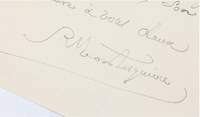
190783361s. l.: S. n. 1907. Fine. S. n. s. l. 21 mai 1907 25.50 x 20 cm une feuille Autograph letter signed by the dandy count 22 lines written in pencil addressed to his friend and bibliographer the critic Henri Lapauze: ""Neuilly Cher ami voici ce que je vous envoie d'accord avec Monsieur Schmoll qui m'en a téléphoné ce matin. Ne soyez pas effrayé par l'importance physique de ce document elle ne vient que de la grosseur des caractères. L'étendue n'en demeure pas moins normale. J'ajoute que les pièces ont été choisies parmi les transformées et remaniées comme elles le sont d'ailleurs à peu près toutes. Il serait désirable que cette publication eut lieu demain pour ne pas retarder l'apparition du volume. Dans ce cas j'enverrais ce soir pour la correction. La place sera celle que vous voudrez pourvu que ce soit en première page ou ""cheval"" - Votre femme m'a écrit une lettre délicieuse son éloge coule de source. Bien à vous deux. R. Montesquiou 21 mai 07."" Avec la mine de son crayon Robert de Montesquiou a trop appuyé en traçant un trait en dessous de son patronyme ce qui a occasionné un petit trou. ""Neuilly Dear friend here is what I am sending you in agreement with Monsieur Schmoll who telephoned me about it this morning. Do not be frightened by the physical importance of this document it only comes from the size of the characters. The extent nonetheless remains normal. I add that the pieces have been chosen among the transformed and reworked as they are moreover almost all of them. It would be desirable that this publication take place tomorrow so as not to delay the appearance of the volume. In this case I would send this evening for correction. The placement will be whatever you wish provided it is on the front page or ""cheval"" - Your wife wrote me a delightful letter her praise flows naturally. Best to you both. R. Montesquiou May 21st 07."" With the lead of his pencil Robert de Montesquiou pressed too hard while drawing a line under his surname which caused a small hole. Fold marks inherent to being placed in an envelope. S. n. unknown
190783361S. n. | s. l. 21 mai 1907 | 25.50 x 20 cm | une feuille
Oblong folio (ca. 316 x 226 mm). Brown ink on paper, 16 staves (Johnson, Tyson & Winter Nr. 2). 3 pp. on 2 leaves (separate, second leaf mounted to a cloth stub with another, blank sheet of contemporary paper). A total of 217 measures (omitting preludes) with deletions and corrections throughout. Stored in custom-made red morocco portfolio with cloth interior flaps and brass applications on both covers (342 x 248 mm). First draft for the lied "Neue Liebe, neues Leben", a setting of a 1775 poem by Johann Wolfgang von Goethe, begun in late 1798. The present sketch, jotted down without interruptions in a very cursory, almost rushed hand already contains the melody and the words with no expression markings, but includes occasional bass sections as well as parts of the piano accompaniment at the end of verses; it shows several important departures from the version printed in 1810. At the head of the page, written in a different ink and pen and comprising the first four staves, are the first eight bars of the finale of Beethoven's String Quartet No. 1 in F major (Op. 18, No. 1, composed between 1798 and 1800, published in 1801), providing the violin voice with the theme chorus of triplets. - The lied in its present version (WoO 127) was published in early 1808, nearly a decade after this first sketch, by Simrock in Bonn as the first part of the "III deutsche Lieder", apparently without the composer's consent. Beethoven subsequently revised his work (the manuscript of that revision, dated "1809", is today kept at the Beethoven Haus in Bonn) and published it the following year with Breitkopf & Härtel in Leipzig as part of his "Sechs Gesänge" (Op. 75, No. 2). "Il s'agit du monologue d'un amant que la rencontre d'un nouvel amour a bouleversé au point de ne plus savoir où il en est : sa tentation est alors de fuir ce qui le rend étranger à lui-même" (E. Brisson). In 1811 Beethoven presented a manuscript copy of that second version, the first leaf of which is also kept in Bonn (while most of the remainder is at the Pierpont Morgan Library in New York), to Bettina Brentano on the occasion of her wedding to Achim von Arnim. Nohl has pointed out that the present first draft with its "dramatic, aria-styled phrasings" retains a somewhat "grandiose and dark quality" as compared to the reduced later version, and "if one were to interpret the urgent stride so vividly apparent in this sketch, dashed off, as it seems, without a single interruption and in a mood of deep emotional excitation, then one feels instinctively that forces of an even greater passion than such as Bettina could have aroused in Beethoven must have been at work here" (cf. p. 695). - Occasional quite insignificant brownstaining; altogether very crisp. Both leaves annotated with Beethoven's name in a near-contemporary hand. At the head of the first page is the "mysterious caption" (cf. Nohl), also by a different, early hand: "Der Schluß von seinem letzten Septuor als Motto für den Text" (apparently referring to Beethoven's Septet, Op. 20, also written in 1799; a tentative explanation is advanced by van der Zanden, p. 168). - Beethoven manuscripts written before 1800 almost never come to market; no other complete autograph manuscript of this version is known. The two leaves formerly were a single bifolium owned by baroness Anna von Gleichenstein, the sister of Beethoven's friend Therese Malfatti (remembered as a possible dedicatee of "Für Elise"), which was soon separated. Even in 1865, when Nohl edited the first leaf, its counterpart was no longer in the possession of the Gleichenstein family. The first sheet later surfaced in the archives of the music publisher Schott in Mainz and was sold at Sotheby's in 2002 (6 December, lot 14: £65,725). The second leaf was offered in 1968 by Hans Schneider of Tutzing in his catalogue 136 (lot 37, DM 17,800; then again in cat. 142, lot 266, with illustration on p. 45) and was acquired in 1969 by a private collector who had it auctioned by Venator & Hanstein in Cologne in 2011 (cat. 118, lot 861: EUR 108,000). Now that both leaves have been reunited, Hans Schneider's words, written half a century ago about only the final 62 measures, are no less true: "Through Beethoven's synthesis of his own music with a text by Goethe we are presented with a musical autograph as desirable as it is beautiful" (cat. 136, p. 37). WoO 127. Beethoven, Werke (Neue Ausgabe), Abt. 12.1, Lieder und Gesänge mit Klavierbegleitung. Kritischer Bericht (Munich, 1990), no. 18, pp. 20f., and cf. no. 41, pp. 47-49. Ludwig Nohl, "Eine Beethoven'sche Skizze", Recensionen und Mittheilungen über Theater und Musik 44 (4 Nov. 1865), pp. 695-697 (an edition of the first leaf only). Max Unger, "Neue Liebe, neues Leben. Die Urschrift und die Geschichte eines Goethe-Beethoven-Liedes", Zeitschrift für Musik 103.9 (Sept. 1936), pp. 1049-1075, here at pp. 1060-1062. Jos van der Zanden, "The Shakespeare Connection: Beethoven's String Quartet Op. 18 No. 1 and the Vienna Haustheater", Eighteenth-Century Music 18.1 (March 2021), pp. 151-170, here at p. 168 note 106.
2½ SS. (45 Zeilen) auf Doppelblatt. Gr.-8vo. "Oft hegt das Herz den düstern Glauben: | Nun könne nie und nimmermehr | Sich seiner Freuden Baum belauben | Weil er nun gar so blätterleer [...]". - Redwitz gehörte seit 1858 als Vertreter der liberalen Partei der Zweiten Kammer des bayerischen Abgeordnetenhauses an. Seit 1872 lebte er in seiner Villa "Schillerhof" in Meran. Er starb, schwer nervenkrank und morphiumabhängig, in der Heilanstalt St. Gilgenberg.
¾ S. Gr.-8vo. Gewidmet "L. L. Baltekron, Ostern 1844": "Zu neuem Leben bist Du auferstanden, | Was zagend wir gewünscht, es ist gelungen, | Urkräftig, hat Dein Genius dich entrungen | Der Krankheit Klaun, des Mißgeschickes Banden [es folgen zehn weitere Zeilen]". - Schuselka zählt zu den bedeutendsten Publizisten des österreichischen Vormärz. Er war Mitglied im Frankfurter Parlament, war 1859-65 erster Präsident des Wiener Journalisten- und Schriftstellerverbandes "Concordia" und gab 1862-79 das Wochenblatt "Die Reform" heraus. - Der Adressat von Schuselkas in Versform gefaßten Genesungswünschen dürfte ident sein mit dem im Jahr darauf verstorbenen Schriftsteller und Arzt Albert Knoll, der unter dem Anagramm Baltekron in verschiedenen Wiener Blättern publizierte. Ein schweres Nervenleiden hinderte ihn mit der Zeit jedoch an der Ausübung seiner medizinischen Tätigkeit. Seine von Schuselka herausgegebenen "Gedichte eines Österreichers" erschienen posthum.
197284434Paris 1972. Fine. Paris 26 Avril 1972 21 x 27 cm une page Autograph letter dated and signed by Raymond Queneau 17 lines in black ink addressed to Monsieur Lauwaert. Raymond Queneau and his wife Janine are sorry they cannot spend a few days with their friends: "" Ma femme doit entrer en clinique ces jours-ci pour un traitement de radiothérapie souffrant d'une sciatique aiguë"" ""My wife must enter the clinic these days for radiotherapy treatment suffering from acute sciatica"" hoping this is only a postponement: "". nous espérons bien venir en septembre et pouvoir récupérer longuement une meilleure santé car la meilleure non plus n'a pas été brillante cet hiver."" "". we very much hope to come in September and be able to recover better health for a long time as mine hasn't been brilliant this winter either."" A touching letter from Raymond Queneau about his wife's fragile health she being destined to pass away a few months later on July 18 1972. unknown
197284434Paris 26 Avril 1972 | 21 x 27 cm | une page
1 S. Qu.-8vo. Acht Zeilen in zweizeiligem System für Klavier. Montiert auf Trägerkarton, auf dem Döring einem namentlich nicht genannten Adressaten in Wien berichtet: "Der Anfang dieses Stückes ist der ersten Nummer meiner 'Lose Blätter' benannten Klavierstücke entnommen, die unter Opus 177 - Dresden bei L. Hoffarth - erschienen sind. Möchten sie auch im lieben Wien freundliche Aufnahme finden". - Döring war Schüler des Leipziger Konservatoriums und Privatschüler von Hauptmann und Lobe; 1858 wurde er Lehrer am Dresdner Konservatorium und verfaßte "eine große Zahl trefflicher Klavierunterrichtswerke" (Riemann, 11. Aufl., 1929, s. v.).
Large 8vo. 4 lines on 2 pp. "O, du mein Deutschland, so fern, so weit, | O, du mein Heimatland, ich muß dich meiden, | In meinem Herzen muß ich drob leiden, | O, du mein Deutschland". - The reverse with another poem (3 lines, crossed out repeatedly) and 13 exercises in writing "Goebbels" fluently. - Edges slightly frayed.
Titel und 2 SS. (9 Strophen zu je vier Verszeilen) auf Doppelblatt. 4to. An Franz II. (I.) im Jahr vor dessen Ableben: "Der Tag des Segens, welcher Dich Herr! gebar | Er regt nicht Jubel auf nur und laute Lust, | Er ruft ans Licht auch stille Wünsche, | Dir in den Tiefen des Busens schlummernd [...]".
3 SS. auf Doppelblatt. Kl.-4to. Mit einer Beilage (s. u.). "Wenn vor Eigensinn trüb, Daphnens zärtliches Aug | Keine belebenden Blicke mir schickt | Und mit Kummer umwölkt mein gebeugtes Gesicht | Ihrem Herzen kein Mitleid erregt [...]" (es folgen sieben weitere Strophen). - Beiliegend ein zeitgenössisches Gedicht von nicht identifizierter Hand mit dem Titel "An den ungetauften Grafen von Stollberg" (2¾ SS. auf Doppelblatt, gr.-8vo). - Stärker fleckig und gebräunt.
Titel und 2 SS. auf Doppelblatt. 4to. "Aufgeführt zur Genesungs-Feier Seiner Kaiserlichen Königlichen Hoheit, des durchlauchtigsten Prinzen und Herrn Erzherzogs Franz Carl, als erhabensten Protectors der Versorgungs-Anstalt für erwachsene Blinde, bei dem am 25. April 1843 in dem k. k. großen Redoutensaale zum Besten der genannten Anstalt veranstalteten großen Concerte". - Anton Emil Titl, bei Gottfried Rieger in Brünn ausgebildet und über Olmütz und Prag nach Wien gekommen, wurde 1840 neben Franz von Suppè Dirigent am Wiener Theater in der Josefstadt; von 1850 bis 70 leitete er das Orchester des Hofburgtheaters. Er "komponierte eine außerordentlich große Anzahl von Schauspielmusiken" (DBE), und "besonders durch seine gefällige Musik zum phantastischen 'Zauberschleier' (nach dem Scribe-Mélesville-Libretto 'Le lac des fées') hatte sich Titl einen jahrelang anhaltenden Erfolg erschrieben, der ihn und seinen Dir. F. Pokorny mancher materiellen Zukunftssorge enthob. Die hier erfolgreiche 'Wandeldekoration' wurde für Richard Wagners 'Parsifal' vorbildlich" (MGG XIII, 434). - Papierbedingt gebräunt und etwas fleckig sowie mit kleineren Läsuren.
191677523Paris Lundi 11 septembre [1916] | 13 x 20.50 cm | 3 pages sur 2 feuillets
32 SS. 4to. Bauernfeinds vollständiges Manuskript für seinen Artikel über den Physiker Georg Simon Ohm in der Allgemeinen Deutschen Biographie, der 1887 in Band 24 (S. 187-203) erschien. Mit einigen redaktionellen Änderungen und einer Notiz des Germanisten Rochus von Liliencron (1820-1912), des Herausgebers der ADB: "Der Herr Verfasser möge, wenn ihm der Artikel zur Revision zugeht, die Streichung der kleinen Vorrede entschuldigen. Es genügt, wenn die darin ausgesprochene Rechtfertigung der Länge des Artikels als zutreffend seitens der Redaction anerkannt wird. Bei dem Leser dagegen wird die Ausführlichkeit der so hochinteressanten Darstellung einer Entschuldigung nicht bedürfen [...]". - Bauernfeind war an der Polytechnischen Schule in Nürnberg Schüler Ohms gewesen, bevor er in München Mathematik und Physik studierte. Ab 1846 wirkte er als Professor der Geodäsie an der Polytechnischen Schule in München; von 1868 an war er Leiter der nach seinen Vorschlägen neu organisierten Polytechnischen Schule (heute TU München), wo er die Geodäsie zu einer wissenschaftlichen Disziplin entwickelte. - Wohlerhalten.
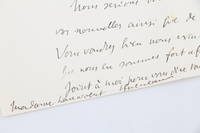
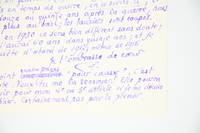
191677523Paris 1916. Fine. Paris Lundi 11 septembre 1916 13 x 20.50 cm 3 pages sur 2 feuillets Autograph letter signed with initial by Pierre Louÿs addressed to Georges Louis. Two pages written in purple ink on two sheets. Central folds inherent to posting. Fine letter addressed to his brother Georges Louis with whom Pierre Louÿs maintained a very intimate relationship and whom he considered as his own father. The question of Pierre Louÿs' real paternal identity still fascinates biographers today: ""His father Pierre Philippe Louis . had married in 1842 Jeanne Constance Blanchin who died ten years later after giving him two children Lucie and Georges. In 1855 he remarried Claire Céline Maldan and from this union was born in 1857 a son Paul; then in 1870 our writer who received the Christian names Pierre Félix. This late birth the differences in character between father and son the former's disaffection towards the latter the profound intimacy that always reigned between Louÿs and his brother Georges all this has led certain biographers and critics to suspect that the latter was in reality the writer's father. The exceptionally intimate and constant relationship that Pierre and Georges maintained between themselves throughout their lives could be an argument in this direction. Of course no irrefutable proof has been discovered and probably never will be. Nevertheless certain letters . are quite troubling. In 1895 for example Louÿs writes gravely to his brother that he knows the answer to 'the most poignant question' he could ask him a question he has had 'on his lips for ten years'. The following year at the height of Aphrodite's triumph he thanks Georges effusively and ends his letter with this sentence: 'Not one of my friends has a FATHER who is to him what you are to me.' Arguing from the close intimacy between Georges and Claire Céline during the year 1870 and from the jealousy that the father never ceased to show towards his younger son Claude Farrère did not hesitate to conclude in favor of Georges Louis. And what should we think of this dedication by Louÿs to his brother on a Japan paper copy of the first edition of Pausole: To Georges his eldest son / Pierre."" Jean-Paul Goujon Pierre Louÿs In this interesting letter Louÿs discusses at length the difficulty writers face in living by their pen. Titling his missive ""Continuation of our conversation about war and literature"" he first makes a very pessimistic observation: ""In the 16th century It was even worse! In the 16th the independent man of letters did not exist at all - to write one needed an office a benefice - or land and income rare fortune among writers. . It is only in the 19th century that we find a very small number of conscientious writers living by their pen. And even then. Do you want to count them Hugo almost alone succeeds. Lamartine fails and is obliged to beg pitifully at the end of his life. Gautier who had magnificent gifts only subsists by writing in newspapers . you see what I mean: Theatre and Journal."" He continues: ""That works well in peacetime. - In 1890 l'Echo de Paris inserted prose poems in the first column. - In ""date illegible because crossed out ""le Figaro had a literary supplement. . But in wartime in this century and ten twelve or fifteen years after the war we shall go to the woods no more; the laurels are cut down. Oh! In 1930 it will doubtless be very different; but I shall be 60 in fifteen years; and I worry first about 1917; even about 1916."" This very pessimistic letter was written at a period when Louÿs was at his worst ""The man who wrote these pages was a solitary man reclusive sick drugged surrounded by dubious creatures and having as confidant only this adored brother who would die less than a year later."" Ibid. unknown
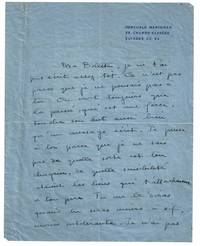
193674160Paris 1936. Fine. Paris s. d. 12 mars 1936 17.80 x 22.60 cm 2 pages sur un feuillet Fine autograph letter signed by Colette addressed to her friend Bolette Natanson. Two pages written in ink on blue headed paper from the Marignan building the writer's residence between 1936 and 1938. Transverse folds inherent to the folding of the letter for mailing. Moving letter addressed by Colette to her close friend following the death of her father Alexandre Natanson: "". ce dimanche va être un dimanche bien pénible. Je t'écris à l'heure juste où tu conduis ton père."" ""this Sunday is going to be a very painful Sunday. I am writing to you at the very moment when you are laying your father to rest."" Conscious of the suffering and ""chagrin"" ""grief"" of her ""chère Bolette"" ""dear Bolette"" she affectionately offers her support ""On croit toujours que la pensée qui est une force touche son but aussi bien qu'un message écrit."" ""We always believe that thought which is a force reaches its target as well as a written message."" ending her letter with a very beautiful declaration: ""Beaucoup de visages humains se penchent vers le tien et tu ne les aimes pas tous. Le mien que tu ne verras pas te suit de loin et s'inquiète de toi."" ""Many human faces lean toward yours and you do not love them all. Mine which you will not see follows you from afar and worries about you."" Bolette would commit suicide a few months later. Having evolved since her earliest childhood in artistic circles - she was the daughter of Alexandre and the niece of Thadée Natanson the creators of the famous Revue Blanche - Bolette Natanson 1892-1936 became friends with Jean Cocteau Raymond Radiguet Georges Auric Jean Hugo and also Colette. Passionate about couture she left Paris for the United States with Misia Sert a great friend of Coco Chanel and was hired at Goodman. With her husband Jean-Charles Moreux they created in 1929 the gallery Les Cadres on boulevard Saint-Honoré and frequented numerous artists and intellectuals. Their success was immediate and they multiplied their projects: the creation of the fireplace for Winnaretta de Polignac the decoration of the château de Maulny the arrangement of Baron de Rothschild's private mansion the creation of frames for industrialist Bernard Reichenbach and finally the creation of the storefront for Colette's beauty institute in 1932. Bolette Natanson also framed the works of her prestigious painter friends: Bonnard Braque Picasso Vuillard Man Ray André Dunoyer de Segonzac etc. Despite this meteoric rise she would end her life in December 1936 a few months after her father's death. unknown
193674160Paris s. d. [12 mars 1936] | 17.80 x 22.60 cm | 2 pages sur un feuillet
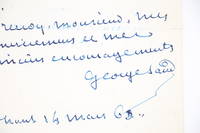
186376837Nohant Nohant-Vic 1863. Fine. Nohant Nohant-Vic 14 mars 1863 13.40 x 20.60 cm 3 pages sur un double feuillet Autograph letter signed by George Sand addressed to René Biémont. Three pages written in blue ink on a double sheet bearing at the head of the first page the blind stamp of Sand's initials. Envelope included. Folds inherent to mailing. This letter was published in the complete correspondence of George Sand established by Georges Lubin. Fine letter of congratulations addressed to René Biémont after sending his work Le Petit Fils d'Obermann: ""Your little book is very original and you show qualities of talent that will develop if you look ahead."" As an attentive reader much solicited by her young peers Sand develops her literary criticism: ""Obermann and his grandson the monk belong to the past. They are true and the timid Jean is well drawn. There is grandeur and truth in this exceptional type. But Constant d'Heurs is too passive to events. He should react against this powerless man and cure him or pity him more ."" Sententiously she thus concludes her letter: ""Do not complain of thankless work and accept it as a good thing three-quarters of life sacrificed to some duty makes the last quarter very strong and very alive. It is very good to be attached to poetry and thwarted in the possession of a beautiful dream. As soon as one can savor it without respite it fades or becomes troubled. I speak to you from experience. One is never happier and more inspired than when one believes one does not have time to be so."" Very fine testimony to the leading role that George Sand played on the literary scene of the Second Empire. unknown
186376837Nohant 14 mars 1863 | 13.40 x 20.60 cm | 3 pages sur un double feuillet
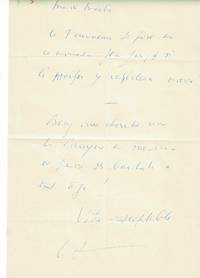
195076185s. l. Klarskovgaard 1950. Fine. s. l. Klarskovgaard 28 octobre 1950 21 x 34 cm 1 pages sur un feuillet Partly unpublished autograph letter signed by ""your touchy LF"" Louis-Ferdinand Céline addressed to his lawyer Maître Thorvald Mikkelsen. One page written in blue ink on a large sheet of white paper; number ""563"" in Céline's hand in the upper left corner in red pencil. Transverse folds inherent to the mailing. This letter was very partially transcribed in the Année Céline 2005. Céline after days of suffering from the cold is delighted to announce to his friend that he has received heating: ""Le fourneau se pose en ce moment. Je ne sais pas si la maison y résistera l'on verra !"" ""The stove is being installed right now. I don't know if the house will withstand it we shall see!"" This letter also mentions his Swedish friend Ernst Bendz like him a doctor and writer: ""Benz sic vous cherche un La Bruyère en suédois - on passe des bachots à tout âge !"" ""Bendz is looking for a La Bruyère in Swedish for you - one takes exams at any age!"" In 1947 Céline pursued by French justice for his collaborationist involvement was confined in Denmark. It was in May 1948 accompanied by Lucette and Bébert that he arrived at his lawyer Maître Thorvald Mikkelsen's home in Klarskovgaard. The latter owned a large property by the Baltic Sea and invited the exile to stay there. On February 21 1950 as part of the purge the writer was definitively condemned in absentia by the civic chamber of the Paris Court of Justice for collaboration to one year of imprisonment which he had already served in Denmark. The Swedish Consul General in Paris Raoul Nordling intervened on his behalf with Gustav Rasmussen the Danish Foreign Minister and managed to delay his extradition. On April 20 1951 Jean-Louis Tixier-Vignancour his lawyer since 1948 obtained Céline's amnesty as a ""severely disabled veteran of the Great War"" by presenting his file under the name of Louis-Ferdinand Destouches without any magistrate making the connection. Céline would leave Denmark the following summer after three years spent at his lawyer's home. unknown