66 616 résultats
195076185s. l. [Klarskovgaard] 28 octobre 1950 | 21 x 34 cm | 1 pages sur un feuillet
191280804Alger Algiers 1912. Fine. Alger Algiers 14 mars 1912 11.30 x 15.20 cm 4 pages sur un feuillet double Autograph letter signed by Judith Gautier addressed to Céleste Chrétien her maid; four pages written in black ink on a double sheet. This letter mentions the visit of Francis a carpenter by profession and Céleste Chrétien's husband to Paris: ""Does Francis still want to come and spend a few days in Paris Can he do so without harming his work They are going to perform Tristane with marionettes. I would like to have him to help me and I think it would amuse him. I would send him a first-class railway pass he would sleep and eat at my place so as not to incur any expenses. The performance takes place Saturday the 23rd at 4 o'clock; and there will be a dress rehearsal the day before or two days before."" It was in 1910 that Judith Gautier published in La Revue de Paris a triptych in verse entitled Tristane which she had performed in her Little marionette theatre inaugurated in May 1897 at 4 rue Charras in Paris. This theatre which contained about a hundred seats was quickly allocated a subsidy by the Ministry of Fine Arts. unknown
191280804Alger 14 mars (1912?) | 11.30 x 15.20 cm | 4 pages sur un feuillet double
55015o.J. Landshut, 1. VI. 1833 bis 9. III. 1839, Fol. 24 beschriftete Bl. und ca. 150 weiße Bl. Roter Pp. d. Zt. mit Titelschild (etw. fleckig und bestoßen) und Sprengschnitt.
Titel und 4 Strophen zu je vier Zeilen auf 1 S. 8vo. Mit einer Beilage (s. u.). Leicht abgewandelte Zeilen aus seinem "Osterlied" (1835): "Wenn die rothen Ostern kamen, / Und der Heiland auferstand, / Weckt er auch aus ihrem Schlummer / Unsre Welt mit sanfter Hand. / Weckt sie, grüßet u. liebkost sie. / Bis ihr Mund u. Wangen roth, / Und ins Ohr flößt er die Worte: / Vor mir fleuchen Nacht u. Tod! […]". - Beiliegend ein eigenh. Brief mit U. seiner Witwe Therese, datiert Ried im Innkreis, 9. XI. 1881, an den Grazer Autographensammler Alexander Hesse: "Wenn beiliegendes Blättchen Ihrem Wunsche entspricht, so gereicht es mir zur herzlichen Freude, wie immer wenn ich meines Mannes theures Andenken bei Freunden u. Verehrern gewahrt u. erhalten finde [...]". Stelzhamers Zeilen auf Briefpapier mit gepr. Monogrammvignette und Hesses Sammelvermerk verso.
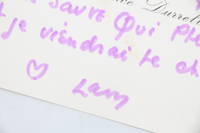
198086623Rhodes 1980. Fine. Rhodes s. d. ca 1980 13 x 8 cm une carte postale une enveloppe Suggestive autograph carte de visite signed by Lawrence Durrell addressed to Jani Brun written in brown and mauve felt-tip pens with accompanying envelope. ""dear Buttons. Oui telephonez moi quand tu es à Sauve-qui-pleut et je viendrai te chercher un coeur dessiné. Larry."" After many years spent in Greece Egypt and Rhodes the travel writer Lawrence Durrell was forced to flee Cyprus following popular uprisings that led the island to its independence from the British crown. Rich only in a shirt and a typewriter but crowned with the success of his novel Bitter Lemons of Cyprus Les citrons acides he arrived in France in 1956 and settled in the Languedoc village of Sommières. In the ""Tartès house"" his large dwelling surrounded by trees he wrote the second part of his work his monumental Avignon Quintet devoted himself to painting and received his illustrious friends including the couple Henry Miller and Anaïs Nin violinist Yehudi Menuhin London publisher Alan G. Thomas and his two daughters Penelope and Sappho. Among the olive trees and under the Mediterranean sun he met in the mid-1960s the young and vivacious ""Jany"" Janine Brun a thirty-year-old woman from Montpellier of devastating beauty who worked at the Antiquities department of the Sorbonne in Paris. She was nicknamed ""Buttons"" in memory of their first meeting where the young woman wore a dress covered with buttons. Henry Miller also fell under the charm of ""Buttons"" praising her beauty and eternal youth in exceptional unpublished letters. The three companions spent memorable Parisian evenings of which we retain precious autograph traces through their epistolary exchanges. Recommended by Durrell she made numerous trips notably to England from where she received vast correspondence from the writer as well as original works of art signed with his artist pseudonym Oscar Epfs. unknown
198086623Rhodes s. d. [ca 1980] | 13 x 8 cm | une carte postale + une enveloppe
Folio (270 x 345 mm). Title and 24½ pp. (paginated 1-25), final blank leaf. Written in brown ink on 32-stave paper, with 2 systems of 15 staves per page (except for the last page, which only has one system). 431 bars. Bound in contemporary red half morocco with gilt red morocco title label to the upper cover. Marbled endpapers (somewhat chipped). Exceptionally rare, unpublished musical manuscript: Bizet's autograph orchestration of the overture to Hippolyte Rodrigues's opera "David Rizzio", about the historical courtier who was the private secretary and rumoured lover of Mary, Queen of Scots. In 1566 he was assassinated by her husband, the jealous Lord Darnley, and a conspiracy of Protestant nobles. - A wealthy stockbroker and lawyer, Rodrigues (1812-98) was also a writer and composer. He retired early to devote himself to literature and music, notably composing melodies and piano pieces, but also more ambitious works such as this opera. Rodrigues was secretary of the "Société scientifique-littéraire israélite"; his sister Léonie was married to Fromental Halévy, Bizet's former teacher. Thus, Hippolyte Rodrigues was Geneviève Halévy's uncle and served as witness to her marriage to Bizet on 3 June 1869; he would lend the young couple his house in Saint-Gratien for their honeymoon. - In 1866 Hippolyte Rodrigues first published the textbook for "David Rizzio"; the piano and vocal score of the opera in four acts (first designated as a lyrical drama "en 3 actes, 4 tableaux", "paroles et musique de Hippolyte Rodrigues", would appear in 1873, privately printed by Eugène Heutte in Saint-Germain. Bizet listed this score in the catalogue of his music library. "Whether Bizet orchestrated any more of the opera than the overture is not known [...] The opera was not performed, except possibly as a play, and the music has not otherwise survived" (MacDonald). - The title-page of the manuscript first states, cryptically: "Ouverture / Jean-Jacques", followed by the correct title in Bizet's hand: "Overture de / David Rizzio / composée par / Hippolyte Rodrigues / orchestrée par / George Bizet". The orchestra includes 2 flutes, 2 oboes, 2 clarinets in A, 2 bassoons, 2 horns in D, 2 horns in C, 2 pistons in A, 3 trombones, timpani, bass drum and cymbals, violins I and II, violas, cellos, basses. The Overture begins with an Allegretto moderato in B minor in 2/4 time (25 bars); then, after a rallentendo and a brief Andante (10 bars, the last two, skipped, are noted on p. 4), comes an Allegretto (16 bars), followed by a reprise of the Andante; an Allegro 2/2 (36 measures); an Andantino in D minor in 2/4 (72 bars), then a brief passage "Un peu animé" (14 bars), leading to an Allegretto in E major (79 bars), then briefly in C (11 bars); the work ends with an Allegro in C minor in 2/2 time (110 bars), then in D, changing after 4 bars into 2/4 time until the end (46 bars). - Binding rubbed and bumped; stitching loosened. Of great rarity. Provenance: Hotel Drouot, Paris, sale at an unknown date. Delorme & Collin du Bocage, 14 Nov. 2008, lot 10. MacDonald, Bizet Catalogue, T56.
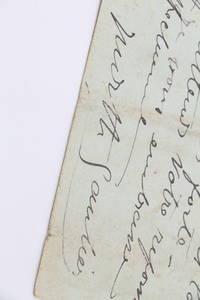
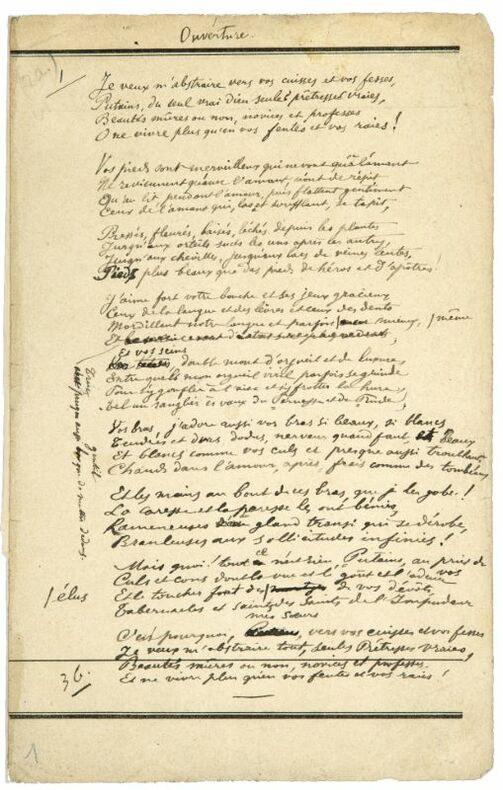
1890888011890 1 page in-8 à l'encre brune (22 x 13.9 cm) sur papier d'hôpital, sous chemise demi-maroquin noir. Trace d'un ancien montage sur onglet. Beau poème libre paru dans le recueil Femmes, imprimé "sous le manteau" en 1890 à Bruxelles chez Kistemaeckers [Dutel, Bibliographie des ouvrages érotiques publiés clandestinement en français entre 1880 et 1920, p.138]. Verlaine rend gloire à la chair féminine et d'abord à ses représentantes, les prostituées (on relèvera la subtilité de cette mise en bouche décrite uniquement en rimes féminines dans le premier quatrain) : "Je veux m’abstraire vers vos cuisses et vos fesses,Putains, du seul vrai dieu seules prêtresses vraies,Beautés mûres ou non, novices et professesO ne vivre plus qu’en vos fentes et vos raies !"Cette ouverture donne le ton, et Verlaine décline en neuf strophes sa passion pour le corps féminin : pieds, bouches, seins, bras, mains, sexes... Les putains sont "soeurs", "seules prêtresses vraies". Il compose une adoration incarnée et pornographique. Verlaine, amant inassouvi, chante la femme non en spectateur attendri, mais en acteur mu par la hantise charnelle :"Et vos seins, double mont d'orgueil et de luxureEntre quels mon orgueil viril parfois se guindePour s'y gonfler à l'aise et s'y frotter la hure :Tel un sanglier ès vaux du Parnasse et du Pinde."Si l'oeuvre de Verlaine est empreinte de volupté, ses derniers productions érotico-pornographiques ont une force brute, nourries d'une spontanéité et d'une urgence flamboyante libérées de tout impératif d'élégance ou moral... une poésie, par la même, profondément humaine. Le manuscrit comporte quelques ratures et une variante : "Prêtresses" au lieu de "compagnes" (vers 34).
57304o.J. München, 1829, 26 x 16,5 cm. Unter Glas gerahmt, Goldleiste.
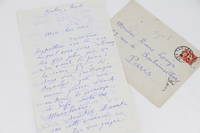
190886173Toulon 1908. Fine. Toulon 20 Juillet 1908 13.50 x 21.50 cm deux pages et demie sur un double feuillet une enveloppe Autograph letter signed by Claude Farrère then serving in the military 47 lines in blue ink written from Toulon to his friend Pierre Louÿs. Fold marks inherent to mailing envelope included. The soldier Claude Farrère thanks his friend for defending him during a dispute opposing him to a certain Monsieur B even though it was hardly worth devoting so much importance to him: ""Monsieur B read in some Annales that his fierce enemy was busy waging war in Safi against the Muslims. By incredible misfortune it happened that I had returned from there. His stupor was then so great that he lost his head."" ""Now I will never tell you to what extent I was moved by your role and by V.'s role in the whole affair."" Confident in his qualities as a fencer and marksman Claude Farrère allows himself this gentle and humorous jibe at his friend and seeks to reassure him at the risk of falling into anachronism: ""Lose the disastrous habit of seeing me killed each time someone speaks of swords around. On the contrary it is I who will kill the others. I do a great deal of fencing now. And I shoot the pistol like the late William Tell. Therefore be quiet. There. When shall we meet"" unknown
190886173Toulon 20 Juillet 1908 | 13.50 x 21.50 cm | deux pages et demie sur un double feuillet + une enveloppe
1928102911928 La Charité-sur-Loire, R. Thoreau, 1928; in-8°, broché, couverture beige illustré et imprimée en noir au 1er plat, titre en noir au dos; (5)ff., 200pp., (5)ff. Couverture illustrée et bois gravés dans le texte d'André Deslignères. La couverture porte “Suite au Rimoir“. Edition originale tirée au total à 500 exemplaires numérotés, celui-ci 1 des 100 premiers sur pur fil Lafuma (n°77). Très petite tache rousse au 1er plat, exemplaire très frais.
4 SS. auf Doppelblatt. 8vo. Eine Romanze in 12 Strophen zu je 8 Zeilen: "Zu Augsburg hinein in glänzender Pracht | Zu des Reichstag's kräftigem Walten, | Zog des ersten Ferdinand's Kaisermacht | Mit der Fürsten hohen Gewalten. | Zur Seiten ritt ihm sein ältester Sohn | Fürst Erbe vom mächtigen Kaiserthron | Jung, ritterlich, lockigen Haares | Schön, wie Apollo und Ares [...]". - Heinrich Beitzke nahm 1845 als Major seinen Abschied und lebte fortan als freier Schriftsteller in Köslin. "1858-62 für den Wahlkreis Anklam, danach für Hamm-Soest Mitglied des preußischen Abgeordnetenhauses, nahm Beitzke auf seiten der Fortschrittspartei u. a. regen Anteil an der Reorganisation des Heeres. Er verfaßte u. a. die Geschichte der deutschen Freiheitskriege in den Jahren 1813 und 1814" (DBE). - Papierbedingt etwas gebräunt und mit kleinen, in die Unterschrift hineinreichenden Randläsuren.
Manuscrito integrado por dos cuartillas escritas por ambas caras, rubricada cada una con la firma autógrafa del poeta.
12mo. 204 pp. Contemporary cloth. A range of 109 numbered poems, written in Marburg between April and July 1863 (nrs. 1 to 75) and in Vienna from August 1863 to February 1864. - Tauschinsky, a "pioneer of the labor movement" (aeiou.iicm.tugraz.at), was active in the labor movement since 1868; in 1874 he was the founder and first Chairman of the Social Democratic Party at Neudörfl.
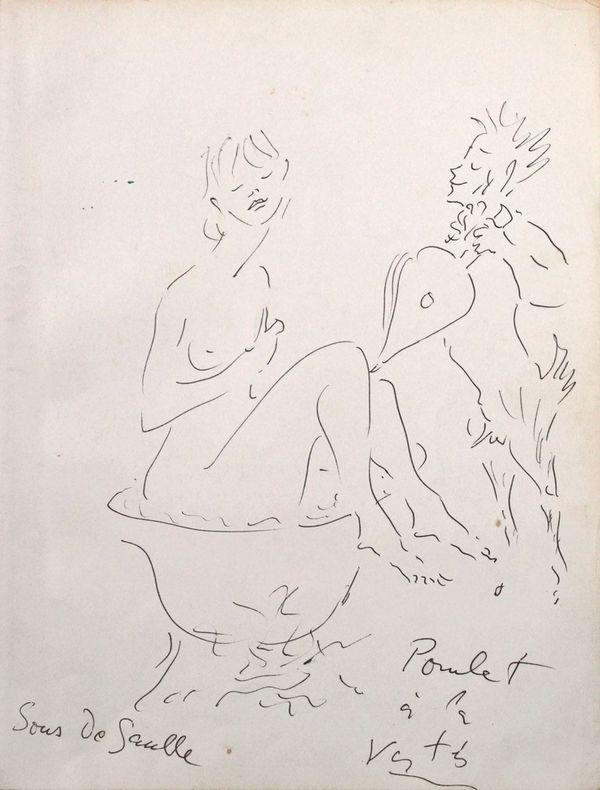
19613026Puteaux 1961 aucune reliure [1961]. 32,5 x 25 cm. Dessin original signé à l'encre. Diverses signatures au verso.
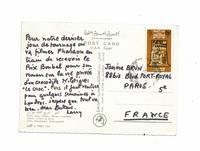
197173360Egypte Egypt 1971. Fine. Egypte Egypt 1971 10.50 x 15 cm une carte postale Autograph postcard signed ""Larry"" by Lawrence Durrell addressed to Jani Brun written in black felt-tip pen on the verso of a photograph of an Egyptian bas-relief. The writer to his young Montpellier lover: ""For our last day of filming we're going to film Pharaoh receiving the Bonbel Prize for his novel about the private life of a Nile crocodile: 'Le croc'. Then I have to return to London for a few weeks. I hope all is well dear Buttons."". After many years spent in Greece Egypt and Rhodes the traveling writer Lawrence Durrell was forced to flee Cyprus following popular uprisings that led the island to its independence from the British crown. Rich only with a shirt and a typewriter but crowned with the success of his novel Bitter Lemons of Cyprus Les citrons acides he arrived in France in 1956 and settled in the Languedoc village of Sommières. In the ""Tartès house"" his large residence surrounded by trees he wrote the second part of his work his monumental Avignon Quintet devoted himself to painting and received his illustrious friends including the couple Henry Miller and Anaïs Nin violinist Yehudi Menuhin London publisher Alan G. Thomas and his two daughters Penelope and Sappho. Among the olive trees and under the Mediterranean sun he met in the mid-1960s the young and sparkling ""Jany"" Janine Brun a thirty-something woman from Montpellier of devastating beauty who worked at the Department of Antiquities at the Sorbonne in Paris. She was nicknamed ""Buttons"" in memory of their first meeting where the young woman wore a dress covered with buttons. Henry Miller also fell under the charm of ""Buttons"" praising her beauty and eternal youth in exceptional unpublished letters. The three companions spent memorable Parisian evenings of which we retain precious autograph traces through their epistolary exchanges. Recommended by Durrell she made numerous trips notably to England from where she received vast correspondence from the writer as well as original works of art signed with his artist pseudonym Oscar Epfs. unknown
197173360Egypte [1971] | 10.50 x 15 cm | une carte postale
198586224Sion-sur-l'Océan Sion-sur-l'Océan 1985. Fine. Sion-sur-l'Océan Sion-sur-l'Océan 13 Août ca 1985 15 x 10 cm une carte postale Autograph postcard signed by Julien Gracq 19 lines in black ink addressed to his friend and monographer Ariel Denis written from his Vendée retreat on the verso of a photographic reproduction showing the Sion-sur-Océan coast from aerial view. Julien Gracq discusses his reading of Joyce and compares the Irish landscapes and climate to those of Vendée : ""Ici aucune trace des brumes d'Irlande il fait inaltérablement beau sans même un orage."" Here no trace of Irish mists the weather is unalterably beautiful without even a storm. and inquires about his friend's professional future : ""Comment s'arrangent vos perspectives universitaires pour l'année à venir Problème qui je sais assombrit toujours un peu vos fins de vacances et dont j'espère qu'il va se régler à votre satisfaction."" How are your university prospects working out for the coming year A problem which I know always casts a slight shadow over your vacation endings and which I hope will be resolved to your satisfaction. unknown
198586224Sion-sur-l'Océan 13 Août [ca 1985] | 15 x 10 cm | une carte postale
Deutsche Handschrift auf Papier. Titel und 22½ SS. auf 14 Bll. Gr.-8vo. Fadengeheftet. Johann Wächter studierte Philosophie, Theologie und Philologie in Eperies (Preschau), Kesmark und Ödenburg, war Hauslehrer in seiner Heimat Zeben (Ungarn) und wurde 1794 Vikar und Katechet der evangelischen Gemeinde zu Wien. Später Superintendent von Nieder - und Innerösterreich, war Wächter zudem auch Direktor der evangelisch-theologischen Lehranstalt. Er verfasste u. a. ein Gesangbuch (1820) und ein Gebetbuch (1816) sowie "Über den Einfluß, welche große Weltbegebenheiten auf die Angelegenheiten einzelner Menschen äußern" (1812). Nach seinem Tod erschienen, von seinen Freunden herausgegeben, 2 Bände "Predigten auf alle Sonntage des Kirchenjahres". - Papierbedingt etwas gebräunt und mit kleineren Randläsuren.
Deutsche Handschrift auf Papier. Titel und 17½ SS. auf 12 Bll. Gr.-8vo. Fadengeheftet. Johann Wächter studierte Philosophie, Theologie und Philologie in Eperies (Preschau), Kesmark und Ödenburg, war Hauslehrer in seiner Heimat Zeben (Ungarn) und wurde 1794 Vikar und Katechet der evangelischen Gemeinde zu Wien. Später Superintendent von Nieder - und Innerösterreich, war Wächter zudem auch Direktor der evangelisch-theologischen Lehranstalt. Er verfasste u. a. ein Gesangbuch (1820) und ein Gebetbuch (1816) sowie "Über den Einfluß, welche große Weltbegebenheiten auf die Angelegenheiten einzelner Menschen äußern" (1812). Nach seinem Tod erschienen, von seinen Freunden herausgegeben, 2 Bände "Predigten auf alle Sonntage des Kirchenjahres". - Papierbedingt etwas gebräunt und mit kleineren Randläsuren.
37379o.J. Wolbeck bei Münster, ca. 1850, Gr.-8°. 1 Seite. Bläuliches Papier.