66 618 résultats
Deutsche Handschrift auf Papier. Titel und 17½ SS. auf 12 Bll. Gr.-8vo. Fadengeheftet. Johann Wächter studierte Philosophie, Theologie und Philologie in Eperies (Preschau), Kesmark und Ödenburg, war Hauslehrer in seiner Heimat Zeben (Ungarn) und wurde 1794 Vikar und Katechet der evangelischen Gemeinde zu Wien. Später Superintendent von Nieder - und Innerösterreich, war Wächter zudem auch Direktor der evangelisch-theologischen Lehranstalt. Er verfasste u. a. ein Gesangbuch (1820) und ein Gebetbuch (1816) sowie "Über den Einfluß, welche große Weltbegebenheiten auf die Angelegenheiten einzelner Menschen äußern" (1812). Nach seinem Tod erschienen, von seinen Freunden herausgegeben, 2 Bände "Predigten auf alle Sonntage des Kirchenjahres". - Papierbedingt etwas gebräunt und mit kleineren Randläsuren.
37379o.J. Wolbeck bei Münster, ca. 1850, Gr.-8°. 1 Seite. Bläuliches Papier.
1 p. (22 lignes). In-4. Peut être un brouillon pour sa "Citadelle" composée en partie aux Etats-Unis en 1941/1943, peu avant son retour en Europe et son dernier survol de la Méditerranée. Non corrigé. - "Oh, mon Dieu, moi je veux vous aider et reparer les mœurs du jour et redresser l'autel. Et retablir le sens du livre. On vous permettra, vous les hommes, sur une page blanche de l'ecrir. L'amour? Je ne crois plus à cet amour immediat. L'amour n'est point de s'attendrir sur cette [...] qui [...] mais sur ce dont elle est depositaire et qui seul rayonne. Il ne s'agit pas de ranger ceux qui ont dispersé leurs aromates mais de refaire ces vase sacrés capable de capter la conscience et de construire un livre avec les mots. Nous avons besoin que tous collaborent. La [...] n'est point l'œuvre repandue par quelque vers, alimentant les justes - mais la [...] de vreation - et ici je resoud cette contradiction interne qui nous fait sentir sans enthousiasme pour Descartes - La [...] pour nous - tantot pour les sauvages des iles qui dansent leurs danses et chantent leurs chants loin de nos [...] [...] ouvriers. Et nous balancons entre ces deux pôles sans idée claire pour saisir la réalité qui disperse nos aspirations. La même chose cependant. Createur - Je t'ai donc surpris là dans ton obscur travail fourmillier qui ruche qui fabrique ton miel sans le savoir. Et cette [...] qui souffre ne na sais pas pourquoi elle souffre sinon qu'elle souffre. C'est l'humble image d'une mauvaise aventure, d'une famille dispersée et d'un enfant malade - quand il s'agit de quelque chose [...] comee une crise religieuse et d'une ascension retardée. Je ne peux souffrir ces notions prises non à la base. Les polemiques. Un roi c'est un sang royal jusqu'au dernier".
3½ SS. auf 7 Bll. 4to. Halbleinen der Zt. mit goldgepr. Deckeltitel. 4to. Wie einem einmontierten Theaterzettel und einer kleinen Pressenotiz zu entnehmen ist, wurde Shaws bekanntes Schauspiel im März 1951 "neu einstudiert und in Szene gesetzt" am Burgtheater aufgeführt, wobei Skoda die Rolle des Königs Ra im Prolog verkörperte. Skodas mit roter Tinte bzw. Bleistift vorgenommene Anmerkungen beziehen sich neben Streichungen einzelner Textpassagen vornehmlich auf Vorgaben der Regie, wo er zu stehen, wie er sich zu bewegen, wohin er zu schauen habe. Optische Unterstützung findet der Text von Skodas Prolog durch eine einmontierte Photographie des Schauspielers im Rollenkostüm des Königs (Brustbild im ¾-Profil). - Albin Skoda war von 1946 bis 1961 “einer der wichtigsten Protagonisten des Burgtheaters” (Öst. Lex. II, 404), spielte in unzähligen klassischen und modernen Stücken der Weltliteratur und wurde weithin als außergewöhnlicher Sprecher bekannt. Seine Gattin Margarethe stiftete 1971 den Albert-Skoda-Ring für den besten Sprecher des deutschen Sprachraums, der 1973 an Will Quadflieg, 1977 an Paul Hoffmann, 1983 an Ernst Meister, 1988 an Franz Morak und 2001 an Peter Matic verliehen wurde. Eine von Skodas bekanntesten Filmrollen war die des Adolf Hitler in G. W. Pabsts ‘Letztem Akt’ (1955). - Deckel mit montiertem Bibliotheksvermerk des Burgtheaters.
1911761441911. Fine. 29 juin 1911 13.50 x 21 cm 2 pages sur un feuillet double Signed autograph manuscript by Alain bearing the title ""Propos d'un Normand"" and the mention ""sans retard"" in the upper left of the first leaf two pages written in black ink on a double sheet. This text was published in the Propos d'un Normand de 1911. Interesting manuscript written following the appointment of Adolphe Messimy to the post of Minister of War: ""Ce général ministre avait en somme très noblement répondu. Il faudra enfin décider un jour ou l'autre sans aucun mystère que la Défense Nationale est républicaine."" ""This general minister had in sum responded very nobly. We must finally decide one day or another without any mystery that National Defense is republican."" Indeed the newly elected minister sought to redefine relations between political power and military authorities. Alain reproaches the military world for its opacity ""Comment la France sera-t-elle défendue Nous n'en savons rien. . chez nous même les députés ne s'en font aucune idée."" ""How will France be defended We know nothing about it. . even our deputies have no idea."" before proposing solutions: ""Donc il faudrait qu'il soit bien entendu que chaque chef garde une large initiative dans l'exécution d'un programme déterminé. Et ce programme ne dépend pas seulement de la science militaire ; c'est aux ministres avec le conseil des grands chefs qu'il appartient de le déterminer."" ""Therefore it should be well understood that each leader retains broad initiative in executing a determined program. And this program does not depend solely on military science; it is up to ministers with the counsel of senior leaders to determine it."" From 1903 Alain published weekly chronicles titled ""Propos"" in La Dépêche de Rouen et de Normandie. More than 3000 of these ""Propos"" concise articles inspired by daily current events would appear from February 1906 to September 1914. unknown
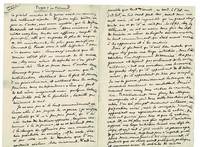
- 29 juin 1911, 13,5x21cm, 2 pages sur un feuillet double. - Manuscrit autographe signé d'Alain portant le titre "Propos d'un Normand" et la mention "sans retard" en haut à gauche du premier feuillet, deux pages rédigées à l'encre noire sur un feuillet double. Ce texte a été publié dans les Propos d'un Normand de 1911. Intéressant manuscrit rédigé au lendemain de la nomination d'Adolphe Messimy au poste de Ministre de la Guerre : "Ce général ministre avait, en somme, très noblement répondu. Il faudra enfin décider, un jour ou l'autre, sans aucun mystère, que la Défense Nationale est républicaine." En effet, le ministre fraîchement élu chercha à redéfinir les relations entre le pouvoir politique et les autorités militaires. Alain reproche au monde militaire son opacité ("Comment la France sera-t-elle défendue ? Nous n'en savons rien. [...] chez nous même les députés ne s'en font aucune idée.") avant de proposer des solutions : "Donc il faudrait qu'il soit bien entendu que chaque chef garde une large initiative, dans l'exécution d'un programme déterminé. Et ce programme ne dépend pas seulement de la science militaire ; c'est aux ministres, avec le conseil des grands chefs, qu'il appartient de le déterminer..." À partir de 1903, Alain publie dans La Dépêche de Rouen et de Normandie des chroniques hebdomadaires intitulées "Propos". Plus de 3 000 de ces "Propos", articles concis inspirés par l'actualité quotidienne, paraîtront de février 1906 à septembre 1914. [ENGLISH DESCRIPTION ON DEMAND]
2 pp. on bifolium. With red wax seal. Folio. Statement made by the two shipwrecked Aberdeen mariners John Harvey and Daniel Lamond before George Boyd, the Notary Public of Sunderland, detailing how they lost their vessel and cargo off Sunderland Pier in a storm: "[...] these Appearants set sail with the said ship [the 'Peggy'] from Alemouth in Scotland [i.e., Alnmouth, Northumberland] on the 27th Day of September instant about one o'Clock P.M. staunch and in good Condition, and well manned, with a Cargo of Wheat on board, and proceeded with the said Ship to Newbiggen in the County of Northumberland, when about 4 o'Clock P.M. the Sea raged very high, and the said Ship sprung a Leak [...] the water still increasing upon them, they could with the greatest Difficulty keep the said Ship above water; - when the said Ship arrived off Tynemouth Castle, these Appearants let go the Anchor of the said Ship, but the Sea, still continuing to rage with great violence, they were under the Necessity of cutting the Cable [...] these Appearants endeavored to run the said Ship for Sunderland Harbour, (they not being able to get the said Ship into Shields Harbour) but when they arrived off there (viz. about 5 o'clock A.M.) there was six feet of Water in the Hould and these Appearants finding it impossible to keep the Ship above Water any longer, were under the Necessity of running her on Shore on the South-side of Sunderland Pier, in order to save their lives [...]". - While little is known of John Harvey, Daniel Lamond later entered the Royal Navy and died in the Battle of Copenhagen on 2 April 1801, one of the nine officers and 103 men of Captain James Walker's "Isis" killed or wounded when Rear-Admiral Horatio Nelson's fleet defeated the Danish-Norwegian fleet. - Folded and with three drystamps (6d, 6d, 1s) and 8d stamp. Seal cracked. Signed by both mariners and the Notary, counter-signed by his clerks, Thomas Mewburn and James Dove.
193286589S. n. [Mercure de France] | Paris 22 Mai 1932 | 21.50 x 17.50 cm | une feuille
193286589Paris: S. n. Mercure de France 1932. Fine. S. n. Mercure de France Paris 22 Mai 1932 21.50 x 17.50 cm une feuille Manuscript publisher's slip written by Sar Péladan for the publication of his Pérégrine & Pérégrin at Mercure de France. Fold mark inherent to mailing. Manuscript with corrections. ""Prière d'insérer Pérégrine & Pérégrin le nouveau roman de Péladan est la peinture d'un dernier amour de celui où les femmes mettent tout leur coeur. Cette passion d'automne qui a les ardeurs de l'été s'encadre à chaque chapitre dans un décor nouveau quii varie l'impression des amants. La jalousie & les transes la volupté & ses réactions sont étudiées avec la même crossed out word pénétratiion subtile qui caractérise l'autuer du Vice suprême& la modestie & vanité. C'est la société du Mercure de France qui édite le dixseptième roman de la décadence latine this sentence having been crossed out."" S. n. [Mercure de France] unknown
190090020Sans nom d'éditeur | Sans lieu d'édition [circa 1900 ?] | 12.9 x 14.6 cm | trois pages sur un bieuillet
191289384Sans nom d'éditeur | Sans lieu d'édition 16 avril 1912 | 9.9 x 6 cm | Une carte de visite avec enveloppe
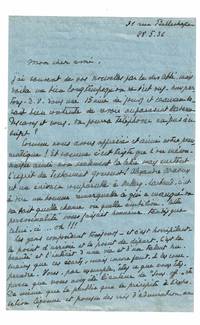
193676136Paris 28 mai 1936 | 13.40 x 21 cm | 2 pages sur un feuillet
189876332Paris 25 février 1898 | 11.40 x 8.80 cm | une carte recto-verso et une enveloppe
189376340S. n. | Paris 16 mars 1893 | 10.40 x 6.30 cm | une carte de visite et son enveloppe
4to. 5½ pp. In French. Important text about artistic creation and the avant-garde, published in "Les Lettres françaises" of 17 April 1958 as part of the survey: "What is the avant-garde in 1958?". In Ionesco's view, art must strive to express realities that are "new and ancient, present and inopportune, living and permanent, particular, and, at the same time, universal". A label like "the avant-garde" is a mere afterthought to this goal: "To want to be part of the avant-garde before writing, not to want to be part of it, to refuse or choose an avant-garde is, for a creator, to construe things the wrong way round". For Ionesco the avant-garde is "only the current, historical expression of an inactual actuality (if I may say so), of a trans-historical reality". Therefore he is very sceptical of political art, as the work of art "is nothing if it does not transcend the temporary truths or obsessions of history". Several artists, historical and biblical figures are mentioned as examples of the "profound universalism" Ionesco is arguing for, including Buddha, Shakespeare, the Spanish mystic Juan de la Cruz, Proust, Chekhov, Brecht, and Picasso. In his own work, Ionesco tries "to say how the world appears to me, what it seems to be for me, as sincerely as possible without concern for propaganda, without intention of directing the consciences of contempraries. I try to be an objective witness in my subjectivity". The essence of his theatre is the contradictory, the absurd: "Since I write for the theatre, I am only concerned with personifying, embodying a comic and tragic sense of reality at the same time." Ionesco describes a childhood memory of a senseless act of violence which first invoked the feelings of vertigo, anguish, and transience that he tries to convey in his art: "I have no other images of the world apart from those, expressing the ephemerality and the harshness, the vanity and the anger, the nullity or hideous, useless hatred. This is how existence continued to appear to me". In closing, he aims to reconcile avant-garde and "living tradition", past and present: "One has the impression, also, that the more one is of one's time, the more one is of all times (if one breaks the crust of superficial topicality) [...] The youngest, newest works of art are recognizable and speak to all eras. Yes, King Solomon is my leader; and Job, this contemporary of Beckett". - With a stricken-out title "Avant-garde et tradition", corrections, and typograph marks. The first three pages with a tear minimally affecting the text. Some black fingerstains and stains, minor tears, and browning. Published in: Les Lettres françaises, no. 717, April 1958. Cf. M. Esslin, The theatre of the absurd (London: Eyre & Spottiswoode 1964)
Folio. Title page and 4¾ pp. on 6 ff. Folio. Music paper. Notation for "Mezzo Sopran ou Barytone en ré" and piano, underlined with G. François's text, and dedicated "á Madame A. D." as well as to his lawyer, Della Rogers.
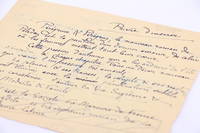
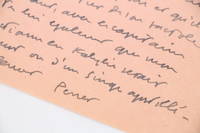
196085174s. l. 1960. Fine. s. l. s. d. ca 1960 21 x 27 cm une page Autograph letter signed by Jacques Perret 22 lines in black ink addressed to a colleague probably Roger Nimier. Fold mark inherent to postal dispatch. Jacques Perret awaits a letter from Roger Nimier that is running late: ""Your note arrived late given that I no longer live on rue de la clé but at 5 rue de l'Ancienne Comédie. Gordon Pym has not yet arrived but that doesn't surprise me coming from him."" and inquires about his correspondent's health: "". I learned that you had heart troubles; before long I will go see if everything has returned to order."" He enthuses about the success his friend Antoine Blondin is enjoying: ""When you see Blondin tell him that my thoughts follow him in his glory and that he should reserve half a setier of his treasure to drink when the day comes. Also tell him that my boy who is operating in Kabylia would be quite pleased with a word or an apostilled sign."" Jacques Perret a royalist writer fierce partisan of French Algeria and virulently anti-Gaullist was stripped of his civil rights and then in 1963 struck from the military medal roll despite protests from some of his fellow writers suspects that his political positions do not favor honorary decorations: ""I find that we were made to sign a manifesto manifestly designed to torpedo my ribbon."" unknown
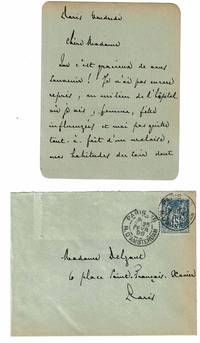
189876332Paris 1898. Fine. Paris 25 février 1898 11.40 x 8.80 cm une carte recto-verso et une enveloppe Autograph signed postcard by Stéphane Mallarmé addressed to Gabrielle Delzant wife of his friend Alidor written on both sides in black ink. Envelope included. Alidor Delzant was a lawyer collector and bibliophile. Friend of the Goncourts he devoted a work to them and was secretary and testamentary legatee of Edmond. ""Que c'est gracieux de vous souvenir ! Je n'ai pas encore repris au milieu de l'hôpital où je vis femme fille influenzées et moi pas quitte tout-à-fait d'un malaise mes habitudes du soir."" ""How gracious of you to remember! I have not yet resumed in the midst of the hospital where I live with wife and daughter suffering from influenza and myself not entirely free of discomfort my evening habits."" unknown
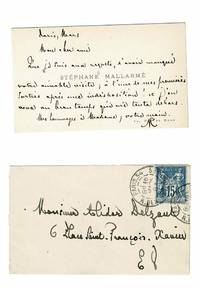
189376340Paris: S. n. 1893. Fine. S. n. Paris 16 mars 1893 10.40 x 6.30 cm une carte de visite et son enveloppe Visiting card with autograph signature by Stéphane Mallarmé addressed to Alidor Delzant. With envelope. Alidor Delzant was a lawyer collector and bibliophile. Friend of the Goncourts he devoted a work to them and was Edmond's secretary and testamentary legatee. ""Que je suis aux regrets d'avoir manqué votre aimable visite ; à l'une de mes premières sorties après une indisposition ! et j'en veux au beau temps qui me tenta dehors."" ""How I regret having missed your kind visit; during one of my first outings after an indisposition! and I blame the fine weather that tempted me outside."" S. n. unknown
193676136Paris 1936. Fine. Paris 28 mai 1936 13.40 x 21 cm 2 pages sur un feuillet Autograph letter signed by Lucien Daudet addressed to Lucien Descaves; two pages written in black ink on a sheet of blue paper. Folds inherent to mailing. Fine letter discussing Alexandre Arnoux talent and the Prix Goncourt: ""Alexandre Arnoux est un écrivain comparable a Vallery sic Larbaud c'est-à-dire un homme remarquable à qui a manqué on ne sait quelle chance ou quelle ambition. . Quelquefois je m'imagine ce que devrait être l'Académie Goncourt dans son véritable esprit Goncourt et son prestige ici et en Europe si les Dix étaient vous mon frère Claudel Gide Max Jacob Cendrars Malraux Neveux etc."" ""Alexandre Arnoux is a writer comparable to Vallery sic Larbaud that is to say a remarkable man who lacked we know not what chance or what ambition. . Sometimes I imagine what the Goncourt Academy should be in its true Goncourt spirit and its prestige here and in Europe if the Ten were you my brother Claudel Gide Max Jacob Cendrars Malraux Neveux etc.""Alphonse Daudet Lucien's father was the first president of the Goncourt Academy in 1897. unknown
196683035s. l. 27 juin 1966 | 21 x 27 cm | une feuille
50606o.J. Stockholm, 1961, Fol. 18 Seiten. Geklammert.
1 S. 8vo. Unvollständig; es fehlt zumindest ein zweites Bl. Das Vergleichsmanuskript der Wiener Stadt- und Landesbibliothek zählt um ein Bl. mehr (im Format A4). - Incipit: "'Oh sieh -!' - 'Zur Seite spring!'", Explicit: "'Gleichviel! Zum Hügel hin und laß uns schauen!'".
4to. German manuscript in brown ink on paper. 7 lines. An early version of Celan's poem "Auf hoher See" that was first published in the 1952 poetry collection "Mohn und Gedächtnis": "Paris, das Schifflein, liegt im Glas vor Anker: | So halt ich mit dir Tafel, trink dir zu. | Ich trink solang, bis dir mein Herz erdunkelt, | Solange, bis Paris auf seiner Träne schwimmt, | Solange, bis es Kurs nimmt auf den Schleier Klarheit, | Der uns die Welt verhüllt, wo jedes Du ein Ast ist, | An dem ich hänge als ein Blatt, nie als ein Mensch". - Apart from the new title, Celan changed the fifth and seventh lines of the poem ahead of its publication. Instead of "Solange, bis es Kurs nimmt auf den Schleier Klarheit", the published version reads "So lange, bis es Kurs nimmt auf den fernen Schleier", and instead of "An dem ich hänge als ein Blatt, nie als ein Mensch", it reads "An dem ich hänge als ein Blatt, das schweigt und schwebt". - Celan presented this manuscript as a gift to Diet Kloos-Barendregt on 7 October 1949. Kloos-Barendregt (1924-2015) was a Dutch singer and resistance fighter whose husband had been executed by the Nazis in 1945. During a brief stay in Paris she met Paul Celan by chance at the Café Dupont in August 1949. They immediately formed a connection over their traumatic experiences and losses and started a romantic relationship. - Traces of folds. Minimally creased and minor browning. With punch holes. Provenance: from the estate of Diet Kloos-Barendregt, Bubb Kuyper auctions, November 2021. P. Celan, Mohn und Gedächtnis (Stuttgart, DVA, 1952). Cf. Paul Celan, Du mußt versuchen, auch den Schweigenden zu hören. Briefe an Diet Kloos-Barendregt. Handschrift - Edition - Kommentar (ed. by P. Sars, Frankfurt a. M., 2002).