66 618 résultats
Folio. 3½ pp. on bifolium. Regarding the relationship between Germany and Austria as well as the Russian situation.
8 SS. auf 4 Bll. Gr.-4to. Vorliegend das zweite und dritte Kaiserliche Patent v. 31. Dezember 1851, womit die Verfassungs-Urkunde vom 4. März 1849 und das Patent vom selben Tage "außer Gesetzeskraft erklärt [werden]", sowie das "Allerhöchste Cabinetschreiben Seiner Majestät des Kaisers" vom 31. Dezember 1851 zur Feststellung der Grundsätze für die organische Gesetzgebung in den Kronländern des österreichischen Kaiserstaates. - Mit kleinen Randläsuren.
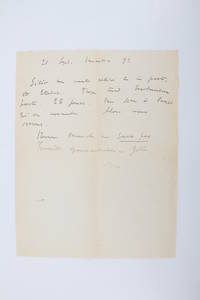
189380761Vaucottes Vattetot-sur-mer 1893. Fine. Vaucottes Vattetot-sur-mer 21 septembre 1893 15.60 x 20.10 cm quelques lignes sur un feuillet Autograph letter signed by Maurice Leblanc to an unknown recipient; a few lines written in black ink on a sheet. Transverse folds inherent to mailing. ""Sitôt ton mot retiré de la poste été Etretat. Trop tard. Natanson parti. 28 jours. Ne sera à Paris qu'en novembre. Alors nous verrons. Revue Blanche ne paie pas. Tempête épouvantable - grêle."" ""As soon as your note was collected from the post office went to Etretat. Too late. Natanson left. 28 days. Won't be in Paris until November. Then we'll see. Revue Blanche doesn't pay. Terrible storm - hail."" unknown
189380761Vaucottes 21 septembre 1893 | 15.60 x 20.10 cm | quelques lignes sur un feuillet
38464o.J. Linz, 26. V. 1975, 8°. 12 Blatt. Orig.-Broschur.
13 SS. auf 13 num. Bll. Folio. "Ich habe in einem einführenden Artikel zu meiner symph. Dichtung 'Fata Morgana' (Berliner Signale No 1) den Symbolismus in der Musik kurz berührt und dabei Richard Strauß erwähnt, und bin natürlich wie das nun einmal bei kurzen Erwähnungen meistens der Fall ist, mißverstanden worden. Man wirft mir vor, ich hätte die symph. Dichtungen von Richard Strauß für Verirrungen erklärt. Da ich es aber für keine Ehre halte, als ein Gegner der Strauß'schen Musik zu gelten, so möchte ich mich gegen diesen Vorwurf verwahren. Wörtlich habe ich am Schlusse meines Artikels folgendes gesagt [...]". - Karl Gleitz studierte am Leipziger Konservatorium und an der Musikhochschule in München bei Josef Gabriel Rheinberger. Später ging er nach Berlin, wo er sich in Privatstunden weiterbildete und auch Erfolge als Komponist feiern konnte. Seit 1902 war Gleitz in Hamburg und Kiel als Musiklehrer tätig. Sein Werk umfaßt Lieder, Klavierstücke und symphonische Dichtungen. - Etwas gebräunt und mit kleinen Randläsuren.
58240o.J. Kopenhagen, Oscar Risom (PN OR 106), ohne Jahr [1879], Fol. 9 S. Rosa Orig.-Umschlag.
2022248822022 Paris, Galerie Laurent Strouk, 2018, in-4, couverture illustrée en couleurs, nom de l'artiste en long sur le dos, 119 pages.
4 SS. auf Doppelblatt. Folio. Gedruckter Formularbogen mit hs. Eintragungen und Übernahmequittierungen von Textbüchern (darunter Goldinis "Mirandolina" oder Schillers "Jungfrau von Orleans") durch folgende Schauspieler und Schauspielerinnen, teilweise mit Doppel- oder Mehrfachzeichnung: Auguste und Eduard Anschütz, Frl. Bandini, Auguste Brede, Carl Fichtner, Julius Hennig, Julius La Roche, Ludwig Löwe, Carl Lucas, Emilie, Betty, Antoine und Karl Josef Mittell, Heinrich Marr, Fanny Matras, Franz Mayerhofer, Joseph Moreau, Adolfine Neumann, Julie und Karl Rettich, Adolf Schwarz, Frl. Schuller, Karl Stein, Adolph Vollkomm, Anton Wagner, Friederike und Karl Weber, Friedrich Wilhelmi und Anna Zeiner. - Mit einigen wenigen größeren Randeinrissen entlang des Falzes und leicht braunfleckig.
3 SS. auf gefalt. Bogen. Qu.-Folio. Lied ("Andante") für Singstimme und Klavierbegleitung: "Liebstes Heymatland, nimm meinen Abschiedsgruß - des Glückes schöner Lebenstraum entschwand, er entschwand und flüchtig wird mein Fuß [...]" (2 Strophen). Am ersten Blatt oben rechts in Bleistift bezeichnet: "J. Glaeser". - Gläser, ehemaliger Sängerknabe bei der Dresdner Hofkapelle, wirkte später als Kapellmeister am Theater in der Leopoldstadt (1817-22), in der Josefstadt (1822-27) und am Theater an der Wien (1827-30). "Als das Josefstädter Theater nach der Renovierung 1822 eingeweiht wurde, dirigierte der taube Beethoven mit Gläsers Hilfe seine Ouvertüre 'Die Weihe des Hauses' [...] Das Berliner Königsstädtische Theater berief Gläser 1830 zum Kapellmeister Er wirkte hier sehr verdienstvoll, bis 1842 eine ital. Truppe in das Theater einzog und ihn in seiner Tätigkeit einengte. So folgte er 1842 gern einem Ruf nach Kopenhagen" (MGG XVI, 479f.).
Titel, 6 SS. auf 2 gefalt. Bögen. Qu.-Folio. "Componirt und der Frau Gräfin Nina Apraxin gewidmet von Fürst Metternich". - Der Sohn des berühmten österreichischen Staatskanzlers Klemens Wenzel Fürst von Metternich diente 1855 als Legationssekretär in Paris, 1856 als österreichischer Gesandter und bevollmächtigter Minister am Dresdner Hof. 1859-71 war er Botschafter in Paris, wo er am Hof Napoleons III. mit seiner Gattin Pauline gesellschaftlich eine bedeutende Rolle spielte und vergeblich versuchte, Frankreich im Deutschen Krieg auf die Seite Österreichs zu ziehen; nach dem Sturz des Zweiten französischen Kaiserreichs sicherte er die Flucht Kaiserin Eugénies nach England. Als Komponist pflegte er vor allem die Tanzmusik für Klavier. "In harmonischem Zusammenwirken mit seiner populären Frau nahm der musikalisch sehr begabte Fürst in seiner noch über zwei Jahrzehnte währenden Wiener Periode ein kulturelles Mäzenatentum wahr" (ÖBL VI, 250). - Gering angestaubt.
4to. Italian manuscript on paper. 29 pp. on bifolia. This historically important document sheds light on the famous diplomatic row between the Vatican and Lisbon in the immediate aftermath of the expulsion of the Jesuits from Portugal that had been orchestrated by the Marquis of Pombal. The report that includes the original attachment of copies of four letters in relation to the events offers the perspective of Cardinal Secretary Torriggiani, a defender of the Jesuits, who was the target of diplomatic affronts by the Portuguese ambassador. - The origin of the row was the marriage of the later King Pedro III to Princess Maria of Portugal on 6 June 1760. Torreggiani seeks to prove that the Papal nuncio Cardinal Filippo Acciaiuoli had not been invited to the wedding ceremonies, arguing against the Portuguese position that there had only been a general invitation. The first attachment to the report is the copy of a letter by the Portuguese Secretary of State Luis da Cunha to the French ambassador, announcing the diplomatic protocol for the wedding, which is supposed to contradict the official Portuguese statements concerning the treatment of Acciaiuoli. It is known today that the Portuguese deliberately broke protocol so as to provoke a reaction by the nuncio that would serve as a pretext to expel him, as he had been opposed to the expulsion of the Jesuits in 1759. Not having been properly invited to the marriage, Acciaiuoli did not order to illuminate his palace during the three-day festivities. In consequence, he was ordered to leave the country within four days on 14 June 1760. A copy of the letter by the Portuguese State Secretary Luis da Cunha conveying the royal order is part of the attachment. - According to Torriggiani's report, nuncio Acciaiuoli was not allowed to inform Rome of his expulsion upon the delivery of the letter and was immediately escorted to the Spanish border near Badajoz. He was "placed in a bad carriage", accompanied by 30 dragoons, "supposedly to protect him against all insults but who were actually deployed to guard him like a prisoner". - Meanwhile in Rome, the Portuguese ambassador had received several directives from Lisbon and demanded an audience with the Pope. Once news of the expulsion of the nucio reached Rome, the Pope adjourned the scheduled audience until he would have personal notice from Acciaiuoli. The ambassador reacted with an open letter from 2 July 1760, copied in the attachment, accusing Torriggiani of denying him access to the Pope and announcing his departure from Rome in protest of his treatment. Another public announcement by the ambassador followed on 4 July, wherein he demanded to sideline Torreggiani in the diplomatic relations between the Vatican and Lisbon in favour of the Portuguese Cardinal Protector Neri Maria Corsini, repeating the Portuguese accusations of attempted regicide against the Jesuits in the so-called Távora affair. Torreggiani claims that the Pope summoned Corsini to tell him that he would not cede to the ambassador's demands and ordered his expulsion from Rome, but it is more likely that the ambassador was recalled by the Marquis de Pombal. Francisco de Almeida de Mendonça left Rome on 7 July 1760. The diplomatic relations between Lisbon and the Vatican were not restored until after the death of the Marquis de Pombal in 1777. - The report was published in a slightly different but faithful version in the Italian original with a German translation in an anonymous anti-Jesuit publication in Göttingen in 1850. - Slight damage due to ink corrosion and minor browning overall. The first bifolium of the report has a long tear to the fold, slightly affecting the text. The first copied letter shows a large corroded ink stain and a minor pink stain. Published in: Diplomatische Correspondenz aus den Jahren 1759 u. 1760 betreffs der Bestrafung und Ausweisung der Jesuiten aus Portugal (Dieterich: Göttingen, 1850); cf. S. J. Miller, Portugal and Rome C. 1748-1830. An Aspect of the Catholic Enlightenment (Rome, 1978).
2½ SS. auf Doppelblatt. 8vo. "So viele Musen den Parnaß bewohnen, | So viele Zeichen bilden dieses Wort; | O möge Gott damit die Männer lohnen | Ist's immer gut und froh wie du es bist; | Doch ach, es ist bey Gott! nicht immer gleich [...]". - Durch bohemienhaftes Leben vollkommen verarmt, verbrachte Püchler seine letzten Lebensjahre "unter sehr bedrückenden und mißlichen Umständen. Neben Versuchen als - völlig unkritischer - Geschichtsschreiber und Gelegenheitsdichter verfaßte Püchler eine große Anzahl von Theaterstücken fast jeden gängigen Genres. Während seine patriot.-hist. Schauspiele in vielen Details und Anspielungen - sie sind sogar mit Fußnoten versehen - seine Bildung unter Beweis stellen, folgt er in seinen Dramatisierungen von Balladen und Volkssagen, in seinen Zauber- und Ritterstücken dem Zug der Zeit zum großen, revuehaften Ausstattungsstück. Seine Dramen wurden an Provinz- und Wr. Vorstadtbühnen aufgeführt, wo sie - tw. mit hervorragender Besetzung, wie Nestroy und Scholz, und u. a. von A. Müller sen. und Riotte vertont - beim breiten Publikum erfolgreich waren" (ÖBL VIII, 325).
190090023Sans nom d'éditeur | Sans lieu d'édition s. d. [1895-1909] | 9.1 x 11.6 cm | Une carte
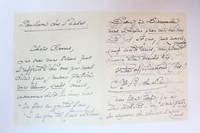
190574262s. l.: S. n. 1905. Fine. S. n. s. l. s. d. circa 1905 15 x 19 cm trois pages sur une double feuille Autograph letter signed by the dandy count three pages 27 lines written in black ink to his friends the Lapauzes that he is delighted to see them again soon even if they impose upon him the presence of a certain Sarah who is not among the people the poet seems to appreciate: ""Dear friends I will not do you the affront of not telling you that I would have preferred just the two of you alone"" words underlined but as the beautiful verse says: You do what you do / What you do is right."" For this meeting arranged at the Petit Palais of which Henry Lapauze becomes curator in 1905 after having been assistant director for the four preceding years Robert de Montesquiou ""a late riser who has the cowardice - or if you prefer the wisdom to choose the afternoon"" timidly expresses in a surge of wounded pride and revenge that he already regrets the possibility of his absence: "".only a throat irritation carelessly treated and unexpectedly could keep me away at the last moment. But I don't want to believe it. Let us arrange ourselves around Sarah!"" Henry Lapauze 1867-1925 was a journalist art critic then in 1905 curator of the Petit Palais converted four years earlier into a museum and whose collections he considerably enriched by acquiring notably the Courbet Henner Falguière collections with at the twilight of his life a marked predilection for the Decorative Arts of which he was one of the ardent promoters. S. n. unknown
190574262S. n. | s. l. s. d. [circa 1905] | 15 x 19 cm | trois pages sur une double feuille
Qu.-8vo (165 x 92 mm). 113 Bll. mit 76 Einträgen. Mit 3 kleinen und 6 blattgroßen Aquarellen. Cremefarbener Satineinband der Zeit mit feiner farbiger Seidenstickerei auf beiden Deckeln, der Vorderdeckel mit kleinem aufgeklebtem koloriertem Aquarell auf Papier im Rund "L'amitié l'a errigé / le plaisir l'a couranné / Wilhelmine", die Rückseite mit gesticktem Monogramm "MB", Vorsätze mit rosa Satinbezug und Kattunpapier. Dreiseitiger Goldschnitt mit Blindprägung. Im Schuber der Zeit. Reizendes blumiges Freundschaftsalbum mit vielen Einträgen von diversen Mitgliedern der Adelsfamilien Brandenstein, Buch, Bülow, Buddenbrock, Delagarde, Itzenplitz, Maltzahn, Möllendorff, Oertzen, Schack, Schulenburg u. v. a. Der Titel mit hübscher floraler Aquarellbordüre. Unter den Aquarellen die Ansicht eines runden Turms auf einer Insel, eine Meerlandschaft mit Inseln, Segelschiff und Angler sowie Freundschaftsbilder im Stil eines Denkmals und schmückende Blumenarrangements (davon eines montiert). - Bei einem Eintrag das obere Drittel ausgeschnitten (kein Textverlust). Das Gegenblatt des Titels mit hs. Widmung und U. eines Fritz Bamberger (22. V. 1933) an eine Frau Edith Bing. Einige Bll. nahe am Bug entfernt, einige montiert. Der rosafarbene Satinbezug der Vorsätze stellenweise etwas fleckig. Einband stärker berieben, Satin an Kanten und Deckelrändern zerschlissen, am Rücken nicht mehr vorhanden, der Rücken etwas lädiert, Papiervignette im Rund stärker gebräunt. Der Schuber stärker berieben und bestoßen. Innen frisch, teilweise leicht fleckig.
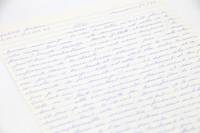
197685081Fleury-Mérogis 1976. Fine. ""She's an exceptional woman . I considered her like a mother . Woe to anyone who would touch a single hair on her head."" Fleury-Mérogis 22 Septembre1976 21 x 29.50 cm une page recto verso Autograph letter dated and signed by Jacques Mesrine dated Saturday September 22 1976 67 lines in blue ink on one page recto verso addressed to his love of the time Jeanne Schneider thanks to whom the manuscript of Instinct de mort was discreetly smuggled out of prison. Jacques Mesrine then incarcerated at Fleury-Mérogis prison and deprived of human warmth is enthusiastic about all the visits he receives in the visiting room thus dispelling the myth of the antisocial bandit devoid of human feelings: ""And after that they'll say I'm a savage! No quite the contrary and people who have had contact with me want to see me again. This gave me immense pleasure and do you know what happened next. she's also going to ask to see you. Apparently I'm missed by the nurses 'mister smile' that's the secret."" He particularly appreciated the visit from the nurse at La Santé prison who would also be their wedding witness with Jeanne Schneider and whom he praises: "". an enormous surprise! You'll never guess who came to see me! My nurse from La Santé. yes my darling. that charming lady with white hair whom you had seen in the visiting room at La Santé and who is to be our witness at our wedding . She's an exceptional woman a former military nurse and quite well-placed in the ministry. During my 2 and a half years at La Santé I considered her like a mother this woman is so devoted it's unthinkable. Woe to anyone who would touch a single hair on her head."" Public enemy No. 1 takes the opportunity again to break this reputation as a bloodthirsty beast that sticks to him: ""If journalists knew that all the nurses entered my cell alone and with complete confidence we'd be far from the 'beast' and hostage-taking à la Buffet. Nurses have always been sacred to me. They are untouchable like quite a few other people but those journalist faggots don't know that; because they're not in my thoughts and that's regrettable sometimes."" Jacques Mesrine the rebel is surprised to find himself appreciating his prison solitude: ""Do you know that I'm beginning to like it here. What calm you know manou my isolation I bear it insofar as I have peace. In detention it's not proven that I would have it. It's my reactions I'm afraid of. and the mentality of so-called crooks is increasingly disgusting! . in my isolation there's good and bad. but personally I don't want to complain. because there's no reason to do so."" and ends his letter with paternal considerations for his daughter who is not very assiduous at school and for whom he worries: ""I'm going to find out if Sabrina has been regularly attending her classes. I hope so because if the opposite were the case. no mercy this time. But what worry this kid can represent and what powerlessness I have to control her being here!"" Rare and very fine letter from Jacques Mesrine overflowing with reverence for the nursing profession and regrettable detestation for that of journalists. unknown
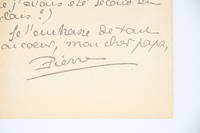
188977511Paris 1889. Fine. Paris jeudi 4 avril 1889 12.50 x 20 cm 4 pages sur un double feuillet Autograph letter signed by Pierre Louÿs addressed to his father four pages written in black ink on a double sheet of white paper. Transverse folds inherent to folding for mailing. This letter was sent by the young Pierre Louÿs while he was studying at the Janson-de-Sailly lycée Paris - 16th arrondissement. This is very likely one of Pierre Louÿs's last letters to his father ten days before the latter's death: ""Do you know that in less than two weeks I will be beside you . May I hope that by then you will have regained some strength"" The question of Pierre Louÿs's real paternal identity still fascinates biographers today: ""His father Pierre Philippe Louis . had married in 1842 Jeanne Constance Blanchin who died ten years later after giving him two children Lucie and Georges. In 1855 he remarried Claire Céline Maldan and from this union was born in 1857 a son Paul; then in 1870 our writer who received the first names Pierre Félix. This late birth the differences in character between father and son the first's disaffection toward the second the profound intimacy that always reigned between Louÿs and his brother Georges all this has led certain biographers and critics to suspect that the latter was in reality the writer's father. The exceptionally intimate and constant relationship that Pierre and Georges maintained between them throughout their lives could be an argument in this sense. Of course no irrefutable proof has been discovered and none will probably ever be discovered. Nevertheless certain letters . are quite troubling. In 1895 for example Louÿs writes seriously to his brother that he knows the answer to 'the most poignant question' he could ask him a question he has had 'on his lips for ten years.' The following year in the midst of Aphrodite's triumph he thanks Georges effusively and ends his letter with this sentence: 'Not one of my friends has a FATHER who is to him what you are to me.' Arguing from the close intimacy of Georges and Claire Céline during the year 1870 and from the jealousy that the father never ceased to show toward his younger son Claude Farrère did not hesitate to conclude in favor of Georges Louis. And what to think of this dedication by Louÿs to his brother on a Japan paper copy of the first edition of Pausole: To Georges his eldest son / Pierre."" Jean-Paul Goujon Pierre Louÿs Pierre Louÿs was only nine years old when his mother died suddenly. The father from then on entrusted his education to his brother Georges twenty years his senior and Pierre then joined him in Paris where he attended the École Alsacienne then the Janson-de-Sailly lycée. Despite the little affection shown to him the young man writes every week to his ""dear papa"" residing at Dizy-Magenta near Épernay. The young man inquires about his poor health: ""May I hope that by then you will have regained some strength No doubt. Your eczema we hope will not have worsened; and the green leaves that are beginning to appear will perhaps give you hope yourself for improvement next summer."" The ""improvement"" would sadly never come and Pierre Philippe Louis would breathe his last on April 14 1889. In the meantime Pierre Louÿs gives family news more precisely about Germaine his sister Lucie's daughter: ""Today I went to rue de la Santé to get news of Germaine. I found the little one who had been operated on in very good condition very cheerful and in good health. She was up and playing on the floor. . Finally I ended my day by going to my aunt Marie's and to Elisabeth's. Everyone is well in both houses."" As usual always anxious not to disappoint his father he finally transmits his school results: ""I return to the lycée tomorrow did Georges tell you that I was second in English"" unknown
188977511Paris jeudi 4 avril [1889] | 12.50 x 20 cm | 4 pages sur un double feuillet
197685081Fleury-Mérogis 22 Septembre1976 | 21 x 29.50 cm | une page recto verso
5 SS. auf 3 Bll. 4to. 28 Strophen zu je vier Zeilen über den französischen Physiker und Ingenieur Salomon de Caus (1576-1626): "Paris ist neuen Stoffes und neuer Witze froh, | Denn eben erschien ein Büchlein von Salomon de Caus. | Das spricht vom kochenden Wasser, von qualmender Dünste Kraft, | Und wahrsagt Wunder der Zukunft. 'Verrückt spricht's; märchenhaft' [...]". - Das vorliegende Manuskript dürfte von Pachler einem Redakteur zugesandt worden sein, der Pachlers Unterschrift am Ende durchstrichen und in Bleistift mit eigener Hand unter den Titel gesetzt hat. - Der gebürtige Grazer und Freund von Franz Grillparzer, Anastasius Grün, Friedrich Halm und Paul Heyse war Leiter des "Illustrirten Familienbuchs des österreichischen Lloyd" und schrieb tls. unter dem Pseudonym C. Paul Gedichte, Romane und Schauspiele, die wiederholt aufgeführt wurden. Gemeinsam mit Ernst Birk, Eduard von Sacken und Joseph Müller gelang es ihm am 31. Oktober 1848 durch waghalsige Löscharbeiten die von den kaiserlichen Belagerungstruppen in Brand gesetzte Hofbibliothek vor dem Schlimmsten zu bewahren. - Vgl. Kosch III, 1971 und Czeike IV, 478.
193 Fouragezettel mit den Unterschriften französischer Offiziere. Gruppenweise oder einzeln abgelegt in zeitgenöss. vorgedruckten Archivumschlägen der französischen Armee, diese ihrerseits in 4 Sammlungsmappen um 1900. Beiliegend 1 maschinschriftlicher "Katalog des Konvoluts von Formularen der Régie des Fourrages, Place de Leipzig, Okt. 1806-März 1807". 100 SS. Sämtlich in Halbleinen gebunden und mit handschriftl. Deckeltitel, jeweils Kl.-Folio (ca. 23:28 cm). Hübsche, umfassende Sammlung von Fouragequittungen aus dem während des Vierten Koalitionskriegs besetzten Leipzig mit den Unterschriften bedeutender napoleonischer (teils kommandierender) Offiziere, darunter Jacques Allain (1773-1851), Louis Hullin de Boischevalier (1770-1809), Louis-Jacques de Coehorn (1771-1813), Joseph Goll (1771-1850), Jean-Michel Haudebault (1766-1837), Louis-Joseph Maupoint (1766-1850), Simon Prévost de Vernois (1778-1859), Jean-Gaspard René (1769-1808), Auguste Talhouet (1788-1842), Jean-Marie de Varlet (1775-1857) und Charles-Louis Vimeux (1787-1859). - Obwohl das Rückgrat auch des napoleonischen Heers weiterhin die billigere und wendigere Infanterie bildete und Napoleons Hauptaugenmerk als Feldherr stets der Artillerie galt, waren Pferde unerlässlich nicht nur als Kavallerieeinheiten im Kampf, sondern auch für die Heereslogistik, gerade für den Transport der schweren Geschütze. Allerdings waren Pferde zu Beginn des 18. Jahrhunderts für die erschöpfte französische Staatskasse ein besonders rares Gut: Die meisten Gestüte lagen außerhalb der Landesgrenzen, und die mit der Flucht des Adels entstandenen Lücken unter der Kavallerieoffizieren hatten sich nur allmählich aus den nachrückenden Rängen sowie durch Remigranten füllen lassen. Umso peinlicher war die Buchführung über alle Ausgaben für die fast unvertretbar kostspieligen Tiere, insbesondere über die unablässige Fouragierung. Die vorliegende Sammlung von Quittungen, gemeinsam abgelegt in von der Armee vorgedruckten Umschlägen, zeugt von der genauen Organisation des Verpflegungsvorgangs. Als nach der Schlacht bei Jena und Auerstedt am 14. Oktober 1806 Preußen und Sachsen von Frankreich besetzt wurden, zog Marschall Davoust am 18. Oktober in Leipzig ein; schon die erste hier überlieferte Fouragequittung datiert vom 19. Oktober. Die Quittungen sind von Sekretärshand - teils auf Vordrucken - geschrieben und von den verschiedenen Offizieren, Unteroffizieren, Soldaten und Militärbeamten unterschrieben und von Sekretären gegengezeichnet. Zumeist tadellos erhalten in den originalen Archivumschlägen, gegenüber deren zeitgenössischen Aufschriften nur wenige Blätter fehlen. Anfang des 20. Jahrhunderts in vier Mappen abgelegt und in einem maschinschriftlichen Katalog erfasst, die Schreiber biographisch erschlossen. Gegenüber dem um 1928 vorliegenden Bestand fehlt heute eine "kleine Mappe", hauptsächlich Quittungen von Bory, Guyardet, Siry, Souplet, Thevenet und Varlet umfassend (davon noch die Formularumschläge mit 2 Quittungen vorhanden). - Provenienz: Der ungenannte Bestandsbildner (nach seinem selbst angelegten Katalog wohnhaft in Zehlendorf und anscheinend aus in Appelwerder/Westpreußen begüterter Offiziersfamilie, noch 1918 an der Salonikifront; sein nicht identifiziertes Adelswappen auf S. 1 gestempelt) hatte die zwischenzeitlich verstreute Sammlung hauptsächlich zwischen 1918 und 1928 (mit zwei Ergänzungen bis 1938) aus Angeboten verschiedener Händler wieder zusammengetragen, darunter R. Hönisch und W. Hiersemann in Leipzig, H. Burmeister und J. A. Stargardt in Berlin. Erworben aus Privatbesitz.
Series of 34 watercolours showing 17 male and 17 female costume figures. Wove paper (mostly watermarked Whatman 1821). C. 195 x 165 mm each. In custom-made half calf portfolio. Charming, beautifully executed set of 34 watercolours: two series of Tyrolean costumes (men and women) numbered 1 through 17. Spitzer, born in Vienna around 1780 according to AKL, worked in Innsbruck between 1810 and 1825 before moving to Salzburg (cf. Thieme/Becker XXXI, 393). He apparently was close with the Vienna-trained artist Johann Georg Schedler (1777-1866), a native of Constance. Schedler, who lived in Innsbruck from 1804 and witnessed the Tyrolean Rebellion, was known for his landscapes and costume scenes of his adopted country (cf. Wurzbach XXIX, 154). One of his published series, a collection of engravings showing the costumes of Tyrol and Vorarlberg, appeared in Innsbruck around 1824 (the Ferdinandeum copy containing 20, the Berlin copy 17 plates: Hiler 780 and Lipperheide Eba 10). The Lipperheide collection also includes a corresponding set of 34 watercolour plates, bound as an octavo volume (Eba 11). This book is from the library of Schedler himself and contains his autograph title: "Tiroler Volkstrachten nach Entwürfen von Joh. G. Schedler gemalt von Spitzer in Innsbruck". Spitzer, apparently, had forged an agreement with Schedler to produce a small number of watercolour copies of his costume series, which he would offer to customers willing to pay a premium for an original work of art rather than buy the published engravings. The present set thus constitutes Spitzer's second known watercolour version of Schedler's series of Tyrolean costumes, and the only one in the trade. - Occasional slight browning and duststaining; the colour shows exceptionally fine hues and tonal values; extremely well preserved. Cf. Lipperheide Eba 10 & 11. Hiler 780.
57842o.J. Ohne Ort, ca. 1780, Ca. 12 x 9 cm. Knickfalten an der Einfassungslinie.