MALRAUX, André.Livre Rare Book
858 463 résultats
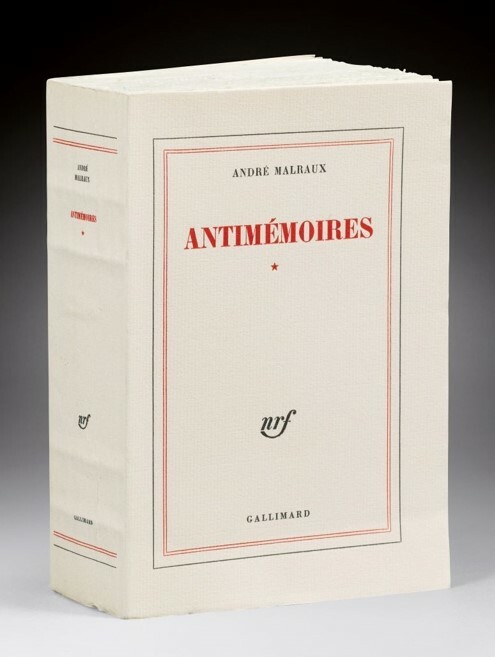
YTB-110Paris, Gallimard, 1967. In-8 de 604 pp., (3) ff. Broché, partiellement non coupé, tel que paru. 206 x 139 mm. ÉDITION ORIGINALE. L’un des 80 exemplaires de tête sur vélin de Hollande (N°22). D’apparence récit autobiographique traditionnel, cette confession s’en éloigne pourtant en mêlant aux faits historiques de nombreux éléments de fiction, et en refusant la chronologie linéaire au profit d’une chronologie circulaire. Le fil rouge des Antimémoires est un voyage effectué par Malraux en 1965, qui le mène de l’Égypte à la Chine en passant par la péninsule arabique et l’Inde. Chaque escale évoque des voyages passés. Chaque souvenir en rappelle un autre, qui en rappelle un autre à son tour. Le livre s’interroge avant tout sur la nécessité du travail de mémoire. Il ne s’agit pas à proprement parler d’une autobiographie de l’auteur ; Antimémoires est plutôt une revue de son existence liée aux grands événements politiques et géopolitiques de son époque, où il évoque par ailleurs de nombreux auteurs qui ont marqué la vie sociale de leur empreinte. « Ni confessions, ni mémoires, mais inlassable interrogation d’une expérience toujours davantage transformée en conscience. Les Antimémoires, malgré leur pudeur, sont un autoportrait : celui d’un esprit génial et fraternel qui, en posant les vraies questions, progresse des « problèmes » aux « mystères », de Gide à Bernanos » (Nouveau dictionnaire des œuvres). L’un des tous premiers lecteurs de l’ouvrage, le général de Gaulle, télégraphia à Malraux « Livre admirable dans les trois dimensions ». BEL EXEMPLAIRE APPARTENANT AU TIRAGE DE TETE, CONSERVE BROCHE, TEL QUE PARU.
LCS-18380Très bel exemplaire conservé dans sa fine reliure de l’époque et provenant de la bibliothèque de Paul Eluard. Paris, Victor Lecou, 1852. In-12 de vii pp., 354 pp., (1) f. de table. Demi-veau lavallière, pièce de titre de maroquin vert, tranches marbrées. Reliure de l’époque. 175 x 106 mm.
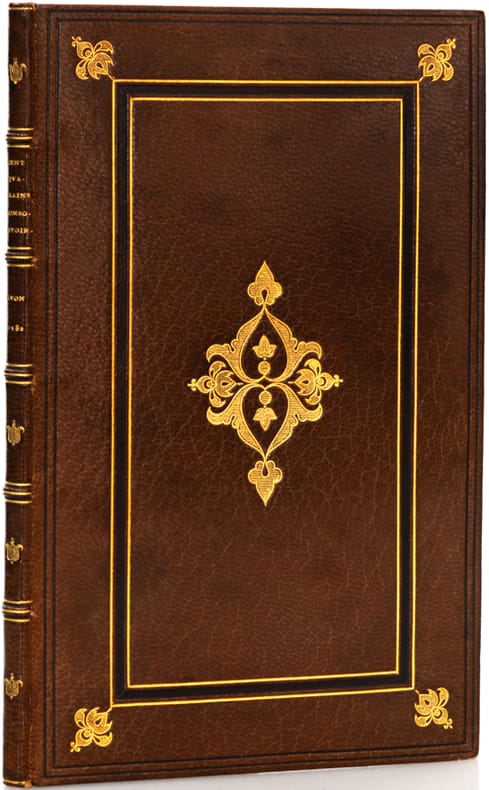
158242196Lyon, Benoît Rigaud, 1582. In-8 de 27 pp., maroquin havane, décor à la Du Seuil, fleuron azuré au centre, dos orné à nerfs, filet sur les coupes, large dentelle intérieure, tranches dorées (Chambolle-Duru).
1898PHO-1730Paris, Ernest Leroux, Challamel , 1898, 11 volumes in-4, brochage éditeur, le tome 7 est une réédition, la plupart non coupé et débroché. Envoi de l’auteur à Eugène Lenfant, sous-lieutenant dans l'artillerie coloniale en 1892, il a participé aux campagnes d'Annam et du Tonkin (1893-1895) [t. I] Géographie et voyages. Exposé des travaux de la Mission, dix-huit cartes, cent quarante illustrations, et un portrait de l’auteur par Paul Renouard. 1901. 4 ffnch. -332 pp.-1 f., débroché [t. II]. Géographie et voyages. Exposé des travaux de la Mission, huit cartes, cent quarante-cinq illustrations. 1906. (3)-402 pp.-1 f., non coupé, débroché [t. III]. Géographie et voyages. Voyages au Laos et chez les sauvages du sud-est de l’Indo-Chine par le capitaine Cupet. Introduction par Auguste Pavie. Avec quinze cartes et cinquante illustrations. 1900. (4)-428 pp., débroché [t. IV]. Géographie et voyages. Voyages au centre de l’Annam et du Laos et dans les régions sauvages de l’Est de l’Indo-Chine par le Capitaine de Malglaive et par le Capitaine Rivière. Introduction par Auguste Pavie. Avec treize cartes et soixante-quinze illustrations. 1902, XXVII-296 pp.-1 f., débroché [t. V]. Géographie et voyages. Voyages dans le Haut Laos et sur les frontières de Chine et de Birmanie par Pierre Lefèvre-Pontalis. Introduction par Auguste Pavie, huit cartes, 137 illustrations et un portrait de l’auteur. 1902. XLVII-326 pp.-1 f., non coupé, débroché [t. VI]. Géographie et voyages. Passage du Mé-Khong au Tonkin (1887 et 1888) par Auguste Pavie. Avec quatre cartes et 79 illustrations. 1911. (4)-348 pp.-2 ffnch., non coupé Tome 7, Géographie et voyages, réédition moderne, White lotus, pleine toile, titre au plat [t. I]. Études diverses. Recherches sur la Littérature du Cambodge, du Laos et du Siam par Auguste Pavie. Avec nombreuses illustrations, 20 planches en couleur, une carte et textes cambodgien, laotien et siamois. 1898. XLVI-367 pp.-1 f., non coupé, débroché, manque de papier à la première de couverture [t. II]. Études diverses. Recherches sur l’Histoire du Cambodge, du Laos et du Siam par Auguste Pavie. Contenant la transcription et la traduction des inscriptions par M. Schmitt. Avec une carte, plusieurs illustrations et 70 planches d’inscriptions. 1898. XLV-494 pp. [mal ch. 449 pp., non coupé, débroché, 1ere de couverture détachée et ébarbée [t. III]. Études diverses. Recherches sur l’Histoire naturelle de l’Indo-Chine orientale par Auguste Pavie. Avec une carte, 13 planches en couleurs et 28 planches 1904. XXI-549 pp., non coupé, débroché, mouillure page 521-549 [t. IV]. Atlas. Notices et Cartes par Auguste Pavie. 1903. 54 pp.-10 cartes coul. h.-t.
4to. 3 vols. (8), XXXVI, 526 pp. (4), XXXIV, 383 (but: 381) pp. (14), 218 (but: 216), 150, (34) pp. With 2 engr. titles, 1 engr. portrait, 1 engr. frontispiece, 3 engr. title vignettes, 13 engr. headpieces, 12 engr. tailpieces, 1 folding engr. map, and 16 (3 folding) engr. plates. Contemp. calf with double giltstamped label to spine, attractively gilt spine, and triple gilt cover fillets. Leading edges gilt; all egdes gilt. Second edition of the first critical Rabelais edition by Jacques Le Duchat; the first to contain these illustrations. The charming vignettes in Pompeian style are mostly by B. Picart; the second portrait of the poet in vol. II is framed by rich allegorical decorations. The three folding plates in vol. I show views of Rabelais' birth house. - Beautiful bindings with professionally restored spine-ends. Slight tear to pp. XIII-XVI in vol. I; altogether a very clean, virtually unbrowned copy. Engraved bookplate by the French antiquary, collector, and occasional poet Jules Couderc, whose collection was sold by Drouot in Paris in 1914, on front pastedown. Sander 1631. Cohen/Ricci 840. Tchemerzine IX, 319 b. Lewine 439. Fürstenberg coll. 157. Fürstenberg 71. Oberlé 353 ("C'est la plus importante édition illustrée de Rabelais au XVIIIe siècle").
8vo. 3 pp. In French, to an unnamed friend: "It's been two weeks, my dear friend, since I last got a line from you, although I need your friendship more than I ever did before. My daughter has had a fever for a week, and here I am, among strangers, surrounded by German doctors in an inn, and well, I feel quite miserable. Thank God, she hasn't been in danger so far; if she were, I couldn't survive it. I wrote to you from Metz when I left, and from here too, to offer you my [apartment]. How is it that I didn't get at least a note from you? You know quite well that all I know about life, I have learned from you and it's all the more true now that I live abroad. Have you seen Villers? Tell him that one must be mad to live anywhere else than in France when one is French. The Germans are quite kind to me, though, and I already have a chest full of poems and notes. I have been writing down some of my reflections about all that, which might be of interest if ever see my friends again, since nothing will ever make me publish one line for any other public than the French. Please do write to me; consider that if you spent five minutes at it every night, the result would be a week of relief for me. But I have never been able to give you an idea of how much your letters please me; you would not be so sparing with them if you knew. Kindly remember me to all those who care for me". - Madame de Staël wrote this letter at the beginning of her exile. Her duel with Napoleon, stemming from her recalcitrance to his influence, had led to his orders that she was not to reside within forty leagues of Paris. This occurred in the fall of 1803. After considerable delay she decided to go to Germany. She travelled in the company of Benjamin Constant, by Metz and Frankfurt to Weimar, arriving there in December. She stayed in Weimar during the winter, and then went on to Berlin.
156942200Paris, De l'Imprimerie de Fédéric Morel, 1569. In-8 de 8 ff., maroquin rouge, triple filet doré sur les plats, dos orné à nerfs, dentelle intérieure, tranches dorées sur marbrure (Trautz-Bauzonnet).
8vo. 2 pp. In French, to an unidentified writer: "I must thank you a thousand times for your very kind article. A person living in Berlin has sent me a translation of it and I have been particularly pleased about all the good you said of my work. Up to now Germany had not spoiled me and that is the reason why your study was so agreeable to me as I hope it will shed some light on me in showing that I am not as dark as they believe. I have the honor of addressing you here, and enclose the picture you asked of me".
8vo. 2 pp. In French, on mourning stationery, to a close colleague: "Upon relocating myself in the country, I took a portfolio of your letters, to which the bustle of Paris would not permit me to respond. In short, thank you for your good literary sympathy, thank you for all the pages, which I have read with great interest". - Mounting remnants at foot of second page.
18904628Paris 1890 1890. A beautiful late nineteenth-century illuminated manuscript with the text of the Ordinary of the Mass. 178x125mm. Title page and thirty-two pages. Signed at foot of final page "Germaine Mimey 1890" with the initials "G.M." at the foot of each page. Bound by Emile Rousselle signed at foot of front doublure in tan morocco with a single fillet border framing a wide gilt tooled border inside which is a smaller gilt tooled border which frames a shield with three fleur de lys surmounted by a crown. Below the shield is a dragon. Either side of the shield is stamped four times the letter "F" surmounted by a crown. This is repeated on the lower cover. The spine has five raised bands with four compartments decorated with a fleur de lys the second compartment being blank. The front and rear doublures are of blue morocco with gilt decoration and a brown calf diamond. Turn-ins decorated in gilt. Front and rear free endpapers are in brown silk. The illuminations are gorgeously delicate with the occasional block of colour. The spirit is genuinely medieval with a light sinuousness in contrast to the rather heavier Gothic Revival manner which is often in evidence in this type of late nineteenth century illumination. We have been unable to identify "F" unless of course it simply stands for "France" but with the crowns shield and fleur de lys this beautiful little Missal was clearly done for an aristocratic and perhaps even a royal patron although of course by 1890 he or she would have been a mere Pretender taking solace in this sumptuous devotional book. [Paris] 1890 hardcover
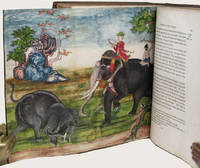
182634747London: Published for the Author 1826. First Edition. THE AUTHOR'S COPY SPECIALLY BOUND. A Highly Important and Unique Copy with 25 Extra Illustrations tipped or pasted in 6 coloured 5 full page. SIGNED BY RANKING with the Inscription - "To remain in the family this correted copy with new notes and Illustrations." The Notes appear on several pages and are rendered in pencil. Folding lithograph frontispiece folding map 1 folding engraved map 6 lithograph and 3 engraved plates plus the 25 extra illustations and engravongs. A large folding handcoloured plate of elephants Quarto conemporary red straight-grained morocco the spine exquisitely designed with wide raised bands gilt rolled the compartments decorated with in both gilt and blind two compartments lettered one being the declaration that this is the author's copy covers bordered with triple gilt rules surrounding an inner panel gilt decorated and ruled the corners with elaborately tooled decorations in gilt an inner diamond and roll tooled border in blind inner gilt dentelles original dark green endleaves all edges gilt a superb binding accomplished for the author. xiv 516 pp. A very handsome copy in a beautifully designed and unique contemporary binding the binding tight and strong and beautifully preserved there is a very faint old stain from damp affecting the lower portion of the pages but this remains a quite extraordinary copy nevertheless. UNIQUE FIRST EDITION SPECIALLY BOUND THE AUTHOR'S OWN COPY WITH HIS INSCRIPTIONS AS TO OWNERSHIP AND FAMILY ASSOCIATION. Ranking's wide-ranging work generally returns to the author's interest in Asiatic and African elephants and his "endeavor to trace the historical proofs that the fossil bones of elephants and wild beasts which have been found throughout Europe are the remains of those animals which have been employed in the wars religious ceremonies and amphitheatrical sports of the Romans and the Mongols" Preface. The book examines the historical roots of fossil remains found in Siberia and other countries arguing that these remains belong to elephants and other animals used in the wars religious ceremonies and amphitheatrical sports of the Romans and Mongols. The author traces the evidence from historical sources including accounts from Marco Polo and other travelers to prove that the number of elephants employed by these empires far exceeded previous estimates. <br> The book also explores the broader context of elephant usage in ancient times from their role in warfare to their significance in cultural and religious practices. Ultimately this book sheds light on the interconnectedness of human history and the natural world providing insights into the complex relationships between humans animals and the environment. <br> The volume full of "much amusing and instructive matter industriously accumulated and detailed with conciseness and perspicuity" American Quarterly Review March 1827 includes chapters on the lives of the Grand Khans and of Tamerlane the "Employment of Elephants from the earliest times" "Fossil Remains of Elephants" "Of Roman and Greek Wars in which Elephants were employed" "Sports and Combats in the Circus and Amphitheatre". Illustrated with a large folding map measuring approximately 17-1/2 by 21 inches unfolded "The Continent of Asia as conquered and governed by Genghis Kahn… and to the Death of Tamerlane" and with ten engraved plates: these include "The Emperor Kublai" a spectacular depiction of "The Emperor Kublai" going to war in a pavilion borne atop four elephants.; three numismatic plates depicting coins and medals from Roman Britain; the "Defeat of Hannibal by Scripio at Zama" portraying a battle with armies cavalry and elephants; views of the "Amphitheatre of Claudius" and a "Circus" with numerous elephants giraffes and lions; and a folding map of Hannibal's storied campaign over the Alps "with large armies and numerous Elephants". Presentation Inscription and Ownership signification to the title-page. Published for the Author hardcover
LCS-18606Superbe exemplaire à grandes marges revêtu d’une éblouissante reliure de l’époque en maroquin rouge au dos finement orné. Paris, André Pralard, 1694. In-12 de (12) ff., 484 pp., (1) f. Maroquin rouge, double encadrement de double filet doré sur les plats avec fleurons d’angle à la Duseuil, dos à nerfs richement orné, coupes décorées, roulette intérieure, tranches dorées. Reliure de l’époque attibuable à Boyet. 168 x 93 mm.
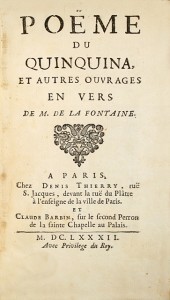
LCS-13502Edition originale de ce recueil renfermant 5 pièces de La Fontaine qui paraissent pour la première fois. Bel exemplaire très pur dans sa condition d’origine. Paris, Denis Thierry et Claude Barbin, 1682.In-12 de (2) ff., 242 pp. et (1) f.bl. Relié en plein veau brun granité de l’époque, dos à nerfs orné de fleurons dorés, coupes décorées, tranches mouchetées. Reliure de l’époque. 160 x 87 mm.
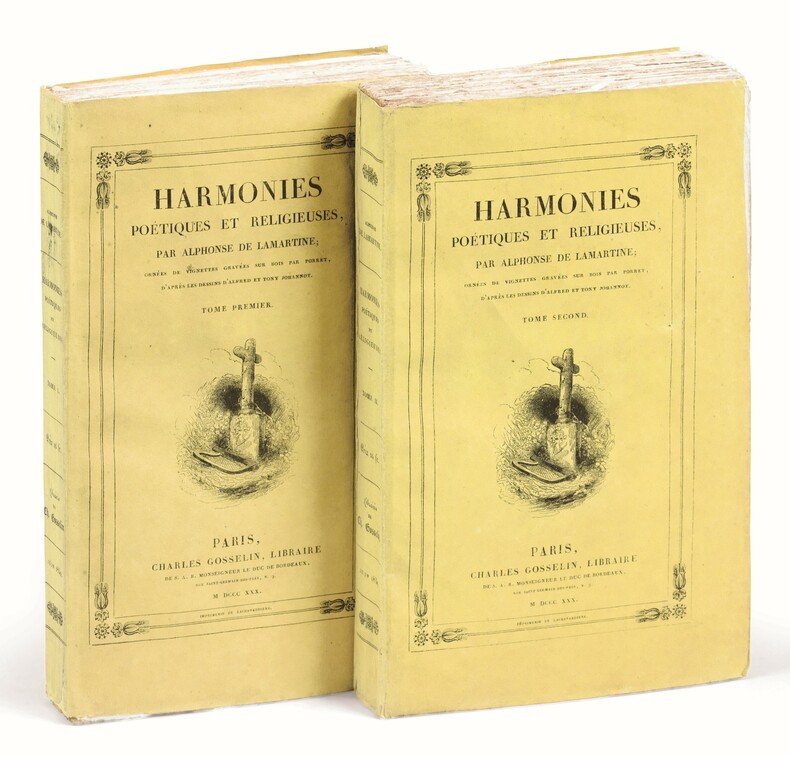
1830YTB-21Paris, Charles Gosselin., 1830. Edition originale. Paris, Charles Gosselin, 1830. 2 tomes en 2 volumes in-8 de : I/ 342 pp. (1) f. bl. ; II/ 356 pp. Brochures, couvertures jaunes imprimées, exemplaire non rogné, chemises de demi-chagrin rouge, étui. Brochures de l’époque. 220 X 137 mm. EDITION ORIGINALE DES « Harmonies poétiques et religieuses » DE LAMARTINE, « ouvrage rare et très important » (Carteret) DE LAMARTINE. Clouzot, 177 ; Carteret, II, 22 ; Vicaire, IV, 969 ; Talvart, XI, 31-32. L’édition est ornée de vignettes de Johannot gravées sur bois par Porret ainsi que de deux autres vignettes sur les couvertures. « La plupart des exemplaires portent une mention fictive d’édition, ils en sont très fortement dépréciés. Très fréquemment piqué » (Clouzot). Rare exemplaire sans mention d’édition. Les « Harmonies poétiques et religieuses », par la diversité de leur inspiration, constituent le sommet du lyrisme lamartinien. TRES SEDUISANT EXEMPLAIRE, A TOUTES MARGES, CONSERVE DANS SES BROCHURES DE L’EPOQUE, TEL QUE PARU, CONDITION RARE ET RECHERCHEE. Un exemplaire broché, provenant de la bibliothèque de M. Eugène Paillet est coté 200 fr. au Bulletin Morgand et Fatout, n°12156. Aucun exemplaire de l’édition originale conservé dans ses brochures de l’époque n’est répertorié sur le marché public depuis le début des relevés, il y a plus de 35 ans (ABPC).
LCS-16361Précieux et émouvant exemplaire dédicacé par l’auteur à l’amie intime de sa fille disparue. Paris, Charles Gosselin, Furne et Cie, 1841. Grand in-8 de (2) ff., xl pp., 424 pp., 1 frontispice et 11 gravures hors texte protégées par des serpentes légendées, nombreuses vignettes dans le texte. Relié en demi-chagrin rouge, dos à nerfs finement orné, minimes frottements aux coupes. Reliure de l’époque. 257 x 163 mm.
LCS-18522Exemplaire conservé dans ses reliures de l’époque. Paris, Delaunay, Bossange et Masson, 1818. 3 volumes in-8 de: I/ x pp., 440 pp.; II/ (2) ff., 424 pp. ; III/ (2) ff., 395 pp., (1) f. d’errata, (4) ff. d’annonces. Demi-basane verte, dos lisses ornés du titre doré et de filets dorés figurant les nerfs. Reliure de l’époque. 201 x 126 mm.
14502454001/01/1450. <blockquote><p>A very uncommon leaf from Livy very few manuscript examples having survived</p></blockquote><p>Rome having survived the invasions of the Celtic Gauls in the early 4th century BC set its sights on further expansion in the middle part of the century. They re-conquered those Latin and Etruscan towns that had left the fold during the Gallic occupation and in absorbing others reconsolidated their position as the dominant force in Latium and Central Italy. With their home turf secured or so it seemed the Romans looked south towards Campania.</p><p>At this time the Samnites had moved into the fertile lands of Campania from the south-central Appenines. They already controlled the towns of Capua and Cumae to the south of Rome and held sway to the east as well. Rome to protect its flanks while still in the midst of re-taking Latium and Etruria wisely entered into an alliance with the Samnites in 354 BC. Conflict with Samnium over Campanian dominance was inevitable however and would soon turn into a series of wars lasting from 343 - 290 BC.</p><p>The years surrounding the Samnite Wars were not only one of military prowess for Rome but of great public works as well. In 329 BC the Circus Maximus got one of many face-lifts throughout its history gaining permanent horse-stalls and starting gates. The first Roman road the Via Appia was constructed from Rome to Capua in 312 BC and the first aqueduct the Aqua Appia was also established at the same time. These magnificent structures not only were of great benefit to Rome and her people but proved the flourishing disposition of the state even during time of war and expansion. At the end of the Samnite Wars Rome held perhaps as many as 150000 people making it one of the largest cities in the Mediterranean region. As many as 1000000 people claimed citizenship to Rome and vastly larger numbers were obligated through Latin rights and allied status.</p><p>With the defeat of Samnium the last major Italian threat Rome was the master of nearly the entire Italian peninsula save for the Gauls occupying the Po valley in the north and the Greek holdout cities like Tarentum in the far south. This growing power soon gained the attention of regional powers in Greece and later the masters of the Mediterranean the Carthaginians.</p><p>Livy or Titus Livius 59 BC - 17AD wrote his history of Rome starting with the foundation myth of Aeneas 510 BC up to the successful German campaigns and death of Emperor Drusus 9 BC. This history comprised 142 books. Of those books 35 survive to present day with the bulk being the first 10 years Books 1-10 fragments of 11 Books 21-45 fragments of 91 and scattered quotations preserved in secondary works.</p><p>Though the accounts differ the destruction of Livy’s work has been attributed to the hand of Pope Gregory the Great 590–604 who was trying to eliminate pagan works from Christian hands. This biblioclasm whether it was through the Pope’s doing or through the natural loss of material to time has severed us from an important access point to Roman history as some of the material used by Livy has not been found in his source texts.</p><p>With the bulk of the texts destroyed Livy’s History of Rome passed into the Middle Ages primarily through summary and with the extreme length of the work the original Classical and Early Medieval manuscripts were not recopied and fell into decay and loss. Thus by the so-called 12th Century Renaissance Livy’s historical writing was quite rare. It was not until the 1300s that Livy regained popularity. Dante was one of those who respected Livy and in his Inferno the poet references Livy ""come Livïo scrive che non erra"" as Livy wrote who does not err.</p><p>The hunt was on for Livy’s lost manuscripts even just a fragmental scrap was a treasure worth finding in the 1300s. Even Pope Nicholas V turned his efforts towards finding these rare manuscripts some of which had been destroyed by his papal predecessor. The Italian Humanist period into the Renaissance increasingly sought any extant versions of this history; as the esteem for and ardent imitation of Greco-Roman culture increased so did the need for access points to this history. Entire country homes in Italy were sold to buy a single manuscript of Livy’s works copied by one of the men primarily responsible for the new handwriting style now known as the Humanist hand. Scholarship and commentary ranging from England by Dominican Friar Nicholas Trevet to Italy by Laurentius Valla paved the way for further analysis of the Roman historian.</p><p>This Italian manuscript leaf likely from the mid-1400s to the very early 1500s comprises part of Book 9 from BC 308. With only minor deviations from the Loeb Classical Library text which is the scholarly standard. These deviations indicate that this manuscript descends from a different stemma than the most common or most “correct†one which was for the Loeb edition further painting the picture of the Humanist effort to grasp this fading history from the jowls of history and the pains to retaining the original text despite the lack of exemplars.</p><p>In addition to representing an important moment in the recuperation of history the script throws us into modernity. Towards the end of the 14th century several Italian humanists including Niccolò Niccoli and Poggion Bracciolini began set about to reform the increasingly dense Gothic handwriting which had dominated book making since the mid-13th century. The Gothic script whose legacy in printing extends to 20th century German fraktur found in pre-war books was full of letters fused together ornate thorns and hairlines and single strokes called minims which became impossible to read. These 14th century Italians set about to recreate a script that utilized space between each letterform and simpler strokes— a new take on the handwriting endorsed by Charlesmagne himself for the education of his Holy Roman Empire. This script known as Humanist caught on and proliferated. By the time texts were bring printed at the end of the 15th century the printers looked to this script to make a font and further our modern Times New Roman font is based on the Humanist script which is in part why this text of Livy is so legible to us as a modern audience.</p><p>Pierre Maréchaux “The Transmission of Livy from the End of the Roman Empire to the Beginning of the Seventeenth Century: Distortion or Discovery a Story of Corruption†A Companion to Livy ed. Bernard Mineo John Wiley & Sons: 2014 pp. 437-452.</p><p><strong>More details</strong></p><p>LEAF FROM LIVY’S AB URBE CONDITAS in Latin text manuscript on parchment Northeastern Italy perhaps Padua 1456 Single column of 34 lines written in brownish ink in Humanist hand with some slant and ligatures. Letters beginning sections set in margins with two hatch marks in pen next to all but one of the initials. Single correction indicated by strike through with amended word written above line 15 recto; Ruled horizontally in red ink. Distinct hair and flesh sides. Modern pencil number 185 at the bottom left hand of the column on verso. Provenance: Sothebys March 1825 Payne and Foss 1825 Sothebys 1902 & 1923 Parke-Bernet 1941 Otto Ege. Gwara Handlist 52.</p><p><strong>Text & Translation:</strong></p><p>…ruperat Fabius consul nec dubia nec difficili victoria dimicat. Ipsum oppidum—nam ad moenia victor accessit—cepisset ni legati dedentes urbem exissent. Praesidio Perusiae imposito legationibus Etruriae amicitiam petentibus prae se Romam ad senatum missis consul praestantiore etiam quam dictator victoria triumphans urbem est invectus; quin etiam devictorum Samnitium decus magna ex parte ad legatos P. Decium et M. Valerium est versum; quos populus proximis comitiis ingenti consensu consulem alterum alterum praetorem declaravit.</p><p>XLI. Fabio ob egregie perdomitam Etruriam continuatur consulatus; Decius collega datur. Valerius praetor quartum creatus. Consules partiti provincias: Etruria Decio Samnium Fabio evenit. Is profectus1 ad Nuceriam Alfaternam cum pacem petentes quod uti ea cum daretur noluissent aspernatus essetoppugnando ad deditionem subegit. Cum Samnitibus acie dimicatum. Haud magno certamine hostes victi; neque eius pugnae memoria tradita foret ni Marsi eo primum proelio cum Romanis bellassent. Secuti Marsorum defectionem Paeligni eandem fortunam habuerunt.</p><p>Decio quoque alteri consuli secunda belli fortuna erat. Tarquiniensem metu subegerat frumentum exercitui praebere atque indutias in quadraginta annos petere. Volsiniensium castella aliquot vi cepit; quaedam ex his diruit ne receptaculo hostibus essent; circumferendoque passim bello tantum terrorem sui fecit ut nomen omne Etruscum foedus ab consule peteret. Ac de eo quidem nihil impetratum; indutiae annuae datae. Stipendium exercitu Romano ab hoste in eum annum pensum et binae tunicae in militem exactae; ea merces indutiarum fuit.</p><p>Tranquillas res iam in Etruscis turbavit repentina defectio Umbrorum gentis integrae a cladibus belli nisi quod transitum exercitus ager senserat. concitata omni iuventute sua et magna parte Etruscorum ad rebellionem compulsa tantum exercitum fecerant ut relicto post se in Etruria Decio ad oppugnandam inde Romam ituros magnifice de se ac contemptim de Romanis loquentes iactarent. Quod inceptum eorum ubi ad Decium consulem perlatum est ad urbem ex Etruria magnis itineribus pergit et in agro Pupiniensi ad famam intentus hostium consedit. Nec Romae spernebatur Umbrorum bellum et ipsae minae metum fecerant expertis Gallica clade quam intutam urbem incolerent Itaque legati ad Fabium consulem missi sunt ut si quid laxamenti a bello Samnitium esset in Umbriam propere exercitum duceret. Dicto paruit consul magnisque itineribus ad Mevaniam ubi tum copiae Umbrorum erant perrexit.</p><p>Repens adventus consulis quem procul Umbria in Samnio bello alio occupatum crediderant ita exter-ruit Umbros ut alii recedendum ad urbes munitas…</p><p>In the same year the consul Fabius fought a battle with the remnants of the Etruscan forces near Perusia—which together with other cities had broken the truce—and gained an easy and decisive victory. He would have taken the town itself—for after the battle he marched up to the walls—had not ambassadors come out and surrendered the place. Having placed a garrison in Perusia and having sent on before him to the senate in Rome the Etruscan deputations which had come to him seeking friendship the consul was borne in triumph into the City after gaining a success more brilliant even than the dictator’s; indeed the glory of conquering the Samnites was largely diverted upon the lieutenants Publius Decius and Marcus Valerius of whom at the next election the people with great enthusiasm made the one consul and the other praetor.</p><p>In recognition of his remarkable conquest of Etruria Fabius was continued in the consulship and was given Decius for his colleague. Valerius was for the fourth time chosen praetor. The consuls cast lots for the commands Etruria falling to Decius and Samnium to Fabius. The latter marched against Nuceria Alfaterna and rejecting that city’s overtures of peace because its people had declined it when it was offered them laid siege to the place and forced it to surrender. A battle was fought with the Samnites in which the enemy were defeated without much difficulty nor would the engagement have been remembered but for the fact that it was the first time that the Marsi had made war against the Romans. The Paeligni imitated the defection of the Marsi and met with the same fate.</p><p>Decius the other consul was also successful in war. When he had frightened the Tarquinienses into furnishing corn for the army and seeking a truce for forty years he captured by storm a number of strongholds belonging to the people of Volsinii. Some of these he dismantled lest they should serve as a refuge for the enemy and by devastating far and wide he made himself so feared that all who bore the Etruscan name begged the consul to grant them a treaty. This privilege they were denied but a truce for a year was granted them. They were required to furnish the Roman army with a year’s pay and two tunics for each soldier; such was the price they paid for a truce.</p><p>The tranquility which now obtained in Etruria was disturbed by a sudden revolt of the Umbrians a people which had escaped all the distress of war except that an army had passed through their territory. Calling up all their fighting men and inducing great part of the Etruscans to rebel they mustered so large an army that they boasted with much glorifying of themselves and fleering at the Romans that they would leave Decius behind them in Etruria and march off to the assault of Rome. When this purpose of theirs was reported to the consul Decius he hastened by forced marches from Etruria towards the City and encamped in the fields belonging to Pupinia eagerly waiting for word of their approach. At Rome no one made light of an Umbrian invasion. Their very threats had excited fear in those who had learnt from the Gallic disaster how unsafe was the City they inhabited. Accordingly envoys were dispatched to carry word to Fabius the consul that if there were any slackening in the Samnite war he should with all speed lead his army into Umbria. The consul obeyed the order and advanced by long marches to Mevania where the forces of the Umbrians at that time lay.</p><p>The sudden arrival of the consul whom they had believed to have his hands full with another war in Samniurn a long way from Umbria so dismayed the Umbrians that some were for falling back on their fortified cities and others for giving up the war…</p><p><img class=""alignnone wp-image-24457 size-post-window"" src=""https://cdn.raabcollection.com/wp-content/uploads/20231204150746/Folder-site-8-1600x1327.jpg"" alt="""" width=""1600"" height=""1327"" /></p> unknown
40990Paris, Au Sans Pareil, 1919. In-8°, non paginé. Broché.
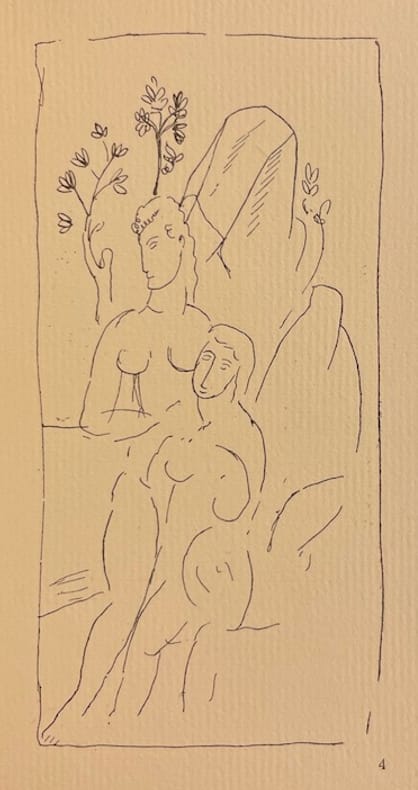
1958110353Paris, Jacques Vialetay, impr. Robert Blanchet 1958 2 volumes. Grand in-4 34 x 28 cm. En feuillets, sous chemise et étui rigides, couvertures rempliées, premiers plats illustrés d’une vignette, 253 pp. en pagination continue, composé en Libra de corps 20 par Robert Blanchet, 56 illustrations dont un frontispice réhaussé d’or et 8 à pleine page, 33 lettrines de Paul Jouve, gravées sur bois par Jacques Camille et Georges Beltrand. Tirage à 223 exemplaires numérotés. Celui-ci sur vélin de Rives, l’un des 25 exemplaires réservés aux collaborateurs, justifié au crayon “exemplaire d’artiste”. étui en partie passé, une petite brunissure au faux-titre et petite tache à la justification. Bel exemplaire.
1561372709Venice: apud Iuntas heirs of Luca Antonio Giunta 1561. Title page with small woodcut of pope and six bishops; Giunta printer's device in red on title and at end; one full-page woodcut of Crucifixion third-page woodcuts at head of each of three parts 162 woodcuts of liturgical scenes woodcut initials. Text printed in two columns in red and black throughout musical notation in black on staves of four red lines. 4 243 ff. 1 vols. Folio. Contemporary Italian orange morocco gilt boards ruled in gilt central panels in double gilt rule with floral corner tools upper board with cardinal's hat lower board with sunburst initials in central cartouches effaced a.e.g. Spine dark some soiling and rubbing light traces of worming at back. Title page with small woodcut of pope and six bishops; Giunta printer's device in red on title and at end; one full-page woodcut of Crucifixion third-page woodcuts at head of each of three parts 162 woodcuts of liturgical scenes woodcut initials. Text printed in two columns in red and black throughout musical notation in black on staves of four red lines. 4 243 ff. 1 vols. Folio. Liturgical work including the music of the chants and hymns to accompany the services. Adams L1241; EDIT16 CNCE 11860. Provenance: early ownership signature of Joanis Ant. S- on pastedown. General Theological Seminary bookplates and stamps apud Iuntas [heirs of Luca Antonio Giunta] unknown
192988435New York: Harper & Brothers Publishers 1929. First Edition. First Printing. Octavo 19.5cm; navy blue and red paper-covered boards and black cloth backstrip with titles stamped in gilt on spine; decorative endpapers; orange topstain; dustjacket; viii23-3262pp. Spine ends gently nudged topstain slightly dulled else a fresh very Near Fine copy. In the original dustjacket designed by Aaron Douglas; unclipped priced $2.50 gently spine-sunned and lightly edgeworn with a few tiny tears a tiny split at rear flap fold and some mild dust-soil; still a bright Near Fine copy. <br /> <br /> McKay's second novel an accurate social perspective of Black life in southern France drawn directly from McKay's experience living in Marseilles. "Lincoln Agrippa known to his drifter cohorts on the 1920s Marseilles waterfront as "Banjo" passes his days panhandeling and dreaming of starting his own little band. At night Banjo Malty Ginger Dengel Bugsy Taloufa Goosey and even Jake of Home to Harlem prowl the rough waterfront bistros drinking looking for women playing music fighting loving and talking - about their homes in Senegal the West Indies or the American South; about Garvey's Back-to-Africa Movement; about being Black. When Ray a writer joins the group it triggers his rediscovery of his African roots and his feeling that at last he belongs to a race "weighted tested and poised in the universal scheme" from the HarperCollins reissue. PERRY 377; GLOSTER p.165-166. 88435. Harper & Brothers Publishers unknown
46769V.p.: 1946-47. Archive of six TNS typed notes signed five TLS typed letters signed and one Western Union telegram from Upton Sinclair to the Paris literary agent and translator Jean-Robert Lamour better known by his pseudonym Yves Malartic. Together with ten of Lamour's retained carbons of communications to Sinclair and others. Correspondence spans the period January 1946 to December 1947 and deals with Lamour's efforts to secure publishing contracts for French-language translations of Sinclair's works including The Jungle They Call Me Carpenter Our Lady and others as well as Sinclair's ongoing work on the Lanny Budd series. Sinclair's letters range from notes of as few as four lines to letters of two pages the entirety comprising approximately 2500 words with numerous hand-corrections and signatures in blue or black ink. Lamour's letters to Sinclair comprise nine pieces of correspondence of which three are partial and one draft contract with a total of approximately 3000 words. Three of Lamour's letters are in French addressed to French correspondents all on matters concerning the translation and publication of Sinclair's works. Occasional toning; old folds; onion-skin carbons creased at margins; Very Good. Excellent archive of original correspondence dating from Sinclair's productive wartime and post-War period during which he produced the monumental eleven-volume Lanny Budd series of novels including the Pulitzer Prize-winning Dragon's Teeth. <br /> <br /> The correspondence appears to have been struck up by Lamour in late 1945 those letters not present here seeking rights to translate and publish a number of Sinclair's early proletarian novels including The Jungle They Call Me Carpenter Samuel the Seeker as well as such shorter works as No Pasaran! The Flivver King Depression Island and others. Lamour born ca. 1911 at this date in the early stages of his literary career would go on to translate numerous works by American authors in particular Chester Himes and Alex Haley under the pseudonym "Yves Malartic." In his letters to Sinclair Lamour/Malartic shows careful reading and textual analysis of the novels under consideration expresses admiration for Sinclair's body of work and is clearly excited about exercising a newly-available liberty to publish leftist works after the long occupation of Paris stating in one undated letter: "France is groping for a notion of human socialism and french sic people are very interested in everything that refers to U.S.A." At another point Lamour dismisses the publisher Bernard Grasset who had turned down several of Sinclair's works for translation during war-time: "In 1944 Grasset has been deprived of his ownership for collaboration and a manager has been appointed by the government." indeed following the dismissal of its principal the firm of Grasset would become the primary publisher for many of Sinclair's works in France. <br /> <br /> Sinclair's replies range from long admiring letters to brief acknowledgments and notes of transmittal. Throughout he shows concern not only for his own legacy among French readers but for the wellbeing of his putative translator - Lamour who does in fact appear to have been driven by a somewhat altruistic impulse at one point appears to suggest that he is willing to translate and edit Sinclair's works without compensation to which Sinclair replies: "." Sinclair's ongoing consuming work on Presidential Mission and One Clear Call the eighth and ninth installments in his Lanny Budd series forms a backdrop to the entire correspondence; at one point he attempts to engage Lamour's assistance with background research on One Clear Call; at several others he begs off new writing assignments because of the all-consuming nature of his work even declining to read a recently-published short story by Lamour claiming that all his energies are consumed by the Lanny Budd project. Indeed Sinclair's output during this period was phenomenal: in the two-year span in which these letters were written Sinclair well into his sixties produced three massive novels - A World to Win Presidential Mission and One Clear Call - and was well along on a fourth O Shepherd Speak! published in 1949. <br /> <br /> While Sinclair letters are hardly an oddity in commerce the current archive of correspondence is noteworthy for providing real insight not only into Sinclair's working methods but also into the post-war literary climate in France where it is clear that writers on the left who had been radically disenfranchized during the long Occupation were eager to take on any project that might re-establish their careers while also hopefully putting food on the table. unknown
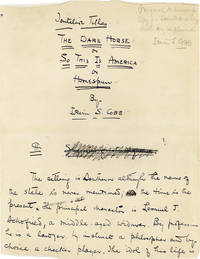
193446764N.p.: S.i. 1934. Holograph manuscript composed in dark blue ink on 152 numbered leaves rectos and housed in a bespoke chemise and slipcase by Barrieri. With presentation inscription from Cobb to MGM film produced and screenwriter Samuel Marx in pencil at upper right corner of title leaf: "Original manuscript copy for Sam Marx Esq / with my compliments / Irvin S. Cobb." A heavily-revised draft with extensive holograph additions and elisions in pencil and in pen throughout marking substantial textual differences between this and the final draft of the screenplay. Mild wear and handling; preliminary leaves with faint creasing to extremities with subtle toning to title leaf; Very Good or better. Slipcase with some light wear and minute board exposure to points around opening else Near Fine. Early unpublished manuscript treatment of the 1939 Paramount Studios film Our Leading Citizen directed by Alfred Santell with a screenplay by Jack Moffitt. A "Capital vs. Labor" story set in a once-small town that has evolved into an industrial city and centered around Lem Schofield an attorney and homespun philosopher and Clay Clinton son of Schofield's deceased partner. Clinton in love with Schofield's daughter and anxious for quick success joins the employ of J.T. Tapley the town's corrupt and influential industrialist. "When Tapley imposes a ten percent wage cut at his factory the workers walk out on strike precipitating a labor war. Lem immediately withdraws as Tapley's attorney but Clay ignorant of the nefarious tactics that Tapley is planning stays on. To crush the strike Tapley calls in a gang of strikebreakers led by Shep Muir. While pacifist union leader Jim Hanna struggles to end the strike peacefully communist agitator Jerry Perkins arrives in town to advocate radicalism and violence. Riots break out and amid an atmosphere of fear and suffering Lem steps in to quell the unrest. After insuring the arrest of agitators Peters and Muir Lem works to institute a labor settlement and Clay finally recognizing Lem's virtues nominates him for the position of United States Senator" TCM. <br /> <br /> While the final script faulted greedy capitalists and violent revolutionaries alike the film was blacklisted by V.J. Jerome head of the communist cultural commission who got an early look at the script and together with film critic Howard Rushmore deemed it potentially anti-communist. S.i. unknown
189544165New York December 8th 1895. Autograph letter signed on recto and verso of single cream laid sheet 22x14.5cm.; approx. 85 words; dated 26 West 61st N.Y. Dec 8th and simply addressed to "Parker" presumably Stanton's friend and fellow-suffragist Parker Pillsbury 1809-1898 who with Stanton had co-edited the women's rights newsletter "The Revolution" twenty years earlier. Faint mail folds small unobtrusive archival paper remnants to two corners from having been previously mounted else Near Fine and still quite fresh. Brief contemporary 1897 pencil note at bottom edge "Mrs. Stanton - born Nov. 12 1815 Now past 82 - C.E.R." though based on contents we would place this letter as having been written around 1895. Brief but significant missive addressed to Parker Pillsbury the American minister and women's suffrage advocate regarding a copy of Stanton's "Woman's Bible" she had just sent him. "I wonder if I could interest them a "Mrs. White" and one other sufficiently in the Woman's Bible to sell ten or twenty copies in there sic respective woman's clubs It is published at my expense hence I am trying to push its circulation." The controversial "Woman's Bible" a series of commentaries pertaining to the portions of the Bible relating to women was published in two parts in 1895 and 1898 and composed almost entirely by Stanton alone her committee of Bible revisors finding the project too controversial and harmful to the cause of women's suffrage. Clearly at the time of writing this letter the book was still meeting with resistance thus our placing the date at around 1895 Stanton turning to Pillsbury as a potential source of influential and wealthy patrons she inquires "Is Mrs. White still living & working Is that rich woman that Mr. illegible used to visit in Maine living". But by 1897 the book had become a best seller though many of the members of the women's suffrage movement would continue to distance themselves from it. This letter quite significant as a testimony to the aging Stanton organizer of the historical 1848 Seneca Falls Convention and her continuing indefatigable efforts and initial lack of support in getting this work circulated. See Tracy A. Thomas "Elizabeth Cady Stanton and the Feminist Foundation of Family Law" 2016 pp. 15 & 223. unknown
12mo. ½ p. In French. Thanking the poet Léon-Paul Fargue for defending Aragon and his friends "against people who are a bit too quick with their tongues and quills". Aragon wrote this charming note with the heading "as soon as possible" after learning of Fargue's "courageous" act from the librarian Adrienne Monnier. With ironic hyperbole, Aragon apologizes for finding "neither clever phrases nor commonplaces", explaining that Fargue's attitude touches him so deeply that he is "reduced to" silence. The note in full: "Je ne veux pas, Monsieur, m'en remettre au hazard d'un rencontre pour vous remercier. Je viens d'apprendre de Mademoiselle Monnier de quelle façon courageuse vous nous avez défendus mes amis et moi contre des gens un peu trop prompts de la langue et de la plume. Excusez-moi de ne trouver pour vous en exprimer [!] ma gratitude ni pharses habiles ni lieux communs. Votre attitude me touche mieux et ne me laisse qu'à me taire". - Louis Aragon and Léon-Paul Fargue were among the numerous important customers and friends of the legendary book dealer Adrienne Monnier. The dispute alluded to in the note might well be the famous rupture between the Dadaists with their leader Tristan Tzara and the new Surrealist group centering on André Breton and Louis Aragon. - Two minor stains. Recipient identified on the basis of a collector's note.