859 132 résultats
83141 13 eaux-fortes en couleurs de Daniel Authouart dont une à double page et un cul-de-lampe. Rouen, Société normande des Amis du livre, 21 avril 1981, in-folio en feuilles sous chemise et étui violet.
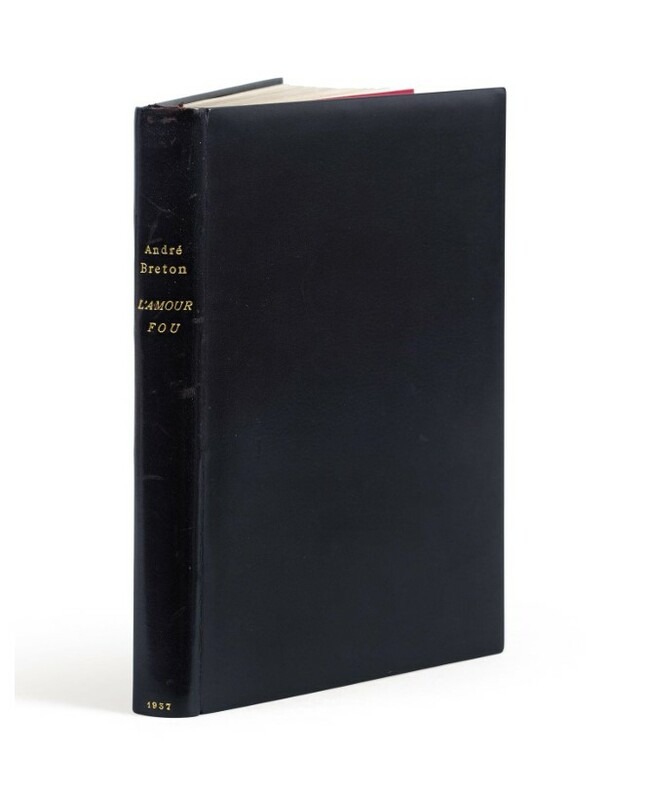
YTB-46Paris, NRF, Collection Métamorphoses, 1937. In-8, box noir, gardes et doublures de papier rose, couvertures et dos conservés, étui. Miguet. 190 x 142 mm. ÉDITION ORIGINALE. Béhar, Dictionnaire André Breton, Classiques Garnier, 2012, pp. 47-52 et 509-510. Elle est ornée de 20 reproductions photographiques à pleine page, dont 7 prises par Man Ray, 4 par Brassaï, et 4 respectivement par Cartier-Bresson, Dora Maar, Rogi-André et N.Y.T. L’un des 35 numérotés sur pur fil, bien complet de l'Errata en fin sur papier fort, après 9 exemplaires sur Japon. Il porte le numéro 11. « De quel type de hasard, ou de nécessité, une rencontre relève-t-elle ? » Based on the objective facts of his meeting with Jacqueline Lamba on 29 May 1934 ("this woman was scandalously beautiful", p. 63) and the beginnings of their love affair, André Breton proposes a meditation on love at first sight, which dispossesses the human being of his reason, on what makes an encounter happen, questions chance, necessity, availability, and launches into a rereading of their love affair by detecting all sorts of concordances, associations, influences, and signs. L’Amour fou est un récit que son titre, d’emblée, place sous le signe de la passion amoureuse et sous celui de la beauté convulsive, expression par laquelle André Breton (1896-1966) avait clos Nadja en 1928. Pour celui qui est sensible aux coïncidences, tout peut faire signe, y compris les faits les plus ordinaires. Importe alors d’être disponible, qu’il s’agisse de l’être à une femme ou bien à cet objet qui, aux puces, parvient à imposer sa présence au chineur… Le désir n’est-il alors pas l’unique ressort de ces révélations ? L’Amour fou commence ainsi par la narration de sa rencontre avec Jacqueline Lamba, comme prédite par le poème « Tournesol » qu’il avait écrit en… 1923. Il est aussi l’occasion d’une déambulation amoureuse nocturne dans Paris, où, au pied de la tour Saint-Jacques, Breton convoque la poésie d’Apollinaire. Il s’achève enfin par l’évocation de sa fille, Aube, née en 1935 de sa relation avec Jacqueline. Il lui adresse une lettre qu’elle lira lorsqu’elle aura seize ans… en 1952 : « ce livre dont j’aime à penser qu’euphoniquement le titre vous sera porté par le vent qui courbe les aubépines…Je te souhaite d’être follement aimée ». EXEMPLAIRE ELEGAMMENT RELIE EN BOX NOIR PAR MIGUET, AUX COUVERTURE ET DOS CONSERVES.
Incisione su rame (2710 x 1110 mm) costituita da 12 fogli uniti al fine di formare un panorama unico. Brunita, restaurata con rimozione di vernice aggiunta nel corso del secolo XIX e rifoderata su tela neutra.
1½ pp. 4to. To a lady who had sent him a manuscript, discussing some questions of form, style, punctuation, plot, etc.
4to. 1 p. In English, to Dr. Andor Klay, on his imprinted stationery: "But isn't it a strange and characteristic phenomenon of the mental condition of the German of today that the author feels he must apologize for me because of my letter to Molo and even because of my broadcast during the war? He says that, after all, one cannot expect me to possess the qualities of a political fighter, - and all the while I had imagined to have indeed been something like a political fighter during the last two decades".
4to. 2 pp. In English, to Dr. Frank Kingdon, President of the University of Newark, on his imprinted stationery: "This is to tell you how happy I am that you accepted the chairmanship of the American Committee for Moral Aid to the other Germany. The idea of contacting the German people directly with the help of such writers, artists, scientists, men of the church who were loved and trusted in pre-Hitler-Germany without ever having been political figures and without having therefore lost part of their prestige, as did all former party leaders, appealed to me from the very beginning. Let me tell you, however, that your acceptance, the certainty of your active participation is giving me a great deal of hope as for the success of our efforts. Letters of invitation to join our German Committee (of which I may serve as something like a Chairman, while my daughter Frik will be its Secretary) are being sent to the following friends and colleagues: Wilhelm Dieterle, Bruno Frank, Professor James Frank, Leonhardt Frank, Lotte Lehmann, Heinrich Mann, Dr. Hermann Rauschning, Ludwig Renn, Professor Max Reinhardt, Renen Schieckele, Professor Erwin Schrödinger, Professor Paul Tillich, Fritz von Unruh, Franz Wefel, Stefan Zweig. As for the American Committee I should wish to leave all decisions to your own judgement [sic]. I would, however, be very glad to discuss details with you as soon as possible. Could you arrange to come here in the near future? Realizing how busy you are I would, of course, be willing to meet you in New York, if this should be more convenient for you. Since, very much to my deep satisfaction, Mr. Paul Willert, President of Oxford University Press has agreed to be the American Committee s treasurer, it might be useful to invite him also to the meeting. All the more so, since, unfortunately, the financial question will be somehow in the foreground of our discussion. On the other hand, there can be no doubt that our chances to really accomplish important effects by what we are trying to do, are much greater than the financial risk involved. Erika is translating this letter for me and although I have full confidence in her ability of making herself understood, I beg your pardon, in case these lines are lacking some qualities of style and language. They are supposed to convey nothing more but my gratitude for your acceptance and my hopes to see you soon".
Neun Strophen zu je vier Zeilen auf 2 SS. 8vo. Stark bearbeitetes Manuskript mit einigen Varianten zur gedruckten Fassung: "Ponchon, vous n'êtes pas raisonnable non plus, | Écoutez ma semonce. | Eh quoi! vous vous rangez dans les gens dissolus | Dont rougirait Alphonse, || Qui font la honte, ayant de l'esprit à gogo, | De toute notre époque. | Notre epoque n'est plus celle du pére Hugo | - Encore un beau loufoque […] Quinze jours de prison pour outrages à la Sainte Magistrature ... | Mais je me trompe: à la morale, et me voilà | Prêt à toute rature. || Car je ne suis pas, moi, comme vous, bon Raoul, | De l'opposante race, | Et que me fait d'ailleurs que tel juge maboul | Soit un pur pederasse […]". - Der Dichter Raoul Ponchon war am 11. November 1891 wegen Beleidigung der öffentlichen Moral zu fünfzehn Tagen Gefängnis verurteilt worden, nachdem am 13. September desselben Jahres im "Courrier français" sein "Reimblatt" mit dem Titel "Vieux Messieurs" veröffentlicht worden war, das in obszönen Versen auf eine kürzlich stattgehabte Sexaffäre anspielte. - Stärker fleckig und mit kleinen Randläsuren; ein restaurierter Falteinriss teils wieder gerissen. Paul Verlaine: Œuvres poétiques complètes. Paris, Bibliothèque de la Pléiade, no. 47, 1938, SS. 946-947 und 1317.
- Alphonse Lemerre, Paris 1910, 12x19cm, relié. - First edition of which there were no deluxe copies ("grands papiers"), statement of second edition on the first cover and no statement of edition on the title page. Binding in half morocco, signed by Goy & Vilaine. Rare handwritten inscription dated and signed by Raymond Roussel to Monsieur Pally. [FRENCH VERSION FOLLOWS] Edition originale pour laquelle il n'a pas été tiré de grands papiers, mention de deuxième édition sur le premier plat et aucune mention d'édition sur la page de titre. Reliure en demi maroquin roux, dos à cinq nerfs, date en queue, tête dorée, reliure signée Goy & Vilaine. Rare envoi autographe daté et signé de Raymond Roussel à monsieur Pally.
195846276Paris, The Olympia Press, (1958). Original printed green wrappers. Green border on title-page. Spine a bit worn, with minor loss of upper layer of paper to hinges and capitals. Light wear to extremities. Lower corner of front wrapper slightly bent. Internally nice and clean.
Paris, The Olympia Press, (1958). Original printed green wrappers. Green border on title-page. Spine a bit worn, with minor loss of upper layer of paper to hinges and capitals. Light wear to extremities. Lower corner of front wrapper slightly bent. Internally nice and clean.
20062081402110005283Not Available 2006. Soft Cover. Fine. Number of books: 1 Not Available paperback
20002111902160307367Showa Women's University Institute of Modern Culture 2000. Soft Cover. Fine. Number of pages: 500 pages average Size: B6 size Number of books: 79 volumes Showa Women's University Institute of Modern Culture paperback
Condizioni dell'esterno: logorata da fattore tempo Condizioni dell'interno: Buone
Meist 1 bis 2 SS. 4to und 8vo. Mit einigen adressierten, teils gelaufenen Briefumschlägen. Briefe zum Theater. 1923: "Herr Direktor [...] Sie sagten mir ganz fest zu, meine 'Klarisa' noch einmal im großen Haus für die Abonnenten zu bringen [...]". - 1923, 2 Postkarten an Erich Marcus: "Doch nichts über Berliner Theater [...] Vielleicht aber etwas über Kultur oder Kultur-Verfall [...]". - 1923, an eine Schauspielerin: "Ich sprach soeben mit Dr. Hilar. Er hat recht gute Stimmung für mein Stück mit Ihnen in der Hauptrolle [...]". - 1924, an Dr. Altmann: "Es würde mich nun sehr freuen, von Ihnen bald zu hören, wie die Situation mit meinem neuen Stück 'Prozeß Bunterbart' ist. Die beste Darstellerin (für mein Gefühl) wäre die Dorsch. Bei der bekannten Saumseligkeit meines Verlages konnte ich aber bis heute nicht erfahren, ob Frau Dorsch (wie ich bat) ein Exemplar erhalten hat [...]". - 1926, an die Schauspielerin Jarmila Kronbauerová: "Hamlet habe ich bei der Première gesehen und darüber schon am 26. November geschrieben. Ich lege die Zeitung bei, aus der Sie sehen, daß Ihre Ophelia für mich eine besondere Freude an diesem nicht durchaus erfreulichen Abend war [...]" (vgl. hierzu Brods Kritik der Inszenierung von Karel Hugo Hilar am Tschechischen Nationaltheater in: Prager Tagblatt, Nr. 278 vom 26. XI. 1926, S. 6). - 1929, an einen Professor: "Ihr Brief hat mich auf die Idee gebracht, das Stück statt in sechs Szenen folgendermassen einzuteilen: 5 Akte und ein Epilog, also ähnlich wie die 'Heilige Johanna' von Shaw [...]". - 1942: "Sehr werter Herr Rabbinowicz, zu meinem Bedauern kann ich Ihnen nichts Günstiges über Ihr Stück mitteilen [...]". - 1943: "Sehr geehrter Herr Weglein, Ihr Stück hat mir sehr gefallen. Es hat Herz und hat Technik - zwei Dinge, die man selten bei unseren Dramatikern vereinigt findet [...]". - 1963: An Eric Spiess, Leiter des Bühnenvertriebs im Kasseler Bärenreiter Verlag: "Ich hoffe, daß Sie meinen eingeschriebenen Brief vom 20. III. und den inliegenden Vertrag über Lord Byron erhalten haben. Mit gleicher Post (doch mit Seepost) sende ich Ihnen [...] zwei Theaterstücke von Sch[in] Schalom, der als einer der bedeutendsten Dichter des Landes Israel angesehen wird. Ich habe über ihn ausführlich in meiner Selbstbiographie 'Streitbares Leben' berichtet, im Schlußkapitel. Das eine der beiden Stücke ('Schüsse auf den Kib[b]uz') liegt in hebräischer Sprache gedruckt vor und wurde in einer von mir stammenden Opernbearbeitung (Musik von Lavry) hier wiederholt mit großem Erfolg aufgeführt. Das andere Stück ist noch unaufgeführt [...]".
8vo. 2 pp. To an unidentified recipient, apologizing for having kept for so long a book about hieroglyphs, and asking whether he might have it again for a period of several days so that he might reread a certain chapter; also, requesting a Coptic grammar and dictionary: "Ich würde gewiß nicht gewagt haben, das Werk über die Hieroglyphen länger zu behalten, wenn mir Hormayr nicht gesagt hätte, daß er es nicht braucht [...] Da Ihre Abreise nach Turin, über die ich mich gerade auch wegen dieser Sache ungemein freue, doch gewiß noch nicht so nahe ist; so würde ich freylich sehr wünschen u. mich ungemein freuen, wenn Sie aus Antrieb eigner Großmuth mir das Buch nochmals auf 3-7 Tage, oder längstens 7 Tage 7 Stunden wiederschicken könnten, um das Chap. IX. nochmals lesen zu können. Daß Sie es eigentlich schon durch u. durch gelesen haben, u. ganz zu Ende, habe ich aus den beygefügten Strichen genug gesehen. Und sonst ist doch niemand hier, den es interessirt. Nun habe ich aber noch eine andre Bitte an Sie: daß Sie mir nämlich die Koptische Grammatik und auch das Koptische Wörterbuch auf eine kurze Zeit leihen möchten [...]".
Paris, 1898. 8vo. Contemporary half calf with five raised bands, gilt spine. Single gilt lines to boards. Capitals and corners worn. Inner hinges a bit weak. With Eugen Zabel's book plate to inside of front board, a postcard depicting Edmond Rostand's residense at Cambo, obviously posttamped on verso, pasted on to front free end-paper, contemporary newspaper-clipping about the numerous performances of ""Cyrano von Bergerac"" around the world pasted in to hinge of fly-leaf, where the presentation-inscription (for Eugène Zabel) is written, and finally, the original handwritten address in Rostand's hand, cut out from the envelope in which the book was sent to Zabel, is pased into hinge of half-title. Internally nice and clean.
Gr. In-4 (200x315mm), [12]-482p. [i. e. 480]. Traduction allemande de Matthias [Philesius] Ringmannn. Illustré de 148 bois gravés dans le texte attribué à Jost Amman [Brunet I, 1462]. Mouillure claire en pied de pages, sans atteinte au texte. Reliure modeste mais solide.
1598127139Paris, Jean Houzé 1598 In-folio 37,5 x 23 cm. Reliure postérieure, dos lisse demi-basane fauve avec report du titre doré, plats en bois sculptés, le premier avec le portrait en pied d’Athena en bas-relief, [6]-889-138-[3] pp., bandeaux, lettrines et culs-de-lampe. Premier plat fendillé, charnières fendillées, 3 premiers feuillets avec réparations marginale et angulaires, mouillure angulaire en continu sur les 100 dernières pages, page de titre postérieure manuscrite.
158215508A Paris, Chez Claude Michard, au cloz Bruneau à la chaire, 1582. In-16 de (19)-588-(1) pp., titre gravé dans un encadrement historié, maroquin citron décoré, dos orné à nerfs, cadres et rinceaux dorés sur les plats, roulettes et dentelles intérieures, tranches dorées sur marbrure (Pagnant).
18671562# AUTEUR: La Fontaine # ILLUSTRATEUR: Doré Gustave # ÉDITEUR: Hachette L. & Cie - Paris # ANNÉE ÉDITION: 1867 # ENVOI, BEAUX PAPIERS: Edition de luxe avec les grandes compositions tirées sur papier de Chine - encadrements et titres imprimés en rouge # COUVERTURE: 1/2 chagrin citron à coins - dos à nerfs finement décoré doré - pièce de titre en maroquin rouge - tête dorée - non rogné # DÉTAILS: 2 volumes in folio reliés T1. 2ff ( faux titre et titre) + LX ( notice sur Jean de La Fontaine, dédicace à monseigneur le Dauphin, préface, la vie d'Esope le Phrygien) + 317pp + 1ff. 43 grandes gravures sur Chine. T2. 2ff + 383pp. 43 grandes gravures sur Chine. Page 133 ” le renard et les raisins”, montées sur Chine sont en 2 tirages: l'une gravée par Hildebrand l'autre par Pannemaker. Belle reliure signée Raparlier. Est joint une lettre autographe signée de 2 pages in 8°, du 29 Octobre 1875, de Gustave Doré: ” A cher monsieur, il regrette de ne pouvoir lui confier l'impression de son livre. Il dit le travail de chaque instant qu'exigent les planches sous la presse. Mais dit cependant la haute estime qu'il a pour ”l'art et le talent typographique de la maison Grant ”. Romain Raparlier relieur à Paris dès 1855 exerça jusqu'en 1880; vers 1885 son fils Paul Romain était installé lui-même 7 rue des Canettes. # PHOTOS visibles sur www.latourinfernal.com
178643473Paris, Royez, 1787 -1786. 2 parties en 1 vol. in-12 de VIII-34 pp. et (35)-75 pp., 3 planches, maroquin noir, dos à nerfs, tranches dorées (Lobstein).
8vo. 421, (17) pp., final blank leaf. Illustrated title-page printed in red and black. With 41 woodcut illustrations after Virgil Solis. Contemporary vellum. All edges coloured. Second Wilde edition of the popular tales of Reynard the Fox, which were widespread across northern Europe from the Middle Ages onwards. This "Baroque retelling" (Menke) in verse, "d'un contemporain inconnu du fameux Zesen" (Graesse), had first appeared in 1650 and was here expanded "by several hundred lines" (subtitle). Virgil Solis' fine woodcut illustrations are repeated from Hartmann Schopper's "Opus poeticum" (1567). - Occasional light browning as common. Wants first flyleaf. Rare. VD 17, 39:120999S. Menke B, 25. Graesse VI/1, 84 (note). Cf. Goedeke II, 322, 3 ("1663"). Not in Jantz or Faber du Faur. Not in Heitz/Ritter.
Aquarellierte Federzeichnung auf Papier. 208:143 mm. Hübsches Portrait des Philosophen und Schriftstellers Voltaire (d. i. François Marie Arouet, 1694-1778) im für den Künstler typischen Trompe-l’œil-Stil.
Zusammen 2 SS. Folio. Mit 2 eigenh. adr. Briefumschlägen. Beide Briefe an den Künstler und Schriftsteller Adi Rosenauer-Kölbl in Traunreut: "[...] Ich werde von der Galerie Dieter Brusberg, 3 Hannover, Friedrichswall 13, im Kubus, vertreten. Dort erschien auch der Werkkatalog 'Altenbourg', den ich Ihnen emprehlen darf [...]" (Brief am 24. April 1972). Im brief vom 12. Juli 1972 berichtet er von einem Aufenthalt im Elstertal: "[...] Die Landschaft dort zeigt ein Gesicht, wie ich es liebe, hügelwärts Wege, Kuppen und Schluchten mit undurchdringlichem Wald bedeckt. Überraschungen für das Auge, Grashänge mit Dornbüschen und überwucherte Lichtungen, alles eng beieinander [...]". - Auf Briefpapier mit Wasserzeichen "Geschoepft Buetten Koenigstein".
8vo. 60 pp. Bound with both original wrappers in later half cloth. First edition. - Provenance: descendants of the Henriques family, in whose home Andersen had been a frequent visitor during the last fifteen years of his life. The house was full of life and happy days as a large circle of both Danish and foreign musicians and artists visited the salons and parties held there. The friendship with the family was established in August Bournonville's home, where the poet first heard the young, talented Therese Henriques (1833-83) playing the piano. Immediately, a warm friendship between the two was kindled, and it would last a lifetime. - A tear to the front wrapper repaired, otherwise fine.