859 132 résultats
4to. 1½ pages. To the journalist and literary critic André Rousseaux (1896-1973) about a discussion of Victor Hugo's poem "Booz endormi" by Charles Péguy (1873-1914), an admirer of Hugo's, considering current poetic criticism in the Revue Critique to be in desperate need of some humor: "Péguy a discuté le coup de Jerimadeth... et je sais bien qu'il aimait Hugo, et qu'il le défendait [...] j'ai voulu simplement dire que le pont-aux-ânes inventé par la Revue Critique ne relève pas de la discussion sérieuse, mais qu'il fallait lui opposer ce vieil humour des familles dont la critique poétique est de nos jours si étrangement démunie [...]". - Further about travelling to Switzerland shortly, having missed the writer Georges Bernanos (1888-1948), who recently visited a mutual friend along with the priest and screenwriter Raymond Léopold Bruckberger (1907-98), mentioning his wife Elsa and himself fleeing Paris due to the Prix Goncourt, and considering a stay in occupied Germany more agreeable than witnessing the award ceremony. Aragon goes on to complain about the silence of the critics regarding his book "Servitude et Grandeur des Français" published three months earlier, and concludes with his intention of allaying his anger by consuming Swiss milk, chocolate, and nescafé, having lost much weight since the war: "Nous partons tout à l'heure pour la Suisse [...] Je n'ai pas vu Bernanos, signalé dans ces pages par les hebdomadaires, et qui est allé avant-hier avec le R. P. Brückberger chez une dame chez qui j'ai été moi hier [...] Elsa et moi avions fui Paris rendre invivable par le Goncourt. Un séjour en Allemagne occupée, zone franque, vaudrait mieux que cette mention peu honorable [...] A part ça, je vous signale le silence croissant fait autour de ce que je publie. 4 articles [...] pour Servitude et Grandeur après trois mois d'envoi du S. P. Pas mal, hein? Parlons de la glorie. Mais comme je pèse 62 kgs, pour 75 avant guerre et 69 en septembre, je vais passer ma bile sur le lait, le chocolat, le nescafé de Suisse [...]".
Large 8vo. 2 pp. on bifolium. With autogr. address. To her sister Lulu Desbordes (Rozier des Bordes), asking her to move Théophile Gautier ("Gauthier"), a friend of her son Siegmund and now in Francfort, to undertake a visit to Berlin: "Da Siegmund hört daß sein guter Freund Gauthier in Frankfurt ist der ihm versprochen hat, nach Berlin zu kommen, daß er jetzt aber dies le[t]ztere Projekt aufgegeben, so läßt er Dich bitten, durch Deine Überredungskunst ihn dahin zu bewegen, seinem Versprechen nachzukommen, er bittet ihn ein Zimmer in unserer Wohnung anzunehmen [...] Alles ist hier wohl, wir hatten einen Augenblick die brillante Idee Du würdest unsern Wünschen entgegen kommen, nehmlich hierher; Berlin ist ein Katzensprung von Frankfurt; indessen kann man mit gutem Gewissen den Aufenthalt von Berlin wen nicht wissenschaftliches Interesse anregt, nicht empfehlen, nur daß die Vier Schwestern [d. s. Gunda von Savigny, Bettina, Lulu und Meline von Guaita] beisammen wären. Meline besucht mich recht oft und recht gern wie sie sagt, obschon ich sehr wenig Mittel habe ihr Unterhaltung zu gewähren, auch Guaita ist sehr freundlich gegen mich [...] Die Zeiten vergehen und ehe wir dran denken, wird der Reisewagen für die gute Meline vorfahren. Dann wird meine Dichte Einsamkeit nicht mehr unterbrochen werden, denn ich hab mich so zimlich gegen allen menschlichen Umgang verschanzt und komme nicht aus dem Hause, jedoch vergeht mir die Zeit sehr schnell, ob es mir auch ein Räthsel ist mit was ich sie verbringe; ich könnte wohl sagen mit nichts; die Zeit muß sein wie ein Fluß wenn er Berg ab strömt so ist er reißend [...]". - In 1856, Théophile Gautier's like-named son published a translation of "Contes bizarres par Achim d'Arnim" (with a preface by his father). - Slightly browned due to paper, small defect on f. 2 from opening the letter (no loss to text); somewhat wrinkled and with small creases in the centerfold.
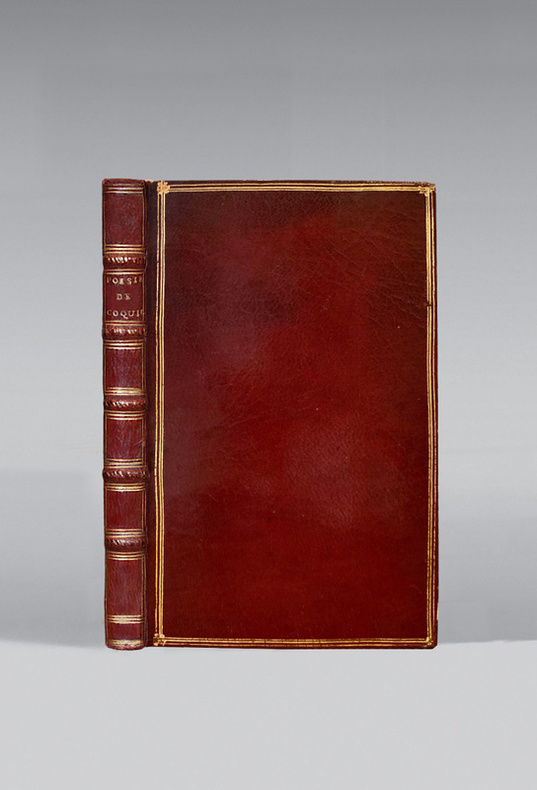
LCS-18203Le Petit Conseil de Genève, scandalisé par l’irrévérence et la gauloiserie des propos condamna l’imprimeur à l’amende et s’apprêtait à défendre à l’auteur de publier de tels écrits, lorsque celui-ci mourut. Au Dezert, Imprimé aux despens de l'Autheur, 1630. In-8 de (6) ff. titre compris et 308 pages, infime manque de papier en marge de la p. 67 sans atteinte au texte, pte. mouillure claire dans le coin inf. de 5 ff. sans gravité. Plein maroquin rouge, triple filet doré autour des plats, dos à nerfs orné, double filet or sur les coupes, roulette intérieure, tranches dorées. Reliure signée de Capé vers 1860. 161 x 96 mm.
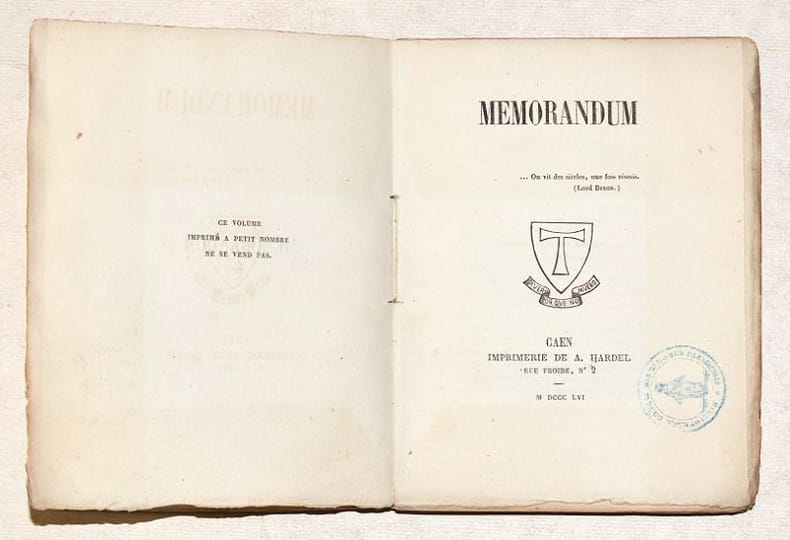
18560001401856 In-16 (122 X 151 mm) broché ; (1) f. blanc, faux-titre, 107 pages, (1) f. blanc. Chemise papier bleu nacré imprimée sur le premier plat à l'identique de la couverture originale, étui noir bordé d'un liseré blanc (Julie NADOT). Cachet encre bleue « Bibliotheca Cong.[regatio] Mis.[sionis] Domus Parisiensis » sur la page de titre. Petit manque à l'angle inférieur droit du premier plat, trace de mouillure claire en tête du premier plat et du premier feuillet blanc, dos fendillé avec légers manques, premier plat détaché (seulement tenu encore par la ficelle de la couture).
2 pp. Oblong 8vo. To [Madame Irma Antonetti of the Italian Cultural Association (Associazione Culturale Italiana) in Turin]. Barthes thanks her for her invitation and tells her he feels the greatest desire to accept it but he has major difficulties with his time management. "Aussi avant de vous répondre, voulez-vous avoir la gentillesse de me préciser d'un mot les villes que je devrais visiter et la durée totale (en jours) de ce voyage?" ("Also before answering you, would you have the kindness to let me know in one word which cities I would have to visit and the total duration of this journey (in days)?"). Barthes promises to answer by return mail. - On headed paper; with punched holes (not touching text).
1 p. 4to. To [Madame Irma Antonetti of the Italian Cultural Association (Associazione Culturale Italiana) in Turin]. Barthes thanks her for her letter and her proposal. He has kept a very good remembrance of his collaboration with the ACI (Associazione Culturale Italiana, Italian Cultural Association). Most unfortunately, he does not travel any more: "la santé de ma mère n'est pas bonne, je dois rester beaucoup auprès d'elle et je ne peux pas envisager aucun déplacement" ("my mother's health is not good, I have to stay close to her a lot and I cannot consider any movement"). - Barthes regrets this very much and thanks Madame Antonetti for having thought of him, expressing his respectful sympathy for her. - On headed paper; with punched holes (not touching text).
1 p. 4to. To [Madame Irma Antonetti of the Italian Cultural Association (Associazione Culturale Italiana) in Turin]. Barthes lets her know that his Italian journey approaches. He confirms that he himself will take the ticket Paris-Turin. He will arrive in Turin Thursday 29 March at 21H47 by train and he will go to Hotel Turin where he will doubtlessly have a note from her. As agreed upon Barthes will leave the other tickets to be taken by Madame Antonetti: by train, surely, from Trieste to Milan as he would like to stop in Venice; doubtlessly by plane from Milan to Rome and from Rome to Bari. Barthes would like to return to Paris by plane on Friday 6 April during the day. Barthes ends his letter by thanking Madame Antonetti for all this and by sending his respectful greetings to her. - On headed paper; with punched holes (not touching text).
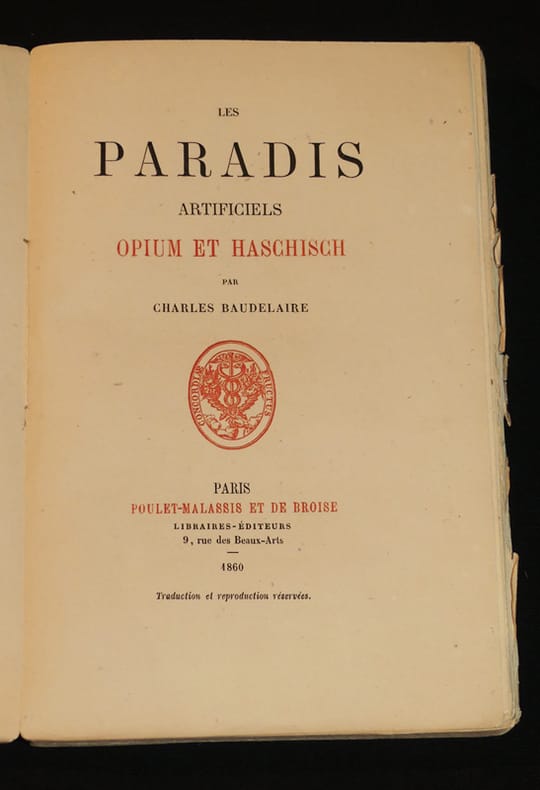
1860va1770Poulet-Mallassis et de Broise Broché sous emboitage 1860 "EDITION ORIGINALE. In-12 (12,7 x 19,2 cm), broché, couverture jaune imprimée, sous chemise cartonnée avec pièce de titre et date au dos, et étui cartonné assorti, 304 pages, exemplaire à grandes marges, avec un portrait ajouté de l'auteur d'après E. de Roy. Edition originale de ce poème de Charles Baudelaire, dans lequel l'auteur explore le lien entre création poétique et drogues. L'ouvrage est structuré en deux parties, dont la première s'intitule ""Le poème du haschisch"" et la seconde ""Un mangeur d'opium"" ; pliures d'usage au dos, quelques petites rousseurs aux plats, mors inférieur de la chemise un peu fragilisé, par ailleurs bel exemplaire. Livraison a domicile (La Poste) ou en Mondial Relay sur simple demande."
¾ S. auf Doppelblatt. 8vo. An die befreundete Journalistin Käthe von Porada in Paris: "Dank für Nachrichten. Wenn Sie am 27 od 28 abreisen, werden Sie am 30. hier sein! Sie vergessen vollkommen, dass wir uns schon im Juli sahen, wir vergessen es beide u. betrachten uns von Neuem. Sie reizender Mensch, ich freue mich riesig Sie wiederzusehn! [...] Schreiben Sie mir bitte noch, wo Sie wohnen werden. Alles andere mündlich. Viel zu erzählen! Jules sandte mir sein neues Buch. Ich verstehe zu wenig français, um es zu beurteilen. Der Prospekt ist reichlich infantil. Adieu u. auf Wiedersehn, cheré, cheré Käthe! [...]". - Auf Briefpapier mit gedr. Briefkopf.
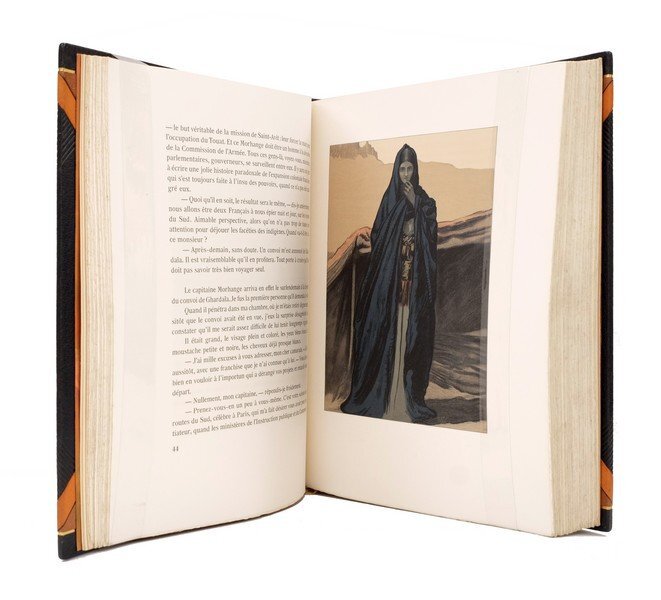
1196Lyon : Cercle lyonnais du livre, 1934. L'ATLANTIDE EN ALGÉRIE, EXEMPLAIRE DE LA BIBLIOTHÈQUE PERSONNELLE DE RENÉ KIEFFER
8vo. 358 pp. Original cloth with blue spine label. First edition of Bernhard's first novel. Punningly inscribed to the Hamburg pianist Ingrid Bülau, who had studied with him at the Mozarteum in Salzburg: "Im Auto / vom Autor / für Ingrid / Thomas / Jänner 64 / Hbg." - Provenance: from the estate of the Frankfurt lawyer Wilhelm A. Schaaf (1929-2015), a specialist in economic, commercial and insolvency law. WG (2. ed.) 7.
2 SS. 8vo. Möglicherweise aus einem Gästebuch oder Freundschaftsalbum. - Beide Einträge datieren aus dem Juli 1905. - Das 18zeilige Gedicht von Franz Blei beginnt "Es drückt dich keine Last, nichts Schweres gab das Leben dir zur Bürde, nicht niedre Demuth und nicht steile Würde - Doch gehst du müde hin und hast den Rücken krumm vom schweren Tragen." - Kubin zeichnete dazu eine andächtig meditierende Figur. - Ursprünglich gefaltetes Doppelblatt, im Falz brüchig. - Vom Vorbesitzer ehemals im Rahmen präsentiert, daher im Passepartoutausschnitt leicht gebräunt.
Meist 1 bis 2 SS., teils mit adressierten und gelaufenen Briefumschlägen. 4to und 8vo. Unter anderem an die Herren Raschert (Anfrage zu seinen Büchern) und Brusch (Hinweis), an ein Fräulein D. Scheuer (zu einem Artikel), Anni Joachim-Daniel (Dank), Hans Zesewitz (Dank), Karl Bachler (Dank und Verabredung), Karl Wache (Dank), Bruder J. K. Fried (Dank und Verabredung), den Verleger Henry Goverts (Dank und Wunsch nach Zusammenarbeit), Uri Naor (Glückwunsch zur Ernennung als Botschafter in Chile), Freund Nack (via Willy Brod, mit Dank und einer Terminabsprache: "Hier war Briefträgerstreit und dann kam eine Überschwemmung in Briefen (täglich an die 40 Stück). Dieses und die Feiern, eine beim Staatspräsidenten in Jerusalem, haben mich sehr angestrengt"), Frank T. Wolfenstein ("Leider besitze ich keine Briefe von Ihrem Vater, auch keine Erinnerungsstücke [...] Tel Aviv würden Sie nicht wiedererkennen. Ich lebe nun mehr als 25 Jahre hier und es gefällt mir immer besser!"), Frau Ruth ("Falls Witriol wirklich solch ein schlechter Übersetzer ist [...]"), der Philosoph Julius Margolin (Dank), ein Dr. Ehrlich (Terminabsprache), eine Frau Gutter (Absage der Aktion betreffend unseres Hausherrn) und ein Dr. Gold (Zusendung eines Artikels). Die maschinschriftlichen (meist geschäftlichen) Briefe mit gewünschten Informationen, Terminabsprachen für Vorlesungen u. a.; die Postkarten mit Buchbestellungen und Dankesworten für Glückwünsche und dergleichen.
1½ SS. 4to. An den Redakteur der "Casseler Zeitung", dem er den ihm befreundeten Musiker Aloys Schmitt (1788-1866) empfiehlt: "Herr Aloys Schmitt von hier, Virtuos auf dem Clavier, der Ihnen diesen Brief überbringt, ist einer meiner besten Freunde, und ich schmeichle mir, daß ihn dieses in Ihren Augen, wenigstens auf so lange empfehlen wird, bis Sie durch die nähere Bekanntschaft dieses ausgezeichneten Künstlers und vortrefflichen Menschen ihn selbst lieb gewinnen und Ihrer Theilnahme würdig finden werden. Auf seiner Kunstreise durch Deutschland führt ihn auch sein Weg nach Cassel, und dieses wird der erste Ort seyn, wo er Konzert geben wird. Ich bitte Sie aufs innigste, meinem Freunde zu seinem Zwecke so behülflich zu seyn als es in Ihren Kräften steht. Vorzüglich erwarte ich von Ihrer Güte, daß Sie, sobald Sie sich von der Kunstvollkommenheit des Herrn Schmitt überzeugt haben werden, ihm eine rühmliche Erwähnung seines Talents in Ihrem Blatte gönnen wollen [...] Wenn Sie eine Neuigkeit, die Sie in Cassel nicht gebrauchen können, mir für meine Zeitung wollten zuweilen zukommen lassen, dann würden Sie mich sehr verbinden [...]". Börne hatte im Jahr zuvor eine eigene "Zeitschrift für Bürgertum, Wissenschaft und Kunst" unter dem Titel "Die Waage" ins Leben gerufen. - Unbedeutende Faltspuren und unbedeutend fleckig, sonst tadellos erhalten.
1¼ SS. auf Doppelblatt. Folio. Mit eh. Adresse (Faltbrief) und blindgepr. Siegel. An seinen Freund und Verleger Johann Christian Dieterich in Göttingen, der ihn eingeladen hatte: "Ehe gestern, liebes Männchen, da deine Citation einlief, war ich in Amts Verrichtungen aus. Gestern hatte ich Gerichtstag und muste mich fast bis um 4 Uhr mit allerlei liederlichem Gesindel herumplacken. Da gab es Hundelochs Schauspiele mit Musik von Ach und Weh und Cetermordio. Heute habe ich mit d[em] H[errn] Gerichts Sch[ulzen] Compe zwischen Obernjesa und Sieboldshausen eine Feld- und Gränzbesichtigung. Sol[l]te ich früh genug fertig werden, so kann es seyn, daß ich noch zum Mittagsessen zu dir komme. Doch hast du weder auf mich warten, noch deine Kochegeister sich mit den sonst schuldigen Delicatessen sich bemühen zu lassen. Nachmittag komme ich aber nach aller Wahrscheinlichkeit. Ich kann aber nicht länger, als höchstens bis Morgen nach Tische bleiben. Sollte mich je ein unversehener Vorfall dennoch an dem heutigen [K]ommen hindern, so werde ich mich doch Morgen wenigstens um 4 Uhr schon auf die Beine machen und dich aus dem Bette hohlen. Ubrigens wird auf Morgen Mittag hiermit eine extrafeine Krebs Suppe, samt Spargel ganz ausdrücklich und ohne allen Mangel beordert. Die übrigen Delicatessen werden zwar deiner Wahl überlassen, allein sie müssen demohngeachtet alle von der Beschaffenheit seyn, daß sie dermalen in Göttingen und Viermeilen auf die Runde nicht besser zu haben sind. Wornach du dich also zu richten und vor großer Ungelegenheit zu hüten hast. Wenn du keine Paquete von besserm Inhalte, als das lezte, zum M[usen] A[lmanach] zu schiken hast, so siehts immer noch sehr übel aus. Das meiste bisherige ist nicht nur Stroh, ohne alles Korn, sondern noch dazu mulstriges Stroh, welches zu nichts weiter, als ins Dünger Magazin dienet [...]". - Etwas fleckig. Joost Nr. 72.
8vo. 1 p. To his friend, the philosopher and essayist Brice Parain (1897-1971), asking him to send him a manuscript by the philosopher Yvon Belaval (1908-88): "[...] envoyez moi le manuscrit de Belaval, qui m'intéresse. J'ai beaucoup d'estime pour ce que fait Belaval. Mais il est vrai qu'il m'a toujours marqué, à cause de ses qualités mêmes, d'une sorte de tranchant. Il reste trop souvent dans la bonne compagnie. Mais il se décidera peut être et alors, ce sera de premier ordre [...]". - Slightly browned. On stationery with printed letterhead of the Nouvelle Revue Française.
186941925Paris, aux bureaux du journal, 1869. 15 livraisons en 1 vol. in-4, percaline gaufrée brune, dos lisse fileté (Ateliers Laurenchet).
8vo. 2 pp. To the German-born actress and singer Marlene Dietrich about the exhausting work on his film "Le Testament d'Orphée" (1960), discussing filming at Saint-Maurice the following day, his return from the Côte d'Azur, where he also filmed a scene and found the Quai de Villefranche in Fréjus had disappeared. He also mentions fond memories of her sitting beside him in a showing of his 1946 film "La Belle et la Bête", writing that he is happy to see her beloved by simple people, and that the higher one climbs the social ladder, the less kindness one meets: "Triste loin de toi enfermé dans cette besogne épuisante du film que je joue, monte et mixe moi-même. J'arrive de la côte où je devais recommencer une prise et j'ai respiré le drame de Fréjus. (Le quai de Villefranche a disparu comme un domino tombe d'un table). Demain je tourne encore à Saint Maurice [...] et chaque fois que j'entre dans la salle du projection je pense à toi, amie auprès de moi pour la Belle et le Bête. Je suis profondément heureux de ton succès et de te savoir aimée par les simples - car plus on monte dans l'échelle sociale moins on rencontre de gentillesse [...]". - Small brownstain.
LCS-17818Précieux et magnifique exemplaire, très grand de marges (hauteur 157 mm) conservé dans son maroquin rouge de l’époque. A Paris, Imprimerie Antoine-Urbain Coustelier, 1723. 1 volume petit in-8 de (3) ff., 184 pp., (2) ff. Plein maroquin rouge, triple filet doré autour des plats, dos à nerfs finement orné de même, filet or sur les coupes, roulette intérieure, tranches dorées sur marbrures. Reliure de l’époque. 157 x 98 mm.
Tirage de tête , édition numérotée N° VI , un des 100 exemplaires sur Hollande Van Gelder , broché remplié sous 1° cartonnage toilé or et bleu marine , comprenant pièce de titre , auteur et tomaison ; se glissant sous étui de même facture . Pages non découpées , composées d'une succession de feuillets brochés , grands et petits de marge . Les aquarelles en couleurs , dessins et portraits sont lithographiées , oeuvres d'un artiste par volume : Marcel Roche , Adrien Bagarry , André Villeboeuf , Edy Legrand , F. Quelvée , Dignimont , Piot , Jeanne Rosay...L'intégralité de l'oeuvre de ce grand prosateur dont l'accent chantant illumine le style est accompagnée de pages inédites de critique dramatique et de l'ensemble de ses pièces de théâtre . Une merveille , rare en 27 volumes et de grande qualité . Port compris pour la France hors DOM TOM . ensemble de 40 kg , emballé en plusieurs colis ou possible à la Librairie sur RV . Livraison envisageable dans le Sud de la France .
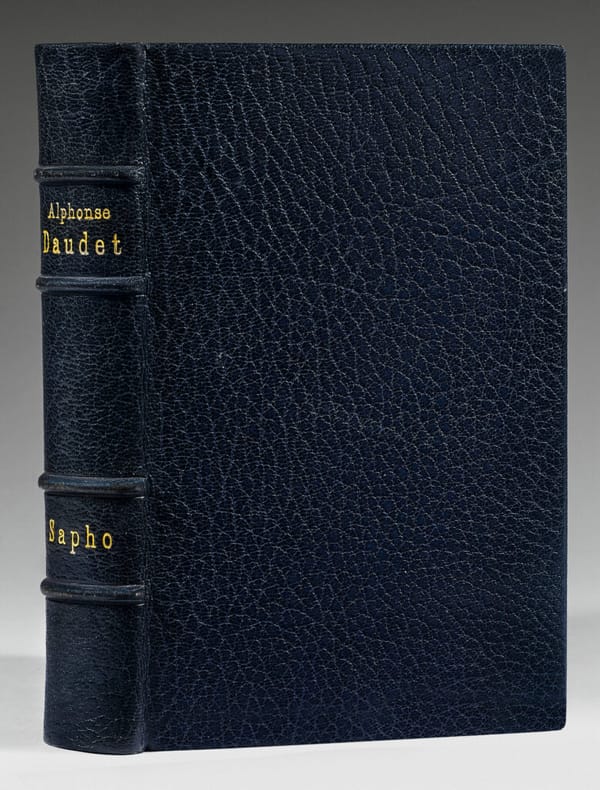
LCS-18315Précieux exemplaire dédicacé par l’auteur de ce classique de la littérature provençale, conservé dans sa reliure de l’époque. Les grandes originales de Daudet dédicacées sont recherchées. Paris, Alphonse Lemerre, 1873. In-12 de (4) ff., 258 pp. Pt. manque de papier dans la marge blanche sup. des pp. 233-235, qq. rousseurs. Demi-veau bleu nuit, dos lisse orné de fleurons dorés, tranches mouchetées. Reliure de l’époque. 176 x 111 mm.
LCS-18579Bel exemplaire de ce classique de la littérature provençale, relié à l’époque avec les couvertures jaunes conservées en maroquin doublé de maroquin par Marius Michel. Paris, G. Charpentier, 1884. In-8 de (4) ff. dont 2 bl., 337 pp. Maroquin bleu Janséniste, dos à nerfs, filet intérieur doré, doublures de maroquin havane, gardes de tabis bleu et or, tranches dorées sur témoins, couvertures jaunes reliées. Reliure signée Marius Michel. 185 x 115 mm.
8vo. 157, (1) pp. Publisher's original cloth with title to spine and front cover. First edition. - Inscribed by Döblin on the front flyleaf, a full-page quotation to Else Franke, dated Berlin, 30 May 1923: "Wir haben viele Seelen / und eine soll die andere / kennen. Laß Deine linke / Hand wissen, was Deine / rechte tut [...]" ("We have many souls, and one shall know the other. Let thy left hand know what thy right hand doeth"). Signed as "Linke Poot" and with his real name. Else (Leonie) Franke (née Stein, 1893-1958) was the wife of the Leipzig-born satirist and writer Walther Franke (later known as Franke-Ruta, 1890-1958), one of Döblin's friends among Berlin's literary scene. - The novelist, essayist, and physician Döblin, one of the principal figures of German literary modernism, is best known for his 1929 novel "Berlin Alexanderplatz". Georg Kaiser (1878-1945) was the Weimar Republic's most widely performed playwright until he was banned by the Nazis. - Slight brownstaining; extremeties somewhat bumped. WG² 17.
4to and 8vo. Altogether 6½ pp. on bifolia. With autograph addresses and traces of seals. Together with a manuscript attributed to the recipient of the letters, Alexandre Colin, and a letter to Colin concerning Farcy. Collection of three rare and insightful letters from Farcy’s correspondence with the painter Alexandre Colin, written during his extensive travels. The earliest letter was sent from Naples, towards the end of Farcy’s sojourn in Italy. He and Colin had been travelling together until Colin fell ill and was forced to return to Paris. After apologizing for not having written in a while and jokingly scolding his friend for the same negligence, Farcy assures Colin that he did not miss much in Sicily: "I believe that you, as a painter, do not need to have many regrets about leaving without having had time for this tour. There is, in fact, complete nullity in terms of male costumes, extreme poverty among the women, and little beauty in general. It would have been better for you to see the peasants of the Abruzzi who now abound in Naples with their goatskin bagpipes" (1 Oct. 1827). - The second letter was written aboard the brig "George & Mary" in Gravesend, ahead of Farcy’s crossing to Brazil: "before parting to go I know not where and to return I know not when, at least I want to bid my final adieux from the bottom of my cabin" (2 June 1828). Farcy gives a bitter assessment of his two-month stay in London: "Among this vain and disdainful people one must present oneself with advantages at least equal to those they possess. I have never felt a greater need to be wealthy. This is the indispensable condition for living here, at least if one lives in London. Otherwise you just vegetate, or rather dry up on your feet. I admired London, I considered it the most beautiful and the most powerful city in the universe. But to me it has been nothing but a magnificent prison". For Farcy, London compares very unfavourably to Italy in terms of inhabitants, climate, and cost of living. But, as a true romantic, he also deplores that he and Colin could not see Italy "for the first time" again. In closing, Farcy mentions a visit to the studio of a painter and printmaker called West, probably Raphael Lamar West (1766-1850), who "appeared to be very touched by your memory". Alexandre Colin had spent several months in London in 1825 and participated in several exhibitions between 1829 and 1851. Apparently Colin wanted West to participate in his upcoming exhibition at the Royal Academy but, according to Farcy, he "had not painted anything for the exhibition". - In April 1829 Farcy returned from Brazil to France even more disillusioned than when he had left London. Writing Colins from Brest in order to announce his return and to ask his friend a favour, he makes a bleak statement about the journey and describes his final itinerary to Paris via the Loire valley: "I have returned once more but after a trip without pleasure or any advantage. In a few days I will be in Paris and I promise myself to see you again among the first [...] I expect to stop in Nantes, Tours, and Blois, and your letter will have time to reach me at that village [...]" (Brest, 22 April [1829]). - Jean-Georges Farcy studied philosophy at the École normale de la rue d’Ulm under Victor Cousin and Théodore Jouffry. When the school was shut down in 1822 because of its liberal agenda, Farcy started work as a private instructor. He found employment with the Russian aristocrat Madame Narischkin, who is mentioned in the letter from Naples. In 1826 Farcy started his restless travels, first heading south to Italy. After a short return to Paris in 1828 he went to London. Being unable to gain access to British society and utterly disappointed, Farcy embarked for Brazil. He only spent a few months in Rio de Janeiro before returning to France for lack of possibilities. Jean-Georges Farcy’s final adventure took place in Paris, as he participated in the July Revolution of 1830. He died on the third day of the successful insurrection against King Charles X, fighting alongside his friend Émile Littré. - The manuscript is a tribute to Farcy written on the occasion of the first anniversary of his death. The author of the emotional text states that he was in London when the news of Farcy's "glorious end" reached him. This agrees well with the biography of Alexandre Colin, who had an exhibition at the British Institute that year. - The letter to Colin by J.-M. Dargaud is a request for a copy of one of Colin's portraits of Farcy. Dargaud calls Farcy his "old friend" and explains that the portrait he used to have, probably a lithograph, was torn from his copy of the "Reliquae", Farcy's only (and posthumous) monograph. Colin portrayed his friend at least twice; the posthumous second portrait shows Farcy as a revolutionary. Both oil paintings are in the collection of the Musée Carnavalet. Three pencil sketches on the back of the letter are probably from Colin’s hand. - All letters with traces of folds and tears from breaking the seal. The letter from Gravesend somewhat brittle and with a restored tear affecting the text; the letter from Naples with minimal foxing and a restored tear; the letter from Brest with two restored tears. Manuscript with several minor tears and restorations. The letter to Colins with traces of folds, restored tears and stains.
LCS-18376Précieux exemplaire imprimé sur grand papier vélin, comportant les figures de Moreau avant la lettre. Paris, Imprimerie de Firmin Didot frères, 1833. 4 tomes en 4 volumes in-8 de : I/ xv pp., 376 pp., 4 planches hors texte protégées par des serpentes ; II/ (2) ff., 411 pp., 2 planches hors texte, protégées par des serpentes ; III/ (2) ff., 356 pp., 2 planches hors texte, protégées par des serpentes ; IV/ (2) ff., 444 pp., 4 planches hors texte, protégées par des serpentes. Demi-maroquin vert à coins, dos à nerfs richement ornés, tranches peigne. Reliure de la seconde moitié du XIXe siècle. 231 x 141 mm.