VILLON - GHIKA Tiggie,MareMagnum

152 160 résultats
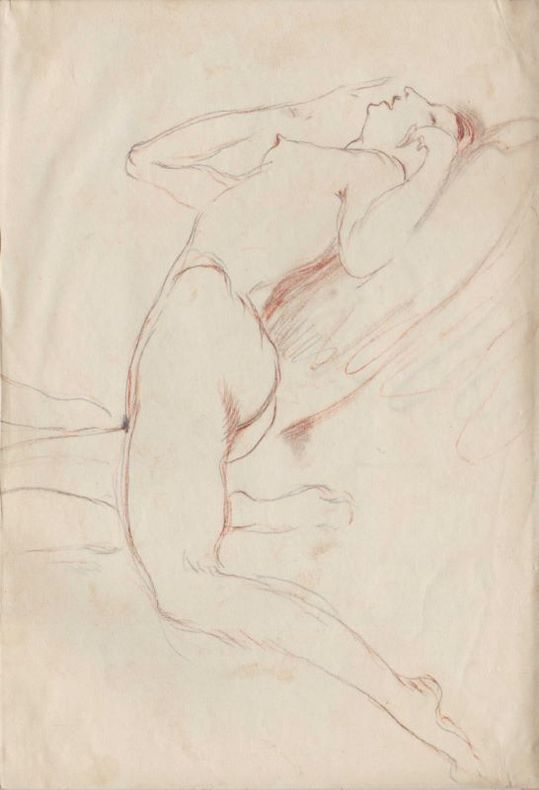
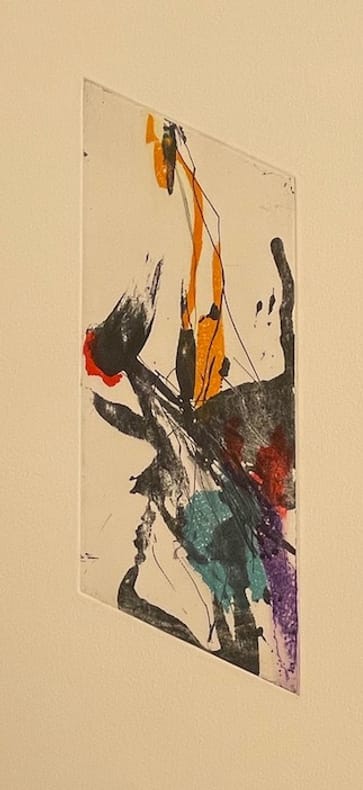
Poème de Tiggie Ghika traduit par Jacques Dupin et orné de 3 pointes sèches originales par Jacques Villon (cm da 23x11; 23x16) Achevé d'imprimer, le texte composé à la main en Garamont italique de 24 de la fonderie Deberny et Peignot par l'imprimerie Tournon et les pointes sèches par les ateliers G. Leblanc à Paris. Folio. pp. 32 n.n.. . Ottimo (Fine). . Edizione originale di 200 es. numerati. .
192321008LEMERRE 1923 2 Etudes et Préludes, Cendres et Poussières, Evocations, Sapho, La Vénus des Aveugles, Les Kitharèdes, A l'heure des mains jointes, Sillages, Flambeaux éteints... Paris, Alphonse Lemerre, 1923-1924, 2 volumes in-8, brochés, couvertures titrées rempliées, sous-étui, de papier reliure, 244 et 267 pages.
Prima e unica edizione inglese, vivente l’autore. Più che buon esemplare (copertina recuperata e applicata su tela, con dorso molto lacunoso e usura ai bordi; interno in ottime condizioni). Fogli di guardia in carta gialla, con ex libris «Major Bryan Palmes» al contropiatto anteriore. Si tratta di un’edizione pirata esemplata in poche copie (circa un centinaio) sulla seconda emissione della quinta edizione, ovvero quella che nel 1872 accorpa ai ‘Leaves’ Washington 1871 il ‘Passage to India’ dello stesso anno (legando insieme i fascicoli dell’una e dell’altra e mantenendo frontespizio e paginazione autonoma). L’edizione pirata è riconoscibile per la tela di copertina, in tutto diversa da quella originale verde, per l’aggiunta in fine del poema ‘After All, Not To Create Only’ (anch’esso con propria numerazione) e per una serie di specifici rilievi filologico-testuali. -- La raccolta di poesie ‘Leaves of Grass’, apparsa la prima volta nel 1855 con solo dodici poesie, conta almeno sette edizioni importanti (notevolmente aumentate e modificate) pubblicate per cura dell’autore: la quinta edizione rappresenta uno stato abbastanza vicino alla forma definitiva, se non altro per i titoli inclusi. Myerson, Whitman Bibliography, A2.6 bind. A
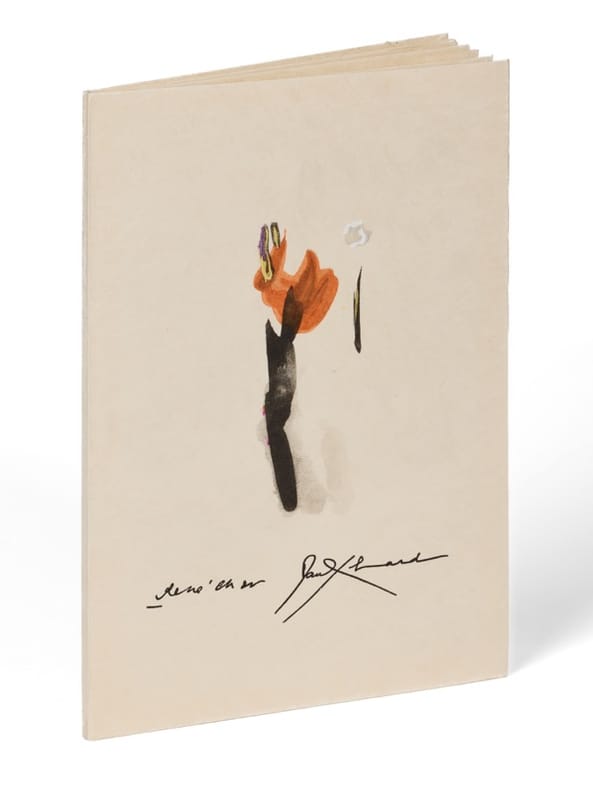
196016604Exemplaire sur japon avec envoi Paris, Jean Hughes, (3 août) 1960. 1 plaquette (165 x 250 mm) non paginée de 2, [8] et 3 f. Broché, chemise et étui. Edition originale. Portrait photographique d'Éluard en frontispice et illustration réhaussée à l'aquarelle par René Char en couverture. Un des 50 premiers exemplaires sur japon (n° 3). Envoi signé : « pour Edmée Maus, ces poèmes fraternels. René Char ».
187918644Paris, Tresse, 1879. In-12 de [6]-II-279 pages, plein maroquin chamois-caramel, dos à nerfs, double filet doré sur les coupes, roulette et filets dorés encadrants les contreplats, tranches dorées, couvertures et dos conservés. Reliure signée Affolter.
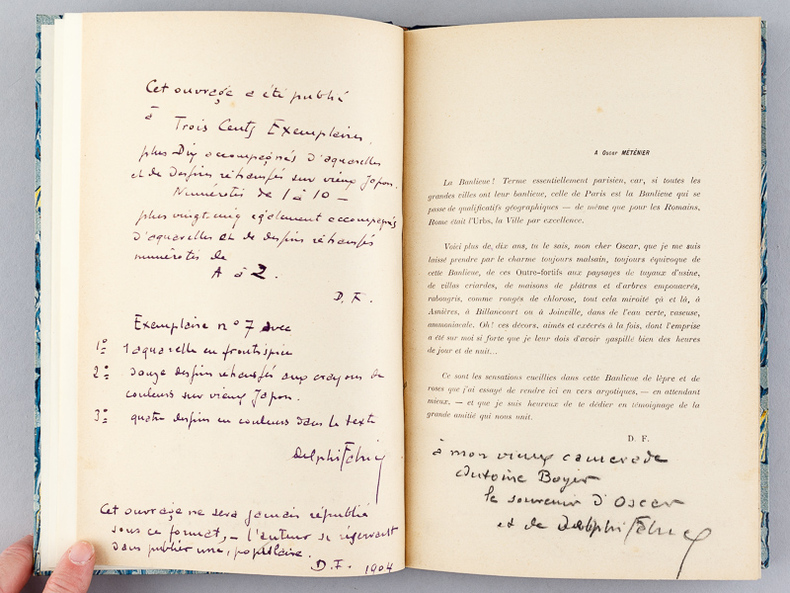
190457201Un des 10 exemplaires sur Japon accompagné d'aquarelles et de dessins rehaussés : Exemplaire n° 7 justifié à la main par l'auteur, contenant une aquarelle en frontispice, douze dessins rehaussés aux crayons de couleurs sur vieux Japon, quatre dessins en couleurs dans le texte, 1 vol. grand in-8 cartonnage bradel postérieur demi-percaline bleue, couverture conservée, Malot, 1904, 28 pp. et 2 ff. (l'avant dernier f. blanc sur vieux japon)
1914007791London: John Murray 1914. Book. Near Fine. Hardcover. SIGNED AND INSCRIBED BY AUTHOR. Later Edition. 16mo - over 5¾" - 6¾" tall. Presentation Copy SIGNED AND INSCRIBED by Harry Gordon Selfridge front end page of Vol. 1 - "To Mrs. Skidmore With best wishes from H. Gordon Selfridge Wed. April 6 1921". Harry Gordon Selfridge was the founder of Selfridges department store in London whose innovations revolutionized English merchandising and created a fortune for him. His life is the subject of the popular PBS TV series "Mr. Selfridge" starring Jeremy Piven. This set contains eight volumes bound as four from the Edition in 17 Volumes lacking Vols. 13 and 17 as follows: Pauline-Sordello Vols 3 & 4 bound in Vol. I Vols. 5 &6 and 7 bound in Vol. II Vols. 8-10 and Vols. 12 & 13 bound in Vol. III and Vols. 14 & 15 and Vol. 16 with General Index bound in Vol. IV. In signed Riviere & Son fine binding of half vellum over powder blue buckram the backs richly gilt top edges gilt marbled end pages Near Fine light soiling to vellum scant toning at illustrations. Each of the eight volumes have a different tissue-guarded frontispiece engraved portrait of Browning. Most likely a unique set especially bound for presentation by Selfridge as no other similarly bound sets published by John Murray appear in the current market or in auction records. John Murray Hardcover
1898BB0526Boston New York London: Lamson Wolffe and Company 1898. First Edition. Hardcover. Near Fine. First English Edition inscribed in an elegant hand by the translator on front fly-leaf: “Compliments of / Howard Thayer Kingsbury / November 1898.†Small 8vo: 2411pp. Publisher's original red cloth lettered and decorated in silver to spine and upper board with frontispiece portrait tissue guard still present of the actor Richard Mansfield in costume. A Near Fine or better spine slightly faded though silver remains bright and darkened page edges. Very scarce particularly in this condition. Cyrano de Bergerac was first published in France by Charpentier et Fasquelle in 1898 following its stage production at the Porte Saint-Martin Theater in Paris on December 28 1897 and first translated into English by Kingsbury for Lamson Wolffe the same year. Mansfield was the first actor to play Cyrano in the United States in an English translation. The play is based loosely on the life of Savien de Cyrano de Bergerac 1619-1655 Rostand’s favorite writer. "Yet the character as portrayed by Rostand – with his excessively-enlarged nose his almost super-human duelling skills and his ability to improvise eloquent poetic speeches – is far from an exact portrait of the real-life Cyrano of the seventeenth century. . . . Possessed of a keen intellect with an insatiable appetite for reading and for learning he constantly experiments with when he is not challenging outright the established social scientific political and religious ideas of his day. This questioning satirising and ridiculing of contemporary authorities along with an open-mindedness to new concepts that remains strikingly modern has earned Cyrano a firm place amongst the libertin writers of seventeenth-century France." Literary Encyclopedia N. B. With few exceptions always identified we only stock books in exceptional condition carefully preserved in archival removable mylar sleeves. All orders are packaged with care and posted promptly. Satisfaction guaranteed. Fine Editions Ltd is a member of the Independent Online Booksellers Association and we subscribe to its codes of ethics. Lamson, Wolffe and Company hardcover
Good Turkish, Ottoman (1500-1928) Contemporary burgundy cloth bdg. Marginal stains on the front board, foxing on pages, period repairs on some papers' margins. Otherwise a good copy. Stamp of "P. I. Kaia Bibliothek" on title page. With an exceptional provenance, from the collection of "S. Kiiliççioglu", who was a collector of books in Ottoman Turkish related to Asia and China. Roy. 8vo. (24 x 17 cm). In Ottoman script (Old Turkish with Arabic letters). 192 p. The very rare first Turkish edition of the narrative of a Hungarian-Jewish polyglot orientalist and traveler's first-hand account as a spy in the British service in disguise through Central Asia. This work was translated by Abdülhalim (1794-1882) who was the father of the famous Turkish writer Samipasazâde Sezai, fifteen years later he met Vambery first in the Rifat Pasha's Konak [ie. Mansion], while Vambery was teaching linguistics. With his journey paid for by Baron József Eötvös, in 1857 he set off for Istanbul, where there was a network of (quarrelsome) Hungarian émigrés. He survived, first, as a cook's lodger in Pera, then in a cold, damp cellar of the Hungarian Association. To make ends meet he sang Ottoman ballads in the meyhanes, wearing Turkish costumes and calling himself, eventually, Reshid Efendi. Then he climbed, went over to Stamboul, the old city, and was taken up by the Rifat Pasha family, to teach the sons (Raif Bey and his elder brother) Western ways. The journey lasted six months and was very dangerous. There were deserts to cross, with bandits, extreme thirst, and sandstorms. Vámbéry and his companions were holy beggars, dependent on charity for survival, but rumours went about that "hadjis" returning from Mecca had concealed treasure, and it was difficult to find boatmen who would take them across the Caspian without being well paid. All the while Vámbéry kept up his alias as a Turkish dervish, past Russians already suspicious of interlopers; and at the end of the road were emirs, in Bokhara, Samarkand, and Khiva, who put foreigners to death or threw them into a snake pit. However, Vámbéry had the presence of mind and the panache for which Budapest Jews are famous and passed himself off. He encountered the Emir of Khiva, who took an interest in him, and they discussed the possible links between the languages. Sorrowfully they concluded that there was nothing much in it - the music perhaps? The emir produced a court orchestra that made native noises. Vámbéry was asked to sing some of his own native music and produced excerpts from Don Giovanni. He went back via Samarkand and the tomb of Tamerlane to Iran, returned to Budapest, and then got himself to England. British representatives in Tehran had become very interested in his activities. Russian railway-building had gone ahead, and within a few years, the Russians had taken over Central Asia - Samarkand in 1868, and Khiva in 1873. The British were alarmed... (Cornucopia). Vámbéry met Dickens (they regularly lunched at the Athenaeum) and he seems to have inspired Matthew Arnold's most famous poem, Sohrab and Rustum. When he wrote his Travels in Central Asia, the publishers were Byron's and Scott's John Murray, the firm to be published by, though they drove a hard bargain. The Travels sold 24,000 copies. "Vámbéry became an instant celebrity in London and the public's fascination with his adventures and linguistic prowess created a huge demand for his original work upon publication in 1864." "I have divided the book into two parts; the first containing the description of my journey from Teheran to Samarcand and back, the second devoted to notices concerning the geography, statistics, politics, and social relations of Central Asia." (From the preface of Vambery for the original edition). Özege 2391.
Very Good Turkish, Ottoman (1500-1928) Contemporary cloth bdg. Rebacked spine. Roy. 8vo. (23 x 14 cm). In Ottoman script (Old Turkish with Arabic letters). 143 p. Slight tear on two leaves, wear on extremities of original marbled boards, otherwise a good copy. Early printed edition of this exceedingly rare collection of early Ottoman erotic poems of homosexuality and bisexuality, of the 18th century including the multiple works of Enderunlu Fazil and Sünbülzâde Vehbi. This book includes five works originally: Defter-i ask [i.e. The book of love] (pp. 1-21); Hubannâme [i.e. The book of male lovers] (pp. 22-55); Zenannâme [i.e. The book of beautiful women] (as well as "Çenginâme" of Fazil Bey in Zenannâme, pp. 102-111); and Sevkengiz [i.e. Inspiring] (pp. 112-143). "Defter-i ask" [i.e. The book of love] by Fazil, in which he tells about his own romances, is a mathnavi of 438 couplets. It begins with a description of divine love and tells the story of the poet's romances, which he fell into only to regret and repent afterward. "Hubannâme" [i.e. The book of male lovers] consists of 796 couplets with various titles and it has a mystical analysis of beauty in the first chapter. After an introduction that gives geographical information that may be considered novel for its period, it describes the beauties of male bodies in many countries from India to America. This style is unique and the first in Turkish / Ottoman literature. In the work titled "Zenannâme" [i.e. The book of beautiful women], which is a mathnavi of 1101 couplets, women of various nations are described. The poet indicated in the introduction of his work that he does not want to talk about women, and that he has no orientation towards women. Enderunlu Fazil was an Ottoman poet who depicted the beauty of men from various lands of the Ottoman Empire. He achieved fame through his erotic works, which were published posthumously. Among his most famous works is The Book of Women, which was banned in the Ottoman Empire. The book describes the advantages and disadvantages of women from different nations. Fazil was born in Acre into an Arab family originally from Medina. He spent his early years in Safed in Ottoman Palestine. His grandfather Zahir al-Umar and his father Ali Tâhir were both executed (in 1775 and 1776, respectively ) for participating in a rebellion. After his father's death, Fazil moved to Istanbul. There, he was admitted to the Enderun palace school (thus taking on the name Enderuni or Enderûnlu) but was expelled in 1783 as a result of his love affairs with other men there. In 1799, he was exiled to Rhodes because of his satirical writings and was only allowed to return to Istanbul after becoming blind. He spent the rest of his life there, ill and bedridden. Sümbülzâde's "Sevkengiz" [i.e. The Inspiring] is an erotic and mystical poem in which heterosexual and bisexual narratives compare male and female beauties and eventually turn to divine love. It has 770 couplets in the "münâzara" genre. Özege 7711.
Very Good Turkish, Ottoman (1500-1928) Paperback. Cr. 8vo. (20 x 14 cm). In Ottoman script. 127, [1] p. The long period of Turkish war, (1911-1922), the efforts to establish the foundations of the new state and introducing new principles to the public, and making them adopt these principles naturally reflected on literature. By the 1930s, however, new republican literature had emerged and was developing in many directions. Nazim Hikmet Ran, a socialist poet who later moved further 'Left' and in 1951 immigrated to the SovietUnion, was already looking beyond the Kemalist Revolution and was anticipating class struggle of the industrialist period. Ironically, this communist poet, who brought so-called classical Marxist humanism into Turkish literature in free verse, wrote the most moving saga of the Turkish War of Independence. Within a few years of his death in the Soviet Union in 1963, his works had been translated into virtually all languages. In contrast o this romantic revolutionary, Yahya Kemal Beyatli constituted a one-man neoclassical school, and Ahmet Hasim wrote a highly colorful symbolist verse under the influence of the French Parnassians. Both poets used the classical quantitative meter and Ottoman vocabulary yet became very popular by appealing to the nostalgia of people who had grown tired of didactic concerns. In reaction to the stereotype, didactic currents in poetry emerged in Seven Torchbearers (Yedi Mes'aleciler), a group that called for experimentation and new departures in the stanzaic and syllabic poetic medium. The group succeeded in bringing about a revolution in poetry; they gave particular encouragement to young poets, whose works they published in their literary reviews. Yedi Mesale movement, after the literary community of Fajr-i Âti, in 1928, seven young people such as Yasar Nabi Nayir, Sabri Esat Siyavusgil, Muammer Lütfi Bahsi, Kenan Hulusi Koray, Ziya Osman Saba, Vasfi Mahir Kocatürk, Cevdet Kudret Solok wanted to start a movement by publishing this book. In the issue of Servet-i Fünun Magazine dated March 22, 1928, they declared that they will publish a book named "Seven Torches". The book is published in April and attracted great attention. The foreword written in the book tells what they will do in the literary field. Contents of this book: Sabri Esat Siyavusgil: Kukla Oyunu [i.e. Puppet game], Yasar Nabi Nayir: Sairin Bahçesi [i.e. The garden of the poet], Vasfi Mahir Kocatürk: Daglarin Derdi [i.e. The suffering of mountians], Ziya Osman Saba: Sebil ve Güvercinler [i.e. The fountain and the doves], Cevdet Kudret Solok: Cenaze ilahisi [i.e. Hymn for funeral, Kenan Hulusi Koray: Denizin Zaferi [i.e. Victory of the sea] (only writer of the story of the group), Muammer Lütfü Bahsi: Dante'nin Ruhuna [i.e. For the soul of Dante]. Ahmet Hasim supported them in the Mesale Dergisi [i.e. Torch Magazine] which was published two months later. The Seven Torchbearers, who continued almost the same thoughts until the 1935s, then proceeded in line with their artistic identity. They wanted to overturn the old generation to underestimate them. They argued that Turkish Literature had been imitating eastern literature for centuries and Western literature after Tanzimat and that it is time to return to itself. This rare book includes a "Mukaddime" [i.e. Introduction] which is a manifest as well. Özege 22927.; Seven institutional copies in OCLC: 553030426 / 642977899 / 976872726. First and Only Edition. Signed and inscribed by Cevdet Kudret Solok. Extremely rare.
- K éditeur, Paris 1948, 13,5x19,5cm, broché. - First edition of this issue about Antonin Artaud, one of 50 numbered copies on chiffon du Marais, the only large paper copies. Texts by Antonin Artaud, Georges Braque, René Char, Charles Dullin, Jacques Audiberti, Camille Bryen, André Pieyre de Mandiargues, Arthur Adamov... A good and rare copy. [FRENCH VERSION FOLLOWS] Edition originale de ce numéro consacré à Antonin Artaud, un des 50 exemplaires numérotés sur chiffon du Marais, seuls grands papiers. Textes d'Antonin Artaud, Georges Braque, René Char, Charles Dullin, Jacques Audiberti, Camille Bryen, André Pieyre de Mandiargues, Arthur Adamov... Agréable et rare exemplaire.
- Chez Antoine-Augustin Renouard, à Paris 1817, 13,5x23cm, 12 volumes reliés. - Later edition of the works of Pierre Corneille with a commentary by Voltaire. Contemporary half green Russia over paper boards (a little rubbed), spine with gilt Restoration typographic motifs. A little foxing. The set is illustrated with a frontispiece portrait of the author drawn and engraved by Auguste de Saint-Aubin and 25 hors texte figures by Jean-Michel Moreau. A very good complete set of the works of Pierre Corneille in contemporary half Russia. [FRENCH VERSION FOLLOWS] Nouvelle édition des oeuvres de Pierre Corneille avec des commentaires de Voltaire. Reliures en demi-cuir de Russie vert, dos lisses ornés de filets et de motifs typographiques dorés de type Restauration, plats de papier un peu frottés. Reliures de l'époque. Quelques rousseurs. L'ensemble est illustré d'un portrait de l'auteur en frontispice dessiné et gravé par Auguste de Saint-Aubin et de 25 figures hors texte par Jean-Michel Moreau. Bel ensemble complet des oeuvres de Pierre Corneille établi dans une reliure de l'époque en demi-cuir de Russie.
Un des 75 exemplaires sur papier du Japon de la Manufacture Impériale (n° 56), 1 vol. in-12 reliure de l'époque plein maroquin vert à semis de lys, coupes et chasses richement ornés, gardes de moire rose, Arthème Fayard, Paris, s.d. [ 1924 ], 221 pp. Magnifique reliure aux fleurs-de-lys établie par le grand reliure Léon Gruel, pour cet exemplaire du tirage de tête de l'édition originale sur papier du Japon. Bel exemplaire. Français
1892bf5521Librairie Léon Vanier Sélection Abraxas-libris Broché 1892 RARE EDITION ORIGINALE DE LA PREMIERE EDITION COLLECTIVE DES ILLUMINATIONS ET D'UNE SAISON EN ENFER ; In-12 (12 x 19 cm), broché, 151 pages, partiellement coupé, édition originale peu commune de la première édition collective des Illuminations et Une saison en enfer, préfacé par Paul Verlaine (reprise de la première édition des Illuminations) et publié quelques semaines après la mort de Rimbaud le 10 novembre 1891, truffé de nombreuses coupures de catalogues recensant différentes éditions (relié notamment) de cette première édition collective et d'un échange entre les poètes Gérard Macé et Jacques Réda à propos des Illuminations; plats présentant de légères déchirures et de petits manques en queue et en tête, dos comportant une craquelure tout le long, intérieur frais et bon état par ailleurs. Livraison a domicile (La Poste) ou en Mondial Relay sur simple demande.
195456623BBBern, Spiral Press, (November, 1954). 49,8x35 cm. 44 S. (inkl. Umschlag) und 2 S. Inserate auf 1 Faltblatt. Lose Bogen. [3 Warenabbildungen]
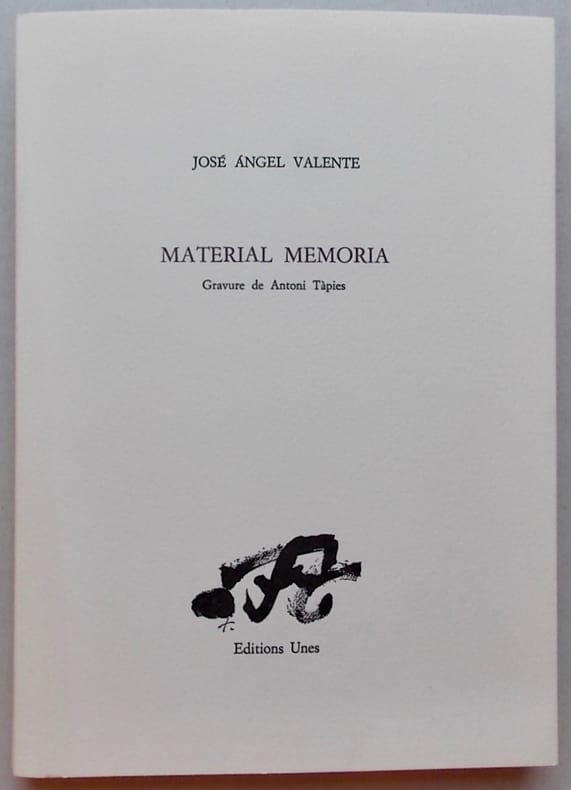
38954Le Muy, Editions Unes, 1986. In-8°, 85p. en feuilles, sous couverture imprimée rempliée.
33803Lausanne, Editions des Gaules, 1963. In-folio, 87p. en feuilles, sous couverture imprimée rempliée, chemise et étui.
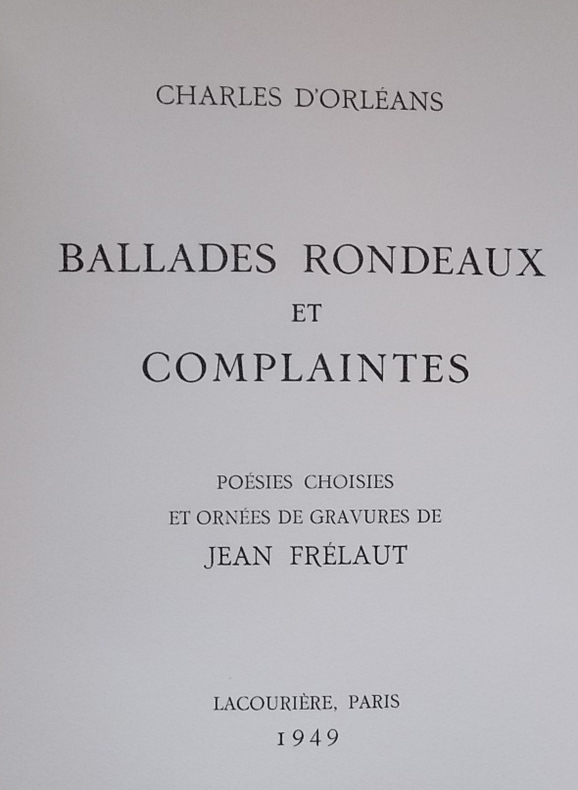
34388Paris, Lacourière, 1949. In-4°, 175p. en feuilles, sous couverture illustrée, chemise et étui.
39301Sans lieu, Editions Numaga, 1974. In-4°, 117p. Broché, couverture illustrée.
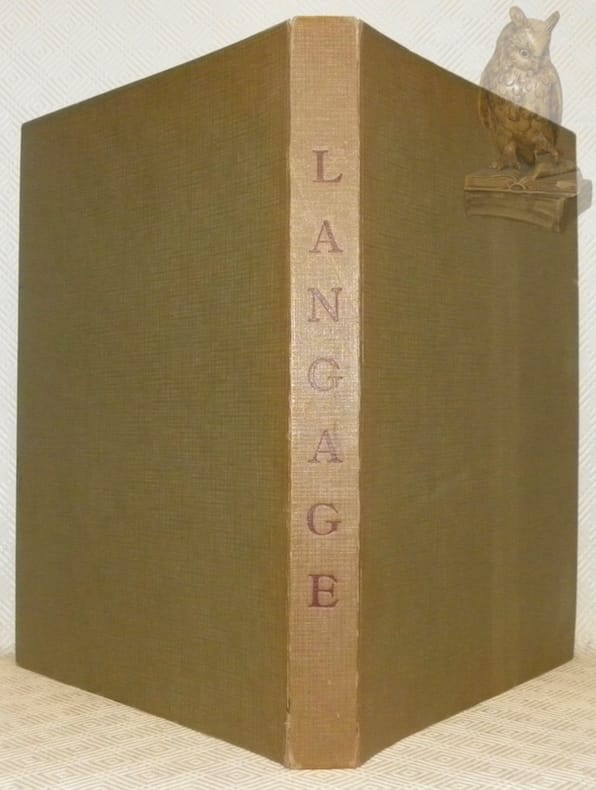
118460Paris, Lydia Conti 1948, 360x270mm, 65pages, en feuille, couverture rempliée, sous chemise toilé. Un des 112 exemplaires sur papier de Rives, numéroté n.° 98 / 112. La présente édition de Langage, établie par les soins de Robert Ganzo et de Lydia Conti a été achevée d’imprimer sur presse a bras le quinze mai 1948, dans l’atelier de Jean Paul Vibert à Grosrouvre. Les lithographies de Gérard Schneider ont été tirées par Jean Pons, Artisan à Paris. Signés au justificatif de tirage par l’auteur et l’artiste. Bel exemplaire.
29042Sans lieu, Editions Dorothea Keeser, 1998. Gr. in-folio, non paginé, en feuilles, sous couverture imprimée rempliée.
1934214Paris et Lausanne, Frères Gonin, 1934. Un vol. in-4 (26x33. 5) en feuilles sous emboîtage.
196652562BB1966. 21 x 21 cm.
196652562BB1966. 21 x 21 cm.