690 923 résultats
4to (160 x 244 mm). Arabic manuscript on polished oriental paper. (252) pp., 21 lines, per extensum. Black ink with red underlinings and emphases. With numerous red ink diagrams in the text and margins. Contemporary blindstamped full calf, restored and spine rebacked. A fine mid-17th century Arabic manuscript of Euclid's famous "Elements of Geometry", the "oldest mathematical textbook in the world still in common use today" (PMM). The translation is by the great Persian polymath Nasir ad-Din at-Tusi (1201-74), after whom the lunar crater "Nasireddin" is named. Written in Central Asia, this manuscript comprises fifteen books rather than the usual thirteen. Some of the marginal diagrams may have been added later. - Paper browned and somewhat mottled throughout, less so near the end of the volume. The restored binding uses the stamped original cover material. Cf. GAL I, 510, 23.
Tall 8vo (136 x 258 mm). Arabic manuscript on unsophisticated oriental paper. 206 leaves. 20 lines, black and occasional red ink with underlinings in red. Restored red morocco oriental binding with blind-tooled medaillons to both covers, using oder material from a shorter binding. The fourth and final part of Ibn Sina's famous "Kitab Al-Shifa'" ("The Book of Healing"), a great scientific and philosophical encyclopedia that covers logic, natural sciences, mathematics including astronomy, and, as here, metaphysics and religion. - Browned throughout with occasional waterstaining. Early waqf stamp near the colophon. In all a good manuscript, copied in Safavid Persia by Shafi' Muhammad bin Muhammad al-Qayni. GAL I, 454, 18.
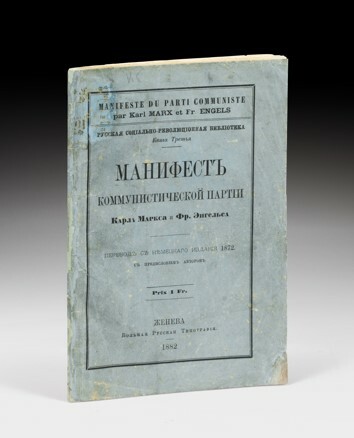
YTB-62Geneva, Volnaja Russkaja tipografia, 1882. 8vo of 50 pp., publisher’s printed wrappers, corners restored, library sign removed from the cover, slip-case. 180 x 120 mm. The very rare first complete Russian translation of the Communist Manifesto, with an original preface by the authors, written a year before the death of Marx. Prepared by Georgi Plekhanov, the present authorized edition made obsolete the 1869 first Russian translation by Bakunin which contained a number of serious mistakes and omitted several sections of the German original. Although heavily persecuted by the Tsarist government, it would have an immense impact on the Russian socialist movement of the 1880s. « Le Manifeste obtient sa consécration mondiale avec la Révolution soviétique d’octobre 1917 » (J. Elleinstein, Histoire mondiale des socialismes). Marx's and Engels' groundbreaking work of communist propaganda is "undoubtedly the most widespread, the most international production of all Socialist literature, the common platform acknowledged by millions of working men from Siberia to California" (preface to the 1888 edition). In the words of the British economist Harold Laski, the Manifesto is "admitted by every serious student of society to be one of the outstanding documents of all time". It also constitutes an early sum of Marx's and Engels's ideas, later to become known by the catchword of "scientific socialism": "[L]e manifeste renferme en puissance la quasi-totalité des idées élaborées par ses deux auteurs dans leurs ouvrages ultérieurs et qui, dans leur ensemble, représentent ce qu'ils appellent le socialisme scientifique; la seul exception importante est la théorie de la plus-value" (Andréas, p. 1). It begins with what has become one of the most famous sentences ever penned :”A spectre is haunting Europe-the spectre of Communism”. Unbeknownst to either author, it would be Russia where the Revolution heralded by the Manifesto would finally take place, under the leadership of their disciple Lenin who did not discover Marxism until after Marx's passing. Very rare and sought-after copy preserved in publisher’s wrappers.
Small folio (ca. 210 x 314 mm). (10), 308, (12) pp. With engraved title-page and 5 full-page engraved illustrations in the text, as well as several woodcut initials and woodcut printer's device. Contemporary full vellum. All edges red. Second, improved Latin edition of this famous account of a pilgrimage to the Holy Land by the Polish Prince Mikolaj Krzysztof Radziwill (1549-1616), frequently translated and reprinted. First published in 1601; the present edition is corrected and expanded. - During his two-year journey from 1582 to 1584 Radziwill visited not only Palestine, but also Syria, Egypt, Crete, Cyprus, Italy and Greece. "Radziwill, in his account of the pilgrimage to the Holy Land and Egypt, described the ethnic diversity of the inhabitants of these lands. Critics underline the fact that his descriptions were ethnographic in character and quite objective. His 'Peregrynacja' was published in Latin and in Polish and apparently was quite widely read" (S. Grodz, Islam in Polish-Lithuanian/Ottoman Encounters, in: The Character of Christian-Muslim Encounter, Leiden 2015, p. 234). - The emblematic illustrations show sailboats in a fierce storm, such as Radziwill himself encountered, as well as appropriate Biblical quotations in banners decorated with maritime elements, but also a plan of the Church of the Holy Sepulchre in Jerusalem (a separate appendix describes the prayers and songs there to be sung). - Binding somewhat brownstained and a little warped; upper hinge starting. Paper evenly browned throughout, occasional brownstains. Provenance: from the library of Duke Franciszek Maksymilian Ossolinski (1676-1756), Polish politician in the service of the exiled Stanislaus I. Leszczynski and an important collector, with his autograph ownership inscription "Ex Libris F. M. Ducis de Tencryn-Ossolinski", dated Lunéville, 12 Sept. 1741, to front pastedown, and a three-line handwritten French quotation from St. Augustine to lower pastedown. In all a good copy of a widely received work; this edition rarely seen at auction. Weber II, 204. Röhricht p. 208, no. 787. Estreicher XXVI, 90. Brunet IV, 1087. Graesse VI, 17. Baumgarten, Hall. Bibl. VI, 65f. Ebert II, 18596. Tobler 83. Cf. Aboussouan 769.
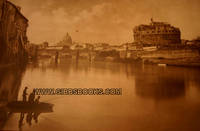
1870053004-KItaly 1870. Book. Illus. by Giacomo Brogi. Very Fine. No Binding. Albumen Mammoth Print c. 1870's By Giacomo Brogi 1822- 1881 Italian. Very rare photographic image by this artist in the original restored frame . This is not one of the standard tourist pictures that you find but a true work of art by this master photographer. Both Brogi and the Alinari Brothers worked as photographers and took the standard architecture ruins photos in Italy most being small 8"x10" Albumen prints but they did art photography also and to find one is a rare treat . This piece shows three men in a row boat on the Tiber River with Castel Saint`Angelo Mausoleum of Adrian on the right the Saint`Angelo bridge to the castle in the middle in the far distance you can see St. Peter's Dome . Looking around the photo the men in the boat you can see their reflection in the water. With sheep on the right shore and the clouds rolling by above it all this is a very importain photographic image by this artist . Please call for more information on this and other works of art. Size: 32 x 23. unknown
In folio (600x390 mm.), album oblungo in mezza pelle coeva con angoli, fregi e titolo oro al dorso. L’opera è così composta: importante frontespizio allegorico e dedicatorio, inciso da Seutter, che ruota attorno alla statua dell’imperatrice Maria Teresa d’Austria (manca la tavola con la dedica all’Imperatrice) - Seguono (come da Indice a stampa posto al fine) le 50 grandiose e stupende vedute con paesaggi per lo più fluviali, tutte animate da personaggi, carrozze, barche e animali; sono tavole calcografiche, non numerate, ciascuna con didascalia, che raffigurano le ville di: - "Porta S. Piero Gattolini": La Real Villa del Poggio Imperiale - La Pace - Villa di Pozzolatico, del Sig. Senator Ricci - Villa de’ Collazzi, de’ Sigg. Dini - Villa di Monte Gufoni, de’ Sigg. Marchesi Acciajoli. - "Porta S. Fridiano": Veduta di Monte Oliveto - Veduta della Pescaja d’Arno, fuori della Porta a S. Fridiano - Villa di Castel Pulci, del Sig. Marchese Riccardi - Il Ponte a Signa, dalla parte di Levante e dalla parte di Ponente - Villa de’ Sigg. Mancini vicino a Signa, detta Castelletti - Veduta del Porto di mezzo, vicino a Signa - Porto di sotto nella Golfolina, all’imboccatura dell’Ombrone - Veduta di Paese sul Fiume Arno nella Golfolina, e della Real Villa d’Artimino in lontananza - Veduta di Paese sul Fiume Arno, dalla parte di Grumaggio - Veduta di Paese sul fiume Arno, nella Golfolina - La Real Villa dell’Ambrogiana - Veduta di Castel Fiorentino - La Cecina di S. E. il Sig. Sen. March. Carlo Ginori. - "Porta al Prato": Villa di Sesto, de’ Sigg. Marchesi Corsi - La Real Villa del Poggio a Cajano - La Real Villa d’Artimino - Villa della Magia, del Sig. Pandolfo Attavanti - Villa del Barone, de’ Sigg. Marchesi Tempi - La Real Villa di Cerreto - Veduta della Villa di Lamporecchio, di S.E. il Sig. Principe Rospigliosi - Villa di Bella Vista, del Sig. March. Feroni. - "Porta a S. Gallo": La scesa, e Convento de’ Padri Cappuccini - Villa di Montughi, de’ Sigg. Marchesi Gerini - Villa di Castello, di S.E. il Sig. Principe Corsini - La Real Villa di Careggi - La Real Villa di Castello - La Real Villa della Petraja - La Real Villa di Pratolino - Veduta del Ponte a S. Piero a Sieve - La Real Villa di Cafaggiolo - Villa de’ Sigg. Marchesi Gerini, detta le Maschere - Villa de’ Sigg. Marchesi Gerini a Ronta - Tre Visi, Villa de’Sigg. Palmieri, al principio della salita di Fiesole - Veduta del Ponte alla Badia - Villa del Ponte alla Badia, di S.E. il Sig. Duca Salviati - Villa della Luna, del Sig. March. Guadagni. - "Porta alla Croce": Villa del Sig. March. Bartolini a Rovezzano - Veduta di Paese dalla Villa di Loretino - Veduta dell’ingresso alla Villa di Gamberaja, del Sig. March. Capponi - Veduta di Campagna vicino a Gamberaja - Villa di Gamberaja, del Sig. March. Capponi - Villa delle Falle, de’ Sigg. Guadagni dall’Opera. - "Porta S. Niccolo": La Tana, Villa de’ Sigg. Baroni Ricasoli - La Real Villa di Lappeggi. Magnifica raccolta, fondamentale per la vedutistica toscana e la documentazione iconografica sulle ville Medicee e della nobiltà fiorentina. Tutti i fogli sono firmati da Giuseppe Zocchi e dagli ottimi artisti che incisero i rami all’acquaforte: Giuseppe Benedetti (7 tavv.), Marco Antonio Corsi (4), Philotee-François Duflos (2), Giuseppe Filosi (4), Vincenzo Franceschini (1), Giuliano Giampiccoli (1), Michele Marieschi (2), Niccolo Mogalli (3), Pietro Monaco (7), Filippo Morghen (9), Johann Sebastian Muller (1), Giovanni Battista Piranesi (1), Joseph Wagner (6) e Giuseppe Zocchi (2). Rarissima "prima edizione" (la seconda e terza - 1754 e 1757 - si contraddistinguono per la numerazione delle tavole, in basso a destra). “Giuseppe Zocchi fu stimato e fecondo pittore e illustratore fiorentino (1711-1767) e, come precisa il Benezit,XIV, p. 918: “Il fut surtout employé à des décorations dans les palais de Florence et de ses environs particulièrement dans les Palais Serristori, Rimuceini et Gerini. Au cours de ses voyages, il dessina les sites les plus remarquables des régions qu’il parcourait et ces dessins furent, dans la suite, gravés et réunis en intéressantes séries topographiques. Il grava lui-meme au burin quelques estampes originales et d’après les maitres du XVII siècle”. Cfr. anche Mason R.M. “Zocchi - Vedute di Firenze e della Toscana” - Millard “Italian and Spanish books”, n. 169 - Berlin Katalog,I,2701 ha solo la III ediz. del 1757 - Tosi A. “Inventare la realtà: Giuseppe Zocchi e la Toscana del Settecento”, p. 82 e succ. - Ficacci L. “Piranesi”, pp. 68-69 per la veduta “La Real Villa dell’Ambrogiana”: “the engraving by G.B. Piranesi after a drawing by Giuseppe Zocchi is the plate 17 of the edition ‘Views of the villas..’”. Nel ns. esempl. le tavv. 9 e 10 (”Il Ponte a Signa, dalla parte di Levante e dalla parte di Ponente”) portano a stampa, in basso a destra: “in Firenze, appo. Giacomo Moro”, e sono corte del marg. bianco; 2 tavv. sono state sapientem. restaur. per strappo; 5 restaur. al margine infer. bianco per piccoli strappi; alcune con tracce d’uso margin. altrimenti bell’esemplare di questa rarissima raccolta in edizione originale.
OH-15Shanghai China: Yinwen Yinshu Guan The official histories of China are compilated to the corpus of Twenty-five Histories Ershiwu Shi which comprise this 50-volume complete set. The 25 26 Official Dynastic Histories includes: Shiji Records of the Grand Scribe a universal history compiled by Sima Tan and his son Sima Qian ends in 93 BC Hanshu Book of Former Han compiled by Ban Gu in 83 AD Houhanshu Book of Later Han compiled by Fan Ye in 445 Sanguozhi Records of the Three Kingdoms compiled by Chen Shou in 289 AD Jinshu Book of Jin compiled under Fang Xuanlingin 648 Songshu Book of Liu-Song compiled by Shen Yue in 488 Nanqishu Book of Qi in the South compiled by Xiao Zixianin 514 Liangshu Book of Liang compiled under Yao Silian in 635 Chenshu Book of Chen compiled under Yao Silian in 636 Nanshi History of the South compiled by Li Yanshou in 659 comprising the history of Liu-Song Qi Liang and Chen dynasties Beishi History of the North compiled by Li Yanshou in 659 comprising the history of Northern-Wei Eastern and Western Wei Northern Qi and Northern Zhou; for the sixteen states of north China there is a kind of semi-official history called Spring and Autumn of the Sixteen Kingdoms Shiliu Guo Chunqiu; the biographies of these northern rulers can also be found in the Jinshu 101-130 Songshu 98-99 Nan-Qishu 59 Weishu 87 Beishi 93 Weishu Book of Northern Wei Tuoba compiled by Wei Shou in 554 Beiqishu Book of Northern Qi compiled by Li Baiyao in 636 Beizhoushu Book of Northern Zhou compiled under Linghu Defen in 636 Suishu Book of Sui compiled under Wei Zheng in 636 Jiutangshu Old Book of Tang compiled by Liu Xu in 945 Jiuwudaishi Old History of Five Dynasties compiled by Xue Juzheng in 974 Xintangshu New Book of Tang compiled under Ouyang Xiu in 1061 Xinwudaishi New History of Five Dynasties compiled under Ouyang Xiu in 1072 for the ten states of south China there is a kind of semi-official history called Spring and Autumn of the Ten Kingdoms Shi Guo Chunqiu published by Wu Renchen in 1793 Songshi History of Song compiled under Tuo Tuo Toktoghan in 1345 Liaoshi History of Khitan-Liao compiled under Tuo Tuo Toktoghan in 1344 Jinshi History of Jurchen-Jin compiled under Tuo Tuo Toktoghan in 1344 Yuanshi History of Yuan compiled under Song Lian in 1370 Xinyuanshi New History of Yuan compiled by Ke Shaomin in 1920 Mingshi History of Ming compiled under Zhang Tingyu in 1739 Qingshigao Draft to a History of Qing compiled under Zhao Erxun in 1927 another semi-official history of the Qing dynasty is Qingdai Tongshi compiled under Xiao Yishan . Green cloth hardcover texts. Gilt spine and embossed title on front cover. Date of publication not stated presumed to be circa 1960's. Each volume is approximately 750 pp. in length. Text in Chinese. Heavy item. . No Stated Edition. Cloth. Fine/ . 4to - over 9¾" - 12" tall. . Yinwen Yinshu Guan Hardcover
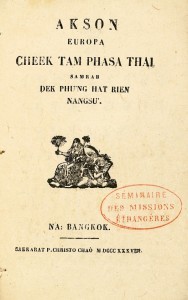
LCS-600Très rare édition originale du premier livre sorti de l’imprimerie catholique de Bangkok, l’un des tout premiers témoignages de l’essor de l’imprimerie en Thaïlande. Bangkok, 1838. Na : Bangkok, Sakkarat P. Christo Chao 1838. (= à Bangkok, l’année chrétienne 1838).In-12 composé de (2) ff. dont 1 de titre, 56 pp., et (1) f. Vignette gravée sur le titre. Conservé dans son cartonnage d’origine. Boîte moderne.155 x 98 mm.
Folio (228 x 330 mm). (36), 415, (1) pp. Title-page printed in red and black. With hundreds of geometric figures in the text. - (Bound after) II: Coenders van Helpen, Barent. Thresor de la philosophie des anciens où l'on conduit le lecteur par degrez à la connaissance de tous les metaux & mineraux [...]. "Cologne" (i.e., Groningen), Claude le Jeune, 1693. (6), 240 pp. Title-page printed in red and black. With allegorical frontispiece ("Escalier des Sages"), woodcut ornaments, 12 allegorical plates, and 5 copper engraved plates with alchemical motifs. Contemporary smooth, deep auburn full calf with gilt ornamentation and traces of a label to spine. Editio princeps of books V, VI and VII of the "Conica", the most original part of Apollonius's fundamental work on conic sections. The text survives only in the Arabic manuscript of Abu 'l Fath of Ispahan, purchased by the Medici family in the first half of the 17th century and here translated and edited by Alfonso Borelli. "This was a valuable addition to the mathematical knowledge of the time, for whereas Books I-IV of the Conics dealt with information already known to Apollonius's predecessors, Books V-VII were largely original. Book V discusses normals to conics and contains Apollonius's proof for the construction of the evolute curve; Book VI treats congruent and similar conics and segments of conics; Book VII is concerned with propositions about inequalities between various functions of conjugate diameters" (Norman). "The fifth book is especially important treating of normals as minimum and maximum straight lines drawn from given points to the curve" (Honeyman). "The sixth book is on the similarity of conics. The seventh book is on conjugate diameters" (Cajori). - A fine, wide-margined copy. - Bound first is the final edition of the "Thresor de la philosophie des anciens", a reference treatise for the theory and practice of alchemy, esotericism and hermetic philosophy that draws on Hermes Trismegistus, Paracelsus, and Sendivogius. Couched in the form of a dialogue, the book discusses the ten-step ascent to the single matter via two qualities, three principles, and four elements. The 17 remarkable allegorical plates depict alchemy, chaos, heat, love, the elements, sulphur, mercury, and salt. The Groningen politician Coenders (1601-78) first published this rare work in 1686. - Occasional light browning; title-page trimmed along top edge. Binding a little rubbed at extremeties, spine-end professionally repaired, but an appealing volume. I: Norman 58. Honeyman 119. De Vitry 29. Sarton I, 173-175. DSB I, 179-193 (Apollonius) & II, 308f. (Borelli). Cajori, A History of Mathematics, pp. 40f. DBI XII, 546. Riccardi I, 158 ("bella edizione, ed assai ricercata"). - II: VD 17, 7:651937N. Caillet 2419. Duveen 287. Verginelli 74. Brüning II, 2718. Brunet II, 1052.
Large 12mo. 24 vols. With engraved portraits of Barros, Couto, Henry the Navigator, and Afonso de Albuquerque and 3 (instead of 5) folding maps. Uniformly bound in contemporary half calf over marbled boards, spines with giltstamped titles and volume numbers. Edges lightly sprinkled red. A fundamental travel work: the best and most complete edition of what is considered the most comprehensive publication on Portuguese exploration and colonial history by João de Barros (decades I-IV) and Diego de Couto; the first edition to include decades X and XI. Books 2 and 3 of the "Decada Segunda" offer a detailed narrative of Afonso de Albuquerque's expedition to the Arabian Gulf and his conquest of Ormuz in 1507; the island remained under Portuguese occupation from 1515 to 1622. As vassals of the Portuguese state, the Kingdom of Ormuz jointly participated in the 1521 invasion of Bahrain that ended Jabrid rule of the Arabian archipelago. - This is "the best edition of this famous work on Portuguese colonial history. The first edition appeared at Lisbon, Madrid and Paris from 1552 to 1645. It consists of 12 "Decadas" (decades), comprising the history of the years 1420-1600. Only Decadas I, II, III and a part of IV are by J. de Barros, the rest is by D. de Couto, who begins his part also with Decada IV, so that there are two Decadas IV" (Laures). De Barros (1496-1570), head agent for the Portuguese overseas trade authority "Casa da Índia", managed to persuade King João III to commission from him a history of the Portuguese in India (including Asia and southeast Africa). The result earned him renown as one of the first great Portuguese historians, and the the title of a "Portuguese Livy". The 'Decades' contain "the early history of the Portuguese in India and Asia and reveal careful study of Eastern historians and geographers, as well as of the records of his own country. They are distinguished by clearness of exposition and orderly arrangement. They are also lively accounts" (Enc. Britannica). Cordier, BJ, 34 and BS, 2309. Innocencio III, 322. Laures 642. Streit IV, 667 (with extensive list of contents) & VI, 630. This edition not in Borba de Moraes. For the maps cf. Gole, India, 8.
LCS-18235Edition originale posthume des Méditations sur l’Evangile de Jacques-Bénigne Bossuet, évêque de Meaux (1627-1704), composée et adressée aux religieuses de la Visitation de Meaux en 1695. Paris, Pierre-Jean Mariette, 1730-1731. 4 volumes in-12 de: I/ (1) f.bl., 63 pp., (17), 519 pp., (1) f.bl. ; II/ (1) f.bl., (1) f., 464 pp., (6) ff., (1) f.bl.; III/ (1) f.bl., (2) ff., 454 pp., (8), (1) f.bl.; IV/ (1) f.bl., (2) ff., 506 pp., (18), (1) f.bl. Reliés en plein maroquin rouge de l’époque, double filet doré d’encadrement sur les plats, armes frappées or au centre, dos à nerfs richement ornés, coupes décorées, roulette dorée intérieure, tranches dorées. Reliure de l’époque. 163 x 90 mm.
YTB-103Paris, Didot, Nyon..., 1751, 6 volumes in-12, maroquin rouge, triple filet doré encadrant les plats, armoiries frappées or au centre, dos à nerfs richement ornés, pièces de titre et de tomaison en maroquin vert, filet or sur les coupes, roulette intérieure, tranches dorées. Reliure armoriée de l’époque. 166 x 96 mm. Les Négociations précédant le Traité de Westphalie dédicacées « A Monseigneur Amelot Ministre et secrétaire d’Etat du roi Louis XV » reliées en maroquin rouge de l’époque aux armes de la Comtesse de Provence (1753-1810). Le 24 octobre 1648 sont publiés les traités négociés dans les semaines précédentes en Westphalie. Ces traités mettent fin à l'interminable guerre de Trente Ans qui a saigné à blanc l'Allemagne. Ils se soldent par l'émiettement politique de celle-ci. Les deux grands vainqueurs du conflit sont la Suède, devenue la principale puissance de la mer Baltique, et la France, son alliée, désormais sans rivale en Europe occidentale. La France est confirmée dans la possession des Trois-Évêchés de Metz, Toul et Verdun, ainsi que de la plus grande partie de l'Alsace à l'exception notable de Strasbourg que Louis XIV va annexer quelques années plus tard, Dix ans plus tard, en 1659, la paix des Pyrénées et la paix du Nord allaient confirmer sa prépondérance en Europe. La réorganisation de l'Europe centrale instituée par les traités de Westphalie va perdurer jusqu'à la Révolution française, 150 ans plus tard. On peut dire que les beautés de Dresde ainsi que Mozart, Bach, Beethoven ou encore Goethe sont les fruits des traités de Westphalie ! TRES BEL EXEMPLAIRE RELIE EN MAROQUIN ROUGE DE L’EPOQUE AUX ARMES DE DE Marie-Joséphine-Louise de Savoie, comtesse de Provence. « Animée d’un esprit très libéral, Louise de Savoie eut son heure de faveur populaire, en défendant au début de la Révolution ce qu’elle-même appelait alors les « droits de la nation, et le bruit des explications assez vives qu’elle eut avec la reine Marie-Antoinette lui valut plus d’une fois les applaudissements de la foule. La comtesse de Provence eut le goût des Lettres et des Arts. Sa bibliothèque avait été composée avec beaucoup d’intelligence » (E. Quentin Bauchart, II, pp. 309-330).
2 volumes. 8vo (160 x 216 mm / 160 x 205 mm). Arabic manuscript on polished paper. First volume: 340 ff.; title-page with gilt borders. Second volume: 178 ff. Script in black naskh with occasional words, phrases, and punctuation in red. 19th century leather and morocco with fore-edge flaps, stamped in blind. An important Arabic bestiary and the most famous work of al-Damiri (1341-1405), little known in the West. In the "Hayat al-Hayawan", al-Damiri alphabetically lists over nine hundred animals mentioned in the Qur'an or known in Muslim literature; his extensive commentary explains the use of such animals in medicine, tradition, and ancient poetry: whether they can lawfully be eaten, and their role in folklore and superstition. - Al-Damiri was a Muslim writer from Mamluk-era Egypt, and his other works are largely on canon law. His natural history, however, is considered his most influential and popular writing. - The first volume is not dated or signed, but was written in the Ottoman provinces in the 18th century; the second volume was completed by the scribe Umar ibn Abd al-Da'im ibn Umar al-Dandi on the 15th of Muharram 1024 H (14 February 1615 CE). Covers a little worn, spines professionally rebacked, some light paper repairs and soiling. A scarce and appealing piece of mediaeval zoology; complete in two volumes dating from the 17th and 18th century. Cf. GAL II, 137/8.
159 x 108 cm (conjoined sheets), in hand colour. Scale ca. 1:12,000,000. A magnificent coloured wall map, enclosed within historiated borders showing topographical vignettes, printed on four conjoined sheets with additional running title above and engraved text providing geographical and political information to the sides, all on additional sheets. While it is a map of Africa, it also shows the Arabian Peninsula in its entirety. - The cartographer Nicolas de Fer (1646-1720), son of a Parisian engraver specialising in the colouring and selling of maps, maintained a good relationship with the Academy of Sciences and was Geographer Royal to the Dauphin and the King of Spain. Nevertheless, his productions were not aimed at a university-educated audience, and his work is distinguished by easy accessibility and popularisation of geographical information rather than by scholarly precision. The present rendering of Arabia, apparently based in part on the work of Delisle, shows this posthumous publication (by de Fer's son-in-law Danet) to be a later release of a much early conception of the Middle East, outdated even in the 1740s. In particular, it omits the Sinai Peninsula included in several of de Fer's earlier efforts. "Like Delisle, De Fer had considerable prestige and influence in France and all over Europe" (Historical Atlas of the Gulf, p. 278). Among the toponyms along the coast of the Arabian Gulf are Abadan, Sur, Ahsa, Janama, Bahr, El Catif, Bischa, Borou, Godo, Vodana, Calba, Dadana, and Pinder. - Professionally repaired; some wrinkling, but preserving its impressive wall appearance. Cf. OCLC 71549733. Historical Atlas of the Persian Gulf (16th to 18th c.) 70 (1717 map). Khaled Al Ankary, The Arabian Peninsula in Old European Maps, 112 & 140.
Folio (368 x 272 mm). 30 lithogr. plates, including one title page. Bound in contemporary oblong red half morocco, spine bearing giltstamped title "Chevaux et Voitures". Three series of Gericault's horse studies, each complete as published and in excellent impressions on strong wove paper (not watermarked), bound together with a hitherto unrecorded depiction of a sheikh on an Arabian horse. The first series, published as "Etudes de Chevaux lithographiés" in 1822, shows various horse races, including the Arabian horse as well as Egyptian, English, and French horses. "Cet ouvrage sera composé de trois livraisons, dont chacune contiendra quatre planches" (Beaux-arts de Paris). Second of at least four states throughout, stating the names of the artist and printer. The second series, published without a title in 1823, shows the various purposes for which horses are used (racehorses, military horses, cart horses and postillon horses, among others) and is complete as well with eight prints. The third series, likewise issued without a title in 1823, comprises seven prints depicting cavalry, trotters, a horse leaping over an obstacle, and a jockey on his horse, also including two oriental-themed plates: a lion devouring a horse and a fist-shaking "Giaour" (not from Géricault's Byron series). Three plates from this set are identified by Delteils as contemporary copies by Louis Courtin. The lithographed frontispiece of the first series was bound at the beginning of the present volume to serve as a title. The final leaves in this collection are the dead horse in the snow (an image inspired by Napoleon's Russian campaign) from Géricault's 1823 series "Quatre sujects divers" and a fine plate of a pistol-wielding Sheikh mounted on his Arabian steed, with an oriental desert settlement in the background (not recorded by Delteil). "Gericault est, sans conteste, un des plus grands peintres hippiques de son siècle [...] Les bonnes épreuves sont recherchées et et assez rares" (Mennessier de la Lance I, 545). - Of the utmost rarity: while the British Museum holds the complete suite of the first series, we were unable to trace any complete copies of the other suites contained in this sammelband. While numerous separate Gericault lithographs sold at recent auctions, realising up to £3000 each, not a single complete suite is listed in auction records of the last decades. - All prints are of exceptional quality, with rich contrast on superior paper, occasionally showing various degrees of foxing in the margins; a minute tear to the lower edge of the title leaf. Attractively bound in red half morocco with sparsely gilt spine. Altogether a beautiful copy in excellent, crisp condition. Delteil 46-57; 58-65; 66-72; 77.
8vo. (2), CLXVI ff. With several botanical woodcut initials. Contemporary dark goatskin, blind-tooled in a panel design. First edition of this important capsule edition of Ibn Sina's comprehensive Canon of Medicine (Kitab al-Qanun fi al-tibb). Designed with the Western medical student and practicioner in mind, Michael de Capella's abridgement of the greatest and most influential work in mediaeval and early modern medical history is here pared down to a nutshell manual of 166 leaves. "The preface … refers to the importance in medicine of aphoristic works that can readily be committed to memory and to the example of Hippocratic writings. The task of abbreviation was undertaken with such enthusiasm that Avicenna's chapter on the elements (Canon 1:1:2) [...] was compressed from about 550 words in the full Gerard of Cremona version into 53 in the 'Flores'. This compendium was twice reissued, in 1514 and again in 1528" (Siraisi). - Provenance: 1) Title-page shows handwritten ownership of the Augustinian monastery of Zaragoza, Spain, dated 1743. 2) 20th century bookplate of Karl and Thilde Wagner to front pastedown. - Binding somewhat worn, spine-ends and extremeties chipped. Some browning throughout, inkstains on title-page and a couple of minor stains in text. A good copy. Adams A 2319. Durling 411. USTC 143378. N. G. Siraisi, "The Changing Fortunes of a Traditional Text", in The Medical Renaissance of the Sixteenth Century (1985), p. 21. Cf. BM-STC French 234 (1514 ed. only). Cf. Wellcome I, 577 (1528 ed. only).
1065 x 578 mm. Cloth-backed engraved view on 2 sheets joined, letterpress text pasted below (4 columns in Italian: "Descrizione della Città di Alessandria d'Egitto") with publisher's imprint. Matted. Unrecorded in the standard bibliographies and without counterpart in western libraries: a unique, large-scale view of Alexandria as seen from the north. Formerly the most powerful city of the ancient world after Rome, Alexandria came under Ottoman rule in 1517 and subsequently lost much of its importance to the new port of Rashid (Rosette), 40 miles east, though it would regain some of its former prominence with the construction of the Mahmoudiyah Canal in 1807. In Longhi's engraving, the Ottoman influence may be discerned in the people's clothing as well as in the city's architecture. Within the city are several mosques; the ancient obelisks are shown crowned with crescents. On the river Nile, which flows through the city and underneath the walls, the view depicts numerous trade boats and sailors. Outside the walls lies Pompey's Pillar. The Italian letterpress text pasted under the engraving provides mostly historical and geographical information. - Longhi's panorama seems to draw various aspects from previous works to create its own original representation of the Egyptian city. The perspective is similar to that used in Pierre Belon's 1553 "Observations" and in Braun and Hogenberg's 1575 "Alexandria, Vetustissimum Aegypti Emporium, Amplissima Civitas", published in their famous "Civitates orbis terrarum", but also to that in Mallet's smaller, almost certainly later (1683) view of Alexandria. Apart from the Braun/Hogenberg map, however, the principal model for Longhi's view was likely his own view of "Gran Cairo", apparently published simultaneously: the bird's-eye view and general composition correspond to this similarly rare engraving, which was probably based on a 1549 woodcut panorama created by Matteo Pagano in Venice. - According to scholars, Gioseffo (Giuseppe) Longhi (1620-91) issued a series of views of Italian and foreign cities between 1654 and 1674. A publisher, bookseller and archiepiscopal printer, he was active in Bologna from 1650 to the time of his death. Not only did he publish maps, but he was also a prolific literary editor, notably publishing all the dramatic works of the Italian playwright Giacinto Cicognini. - An excellent specimen. Cf. Tooley, Mapmakers III, 150 (for Giuseppe Longhi).
945 x 620 mm. Engraved view on 2 sheets joined, letterpress text pasted below (4 columns in Italian, 4 columns in Latin: "Descrittione del gran Cairo [...] Cairi quae olim Babylon") with publisher's imprints. Watermark Panzano. Unrecorded in the standard bibliographies and without counterpart in western libraries, this unique, large-scale view of Cairo reflects the economic and cultural effervescence of the second-largest city in the Empire: under Ottoman rule since 1517 and having expanded south and west from its nucleus around the Citadel, Cairo in the latter half of the 17th century was second only to Constantinople. The Ottoman influence may be discerned in the people's clothing in the foreground as well as in the city's architecture. On the river Nile, the map depicts numerous trade boats and sailors. To the left are soldiers battling as part of a tournament; on the right are the Sphinx (wearing a necklace!) and the famous pyramids of Giza: those of Khufu, Khafre, and Menkaure, as well as the smaller pyramids. The centre of the city shows numerous mosques and gardens. The letterpress text pasted under the engraving provides mostly historical and geographical information (in Italian and Latin). - Longhi's panorama seems to draw various aspects from previous works to create its own original representation of the Egyptian city. Indeed, it bears some resemblance to Braun and Hogenberg's 1572 "Cairos, quae olim Babylon, Aegypti maxima urbs", published in their famous "Civitates orbis terrarum". There are also similarities with Donato Bertelli's "La gran città del Cairo" (Venice 1575), as well as with the map of "Le Grand Caire" produced by the French soldier and traveller Henri de Beauveau (published in his "Relation journaliere du voyage du Levant", Nancy 1615). Ultimately, these plans probably all derive from a 1549 woodcut panorama credited to Matteo Pagano (or a Venetian engraving derived from it), as they all depict the city from the same viewpoint and on a similar scale. Longhi's map even takes up some of the ornaments of the Braun/Hogenberg map, such as the two people riding on a horse and a donkey in the foreground, though the antiquities as well as the numerous irrigation wheels are here shown in much greater detail. - According to scholars, Gioseffo (Giuseppe) Longhi (1620-91) issued a series of views of Italian and foreign cities between 1654 and 1674. A publisher, bookseller and archiepiscopal printer, he was active in Bologna from 1650 to the time of his death. Not only did he publish maps, but he was also a prolific literary editor, notably publishing all the dramatic works of the Italian playwright Giacinto Cicognini. - Some small marginal tears repaired; slight marginal fraying to upper left. Cf. Tooley, Mapmakers III, 150 (for Giuseppe Longhi); Schulz, Venice 70 (for Arrigoni/Bertarelli).
- Charpentier, Paris 1885, 11,5x18,5cm, relié. - Charpentier, Paris 1885, 11,5x18,5cm, bound. First edition. One of 150 numbered copies on hollande, the only deluxe issue after 10 on japon paper. Bound in half red morocco, gilt date on spine, marbled paper covers and endpapers. Original wrappers including the spine preserved. Set in an early 20th century binding signed by Alfred Farez. Our copy includes a two-page autograph letter dated and signed by Emile Zola to Octave Mirbeau. The author thanks him for the benevolent article he recently wrote about Germinal, while defending himself from being considered as the leader of Naturalism: "... but why do you say that I lead naturalism? I don't lead anything at all... I work in my own corner, letting the world go where it pleases...". A beautiful and rare copy, perfectly established with a superb autograph letter signed about Germinal and Emile Zola's position within the "Ecole Naturaliste". [FRENCH VERSION FOLLOWS] Edition originale, un des 150 exemplaires numérotés sur hollande, seuls grands papiers après 10 japon. Reliure à la bradel en demi maroquin rouge à coins, dos lisse, date dorée en queue, plats de papier marbré, gardes et contreplats de papier peigné, couvertures et dos conservés, reliure début XXème signée Alfred Farez. Notre exemplaire est enrichi d'une lettre autographe datée et signée de deux pages d'Emile Zola à Octave Mirbeau le remerciant de l'article bienveillant récemment consacré à Germinal, tout en se défendant d'être considéré comme le chef de file du Naturalisme : "... mais pourquoi dites-vous que je conduis le naturalisme ? Je ne conduis rien du tout... Je travaille dans mon coin, en laissant rouler le monde où il lui plait..." Bel et rare exemplaire parfaitement établi et enrichi d'une superbe lettre autographe signée traitant de Germinal et de la situation d'Emile Zola vis-à-vis de "l'Ecole Naturaliste".
LCS-1864053
Folio (45 x 29 cm). (2) (half title and title), (4) (description of plates), 28 pp. With 20 plates (including a map of Northern Africa and the region around Siwa). Very nice contemporary half calf, spine richly gilt. Map slightly cropped in right-hand margin, but only touching frame, no loss of picture. A fine, very attractive copy of a particularly scarce work. - (Bound after:) Cailliaud, Frédéric. Voyage a l'Oasis de Thèbes et dans les Déserts situés a l'orient et a l'occident de la Thébaide, fait pendant les années 1815, 1816, 1817 et 1818. Contenant: 1. Le Voyage à l'Oasis de Dakel, par M. le Chevalier Drovetti. 2. Le Journal du premier Voyage de M. Cailliaud en Nubie. 3. Des recherches sur les Oasis, sur les Mines d'émeraude, et sur l'ancienne Route du commerce entre le Nil et la mer Rouge. Paris, l'Imprimerie Royale, 1821. XVII, 120 pp. With 24 (1 colour) plates (including 2 maps). I) Voyage y l'oasis de Syouah: An important work on Siwa and at the same time the only source on Drovetti's research in the oasis - a particularly rare book! - In September 1819, Cailliaud travelled from Fayun westward to Siwa, where he carried out important research which was the foundation of the scientific discovery and exploration of Siwa oasis. In 1820 Bernardino Drovetti arrrived in Siwa together with Mehmed Ali's expedition. Accompanied by 2 draughtsmen and protected by the Egyptian troops, Drovetti was able to explore the oasis and to have plans and views drawn. Thus, he managed to supplement the picture Cailliaud had given of Siwa. He was also the first European to visit the village of Agharmi. Drovetti's and Cailliaud's reports were sent to Jomard who edited and published them. - II) Voyage à l'oasis de Thèbes: In 1815, Cailliaud travelled to Nubia together with B. Drovetti. When he had returned, Mehmed Ali advised him to explore the adjacent desert regions near Egypt. First he went east through the Arabian desert to the Red Sea. After seven days he reached the diamond mines at Djebel Subara. From Djebel Kebrit, his easternmost point, he went back to the Nile. In June 1818 he went east of Esna to the Great Oasis (Kharga), which, although Poncet und Browne had already seen it, had still remained unexplored. - The plates show Sekket, Douch El Qualah, Chargeh, El Gabouet, the ruins of Chargeh, etc. Also contains the only publication of Bernardino Drovetti's 'Le Voyage à l'Oasis du Dakel'. Drovetti was, after Edmonstone, the second explorer to reach Dakel. - A separate second volume of the Voyage a l'oasis de Thèbes was issued in 1824. I: Henze I, 474/475 (Cailliaud) and II, 97/98 (Drovetti). Ibrahim Hilmy I, 113. Not in Blackmer. - II: Cf. Henze I, 474 ff. Blackmer 268. Gay 1967. Ibrahim-Hilmy I, 113. Embacher 66.
LCS-18369Ouvrage édité à l’occasion du mariage de Madame Elisabeth de France avec l’Infant d’Espagne. Paris, Le Mercier, 1740. Grand in-folio de (1) f.bl., (1) f. de titre, 22 pp., (1) f.bl. et 13 gravures dont 8 sur double-page. Plein maroquin rouge, plats ornés d’une roulette fleurdelysée avec fleurs-de-lys aux angles, grandes armes au centre, dos à nerfs orné de fleurs-de-lys et d’étoiles dans les caissons, pièce de titre de maroquin havane, coupes décorées, roulette intérieure dorée, tranches dorées. Reliure de l’époque. 625 x 480 mm.
Folio. 4 volumes (1 text volume, 2 plates volumes and the supplement volume with plates and interleaved text). (406); (96) ff. plus plates. With lithographed title-pages in plates and supplement volumes; in total 552 plates (the plates volumes with in total 432 lithographed plates (425 hand-coloured, 7 black and white); supplement volume with 120 hand-coloured lithographed plates. Contemporary red half sheepskin. Rare complete set with the supplement (often lacking) of a sumptuous botanical work with 552 striking lithographic plates by Aimée Henry. Among the plants and trees depicted are the date palm, the Commiphora gileadensis, and the Acacia Arabica. The work was begun by M. F. Weyhe, J. W. Wolter and P. W. Funke, and finished by the important German botanist and pharmacologist Theodor Friedrich Ludwig Nees von Esenbeck (1787-1837), best remembered for his systematic research on the medical properties of plants, which helped to establish pharmacology as a serious academic discipline. The plates appeared in instalments between 1822 and 1828, followed by several instalments of text, and finally a supplement volume in 1833. Some confusion exists as to the general title of the work, since the volumes of plates are titled "Plantae medicinales", whereas the text volume was published as "Plantae officinales". - Bookplate and library stamps in each volume. Some browning and foxing as usual; bindings worn. A good set, rare in its present complete form. GFB, p. 69. Johnston 945. Nissen, BBI 1442. Plesch p. 347. Pritzel 6662. Stafleu/C. 17391. Cf. Graesse IV, 655.
Folio (ca. 280 x 365 mm). 3 vols. XVII, (3), 482 pp. (2), 483-1041, (2) pp. With 2 folding maps and illlustrations in the text. Vol. III (atlas): half-title and 100 engraved plates, 84 of which in original hand colour, with descriptions. Original printed wrappers; vol. III in contemporary half cloth. Stored in decorative full cloth slipcases. First edition. Signed presentation copy, inscribed by the author to the entomologist and carcinologist Eugène Louis Bouvier (1856-1944), who wrote the introduction to this elaborate entomological work: "A Monsieur le Professeur Bouvier, à qui je dois toute ma reconnaissance pour avoir mené à bonne fin cet important ouvrage faisant le plus grand honneur à sa haut compétence et à son grand dévouement à la sciene [...]". - Between the years of 1904 and 1905 Maurice de Rothschild (1881-1957) led and financed a collecting expedition in East Africa, travelling from Djibouti, across Eritrea to Ethiopia and Kenya. The collected specimens were presented to the Paris Natural History Museum. A large number of entomologists, including Charles Rothschild (1877-1923), worked on the specimens, their descriptions - some in Latin - being published in the first two volumes. A total of 68 specimens were named 'rothschildi', although not all of them are today known by this name. The third volume, containing exquisite colour illustrations of the insects, occupied a similarly large number of artists. - Uncut. Bindings somewhat worn; interior crisp and clean. A very well preserved copy of this elaborate work. Rare: a single copy in auction records. BM (NH) VIII, 1096. Not in Nissen or Pankhurst.
Folio (210 x 345 mm). 22 issues. Together (58), 388 pp. With 2 photographs, 1 plate of graphs showing incidents in Egypt, June-July 1946, 1 folding plan of Persian Azerbaijan, 1 folding plan of Greece and Western Turkey, and 1 folding map of Middle East Intelligence. Original printed stapled wrappers. An intriguing specimen of British post-war intelligence documentation rarely seen in the trade, focussing on but not limited to the Middle East. Based on the Middle Eastern Intelligence services' zones of major responsibility and their spheres of interest (see the map in vol. 100), their reviews cover a vast range of topics. They not only outline the Anglo-Egyptian treaty negotiations and the political situation in Libya, Palestine, and Syria, but also discuss the Arab League (photograph of a meeting of the League in vol. 90), terrorist attacks carried out by Jewish illegal forces in Palestine, the struggle with illegal immigration (a photograph showing a boat of immigrants in vol. 74), and political Zionism. However, the reviews also cover the political and economic situation in Germany, the problem of former Nazi sympathisers regaining positions of power and security (sketched out in the case of "Dr. Drecksacker"), and include an eye-witness report by an SS man employed at the Auschwitz concentration camp, translated into English. British views on Russia make up another significant part, including the reprint of an article by the American journalist Brooks Atkinson, published in the U.S. magazine "Life", accusing Soviet leaders of "group paranoia", as well as analyses of Russian broadcasts with respect to Middle Eastern countries. Moreover, the reviews outline British relations with Greece and the Balkans, France, Yugoslavia, Bulgaria, Italy, Turkey and Kurdistan, Romania, and India, while also discussing the organisation and functions of the U.N. - Despite the imprint indicating a print run of 400 copies, none can be traced on WorldCat. A 12-volume set was sold at Christie's in 2018. - Wrappers have stamps of the "Assistant Director of Medical Service 3rd Divisions". Traces of rust near the staples. The first two pages of vol. 100 loose; a small tear on pp. 9f. of vol. 90, as well as a small flaw to the title-page of vol. 98, neither touching the text. - A rare window into the issues that concerned the British military intelligence following WWII.