690 923 résultats
19470008116Jerusalem Israel British Mandated Palestine. Good. 1947. On offer is a unique historically significant journal handwritten during the final days of British Mandated Palestine most entries made immediately prior to the Declaration of Independence. This is a one-year page a day journal for the Jewish year of 5708 September 1947 to October 1948 has about 50 entries with most entries made between September 1947 and December 1947 and few brief records scattered over the next few months - the last one is dated June 7. It measures 7' by 5' the hardcover is slightly soiled but otherwise the journal is in very good condition. The text is in Hebrew the handwriting is mostly legible. Author's name is not identified but there is a note on the front page: "Vaad Hakehilla. Hanala Klalit" Local Community Council. General Management. It is clear from this note and from the context that the journal was kept by a member of the Hebrew Community Council in Jerusalem the body that was established in 1917 and coordinated and represented different groups of Jerusalem Jews during the British Mandate. Vaad Hakehila was responsible for different aspects of Jewish life in the city including economic and social assistance to the residents. It had a social services department and a society of assistance to kindergartens issues related to them are mentioned in the journal several times. Most entries are the minutes of the Council meetings. Some entries deal with organizational and financial matters taxes elections complaints dispute settlement work of social services purchase of fire engines but most meetings reflect increasingly tense situation in the city and concern food and fuel supply food rationing security and organizing Mishmar ha'am National Guard - unit of volunteers established in September 1947 in Jerusalem for maintenance of public order. The Council was constantly in contact with the state authorities political and religious leaders various Jewish organizations trying to solve various problems facing Jewish community in the city. Among the names mentioned in the journal are Yitzhak Ben-Zvi David-Zvi Pinkas a Zionist activist politician a signatory of the Declaration of independence and a future minister Mordechai Shatner a signatory of the Declaration activist and politician one of the founders of Yad Va-Shem who then was a member of the Jewish National Council Ben-Zion Meir Hai Uziel the Sephardi chief rabbi of Mandatory Palestine who appeared before the Mandatory government as representatives of the Jewish community and on missions on its behalf Itzhak HaLevi Herzog the first Chief Rabbi of Ireland and then the Ashkenazi Chief Rabbi of Mandatory Palestine and of Israel Menashe Elassar a noted Jerusalem businessman and many other. The first entry is dated September 15 and mentions a meeting with Mr. Ben-Zvi who had been the President and a member of the Vaad Haleumi the National Council a post in which he served as the chief representative of the Jewish community vis-a-vis the mandatory authorities. His name is mentioned several times throughout the journal in relation to various matters. A council meeting on September 17 dealt with several issues including social work and house confiscation order of the Babayoff family: "Military Commander refused a request to postpone confiscation order for the Babayoff's House till after the holidays . Chief Rabbi Uziel was asked to speak with the commissioner about postponement of the confiscation order. Rabbi Herzog was also asked to speak with the Military Commander regarding the same matter". Many entries mention searches conducted by the British Army in Jewish neighbourhoods one of such searches on Yom Kippur Eve finished with desecration of a synagogue: "Search in Nachlat Zvi Jerusalem neighbourhood. After we received information regarding the desecration of the synagogue by the army during their search R' Nattan and I went to check if the information was correct. We reached the location after the search had finished and the army left the place. All the synagogue benches the tables chairs and pillows were upside down. All of the study books Mishnayot Zohar Gemaras were scattered on the floor. The holy ark was open and the Torah scrolls were open ." Some of the entries refer to property damage caused by bombings that the council members were assessing: "After the two nights that passed in Jerusalem Shabbat night and Motzei Shabbat when tens of thousands of bullets were shot towards the all the Jewish areas of the city I got up early . to visit the places that were the primary targets of the bullets of the police and soldiers. The primary target was again the homes near the police dormitory in the hospital of the English Mission. The view of the horrifying sight of the destruction caused to these homes and the miracle that nobody's life was taken . testimonies were collected from dozens of people."Nov. 16. One of the constant subjects was ensuring food and fuel supply in the city: "Meeting of the supply committee with bakery owners to ensure sufficient flour supply in case of emergency" ".To bring all wholesalers and demand from them to increase supplies in Jerusalem." they meet with members of the Jewish National Council JNC and devote many meetings to this matter. As part of their activity they meet with mukhtars heads of Arabic neighbourhoods. Va'ad had limited means to cope with the worsening situation and in December the Jerusalem Emergency Committee was set up that took upon itself civil administration of Jewish Jerusalem which explains why there are almost no entries after November. Though it includes only about 50 entries of varying length the journal provides a lot of details from the months preceding the Declaration of Independence and contains names of many people who played an important role in creation of the Israeli State. Overall it's a fascinating document of the life of Jewish community in Jerusalem during the last months of the British Mandate and activity of the Jewish Community Council in Jerusalem.; Manuscript; 12mo - over 6¾" - 7¾" tall; KEYWORDS: HISTORY OF 20TH CENTURY 1940s POST-WW2 ERA MIDDLE EAST ISRAEL JERUSALEM JEWISH QUARTER CREATION OF ISRAEL JEWS OF JERUSALEM BRITISH MANDATE DECLARATION OF INDEPENDENCE MANDATORY PALESTINE BATTLE OF JERUSALEM 1947 BOMBINGS IN JERUSALEM JEWISH SELF-GOVERNING BODIES IN MANDATORY PALESTINE MISHMAR HA'AM NATIONAL GUARD IN JERUSALEM LOCAL COMMUNITY COUNCIL IN JERUSALEM VA'AD HAKEHILA VAAD HAKEHILA JERUSALEM LOCAL AUTHORITIES LEADERS OF JEWISH COMMUNITY OLD CITY PARTITION BRITISH ARMY IN MANDATORY PALESTINE SOCIAL SERVICES DURING THE BRITISH MANDATE ISRAEL BEFORE INDEPENDENCE SELF-GOVERNMENT OF JEWS IN JERUSALEM JEWISH COOPERATION WITH BRITISH ADMINISTRATION IN PALESTINE YITZHAK BEN-ZVI DAVID-ZVI PINKAS MORDECHAI SHATNER END OF THE BRITISH MANDATE FOOD RATIONING IN JERUSALEM FOOD SUPPLY TO JERUSALEM ZIONISM ZIONIST ACTIVISTS JEWISH NATIONAL COUNCIL JNC VAAD HALEUMI 1947 JERUSALEM RIOTS JERUSALEM RELIGIOUS LEADERS HEBRAICA JEWISH HISTORY HANDWRITTEN MANUSCRIPT DOCUMENT LETTER AUTOGRAPH WRITER HAND WRITTEN DOCUMENTS SIGNED LETTERS MANUSCRIPTS DIARY DIARIES JOURNALS PERSONAL HISTORY SOCIAL HISTORY HISTORICAL HOLOGRAPH WRITERS AUTOGRAPHS PERSONAL MEMOIR MEMORIAL ANTIQUITÉ CONTRAT VÉLIN DOCUMENT MANUSCRIT PAPIER ANTIKE BRIEF PERGAMENT DOKUMENT MANUSKRIPT PAPIER OGGETTO D'ANTIQUARIATO ATTO VELINA DOCUMENTO MANOSCRITTO CARTA ANTIGÜEDAD HECHO VITELA DOCUMENTO MANUSCRITO PAPEL . hardcover
LCS-15649Précieux exemplaire, l’un des rares contenant la pièce en vers de 9 feuillets d’Etienne Pasquier. Paris, Denis du Pré, 1572.In-4 de 53 ff., (1), 9 gravures à pleine page dans le texte et une gravure dépliante hors texte ; 10 ff., 26, (2) ff. dont 1 bl., 9, (2) ff.bl., 6 gravures à pleine page dans le texte. Ex libris manuscrit sur le titre. Relié en plein veau brun granité, filet à froid encadrant les plats, dos à nerfs orné, coupes décorées, tranches mouchetées. Restaurations anciennes au dos. Reliure du début du XVIIIe siècle. 235 x 157 mm.
LCS-1864015
Folio (210 x 319 mm). (4), 126, (4) pp.; 22 ff. Title within engraved figurative border. With an engraved vignette, 22 engraved plates (2 of which are double-page-sized). Contemporary brown calf with gilt borders and decoration on middle of covers; blindtooled spine rebacked. Traces of ties. Book seven of Théodore de Bry's "Petits Voyages", the greatest single collection of material on early voyages to the East Indies, which is considered unique in its extraordinary wealth of cartographical and visual material. Crucially, this much-sought volume includes Gasparo Balbi's groundbreaking account of the Middle East, first published in 1590 as "Viaggio dell' Indie Orientali" - a mere 16 years before this present issue, making this the second appearance in print altogether and the first Latin translation. Balbi, a Venetian jewel merchant, travelled extensively in the Arabian Peninsula in search of precious stones. From Venice he sailed for Aleppo, proceeding to Bir and from there overland to Baghdad, descending the Tigris to Basra, where he embarked for India. While in the Gulf, he studied the pearl industry, noting that the best pearls were to be found at Bahrain and Julfar. He refers to islands in the Emirate of Abu Dhabi (including Sir Bani Yas and Das) and to several coastal settlements that were to become permanently established, such as Dubai and Ras al Khaima. Balbi was the first to record the place names along the coast of modern Qatar, the United Arab Emirates and Oman. Practically "none of the names of places on the coast between Qatar and Ras al Khaima occur in other sources before the end of the eighteenth century" (Slot). The volume also comprises the account of Joris von Spilbergen's voyage to Ceylon in 1601-04 (with excellent plates). - Calf slightly worn, some browning due to paper. Title browned in the margins; some foxing to plates. Contemporary ownership inscription of Thomas Knyvett in upper margin of title (partly obliterated by a later owner), dated 27 June 1608; also inscribed "perlegi (I finished reading) 20 Octob. 1608 Tho. Kny." near lower edge of the title. Armorial bookplate and later ownership of "T. Norcliffe" on inside of upper cover. Thomas Knyvet, 1st Baron Knyvet (also Knevytt, Knyvett, Knevett, Knevitt; 1545-1622) was an English courtier and Member of Parliament who played a part in foiling the Gunpowder Plot. Latterly the library of Swedish antiquarian bookdealer Björn Löwendahl (1941-2013). Brunet I, 1334. Church 206, 207, 208, 211, 212, 214, 217, 219, 221-225. Cf. Howgego I, B7. Ibrahim Al Abed, Peter Hellyer. United Arab Emirates: A New Perspective. London 2001. Slot, B. J. The Arabs of the Gulf, 1602-1784. Leidschendam, published with the support of the Cultural Foundation Abu Dhabi, 1993. Geoffrey King. Delmephialmas and Sircorcor: Gasparo Balbi, Dalmâ, Julfâr and a problem of transliteration. In: Arabian archeology and epigraphy 17 (2006) 248-252. United Arab Emirates yearbook 2005 by Ibrahim Al-Abed, Paula Vine, Peter Hellyer. London 2005. The Heritage Library, Qatar, p. 17. Carter, Robert A. Sea of Pearls, p. 79.
Small folio (ca 24 x 30 cm). Ca. 170 letters in Algerian Arabic, pasted to 100 numbered leaves. Contemporary papered boards (severely rubbed and bumped) with remnants of a green calfskin spine. A vast ensemble of handwritten letters in Arabic, assembled by the Franco-Algerian typesetter A. Duchâteau who used the collection both to perfect his command of practical Arabic in various local dialects and as a typographical style guide. Most of the letters were written by local dignitaries, including Beys, Kaïds, Sheikhs, provincial leaders and village chiefs. To obtain them, Duchâteau must have drawn upon various sources such as his own relations and other Algerian families, the French community, and the military. About a third of the letters include Duchâteau's French translations or at least notes about their origin, giving dates or details of their content or identifying the recipient. - Duchâteau worked as typesetter for the Algiers-based "Bastide" printing house in the early 1850s. Specializing in Arabic typography, he was especially close to Louis-Jacques Bresnier (1814-69), the first professor of Arabic in Algiers. It was Duchâteau who attended to the printing of the Arabic parts of Bresnier's chrestomathies and language guides, and it is apparent that the album also served as documentation for the professor's own publications, such as his "Chrestomathie arabe: lettres, actes, et pièces diverses" (1857). In the preface to his "Cours pratique et théorique de langue arabe", published by Bastide in 1855, Bresnier explains that his work could only be realized thanks to the talent of Duchâteau: "Two modest and excellent artists, Messrs. Ch. Portmann, lithographer, and A. Duchateau, an Arabic typesetter, understood and supported the author's work with remarkable intelligence and skill." - Some of these letters are of great historical interest, enabling us to trace in them the frequently poorly-documented history of Algeria between the late 18th and mid 19th century. The ensemble includes, inter alia, a letter from the Bey of Constantine, Hussein Bey (1807); letters addressed to Napoleon III, who is referred to as "Sultan" and "Lord Prefet"; a letter from a brotherhood leader asking permission to bring a number of faithful into his Zaouira; a document regarding the prisoners of Constantine; a letter from Mufti Hanefi of Constantine requesting the replacement of the hezzab of the mosque; letters from the interpreter Ismael Ben El Had Mohammed Amin El Sekkat, from Kaïd Belkaum Ben Minia, from Messrs. El Hadj Merouan & El Hadj ben Fouka, from Sid Said EI Hadj, a regional chief (1817), several letters to and from physicians, letters related to invitations, festivities and gatherings, requests to the authorities for intervention, commercial letters, and letters of thanks. A single letter in Hebrew is also included. Inserted at the beginning are 6 lithographed leaves of letter specimens as used by Bresnier in his courses, annotated by hand (likely that of Bresnier himself) with extensive remarks in French and Arabic on the vocabulary and phrasing. - An important source for the history of French Algeria and the history of Arabic typography in the mid-19th century.
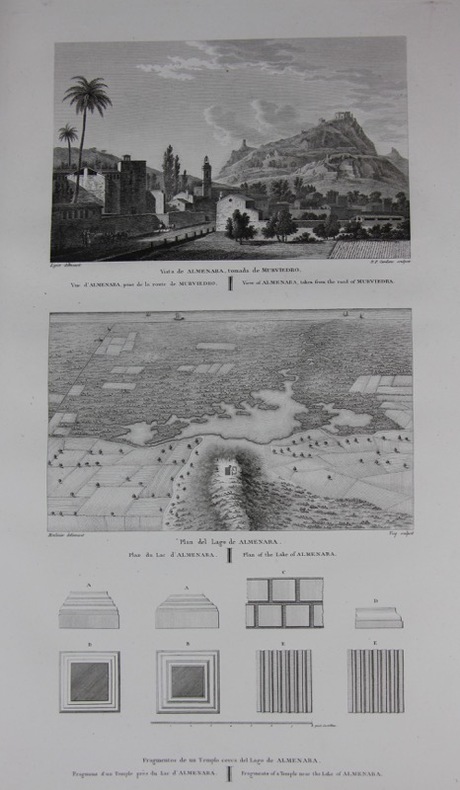
Elephant folio (685 x 510 mm). 2 plate volumes. [Antiquities volume]: Half-title, title for Histoire Naturelle [!], list of artists (mounted). 92 large engraved plates, maps, and plans, including 2 colour, 9 double page, and a few folding, numbered 1-97 (lacking plates 15, 18, 49, 79, 87). - [Etat Moderne]: Half-title, title, list of artists (all trimmed and mounted). 57 engraved plates and maps, including 2 double page. 19th century green half morocco, spines gilt. All edges gilt. From the first comprehensive description of ancient and modern Egypt. Two plate volumes from the 23-volume series produced by the commission of scholars and artists that accompanied Napoleon's expedition to Egypt in 1798-1801. The complete set comprises 10 text and 13 plate volumes, divided into "Antiquités", "Mémoires", "Histoire naturelle", "Etat moderne", and "Carte topographique", published between 1809 and 1828. The present volumes are something of an amalgam: the spine and title page of one indicate the first volume of plates for "Histoire Naturelle", but the 92 large plates within are from the first volume of "Antiquités", depicting architecture and ruins, monuments, tombs, artifacts, views, elevations, and maps from Philae, Eswan, Edfou, Esne, Koum Omobu, and elsewhere. The volume labeled "Etat Moderne" (with a corresponding title page) features a selection of plates from volumes 1 and 2 of "Etat Moderne", in addition to 21 plates from the first volume of "Histoire Naturelle", including 17 ichthyological plates as well as plates mineralogical and botanical. - Condition report for "Antiquités": all plates backed with new sheets, scattered foxing (significant to 2 or 3 plates) and a few pale dampstains, a few repaired tears and marginal restorations, lower third of plate 10 lacking, some restoration to spine. - "Etat Moderne": Plates trimmed at plate marks and mounted to elephant folio sheets, dampstaining throughout at upper right quarter, restoration to margins outside image of several plates, title page trimmed close at upper margin and worn at lower margin, plate 14 scuffed with loss of text, foxing throughout, staining to natural history plates, repairs to margins mostly outside of image of several plates. Blackmer 476. Ibrahim-Hilmy I, 239. Gay 1999. Cf. Tobler p. 236 (citing the Carte Topographique only). Heritage Library, Islamic Treasures, s. v. "Art" (illlustration). Graesse II, 365.
8vo mimeographed typescript. Approx. 122 pp. Original black wrappers. Together with: 3 colour stills on board (364 x 281 mm), 12 colour stills (241 x 185 mm) issued for the press, 10 silver gelatin print stills (278 x 210 mm), colour poster, and 14 behind the scenes and costume test silver gelatin prints (ranging from 158 x 105 mm to 290 x 290 mm), with further costume test photographs tucked into the script. Fascinating and significant collection of material relating to one of the most famous British films of all time, Sir David Lean's "Lawrence of Arabia" (1962). The collection includes a unique production-used script, the title-page annotated "2nd Unit, Abbey", with various test photographs inserted into the script at different points and annotations and added tabs towards the end of the script. Includes four large black and white behind-the-scenes photos of the film's then-unknown star, Peter O'Toole (1932-2013), on camelback taken by famous stills photographer Ken Danvers (1911-80). Various additional costume reference photographs are present, including three for 'Lawrence', one featuring Peter O'Toole, in costume, smoking next to a set trailer. Also present are a set of twelve front of house stills for the film, an American one-sheet poster from the 1971 re-release, and other photographic stills relating to the production including three large colour film stills on board, which round out an impressive collection. Also included are 11 photographic references of T. E. Lawrence used by the costume design team to style Peter O'Toole. - "Lawrence of Arabia" (1962) was O'Toole's film debut, for which he received international acclaim. The film itself was selected in 1999 as the third best British film of the 20th century, and won seven of an impressive ten Oscar nominations. It is generally considered one of the most important films to come out of the 1960s, and has been selected for preservation in America's National Film Registry in acknowledgment of its cultural significance. - Occasional light wear to photographs, generally in the form of subtle pinpricks to corners. In general, exceptionally well preserved. - Provenance: Acquired by an employee of the film's producer, Sam Spiegel (1901-85). Spiegel was financially responsible for some of the most critically acclaimed motion pictures of the 20th century, and was the first independent Hollywood producer to work on films that won the Academy Award for "Best Picture" three times. One of those films was, of course, "Lawrence of Arabia".
Album of 18 well-preserved algal specimens carefully mounted on individual sheets of white wove paper, each approximately 330 x 155 mm. Loosely laid in to folding portfolio, housed in a marble clamshell box. A rare and early ensemble of algae specimens collected from the Red Sea, from different areas between Suez and Yemen, including one specimen from Alexandria. All items identified with the Latin name and details of the location around the Red Sea and date of collection written in French on the mounts, e.g., "Caulerpa prolifera: très commune dans toute la mèr rouge á la prodondeur de 1½ mètre à 2 [...] Avril 1844", or "Mer rouge dans le Golfe de l'Acaba, Juillet 1844". - The French botanist A. H. Husson, a native of Nancy, was also a pioneer of early photography. He lived in Egypt, where he worked as the director of the botanical garden and conservator for the Museum of Natural History for the Qasr Al-Ainy, the Cairo University's Faculty of Medicine. - "The Red sea has been a region of natural history exploration by European scientists from about 240 years. The first record of marine algae in the Red Sea was by Strand (a pupil of Linnaeus's), who in his thesis on the flora of Palestine listed three species. The first person to collect marine algae from the Saudi Arabian Red Sea Coast was the Danish botanist and explorer Forsskal in the 18th century who, in the month of November 1762, made a collection of seaweeds from the Sea of Jeddah [...] In the early years of the 19th century a British admiral Viscount Valentia made collections of algae from the Red Sea [...] Several other workers, including medical doctors and amateurs, collected marine algae from the Red Sea during the rest of the 19th century" (Beni-Suef Univ. Journal of Basic and Applied Sciences, Vol. 3/4 [Dec. 2014], pp. 278-285). - Includes the offprint of a short biography of Husson: Christian Debize, "L'album photographique d'Anne-Henry Husson. Regards d'un colon nancéien dur l'Egypte moderne", Annales de l'Est (1985), no. 4, pp. 261-299. Stab-sewn in wrappers. - A most exceptional and scarce collection of preserved algal specimens from the Red Sea. Provenance: from the property of the botanist Dr. Eugene L. Vigil (b. 1941), of Lynden, Washington, USA.
229 original photographs, 1 portrait reproduced from a painting, and 2 portraits printed on thin cardboard (one round-shaped). Various sizes (ca. 74 x 110 to 201 x 282 mm), printed both in colour and black-and-white. Some photographs with handwritten Arabic captions in pen on verso; a few with pasted mimeograph typescript captions in English. Stored in 5 display books. A large private photo archive, apparently assembled by a professional Middle Eastern journalist or press photographer, illustrating the reign of HRH Sheikh Zayed bin Sultan Al Nahyan (1918-2004), Father of the Nation and the ruler of Abu Dhabi for more than 30 years. Some pictures show HRH Sheikh Zayed welcoming foreign dignitaries such as the Syrian president Hafez Al Assad, Egyptian president Hosni Mubarak and French president Valery Giscard d'Estaing; others display industrial and cultural aspects of the Emirates, ranging from oil production in the desert to camel races and falconry. Another part of the set shows off prominent landmarks, including the Al Badiyah mosque, the oldest mosque of the Emirates, the forts of Al Hayl, Al Bithnah, and Al Jahili, the Blue Souq market hall in Sharjah, as well as Earth Park and the Zayed Sports City Stadium in Abu Dhabi. In addition, several images record National Day celebrations at the foot of Volcano Fountain in Abu Dhabi, demolished in 2004, but also show the Dubai skyline, military parades, and sailing vessels. A picture of an Iranian Phantom fighter-bomber flying over the Tunb islands shortly before Iranian forces occupied them in 1971 is a rare asset to this archive. - Mostly stamped and/or annotated in Arabic (and some in English) on versos for possibly use by the press, but not traced in the UAEhistory, Keystone or Hulton/Getty press photo archives. A few images have marginal tears or creases; one with a portion whited out for reproduction. Impressive in its extent and its wide variety of motifs, this uncommon set of not widely circulated photographs documents Abu Dhabi's transformation into a modern metropolis since the early 1970s.
8vo. 1 p. Written on the reverse side of a portion of a 1946 letter written to Gandhi from a young Western follower, George Mammen. Gandhi has penned some closely-written notes - clearly a draft for a letter. He writes, in fountain pen ink: "Our India will have need of you. You have had your training. You will give India the benefit of that training. It would be sad only if after the trials and suffering ["of war" stricken out] that our soldiers have been through, they forget the lessons of their eyes, the moment the peril is lifted. But one thing you should remember, under national Govt, you won't be pampered. You won't have all those lavish remunerations and privileges which a foreign Govt. bribed you with at the expense of India. India is destitute. You can serve her only by showing her destitution and poverty. Otherwise you will earn not the gratitude but the execration of your country. [Now writing at the top of the page:] You will, I know, fully share in this freedom, only to breathe the air of freedom with your countrymen". - Somewhat wrinkled and dust-soiled; small pinhead-sized holes on top.
Folio. 3 pp. With integral address leaf. Appointed by King Henri III, Jacques de Germigny served as French Ambassador to the Ottoman Empire from 1579 to 1585. - Writing to Lieutenant General M. de Montholon, recounting the torment of two Jewish women and their Jewish and Christian lovers: "[…] nous attendons encor de ce coste là le boyteaux avecq les gallères du cappitaine Bassa lequel est Osman Bassa [Assan Bassa, roi d’Alger] sont ycy attenduz en bonne dévotion. Nottamment led. Osman que ce seigneur veult faire triompher à son entrée audid Constantinople pour sa valeur et ses conquestes qu’il a faites […]. Et le mesme mofti a envoyé un fetfa ou advis à cedit seigneur portant que si son Altesse lui alloit en personne au devant qu’elle ne feroit chose qui fust contre leurs lois. Et ia esté deffendu par cry publicq à touttes femmes de ne se trouver le jour de lad. entrée par les rues, sous grand peine, ainsi demeurer aux maisons et à venir par les fenestres pour plusieurs respects. Et sur ce propos je vous diray qu’il se faict teftis ou informations aud. Constantinople en tous les quartiers ou parroisses des mosquées de la prud’hommie et chasteté de toutes lesdictes femmes turques à l’instance des spahis et aïas bassi, pour avoir esté trouvées et prinses en adultère ces jours derniers. Deux femmes de semblables hommes leurs compaignons qui se retrouvent à la guerre, l’une avec un Juif qui en fut samedy dernier empallé vif, devant la porte de la grande sinagogue, qui soit audit, et icelle ayant esté noyée. Et aultres pour avoir esté aussi prinse avec un chrétien arménien, que l’on tient, seront ensemblement et aujourd’huy traynez à la queue d’un cheval les visaiges contre terre par tout ladit. ville. Et après s’ils auront encore vie mis aux Ganches sur le port […]". - Early diplomatic correspondence relating to the Ottoman Empire, especially on such a delicate matter, is of the utmost rarity.
Folio (390 x 518 mm). VII, (1), 81, (4), 82-86, (2) pp.; 58 pp. With 190 lithographed plates (14 in colour). Modern full black morocco gilt, spine in six compartments gilt, remains of original wrapper cover title inset within lower cover. First and only edition of "the earliest comprehensive study on the history and theory of Ottoman architecture" (Ersoy, p. 117). Only a few copies of this rare work, produced to the most exacting standards of the day, appear to have been printed. It was produced under the patronage of Edhem Pasha, president of the Imperial Ottoman Commission for the Vienna Exhibition of 1873. The text (in German and French, followed by Turkish) consists of a series of monographs. The entire work was "prepared [...] by a diverse group of artists, architects, and bureaucrats who had close professional ties with the palace. The text begins with a lengthy historical overview that embodies a pioneering attempt to define and represent the entire Ottoman architectural past according to the norms of modern historiography [...] The editor of the whole volume, and the author of a substantial portion of the original text, was the amateur historian and artist Victor Marie de Launay, a 'naturalized' Frenchman who held a secretarial position in the Ministry of Trade and Public Works [...] With a keen scholarly interest in architecture, art, and traditional crafts, Marie de Launay, throughout his lengthy bureaucratic career in the imperial capital, was deeply involved in the representation of the Ottoman state in the world expositions [...] The expertly crafted plates that supplement the text of the 'Usul' include plans, elevations, and section of various Ottoman buildings as well as a rich panoply of decorative details and ornamental patterns, all meticulously depicted in accordance with the academic standards of the Beaux-Arts model [...] Accompanying the monochrome illustrations are fourteen chromolithographic plates (printed in the Sébah studios in Istanbul), skillfully drafted with vibrant and sharply delineated colors. In the superior technical quality and graphic precision of its illustrations, the 'Usul' is duly comparable to its highly acclaimed European counterparts, such as Owen Jones's 'The Grammar of Ornament' (London, 1956), Auguste Racinet's 'L'ornement polychrome' (Paris, 1869), or Jules Bourgoin's 'Les arts arabes' (Paris, 1873). Thus, leaving aside the intellectual scope of its text, the 'Usul' must be considered an artistic specimen in and of itself, conceived as a unique showcase of Ottoman technical competence in the art of publishing" (ibid., p. 117-120). The set is not infrequently encountered incomplete: even the Blackmer copy lacked a plate, and that of William Morris (now in the Calouste Gulbenkian Library) lacked three. - Occasional slight brownstaining (not concerning plates), but entirely complete and finely bound to style. Blackmer 956. OCLC 5465203. A. Ersoy, "Architecture and the Search for Ottoman Origins in the Tanzimat Period", in: J. Bailey et al. (ed.), History and Ideology [Leiden 2007], p. 117ff. Not in Atabey.
Folio (32 x 20 cm). 2 vols. in one. (58), 614, (42) pp. (12), 632, (86) pp. Elaborate woodcut device on title-page; woodcut initials, head and tailpieces. 19th century half morocco & marbled boards, spine tooled in blind, lettered in gilt, raised bands. Pliny the Elder's renowned Natural History in its first publication in English, translated by Philemon Holland, the greatest translator of the Elizabethan age. The "Naturalis Historia" is one of the largest single works to have survived from the Roman empire to the modern day and purports to cover the entire field of ancient knowledge, based on the best authorities available to Pliny. He claims to be the only Roman ever to have undertaken such a work. It comprised 37 books in 10 volumes and covered over 20.000 facts on topics including the fields of botany, zoology, astronomy, geology and mineralogy as well as the exploitation of those resources. It remains a standard work for the Roman period and the advances in technology and understanding of natural phenomena at the time. Some technical advances he discusses are the only sources for those inventions, such as hushing in mining technology or the use of water mills for crushing or grinding corn. Much of what he wrote about has been confirmed by archaeology. "We know from Pliny that there were important pearl fisheries in the Gulf [...] Pliny identifies Tylos (Bahrain) as a place famous for its pearls [... He] attests that pearls were the most highly rated valuable in Roman society, and that those from the Gulf were specially praised [...] The pearl related finds at the site of El-Dur indicate the site was integrated into the maritime trade routes linking the Roman Empire, the Persian Empire, India and South Arabia" (Carter). Book 6 holds a chapter that gives the first detailed account of the regions around the Gulf, including what are now Qatar, the Emirates and Oman. - Includes the final printed leaf in vol. 2, containing the errata and printer's colophon. In this copy, the title-page was evidently cut horizontally, above the device, then pieced back together, backed with early laid paper, with the lower half slightly darkened. STC 20029. Pforzheimer 496.
Small folio and 8vo. Altogether 66 pp. on 22 bifolia and 1 single sheet, one with autograph address on verso, one with pencil notes on verso. Emotional correspondence between Proudhon and the entrepreneur Aloysius Huber (1815-65) about the Besançon-Mulhouse railway project. In the early 1850s several rival companies vied for a government concession for the route, including the company founded by Huber, an Alsatian veteran of the Revolution of 1848 who had been Proudhon‘s neighbour at Doullens gaol. Proudhon managed to arouse the interest of Jerome Bonaparte in the projected railway, and in the process seems to have convinced himself that the plan had an idealistic side, as a decentralised pattern of small railroads would be superior - at least according to his social theories - to a unified system. As Huber struggled to obtain a concession, he regularly informed Proudhon of his progress in the matter, frequently appearing in a rather desperate mood, at one point even proclaiming in frustration: "un diable les chemins de fer!" (23 May 1853). - Completely invested in the project, Huber considers his obtaining the concession "a matter of life and death", and invokes Jean-Gilbert Victor Fialin, Duc de Persigny, Minister of the Interior, who supposedly told Proudhon that all it takes is a company presenting favourable conditions: "Le moment est decisif et c'est pour nous, pour moi sutout qui n'ai pas d'autre avenir, une question de vie et de mort [...] Quant tu es allé auprès de M. de Persigny, celui-ci t'a repdondu qu'il suffisait de présenter une pareille compagnie avec des conditions aussi avantageuses pour que le gouvernement lui accorde la concession [...]" (8 April 1851). He urges Proudhon to act quickly, fearing that one of the other companies might beat them to the concession: "Ne perdons pas de temps, mon cher Proudhon, je t'assure que si la concession du chemin de fer de Besançon à Mulhouse ne nous est pas accordée, elle sera très prochainement accordée à une autre compagnie […]" (16 Jan. 185?). - Some six weeks after he agreed to function as solicitor in the project, Proudhon appears irritated, doubting the sincerity of the company as well as its need of Huber himself: "Je te l'ai dit dès le commencement: Je ne crois pas de deux choses […] or que ta Compagnie soit sérieuse […] or qu'elle ait besoin de toi […]" (17 Feb. 1853). Huber repeatedly mentions his dire financial situation, as he is struggling with substantial debt: "En attendant, je suis moi-même profondement decouragé, je me suis donné tant de peine, j'ai fait tant de dettes dans l'intérêt de ma compagnie, que je ne saurai jamais comment me liquider […]" (23 July 1853). - Eventually, the railway concession went to Pereire, a former Saint-Simonian who became an economic pillar of the Bonapartist regime. Pereire offered an indemnity of 40,000 francs to be shared between Proudhon and Huber as compensation for their disappointment. In one of his letters Huber wonders whether Proudhon will take the money (in the end he did not): "Que veux-tu faire avec les vingt mille francs qui sont à la disposition chez M. Pereire? Les prends-tu? o en fais-tu présent à ce Juif? ou enfin veux-tu que je les prenne? […]" (24 Sept. 1853). - Includes further documents on the same matter: ALS by Huber to the Minister of Public Works; ALS by Huber to a friend; autograph transcript by Huber of an article in "La Patrie"; ALS by Camillo Marsuzi de Aguirre with autograph reply signed by Huber; ADS by Proudhon describing three rivaling companies. - Occasional small marginal flaws and traces of worming; one letter with some loss to text. Not in the Correspondance de P.-J. Proudhon. For Huber, who in 1838 had participated in a conspiracy to assassinate Louis-Philippe I and may later have worked as a police agent, see J.-P. Kintz, "Aloyse Huber", in Nouveau dictionnaire de biographie alsacienne 17 (1991), p. 1678.
Small folio (224 x 284 mm). 15 vols. (final vol. in 2 parts), uniformly bound in half tan sheep over decorated boards, spines gilt with raised bands in five compartments, decorated endleaves. Some original printed wrappers bound within. All edges sprinkled. First editions; all that was published of this massive project. The "Corpo diplomatico" deals with the relations between Portugal and the Roman Curia, presenting a chronologically arranged sequence of documents from the 16th and 17th centuries. The Portuguese Empire was the first global empire in history, and the sources here edited - frequently citing the significant Portuguese royal title of "King of Portugal and the Algarves, on this side of the sea, and on the other side in Africa, lord of Guinea and of the naval and commercial conquest of Ethiopia, Arabia, Persia, and India" - provide substantial information on the principal world issues and conflicts during that vast Empire's first era. Much of the diplomatic correspondence concerns conflicts between the worlds of Christianity and Islam: in one letter, King Manuel describes his attacks on and victories over the local Muslim rulers ("the Saracens are thrown into confusion"; "our men attacked and burned maritime towns belonging to the Saracens, situated on the mainland"; cf. vol. I, p. 116f.), and in a Papal Breve, Pius V praises the strengthening of the Maltese fortifications after the Great Siege of Malta ("erit opportunissimum adversus Turcas, et praedones Afros totius christiani populi propugnaculum", vol. X, p. 226). Many volumes, but VII through XI in particular, contain material on the Arabian Gulf (Basra, Bahrain, Muscat, and Ormuz): "Ormuz, que he cabeça de todo o Reino de Ormuz [...] e na dita Cidade de Ormuz fortaleza minha com muita gente de christâos portuguezes" (vol. II, p. 374); "o vejo, que se se faz guerra ao Turco e Vossa Alteza quer, sem despesa de quasi nada, o Egipto e Suria e Arabia seraom vossos" (vol. III, p. 243); "e asy mandou que se reteuessem todas as naos, que viessem da India a Judá e a Meca" (p. 397); "se entende hum muito boom socedimento pella armada de Vossa Alteza na ilha de Banrrehem [= Bahrain] de que se deve ter muito contentamento assi pella reputaçâo" (vol. VIII, p. 372); "e depois em Ormuz poderia saber o acontesimento de Baharem" (p. 468); "toda a costa de Melinde ate Moçambique e assi da outra de Adem ate Ormuz quererâo por alguma d aquellas tentar ardis [...] A Baçora vai tambem muita somma de especiaria" (vol. IX, p. 110f.); "O negocio he grave e de muita consideraçâo e em ser muita a somma da speciaria que vem pello mar Roxo ao Cayro e pello de Ormuz a Bacora" (p. 135); "Andre Ribeiro que com Joâo de Lisboa foi cativo em Mazcate" (p. 175); "creo tambem que elles lá ou nos quá nâo sabemps o que passa em Bacora porque se n aquella ilha creserem galees sem hirem do mar Roxo, como as que ali vierâo quando de caminho tomarâo Mascate nâo sey por onde viessem as outras" (p. 305); "pera o resgate dos portugueses que estam cativos no Cayro, e forom presos em Mazcate" (p. 382; cf. p. 485); etc. - Furthermore, there are reports on the Portuguese in Suez, Africa (including Angola, Mozambique, Guiné, Sofala, Morocco, Arguin, Cabo Verde, Congo, São Thomé, Ethiopia), Brazil (Bahia, Maranhão, Rio de Janeiro, Pernambuco), the Azores, India (in nearly every volume, including Goa, Cochin, Damão, Malabar), and the Far East (Malacca and the Moluccas, with a few sections on Macau, China, and Japan scattered in vols. X-XIV). The work also provides a wealth of detail about the Inquisition and "cristãos novos" (both discussed in almost every volume), the Jesuits (vols. V-XV), the Council of Trent (vols. VI-X), Protestant activity (particularly in England), the Restauração, the Dutch in Brazil, the wars with the Turks on land and sea, and the activities of D. Sebastião and St. Charles Borromeu, the Order of Malta, and Cardinal Mazarin. Among the most notable texts are Ambassador Martinho's 1533 letter describing the forces defending Christianity in India and Africa, Bishop Lourenço Pires de Tavora's account of monasteries in India in 1561, and 25 letters written by P. Antonio Vieira from 1671 to 1675 (vol. XIV). - Marginal spotting in vol. XV, part 1; last 5 leaves remargined. Very discreet library markings on rear pastedown of each volume. Overall a very good set. Innocêncio IX, 95. OCLC 55783574.
4to. 75, (1) ff. - (Bound with) II: Fabri, Felix. Eigentliche beschreibung der hin unnd wider farth zu dem Heyligen Landt gen Jerusalem, und furter durch die grosse Wüsteney zu dem Heiligen Berge Horeb Sinay, darauß zuvernemen was wunders die Pilgrin hin und wider auff Land und wasser zu erfahren und zu besehen haben. [Frankfurt, David Zöpfel], 1556. 219, (1) ff. With a title woodcut depicting a pilgrim with two camels. Contemporary blindstamped leather over wooden boards. I: A fine Renaissance edition of Tucher's pilgrimage to the Holy Land, undertaken in 1479-80 and first published by Schönsberger in Augsburg in 1482. Tucher (1428-91) was a wealthy Nuremberg merchant who moved in humanistic circles; "his travel report is remarkable in several respects: geographically, because it provides a different, non-traditional route from Jerusalem to Mt. Sinai. Tucher departed from Gaza like Breydenbach, Count Solms, and Felix Fabri in 1483, and seems to have crossed the Tih by the pass el-Mureikhy (which he calls 'Roackie'). But Tucher's stations in the desert denote a different route and are even more difficult to reconcile with the known localities. In historical respect, Tucher's account is remarkable for abstaining largely from the fabulous and for revealing a sense of factual reporting, even though much space is given to miraculous episodes, as might be expected from a text of this genre and age. Finally, it is of linguistic interest" (ADB). - II: Editio princeps of Fabri's pilgrimage account. Felix Fabri, a native of Zurich and a Dominican preacher at Ulm, describes his two pilgrimages made to the Holy Land, the first in 1480, as chaplain to Georg von Stein, and the second in 1483-84 as chaplain to Johannes Truchsess von Waldburg, as part of the same party as Breydenbach. - Title-page of Tucher frayed. Some light staining throughout. Worldcat lists 3 copies of Tucher in the US, and 5 copies of Fabri. Not a single copy of Tucher in auction records; a copy of Fabri in a modern binding commanded £4140 at Sotheby's in 1998. I: VD 16, T 2164. Röhricht 390. ADB XXXVIII, 766. - II: VD 16, F 136. Röhricht 395 ("Ulm").
12mo. 4 vols. (40), 670 pp. (2) ff. (1 blank), 734, (34) pp., (2) ff. (1 blank), 792, (18) pp. 756, (24) pp. With a woodcut in the text of vol. 3, p. 193, and a full-page engraving on p. 361 of vol. 4 (both diagrammatic). Contemporary limp vellum with ms. spine titles; all edges of vol. 2 sprinkled in red. Early duodecimo edition of Della Valle's complete "Viaggi", published while the first complete edition was still under the press. Della Valle's account is highly sought after as one of the earliest printed sources for the early history of Dibba, the coastal region at the northeastern tip of the United Arab Emirates, today ruled by the Emirates of Fujairah and of Sharjah. - Pietro della Valle (1586-1652) left Venice in 1614 on a pilgrimage to Palestine, proceeding to Baghdad and then into Persia, where he married and sojourned in the court of Shah Abbas. While staying with the Sultan of Bandar Abbas, he "met the son of the ruler of Dibba who was visiting. From this he learned that Dibba had formerly been subject to the kingdom of Hormuz, but was at that time loyal to the Safavids who in 1623 sent troops to Dibba, Khor Fakkan and other ports on the southeast coast of Arabia in order to prepare for a Portuguese counter-attack following their expulsion from Hormuz (Jarun). In fact, the Portuguese under Ruy Freire were so successful that the people of Dibba turned on their Safavid overlords, putting them all to death, whereupon a Portuguese garrison of 50 men was installed at Dibba. More Portuguese forces, however, had to be sent to Dibba in 1627 as a result of an Arab revolt. Curiously, two years later the Portuguese proposed moving part of the Mandaean population of southern Iraq, under pressure from neighbouring Arab tribes, to Dibba" (UAE History: 2000 to 200 years ago - UAEinteract, online). "Della Valle displayed excellent narrative and descriptive skills, powers of acute observation, and a genuinely scholarly breadth of learning. He refused to comment on what he had not witnessed himself or checked against the best authorities" (Gurney). He continued his travels east to the coast of India, Goa and Muscat, and thence back to Aleppo by way of Basra. He reached Rome in 1626, where the original Italian text of his letters written to the Neapolitan physician Mario Schipano was published. Only the first volume, dealing with Turkey, saw print during his lifetime. The two-part volume II on Persia was released in 1658, four years after his death; in 1662 the Turkey volume saw a second edition, and the set was concluded in 1663 with the volume on India. A single-volume English translation of the Indian travels appeared in 1665. - Occasional slight brownstaining, otherwise fine. Röhricht 947, p. 238. Tobler 95. Weber II, 251. British Library STC II, 931. Cf. Graesse VII, 251. Atabey 1271 (1667 Baglioni ed., 3 vols. only). Blackmer 1712 (mixed French ed.). Macro 2233. Gurney, "Della Valle, Pietro", in: Encyclopaedia Iranica (online ed.).
8vo. 2 pages. In German. To the actress Margarete Walkotte, who had inquired about a relief fund: "Unfortunately I cannot give you any information about the 500,000 Mark fund. I have not heard anything about it. This, of course, does not prove the falsehood of the newspaper's claim. I will try to discover particulars [...]". Moreover, Zetkin is upset about a celebratory banquet: "The past secretary of education is holding a banquet at Kroll's with several dozen so-called 'celebrities', while many thousands of artists, scholars and scientists, teachers, technicians, and civil servants are suffering severe hardships, indeed are starving. This is the much-heralded 'culture' of bourgeois Germany! [...]" (transl.). - On headed paper.
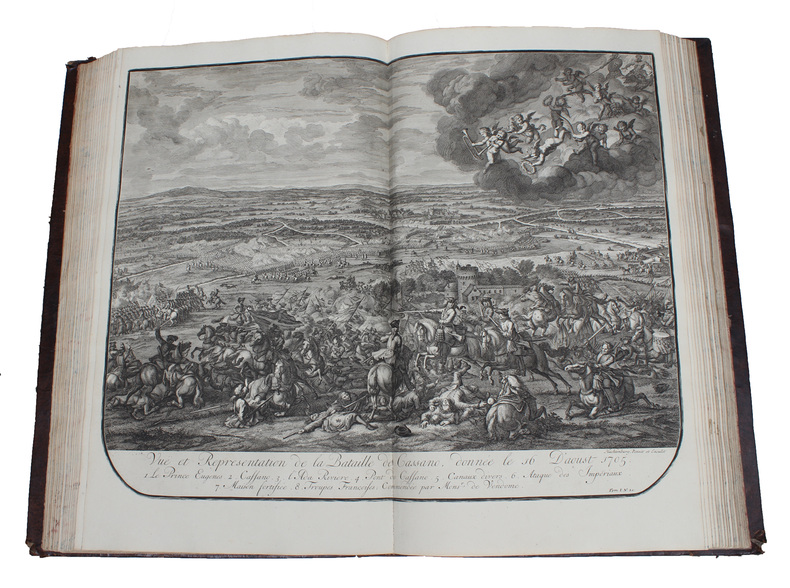
172955765A la Haye, chez Isaac van der Klott, 1729-47. Large folio. (54 x 35 cm.). 3 uniform contemporary full mottled calf. Spine with 9 compartments, divided by 8 raised bands. Compartments richly gilt. Titlelabels with gilt lettering. Light wear to top of spine on volume I. Small stamp on title-pages. LXI,132 II,336(6),357,(1) pp. 3 engraved titlevignettes, 10 half-page engraved headpieces and 101 fine engraved plates (10 maps, 12 battle-scenes 77 plans and views, 2 portrait-plates (one as frontispiece in Vol. III) mostly double-page (also triple-page or more). 6 tables, some folding. Internally fine and clean, printed on good paper. Wide-margined.
A la Haye, chez Isaac van der Klott, 1729-47. Large folio. (54 x 35 cm.). 3 uniform contemporary full mottled calf. Spine with 9 compartments, divided by 8 raised bands. Compartments richly gilt. Titlelabels with gilt lettering. Light wear to top of spine on volume I. Small stamp on title-pages. LXI,132 II,336 (6),357,(1) pp. 3 engraved titlevignettes, 10 half-page engraved headpieces and 101 fine engraved plates (10 maps, 12 battle-scenes 77 plans and views, 2 portrait-plates (one as frontispiece in Vol. III) mostly double-page (also triple-page or more). 6 tables, some folding. Internally fine and clean, printed on good paper. Wide-margined.
182069056Paris, Pierre Didot l'ainé, 1806 1820 4 volumes grand in-folio, demi chagrin fauve, dos à nerfs ornés de filets dorés reliure fin XIXe s., faux titre gravé, 1 portrait de SAS le Prince de la Paix d'après Steven, XLVI pp. dont le titre, 72 pp., 1 f. n. ch. et LXXXVIII planches - Faux-titre, titre, pp. de 73 à 132, planches de LXXXIX à CLXXXIX - Faux-titre, titre, XLV pp., 36 pp. et XC planches - Faux-titre, titre, XCI pp., 38 pp. et LXX planches, 2 cartes doubles de l'Espagne et du Portugal. Soit 272 planches hors texte.
4to. 1 leaf. Previously unpublished letter from Che's hideout in the Sierra Maestra mountains. Just six months before, Che landed in Cuba alongside Fidel Castro. He was one of the few who survived the initial battle which killed most of his companions before they were able to flee and begin to build a network of guerrilla revolutionaries. - Addressed to "Eliodoro", Che's letter is preoccupied with the basic necessities of warfare and survival, including the common military difficulty of clothing an army. Che is working on setting up textile manufacturing in the remote countryside: "Estamos trabajando con Manuela para la ubicación y confección de la textilera. Estuvimos discutiendo igualmente la calidad de los insumos para ello, es decir, tela, hilo, cuero, etc." He stresses the vital importance of this endeavour: "Se hace sumamente necesario la agilización de esta situación ya que la gente se enemente casi desnuda". He asks that Eliodoro and Manuela work together, with their local knowledge and connections, to make this happen: "agilizan el proceso, estoy seguro jue dará sus frutos". Signed, as always, simply "Che". - The fellow revolutionaries named are likely local farmers or workers in the Sierra Maestra, with whom Che worked extensively during his time in there. Interestingly, a 1967 short film titled "Manuela" tells the story of a young woman in the Sierra Maestra who joins forces with the revolution, echoing the Manuela mentioned in this letter. - Lightly creased, minor chipping along edges. A rare glimpse of Che's life in the earliest months of the war.
4to. 48 pp. With armorial woodcut and folding engraved plate. Contemporary limp vellum with ms. title to spine. The earliest treatise - and only early monograph - on the historical precursor to the modern game of football (or soccer), namely the game of "Calcio" traditionally played by young men in Florence's Piazza Santa Croce during the Carnival season. The book explains the mechanics of the game, provides its historical background, and describes actual games played in and around Florence in the recent past. The detailed account was first published in 1580 and reprinted in 1615, unchanged save for a new dedication and preface by the printer, Cosimo Giunti, who also reveals the author's name as Giovanni de' Bardi, Conte di Vernio. - The engraving shows a fine view of the Piazza with the players on the field immediately before kick-off. The title page shows the Medici arms: the book is dedicated to Archduchess Maria Maddalena of Austria, Grand Duchess of Tuscany as wife of Cosimo II de' Medici. Melzi II, 388. Moreni I, 84. Bascetta, Sport e Giuochi I, 129. Cf. Parenti 54f. (1st ed.). Inghirami I, 60. Cicognara 1570; Gamba 98f. (later eds. only).
Oblong album (445 x 315 mm) with 71 large albumen photographic prints, mostly ca. 22 x 28 cm, signed and captioned in the negative (in French and English), mounted on both sides of the album's leaves. Includes a three-part folding panorama of Jerusalem from Mount Olivet, measuring 82 x 21 cms. Ornamental endpapers printed in gilt. Original auburn morocco with gilt upper cover. All edges gilt. A rare and unusually massive Palestine souvenir album containing 71 photographs by the renowned studio of Félix Bonfils (1831-85), the French-born photographer who had come to the Levant with General d'Hautpoul in 1860 and remained active in the East. Based in Beirut, Bonfils produced thousands of photographs depicting Palestine, Egypt, Syria, Greece and other parts of the Ottoman Empire. In the early days of western tourism to the Middle East, his works soon became popular as souvenirs. The photographs were available both separately and as individually arranged albums, but sets of this scope were uncommon, very few exceeding fifty images. The sumptuous binding which the owner chose underlines that this was a luxury souvenir for a more than ordinarily wealthy traveller. It features landscapes and city views, famous sights such as Jaffa Gate (Bab el-Khalil), sites sacred to the three religions (Church of the Holy Sepulchre, Church of the Flagellation, Al-Aqsa Mosque, Mosque of Omar, Wailing Wall), but also sights outside Jerusalem, including Hebron, Bethlehem, the Dead Sea, the River Jordan, Jericho, Wadi el-Kelt, Khan-el-Ahmar, Bethany, Nazareth, and Emmaus. - The photographs occasionally show some insignificant loss of contrast, but are altogether in good condition. A few edge flaws to the cardboard leaves, including a chafe mark across the lower edge where the paper has buckled. Binding in good condition, with occasional scuffing (more obvious on lower cover). A fine album of photographs of Palestine.
143 Bll. (pag. SS. 27 bis 346), 11 Bll. Register, 1 Bl. 283 Einträge mit 13 Scherenschnitten/Silhouetten, 3 einmontierten Kupferstichen (einer davon koloriert) und 1 kolorierten Zeichnung (Studenten beim Billardspiel). Lederband der Zeit. Qu.-8vo. Der Inhaber des vorliegenden Stammbuches, Johann Heinrich Scherber, war Pfarrer von Bischofsgrün und später dann von Selb. Die Einträge entstanden ausschließlich während der Studentenzeit in Jena (Immatrikulation am 23. X. 1777) und Erlangen (Immatrikulation am 3. V. 1779). Hervorzuheben ist ein bislang nicht bekannter Eintrag des Dichters Johann Peter Hebel (S. 102) und daß einige Beiträger einen Bezug zu Goethe haben, so etwa der "Onkel von Christiane von Goethe", Justus Herrmann Deahna, andere zu Jean Paul, etwa Johann Nicolaus Apel oder der Schwiegervater von Jean Pauls jüngster Tochter Odilie, Christian Hake. Unter den Eintragungen finden sich u. a.: 1) Erlangen, 27.06.1779. Friedrich Gustav Metzger (1762-82) aus Rothenburg; in das Stammbuch des früh Verstorbenen hat sich Johann Peter Hebel eingetragen; der von Metzger mit einem Kommentar versehene Eintrag des Dichters ist wiedergegeben bei Pietsch. Das Stammbuch liegt im Museum für Angewandte Kunst in Frankfurt a. M. 2) Erlangen, 21.09.1780. Johann Nicolaus Apel (1757-1823), deutscher Autor, Naturforscher, Konstrukteur und Politiker. Stand u. a. in Briefkontakt mit Jean Paul, der von seinem Vater, dem Pastor Johann Apel (1726-79) getauft worden war. 3) Erlangen, 16.10.1780. Georg Christian Elias Erb (1759-1826), Pfarrer in Schornweisach, später in Neudrossenfeld. War als Feldprediger 1782-84 bei den Bayreuther Regimentern in Amerika und nahm dort an den Kämpfen der Amerikanischen Revolution teil. Verfasser einiger Predigten. 4) Jena, 14. III. 1779. Johann Wilhelm Schmidt (1760-1816), Pfarrer, zuletzt in Buggingen. Freund des Dichters Johann Peter Hebel, der sich gleich zwei Mal in sein Stammbuch eingetragen hat, das in der Badischen Landesbibliothek in Karlsruhe liegt. 5) Erlangen, 1780. Johann Gotthard Gericke (1759-83), Theologiestudent aus Riga, der auf der Heimreise nach Riga ertrank. Sein Stammbuch ist erhalten geblieben, in dieses haben sich Goethe, Wieland und Herder - mit einem Gedicht - eingetragen. 6) Erlangen, im März 1779. Johann Peter Hebel (1760-1826) mit einem Gedicht: "Fehlt innen Ruhe nicht, was fehlet meinem Leben. | Als was entberlich ist, und unentberlich scheint? | Solt ich bei iedem Unfal beben, | und weinen, wan die Torheit weint | Zum Andenken der ungeheuchelten Freundschaft von deinem treuen Freund J. P. Hebel [...]". Der vorliegende bislang unbekannte Hebeleintrag zitiert - wohl aus dem Gedächtnis - eine Strophe aus dem Gedicht "Glückseligkeit" des Dichters Johann Peter Uz. 7) Erlangen, 4. V. 1779. Johann Friedrich Plitt (1761-1823), ab 1803 "von" Plitt, Dr. iur., Hofrat, Minister-Resident usw. 8) Erlangen, im May 1779. Ludwig Sebastian Zehelein (?-?), bis 1803 Conrector des Lyceums, ab 1803 Rector der Lateinschule in Tirschenreuth, Bruder des Lyrikers Ludwig Sebastian Zehelein. 9) Erlangen, 07.05.1779. Ehrenfried Hans Friedrich Ferdinand Busch (1756-1816), als Secondeleutnant bei den Ansbacher Jägern in den Jahren 1781-1783 in Amerika kämpfend (in derselben Einheit wie die Einträger Erb und Deahna), später Hauptmann und Stadtvogt in Crailsheim. Busch "verliess Erlangen am 14.May in der Hoffnung, sein Glück als Officier in Amerika zu machen. Der Himmel begleite deinen Entschluß, gute Seele!" 10) Erlangen, September 1780. Philipp Adolf Besserer von Thalfingen (um 1756- 1779), Sohn des Ratsältesten Christoph Erhard Besserer von Thalfingen, ertrank 1789 bei Bövingen, mutmaßlich Suizid. Sein Stammbuch liegt in der HAAB in Weimar (StB128). 11) Erlangen, Nov. 1780. Sebastian Andreas Balthasar von Hößlin (1759-1845), bedeutender Stadtbaumeister der Stadt Augsburg. 12) [Erlangen], 1779. Martin Heinrich Friedrich Pilger (1760 Wetzlar-1838 Charkov), zuletzt Ordinarius für Veterinärmedizin in Charkov. Nach einer militärischen Karriere veröffentlichte der Autodidakt Pilger zahlreiche Aufsätze zum Thema Veterinärmedizin, dies unter Nennung seines Offiziersranges als Hauptmann. Daneben veröffentlichte Pilger 1791 die sog. "Wezlarische Annalen", die ihn als echten deutschen Aufklärer zeigen, der sich mit buchstäblich allen anlegt. Bis heute von hoher Bedeutung seine Abhandlung "Ideen über die Behandlung der Juden in Deutschland", die ihn als Vorkämpfer der Juden-Emanzipation ausweisen. Der Ruf an die Universität Charkov in der Ukraine war Diskussionspunkt bei J. W. v. Goethe. In Charkov hat sich dieser streitlustige Mann dann mit allen überworfen. Zu ihm wird bemerkt: "Dies wenige mag von dem Charakter dieses Ehrenmannes zeugen | war zu nichts anderes tüchtig als zur Tragung der Flinte" und "General aller Schisser und dummen Jungen". 13) Erlangen, Merz 1781. Ludwig Steinbrenner (1759-Großbödungen), Theologe. 14) O. O. u. D. Justus Herrmann Deahna ( 1758-1825 Bayreuth) zuletzt Justiz- und Regierungsrat in Bayreuth. Nahm als junger Mann als Leutnant der Ansbacher Jäger für ca. 2 Jahre an dem Unabhängigkeitskrieg in Amerika teil. Seine Tochter Helene heiratete 1801 Christian August Vulpius, den Schwager Goethes, die andere Tochter Rosalie den Bankier Falkner. Deahna wird wegen dieser verwandtschaftlichen Beziehungen, die ihm Tischeinladungen mit Goethe einbrachten, in der Literatur als "Onkel von Christiane von Goethe" bezeichnet. 15) Erlangen, Mai -79. Justus Friedrich Zehelein (1760-1802), Schriftsteller, Lyriker, Komponist, Radierer. Friedrich von Matthisson hat ihn mit seinen Werken in Band 14 seiner Lyrischen Anthologie aufgenommen. 16) Erlangen, 10.11.1780. Peter Adam Freiherr Liebert von Liebenhofen (1759-1818), Augsburger Bankier, Sohn des (weitaus berühmteren) Benedikt Adam Liebert, des Erbauers des Schaezlerpalais in Augsburg, in dem Marie Antoinette angeblich ein Paar Schuhe durchgetanzt hat. 17) Erlangen, 17.08.1779. Christian Heinrich Gottlieb Harke(?-nach 1823), bayerischer Appellationsgerichtsrat, Verfasser eines Kommentars zum Bergrecht mit dem Titel "Commentar über das Bergrecht" (1823) und eines Lehrbuches zum Bergrecht. Sein Sohn, der spätere Hauptmann Friedrich Harke (1797-1873) heiratete 1829 die jüngste Tochter Jean Pauls, Odilie Richter. Auf den Briefen Friedrich Harkes basiert im wesentlichen das Buch von Christiane Pritzlaff "Geliebt und vergessen: Odilie Richter - Jean Pauls jüngste Tochter" (2013). 18) Erlangen, 28.11.1780. Immanuel Gottlieb Koch (1762-1788 in türkischer Gefangenschaft), war ab 1788 dem österreichischen Infanterieregiment Nikolaus Esterhazy zugeteilt, geriet dann in türkische Gefangenschaft. (Das Regiment hatte 1788 die Festung der Osmanen in Schabatz, heute: Sabac/Serbien, gestürmt.). 19) Erlangen, Mai 1779. Christoph Ludwig Schreiber (1758-1839), zunächst Deputierter der Stadt Heilbronn in den napoleonischen Kriegswirren, später badischer Hofrat, in der Zeit von 1817-1820 in Korrespondenz mit dem Freiherrn von Stein. Führte häufig Protokoll bei den Experimenten seines Freundes Eberhard Gmelin, v. a. bei der Behandlung der Caroline Heigelin, dem (so wird vermutet) Vorbild für das "Käthchen von Heilbronn" von Kleist, der seinerseits mit Schreibers Kommilitonen Georg Christian Wedekind nahe befreundet war.