692 496 résultats
12mo (83 x 129 mm). 84 ff. containing entries by more than 230 personages. With one engraved devotional lace picture, one small pen-and-ink drawing, and one dried flower. Contemporary half calf over wooden boards; both covers elaborately decorated with ornamental plating and inlays of bone, brass, and mother-of-pearl (front cover very slightly cracked and brass plating loosened at the top left corner). Pocket in inside of lower cover; sheath with original thin pencil. Narrow gilt rules to spine. A single central clasp. All edges gilt. Remarkable, wide-ranging friendship album of Princess Anna of Hesse and by Rhine (1843-65), only daughter of the Hessian general Karl of Hesse and Princess Elizabeth of Prussia. In May 1865 she married Grad Duke Frederick Francis II of Mecklenburg-Schwerin but died of puerperal fever a week after the birth of her only child. Both her parents as well as her later husband have signed her album. - The entries are mainly by members of the European aristocracy, including Archduke Albert of Austria-Teschen (1817-95), Czar Alexander II of Russia (1818-81), Princess Alice of Great Britain (1843-78), Duke Frederick of Anhalt (1831-1904), Countess Charlotte Fugger (1830-76), Gustav Prince of Vasa (1799-1877), Prince Henry XXII Reuss-Greiz (1846-1902), Helena Louise of Mecklenburg-Schwerin, Duchess of Orléans and Chartres (1814-58), Duke Joseph of Saxe-Altenburg (1789-1868), Joséphine de Beauharnais, Queen of Sweden and Norway (1807-76), Louis Philippe Albert d'Orléans, Comte de Paris (1838-94), King Ludwig II of Bavaria (1845-1912), King Maximilian II of Bavaria (1811-64), Princess Sophie of Orange-Nassau, Grandduchess of Saxe-Weimar-Eisenach (1824-97), Countess Théodolinde of Württemberg, Princess of Leuchtenberg (1814-57), Princess Therese of Oldenburg, née Nassau Weilburg (1815-71), Prince Wilhelm of Schaumburg-Lippe (1834-1906), and many others. The later "Swan King" Ludwig II has signed his name twice: once as a six-year old, together with his mother Marie Friederike of Prussia (1825-89), and again as a twelve-year-old, alone. Other entries by children include Mary Victoria Hamilton (1850-1922), who would marry Prince Albert I of Monaco in 1869, and the later ethnologist, zoologist and botanist Therese of Bavaria (1850-1925). Other contributors from the field of science and scholarship include the explorer Adalbert von Barnim (1841-60), the geologist Wilhelm von Branca (1844-1928), and the theologian Carl Heinrich August von Burger (1805-84). - Pages numbered in pencil up to p. 160 by a later hand. Provenance note on the final page of text (p. 133) by Marie of Schwarzburg-Rudolstadt, Grand Duchess of Mecklenburg (1850-1922): "This book belonged to the Grand Duchess Anna of Mecklenburg née Princess of Hesse-Darmstadt; it was later given to Duke John Albert of Mecklenburg in Dezember 1919 [...]".
Oblong 8vo. Title page and 97 ff. (46 of which are inscribed). Red morocco, spine and covers lavishly gilt. The album contains entries by many outstanding scientists and scholars of the time, including not only Bernoulli, Breitinger and Hebenstreit, but also Christian Augustus Crusius (Protestant theologian and philosopher, 1715-75), Johannes Gesner (physician and mathematician, 1709-90), Christian Gottlieb Ludwig (physician and botanist, 1709-73), Casimir Christoph Schmidel (naturalist, 1718-92), Heinrich Friedrich Delius (physician, 1720-91), Philipp Friedrich Gmelin (botanist, 1721-68), Christoph Jacob Trew (botanist, 1695-1769), Abraham Gotthelf Kästner (mathematician and teacher of Gauss, 1719-1800), Philipp Adolph Böhmer (physician, anatomist and personal physician to King Frederick William II of Prussia, 1711-89), and Andreas Elias Büchner (head of the Academy of Sciences Leopoldina, 1701-69). The album's owner, Johannes Hotze (1734-1801), was a Swiss physician of great international renown and the cousin of the pedagogue Johann Heinrich Pestalozzi. Born into a well-known family of surgeons, Hotze attended the Collegium Carolinum in Zurich and then studied at Strasbourg, Tübingen and Leipzig, from where date numerous entries. Goethe, who visited him twice, described him as a "most intelligent and benevolent man" ("Dichtung und Wahrheit" IV, 18).
Cut and pasted on a 4to sheet. Signatures of the first, third, fourth and fifth Presidents: George Washington, Thomas Jefferson, James Madison, and James Monroe. - Well preserved.
A single hand-carved woodblock (ca. 170 by 110/92 by 220 mm) for use as printing block, together with a print on 18th century paper (165 x 105 mm). Woodblock in Ottoman Turkish for a Hebrew publication of the Song of Solomon, probably produced in the Ottoman regions of the Levant for a rural printing press. A rare survival of a printing tool, and also an important witness to cross-cultural printing for minority audiences in the Ottoman world. - Includes a print of the text reading "Safr Nishd al-Nishad li-Suleyman wa'ighal ba-l'Abraniyat Sir Hashirim", printed on a piece of 18th-century paper pasted to a cutting from a Croatian printed book ("Pasha Duhovna", on Spirituality and the Passover). - Some small wormholes in the wood, post-dating the print; carved side stained black from ink used for printing. Printing devices such as this are often discarded or recycled and rarely survive in such condition as the present example.
Folio. 368 pp. With 149 large woodcuts. Contemporary paper wrappers. Rare first edition of the Gospels in Arabic; the first work to be issued from the Medicean Press, directed by G. B. Raimondi. Printed in Granjon's famous large fount, generally considered the first satisfactory Arabic printing type and appears here for the first time. Apart from the Latin title and colophon, the book is in Arabic throughout. Also in 1591 an Arabic-Latin edition was issued, more common than the present one and reprinted in 1619 and 1774. Illustrated with 149 large woodcuts from 67 blocks by Leonardo Parasole after Antonio Tempesta. - Some browning and waterstaining throughout; a few marginal tears. Untrimmed in the original temporary wrappers as issued. The Hauck copy commanded $75,000 at Sotheby's in 2006. Adams B 1822. Mortimer 64. Darlow/Moule 1636. Fück 54. Schnurrer 318. Smitskamp 374.
Folio (260 x 366 mm). (4), 9-462, (2) pp. Title-page printed in red and black, with the Medici arms. With 149 text woodcuts by L. N. Parassole after Antonio Tempesta. Contemporary Italian flexible boards with ms. title to spine. The rare first re-issue, with new preliminary matter only, of the first Gospel printing in the interlinear Arabic and Latin version, prepared at the same time and printed by the same press as the first Arabic-only Gospel. These were the first works ever produced by Ferdinando de' Medici's "Medicea" press, founded by Pope Gregory XIII to spread the word of Christ in the Orient. Supervised by the able scholar Giovambattista Raimondi (1536-1614), its strength lay in oriental, especially Arabic, printing. After Raimondi's death, the press relocated to Florence. - The Arabic text is printed in Robert Granjon's famous large fount, generally considered the first satisfactory Arabic printing type; as all early printed editions of the Arabic Gospels, it is based on the Alexandrian Vulgate (cf. Darlow/M. 1636). The Latin version is by Leonardo Sionita. As issued in 1591, the work began with page 9, without a title page or any preliminary matter at all: "the intended prefatory matter was apparently never published" (Darlow/M.). The 1619 re-issue contains 4 pages of preliminary matter (title page and a note "typographus lectori"); there exist copies with two additional leaves of dedications not present here. Another re-issue, much more common, was released in 1774. - Occasional browning; a good, untrimmed and hence wide-margined copy in its original temporary binding. Darlow/Moule 1643. Mortimer 64 (note). Streit XVI, p. 866, no. 5138.
8vo (101 x 171 mm). (16), 286 pp., final blank leaf. Near-contemporary full red morocco binding, flat spine with gilt title and elaborate ornamentation, both covers bordered with triple rules, leading edges gilt, inner dentelle gilt. Marbled endpapers. All edges gilt. Extremely rare first French edition of the oriental tales known as "Kalila wa-Dimna" or "Anvari Suhaili", being the Persian version of the Fables of Bidpai (here comprising the prologue and the first four chapters). Translated by the great French linguist Gilbert Gaulmin (1585-1665) and his student and collaborator David Sahid d'Ispahan (whose is the only name given on the title). Bidpai (or "Pilpay") is the name of the Indian philosopher to whom the Arabic and Persian tradition attributes this famous collection, known in the Sanskrit tradition as "Panchatantra". It was translated into Latin as early as the 13th century. - This first French edition is of particular importance for popularising the fables in France and providing Jean de La Fontaine with themes for many of his later and most beautiful stories in his own fable collection, first published in 1678-79 (cf. Le Roux). - Volume ends with the note "Fin de la premiere partie", but all published. Provenance: old ink ownership "Bouhon or. de S. Sac" to title-page. Later in the library of the Lebanese-born entrepreneur Charles Kettaneh (1904-85) with his etched bookplate to the front flyleaf. Together with his brothers, Charles Kettaneh developed the export business of cars and other American luxury goods to the Middle East, where he established licenced dealerships. Passionate about travel, a fine scholar and knowledgeable about art, Kettaneh was a great collector and bibliophile; his library was remarkable for the rarity of the books rather than for their number. - Binding very slightly rubbed in places, but finely preserved. Contemporary bibliographical notes and the odd penstroke to the margin. A superb copy, not in trade records. Chauvin II, p. 33, no. 55A. Brunet I, 937. Graesse I, 421f. Barbier II, 1329. Le Roux de Lincy, Essai sur les fables indiennes et sur leur introduction en Europe (1838), p. 23f. OCLC 457066815.
French bronze reliefs gilt, both preserved in their original frame. Each 43 x 39 x 4.5 cm. Showing two horses facing each other. Both bronze reliefs are very intricately detailed and mounted on a base of red velvet in two strictly contemporary frames of the French Empire period.
Small folio (232 x 280 mm). 36 ff. Contemporary marbled wrappers. All edges gilt. The Regulating Act of 1773, published in Persian and English on opposite pages. - British interest in Persia and the Arabian Gulf originated in the 16th century and steadily increased as British India’s importance rose in the 18th century. In the beginning, the agenda was primarily of a commercial character: realizing the region's significance, the British fleet supported Shah Abbas in expelling the Portuguese from Hormuz in 1622. In return, the British East India Company was permitted to establish a trading post in the coastal city of Bandar 'Abbas, which became their principal port in the Gulf. The Company became responsible for conducting British foreign policy in the region, and concluded various treaties, agreements and engagements with Gulf states. In 1763 the EIC established a permanent residency at Bushehr, on the Persian side of the Gulf. By the early 1770s, the East India Company was in severe financial straights due both to corruption and nepotism as well as from steeply declining tea sales to America and heavy annual payments made to maintain the trading monopoly. When approached for assistance, the government enacted legislation to supervise ("regulate") the activities of the Company. This "Act for establishing certain Regulations for the better Management of the Affairs of the East India Company" constituted the first step toward eventual British government control of India, thus radically limiting the role of EIC in the administration of India. In 1784, little more than a decade later, Pitt's India Act would take reforms even further. - Another issue in the same year is known, with identical typesetting, but in which each page of text is enclosed within an engraved frame (these copies are printed in a taller folio format ). Slight edge repairs; spine restored. From the library of William Aldersey, president of the board of trade in Bengal, with his ownership (dated 1774) to recto of f. 1. ESTC T145421. OCLC 560572771.
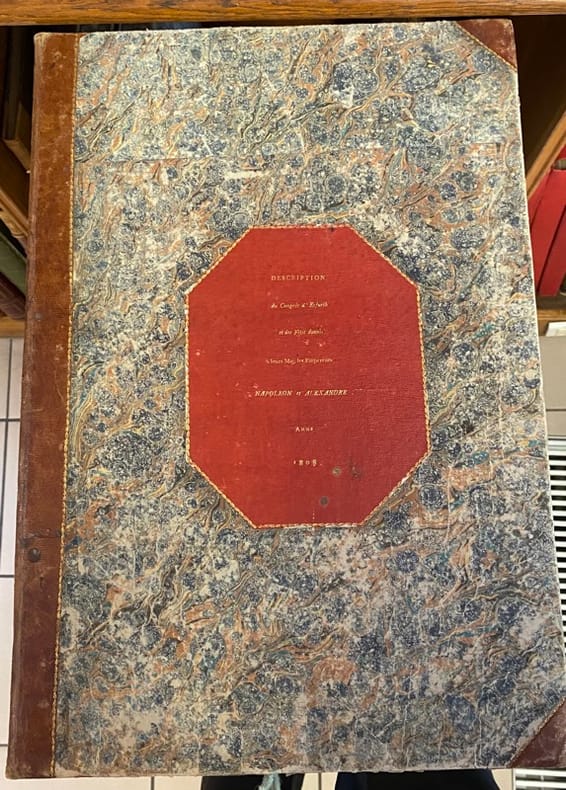
219943Weimar, Bureau d'industrie, 1809 in-folio, [4]-24 pp., texte bilingue sur deux colonnes (allemand et français), avec 5 planches hors-texte dont 4 en couleurs, demi-basane acajou à coins, dos lisse muet, titre dans un cartouche de maroquin rouge sur les premier plat, ex-dono dans un cartouche de maroquin rouge sur le second plat (reliure de l'époque). Anecdotique usure d'usage.
Engraved map of the Indian Ocean, Indian subcontinent and most of the Gulf region (28 x 39 cm; margins extended to 50 x 66.5 cm), at a scale of about 1:13,500,000 with north at the foot, with the equator reticulated with longitudes based on a prime meridian through Cape Verde, reticulated scales of latitude in the left and right borders, the Tropic of Cancer not reticulated; 3 sea monsters, a spouting whale and 3 ships in the ocean; and on the land elephants, lions and 2 people on horseback carrying spears. Rare very early engraved map showing the Indian subcontinent, the Strait of Hormuz, the eastern half of the Gulf, and the Indian Ocean, including the islands of Ceylon (Sri Lanka), the Maldives, Seychelles, the western tip of Sumatra and what must be the eastern tip of Somalia. The island Diego Garcia (7° S), labelled "Isole de Don Garzia", touches the southern edge of the map image. The map's own scales indicate that it covers 35°N to 9°S and 60 to 120°E (labelled 85 to 145°E following the Cape Verde prime meridian), but in fact it covers about 60 to 96°E. It is double trapezoidal projection, but tapers only slightly from its widest point at the equator. Many topographic names appear in forms used in early Portuguese accounts of voyages, but most can be identified. In India and Ceylon we find Goa, Mangalor (Mangalore), Cochin (Kochi), Calinapata (Calcutta?), Besinagar (Bangalore), Colmucho (Colombo) and many others; in the Gulf region Cor. Dulfar (Dhofar), the island Macira (Masirah), C. Resalgate (Ras el Had?), Galatia (the ancient site Qalhat), Mazcate (Muscat), the island Quexumo (Qeshm) and Ormus (Hormuz). There is even an unlabelled city close to present-day Abu Dhabi. Two of the ships are labelled with their destinations: Calicut (Kozhikode) on the Malabar Coast and Molucche (the Moluccas) in the East Indies. - Gastaldi first published a similar map as one of a set of three woodcut maps in the first volume of the second edition of Giovanni Battista Ramusio,Navagationi et viaggi, Venice, 1554: the "Prima tavola" shows Africa, the "Seconda tavola" shows the regions in the present map and the "Terza tavola" shows Southeast Asia and the East Indies. These were a great advance on earlier maps, including even Gastaldi's own, taking account of new information from Portuguese explorers. - The woodblocks and whatever copies of the printed edition had not yet been sold were destroyed by a fire in 1557, so for the 1563 edition the publisher had the three maps engraved on copperplates by Niccolo Nelli. Bertelli published the three maps without Ramusio's text, and his maps are usually supposed to have been printed from the 1563 plates, but Karrow describes them as close copies, with his name and the date 1565 added in each map, and Bertelli was an engraver as well as a publisher. Although the first map also has a longer note referring to all three maps, they were probably issued separately as well. Although printed from a single copper plate, the present map image is divided into two parts, with a 7 mm gap between the right and left halves, so that nothing would be lost if the map were bound as a double-page plate. No later state is noted in the literature, so there may have been multiple printings with the unrevised plate. - The present copy is printed on a whole sheet of paper, watermarked: coat of arms (77 x 44 mm) bearing a tree on the central and highest of three hills = --, with about 38.5 mm between chainlines except that the mark is centred on a chainline only 25 mm from the adjacent ones. The tree clearly matches the style of the oak tree in the arms of the family Delle Rovère, including the Popes Sixtus IV and Julius II (who served 1471-1484 and 1503-1513), but their arms does not include the hills. The present mark is very close to Briquet 969 (Lucca 1573-1582) and Zonghi 1737 (Fabriano 1571). Likhachev 3636 (an Italian manuscript f ca. 1570) is not as close. All similar marks noted in the literature date from the period 1569 to 1582, so the present map seems unlikely to have been printed in 1565, but very likely to have been printed ca. 1570 (Bertelli remained active to ca. 1580 or perhaps even later). Bifolco & Ronca lists copies of the 1563 (84a) and the present 1565 (84b) state or edition together, but their separate lists of references suggest the present 1565 version is much rarer. - The margins have been cut down close to the plate edge and in places to the outer edge of the border, and the margins then greatly extended (10-14 cm) with blank paper, but this paper is also contemporary, watermarked: coat of arms bearing a ladder and topped with a 6-point star (90 x 27 mm) = --, similar to Likachev 3524 (Loreto 1564). The map is very slightly browned at the edges (where the pieces of paper used to extend the margins were pasted together) and in the gap between the right and left halves (where the old fold has been reinforced on the back), but the map is otherwise in fine condition. A milestone in the cartography of India and the Gulf States, remarkably well preserved. Bifolco & Ronca, Cartografia topografia Italiana, 84b. Gole, Early printed maps of India, 2. Karrow 30/74.2.
Folio (212 x 333 mm). Publisher's original blue printed boards, black cloth spine hand-lettered. Appendices to the annual "Administration Report" on the Gulf region which the British Political Residents submitted to the Indian Viceroy and Governor. The bland official title belies the true value of the series, which has been called "a mine of information on the development of the modern Gulf" (Cambridge Archive Editions). Regularly the reports contain political details of the local sheikhdoms as well as trade information. - The present appendix volume contains the meteorological tables for the year 1896/97 as well as, crucially, the year's trade reports for the entire Gulf region. The issue notes widespread lower trade revenues, which it diagnoses as due to an Indian plague and subsequent quarantines of port cities, as well as ongoing political unrest in Qajar Iran following the assassination of the Shah, Naser al-Din Shah Qajar, the previous year. The volume provides carefully detailed charts of imports and exports for Bushire, Lingah, Bunder Abbas, Bahrain, the Arab Coast of the Gulf, and Shiraz. Though most exports dropped, the value of Bahrain's in fact had gone up since the previous year, with its most valuable exports being coffee, rice, and printed cottons to Turkey and the especially valuable export of pearls to India. On the Arabian Gulf Coast, principal exports were, again, pearls, though these were largely bound to "Persian ports". Those on the Arab Coast also benefitted from the mother o' pearl shell trade, one of the least impacted by the upheavals of India and Qajar Iran. - The "Administration Report on the Persian Gulf" was published under various titles annually between 1875 and 1957. Original specimens are almost unobtainable in the trade. - Provenance: removed from the London Library, with their printed label on the upper cover and their stamps (in blind and printed) on title-page and final leaf, accompanied by cancel stamps. Macro, p. xii (s.v. "RAPA": Report on the Administration of the Persian Gulf Political Residency and Muscat Political Agency). OCLC 224558510. ZDB-ID 768652-3. Cf. the 1989 Cambridge Archive Editions reprint.
12 unnumbered ff. (1 blank), 60 numbered ff., 64 blank ff. With 56 armorial drawings in watercolors (1 in India ink) and 40 decorative grisaille cartouches washed in India ink. Late 18th c. calf with gilt spine, gilt-tooled border on boards and star-shaped center panel on both boards. Leading edges gilt. Oblong 12mo. Remarkable collection of autographs from the library of the English botanist and antiquary Dawson Turner (1775-1858) with his autogr. ownership entry on first leaf (dated 1825). Dawson, who had published on botany and was elected a Fellow of the Royal Society in 1802, turned his interests to antiquities in the 1820s. He and his children were taught to draw by their good friend, the renowned Norfolk artist John Sell Cotman, who resided in Yarmouth from 1812 to 1823. - The signatures, mostly clipped from letters and other documents, are from historic French, German and Dutch personages, including William, Prince of Orange (1533-84); Prince Eugene of Savoy (1663-1736); Johann Tserclaes, Count of Tilly, commander of the Imperial forces in the Thirty Years' War (1559-1632); Cornelius Jansen, theologian and later cardinal, founder of Jansenism (1585-1638); Philip de Montmorency, Count of Hoorn (1524-68), and Lamoral Count of Egmont (1522-68, opponents to Spanish rule in the Netherlands, executed); Johann Casimir, Duke of Saxe-Coburg (1564-1633); August the Younger, Duke of Brunswick-Wolfenbüttel, founder of Wolfenbüttel's Herzog August Library (1579-1666); Johann Wilhelm von der Pfalz, Elector Palatine (1658-1716); André-Hercule de Fleury, Cardinal (1653-1743); Fredrick, landgrave of Hesse-Eschwege (1617-1655); Floris van Pallant, Count of Culemborg (1537-98); Froben Ferdinand zu Fürstenberg-Mößkirch (1664-1741), and many more. Most names are accompanied by a skilled armorial illustration in full colour painted on the opposite page; forty of the signatures are bordered by decorative washed cartouches with specially designed figurated, landscape and allegorical ornaments, sometimes rather ingeniously incorporating the signature's pen flourishes and very likely prepared by members of the art-loving and gifted Turner family, possibly with help from Cotman. - Occasional slight brownstaining; book block loosened. Corners bumped; defects to upper spine end and lower third of spine. A remarkable (and remarkably presented) ensemble of autographs, forming a striking early 19th-century showpiece.
Oblong 4to. [70] gray, white and blue album ff., containing 67 sketches with accompanying manuscript captions and descriptions. 66 sketches in pen & ink and pencil, mostly signed by Blackwell, depicting Swiss, Burmese and Indian panoramas and domestic scenes, buildings, events, animals and inhabitants, mounted and bound in, most accompanied by manuscript captions and descriptions by Blackwell and sometimes by a later hand. There is also 1 print (ca. 1795/1800?) showing a "rhahan" (priest) drawn by Singey Bey and engraved by Thomas Medland. Half black morocco, black decorated paper sides, gold-tooled ornaments on spine. Sketchbook by the English lieutenant Thomas Eden Blackwell (1803?-45), showing views of India, Burma, and Switzerland, made in the years 1826-30, when India, which is the subject of about 30 of the sketches, and parts of Burma (now Myanmar) were British colonies. The sketches, mostly signed and dated by Blackwell, are mounted on album leaves and accompanied by manuscript captions and descriptions, also by Blackwell and sometimes by a later hand. Some of these remarks are general or contain interesting facts, while others are very personal or describe an event that happened during Blackwell's time as officer. - Blackwell drew some panoramic views and buildings (for example an Indian mosque or a narrow street in Calcutta), but he pays particular attention to Indian culture in his sketches of India and the accompanying explanations. He sketches the Indian population, animals, and scenes representing the everyday life of Indian people. Several animal sketches are exceptionally beautiful, including that of a horse (with notes about Arabian horses). He also draws a camel, compares camels to dromedaries, and outlines the habitat of both species in India. Also included are many sketches of Indian cattle, such as bullocks, which were used as water-carriers, and Bengal cows (whose milk is said to be "inferior" to that of English cows). - Blackwell also drew the inhabitants of the Indian places he visited, including a priest ("rhahan") and an Indian watchman ("chokedar"), but also a "Musselman" and an Indian woman, with remarks concerning the attitude of Indian men towards women. Of particular interest are the Indian "sceneries", as Blackwell calls them, showing the everyday life of Indian people: native cooking, but also how Indian people bathe in Hooghly river, how they wash their clothes, and men smoking a so-called "hubble bubble" (a hookah or water pipe). Blackwell annotatioins to nearly all these sketches provide the reader with rare insights into Indian culture. - of Burma (now Myanmar) fewer sketches were made, and they focus mostly on the coasts and the city of Rangoon's wharfs. These include the royal wharf at Rangoon, with a whole page of explanatory text on the facing page, and a sketch showing a stockade in Burma, where, according to Blackwell's caption, the British killed the Burman general Maha Bundoola (1782-1825) in the First Anglo-Burmese War. Yet there is also a sketch of the so-called Great Bell in Rangoon, which is representative of Burmese bells, which are often located near celestial buildings. The album also includes two views of Tobago in the West Indies: a large two-page panoramic view and a sketch of the government house in Tobago with a garrison in the background; Blackwell's note states that his daughter Eliza was born there on 25 January 1833. - Another part of the sketchbook comprises sketches of Swiss landscapes and panoramas, especially of the region surrounding Basel (of which Blackwell also includes a two-page panoramic view). - With owner's inscription on the front pastedown: "Lieut. Blackwell 13th Light Infantry. Indian, Burmese and Swiss Sketches". Binding a little worn, one quire loose, some occasional spots and somewhat browned, but not affecting the drawings. In good condition.
Oblong quarto. 371 photographs in 3 albums: 1) 121 original photographs ranging from small (70 x 100 mm) to medium (111 x 170 mm) and large (170 x 235 mm), mounted on 18 leaves (230 x 315 mm); 2) 178 original photographs ranging from small (70 x 50 mm) to medium (95 x 140 mm) and large (160 x 220 mm), mounted on 24 leaves (195 x 280 mm); 3) 72 original photographs ranging from small (65 x 90 mm) to medium (120 x 185 mm) and large (160 x 220 mm), mounted on 14 leaves (220 x 315 mm). Most photographs with manuscript captions beneath in white chinagraph pencil. With 6 additional photographs and a swimming certificate loosely inserted. Contemporary card covers with cord ties. Large collection of important photographs depicting RAF activity in Iraq during the late 1930s, demonstrating British imperial power by use of "Air Control": a policy designed to maintain the RAF as the independent third service of the British armed forces and enforce British imperial rule economically through the use of air power. - The current collection of photographs centres around the activities of 70 Squadron, providing heavy transport facilities and air ambulances and operating airmail routes between Cairo and Baghdad. Images include an armoured car with a mounted machine gun at Hinaidi; air-conditioned desert buses belonging to Nairn Transport Co going from Baghdad to Damascus, and the Flying Boat "Ceres" on Lake Habaniyah. The dangers of the operations are evident in the photos of a crash of the Flying Boat "Calpurnia" in Lake Habaniyah with the loss of five lives, the crash of Jonah Kyte No. 3 while landing, and the "Vincent" of 55 Squadron going up up in flames in Simel. The album captures well the cultural and military diversity of Iraq at the time. Not only are there bombers from the French Air Force on visit in both Dhibban and Habbaniya, but there are also photos of Iraqi "Gladiator" aircraft, Jewish women in Baghdad, and the Kurdish population spread across central Iraq. A 500-year-old church in Haiz is complemented by the photo of a priest with a 700-year-old Bible. As a foreigner abroad, the photographer gives the albums their healthy dose of tourist sites such as Alexandria (Egypt), the landscapes of Ser Amadia (while in a Summer Training Camp) and Ctesiphon Arch (530 CE). Aerial shots add bird's-eye views of the Golden Mosque of Khadimain (Baghdad), the crossing of the Suez Canal, and the Maude Bridge over the Tigris. The international and geopolitical importance of the photographs is further underscored in their documentation of the first Hinaidi-Singapore flight on 18 January 1937. - Extremities of albums slightly rubbed. 1 loose photograph creased at edge. A well preserved ensemble.
Folio (288 x 351 mm). 192 pp., profusely illustrated throughout, with 48 full-page Woodburytype plates mounted within printed borders on sturdy cardboard, 24 mounted Woodburytype plates in the text, and 2 plates printed in red. Bound in sumptuous red morocco for Ismail Pasha, Khedive of Egypt, elaborately giltstamped on spine and both covers. Leading edges gilt, inner dentelle gilt, marbled endpapers. All edges gilt. A striking collection of 72 woodburytype portraits of great artists and reproductions of their art, with accompanying biographical sketches, issued in undated instalments, then bound for and dedicated to Ismail Pasha, Khedive of Egypt and Sudan from 1863 to 1879. The portraits include famous authors and officers such as Victor Hugo, Thiers, Georges Sand, Sarah Bernhardt, Alexander Dumas fils, Gounod, Daudet, Erckmann-Chatrian, Mac-Mahon, Coppée, Jules Janin, Velpeau etc. - but also Ferdinand de Lesseps, the French engineer whose Suez Canal was constructed and opened under Ismail's khedivate. The photographs are by Mulnier, Nadar, Carjat, Petit, and others, and printed by Goupil. The woodburytype is a photomechanical process capable of reproducing the continuous tones of photography with pigmented gelatin molded to a varying thickness. The speed and economy of woodburytypes, as well as their permanence (unlike traditional photographic processes that were subject to fading), made them a highly practical substitute for albumen silver prints in book publication or other situations where mass production was desirable. - Occasional slight foxing, but very well preserved altogether. The upper cover of the luxuriant red morocco binding bears the dedication: "A Son Altesse Ismaïl Pacha Khédive d'Égypte". Sharing the ambitious outlook of his grandfather, Muhammad Ali Pasha, Ismail greatly modernized Egypt and Sudan during his reign, investing heavily in industrial and economic development, urbanisation, and the expansion of the country's boundaries in Africa. OCLC 17984963. Cf. Lucien Goldschmidt and Weston J. Naef, The Truthful Lens (1980).
40 volumes, mainly 4to. Mostly printed in the second half of the 18th century, the present collection includes the works of the principal Swedish orientalists of their time, mainly teaching and publishing at the universities of Uppsala and Lund, many by the great Matthias Norberg (1747-1826). Among the topics covered are medicine in the Middle East, history, linguistics and literature, education, and the learnedness of Middle Eastern rulers. - Detailed list of all titles available upon request.
8vo (148 x 90 mm). Illuminated Arabic manuscript on paper, 243 leaves plus 2 fly-leaves, complete. 19 lines per page, written in a neat Naskhi script in black ink with diacritics in red, margins ruled in gold and colours. Gold discs or florets between verses, sura headings written in white within gilt cartouches flanked by panels with alternating floral motifs in gold and various colours. Brown morocco with flap and giltstamped borders and central ornaments. Splendid pocket-size Qur'an. Marginal section markers in white naskh on gold ground within polychrome flower blossom, opening double-page frontispiece richly illuminated in lapis lazuli blue, green, red, pink, and gold, the text within cloud bands in gold. - Hinge tender between the first two pages, some light marginal fingering, otherwise in perfect condition. From the library of the scientists and collectors Crawford Fairbanks Failey (1900-81) and Gertrude Van Wagenen (1893-1978), who performed research at Yale and Johns Hopkins in the fields of medical chemistry and biology.
187 x 276 mm. With a rosette gilt and in gouache colour. Diacritical marks added later in black ink, vocalization marks in red (as well as one in green and one in blue). 5 lines. Well-preserved leaf in monumental Kufic script (line height c. 30 mm), written in dark brown ink. The text is from the middle part of verse 109 of the second Quran sura. The script style belongs to group D (according to Déroche's classification, subtype D.III). Similar examples are usually dated to the 9th century C.E. (cf. François Déroche, The Abbasid Tradition, London 1992. The Nasser D. Khalili Collection of Islamic Art, Vol. I, nos. 25 [p. 76] and 34/35 [p. 84]). The polychromatic rosette shows an inscribed number: The red dots are vocalisation marks; the diacritics (in the form of small slashes) were added later in black ink. - Some browning and staining. Brittle in places due to ink corrosion (minor defects to vellum). Verso rubbed, but still legible. Cf. Fingernagel (ÖNB 2010), p. 33.
4to (170 x 266 mm). Persian and Chagatay Turkish manuscript on polished laid paper. 158 ff. 14 lines of black Naskhi script, set in two columns within gilt borders and black, blue, and red rules; chapter headings in red ink. Prettily illustrated throughout with 28 coloured gouaches (of which 11 are half- to full-page-sized). Margins decorated with gilt scrollwork. Near-contemporary full brown binding with blind-tooled borders and medallion stamps to both covers. Highly rare, charmingly illustrated 18th century manuscript of the story of Yusuf and Zulaikha, which forms the medieval Islamic version of the narrative of the prophet Yusuf and Potiphar's wife. In the Muslim world for centuries, it is found in many languages such as Arabic, Persian, Bengali, Turkish and Urdu, but was given its best-known expression in Persian, by Jami, in the 15th century. - Edges brittle with some tears and chipping, quite extensive remarginings (no loss to text, but obscuring some of the gilt scrollwork borders), occasional light waterstaining. Ownership seals and stamps of Ya Cabbar and Habib Allah.
Folio (250 x 310 mm). (28), 586, (2) pp. Contemporary blindstamped full calf; spine rebacked. Second Henricpetri edition of this elaborate system of astrology, edited by Antonius Stupa. Abul Hasan Ali ibn abi Rijal (also known as Haly or Hali, and by the Latinized versions of his name, Haly Albohazen and Haly Abenragel), probably born in Cordoba, flourished in Tunis from ca 1020 to 1040, where he served as court astrologer to Prince Al-Muizz Ibn Badis. His "Distinguished Book on Horoscopes from the Constellations" enjoyed a great reputation, and he was celebrated as "Ptolemaeus Alter" and "summus astrologus". The work was translated from Arabic into Castilian by Judah ben Moses, upon orders of King Alfonso X of Spain, and - in 1485 - from the Castilian into Latin, by Aegidius de Tebaldis and Petrus de Regio. A manuscript copy containing five of the eight books of a translation into Old Castilian by Yehuda ben Moshe Cohen survives in the National Library of Spain. "De Judiciis Astrorum", a Latin translation of the Old Castilian manuscript, was first published in Venice in 1485 and became an important source in Renaissance Europe for the understanding of medieval astrology. - Spine and binding repaired; some duststaining to the first pages. Entirely complete: VD 16 cites 20 ff. of prelims in error; all digitized copies entirely agree with the present specimen. Removed from the Ampleforth Abbey library in North Yorkshire with their bookplate to pastedown. A good copy. VD 16, A 1884. Cf. BM-STC German (1551 ed.). M. H. Fikri, Treasures fron the Arab Scientific Legacy in Europe, Bibliography, no. 26 (1551 ed.). Honeyman I, 54 (editio princeps). Not in Adams.
Folio (55 x 40 cm). Two parts in one volume. Engr. title printed in red and black, list of plates, 24 hand-coloured lithographs. Contemporary French red half roan by Meslant with his stamp at the spine foot, flat spine lettered and tooled in gilt, marbled boards and endpapers. First edition: the hand-coloured copy of the Duke of Orleans, in a signed binding by Meslant, celebrated court binder of the Empire period. The Duke is listed as co-publisher on the engraved title. - Some spotting to text leaves, one plate with old repair in the bottom margin, others repaired in the inside margin, some plates slightly and evenly yellowed. Extremities rubbed, corners scuffed with some surface loss. Provenance: Ferdinand Phillipe, Duke of Orleans (1810-42; title-stamp of his military library). Mennessier de la Lance I, 41. Huth 121.
4to. 3 pages on bifolium. Interesting letter to his friend José Angel Alamo, mentioning the Conspiracy in September waged against him. Bolivar is president of Gran Columbia where he had declared dictatorship from 27 August 1828. A coalition of liberals and military men attempted to take over the presidential palace: Bolivar escaped by the window. The conspiracy was severely repressed including such leaders as Santander punished for his passivity. In this letter, Bolivar mentions his elder sister Maria Antonia Bolivar (1777-1842). Bolivar thanks Alamo for his letter of 20 October full of useful information. Alamo must be aware of the cause of the conspiracy. Santander was arrested in Boca Chica and his supporters sent to Puerto Cabello rather than exile. All will be done to annihilate the rebels. - Some foxing to paper; small slitting to folds; a few wormholes; repairs; stored in a red cloth and half-morocco folder with a photographic portrait on the inner upper board. Cartas del Libertador. Memorias del general O'Leary, t. XXXI, p. 234. Archivo del Libertador, doc. 1840.
8vo. 2 vols. VIII, 472, XXXIV. (4), V, (6)-238 pp. With 2 lithogr. frontispieces, 9 lithogr. plates on Chine appliqué and 1 folding lithogr. map of Central Arabia and Egypt. Contemporary tan calf bindings, spines renewed in period style. First edition. The second volume - and the map - are devoted entirely to the so-called "Nedjed Country". - "The first political and commercial treaty between Great Britain and Persia was concluded in 1801, when the East India Company sent John Malcolm to the Court of Fath Ali Shah. Persia undertook to attack the Afghans if they were to move against India, while the British undertook to come to the defence of Persia if they were attacked by either the Afghans or the French. When the Russians intensified their attacks on the Caucasian Provinces in 1803 annexing large territories, Fath Ali Shah appealed to the British for help, but was refused on the grounds that Russia was not included in the Treaty. The Persians thus turned to the French and concluded the Treaty of Finkenstein in 1807. It was against this background that Harford Jones, who was the chief resident at Basra for the East India Company, was sent to Persia by the Foreign Office in 1809 [...] The French who had now entered into a treaty with Russia (the Treaty of Tilsit in 1807) had lost interest in Persia and removed their political and military missions. Thus the British were able to conclude another treaty with Persia (the Treaty of Friendship and Alliance, also called the Treaty of Tehran) which bound Britain to assist Persia in case any European nation invaded her (even if Britain had a treaty with that nation). This treaty was not honoured by the British after the first Persian-Russian War" (Ghani). Volume 2 is devoted exclusively to the Wahhabis, tracing their history from the mid-eighteenth century to their defeat by Egyptian Ottoman forces at the site of the Wahhabi capital, Dariyah (Dereyah), in 1818. - Rare: the only other copy in a contemporary binding on the market within the last 30 years was the Burrell copy (wanting half titles and rebacked; Sotheby's, Oct 14, 1999, lot 127, £8,000). Only slightly browned and foxed (occasionally affecting plates), but altogether fresh, in an appealing full calf binding. Macro, Bibliography of the Arabian Peninsula, 606. BM IV:457 (941). Wilson 33. Cf. Ghani 53f. (reprint). Diba 79.
Large 4to (278 x 228 mm). XVI, 478 pp. With five lithographed maps (one folding). Contemporary full calf with gilt spine, two labels, and cover borders. Gilt inner dentelle, marbled endpapers. All edges marbled. First edition (the second of the same year was in two volumes, octavo). Burckhardt travelled disguised as an Arab, making his notes clandestinely. This work deals primarily with his travels to Mecca and Djidda, Medina and Yembo. The Lausanne-born Burckhardt (1784-1817) was a remarkable character, the first Westerner to visit the Holy Cities. In the guise of a pilgrim "he proceeded to perform the rites of pilgrimage at Mekka, go round the Kaaba, sacrifice, &c., and in every respect acquitted himself as a good Muslim. No Christian or European had ever accomplished this feat before; and the penalty of discovery would probably have been death. [...] Burckhardt possessed the highest qualifications of a traveller. Daring and yet prudent, a close and accurate observer, with an intimate knowledge of the people among whom he travelled, their manners and their language, he was able to accomplish feats of exploration which to others would have been impossible" (Stanley Lane-Poole, in DNB VII, 293f.). - Extremeties quite severely rubbed and bumped. Spine shows traces of early repairs, using the original material. Several tears to the half-title, light foxing to beginning and end, otherwise internally a very good copy from the library of the Rev. Thomas Thurlow (1788-1874), Rector of Boxford, Suffolk, with his engraved bookplate to the front pastedown. Rare. Macro 627. Howgego II, p. 82f., B76. Weber I, 168. Henze I, 407. Gay 3606. Graesse I, 575. Cf. Blackmer 239. Ibrahim-Hilmy I, 106. Not in Atabey.