690 923 résultats
Watercolour on a large sheet of paper (image size: 74.5 × 52 cm), signed at the foot right: "E. Tarenghi". Contemporary (?) gilt wooden frame (89.5 × 66 cm), behind plastic. Attractive watercolour painting by the Italian orientalist painter Enrico Tarenghi (1848-1938), it shows three bearded men with carpets and two poufs. One of them is clearly the seller, another is inspecting the wares and the third is sitting on the ground rolling up one of the carpets. In the background a wide river (generally assumed to be the Nile), a dromedary and dozens of palm trees. Tarenghi made extensive use of photography in his work and often used photographs as a template for the background. The present setting is found more often in his work, not only showing carpet sellers, but also merchants selling fruit. The carpet trade, however, seems to be one of his favourite subjects regardless of the background. The carpets allowed Tarenghi to show off his skills, with their intricate motives, textures, creases and folds. - Small waterstain and minor defects at the foot and a few other negligible blemishes, but otherwise in very good condition. For the artist: Thieme & Becker XXXII, p. 445.
Folio (212 x 324 mm). Persian manuscript on faintly ruled paper. 1 blank leaf, 336 pp. (168 ff.), 1 blank leaf. Text is complete, but last leaf is missing. 1 illuminated headpiece and 49 illustrations in ink and bright watercolour wash. Text in black, ruled in black, with important words and phrases picked out in purple. 19th century leather ruled and stamped in blind. Lavishly illuminated Persian manuscript depicting the romance which came to define the love story in Western literature. Composed by Abu al-Qasim Hasan Unsuri (ca. 961-1039), the original Persian was in fact lost, and preserved in a Turkish translation. Unsuri's version was itself based on what was already an ancient love story in his own time, the Ancient Greek novel "Metiochus and Parthenope", which also survives only in fragments. Though certainly derived from the Greek, like many Persian romances with Greek origins, "the nature of the relationship is not [...] the simple one of the earlier (Greek) material influencing the later (Persian) material, as the Greek novels contain a number of motifs and topoi which are identified within the narratives themselves as Persian in origin. The relationship between the love narratives of the two cultures appear, therefore, to have been one of mutual reciprocity over a considerable stretch of time" (Davis). - Some fragments of the original Persian do survive: Sa'id Nafisi collected 141 verses of "Wameq o 'Adra" that were used as evidence in Persian dictionaries, and 372 more verses were discovered by Mohammad Šafi' in the binding of an old manuscript in 1950 (Blois, 201). Unsuri's version was translated in the 16th century into Turkish by Shaikh Mahmud Lame'i, though in comparison with the earlier fragments, this is considered a loose translation of the original. However, it provides the source of most subsequent translations and most of what we know of "Vamiq va 'Azra", as a romance which underpins the genre. In literature both medieval and modern, the narratives of the original persist: lovers separated by a kidnapping, a virgin who must use a range of tricks to elude unworthy attempts on her chastity, an interrupted wedding, and a seemingly final separation with the (supposed) death of one of the lovers. In this way, "Vamiq va 'Azra" echoes down the literary ages. - Covers somewhat worn but professionally repaired; still tightly bound. Light soiling, otherwise a beautifully illustrated and uncommon manuscript. Richard Davis, "Greece IX. Greek and Persian Romances", in: Encyclopaedia Iranica XI, 339-342. Francois de Blois, Persian Literature: A Bio-Bibliographical Survey. Vol. V: Poetry of the Pre-Mongol Period (London: Royal Asiatic Society, 2004), pp. 201-204.
2 text vols. (8vo) and 2 plate vols. (large folio). (2), 491, (1), (4) pp. 788, (6) pp. text. With engraved portrait of Segato as frontispiece in the first text volume and the plate volumes with 160 engraved and aquatint plates (7 double-page), including 51 tinted and/or coloured by a contemporary hand; many plates contain multiple illustrations, making 309 illustrations in total. Contemporary green (text vols.) and brown (plates vols.) half morocco, sewn on 3 recessed cords (text vols.) and 4 tapes (plates vols.), "agate" chemical marbled sides. First edition of a beautiful series of illustrations of Egypt and classical Egyptian monuments, with the accompanying text volumes giving detailed information on each illustration. The illustrations show maps, costumes and views of both ancient and modern Egypt. The scientist and Egyptologist Girolamo Segato (1792-1836) began working on a new description and depiction of Egypt, selecting illustrations from the works of Denon, Grau and Rosellini, and also including his own original drawings. After his premature death his collaborator Domenico Valeriani finished the work and provided the accompanying texts. - Segato is best known for his technique similar to mummification, this technique of petrification remains mysterious, despite numerous studies and attempts to imitate, as he destroyed all his documentation before his death. - The text and plates volumes with marginal foxing throughout, minor except in the preliminary leaves. Otherwise in good condition. The binding slightly rubbed along the extremities, damage to the upper right corner of the first plates volume, resulting in a stain on the front endpapers, and the upper half of the sides on the second plate volume faded, otherwise good and structurally sound. Blackmer 1521 (plate volumes only, erroneously noting 159 plates). Blackmer sales cat. 984 (160 plates). Ibrahim-Hilmy II, 301. ICCU 0154707. For Segato: Almagia, "Segato, Girolamo" in: Treccani Enciclopedia Italiana (online ed.).
Small 8vo (94 x 143 mm). 100, (4) ff. With woodcut title illustration and woodcut printer's device to final leaf. Near-contemporary limp vellum with traces of a handwritten spine title. Still early original Italian edition of Ludovico di Varthema's famous travels to Arabia, Persia, and India: the highly important and adventurous narrative containing the first printed eyewitness account of any place in today's United Arab Emirates. On his return journey from Mecca (which he was the first Westerner to describe), Varthema visited Ras al-Khaimah ("Giulfar") and portrayed the city as "most excellent and abounding in everything", with "a good seaport", and whose inhabitants are "all Muslims". While Montalboddo's famous anthology of discoveries, printed in 1507, contained the first printed reference to the Arabian Gulf region, it was Varthema's work, published only three years later, that offered the first actual report from the region by a Western traveller who had visited the coast. All early editions of Varthema’s “Itinerario” are exceedingly rare (even the 2013 Hajj exhibition at the MIA, Doha, only featured the 1654 reprint; cf. below). - Varthema, a gentleman adventurer and soldier from Bologna, left Venice at the end of 1502. In 1503 he reached Alexandria and ascended the Nile to Cairo, continuing to Beirut, Tripoli, Aleppo and Damascus, where, adopting Islam and taking the name of Yunas, he joined a Mameluke escort of a Hajj caravan and began the pilgrimage to Mecca. Varthema was amazed by what he observed: "Truly I never saw so many people collected in one spot as during the twenty days I remained there", he begins, and arriving at the Great Mosque, continues, "it would not be possible to describe the sweetness and the fragrances which are smelt within this temple." Thanks to his knowledge of Arabic and Islam, Varthema was able to appreciate the local culture of the places he visited. Impressed and fascinated, he describes not only rites and rituals, but also social, geographical, and day-to-day details. "I determined, personally, and with my own eyes", he declares in the prefatory dedication, "to ascertain the situation of places, the qualities of peoples [...] of Egypt, Syria, Arabia Deserta and Felix, Persia, India, and Ethiopia, remembering well that the testimony of one eye-witness is worth more than ten hear-says." His good fortune did not continue unabated, however: after embarking at Jeddah and sailing to Aden, he was denounced as a Christian spy and imprisoned. He secured his release and proceeded on an extensive tour of southwest Arabia. Stopping in Sanaa and Zebid as well as a number of smaller cities, he describes the people, the markets and trade, the kind of fruits and animals that are plentiful in the vicinity, and any historical or cultural information he deems noteworthy. Returning to Aden, and after a brief stop in Ethiopia, he set sail for India. In addition to visiting Persia, Varthema explored the coasts of Malabar and Coromandel, including a stay at Calicut at the beginning of 1505. He also purports to have made extensive travels around the Malay peninsula and the Moluccas. Returning to Calicut in August 1505, he took employment with the Portuguese at Cochin and, in 1508, made his way back to Europe via the Cape of Good Hope. - First published in 1510, Varthema's account became an immediate bestseller. In addition to his fascinating account of Egypt, Syria, the Arabian Peninsula, and the holy Muslim cities, "Varthema brought into European literature an appreciation of the areas east of India [...] which it had previously not received from the sea-travelers and which confirmed by firsthand observations many of the statements made earlier by Marco Polo and the writers of antiquity" (Lach, I. i. 166). "Varthema was a real traveller. His reports on the social and political conditions of the various lands he visited are reliable as being gathered from personal contact with places and peoples. His account of the overland trade is of great value in that we are made to see it before it had begun to give way to the all-seas route. He even heard of a southern continent and of a region of intense cold and very short days, being the first European probably after Marco Polo to bring back the rumor of Terra Australis" (Cox I, 260). - This edition includes the itinerary of the island of Yucatan (fols. 89ff.), repeated from the 1526 edition of Varthema: Juan Díaz's account of Juan de Grijalva's 1518 expedition to Middle America, first published in Venice in 1520. - Trimmed closely with occasional slight loss to the outermost letters of the page. Some browning and waterstains. The fine title woodcut, copied from Scinzenzeler's 1523 edition, shows Varthema seated on a bench in front of a building, writing on a globe, behind him a set of dividers; in the background is a landscape with a ship at sea and a castle. 17th century ink annotation to verso of last leaf. Rare; a single complete copy in international auction records since 1936. OCLC lists six copies only. Edit 16, CNCE 48228. BM-STC Italian 73. Macro 2239. Gay 140. Röhricht 574, p. 163. Cordier Indosinica I, 98f. Fumagalli 77. Harrisse 205. Sabin 98646. Alden, European Americana, 535/20. OCLC 56581916. Cf. Blackmer 1719. (1523 edition). Boies Penrose, pp. 28-32. Exhibition cat. "Hajj - The Journey Through Art" (Doha, 2013), p. 90 (1655 Dutch ed. only). Carter, Robert A. Sea of Pearls, p. 68 (1520 edition). Not in the Atabey collection. Not in Adams.
Folio (205 x 290 mm). (24), 491, (1) pp. 17th century black-tinted vellum binding using an earlier liturgic musical manuscript. Important Latin edition of this Arabic medical compendium (first printed, also in Latin, in 1479), with additions by Gerard de Cremona. It provides a collection of opinions voiced by Greek and Arabic physicians on pathology and therapeutics. "No Arabic printed edition exists so far" (cf. Choulant). The third-century doctor Yahya bin Sarabiyun, son of a Bagarma physician, wrote his great medical work "Al-Kunnas" in Syriac, but it was soon translated into Arabic by scholars such as Musa Ibrahim al-Haditi and ibn Bahlul. There exist manuscripts in twelve and in seven books. "The seven-book edition was frequently printed in Latin translations as 'Breviarium' and 'Practica therapeuticae methodus'. Albanus Torinus, the editor of the Basel 1543 edition, called him Janus Damascenus, for which reason he has been confused with the well-known theologian of that name. He is also often mistaken for his younger namesake, Serapio junior" (cf. GAL I, 233). Some catalogues even ascribe this work to the Baghdad physician Abu-Zakariya Yuanna Ibn-Masawaih. - Slight waterstaining; some unobtrusive worming to upper cover and flyleaves. Binding rubbed; extremeties bumped with chipping to spine-ends. A wide-margined copy. Provenance: 1677 ownership of the pharmacist and medical student Joseph Franz König on front pastedown; later in the library of Bonifacius Brix von Wahlberg, court physician to the Princes of Fürstenberg, in the later 18th century (his ownership on the title page). VD 16, Y 11. Adams I 14. BM-STC German 932. GAL I, 233 & S 417. Durling 4778. Choulant, Handb. p. 347. Not in Waller.
4to. (4), 35, (1), 306 pp. With 2 folding tables and 1 folding plate. Contemporary full vellum with 19th century giltstamped red title label pasted to spine. All edges red. First edition of "Bernoulli's most original work [... and his] most famous single writing" (DSB). the "establishment of the fundamental principles of the calculus of probabilities" (Grolier/Horblit). "Jakob Bernoulli's posthumous treatise, edited by his nephew [Nicholas I Bernoulli], (the title literally means "the art of [dice] throwing") was the first significant book on probability theory: it set forth the fundamental principles of the calculus of probabilities and contained the first suggestion that the theory could extend beyond the boundaries of mathematics to apply to civic, moral and economic affairs. The work is divided into four parts, the first a commentary on Huygens's 'De ratiociniis in ludo aleae' (1657), the second a treatise on permutations (a term Bernoulli invented) and combinations, containing the Bernoulli numbers, and the third an application of the theory of combinations to various games of chance. The fourth and most important part contains Bernoulli's philosophical thoughts on probability: probability as a measurable degree of certainty, necessity and chance, moral versus mathematical expectation, a priori and a posteriori probability, etc. It also contains his attempt to prove what is still called Bernoulli's Theorem: that if the number of trials is made large enough, then the probability that the result will lie between certain limits will be as great as desired" (Norman). This was the first statement of the law of large numbers. - Insignificant browning, more noticeable in title-page (with an old edge repair on verso); final leaf a little duststained in the margins. An excellent copy from the library of the Swedish astronomer and statistician Carl Vilhelm Ludwig Charlier (1862-1934) with his bookplate to front pastedown (overpasting an earlier Parisian printed bookseller's label). Charlier played a crucial role in the development of statistics in Swedish academia, and several of his pupils became statisticians. He also translated Newton's "Principia" into Swedish. PMM 179. DSB II, 50. Dibner 110. Evans 8. Grolier/Horblit 12. Sparrow 21. Norman 216. OCLC 10851120. Goldsmiths'-Kress 05090.0.
Large 4to (32 x 26). "XVIII" [= XX], (2), 243, (1) pp. With various passages including the original Arabic text. Also with a subscription leaf for the Marquess of Lansdowne ("this copy was printed for the most noble the Marquess of Lansdowne"), printed in black and blue, with wood-engraved illustration, in a cast floral border printed in red. Later half calf. Top edge gilt. First edition of the first substantial English translation of the travel account of Abu Abdullah Mohammed ibn Batuta (1304-68/69), known in the West as the Arabian Marco Polo, with extensive footnotes. "While on a pilgrimage to Mecca he made a decision to extend his travels throughout the whole of the Islamic world. Possibly the most remarkable of the Arab travellers, he is estimated to have covered 75,000 miles in forty years" (Howgego). His journeys included trips to North Africa, the Horn of Africa, West Africa and Eastern Europe in the West, and to the Middle East, South Asia, Central Asia, Southeast Asia and China. - The account, known as the Rihla, is esteemed for its lively descriptions of his travels, giving notable information on the history, geography and botany of the countries and cities Ibn Batuta visited. He describes, for example, the city of Aden as follows: "From this place I went to the city of Aden, which is situated on the sea-shore. This is a large city, but without either seed, water, or tree. They have, however, reservoirs, in which they collect the rain-water for drinking. Some rich merchants reside here: and vessels from India occasionally arrive here. The inhabitants are modest and religious" (p. 55). - Endpapers, half-title and subscription leaf foxed, some spots on the title-page, otherwise a very good copy, only slightly trimmed leaving generous margins. Binding very good as well. Howgego, to 1800, B47.
Large 4to (32 x 26 cm). "XVIII" [= XX], (2), 243, (1) pp. With various passages including the original Arabic text. Modern half morocco. First edition of the first substantial English translation of the travel account of Abu Abdullah Mohammed ibn Batuta (1304-68/69), known in the West as the Arabian Marco Polo, with extensive footnotes. "While on a pilgrimage to Mecca he made a decision to extend his travels throughout the whole of the Islamic world. Possibly the most remarkable of the Arab travellers, he is estimated to have covered 75,000 miles in forty years" (Howgego). His journeys included trips to North Africa, the Horn of Africa, West Africa and Eastern Europe in the West, and to the Middle East, South Asia, Central Asia, Southeast Asia and China. - The account known as the Rihla, is esteemed for its lively descriptions of his travels, giving notable information on the history, geography and botany of the countries and cities Ibn Batuta visited. He describes, for example, the city of Aden as follows: "From this place I went to the city of Aden, which is situated on the sea-shore. This is a large city, but without either seed, water, or tree. They have, however, reservoirs, in which they collect the rain-water for drinking. Some rich merchants reside here: and vessels from India occasionally arrive here. The inhabitants are modest and religious" (p. 55). - A very good copy, binding very good as well. Howgego, to 1800, B47.
- Philippus de Mantegatiis, Milan s.d. [après le 8 avril 1492] et s.d. [1493], ouvrage : 20,8x13,8cm et lettre : 22x30cm, (8f.) Sig : a8, relié. - Oratio in funere Laurentii de Medicis habita. With an autograph letter signed by Piero II de' Medici to Dionigi Pucci Philippus de Mantegatiis, Milan n. d. [after April, 8, 1492], 20,8 x 13,8 cm, (8 f.) Sig: a8, later morocco & for the letter n. d. [1493], 22 x 30 cm, 1 page and a few lines on a folded leave First edition of the eulogy of Lorenzo de' Medici, said by Aurelio Bienato, bishop of Martorano (Catanzaro, Calabria), on 16 April 1492 in the church of Santa Maria la Nuova in Florence, eight days after the prince died. This eulogy is followed by a short eight-verse poem. This is the only printed eulogy of Lorenzo the Magnificent (John McManamon, Funeral Oratory and the Cultural Ideals of Italian Humanism, 1989). 19th century binding, full red morocco, spine framed with gilt fillet and blind stamped, full title, large lace pattern frame and double gilt fillet framing the inside cover. Several brackets and handwritten notes from then. Ex-libris from the Prince Piero Ginori Conti (1865-1939), an Italian businessman and politician, coated on the first inside cover. Ex-libris embossed with the stamp of the Gianni de Marco's Library. Opposing a complete different approach from the usual laudatory praises, Aurelio Bienato introduces Lorenzo the Magnificent as a modern prince, a European model, a patron of arts and literature, but also a guarantor for peace in Italy. The purpose of his text is above all political: he underlines and praises the recent diplomatic ties between Florence and Naples, enabling Lorenzo the Magnificent to establish his power over the Florentine city. This volume comes with an autograph letter signed by Piero de' Medici, son of Lorenzo the Magnificent, addressed to Dionigi Pucci, himself a diplomat and friend of the sender. 28 lines written in a fine and slim writing. Address of the recipient at the back of the second leaf. Wax seal marks. Light brown spotting. In this letter Piero the Unfortunate claims his allegiance to Ferdinand II of Aragon, king of Naples. Actually, as he was writing this letter, he had already reached a neutrality agreement with Charles VIII King of France who was about to capture by force the realm of Naples he considered his. Despite this agreement, Piero II de' Medici was nonetheless compelled to surrender unconditionally and seek exile in Venice: this is the beginning of the first Italian war. In two years on the throne, he destroyed everything the Medici dynasty had built during the former century. Rare collection of documents evoking the climax and the dawn of decay of the mighty Medici dynasty, the most influential family of the Italian Renaissance. [FRENCH VERSION FOLLOWS] Édition originale de l'oraison funèbre de Laurent de Médicis prononcée par Aurelio Bienato, évêque de Martorano (Catanzaro, Calabre), le 16 avril 1492 en l'église de Santa Maria la Nuova à Florence, huit jours après la mort du prince. Cette oraison est suivie d'un court poème de huit vers. Il s'agit de l'unique oraison funèbre de Laurent le Magnifique à avoir été imprimée. (John McManamon, Funeral oratory and the cultural ideals of Italian humanism, 1989) Reliure postérieure du XIXème siècle en plein maroquin rouge, dos lisse encadré d'un filet doré et serti de trois poinçons dorés, titre en long, plats encadrés d'un filet doré, large dentelle et doubles filets dorés en encadrement des contreplats. Plusieurs accolades et annotations manuscrites du temps. Ex-libris du Prince Piero Ginori Conti (1865-1939), homme d'affaire et politique italien, encollé sur le premier contreplat. Ex-libris et timbre à sec de la bibliothèque de Gianni de Marco. Prenant le contrepied des habituelles louanges laudatives, Aurelio Bienato présente Laurent le Magnifique comme un prince moderne, modèle de l'Europe, à la fois mécène des Arts et des Lettres et garant de la paix en Italie
- s.l. 1750, in-folio (23x38cm), 330 pp. (4 p. bl.) (8 p.) (4 p. bl.) 83 pp., 2 manuscrits reliés en un volume. - Manuscript entitled "Mémoires pour servir à l'histoire du publicanisme moderne contenant l'origine, les noms, qualités, le portrait et l'histoire abrégée de nosseigneurs les fermiers généraux du Roy qui se sont succédés depuis l'année 1720 jusqu'à la présente année 1750" [with] "Mémoires pour servir à l'histoire du publicanisme ou l'Origine des receveurs généraux des finances du royaume" 1750 | folio (23 x 38 cm) | 330 pp (4 p. bl.) (8 p.) (4 p. bl.) 83 pp. | contemporary full calf Important and long manuscript composed of two parts written by two different hands retracing in total 160 biographies of the Fermiers Généraux active between 1720 and 1750, lavish and unpopular collectors of indirect taxes in the Ancien Régime. Each of the parts also contains a very useful index. The entries - with the exception of 19 of them - are all decorated with a coat of arms drawn in pencil, painted by hand in colour and sometimes enhanced with gold or silver. Some modern notes (some juicy) in pencil in the margin of certain leaves. These memoirs have never been the object of a publication and we know of only a few handwritten copies with varying texts. The other examples that we have been able to find, including the one digitised by the French National Library, contain fewer biographies that ours and are not illustrated. Contemporary binding in full blond marbled calf, title pieces in black and red morocco. Joints, top of the first board and spine head repaired, joints of the first board split but solid, scratches on the boards, corners damaged. A very beautiful manuscript, richly painted, retracing the history of the most despised institution of the Ancien Régime. Provenance: library of Count Chandon de Briailles, descendent of the founders of the famous house of Champagne, then of the Michel de Bry library with its motto "Pro captu lectoris" with their ex-libris glued to the first endpapers. [FRENCH VERSION FOLLOWS] Important et long manuscrit composé de deux parties rédigées par deux mains différentes retraçant au total 160 biographies des Fermiers Généraux en activité entre 1720 et 1750, fastueux et impopulaires percepteurs des impôts indirects dans l'Ancien Régime. Chacune des parties contient en outre un très utile index. Les entrées - sauf 19 d'entre elles - sont toutes ornées d'un blason dessiné à la mine de plomb, peint à la main en couleurs et parfois rehaussé d'or ou d'argent. Quelques notes modernes (certaines savoureuses) au crayon en marge de certains feuillets. Ces mémoires n'ont jamais fait l'objet d'une publication et on ne connaît que quelques copies manuscrites aux textes variables. Les autres exemplaires que nous avons pu trouver, y compris celui numérisé par la Bibliothèque nationale de France, contiennent moins de biographies que le nôtre et ne sont pas illustrés. Reliure de l'époque en plein veau blond marbré, dos lisse richement orné, pièces de titre de maroquin noir et rouge, gardes et contreplats de papier à la cuve, dentelle dorée en encadrement des contreplats, toutes tranches rouges et dorées. Restaurations anciennes au niveau des mors, du plat supérieur et des coiffes, mors du premier plat intégralement fendu mais toujours solidaire, épidermures sur les plats, deux coins émoussés. Très beau manuscrit, richement peint, retraçant l'histoire de l'institution la plus honnie de l'Ancien Régime. Provenance?: bibliothèque du Comte Chandon de Briailles, descendant des fondateurs de la fameuse maison de Champagne puis de la bibliothèque Michel de Bry avec sa devise «?Pro captu lectoris?» avec leurs ex-libris encollés sur les gardes initiales.
- La librairie nouvelle, Paris 1851, 16,5x25cm, broché. - First edition, falsely stated 8th edition. With a frontispiece portrait of the author by Masson. Occasional spots. Handsome autograph inscription from Victor Hugo to Juliette Drouet : "A mon pauvre doux ange aimé. V." Provenance : from the library of Pierre Duché with his ex libris. Edition originale qui reprend les discours les plus célèbres, dont certains, mémorables, prononcés à la tribune de l'assemblée nationale législative, le discours sur la révision et le plaidoyer prononcé le 11 juin 1851, devant la cour d'assise de la Seine, défendant l'inviolabilité de la vie humaine. [FRENCH VERSION FOLLOWS] Édition en partie originale qui reprend les discours les plus célèbres, dont certains, mémorables, prononcés à la tribune de l'Assemblée nationale législative, le discours sur la révision et le plaidoyer prononcé au procès de son fils, le 11 juin 1851, devant la cour d'assises de la Seine, défendant l'inviolabilité de la vie humaine ; fausse mention de huitième édition. Bien complet du rare portrait de l'auteur par Masson tiré sur Chine, en frontispice. Quelques rares rousseurs. Précieux envoi autographe signé de Victor Hugo à Juliette Drouet?: «?à mon pauvre doux ange aimé. V.?» Précieux exemplaire de la muse et maîtresse de Victor Hugo. Cette dédicace pleine de compassion et de regret est une réponse de Hugo à la tragédie que vit Juliette cette année-là, alors qu'elle vient de découvrir qu'Hugo la trompe depuis sept ans avec Léonie Biard, qui, en juin 1851, envoie à Juliette les lettres que Victor lui a adressée. Hugo prêtera serment de fidélité éternelle à Juliette en juillet et lui dédicacera en août ce plaidoyer pour une justice plus clémente. À l'automne, Juliette exigera qu'Hugo rencontre Madame Biard pour lui signifier leur rupture, entrevue dont elle dirigea chaque détail du protocole, et auquel Hugo se soumit. Provenance?: bibliothèques Pierre Duché (1972, n° 75) et Philippe Zoummeroff (2001, n° 71).
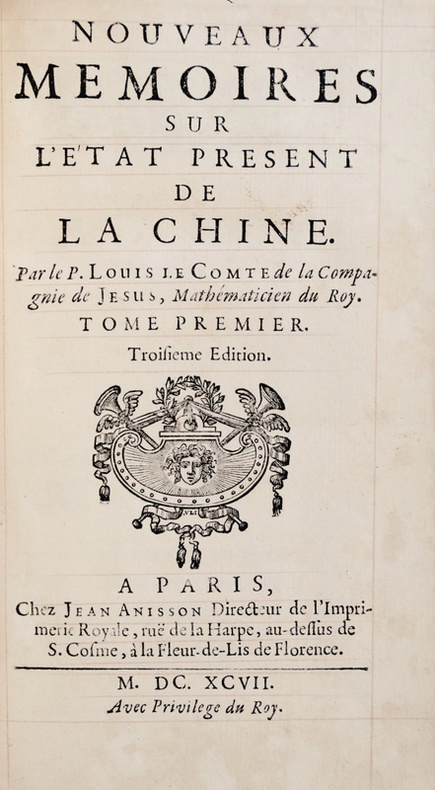
LCS-17527Merveilleux exemplaire réglé et à très grandes marges, complet des 20 estampes et du troisième volume ici en édition originale, revêtu de somptueuses reliures de l’époque en maroquin rouge orné d'un décor à la Duseuil. Paris, Jean Anisson, 1697.[Suivi de :] [Le Gobien]. Nouveaux Mémoires sur l’état présent de la Chine.Paris, Jean Anisson, 1698.3 tomes en 3 volumes in-12 de : I / 1 portrait, (16) ff., 410 pp., 1 tableau dépliant, 18 pl. dont 3 dépliantes ; II/ (2) ff., 435 pp., (9) pp., 2 planches à pleine page ; III/ (16) ff., 216 pp., (2) ff., pp. 217 à 322, (5) ff. Pte. brûlure p. 319 du tome 3. Exemplaire réglé.Maroquin rouge, plats ornés d’un décor à la Duseuil, dos à nerfs richement ornés, coupes décorées, roulette intérieure, tranches dorées sur marbrures. Reliure de l’époque.163 x 94 mm.
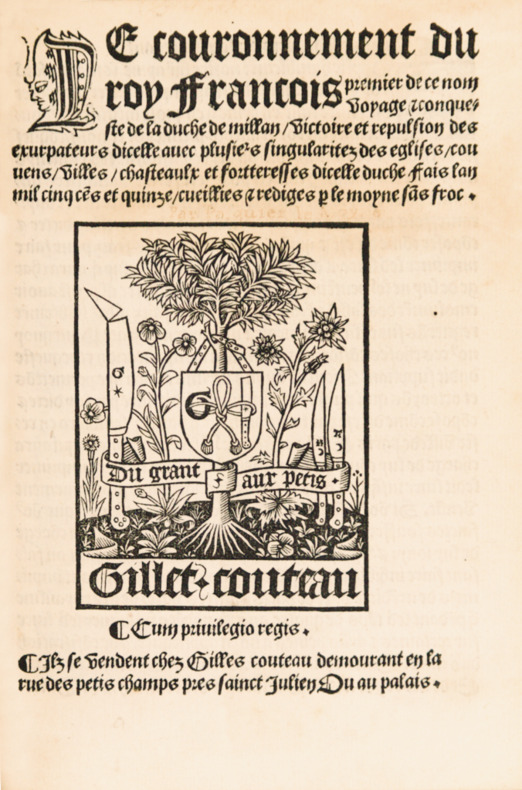
LCS-18450Ainsi que la bataille de Marignan et la Campagne d’Italie de François Ier. A este acheve de imprimer le xxè iour de septembre mil cinq cens et vingt pour Gilles Couteau imprimeur à Paris (1520). In-4 gothique de (104) ff. Maroquin rouge janséniste, dos à nerfs fleurdelysé, double filet or sur les coupes, roulette intérieure, tranches dorées sur marbrures. Trautz-Bauzonnet. 188 x 129 mm.
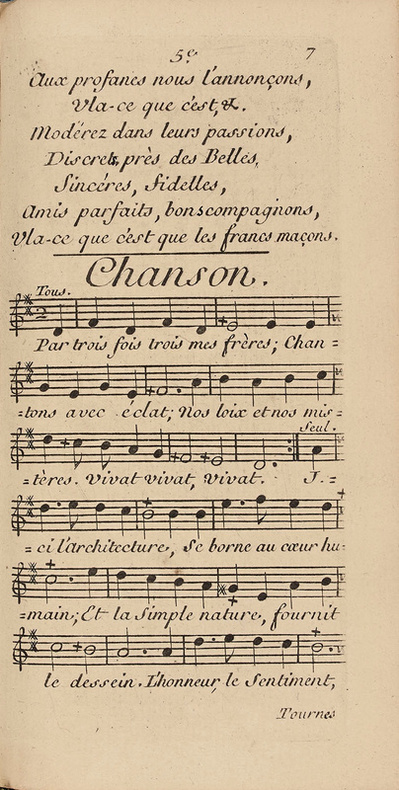
LCS-17544Superbe recueil entièrement gravé, texte et musique, sur grand papier de Hollande. S.l., 1744. Petit in-8 étroit de (1) f.bl., 1 titre gravé dans un joli cartouche surmonté des armoiries du comte de Clermont avec les emblèmes maçonniques, 40 pp. contenant la Dédicace de Naudot, suivi de « Recueil de chansons nouvelles de la Maçonnerie »51 pp., (1) p., suivi de « Chansons notées pour l'ordre de la Félicité » 16 pp. Maroquin olive, large roulette dorée autour des plats, guirlande dans les angles, armoiries au centre, dos lisse orné, roulette intérieure et sur les coupes dorées, doublures et gardes de moire jaune, tranches dorées. Reliure de l'époque. Etui. 178 x 90 mm.
LCS-A4L’introduction des idées de Newton en France et la victoire de l’empirisme sur le cartésianisme. Amsterdam, chez Jacques Desbordes, 1738. In-8 de (1) f. de titre, 399 pp. et (1) p. d’errata; 1 portrait de l’auteur, 1 frontispice, 7 planches hors texte dont une dépliante, 50 culs-de-lampe et vignettes, 60 figures géométriques dans le texte, titre imprimé en rouge et noir, 4 numéros de page grattés. Plein maroquin rouge, triple filet doré encadrant les plats avec fleurons d'angles, dos lisse orné, coupes ornées, roulette intérieure dorée, tranches dorées. Relié par Derome le jeune avec son étiquette. 212 x 132 mm.
108858Toronto: The Champlain Society and The Hudson's Bay Record Society Book. Very Good. Hardcover. First Edition. RARE complete run of the CHAMPLAIN SOCIETY PUBLICATIONS plus THE COMPLETE HUDSON'S BAY RECORD SOCIETY PUBLICATIONS and THE COMPETE ONTARIO SERIES within the Champlain Society set This includes 113 Champlain Society books from 1907 to 2015 inclusive plus an additional 21 volumes from the Hudson's Bay Record Society that are not within the publications listed for the Champlain Society. Note 12 of the Hudson's Bay Record Society books are within the listing of the Champlain Society publications as are all of the 16 Ontario Series. The only missing items are 2 of the 3 "occasional papers" within the Champlain Society publications list. All are hard cover books except for the 1 Occasional Paper; 10 of the Hudson's Bay books have dust jackets. All in very good condition a couple have minor wear and or marks. Shipping will be based upon the weight of these books 370 pounds with packing materials and the location they will be sent to. Thus shipping costs will be more than this system allows us to note - please contact us for the exact shipping cost to your location approximately $280. The Champlain Society and The Hudson's Bay Record Society hardcover
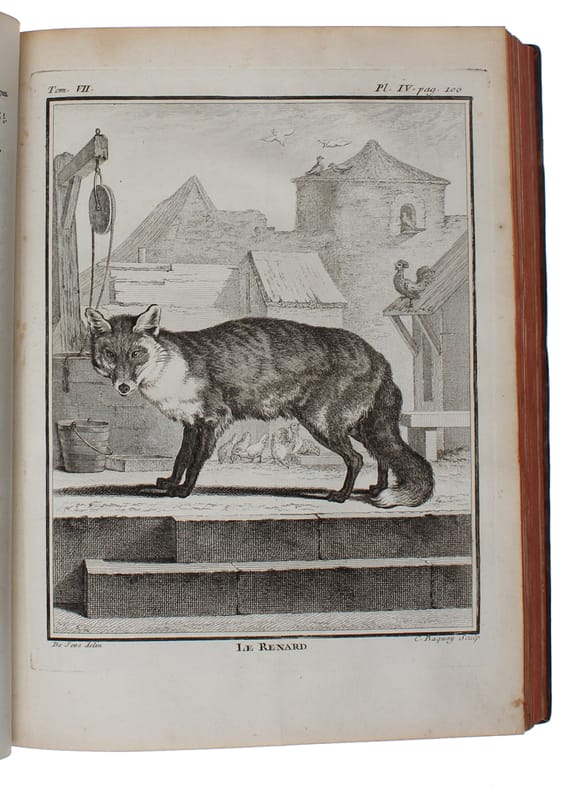
178960389Paris, l' Imprimerie Royale, Plassan, 1749 - 1789. 4to (262 x 205 mm). Uniformly bound in 32 contemporary full sprinkled calf bindings with five raised bands and richly gilt spines. Leather tome- and title-labels to all volumes. Edges of boards gilt. Light wear to extremities primarily affecting head and foot of spines, corners bumped. Internally with light occassional, marginal brownspotting, but generally fine. With ""J. Collin"" (Danish zoologist Jonas Collin) to top margin of most front free end-papers. An overall nice set comprising the following:Histoire Naturelle, Générale et Particulière (15 vols) - 578 plates and 2 maps.Supplément à l'Histoire naturelle (6 vols) - 141 plates and 2 maps.Histoire naturelle des Oiseaux (9 vols) - 257 plates.Quadrupedes Ovipares et des Serpens (2 vols) - 66 plates. A total of 1042 plates and 4 maps. Wanting the portrait. The complex collation of this work has not been accurately described by bibliographers. Nissen and Heilbrun differ in the listing of number of plates and misname the descriptions of the plates.
Colophon: Pisauri (Pesaro), Hieronymum Concordiam, 1588. (Having the reprinted title-page: Venetiis, Franciscum de Franciscis Senemsem, 1589). Folio. Cont. limp vellum. Repairs to upper part of back and small nicks to back repaired. Edges of covers with tiny loss of vellum. Covers slightly soiled. Calligraphed title on back. Title-page with and old, partly erased stamp. Woodcut printer's device on title. Ff (3), 334 (332) (= 664 pp). Numerous woodcut diagrams and illustrations in the text. Printed on good paper, Ff 2-3 with an old repair to inner margin (no loss). F 2 browned, but otherwise remarkably clean with only a few brownspots. A few small worm-tracts to some margins.
(mm 190 x 260), 39 ff. per gli acquerelli, numerati 1-39, alcuni ff. bianchi, 2 ff. d"indice delle tavole, legatura coeva in cartone rigido marmorizzato. Acquerelli di notevole eleganza pittorica e pre ci sione scientifica, per lo più a grandezza naturale. L"album è datato 1830 nell"Indice di 2 fogli posto in fine. I dipinti policromi sono attribuibili ad Antonio Bertoloni (1775-1868, illustre botanico, professore universitario a Genova ed a Bologna, autore della fondamentale opera "Flora Italica" in 10 volumi, 1833-1854) o ad artista che lavorò per lui e furono certamente utilizzati dal B. per l"edizione della migliore e più estesa Flora italiana dell"Ottocento. Bellissima serie, in perfetta conservazione.. .
4to. (24), 636, (8) pp. - (With:) [Dastan-i San Bidru]. Historia S. Petri Persice conscripta [...], Latine reddita [...] a L. de Dieu. Ibid., 1639. (8), 144 pp. - (And:) L. de Dieu. [`Ansarha-yi zaban-i Farsi]. Rudimenta linguae Persicae. Ibid., 1639. (8), 95, (1) pp. All titles printed in red and black. Contemporary brown full calf with gilt spine. First edition of the first Persian grammar ever printed, with two Persian texts edited for the first time from manuscripts. "De Dieu's most striking performance [...] De Dieu is well aware that he is the first to publish a grammar of Persian. [...] In the preface De Dieu relates how he studied Persian with the help of the Constantinople Polyglot borrowed from Gomarus, and mentions Elichmann as the supplier of the manuscript with the 'Historia Christi', which was owned by Golius. The latter also supplied a ms. dictionary of Persian. In the annotations to the 'Historia S. Petri' the original ms. is described: it contained two more Persian texts, and was once bought by the Rotterdam physician Johannes Romanus at Agra in 1626. The volume then passed into the hands of Elichmann, who lent it to the editor. The two chapters from Genesis are taken from a complete translation in Arabic characters [by Rabbi Jacob Tawus] at Istanbul in 1546" (Smitskamp). These are lives of Christ and St Peter, originally written in Portuguese by the Jesuit priest Jerome Xavier (1549-1617) and then translated into Persian at the command of the Mughal emperor Akbar. It was at the Elseviers' request that De Dieu composed, as an addition, the elementary grammar. The grammars of Ignazio di Gesù (Rome 1661) and of Labrosse (Amsterdam 1684) were largely based on his work. Willems notes that Raimondi, as early as 1614, produced a grammar in Rome for the use of missionaries which remained virtually unknown in the west, but this existed only in manuscript (cf. Smitskamp). - Occasional slight brownstaining, but a good, tight copy from the library of the Swedish antiquarian bookdealer Björn Löwendahl (1941-2013). Smitskamp, PO 310. Willems 490 & 477. Copinger 5255 & 1314. De Backer/S. VIII, 1339, 8 & 9. Rahir 473. Berghman 674. Schwab II, 727. OCLC 6445068, 6445039, 82252380.
Various formats. Altogether 150½ pages. Large collection of authentic material relating to one of Adolf Hitler's closest associates. Comprising in total: - I: Goebbels's college science notebook. Ca. 1919, in pencil and ink, signed within eight times "Goebbels". 8vo. 52 pp. - II: Goebbels's high school maths workbook. Ca. 1918. 8vo. 60 pp. Goebbels has written his name on the title-page and filled the book with mathematical equations and logarithms, precisely written in pen and pencil. - III: Goebbels's registration book for classes he took at the Julius Maximilians University (Würzburg) in the winter semester of 1918/19. 8vo. 24 pp. Goebbels has signed his full name on the cover, along with his city of residence and his course of study ("German Studies"). Within he lists the classes taken, professors' names, and class fees. - IV: Typed letter signed from his father Fritz Goebbels. Rheydt, 14 Nov. 1918. 1 p. 4to. On the verso of the letter, Goebbels, at the time drinking heavily, has signed his name 28 times as "Goebbels", seven times with his familiar "Ulex Goebbels", and seven times as "Ulex". - V: Manuscript poem. 11 July 1920. 1 p. 205 x 81 mm. Unsigned, titled "Husaren Abschied" ("Hussars' Farewell"). - VI: Autograph poetry manuscript. 23 April 1923. 1 p. 8vo. Unsigned, titled "Bei Nacht" ("By Night"). - VII: Autograph poetry manuscript. Ca. 1920. 1 p. 8vo. Unsigned, titled "In einer Nacht" ("One Night"). - VIII: Autograph poetry manuscript. Ca. 1920. 3 pp. 8vo. Unsigned, titled "Der Mutter Wiegenlied" ("A Mother's Lullaby"). On the verso is a second poem. - IX: Autograph poetry manuscript. Ca. 1920. 1 p. 205 x 73 mm. Unsigned, titled "Abschied" ("Farewell"). - X: "Ins Tagebuch" and "Mahnung" ("For the Journal" and "Admonition"). 2 autograph poetry manuscripts (12 and 15 lines). Heidelberg, 15 May 1920. Small 4to. 1 p. - XI: Autograph poetry manuscript. Ca. 1920. 1 p. 205 x 73 mm. Unsigned, titled "Heimfahrt" ("Journey Home"). - XII: Autograph manuscript signed. N. p. o. d. 8vo. 1½ pp. Signed "Goebbels" (4 times) and "Pflüger" (2 times). - XIII: Autograph poetry manuscript. Ca. 1920. 1 p. 8vo. Unsigned, titled "In vielen Naechten" ("In Many Nights"). On the verso are several lines of personal notes, signed "D. U.", probably also by Goebbels as his familiar "Ulex". - XIV: Library card issued to Goebbels. Ca. 1919. 1 p. 8vo. Signed by a university official. Goebbels has added ten lines of study notes on the verso. - XV: His very early familiar signature and interesting addition: "Ulex Goebbels from the little child". On the 36mo cover of a 1920 calendar cover page. - XVI: Goebbels's senior year report card. Rheydt, 7 April 1916. 1 p. Small folio. Signed by his headmaster and teacher.
Folio (204 x 309 mm). 6 parts in one vol. (24), 264 pp. (2), 214 pp. (6), 113, (1) pp. 154, (2) pp. 87, (1) pp. 66 pp. With 37 engr. plates (many folding). Period-style full panelled calf, elaborately gilt-decorated spine on raised bands with red morocco spine label. Marbled endpapers. The first collected edition in English, translated by John Phillips and Henry Oldenburg: an account of Tavernier's travels to Turkey, Persia, India, and Japan (with large map of Japan), containing reports about the Japanese persecution of the Christians and the Dutch settlements in the Far East. Book Two, chapter Nine of the Persian Travels is of particular interest, as it contains an account of Tavernier's voyage through the Arabian Gulf, mentioning Bahrain, Bandar Abbas, Qeshm, and Hormuz and making observations on the pearl-fishing, people and navigation of the Gulf. There is also a bird's-eye map of the Strait of Hormuz showing the Musandam Peninsula (peppered with palm trees and captioned "A promontorie of Arabia the happey"), Hormuz, Larak, and Qeshm island, as well as Bandar Abbas and Bandar Kong on the Persian side. Intruguingly, this engraved map also includes depth soundings throughout the Gulf, making it useful as an early "Persian Gulf Pilot". A separate, illustrated chapter discusses extensively the invaluable pearl in the collection of the Imam of Muscat. Another illustrated chapter discusses "The Money of Arabia". In general, the plates depict festivals, processions, costumes, views, and images of the Eastern flora and fauna as well as coins and gems. - Title-page rehinged, with ownership of Thomas Hardy, dated 1698. Repaired tear to first leaf of contents. Faint marginal dampstain along lower edge of first several leaves; occasional browning, final leaves of text cleaned with some minor marginal restoration, but well-preserved on the whole. Handsome period-style calf-gilt binding fine. Blackmer 1632. Wing T251A, T252, T253. Campbell (Japan) 28. Cox I, 275f. OCLC 6071990. Cf. Wilson 223. Howgego T14. Severin 104-113. Not in Atabey or Weber.
1998214h5886Singapore: Prentice Hall. Very Good in Very Good dust jacket. 1998. Hardcover. 0130208035 . Signed and inscribed upon title page by Lee Kuan Yew to Valéry Giscard d'Estaing dated October 1998. "The first volume of the memoirs of Lee Kuan Yew 1923-2015 the man who planted this island state firmly on the map of the world. In Intimate detail Lee recounts the battles against colonialists communists and communalists that led to Singapore's independence. Lee brings the reader into his personal life with unusual candour and the occasional touch of humour. He also shares insights into the men who shaped the times." - dust jacket. "For a country to rise from the threshold of subsistence to one of the highest living standards in the world in 30 years is no common achievement. At the root of this success lies the genius of one man Mr. Lee Kuan Yew." - Jacques Chirac. "Lee Kuan Yew is one of the seminal figures of Asia and this book does justice to his extraordinary accomplishments." - Henry Kissinger. "Senior Minister Lee Kuan Yew is one of the brightest ablest men I have ever met. This book is a must read for people interested in a true Asian success story. From this book we also learn a lot about the thinking of one of this century's truly visionary statesmen." - George Bush Sr. Valéry Giscard d'Estaing was President of France from 1974-1981 and hosted the author several times in France. 5-680 pp. Chronology. Index. Black and white reproductions of photos. Unmarked with light wear. A special copy.; 8vo; Signed by Author . Prentice Hall hardcover
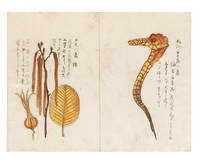
6313About 40 finely drawn & colored illus. 16 folding leaves. 8vo 264 x 180 mm. orig. wrappers new stitching. Japan: late Edo. This is an extremely finely executed album of illustrated natural history specimens collected from throughout Japan; the nearly 40 illustrations are very well drawn and painted many with mica or three-dimensional techniques used in traditional Japanese painting to make the drawings more realistic. The specimens include botanical mineral and animal examples. The first leaf of the album contains the title and an index of the 22 specimens. These include: a special kind of ivy from Nikko with Chinese names and where found a "four-eyes" jellyfish from Shizuoka a seahorse from Wakayama a cowskin from China a "floating rock" from Izu a "crab rock" and camphor wood from Ehime fossils "pepper rock" from Yamagata copper three images showing the stages of refining the ore from Iwate seaweed from Niigata white bats from Ibaraki the tree producing white lacquer from Kagoshima leeches from Musashino almonds from Nagano etc. There is some repaired worming which occasionally touches images but we do not find it offensive. This manuscript is very beautiful. unknown books