692 496 résultats
22 pieces of 19 different fabrics, mounted on thin paper (the last piece loose), mostly ca. 10-15 x 12-15 cm, some larger. Within a 1930s cloth binder (220 x 280 mm). - (Includes): Lamm, Carl Johan. Jordfundne tekstiler fra Aegypten. Særtryk af "Tilskueren" 1938. (Copenhagen, 1938). 333-350 pp. With 7 text illustrations. Contemporary cloth with title label to spine. A fine collection of Egyptian Coptic textile fragments compiled in the 1930s, comprising samples of multi-coloured embroidery and hand-printed linen. Most are of Coptic origin: hand-woven embroideries on linen wraps dated to the 5th and 6th centuries, originally used in tunics or other clothing. The fragments are decorated with human figures, animals and birds, mythical creatures, and floral designs, as well as with geometrical patterns. There are also six scarce blue "Arabic" samples, beautifully hand-printed on linen, from ca 1300 CE, and one woven silk tissue with an arabesque pattern from the 11th century. Four of the Arabic specimens are larger. - Carl Johan Lamm studied archaeology at the University of Stockholm. He wrote about the glass excavated at Samarra in 1928 and became a leading scholar on Islamic arts and crafts, notably in glass and carpets. He was on the staff of the Stockholm Museum and taught at Uppsala University. - Ancient Coptic material of this kind was typically removed from Egyptian graves around the turn of the twentieth century. Lamm may have acquired these specimens while living in Cairo in 1934-37 while assembling a large collection of ancient Coptic textiles, and it would appear that the binder containing the fragments dates from those years. Parts of Lamm's Coptic textile collection are now housed in two Swedish museums; Kulturen museet in Lund and Röhsska museet in Göteborg. - Stored in a worn craft binder, the samples are sewn on paper with hand-written ink annotations and typed descriptions and dates. Several fragments show small losses, but overall most are in fairly good condition. - Includes a printed article by Lamm on "excavated textiles from Egypt", an offprint from the Danish journal "Tilskueren" ("Spectator"). With a few changes, this text was delivered as a speech at the Copenhagen Kunstindustrimuseet in connection with an exhibition arranged by Lamm. The textiles exhibited belonged to Lamm himself, the National Museum in Stockholm, and the Danish Kunstindustrimuseet. This is Lamm's personal copy with his bookplate to front pastedown.
Large 4to. Altogether (2+1½ =) 2½ pp. on 2 bifolia. Each with autograph address. Family letters from Friedrich Engels's younger brother Emil (Friedrich was the eldest of nine children) to their mother Elise Engels, née van Haar, in Barmen, reporting on his military service in Berlin (7 Nov) and on the Christmas celebration at his uncle's house (25 Dec.). - I) "[...] Ihr werdet wol gehört haben daß die ganze preuß. Armee mobil gemacht wird; uns trifft das natürlich mit [...] Ich bin auf Alles gefaßt u. guten Muthes dabei [...] Der junge Borsig ist auch in meiner Compagnie, mit ihm war ich auch oft zusammen [...] Ich hoffe wir werden bald avanciren, u. es dann etwas besser haben. Sei aber nur nicht ängstlich um mich, wenn ich merke, daß mir die Sache zu sauer wird, melde ich mich gleich krank, u. lasse es die andern allein besorgen; ich bin durchaus nicht geneigt u. habe noch viel weniger Lust, mir für eine Sache wie die jetzige, nur das geringste Leid zufügen zu lassen [...]" (7 Nov.). - II) "Gestern Abend feierten wir bei Snethlages [i.e. Karl Wilhelm Moritz S., court chaplain in Berlin, an uncle of Engels] sehr heiter u. vergnügt Weihnachten, wobei für mich auch ein Tischchen aufgebaut war [...] Der Ring, den mir Onkel Snethlage ausgesucht, ist sehr hübsch [...] Ich habe mein Daguerotyp beigepackt [...] Ich mußte 1½ Stunden bei dem Manne warten, u. ich sehe deshalb so brummig aus [...] Heute Nachmittag sind wir alle bei der guten Großmutter die Euch aufs Beste grüßen läßt; morgen Mittag bin ich bei Jacobs. Gestern waren bei Onkel 4 Engländer die hier studieren, mit denen wir uns höchlichst amüsiert haben, u. bei denen ich Gelegenheit habe mein Englisch zu vervollkommnen [...]" (25 Dec.). - After fleeing from Germany in November 1850, Friedrich Engels for a while had to work at his father's textile factory at Manchester; their relationship was strained. Emil would marry Charlotte Bredt in 1853 and took over their father's company. - Integral address leaves showing some tears, otherwise fine.
8vo (150 x 240 mm). Persian manuscript on paper. (4), 62 (misnumbered: 63, omitting fol. 19), 64 (misnumbered: 58, leaping back to 24 after 23 but lacking fols. 38-39) ff.; 64 (instead of 70) ff. (lacking fols. 25-30). 15 lines of black and occasional red ink script. Rebound in full red morocco using the original covers. A collective manuscript on falconry, including the famous "Baz-nama" of Khushal Khan, the Afghan national poet, copied in the area of Afghanistan within a year after the passing of the author. - This fine and early manuscript contains two separate treatises on falconry, the latter one being the "Book of Falconry" of Kushal Khan Katak, the father of Pashto literature, written in verse. The first English translation, prepared by Sami ur Rahman and dedicated to Sheikh Mohammed bin Rashid Al Maktoum, Ruler of Dubai, appeared in Islamabad as recently as 2014: "What makes Khushal's 'Baaz Nama' unique is its poetical form. Perhaps there is no other work in world literature that treats the subject matter in verse on the one hand and keeps its systematic exposition and professionalism intact on the other [...] Khushal's manual is pretty concise and cogent. There are no long-drawn and tedious accounts. The style and diction are extremely down-to-earth" (translator's note, p. xiv). - The present manuscript contains a colophon at the end stating that it was copied by Muhammad Khan in 1101 AH, within a year of the death of its author on 5 Jumada I, 1100 AH, and it may thus command a high degree of textual authority. A renowned Pakistani warrior, Khushal Khan Khatak (1613-89) long served the Mughal Empire, but when he was expelled from his tribal chiefdom, he turned against his Mughal lords, promoted Pashtun nationalism, and encouraged revolt against the Mughal Empire. His works, mostly written in Pashto, are considered the foundation of modern Afghan literature. - A few occasional stains and ink smudges; lacks six leaves according to foliation and catchword. The first treatise in this volume, by an unidentified author, is in two parts with an index after the first but apparently not complete, lacking the end of the second half, as well as two leaves. First leaf extensively remargined but without loss to text; a few old waqf stamps and occasional marginalia.
Various sizes, c. 14 x 22 cm to c. 20 x 25 cm. Mounted on folio backing paper. Stored in custom-made sand coloured half morocco solander case. Ten finely executed pen-and-ink drawings of different falcons in various poses, all captioned and vividly watercoloured by a mid-19th-century artist. Includes the Saker Falcon, Iceland Falcon, Greenland Falcon, Merlin, Lanner Falcon, Norway Falcon etc. - Well preserved.
12mo. 134, (6) pp. Contemporary red morocco, triple gilt filet on covers, central royal coat of arms, gilt edges. First edition. The priest Gaudereau (1663-1743) had gone to Persia in 1689 in the company of Bégnine Vachet, a director of the Seminary of Foreign Missions. Having arrived at Isfahan in late 1690, they joined François Sanson, another member of the Society of Foreign Missions sent by Louis XIV to the court of Shah Suleiman. After Sanson's departure in 1692, Gaudereau continued negotiations with Suleiman, after 1694 with Husayn. Having negotiated a military and commercial alliance between Persia and the French East India Company, he returned to Isfahan, which he quit for Europe in 1703. It was during this journey from Constantinople and Trabzon that in September 1704 he contracted the illness he describes in his book, which he based on his own experience, having miraculously survived. - Fine copy, bound for Philippe d'Orléans. From the library of Hyacinthe Théodore Baron (18th century engraved book plate). Blake 169. OCLC 495355672. Not in Waller or Wellcome.
Folio (227 x 317 mm). (18), 191 ff. (without final blank). Printer's device on title page and, in a different version, on the last page. Contemporary vellum. Traces of ties. First issue under this title, previously released as "Expositio in primam fen quarti canonis Avicennae" (1506). A commentary (with the text, in the version of Gerardus Cremonensis) of book four, part (fen) one of Avicenna's systematic "Canon of Medicine", written in Arabic but widely translated throughout the Middle Ages and the basis of medical training in the West as late as the mid-17th century. It continues in use to this day in parts of the Arab world. Through this encyclopedic work, the author exerted "perhaps a wider influence in the eastern and western hemispheres than any other Islamic thinker" (PMM). "The 'Qanun' [...] contains some of the most illuminating thoughts pertaining to distinction of mediastinitis from pleurisy; contagious nature of phthisis; distribution of diseases by water and soil; careful description of skin troubles; of sexual diseases and perversions; of nervous ailments" (Sarton, Introduction to the History of Science). The present part is dedicated to a discussion of feverish illnesses. - 17th century ownership "Bernardinus Statius Phys." on flyleaf. Some brownstaining throughout, as common; some worming to spine. Still a good copy. Edit 16, CNCE 2345. Adams A 1541. Durling 245. Cf. Wellcome I, 387 (only the Venice reprint). PMM 11.
Stencil-coloured lithograph. 42.5 x 63.7 cm. Framed (77:63 cm). An extremely rare illustrated broadsheet showing the procession of the Egyptian Mahmal en route from Cairo to Mecca, with a colourful reception of a group of pilgrims in an Egyptian desert village. The Arabic caption states that the print was made from a drawing made on the spot by Sheikh Yunus, citing Hassan Uwais in Abidin Road, Cairo, as the publisher. The true publisher, Camille Burckardt in Weißenburg, is not named: it was company policy to obscure the European provenance of these broadsheets so as to to improve their sale potential in the Middle East. All of these prints are very rare; another copy of this print commanded £21,250 at Sotheby's in 2012. Des Mondes de Papier 120.
Folio. Italian manuscript on paper. 3½ pp. Rare manuscript of an anonymous report of the martyrdom of the Blessed Baltasar de Torres Arrias (1563-1626), who was burned at the stake in Nagasaki on 20 June 1626 together with eight other Jesuits. The report is largely based on a letter that Baltasar de Torres had managed to write during his imprisonment in Omura. It repeats details from the letter such as description of Torres's diet in prison, which consisted of "rice, a broth with herbs, and a cured sardine". The other "authentic writings" from Japan that are alluded to in the title of the manuscript have not been identified. The earliest known publication of Torres's letter with an extensive description of his martyrdom is in Juan Eusebio Nieremberg's "Vidas exemplares" (vol. 4 [1647], pp. 559-572). The manuscript at hand is not based on Nieremberg's version, as it wrongly states the 21st of June 1626 as the day of the executions. This grave error points to an earlier source, as the date would have certainly been corrected based on Nieremberg's widely read martyrology. - Torres had defied the Japanese ban on all Christian missonaries in 1614 and was among the Jesuits who took refuge in Osaka castle until its capture in 1615. He continued his work as a missionary and provincial of northern and central Japan in secrecy for more than another decade. In 1626, Baltasar de Torres was finally arrested near Nagasaki and imprisoned in nearby Omura. His Japanese catechist, the Blessed Michael Tozó (ca. 1588-1626), soon followed Torres to prison. On 12 June 1626 the governor of Nagasaki returned from the court in Kyoto with a death sentence for all Jesuit prisoners. For their execution in Nagasaki, Baltasar de Torres and Michael Tozó were joined by seven Jesuits who had been imprisoned in Shimbara, including the Blessed Francisco Pacheco (1566-1626), the provincial general for Japan alluded to in the title, and the Blessed Gianbattista Zola. - With a large old waterstain throughout and several deep tears partly affecting the text (without loss).
8vo. German manuscript on paper. 25 inscribed pp. on 16. ff. In dust cover with the handwritten dating "1511". A unique testimony of late medieval building, significant for questions of art history as well as economic and social history. On the one hand, the manuscript proves useful for dating the construction works at St. Michael and provides important information about the persons in charge, being, apart from inscriptions in some of his sacral buildings, the only known written source naming the builder Bartlmä Firtaler. On the other hand, it allows a profound insight into the organisation of a late medieval construction site. While other manuscripts document the building of cathedrals or urban edifices, the one at hand lists the expenses of a small site in the periphery, covering about two months. The booklet was probably composed after the work was completed, drawing from notes constantly taken during the building process. It is arranged in several chapters, stating the weekly expenses for bricklayers and carpenters, for day works, the acquisition and transportation of stones, as well as other more general expenditures (such as the purchase of wood, nails, chains, saws etc.). Expenses for sealing by the town judge, for an errand and for the workmen's wine supply complete the picture. - Bartlmä Firtaler, born aound 1480, built many sacral edifices in Carinthia, Tyrol and Carniola/Slovenia, his debut work being the chapel in Schloss Stein near Oberdrauburg in 1505. The lord of the castle, Lukas von Graben, who also appears in the manuscript, probably acted as the principal and financier of St. Michael, which was to become the future burial place of the lords of Graben. The booklet records the offer of 22 guilders to Firtaler, which he didn't accept ("damit hat er aber nit besteen mügen"), leading to a concession of 32 guilders in the end. This episode illustrates Firtaler's esteem as a builder, as well as his self-confidence. Previous researchers didn't assign St. Michael in Lienz to Firtaler, or merely accredited him works in the nave, dating them around 1530, when he might have already been deceased. The accounting booklet proves the church to be a product of Firtaler's first style period, which might have been inspired by Benedikt Ried's work in the Vladislav Hall in Prague Castle. - The expenses were listed by an unknown scribe, giving the total at the end of each page. The grand total of 83 guilders is given at the end of the booklet (a miscalculation, as the total reached by adding the sums of each page amounts to 84). However, not only financial but also social circumstances connected with the Lienz building site can be reconstructed. The scribe distinguishes between masters and assistants, who are mentioned by name, and unskilled workers, whose names aren't given. Personal names also appear in the expenses for the transportation of stones to Lienz, as well as in the general expenses, indicating sellers and handymen. These names could be a basis for further research, not only defining the roles of the historical players involved in the building of St. Michael in the whole of the city's history, but also placing the accounting booklet in a prominent position compliant with its historical relevance.
More than 400 glass slides depicting various motifs of coal mining, chemical processes, astronomy and topographical motifs from Asia, Africa, China, Europe and America. Housed in original wooden boxes. Includes 2 original projectors and 1 camera. Remarkable, encompassing collection of turn-of-the-century Magic Lantern slides. Several of the slides show cavalry horses: the "Krigen, 1848-1864" set includes (no. 45) an equestrian portrait of General Bülow, victor of the 1849 Battle of Fredericia, painted by Aug. Jerndorff; (no. 29) Friedrich von Schleppegrell riding at the battle of Isted; (no. 26) General Krogh on horseback (all V. Richter, Kopenhagen); no. 20. captioned "Pferdeablieferung" (horse delivery). A box labelled "København" includes: (no. 21) Brandmajoren rykker ud; (no. 20) a fire at the time of Frederik VI. Other slides show workhorses in Denmark and Sweden during haying-time or spreading manure, as well as works of the Danish painter Otto Bache: the Coronation of Christian IV in 1596; the conspirators escaping from Finderup on horseback after having murdered Eric V of Denmark. The collection also contains copies of paintings by various artists, such as Leonardo da Vinci, Raphael, and Rembrandt. Among the remaining slides, we find astronomic illustrations and pictures of observatories (Greenwich, Delhi, Potsdam, etc.); as well as numerous photographs and paintings of landscapes, people and architecture in Africa, Asia, Europe, China and America.
4to (235 x 200 mm). [52 pp.] Album containing 24 small contact prints (25 x 25 mm) and 153 albumen or gelatin silver prints (65 x 80 mm), both mostly numbered and captioned in French on the photograph, 16 photographic reproductions of paintings or drawings (175 x 130 mm), 2 albumen prints of nudes and 17 silver gelatin prints of sadomasochistic scenes (105 x 150 mm). Contemporary black cloth, with the title ("H. Rabier - peines - supplices") on the spine. Captivating erotic photo album containing both original photographs and reproductions on the themes of "punishment and penance", which in most cases means flagellation. Sadomasochism, including flagellation, was very popular in the Belle Époque. In France, government restrictions were slightly looser than in other European countries, which led to the country producing almost all photographic pornography in the world as well as having an advanced sex industry. Descriptions note that every quality brothel in Paris contained a "torture chamber" and numerous books on the subject appeared, both scientific such as Marius Boisson's "Flagellomanie" (1912) and pornographic. This specific album was probably compiled by a certain H[ector] Rabier, whose name is inscribed on the spine and was possibly a young Belgian. Nothing is known of Rabier other than that he wrote an introduction for "Trois drames" (Gent, 1932) by the Belgian poet and dramatist Edgar Tant (1889-1963). Rabier also features as a character in one of these plays, alongside a fictional version Tant, in which it is stated that he is identical in age to the fictional Tant. Among the reproductions of prints in this album can be found various images of an erotic nature showing the flagellation of women by men and women and non-erotic images of the torture and punishment of (female) heretics and witches including reproductions of artworks. A few series do not involve women and show various types of corporal punishment in the French colonies of Algeria and Indochina and flogging in the British army. A series of 27 images is without direct punishment and shows life in the Parisian women's prison of Saint Lazare, which also doubled as a hospital for the city's prostitutes. 12 photographs are reproductions of wood engravings and on most of the images the pins which were used to hold the engraving are visible. The images show the cruel murder and torture of nude women by Cossacks. Of the original photographs, two "academic nudes" show a woman from the back kneeling on top of a chair or hanging face down over a chair or cabinet. The 17 other photographs all show a demi-clad woman being bound or tortured by an "oriental" man or monks. A montage of small images suggests that the woman and monk photographs, probably suggesting a witch or heretic being tortured by the inquisition, formed part of a larger collection on this subject. Although these photographs were obviously intended as pornographic images, it is interesting to note that they are hardly more explicit than contemporary history paintings at the Salon, or the images in popular histories, as the content of this album shows. - Spine somewhat worn and discoloured. Pages of the album very lightly foxed and some of the photographs partly detached from the page, some of the larger photographs lightly worn and discoloured at the edges; overall both album and photographs are in good condition.
4to. (1+2 =) 3 pp., in Arabic throughout. Includes one original addressed airmail envelope (printed Government of Ras-Al-Khaimah stationery). Two early, unique paper items from the Gulf Sheikhdoms: an official document from Sharjah witnessed by the ruler and a piece of private correspondence relating to the founding of a Ras Al-Khaimah government institution six years before independence. - 1) A power of attorney witnessed by the ruler of Sharjah, Sheikh Sultan bin Saqr Al Qasimi (ruled 1924-51). The document certifies that Salim ibn Ibrahim al-Yusuf and Abd al-Rahman ibn Khalifa al-Yusuf appoint Abd Allah ibn Abd al-Rahim and Haji ibn Abd al-Rahim to collect the rent for their properties in Bahrain, replacing their previous agent Muhammad ibn Rashid al-Qassab. The document, signed by Salim al-Yusuf in the month Dhu al-Qa'dah 1362 AH, bears in its upper right corner the seal of the ruler of Sharjah with a handwritten note: "They testified in my presence / Sultan bin Saqr al-Qasimi, Ruler of Sharjah and its Dependencies". With an eight-anna revenue stamp issued by the British Indian government and a stamp of attestation, certifying that the Sheikh's seal is authentic, dated 9 Feb. 1944 and signed by the Political Officer of the Trucial Coast, Maurice Patrick O'Connor Tandy (1912-86). Some browning and stains, edge tears and paper flaws (some with early repairs on verso). - 2) A two-page letter in blue ink, dated 7 March 1966, from Sami Abd al-Rahman Saqr, based at the Municipality in Ras al Khaimah, addressed to his friend Maher in Cairo. Sami Abd al-Rahman Saqr explains that when he returned to Ras al-Khaimah from his recent visit to Maher, the Sheikh [of Ras al-Khaimah, Saqr bin Mohammed Al Qasimi] asked him to help establish the State Audit Institution. He writes that he has therefore now relinquished his position at the Municipality, adding that the institution will start small until the building is ready and discussing the plans for its further development. Sami Abd al-Rahman Saqr further mentions that he will travel to London in April on the first BOAC flight from Dubai to London, marking the launch of this new route. While the airline invited the Sheikh to travel on this inauguration flight, having provided him with a return ticket and expenses for a week's stay in London, the Sheikh is too busy to avail himself of this gift and is therefore sending Sami Abd al-Rahman Saqr on his behalf. He may extend his stay as long as two weeks to discuss business opportunities with British companies and offers to bring Maher anything from London that he may wish. Written on blue airmail stationery with printed letterhead; includes the airmail envelope.
LCS-18609Edition originale rarissime, “fort recherchée à cause des figures” (Brunet). Roma, Ant. Blado, 1553. In-4. Figures, 4 ff. ; 70 ff ; 1 f. Plein maroquin rouge janséniste, dos à nerfs, filets or sur les coupes, roulette intérieure, tranches dorées; infimes restaurations sans manque à deux planches. Reliure du XIXè siècle signée de Chambolle-Duru. 225 x 171 mm.
4to. 213 (instead of 215) ff. (lacking ff. 212-213 and final blank). Title printed in red and black. With woodcut title border and two nearly full-page woodcuts in the text. 19th century half calf (restored) with giltstamped spine. First edition. "The earliest Syrian and Armenian grammar printed" (IA). Extremely rare and early work of oriental studies, also important for the history of music due to the first illustrated description of the bassoon, which the author's uncle, Afranio degli Albonesi, had invented early in the century and had first demonstrated in 1532. - The canon regular Teseo Ambrogio degli Albonesi (often simply referred to as Ambrogio or Ambrosius; 1469-1540) taught the Syriac language. This introduction to the oriental languages - his only publication - is a mixture of lingustic treatise and a collection of exotic alphabets. If Albonesi's results are not in every case correct, they remain of great importance to the history of linguistic scholarship: the "Introductio" constitutes one of those works which inspired the budding discipline of comparative philology to undertake further research. "His work offers a detailed survey of the Syriac and Armenian languages from various points of view, and a short notice about the other exotic languages (Samaritan, Arabic, Coptic, Cyrillic, Ethiopic) - these languages are all discussed with examples written by hand in the earlier chapters, and throughout the work we find blank spaces where such words had still to be filled in" (Smitskamp). Some of the blank spaces mentioned have been filled in in ink by a contemporary hand. Lacks the final two pages of text (including the colophon). Slight worming to upper margin near end. Edit 16, CNCE 816. Adams A 957. Mortimer 20. BM-STC Italian 16. Eitner I, 91. MGG III, 1721. Smitskamp 240. IA 104.625. Brunet I, 229. Graesse I, 59.
4to. 212 (instead of 215) ff. (lacking ff. 209, 212-213 and final blank). Title printed in red and black. With woodcut title border and two nearly full-page woodcuts in the text. Contemporary limp vellum with ms. spine title. Traces of ties. First edition. "The earliest Syrian and Armenian grammar printed" (IA). Extremely rare and early work of oriental studies, also important for the history of music due to the first illustrated description of the bassoon, which the author's uncle, Afranio degli Albonesi, had invented early in the century and had first demonstrated in 1532. - The canon regular Teseo Ambrogio degli Albonesi (often simply referred to as Ambrogio or Ambrosius; 1469-1540) taught the Syriac language. This introduction to the oriental languages - his only publication - is a mixture of lingustic treatise and a collection of exotic alphabets. If Albonesi's results are not in every case correct, they remain of great importance to the history of linguistic scholarship: the "Introductio" constitutes one of those works which inspired the budding discipline of comparative philology to undertake further research. "His work offers a detailed survey of the Syriac and Armenian languages from various points of view, and a short notice about the other exotic languages (Samaritan, Arabic, Coptic, Cyrillic, Ethiopic) - these languages are all discussed with examples written by hand in the earlier chapters, and throughout the work we find blank spaces where such words had still to be filled in" (Smitskamp). In this copy, these blank spaces have been filled in in ink by a contemporary hand. - Near-contemporary ownership, in Hebrew cursive, to title page. Minor edge tear to fol. 191. Binding loosened; lacks four pages in the final quire (including the colophon). Edit 16, CNCE 816. Adams A 957. Mortimer 20. BM-STC Italian 16. Eitner I, 91. MGG III, 1721. Smitskamp 240. IA 104.625. Brunet I, 229. Graesse I, 59.
Folio (215 x 300 mm). (4); (4); (2) pp. including blanks. (1) Letter in Italian, signed, from Pedro Alvarez de Toledo in Andria to Ferrante Gonzaga, 13 August 1539, with a 23 mm seal bearing Alvarez de Toledo's coat of arms (with a chain of flags) stamped on a slip of paper attached with red wax. (2) Letter in Spanish, signed, from Pedro Alvarez de Toledo in Andria to Ferrante Gonzaga, 3 September 1539, with the 45 mm imperial armorial seal stamped on a slip of paper attached with red wax. (3) Letter in Italian, signed, from Maria Osorio y Pimentel [in Andria] to Ferrante Gonzaga, 10 September 1539, with the remains of what appears to be her husband's 23 mm red wax seal. - Each letter, in brown ink, occupies one page, with the last page containing the address and the sender's seal. The two inside pages of the second and third letter are blank. Each formerly folded for posting, so that the address would have appeared on one side and the seal on the other. Three letters from Pedro Alvarez de Toledo (1484-1553), Duke of Alba and councillor to the Holy Roman Emperor Charles V, and his wife Maria Osorio y Pimentel (1498-1539) to Ferrante Gonzaga (1507-57), Viceroy of Sicily, who commanded the Imperial cavalry fighting the Ottomans in North Africa. They concern the Ottoman fleet marauding in the Mediterranean in 1539, thirteen years after the Ottoman victory at the Battle of Mohács gave them control of much of Hungary and roused Christian fears of their strong presence in Europe, and ten years after Barbarossa established his base in Algiers. The first letter, signed by Alvarez de Toledo, advises Gonzaga that, due to the recent loss of Castelnuovo to the Turks, he has given orders for vigilance and defensive preparations on the island of Lipari. He asks Gonzaga to supply any assistance the islanders require. The second letter, also from Alvarez de Toledo, advises Gonzaga that he has received a letter dated 30 August 1539 from Andrea Doria (1466-1560) in Brindisi, then Imperial admiral of the Holy League, urging a campaign against Barbary to be carried out forthwith, in order to avoid further damage from the Turks. This followed the defeat of Doria's fleet at the battle of Preveza in September 1538 by the fleet commanded by the Ottoman admiral Hayreddin Barbarossa (ca. 1478-1546), long feared in Europe as the infamous privateer Redbeard. The third letter is addressed to Gonzaga by Osorio y Pimentel, informing him that her husband has sent news that the Turkish fleet has been sighted off the Capo d'Otranto, some 150 sails having been observed. She also notes that she has informed Francisco de Tovar, governor of the port La Goleta at Tunis. Given that Barbarossa may direct his attention there, she requests that Gonzaga send a frigate to Tunis to warn de Tovar to remain vigilant. - The seal on Osorio y Pimentel's letter is damaged and can no longer be made out, but the faint visible traces appear to match the arms and flags of her husband's seal, and a small part of the imperial seal on his second letter is damaged, but all three letters are still in very good condition. Three letters of 1539 all important primary sources for hostilities between the Ottoman Empire and Christian Europe.
LCS-18630Des bibliothèques Charles V. D. Elst et Nordkirchen. Francofurti ad moenum, cum privilegio caesareo, 1571. Petit in-8 de (208) ff. [Sig. A-Z8, a-c8], vignettes dans le texte. Les 16 premières planches anciennement rehaussées sans finesse, en jaune et sanguine. Vélin ivoire à recouvrement, dos lisse, tranches rouges. Reliure de l’époque. 137 x 87 mm.
Tall 8vo (158 x 288 mm). Persian manuscript on paper. 278 ff. Nastaliq text in black and occasional red ink, handsomely ruled in red and blue, with occasional marginal notes and further ownership notes on exterior leaves. Modern blank endpapers. Bound in full 20th century red ochre leather, stamped in blind. One of the most important books on pharmacology written in Persian in the Islamic era. Ansari Shirazi (1329-1403) was a famous physician of the Mughal period, serving at the court of Sultan Jalal ud-Din Shah Shuja (1333-84). During Ansari Shirazi's years at court the Sultan was a patron of the poet Hafez (1325-90), icon of Persian poetry, whom Ansari Shirazi would have known personally. Another esteemed acquaintance appears in the title of this particular book, "Selections for Badi". The work is dedicated to a woman, allegedly a Persian princess named Badi al-Jamal about whom little is known. - The work itself is a gem of Persian medical literature: scholars have claimed that "in the history of Persian medicine, the book 'Ikhtiyarat Badiei' is considered the most important book written in Persian", citing the large number of sources and remedies it provided the mediaeval reader, though some irrational fallacies are noted as well: "In three entries in Ikhtiyarat Badiei, the author has illustrated some superstitious ideas, namely that 'If the food is poisonous, and the weasel finds out, it will shout and its hair will stand on its end' and says: 'looking at zebra is good for the eyesight'" (Ghazi Sha'rbaf, 99). - The scribe responsible for copying the text was Muhammad Qasim Quraishi Siddiqui, who is known to have been active in India in the 17th century. A few minor stains and soiling; altogether a well-preserved and vital piece of Persian scientific history. Cf. Javad Ghazi Sha’rbaf et al., "Introducing the Book Ikhti-yarat Badiei: An Investigation Over its Importance in the Pharmacology of the Islamic Period", in: Journal of Research on History of Medicine 9.2 (2020), pp. 95-102.
1380:1216 mm. Lambert conformal conic projection, constant ratio linear horizontal scale 1:2,000,000. Relief shown by hachures and spot heights. Folded. A highly detailed map of the complete Peninsula, the first modern map in 1:2,000,000 scale: the rare preliminary edition, issued five years before the officical release. Based on the groundbreaking series prepared by the U.S. Geological Survey and the Arabian American Oil Company under the joint sponsorship of Saudi Arabia and the U.S. State Department, "a unique experiment in geological cooperation among several governments, petroleum companies, and individuals" (Seager/Johnston). Also includes the territories of today's Kuwait, Qatar, Bahrain, United Arab Emirates, Oman, and Yemen. "The plan for a cooperative mapping project was originally conceived in July 1953 [... By 1955] there was established a cooperative agreement between the Kingdom of Saudi Arabia, the U.S. Department of State, and the Arabian-American Oil Co. to make available the basic areal geology as mapped by Aramco and the U.S. Geological Survey" (ibid.). The plan provided for 21 maps on a 1:500,000 scale in both geologic and geographic versions; "a peninsular geologic map on a scale of 1:2,000,000 was to conclude the project [...] The first geographic quadrangle was published in July 1956 and the last in September 1962. While preparation of the geographic sheets was in progress, a need arose for early publication of a 1:2,000,000-scale peninsular geographic map. Consequently, a preliminary edition was compiled and published in both English and Arabic in 1958" (ibid.). While the revised, final version that appeared in 1963 ("I-270 B-2") would incorporate some additional photographic, topographic and cultural data, the exceedingly uncommon present, preliminary edition is surprisingly complete in virtually all respects - a testament to the precision with which Aramco's cartographers proceeded from the very first. Includes a key with symbols for water pipelines, desert watering points, oil fields, pumping stations, refineries, and a glossary of Arabic names. - "Although the search for oil, gas and minerals was ultimately to drive geological survey work across the region [...], in its early years it was the need for water that was the catalyst for Saudi Arabia's resource exploration. In 1944 King 'Abd al-'Aziz approached the United States for a technical expert who could assist with the identification and plotting of the kingdom's natural resources, particularly its groundwater reserves. The individual who arrived, Glen F. Brown, was one of the pioneers of a partnership between the United States Geological Survey (USGS) and the government of Saudi Arabia that was to span the next five decades and play an important role in the development of the kingdom [...] By 1954 the Saudi Ministry of Finance, USGS and Aramco were working together to produce the first full series of geographic and geologic maps of the country. The first of their type in the Peninsula, these were published [...] in both Arabic and English versions, and the information they contained formed the basis of subsequent Saudi national development plans. To this day, all modern maps of the kingdom trace their roots back to these first publications" (Parry). - In excellent condition. James V. Parry, "Mapping Arabia", in: Saudi Aramco World 2004/1, p. 20ff. OCLC 30099393. O. A. Seager/W. D. Johnston, Foreword to the Geology of the Arabian Peninsula series (U.S. Geological Survey Professional Paper 560-A-D, 1966).
1380 × 1216 mm. Lambert conformal conic projection, constant ratio linear horizontal scale 1:2,000,000. Relief shown by hachures and spot heights. Framed and glazed. A highly detailed map of the complete Peninsula, the first modern map in 1:2,000,000 scale: the rare preliminary edition, issued five years before the officical release. Based on the groundbreaking series prepared by the U.S. Geological Survey and the Arabian American Oil Company under the joint sponsorship of Saudi Arabia and the U.S. State Department, "a unique experiment in geological cooperation among several governments, petroleum companies, and individuals" (Seager/Johnston). Also includes the territories of today's Kuwait, Qatar, Bahrain, United Arab Emirates, Oman, and Yemen. "The plan for a cooperative mapping project was originally conceived in July 1953 [... By 1955] there was established a cooperative agreement between the Kingdom of Saudi Arabia, the U.S. Department of State, and the Arabian-American Oil Co. to make available the basic areal geology as mapped by Aramco and the U.S. Geological Survey" (ibid.). The plan provided for 21 maps on a 1:500,000 scale in both geologic and geographic versions; "a peninsular geologic map on a scale of 1:2,000,000 was to conclude the project [...] The first geographic quadrangle was published in July 1956 and the last in September 1962. While preparation of the geographic sheets was in progress, a need arose for early publication of a 1:2,000,000-scale peninsular geographic map. Consequently, a preliminary edition was compiled and published in both English and Arabic in 1958" (ibid.). While the revised, final version that appeared in 1963 ("I-270 B-2") would incorporate some additional photographic, topographic and cultural data, the exceedingly uncommon present, preliminary edition is surprisingly complete in virtually all respects - a testament to the precision with which Aramco's cartographers proceeded from the very first. Includes a key with symbols for water pipelines, desert watering points, oil fields, pumping stations, refineries, and a glossary of Arabic names. - "Although the search for oil, gas and minerals was ultimately to drive geological survey work across the region [...], in its early years it was the need for water that was the catalyst for Saudi Arabia's resource exploration. In 1944 King 'Abd al-'Aziz approached the United States for a technical expert who could assist with the identification and plotting of the kingdom's natural resources, particularly its groundwater reserves. The individual who arrived, Glen F. Brown, was one of the pioneers of a partnership between the United States Geological Survey (USGS) and the government of Saudi Arabia that was to span the next five decades and play an important role in the development of the kingdom [...] By 1954 the Saudi Ministry of Finance, USGS and Aramco were working together to produce the first full series of geographic and geologic maps of the country. The first of their type in the Peninsula, these were published [...] in both Arabic and English versions, and the information they contained formed the basis of subsequent Saudi national development plans. To this day, all modern maps of the kingdom trace their roots back to these first publications" (Parry). - Some insignificant browning; a few slight edge defects professionally repaired. Altogether in fine condition. James V. Parry, "Mapping Arabia", in: Saudi Aramco World 2004/1, p. 20ff. OCLC 30099393. O. A. Seager/W. D. Johnston, Foreword to the Geology of the Arabian Peninsula series (U.S. Geological Survey Professional Paper 560-A-D, 1966).
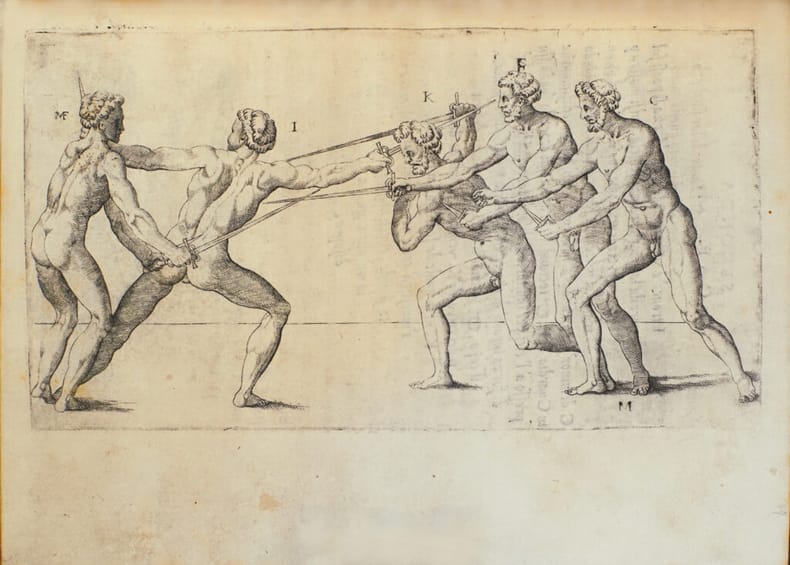
62206Philippus de Mantegatiis | Milan s. d. [après le 8 avril 1492] et s. d. [1493] | 20.80 x 13.80 cm | relié
179641095, , 1796-1797. Ensemble 24 volumes.
8vo. (16), (88) pp. With woodcut arms of the Pope on first and engraved arms of Savary de Brèves on final leaf of prelims. Contemporary blindstamped brown full calf with ornamental central and cornerpiece decorations. Marbled endpapers. The first book ever printed with the fine Arabic types of the Roman Typographia Savariana: the first Arabic edition of Robert Bellarmino's catechism, an abridgment of his "Dichiarazione piu copiosa della dottrina christiana" (1598). Translated by the Maronites Vittorio Scialac (d. 1635) and Gabriel Sionita (1577-1648). "Les traducteurs disent qu'ils ont ponctué l'arabe, changé et ajouté quelque chose au texte primitif de Bellarmin, mais avec son consentement. Ce volume rare est le premier publié avec les beaux charactères arabes de Savary" (de Backer/S.). The present copy does not contain the Latin text at all, hence it has only 88 unnumbered pages of text instead of the 171 numbered pages usually cited. This catechism and the Arabic-Latin Psalter produced the following year would remain the only works to leave the Typographia Savariana; the types have survived and are now in the archives of the Imprimerie Nationale in Paris. - Stains and traces of moisture. Old shelfmark labels to spine, cover and final flyleaf; bookplate of the Dutch Jesuit Seminary on final pastedown. Contemp. ms. notes to endpaper. Rare; only two copies in auction records (the last in 1999). Schnurrer 242. Smitskamp, PO 181. De Backer/Sommervogel I, 1188f. OCLC 491559247.
LCS-17920Edition ornée du portrait aux perles et collier de la Duchesse de Montpensier, dessiné par Larmessin en 1664. Paris, 1669. In-4 de (4) ff., 1 portrait et 152 pp. Maroquin olive, double encadrement de filets dorés sur les plats orné de motifs latéraux aux petits fers et d’un décor central composé d’un cœur percé d’une flèche ceint de petits fers dorés, dos à nerfs fleurdelysé, tranches mouchetées. Reliure de l’époque. 219 x 155 mm.
LCS-7233Edition originale du fameux Catéchisme de Bossuet. L’exemplaire relié à l’époque aux armes de Charles Maurice Le Tellier, archevêque de Reims et fils de Michel Le Tellier qui signa l’acte de révocation de l’édit de Nantes en 1685 et dont Bossuet prononça l’Oraison funèbre en 1686. Paris, Sébastien Mabre-Cramoisy, 1687. In-12 de (9) ff. y compris le titre portant les armes de l’auteur gravées, 246 pp., (3) pp. Erreurs de pagination sans manque. Relié en plein maroquin noir de l’époque, filet doré encadrant les plats, grandes armes frappées or au centre, dos à nerfs orné de filets dorés, filet doré sur les coupes, roulette dorée intérieure, tranches dorées. Reliure de l’époque. 147 x 80 mm.