BOSSUET, Jacques BénigneLivre Rare Book
692 496 résultats
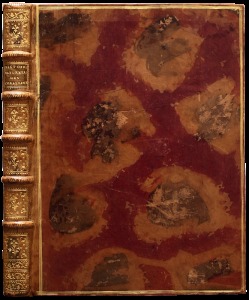
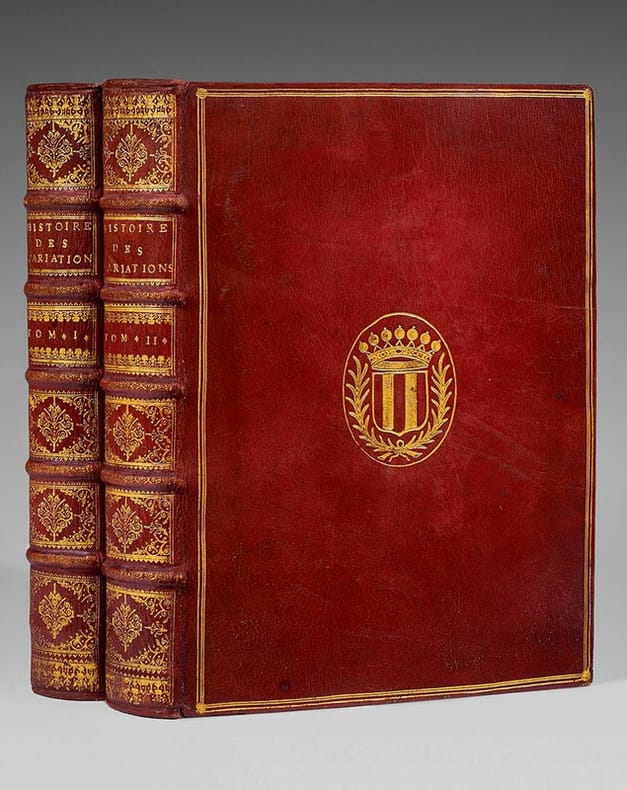
LCS-18303Exemplaire enrichi d’une vingtaine de corrections manuscrites de l’époque. Paris, Veuve de Sébastien Mabre-Cramoisy, 1688. 2 volumes in-4 de : I/ 1 portrait, (20) ff., 506 pp., 17 ff. de table et privilège ; II/ (4) ff., 680 pp., (21) ff. de table et privilège. Qq. corrections manuscrites. Un portrait ajouté au début du volume 1. Maroquin rouge, triple filet doré encadrant les plats, armoiries frappées au centre, dos à nerfs finement ornés de filets pleins et pointillés et fleurons dorés, roulette dorée sur les coupes et intérieure, tranches dorées. Reliure de l'époque. 253 x 182 mm.
Large folio (265 x 404 mm). Large paper copy. (18), 398, (8) pp. Complete copy with engraved frontispiece, engraved author's portrait, the frequently missing large engraved folding map of the Mediterranean Sea and all 122 plates. 18 large folding panoramic views, 28 folding plates and 56 full-plates, numerous half-plates text illustrations. Contemporary Dutch blindstamped vellum. First edition, large-paper copy, of this beautifully illustrated account of De Bruyn's first journey through Egypt, Syria, the Holy Land, Rhodes, Cyprus, Scio and Turkey. - The Dutch traveller and landscape painter Cornelis De Bruyn (1652-1726/28) left the Netherlands in 1674 to travel through the Levant by way of Italy. He stayed in the Levant for seven years before settling in Italy in 1685 and returning to the Netherlands in 1693. The work is especially valued for its plates after De Bruyn's own drawings, made on location and then engraved by such well-known artists as Jan and Caper Luyken, including folding panoramas of Alexandria, Antalya, Constantinople, Bethlehem, Jerusalem, Rhodes and Chios. De Bruyn's costume plates are mostly of the different types of Greek and Turkish head-dresses. The publication was soon followed by editions in English and French. - All panoramas in fine condition, not creased or torn (as often), only the panorama of Smyrna (Izmir) is trimmed with considerably narrower margins. Binding repaired with old vellum; some splitting to front hinge; upper spine-end damaged; loss to lower end. A few occasional internal stains, but still a very fresh and crisp copy. Atabey 159. Tiele 207. Klaversma & Hannema 311. Gay 2101. Henze I, 378. Howgego I, p. 157, B177. Weber II, 402 (note). Röhricht 1184. Tobler 114. Cobham/Jeffery 7. Laor 967. Schwab 74. Cohen/de Ricci 610. Lipperheide Ci 48 (= 546). Graesse I, 552. OCLC 4619950. Cf. Blackmer 225 (2nd French ed.). Aboussouan 164 (1725 French 4to ed.). Gnirrep, De Levant in een kleur (1997).
3 volumes. 8vo. XVI, 388 pp. (2), IV, 426 pp. XII, 448 pp. Half-title in vol. 3, without publisher's ads. 4 maps & plans (3 folding), 5 colour lithographed plates, 8 tinted lithographed plates. Later half morocco over marbled paper covered boards, bound by Zaehnsdorf, spine with raised bands in six compartments, lettered in the second and fourth, the others with a repeat decoration in gilt, marbled endpapers, top edge gilt. First edition of Burton's classic account of his journey across the Arabian peninsula. In the fall of 1852, Burton first proposed to the Royal Geographical Society an expedition to central Arabia with the intent on visiting the holy cities. His request was denied by the RGS and the East India Company as being too dangerous for a westerner, though he was funded to study Arabic in Egypt. Upon arrival there, in April 1853, disguised as a Pashtun and travelling under the pseudonym Mirza Abdullah, Burton made the pilgrimage to Mecca and Medina. "The actual pilgrimage began with a journey on camel-back from Cairo to Suez. Then followed twelve days in a pilgrim ship on the Red Sea from Suez to Yambu, the port of El-Medinah. So far the only risk was from detection by his companions. Now came the dangers of the inland road, infested by Bedawin robbers. The journey from Yambu to El-Medinah, thence to Meccah, and finally to the sea again at Jeddah, occupied altogether from 17 July to 23 Sept., including some days spent in rest, and many more in devotional exercises. From Jeddah, Burton returned to Egypt in a British steamer, intending to start afresh for the interior of Arabia via Muwaylah. But this second project was frustrated by ill-health, which kept him in Egypt until his period of furlough was exhausted. The manuscript ... was sent home from India, and seen through the press by a friend in England. It is deservedly the most popular of Burton's books ... as a story of bold adventure, and as lifting a veil from the unknown, its interest will never fade" (DNB). Indeed, the work would be described by T.E. Lawrence as "a most remarkable work of the highest value." Abbey, Travel 368. Penzer, pp. 43-50. Macro, 640. Howgego IV, B95.
12mo. 6 vols. With 6 engraved frontispieces and 66 engraved plates, all in original hand colour. Contemp. calf gilt; all edges gilt. First edition. "Plates are by Dalvimart, most of them reduced from those in William Alexander’s ‘Costume of Turkey’" (Hiler). The pretty plates (some aquatints) depict not only various costumes and head coverings, but also dramatic scenes. - Well-preserved, appealingly bound copy with engraved bookplate of Baron de La Roche Lacarelle to pastedowns. Removed from the Ottoman collection of the Swiss industrialist Herry W. Schaefer. Blackmer 300. Aboussouan 189. Hage Chahine 821. Lipperheide Lb 42. Colas 545. Hiler 143. Auboyneau 370. Brunet I, 1226. Graesse I, 530.
4to. (7), "335" [= 332], (6) ff. With a helmed, crested and mantled dedication woodcut of the Contreras coat of arms on the title-page (dexter argent paly of 3 azure, sinister an inverted tower, the whole with a bordure containing 12 X's) repeated at the end of liber I, woodcut device at the end of the text (stork standing on its left foot on a scull and holding a rock in its right foot, holding a banderole in its beak with the word "vigilate"), and a woodcut annunciation (including a banderole with "ave Maria gracia plena") above the colophon, a woodcut tailpiece (plus 5 repeats), and headpieces, tailpieces and factotums built up from arabesque and other typographic ornaments.Tree-pattern tanned sheepskin (ca. 1830), sewn on 3 recessed cords but with 4 false bands on the gold-tooled spine, with the title and author's name on a brown and a black morocco label in the 2nd and 4th of 5 compartments and the owner's initials J.S. (for José Saranderes) in the 5th, marbled endpapers (large blue shell on small brown shell, the form similar to Wolfe 125), headbands in blue and white. Rare first and only early edition, with the text in Spanish but the lists of ingredients in Latin, of by far the most extensive and most detailed early medicinal recipe book in Spanish, with recipes for about 300 medicines arranged in 9 sections for internal medicines followed by 3 sections for external medicines. Each recipe begins with a list of ingredients followed by instructions for the preparation of the medicine and information about its uses and dosage under various circumstances. Liber 1, section V is devoted to opium. The book closes with an appendix on weights and measures and an extensive index. Its only real predecessor, Luis de Oviedo's 1581 Methodo de la coleccion, y reposicion de las medicinas, offers only 49 recipes and gives no clear lists of ingredients. - Almost all we know about Castillo comes from the book itself, where he gives some biographical information. He was born to Spanish parents in Bordeaux, where he studied pharmacology, then worked in the apothecary shop at the Escorial in Madrid where he learned a great deal about chemistry (a remarkably early example of experimental chemistry in pharmacology: López-Pérez, Chymia, 2010, p. 344) and moved about 1610 to Cádiz where he set up his own apothecary shop. He noticed the dangerous lack of good Latin among young people working for apothecaries and provided the present work to remedy the situation. He was still fairly young when he wrote it. On the title-page he calls himself a professor of medicine at Cadíz, but he probably taught on his own account, for there was no faculty of medicine in Cadíz until 1748. The colophon's "en cassa de l autor" suggests the publication was his own venture, without institutional support, and he dedicates it to Juan Ruiz de Contreras y Téllez (ca. 1570-1625), an important councillor to King Phillip III, though he lost some of his influence when the king died in 1621. Although Castillo titles his book Pharmacopoea, and it was widely used and influential in Spain, it appears never to have been officially adopted as a standard, so that it does not fit the strict modern definition of a pharmacopoeia. The content of the book is: liber 1 (internal): I De conditis aut conservis. II De sapis. III De eclegmatis seu loch. IV De pulveribus aromaticis electuariorum. V De opiatis. VI De electuaris. VII De hieris. VIII De pilulis. IX De trochiscis. liber 2 (external): prefacio. I De oleis. II De unguentis. III De emplastris. [Appendix:] Tractado de los pessos, y medidas vivales. - With an owner's inscription of the Madrid pharmacologist José Saranderes, author of a 1837 manuscript on the preparation of opium, on the back of the title-page and his initials J.S. gold-tooled at the foot of the spine. Slightly browned with some foxing, spots and stains, a hole affecting a couple words in Y2 and restored corners in 7 other leaves without loss of text, but still generally in good condition. Binding slightly rubbed but otherwise good. The earliest extensive book of medicinal recipes in Spanish: a pioneering pharmacological work. Bibliographia medica Hispanica II, 140 (p. 63). R.R, Guerrero, Diccinario ... autores farmacéuticos I (1958), pp. 632f. A. Hernández Morejón, Historia bibliográfica de la medicina Española V (1846), 50. Krivatsy 2260 (lacking title-page & 1 text leaf). Palau 47896 & 48131. USTC 5021897. Wellcome I, 1355.
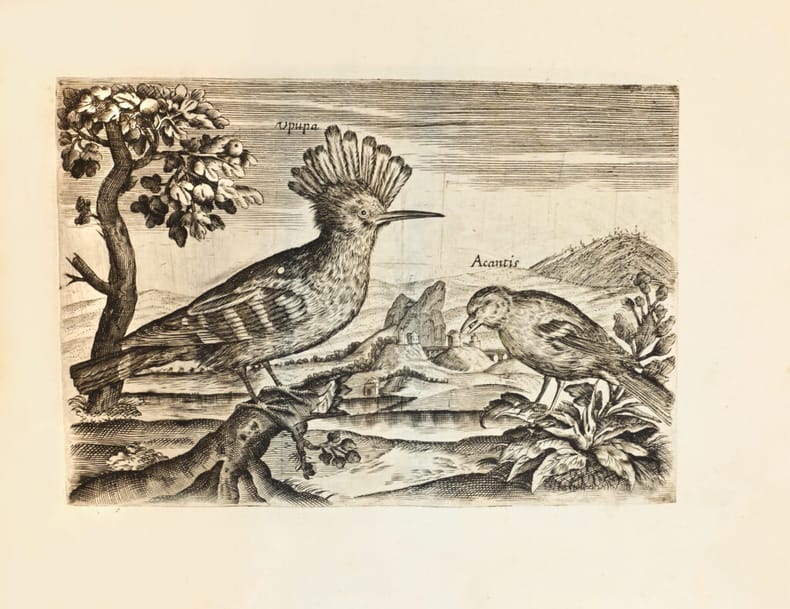
LCS-18631Exemplaire d’une grande fraicheur et à très grandes marges. [Venice, Iacomo Paulini, ca 1580-1600]. In-4 oblong, titre gravé et 15 planches. Basane mouchetée, dos lisse. Reliure ancienne. 191 x 260 mm.
Elephant folio (380 x 490 mm). 5 vols., comprising: Volume I: The Tomb of Nakht at Thebes. Volume II: The Tomb of Puyemre at Thebes. Part I: The Hall of Memories. Volume III: The Tomb of Puyemre at Thebes. Part II: The Chapels of Hope. Volume IV: The Tomb of the Two Sculptors at Thebes. Volume V: The Ramesside Tombs at Thebes. With 5 frontispieces (4 in color), 178 plates (21 in color), and numerous figures. Original printed wrappers, untrimmed. Limited first edition of this catalogue of the principal tombs at western Thebes published by the Metropolitan Museum of Art from 1917 to 1927, one of 500 atlas folio sets beautifully printed on handmade Van Gelder paper. A magnificent, untrimmed set. - Published in memory of the artist and amateur archaeologist and Egyptologist Robb de Peyster Tytus (1876-1913), this series was published to shed light on the magnificent artistic treasures of the tombs at Thebes. In over 180 folio plates, 25 of which are in color and many of which are folding, statues, paintings, treasures, and the interior plans of the tombs themselves are reproduced in loving detail. - The Robb de Peyster Tytus Memorial Fund was set up by the artist's mother, Mrs. Edward J. Tytus, after his death at the age of 32. For five years the Egyptian Department of the Metropolitan Museum of Art received $15,000 which were used to explore the tombs in Sheik Abd-el Qurna and the environs. Norman de Garis Davies (1865-1941) and his wife Nina collaborated with other artists, including Charles K. Wilkinson and H. R. Hopgood, for a decade to achieve the present set. Davies worked on numerous digs in Egypt (including with Petrie at Dendera and with the Egypt Explorations Fund's Archaeological Survey) before being appointed head of the graphics section of the Metropolitan Museum of Art's expedition to Egypt in 1907. Along with his wife Nina and his assistant Francis Unwin, he pioneered the use of egg tempera when recording the paintings from tombs, allowing for much more accurate and satisfying results in comparison to watercolours, which, although they rendered the colour with a flat finish, were the standard way of recording tomb paintings before the advent of reliable colour photography. - Insignificant edge flaws to the wrappers. Margins of a few plates very slightly browned; altogether a very clean set. Inconspicuous contemporary bookseller's label of Paul Koehler, Leipzig, to covers of three volumes. OCLC 19290154.
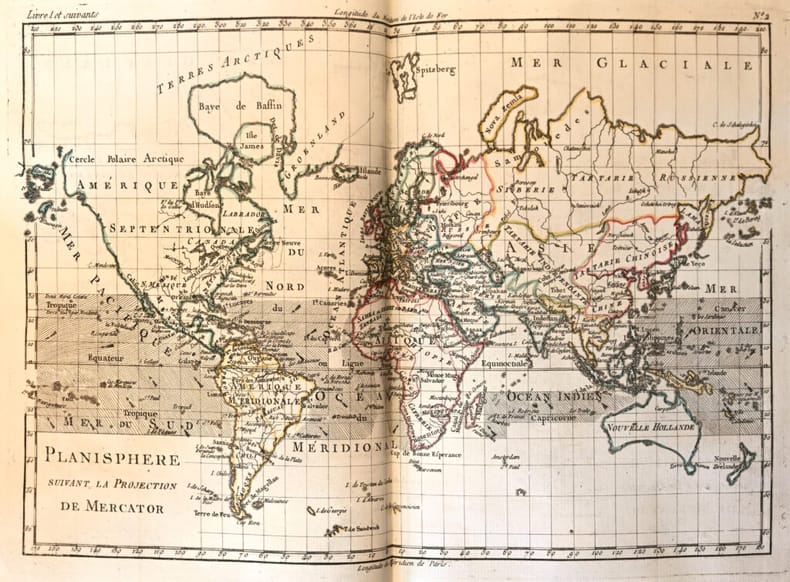
LCS-186427Les bibliographes soulignent l'extrême importance de cette troisième édition originale à ce point truffée et radicalisée par Diderot qu'elle constitue un nouvel ouvrage totalement révolutionnaire et condamné par le Parlement, qui valut la gloire et l'exil à son auteur. Genève, Jean-Leonard Pellet, 1780. 10 volumes in-8 et un volume in-4 d'atlas: I/ 1 portrait, xvi pp., 532 pp., (2) ff.bl.; II/ (2) ff., 1 gravure, viii pp., 582 pp.; III/ (2) ff., 1 gravure, vii pp., 580 pp.; IV/ (2) ff., 1 gravure, viii pp., 472 pp.; V/ (2) ff., 1 gravure, vii pp., 405 pp.; VI/ (2) ff., 1 gravure, vii pp., 484 pp., pp. 281-304 reliées en double; VII/ (2) ff., 1 gravure, table des pp. v à xvi, 558 pp.; VIII/ (2) ff., 1 gravure, viii pp., 548 pp.; IX/ (2) ff., 1 gravure, table pp. v à viii, 412 pp.; X/ (2) ff., 1 gravure, table des pp. v à vi, 538 pp. Atlas: (2) ff., 28 pp., 1 carte dépliante, 49 cartes sur double page, 23 tableaux dont 12 dépliants et 1 sur double page. Maroquin rouge, double filet doré et roulette autour des plats, dos lisses très joliment ornés avec fers spéciaux, roulette intérieure, tranches dorées. Reliure de l'époque. 202 x 123 mm; 257 x 203 mm pour l’atlas.
1 S. auf Doppelblatt. 4to. Auf feinem Briefpapier, das Deckblatt mit gestanzter Spitzendekorbordüre. Neunjährig trägt die spätere Kaiserin, in der Familie Sisi genannt, ihrer Mutter Ludovika Wilhelmine die besten Wünsche zum Namenstag vor. Gott möge die Mutter zu ihrer aller Glück behüten, und Elisabeth werde ihr Bestes geben, ihre Mutter glücklich zu machen, auf dass diese ihre Tochter auf immer lieben wolle: "Ma chère Maman! Je te félicite de tout mon cœur pour ta fête; je prie journellement le bon Dieu de Te conserver longtemps pour notre bonheur. Te promettant de faire mon possible pour Te contenter, chère maman, je Te prie d’aimer toujours Ta reconnaissante fille Elise". - In der Familie von Herzog Max in Bayern war es üblich, dass die Kinder zu verschiedenen Festen Gratulationsschreiben verfassten, die zugleich als Schreibübungen dienten. In unserem Fall zeugt der kindliche Brief zugleich von ersten Fertigkeiten in der französischen Sprache. Elisabeth offenbart dabei beim Gebrauch der Feder noch kleinere Unsicherheiten. - Mit einem kleinen Randeinriss und altersbedingt leicht braunfleckig. Aus Wittelsbacher Besitz.
LCS-12624Le meilleur ouvrage consacré au corail au XVIIIe siècle. Précieux exemplaire entièrement enluminé à la main à l’époque. La Haye, Pierre de Hondt, 1756.In-4 de 1 frontispice gravé, xvi pp., 125, (3), 39 planches hors texte numérotées. Relié en plein veau porphyre de l’époque, triple filet doré d’encadrement sur les plats, dos à nerfs finement orné, pièce de titre de maroquin havane, filets dorés sur les coupes, tranches marbrées. Reliure de l’époque. 270 x 204 mm.
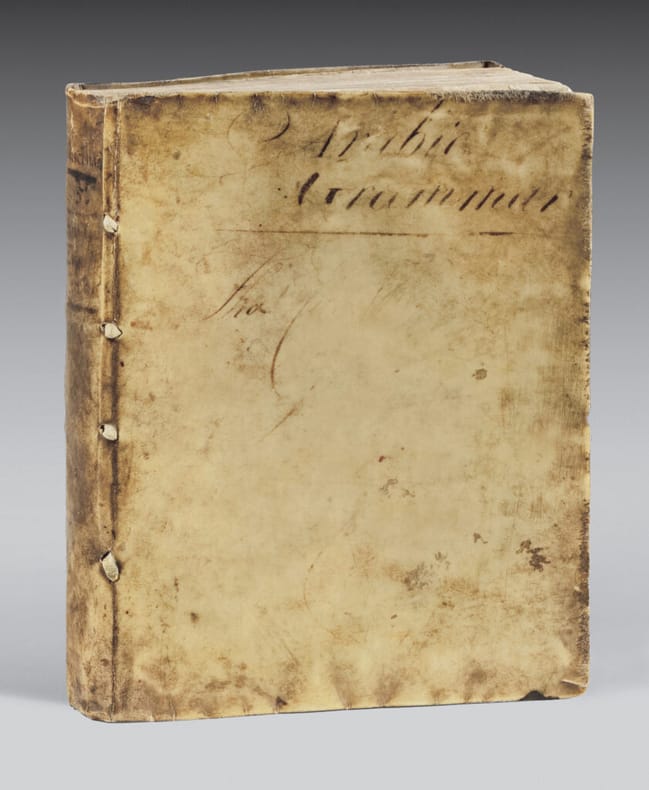
LCS-18607Précieuse réunion de trois rares éditions originales reliées en vélin souple de l’époque. Leyde, in officina Raphelengiana, 1613. - [Avec]: II/ Rous, Francis. Archaeologiae Atticae libri tres. Three bookes of the Attick Antiquities. Containing The description of the Citties glory, government, division of the People, and Townes within the Athenian Territories, their Religion, Superstition, Sacrifices,… Oxford, Printed by Leonard Lichfield for Edward Forrest, 1637. - [Avec]: III/ Crinesius, Christoph. Babel Sive Discursus de confusion linguarum, tum orientalium: Hebraicae, Chaldicae, Syriacae, Scripturae Samariticae, Arabicae, Persiae, Aethiopicae: tum Occidentalium, nempe, Graecae, Latinae, Italicae, Gallicae, Hispanicae,… Nuremberg, Simon Halbmayer, 1629. Soit 3 ouvrages relies en 1 volume in-4 de : I/ (4) ff., 192 pp., (2) ff. d’errata; II/ (4) ff., 149 pp.; III/ (6) ff., 144 pp., (2) ff. Vélin souple de l’époque, mention «Arabic grammar» inscrite à l’encre sur le plat supérieur, dos lisse. Reliure de l’époque. 186 x 147 mm.
8vo. ¾ p. Notes in Swedish recording the trial and execution of several persons between October 15 and November 10, 1793. The first of these is his beloved Marie Antoinette. - Hans Axel count Fersen had fought on the French side in the American Revolution; after his return to France in 1783 he had been made commander of the Royal Swedish Regiment in the French Army by Louis XVI. In the years from 1789 onwards, Fersen, long an ardent devotee of the Queen, soon became Marie Antoinette's sole remaining close friend, acting as a liaison between the royal couple and the Swedish monarch. When Louis and Marie Antoinette finally decided to flee with their children in June 1791, it was Fersen to whom they turned for help. He lent the King the necessary funds, obtained the coach and assisted in engineering the flight which so disastrously ended with the royal family's arrest in Varennes. The King and Queen were returned to Paris, and Marie Antoinette began a clandestine, dangerous correspondence with Fersen, who had escaped to Belgium. While there is no question that Fersen deeply loved Marie Antoinette (he probably became aware of a passionate side to his admiration only in 1790) and that his feelings were increasingly returned by the imprisoned Queen, popular tradition has styled Fersen as Marie Antoinette's long-time secret paramour - a myth debunked by Vincent Cronin in his biography of "Louis and Antoinette" (the single source for this story is an account in the highly biased and unreliable memoirs of the former minister Saint-Priest, whose own wife had indeed been Fersen's mistress for a while). However, Antoinette's loyal friend Fersen secretly returned to Paris in 1792 and spent the night in the Queen's prison-like apartment in the Tuileries, and several pieces of evidence suggest that the liaison, which had been forestalled by the events of 1791, was consummated on that night of 13 February 1792. After again escaping from France, Fersen continued to fight for Marie Antoinette's release - unsuccessfully. Fersen mourned her deeply. "The Queen's face, he wrote in his diary, 'follows me wherever I go. Her suffering and death and all my feelings never leave me for a moment. I can think of nothing else [...]'" (Cronin 392). He would never marry, but "lived quietly with his sister, remembering the past. He wished that he had accompanied the King and Queen on their flight and had been killed making possible their escape. The anniversaries of their deaths he remembered devotedly" (Cronin 394f.). - Slight brownstaining, but well-preserved. Provenance: Stafsunds-Auktionen, later sold at Kvalitetsbokauktionen 23 Nov. 1988, lot 6347. A unique association piece. Cf. V. Cronin, Louis and Antoinette (1974). A. Söderhjelm, Fersen et Marie-Antoinette. Correspondance et journal intime inédits (1930).
8vo. 453-460 pp. Original wrappers. Stored in custom-made black half morocco case. First printing, offprint from the "Archiv für Anatomie und Physiologie" (1884, 5-6). Inscribed and signed to his schoolfriend, the chemist Josef Herzig, on the upper wrapper cover: "Seinem lieben Freunde Dr. Jozef Herzig | dVerf.". "Freud's full account of his method of staining nerve tissue with gold chloride [...] An English version [...] was published in Brain 7 (1884) [...] under the title 'A new histological method for the study of nerve-tracts in the brain and spinal cord'" (Norman). - Very rare and in quite good condition with insignificant edge wear and traces of handling. Provenance: from the collection of the psychoanalyst and bibliophile Haskell Field Norman (1915-96) with his bookplate on inside front cover; acquired from a Belgian private collection. Grinstein 30. Stanford 6. Norman F 6 (this copy).
8vo. 38 pp. Original wrappers. Stored in custom-made black half morocco case. First edition of this very rare pamphlet: Freud's only fifth own publication, offprint from vol. LXXXV, 3rd Dept., January issue. Inscribed and signed on the upper wrapper cover to his schoolfriend, the chemist Josef Herzig: "Seinem lieben Freunde Dr. Jozef Herzig | dVerf.". - "In this paper on the nerve cells of river crayfish, Freud was the first to demonstrate conclusively that the axes of nerve fibers are without exception fibrillary in structure [...] in this and his earlier researches Freud recognized that nerve cells and fibers were a single unit, thus paving the way for the neuron theory a number of years before Waldeyer-Hartz announced it in 1891. Freud had in fact stated as much in a lecture before the Psychiatric Society in 1882" (Norman). - Wrappers slightly duststained, otherwise a perfect, uncut copy from the collection of the psychoanalyst and bibliophile Haskell Field Norman (1915-96) with his bookplate to inside front cover; acquired from a Belgian private collection. Meyer-Palmedo/Fichtner 79. Grinstein 5. Stanford 5. Norman F5 (this copy).
8vo. 1 p. On the reverse of a letter addressed to him: "Going to Manselin (about 20) We are soldiers but are all lovers of Indian freedom. | B | I am glad to hear that. For so far you have been instrumental in the suppression of that freedom. What did they do in Jallianwala Bagh? Do you know the meaning? Have you been there? | S | Oh, yes, but those days are past. Those people were water frozen in the well. We have seen the world. Our eyes are opened. | G | I know this. That is how it should be. | S | What would be our future when we fear Indian freedom?" - Somewhat wrinkled and dust-soiled; small pinhead-sized holes on top.
Small 8vo (120 x 82 mm). 1 p. In Gujarati to his friend Behramhi Khambhatta: "I hope you are now improving. You must give up your attachment to Bombay. Be content with what God has given you. Are you likely to find any difficulty in living in Poona? Do let me know" (transl.). - Brownstained, stamped "6607". The collected works of Mahatma Gandhi. Vol. 50, June-August 1932 (Publications Division Ministry of Information and Broadcasting Government of India, 1972), no. 195.
Small folio (184 x 250 mm). (8), 330, (28) pp. Architectural title page engraved (Cl. Mellan sculps.). With woodcut printer's device on final page and several initials, head- and tailpieces. Contemporary full red morocco, lavishly gilt, with the arms of the Barberini family on an inlaid shield of different-coloured leather on both covers. All edges gilt. First edition, dedication copy. - One of the fundamental sources for the Ottoman conquest of Cyprus in 1571, when the Turkish forces invaded the island with 400 ships and some 100,000 men, massacring Nicosia's 20,000 inhabitants. Thus wrested from the Venetians, Cyprus would remain under Ottoman rule until 1878, when it was ceded to Britain as a protectorate; Ottoman sovereignty continued until the outbreak of World War I. - A. M. Graziani (1537-1611) studied the law at Padua before becoming secretary to Pope Sixtus and, in 1592, bishop of Amelia (in Umbria). Pope Clement VIII sent him as his nuncio to the Italian princes and states to unite them in a league against the Ottomans. Graziani having died in 1611, his account was published only posthumously: it was edited by his son Carolo, who dedicated the book to Cardinal Francesco Barberini, nephew of Pope Urban VIII. Barberini was created a cardinal in 1623; in 1627 he became librarian of the Vatican, and in 1632 vice-chancellor. The engraved architectural title (by Claudio Mellan after Antonio Pomeranci) shows History, "magistra vitae", seated atop an elaborate Baroque structure which incorporates Barberini's arms. This is the dedication copy bound for Cardinal Barberini himself: both covers show the crowned bee arms of the Barberini family on dark green leather, enclosed within borders of blind rules and double fillets with corner fleurons and two different bee cornerpieces, all set within a wide floral border and double gilt fillets. Even the spine is richly decorated with bee tools running up and down between a floral railing. - Corners insignificantly bumped, joints barely starting at foot. Some browning and slight waterstaining throughout, also visible on covers, but endpapers replaced with old paper. Later armorial bookplate of the collector John Stafford Reid Byers (1903-84), of Waterfoot House, Newcastle, County Down, to pastedown. Blackmer 726. Cobham/Jeffery, p. 24. Bruni/Evans, Italian 17th-c. books in Cambridge libraries STC 2547. NUC 211:420. BMC 91:156. Maggs, Cat. 697 (1940-1), no. 114 (this copy). Not in Atabey or Aboussouan. Not in Brunet, Ebert, or Graesse.
14252Florence, Caietani Albizzini, 1742.
2 vols. Elephant folio. 112 pp. 224 text illus. (some in colour), 204 plates (numbered 1-205, nos. 204-205 forming one double-page plate; 7 double-page; 2 coloured), showing photographs, measured drawings, ground plans, etc. Loose as issued in original board portfolio. First edition; rare. An important survey of the architecture of Constantinople, concentrating mainly on religious buildings. The extensive scope covers the major mosques of the Ottomans, as well as Topkapi Palace, the Hagia Sophia, Hagios Theodoros and the Byzantine land walls. The plates depict interior and exterior views, architectural details, street scenes, plans, and elevations. A panoramic and comprehensive overview of many centuries of architectural evolution in Istanbul. - Very scare, and virtually impossible to obtain: the last copy at Sotheby's sold for £13,150 in 2002. The only other copy available in the trade has library stamps on every plate. - Some plates evenly browned (as usual); a few plates a bit frayed. Spines repaired with tape. Atabey 545. The Ottoman World II, Cat. Sotheby's, 28 May 2002, lot 537. Not in Blackmer.
4to. (16), 247, (1), 15, (1) pp. With 111 etched plates depicting plants, an elaborate woodcut tailpiece with an eagle feeding her young, caterpillars, dogs, and flowers, as well as a woodcut printer's vignette on the title-page. Early 18th century (?) richly gold-tooled mottled calf, in a panel design with a large centre-piece of curlicues, gold-tooled board edges, marbled end papers and gilt edges. First edition of an overview of exotic plants were recently discovered by the Dutch. The foreign plants were brought back to the Netherlands by ship from around the world and planted in various botanical gardens to be studied. With the help of new botanical technology such as greenhouses it became possible for the first time to cultivate exotic plants such as orchids in the colder European climates. Paul Hermann (1646-95) had excellent contacts and based his work on various Dutch botanical collections that held plants from the Americas, from Africa (Egypt), the South Indian Ocean regions, and Asia. Mentioned plants include passion fruit, cacti, and papaver. Hermann himself served as director of the Hortus Botanicus at the University of Leiden and contributed to this work specimens from India, Africa, and Sri Lanka. He died in 1695 while at work on a number of important publications, this one of them. His widow was able to complete the "Paradisus Batavus" and got influential English botanist William Sherard (1659-1728) to edit her husband's work. The publication raised the bar for floral publications and set the standard so high that it inspired Linnaeus to write his "Flora Zeylanica" (about the plants of Sri Lanka). - Some copies include a four-page laudatory poem to the author, not present here. Most copies of this first edition have 110 plates, while the present volume contains 111. Some of the depicted plants are the first ever to be documented in European cultivation. Although the plates are referred to as engravings it appears more likely that they are etchings. The anonymous illustrations seem to be aimed at showing the whole plant, including the roots, leaves and twigs, rather than just the blossom or fruit that the plant produces. The woodcut tailpiece is signed "C" (possibly Nagler Monogrammisten 2151). - Boards slightly warped, but still a very good copy. From the library of William Cavendish-Bentinck, the 6th Duke of Portland, with his engraved armorial bookplate on the upper pastedown. Kuijlen 115. Nissen BBI 860. The Anglo-Dutch Garden 143.
Large 8vo (245 x 155 mm). 2 vols., comprising text volume and appendix of maps: 5 folding maps, all but one colour-printed, folding graph at end of text volume. Original blue-green wrappers. Complete with the very rare appendix of maps. In reaction to the 1929 violent unrest in Palestine, the British government in 1930 sent the Shaw Commission ("Palestine. Statement with regard to British policy", Cmd. 3582) to report on the situation in the Mandate. This concluded that Jewish immigration pressurized and displaced the Arab population, and rejected the view that the Jewish National Home was the principal feature of the Mandate. The Shaw Commission recommended an investigation into Palestine's economic absorptive capacity of Jewish immigration, and the present publication, Sir John Hope Simpson's report, concluded that the increasing number of Jewish land purchases was leading to a growing population of landless Arabs. Hope Simpson's recommendations of reduced Jewish immigration and restrictions on land transfers were adopted by the Passfield White Paper ("Palestine. Statement of policy by His Majesty's Government in the United Kingdom", Cmd. 3692) that same year. - Maps 1 and 6 with very small holes at some creasefolds and a few very short marginal tears and nicks, maps and accompanying text in appendix with light dog-earing. Map 3 apparently never issued. Wrappers to text volume faintly creased, appendix unevenly faded and extremities lightly rubbed. Extremely rare. Khalidi & Khadduri 1658. Cf. Bryars & Harper, A History of the 20th Century in 100 Maps (2014), p. 79.
2 volumes. 4to. (8), XXVI, 503, (1), 16; (8), 642, (1), (1 blank) pp. Contemporary half calf, rebacked with the original backstrips laid down. Rare third, revised edition of a massive navigational directory, with exhaustive information on the Arabian Sea, the Red Sea, and the Arabian (Persian) Gulf. Including detailed entries on Sharjah, Dubai, Abu Dhabi ("Abothubbee"), Bahrain and Hormuz, not only covering navigational details, but also the inhabitants, pearl fishery, geography, commerce etc. - Compiled chiefly from recent journals of ships employed by the East India Company, by James Horsburgh (1762-1836), hydrographer and chart maker to the Company. "As hydrographer Horsburgh was primarily responsible for supervising the engraving of charts sent back to London by marine surveyors in India and ordered by the company to be published, and for examining the deposited journals of returning ships for observations which would refine the oceanic navigation charts currently in use, besides other duties of provision of information laid on him by the court" (Cook). - The book appeared in a total of eight editions between 1809 and 1864 before being superseded by Findlay's A directory for the navigation of the Indian Ocean (1869). - With an inserted manuscript note facing p. 136, vol. 1, and a short manuscript note at the foot of page 501, vol. 2. Some faint thumbing to the title-pages and rebacked, but otherwise in very good condition. Cf. Cat. NHSM, p. 73 (fifth ed.). Sabin 33047 (fifth ed.). For the author: Cook, "Horsburgh, James (1762-1836)", in: ODNB (online ed.).
8vo (120 x 180 mm). (40), 303, (31) pp. Contemporary full red morocco, both covers, spine and leading edges finely gilt. Marbled endpapers. First French edition of the Kitab al-Najah ("The Book of Salvation"), the part on logics from Ibn Sina's great scientific and philosophical encyclopedia Kitab Al-Shifa' ("The Book of Healing"). Translated by the French oriental scholar Pierre Vattier (1623-67), himself a physician like Avicenna. - Ibn Sina's system of logic is known as "Avicennian logic", in contrast to Aristotelian logic. By the 12th century, Avicennian logic had replaced Aristotelian logic as the dominant system in the Islamic world; after the Latin translations of the 12th century, his writings were also an important influence on Western mediaeval writers such as Albertus Magnus. - Light browning throughout; occasional faint waterstains to the lower margin. Very prettily gilt morocco binding; tools attributable to the binders of Macé-Ruette (cf. Esmerian, La reliure au XVIIe siècle). From the library of the French neurologist Maurice Villaret (1877-1946) with his memento-mori style bookplate to front pastedown. OCLC 978575366. Cf. GAL I, 454, 18.
4to (ca. 175 x 230 mm). Ottoman Turkish manuscript on paper. 11-277 numbered leaves (lacking the first 10 ff. from the front of the volume, all likely from the Fihrist), per extensum, 16 lines in black Naskh, words and headings in red throughout, over ten leaves with full-page illustrations and diagrams, some of these in colour, including the double-page illustration of the globe as spheres, many tables and diagrams also appearing throughout the text. Contemporary leather-backed cloth boards, cloth with stamped tughra of sultan to covers (head-over-heels). A fine early 19th century manuscript copy of the famous scholarly encyclopedia, not printed until 1835 (in Bulaq). The "Marifetname", or "Book of Gnosis" is a compilation of astronomical, astrological, mathematical, anatomical, psychological, philosophical as well as mystical religious texts. It is famous for containing the first treatment of post-Copernican astronomy by a Muslim scholar, placing the sun at the center of the universe. - Ibrahim Haqqi Erzurumi (1703-80) is considered an outstanding figure of 18th century Ottoman Turkey. Based on an immense knowledge of the Sufi branch of Islam as well as his studies in Western science, he devoted himself to the domains of both religion and science, considering both a means of approaching God. - Although Ibrahim Haqqi completed his work in 1756, very few surviving manuscripts predate the first quarter of the nineteenth century. The British Library holds a copy (MS.Or.12964) compiled in 1235 H (1820 CE), and the earliest known manuscript copy was long thought to be that in the Khalili collection, dated 1226 H / 1811 CE (J. M. Rogers, Empire of the Sultans, 1995, no. 74, pp. 121 & 123), but a copy predating this by seven years was sold by Bloomsbury in 2014 (7 December sale, lot 123), and a manuscript dated to ca. 1760 was offered by Inlibris. - While this copy of the text is in a relatively informal hand, the diagrams have been executed to an excellent standard. The text and drawings were likely executed in different workshops, as the scribe allocated far more space than necessary for the illustrator, resulting in numerous blank pages throughout the text. - Leather spine worn with slight loss to leather at extremities, cloth also worn with loss. Contemporary foliation throughout, a few scuffs and smudges. Spine cracked with a few individual gatherings becoming loose. Overall a clean copy.
LCS-18052Fort rare édition imprimée en grec à Francfort vers l’année 1540. Francfort, s.n., [1540]. In-8 (157 x 96 mm) de (28) ff., 349 ff. dont le premier blanc, (3) ff. Veau fauve, triple filet à froid encadrant les plats, fer doré représentant un aigle bicéphale au centre, fleurons d’angle, dos à nerfs, pièce de titre manuscrite sur vélin, titre à l’encre sur la tranche. Reliure parisienne de l’époque. 163 x 100 mm.