692 496 résultats
4to. (8), 200 pp. With 8 engraved plates (some with touches of colour, two folded). - (Bound with) II: Wenner, Adam. Türckisches Reisebuch von Prag aus biß gen Constantinopel [...]. Nuremberg, Johann Andreas Endter & Wolfgang Endter's heirs, 1665. (8), 135, (5) pp. Title printed in red and black. Contemporary full vellum with handwritten title to spine. Exceedingly rare Mediterranean travelogue: one of two German editions published in the same year (the other, an entirely different translation, by Cunradus in Amsterdam; the Nuremberg edition cited by several bibliographies is fictitious). Dutch editions had previously appeared in 1649 (the first) and in 1661. Although the Amsterdam-published German edition dates the journey to 1640-42, the Dutch first edition as well as the present translation make it clear that it had taken place as early as 1590-92! Somer's voyage began inauspiciously - he was captured by a Turkish galley in the harbour of Famagusta and briefly enslaved, but was soon set free after the French consul at Alexandria intervened for him. In spite of this episode, he travelled the Ottoman Empire at a time of relative peace (the Long Turkish War with the Habsburgs would not break out until 1593), spending several months in Egypt, Constantinople and Palestine. His colourful account includes a description of desert sandstorms and the trade in Egyptian mummies (not all of them ancient) as well as extensive chapters on Constantinople, the Ottoman court, the ubiquitous baths, Turkish customs and manners, the Muslim faith, curses and magic, etc. Somer returned via then-Ottoman Greece and Hungary, which he also describes. An appendix (pp. 170ff.) contains A. Stockram's topical account of the voyage of the Dutch ship Arnheim, which foundered off Mauritius on the return from Batavia. The translation is credited to "Philemerus Irenicus Elisius" (i.e., Martin Meyer). Rare; the last copy in auction records sold in 1983 (Erasmushaus, an incomplete reissue with only 5 views). - Bound after this is the second edition of A. Wenner's narrative of the Imperial embassy to the Porte in 1616-18, to ratify the Treaty of Zsitvatorok. Wenner served as secretary to the embassy; his "book is a day-to-day account of the journey to Constantinople from Prague, and includes a list of all the entourage from nobles to the apothecary, goldsmith, musicians, tailors, cooks, and so on. A list of presents for the sultan, with their values, is also given" (Atabey). The Treaty of Zsitvatorok "was a landmark in Turkish-European diplomatic relations, when the Turks first began to observe the general principles and courtesies of international law, and to exchange special ambassadors on an equal footing with European nations" (Blackmer). - Some browning throughout due to paper, more pronounced in Somer's work, the title-page of which shows an unobtrusive tear in the upper edge. Contemporary handwritten ownership "Bocken" to recto of flyleaf; verso has stamp and 1978 ownership of the Viennese collector Werner Habel (1939-2015). I: VD 17, 23:231760C. Tobler 86. Röhricht p. 217, no. 820. Paulitschke 532; Ternaux-Compans, Bibliothèque asiatique et africaine, 1977 (both have "Nuremberg" in error for Frankfurt). Cf. Weber II, 216 (Amsterdam German ed.); Kat d. Scheepvart Mus. I, 254f. (Dutch eds.). Not in Atabey, Blackmer, Aboussouan, Howgego, Henze, Cox, or Chauvin. - II: VD 17, 23:234557B. Cf. Atabey 1326; Blackmer 1783; Brunet VI.2, 435 (all for the 1622 first edition). Not in Röhricht, Tobler, Aboussouan or Brunet.
Oblong large 8vo. 1 p. To the chief of staff at the Field Army Command, sending a report on prisoners of war: "In der Anlage übersende ich den Bericht des O. K. H. vom 07. 11. 41 mit der Auswertung der Kriegsgefangenenmeldungen im Bereich der HGr. Süd, Zeitraum: Sept. und Okt. 41 mit der Bitte um Kenntnisnahme und Empfangsbestätigung [...]". - Left margin with punched holes (no loss to text); stamped by the Field Army Command.
4to (235 x 325 mm). (1), 118 pp. Lithographed throughout; pp. 8-97 comprise a continuous genealogical tree. Contemporary plain black cloth-covered boards with black sheepskin spine. First edition: a rare and important work on the genealogy of the Arab tribes, also an early, graphically sophisticated lithographic effort from the Arab World. The "Book of Gold Bars" by the prominent Iraqi theologian and historian Suwaydi (1786-1831) is a revised and expanded interpretation of the "Dictionary of the Arab Genealogy" by the legendary Medieval Egyptian scholar Ahmad ibn Ali Qalqashandi; notably, Suwaydi continued the genealogical profile up to modern times. The book seeks to trace the genealogy of the Arab peoples, and the branches of their tribes, from Biblical times up to the age of Muhammad and then to the modern era. The introductory text (pp. 1-7) is followed by the grand, 90-page genealogical table and ultimately by an alphabetical reference section and analytical section (pp. 98-118). - Suwaydi is thought to have commenced preparation of the work as early as 1814, although he did not complete the treatise until 1830 or 1831, shortly before his death. Highly regarded in its time, for some years a small number of manuscript copies circulated in Islamic academic circles. The present publication represents the first printed edition of the work. The second edition was published in Bombay in 1877 (and is likewise rare), while several subsequent editions appeared during the 20th century. - Covers slightly stained. Last 3 leaves with light tide-marking to outer margins and some sporadic light stains elsewhere, but overall in a good clean condition, a few leaves with short marginal tears some closed with discreet old restoration. Very rare: we can trace only six institutional examples (British Library; University of Cambridge; Bibliothèque de Genève; Yale University Library; University of California at Berkeley; National Library of Israel). No examples have appeared on the market over the last generation. OCLC 708712572 & 32728624. British Library: Asia, Pacific & Africa 14548.c.5. Yale University Library: CS1129.A2 S8 1864. On early lithography in Iraq, cf. A. Al-Rawi, Media Practice in Iraq (2012), passim.
Folio (214 x 310 mm). 6 parts in one vol. (18), 264 pp. (2), 214 pp. (2), 66 pp, (2). (12), 14, (4), 15-46, (4), 47-87, (1) pp. (6), 113, (1) pp. 154, (2) pp. With 17 full-page engr. plates, 13 folding plates, and numerous text illustrations (including plates of Arabian coins, the great name of Allah, and other Arabian inscriptions). Contemporary calf, spine rebacked. Rare first collected edition of Tavernier's works, profusely illustrated with a fold-out map of the Arabian Gulf, an unusual, large map of Japan, and a fold-out map of the Great Moghul. Comprising: 1) The First Book of Monsieur Taverner's [!] Persian Travels; 2) The Six Trabels of John Baptista Tavernier [...] Through Turky and Persia to the Indies: 3) A Relation of Japon; 4) A New and Particular Relation of the Kingdom of Tunquin; 5) A New Relation of the Inner-Part of the Grand Seignor's Seraglio; 6) The History of the Late Revolution of the Dominions of the Great Mogol. A rare and interesting account of Turkey, Persia, India, Japan, Tonkin, and Formosa. "The Persian Gulf is the most dangerous Gulf I know, by reason of the shallowness and sharp promontories that point out into Sea [...] The Merchant would be glad to find a way through the Coast of Arabia to get to Mascate [...] Elcatif a Sea Town in Arabia, where there is a fishery for Pearls that belong to the Emir of Elcatif" (pt. I, p. 95; "Qatif" being an oasis in Saudi Arabia). Chapter XI (p. 49) of the first part deals with the breeding and nature of camels; chapter III (p. 64) mentions a voyage to Mecca; chapter XXIII (p. 255) deals with the island of Ormus (with the map of the Arabian Gulf). - The second part begins with a discussion of Arabian currency and is illustrated with plates of Arabian coinage. The most important story is perhaps that of “The Imam of Muscat Pearl - That Surpassed in Beauty All Other Pearls in the World”. In chapter XVIII of book II, "Of Pearles and the places where to find them" (p. 145), Tavernier states: "In the first place, there is a Fishery for Pearls in the Persian Gulf, round about the Island of Bakren. It belongs to the King of Persia, and there is a strong Fort in it, Garrison'd with three hundred men." Tavernier then narrates: "There is a wondrous Pearl in the possession of an Arabian Prince, that took Mascate from the Portugals. He then call'd himself Imenhect Prince of Masscaté; being known before only by the name of Aceph Ben-Ali Prince of Norennaé. It is but a small Province, but it is the best of all in the Happy Arabia. Therein grow all things necessary for the life of man; particularly, delicate fruits, but more especially most excellent Grapes, which would make most incomparable Wine. This Prince has the most wonderful Pearl in the world, not so much for its bigness, for it weighs not above twelve Carats and one sixteenth, nor for its perfect roundness, but because it is so clear and so transparent that you may almost see through it. The Great Mogul offer'd him by a Banian forty thousand Crowns for his Pearl, but he would not accept it." The use of the phrase "clear and lustrous as to appear translucent" seem to indicate a white or colorless pearl, the most sought-after color in pearls, with an optimum of lustre and orient caused by the reflection and refraction of light, respectively. The surface quality of the pearl must be exceptional and almost blemish-free in order to characterize it as a specimen surpassing in beauty all other pearls in the world, at that time. The fact that the pearl was in the possession of the Imam of Muscat in the mid-17th century indicates without any doubt that the pearl originated in the most ancient pearl fishing grounds in the world, the Arabian Gulf, most probably in the kingdom of Oman itself, at its very doorstep - on the pearl banks situated closer to the country's shoreline in the Gulf or the Strait of Hormuz. Oyster bearing reefs were well distributed throughout the Gulf, but were greater in abundance on the Arabian side of the Gulf than the Persian one. The pearls are depicted on a plate opposite page 150: "Figure one is of a Pearl which the King of Persia bought at the Fishery of Catifa in Arabia. It cost him 32,000 Tomans, or 1,400,000 Livres of our Money, at forty-six Livres and six Deneers to a Toman. It is the fairest and most perfect Pearl that ever was yet found to this hour, having no defect". Blackmer 1632. Wing T251A, T252, T253. Campbell (Japan) 28. Cox I, 275f. OCLC 6071990. Cf. Wilson 223. Howgego T14. Severin 104-113. Not in Atabey or Weber.
8vo. 90 pp. (without the final blank leaf). Small woodcut device on title, woodcut decorations and initials. Fine 19th century mottled calf by Lloyd, with gilt arms of Sebastião Pinto Leite, Conde de Penha Longa (motto "Superabo") to both covers, gilt fillets and faux raised bands to spine, compartments tooled in gilt, two red lettering pieces. Leading edges gilt; inner dentelle gilt. Marbled endpapers. First English edition of this rare work, containing an account of the failed invasion led by the young king of Portugal, Dom Sebastian, to the north of Africa, his defeat and death, and the political unrest that ensued. - Sebastian, the 24 year-old King of Portugal, invaded Morocco in 1578 with an army of 18,000 men. The army was crushed by the forces of Marwan Abd al-Malik I Saadi at the battle of Alcacer Quibir and King Sebastian was killed. The fact that he had left no successor paved the way for a series of impostors claiming the throne, only to be captured and executed (ultimately, the Spanish king would accede to the throne of Portugal). Teixeira's work narrates the machinations of the fourth such impostor, a Calabrian by the name of Marco Tullio. - Bound for the Portuguese politician and entrepreneur Sebastião Pinto Leite (1815-92), Conde de Penha Longa. Bookplate of the Fox Pointe Collection Library of Dr. & Mrs. Howard R. Knohl to pastedown. Joints of the fine binding slightly rubbed. Lightly browned throughout; title-page and verso of final leaf lightly dustsoiled. Overall in excellent condition. Rare at auction, the last copy being sold in 1991. BM-STC 23864. OCLC 32330439.
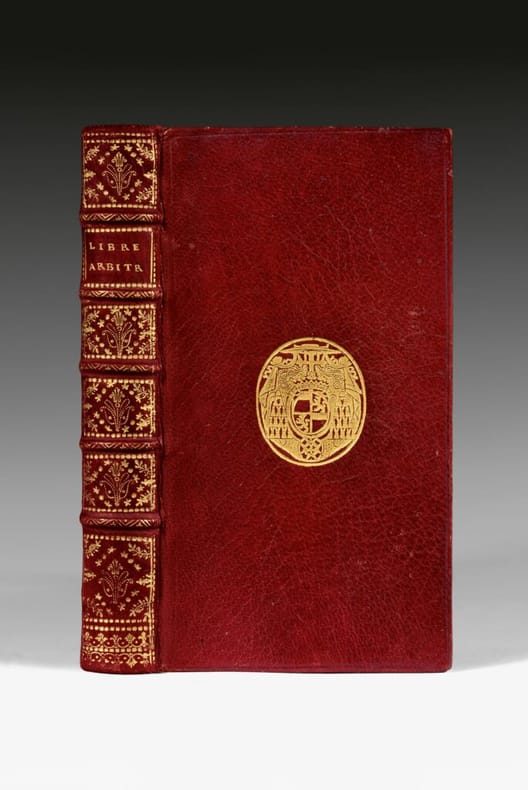
LCS-17512Le Bréviaire romain - partie d’hiver - imprimé en 1533 en deux forts volumes in-8 somptueusement reliés dans la seconde partie du XVIe siècle pour le prieur des bénédictines de Sainte Suzanne, avec son nom « Chastellain » frappé en lettres d’or au centre du plat inférieur et illustré par Geoffroy Tory. Pars hyemalis brevarii impressa 1533.2 volumes in-8. Impression en rouge et noir sur double colonne. Plein maroquin olive, plats ornés en leur centre des instruments de la passion, plats supérieurs portant en lettres plein or le nom du monastère de Sainte Suzanne, plats inférieurs portant en leur centre en lettres plein or le nom du prieur des bénédictines de Sainte Suzanne, « Chastellain », encadrement d’une large roulette dorée de motifs à la fanfare : fers évidés, pointillés, fleurettes et feuillage dorés insérés dans des motifs géométriques évidés, dos lisses magnifiquement ornés de décors à la fanfare avec, en leur centre, les instruments de la passion, filet or sur les coupes, tranches dorées, trois attaches. Reliures du XVIe siècle. 155 x 99 mm.
LCS-17877Précieux volume, entièrement gravé, représentant les uniformes de l’infanterie de l’armée du roi Louis XV. A Paris, chez Lattré, graveur ordinaire de Monseigneur le Dauphin, s.d. [1767]. Petit in-8 de (4) ff. dont 1 titre gravé aux armes et chiffres royaux aquarellés et 3 ff. de table gravés, 120 planches à pleine page. Maroquin rouge, triple filet doré encadrant les plats, dos lisse orné de fleurons dorés, pièce de titre de maroquin olive. Reliure de l’époque. 182 x 108 mm.
Folio. 4 vols. bound as 1. [20], 218, [12], [2 blank]; [4], 236, [12]; [4], 244, [13], [1 blank]; [6], 231, [17] pp. First title-page printed in red and black, each title-page with Widerholds's woodcut device (motto: "Gradatim ad sidera tollor"). With 31 engraved plates (1 folding), including frontispiece and portraits of the author and his wife, by Jean Jacques Thourneyser. Further with woodcut initials, head- and tailpieces, factotums and several small woodcuts in the text. Contemporary vellum, manuscript spine-title, blue sprinkled edges. First edition in German of Pietro della Valle's deservedly famous narrative of his travels in the Middle East, with an excellent account of Muscat and the Arabian Gulf and references to Dibba. Della Valle, an Italian nobleman, sailed from Venice in 1614 to Istanbul, where he arrived in August 1614, spending a year to explore the city. He continued to Rhodes, Alexandria, Rosetta, Cairo, crossing the Sinai desert to Jerusalem, Damascus and Aleppo. From there Della Valle proceeded to Isfahan (Iran) to meet the Safavid ruler Shah Abbas I. He sojourned in Persia until early 1623, witnessing and commenting on the escalating conflict between Shah Abbas and the Portuguese empire. In 1621 he decided to return to Europe and set off for the Persian Gulf, but the Persian and English blockade prevented his sailing. By way of India he finally sailed for Muscat in January 1623, from which he crossed the Arabian Gulf to Basra, continuing overland to Aleppo, arriving in Europe in 1626. During his travels he wrote regularly to his learned friend in Naples, Mario Schipano. These 54 letters formed the basis of an account of his travels that was first published in Rome as Viaggi di Pietro della Valle from 1650 to 1658. "Della Valle displayed excellent narrative and descriptive skills, powers of acute observation, and a genuinely scholarly breadth of learning. He refused to comment on what he had not witnessed himself or checked against the best authorities [...] Della Valle's eighteen letters from Persia provide one of the most detailed sources of information for most aspects of Persian life in the second half of Shah Abbas' reign" (Gurney). - Engraved armorial bookplate on paste-down. Evenly browned throughout, some spotting, few quires in volume 3 with wormholes in gutter margin, not affecting the text, otherwise in very good condition. VD 17, 39:135561Q. Tobler, p. 95. Cf. Atabey 1269-1271 (other eds.); Blackmer 1712 (French ed.); Gurney, "Della Valle, Pietro", in: Encyclopaedia Iranica (online ed.).
193488436London: Nancy Cunard at Wishart & Co 1934. First Edition. One of 1000 copies. Large quarto 31.5cm; publisher's dark brown buckram with titles stamped in red on spine and front cover and a map of "The Black Belt of America" on rear cover; dark brown topstain; viii23-855pp; with numerous half-tone and other illustrations throughout including the color fold-out map of Africa tipped in between p.584-585. Modest external wear particularly to base of spine and upper and lower front joint gently spine-sunned light wear to topstain with a touch of dust-soil to covers and faint foxing to endpapers and text edges occasionally extending into the margins; small closed tear to lower edge of title page with a tiny puncture to one lower fold on the map; hinges sound; a solidly Very Good copy. <br /> <br /> A monumental work compiling some 250 contributions by more than 150 authors two-thirds of whom were Black privately published and financed by Cunard a direct descendant of Benjamin Franklin and heiress to the Cunard shipping fortune. Blockson notes Cunard's "bohemian spirit" and "unbending devotion to ending racial prejudice" and calls Negro "a landmark in African-American literature see BLOCKSON 71 p.53-5. Cunard stated her purpose in publishing Negro was to show "that there was no superior race merely cultural differences that racism has no basis whatsoever." Among the impressive list of contributors were Langston Hughes W.E.B. Du Bois Zora Neale Hurston Jomo Kenyatta Samuel Beckett Ezra Pound Theodore Dreiser Countee Cullen Sterling Brown Claude McKay and many other key figures in the Harlem Renaissance. Of the 1000 copies printed many hundreds were destroyed during the blitz of London -- an assertion that was long offered by dealers without documentation but which is indeed supported by an annotation in Cunard's own copy held by the Ransom Center dated October 1941: ".what remained of the whole edition has been destroyed by bombs and fire last years Sept. save 10 copies saved by E.E. Wishart as if in prevision." This fact along with the book's unwieldy size and fragile binding accounts for the scarcity of attractive copies in the marketplace; the present example being among the nicer copies we have handled. BLOCKSON 71; PERRY 761 The Harlem Renaissance: An Annotated Bibliography and Commentary. 88436. Nancy Cunard at Wishart & Co unknown
1997541H2157New York: Broadway Books. Good in Very Good dust jacket. 1997. First Printing. Hardcover. 055306682X . Signed without inscription by both authors upon half-title page. "Offers an utterly persuasive prophecy about a new American era that will begin just after the millennium." - dust jacket. xiv 382 pages. Footnotes. Index. Light overall wear. Binding tight. Yellow high-lighting to eight pages. Dust jacket now in glossy new archival protection. A rare double-signed first printing example of this most extraordinary work. ; 8vo - over 7¾" - 9¾" tall; United States History Cycles Forecasts Future Signed Twenty-First Century Strauss-Howe generational Theory Steve Stephen Bannon Donald Trump Presidential Campaign 2016; Signed by Authors . Broadway Books hardcover
158053493Paris, J. du Puys, 1580. 4to. Contemporary full vellum wih contemporary handwritten title to spine. Binding somewhat warped, but unrestored and tight. A (mostly very faint) damp stain to upper blak margin of some leaves (not affecting text), but otherwise internally very nice clean and fresh. Old owner's name to title-page (Dufault) and old acquisition note to front free end-paper. Woodcut title-vignette, woodcut headpieces, woodcut end-vignette, and a few woodcut initials. A large copy with good margins. (14), 252 (recte: 256) ff.
Paris, J. du Puys, 1580. 4to. Contemporary full vellum wih contemporary handwritten title to spine. Binding somewhat warped, but unrestored and tight. A (mostly very faint) damp stain to upper blak margin of some leaves (not affecting text), but otherwise internally very nice clean and fresh. Old owner's name to title-page (Dufault) and old acquisition note to front free end-paper. Woodcut title-vignette, woodcut headpieces, woodcut end-vignette, and a few woodcut initials. A large copy with good margins. (14), 252 (recte: 256) ff.
108073The very fine portrait visible image size 545 × 395 mm in its original ornate gilt frame external dimensions 740 × 595 mm is exquisitely hand-painted and signed by the famous colonial photographer Townsend Duryea 1823-1888. His original label is affixed to the paper backing on the verso of the frame 'T. Duryea Artist Photographer 66 and 68 King William Street Adelaide' and in our opinion he has created a masterpiece as both artist and photographer with this work. James Hurtle Fisher commenced practice as a solicitor in London in 1816 and 'was drawn into the colonizing movement in 1835. He was selected as resident commissioner one of the most important offices under the South Australian Act . second only to the governor'. Fisher 'left England in July 1836 with the governor's party in the "Buffalo" arriving on 28 December 1836 at Holdfast Bay where the official oaths were administered a proclamation was read and a ceremony marked the beginning of settlement. <p>In January 1837 Fisher erected his reed hut and Land Office near the survey camp of Colonel William Light at the north-western corner of the new capital site; the destruction of these temporary buildings by fire on 23 January 1839 caused both men serious loss. Fisher had been allowed to draft his own instructions which were not shown to Governor Sir John Hindmarsh. Disputes between the two men over their respective powers had begun on the voyage and were soon revived in the new Council of Government and more violently outside and led in February 1837 to the Resident Magistrate's Court binding the participants over to keep the peace towards each other. The new governor George Gawler was appointed both governor and resident commissioner a radical departure from the principles on which the colony had been founded' ADB. <p>Fisher returned to his profession and became a leader of the South Australian Bar. In October 1840 he was elected first mayor of Adelaide; in 1860 he became the first resident South Australian to be knighted. Townsend Duryea was at the King William Street address from 1858 until his illustrious career as a photographer 'was cut short when his studio and entire collection of 50000 negatives were destroyed by fire on 18 April 1875' ADB. We suggest as a date for this magnificent portrait 'circa 1870'. unknown
80 Einträge auf 82 Bll. Mit 3 Aquarellen (davon 1 sepiafarbenes), 1 aquarellierten Federzeichnung, 1 Bleistiftzeichnung, 2 Notenmanuskripten und 3 Notenzitaten. Roter Schaflederband der Zeit mit umlaufendem Goldschnitt, goldfarbener Bordüre, floraler Rückenvergoldung und goldgepr. Rückenschildchen ("Denkmal der Freundschaft"). Marmorierter Vorsatz. Qu.-8vo. Hübsches Stammbuch der Nanette Valentin, geb. Dellevie (1758-1850), Salonnière und Gattin des Pariser Bankiers Sebastian Valentin. Begonnen wenige Monate vor ihrer Hochzeit am 15. April 1809, mit zahlreichen Einträgen aus der Hamburger Bourgeoisie, einige mit Zeichnungen oder Notenzitaten, großteils in deutscher, vereinzelt auch in französischer und italienischer Sprache. Hervorzuheben sind Beiträge einiger prominenter Persönlichkeiten aus Musik, Kunst und Literatur, darunter der Cellist und Komponist Bernhard Romberg (1767-1841), die Sängerin Félicitas Blangini (1794-1844), der Komponist Anton Bohrer (1783-1863) und dessen Bruder, der Cellist Maximilian Bohrer (1785-1867), die Pianistin, Komponistin und Sängerin Helene Riese, verh. Liebmann (1795-1869), der Maler Leo Lehmann (1782-1859), die Schriftstellerin Regina Frohberg (1783-1850) und der Musiker, Privatgelehrte und Musikaliensammler Georg Poelchau (1773-1836) sowie der Jurist Carl August Buchholz (1785-1843). - Ferner sind einige bedeutende Familien der florierenden jüdischen Gemeinde Hamburgs vertreten; diese war im Jahr 1812 mit etwa 6300 Mitgliedern (rund 6 Prozent der Stadtbevölkerung) die größte in Deutschland. Zu nennen sind Moses Lazarus Dieseldorff und seine Frau Betty, deren Kinder von Salomon Heine, dem Vater von Heinrich Heine, unterrichtet wurden, der Bankier Moses Jacob Hertz (1752-1833) sowie Clara Hertz (1781-1851), Gattin eines Teilhabers des Bankhauses Moses Hertz Söhne, Jules und Betty Arrong, Marianne und Louise Oppenheim aus der Bankiers-Familie Oppenheim, Henriette und Jeannette Schlesinger sowie Suzette und Henriette Benjamin, und Ernestine Robert-Tornow, geb. Victor, Schwägerin der jüdischen Schriftstellerin und Salonnière Rahel Levin Varnhagen. Weiters sind verewigt der Hamburger Kaufmann Ludwig Franz Völckers sowie Nanettes Schwestern Serina und Friederike sowie ihr Cousin Leonhard Dellevie. - Unter den Illustrationen finden sich eine hübsche Bleistiftzeichnung eines Dorfpanoramas mit Windmühle, gezeichnet "G. Sutz", Blumenaquarelle sowie eine Profilansicht einer antiken Skulptur. - Einband etwas berieben. Etwas gebräunt, vereinzelt leicht fingerfleckig.
LCS-1864069
LCS-186413Editions originales de deux traités majeurs de Bossuet reliées à l’époque en maroquin rouge aux armes de Charles-Gaspard-Guillaume de Vintimille du Luc, successivement évêque de Marseille, puis archevêque d’Aix et enfin archevêque de Paris. Paris, Barthélémy Alix, 1731. 2 parties en 1 volume in-12 de 26 pp., (3) ff. de table, 155 pp., (1) f.bl., (1) f. de titre, 218 pp., (6) ff. Relié en plein maroquin rouge de l’époque, filet à froid sur les plats, armes frappées or au centre, dos à nerfs richement orné, filet doré sur les coupes, roulette dorée intérieure, tranches dorées sur marbrures. Reliure de l’époque. 168 x 94 mm.
8vo. 2 pp. on a bifolium. In German. With printed letterhead of the "Villa Meran". Kind words written from Gastein, where she was spending her summer holidays, to the just-departed German Emperor Wilhelm I, whom Franz Joseph met in Gastein, Salzburg or Ischl almost every year since 1871, in spite of the fact the neither ruler felt very kindly toward the other (cf. Vocelka, Franz Joseph I [2015], p. 244): "Would your Majesty permit me to send you these flowers from our Alps, in remembrance of the happy hours which I had the enjoyment of spending here with you. I remain in fond love, your Majesty's much devoted Elisabeth". - Archduke Johann had the Villa Meran built for the frequent summer sojourns he spent there with his wife Anna Plochl; Elisabeth used the Villa, which boasted its own hot springs, from 1886 onwards.
1 S. 8vo. Entwurf eines Telegramms in ungarischer Sprache an ihre Tochter Erzherzogin Valerie: "Ihrer k. k. H. Erzherzogin Valerie, Ischl. Köszönöm jòléreztél éppen irtam, Ölelem / Erzsébet" ("Danke, dass Du Dich amüsiert hast, habe ich gerade geschrieben"). - Auf Briefpapier mit gepr. Briefkopf. Tadellos erhalten.
Folio. 2 volumes. 66, (4), 67-78; 12 pp. With 24 engraved plates in vol. 1 (numbered 1-24) and 6 engraved plates in vol. 2 (numbered 25-29, 31: all published), all signed by I. Nuszbiegel after originals by the author, except plate 31, which is signed by Johann Stephan Capieux. Blue sprinkled paper over boards (vol. 1) and limp grey paper wrappers, stab-sewn through the wrappers (vol. 2). Both volumes of the first and only edition of Hoffmann's monograph on willows, published in instalments from 1785 to 1791, including the series of 30 engraved plates (numbered as 31) made to accompany them, showing willows, their branches, leaves and flowers. He describes different kinds of willows, their varieties, habitat and sizes. All descriptions refer to the plates, so that readers could use them together. - G. F. Hofmann was a German botanist and physician. He first served as professor of botany in Erlangen, then professor of botany and director of the botanical garden in Göttingen. Finally he went to Moscow, where he continued his botanical studies, taking charge of the Imperial Academy of Science's botanical garden and herbarium. - The two volumes of the "Historia salicum iconibus illustrata", including the engravings, have a turbulent publication history. Volume 1, in 4 instalments, was actually issued in two parts: instalments 1 and 2 (pp. 1-48), together with plates 1-5 and 6-10 respectively, appeared between February and June 1785. Instalments 3 and 4 (pp. 49-78), together with plates 11-16 and 17-24 respectively, probably in September or October 1786, the 4th instalment also including the title-page for the entire vol. I. Volume 2 appeared nearly four years later, between January and June 1791, together with plates 25-29 and 31. Plate 30 is never mentioned in the text or bibliographies, so it was apparently never published or was misnumbered “31”. - With manuscript owner's inscriptions on the title-page of instalment 1 and on the title-page of vol. 1. With the title-page to vol. 1 misbound between instalments 3 and 4. Binding of vol. 1 slightly worn, corners bumped. Paper wrappers of vol. 2 slightly frayed at the corners. With a small professional restoration to the foot of the spine. With some minor stains in each volume, but still in good condition. Both volumes, rarely found together, of a remarkable monograph on willows, with all the plates. Hunt II, 678. Johnston 565. Nissen BBI 893. Pritzel 4127. Stafleu & Cowan II, 2879.
4to. (16), 458, (2) pp. With the title in a woodcut architectural frame. Contemporary vellum. "First printing of the Pentateuch in Arabic characters" (Smitskamp). Edited by Thomas Erpenius and printed with his influential nashk Arabic types, cut under his direction by Arent Corsz. Hogenacker in Leiden. It gives the text of a 13th-century translation of the Pentateuch in the Maghreb dialect (spoken in Mauritania). Erpenius was one of the most distinguished orientalists and by far the best Arabist of his day. He published an influential Arabic grammar and several excellent critical editions. His own private printing office, equipped with Hebrew, Arabic, Syriac, Ethiopic and Turkish type, produced its first works as early as 1615. - With bookplate, owner's inscription and library stamp of Verplanck Colvin (1847-1920). Occasional spots, some leaves with a minor waterstain in the upper or lower margin, nor affecting the text. A good copy, with generous margins. Binding slightly soiled and with a restoration to the front inner hinge, but otherwise good. Breugelmans 1622-2. Darlow/Moule 1645. Smitskamp, PO 86.
Small folio (218 x 290 mm). 2 pts. in 1 vol. 688 pp. Near-contemporary half vellum with red label to gilt spine. New edition of the text published in 1671 in the Propaganda College's three-volume Arabic-Latin Bible, which is considered the editio princeps of the complete Bible in Arabic (disregarding the Paris and London polyglots). The version was prepared over a period of many years by Philip Guadagnolo and revised by Louis Maracci. First received with hesitation, it "eventually won general acceptance among Arabic-speaking Christians" (Darlow/M. 1652). Edited by Raphael Tuki, Bishop of Arsinoe, this present edition (usually issued in two volumes but here bound in one) contains the books of Genesis through Nehemiah and Tobit only. - Occasional worming to margins, otherwise a good, well-preserved copy. OCLC cites eight copies worldwide, none in America. Darlow/Moule 1660. OCLC 398605651.
Folio (242 x 346 mm). (8), 9-462, (2) pp. With 149 text woodcuts by L. N. Parassole after Antonio Tempesta. Half vellum binding (c. 1900) with marbled boards. Re-issue, with new preliminary matter only, of the first Gospel printing in the interlinear Arabic and Latin version: the first work ever produced by the Typographia Medicea, founded by Pope Gregory XIII for spreading the word of Christ in the Orient and supervised by the oriental scholar G. B. Raimondi. The Arabic text is printed in Robert Granjon's famous large fount, generally considered the first satisfactory Arabic printing type. An Arabic-only version was produced at the same time. - Binding somewhat bumped; hinges beginning to split; interior variously browned in places. Removed from the library of the St. Charles Borromeo Seminary in Philadelphia with their stamps and ms. dedication by the Roman Congregatio de Propaganda on front pastedown. Darlow/Moule 1637 & 1643. Mortimer 64 (note). Streit XVI, p. 866, no. 5138.
4to. (24), 315, (12) pp. With two printer's devices in prelims. - (Bound with) II: [Barhebraeus, Gregorius]. Veteris philosophi Syri de sapientia divina. Poema aenigmaticum. Ibid., 1628. 4 ff. (incl. final blank), 35, (1) pp. With printer's device to title-page. Calf binding (ca. 1800), covers and spine gilt, leading edges and inner dentelle gilt. First complete edition of the Psalter in Syriac. "The text, which includes Ps. CLI, is based on three manuscripts, one of which had been sent to the editor by George, the Maronite Archbishop of Nicosia. The Latin version professes to be as literal a translation as possible of the Syriac text" (Darlow/M.). The present Paris edition and the one published at Leiden in the same year by Erpenius are the first two European editions of the Psalter in the Syriac language. While both are printed in Syriac and Latin, Erpenius's edition omits psalm 151 (cf. Smitskamp 80). Edited by the Maronite Gabriel Sionita (1577-1648), principally involved in the 1645 Paris polyglot Bible, printed with the types of Savary de Brèves. - Bound with the sole edition of Barhebraeus's Syriac poem. "Sionite édita et traduisit ce poème syriaque de Barhebraeus, mais sans en avoir identifié l’auteur. Pour lui c’est un auteur inconnu qui a composé ce poème sur la sagesse divine" (Le livre et le Liban). Even library catalogues frequently fail to identify the author (or cite the editor Sionita). - Catalogue clipping mounted on front endpaper. Psalter title has ms. ownership and several stamps. Title of Barhebraeus stamped; all edges remargined to page dimensions of Psalter. Of the utmost rarity, only a single, incomplete copy at auction within the last decade (Sotheby's, Dec 7, 1993, lot 315, lacking 6 prelim. leaves). I: Goldsmith B 848. Darlow/Moule 8961. - II: Le livre et le Liban 143.
8vo. 3½ pp. on bifolium (letter) and 4 pp. on 4 ff. Four autograph draft menus for private dinners, two annotated with the names of the hosts and the dates, 17 February 1907 and 18 March 1908, three with prices for 10 or 12 covers at 12s 6d. - "Consommé Rossini / Saumon Royale / [...] Caneton de Rouen a l'orange / Fonds d'artichauts [...]" (Menu for "Powell Esq. Dimanche 17-2-07", annotated in blue crayon). Together with two more menus transcribed by a clerk (on headed paper of The Carlton Hotel, London); 3 drafts with slight damage to paper through clipping, otherwise in good condition. - The letter is written to a "Charles", referring to a reference he has supplied for a former assistant at the Savoy: "[...] il était jeune encore je suppose que depuis lors il a du se fortifier, il était déjà assez debrouillard, tout dernièrement il m'a demandé un certificat de son séjour au Savoy, je lui ai fait remettre le certificat comme chef mais en réalité il n'était pas chef garde manger mais ceci n'est pas une raison pour ne pas remplir aujourd'hui une place de chef [...]".
In folio (mm. 520 x 335), 3 volumi, mz. pelle coeva, decoraz. e titolo oro al dorso, pp. (4),VIII,168; IV,140; IV,140; testo su due colonne. Suggestiva e magnifica raccolta di complessive 209 tavole (a p. pagina) che raffigurano vedute panoramiche e monumenti delle città toscane. Di queste tavole, 9 sono a doppia pagina i.e.: la carta geografica della Toscana (incisa da Cosimo Zucchi su disegno di Giuseppe Puliti) e 4 vedute delle città di Firenze, Pisa, Livorno e Siena, con le rispettive 4 piante. Le bellissime tavole, incise all’acquatinta dai fratelli Antonio e Jacopo Terreni, da Giovanni Pera ed altri, sono tutte accompagnate da dettagliate notizie storiche. Ogni tomo è corredato da tre Indici: delle vedute, degli “artisti l’opere dei quali sono rammentate e descritte” e delle cose più notabili. Rarissima "prima edizione". “Il Viaggio pittorico della Toscana” dell’abate fiorentino Francesco Fontani (1748-1818), bibliotecario della Biblioteca Riccardiana e accademico della Crusca e dei Georgofili, fu pubblicato per la prima volta in tre tomi in folio, tra il 1801 ed il 1803, dall’editore fiorentino Giuseppe Tofani. (La seconda ediz., in piccolo formato, è del 1817, in 6 volumi). Come dichiarato nella Prefazione l’obiettivo è quello di "… raccogliere insieme tutto quel più che nobilita e rende superiore in pregio e in bellezza la deliziosa Toscana". Il primo volume - con 79 tavole - tratta l’area nord occidentale della regione, compresa tra la provincia di Massa e Carrara con Pontremoli e l’area metropolitana di Firenze, Prato e Pistoia, includendo numerose importanti località poste sul tratto della Via Francigena nelle regioni storiche della Lunigiana e della Garfagnana. Il secondo - con 64 tavole - considera la parte centro-meridionale compresa tra Pisa, Livorno, Massa Marittima, Grosseto, Montalcino, S. Gimignano, Volterra, Certaldo, Fucecchio, S. Miniato, Empoli, per finire con le vedute di Monte Lupo e Capraja, e del Ponte a Signa. Il terzo - con 66 tavole - tratta la parte orientale: Siena, Chiusi, Montepulciano, Cortona, Arezzo, Camaldoli, Rocca S. Casciano, Terra di Marradi, Monte Asinario, Valle Ombrosa, Montevarchi, Terra di Figline, Castello dell’Incisa, per terminare con la veduta dell’Apparita. Cfr. Brunet,II,1330 - Lozzi,II,5462 che cita solo la II (1817) e la III (1827) ediz., in-8, in 6 volumi - Choix de Olschki,I,1222 per la III ediz. “ouvrage très intéressant”. Pagine di testo con uniformi arross. più o meno lievi; solo alc. tavole con lievi fiorit. margin., ma certamente un buon esemplare.