Welker, Ernst - 1788 Gotha - Wien 1857Antiquariat.de

48 788 résultats
015-Io.J. Aquarell über Bleistift, mit einigen Deckweißlichtern, mit schwarzer Tuschlinie umrandet, verso vom Künstler bezeichnet ?Aussicht von Velletri aus über die Pontinischen Sümpfe nach Terracina zu?, auf Velin. 25:40 cm.
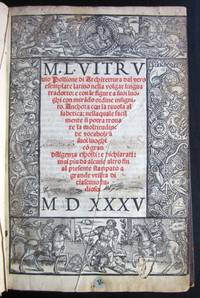
1535SAV123Venice: Nicolo de Aristotele detto Zoppino 1535. Hardcover. Very Good. Folio 295 x 190mm. 12 I-CX 110ff. Signatures: AA6-BB6; A8-N8; O6. Title printed in red and black with woodcut block border depicting strewn armor and dueling knights with wreathed portrait of Cicero at top and plaques with monogram initials of Roman Emperors Fabius Maximus Julius Caesar and Alexander Magnus. 136 woodcut in-text illustrations depicting lives of primitive humans the famous Vitruvian Man on p. XXII constellations rules for perspective and other mathematical figures and diagrams of architecture. Woodcut historiated chapter initials throughout of repeating portraits. Translated by Benedetto Giovio 1471-1545. Edited by Francesco Lutio Durantino. 19th-century calf with decorative stamps spine stamped in gilt TRAT DE ARCH endpapers renewed; loose in binding some margins trimmed close some light worming at least six early cancelled inscriptions on title leaf CX with significant excision otherwise an crisp and clean text block with wonderful woodcut impressions. 19th-century inscription on fly-leaf Famoza Archi-tectura. Another 19th-century inscription on front flyleaf Presented to the Mercantile Library Association of New York by Philip A Reach .Consul/ Lisbon Jan. 7 1848. Sold in 1958 on removal of Architecture Books from the Library pencil note. Rare illustrated Durantino edition of Vitruvius printed in Venice by Zoppino in 1535. This Vitruvius work was first printed in 1521 for Como. As it gained notoriety another edition in the vernacular Italian was prepared by Giovanni Antonio and Pietro de Nicolino da Sabbio in 1524. It incorporated woodcuts from a 1511 Latin edition produced by Giovanni Giocondo in Venice Tacuino. This Zoppino printing had a newly redesigned title-leaf with an elaborate woodcut border of chivalric battle scenes between Augustus Caesar Julius Caesar and Alexander the Great. The 136 in-text woodcuts are an all too interesting miscellany of late-medieval life nature and architecture and are characteristic of Vitruvian ideals in regards to proportion ornament language space place and beauty. The famous figure of Symmetria Vitruvian Man is present on p. XXII. Both the 1524 and 1535 editions were widely read by an Italian public. Vitruvian principles deeply influenced early Renaissance artists thinkers and architects who believed they were rediscovering an ancient discipline which would be the foundation of their culture. <br/><br/>Rare illustrated Durantino edition of Vitruvius printed in Venice by Zoppino in 1535. This Vitruvius work was first printed in 1521 for Como. As it gained notoriety another edition in the vernacular Italian was prepared by Giovanni Antonio and Pietro de Nicolino da Sabbio in 1524. It incorporated woodcuts from a 1511 Latin edition produced by Giovanni Giocondo in Venice Tacuino. This Zoppino printing had a newly redesigned title-leaf with an elaborate woodcut border of chivalric battle scenes between Augustus Caesar Julius Caesar and Alexander the Great. The 136 in-text woodcuts are an all too interesting miscellany of late-medieval life nature and architecture and are characteristic of Vitruvian ideals in regards to proportion ornament language space place and beauty. The famous figure of Symmetria Vitruvian Man is present on p. XXII. Both the 1524 and 1535 editions were widely read by an Italian public. Vitruvian principles deeply influenced early Renaissance artists thinkers and architects who believed they were rediscovering an ancient discipline which would be the foundation of their culture. Nicolo de Aristotele detto Zoppino hardcover books
1535SAV123Venice: Nicolo de Aristotele detto Zoppino 1535. Hardcover. Very Good. Folio 295 x 190mm. 12 I-CX 110ff. Signatures: AA6-BB6; A8-N8; O6. Title printed in red and black with woodcut block border depicting strewn armor and dueling knights with wreathed portrait of Cicero at top and plaques with monogram initials of Roman Emperors Fabius Maximus Julius Caesar and Alexander Magnus. 136 woodcut in-text illustrations depicting lives of primitive humans the famous Vitruvian Man on p. XXII constellations rules for perspective and other mathematical figures and diagrams of architecture. Woodcut historiated chapter initials throughout of repeating portraits. Translated by Benedetto Giovio 1471-1545. Edited by Francesco Lutio Durantino. 19th-century calf with decorative stamps spine stamped in gilt TRAT DE ARCH endpapers renewed; loose in binding some margins trimmed close some light worming at least six early cancelled inscriptions on title leaf CX with significant excision otherwise an crisp and clean text block with wonderful woodcut impressions. 19th-century inscription on fly-leaf Famoza Archi-tectura. Another 19th-century inscription on front flyleaf Presented to the Mercantile Library Association of New York by Philip A Reach .Consul/ Lisbon Jan. 7 1848. Sold in 1958 on removal of Architecture Books from the Library pencil note. Rare illustrated Durantino edition of Vitruvius printed in Venice by Zoppino in 1535. This Vitruvius work was first printed in 1521 for Como. As it gained notoriety another edition in the vernacular Italian was prepared by Giovanni Antonio and Pietro de Nicolino da Sabbio in 1524. It incorporated woodcuts from a 1511 Latin edition produced by Giovanni Giocondo in Venice Tacuino. This Zoppino printing had a newly redesigned title-leaf with an elaborate woodcut border of chivalric battle scenes between Augustus Caesar Julius Caesar and Alexander the Great. The 136 in-text woodcuts are an all too interesting miscellany of late-medieval life nature and architecture and are characteristic of Vitruvian ideals in regards to proportion ornament language space place and beauty. The famous figure of Symmetria Vitruvian Man is present on p. XXII. Both the 1524 and 1535 editions were widely read by an Italian public. Vitruvian principles deeply influenced early Renaissance artists thinkers and architects who believed they were rediscovering an ancient discipline which would be the foundation of their culture. <br/><br/>Rare illustrated Durantino edition of Vitruvius printed in Venice by Zoppino in 1535. This Vitruvius work was first printed in 1521 for Como. As it gained notoriety another edition in the vernacular Italian was prepared by Giovanni Antonio and Pietro de Nicolino da Sabbio in 1524. It incorporated woodcuts from a 1511 Latin edition produced by Giovanni Giocondo in Venice Tacuino. This Zoppino printing had a newly redesigned title-leaf with an elaborate woodcut border of chivalric battle scenes between Augustus Caesar Julius Caesar and Alexander the Great. The 136 in-text woodcuts are an all too interesting miscellany of late-medieval life nature and architecture and are characteristic of Vitruvian ideals in regards to proportion ornament language space place and beauty. The famous figure of Symmetria Vitruvian Man is present on p. XXII. Both the 1524 and 1535 editions were widely read by an Italian public. Vitruvian principles deeply influenced early Renaissance artists thinkers and architects who believed they were rediscovering an ancient discipline which would be the foundation of their culture. Nicolo de Aristotele detto Zoppino hardcover
19751038FBBruxelles., POUR ECRIRE LA LIBERTE., 1975. 37 x 30 x 8 cm. OPapp-Kassette., 1038F 900 boites contenant des oeuvres numerotees de 101 Kassette am Deckelrand zum Rücken berieben und etwas angeplatzt. 3 Namensetiketten haben sich gelöst und liegen lose bei. Die inliegenden Objekte sehr gut erhalten.
1930166218Berlin, Kiepenheuer, 1930. S. 123-151. OBr. Umschl. M. Randläsuren. Rücken m. kl. Fehlst. U. geklebt.
19741013FBMönchengladbach., Städtisches Museum Mönchengladbach., 1974. 21 x 17 cm. 12 S. Leporello, 4 S. OPapp-Kassette., 1013F Tadellos frisches Exemplar.
184441372Milsom Street Bath and 26 Haymarket London: Edmund Francis English Jr. and Thomas McLean. Lithographed and printed at 79 St. Martin's Lane and by Moyes and Barclay Castle Street Leicester Square London 1844. Folio. 24 1/4 x 16 1/2 inches. First Edition. 8 1-10. 18 pp. 12 leaves of plates. Title with hand-colored vignette mounted on card lithographed dedication to Princess Emilia of Baden and the Marchionesses Douglas and Clydesdale List of Subjects and List of Vignettes on Letterpress List of Subscribers "To the Reader" by English Lithograph letter from Beckford to English that is not mentioned in Abbey 6 tinted lithograph "Illustrations of Lansdown Tower Bath" with text on each room of the tower and Beckford's obituary and woodcut epitaph errata note 13 tinted and hand-colored lithograph plates mounted on 12 card leaves with pencilled titles underneath plates. Dark red straight-grained half morocco over publisher's brown moiré cloth title stamped and lettered in gilt on front and on spine with bookplate on pastedown<br/> <br/> Grand first edition folio volume of a fantastical folly with 13 hand-colored lithographs of Beckford's unimpeachable decor.<br/> <br/> Shortly after the eccentric novelist collector bibliophile and plantation-owner William Beckford died in May of 1844 the book Views of Lansdown Tower was published revealing Beckford's extraordinary retreat its luxurious interiors and the exquisite art collection he had assembled inside this fantastical architectural folly just outside Bath in Somerset England. Views was initiated by Willes Maddox under the patronage of Beckford who is found in the book's subscribers list. Beckford had moved to Bath from his estate Fonthill Abbey in Wiltshire in 1822 and remained there until his death. In 1826 Beckford employed a young architect named Henry Goodridge 1797-1864 to build the tower and its adjoining library about a mile away from Beckford's residence in Crescent. Beckford's Tower known initially as Lansdown Tower was built in Italianate neo-classical style on Lansdown Hill. The Tower and its attached railings are now designated as a Grade I listed historic building by the UK. It is the only standing example of Beckford's architecture. Though he did not live there Beckford used the tower as a showcase for his collection of art and fine books and its crowning cupola as a belvedere for taking in picturesque vistas of the surrounding landscape. The book reproduces drawings by Maddox in lithographs by C. J. Richardson. Maddox later gained a reputation for painting the portraits of eminent Turks and took up an invitation from the Sultan to work in Istanbul. Four of the book's 13 plates illustrate some of Beckford's objets d'art including ceramics ivories and metalware alongside his immaculate parlor furniture. The colored plates in order: I. Ornamental Title with View of Tower. II. Exterior of LansdownTower. III. The Vestibule. IV. The Scarlet Drawing Room. V. The Staircase. VI. View of the Belvedere. VII. Objects of Vertu No.1 in Mr. Beckford's Collection. VIII. The Sanctuary. IX. The Crimson Drawing Room. X. Black Cabinet in Crimson Drawing Room. XI. Objects of Vertu No.2 in Mr. Beckford's Collection. XII. The Library. XIII. Objects of Vertu No.3 in Mr. Beckford's Collection. XIV. Ornamental Furniture in Mr. Beckford's Collection. And the Vignettes in Letterpress: XV. Embattled Gateway in Garden. XVI. Italian Cottage. XVII. The Grotto. XVIII. View in Garden where the Sarcophagus stood before removed. XIX. The Tomb of Mr. Beckford. XX. The Tomb of Mr. Beckford's favourite Dog.<br/> <br/> Abbey Scenery 420. Bobins II 682. SP Lohia 626. Edmund Francis English Jr. and Thomas McLean. Lithographed and printed at 79 St. Martin's Lane, and by Moyes and Barclay, Castle unknown
064-Do.J. Schwarze Kreide, braun laviert, auf Bütten, rechts unten mit dem braunen Pinsel gemalte Signatur ?Schüz?, auf Sammlungsuntersatz des 18. Jahrhunderts montiert. 25,3:34,5 cm. Literatur: Ph. F. Gwinner, Kunst und Künstler in Frankfurt am Main... Frankfurt am Main, J. Baer, 1862, p. 313ff.
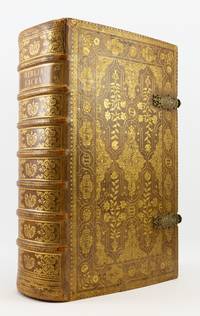
1768ST19422Nuremberg: Johann Andrea Endterischen 1768. 460 x 295 mm. 18 1/4 x 11 1/2". 17 p.l. 11 48 2 2 3-8 3 9-190 2 191-740 pp.; 512 pp.; 2 2 3-190 2 191-480 18 pp. Three parts bound in one volume. <br/> STRIKING CONTEMPORARY SMOOTH CALF LAVISHLY GILT in the entrelac style covers with frame and compartments formed by gilt-ruled strapwork and filled with floral designs and lace-like ornaments of massed volutes and small tools raised bands spine compartments with central bouquet of pomegranate and flowers with massed floral tools on either side gilt lettering brass clasps featuring images of King David and St. Paul gilt-tooled turn-ins marbled endpapers all edges gilt and gauffered with pomegranates and flowers older repair to front joint alongside top compartment. Extra engraved title page woodcut headpieces and historiated initials 47 engraved plates comprised of: copperplate portraits of Luther and 11 Electors; 11 section titles each with 11 vignettes; nine full-page engraved depictions of Moses the Prophets and the Evangelists; seven full-page plates engraved with 12 vignettes six double-page maps and two double-page engravings. Front pastedown with ornate heart-shaped bookplate of Adam Melchior Dæumer dated 1784. ◆Two-inch crack to head of rear joint a bit of rubbing to joints and extremities a handful of quite minor dark spots to boards isolated trivial smudges or stains internally other insignificant imperfections but still a fine specimen--THE CONTENTS EXCEPTIONALLY CLEAN BRIGHT AND FRESH and the remarkable binding entirely solid and bright with gilt.<br/> <br/> This is an especially pleasing copy of the last and most extensive edition of the very popular and sumptuously illustrated Weimar Electors' Bible offered here in an impressive contemporary binding. Known as the "Kurfürstenbibel" because of its portraits of the Electoral Princes called "Kurfürsten" in German it was originally prepared for Ernst I Duke of Saxe-Gotha and Altenburg as a celebration of Martin Luther's Bible translation. Editions were issued by the Endters one of the prominent German printing families beginning in 1641. In addition to portraits of Luther and the Protestant princes of Germany the present edition contains the maps views and illustrated half-titles by Jacob van Sandrart and others first used in the edition of 1686. Our copy contains four maps and views not found in other copies of this edition showing the eastern Mediterranean and Palestine as well as both a map and a view of Jerusalem. The size of our volume puts a great strain on the binding which has nevertheless stood the test of time remarkably well. The overall decoration is exuberant the delicate gauffering lovely and the original straps remarkably well preserved. Johann Andrea Endterischen unknown
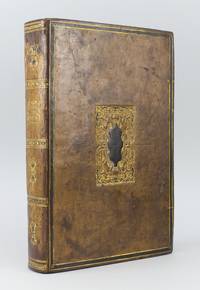
1552ST12878Parisiis: Apud Ioannem de Roigny 1552. 325 x 210 mm. 12 3/4 x 8 1/4". 1 p.l. title 776 pp. 20 leaves last blank. Collates as in Adams and Schweiger. <br/> Attractive contemporary calf over thick pasteboards covers with painted black and gilt rule frame center of both boards with large elaborate rectangular strapwork ornament in black and gilt flat spine divided into panels by gilt rules and cresting roll three spine panels with black and gilt ornament similar to those on the covers one panel with gilt titling inside an escutcheon all edges gilt the joints edges and portions of the spine at top and bottom very expertly renewed. Numerous fine "criblé" and other decorative initials and 145 WOODCUT SCENES measuring approximately 2 x 3" some of the cuts repeated. Front pastedown with "HB" book label of Heribert Boeder; title page with ink inscription of Johann Adolph Freitag dated 1653 and with library stamp of the College of Notre Dame Villefranche sur Saone. Adams E-1033; Dibdin II 470; Hoffman II 68-69; Mortimer 512; Schweiger II 1060. ◆Spine slightly faded and discolored in spots color of the cover leather a bit uneven two pages with ink stain touching but not obscuring a word of text isolated rust spots but a very pleasing copy the text unusually fresh clean and bright and the carefully restored binding completely solid and certainly pleasing.<br/> <br/> This is a large-format illustrated printing of the "Comedies" bound in a more restrained version of the painted entrelac bindings in vogue in 16th century a binding tall and dignified enough to suit its contents. Dibdin describes this as "a most excellent edition" that contains "almost all the valuable treatises upon the author up to the period of its publication" and notes that "it is of rare occurrence." There were two issues of this 1552 edition; our colophon dated to 17 Calendas Decembris Anno 1551 indicates that we have the first. Terence's six extant plays the ancestors of drawing room and modern situation comedies feature crusty fathers rebellious sons and impertinent slaves whose machinations solve the playwright's intricate complications of plot. The plays were popular throughout the Middle Ages and the Renaissance and still retain their appeal. The text of the plays in large and attractive italic type is surrounded here by the commentary in smaller italic of Donatus fourth century A.D. and others. Each scene is preceded by a woodcut depicting the actors on a curtained stage. While very simple in composition these are animated and frequently amusing. According to Mortimer our text and scholarly apparatus are mostly reprinted from Girolamo Scoto's Venice edition of 1545 and the scene cuts "are extremely close copies of the Italian blocks used by Scoto.". Apud Ioannem de Roigny unknown
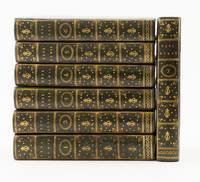
1775ST17825Paris: Joseph-Gérard Barbou rue Mathurins 1775. 163 x 96 mm. 6 3/8 x 3 3/4". Seven volumes. Edited by J. N. Lallemand; preface by Jean Baptiste Louis Crévier. <br/> EXTREMELY ATTRACTIVE CONTEMPORARY GREEN ARMORIAL MOROCCO perhaps by Derome covers with triple gilt rule border central gilt coat of arms of the Blanche family featuring a seated fox with one paw raised above it a row of three five-pointed stars smooth spine divided into compartments containing a gilt lyre surrounded by stars and dots floral sprigs at corners volume number within a laurel wreath gilt lettering marbled endpapers all edges gilt. With printer's two-swans device on title pages volume I with frontispiece portrait engraved by L. J. Cathelin after J. C. Philips. With pencilled note on front flyleaf attributing the binding to Derome. Brunet III 1108 "Edition estimée"; Dibdin II 171. For the binding: Olivier Pl. 2279. ◆Spines slightly and uniformly sunned very light shelf wear to bindings occasional faint foxing in volume IV but A SUPERB SET almost entirely absent of any signs of use.<br/> <br/> This is a fine-paper copy in a binding both charming and handsome of what Dibdin deems "a truly beautiful and accurate edition" of Livy's Roman history. Brunet called it an "esteemed edition" and notes that fine paper copies like the present set sold for twice what regular copies cost. First printed by Sweynheym and Pannartz in 1469 the "Histories" of Titius Livius Patavani 59 B.C. - 17 A.D. follow the rise of Rome from the founding of the city through its triumphs in the Punic Wars and up through the reign of the author's contemporary emperor Augustus. His account is notable for its emphasis on the glorious triumphs and accounts of heroism of the Romans stemming in his eyes from their virtue; his history is intended not just to inform but also to elevate the reader. The present edition according to Dibdin builds on the fine editions edited by Crevier and Drakenborch incorporating their useful notes and additions. It was beautifully printed by Joseph-Gérard Barbou 1723-90 scion of a family that had begun printing in Lyon in 1529 moving to Paris in 1540. Joseph apparently specialized in Latin classics producing editions of Cicero Lucretius Pliny Caesar and Martial among others. The fine binding here does not have Derome's ticket but is well executed enough to make the attribution written in at front plausible. There were no fewer than 18 members of the Derome family not to mention workshop associates who made their livings as binders in Paris from the middle of the 17th century until the first quarter of the 19th. Our binding is tasteful--perfect for a scholarly edition of a classic--and conceivably the work of one of the Deromes or of an extremely competent associate. Olivier attributes our armorial stamp to the 18th century Blanche family of Burgundy and he finds it on a copy of Barbou's 1771 Sallust in the library of Madame la Comtesse de Cossé. The "country house" condition of the present set suggests an aristocratic owner more concerned with owning fine books than with reading them. [Joseph-Gérard] Barbou, rue Mathurins unknown
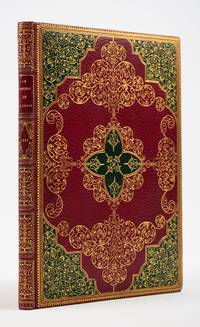
1651ST20278Paris: Chez F. Mazot 1651. 172 x 118 mm. 6 3/4 x 4 3/4". 3 34 leaves 35-39 1 pp. 2 leaves. <br/> LOVELY CRIMSON CRUSHED MOROCCO GILT AND ONLAID BY CAPÉ stamp-signed on front turn-in covers with onlaid green morocco cornerpieces and central quatrefoil all filled and surrounded by delicate pointillé tooling in floral and paisley designs raised bands spine compartments tooled in pointillé gilt lettering richly gilt turn-ins marbled endpapers all edges gilt. In a felt-lined morocco-lipped marbled paper slipcase. ENGRAVED THROUGHOUT WITH 38 FULL-PAGE ILLUSTRATIONS consisting of one portrait two allegorical religious scenes including title and 35 illustrations of the Holy Eucharist 40 pages of engraved text 37 of these with text flanked by full-length figures of saints accompanied by other religious symbols at head and foot of page two framed with vignettes of angels or the Madonna one page with text only. Front pastedown with "A W F" book label of bookseller Adrian Fluhmann. Duportal "Étude sur les livres à figures" pp. 244-45; Brunet V 624; Graesse VI 4; Leaves perhaps very lightly washed and pressed but an extremely fresh clean copy IN A SPARKLING BINDING.<br/> <br/> Covered by a luxurious binding by Capé this is a particularly attractive copy of a sumptuously illustrated prayer book composed entirely of engraved plates. According to Duportal it is "One of three important publications whose engravings reveal the trend characteristic of religious illustrations in France between 1601 and 1660." The work opens with a dedication to Charles d'Aubespine Marquis de Châteauneuf 1580-1653 with a full-page portrait by Guillame de Gheyn b. 1610. The bulk of the book is made up of two groups of plates. Those in the first group appearing primarily on the rectos contain prayers in Latin and French flanked by pairs of saints; gaps in the prayers are filled by naturalistic flowers insects and birds. Many of these plates also include a scene or two in miniature depicting the life of one or both of the saints or a vignette of angels. While just two of these engravings are signed "J. Collin" they all appear to be in the same hand which demonstrates an impressive level of finesse and delicacy depicting graceful figures with sure light lines. Duportal notes that this artist had a "talent charmant" and that well-executed dry-points of this type are quite rare in French books of the period. The second group of engravings appear strictly on the versos and depict the performance of a part of the Mass beneath a cloud in which appears a relevant scene from the life of Christ. They are all unsigned and clearly by a different hand with more rustic features--possibly "copies of originals published abroad" according to Duportal. The book concludes with two leaves of text framed by gamboling putti and the Virgin. Copies of this work can be found with varying numbers of leaves and engravings apparently the result of multiple reprintings with added material produced between 1651-53 but the present item can be distinguished as an early if not the very first edition as it does not contain "Privilege du Roy" dated 1652 or 1653. Furthermore our copy also contains the earliest state of the plates without the "I N R I" initials on the cross found on the title page and with the earlier state of the verso engravings before they were substantially reworked. Our edition seems to be quite rare with OCLC finding just one other copy with the same sequence of contents at the Bibliothèque Sainte-Genevieve. The stunning binding by Capé looks just as fresh and lustrous as the day it left its workshop. One of the most distinguished binders in France in the middle years of the 19th century Capé d. 1867 was especially well known for the delicacy of his work--which can be appreciated to full effect in the present example. He was the binder to the Empress Eugénie and Béraldi calls him "the Bozérian of the second Empire." This is precisely the kind of book our former owner the discriminating connoisseur-bookseller Fluhmann would have owned. Chez F. Mazot unknown
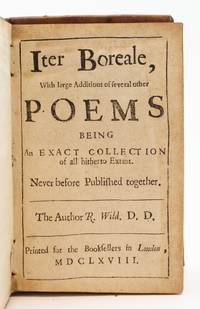
1668ST19030London: Printed for the Booksellers in London 1668. First Complete Edition Fourth Edition overall. 145 x 90 mm. 5 3/4 x 3 1/2". 1 p.l. blank 3-122 pp. 3 leaves table and final blank. <br/> Contemporary sheep covers ruled in blind smooth spine early paper label with gilt titling. Front blank with the ink ownership inscription of John Drinkwater; inside lower board with the book label of Michael Curtis Phillips. Hayward "English Poetry" 121 this copy; Grolier Club "Wither to Prior" 976; Wing W2136; ESTC R7135. ◆Covers with light scuffing bottom leather thong of two broken but the text block quite secure at the top pastedowns lifted but the insubstantial binding still in remarkably good original condition; internally A VERY FINE COPY especially clean fresh and bright.<br/> <br/> From the library of Richard Jennings noted for the outstanding condition of his books this is an especially fresh and extraordinarily well-preserved copy of poems by a Puritan divine known for his surprisingly biting wit. Dryden dubbed Robert Wild 1609-79 "the Wither of the City" after hearing the Financial District's workers' enthusiastic reception of the title poem here which celebrates General Monck's successful campaign to restore Charles II to the throne: "I have seen them reading it in the midst of 'Change so vehemently that they lost their bargains by their candles' ends." Our collection contains several of Wild's most notable works including "The Recantation of a Penitent Proteus" satirizing Puritan clergy who had conformed to the Anglican Church; "The Loyal Nonconformist" professing his loyalty to the monarchy but maintaining his Puritan religious views; and "The Fair Quarrel" an attack on the 1665 Five Mile Act designed to drive nonconformist ministers out of their parishes. Wild was something of a paradox: he could preach a hellfire Puritan sermon but also write verse sufficiently scandalous to be mistakenly attributed to the notorious libertine John Wilmot Earl of Rochester. Our volume was loaned by Richard Jennings for the celebrated 1947 London Exhibition of First and Early Editions of English Poetry catalogued by John Hayward. It would not be reasonable to expect to find a finer unrestored contemporaneous copy of this imprint. Printed for the Booksellers in London unknown
EN-073o.J. Radierung, 1918, auf cremefarbenem Japan, mit Bleistift betitelt, datiert und signiert. 29,8:19,8 cm.- Blatt 13 aus der Mappe ?Gesichter?. München, Verlag der Marées Gesellschaft R. Piper, 1919.- Vorzüglicher Abdruck mit vollem Rand und dem Blindstempel der Marées Gesellschaft. Eins von 40 Exx. auf Japan, vor Verstählung der Platte.- Literatur: Hofmaier 133 B a mit dem Blindstempel der Marées Gesellslchaft. 1 von 40 Exx. auf Japan, vor der Verstählung der Platte; Beckmann Liste 177; Glaser 114; Gallwitz 104.- Vorzüglicher Abdruck mit vollem Rand.
EN-072o.J. Radierung, 1916, auf cremefarbenem Japan, mit Bleistift betitelt, datiert und signiert. 23:29,2 cm.- Blatt 8 aus der Mappe ?Gesichter?. München, Verlag der Marées Gesellschaft R. Piper, 1919.- Vorzüglicher Abdruck mit dem Blindstempel der Marées Gesellschaft. Eins von 40 Exx. auf Japan, vor der Verstählung der Platte, oben und unten mit vollem Rand, die Seitenränder gering beschnitten.- Literatur: Hofmaier 88 B a; Beckmann Liste 79; Glaser 81; Gallwitz 65.
273-Eo.J. Feder in Grau und Braun, braun laviert, über Bleistift, auf cremefarbenem Velin. 29,7:41,7 cm. Wahrscheinlich gehört diese Zeichnung zur ?Voyage pittoresque de Basle à Bienne par les Vallons de Mottiers-Grandval? im Rahmen der Birstal-Reisebeschreibungen, ab 1802 im Eigenverlag erschienen, die im Katalog zur Baseler Ausstellung 1998 in mehrere Kategorien eingeteilt wird. Unsere Zeichnung gehört zur Kategorie 5: Darstellung kleiner und kleinster Landschaftsausschnitte mit kleinen Wasserfällen, Felsblöcken, Einzelbäumen, Baumgruppen, Kräutern, Astwerk, Wurzeln. ?Der Maler wirft seinen Blick nicht von oben auf die darzustellenden Gegenstände, er betrachtet sie von der Seite oder von unten her. Sehr häufig setzt er sich direkt ans Flussbett. Diese Tafeln sind eine der Besonderheiten der Birmann?schen Voyage Pittoresque. Ihre Motive sind fast ausnahmslos nur von Birmann, vor oder nach ihm von keinem andern Maler, dargestellt worden. Dadurch erhält das Werk einen unverwechselbaren Charakter? (zitiert aus: Ausst. Katalog: Peter und Samuel Birmann. Künstler, Sammler, Händler, Stifter, Basel 1998, S. 49).
205-Do.J. Pinsel in Braun, braun laviert, über Bleistift, auf Bütten. 28,3:40 cm. - Mit einem Braunfleck im Bereich des oberen Brunnenrandes. Provenienz: Sammlung SRH im Dreieck mit einer Schale (Wiener Sammlung), nicht bei Lugt; Sammlung Anton Schmid, Wien, nicht bei Lugt; Sammlung Helmut Märkt, Reutlingen; Galerie Sabrina Förster, Düsseldorf, Herbstkatalog 2006/2007, Nr. 33 mit Abb. Gutachten: Dr. George Knox, Vancouver (29.06.2006).
004-Io.J. Aquarell und Pinsel in Grau, über leichter Bleistiftskizze, auf Bütten, auf grauen Büttenkarton aufgezogen, dort verso signiert und nummeriert ?Frommel 3? sowie mit Bezeichnungen von Vorbesitzern. 31,7:24,5 cm. Provenienz: 1. Sammlung E. Fuhrer, Essen, nicht bei Lugt; 2. Galerie Joseph Fach, Frankfurt a.M., Kat. 57, Nr. 70; 3. Sammlung Helmut Märkt, Reutlingen, nicht bei Lugt.
EN-021o.J. Umdruck-Lithographie, 1912, rechts unten mit Bleistift signiert, auf Bütten mit Wasserzeichen: ICA France. Darstellungsgröße 17,1:26,6 cm, Blattgröße 32,1:48 cm. Eins von nur 12 Exemplaren! Literatur: Dückers E 4. - Grosz hat das vorliegende Blatt wohl später signiert. Rückseitig mit dem Nachlassstempel und der Nummerierung "7 202 10". - Prachtvoller, lebendiger Druck mit breitem Rand, unten mit dem Schöpfrand. Extrem selten!
FH-266o.J. 6 handkolorierte Holzschnitte, auf China, mit Bleistift signiert und nummeriert. Wei-mar, Reiher-Verlag, 1922. Orig.-Halbpergament-Mappe von Otto Dorfner, mit Rückenvergol-dung und vergoldeter Prägung eines Wiedehopfs auf Vorderdeckel. Format 41,3:32 cm. - Eins der Passepartouts beschnitten, Mappe leicht berieben.- Nr. 1 von 100 Exx. als Mappe herausgegeben; Gesamtauflage der Holzschnitte 200 Exx. - Die Holzschnitte wurden in der Reiher-Presse zu Weimar unter Aufsicht des Künstlers gedruckt, handkoloriert und jeder ein-zelne von diesem handsigniert. Provenienz: Sammlung Heinrich Stinnes, Köln, Lugt Suppl. 1376a. Mit handschriftlichem Besitzvermerk auf dem vorderen Innendeckel, erworben 1923 (Kaufpreis 15.000.--). [6 Warenabbildungen]
FH-460o.J. Farbholzschnitt, 1903, auf feinem Japan, mit Bleistift signiert. Darstellungsgröße 28,5:26 cm, Blattgröße 55,8:45 cm. - Im sehr breiten Rand rechts unten etwas knitterfaltig. Literatur: H.H. Hofstätter, Jugendstil. Druckkunst. Baden-Baden, 1968, Farbtaf. S. 241; H. Junge, Wohlfeile Kunst. Mainz, 1989; H. von der Grinten (Hrsg.), Die Frühzeit des modernen Holzschnitts. Museum Schloss Moyland, 1993; Ausst. Katalog: Art for All. Der Farbholzschnitt in Wien um 1900. Frankfurt/Main, 2016, Farbabb. S. 128/129; Ausst. Katalog: Daniel Studer, Faszination Farbholzschnitt. St. Gallen/Reutlingen, 2016/17, Farbabb. S. 232; Ausst. Katalog: Crossing Cultures. Der Farbholzschnitt in Europa und Japan 1900-1950. Kaufbeuren, 2017/18, Farbabb. S. 41, Nr. 36. Inkunabel der Jugendstilgraphik!
206-Do.J. Feder in Braun, braun laviert, über Bleistift, mit brauner Feder umrandet, links signiert und datiert ?CLabruzzi 1796?. 22,8:18,7 cm. Auf alten Sammlungsuntersatz mit grün laviertem Rand aufgezogen. Vergleichsliteratur: Ausst. Katalog: Carlo Labruzzi. The Grand Tour. Cur. by Sir Timothy Clifford. Simon C. Dickinson Ltd., London, 12 Juni - 13 July, 2012, Nr. 38, Venustempel in Bajae (Vergleich zur Signatur); Auktion Pandolfini Casa d?Aste, Florenz, 15.12.2014, Stampe e Disegni dal XVI al XX secolo,? Nr. 56 Figure di Carlo Labruzzi. Aquatinta, 1788; Auktion Koller, Zürich, 18.09.2015, Zeichnungen des 15.-20. Jahrhunderts, Nr. 3418 Zwei Mönche im Gespräch. Zeichnung.
EN-046o.J. Holzschnitt, 1919, auf dünnem Bütten, mit Bleistift signiert, nummeriert und bezeichnet ?VIII Hertwig gewidmet?. Darstellungsgröße 30,5:26,2 cm, Blattgröße 60:45,2 cm. - Mit schwachem Lichtrand rundum, winziger Abriss an der linken oberen Ecke. Eins von 31 Exx. Mit eigenhändiger Widmung ?Frau Margarete Dexel - Ein Haus das mir lebendig wurde / Johannes Molzahn / 10. Februar 2.? Die Widmung bezieht sich auf den Graphikdesigner Max Hertwig (1881-1975), dessen Werbemittel-Entwürfe für die berühmten Fagus Werke Molzahn später überarbeitete und ergänzte. Bei der Widmungsempfängerin handelt es sich um Walter Dexels (1890-1973) Ehefrau Grete, die er 1914 geheiratet hatte. Walter Dexel wurde 1928 Molzahns Nachfolger als Dozent an der Kunstgewerbe- und Handwerksschule Magdeburg. Provenienz: Privatsammlung Braunschweig; Privatsammlung Hamburg. Literatur: Salzmann 8 g.
FH-168o.J. Farb-Lithoholzschnitt, 1902, auf Japan-Bütten, mit Bleistift signiert, datiert, betitelt und als ?Litoholzschnitt? (sic!) bezeichnet. Darstellungsgröße 35:28 cm, Blattgröße 36,3:29,3 cm. - Verso am Oberrand Reste einer alten Montierung, mit einem kleinen Braunfleck im weißen Rand rechts unten, sonst tadellos. Sehr selten! [2 Warenabbildungen]
EN-052o.J. Kaltnadelradierung, 1925, auf cremefarbenem Japan, mit Bleistift signiert und nummeriert. Darstellungsgröße 27,8:23,4 cm, Blattgröße 43,6:31 cm. Nr. 24 von 50 Exx. auf Japan. Erschienen im Verlag Bukum AG, Wien. Ferner gibt es noch 10 Vorzugsexemplare. Vorzüglicher Abdruck mit zartem Plattenton und dem vollen Rand, rechts und unten mit dem Schöpfrand. Literatur: Stix/Osborn R 45; Papst 50. Die Radierung steht im Zusammenhang mit dem Gemälde ?Tilla Durieux?, das die Schauspielerin und Frau des Kunsthändlers Paul Cassirer in vergleichbarer Pose zeigt. Das Gemälde entstand bereits 1913.