(BINDINGS - 18TH CENTURY MOROCCO). (BASKERVILLE IMPRINT). CATULLUS TIBULLUS [and] PROPERTIUSBiblio.com
48 779 résultats
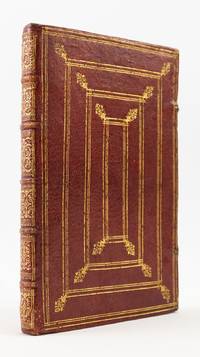
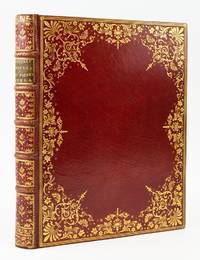
1772ST18628bBirminghamiae: Typis Joannis Baskerville 1772. First Baskerville Edition. 310 x 260 mm. 11 7/8 x 9 3/4". 1 p.l. 200 221-372 pp. but complete. <br/> SUPERB CONTEMPORARY RED MOROCCO LAVISHLY GILT IN THE STYLE OF DEROME covers with wide dentelle frame composed of botanical elements and many small tools raised bands spines gilt in compartments with central floral sprig surrounded by acorns flowers stars and dots volute cornerpieces green morocco labels gilt turn-ins marbled endpapers all edges gilt. Front pastedowns with engraved bookplate of P. Dupont and with morocco heraldic book label. Gaskell 44. ◆A breath of rubbing to extremities title page a little browned final page a bit foxed other trivial imperfections but AN EXCEPTIONALLY FINE COPY internally clean smooth and bright and in a sparkling binding.<br/> <br/> This is the impressive quarto edition of a trio of great Roman love poets in a premier binding befitting the elegant printing. In a sheet dated 1760 which Baskerville issued appended to a specimen of his folio Bible the printer discusses his proposed "Baskerville Classics": "Many gentlemen" he says "have wished to see a sett of the Classicks . . . in the Manner Letter and Paper of the 'Virgil' already published" and he vows to print the same with the poetical classics first. The present items are from what turned out to be seven Baskerville quarto printings of the classics mostly done late in the printer's career but according to Reed bearing "the marks of unabated genius." These volumes says Reed would "suffice had Baskerville printed nothing else to distinguish him as the first typographer of his time." In the present works the stately typography the luxurious paper textured but feeling rather like vellum and the spacious design combine to give the reader a particularly gratifying feeling of strength and serenity. The extraordinarily smooth surface of our leaves provides a tactile experience not available from any other 18th century printer Bodoni included. The beautiful binding here is unsigned but is clearly the product of a first-rate workshop; while it is not uncommon to see a volume from the Baskerville quartos in a decorative contemporary binding the present one would have a place in the front row of any assemblage. Typis Joannis Baskerville unknown
1651ST19567-214Paris: Chez F. Mazot 1651. 172 x 110 mm. 6 3/4 x 4 1/4". 3 34 leaves 35-39 1 pp. 12 leaves. <br/> Fine old contemporary red morocco covers panelled with gilt fillets with flowering urn cornerpieces raised bands the spine densely gilt in compartments with scrolls and dots two clasps marbled endpapers all edges gilt. ENGRAVED THROUGHOUT WITH 38 FULL-PAGE ILLUSTRATIONS consisting of one portrait two allegorical religious scenes including title and 35 illustrations of the Holy Eucharist plus 44 PAGES OF ENGRAVED TEXT 37 of these with text flanked by full-length figures of saints accompanied by other religious symbols at head and foot of page six framed with vignettes of angels the Madonna or scenes from the life of David one page with text only. Contemporary ink inscription to the lower margin of the title page reading "In Archui. vitr." Endleaf with engraved armorial bookplate of Viscount Strathallan; front pastedown with the bookplate of John Evelyn. Duportal pp. 244-45; Brunet V 624; Graesse VI 4. Trivial rubbing to the extremities leather straps slightly worn but holding strong but A SUPERB COPY exceptionally clean fresh and bright internally and in its solid and unsophisticated and still very pleasing binding.<br/> <br/> This is a particularly attractive copy of a sumptuously illustrated prayer book in its especially appealing original 17th century binding. According to Duportal it is "One of three important publications whose engravings reveal the trend characteristic of religious illustrations in France between 1601 and 1660." The work opens with a dedication to Charles d'Aubespine Marquis de Châteauneuf 1580-1653 with a full-page portrait by Guillame de Gheyn b. 1610. Then the bulk of the book is made up of two groups of plates. Those in the first group appear primarily on the rectos and contain prayers in Latin and French flanked by pairs of saints; gaps in the prayers are filled by naturalistic flowers insects and birds. Many of these plates also include a scene or two in miniature depicting the life of the saints or a vignette of angels. Just two of these engravings are signed "J. Collin" but they all appear to be in the same hand and demonstrate an impressive level of finesse and delicacy with emotive graceful saints depicted with sure light lines. Duportal notes that our artist had a "talent charmant" and that well-executed dry-points of this type are quite rare in French books of the period. The second group of engravings appear on the versos and depict the performance of a part of the Mass beneath a cloud in which appears a relevant scene from the life of Christ. They are all unsigned and clearly by a different hand with more rustic features--possibly "copies of originals published abroad" according to Duportal. The book concludes with text framed by gamboling putti and scenes from the life of Christ and facing full-page bust portraits followed by the Penitential Psalms each with elaborate illustrated frames depicting scenes from the life of David. Copies of this work can be found with varying numbers of leaves and engravings but the present item seems to be an early edition as it contains the earlier state of the engravings on the versos before they were substantially reworked and it does not contain the "Privilege du Roy" with the date 1652 or 1653. Our copy comes from the books assembled by the famous diarist John Evelyn 1620-1706 a library that Quaritch's dictionary of English book collectors calls "a noble collection." De Ricci says that the finest books from the library bear Evelyn's monogram as ours does and this bookplate brings with it the expectation of remarkably fine contemporary condition. This copy also has the bookplate of Viscount Strathallan possibly William Drummond 1810-86 Conservative MP and the second to hold the family title following the reversal of the attainder put in place after his family's participation in the Jacobite uprising. Chez F. Mazot unknown
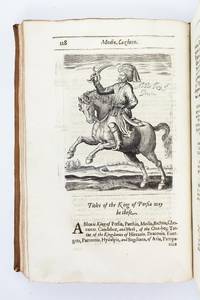
1634ST20186London: printed by William Stansby and Jacob Bloome 1634. FIRST EDITION. 290 x 195 mm. 11 1/2 x 7 3/4". 6 p.l. 225 15 pp. <br/> Contemporary sprinkled calf raised bands traces of old paper label to spine pastedowns lifted to reveal leather bands and manuscript document fragments used as sewing guards all edges sprinkled red expert repair to rear joint. With additional engraved title page featuring two figures of Persian dignitaries and three small travel vignettes signed at foot by William Marshall and 36 engravings in the text the majority vignettes but one full-page and nine more than half a page tall. Front endpaper with ink armorial stamp of Sir Walter John Trevelyan 8th Baronet of Nettlecombe and High Sheriff of Cornwall. Price inked in a contemporary hand to the front endpaper. Sabin 31471; STC 13190.3; ESTC S92948. Front board a bit splayed covers with three old dampstains and a few scars and tiny wormholes but a very pleasing original binding with almost no wear to the joints. A very few marginal smudges made during printing other quite trivial imperfections but AN ESPECIALLY FRESH BRIGHT AND CLEAN COPY INTERNALLY with rich impressions of the engravings.<br/> <br/> This is a contemporary copy in remarkably fresh internal condition of an important and entertaining account of the travels of a 17th century Englishman in exotic Asian and African territories particularly Persia. It is significant both for the ways it is accurate and for the ways it is fictitious. Sir Thomas Herbert 1606-82 left for Persia on a diplomatic mission to Shah Abbas in 1626 as part of the entourage of Sir Dodmore Cotton. The mission was not successful: Cotton and the mission's other leader Sir Robert Shirley both died in 1628 leaving their retinue at loose ends with the increasingly unimpressed Shah. Herbert made a slow return to England traveling through a large portion of Asia and Africa and even sailing up the coast of North America. He finally returned to England in 1630; four years later he published this account of his adventures. The text describes meetings with people of many cultures as well as encounters with exotic animals including the dodo flamingoes and flying fish. Herbert's accounts are of great importance for their details of early Asian travel by Westerners. At the same time the author was unable to resist the urge to embellish a good story and according to DNB gave implicitly first-person accounts of places he had not in fact visited. One such detour into the fanciful comes in the chapter involving the author's apparent visit to America. In it Herbert discusses the belief that the mythical Welsh king Madoc ap Owen-Gwyned had settled in North America in the 9th century for which he provides linguistic evidence that Sabin calls "entirely fanciful." DNB tells us that "this segment was apparently included to please the earl of Pembroke's own Welsh nationalist fancies. It also continued to help fuel various theories about Madoc's colonies and Welsh Indians in North America until the early years of the nineteenth century." Herbert's tale is profusely illustrated by William Marshall fl. 1617-49 with engravings that are sometimes more imaginative than accurate see for example the depiction of the shark on page 6 or the penguin on page 13. Despite these rather amusing inaccuracies the illustrations are lively and detailed providing a sense of the awe the early readers must have felt when imagining foreign places. Our copy in a period binding with part of a manuscript ledger used in the binding process visible is from the library of Walter John 1866-1933 8th baronet Trevelyan who as his inkstamp suggests served as High Sheriff of Cornwall from 1906-07. printed by William Stansby, and Jacob Bloome unknown
0757-Co.J. Kaltnadelradierung, signiert und nummeriert. 39,7:27,2 cm. Nicht bei Montesquiou.- Nr. 7 von nur 10 Exx. Prachtvoller Abdruck mit etwas Plattenton auf Velin. Die breiten Ränder gebräunt, leicht stockfleckig.
014-Io.J. Aquarell, über Bleistift, teils mit Deckweiß gehöht, auf Velin, rechts unten signiert, datiert und bezeichnet ?C. Werner f. 1838. Roma?. 19,2:27,5 cm. Verso Reste einer alten Montierung und mit einer genauen topographischen Bestimmung versehen. An der rechten unteren Ecke kleine Fehlstelle, sonst sehr gut erhalten und farbfrisch.
1966252FBAntwerpen., Wide White Space., 1966. 7,0 x 11,3 x 4,7 cm., 252F Edition of 50 copies. Dosendeckel mit drei Sprung-Kratzern ohne direkten Schaden, sonst sehr gutes Exemplar.
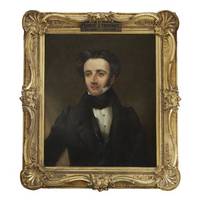
1837690621837. 29 inches x 24 1/4 inches. 29 inches x 24 1/4 inches. An Important Nineteenth-Century Pennsylvania Jurist American School 19th Century. Troubat Francis Joseph 1802-1868. Portrait of Francis Joseph Troubat. Philadelphia c.1837. 29" x 24-1/4" image size. Oil on canvas in ornate nineteenth-century gilded wood frame small plaque reading "Francis J. Troubat/ Born 1802-Died 1868" to head of frame. Some minor nicks and chips to frame gilding slightly dulled otherwise fine. $5000. A prolific writer of legal texts Troubat is best known as the co-author with William W. Haly of The Practice in Civil Actions and Proceedings in the Supreme Court of Pennsylvania in the District Court and Court of Common Pleas for the City and County of Philadelphia and in the Courts of the United States 1837. This portrait belonged to the Philadelphia Bar Association. Founded in 1802 it is the oldest association of lawyers in the United States. Its library where this portrait was last displayed was renamed the Theodore F. Jenkins Memorial Law Library in 1967. unknown books
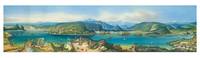
185042495Italy 1850. Gouache over faint etched line black gouache border. Period gilt and faux bois frame. A splendid panoramic view of Lake Como.<br/> <br/> Catering to the foreigners flocking to the region on The Grand Tour this hand-painted print beautifully depicts the famed picturesque lake with rich bands of blue highlighting the water and sky with the surrounding hills and mountains dotted with luxurious villas. The view looks north up the lake towards Switzerland from above Bellagio which occupies the point at which the lake divides in two. unknown
185042496Italy 1850. Watercolour over faint etched line black gouache border. Period gilt and faux bois frames. A splendid panoramic view of Lake Maggiore.<br/> <br/> Catering to the foreigners flocking to the region on The Grand Tour this hand-painted print beautifully depicts the famed picturesque lake with rich bands of blue highlighting the water and sky with the surrounding hills and mountains dotted with luxurious villas. In this view of Lake Maggiore we see from a very high vantage point the Borromean Islands: Isola Bella Isola Madre and Isola dei Pescatori with their extraordinary gardens. unknown
291-Eo.J. Gouache, mit schwarzer Tuschlinie umrandet und mit grünlich gouachiertem Rand, auf dünnem Karton, verso bezeichnet ?Glacier du Rosenlaui vue en passant le Scheidegg. Chez J. Louis Bleuler au château de Laufen près Schaffhouse Suisse?. Darstellungsgröße 33:48 cm, Blattgröße 43,7:57,5 cm. Im gouachierten Rand rechts und unten leicht berieben, sonst tadellos.
601-Eo.J. Aquarell teils mit Gummi arabicum laviert, auf cremefarbenem Velin, in einen Papierausschnitt montiert und mit zwei Linien in brauner Feder umrandet, dort links unten signiert ?L. Cassas.? Sowie betitelt ?Via mala, en regardant le Splugen?. 18,8:13,4 cm. Wunderbar farbfrisches, sehr detailliert durchgeführtes Aquarell.
309-Eo.J. Aquarell über Bleistift, mit Deckweiß gehöht, auf Zeichenkarton. 22,9:23,6 cm. - Verso an den Ecken Reste einer alten Verklebung. Literatur: Jakob Fürchtegott Dielmann. Gründer der Kronberger Malerkolonie. Hrsg. von der Museumsgesellschaft Kronberg im Taunus, Frankfurt am Main 1985, Farbabb. S. 84; vgl. auch die Vorzeichnung vom 24. August 1840, abgebildet in: op. cit., S. 58. Bildmäßig ausgeführte Aquarelle mit Architekturmotiven, wie das vorliegende, sind im zeichnerischen Werk Dielmanns nicht häufig anzutreffen.
0948-Co.J. Radierung, 1897, auf chamoisfarbenem Japan, mit Bleistift signiert und bezeichnet ?Hans am Ende Worpswede?. Plattengröße 29,8:21,7 cm, Blattgröße 41,9:31,2 cm. Mit Signatur des Druckers Otto Felsing. Vorzüglicher, vollrandiger Abdruck!
FH-343o.J. Folge von 6 (von 9 Blatt) Farbholzschnitten, auf Japan, mit Bleistift signiert und bezeichnet. Darstellungsgrößen 16,2:19,6 bis 29:34,5 cm. Werknummern: 237, 239, 240, 241, 242 und 243.
FH-388o.J. Farbholzschnitt von mehreren Stöcken, 1912, auf braunem Papier. 12:18,1 cm, auf die Umfassungslinie geschnitten, unten und rechts mit Rändchen. Werknummer 86. - Von größter Seltenheit!
0811-Co.J. Farblithographie 1896, von 4 Platten, auf aufgewalztem China, signiert. 14,8:27,9 cm. Prachtvoller, fein zeichnender Abdruck, mit 3-4 cm breitem Rand ringsum. Literatur: Vogel 62, II.
EN-145o.J. Lithographie, 1922, auf chamoisfarbenem Bütten, mit Bleistift nummeriert ?40/40? und signiert ?Grosz?. Darstellungsgröße 33,3:37,5 cm, Blattgröße 50:65,5 cm. Kleiner hinterlegter Einriss im rechten Blattrand, ansonsten sehr schönes Exemplar. - Literatur: Dückers E 79. ? Nach Dückers vermutlich im Selbstverlag, in einer Gesamtauflage von mindestens 53 Exemplaren, erschienen. Die Darstellung ist unter dem genannten Titel abgebildet in ?Ecce Homo?, 1923, Taf. 67, und wird dort ebenfalls auf 1922 datiert. [2 Warenabbildungen]
EN-033o.J. Lithographie, 1925, auf Kupferdruckpapier, mit Bleistift nummeriert und signiert. Darstellungsgröße 39:18 cm, Blattgröße 57,5:42,5 cm. Nr. 5 von 5 Exx. - In jeder Hinsicht einwandfreies Exemplar! Literatur: Riester 93, Abb. S. 42.
728-Eo.J. Feder und Pinsel in Braun, über Bleistift, auf braunem Papier, mit Goldlitze eingefasst, rechts unten datiert ?1856? (durch eine geglättete Knickfalte in der rechten unteren Ecke ist die ?5? im Datum nicht mehr voll sichtbar, doch als solche zu erkennen). 33:44,4 cm. Vergleichsliteratur: Ausst. Katalog: Carl Friedrich Lessing 1808-1880. Handzeichnungen aus dem Cincinnati Art Museum, Ohio/USA. Karlsruhe 1980, Nr. 11-13 mit Abb.
FH-159o.J. Farbholzschnitt, wohl 1904, auf Japan, mit Bleistift signiert und bezeichnet. Darstellungsgröße 15,8:21,5 cm, Blattgröße 26,5:32,7 cm. - Mit Quetschfalten vom Druck im unteren Rand.- Literatur: Ausst. Katalog: Daniel Studer, Faszination Farbholzschnitt. St. Gallen, 2014, Abb. S. 41. Hier heißt es zu diesem Blatt: ?Als Vorbild zu diesem Farbholzschnitt dürfte Liner das 1890 entstandene Gemälde ?Frau mit Geisen in den Dünen? von Max Liebermann gedient haben, das 1891 auf der Münchner Jahresausstellung im Glaspalast vom Künstler erworben wurde und seither in der Neuen Pinakothek gezeigt wird. Wie Liebermanns Gemälde wirkt auch Liners Farbholzschnitt wie eine Momentaufnahme und gibt einen guten Eindruck vom Appenzeller Alltagsleben, das zu Beginn des 20. Jahrhunderts noch von harter Arbeit, Einsamkeit und Entbehrung geprägt war.? [2 Warenabbildungen]
EN-085o.J. Schwarze Kreide, auf cremefarbenem Velin, rechts unten signiert C Mense, verso bezeichnet Original-Kreidezeichnung von Carlo Mense. 21:16,5 cm.- Am oberen Rand zwei braune Tesafilmspuren.
EN-095o.J. Kaltnadelradierung, 1917, auf chamoisfarbenem Kupferdruckpapier, signiert und nummeriert. Darstellungsgröße 33,3:26,5 cm, Blattgröße 54,9:48,2 cm. Nr. 1 von 25 Exemplaren. Provenienz: Galerie Michael Pabst, München. Literatur: Stix 40 erwähnt 36 Exemplare auf Bütten; Pabst R 39; Ausstellungskatalog Stiftung Langmatt Sidney und Jenny Brown, Baden, Kat.-Nr. 44, Abb. S, 91. ? Vorzüglicher Abdruck, im rechten Rand 4 kleine restaurierte Einrisse. ? Das Porträt steht in Zusammenhang mit dem Gemälde gleichen Themas von 1917 und ist abgebildet in: Ausstellungskatalog Stiftung Langmatt Sidney und Jenny Brown, Baden, Kat.-Nr. 13, Abb. S.121.
151-Io.J. Bleistift, auf Velin, rechts unten bezeichnet und datiert ?Tivoli d 24 August 1840?. 22,3:46,3 cm. Detailreich ausgeführte Zeichnung, die mit großer Sorgfalt die Ansammlung der Türme und Häuser der alten Stadt schildert, wie auch die davor liegende Landschaft aus Felsen, Grotten, Bäumen und Büschen.- Die verwandtschaftliche Beziehung seiner Frau zu Tivoli ist wohl der Grund für die zahlreichen Gemälde, Studien und Zeichnungen, die von Rohden von Tivoli und seinen Umgebungen angefertigt hat. Ruth Irmgard Pinnau erwähnt in ihrer Dissertation ?Johann Martin von Rohden. 1778 ? 1868 Leben und Werk. Bielefeld, 1965? auf S. 78, Kap. 3 ?Aus den letzten Schaffensjahren Rohdens besitzen wir noch 6 datierte Zeichnungen und eine Ölstudie mit Motiven aus Rom und seiner Umgebung. Ebenso wie bei den in den ersten beiden Schaffensperioden entstandenen Zeichnungen fällt es auch bei diesen Blättern schwer, einen Zusammenhang zwischen der in den Landschaftsgemälden erkennbaren Entwicklung, die in den Jahren zwischen 1828 und 1839 ihren Höhepunkt findet, und Rohdens Zeichenkunst herzustellen.? Unter diesen 6 Zeichnungen datierten Zeichnungen befindet sich ein als Z 188 aufgeführtes Blatt ?Villa d?Este (Tivoli)?, die nur 3 Tage nach unserer Zeichnung entstanden ist, am 27. August 1840.
289-Eo.J. Aquarell, auf festem bräunlichem Zeichenpapier, links unten bezeichnet ?Untere Erzgraben... Ettal?, rechts unten signiert und datiert ?Leop Rottmann 1852?. 29,9:50,3 cm. - Zwei Einrisse im linken Teil der Darstellung sind sauber restauriert und von vorne nicht sichtbar, kleine Restaurierung in der linken unteren Ecke. Farbfrisches Aquarell und typische Arbeit Leopold Rottmanns. Der in der Bezeichnung erwähnte ?Erzgraben? ist ein Nebenfluß des Alpbachs.
272-Eo.J. Bleistift, auf bräunlichem Velin, verso ältere Zuschreibung an Franz Horny sowie Inventarnummer ?Inv 452? 14,5:23,2 cm. - Verso: Fragment einer männlichen Porträtskizze, möglicherweise ein Selbstbildnis. Bleistift. Provenienz: vermutl. Sammlung Hans Geller, Dresden, wegen der Inventarnummer verso. Vergleichsliteratur zur Porträtskizze verso: H. Geller, Ernste Künstler fröhliche Menschen. München, 1947, Abb. 8: Porträt A. Zimmermann von J. Führich.