48 779 résultats
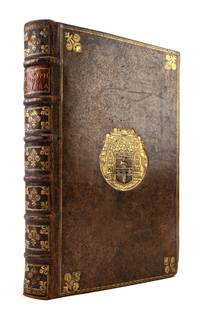
1581ST20964Geneva: Excudebat Henrius Stephanus 1581. Second Estienne Edition. 320 x 212 mm. 12 1/2 x 8 1/2". 6 p.l. 584 76 pp.Edited and with annotations by Henri Estienne. <br/> FINE 17TH CENTURY SPRINKLED CALF PRIZE BINDING covers gilt with French fillet border oblique fleur-de-lys at corners SUPRA LIBROS OF CARDINAL MAZARIN AT CENTER raised bands spine compartments with fleurs-de lys at center and corners edges gilt over marbling old repair to head of spine. Printer's device Schreiber 18 on title. WITH 1692 COLLÈGE MAZARIN PRIZE PRESENTATION to Laurence Thibault for Greek oratory signed by the head of College P. J. Le Chapelier with seal of the college attached tipped onto title page. Main text in Greek dedication to James VI of Scotland and Estienne's annotations in Latin. Renouard 149.6; Hoffmann III 577; Dibdin II 567; USTC 450908. Lower corner of back board somewhat bumped leather slightly marked other very modest exterior wear but the stately binding in nearly fine condition. First five quires with two tiny wormholes to tail margin final signature with a little creasing other insignifcant imperfections but AN ESPECIALLY FRESH CLEAN AND BRIGHT COPY INTERNALLY the leaves crackling when you turn them.<br/> <br/> This copy of what Renouard calls the "far superior" Estienne Xenophon is offered in a very attractive binding that was used as a prize for a student at the Collège Mazarin near the close of the 17th century. Best known to his contemporaries as an historian and general as well as an opponent of Athenian democracy Xenophon ca. 430-354 B.C. was a student of Socrates and aside from Plato's his works contain the only surviving examples of Socratic dialogues. Although born in Athens Xenophon greatly admired Sparta and its political structure and he eventually went to war for Sparta against the Athenians this earned him land in Sparta but unsurprising exile from Athens. Xenophon's philosophical writings found popularity in the Renaissance and some scholars have suggested that Machiavelli was particularly influenced by Xenophon's more "practical" i.e. ruthless approach to politics. The present 1581 printing is among the most highly regarded Renaissance editions of Xenophon's works. The printer and scholar Henri Estienne II 1528-98 was a brilliant classicist best known for producing "Thesaurus Graecae Linguae" 1572 a standard reference for 300 years. He produced his first Xenophon in 1561 but fully revised the text for the present edition. Dibdin tells us that "the edition of 1581 has more intrinsic value than the preceding one" and Renouard notes that it is "not as pretty as the 1561 edition but far superior." Our copy fittingly was presented as a prize for Greek oratory to a student at the Collège Mazarin founded by a bequest from the former first minister of France Jules Cardinal Mazarin 1602-61. Mazarin was not just a prince of the Church and an advisor to the Sun King but one of the greatest bibliophiles of his day with a library of 40000 volumes that became the foundation of the Bibliothèque Mazarine. Our book is bound in a style appropriate to that famed collection with Mazarin's personal supralibros at the center of each board. The partly printed award certificate bound in at the front indicates that Laurence Thibault had won second prize for Greek oration in the college's "solemn games" honoring the royal recognition of the college. It is signed by the head of the college Pierre-Jean Le Chapelier de Mauron who held a doctorate from the Sorbonne and simultaneously served as abbot of the Abbey of Ste Marie-de-Boquen in Brittany. Excudebat Henrius Stephanus unknown
FH-346o.J. 14 Farbholzschnitte in Schwarz und Grau, 1921-1923, auf Bütten, sämtlich im Stock monogrammiert, mit Bleistift signiert und als ?Orig. Holzschnitt Handdruck? bezeichnet, als Blockbuch gebunden, mit einem von der Künstlerin selbst gestalteten Umschlag. 12:16,5 cm. Mit handschriftlichem Inhaltverzeichnis auf dem Vorsatz. Werknummern: 163, 164, 166, 170, 173, 174, 177, 178, 179, 180, 183, 185, 186 und 192.
449-Eo.J. Bleistift, braun laviert, mit schwarzer Tuschlinie umrandet, auf Bütten, rechts unten signiert und datiert ?Hetsch. 1820.?. 15:20,7 cm.
Very Good Latin Extremely rare second edition of Quaresmus' work including four parts in two volumes, which is a a contribution to history, geography, archaeology, biblical and moral science of the East and Holy Land. First Edition is 1639, printed in Antwerp. This edition was edited by Father Cypriano da Treviso. First volume has one two-page map titled 'Chorographia Terræ Sanctæ Sev Terræ Promissionis Nova Descriptio' depicting a very attractive view of the Holy Lands, which is decorated ships heading to the Holy Land. Second volume has two maps, one plate, and two plans (All is folded and huge sizes). First map is one of the most attractive views of Extremely rare second edition of Quaresmus' work including four parts in two volumes, which is a contribution to history, geography, archaeology, biblical and moral science of the East and Holy Land. First Edition is 1639, printed in Antwerp. This edition was edited by Father Cypriano da Treviso. The first volume has one two-page map titled 'Chorographia Terræ Sanctæ Sev Terræ Promissionis Nova Descriptio' depicting a very attractive view of the Holy Lands, which is decorated ships heading to the Holy Land. The second volume has two maps, one plate, and two plans (All are folded and huge sizes). The first map is one of the most attractive views of Jerusalem titled 'Novæ Ierosolymæ et Locorvm Circvmiacentivm Accvrata Imago'. Other is depicting attractively 'Montis Calvariæ' [i.e. Calvary, or Golgotha] which was, according to the canonical Gospels, a site immediately outside Jerusalem's walls where Jesus was crucified, as well as Bethlehem and Resurrection Temple's plans. Quaresmio was a writer and Orientalist of the seventeenth century. His father was the noble Alberto Quaresmi and his mother Laura Papa. At an early age, he was enrolled among the Franciscan Observantines at Mantua. For many years he held the chairs of philosophy, theology, and canon law, and became successively guardian, custos, and minister of his province. His long apostolate in the East and the magnificent works he has left us have secured Quaresmius worldwide fame, especially among earlier historians, Biblical scholars, and Orientalists. On 3 March 1616, he went to Jerusalem, where he became Guardian and Vice-Commissary Apostolic of Aleppo in Syria (1616-8), and Superior and Commissary Apostolic of the East (1618-9). During this period he was twice imprisoned by the Turks. In 1620 he returned to Europe, but in 1625 was back in Jerusalem, whence the following year he addressed from the Holy Sepulchre an appeal to Philip IV of Spain, inviting him to reconquer the Holy Land, and at the same time dedicating to him his work, "Hierosolymæ afflictæ". Between 1616 and 1626 he wrote his classical work, "Elucidatio terræ Sanctæ", adjudged by the learned a monumental contribution to history, geography, archæology, Biblical and moral science. During 1627-9 he was at Aleppo as papal commissary and as vicar-patriarch for the Chaldeans and Maronites of Syria and Mesopotamia. In 1629 he went to Italy to render an account to the Holy See of the state of the Eastern Churches; he then returned to the East, but how long he remained is not known. Meanwhile, he journeyed through Egypt and Sinai, the Holy Land, Syria, Mesopotamia, Cyprus, Rodi, Constantinople, and a large part of Asia Minor; he also visited Germany, France, Belgium, and Holland. In 1637 he was a guardian of S. Angelo (Milan), wherein 1643 he completed his other great work on the Passion of Christ. Original 1/3 black leather bdg. Six raised bands to spine. Marbled endpapers. Gilt title on spine and volume numbers. Folio. (38 x 28 cm). In Latin. 2 volumes set: (xxviii, [8], 761 p.; 893 p., 6 engraved maps and plans (5 folded)).
Very Good Turkish, Ottoman (1500-1928) Original full brown morocco in its period with a flap. Decorative embossed flowers on boards, and lines on borders. Minimal wear on the spine. Demy 8vo. (22 x 15,5 cm). In Ottoman script (Turkish with Arabic letters). [3], [4], 259, [2] p. Calligraphic title 'Üss-i zafer 1241' in ornamental sarlavha (head). It starts with basmalah, and a long eulogy to Sultan Mahmud II. Traditional framed text. Book design in the style seen in the transition period from manuscript to printing. An early printed book on fine paper. This is the earliest account of Sultan Mahmud II's disbandment of Janissaries in 1826 written by Ottoman 'vak'anuvis' [i.e. chronicler, or, historian], and the minister of Takvîm-i Vekâyi which is the first formal Ottoman newspaper, Sahhaflar Seyhizâde Mehmed Es'ad Efendi, (1789-1848). He was the son of a bookseller and lately the president of the Ottoman booksellers' guild. His father died in 1804 when the ship on which they were traveling sank in Suez when he was appointed as the qadi [i.e. judge] of Medina. When Esad Efendi presented the manuscripts of his work called Üss-i Zafer, he was given the rank of the foundation's inspectorate and 'Üsküdar Mahreci'. The Auspicious Incident (or Event), Vaka-i Hayriye, "Fortunate Event"; (in the Balkans) Vaka-i Serriyye, "Unfortunate Incident") was the forced disbandment of the centuries-old Janissary corps by Sultan Mahmud II, (1785-1839), on 15 June 1826. Most of the 135,000 Janissaries revolted against Mahmud II, and after the rebellion was suppressed, its leaders were killed, and many of its members exiled or imprisoned, the Janissary corps was disbanded and replaced with a more modern military force. By the early 17th century the Janissary corps had ceased to function as an elite military force and had become a privileged hereditary class, and their exemption from paying taxes made them highly unfavorable in the eyes of the rest of the population. The number of Janissaries grew from 20,000 in 1575 to 135,000 in 1826, about 250 years later. Many were not soldiers but still collected pay from the empire, as dictated by the corps since it held an effective veto over the state and contributed to the steady decline of the Ottoman Empire. Any sultan who tried to diminish its status or power was immediately either killed or deposed. When Mahmud II began forming a new army and hiring European gunners, the Janissaries mutinied as usual and fought on the streets of the Ottoman capital, but the militarily superior Sipahis charged and forced them back into their barracks. Turkish historians claim that the counter-Janissary force, which was great in numbers, included the local residents who had hated the Janissaries for years. Historians suggest that Mahmud II purposely incited the revolt and have described it as the sultan's "coup against the Janissaries". The sultan informed them that he was forming a new army, the Sekban-i Cedit, organized and trained along modern European lines (and that the new army would be Turkish-dominated). The Janissaries saw their institution as crucial to the well-being of the Ottoman Empire, especially to Rumelia, and had previously decided they would never allow its dissolution. Thus, as predicted, they mutinied, advancing on the sultan's palace. Mahmud II then brought out the Holy Banner of the Prophet Muhammad from inside the Sacred Trust, intending all true believers to gather beneath it and thus bolster opposition to the Janissaries. In the ensuing fight the Janissary barracks were set ablaze by artillery fire, resulting in 4,000 Janissary deaths; more were killed in the heavy fighting on the streets of Constantinople. The survivors either fled or were imprisoned, their possessions confiscated by the Sultan. By the end of 1826 the captured Janissaries, constituting the remainder of the force, were put to death by decapitation in the Thessaloniki fort that soon came to be called the Blood Tower Özege 22434.; OCLC 13900808, 838101965. Rare First Editi
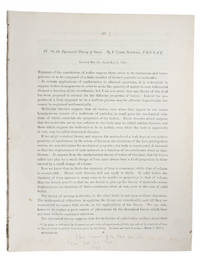
186743456London, Taylor and Francis, 1867. 4to. No wrappers as extracted from ""Philosophical Transactions"", Vol. 157 - Part I. Titlepage to volume 155 and pp. 49-88. Titlepage with minor light browning at corners. Internally clean. A small stamp on verso of titlepage.
186743456London Taylor and Francis 1867. 4to. No wrappers as extracted from "Philosophical Transactions" Vol. 157 - Part I. Titlepage to volume 155 and pp. 49-88. Titlepage with minor light browning at corners. Internally clean. A small stamp on verso of titlepage. <br/><br/><em>First appearance of this seminal paper in its full version from "Transactions" representing the announcement of Maxwell's final "Theory of Gases" and introduces the "Maxwell Distribution" in its final form a statistical means of describing aspects of the kinetic theory of gases a theory together with his electromagnetic theory are considered to be SOME OF THE GREATEST ADVANCES IN PHYSICS OF ALL TIMES. Everett considers this paper 1868 to be Maxwell's greatest single paper. Maxwell's discoveries laid the foundations of special relativity and quantum mechanics.One of Maxwell's major investigations was on the kinetic theory of gases. Originating with Daniel Bernoulli this theory was advanced by the successive labours of John Herapath John James Waterston James Joule and particularly Rudolf Clausius to such an extent as to put its general accuracy beyond a doubt; but it received enormous development from Maxwell who in this field appeared as an experimenter on the laws of gaseous friction as well as a mathematician.In 1866 he formulated statistically independently of Ludwig Boltzmann the Maxwell-Boltzmann kinetic theory of gases. His formula called the Maxwell distribution gives the fraction of gas molecules moving at a specified velocity at any given temperature. In the kinetic theory temperatures and heat involve only molecular movement. This approach generalized the previously established laws of thermodynamics and explained existing observations and experiments in a better way than had been achieved previously. Maxwell's work on thermodynamics led him to devise the Gedankenexperiment thought experiment that came to be known as Maxwell's demon. </em> unknown
196664879ABBerlin., edition et im Verlag Christian Grützmacher., 1966. 23 x 23 cm. Bd-1 -4 OKarton-Flügelmappen in OPapp-Schubern; Bd. 13-15 OKarton-Flügelmappen., 64879AB 7 Bände. 1. Auflage. Band 1 - 4 nahezu druckfrisch mit dem eigentlich immer fehlenden Blatt 28 von Konrad Lueg. Bei Band 14 ist an der unteren Lasche der Mappe der Steg etwas eingerissen, sonst ebenfalls sehr gutes, frisches Exemplar. In dieser Erhaltung und Vollständigkeit s
Acquaforte, 1930 circa. Lastra mm 125x165, figlio mm 355x505. Firma a matita in basso a destra “L. Bartolini”. Dedica incisa in lastra, in basso “V. Cardarelli”. Dalla biografia di Luigi Bartolini si evince che nel gennaio 1928 ha inizio la corrispondenza epistolare con Vincenzo Cardarelli, che durerà fino al febbraio 1930. Pertanto, la datazione della lastra viene ricondotta a tale periodo. Luigi Bartolini è considerato uno dei maggiori incisori italiani del Novecento, insieme a Giorgio Morandi e Giuseppe Viviani. Oltre ad essere un prolifico incisore (al suo attivo oltre mille acqueforti), fu anche pittore e scrittore. Partecipò sia come pittore che come incisore a diverse edizioni della Biennale di Venezia dal 1928 al 1962. Presente a varie manifestazioni artistiche, sviluppò diverse maniere definite: ‘maniera bionda’, ‘lineare’ e ‘nera’. Ricordiamo soprattutto le acqueforti della serie Marche e della serie Sicilia. Iniziò la sua produzione grafica nel 1914 e il suo stile si rifà alla tradizione naturalistica dell’Ottocento. Molte sue incisioni si possono ricollegare ad alcune opere del Goya, di Telemaco Signorini e di Giovanni Fattori. Eccellente nella rappresentazione della natura morta e del paesaggio, spesso il Bartolini rappresentò dolcemente le cose e gli oggetti più umili, i soggetti di natura più dimessi. In essi ritroviamo il sentimento che diviene immagine e la forma che si sviluppa in espressione. Con Bartolini l’incisione torna ad essere un mezzo di espressione poetica libera dal simbolismo e dal vedutismo allora in voga presso le accademie. Nelle sue acqueforti prevale ora un tratteggio leggero (genere biondo), ora una ricerca del chiaroscuro alla Rembrandt (genere nero). Opera rarissima, non descritta dai repertori. Etching, circa 1930. Plate mm 125x165, son mm 355x505. Pencil signature at lower right "L. Bartolini". Dedication engraved on plate, at bottom "V. Cardarelli". From Luigi Bartolini's biography it is clear that in January 1928 he began his correspondence with Vincenzo Cardarelli, which lasted until February 1930. Therefore, the dating of the plate can be traced back to that period. Born in Cupramontana near Ancona, Luigi Bartolini was the twentieth century Italian etcher, who came closest to the stature of his great rival, Morandi. As a teenager, he saw the collection of etchings, including work by Callot, owned by the Corradi family in Iesi. From 1907 to 1910 Bartolini studied at the Istituto di Belle Arti in Siena, and started to etch c. 1909. He moved to Rome in 1910, where until 1912 he frequented the Accademia di Belle Arti, while also attending lectures on literature and the history of art, and courses on anatomy at the University in Rome. Bartolini studied the etchings of Goya and took lessons on drawing at the Accademia di Spagna. From there, he went to Florence in 1913, where he attended the Scuola del nudo. Bartolini continued his anatomical research, as well as studying architecture, making himself the most assiduous student of all Italian twentieth century printmakers. He also visited the Uffizi and Florentine print dealers to look at the etchings of Rembrandt and Fattori. Bartolini painted his first oils just before the outbreak of the First World War. Although he painted pictures throughout the rest of his career, and was awarded the Premio Marzotto for them in 1956, they have been far eclipsed in fame by his etchings and writings. During the First World War, Bartolini published his first collection of poetry. A very prolific and accomplished writer, in this field he is best known today as the author of the novel, 'Ladri di biciclette' (Bicycle thieves), of 1946, which was quickly turned into a celebrated film by Vittorio de Sica and Cesar Zavattini. After the First World War, Bartolini held a series of minor teaching posts in Macerata, Sassari, Avezzano, Pola, and Caltagirone, while he continued to etch, and started a long career as a polemical journalist and critic of art and architecture. From 1923 to 1929, he wrote for the Naples periodical, 'Cimento', but he also contributed to 'Il Selvaggio', 'Quadrivio', 'Italia letteraria', and 'L'Ambrosiana'. Bartolini's 1924 exhibition of etchings at the Casa d'Arte Bragaglia in Rome was a great success, and later that year he showed 70 etched landscapes of the Marches at the Casa Palazzo di Roma. The following year he visited Paris, where he paid particular attention to the paintings of Van Gogh. Bartolini's political convictions led him to being assaulted by Fascists and hospitalised in 1928. Two years later, he won a prize at the Venice Biennale, where he had exhibited a portfolio of etchings. In 1930, the Turin publisher, Buratti, began to issue a series of portfolios of etchings by contemporary Italian artists under the editorship of Cipriano Oppi, selecting Bartolini for the first album. The following year, Buratti published 'Le carte parlanti', a portfolio of 10 of Bartolini's etchings, which was published in an edition of 20. In 1932, Bartolini shared the first prize at the Prima mostra dell'incisione moderna at the Uffizi with Morandi and Boccioni. His close friend, the leading anti-Fascist art historian, Lionello Venturi, acted as his agent selling his etchings in Paris. Bartolini's correspondence with his compatriots in exile led to his imprisonment, from which he was released on Mussolini's personal intervention. He was then placed under political surveillance. From 1933 to 1938, Bartolini taught in Merano, where he painted and etched in the open air, finding subjects on the banks of the fast flowing Adige. Despite being under political suspicion, he was given a one - man show of 50 etchings at the second Rome Quadriennale in 1935, when he was awarded ...
Xilografia, 1513, senza monogramma. In una lettera indirizzata a Dürer da Nikolaus Kratzer (1486-155), astronomo di corte del re Enrico VIII d'Inghilterra, Kratzer chiede a Dürer: "Ti prego di mandarmi il ritratto di Stabius, raffigurato come San Kolman, tagliato in legno". La paternità dureriana di questa xilografia non è stata ancora accettata da tutti. Strauss la include tra le xilografie per la forte possibilità che sia basata su un disegno di Dürer, forse frettoloso, e poi tagliata nel blocco senza la sua super visione. Dodgson attribuisce questa stampa a Springinklee, come fa Meder, mentre Schoch afferma che la figura è disegnata troppo bene per essere stata disegnata da Springinklee. L'assenza del suo monogramma non può essere necessariamente interpretata come un'indicazione che Dürer non sia l'autore, perché la xilografia serviva come illustrazione di un foglio accompagnato da un'ode saffica di Stabius, e recante, sopra l’immagine, il seguente testo 'Divo Colomanno martyri sancto: Austrieque patrono/ presentissimo: Joann. Stabius. Au. voti reus. Hoc/ carmen dedicat. Anno dni. etc. M.D.xiij' Dürer conosceva bene Johannes Stabius (morto nel 1522), filosofo e astronomo di corte dell'imperatore Massimiliano. Stabius accompagnò l'imperatore nella sua visita a Norimberga, 3-15 febbraio 1512, ma a quanto pare rimase più a lungo perché il 30 luglio ha preparato un oroscopo a Norimberga per Matthäus von Gurk . Stabius è qui raffigurato nelle vesti di San Colomanno, venerato in Austria. Il santo fu impiccato nel 1020 a Stockerau. Indossa un cappello da pellegrino e tiene nella mano sinistra una frusta intrecciata. I quattro stemmi sono (in senso orario) quelli dell'Impero, dell'Arciducato d'Austria, della Scozia e di Stabius. San Colomanno, secondo la leggenda, era un discendente della famiglia reale scozzese. Magnifica impressione, impressa su carta vergata con filigrane doppia croce e lettere ICP”, in perfetto stato di conservazione. Esemplare nella seconda edizione descritta da Meder e pubblicata da Adam von Bartsch utilizzando la matrice originale conservata all’Albertina di Vienna e datata 1781. Woodcut, 1513, without monogram. In a letter, addressed to Dürer by Nikolaus Kratzer (1486-155), court astronomer to King Henry VIII of England, Kratzer asks Dürer: “I beg you to send me the portrait of Stabius, portrayed as Saint Kolman, cut into wood. "Yet Dürer's authorship of this woodcut has not gained general acceptance Dodgson attributes this print to Springinklee, as does Meder, while Schoch states that the figure is drawn too well to have been designed by Springinklee. Strauss included it among on Dürer’s woodcuts because of the very strong possibility that it is based on a drawing by Dürer, perhaps a hasty one, due to his preoccupation with the master engravings of this period, and then cut into the block without his super vision. The absence of his monogram cannot necessarily be construed as an indication that Dürer was not the author because the woodcut served as illustration of a broadsheet accom panied by a sapphic ode by Stabius, lettered above the woodcut on left sheet: 'Divo Colomanno martyri sancto: Austrieque patrono presentissimo: Joann. Stabius. Au. voti reus. Hoc carmen dedicat. Anno dni. etc. M.D.xiij' Dürer was well acquainted with Johannes Stabius (d. 1522), philosopher, and court astronomer to Emperor Maximilian (see the following woodcuts). Stabius accompanied the emperor on his visit to Nuremberg, 3-15 February 1512, but apparently stayed on for some time because on 30 July he prepared a horoscope at Nuremberg for Matthäus von Gurk. Stabius is pictured here in the guise of St. Coloman, venerated in Austria. The saint was hanged in A.D. 1020 at Stockerau. Wearing a pilgrim's hat, he is holding in his left hand a braided whip. The four coats of arms are (clockwise) those of the Empire, the Archduchy of Austria, Scotland, and of Stabius. St. Coloman, according to legend, was a descendant of the Scottish royal family” (cf. Strauss. p. 483). Example of the second issue described by Meder, printed by Bartsch from the block in the Albertina dated MDCCLXXXI. A fine impression, printed on laid paper with “ICP with Doublecross” watermark, perfect condition. Bartsch, 106; Meder n. 194; TIB 1001.306 (137): Strauss, p. 483-485, n. 169.
196857986ABStuttgart., Edition Hansjörg Mayer., 1968. 24,9 x 14,3 cm. (Nummer 3) 24 unpaginierte S.; (Nummer 4) 44 unpaginierte Blockbuchseiten. Hellgraues, flexibel umgelegtes Original - Zickleinleder., 57986AB Auflage 230 Exemplare. Das extrem feine Leder von bester Erhaltung, nahezu perfekt schönes Exemplar.
1987837FBMönchengladbach., Museumsverein Abteiberg., 1987. 837F Sehr gutes Exemplar.
411-Eo.J. Bleistift, mit Bleistiftlinie umrandet, auf bräunlichem Transparentpapier, 1882, auf Untersatz montiert. 30,9:19,5 cm. Literatur: A.M. von Steinle: Edward von Steinle. Des Meisters Gesamtwerk in Abbildungen. Kempten/München 1910, Nr. 396 f. Vorarbeit zu einer der sieben Federzeichnungen zu Clemens Brentanos ?Chronika eines fahrenden Schülers?, in der ersten Fassung des Manuskriptes von 1882. 396 bis 396e sind als Holzschnitt in der durch P.W. Kreiten aus beiden Fassungen der Chronik zusammengestellten Ausgabe im Verlag von M. Huttler, Augsburg, erschienen. Die Federzeichnung 396f befand sich ehemals im Besitz der Königin Carola von Sachsen, dann des Prinzen Johann Georg von Sachsen.
520 pages. Black and white illustrations. Text in French, English, German and a fourth language which is presumably Yugoslavian. Some Russian may also be mixed in. The language used seems to depend upon that of the contributor. Contains a wealth of technical content, the bulk of which appears to be in German and French. Includes reprint of an 1892 Electrical Engineer article on "The Tesla Multiphase Motors" plus "Nikola Tesla: The Problem of increasing human energy" reprinted from The Century Magazine, June 1900, 'The Tesla Patents' from Electrical Review, September 19, 1900 and much more. Index card laid in states this copy was presented by Comite yougoslave de l'URSI to Professor Charles. R. Burrows, whose signature appears atop front flyleaf. Printed on poor quality paper which has become embrittled, chipped and yellowed, particularly at extremities. Binding extremely fragile. Please Note: pages 6 through 10 missing. This may not be too dramatic a loss as the Table of Contents omits pages 1-8 and first lists page 9 which may have contained the Preface in Russian. Some pages uncut. Front cover and all pages prior to page 17 loose but present aside from pages listed above. Page 519-150 and back cover loose but present. Although strictly a Reading Copy, this remains a rare and substantial Tesla reference. Book
FH-468o.J. Farbholzschnitt, 1901, auf Japan-Bütten, mit Bleistift signiert, datiert und bezeichnet ?Emil Orlik 1901 Kioto?. Darstellungsgröße 18,5:15,2 cm, mit schmalem Rand rechts und unten. Literatur: Emil Orlik. Leben und Werk 1870-1932. Prag-Wien-Berlin. Hrsg. von Eugen Otto. Wien, Brandstätter 1997, Farbabb. S. 134; Ausst. Katalog: Wie ein Traum. Emil Orlik in Japan. Hrsg. von Peter Voss-Andreae. Hamburg, 2012, Farbabb. S. 47, Nr. 7.
FH-270o.J. Farbholzschnitt in Schwarz, Grau und Rot, 1930, auf dünnem Japan-Bütten, mit Bleistift signiert, bezeichnet und datiert ?H. Paule Capri 1930?. Darstellungsgröße 14,7:11,2 cm, Blattgröße 17,8:13,1 cm. - Am Oberrand auf Untersatz montiert, Papier dadurch etwas wellig.
FH-273o.J. Farbschablonendruck, um 1921, auf chamoisfarbenem Papier mit Wasserzeichen: France, mit Bleistift signiert, betitelt ?Swans? und nummeriert. Darstellungsgröße 19,5:25 cm, Blattgröße 28,8:40,5 cm. - Papier leicht vergilbt und mit wenigen Fleckchen in den Rändern.
FH-274o.J. Farbschablonendruck, um 1921, auf chamoisfarbenem festem Japan, mit Bleistift signiert, betitelt und mit Bleistiftlinie umrandet. Darstellungsgröße 18,6:31,5 cm, Blattgröße 26,7:38,4 cm.
FH-275o.J. Farbschablonendruck, um 1921, auf chamoisfarbenem festem Japan, mit Bleistift signiert und mit Bleistiftlinie umrandet. Darstellungsgröße 15,7:24 cm, Blattgröße 24,2:30,5 cm. - Mit Tesafilmspuren an den oberen Ecken und am unteren Rand.
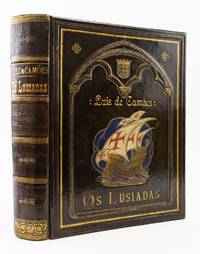
1880ST17890eLeipzig: Typographia Giesecke & Devrient for Emilio Biel Portugal 1880. 400 x 305 mm. 15 3/4 x 12". 2 p.l. LVI 375 1 XCII pp. <br/> IMPOSING CONTEMPORARY BLACK CALF upper cover with sunken central panel framed by gilt and blind rules raised gothic window frame with gilt tooling large ship embossed and painted at center gilt lettering above and below lower cover gilt-stamped "Companhia Portugueza Editora / Porto" raised bands spine panels with blind-stamped floral frames gilt lettering patterned endpapers apparently later hinges all edges gilt and elaborately gauffered. In a later green felt-lined cloth slipcase. Illustrated half title engraved portrait frontispiece dedication and portrait of the dedicatee engraved decorative half frames at beginning of each Canto and tailpiece at the end 10 section titles printed in colors and 19 plates all with original tissue guards. Front pastedown with modern color-printed bookplate dated 1980. ◆Spine slightly sunned leather with a few minor scrapes scratches and other small signs of wear plates variously foxed because of paper used usually mildly or moderately though occasionally more noticeably; nevertheless a striking volume with its main attractions the front cover and shimmering gauffered edges retaining all of their appeal.<br/> <br/> This is an impressive commemorative edition of the masterpiece of the Portuguese language's greatest poet in a binding that celebrates that country's history of exploration. First published in 1572 the epic poem "Os Lusíadas" relates the adventures of Portuguese explorer Vasco da Gama ca. 1460s - 1524 the first European to reach India by sea. Sailing via the Cape of Good Hope in 1497 he established the first ocean route from Europe to India landing in Calicut in 1498. His navigation skills provided Portugal with more than bragging rights for accomplishing a feat attempted for decades at the cost of hundreds of sailors' lives: the Portuguese now had unprecedented access to the spices of the East and came to dominate that market. A master of verse whose skills have been compared to those of Shakespeare Milton and Dante Luís de Camões ca. 1524/25 - 1580 also had firsthand experience of the voyage: he travelled to India on the carrack São Bento in 1553. He composed parts of this work while dwelling in a cave in Macau and managed to save the manuscript when he was shipwrecked in the Mekong delta. After 17 years in the East Camões returned to Portugal and completed "Os Lusíadas." When it was published two years later he was rewarded with a royal pension. The binding here depicts a Portuguese caravel--the small very maneuverable ship Portugal's explorers used in the Age of Discovery--at full sail on choppy seas in a sunken space framed within a Moorish-style arch bearing the Portuguese Coat of Arms. Dedicated to Dom Pedro II Emperor of Brazil this luxurious production was issued to commemorate the 300th anniversary of Camões' death. Typographia Giesecke & Devrient [for] Emilio Biel, Portugal unknown
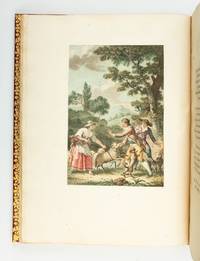
1793ST20474Paris: Defer de Maisonneuve 1793. First Edition with these Illustrations. 350 x 262 mm. 13 3/4 x 10 1/4". 125 pp. <br/> VERY PRETTY 19TH CENTURY CRIMSON MOROCCO ELEGANTLY GILT covers framed with floral tools raised bands spine panels filled with rows of flower-and-lozenge roll gilt lettering gilt turn-ins top edges gilt. FOUR FINE STIPPLE-ENGRAVED PLATES by Colibert and Cazenave after Monsiau PRINTED IN COLORS. A Large Paper Copy. Cohen-de Ricci 400; Furstenberg 122; Lewine p. 188; Maggs 1930 Catalogue of French Illustrated Books 84; Ray p. 145. Occasional minor foxing the margins of one plate foxed a bit more otherwise a fine copy clean and fresh internally with immense margins the plates with pleasing colors and the unworn binding bright with gilt.<br/> <br/> This is an especially tall copy of Florian's pastoral romance in imitation of Cervantes one of the grander French books to be printed in colors when the vogue for such productions took hold during the last years of the 18th century. Ours is one of six such books all printed after 1786 that Ray singles out for praise as "handsome and imposing volumes." A noted painter of both classical and modern subjects Monsiau 1754-1837 was also an illustrator whose "abundant and interesting work in this line" is underrated even though it has the merits of being simple natural lively and piquant. Ray Monsiau's obscurity says Ray may be owing to the fact that he most often worked as a secondary collaborator on major illustrated works; the present book is one of the few he did on his own and it is among his best. Publisher Defer de Maisonneuve did not originate the technique of stipple engraving on copper plates but he did perfect the process which allowed for gradual tonal changes in hues and intensities of color rather than the "stained glass" effect of separately printed patches of color. Given the turmoil of the period when this book was published it is quite likely that it did not have an especially decorative original binding and may have remained in publisher's boards as was often the case. Happily a later owner supplied a period-appropriate binding here that matches the opulence of the contents. While our copy has the engraver's name just visible beneath the plates perhaps disqualifying them as the "avant la lettre" versions used in the Large Paper Copies per Cohen-de Ricci the size of the margins here and the quality of the paper certainly argue for that designation. Defer de Maisonneuve unknown
SECOND AND LAST EDITION of the "Mascara Real", the greatest Spanish fete-book of the 18th century and the apex of Spanish etching of the period. Originally printed in 1764 (Palau 156971, "Magnifica publicacion....") in a very small edition, this is the second edition, with ALL TWELVE OF THE FULL-PAGE ETCHINGS (by Defehrt after Tramullas) PRINTED FROM THE ORIGINAL PLATES. Since the original edition was so small, the plates were in a perfect state of conservation when this second edition was printed, and ALL OF THE ETCHINGS ARE ABSOLUTELY BRIGHT AND SHARP. Edition limited to 150 numbered copies, all printed on extremely fine handmade Guarro wove paper. Oblong large folio (22 x 26 inches). Loose as issued in the original portfolio case with ties. BRIGHT AND FINE, WITH NO DEFECTS. Spectacular.
1990201911990. 1 Titelbl. mit signierter Radierung, 1 Textblatt. ("An den Knaben Elis") sowie 16 lose Graphiken auf getöntem Bütten. 39 x 27 cm. In dunkelblauer OLn.-Kassette.
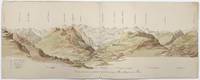
184023481840. Watercolor graphite and grayish ink on two sheets of cream laid paper with an 1836 M and smiling sun watermark 10 1/4 x 25 7/8 inches 260 x 658 mm the full sheet. Titled in ink in French on the recto. In very good condition with minor edge wear including creasing and nicks. A splendid panorama with each of the major peaks and point of interest labeled and identified in French. The iconic symbol of the Swiss resort the "Sun of St. Moritz" was adopted from early European heraldic marks and rebranded around 1930 by graphic designer Walter Herdeg. The image was patented in 1937 by spa director Walter Amstutz becoming the world's first visual trademark for a tourist destination. unknown
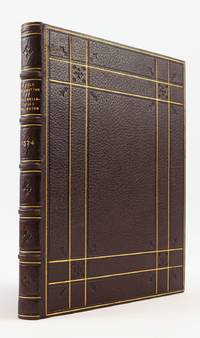
1574ST19871Heidelberg: Imprinted by Michael Schirat 1574. First Edition in English. 194 x 151 mm. 6 5/8 x 6". 6 p.l. last blank 193 pp. 2 leaves final blank. <br/> Very nice late 19th century dark maroon morocco by Lloyd of London stamp-signed on front turn-in covers framed by gilt and blind rules blind ruling at corners raised bands spine panels with blind-stamped quatrefoil gilt lettering gilt-ruled turn-ins quatrefoil cornerpieces all edges gilt. Lacking the folding "Table of Discipline" called for in ESTC. Front pastedown with armorial bookplate of Albert Ehrman; rear pastedown with Ehrman's faded ink stamp bookplate of "Bibliotheca Broxbourniana / J. P. W. E. / 17 March 1949 / ex dono A. & R. E." STC 24184; ESTC S118505; USTC 507892. Text washed and pressed but except for the first and last few leaves without the typical resultant darkening and fading otherwise an extremely attractive copy still fresh the margins especially wide and the binding lustrous and scarcely worn.<br/> <br/> First issued in Latin in the same year as our edition this is the major work of English puritan Walter Travers 1548 - 1625 applying the Calvinist presbyterian system of ecclesiastical government to the episcopal Church of England. According to DNB for Calvin and Travers alike "the duty of the theologian was merely to identify the church's structure and apply it to contemporary circumstances. It was in this last respect that Travers's originality lay for he subtly adapted Calvin's biblical model to an English context. In order to undermine the diocesan episcopate of the English church Travers started off with an examination of the role of bishops in the New Testament showing that they were not part of a separate hierarchy with authority over other clergy but merely ministers of local congregations. He also differed from Calvin in identifying elders as a type of deacon rather than a separate kind of minister." Our book was written during Travers' 1570-76 sojourn in Geneva where he became a friend of Calvin's successor Theodore Beza. Afterwards he ministered to English merchant marines in Antwerp where he refused to use the Book of Common Prayer for worship. Despite this when Travers returned to England he became chaplain to Elizabeth's chief minister William Cecil and tutor to his son. As DNB notes "his close ties to influential courtiers of a Calvinist inclination" would be key to Travers' career keeping him out of serious trouble despite his strongly presbyterian views. Our volume has a distinguished provenance coming from the celebrated Broxbourne library of Albert Ehrman 1890-1969 a diamond merchant who gathered a fine collection of books at his home at Broxbourne in Hertfordshire. He spent half a century collecting books specializing in incunabula and early bindings as well as early type specimens and bibliographies. Feather says that "his collecting was intelligent and scholarly for he sought to illustrate the history of printing and the book trade and the early development of trade binding." Ehrman also authored learned articles on fine bindings and the history of printing. The present work is uncommon: we could trace just five copies at auction since 1979; only the 1979 copy contained the folding "Table" and that one was noted as "slightly defective and mounted on linen.". Imprinted [by Michael Schirat] unknown