48 779 résultats
477-Eo.J. Aquarell, stellenweise mit Eiweißlasur, rechts unten signiert und datiert ?J. W. Lindlar. F. 1845.?. 21,2:23,5 cm. Sehr schöne, fein gezeichnete und dadurch sehr plastisch wirkende Arbeit dieses Künstlers.
197360973AB[New York]., Buffallo press., 1973. 28,8 x 20,5 cm. 2 x 72 halbierte Blatt. OKarton., 60973AB First printing. Eingand minimal berieben, geringe Stauchung an der oberen Stoßkante, sonst sehr gutes Exemplar.
320-Eo.J. Aquarell über Bleistift, auf strukturiertem Papier, aufgezogen, unten signiert ?F W Moritz?. 19,3:25,4 cm. Auf einem alten Abdeckpapier bezeichnet ?Lac de Brienz Suisse peint par Moritz, le beaufrère de ma Grandmère Sophie Willnauer née Pouchon dont il avait épousé la s?ur ».
FH-183o.J. Farbholzschnitt in Schwarz und Rot, 1896, auf feinem Japan-Bütten, mit Bleistift signiert. Darstellungsgröße 14,2:10,7 cm, Blattgröße 20:16 cm.- Literatur: Kat. Galerie Glöckner, Köln, 2007/2008, Nr. 41/1. Blatt 1 aus der Mappe: Kleine Holzschnitte 1896-1899. 34 Bll. Verlag Neue Kunsthandlung, Berlin, 1920. Die Auflage der Mappe betrug 100 Exemplare; Schütte 93; E. Otto, Emil Orlik. Leben und Werk 1870-1932. Prag, Wien, Berlin. Wien/München, Chr. Brandstätter, 1997, Farbabb. S. 86.- Bei dem Versuch sich 1896 einen Trockenstempel für seine Graphik anzufertigen, entdeckte Orlik den Holzschnitt als neue Technik für sich. Dies schildert er im Vorwort zur Mappe ?Kleine Holzschnitte?. [2 Warenabbildungen]
256-Eo.J. Pinsel in Braun, braun laviert, über Bleistift, auf cremefarbenem Velin, rechts unten signiert ?F. Preller?. 19,7:26,8 cm.
621-Eo.J. Bleistift, Juni 1815, auf Bütten, am oberen Rand bezeichnet und datiert ?im Thal von Kaltleutgeben, Juni 1815?. 25:32 cm. Kaltenleutgeben liegt im Bezirk Mödling in Niederösterreich, im südlichen Wienerwald. Das Tal von Kaltenleutgeben wird durchflossen von der ?Dürre Liesing?. Die Schönheit dieser Landschaft hat auf viele Künstler anregend gewirkt. So schrieb z. B. 1797 der katholische Priester, Schriftsteller, Übersetzer, Bibliothekar und Zoologe Johann Nepomuk Cosmas Michael Denis (1729-1800) folgendes lateinische Gedicht darüber, das im Wien dieser Zeit sicher vielen bekannt war. Möglicherweise wurde Heinrich Reinhold zu der hier beschriebenen Zeichnung dadurch angeregt: "Angusta vallis levibus adsurgit jugis, /Quae patula fagus, et nigrans pinus tegunt / P/acidum silentes.Rarus hic collem terit / Viator. Aedes insidet colli Sacra, / Quae subter audit rivuli streperam fugam. / Circum camini fossilem calcem coquunt/?. "Ein enges Tal, von Hügeln sanft umschlungen - / weit spannen Buchen ihr Geäst; / es ist, als ob die Stille schwarzer Föhren / sich fast mit Händen greifen lässt. / So steht gedankenschwer in sich versunken, / der Wald in feierlicher Ruh', / und selten nur erbebt der Waldesboden / vom Tritt durch eines Wandrers Schuh. / Vom hohen Hügel grüßt ins Tal die Kirche, / ein steingewordenes Gebet, / und ihr zu Füßen rauscht ein munt'res Bäch1ein / ohn' Unterlaß von früh bis spät. / Und ringsherum, da herrscht geschäf¬t'ges Treiben: Der Kalkstein aus der Fel-senwand / wird emsig in den roten Feueröfen / von Meisterhand zu Kalk gebrannt. " (Nachdichtung von Hannelore Nics, 1997).
274-Eo.J. Feder in Braun, über Bleistift, auf Velin. 22,3 : 20 cm. Vgl. zu dieser Zeichnung besonders Katalog: Friedrich Salathé. Basel/Lübeck/Stuttgart, 1988, Nrn. 155 und 157, Abb. 60 und 62.
185-Wo.J. Feder in Schwarz, grau laviert, mit schwarzer Feder umrandet, auf Bütten mit Wasserzeichen: D & C Blauw, verso bezeichnet ?Dessin par Wilhelmine de Schmerfeld?. 21,5:28,1 cm.
045-Io.J. Aquarell und Gouache, über Spuren von Bleistift, auf Velin, verso auf dem alten Untersatz Reste der Signatur ?Julius Steink(opf)? sowie bezeichnet ?Castel Gandolfo?. 21,8:31,5 cm. Verso Reste einer alten Verklebung sowie von fremder Hand bezeichnet ?Castel Gandolfo? und ein unvollständiger Name ?Julius Stein(kopf)?. Provenienz: Sammlung Carl Meurer, Straßburg, nicht bei Lugt.
750-Eo.J. Pinsel in Braun über Bleistift, mit Bleistiftlinie umrandet, auf cremefarbenem Velin, rechts signiert ?G. Taubert?. 30,3:41,3 cm. Mit Pinselproben an den Rändern.
FH-447o.J. Farbholzschnitt in Rot, Grün, Blau, Gelb, Grau und Silber, 1935/36, auf cremefarbenem Japan-Bütten, mit Bleistift signiert, bezeichnet und betitelt ?Original-Farbholzschnitt Handdruck ?Schwertlilien?. Darstellungsgröße 29,7:19 cm, Blattgröße 37,7:27,7 cm. Literatur: Thiemann-Stoedtner FH 210; Merx 428 F.
1906009-H1906. Pinsel und Feder in schwarzer Tusche, über Bleistift; Kopf und Körper der Figur aus grauem Papier ausgeschnitten und auf Bütten geklebt, Barhocker in schwarzer Tusche, auf Bütten, links unten bezeichnet, signiert, und datiert ?au bon camerade Col / Ed. J. Tricart 06 Paris.?. 31:24,6 cm. - Blatt insgesamt vergilbt und mit leichten Gebrauchsspuren. Möglicherweise handelt es sich hier um eine Darstellung von Henri Toulouse-Lautrec (1864-1901), dessen Kleinwüchsigkeit allgemein bekannt war. Zeitgenössische Abbildungen zeigen den bekannten Chronisten der Welt des Pariser Künstlerviertels Montmartre mit schwarzer Melone und üppigem Schnurrbart.
0753-Co.J. Farblithographie, 1951, signiert. 62,4:50 cm. Literatur: Dorsch 1297. Gedruckt von drei Steinen: In Rot, Grün und Gelb. Provenienz: Sammlung Erich Arp, Hamburg.
317-Eo.J. Gouache, mit schwarz getuschter Umrandung, auf dünnem Karton. 6,3:9,9 cm.
465-Eo.J. Schwarze und rote Kreide, auf brauntonigem Velin, rechts unten monogrammiert ?WH. fc?. 15,5:10,9 cm. Links mit schmalem Lichtrand.
483-Eo.J. Bleistift, auf chamoisfarbenen Velin, unten betitelt ?Amor von einer Biene gestochen.?. 26,1:23,6 cm. - Geringfügig fleckig. Das Motiv geht auf ein Gedicht aus den ?Idyllen? des griechischen Dichter Theokritos (um 270 v. Chr.) zurück, das seit dem frühen 16. Jahrhundert in lateinischen Übersetzungen vorlag. Zahlreiche Künstler, Maler und Bildhauer aus den folgenden Jahrhunderten haben das reizvolle Motiv seither gestaltet.
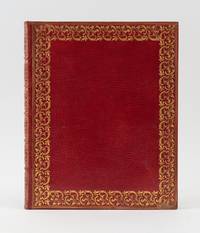
1772ST17890aBirminghamiae: Typis Johannis Baskerville 1772. 300 x 240 mm. 11 3/4 x 9 1/4". 1 p.l. 364 pp. <br/> ELEGANT CONTEMPORARY RED MOROCCO GILT covers with French fillet border and intricate frame of volutes and floral tools raised bands spine compartments with central lozenge radiating lancets from each corner surrounded with small flowers and leaves oblique leafy branch at each corner gilt lettering turn-ins with floral roll marbled endpapers all edges gilt. Front pastedown with armorial bookplate of V. H. Wilmot Esq.; front free endpaper with armorial Glenconner bookplate. Gaskell 46. Lower corner of front board with scarcely noticeable small patch of lost patina and gilt from insect activity just a hint of wear to joints and extremities but still A VERY FINE CONTEMPORARY COPY virtually perfect internally--very clean and fresh with generous margins and in a refined binding with no significant signs of use.<br/> <br/> This is typographically a lovely printing as well as a distinguished edition of Terence in a very handsome contemporary binding. The second century B.C. playwright Terence is believed to have been a native of North Africa enslaved during the Punic Wars. Brought to Rome and given his freedom he joined the cultivated circle of Scipio the Younger. His six extant plays the ancestors of drawing room and modern situation comedies feature crusty fathers rebellious sons and smart aleck slaves whose machinations solve the playwright's intricate complications of plot. The plays were popular throughout the Middle Ages and the Renaissance and still retain their appeal. Dibdin notes that this edition is "printed in the usually beautiful style of the impressions of ancient classical authors" issued by Baskerville. That series known as the Baskerville Quarto Latin Classics began with the first book to be issued by his press: the renowned Virgil praised by Renouard Gaskell Dibdin and other critics for its beauty. In a sheet dated 1760 which Baskerville issued appended to a specimen of his folio Bible the printer discusses his proposed "Baskerville Classics": "Many gentlemen" he says "have wished to see a sett of the Classicks . . . in the Manner Letter and Paper of the 'Virgil' already published" and he vows to print the same with the poetical classics first. These volumes says Reed would "suffice had Baskerville printed nothing else to distinguish him as the first typographer of his time." The beautiful typography the luxurious paper looking and feeling much like vellum and the spacious design combine to give the reader a particularly gratifying feeling of strength and serenity. The stately binding though similar to the French style of the period was likely done in England for 18th century owner V. H. Wilmot. Our copy was later in the collection of Edward Priaulx Tennant 1st Baron Glenconner 1859-1920. Typis Johannis Baskerville unknown
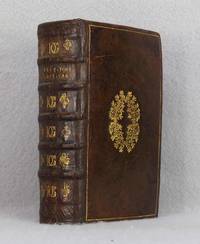
1583ST15026Paris: Arnold Sittart 1584; Heidelberg: Peter Santandrea 1583. 178 x 111 mm. 7 x 4 3/8". 14 p.l. cccix pp. 13 leaves last blank; lxxv 10 ccxvi 22 pp.; 2 leaves 84 pp.; 1 1-196 18 pp.; 62 pp. Two works in several parts bound in one volume. With annotations and commentary by Antonio Augustin Joseph Scaliger and Fulvio Orsini. <br/> Pleasing contemporary calf covers with central gilt wreath of olive branches raised bands spine panels gilt with cipher "D C G" at center flanked by a palmette and a vegetal trefoil gilt titling bottom panel with "OD" and "I8" on either side of the cipher. Printers' devices on the title pages decorative woodcut initials and headpieces. Front pastedown with what appear to be early library shelf markings; one page with neat early marginalia. Adams V-590 and F-390. Covers slightly marked spine with a bit of superficial crackling and with one short crack in the middle of bottom panel the text with faint browning and isolated minor soiling a few leaves with long shallow creases not affecting legibility otherwise in excellent condition the binding solid and without significant wear and the leaves generally clean fresh and smooth.<br/> <br/> This glossary of recondite Latin words and phrases was no doubt bound for a contemporary bibliophile with an extensive library. The "OD" and "I8" at the bottom of the spine appear to be the indication of a shelf location--not something frequently encountered on spines of this period. This designation and the location notation on the front pastedown that clearly relates to it "Arm. 0. Tab 4. Loc. 18" suggest a library of some complexity and an educated owner who believed in careful organization. While we have not been able to identify "D C G" she would seem also to have been a person of taste and good sense. The binding is attractively decorated while still being practical for scholarly use. The work itself has gone through a number of changes of fortune. The story begins when Verrius who lived in the time of Augustus compiled a valuable work full of information on everything from grammar to mythology. Unfortunately his text has been largely lost; the authentic fragments fill only the first few leaves of our volume. His work was epitomized by Festus a ca. third century scholar but Festus was not a very good epitomizer and to make matters worse all of his entries have been lost up to the letter "M." Luckily an epitome of the epitome from "A" to "Z" had been made by Paul the Deacon in the eighth century. Valuing the handbook for its information on the writing of correct Latin Renaissance scholars went to work on this puzzle in the 15th century and a first version of Paul was published by Zarotus in Milan in 1471. Later scholars published Festus and the great French classicist Joseph Scaliger 1540-1609 was largely responsible for bringing definitive order out of chaos. His scholarly edition reconstructs the work of Festus as far as one can filling in the gaps caused by missing pages in the manuscript with conjectures and rectified material from Paul. Peter Santandrea unknown
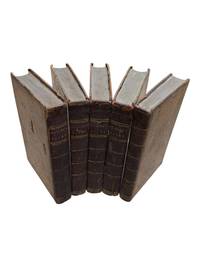
17789147London: Printed for T. Payne at the Mews-Gate 1778. First Tyrwhitt edition. 5 volumes 8vos 310 318 320 336 and 290pp. Contemporary tree calf red spine labels with gilt lettering. Spines dry toned and with a few cracks and chipping at caps. Joints rubbed upper joint in vol 1 cracked but holding. Few contemporary shelving numbers on front pastedowns contemporary inscription to verso of title in vol 1 "Calf leat. Mr. Hodgson." Overall a very good sound set. <br /> <br /> Beautiful 18th century Chaucer which was hailed at the time as the best-edited English classic that had appeared. Tyrwhitt consulted dozens of manuscript versions of Chaucer to put this together in 4 volumes and added a glossary as the 5th volume 3 years later. This set in an untouched period tree calf binding and scarce thus. . Printed for T. Payne at the Mews-Gate unknown
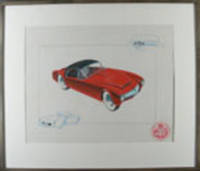
195318800Boston 1953. Tempera on paper. Initialled "R.S.W." Mounted circular label lower right. Handsome 1950s sports car design.<br/> <br/> All of our present information about this drawing comes from a label on the back of the piece which indicates that it comes from the archives of the A.J. White Motor Vehicle Research Company - designers of exotic cars in the Boston MA area. We have not discovered any further information about the A. J. White Research Company thus far nor about the artist R.S.W. of this particular drawing. There does not appear to be any connection to the great White truck manufacturer. The drawing itself is especially nice its cool red sportscar positioned diagonally between two details in blue in a way that makes it appear anxious to move. unknown
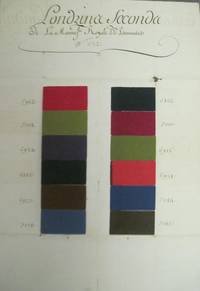
39899TRADE SAMPLES EIGHTEENTH CENTURY FRENCH TEXTILES. A pair of manuscript broadsides or pattern cards of Londrine Seconds swatches. Languedoc France: mid to late 18th century. 24 mounted textile samples on t cards. Important documentation for the historian of textiles all in excellent condition. These two broadsides come from a French manufacturer of Londrine fulled woolen cloth manufactured specially in Languedoc in imitation of West England broadcloths and used in the Levant trade.the Moors always entertai a favorable opinion of English manufactures and the French to humor them g their cloth the name of Londras wishing to make the Moors believe it was manufactured in London." Montgomery Textiles in America 1984. The first is 19 x 13 3/4 inches and titled "Londrine Seconde" and on which ar mounted 12 large colorful swatches 2 1/2 x 1 1/2 inches each with a stock number written in ink. The second is titled "Fabrique Royale de la Bastide Rouge Peyre Londrine Second" same measurements as above with 12 different swatches and stock numbers. Government regulations for premieres Londres and secondes Londres are given i both Savary des Brusions and Diderot. Finer Spanish wool and a greater numbe of threads per inch in the warp accounted for the superior quality of the premiers. Montgomery states that there are letters in the Metropolitan Museu of Art with swatches of Londrina Seconde in bright colors from Carcassone and pattern card with eleven swatches of Londrine Secondes dating from the mid-eighteenth century at Colonial Williamsburg. Montgomery concludes by quoting Arthur Young traveling in France in the late 1780s observed that th "Londrins of which at all these towns I took patterns are a very bright beautiful well-dyed bright cloth that have had deservedly from quality and price the greatest success in the Levant; I saw the wool they are made of a should not have known it from a good specimen from the South Downs of Sussex. The present examples are particularly appealing as the colors are bright and they both have handsome calligraphic titles. Very rare. unknown books
1793W1578Dublin Ireland: P. Wogan P. Byrne J. Moore and W. Jones 1793. Frontispiece vi 2 303 pages. The first printing of the Dublin edition preceded in the same year only by the 2-volume first London edition--both preceding the first U. S. edition published in 1794. The Dublin edition is significant not only for its apparent scarcity but also for the frontispiece an unusual mezzotint portrait of a younger Benjamin Franklin that appears in no other edition and has seldom if ever been reproduced. The clean and tight book has been sympathetically rebacked retaining the original red leather title patch. All edges of the textblock were stained a pale green perhaps when the rebacking was done--the staining intrudes 1/16" onto the top and bottom margins of the frontispiece.Very light and faint foxing throughout; occasional smudges in the margins. Two large but light waterstains to the frontispiece but only minor and relatively unobtrusive intrusion into the image. Missing the front free endpaper. The book's condition is much nicer than it sounds; certainly an acceptable copy for the serious collector. First Dublin Edition. Hardcover. Collectible-Very Good. Small 8vo - over 7¾" - 9¾" Tall. Leather. P. Wogan, P. Byrne, J. Moore, and W. Jones Hardcover
191222619New York: Not Published 1912. Collection includes: A large souvenir program "Julia Marlowe's Benefit in Behalf of The Hopelessly Crippled French Soldiers" held at the Shubert Theatre May 26th 1916 with an inscription on the front cover signed by E.H. Sothern "Dear Harry Kauffman - The great thing is to perceive that most people are asses & that nearly everybody is wrong most of the time - "a soft answer turneth away wrath" But I declare that accidents are inevitable & excite the soul - what we must do is to rehearse everybody & everything all the time & keep our hair on - with love.sincerely E.H. Sothern" approx. 10" x 13" size one large sheet of heavy 'Normandy' watermark paper stock folded to make a cover over the smaller inner program for the event - according to the dedicatory text various artists gave their services - which included Miss Marlowe & E.H. Sothern & Company performing as well as Sir Herbert Tree Mrs. Lillie Langtry and others; the back of the inner program notes a E.H. Sothern appearance in "If I Were King" at the Shubert on the following evening; the cover with printed titles in dark blue simply side-tied with the remains of a red white and blue silk ribbon; with wear and soiling and old paper rub-hole at front margin about good overall; the inner program printed at the Arrow Press Inc. New York and very good; the team of and later husband & wife Edward Hugh Sothern 1859 - 1933 & Julia Marlowe 1866 - 1950 very well-known and popular as the premier Shakespearean interpreters in America at the time making Shakespeare accessible especially for a larger public; with an undated circa 1900 signed photograph of E.H. Sothern taken with two other handsomely dressed unidentified gentlemen strolling down a railroad station platform - Sothern signed in ink below his image; no studio or photographer noted photo approx. 6" x 8 1/4" mounted to an old gray card mount which has been trimmed away at bottom margin; photo with a tiny edge-tear at top otherwise very good as is the bold signature; with A large sepia-toned photograph inscribed and signed by E.H. Sothern taken while costumed in his role as MacBeth inscribed at top right "For Wm Kauffman with the regards of E.H. Sothern"; the photo signed in white ink bottom right 'Notman Boston' and is 10 1/4" x 13 1/4" approx. size; corners chipped closed tears with one through a letter of the inscription with old repairs on back; a few spots showing in the lighter area otherwise a good strong image of the actor in one of his most famous roles; with a very beautifully-taken head-and-shoulders portrait of Julia Marlowe Sothern in elaborate brocaded costume wearing headscarf inscribed below in black ink "To Mrs. Kauffman in remembrance of "Viola" and Julia Marlowe Sothern 1912"; image approx. 9 3/4" x 13" size; with the studio stamp of White N.Y. at right margin; some corner wear the 'Sothern' and a few other letters dimming in the inscription about very good overall and a striking image of the actress; with another White N.Y. large photograph this of both Julia & Edward Sothern in their costumed roles of Romeo & Juliet inscribed at the bottom margin "To Mr. Kauffman in remembrance of both of us! Julia Marlowe Sothern 1912" approx. 10" x 13"; top right corner chipped away little edgewear at bottom otherwise very good and sharply - taken; with a 6" x 9" approx. size photograph a copy of a famous earlier image by Arnold Genthe of Julia Marlowe Sothern as Juliet inscribed at lower margin "To Erwin Carl Kauffman son of our friend & coworker. Julia Marlowe Sothern May 1920." unevenly trimmed some wear and the inscription still very bold good condition; with an inscribed photograph "To my darlingest Mr. Kaufman & Mrs. Kaufman - May we meet again Katherine Alexander" Katherine Alexander 1898 - 1981 part-Cherokee American actress; the photograph pencil signed by the photographer illegible on the margin below dated 1923; approx. 8 3/4" x 13 3/4" including mount - image 6" x 10 1/4" approx. matte photo-paper; closed tears at edges soiling some crinkling into the top of the image about good condition; with an 8" x 10" portrait of Maude Adams Maude Ewing Kiskadden 1872 - 1953 American actress best known for her great success as the character Peter Pan with the studio stamp of Fernand de Gueldre Chicago on back; inscribed at lower margin "To Mr. and Mrs. Kaufman - with all good wishes from Maude Adams 1932" light wear & soil corner crease; in very good condition; with an inscribed portrait photo off Otis Skinner 1858 - 1942 American stage actor inscribed "To Fred Kaufman cordially yours Otis Skinner 1932" approx. 3 1/4" x 4 1/2" with the photographer's stamp on back of Irving - Allen - Fox Studio Denver; light wear and soil very good; with 3 additional 8" x 10" photographs of theatre stars of the past inscribed to the Kaufmanms as well names indecipherable; photographed by Standiford Studio Louisville Bachrach and Florence Vandamm; these all in good condition; an interesting group of signed early 20th century signed theatre material in overall good condition especially so for the personal inscriptions by these stars all to one family for good provenance. Photography. Not Bound. Good. Not Published Paperback books
195318800Boston 1953. Tempera on paper. Initialled "R.S.W." Mounted circular label lower right. Handsome 1950s sports car design.<br/> <br/>All of our present information about this drawing comes from a label on the back of the piece which indicates that it comes from the archives of the A.J. White Motor Vehicle Research Company - designers of exotic cars in the Boston MA area. We have not discovered any further information about the A. J. White Research Company thus far nor about the artist R.S.W. of this particular drawing. There does not appear to be any connection to the great White truck manufacturer. The drawing itself is especially nice its cool red sportscar positioned diagonally between two details in blue in a way that makes it appear anxious to move. unknown books
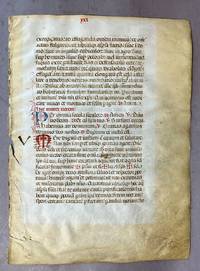
007112Upper Rhine region probably Alemannic Germany or northern Switzerland 1000. No Binding. Good. Single parchment leaf recto and verso 245 x 182 mm written in a fine mature Caroline minuscule in dark brown ink 29 lines per page single column. Rubrics in red; simple pen-flourished initials in red and blue marking textual divisions. Pricklings and ruling faintly visible. The text comprises the Exorcism and Blessing of Water Exorcismus aquae with extended invocations against unclean spirits and prayers for purification healing and protection. These texts form part of the Roman ritual tradition as transmitted in Germanic regions during the 10th century and are characteristic of Rituals or Sacramentaries rather than Missals or biblical codices. The hand is confident and regular with well-proportioned Caroline letterforms and consistent word separation. Decoration is restrained and functional reflecting a working liturgical manuscript produced for clerical rather than a luxury commission. Palaeographical and textual features point to production in the Alemannic sphere of the Upper Rhine an area renowned for conservative preservation of Carolingian liturgical practice. In good bur well-used medieval condition. The parchment is supple but heavily toned at margins with cockling and surface wear consistent with prolonged liturgical handling. There are tears at binding edge with evidence of modern tape repair. Occasional later marginal notations present. Ink and decoration remain clear and legible. Early litugical manuscripts of this early date are increasingly scarce on the market. Leaves containing exorcistic and ritual texts are especially sought after for their historical and theological interest offering insights into early medieval concepts of sanctification healing and spiritual protection. Ships unmatted and unframed <br/> <br/> unknown