FRYER, John.Livre Rare Book
15 990 résultats
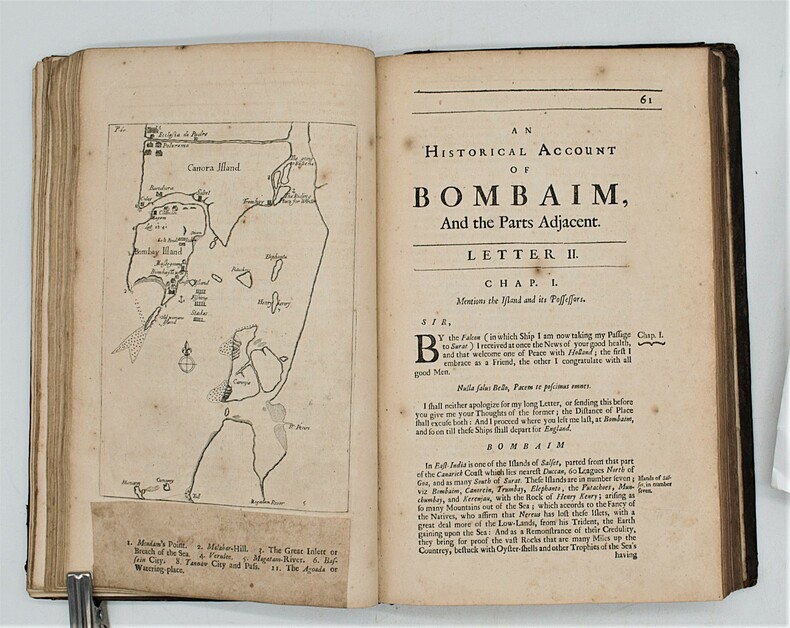
1698PHO-1906London, Chiswell, 1698. In-folio (310x210mm) relié plein veau époque, dos à nerfs, x, xiii, 427, xxiv pp., illustré d’un frontispice, de 5 planches hors-texte dont 3 dépliantes et de 3 cartes, plats détachés, petit trou page 81/82, manque de papier en marge page 80. Titre imprimé en rouge et noir. Fryer était un chirurgien au service de la compagnie des Indes Orientales, pendant 9 ans il voyagea extrêmement des côtes de Coromandel et malabar. Il décrivit les villes de Surat et Bombay le commerce et les coutumes de Madras et de la Perse. Très RARE. Folio, full period paneled calf, boards and free enpaper detached, x, xiii, 427, xxiv pp., illus. with engraved frontispiece portrait of the author, 5 engraved plates (3 folding) and 3 maps, one with printed overslip; title in red and black, woodcut illustrations in text.
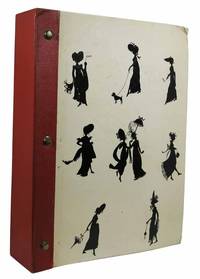
195742918Paris: Societe Paritys / Lebotys 1957. Post binder with 3 brass posts decorative screw tops. Publisher's color pictorial glazed boards blue spine and joints. Board edges rubbed and worn; short split to rear outer joint; inner joints tender paper splitting though cloth reinforcement beneath is intact. Page block foxed occasional foxing/spotting throughout; light offsetting from fabric samples to some pages. Fabric sample generally clean and bright with occasional creasing/fraying. Overall Gd. 97 pp. 16 color fashion drawings; ~ 740 pasted or tipped-in fabric samples. 16-1/8" x 12-1/8" <br/><br/>A mid-century salesman's sample catalogue from the winter collection of Parisian firm Société Paritys a haberdashery and fabric supplier established in 1946 and still in operation today. The fabric samples have been supplied by Lebotys a couture design firm in its own right and highly regarded for the quality of its textiles. As we find record of Lebotys having issued catalogues of its own collections in both the 1930s and 1960s we speculate that the two firms collaborated for a limited time possibly due to continuing post-war shortages and the need to adapt to the rapidly changing clothing market of the 1950s. The late 1950s saw a revolution in French fashion — and by extension Western fashion in general — due in no small part to the influence of material factors underlying the purely aesthetic side of the industry: availability of fabric continuing technological advances in synthetics and the surging post-war economies of America and Europe. The reluctant expansion of haute couture into the ready-to-wear market during the latter half of the century and the increasing reliance on synthetic fabrics to meet the demand would ultimately spell a major shift in the industry one that would impact fashion trends for decades to come. Some fashion houses like Dior whose “New Look” revitalized fashion at the beginning of the decade successfully managed to adapt by issuing couture ready-to-wear lines. Some however even long-established houses survived the war only to be undone by the prosperity that followed. The collaboration here of Société Paritys and Lebotys as well as the fabrics offered and styles displayed leads us to infer that the two firms were likely targeting the growing ready-to-wear market. The fabrics include a variety of silks cottons wools mohair etc. as well as nylon fibranne rayon Rhodia tergal crylor acetate and other “Matieres Synthètiques” often in blends and advertising their washable and/or antiwrinkling qualities. The styles in the illustrations still heavily influenced by the “New Look” emphasize wasp-waisted dresses hourglass silhouettes etc. No copies located on OCLC nor the major French institutions as searched on KVK. Societe Paritys / Lebotys hardcover books
195842919Paris: Societe Paritys / Lebotys 1958. Post binder with 3 brass posts. Publisher's pictorial glazed boards red cloth joints. Light extremity wear to boards; bumping to upper corner of front board; short split to front and rear joints. Page block lightly foxed foxing/spotting scattered throughout. Few white nylon fabric samples discolored by paste beneath. Fabric samples otherwise clean and bright with only minor occasional creasing/fraying. Overall VG. 80 pp. 12 color fashion drawings; ~590 pasted and tipped-in fabric samples 16-1/8" x 12-1/8" <br/><br/>A mid-century salesman's sample catalogue from the winter collection of Parisian firm Société Paritys a haberdashery and fabric supplier established in 1946 and still in operation today. The fabric samples have been supplied by Lebotys a couture design firm in its own right and highly regarded for the quality of its textiles. As we find record of Lebotys having issued catalogues of its own collections in both the 1930s and 1960s we speculate that the two firms collaborated for a limited time possibly due to continuing post-war shortages and the need to adapt to the rapidly changing clothing market of the 1950s. The late 1950s saw a revolution in French fashion — and by extension Western fashion in general — due in no small part to the influence of material factors underlying the purely aesthetic side of the industry: availability of fabric continuing technological advances in synthetics and the surging post-war economies of America and Europe. The reluctant expansion of haute couture into the ready-to-wear market during the latter half of the century and the increasing reliance on synthetic fabrics to meet the demand would ultimately spell a major shift in the industry one that would impact fashion trends for decades to come. Some fashion houses like Dior whose “New Look” revitalized fashion at the beginning of the decade successfully managed to adapt by issuing couture ready-to-wear lines. Some however even long-established houses survived the war only to be undone by the prosperity that followed. The collaboration here of Société Paritys and Lebotys as well as the fabrics offered and styles displayed leads us to infer that the two firms were likely targeting the growing ready-to-wear market. The fabrics include a variety of silks cottons wools mohair etc. as well as nylon fibranne rayon Rhodia tergal crylor lurex viscose imitation fur and other “Matieres Synthètiques” often in blends and advertising their washable and/or antiwrinkling qualities. The styles in the illustrations still heavily influenced by the “New Look” emphasize wasp-waisted dresses hourglass silhouettes etc. No copies located on OCLC nor the major French institutions as searched on KVK. Societe Paritys / Lebotys hardcover books
195942920Paris: Societe Paritys / Lebotys 1959. Post binder with 3 brass posts. Publisher's pictorial glazed boards white cloth joints. Light extremity wear to boards; short split to rear joint. Page block lightly foxed occasional foxing/spotting to margins throughout. Few white nylon fabric samples discolored by paste beneath. Fabric samples otherwise clean and bright with only minor occasional creasing/fraying. Overall VG. 108 pp. 16 color fashion drawings; ~800 pasted and tipped-in fabric samples. 16-1/4" x 12" <br/><br/>A mid-century salesman's sample catalogue from the summer collection of Parisian firm Société Paritys a haberdashery and fabric supplier established in 1946 and still in operation today. The fabric samples have been supplied by Lebotys a couture design firm in its own right and highly regarded for the quality of its textiles. As we find record of Lebotys having issued catalogues of its own collections in both the 1930s and 1960s we speculate that the two firms collaborated for a limited time possibly due to continuing post-war shortages and the need to adapt to the rapidly changing clothing market of the 1950s. The late 1950s saw a revolution in French fashion — and by extension Western fashion in general — due in no small part to the influence of material factors underlying the purely aesthetic side of the industry: availability of fabric continuing technological advances in synthetics and the surging post-war economies of America and Europe. The reluctant expansion of haute couture into the ready-to-wear market during the latter half of the century and the increasing reliance on synthetic fabrics to meet the demand would ultimately spell a major shift in the industry one that would impact fashion trends for decades to come. Some fashion houses like Dior whose “New Look” revitalized fashion at the beginning of the decade successfully managed to adapt by issuing couture ready-to-wear lines. Some however even long-established houses survived the war only to be undone by the prosperity that followed. The collaboration here of Société Paritys and Lebotys as well as the fabrics offered and styles displayed leads us to infer that the two firms were likely targeting the growing ready-to-wear market. The fabrics include a variety of silks cottons wools mohair muslin cashmere and others as well as nylon fibranne rayon Rhodia tergal crylor acetate Albène and other “Matieres Synthètiques” often in blends and advertising their washable and/or antiwrinkling qualities. The styles in the illustrations although still influenced by the “New Look” also show the influence of Dior's successor the young Yves St. Laurent who debuted his "trapeze line" in 1958. No copies located on OCLC nor the major French institutions as searched on KVK. Societe Paritys / Lebotys hardcover books
195741355Paris: Societe Paritys 1957. 1st printing thus. Publisher's color pictorial glazed boards post binder; 3 brass posts decorative screw tops. Red cloth joints. Some general extremity wear to binder with slightly bumped corners. Occasional dust soiling. Minor foxing. Overall VG with cloth samples generally VG to Nr Fine with the occasional crease to the odd sample or two. 104 pp printed in red on stiff-stock paper. 16 color fashion drawings; 897 of 898 tipped-in fabric samples. Folio. 16-1/4" x 12-1/8" <br/><br/>A mid-century salesman's sample catalogue from the summer collection of Parisian firm Société Paritys a haberdashery and fabric supplier established in 1946 and still in operation today. The fabric samples have been supplied by Lebotys a couture design firm in its own right and highly regarded for the quality of its textiles. As we find record of Lebotys having issued catalogues of its own collections in both the 1930s and 1960s we speculate that the two firms collaborated for a limited time possibly due to continuing post-war shortages and the need to adapt to the rapidly changing clothing market of the 1950s. The late 1950s saw a revolution in French fashion — and by extension Western fashion in general — due in no small part to the influence of material factors underlying the purely aesthetic side of the industry: availability of fabric continuing technological advances in synthetics and the surging post-war economies of America and Europe. The reluctant expansion of haute couture into the ready-to-wear market during the latter half of the century and the increasing reliance on synthetic fabrics to meet the demand would ultimately spell a major shift in the industry one that would impact fashion trends for decades to come. Some fashion houses like Dior whose “New Look” revitalized fashion at the beginning of the decade successfully managed to adapt by issuing couture ready-to-wear lines. Some however even long-established houses survived the war only to be undone by the prosperity that followed. The collaboration here of Société Paritys and Lebotys as well as the fabrics offered and styles displayed leads us to infer that the two firms were likely targeting the growing ready-to-wear market. The fabrics include a variety of silks cottons wools mohair etc. as well as nylon fibranne rayon Rhodia tergal crylor acetate and other “Matieres Synthètiques” often in blends and advertising their washable and/or antiwrinkling qualities. The styles in the illustrations still heavily influenced by the “New Look” emphasize wasp-waisted dresses hourglass silhouettes etc. Of particular note are the designs and fabrics for wedding dresses. No copies located on OCLC nor the major French institutions as searched on KVK. Societe Paritys hardcover books
176315240, , 1763. 2 parties en 1 vol. in-4 de 230-161-(1) pp. suivi de : Pièces justificatives des faits contenus au mémoire. Relié à la suite :Réponse du Sr Dupleix, à la lettre du sieur Godeheu. Paris, Cellot, 1763. In-4 de 330 pp.2 pièces reliées en 1 vol. in-4, cartonnage vert, dos lisse orné, tranches rouges (reliure de l'époque).
179223470Bordeaux 1792 In Folio ( 40 x 30 Cm ) 683 pp environ, soit au moins autant de copies de lettres adressées en tant que fournisseur à divers négfociants, marchands revendeurs et particuliers dont les noms sont récurrents tout au long du manuscrit : On trouve à titre d'exemple à Rouen, Delannoy et cie, au Mans, la veuve Orry, à Agen, Lamouroux , à Toulouse, Marie aîné, à Honfleur, Guenier, Bouchard, Caron, Heuute et fils,Marseille, Baux, Lille, Delbarre, Angoulême, Sajerac Desforges , Paris, Tourton & Ravel, Garnot & Ravel, Bond, Dunkerque, Omer Deny , Lancel , Pezenas, Fave, Troyes, Bourgeois lejeune, Nantes, Rivet, Lorient, Mangon laforest & cie , Longuiron Carié & fils , Riédy Thurninger , Mayenne, Benoiste Aîné, Mortagne, Hamel, et même le nom de Lafon Deladebar député de l'assemblée Nationale, etc etc , les lettres sont toutes datées de Bordeaux de 1791 ou 1792 et concernent essentiellement des cargaisons de vins. les Cent derniers ff ont subi un impact qui les a perforé sans pour autant gêner la lecture. L'écriture est tout au long du manuscrit, régulière etr parfaitement lisible et pourrait susciter un travail important sur le commerce des vins pendant la révolution grâce au noms des détaillants partiellement cités ci dessus et donc parfaitement identifiables
15632A Paris, Chez Belin, Volland, Gueffier, Prault, Rondonneau & compagnie, L'An II de la République (1794). 3 volumes. 8vo. Contemporary marbled calf, spines gilt with red and green labels with gilt lettering, lightly rubbed and some small imperfections. Not in Kress; Goldsmiths 16029; Martin & Walter, Anonymes, 17454. Complete set. The Law of the Maximum, legislation that established a partially controlled economy during the year II. It was the second of three primary maximum degrees. It aimed at fixing the prices of wheat and flour (maximum of 4 May 1793), the maximum of 29 September 1794 fixed both prices and wages over a wide spectrum of primary commodities and production, the third, the maximum of 24 February 1794, replaced the local prices of the second maximum with a schedule of national prices. On 24 December 1794 the Thermidorians disestablished this system of price and wage controls. These were the basic laws of a complex of degrees and a torrent of administrative reporting that included not just fixed prices but administratively controlled distribution as well, all of it directed theoretically from Paris by the Commission of Subsistence and Provisions and backed by the authority of the Committee of Public Safety.Volume I: Alimens, boissons, épiceries, et drogueries. (2), 12 pp. No 1: viande fraîche et salée, poisson sec et salé, avec les prix en 1790, augmentés du tiers. 119 pp. - No 2: légumes sec, etc. 83 pp. - No 3: productions d'animaux vivans. 85 pp. - No 4: boissons, etc. 74 pp. - No 5: épiceries et drogueries. 107 pp. and folding table. Volume II: No 6: laines et draperies. 115 pp. - No 7: chanvres et corderies. 36 pp. - No 8: fils et rubans de fil. 21 pp. - No 9: toiles. 55 pp. - No 10: cotons, fils de coton et cotonades. 19 pp. - No 11: bonneterie. 46 pp. - No 12: soies et soieries. 19 pp. - No 13: cuirs et peaux. 79 pp. Volume III: No 14: peaux, poils, chapellerie fine et commune. 23 pp. - No 15: papiers. 42 pp. - No 16: fers et fontes. 4 pp. Folio (folded). - No 17: quincaillerie. 114 pp. - No 18: bois de travail, merrains et boisellerie. 99 pp. - No 19: bois à brûler. 67 pp. - No 20: charbons de bois. 56 pp. Provides a wealth of information.
17247No place, 1769. With 1 folding table. 147, (1, Avis au relieur) pp. 8vo. Modern red half morocco, marbled boards, gilt lettering. Einaudi 2247; Higgs 4642; Leblanc, De Thomas More à Chaptal, contribution bibliographique à l'histoire économique, 290; not in Kress; not in Goldsmiths; not in INED. First edition.There are some copies of the first edition (and this is one of those copies), where the pages 122-124 contain a long note, not present in all copies of the first edition, which note refers to the session of the Parlement de Paris. In this note the author defends the Abbé Baudeau and his work Avis aux honnêtes gens qui veulent bien faire, a work which had become the subject of a request for its prohibition. Most copies of the first edition are without this printed note and in these copies the pagination jumps from page 123 to 126. Why this note was apparently withdrawn and no longer printed in later produced copies is unknown. During the discussion on free trade of grains several 'Parlements' gave their opinions. 'Celui de Dauphiné donnait solennellement, le 26 avril 1769, un Avis qui était une exposition magistrale de la doctrine physiocratique, d'une orthodoxie impeccable. 'Ouvrage excellent à tous égards, s'écrie Dupont en l'annonçant aux 'lecteurs patriotes' aux 'bons citoyens'; ouvrage que nos derniers neveux baigneront encore des larmes de leur reconnaissance, comme nous l'avons fait nous-même en le lisant.' ..... l'Avis fut rendu public. L'impression produite pouvait être si forte que le Parlement de Paris s'arrangea pour faire disparaître la brochure: 'Cet ouvrage est devenu bientôt excessivement rare, écrit Bachaumont, parce que le système qu'on propose à Sa Majesté est totalement opposé à ce que les Parlements de Paris et de Rouen ont écrit sur cette matière, et que cette première Compagnie n'a pas trouvé bon qu'on répandit sous ses yeux un écrit si contraire à sa façon de penser.' Le manifeste du Parlement de Dauphiné n'en émut pas moins l'opinion , et son succès rejaillit sur le parti tout entier' (Weulersse, i, p. 200). 'Le Parlement du Dauphiné se fait défenseur de l'Edit de 1764, donc de la liberté du commerce des grains et de la concurrence. Il s'élève contre les entraves et les limitations qui lui sont apportées' (Leblanc, op.cit.) - Extremely rare.
230773Paris, Frères Vaillant, & Nicolas Prévost, 1738 2 vol. in-12, XXI-444 et [2]-XII-456 pp., avec 10 tableaux dépliants hors-texte, veau fauve marbré, dos à nerfs cloisonnés et fleuronnés, encadrement de simple filet à froid sur les plats, coupes guillochées, tranches rouges (reliure de l'époque).
1801PHO-1139Paris, Dentu, 1801. 2 vol. in-8, (2) ff., 226 pp. ; (2) ff., 320 pp., 2 cartes, un plan et 8 pl. dépl., mouillures claires, relié demi-veau à coins de l'époque , dos lisse avec pièce d’auteur et titre , mouillure au 1er tome sur les 10 premiers feuillets , déchirures aux plis de 2 gravures.
23658Roubaix, la Gazette du Nord, 1900-1913. 14 vols in folio (520x340mm de 1900 à 1908 et 550x370mm de 1909 à 1913) reliés en demi velin, dos droit avec pièce de titre brune ; 52 numéros par volumes. Très bon état intérieur ; bon état extérieur (frottements d'usage et manque d'une coiffe sur l'année 1910). Rare ensemble.
17795654Paris, Imprimerie Royale, 1779 - 1781 ; deux tomes in-4 ; plein veau havane marbré, dos à nerfs ornés et dorés, tranches rouges (reliure de l'époque) ; XVI, 707, (1), XIII (table), (3) pp. ; XVI, 844, XVI (table), (4) pp. et en tout 27 planches et cartes gravées hors-texte, dépliantes.
015736Gallimard NFR 0 In-12 Broché
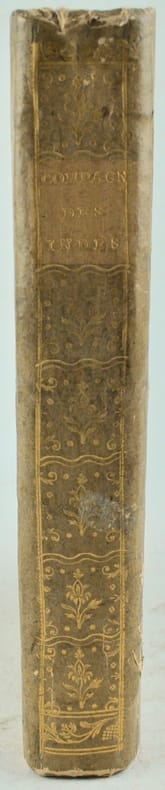
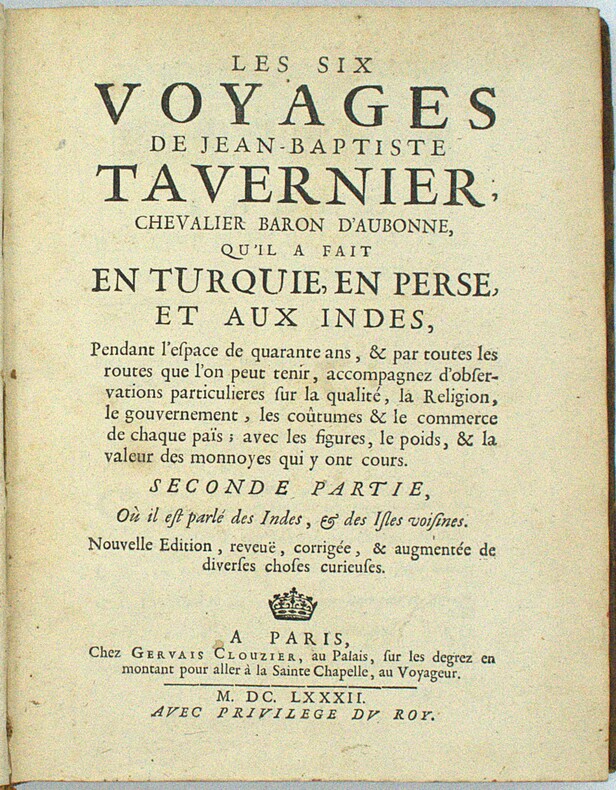
1676PHO-1352A Paris, Chez Gervais Clouzier, 1676-79, 2 volume in-4 (sur 3),30pp.- 698pp.-8pp.-2ff.,8 ff., 72 pp., 1 f., 156 pp.,2 ff., 96 pp. , 1 f., 178 pp., tome 1 ,illustré de 6 planches (7) et tome 3 ; 12 cartes et planches (complet), relié plein veau époque , dos à nerfs ornés avec titre et tomaison , tranches mouchetées , coins , coiffes et coupes usés , début de fente, manque de matière , tome 1 plus petit avec quelques rousseurs , plan d’Erevan coupé court , déchirures aux plis ,réparation carte du Tunquin , manque le tome 2.
1680PHO-1964Paris, chez Gervais Clouzier, 1682-1680, 3 volumes in-4 (246x195mm), 14ff.-636pp., 4ff.-481pp., 8ff.-72pp.-1f.-156pp.-1f.-96pp.-4ff.-1f.-178pp., Illustration : Tome 1 ; 7 planches (6 dépliantes) sur 8, Tome 2 ; 26 planches dont 15 de monnaies, 5 de pierres et 4 gravures dans le texte, Tome 3 ; 2 grandes cartes (Japon, 79x56cm et Tunquin, 56x41cm) et 8 planches dépliantes. Basane époque, dos à nerfs avec titre et tomaison, frottements, griffures et épidermures, Tome 1 ; accroc au plat, coiffe sup. absente, 2 coins usés, rousseurs, mouillure en coin puis en marge, planches avec déchirures sans manque, page 431 déchirée avec manque. Tome 2 ; fente au dos et charnière, coins usés, rousseurs et brunissures, 1 planche déchirée sans manque. Tome 3 ; coins usés, coiffes arasées, carte du Japon volante, déchirure carte du Tunquin, carte du Japon légèrement oxydée, petites rousseurs.
223, 16 (ads) pp. Index. "The problem of the Jews in Britain, and the power they wield in public affairs, is a matter of the most absorbing interest in these days when propaganda has clouded the issue and made it almost impossible for the ordinary man to see the subject in its true perspective. This book is a critical but strictly impartial analysis written by a well-known Fleet Street journalist who has studied the whole problem for a number of years in the light of events since the Great War." - from dust jacket. Unmarked with moderate wear to publisher's orange cloth. Binding intact. Small contemporary Buenos Aires bookseller's sticker inside front board. Above-average wear to dust jacket, now preserved in archival-grade Brodart. A sound copy. Singerman 494. Book
17622191Cadiz: Don Manuel Esoinosa de los Monteros 1762. Hardcover. Very Good. 4to - over 9¾ - 12" tall. 4to. 20.5 x 14 cm 158 pp. 1 f. index. With woodcut head- and tail-pieces blazon of Charles III and two Spanish galleons. Bound in mottled calf over boards spine gilt in six decorative compartments. Somewhat worn at extremities. Generally very good. First enlarged edition of an illustrated merchant's guide to the duties and tariffs levied by the Spanish crown on exports from the Americas chiefly gold and silver but also concerning timber textiles furs coffee spices and foodstuffs.After first offering a general overview of Spanish colonial commerce with Western Europe Garcia de Prado provides a wide range of practical instructions for traders negotiating the hazardous waters of colonial finance giving sample calculations for the volume of shipping containers converting currency and-crucially-providing a comprehensive alphabetical list of the royal tariffs on exports from America and the West Indies printed as a table for quick reference in terms of maravedis de plata silver coins of account and quintales approx. 46 kg. The second half of the work is concerned with trade in gold and silver explaining the six classes of government tariffs and their application to quintales of the metals in their various states acuñada labrada grana fina etc. Printed at the Royal Navy Office in Cadiz where Spanish shipping vessels would have arrived from the Americas the present work anticipates later efforts by the Spanish Bourbons-particularly Charles III and the Marquis de Esquilache-to reform the fiscal administration of its colonial properties. Garcia de Prado remarks in his introduction that a much smaller work un Quaderno with the same title was printed in 1745 and that the present work aims to augment and update the information contained therein. JCB.III.1320; Medina 3999; Palau 58415; Sabin 15037 Don Manuel Esoinosa de los Monteros hardcover
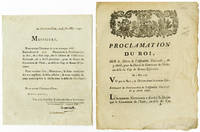
1790WRCAM51521Rouen: L. Oursel 1790. 3pp. with: PRINTED FORM LETTER COMPLETED IN MANUSCRIPT CONCERNING THE PROCLAMATION. N.p. 1790. 1p. Quarto on a folded folio sheet. Light wear and soiling. Very good. Proclamation by the Revolutionary government of France abolishing the monopoly of the French East India Company on trade beyond the Cape of Good Hope and declaring it open to all Frenchmen. The Compagnie des Indes Orientales was established in 1664 to compete with the British and Dutch East India companies. It had considerable difficulty maintaining itself financially through its long history and it was finally liquidated in 1769. In 1785 it was reconstituted and granted a seven-year monopoly on trade beyond the Cape of Good Hope but the French Revolution and the democratic zeal that accompanied it put an end to that with the present decree. The brief proclamation is accompanied by a transmittal form from the Bureau Intermediane du Departement de Montivilliers indicating that one copy of the proclamation was sent to the recipient. L. Oursel unknown books
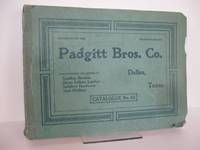
191757734Dallas TX: printed by Egan Printing Co. for the company 1917. Trade catalogue. Oblong 4to. 526 pp. Frontispiece trademark illustration and numerous other illustrations from line drawings and photographs. Padgitt Brothers Company was established in 1869 and incorporated in 1900; the company's success "in supplying the needs of the saddlery trade of the Southwest gave them first-hand knowledge of materials and design that were recognized as standard wherever good goods are sold." Their catalogues were "a veritable encyclopedia of saddlery facts classified for your convenience . there is no reason why this book should not prove a 'silent partner' in the success of every dealer who will utilize its pages freely." The profusely illustrated catalogue with pricing information is organized into sections for saddles and varieties of tack down to spurs buckles hobbles canvas wagon covers buggy tops blankets and feedbags. The Padgitt "Bronco Brand" saddle and accessories were widely known throughout the Southwest. OCLC locates two copies of this number National Cowboy & Western Heritage Museum San Jacinto Museum of History. Owner's name on front wrapper a very good copy. Printed green wrappers original printed cloth tape spine some soiling and chipping to wrappers tape repair to verso of rear wrapper chipping to margin of final blank. #6216. <br/><br/> (printed by Egan Printing Co., for the company) hardcover books
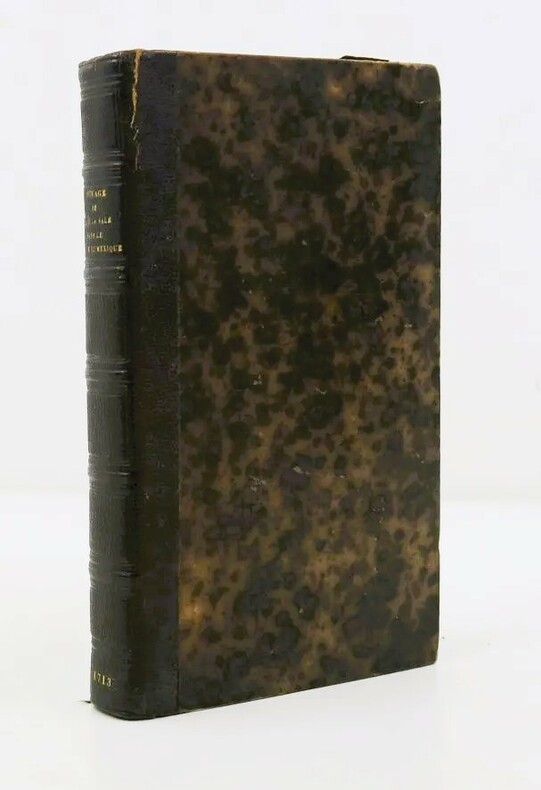
1713PHO-1659Paris, Robinot, 1713. In-12 de xxxiv-386 pp. Demi-chagrin brun foncé, dos à nerfs, titre doré, date en queue (reliure XIXe s.). Début de fente à un mors. La rare grande carte dépliante représentant la Louisiane, le cours du Mississipi et le golfe du Mexique est ici en fac-similé.
1932307823Seattle Shiatoru: Hokubei nihonjinkai shogyo kaigisho North American–Japanese Chamber of Commerce 1932. Third Edition. The third edition after much shorter versions published in 1928 and 1929. This is a promotional publication printed at a Japanese-language press in Seattle intended to encourage pan-Pacific trade through the port of Seattle. Chapters are devoted to manufacturing commercial business the current state of Seattle trade trade with Japan and Seattle's municipal administration education and media outlets.<br /> <br /> Notably the English introduction from the Seattle mayor makes no mention of the local Japanese community emphasizing only mutual trade between Seattle and Japan. The half-tone plates depict views of Seattle and accommodations for Japanese merchants. The supporting ads mostly at the back however are from many Japanese-owned businesses in the region.<br /> <br /> 6 2 110 2 1 2 23 pages plus 14 pages of half-tone photographic plates including one folding plate and a folding chart.<br /> <br /> OCLC: 1020884327 Japan 835589810 Japan 20869632 University of Washington for this 1932 edition. Similar holdings for the 1929 edition. No recorded holdings for the 1928 edition. Third edition. A very good copy in the original wrappers. With professional conservation by ECS to remove rusted staples and infill holes in the paper sheets left by the staples. The binding was then sewn through the original staple holes. The conservation report will be supplied with this copy. Hokubei nihonjinkai shogyo kaigisho (North American–Japanese Chamber of Commerce) unknown
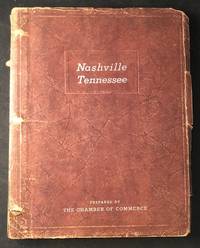
19372527Nashville TN: The Chamber of Commerce Nashville TN 1937. First Edition First Printing. Original wraps. Good . 9 X 11 1/4 Inches. 62 PP Folding Map. Original February 5 1937 Portfolio created by the Nashville Chamber of Commerce. A fairly incredible "time-capsule" glance and 20th Century Nashville in the making. This unique book was created specifically for the purpose of garnering the business of the Norvell & Wallace Lumber factory. We assume that other similar copies were created on an individual basis when the city saw fit to "scout" major companies for the area. We have located "0" copies on OCLC and "0" auction records. The summary states "The principal advantages Nashville offers to industry and other lines of business is summarized from this survey." <br /> <br /> The index includes: agricultural resources altitude area assessed valuation building and construction city government civic and social data building permits churches civic-fraternal and welfare organizations education golf courses hospitals and medical facilities hotels newspapers office buildings parks and playgrounds Parthenon postal receipts public buildings radio stations streets theatres Tennessee State Fair climate financial instituions living conditions location manufacturing attitude toward new industries industrial development in Nashville Labor costs Labor relations Labor Laws and Regulations Labor Supply Workmen's Compensation Law markets mineral resources population public utilities state and local taxes transportation facilities airlines express freight local passenger service interurban service motor truck railroads river transportation vital statistics wholesale and retail establishments.<br /> <br /> A few of the stats that immediately jumped out at me - 1 The report predates any television station in Nashville 2 When polling races in the city the report denotes 111025 white citizens 42836 negro citizens and 5 of "other" races 3 only two airlines American and Eastern service the city and the municipal airport was dedicated only a few months before this report. <br /> <br /> 21 tables and graphs including rail distance and hours by train to other US cities flying hours from Nashville power rates gainful workers condition of the banks of Nashville and more. The folding map mounted at rear measures roughly 25 X 30 inches. Origianl stab binding intact. Pages and text clean. Covers are separated from the text. The map does exhibit a few closed tears and a bit of wear at folds. The Chamber of Commerce (Nashville, TN) unknown
Nine volumes in one. Folio. 350 mm. Collation: Engraved title, 10 leaves (the last blank), 62 p. ; 4 leaves (the first blank), pp. 63-94; 9 leaves (the first blank), pp. 95-200; 19 leaves (the first blank), pp. 201-406; 7 leaves , pp. 407-443; 22 leaves, pp. 444-728; 4 leaves, pp. 729-774; 3 leaves (the first blank), pp. 775-793; 4 leaves, pp. 794-827, 6 leaves. Scattered damp stain, heaviest on last leaf (colophon). Early thumb indexes mostly present. German black letter gothic fraktur type; large woodcut initials; and decorative head and tail pieces throughout. Each sectional title bears Maximilian's large (150 x 185 mm) coat of arms. Most impressive too are the six pages with large woodcuts of 10 fish and one lobster. Generally clean and tight. Original full alum tawed pigskin over beveled oak boards binding; nicely tooled in blind; with Maximillian's simple arms, in a circle, within a 2" diamond. Five raised bands. Original brass clasps present. Early manuscript ownerships; Printed paper ownerships of the Kgl. Bezirksgericht Nurnberg in various places. Several stamped Nazi Eagle ownerships of the Oberlandesgerichts Nurnberg. First Edition of the Codex Maximilianus. Bavaria, under Maximilian I (1598-1651), was a country of around 1 million inhabitants, with agriculture and salt production (a ducal monopoly) being the dominant sectors of the economy. It became a key player in the events leading up to the Thirty Years War. In 1608, Bavaria occupied and annexed the hitherto free Imperial and Lutheran city of Donauworth. The action caused the Protestant princes and cities to found the Protestant Union. Bavaria then concluded an alliance with the Austrian and Hungarian Estates. In 1609 Bavaria became the leading force in the newly founded (Catholic) Holy League, an alliance formed against the Protestant Union. Consolidating his governance, Duke Maximilian, in 1616 introduced a new Bavarian Landrecht (Law Code), which was a compilation, reworking, and summation of all the laws and codes. Includes the codes of: Judicial Procedure; Court Laws; State Laws; Police Law; Forestry, hunting, and fishing regulations; Etc. It became a widespread the model for law and legislation for over 150 years. Stobbe II, 366. Very Scarce. Only a handful of copies are recorded in U.S. libraries. **PRICE JUST REDUCED! CHEST 2/1
1850c2206270149xbvkLondon, William Pickering (Chiswick, C. Wittingham), 1850. 1 blank sheet; xii pages (incl. foretitle-sheet, title-sheet, printed dedication-sheet, 'Contents' and 'Introduction to Eidolon'), 240 pages; 1 blank sheet. - Richly gilt handbound green chagrin-leather binding over 5 raised bands with gilt title at spine (stamp-signed ''Bound by Hayday'' at inner frontpanel), all edges gilt, silken marker-ribbon; 8vo.(ca. 18 x 11,5 cm).