Vega Garcilasso de la, the IncaBiblio.com

184 823 résultats
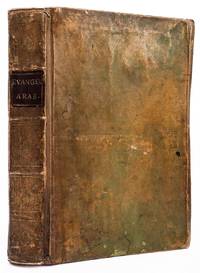
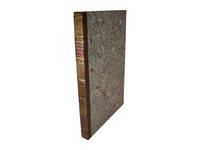
168831913London: by Miles Flesher for Richard Tonson 1688. First Edition in English. This copy has two title pages one with the Tonson imprint rubricated black and red the other with the Heyrick imprint in black only. Sabin states: “As some copies have only the black titles and some only the rubricated ones while others have both it seems possible that all the issues were originally published with two titles.†Engraved portrait frontispiece of translator Paul Rycaut the rubricated title page in red and black and 10 copperplate engravings. Folio an especially handsome copy bound in its original contemporary speckled English calf the spine with raised bands the compartments with floriated panels decorated in gilt red morocco lettering piece gilt the covers with a border decorations rolled in blind and double-filleted rules at the borders. 1019. A superb copy of this rare and early work. The book remains in its original binding. The text-block is crisp clean and unpressed The engraved illustrations are all in excellent condition. A truly wonderful copy and especially fine survival of a book rarely if ever found in such condition. RARE FIRST EDITION OF THIS HIGHLY IMPORTANT EARLY HISTORY OF THE INCAN CIVILIZATION AND OF THE CONQUEST OF PERU BY THE SPANISH. De la Vega was a prince of Incan royalty by virtue of his mother who was descended from the last Incan King of Peru. He took great pride in his Incan ancestry styling himself “Garcilasso Inca†and becoming a dedicated student of the Peruvian language and traditions. However the translator also tells us that “the Spanish humour was most prevalent in him so that he delighted much to tell us as in diverse places that he was also the son of Garcilasso de la Vega one of the first Conquerours of the new World.†Such an illustrious ancestry provides for a rendering of the history of the Incan civilization from a unique point of view. <br> The first section of the text details the early history of the Incas before the Spanish conquest including their laws and government and other “particulars relating to their Empire and Policies.†The second part details the Spanish conquest and the various civil wars and rebellions that came along with them and after them. The first part was published in Lisbon in 1609 and the second part in 1617. This edition is the first English translation by Sir Paul Rycaut. This is a classic work comprehensive and painstakingly researched and remains today one of the chief authorities on the subject of ancient Peru. by Miles Flesher for Richard Tonson hardcover
Very Good Turkish, Ottoman (1500-1928) Contemporary fine quarter leather binding. Five raised bands to spine, second gilt title as "Tarih-i seyyâh", others gilt decorations. Brown boards are embossed decoratively. Demy 8vo. (21 x 15 cm). In Ottoman script (Old Turkish with Arabic letters). [12], 194 p. Hegira: 1142 = Gregorian: 1729. Slightly wear on colophon and the first page. Otherwise a good copy. Extremely uncommon first Ottoman edition printed in the first printing house of the Islamic world as the third Islamic incunabula, of this eye witness and first-hand account, and one of the most important chronicles describing the history of late Safavid Iran in the 18th century, the Iranian invasion of Afghanistan and the siege and the fall of Isfahan in 1722 written by Kruzinski who was a Polish Jesuit missionary served in the Persia in the early 18th century. In 1720 he was nominated advocate general of the mission in Persia and became the secretary to the Bishop of Isfahan. Krusinski himself, however, claimed later on that he is not only the author but also the translator of this work. As a chronicle, this is a history of Iran under the Safavids from 1499 up to 1727 with a special focus on the 1722 Afghan invasion that terminated the Safavid dynasty. "His account of the conditions and events preceding and during the siege and the subsequent demise of the Safavids is unique. It also offers key insights into the workings of the late Safavid state and government as well as the functions of the royal harem." (Bloomsbury). Translated and expanded by Ibrahim Müteferrika of Kruzinski's Latin manuscript written in 1726 in Istanbul and entitled "Historia revolutionis monarchia Persica". The book was first published in Italian, French, and English translations, in Rome (1727), Paris (1728), and London (1728). The founder of the legendary first printing house in the Islamic world, Ibrahim Müteferrika (1674-1745), was the editor and translator of this book. Ceridehâne [i.e. Journal House] Printing House is the successor of the Müteferrika Press in the early 19th century. "The book is a Turkish translation of the history of Iran written in Latin by the Jesuit missionary Judas (Jan) Tadeusz Krusinski (1675-1751). The work, whose title can be translated as 'A voyager's description on the apparition of the Afghans and on the reasons of the Safavid Empire being undermined', focuses on the Afghan invasion of 1722 which led to the fall of the Safavid dynasty, but also offers an overview on the historical processes of early 18th-century Safavid Iran. The publication of this work was made actual not only by the vicinity of Iran to the Ottoman Empire but also by the historical turn reorganizing the relations of power in the region and triggering the intervention of the Ottomans as well. This may have been the reason that among the first Turkish incunabula this was the work published in the highest number of copies. This publication also offers an early example of copyright disputes, as Krusinski considered the Turkish translation as his own work, while Müteferrika, who does not mention his name in the printed version, suggests himself to be the translator". (Source: The Mysterious Printer Ibrahim Muteferrika and the Beginnings of Turkish Book Printing: Library of Hungarian Academy of Sciences Online). The workshop of Müteferrika began its historical mission in 1728. They published 17 works in 22 volumes. The printing house served as a means to the long-term goal of Müteferrika, his efforts to broaden the horizon and modernize the knowledge of Ottoman society and Islamic civilization. This is evidenced by the subjects of the books selected for publishing, the motivations put forth in the publisher's introductions, as well as by the documents illuminating the background of the publication of each book, also published in print. One of 1200 copies. OCLC: 312516053 (For printed copies: Two copies).; Özege: 19897.
First Edition signed and inscribed by Jomo Kenyatta, dated 1944, atop front free endpaper. xxvi, 339 pp. Index. Glossary. Eight pages of black and white photographic plates. One-page map of Gikuyu Country. "One of the first really competent and instructive contributions to African ethnography by a scholar of pure African heritage. Through his upbringing Mr. Kenyatta combines to an unusual extent the knowledge of Western ways and Western modes of thought with a training and outlook essentially African. As a first-hand account of a representative African culture, as an invaluable document in the principles underlying culture-contact and change; last, not least, as a personal statement of the new outlook of a progressive African, this book will rank as a pioneering achievement of outstanding merit." - from Introduction. Author was the founding father of Kenya and led the nation from its independence in 1963 until his passing in 1978. Somewhat above-average soiling and wear to tan fabric-covered boards. One-inch split in fabric between foot of backstrip and front board. Brilliant gilt lettering in green panels upon backstrip. Contents unmarked with occasional moderate soiling and minimal foxing. Binding tender in places but intact. Two openings, each less than one centimetre, to central portion of front hinge. A special copy of this important work. Book
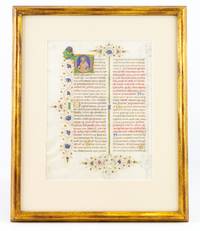
1441ST19880Italy Ferrara 1441-48. Visible leaf: 245 x 187 mm. 9 5/8 x 7 3/8"; Frame: 380 x 315 mm. 15 x 12 1/4". Double column 30 lines in a very fine rounded gothic hand a few lines of text in the same hand but smaller. <br/> Mounted and in a simple but pleasing gold frame. Visible side with rubrics in red one-line initials in burnished gold or painted blue one two-line initial in burnished gold on a pale pink ground with white tracery a lovely illuminated bar between the columns with a central plant knot AND SPROUTING IN UPPER AND LOWER MARGINS CLUSTERS OF FLOWERS AND LEAVES IN VARIOUS COLORS AS WELL AS GOLD BEZANTS outer margin with swirling penwork studded with gilt bezants running the length of the column each penwork swirl enclosing a painted and gilt flower with ONE FIVE-LINE HISTORIATED INITIAL DEPICTING ST. PAUL HOLDING A SWORD AND BOOK the initial painted pink with green leaves and a blue and green acanthus extension on a gilt ground. ◆Not examined outside of frame but in very fine condition: vellum slightly wavy text in the bottom margin just a bit faded but by all appearances A VERY CLEAN BRIGHT LEAF SPARKLING WITH GILT.<br/> <br/> Executed with great skill and delicacy and in sensitive Italianate colors highlighted especially by spring green and pink the present leaf is from a manuscript intended for a powerful aristocrat. It comes from the celebrated Breviary illuminated for the chapel of the Marquises of Este rulers of Ferrara and Mantua a manuscript commissioned by Leonello d'Este duke of Ferrara from 1441-50. Because the d'Este family kept excellent records we have confidence that this manuscript was done for Leonello by Giorgio d'Alemagna Bartolomeo de Benincà Guglielmo Giraldi and Matteo de' Pasti see Toniolo "La Miniatura a Ferrara dal Tempo di Cosmè Tura all'eredità di Ercole de' Roberti" 1998 pp. 19-20 and 76-77. The leaves show subtle variations in the style of the illuminations a result of work done by a team of artists doing variations on a theme. At one time in a Spanish library the manuscript was brought to Britain during the Peninsular War and came to be owned by the Rolls family later Lords Llangattock of Monmouth in Wales from whom it takes its name. By the time the work reached Britain most of the miniatures had already been cut out. The Breviary sold at Christie's on 8 December 1958 lot #190 to Goodspeed's of Boston who broke it up. The intact first quire of 10 leaves was purchased by Philip Hofer and given to Harvard cf. Wieck "Late Medieval and Renaissance Illuminated Manuscripts" p. 130 and fig. 74 and individual leaves appeared in 1967 in the catalogues of Folio Fine Art "the quality of the leaves is extremely high" Maggs Brothers "of a very high quality" and Alan Thomas "of exquisite quality". The present example is especially desirable for the portrait of St. Paul who is depicted holding a sword and book and whose carefully molded features reflect the growing interest in realistic portraiture in Renaissance Italy. unknown
20082091502135700155Kashiwashobo 2008. Soft Cover. Fine. The book is in fine condition. Kashiwashobo paperback
Very Good Turkish, Ottoman (1500-1928) Contemporary quarter dark burgundy leather bdg. Grey cloth boards. Four compartments at spine. Cr. 8vo. (20 x 14 cm). In Ottoman script (Old Turkish with Arabic letters). 96 p. [48 leaves]. 19 lines on each page. Printed on paper with European watermarks. A small tear up to the last page with no loss of text. Overall a fine copy. The 9th incunable of the Islamic world, written by Ibrahim Müteferrika and printed in his legendary Basmahane. Known as the most significant work by Müteferrika, this incunable is a political and state-theoretical treatise composed in order to improve the Ottoman government. In his book, Ibrahim Müteferrika used the sources written in Latin in the Europe of his period, and he presented it to Sultan Mahmud I right after the Patrona Halil Revolt (1730). Müteferrika divided the state forms of government in Europe into three groups with the titles "monarkiya" [i.e. monarchy], "aristokrasiya" [i.e. aristocracy], and "demokrasiya] [i.e. democracy]. In the work, the importance of the sciences (physics, astronomy, and geography) in the state administration was emphasized, and it was stated that a solid-state order could not be established in a country where these sciences were not developed. In addition to this, he used the term "Nizâm-i Cedîd" [i.e. The New Order] for the first time and stated that the Ottoman Empire should definitely adopt and implement the new military orders of the 18th century Europe. In addition, this work is one of the earliest in which the "democracy" term is used in the Islamic world. The book was published in French in Vienna and Paris in 1769 (Traite de la tactique ou méthode artificielle pour l'ordonnance des troupes, Vienne, 1769. Translated by Karl Emerich Alexander von Reviczky von Revisnye [Baron Reviczki]), and was translated from French into Russian in 1777. One of only 500 copies. The volume appeared in 1732, about one and a half years after the uprising of Patrona Halil Revolt which had overthrown the system of Sultan Ahmed III and Grand Vizier Damad Ibrahim. The writing, recalling the characteristics of Ottoman siyâsetnâme [i.e. the book of politics], calls the attention of the Ottoman leaders to the results of the state and military development and to the reasons for the strategic superiority of the rival European powers, while strongly condemning the several centuries long disinterest of the Ottomans to the external world. An important feature of the work is to break with the hitherto prevailing nostalgic attitude to bygone golden ages. Although observes the stylistic conventions in as much he speaks contemptuously about the Christian nations, in the content, already turns away from the indifference referring to the superiority of Islam. It announces in a list organized by items the reasons for the state's weakness and the conditions of rising. In harmony with the main aspects of contemporary Ottoman reforms, the work mainly focuses on the necessity of the reorganization of the army. It also offers a broader historical background by describing after the Greek philosophers the various types of states (6v-7v), or by treating the origins and reasons for the success of the foundations of European culture, the Roman Empire (19v-20v). The concept "Nizâm-I Cedîd" (i.e. the New Order), which would be used for the newly organized military formations of Sultan Selîm III (1789-1807), appears here for the first time referring to the modernized European army (17v-18r). "The utopistic optimism of Risâle-i Islâmîye may have had some rational basis, if one takes into account the Karlovci Treaty (1699) which was a rather positive correction in contrast to the previous series of Turkish failures in the Balkans, the European 'internal wars' of the first decade of the 18th century, and the experiences of the reform and peace years of the Tulip Period. However, the Usûl ül-hikem. was already inspired by the atmosphere after the Pozarevac Treaty (1718) which was a further stro
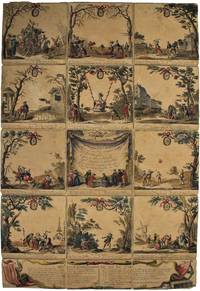
53336Paris: Crépy 1783. Original hand-coloured engraving overall 72 x 48 cm comprising 15 sections the game occupying 12 sections each 16 x 16 cm. plus 3 half-panels at the bottom for the title and rules of the Nouvelle Combinaison each 8 x 16 cm. Contemporary linen backing. Framed with museum quality glass 99% UV filter - less than 2% reflection. Easily removable from frame Joints holding although fragile wear to corners minor loss to inside margin of lower left title panel light browning a few hanging pin holes at margins. Scarce especially when coloured. Without imprint or date as normal. The 12 panels depict 12 traditional games La Main Chaude Le Balon La Crosse etc which follow the 12 months of the year. Rules for advancing around the board underneath each illustration and a second method of playing in the bottom three panels. [Paris: Crépy, 1783]. unknown
63499Romae Rome: Ex Typographia Medicea 1619. Folio 33.5x21 cm. pp. 4 9-462 2 with at recto the printer's letter repeated with the date of the 1591 original edition blank at verso. Contemporary green vellum spine with raised bands and gilt-decorated compartments red Morocco label marbled endpapers edges dyed red. Title printed in red and black with Medici's woodcut coat-of-arms printer's advice "Typographus lectori". With 149 text woodcuts by Leonardo Parassole c.1570-c.1630 after Antonio Tempesta 1555-1630 their monograms appearing on a number of the illustrations. The woodcuts are remarkable examples of Tempesta's work notable for their clarity of composition and their didactic narrative of the episodes depicted. Ex libris Luigi Bossi Milan 1758-1835 with his engraved heraldic bookplate to front pastedown along with T. Fenteman & Sons Leeds booksellers label to upper corner. Title-page lightly browned boards faded and discoloured some occasional light toning generally a very good copy printed on thick paper the woodcuts in strong impressions throughout. Rare 1619 reissue or of the original 1591 stock of the Arabic Medicean Gospels. The text lines are almost identical with those of the Arabic issue but now have an interlinear Latin version added which was prepared by Antonius Sionita. In 1584 the last year of the papacy of Gregory XIII who had constantly endeavoured to effect a union between the Church of Rome and the eastern Christians Cardinal Ferdinando de' Medici the brother and later the successor of the Grand Duke of Tuscany founded a printing press in Rome with a vast selection of oriental types cut by the French typographer Robert Granjon. Run by a versatile orientalist Giovan Battista Raimondi the press had various aims. One was to produce propaganda which would attract the eastern Christians to Roman Catholicism. Another was to corner the publishing market in an area where typography was prohibited and to make a financial profit from the sale in the east of books printed in Arabic. The third aim was to further European knowledge and to provide good editions of Arabic versions of certain standard non-religious texts. These included the writings of Avicenna al-Idrisi's geographical compendium al-Tusi's adaptation of Euclid's text on geometry and various works on Arabic grammar and syntax. The first major publication was the 1591 edition of the Gospels. This copy has an interlinear Latin translation but the work was also issued solely in Arabic. It contains 149 fine woodcut illustrations made by Leonardo Parasole mainly after designs by one of the best known Florentine artists of his day Antonio Tempesta who owed much of his fame to the frescoes he painted in the Vatican and in a number of Roman palaces. The woodcut in the Gospel of St Mark of the presentation of the head of John the Baptist to Salome Mark 6:28 by a man in Turkish dress reminds us of the common association between the great enemy of Christendom in the sixteenth century and the ancient heathens. The Arabic text is printed in Robert Granjon's famous large fount generally considered the first satisfactory Arabic printing type; as all early printed editions of the Arabic Gospels it is based on the Alexandrian Vulgate cf. Darlow/M. 1636. The Latin version is by Leonardo Sionita. The work begins with page 9 without a title-page or any preliminary matter at all: "the intended prefatory matter was apparently never published" Darlow/M. Darlow & Moule 1637 & 1643; Schnurrer Bibliotheca arabica 318; Brunet II 1122-23; Graesse II 531 Romae [Rome]: Ex Typographia Medicea, 1619. hardcover
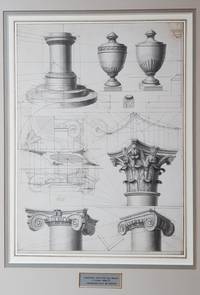
17753622n.p. n.p. n.d. pre-1775 1775. Original drawing of classical capitals and urns with lines of perspective. Pen and brown and black ink pencil and grey wash on laid paper without visible watermark ruled border in brown ink. Sheet 302x218mm window mount 350x275mm. Very slight soiling and foxing but overall in excellent condition. A very good and rare example of a study for an important book on perspective. � In 1775 Thomas Malton the Elder 1726-1801 published A Compleat Treatise On Perspective In Theory and Practice; on the True Principles Of Dr. Brook Taylor. This drawing is a preliminary study for plate XXII from this book. Such drawings are rare; the last to appear before this one was sold at Christie's in 2011. Malton's book was important: the Royal Academy had been founded only seven years before and in its Instrument of Foundation there was a specific requirement that the art and science of perspective be taught. A Compleat Treatise was the first book to be published on the subject following the founding of the RA. Malton was perhaps making a bid for his book to be adopted as a sort of "set text" and many Royal Academicians were among the initial subscribers. It was from the outset regarded as one of the best modern books on the subject based as it was on the newest contemporary mathematical studies of perspective. The combination of science and art is captured beautifully in this drawing. Bad luck in business forced Malton to leave England to start afresh as an artist in Dublin where he died in 1801 but his influence extended well into the nineteenth century thanks to his son also called Thomas and to Turner's use of A Compleat Treatise in his own lectures at the Royal Academy where he was Professor of Perspective. Malton's book and drawings would almost certainly have been introduced to Turner by Malton's son in whose studio Turner worked as an apprentice in the 1780s and whom Turner regarded as his "my real master". Some of Turner's own drawings and sketches used in these lectures are held at the Tate and among them are two of the capitals from plate XXII of A Compleat Treatise whose origins can be traced back to this drawing by Thomas Malton the Elder. n.p. n.p. n.d. [pre-1775]
1801001380London: For the Author By J. Debrett 1801. 2 i-ii v-vi 1-134 plates 135-136 charts 137-144pp 6. Original boards later cloth reback with modern paper title label to spine later endpapers. Boards worn to edges and especially corners scrape to centre of lower board. Internally the front endpaper is creased light spotting to text but plates generally clean a few pages with marginal repairs one plate with marginal repairs with the repairs slightly offsetting on to the margin of another plate but generally quite bright and clean. With twenty coloured aquatint plates showing one hundred and thirty-seven coastal profiles and twenty-four tinted engraved charts on twelve pages by J. Stadler and J. Luffman after J.T. Serres. Housed in a calf backed slipcase with raised bands spine in six panels a leather title label to second panel with the remaining panels with repeated gilt tooling. J.ohn T.homas Serres was the elder son of the marine painter Dominic Serres and was "appointed draughtsman to the Admiralty being employed in making sketches of the harbours on the enemy's coast for which he had a vessel placed at his service and £100 a month. His two books are the outcome of work undertaken in this capacity: the 'Little Sea Torch' being a guide for coasting ships" Prideaux page 275. For Luffman see Worms and Baynton-Williams pages 417-419. NMM III:218; Goldsmiths 18296.1 and Abbey England 344. First Edition. Hardback. Good. Illus. by Stadler J. And Luffman J. After Serres J.T. Elephant Folio. For the Author By J. Debrett Hardcover
17205138<p><em>The World's first Global Stock Market Bubble Illustrated</em></p><p>STOCK MARKET - THE GREAT MIRROR OF FOLLY. Het groote Tafereel der Dwaasheid.The great mirror of folly showing the rise progress and downfall of the bubble in stocks and windy speculation especially in France England and the Netherlands in the year 1720 being a collection of all the terms and proposals of the incorporated companies. with prints comedies and poems published by various amateurs scoffing at this terrible and deceitful trade. n.p. Amsterdam after 1720.</p><p>Folio pp. ii 25 1 52 26 29-31 thus complete 1 8 10 engraved frontispiece Muller plate No.1 title printed in red and black Cole version 2 text in double columns and 74 engraved plates 2 of them in duplicate mostly double-page and/or folding including maps portraits playing cards broadsides; text a little browned due to paper quality some foxing; plates generally clean and crisp one plate cropped at foremargin with loss of text but not to image; contemporary full mottled panelled calf spine gilt in compartments sides with rich gilt decoration head and tail of spine repaired corners strengthened; a good copy.</p><p>The classic rare literary and pictorial satire on John Law's 'system' and the wild speculation in stocks at that time. As part of Law's well-conceived plan to finance the French national debt funds were raised a portion of which was invested in the 'Compagnie d'Occident' which was given rights to exploit trade in Louisiana and Canada. The underlying plan was sound but unprecedented wild speculation sent the share price rocketing to unrealistic levels. Inevitably the 'bubble' burst; the Company was bankrupted and many investors ruined and the 'Système Law' unfortunately discredited. Law himself had foreseen the developments and had withdrawn funds from the French scheme to invest in the British South Sea affair which was being set up at that time. This 'bubble' also burst in 1720.</p><p>'Rarely does a single volume combine in itself so much economic interest. in neither of these countries France and England however did appear such a stout and extravagant piece as this Dutch volume' Cole p. 1.</p><p>Each copy of this work is unique. The number of plates varies from 60 to 90 though generally around 70 and the order of the text and the plates differs from copy to copy. The present copy has the regular plates 1-23 25 28 30-51 53-68 70 - 73 with 36 and 37 bound in twice in different places as well as the supplementary plates 1 2 4 and 5. This includes the very uncommon 'Register of all the prints' first issue with 47 prints listed and a further one added in ink and a fascinating portrait of Madame Law.</p><p>In addition to the vivid portrayals of the 'wind-trade' and stock market frenzy the double-page folding plate with playing cards known as Aprilkaart 65 and the Magic card 73 are particularly appealing. The special feature of this copy is the etched portrait of Madame Law but not with the usual richly decorated border of scrolls foliage fruits and flowers but surrounded by Callot style figures of dwarves. This border has been used on another print in the collection of de Koninklijke Bibliotheek Den Haag see BM 1868-0808-9693.</p><p>Arthur H. Cole The Great Mirror of Folly 1949; Sperling The South Sea Company 205; Kress 3217; Goldsmiths 5879; Sabin 28932; Lipperheide 3550; see Goetzmann et al The Great Mirror of Folly Finance Culture and the Crash of 1720 2013.</p>
1842001525<p>London: Longman Brown Green and Longmans 1842. 7 viii-xlviii 5 6-320pp. Later full morocco by Thomas or John Fazakerley of Liverpool with their name stamped to foot of front turn in raised bands spine in six panels title lettered directly to second panel and author to third remaining panels with double fillet border in gilt red morocco frame single fillet inner border with central heart tool and four dots upper cover with double fillet border in gilt red morocco frame with single fillet inner border hearts and dots surrounding another red morocco inner frame with central oval red morocco frame encompassing the title and author surrounded by fauna and flora in gilt lower cover with similar frames and heart and dot border single line to edges inner edges again with red morocco border and watered silk doublures and endpapers top and bottom edges gilt with gauffering fore edge gilt and gauffered with a triptych of small fore edge paintings visible of country scenes. Small repair to head of upper joint very slightly rubbed to extremities. Internally the text is lightly browned but clean. Illustrated throughout by several artists including John Bell C. W. Cope J. P. Knight Frank Stone C. Stonhouse and Thomas Webster. Book plate of Randall Moskovitz loosely laid in Weber notes that Randall Moskovitz owned other Fazakerley bindings. Thomas Fazakerley and his son John bookbinders in Liverpool were well known for their 'reliure de luxe' bindings. Weber notes that "a lot of fore-edge paintings came out of Fazakerley's bindery . Many of the Fazakerley bindings with fore-edge paintings are done on the flat or closed surface as here especially those bindings that feature a triptych . It might be added that the style of paintings does not clearly appear to differ. Carl J. Weber surmised there may have been several artists working for Fazakerley and this may be true though unproven" Weber 'Annotated Dictionary of Fore-Edge Painting Artists and Binders' page 141. First Edition. Hardback. Very Good. 8vo.</p> Longman, Brown, Green, and Longmans hardcover
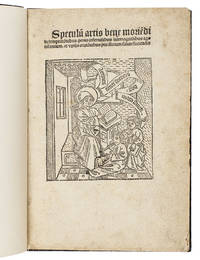
1495ABC_47543Cologne: Heinrich Quentell 1495. Recent marbled paper over boards by the Geneva bookbinder Jean-Luc Honegger b. 1953 who set up his atelier ca. 1978 signed with his honegger stamp in blue ink at the foot of the back paste-down sewn on 3 recessed supports the marbled paper in an antique spot pattern see Wolfe 162-163 with black spots on unusually fine-grained grey Stormont spots and with veins in red turquoise orange dark blue and white black morocco spine label with the title in gold roman capitals reading up the spine. Small Chancery 4to 20.5 x 14.5 cm. With a large woodcut 10.0 x 8.8 cm on the title page: depicting a teacher Pope Gregory the Great ca. 600 CE declared a saint in 1295 with a dove on his shoulder his attribute seated behind a lectern with an open book instructing two of his pupils seated before him each with a book in his hands with above them a scroll inscribed Accipies tanti doctoris dogmata sancti. Set in a single column with 36 lines to the page in a rotunda gothic type Quentell type 7 here 79G though in the Typenrepertorium 80G with a larger textura gothic for the first line of the title Quentell type 10 155G though the only capital in that line is the 8 mm lombardic initial S Quentell initials e described as 6/7 mm but noting that they are used with type 10. With spaces left for manuscript initials 1 6-line and many 3-line a few - mostly on b1v and b2r - with manuscript guide letters in black ink. Most pages with a few words underscored in black ink. Quentells second quarto edition of the well-known manual on the art of dying in the original Latin matching his ca. 1493 quarto edition almost line for line and using the same woodcut quite different from any used with this text before that date. Quentells quarto editions contain the original long version of the text known as Speculum artis bene moriendi often attributed to Matthaeus de Cracovia or Albertus Magnus editions in Italian are often attributed to Dominicus de Capranica Cardinal of Fermo. The Ars moriendi was one of the earliest incunabula printed and consists of two related Latin texts written around 1415 and 1450 offering guidance on how to have a good death according to Christian beliefs of the late Middle Ages. The texts were written in response to the Black Death and social upheavals of the 15th century with the earliest versions likely composed in southern Germany. The highly popular Ars moriendi was translated into many West European languages and was the first in a tradition of guides to death and dying. The first edition in the original Latin appeared ca. 1474 but was preceded by a German edition in 1473 and perhaps by an edition in Italian described as ca. 1471/75. Quentell published the Latin text together with other works in a folio edition described as ca. 1484/89 but he published four quarto editions of the Ars moriendi alone described as ca. 1493 the present ca. 1495 ca. 1498 and another probably after 1500. He published no Ars moriendi editions in vernacular languages. His first three quarto editions have the same collation but the present edition matches the ca. 1493 edition almost line for line and uses the same woodcut while the ca. 1498 edition differs considerably and uses a different woodcut.Heinrich Quentell one of the greatest early Cologne printer-publishers issued many theological and philosophical texts for university use but also liturgical texts working both alone and with Johann Helman who may have also jointly employed contract printers and dispatched servants to sell books. Quentell was one of the first printers to consistently provide his books with title-pages with approximately 91% of his over 380 publications including one.Quentell used the present Magister cum discipulis-woodcut in several other editions including the Heymericus de Campo Promptuarium argumentorum 1492 GW 12406 and Jacobus van Gruitrode Speculum aureum animae peccatricis 1493 GW M10728. Wynkyn de Worde used a copy in his Parabolarum Alani cum commento 1508 STC 254.3 and other printers copied it as well.All Quentells Ars moriendi editions are undated and the present one used his types 7 and 10 and initials e which all apeared in his books in the period 1488 to 1500. The present edition is probably dated ca. 1495 in the literature because it appears to fall between the two quarto editions thought to date from ca. 1493 and ca. 1498.The bookbinder Jean-Luc Honegger still active today is best known for his bindings for the Bibliothèque Nationale de France in Paris and the Bodmer Foundation near Geneva. With the bookplate of the Bibliotheca Philosophia Hermetica Joost Ritman in Amsterdam and probably bound for them. Slightly browned water stains at the foot of a few leaves not approaching the text some smudges in the margins and on the blank final page. The binding slightly worn at the extremities and with a few unobtrusive scratches on the back board. Otherwise in very good condition and only slightly trimmed about 5 mm at the head and probably no more at the fore-edge and foot giving generous margins about 2 3 and 4 cm at the head fore-edge and foot respectively and some leaves with tranchefiles at the foot.l Bibliothèque Nationale Catalogue des incunables A598; BMC I p. 294; Bod-Inc A449; Bohonos Szandorowska Incunabula quae in bibliothecis Poloniae asservantur 562; BSB-Ink A766; Buffévent VIII 45; Goff A1098; Günther Wiegendrucke der Leipziger Sammlungen 781; GW 02610; HC 14911; ISTC ia01098000; Madsen Kongelige Biblioteks inkunabler 352; Ohly-Sack 274; ÖNB-Ink A483; Pell 1339; Polain 972; Proctor 1425; Sack Freiburg 306; Sallander Uppsala 2046; Schramm VIII 484; Schreiber Manuel de lamateur de la gravure sur bois et sur métal au XVe siècle 3671; Thienen Incunabula in Dutch libraries 425; UBL-Ink A354; USTC 739947; Voulliéme Die Buhdrucker Kölns 305; Voulliéme Inkunabeln der Königlichen Bibliothek 1011; Voulliéme Trier 697. Heinrich Quentell, hardcover
196865690London, Petersburg Press, 1968. Gr.-Fol. Mit (inkl. Titel) 13 farb. Orig.-Lithographien u. einer Suite mit 6 sign. farb. Orig.-Lithographien u. 4 sign. Orig.-Radierungen. 26 nn. Bll., OLdr. (Buch), OLdr.-Mappe (Suite) u. ein Multiple (lederbezogene Reliefplatte mit dem blutenden Herz), zus. in OLdr.-Kassette (alles in rot-schwarzem Schlangenledermuster; von Rudolf Rieser).
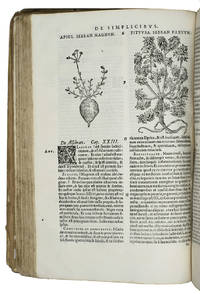
1581ABC_46255Venice: Lucantonio Giunta 1581. Near-contemporary vellum black morocco spine label with title in gold. Folio 23 x 34 cm. With 39 woodcut illustrations in the text. 2 parts in 1 volume. Second illustrated edition the first with the commentary of Costaeus of the collected works of the Arabic physician Mesue the younger also known as Masawaih al-Mardini in Latin with commentaries by Mondino de Liuzzi Christoph de Honestis Jacobus Sylvius Giovanni Mardi and Johannes Costaeus. It includes the "Canones universalis" dealing with treatment regimens; the second part "De simplicibus" about the properties of various pharmaceutical drugs; and the Grabadin "the most popular compendium of drugs in medieval Europe and . used everywhere in their preparation" Garrison. "The esteem in which these works were held is shown by the fact that a Latin translation of both was one of the first medical works to be printed Venice 1471" ibid.With the bookplate of the American botanist Edward Sandford Burgess 1855-1928 on the front paste-down. Also with the bookplate of the Horticultural Society of New York on the first free endpaper identifying this volume as part of the bequest of the American attorney and plant collector Kenneth Kent MacKenzie 1877-1934. Binding stained rubbed and chipped at the extremities. Interior shows occasional brown stains modern endpapers a little browned and brittle but overall in good condition.l Adams Y10; BM STC Italian p. 739; Durling 3131; EDIT 16 CNCE 27626. Lucantonio Giunta, hardcover
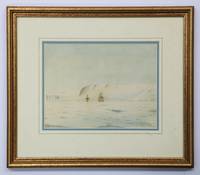
18431450501843. Watercolour. 6 x 8.15/16in. 17.2 x 22.7cm. Titled on the original detached label: Captain John Edward Davis R.N. 1815-1877; Cape Lockyer discovered by H.M. Ships Erebus and Terror January 7th 1843 Lot Essay</p><p>Davis was Second Master on Commander Crozier's Terror and a number of his drawings probably the first ever of the Antarctic continent were used by Ross to illustrate his official account of the voyage published in two volumes in London in 1847.</p><p></p><p>James Clark Ross had reached the northern magnetic Pole in 1831 and was charged by the Government following the recommendation of the British Association for the Advancement of Science and the Royal Society to lead an expedition to investigate terrestrial magnetism in the southern latitudes. The expedition was the first British exploration of the southern latitudes since Cook's skirting of the Antarctic circle in 1773-4 and the sealer Weddell's furthest south of 7415'S in 1823. Bellinghausen had probably been the first to sight the Antarctic continent in January 1820 and Dumont D'Urville then discovered Adelie Land and Claire Coast. Their work towards the discovery of an Antarctic landmass was consolidated by James Clark Ross who penetrated the pack ice in January 1841 sailing into the clear water of the unknown Ross Sea and sighting snow-covered land on 11 January thereby becoming the first to discover a sea route to the continent. McCormick on the Erebus saw and named an active volcano Mt. Erebus and Ross was the first to see and chart the South Polar Barrier which he named Victoria Barrier and which was later named the Ross Ice Barrier. He made two further navigations of the Ross Sea and Wedell Sea before returning to England in 1843.</p><p></p><p>'Jan. 7. 1843.As we advanced to the southward two high rugged bluff capes at a great distance appeared bearing W.S.W. true; the nearest of them I named at the request of Captain Crozier after his friend Captain Nicholas Lockyer R.N.C.B. Capt. Sir J.C. Ross A Voyage of Discovery and Research in the southern and Antarctic Regions during the years 1839-43 London 1847 II p.346.</p><p></p><p>For Davis's own account see his A Letter from the Antarctic London 1901 illustrated with own sketches.</p><p></p><p>For further works by Davis on the voyage see Christie's 10 April 1997 lot 95 and 17 September 1998 lot 178. 1843 unknown
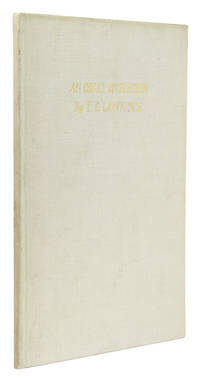
1937308243Corvinus Press 1937. No. 20 of 30 copies on J.B. Green unsized paper edition of 32. 1 vols. 4to. White linen t.e.g. others untrimmed. Fine. No. 20 of 30 copies on J.B. Green unsized paper edition of 32. 1 vols. 4to. Poet and diplomat James Elroy Flecker 1884-1915 burned bright and briefly. He joined the diplomatic service in 1908 trained for two years and was posted to Constantinople in 1910 "but in September a slight fever was diagnosed as tuberculosis and he returned to England to a sanatorium. He pronounced himself cured and . went back to Constantinople in March 1911 to be transferred in April to Beirut. Flecker was not a very efficient vice-consul" ODNB. His first formal collection of verse The Bridge of Fire was published in 1907 and The Golden Journey to Samarkand was published in 1913. He died in Switzerland aged thirty-one.<br /> Lawrence knew Flecker in Beirut before the war. "Flecker probably introduced Lawrence to contemporary poetry" wrote Wilson in his introduction to Minorities 1971. <br /> According to O'Brien An Essay on Flecker was "written in 1925 with the intention of publication in a periodical and did not appear in print until 1937". O'Brien A198; Ridler p. 58 #41 [Corvinus Press unknown
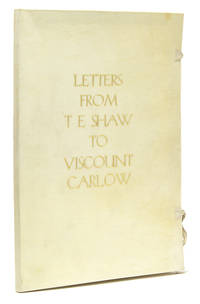
1936308242Corvinus Press 1936. No. 11 of 17 copies this copy on Milbourn hand made paper. 15 unnumbered leaves. 1 vols. 8vo. Full white vellum with yapp edges upper cover titled in gilt by Sangorski & Sutcliffe. Liddell Hart bookplate. No. 11 of 17 copies this copy on Milbourn hand made paper. 15 unnumbered leaves. 1 vols. 8vo. Inscribed to artist Eric Kennington: "EK from Carlow"<br /> <br /> Only 17 copies were printed on a variety of paper stocks for private distribution only.<br /> <br /> RARE. O'Brien A193 [Corvinus Press unknown
1682261Gibson1<p><strong>THE ANATOMY OF HUMANE BODIES EPITOMIZED. </strong></p><p><strong>First Edition. </strong></p><p><strong>Printed in 1682.</strong></p><p><strong>Complete with all 13 plates. </strong></p><p><br /><br /><br /><br /></p><p><strong>The Anatomy Of Humane Bodies Epitomized. </strong></p><p><strong>Wherein All The Parts Of Man's Body With Their Actions And Uses Are Succinctly Described. </strong></p><p><strong>Printed in 1682. </strong></p><p><strong>This is the rare First Edition.</strong></p><p><strong>This book is extremely difficult to find. </strong></p><p><br /><br /><br /></p><p>First published anonymously in 1682 The Anatomy of Human Bodies Epitomiz'd was probably the most successful English anatomical textbook published to date – it was ultimately issued in eight editions.</p><p><br /><br /><br /></p><p>Illustrated with plates.</p><p>ALL 13 PLATES ARE PRESENT.</p><p>This book is complete.</p><p>Title page imprimatur leaf containing all of the correct number of 13 engraved plates.</p><p><br /><br /></p><p>The covers are original.</p><p>The spine was rebacked in the mid 1800's.</p><p>Original title page is exceptionally well preserved.</p><p>Imprimatur leaf opposite the title page is still present.</p><p><br /><br /><br /></p><p><strong>The first edition was printed in 1682 and is unobtainable.</strong></p><p><br /><br /></p><p>In very good condition. Binding with a lot of general wear.</p><p><strong>Heavy generalized abrasion wear to the original binding. Spine rebacked in the 1800's. Title page has the date handwritten. Internally exceptionally well preserved. Minor signs of use stains an underlining. In exceptional condition despite the age. </strong></p><p><strong>Printed on quality rag paper. Paper is supple and well preserved despite the age. Printed on quality rag paper that can still be read without damaging the paper. </strong></p><p><br /><br /></p><p><strong>This was one of the most important anatomical works of this era. </strong></p><p><br /><br /></p><p><strong>Anatomy of Humane Bodies </strong></p><p><strong>Printed in 1682</strong></p><p><br /><br /></p><p><strong>The Anatomy Of Humane Bodies Epitomized : Wherein All The Parts Of Man's Body With Their Actions And Uses Are Succinctly Described</strong></p><p><br /><br /></p><p><strong>By Gibson Thomas</strong></p><p><strong>London: Thomas Fletcher. Good. Full-Leather. Small 8vo</strong></p><p><strong>First published anonymously in 1682 The Anatomy of Human Bodies Epitomiz'd was probably the most successful English anatomical textbook published to date – it was ultimately issued in eight editions. Gibson the Physician-General to the English army based his comprehensive text on Alexander Read's Manual of Anatomy. However the content was so extensively revised and supplemented Gibson claimed authorship. Gibson listed his principal sources some 33 titles by 27 authors which was an uncommon practice at the time. </strong></p><p><br /><br /></p><p>The Anatomy Of Humane Bodies Epitomized</p><p>Original leather boards; nineteenth century re backed leather spine -</p><p>Printed in 1682 by Gibson Thomas By a Fellow of the College of Physicians London Small octavo 7 3/4 by 4 3/4 inches 8 510 pages containing all of the correct number of 13 engraved plates; hardcover leather binding in original boards neatly re-backed in mid 19th century with raised bands title in gilt on spine inked name cleanly written on first fly leaf very good condition minor scuffing to base of spine minor wear to hinges hinges very strong. ESTC Nos. R 8370 & R188113 Wing 5672.</p><p>Divided into six separate sections each with their own chapters:</p><p><br /><br /></p><p>Complete in 6 books bound as one:</p><p>I. "On the lowest Cavity called Abdomen"</p><p>II. "Of the Breast"</p><p>III. "Of the Head"</p><p>IV. "Containing a description of the Veins Arteries and Nerves of the Limbs"</p><p>V. "Containing a Treatise of all the Musceles of the Body"</p><p>VI. "Of the Bones."</p><p><br /><br /></p><p>This book measures 7 3/4 inches tall.</p><p><br /><br /><br /><br /></p><p>This book will be well protected for shipping.</p><p>Your signature will be required for delivery.</p><p><br /><br /><br /></p><p>26.1</p> Thomas Fletcher
196869275London: BOAC 1968. BEATLES The. O.A.C. In-Flight Menu. London: BOAC n.d.c.a 1968.<br> <br> An autographed in-flight menu from the British Overseas Airways Corporation BOAC. The front cover is signed in black ink by John Lennon and George Harrison. The Paul McCartney autograph is actually in John Lennon's hand and Ringo Starr's is in the hand of Neil Aspinall the Beatles' long time road manager and assistant. Octavo 11 1/4 x 7 1/2 inches; 286 x 190 mm. 8 pp. Full color wrappers. Some black ink transfer on the back cover probably from another signed copy being placed underneath it. A very good example of these autographs.<br> <br> The menu for the B.O.A.C. route from Hong Kong-London via Rangoon Delhi Beirut and Rome.<br> <br> This menu is possibly from April of 1968 when John Lennon and George Harrison left India after a two month stint studying Transcendental Meditation with Maharishi Mahesh Yogi at his ashram in Rishikesh where they stayed until 12 April. Ringo Starr and Paul McCartney left before George and John in March which would explain why their signatures are produced by other people's hands. This item was sold at Bonhams Auctions in 2022. According to Bonhams "this was a gift from a First Class B.O.A.C. stewardess."<br> <br> HBS 69275.<br> <br> $10000. BOAC unknown
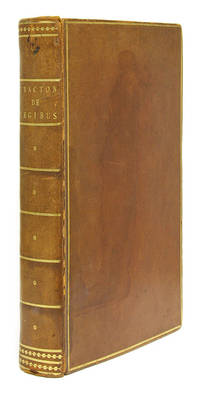
1569673671569. London 1569. First edition. London 1569. First edition. Printing and the Mind of Man 89: The "Crown and Flower of Medieval Jurisprudence" Bracton Henry de d. 1268. De Legibus et Consuetudinibus Angliae Libri Quinq; In Varios Tractatus Distincti ad Diversorum et Vetustissimorum Codicum Collationem Ingenti Cura Nunc Primu Typis Vulgati; Quorum Quid Cuiq; Insit Proxima Pagina Demonstrabit. London: Apud Richardum Tottellum 1569. xvi 444 i.e. 442 ff. Folio 11-1/4" x 7-3/4". Nineteenth-century diced calf gilt rules to boards gilt fillets ornaments and title to spine gilt rules to board edges gilt inside rules marbled endpapers ribbon marker. Light rubbing to boards faint dampstain to front board moderate rubbing to extremities front joint just starting at head corners bumped and somewhat worn armorial bookplate to front pastedown. Attractive large woodcut decorated initials. Light toning to text somewhat heavier in places light foxing and finger smudges to some leaves some fading to text of ff. 1 and 2. A handsome copy of a landmark work. $10000. First edition. Written between 1250 and 1256 De Legibus et Consuetudinibus Angliae The Laws and Customs of England is the first treatise on English law. A systematic work it emphasizes the separation of procedural and substantive matters and also cites cases as sources of at least intellectual if not formal authority. The principles formulated in this work and its use of precedents determined the development of English law and established the method adopted by Littleton and Coke. In Maitland's words it is "the crown and flower of English medieval jurisprudence" and "by far the greatest of our medieval law books.": Maitland Collected Papers II:43. Beale Bibliography of Early English Law Books T323. Printing and the Mind of Man 89. English Short-Title Catalogue S122159. unknown books
190763141Princeton NJ 1907. 4to 28 cm. 10 pages typed rectos only approximately 2850 words each leaf mounted along the left edge to a larger heavier sheet each page double-spaced with 29 separate ink corrections deletions and additions by Cleveland in his characteristic hand 44 words added 19 deleted 20 typos of poor strikes corrected; in addition there are numerous editorial marking on each page "by Grover Cleveland" is written in pencil in another hand underneath the title on the first page and "corrected by Cleveland" is written in pencil in yet another hand at the upper corner of the first page. The longest correction or addition occurs in the final paragraph where Cleveland strikes through four words replacing them with twelve. Following publication the "Youth's Companion" the essay appeared in newspapers e.g. "The Daily Republican" Monongahela Pennsylvania 25 February 1908 under the title "Our People and Our Ex-Presidents." We found one other unsigned essay by Cleveland at auction also a 10-page typescript with holograph corrections "Woman's Mission and Woman's Clubs" sold at Christie's in 2002 $8000. Very good condition throughout. 9870. An essay on the relationship between the American people and their ex-presidents by the only man who was ex-president twice. It addresses the expectations and demands the people place on their former presidents the personal financial effects these may have and the failure of the country to provide any support for them. Noting thankfully his own personally secure estate he based this one and cites specific examples of financial distress among earlier presidents. That combined with his own observations gave him concern for future ex-presidents. "If in concluding this discussion a personal word is necessary or permissible in view of the fact that I am the only man now living who could at this time profit by the ideas I have advocated I hope my sincerity will not be questioned when I say that I have dealt with the subject without the least thought of personal interest or desire for personal advantage. I am not in need of aid from the public treasury. I hope and believe that I have provided for myself and those dependent upon me a comfortable maintenance within the limits of accustomed prudence and economy and that those to whom I owe the highest earthly duty will not want when I am gone." <br/><br/> unknown books
190486033New York: Association of Edison Illuminating Companies 1904. Presumed First Edition First printing. Hardcover. Good. 211. 5 pages. Errata slip bound in after verso. Illustrations. Fold-out. Footnotes. Table of Contents is at the back of the volume. Rare connection to Edison's inner circle. Previous owner's sticker inside the front cover. Name of former owner William H. Meadowcroft !!! in ink on fep. William Henry Meadowcroft 29 May 1853 in Manchester - 15 October 1937 in Boonton New Jersey was the secretary of Thomas Edison and author of several books including The A B C of Electricity 1888. In 1875 he immigrated to the United States where he worked as a paralegal for the law firm Carter & Eaton. He was admitted to the New York State Bar Association in 1881. His collaboration with Edison began as one of the senior partners of the Carter & Eaton firm became Vice President of the newly formed Edison Electric Light Company. In 1910 Meadowcroft left the firm to succeed Frederick Miller Harry as Edison's personal secretary a position he held until Edison's death. Among the items at the Exposition are Edison "Jumbo" Steam-Dynamo Incandescent Lamps Electrical Fixture Filaments Electric Railways Lighting Plants and Lamp Factory In 1904 St. Louis hosted a World's Fair to celebrate the centennial of the 1803 Louisiana Purchase. The actual opening was delayed until April 30 1904 to allow for full-scale participation by more states and foreign countries. Many of the inventions displayed were precursors to items which have become an integral part of today's culture. Novel applications of electricity and light waves for communication and medical use were displayed in the Palace of Electricity. In order to develop a successful incandescent lamp Edison had to design an entire electrical system which he modeled after the gas lighting systems used in large cities. Gas systems included central stations underground conductors meters and lamp fixtures. In addition to these components Edison also had to design an electrical generator and the network it powered. He also planned to sell power to balance the load at his central station during the day when fewer lights were used. In order to do this he had to design electric motors and he even experimented with an electric railway. In addition he also had to develop the screw socket to hold his lamps in the fixtures and fuses to prevent electrical overloads and fires. Edison installed his first permanent central station on Pearl Street in lower Manhattan. He designed special "jumbo" dynamos for the station. The district included Wall Street and many of the New York newspapers. Before installing the station he canvassed the district he planned to light to find out how many gas and kerosene lamps were used and how much machinery could be powered by his electric motors. "This volume . is uniform in size and binding and in general make-up similar to the series of Electrical Handbooks issued under the imprint of the American Institute of Electrical Engineers in connection with the entertainment of foreign visitors to the International Electrical Congress St. Louis September 12-17 1904 and may well be considered as completing the series. it contains a series of views and descriptions of the important features of the valuable collection of 'Edisonia' brought together by the Committee in the Exhibit of the Association at St. Louis and a series of articles containing interesting historical matter in connection therewith. Much of the material in the Exhibit is of great historical value." prefatory note. Of particular interest to collectors will be a series of illustrations of early Edison light bulbs and associated apparatus. Association of Edison Illuminating Companies hardcover
1937308243Corvinus Press 1937. No. 20 of 30 copies on J.B. Green unsized paper edition of 32. 1 vols. 4to. White linen. Fine. No. 20 of 30 copies on J.B. Green unsized paper edition of 32. 1 vols. 4to. Poet and diplomat James Elroy Flecker 1884-1915 burned bright and briefly. He joined the diplomatic service in 1908 trained for two years and was posted to Constantinople in 1910 "but in September a slight fever was diagnosed as tuberculosis and he returned to England to a sanatorium. He pronounced himself cured and . went back to Constantinople in March 1911 to be transferred in April to Beirut. Flecker was not a very efficient vice-consul" ODNB. His first formal collection of verse The Bridge of Fire was published in 1907 and The Golden Journey to Samarkand was published in 1913. He died in Switzerland aged thirty-one.<br/>Lawrence knew Flecker in Beirut before the war. "Flecker probably introduced Lawrence to contemporary poetry" wrote Wilson in his introduction to Minorities 1971. <br/>According to O'Brien An Essay on Flecker was "written in 1925 with the intention of publication in a periodical and did not appear in print until 1937". O'Brien A198; Ridler p. 58 #41 [Corvinus Press unknown books
1936308242Corvinus Press 1936. No. 11 of 17 copies this copy on Milbourn hand made paper. 15 unnumbered leaves. 1 vols. 8vo. Full white vellum with yapp edges upper cover titled in gilt by Sangorski & Sutcliffe. Liddell Hart bookplate. No. 11 of 17 copies this copy on Milbourn hand made paper. 15 unnumbered leaves. 1 vols. 8vo. Presentation to Eric Kennington. Inscribed to artist Eric Kennington: "EK from Carlow"<br/><br/>Only 17 copies were printed on a variety of paper stocks for private distribution only.<br/><br/>RARE. O'Brien A193 [Corvinus Press unknown books