184 823 résultats
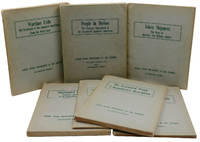
1946140941373Washington D.C.: U.S. Government Printing Office 1946. First Edition. Very Good. First edition first printings. Seven titles: Wartime Exile 167pp.; Impounded People 239pp.; The Relocation Program 105pp; Administrative Highlights of the WRA Program 82pp.; Token Shipment 104pp.; The Evacuated People 200pp.; People in Motion 270pp. Good. Wraps worn some soiled foxed chipped or stained; People in Motion has a long tear to the rear cover. Handwritten titles on spines which are also creased and chipped with loss to spine ends. Pages toned sometimes creased. <p><br /> <br /> Rare documents of the American government's official record of its WWII internment of people of Japanese descent one of the most controversial official programs in American history as reported by the War Relocation Authority. The WRA managed the forced confinement of people of Japanese ancestry in America during World War II as well as their return to civilian life with the commencement of the war. U.S. Government Printing Office unknown
1946140941373Washington D.C.: U.S. Government Printing Office 1946. First Edition. Very Good. First edition first printings. Seven titles: Wartime Exile 167pp.; Impounded People 239pp.; The Relocation Program 105pp; Administrative Highlights of the WRA Program 82pp.; Token Shipment 104pp.; The Evacuated People 200pp.; People in Motion 270pp. Good. Wraps worn some soiled foxed chipped or stained; People in Motion has a long tear to the rear cover. Handwritten titles on spines which are also creased and chipped with loss to spine ends. Pages toned sometimes creased. <p><br /> <br /> Rare documents of the American government's official record of its WWII internment of people of Japanese descent one of the most controversial official programs in American history as reported by the War Relocation Authority. The WRA managed the forced confinement of people of Japanese ancestry in America during World War II as well as their return to civilian life with the commencement of the war. U.S. Government Printing Office unknown books
193237494London England: Sir Emery Walker Wilfred Merton and Bruce Rogers 1932. Hardcover. Fine. Hardcover. One of 500 copies offered for sale of 530 copies of this monumental edition of Homer's Odyssey. The book was printed at the works of Emery Walker Ltd. under the supervision of Bruce Rogers. Walker and Rogers were two of the most influential figures in the world of books design and printing in the late 19th and early 20th century. Emery Walker 1851-1933 was an English engraver photographer and printer. Walker took an active role in many organizations that were at the heart of the Arts and Crafts movement including the Art Workers Guild the Society for the Protection of Ancient Buildings and the Arts and Crafts Exhibition Society. He also was a key figure in the world of design typography and printing in the teaching and dissemination of those crafts and in the cultural landscape of late nineteenth and early twentieth century Britain. Bruce Rogers 1870 - 1957 was an American typographer and type designer acclaimed by some as among the greatest book designers of the twentieth century. Rogers was known for his "allusive" typography rejecting modernism seldom using asymmetrical arrangements rarely using sans serif type faces often favoring faces such as Bell at the time known only as Brimmer Caslon his own Montaigne a Jensonian precursor to his masterpiece of type design Centaur. His books can fetch high sums at auction. Wikipedia<br /> <br /> In his book "Paragraphs on Printing" on pages 148-160 Rogers recounted the four year creation of the Odyssey from his asking Lawrence to translate the work to creating the perfect paper and making ink and the special gold and seven-step printing operation of the rondels. It was widely recognized that Rogers had created a masterpiece see Blumenthal Art of the Printed Book. Rogers had been inspired by his reading of "Seven Pillars of Wisdom" to persuade Lawrence to undertake this new translation. Lawrence began his work in 1928 and after some years produced a translation of the classic using his personal experience in the fog of war as well as faithfulness to the text as his guidelines.<br /> <br /> Bound in full black Niger morocco with gilt toes and lettering on the spine in gold. Printed on special paper made by J. Barcham Greem & Son in 16-point Monotype Centaur. There are 26 decorations of Homeric figures from Greek vase-paintings that are printed in black on roundels of gold leaf that at the head of each Book and on the title page. There is a two inch long ink line on the front free endpaper and the usual discoloration from the leather turns. Otherwise a fine copy. Accompanied by the prospectus. Not in original slipcase. Now housed in a very good fleece lined black clamshell box with a leather spine and black cloth covers. With a bit of scuffing and signs of handling. With an unusual Velcro closure. Measures 8.25 - 11.5 inches. Unpaginated 358 pages. PRI/092724. Sir Emery Walker, Wilfred Merton, and Bruce Rogers hardcover
48387The papers both manuscript and printed document Read's various careers in education business farming and law in Massachusetts and Maine as well as his family's activities from the decades before his marriage in 1790 through the mid-nineteenth century. Some usual attic wear and soil to a small percentage of the papers but a very good lot overall. For the archive Read's multi-faceted career began with his matriculation at Harvard 1777-1781 where he studied for the ministry and became such a well-regarded Hebrew scholar that he was engaged to fill a teaching post in the subject while still an undergraduate. Following his graduation Read taught school for two years before being elected a tutor at Harvard; he resigned that position in 1787 to begin the study of medicine eventually leaving that field behind to open an apothecary shop in Salem. During the 1790s he invented a number of steam engine related improvements and organized the Salem Iron Factory for which he invented a number of manufacturing improvements. After serving in Congress Read moved to Belfast Maine where he served on the local bench for decades while participating in a variety of civic activities and operating his farm. He was elected to the American Academy of Arts and Sciences in 1791 and was an honorary member of the Linnaean Society of New England from 1815.<br/><br/>Included in the family papers offered here is material related directly to Read's life in Massachusetts and Maine account ledgers land surveys correspondence broadsides copies of his own publications receipts for law and medical books from Boston booksellers James White and James W. Burditt etc. approximately 85 items; a detailed view of the construction of his house in Salem Massachusetts in the late 18th-century as represented by a collection of 65 receipts most of them made out to Mrs. Elizabeth Read from a variety of contractors carpenters and other workmen on the job; manuscript and printed material related to the operation Belfast Academy including a ledger several broadsides and a variety of minutes memoranda and other instruction from the town selectmen as presented by Read approximately 25 pieces; material related to the family of Elizabeth Jeffrey Read's wife including guardianship documents and related ledgers business papers and school work 15 pieces; and material related to Read's son William J. Read including letters to his father his 1826 appointment as a Maine justice of the peace and extensive documentation of his years at Bowdoin College 1820-1823 30 items.<br/>Among the interesting items in the archive are the following:<br/>1 Three manuscript "cash books" books kept by Nathan Read in Massachusetts in the 1790s and in Belfast Maine in the 1820s and for a five year period 1836-1841.<br/>2 Three autograph letters written by Mrs. Read addressed to her husband in Washington D.C. while he was serving in Congress.<br/>3 READ Nathan. An Essay on Creation and Annihilation the Future Existence and Final State of All Sentient Beings. Belfast ME: Charles Giles printer 1845. Second edition first published anonymously in Belfast 1828. 8vo. 14 pp. With extensive manuscript additions and corrections by the author. OCLC locates two copies Harvard Bowdoin. Original plain wrappers stitched. Fine.<br/><br/>4 CONGRESS O'BRIEN Jeremiah 1778-1858 Maine Congressman 1823-1828. Discussing the limits of Congressional power in an autograph letter to Nathan Read Belfast Maine resident inventor former Massachusetts congressman signed by O'Brien 22 February 1828 at Washington. 4to. 9 3/4 x 8 inches. 4 pages one sheet of American laid paper folded approximately 775 words in ink. Folded for mailing; with its original franked envelope bearing a Washington D.C. cancellation stamp and O'Brien's red wax seal broken. Responding to a recent letter from Nathan Read and apparently differing from his viewpoint O'Brien writes primarily of dubious Constitutional grounds for congressional action on internal improvements and on education seeing both as doomed to inequity inefficiency and excessive cost: "I am not for loading the national government with subjects that can be better & more economically performed by the constituent parts of the Union." As evidence he cites an example: that of J.C. Calhoun then vice-president who had earlier let the controversial "Rip Rap Contract" as secretary of war and was accused of sharing in profits from it. The letter addresses issues of the day summarizes a portion of its author's philosophy of government and echoes arguments continued through every American era.<br/>5 DECORATIVE ARTS SILVER TYLER David. Selling tablewear to a Nathan Read in an autograph receipt signed twice 29 August 1790 in Boston for delivery of goods to Read. Half-sheet folio 8 x 8 inches. Tyler 1760-1804 worked as a silversmith and jeweler in Boston 1785-1803. Included in the order were "6 Large Table Spoons" £5 8 and "12 Small Tea Spoons" £2 along with sugar tongs a salt shovel and a pen knife.<br/>6 Two manuscript ledger books kept by Mrs. Read's guardian in the 1760s documenting his management of her assets. Such colonial records for wards are quite scarce in trade.<br/>7 Signed receipts from the following Salem Massachusetts and surrounding area artisans 1790-1793 documenting their work or sale of products in the construction of the Read's house: Sam Austin Eben. Caldwell Jno. Appleton Ezra Leavis Nath. Hopkins Peter Oliver Daniel Bancroft Wm. Phelps Abel Gardner Edward Brown Sam. McIntire "frontispiece to your house" Sam Archer Joseph Mackintire Sam Archer Nath. Knight and Nathan Putnam among others.<br/>8 At least four unrecorded broadsides a series of partly printed receipts from the financial office at Bowdoin College in the early 1820s all completed in manuscript some with extra notes and signed by John Abbot treasurer and librarian of the college an extensive file of manuscript material dealing with the founding and management of Belfast Academy in the early 1820s and a variety of other material from Nathan Read's estate papers. <br/><br/> unknown books
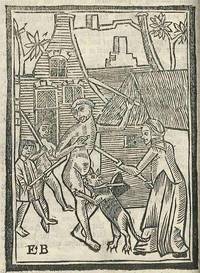
1684WRCLIT66732London: Printed by T.J. for Edward Brewster . and Thomas Passenger . 1684. Three parts bound in one volume. 80 leaves A-U4; 56 leaves A-O4; and 8160pp. Quarto. Modern blind paneled calf raised bands gilt label. First two parts illustrated with spirited woodcuts. Occasional foxing and mild spotting marginal smudges to first title usual tanning lower forecorners of E2-3 in first part torn away and replaced with a few letters and a few words in the sidenote in ms a few upper margins dust-soiled last three gatherings in third part supplied from another copy and trimmed slightly shorter at lower margin; a good sound copy neatly bound. First edition of the third part. An omnibus gathering of these three separately printed editions each with independent register and with the title of the first part taking into account the presence of the latter two. The terminal advert leaf to the first part is present. Wing attributes the text of the first part to John Shirley and that for the third is occasionally attributed to the publisher Edward Brewster. The first part is illustrated with 62 woodcut illustrations signed 'E.B.' of which 23 are repeats; the second part includes 15 woodcuts all of which appear as well in the first part. The first part was first printed in this form in 1667 and the second in 1672; the first part was reprinted again in 1701. Among the most widely adapted of the beast fables the tales of Reynard the Fox originated in the 12th and 13th centuries with early versions in French Dutch Latin and German being notable. Caxton printed a translation based on a Flemish text in 1481. The character of Reynard an anthropomorphic fox and trickster has since become almost an archetype in the literatures of several languages. ESTC R24532 & R218371 & R40614. WING S3513 & M2912 & S3436. BRUNET IV:1228. LOWNDES VII:2076. Printed by T.J. for Edward Brewster ... and Thomas Passenger ... hardcover books
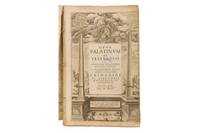
51-6356Neustadt an der Weinstrasse: Matthaeus Harnish 1596 = Excud. M. Harnisius Neostadii in Palatinatu 1596. Folio. 22.5 x 35.5cm. Near-contemporary limp vellum bookblock loose. First edition 4 parts only of 6 engraved title-page woodcut initials and tailpieces woodcut diagrams some printing in red woodcut printer’s device below colophon Vvv5r Rheticus’s name on b5 partly covered over with a contemporary slip of paper blank leaves appearing before each part except first quire P in duplicate stubs from two pairs of ties gilt edges contemporary lettering to spine and number on upper cover lacking quire L4 title-page slightly worn at extremities cut close at foredge partial library ink stamp on title-page Otho’s name at end of preface partially effaced some toning and damp staining in places throughout Q2-3 with large brown stain upper hinge broken spine with small hole and creased Title Dedication and preface by LV Otho. - Parts - II: Rheticus GJ De fabrica canonis doctrinae triangulorum. 104 recte 109 p. 1 w. sheet - III: Ill. De triangulis globi cum angulo recto. 140 right 146 pp. 2 w. ll. including 1 after p. 102. - IV: Otho LV De triangulis globi sine angulo recto libri quinque. 1 sheet 341 recte 342 p. 1 sheet with printer's mark 1 white sheet - V: Ders. Meteoroscopium numerorum primum. 121 recte 126 pp. 1 page errata.Georg Joachim Rheticus 1514-76 fellow student of Conrad Gesner and friend of Melanchthon was an enthusiastic follower and contemporary of Copernicus. This work is of great historical importance as the first trigonometrical tables ever issued. Unfortunately the work was unfinished at his death in 1574 but the publication of Rheticus’s work was accomplished by his pupil Valentin Otho in 1596. These trigonometrical tables as corrected by Bartholomaeus Pitiscus in 1613 were still in use in the early twentieth century.The mathematician and astronomer Georg Rheticus was the only pupil of Nicolaus Copernicus whose De revolutionibus he helped publish. His major work was on the study of triangles culminating in this comprehensive set of tables to be used in angular astronomical measurements; it also includes the first use of the word "cosecant". It was completed and published after his death by Valentin Otho c.1545-1603. The tables were accurate enough to be used in astronomical computation into the early twentieth century.Rheticus’s fame rests on his connection with Copernicus and his efforts to get De revolutionibus orbium coelestium published. This is the first edition of his work on triangles a set of comprehensive set of tables using all six trigonometric functions for use in angular astronomical measurements. The work was unfinished at his death in 1574 but the publication of Rheticus’s work was accomplished by his pupil Valentin Otho c. 1545-1603 eventually seeing the light of day in 1596. These trigonometrical tables as corrected by Bartholomaeus Pitiscus in 1613 were still in use in the early twentieth century.LITERATURE & REFERENCESVD16 J 278; USTC 679854 all 6 parts; OCLC Number / Unique Identifier:457809739; Cajori A History of Mathematics p. 132–â€This was indeed a gigantic work -a monument of German diligence and indefatigable perseverance ; Brunet IV 1265 ; Adams R 443 ; Honeymann 2631 ; Sotheran suppl. I 703 et suppl. II 2295 “excessively rare workâ€. Manque à Smith Rara Arithmetica. Burmeister vol. I 175-180 II pp.79-80 n°42-43. Tomash & Williams R81. Neustadt an der Weinstrasse: Matthaeus Harnish), 1596 = Excud. M. Harnisius, Neostadii in Palatinatu, 1596 hardcover
1922204721922. Full Limp Red Calf. Slipcase -- marbled paper pastedown on all sides other than opening. Chemise or inner folder -- thick glossy card stock all sides other than that has red calf with title label. Emily Swinton. Magnificent illuminated manuscript version of the Rubaiyat or some verses from the Rubaiyat. The illuminated borders are singular -- their design is unlike that we are familiar with and not even vaguely similar to anything we have ever seen produced by a latter-day illuminator professional or amateur. Their tracery is of blues greens reds some yellow in a few instances and not least the all important gilt. The illuminator surely was paying homage to some Islamic and Persian illumination in her palette but overall these sources are but influences; the illuminations are far from merely imitative. The design pulls you in and as one gazes longer one will discover small figurative imagery woven into the lines and swirls of the larger ornamentation. Words are beyond us to come close to capturing their complexity and character -- our photos hopefully will impart something of that. Let us just say the colors are deep and bold. Within these extraordinary borders is the calligraphic text rendered in a stunning easily legible Gothic Fraktur script. And there are four dream-like miniature watercolors as well of scenic Persian villages. N.d. circa early 1920s. 4to. 28.5 by 19 cm. Unpaginated 14 leaves with illumination -- illumination on one side. The back side of the leaf then left blank. Tissue guards for each page with illumination. The first leaf has no text -- it is a rectangular abstract design suggestive perhaps of a spectacular rug and inspired by such illuminated painting as one finds in many an antiquarian Koran. The next leaf is the title page with the words appearing to float on the page. The lettering has a distinctive verticality and the gilt letters are both clearly the letters they are supposed to be but have an abstraction that one can imagine they are Arabic script as well. The last two leaves with a more restrained formalistic illumination has evenly spaced dome-shaped pointers as one finds in Koranic decoration to highlight important passages. The binding slipcase and chemise are functional but don't really do the contents justice. Other than some crease marks on the calf and light wear overall to these protective features the binding and slipcase present no issues. unknown
1829129271Oriental Translation Fund of Great Britain and Ireland 18291836. Leather. Very Good. 3/4 leather over marbled boards 2 volume set. Gilt decorated 5 hub spine top edge gilt marbled end papers. Previous owner's book plate to front paste down and different previous owner's stamp to verso of the flyleaf. While VOL 1. title page indicates 1829 printing information on last page reads London: Printed by R. Watts Crown Court Temple Bar. 1833. VOL 2 respectively reads 1836 in both places. VOL 1. is the first 4 parts and is 421 pages VOL 2. parts 5-9 486 pages. Tight bindings. Please email for photos. Oriental Translation Fund of Great Britain and Ireland hardcover
1928026844Toronto Canada: The University of Toronto Press 1928. 2 volumes complete. This is an INSCRIBED PRESENTATION copy to the American inventor Thomas Edison from Canadian mathematician John Charles Fields. SEE PHOTOS. The inscription reads "To Dr. Thomas Alva Edision With the compliments of the Organizing Committee of the International Mathematical Congress of 1924 together with an expression of grateful appreciation and esteem for one whose discoveries and inventions have done so much to better and beautify the world in which we live signed J. C. Fields Chairman of the Organizing Committee." SEE PHOTOS. The ink stamp of "Thomas A. Edison Inc Research Engineering Department" appears in 3 places in each volume. Also laid in each volume is a printed slip confirming the source: i.e. from the library of Edison's youngest son Theodore M. Edison. SEE PHOTOS. There is no NOBEL PRIZE for mathematics. The closest analog is the FIELDS MEDAL for outstanding achievement in mathematics named for the editor of this set John Charles Fields 1863-1932 See Dictionary of Scientific Biography p. 617. The FIELDS MEDAL is presented only once every four years at the International Congress of Mathematicians. If you are like me you probably never heard of the FIELDS MEDAL until it was featured in the 1997 film GOOD WILL HUNTING nominated for 9 Oscars including Best Picture. It starred Robin Williams Best Supporting Actor Matt Damon and Ben Affleck Best Original Screenplay and Minnie Driver. In the movie fictional MIT professor Gerald Lambeau played by Stellan Skarsgård is described as having been awarded a FIELDS MEDAL for his work in combinatorial mathematics. Fields presented this 2 volume set to Thomas A. Edison the "Wizard of Menlo Park" and recipient of a record 1093 patents. Among Edison's inventions are the electric light phonograph movie camera vacuum diode carbon microphone the system for electric power distribution and the alkaline storage battery used for submarines and electric vehicles. In 1912 Edison designed the self-starter battery introduced on Henry Ford's iconic Model T automobile. These two volumes are uniformly bound in the original gilt stamped dark blue cloth. SEE PHOTOS. Oversize Hardcover. This extra large very heavy 2 volume set nearly 15 pounds before packaging will require SUBSTANTIAL postage that will be charged at our cost depending on destination. Signed by John C. Fields FIELDS MEDAL founder. First Edition. Oversize Hardcover. Near Fine condition. Illus. by NOT a library discard. 2 volumes: 935pp 1006pp. Great Packaging Fast Shipping. The University of Toronto Press Hardcover
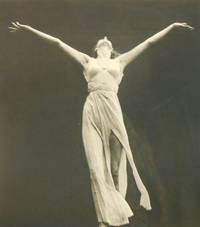
CNWT01Berkeley: Elysian Editions Wesley B. Tanner 1985. First and Limited Edition. Folio in a case. Fine. Mitchell Margaretta K. The printer's proof from an edition of fifty copies seven text pages and twelve photogravures all housed in a clamshell case. This an homage to Angela Isadora Duncan 1877-1927 and the incredible effect she had on modern dance which she initiated at the turn of the last century. <br /> <br /> She "emphasized the dynamics and rhythm of movement invoked the Greeks and refused to perform anywhere but in the sanctified halls of the opera house and concert stage. Duncan avoided all links with dance as it had been known in the nineteenth century - a 'leg business' that was titillating and low class. She remains a key figure in the history of American modern dance primarily because she established dance as a legitimate artistic practice" n.b. info and quote from the online Dictionary of American Biograpy. <br /> <br /> A native of San Francisco she spent much of her adult life in Europe and Russia. However her influence was deeply felt in the San Francisco Bay Area; an admirer and childhood friend of hers Florence Treadwell Boynton and her husband built a home in Berkeley designed by Bernard Maybeck which was named the "Temple of Wings". It was there that Florence created a dance school that adhered to her own beliefs regarding raising children with these beliefs integrated with the dance style of Duncan. Annual summer dance events were held at the Temple of Wings from 1914 through 1985 and it is this style of dance which is celebrated in this photographic portfolio. <br /> <br /> With photographs by Margaretta K. Mitchell b. 1935 whose "photographs belong to the Pictorialist tradition addressing formal concerns of line and shadow primarily in black and white" n.b. from Wiki. Her style shows in the twelve gravure plates in this work which bring to life the interpretation by Duncan and Boynton of the ancient Greek-style of dance. <br /> <br /> Issued in an edition of fifty copies plus nine copies reserved for the participants in the project this the printer's proof copy which we acquired directly from him. Somewhat uncommon in the marketplace as of this writing we see only a single other offering online; our search of OCLC locates four institutional holdings. <br /> <br /> ___DESCRIPTION: The work consists of nineteen sheets in a portfolio box the title page in blue and black four pages of Introduction this followed by the poem "The Dancer" this by the twelve photgravures with the colophon at the end the first page of the Introduction has a small photoengraved illustration printed in black there are nine continous-tone offset illustrations printed in black throughout the Introduction the twelve photogravures are all titled numbered this copy noted as "Printer's Proof" and dated by Margarette Mitchell each photogravure interleaved with archival paper for protection; types Castellar Van Dijck and Garamond on Arches paper the pages measure 19" by 15"; the box is covered in blue cloth with a white paper label mounted onto the front with blue lettering and measures 20 3/4" by 16 1/8". <br /> <br /> ___CONDITION: The text pages and photogravues all fine clean and without wear; the box near fine strong and sturdy but with a few spots of soil and a few areas of light wear including a small tear to the cloth at the bottom of the front of the box. <br /> <br /> ___CITATION: The Book Club of California Quarterly Newsletter Vol. LV Number 4 Autumn 1990 "A Bibliographical Checklist of Wesley B. Tanner Printer" Part II p. 98. <br /> <br /> ___POSTAGE: Please note that this is an extremely large and heavy item and additional postage may apply please inquire for details. International customers also please note that any taxes duty or tariffs charged by your country will of necessity be your responsibility. <br /> <br /> ___Swan's Fine Books is pleased to be a member of the ABAA ILAB and IOBA and we stand behind every book we sell. Please contact us with any questions you may have we are here to help. Elysian Editions [Wesley B. Tanner] unknown
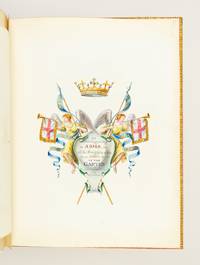
1844ST17129-034London: Illuminated and published by A. Prichard Harrison and Son 1844. FIRST EDITION. 284 x 225 mm. 11 1/8 x 8 3/4". 17 printed leaves preceded by 3 leaves and followed by 44 leaves of illuminated manuscript. <br/> Handsome contemporary crimson straight grain morocco by C. Cross Binder to the Queen stamp-signed on verso of front free endpaper covers with gilt French fillet border raised bands flanked by multiple plain gilt rules spine with gilt titling turn-ins densely gilt marbled endpapers all edges gilt. With illuminated gouache title page and dedication EIGHT FULL-PAGE GOUACHE ILLUSTRATIONS including a dramatic depiction of St. George slaying the dragon AND 37 LEAVES EMBLAZONED WITH 726 COATS OF ARMS ALL OF THE ILLUSTRATIONS DONE BY HAND AND HEIGHTENED WITH GOLD. Front pastedown with engraved armorial bookplate of Henry Drummond and with a manuscript letter to Drummond from A. P. Harrison postmarked 1844 tipped in at front. ◆A few very faint scratches on back cover the printed portion with faint overall browning because of paper stock used otherwise A SUPERB COPY the attractive binding quite lustrous and virtually unworn and the illuminated portion with its brilliant colors and gold entirely intact.<br/> <br/> This is an exceedingly rare and beautifully executed item that combines a printed list with a group of full-page paintings and the hand-painted arms many of them minutely figured of those personages who from its founding by Edward III in 1348 through 1844 had been elevated to membership in the Order of the Garter. Inclusion in this order of chivalry is the highest of the honors bestowed by the British sovereign and is restricted at any given time to just 24 persons. Members include those chosen for their distinctive services to the crown as well as supernumerary members encompassing the British royal family and foreign monarchs. There are 719 members listed in the register here and an additional seven knights and their shields are added on the final illustrated page of the register. In 2008 Prince William became the 1000th Knight of the Garter. The name of the order according to tradition is taken from an incident at the court of Edward III in which the Countess of Salisbury lost one of the garters holding her hose to the amusement of onlookers. The king gallantly retrieved it and tied it to his own leg chiding the courtiers "Honi soit qui mal y pense" "Shame upon him who thinks evil upon it" which became the motto of the order. Our volume in addition to depicting the coats of arms of all recipients of the order through 1844 contains full-page illustrations of the insignia of the order a blue garter with the motto emblazoned in gold encircling the arms of England and surmounted by a coronet of St. George patron saint of the Order and of England slaying the dragon the badge and collar worn by Knights of the Garter on formal occasions a portrait of Edward III after that in St. George's Chapel and a knight of the order in full regalia including the garter worn below the left knee. This appears to be a most unusual item: we could find no copies listed in OCLC or ABPC and only one in COPAC the UK's National Academic & Specialist Library Catalogue. A later version was issued by publisher J.C. Hotten in 1872 but even that is located by OCLC in only six libraries. Our copy comes from the collection of and may have been specially prepared for Henry Drummond English banker politician and writer whose related work "Histories of the Noble British Families with Biographical Notices of the Most Distinguished Individuals in Each" was published by Pickering in 1842-46 in two giant folio volumes. Illuminated and published by A. Prichard Harrison and Son unknown
1915ST17129-042Chicago: Written and Illuminated for The Renaissance Society ca. 1915. 216 x 153 mm. 8 1/2 x 6". ii 28 pp. 1 leaf colophon. Single column 18 lines in an attractive calligraphic hand. <br/> VERY PRETTY VIOLET CRUSHED MOROCCO GILT AND INLAID for The Renaissance Society stamp-signed in gilt on front doublure smooth spine with gilt titling FULL MOROCCO DOUBLURES consisting of a green morocco panel framed by purple morocco with gilt dots and scrolling floral motifs at each corner each with an inlaid white morocco flower cream-colored watered silk endleaves. In a lavender buckram chemise and matching purple morocco-backed slipcase with raised bands and gilt lettering. With many one-line initials in pink each leaf with a different two- to four-line initial in a different style with both painted and gilt elements and exuberantly decorated most leaves with a panel or "L"-shaped border ranging from simple lines to elaborate decorative bars a few borders with small landscapes and a total of FOUR FIGURAL SCENES decorative title page with colorful initials lettering and decorative flourishes text beginning with A HALF-PAGE MINIATURE OF ST. JEROME AT HIS DESK surrounded by A FULL BORDER of flowers gilt detailing and stylized heads of putti all by Louis Bauhan. Front free endpaper with bookplate of Phoebe Boyle. Leather with a slight chalky appearance silk endleaves starting to fray at fore edge a few leaves with a hint of waviness but THE MANUSCRIPT IN BEAUTIFUL CONDITION the vellum entirely clean and the paint especially bright and fresh.<br/> <br/> Exuberantly decorated by a major illustrator of the period this manuscript was commissioned and bound for The Renaissance Society of Chicago before making its way into the superb collection of American bibliophile Phoebe Boyle. The text here comes from a poem by "Atlantic Monthly" writer and editor Thomas Bailey Aldrich 1836-1907 imagining the agony and the ecstasy of St. Jerome as he sat down to write his translation of the Bible. The illumination though certainly inspired by the decorative programs of Medieval manuscripts is decidedly modern in appearance drawing on the Art Nouveau movement and utilizing bold color combinations and whimsical design motifs. It is not clear why the illustrator here Louis Bauhan 1855-1941 has used the ananym "Siuol Na-Huab" because there is no reason to hide responsibility for producing the clean elegant script the imaginative marginal decoration and the finished human and animal images that enliven the manuscript. Bauhan was a very successful painter and illustrator perhaps best known to the public as art editor of "Cosmopolitan Magazine" under John Brisben Walker who edited and published the magazine from 1889 to 1905. In 1881 Bauhan helped to found the Kit-Kat Club of New York a bohemian artists' and cultural association; he was persistently in demand as a book illustrator; and among other things he painted landscapes and portraits in oil. The colophon here states that the manuscript was written and illuminated for The Renaissance Society--an artistic group associated with the University of Chicago whose mission was to cultivate and promote modern art--and it was given an appropriately luxurious binding by the same organization. The manuscript was obviously valued highly enough to join the collection of Phoebe A. D. Boyle a client George Sutcliffe described as "rivalling the Medici in her patronage of the production of beautiful books." Shepherd "The Cinderella of the Arts" p. 63 Stephen Ratcliffe describes the Boyle collection as "unrivalled" for its jewelled bindings and modern illuminated manuscripts and any book from the Boyle collection which was put together with the greatest taste and discrimination is recognized as desirable beyond its intrinsic literary merit. Written and Illuminated for The Renaissance Society unknown
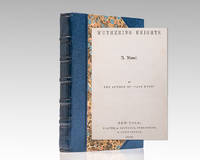
1848151936New York: Harper & Brothers Publishers 1848. First American edition of Emily Brontë's singular masterpiece preceding the Boston edition of the same year and published less than five months after the virtually unobtainable English edition. Octavo bound in three quarter morocco over marbled boards with five raised bands to the spine all edges marbled. The first English edition was published by Newby in 1847 as a three volume set that included Anne Brontë's Agnes Grey. In near fine condition. A very sharp example. "Like Poems Wuthering Heights was presented to an uncomprehending public without preface introduction or explanation and it was left to Charlotte ever her sister's apologist to insist that it was simply a tale of 'the wild moors of the north of England'… There was a constant litany of complaint about the brutality and violence of some of the scenes particularly involving Heathcliffe and about the use of expletives which contrary to custom Emily had written out in full rather than indicated by a dash… An American reviewer wrote in the Literary World: 'Fascinated by strange magic we… are made subject to the immense power of the book… we are spell-bound we cannot choose but read'" Barker 502 539-40. "Wuthering Heights stands alone as a monument of intensity owing nothing to tradition nothing to the achievement of earlier writers. It was a thing apart passionate unforgettable haunting in its grimness… Bronte has a sure and certain place for all time" Britannica. Although the title page of the 1848 Wuthering Heights states "By The Author of 'Jane Eyre'" it was of course Emily's older sister Charlotte who authored Jane Eyre. Not until the famous "Biographical Notice of Ellis and Acton Bell by Charlotte Bronte" in 1850 did Charlotte clearly address the matter of the pseudonyms and the true authorship of the works: "It has been thought that all the works published under the names of Currer Ellis and Acton Bell were in reality the production of one person…On this occasion…I am advised distinctly to state how the case really stands." The first London edition was published December 4 1847; this edition was published April 21 1848 simultaneously as two parts in wrappers and as a single clothbound volume. Emily died one year following her only novel's publication. Harper & Brothers, Publishers hardcover
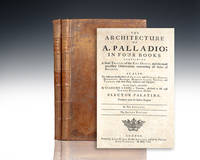
1721146284London: Printed by John Darby for the Author 1721. Rare second English edition of Leoni's English translation of Palladio's monumental work containing new typesetting but reusing the same plates from the first edition. Folio two volumes bound in full contemporary polished calf with gilt titles and ruling to the spine in six compartments within raised bands double gilt ruling and decorative stamping to the front and rear panels engraved frontispiece portrait of Palladio illustrated with 104 numbered engraved plates on 203 leaves including 15 double-page plates as well as 12 engraved in-text plates. Armorial bookplate to the pastedown of each volume. In very good condition. One of the giants of Venetian Renaissance architecture of the 16th century Andrea Palladio based his designs on the values of Greek architecture and the traditions of Roman architecture as outlined by Vitruvius. He is regarded as one of the greatest architects in the history of Western art best known for his villas in the Veneto as well as his palaces Vicenza and churches Venice all located within the Venetian Republic. His architectural theories were laid out in his treatise Quattro Libri dell Architettura The Four Books of Architecture which had a profound impact on building design throughout Europe and America. His style of architecture - a blend of Greek Roman and Renaissance art later known as Palladianism - accorded the greatest priority to maintaining symmetry perspective and overall harmony in the manner of Greco-Roman temple architecture and was widely imitated during the 17th and 18th centuries. Printed by John Darby for the Author hardcover
196283782New York: Duell Sloan and Pearce 1962. First edition of this early biography of The Dalai Lama. Octavo original cloth frontispiece. Signed and dated in the year of publication by His Holiness The Dalai Lama on the front free endpaper. Laid in is a note to the recipient on official Tibetan letterhead from the private secretary to the Dalai Lama stating that The Dalai Lama has signed this copy. Also inscribed on the half-title page by the author "With warmest regards and best wishes to Kenneth Crouch- and with a special salute from- Lowell Thomas Jr. Dec. 14 62." Near fine in a very good dust jacket with some tape to the exterior. Jacket design by Gary Gore. Contemporary signatures of His Holiness are scarce. Housed in a custom half morocco clamshell box by the Harcourt Bindery. Rare and desirable signed. Recognized at the age of two as the reincarnation of the Thirteenth Dalai Lama Tenzin Gyatso was brought to Lhasa the capital of Tibet and enthroned two years later as the fourteenth Dalai Lama. In 1959 following the Chinese suppression of the Tibetan national uprising he was forced to seek asylum in India. As Tibet's leader-in-exile he has worked tirelessly not only on behalf of the Tibetan people but as a voice for human rights worldwide. Duell, Sloan and Pearce hardcover
190781312chscToronto: The Champlain Society 1907. Book. Very Good. Hardcover. 8vo - over 7¾ - 9¾" tall. 111 volumes a complete series except for several of the most recent titles published 1907-2015. The first two volumes show some wear at the top of the spine but otherwise these are all certainly at least very good with most near fine or better and all collating complete including the portfolio in the seven-volume Champlain series. Some surface scratching to the rear cover cloth of the David Thompson volume Varied toning and handling and fading to spines; some toning to edges. Clean tight and otherwise unmarked. Very neat -- a sound and handsome set. The earliest volumes until the early 1940s show the bookplate of Edwin Stanton Fickes American engineer industrialist and collector of Canadiana. In the 1920s Fickes built a large home at Annapolis Royal in Nova Scotia. After his death the accumulated Champlain Society volumes were acquired by Canadian medical scientist Charles H. Best whose bookplate is set to the front free endpaper in each volume. The Champlain Society Hardcover
17016399London: T. Ilive 1701. Early English editions. Bound together with:<br /> <br /> The Most Pleasant and Delightful History of Reynard the Fox. The Second Part. Containing Much Matter of Pleasure and Content. Written For the Delight of young Men Pleasure of the Aged and Profit of all. To which is added many Excellent Morals. London: Printed by A.M. and R.R. for Edward Brewster 1681.<br /> <br /> And:<br /> <br /> The Shifts of Reynardine The Son of Reynard the Fox Or a Pleasant History of His Life and Death. Full of Variety &c. And may fitly be applied to the Late Times. Now Published for the Reformation of Mens Manners. London: Printed by T.J. for Edward Brewster and Thomas Passenger 1684.<br /> <br /> Three parts in one small quarto volume 7 5/16 x 5 9/16 inches; 186 x 141 mm. 156 2 table of contents 2 publisher's advertisements; 111 1 publisher's advertisements; 8 160 pp. Mostly black letter with titles and side notes in roman letter. Sixty-two woodcuts in the first part printed from thirty-nine blocks and fifteen woodcuts in the second part five repeated all repeats from the first part. Most cuts signed "E.B." Edward Brewster. Woodcut on C1 recto Part I printed upside down. Some browning occasional light damp staining and soiling. Part I with tiny puncture marks in the lower blank margin through gathering I just touching one letter in the imprint on the title-page six small holes in I3 and one tiny hole in I4 causing loss of a couple of letters. Part III with paper flaw in the upper blank corner of A3 and A4 tiny tear 1/4 inch in the lower blank margin of F4 and paper flaw in the lower blank corner of I2 none affecting text. Contemporary sprinkled sheep. Covers ruled and decoratively tooled in blind spine decoratively tooled in gilt in compartments with two red morocco gilt lettering labels. Some expert restoration to joints and corners. Armorial bookplate of Gloucester on front free endpaper. Bookplate of Hugh Cecil Lowther 5th Earl of Lonsdale 1857-1944 on front pastedown his sale 12 July 1937 lot 445. An excellent copy. Housed in a felt-lined quarter brown morocco clamshell case spine with five raised bands decoratively tooled and lettered in gilt in compartments.<br /> <br /> Reynard the Fox "hero of several medieval European cycles of versified animal tales that satirize contemporary human society. Though Reynard is sly amoral cowardly and self-seeking he is still a sympathetic hero whose cunning is a necessity for survival. He symbolizes the triumph of craft over brute strength usually personified by Isengrim the greedy and dull-witted wolf. . The main literary tradition of Reynard the Fox descends from the extant French 'branches' of the Roman de Renart about 30 in number nearly 40000 lines of verse. The facetious portrayal of rustic life the camel as a papal legate speaking broken French the animals riding on horses and recounting elaborate dreams all suggest the atmosphere of 13th-century France" Merriam-Webster's Encyclopedia of Literature. There is some variation in chapter number within the early editions: From "Caxton's first edition 1481 to Thomas Gaultier's only edition 1550 the story is divided into 43 chapters" while the anonymous edition 1560-1585 has 58 chapters Varty. By the 17th century when the text is titled The Most Delectable History of Reynard the Fox it appears with only 25 chapters and maintains its image cycle. Early 17th century editions also maintained this "picture cycle" through Edward Brewster's 1662 edition but at this point the Wynkyn de Worde blocks were extremely worn and new set was created Varty. Forty images were used for his second edition 1671 and all contain his initials EB. "He published further illustrated editions in 1676 1681 1694 and 1701. in 1672 he grafted new life onto the old story with A Continuation Or Second Part of the Most Pleasant and Delightful History of Reynard the Fox" Varty for which he eventually created an additional 15 illustrations. In 1684 he would produce an additional sequel following the adventures of Reynard's son Reynardine. <br /> <br /> Brunet IV cols. 1228-1229. Lowndes p. 2076. Varty Appendix Three: "A Short-Title List of All Extant Illustrated Histories of Reynard the Fox from Wynkyn de Worde c. 1495 to A. Soulby c. 1800 which are kept in United Kingdom libraries based on H. Menke Bibliotheca Reinardiana" 24 18 and 21. Wing S3512 Part II and S3436 Part III. T. Ilive unknown
1920156585Paris: N.p. 1920. Collected archives of 40 vintage photographs of notorious vaudeville performers Rosie and Jenny Dolly known professionally as The Dolly Sisters taken throughout the 1910s and 1920s. Consisting of ten small archives of photographs assiduously assembled over a period of time with multiple photographers' stamps and signatures on the versos and rectos respectively. <br /> <br /> The collection represents a veritable who's who of portrait photographers of the early twentieth century including Walery Ruben Sobol Apeda Studio The Campbell Studio Frank Foulsham and A.C. Banfield Ira D. Schwarz and James Abbe. Many have been SIGNED directly by the photographers in manuscript pencil on the rectos in addition to the photographer's stamp on the verso. Five photographs note the name of Paris Plaisirs an early French music and dance magazine on the bottom right corners of the rectos. <br /> <br /> Especially notable in the collection is a photograph credited to Walery that has been INSCRIBED by the sisters on the bottom right corner of the recto: "To Charlotte with good wishes / Dolly Sisters."<br /> <br /> The collection spans the 1910s and 1920s the height of the sisters' popularity with photographs of the pair in the studio onstage and at home although the balance show the sisters performing sporting a variety of outlandish bedazzled costumes. One striking photograph taken to promote the 1916 play "His Bridal Night" shows the sisters with long dark hair about four years before they got the bobbed haircuts for which they became known. The collection also includes several photographs of the sisters at home together evidently taken around the holidays sitting in front of the Christmas tree applying makeup at a large vanity mirror and relaxing with their pets. <br /> <br /> Born in Hungary in 1892 twin sisters Jancsi and Roszika Deutsche moved to America with their family in the early 1900s. Urged on by their mother a former dancer the twins began their performing careers in Boston in 1906 at the age of 13 a performance that purportedly earned them the sobriquet "The Dollies" for their delicate features and perfectly matched proportions. The nickname stuck and the pair would rise through the vaudeville and Broadway ranks as teenagers eventually Americanizing their names to Jenny and Rosie. By 1911 the twins were star attractions in the Ziegfeld Follies aided more by their vampish good looks lively personalities and glamorous personas than any uncommon theatrical talent. <br /> <br /> The sisters would go on to make a fortune touring famed European dance halls and appeared in a few early silent films but quickly realized that engaging the interests of wealthy lovestruck benefactors was a far easier and more rewarding way to earn a living. Rosie and Jenny kept an awe-inspiring string of wealthy patrons in their back pockets including Daily Express owner Max Beaverbrook Diamond Jim Brady William Randolph Hearst and The Prince of Wales. In 1922 the sisters signed a six-week contract to appear at the Hotel Royal in Deauville where their nightly scores at the casino tallied in the millions launching an insatiable appetite for gambling. Their excursions to the casinos at Cannes and Deauville were legendary largely funded by department store magnate Harry Selfridge. <br /> <br /> As the Jazz Age progressed into the Great Depression the sisters faced a slow decline in popularity losing both lovers and husbands while their business ventures began to fail. In 1933 Jenny's face and body was mutilated in a car accident after which she sold her vast jewel collection and burned through her fortunes in an attempt to repair her appearance through costly medical operations ultimately committing suicide out of despair in 1941. Two years later Rosie made $52500 by selling the rights to a film adaptation of their lives starring Betty Grable and June Haver but the film was a failure and Rosie would attempt suicide in 1962 before dying in 1970 of heart failure. <br /> <br /> An extraordinary collection documenting the rise of two of the biggest stars of the early twentieth century perhaps the earliest celebrities to be "famous only for being famous" seen through the eyes of some of the most important portrait photographers of the period. <br /> <br /> Photographs ranging in size from 4.25 x 6 inches to 12 x 17 inches. Generally Near Fine with occasional faint age toning and brief wear at the corners. N.p. unknown
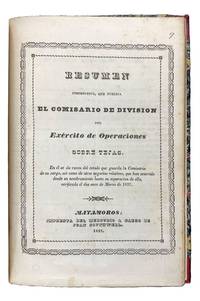
183741693Matamoros Mexico: Imprenta del Mercurio a Cargo de Juan Southwell 1837. 4to. 7 3/4 x 5 1/2 inches. 3 4-36 4. 40 pp. Engraved title-page with decorative border Resumen Instructivo Estado Table 1 by Manuel Mendiola Estado 2 by Luis Jose de la Peza and Vicente Daza. Both estados are accounting tables giving the "ingreso" income and the "egreso" expenditure of the operation. The title carries the date of 3.11.1837 while the text sections are dated 3.14.1837. With woodcut printer's device of an eagle and fleurons. Text in Spanish. Bound to style in 19th-century quarter red straight-grained morocco over 19th-century marble paper boards<br/> <br/> Provenance: Hubert Hudson Texas State Senator for Brownsville 1957-1963<br/> <br/> A rare report detailing the failed Mexican mission to rein in the Republic of Texas following the Texan Revolution.<br/> <br/> "In the fall of 1836 the Mexican government attempted with complete lack of success another expedition into Texas." Streeter "Face-saving explanation for Mexico's failure against the despised Texans in 1836-7." Howes This official pamphlet details the failed Mexican expedition into the Republic of Texas over the period of October 21 1836 to March 14 1837. Barreiro an army commissioner in charge of the operation concludes that the "ridiculo" Texan rebels were far less dangerous than the hostile desert terrain. "No es el numero del exercito de Tejas el temible. Bien despreciable y ridiculo es ese peloton de aventureros que piensan que es como andar en cacerias de fieras haberselas con veteranos valientes y aguerridos: es el clima son los desiertos horrorosos son los rios invadeables son los pantanos." It is not the number of the Texas army that is fearsome. Very despicable and ridiculous is that platoon of adventurers who think that it is like going on wild beast hunts dealing with brave and seasoned veterans: it is the climate it is the horrible deserts it is the uncrossable rivers the swamps. Texas had declared its independence on March 2 1836 a culmination of the Texan Revolution which had begun on October 2 1835. The United States did not diplomatically recognize the Republic of Texas until March of 1837 near the publication date of this pamphlet. Texas would remain an independent nation for a decade until it was annexed by the USA on December 29 1845.<br/> <br/> Howes B 170. Palau 24651. Streeter sale I 357. Streeter Texas 918. Imprenta del Mercurio a Cargo de Juan Southwell unknown
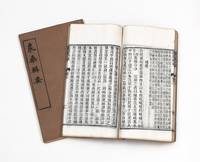
1023998; 89 folding leaves. Two vols. 8vo orig. printed wrappers orig. stitching a little loose. China: Zhong jiang que shu ä¸æ±Ÿæ¦·ç½² 1895.<br /> <br> <br> <br /> <br /> An important edition of the “earliest officially commissioned agricultural work to have survived to the present day.†The book is “essentially a practical handbook full of information on crops both old and new down-to-earth realistic and accurate†Francesca Bray Agriculture Science and Civilisation in China Vol. 6 Part II pp. 49 & 72.<br /> <br> <br> Nongsang jiyao was “issued in 1273 by the Office of the Grand Supervisor of Agriculture. It was compiled by a committee of Chinese officials who drew heavily on earlier manuals.to which they added a small amount of new data based on recent experience. For the most part the crops and techniques discussed were appropriate for agriculture in North China not the as-yet-unconquered south. Intended as an official manual for distribution to the peasant communes she to increase productivity the Nung-sang chi-yao Nongsang jiyao enjoyed considerable success going through several Yuan and Ming editions†Thomas T. Allsen Culture and Conquest in Mongol Eurasia pp. 118-19. The book was included in Yongle dadian 永樂大典 Great Compendium of the Reign of Eternal Happiness the voluminous encyclopedia produced at the Ming court in the early 15th century. The book might even have influenced RashÄ«d al-DÄ«n’s 1247-1318 important agricultural manual written in TabrÄ«z in Iran in the late 13th century.<br /> <br> <br> “This work is organized in seven untitled chapters chuan and ten sections men with the following headings:â€<br /> <br> <br> “Ch. I. 1. Words of wisdom<br /> <br> <br> 2. Plowing and reclaiming<br /> <br> <br> Ch. II 3. Scattering seed cereal crops<br /> <br> <br> Ch. III 4. Mulberries<br /> <br> <br> Ch. IV 5. Silkworms<br /> <br> <br> Ch. V 6. Vegetables<br /> <br> <br> 7. Fruit<br /> <br> <br> Ch. VI 8. Bamboo and trees<br /> <br> <br> 9. Medicinal herbs<br /> <br> <br> Ch. VII 10. Domesticated animals including fish†Allsen p. 119.<br /> <br> <br> Section 3 in addition contains oil and fiber crops and Section 10 also covers poultry raising and apiculture.<br /> <br> <br> “The quotations are attributed and arranged in chronological order; not only is Nung Sang Chi Yao thus an important source for the text of many earlier works but also it allows us to see various agricultural phenomena in a historical perspective. The original material in Nung Sang Chi Yao deals with new crops whose cultivation the government wished to encourage for example ramie from South China and cotton from Central Asia water melons and sugar-cane.†One important goal of the book was to spread sericulture in North China. The Mongol Yuan state needed silk to pay for tea imports from the Chinese south. The book “accordingly describes all the most advanced sericultural techniques.while.advocating the cultivation of alternative fibre crops like cotton or ramie which could substitute for silk within the Yuan empire. The government was largely successful in its campaign: not only did Northern Chinese silk production rise but ramie and especially cotton soon acquired an important economic role in the North†Bray pp. 71-72.<br /> <br> <br> The Office of the Grand Supervisor of Agriculture which commissioned and issued the book had been founded in 1270. Through several regional branches “the office worked with local communes she nominally fifty peasant families to improve agricultural techniques introduce new seeds and raise productivity†Allsen p. 115. <br /> <br> <br> Our edition comes with the text Can shi yao lüe è ¶äº‹è¦ç•¥ Abridged Essentials of the Matters of Silkworms in the appendix. This text was written by Zhang Xingfu å¼µè¡Œåš who was a provincial graduate and scholar in the Qing period.<br /> <br> <br> Our edition was published in 1895 Guangxu yiwei in Jianxi cunshe congke 漸西æ‘èˆå¢åˆ» Collectanea of the Village Dwelling West of the Jian River. This book series was published by Yuan Chang è¢æ˜¶ 1846-1900 a reformist official who was for several years intendant of the Circuit of Southern Anhui during which time he paid great attention to agriculture. Yuan “encouraged agriculture by teaching the farmers better methods; and conserved their land by erecting a dike fourteen li in length along the Yangtze. To this enterprise which employed some 67500 workmen he personally contributed more than 5000 taels†A. K. Ch’iu in Eminent Chinese of the Ch’ing Period Vol. 2 p. 946. The reprinting of the book makes sense in light of Yuan’s concerns.<br /> <br> <br> The basis for the reprint was the movable type juzhen èšç edition produced in connection with the Siku quanshu 四庫全書 Complete Books of the Four Repositories in the 1770s. The editors of the Siku quanshu in turn had recovered the text from Yongle dadian of which a copy was available in the imperial library.<br /> <br> <br> Very fine copy preserved in a hantao. unknown
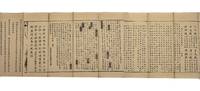
11380Woodblock-printed. 27 joined sheets numbered except 3 & 27 62.5 folding leaves red edges. Tall narrow 8vo bound between wooden boards. Hà Ná»™i: Kì vÅ© tá»± 祈雨寺 1889 date of publisher's colophon; copy perhaps printed in 1922.<br /> <BR> <BR> A beautiful and rare example of Vietnamese printing in the accordion "sutra-binding" or orihon format. We find no Vietnamese edition of this sutra in WorldCat and only the later 1906 edition is listed in the Vietnamese Han-Nom Literature Database surviving in two copies at the Institute of Hán-Nôm Studies AC.403 & 498.<br /> <BR> <BR> The Sutra of Infinite Meanings together with the Lotus Sutra and the Sutra on the Meditation of Samantabhadra Ch. Guan pu xian jing 觀普賢經 are traditionally held to constitute the Threefold Lotus Sutra wherein the brief Sutra of Infinite Meanings served as the introduction or "opening sutra" to one of the most philosophically profound and culturally influential texts in East Asian Buddhism. Although the Sutra of Infinite Meanings is considered today by many scholars to be an apocryphal text the canonical bibliography of Sengyou åƒ§ç¥ 445-518 holds that it was translated by DharmajÄtayaÅ›as sometime before 481. The identification of this sutra with a text by the same title mentioned in the first chapter of the Lotus Sutra was established by Liu Qiu 劉虬 438-95 in his 485 Preface to the sutra an identification that quickly became widely accepted in Buddhist East Asia.<br /> <BR> <BR> Like the Lotus Sutra the Sutra of Infinite Meanings emphasizes the transformative power of the Buddha's word itself which even in the abridged form of a single verse or a single line eternally delivers the hearer from the world of suffering. The belief in this teaching of the Threefold Lotus Sutra motivated centuries of Buddhist printing in East Asia. To briefly quote from the sutra's third chapter "Ten Virtues":<br /> <BR> <BR> "If living beings are able to hear this sutra though they hear only one recitation one verse or just one line and are thereby able to comprehend and master hundreds and thousands ten thousands millions of meanings then although they have earthly desires it will be as though they were free of earthly desires and they will go in and out of the realm of birth and death without thoughts of fear or dread. Toward living beings they will acquire minds of pity and tenderness and they will confront all phenomena with brave and stalwart thoughts"-trans. Burton Watson The Lotus Sutra and Its Opening and Closing Sutras 2009 p. 23.<br /> <BR> <BR> Our copy opens with the Preface of Äá»™ng Thượng Thanh Nguyên å³’ä¸Šæ¸…æº dated Gia Long 嘉隆 15 1816 followed by the dates of two reprints: Minh Mạng 明命 18 1837 and Äồng Khánh åŒæ…¶ 3 1888 the latter being carried out by the monks Thanh Äoan 清端 and Thanh NghÄ©a 清義 on behalf of their master Từ TÃnh 慈性. The printed colophon written by the artisans Nguyá»…n Văn Việt 阮文越 and Nguyá»…n Văn Giáp 阮文甲 of Thanh LÆ°u xã é’蓼社 an important center for Buddhist publishing in the Hà Ná»™i region is dated Äồng Khánh åŒæ…¶ 4 1889 and gives an exhaustive list of donors and the amounts of their donations. The colophon also specifies that Thanh Äoan and Thanh NghÄ©a come from the Kì vÅ© tá»± 祈雨寺 monastery in Hà Ná»™i province æ²³å…§çœ Hoà i Äức prefecture 懷德府 Từ Liêm district 慈廉縣 Hạ Trì canton ä¸‹æ± ç¸½ Thượng Cát commune 上葛社 and that the completed woodblocks were to be kept in this monastery. A handwritten colophon by the monk Thanh Khoan 清寬 and others from the Nam Äịnh province dates the printing and binding of this particular copy to the Nhâm Tuất 壬戌 year 1922 2951 years after the birth of the Buddha.<br /> <BR> <BR> Pristine copy.<br /> <BR> <BR> ⧠Yuenan Hannan wenxian ziliaoku 越å—漢喃文ç»è³‡æ–™åº« Academia Sinica. unknown
010941[Battle of the Little Bighorn, Bataille de Little Bighorn, Felice Orsini, Attentat contre Napoléon III en 1858, Charles Camillo De Rudio], Recueil de 9 autographes des 4 protagonistes dont Charles DeRudio qui devint officier lors de la fameuse bataille de Little Bighorn le 25 juin 1860, y survécut et dont le témoignage fut publié dès le 30 juin 1860. Reliés dans un volume in-8 avec une brochure du docteur Rougean, L'Attentat d'Orsini - étude de psychi-pathologie historique (Paris, Le François, 1934). L'attentat eut lieu le 14 janvier 1858. Felice Orsini (1819-1858), G Pieri (1808-1858), Charles de Rudio (1832-1910) & Antoine (Antonio) Gomez (né en 1825). Les trois premiers furent condamnés à mort le 26 février 1858 et Gomez aux travaux forcés à perpétuité. La peine de Rudio fut commuée en travaux forcés elle-aussi et il s'évada peu après alors qu'Orsini et Pieri furent exécutés le 13 mars 1858. Si on perd la trace de Gomez (probablement mort au bagne), Rudio arriva à Londres puis émigra à New-York. Il s'engagea dans l'armée et fait partie des survivants de la fameuse bataille de Little Bighorn (25 juin 1860). Son témoignage a été publié dès le 30 juin dans New York Herald. On compte ainsi : -2 autographes d'Orsini : une feuille de comptes et une L.A.S. à « M. Leveille, directeur de la conciergerie », en réalité Jean-François Lebel, datée du 2 mars 1858. -3 autographes de Pieri : une L.A.S., probablement jamais arrivée, au procureur général pour solliciter un rendez-vous, datée du 22 février 1858, et 2 reçus A.S. datés des 12 et 13 février 1858. -2 autographes de Gomez : 2 reçus A.S. datés des 9 février et 1er mars 1858. -2 autographes de Rudio : 2 reçus A.S. datés des 12 et 13 février 1858. Reliure demi-chagrin. Exceptionnel ensemble, extraordinaire même par la réunion des 4 protagonistes de l'attentat et par la présence même d'autographe d'un des protagonistes de Little Bighorn, évènement d'une importance capitale dans l'histoire des USA.
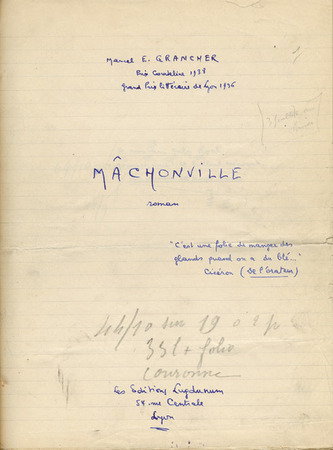
19425627et qui paraitra sous le titre définitif "Le Charcutier de Machonville", par Marcel-E. Grancher, auteur lyonnais, journaliste, écrivain, un des principaux chefs de la Résistance à Lyon pendant l'Occupation allemande. In-4 ; demi-maroquin bordeaux, dos à nerfs, titre doré, non rogné ; (3) ff., 230 feuillets recto, à l'écriture bien lisible.Il s'agit du manuscrit brut, rempli de ratures, rajouts, modifications diverses y compris de bandes collées, du plus célèbre roman de Grancher, Grand Prix littéraire de Lyon en 1936 et Prix Courteline en 1938 ; il est daté de "Reyrieux, janvier 1942" et est émaillé d'indications typographiques. Comme il ne s'agit pas de la "mise au propre", il serait intéressant de comparer précisément ce texte avec celui finalement publié.Mention manuscrite sur la page de garde : "J'ai relié ce livre pendant la guerre de 40, le client ne m'a pas donné son nom ni adresse, je le tiens donc à sa disposition. Signé H. Jacquet, relieur 7, rue des Marronniers. Lyon".Document en très bel état.
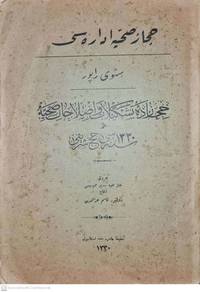
1914000179Ottoman Turkish official report about the Hijaz health rules and organizations with several illustrations of Jeddah and Mecca. Amira , government press paperback
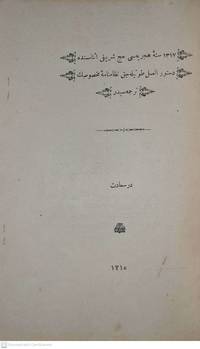
1900000208<p>19 p. Ottoman Turkish text. Official report of the hajj and health quarantine law in 1889-1900. Consists of 20 articles. The Anglo-ottoman Hajj policy conflict. Rare.</p> Osmaniye press paperback