184 824 résultats
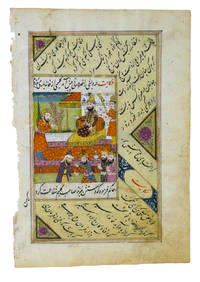
1950ABC_47136Cleveland Ohio: Cleveland Institute of Art or Western Reserve University 1950. Publishers original portfolio 48.5 x 34 x 4.5 cm covered with black cloth with on-lays in black and red on the front and the authors name in white and title in red on the spine with three pairs of black ties one on the inside and a label on the inside of the right black flap giving information about the limited edition: "Edition limited to forty numbered sets of which this is No 33". 15 manuscript leaves in one case a fragment of a scroll of various formats and sizes some glazed see the detailed list of contents for specific dimensions 7 written on straight-forward laid paper European and non-European 6 more problematic probably all non-European 1 on straight-forward wove paper no. 14 supposedly made in Russia and one on vellum no. 7 most rubricated and/or decorated in various colours some decorated or highlighted in gold. Each manuscript leaf is mounted hinged on one edge to allow access to both sides of the leaf in a passe-partout 46.5 x 33 cm and each has a letterpress slip 10 x 18 cm with explanatory text tipped onto the foot of the passe-partout. The publication has no title-page but includes a letterpress folio leaf that serves as a table of contents and has the drop-title given above the present copy contains two copies of that contents leaf. The display typeface used in the letterpress leaves and on the portfolio is the 1938 Libra by the Dutch designer Sjoerd de Roos inspired by uncial manuscripts. Copy number 33 from a limited edition of 40 of Eges famous portfolio containing a collection of 15 leaves from oriental manuscripts written between the 12th and 18th centuries. The press run had to be limited because some of the manuscripts probably had no more than about 40 leaves.Otto Frederick Ege 1888-1951 was the dean of the Cleveland Institute of Art a lecturer on the history and the art of the book at Western later Case Western Reserve University in Cleveland and a famous or infamous biblioclast. He was one of the key figures in creating a market for medieval manuscript leaves in America during the 20th century. Between 1917 and his death in 1951 Ege acquired broke up and subsequently dispersed hundreds of medieval and other interesting manuscripts and early printed books wanting to give as many private collectors and public institutions as possible the opportunity to own these individual leaves. He was convinced that his purpose of inspiring as many people as possible by bringing them in contact with historical and artistic heritage justified the means of scattering the manuscript leaves. In fairness to Ege these were almost certainly incomplete manuscripts to begin with though one could wish he had provided a detailed description of each manuscript before breaking them up and disbursing them and his publications did make them available albeit in the limited form of a single leaf to a much greater audience than could have hoped to see let alone own original manuscripts of this sort. Fortunately people are now more reluctant to break up early manuscripts but that also means that similar publications are less likely to appear in the future. Beginning in the 1940's Ege compiled his most famous portfolios as two limited editions in press runs of 40 copies each: one portfolio with western medieval manuscript leaves and the present one with 12th to 18th century oriental manuscript leaves.The present portfolio includes leaves from 15 manuscripts produced from the 12th to the 18th century in Egypt Iran the Byzantine/Ottoman Empire Persia/Iran Russia Tibet and other places. These mainly religious texts were written in several different languages including Arabic Syriac Armenian Ethiopic Persian Tibetan Greek and Church Slavonic. Two of the fragments one in Greek and one in Church Slavonic even include music notation neumes. Although the publication names no publisher and gives no date of publication Ege compiled it himself and wrote the notes about each manuscript leaf but it is said to have been published after probably soon after his death in 1951 the description of Ege as late dean of . is slightly ambiguous but may indicate that he had died. His brief notes on the manuscripts lack many details and are often not reliable particularly the dating so we have tried to make some additions and corrections in our detailed list of the contents. One of the Cleveland institutions where he worked probably published the portfolio. It is listed in the National Union Catalog of pre-1956 imprints. As Ege intended many of his portfolios and other fragments were sold and distributed worldwide. Beinecke Rare Book & Manuscript Library at Yale University acquired his personal collection including 50 unbroken manuscripts for their special collections in 2015.A detailed list of contents is available upon request.The portfolio the two copies of the contents leaf and the 15 passe-partouts with the manuscript leaves are in very good condition. A detailed condition report of the 15 manuscript leaves included in the detailed list of contents available upon request.l WorldCat 15372178 7 copies 78768040 2 copies 1322443218 1 copy. [Cleveland Institute of Art or Western Reserve University?], hardcover
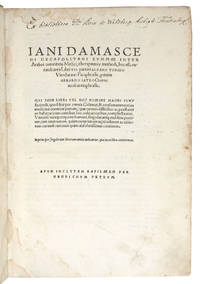
1543IB7BGV3WR8OIBasel: Heinrich Petri 1543. 17th century black vellum made from an earlier liturgical music manuscript. Folio 20.5 x 29 cm. Important Latin edition of an Arabic medical compendium first printed also in Latin in 1479 with additions by Gerard de Cremona. It provides a collection of opinions voiced by Greek and Arabic physicians on pathology and therapeutics. "No Arabic printed edition exists so far" Choulant. The ninth-century Christian physician perhaps in or near Damascus Yahya ibn Sarabiyun son of a Bagarma physician wrote his great medical work Al-Kunnas in Syriac but it was soon translated into Arabic by scholars such as Musa Ibrahim al-Haditi and ibn Bahlul. Manuscripts survive in twelve and in seven books. "The seven-book edition was frequently printed in Latin translations as 'Breviarium' and 'Practica therapeuticae methodus' or here Therapeutice methodi. Albanus Torinus the editor of the Basel 1543 edition called the author Janus Damascenus for which reason he has been confused with the well-known theologian of that name. He is also often mistaken for his younger namesake Serapio junior" GAL. Some catalogues even ascribe this work to the Baghdad physician Abu-Zakariya Yuanna Ibn-Masawaih.Minor water stains; some unobtrusive worming to front board and flyleaves. Binding rubbed; extremities bumped with chipping to spine-ends. A wide-margined copy. With a 1677 owners inscription of the pharmacist and medical student Joseph Franz König on front paste-down; later owners inscription on the title-page of Bonifacius Brix von Wahlberg 1726-1776 court physician to the Princes of Fürstenberg.l Adams I14; BM STC German p. 932; Choulant Handb. p. 347; Durling 4778; GAL I 233 & S 417; USTC 606427; VD16 Y11; not in Waller. Heinrich Petri, hardcover
In-folio (28,8 x 20,5 cm.); 10 cc.nn., 59 cc., 1 bl., 14 cc.nn, 1 bl.; with two woodcuts (15,8 x 12,9 cm) and 30 full-page calligrams in red and black, poems arranged in such a way that it forms a thematically related image. Bound in XVIII century half-leather.
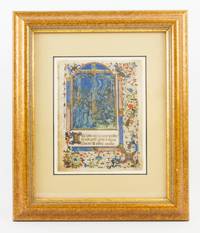
1440ST19540aMetz ca. 1440. Leaf: 162 x 124 mm. 6 3/8 x 4 7/8". Frame: 308 x 258 mm. 12 1/8 x 10 1/8". Single column three lines of text under the miniature obverse with 18 ruled lines five of which contain text in a gothic book hand. <br/> Attractively matted and framed. Recto with one three-line initial in gold on pink and blue ground WITH A LARGE MINIATURE OF THE CRUCIFIXION WASHED IN BLUE Christ on a painted gold cross flanked by two thieves on painted gold crosses surrounded by throngs of people including the Virgin St. John Mary Magdalene and numerous soldiers all in an arched gold frame inside a three-sided painted and gilt baguette and a FULL BORDER of colorful vine sprays and flowers inhabited by a peacock. See: "The Jeanne Miles Blacburn Collection of Manuscript Illuminations" nos. 29-38; Avril & Reynaud pp. 182 & 190. Minor soiling/browning right at inner edge away from border and image otherwise IN VERY FINE CONDITION THE MINIATURE REMARKABLY WELL PRESERVED WITHOUT ANY LOSS OF PAINT.<br/> <br/> This stunning miniature with its memorable nocturnal scene comes from a very fine Book of Hours probably executed by Henri d'Orquevaulz or d'Orquevaulx or a member of his workshop. D'Oquevaulz was active during the second quarter of the 15th century in Metz the cultural and commercial capital of Lorraine during the period and the center of a growing book trade. According to the catalogue of the Jeanne Miles Blackburn Collection in the Cleveland Museum of Art which owns 10 leaves from the original manuscript the parent Book of Hours can be localized based on the Lorraine dialect found in the French text on some of the leaves including the present example and because the calendar singled out two bishop-saints of Metz Clement and Arnoul. Although little is known about d'Orquevaulz his dated signature in the colophon of a Livy manuscript that he illuminated for an alderman of Metz indicates that he was active in that city in 1440. Artistic affinities with northern European styles make it possible that d'Orquevaulz had emigrated from the Netherlands or Germany to Lorraine; another possibility one that Avril and Renaud suggest is that the master himself was from Metz but that he had German associates perhaps from the Rhineland area. According to these two scholars the painter's use of large flat areas of colors is more typical of the Rhineland the Netherlands or Bohemia than of France; in any case they praise his "exquisite color harmonies." The artist has outdone himself in the present miniature rising to the height of pathos and making it one of the most extraordinary leaves we have ever offered for sale. In contrast to the bright colors used in Books of Hours even to depict the most serious scenes the present leaf presents a remarkable visual nocturne with the figures and buildings painted in the same shades of blue as the sky suggesting that heaven itself is darkening at the death of Christ. Mary Magdalen kneels at the foot of the cross while St. John supports the devastated Virgin as a soldier pierces the Savior's side with a lance. The miniature is crowded with figures we see well-defined faces of no fewer than 18 persons and two horses but the artist has not lost his dramatic focus as Christ on his cross of brushed gold dominates the scene. In choosing to make this a darkened composition the artist has risked obscuring detail but his skill has been equal to his concept here as he has used a diluted blue paint that allows for a very successful delineation in various shades almost like grisaille this technique not incidentally has prevented the cracking and erosion so commonly seen with the normal thick applications of typical cobalt blue. The result of the decision to show the world in eclipse at Christ's death is to heighten and universalize the drama here to such an extent that the scene leaves a powerful and lasting impression. The text on this leaf is entirely in French in rhyming verse. Roughly it translates as: "Jesus on the cross did hang / And took upon himself our sins / Gave to humankind redemption / Rendered up his soul to God. / The sunshine lost its glowing light / The earth did tremble and did crack / Grieving for the bitter death / Suffered by the son of God." Although the original Book of Hours was dismembered some time in the 20th century extant leaves suggest that its visual program was much bigger than usual and probably the result of an important commission by a wealthy patron--something likely to be painted by one of the chief artists in the workshop. Illuminated manuscripts from Metz--let alone examples of this quality--are uncommonly seen on the market. unknown
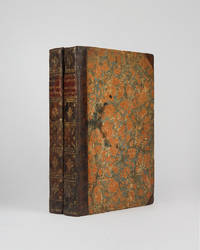
121437London Printed by Adam Islip 1601. . First edition in English first issue with the Islip imprint; 2 vols folio 30.5 x 20.7 cm; 2 title pages each with woodcut allegorical device woodcut head- and tailpieces decorative initials last leaf with errata on recto and colophon on verso one or two instances of early marginalia; lacking first blank leaf in each volume scattered light foxing and staining a few marginal open and closed tears scattered small rust holes costing a few letters faint dampstaining to a few gatherings; late 18th-century half calf over marbled paper-covered boards edges speckled red sometime rebacked with original spines laid down gilt tooling to spines red morocco title labels to spines lettered in gilt; a handsome copy.<br /> 'Over and over again it will be found that the source of some ancient piece of wisdom is Pliny.' PMM 5<br /><br />A handsome first edition first issue of Philemon Holland's renowned English translation of Pliny's Natural History. The most popular of Holland's translations it had never before been printed in English and would not be attempted again for another 250 years.<br /><br />One of the greatest translators of the Elizabethan age Holland's Pliny was an important source for Shakespeare. 'In Othello's allusion to the Pontic Sea Shakespeare was clearly drawing upon Pliny's Historie as translated by Holland Similarly Pliny has also been cited as a source for Othello's reference to the "medicinal gum" of "the Arabian trees"' Payne Search for Meaning 63 and many trace Caliban in The Tempest to Holland's Pliny.<br /><br />'The importance of Pliny lay not so much that he was an inexhaustible source for monsters eclipses and the stranger habits of all created things but that in the pages of Philemon Holland's translation Shakespeare found that emphasis on Nature which he employed and re-interpreted in the tragedy' Evans The Language of Shakespeare's Plays.<br /> STC 20029.5; Pforzheimer 496; ESTC S115918; Brueggemann 670; Lowndes 1885; cf. PMM 5. London, Printed by Adam Islip, 1601. hardcover
156785Cologne: Taschen 2014 . Signed by the artist and by the band Limited Art Edition of 75 numbered copies with a print of Mick Jagger signed by David Bailey on the verso from the photo shoot used for the Goat's Head Soup album cover. This is number 35. From a total edition of 1600 copies signed by the band members of the Rolling Stones: Jagger Richards Watts and Wood. A photographic record charting the Stones' remarkable history and lifestyle. With an appendix including the Stones in the media a Stones timeline discography and photographers' biographies. Folio. Over 500 pages of photographs including 3 fold-outs by David Bailey Peter Beard Cecil Beaton Bob Bonis Anton Corbijn Annie Leibovitz Gered Mankowitz Helmut Newton Norman Parkinson Bent Rej Ethan Russell Albert Watson and others. Original illustrated boards. Housed in a full leather purple clamshell box with The Rolling stones lips logo to the front cover. With the print Mick Jagger 1973 housed in full leather purple folder with The Rolling stones lips logo on the front cover. With the original packing box. In fine condition. hardcover
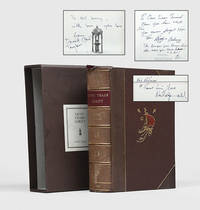
174385Guildford: Genesis Publications Limited in association with Hedley New Zealand and Hedley Australia 1984. Ringo's manager's copy signed by three of the Beatles First edition number 121 of a limited edition of 2000 copies signed by George Harrison Derek Taylor the Beatles's publicist and the illustrator Larry Smith. This is a presentation copy to Hilary Gerrard Ringo Starr's manager and director of Apple Corps and is inscribed to him by Taylor Harrison Paul McCartney Ringo Starr Barbara Bach Starr's wife Neil Aspinall chief executive of Apple Corps and singer-songwriter Harry Nilsson nicknamed the "American Beatle". Ringo Starr and his wife Barbara Bach have inscribed the copyright page "To Our Dear Friend Once you have met Him you never forget Him Love Ringo xxx & Barbara xxx". Bach has added "The longer you know him the more you love him! & I do! B". The limitation page is inscribed "For Hilary I love him too Neil Aspinall". Aspinall was first employed by the Beatles as a road manager and went on to head Apple Corps. Below the author has written "For Hilary another fine limited edition from an old admirer and friend. Lots of love & warmth - Derek aka Derek Taylor. George Harrison has inscribed beneath his foreword "To Hilary - with lots of love and wishes for all our Peace of Minds for ever and ever Amen - with a drawing of an Om and a cross. An inscription on the verso of the Author's Note reads "To Hill 'arry with love yea love from Derek Paul Taylor" an in-joke from Paul McCartney. Lastly inscribed on the afterword by Harry Nilsson "To the greatest man alive! And to Viv - Onward and upward said the progressive midget with love at Xmas '84 signature or H. N. or Hubba OK and more love & more & more & more.". Hilary Gerrard was Ringo Starr's business manager from the early 1970s and a director of the Beatles Apple Corps Limited. Fifty Years Adrift is the autobiography of Taylor and is "the companion volume to I Me Mine" prospectus. "Taylor was many things: an elegant writer who could flip into the crudest earthiest language; a press officer who would go beyond the call of duty at the same time as he placed advertorial copy in the pop magazines of the time; a Beatle intimate taking remedial acid trips with John Lennon at the same time as he was an employee if not a servant. He defined and extended what it was to be a PR at the same time as he retained a cool journalistic eye. In the end he preserved what was best about the high Sixties for future generations. Taylor had remained close to George Harrison who contributed addenda to 1984's Fifty Years Adrift a limited-edition book that expanded the Sixties' coverage of As Time Goes By" Savage. Quarto. Colour frontispiece with tissue guard lavishly illustrated with Beatles memorabilia and half-tones from photographs. Original half calf red morocco spine label spine lettered and ruled in gilt compartments stamped in blind sides and corners trimmed with single gilt fillet brown cloth sides vignette on front cover in red and gilt rear cover with Derek Taylor's signature stamped in gilt illustrated endpapers from a design by Larry Smith edges gilt original red silk ribbon and colour concert ticket bookmark. Housed in the publisher's brown slipcase with paper title label. Spine of book scuffed and slipcase lightly bumped a very good copy. hardcover
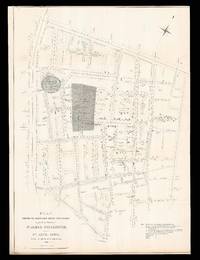
185516264London: HMSO 1855. 810 by 580mm. 32 by 22.75 inches. Folding lithograph plan. Rare epidemiological plan of Soho that accompanied the General Board of Health's exhaustive report into the 1854 Broad Street cholera outbreak. Cholera is a contagious disease caused by the bacterium vibrio cholerae. The bacteria lives in warm salty stagnant waters and is contracted when an individual ingests water or food contaminated with the bacteria. In the most severe strains the bacteria multiplies dramatically within the individual's gut causing the intestine to release increasing amounts of water leading to severe diarrhoea vomiting and rapid loss of the fluids and can if untreated lead to death within 24 hours. The majority of epidemics are caused when the faecal matter of an infected individual contaminates the water supply. It has been estimated that since the beginning of the nineteenth century cholera has been responsible for some 50 million deaths and although relatively simple rehydration treatments are now readily available according to the World Health Organisation some 120000 people a year still die from the disease. The Broad Street outbreak The London epidemic of 1853-54 was part of the larger 1846-1860 cholera pandemic - the third such pandemic to occur since 1817 - and the second time that the disease had spread to British shores. The Broad Street outbreak which was to be traced by Dr John Snow to a contaminated water pump outside number 40 Broad Street was a particularly virulent strain and would result in the deaths of 500 people over a period of just ten days; by the end of the outbreak a total of 619 people would have succumbed to cholera leading the Observer newspaper to note that "such mortality in so short a time is almost unparalleled in this country". The Broad Street outbreak led to the publication of two reports and a monograph: The General Board of Health BoH The Report on the Cholera Epidemic of 1854 1855; The Cholera Inquiry Committee 1855 set up by the Parish of St James's; and Doctor John Snow On the Mode and Communication of Cholera 2nd edition 1855. Although Snow's work is now seen as one of the foundation stones of epidemiology its argument - that cholera was a waterborne disease - was not widely held by the Victorian medical establishment with prominent people such as Edwin Chadwick head of the first General Board of Health expounding the view that cholera was an airborne disease brought about by foul odours caused by unsanitary conditions. Although Snow was to prove that the airborne hypothesis was erroneous the 'miasmatic' theory with its instance that "all smell is disease" would be the catalyst for many of the great municipal sanitary improvements - such as Bazalgette's great sewer - carried out during the Victorian era. Formation of the General Board of Health In 1848 Parliament passed the Public Health Act which instituted the Board of Health for a period of five years with powers to sanction expenditure for sanitary improvements requested by local government and in the event of an epidemic to provide guidance to the government's response. The board was headed by and was the brainchild of Edwin Chadwick whose 1842 General report on the Sanitary condition of the Labouring Population of Great Britain has been called the "fundamental document on modern public health" Rosen. "The creation of the Board of Health was a high point of the great Victorian enterprise of sanitary reform whose central idea was that environmental circumstances particularly pollution of the air and water defective sanitation dampness filth and overcrowding were causes of disease particularly epidemic disease and these diseases often killed the wage earners left poor working families impoverished pushed widows and orphans into workhouses and undermined the moral fibre of the working classes" Paneth. Although the Board was successful in enacting a great many sanitary improvements over the next five years Chadwick's brusque and arrogant manner led to the board's charter not being renewed by Parliament and on 31st July 1854 the members of the board were dismissed. Unfortunately for the government the disbanding of the board coincided with a sharp increase in the number of cholera cases in London from 1 a week to 133 a week during the month of July. On Augsut 1st Parliament instituted another but much weaker Board of Health: its charter had to be renewed annually and consisted of only one board member which had to be filled by a sitting Member of Parliament. The MP chosen was Sir Benjamin Hall who by dint of not being Chadwick was deemed eminently qualified for the job; by the time he assumed his role on the 12th August cases of cholera in London had increased to 644 a week. The Board of Health's Cholera Investigation On the 13th August Hall met with his advisory council which he had rapidly put together the council consisted of some of the most eminent medical practitioners of the day including: John Ayrton Paris and James Alderson president and treasurer respectively of the Royal College of Physicians; William Lawrence vice-president of the Royal College of Surgeons; James Clark physician ordinary to the Queen; Benjamin Babington founder and president of the London Epidemiological Society; and William Farr compiler of the Weekly Returns which included among other statistics deaths and cause of death - a resource that greatly aided Snow in his research. The council divided itself into three sub committees: Committee for Scientific Inquiries CSI which would be responsible for the majority of the cholera report; the Committee for Treatments; and the Committee for Foreign Correspondence. The work of the CSI started on the 5th September 1854 when Drs Fraser Hughes and Ludlow began house to house investigations of the Golden Square area around the same time that Snow was also commencing his investigations; and three days before St James's parish would remove the handle from the water pump on Broad Street on the advice of Snow. The report details some 800 houses listing their inhabitants any deaths from cholera and the sanitary state of the premises which was often terrible and included the condition of any cesspools "bad-smells from water-closets" and untrapped drains. The house to house investigations were supplemented by the scientific report. Hall employed three men to carry out investigations for the committee: James Glaisher superintendent of the magnetic and meteorological department at Greenwich and a founder of the British Meteorological Society; Richard Dundas Thomson professor of chemistry at St. Thomas Hospital; and Arthur Hill Hassall author of the first textbook of microscopic anatomy in English 1846 and famed for his revelations through microscopy of the extraordinarily frequent contamination of food and water in London by adulterants and animalcules Paneth. Although Chadwick was no longer in charge a brief look at the committee's make up clearly shows that the sanitarians still dominated. Their belief that the atmosphere was critical in the spread of disease is demonstrated by the fact that almost a third of the scientific report contains the investigations of meteorologist James Glashier. The Map The map that accompanies the report is a great deal larger and includes much more information than the map that Snow produced for his monograph. Based on the map produced by the Metropolitan Commission of Sewers which was also published in the report carried out by the St James's Parish it covers a much greater area and marks not only cholera deaths and pump locations but also: house numbers new and old sewers sewer grates trapped and untrapped side entrances and ventilators. The map has been updated with the number of cholera deaths in the area tracing people who were hospitalised and those that worked or visited the area. To the upper left are two shaded areas. The first a circle which bisects Little Marlborough Street titled: The erroneously supposed position of the ancient plague pit shewn in the map of the Commissioners of Sewers and the second a rectangle titled: Extent of Craven Estate corresponding with site of pest-field three acres two chains which covers much of Marshall Street and houses either side and ends just west of the water pump on Broad Street - the epicentre of the outbreak. Both sites mark supposed burial pits dug during the Great Plague of 1665. Many had argued that the disturbance of the pits when new sewers where dug in the 1840s and 1850s was responsible for the severity of the Golden Square outbreak. However this theory is conclusively dismissed in the report stating that no burial remains were encountered when the sewers were dug. A comparison of the maps that accompany Snow's monogram and the BoH's report clearly illustrates the authors' varying approach to the epidemic. Snow's map is narrowly focused on the centre of the outbreak and marks only the individual deaths marked by black coffin like lines to each house together with the position of the water pumps; Snow clearly wanting the viewer to draw the causal link between the Broad Street pump and its proximity to a large number of cholera deaths. The BoH's map on the other hand shows a much great area and contains much more information sewers drains plague pits etc. Snow's correlation just like the report that this map accompanied is lost under a mass of miasmic information. In hindsight the report just like the present map can be seen as too large and unwieldy the miasma theory at its heart "predicted to much and therefor was difficult to contradict or falsify"Paneth. In contrast Snow's economy of purpose his monograph at just 162 pages is almost a third the length of the BoH report shines through. "The strength of Snow's hypothesis lies in its exclusion of other alternatives; by insisting on the singular mode of transmission i.e. water Snow was able to imagine circumstances that would invalidate his hypothesis" Paneth. For example the exclusion of both the Broad Street Brewery works and the local Poor House from the cholera epidemic led Snow to investigate their water supply both drew them from independent sources; as did the death of a widow from cholera in faraway Hampstead who was so fond of the Broad Street water that she had her nephews send her bottles of it. Snow is keen to challenge his hypothesis where ever possible alas the BoH report contains no such challenges with the authors suffering from a large degree of confirmation bias. Although the BoH report is now largely forgotten and its hypothesis discredited it was favourably received at the time and would be the catalyst for the creation of The Metropolitan Board of Works arguably the body whose policies would make the greatest impact on the health and wellbeing of Londoners in the nineteenth century. Setup by the head of the BoH Joseph Hall in 1855 it would be responsible for among other things the clearing of slums the creation of London's numerous parks and Bazalgette's great sewerage works. Rarity We are unaware of individual examples of the plan appearing on the market in the last fifty years. HMSO, unknown
18295146264London, The Trustees of the British Museum 1820-1829. Mit 2 Schabkunst-Porträts und 2 Holzschnitt-Vignetten. Gr.-2° (46 x 33,5 cm). Professionell restaurierte Pappbände der Zeit mit gedruckten Orig.-Papierrückenschildern.
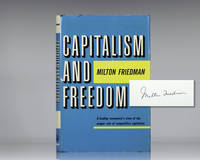
196223005Chicago: University of Chicago Press 1962. First edition of Friedman's magnum opus. Octavo original blue cloth. Signed by Milton Friedman on the front free endpaper in a contemporary hand. Fine in a very good dust jacket with light rubbing. Housed in a custom half morocco clamshell box. Rare signed. "Friedman a laissez-faire economist and professor at the University of Chicago is considered one of the leading modern exponents of liberalism in the 19th-century European sense. In Capitalism and Freedom he argued for a negative income tax or guaranteed income to supersede centralized bureaucratized social welfare services which in his view are inimical to the traditional values of individualism and useful work" Britannica. Selected by the Times Literary Supplement as one of the "hundred most influential books since the war". It also placed tenth on the list of the 100 best non-fiction books of the twentieth century compiled by National Review and on Time Magazine's top 100 non-fiction books written in English since 1923. University of Chicago Press hardcover books
196223005Chicago: University of Chicago Press 1962. First edition of Friedman's magnum opus. Octavo original blue cloth. Signed by Milton Friedman on the front free endpaper in a contemporary hand. Fine in a very good dust jacket with light rubbing. Housed in a custom half morocco clamshell box made by the Harcourt Bindery. Rare signed. "Friedman a laissez-faire economist and professor at the University of Chicago is considered one of the leading modern exponents of liberalism in the 19th-century European sense. In Capitalism and Freedom he argued for a negative income tax or guaranteed income to supersede centralized bureaucratized social welfare services which in his view are inimical to the traditional values of individualism and useful work" Britannica. Selected by the Times Literary Supplement as one of the "hundred most influential books since the war". It also placed tenth on the list of the 100 best non-fiction books of the twentieth century compiled by National Review and on Time Magazine's top 100 non-fiction books written in English since 1923. University of Chicago Press hardcover
1970123601New York: Cinnamon Press 1970. Rare Bag One lithograph signed by Beatles icon John Lennon. One page the title page from Lennon's Bag One Portfolio. Signed by him beneath the image. One of 300 numbered copies this is number 172. In near fine condition. Matted and framed. Rare and desirable. In 1969 as a wedding gift for Yoko John drew the 'Bag One Portfolio'--a chronicle of their wedding ceremony honeymoon and their plea for world peace in the Bed-In. The following year the artwork was produced in a series of three hundred portfolios of fifteen signed prints each. The majority depict John and Yoko's most intimate private moments--upon their first exhibition in London more than half were deemed 'indecent' and confiscated by Scotland Yard. The rare title page features perhaps the most famous and recognizable print of the suite. Cinnamon Press unknown books
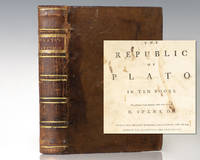
1763138322Glasgow: Printed by Robert and Andrew Foulis 1763. First edition in English of Plato's Republic marking the first appearance in the English language of Plato's profoundly influential dialogue concerning the nature of justice. Quarto bound in full polished calf with raised gilt bands to the spine morocco spine label lettered in gilt all edges speckled red. Harry Spens was a minister at the parish of Wemyss in Fife and respected classicist. In his introduction he professes his intent in his translation is: "To give the English Reader a view of Plato's sentiments and manner of writing and to stir up the youth to the study of the Ancients." Richard Garnett in his own introduction of the Everyman's Library reprint of this translation laments the relative lack of critical attention paid to it writing: "On the whole Spens's version should not be lightly esteemed. It is clearly the work of a scholar and a man of considerable literary ability." The brothers Robert and Andrew Foulis were renowned printers of classical works in their time sometimes referred to as 'the Elzevirs of Britain.' Their works mostly intended for scholars were "much sought after as admirable specimens of typography and are noticeable for their severely plain elegance" DNB 7: 514. In very good condition. Rare and desirable. "Its setting and its characters are full of political meaning. Its arguments are tantalizing and its fables fascinating… Plato's utopia is alarming and his metaphysics are intoxicating" Levi 348. The Republic "has reinforced dedication awakened vocations to leadership and strengthened the morale of those modest and competent souls who are always in reality the guardians of society" Rexroth 79. Printed by Robert and Andrew Foulis unknown
16013078London:: Impensis G. Bishop 1601. FIRST EDITION second issue with cancel title page. Folio:. 33 x 22 cm. Ï€6 par.4 a-b6 A8 B-3I6 3K4; A-3G6 3H4 3I-3O6 3P8 lacking blank leaves Ï€1 and 3P8 Complete in two parts; with a divisional title page to the second tome and the errata/colophon on leaf 3P7 Bound in contemporary English calfskin ruled in blind rebacked and recornered in morocco. An excellent crisp bright copy with very minor faults: repaired clean tear with no loss leaf P4. A few signatures with very light marginal dampstains. Occasional rust spots marginal tears or marginal natural paper flaws no loss whatsoever. Title pages to both volumes. The first with an elaborate architectural border with Solomonic columns. The second with a large woodcut device. An impressive book. “The ‘Natural History’ of Pliny the Elder is more than a natural history: it is an encyclopaedia of all the knowledge of the ancient world… It comprises 37 books with mathematics and physics geography and astronomy medicine and zoology anthropology and physiology philosophy and history agriculture and mineralogy the arts and letters… The ‘Historia’ soon became a standard book of reference; abstracts and abridgements appeared by the third century. Bede owned a copy Alcuin sent the early books to Charlemagne and Dicuil the Irish geographer quotes him in the ninth century. It was the basis of Isidore's Etymologiae and such medieval encyclopedias as the Speculum Majus of Vincent of Beauvais and the Catholicon of Balbus. One of the earliest books to be printed at Venice the centre from which so much of classical literature was first dispensed it was later translated into English by Philemon Holland in 1601 and twice reprinted a notable achievement for so vast a text… Over and over again it will be found that the source of some ancient piece of knowledge is Pliny.†PMM 5 “Holland's first book the first complete rendering of Livy into English was published in 1600 when he was nearly fifty. It was a work of great importance presented in a grand folio volume of 1458 pages and dedicated to the queen. … “The Livy was followed in the next year by an equally huge translation of the elder Pliny: The Historie of the World Commonly called the Naturall Historie. This encyclopaedia of ancient knowledge about the natural world had already had a great indirect influence in England as elsewhere in Europe but had not been translated into English before and would not be again for 250 years.â€ODNB Pforzheimer 496; STC 2nd ed. 20029 Impensis G. Bishop, unknown books
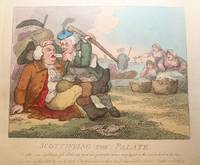
1805007260London: E. Jackson and G. Kearsley 1805. First Edition. Quarter Calf. Cloth slipcase. Very Good. Scarce hand-colored copy of work two parts bound in one. Oblong 27 by 34.5 cm. 20 hand-colored etched plates. The prints are inspired by Boswell's "Journal of a Tour in the Hebrides with Samuel Johnson" which originally appeared in 1785. Additional plates include an engraved portrait of Johnson by Thomas Trotter two hand-colored Cruikshank plates satirizing life in Scotland and the seven etched plates from "Outlines of the Opposition Collected from the Designs of the Most Capital Jacobin Artists" published by Hannah Humphrey in 1794 -- these plates are not colored. Binding heavily rubbed along edges with some chipping and loss of paper pastedown. Calf abraded. Title written in ink on front cover. The etched plate series with a fair amount of light foxing. E. Jackson and G. Kearsley unknown
197478309Washington DC: U. S. Government Printing Office 1974. Presumed First Edition First printing. Wraps. Good/No dust jackets present. This is a complete set of the Statement of Information--28 separately bound items. The July 12 1974 the Committee released of its accumulated evidence on the case which ran to thousands of pages. Book I: Events Following the Watergate Break-in June 19 1972-March 1 1974 ix 1 242 pages; Book II: Department of Justice-ITT Litigation ix 1 208 6 pages; Book III: Political Contributions by Milk Producers Cooperatives: The 1971 Milk Price Support Decision ix 1 217 1 pages; Book IV: White House Surveillance Activities ix 1 225 1 pages. Book II: Events Following the Watergate Break-in June 17 1972-February 9 1973 xii 680 4 pages; Book III Part 1 Events Following the Watergate Break-in June 20 1972-March 22 1973 xii 687 5 pages; Book III Part 2 Events Following the Watergate Break-in June 20 1972-March 22 1973 iii 1 689-1281 3 pages; Book IV Part 1 Events Following the Watergate Break-in March 22 1973--April 30 1973 xii 551 5 pages; Book IV Part 2 Events Following the Watergate Break-in March 22 1973-April 30 1973 iii 555-1080 pages; Book IV Part 3 Events Following the Watergate Break-in March 22 1973--April 30 1973 iii 1 1081-1659 1 pages spine discolored; Book V--Part 1 Department of Justice/ITT Litigation--Richard Kleindienst Nomination Hearings xii 477 1; Book V--Part 2 Department of Justice/ITT Litigation--Richard Kleindienst Nomination Hearings ii 2 479-980 4; Book VI--Part 1 Political Contributions by Milk Producers Cooperatives: The 1971 Milk Price Support Decision ix 1462 pages; Book VI--Part 2 Political Contributions by Milk Producers Cooperatives: The 1971 Milk Price Support Decision iii 1463-984 2 pages; Book VII--Part 1 White House Surveillance Activities and Campaign Activities xii 522 2 pages; Book VII--Part 2 White House Surveillance Activities and Campaign Activities iii 1 523-1177 3 pages; Book VII--Part 3 White House Surveillance Activities and Campaign Activities iii 1 1179-1613 1 pages; Book VII--Part 4 White House Surveillance Activities and Campaign Activities iii 1 1615-2090 2 pages; Book VIII: Internal Revenue Service xii 440 4 pages; Book IX--Part 1: Watergate Special Prosecutors Judiciary Committee's Impeachment Inquiry April 30 1973-July 1 1974 xii 521 3 pages; Book IX--Part 2: Watergate Special Prosecutors Judiciary Committee's Impeachment Inquiry April 30 1973-July 1 1974 iii 1 523-1069 1 pages; Book X: Tax Deduction for Gift of Papers vii 1 552 pages; Book XI: Bombing of Cambodia xii 599 1 pages; Book XII: Impoundment of Funds Government Expenditures on President Nixon's Private Properties at San Clemente and Key Biscayne vii 1 187 1 pages; Appendix I: Presidential Statements on the Watergate Break-in and Its Investigation iv 110 2 pages; Appendix II: Papers in Criminal Cases Initiated by The Watergate Special Prosecution Force June 27 1973-August 2 1974 iv 379 3 pages; Appendix III: Supplementary Documents: White House Edited Transcripts April 4 1972 March 22 1973 June 23 1972; John Ehrlichman Handwritten Notes: Affidavit of Bruce A. Kehrli ii 2271 1 pages; and Appendix IV: Political Matters Memoranda August 13 2972-September 18 1972 v 1 151 3 pages. The impeachment process against Richard Nixon began in the United States House of Representatives on October 30 1973 following the series of high-level resignations and firings widely called the "Saturday Night Massacre" during the course of the Watergate scandal. The House Committee on the Judiciary set up an impeachment inquiry staff and began investigations into possible impeachable offenses by Richard Nixon the 37th president of the United States. The process was formally initiated on February 6 1974 when the House granted the Judiciary Committee authority to investigate whether sufficient grounds existed to impeach Nixon of high crimes and misdemeanors under Article II Section 4 of the United States Constitution. This investigation was undertaken one year after the United States Senate established the Select Committee on Presidential Campaign Activities to investigate the break-in at the Democratic National Committee headquarters at the Watergate office complex during the 1972 presidential election and the Republican Nixon administration's attempted cover-up of its involvement; during those hearings the scope of the scandal became apparent and the existence of the Nixon White House tapes was revealed. On May 9 1974 formal hearings in the impeachment inquiry of Nixon began culminating July 27-30 1974 when the Judiciary Committee approved three articles of impeachment. These articles charged Nixon with: 1 obstruction of justice; 2 abuse of power; and 3 contempt of Congress. These articles were reported to the House of Representatives for final action with members of the committee voting in favor of one or more of the articles. Republican congressional leaders met with Nixon and told him that his impeachment and removal were all but certain. Thereupon Nixon gave up the struggle to remain in office resigning the presidency on August 9 1974 before the full House could vote on the articles of impeachment. The House brought the impeachment process against him to an official close two weeks later. U. S. Government Printing Office paperback
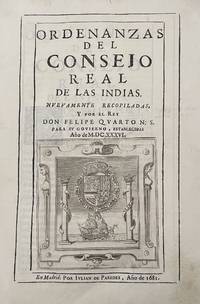
16812474Madrid: Por Julian de Paredes 1681. Second revised and enlarged edition. In contemporary limp vellum. Engraved device on title page. Woodcut initials throughout and a tailpiece at end of each part. Tinted edges. Stains on binding string missing panels with small damage at the outer edge. Tinted title on spine rubbed. 19th-century shelfmark on the inner front panel in ink. Contemporary notes and sings to the margins throughout the first part. Old restoration with paper tape to a few pages in the first part. Otherwise in very good condition. Second revised and enlarged edition. In contemporary limp vellum. 206 14 p. <p><p><br /> Revised and enlarged second edition of these substantial bodies of law relating to the New World and the treatment of Native Americans an important volume on the Administrative History of the Indies.<br /> <p><p><br /> One of the most important volumes of the administrative history of the Indies a fundamental collection of laws and ordinances decreed by the Council of the Indies the supreme governing body of Spain’s colonies in America during the reign of Philip IV. <br /> <p>The first part Ordenanzas del Consejo Real de las Indias contains 245 ordinances of the Council of the Indies pp. 3–112; first published in 1636 the second part Autos acuerdos y decretos de govierno del Conseio Real y supremo de las Indias embodies an additional 190 ordinances concerning for the most part the administration of Spanish America pp. 113–206 plus 14 p. of index; first published in 1658.<br /> <p><p><br /> Any editions of these bodies of law are extremely scarce on the market RHB lists only 2 copies of the present edition within the last 70 years. <br /> Sabin 57477. Por Julian de Paredes unknown
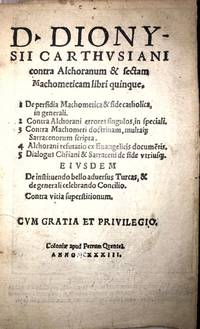
15331027Coloniae Köln: apud Peter Quentel 1533. First edition. In later gilt burgundy maroquin. Gilt floral ornaments and title on spine. Marbled endpapers. Gilt edges. Green silk bookmark. Two leaves misbound: Oov–vi after Qqiiii. Pages trimmed that occasionally effects the printed marginals and page headers. Two wormholes effects the upper part of the last four signatures slightly the text as well partly restored with old paper. Otherwise clean. Engraved bookplate and printed bibliographic reference on inner front panel. Collection vignette on front and rear endpapers. Collection inscription and stamp on additional endpaper. Overall in fine condition. With two large woodcut illustrations the Virgin and Child on verso of title and woodcut of the author at end. Woodcut initials. With two large woodcut illustrations the Virgin and Child on verso of title and woodcut of the author at end. Woodcut initials. First edition. In later gilt burgundy maroquin. Gilt floral ornaments and title on spine. Marbled endpapers. Gilt edges. Green silk bookmark. 16 628 i.e. 626 2 p. Pages 113 and 178 omitted in pagination. Signatures: AA8 A-Z8 Aa-Nn8 Oo10 Pp-Qq8. <p><br /> First edition of Denis the Carthusian’s treatise against Islam with numerous quotations from the Qurʼan. Preceded the earliest complete Latin edition of the Qurʼan by ten years. <br /> <p><p><br /> “Contra Alchoranum†the anti-Islamic work of the Carthusian monk Dionysius 1402–1471 was written around 1454 but only printed some eighty years later in this edition. It was edited by Petrus Blomeuenna whose dedicatory epistle is addressed to Emperor Ferdinand I. The laudatory poem about Dionysius Carthusianus that closes the book was written by Nicolas van Essche 1507–1578.<br /> <p><p><br /> Dionysius cites passages of the Qur’an in the Latin translation of Robert of Ketton and counters them by biblical quotations he places these Qur’anic theses and biblical antitheses in the mouths of a Christian and a Saracen as a fictitious dialogue. He also encourages crusades against the Ottoman Turks who shortly before he wrote this treatise had conquered Constantinople. <br /> <p><p><br /> “Contra Alchoranum†is considered to be the first printed source in Latin of the legend of Bahira or Sergius the Nestorian Monk who according to the story together with three Jews conveyed the text of the Qur'an to Mohammed with massive falsification of the Biblical traditions.<br /> <p><p><br /> The book has been published ten years earlier than the first printed version of the entire text of the Qurʼan in Latin translation Machumetis Saracenorum principis; Basel 1543 and uses the same translation by the English scholar Robert of Ketton Robertus Ketenensis; 1110–1160. In 1540 a paraphrased abridged German translation of “Contra Alchoranum†was published in Strasbourg under the title “Alchoran. Das ist des Mahometischen Gesatzbuchs …†whose translator was probably Heinrich von Eppendorff.<br /> <p><p><br /> Bibl.: Francisco A.: Martin Luther and Islam. A Study in Sixteenth-Century Polemics and Apologetics. Leiden; Boston: Brill 2007. pp. 16–17.<br /> <p><p><br /> VD 16 D 1863.; USTC 626366.; Adams D 539.<br /> <p>. apud Peter Quentel unknown
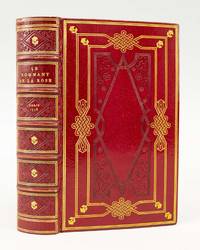
1538ST14933<p>Paris: Jehan Masse Jean Macé 1538. Fourth Edition. 182 x 91 mm. 6 3/8 x 3 3/4". 8 p.l. ccciii 1 blank leaves.Edited by Clément Marot. <br />ELEGANT SCARLET MOROCCO BY LORTIC stamp-signed on front turn-in covers tooled in gilt and blind in a Grolieresque strapwork design raised bands spine compartments with central gilt rose surrounded by blind tooling gilt titling turn-ins richly gilt marbled endpapers all edges gilt. With title page vignette and 49 impressions of 26 CHARMING WOODCUTS in the text. Front pastedown with engraved bookplate of P. Grandsire. Brunet III 1175; Bourdillon "Early Editions of the Roman de la Rose" the "S" version pp. 62-63. ◆Leaves lightly washed and pressed following the bibliophilic fashion at the time of binding occasional mild browning or small marginal stains but still A LOVELY COPY clean and still crisp IN A SPARKLING BINDING.<br /><br />Beautifully bound this is a most attractive copy of the last early edition of this classic of courtly love perhaps the most influential work in Medieval French literature. An allegorical love poem that unfolds as a dream vision the "Romance of the Rose" is the work of two authors Guillaume de Lorris who composed the first 4000 or so lines around 1230 and Jean de Meun who contributed an additional 18000 lines 40 years later. Our version was edited by the poet Clément Marot 1496-1544 to make the language more accessible to 16th century French readers and his efforts contributed to a renewed popularity for the tale. Marot did four recensions of the text; this is the final one. After our printing no other edition appeared until 1735. According to Bourdillon the woodcuts here are copied from the "very pretty" series in the 1529 edition. The scenes are impressive in the level of detail especially considering their diminutive size. Pierre Marcellin Lortic 1822-92 was one of the great binders of 19th century Paris known for his superb interpretations of traditional styles as in the present binding. According to Flety "at once artisan and artiste intelligent and conscientious an expert and a lover of his metier he knew how to give his work the finish the brilliance that very few practitioners of his time could attain." Our copy comes from the library of French bibliophile Paul Grandsire of Nogenten-Bassigny Haute-Marne whose notable collection of French imprints from the 15th to the 18th centuries was sold in 1930. All early versions of the "Romance of the Rose" are sought after and this is especially true of well-preserved copies of those editions with charming illustrations and in fine bindings favored by discriminating bibliophiles.</p> Jehan Masse [Jean Macé]
1813032473London: T. Egerton 1813. Book. Very Good. Quarter Leather. 2nd Edition. 12mo - over 6¾ - 7¾" tall. Three volumes. 2nd edition thus. Contemporary quarter brown calf with marbled boards gilt rules. Decorative gilt and bands to spine with labels expertly replaced. Brown top stain. Half titles not present. Armorial paper bookplate to endpaper. Sporadic foxing to endpapers and occasional inside leaves; otherwise text blocks are clean and square. Slight edge wear. Housed in fine sturdy brown slipcase. A very good rare set. . T. Egerton Hardcover
2022125005<p>Book shows average shelfwear at the cover edges there is some curling at the corners the pages inside are clean and in great condition.</p> paperback
1953214h6109Appleton Wisconsin: C.C. Nelson Publishing Company. Fair in Good dust jacket. 1953. Second Printing With Revisions. Hardcover. Charles A. Lindbergh's copy signed and inscribed to him by his fellow seeker of peace justice and historical truth Harry Elmer Barnes 1889-1968 whom Murray Rothbard eulogized as "the last of the truly erudite historians." A truly magnificent provenance for this work which "shows how the extension of military operations to civilian populations and property and the increasingly destructive nature of total warfare menace the very future of humanity and Western civilization. This work makes it clear how the Nuremberg war-crimes trials far from curbing the barbarism of present-day warfare will make it absolutely certain that every known form of destructiveness and mass-murder however fiendish and devastating will surely be brought forth in the desperate effort to avoid a defeat which in all future wars will mean the summary liquidation of the political leaders and top military officers of the vanquished countries." - dust jacket. Saddam Hussein and Muammar Gaddafi among others would probably concur. As the most prominent spokesman for the America First Committee which sought to keep America out of WWII Lindbergh most likely endorsed the conclusions of this book first issued in England in 1948 under a nom de plume by Veale "a lawyer and student of history with a lifelong interest in the cause of peace and international justice." - xi. On page vii Veale refers specifically to Barnes by stating "in accordance with what Dr. Harry Elmer Barnes has called 'The Historical Blackout' the bulk of the British press newspaper and periodical alike rigidly ignored the first edition of this book. Not one London newspaper with a nation-wide circulation reviewed it." Eventually this work was issued in 18 editions and three languages. pp. xvii 1 305. Index. Bibliography. Black and white reproductions of photos. Unmarked with average wear to publisher's red cloth lettered in gilt. Narrow openings along each hinge bear narrow remnants of earlier tape repairs. Small erasure patch atop front free endpaper. Tanning to photo endpapers. Moderate wear to dust jacket now preserved in archival-grade Brodart. Housed in new custom acid-free slipcase. An extraordinary memento from the collection of Charles Lindbergh 1902-1974 the legendary American aviator who rose to global prominence in 1927 by being the first to fly nonstop from New York to Paris. Stimely p.61 Select Bibliography of Revisionist Books p.21.; 8vo; Signed by Notable Personage Related . C.C. Nelson Publishing Company hardcover
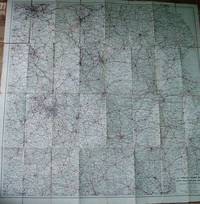
193456Good. 800 x 810 mm. Mounted on original cloth. Some wear especially at upper-left corner as shown. Very rare only 1 record in OCLC/Worldcat. WITH PICTURES. Leicester : The Midland Educational Co. Ltd.,1934
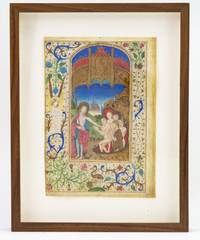
1470ST17764Delft ca. 1470. Leaf: 175 x 122 mm. 6 7/8 x 4 3/4"; Frame: 250 x 195 mm. 9 3/4 x 7 3/4". No text on recto or verso. <br/> In an attractive wooden frame. A FINELY PAINTED MINIATURE OF THE HARROWING OF HELL within an arch-topped compartment the mouth of hell depicted on the left with a fiery red interior and five people emerging from it the figure of Christ on the left holding a cross on a long staff and half-clothed in a pink and blue robe the background with a castle in the distance ALL OF THIS BENEATH A VERY DETAILED ARCHITECTURAL CANOPY suspended in the sky AND THE WHOLE WITHIN A FULL BORDER of acanthus leaves and other foliage and flowers in reds blues greens yellows and brushed gold along with very many small burnished gold ivy leaves and buds on hairline stems a small stork in the bottom border and a large delicately shaded angel in the left border. ◆Left margin trimmed very close to decoration just escaping loss and the other three margins ample mild darkening right at fore and tail edge but not reaching into borders otherwise IN FINE CONDITION the colors rich and true and the burnished gold still shimmering.<br/> <br/> This extraordinary miniature notable for its uncommon subject matter memorable imagery and fine workmanship was produced by a talented artist belonging to the stylistic group known as the Masters of the Delft Half-Length Figures. The subject here is infrequently depicted in Books of Hours: the Harrowing of Hell appears as a full-page miniature in only three of the 119 prayer books described by Roger Wieck in his "Time Sanctified" and three others contain a Harrowing depiction inside an initial. Christian theological tradition tells us that after his crucifixion Christ went to liberate souls from Limbo--a location inhabited by those barred from entry into Heaven because they died before the Redemption. In our scene Christ wrapped in a regal cloak and carrying a long staff his hands and feet still bleeding from the wounds he received on the Cross reaches into an absolutely wonderful Hellmouth to extricate Adam and Eve and other naked souls while the recently deceased and original saint John the Baptist still clad in an animal skin garment waits patiently for his turn to emerge. The great maw of Hell as depicted here has bulging eyes a distended snout thickly matted hair and a bad complexion; his gaping mouth punctuated by sharp gray teeth glows red hot and one can tell from the creature's expression that he is loath to comply with this rescue of souls. In addition to its compelling subject matter there is a high level of artistic achievement here including delicately molded figures impressively detailed architectural elements and a lovely color palette. The elegance and quiet sophistication observed in this miniature distinguishes the artist responsible for this work as a particularly talented member of his circle. Active from about 1450-80 the Masters of the Delft Half-Length Figures were named by James Marrow after the angels and other figures whose upper bodies are typically found emerging from a cloud within the borders. Although the present leaf uncharacteristically contains a full-length angel in the border it shares other stylistic similarities such as the elaborate architectural canopy hovering over the main composition; and it particularly resembles the work of the artist of Keble College MS 77 an illuminator described in "The Golden Age of Dutch Manuscript Illumination" as "one of the more articulate of the group" whose "figures are more fully modelled and his palette . . . deeper and brighter" than that of his contemporaries. Because the subject of the present miniature goes beyond the standard image program seen in routine productions and because of the high level of artistic accomplishment seen here this leaf was almost certainly part of an elaborate Book of Hours produced in response to an important commission. unknown
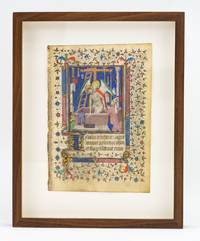
1415ST17763Paris ca. 1415-20. Leaf: 160 x 110 mm. 6 1/4 x 3/8"; Frame: 232 x 185 mm. 9 1/8 x 7 1/4". Recto with three lines single column in a gothic book hand verso not inspected due to frame. <br/> Mounted in a wooden frame. Recto with a three-line initial in blue on gold ground embellished with ivy leaves A HALF-PAGE MINIATURE DEPICTING THE MASS OF ST. GREGORY the recently crucified Christ depicted emerging from a tomb supported by an angel and surrounded by the Arma Christi St. Gregory kneeling at the corner of the image the text and miniature framed by thick bar borders of pink blue and gold on three sides all SURROUNDED BY A FULL BORDER of hairline vines gilt ivy leaves and bezants and a few colorful flowers and acanthus. A little faint smudging in top and bottom borders very small scarcely noticeable area of blue background retouched not affecting the figures but A BEAUTIFUL LEAF the colors bright and the detail in the miniature very well preserved.<br/> <br/> Featuring carefully realized detail intriguing iconography and artistry that shows a very high degree of skill this is an important and early example of the work of the Master of the Harvard Hannibal. The subject of the present work is a well-known story about the sixth century Pope Gregory ca. 540-604 commonly known as St. Gregory the Great. According to legend Gregory was saying Mass when one of his deacons expressed a doubt in the doctrine of Transubstantiation whereby the communion bread actually becomes the body of Christ. Gregory prayed to God for a verifying sign whereupon Christ appeared in the guise of the Man of Sorrows clad in a loincloth and displaying the bloody wounds he incurred during the Crucifixion. Most Medieval miniatures depict Gregory kneeling before an altar as he says Mass accompanied by one or more deacons or assistants who bear witness to the miraculous event. In a notable departure from this norm the present miniature depicts the saint alone at the edge of the picture plane; in place of the chalice host and altar that would normally occupy the center of the scene is a considerable open tomb from which a larger-than-life-size Christ emerges. With blood still rushing from his wounds he places one hand on the edge of the tomb to steady himself while an angel supports him from behind. Christ's expression conveys both physical and mental pain as he struggles to support his own bodyweight; the angel who assists him spreads his wings protectively around the body of Christ while looking down at Gregory with a sorrowful expression knitted into his brow. The fine detail work seen in the figures' faces the angel's wings and the careful delineation of each slender finger is also carried over into more than a dozen objects crammed into the spaces in and around the tomb the rope is especially remarkable in the representation of its detail. Known as the "Arma Christi" or "Instruments of the Passion" these objects are meant to symbolize Christ's suffering. Seen here are: the cross nails and hammer that were used to crucify Christ the ladder used in the Deposition the disembodied hand symbolizing the one which slapped Christ's face the dice used by soldiers to see who would claim his seamless robe a lantern used by the soldiers who arrested Christ the 30 pieces of silver from Judas' betrayal a purple robe used in the mockery of Christ and other items that appear as part of the Passion narrative. It is also interesting to note that although a St. Gregory miniature usually appears at the beginning of the Hours of the Cross the Penitential Psalms or before the Seven Prayers of St. Gregory here rather unusually it opens a reading from John chapter 19 beginning "In illo tempore adprehendit Pilatus Iesum et flagellavit" describing the events of the Passion. This miniature can be attributed to an artist known as the Master of the Harvard Hannibal so-named for a splendid miniature painting of the "Coronation of Hannibal" prefacing a Livy in the Harvard College Library. Active from about 1415-30 in Paris and later possibly Rouen it is believed that our illuminator was a pupil of the Boucicaut Master with whom he is thought to have collaborated on several manuscripts both secular and religious. The present miniature would probably have been executed early in his career and while it certainly shows the influence of his teacher it also reveals certain stylistic tendencies that would become staples of the Master of the Harvard Hannibal's more mature work such as his preference for rich colors heavy molding of the faces and interest in decorative details. With its clever composition meticulous detail work and emotive figures that engage the viewer the present miniature is not only a beautiful work of art it also documents the precocious talent of an emerging master early in his professional career. unknown