184 817 résultats
180645461Stockholm, 1806. Large folio oblong. (44 x 61 cm.). Contemp. hcalf, covers with marbled paper. Titlelabel in red and gilt pasted on frontcover. Wear to foot of spine, otherwise fine. Engraved titlepage (battle view), engraved plate depicting the Carl Gustav on horseback in front of a battle scene and 11 engraved plates showing battlescenes after Dahlberg's drawings. All engravings in beautiful toned sepia aquatint. A few marginal brownspots. A very fine copy.
17952111902160201111Suharaya Mohei 1795. Soft Cover. Fine. Number of pages: 74 pages 84 pages Size: 2.5 cm x 13.6 cm Number of books: 5 volumes 2 volumes Suharaya Mohei paperback
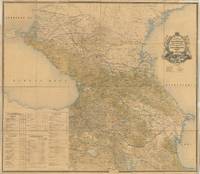
65574Tbilisi: Compiled and Lithographed at the Military Topographical Department of the Caucasus Military District 1870 with corrections to August 1896. Original large-format colour-lithographed map of the Caucasus 132 x 151 cm dissected into 24 panels and backed onto linen text in Cyrillic script folding down to 33.5 x 27 cm. With an extensive key decorative title cartouche and table showing the divisions of the Caucasus. The linen backing is in places dust-soiled and stained some tiny holes in the edges from former wall mounting that have been repaired somewhat browned overall and with a few minor brown spots a few small marginal tears not affecting map repaired with contemporary strips of paper linen edges are slightly frayed in places withal a very good example of this scarce and impressive map. A rare and large-format wall map of the Caucasus region in Russian. The map covers the modern territories of Armenia Georgia Azerbaijan Dagestan Chechnya Kalmykia etc. The map extends south to Tehran and north to Astrakhan. The eastern Black Sea is on the left and the western Caspian Sea is on the right. Beneath the title is a depiction of a railway winding through the mountains and opposite it a galloping horse with a cart crossing the mountains. Later editions were published at least until 1883 and 1903. The later edition is mentioned in 20th-century works dealing with international border disputes in the Caucasus. At the time of its creation it was almost certainly the finest map of the Caucasus produced in the Russian Empire. Tbilisi: Compiled and Lithographed at the Military Topographical Department of the Caucasus Military District, 1870 (with correc unknown
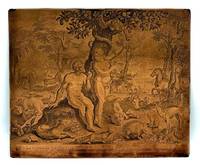
16001745Original printing plate: Johannes Galle. c.1600-1650. Engraved copper printing plate depicting Adam and Eve in the Garden of Eden surrounded by all manner of creatures with Adam sitting at the foot of the tree of knowledge about to take a bite from an apple whilst Eve takes another from the hand of a serpentine creature coiling around the branches above. 22.7 x 19.1cm. The plate incorporating text to the foot from Genesis 3. Signed at the foot "M. de Vos invenit / Corn. Galle Sculp. / Io. Galle excudit". The plate with some old fine scratches is otherwise in very good order. WITH: A later mid nineteeth-century and somewhat weak impression of the plate on paper. This laid down to board with manuscript French labels dated 1851 to the reverse apparently gifting the item from Mademoiselle C. Thyes of Brussels to "Monsieur Delpy"; the print with two pin holes to the blank lower margin and a few spots of faint foxing. A beautifully-executed original engraved copper printing plate by the Flemish engraver Cornelis Galle the Elder 1576-1650 forming a typically busy depiction of the Garden of Eden with Adam and Eve sealing their fate amidst a varied menagerie of peaceable beasts including an elephant camel bear porcupine ostrich and rearing unicorn amongst others.</p><p>Cornelis Galle was first taught engraving by his father the engraver and publisher Philip Galle 1537-1612. He subsequently resided in Rome for several years where he acquired an accuracy of design and freedom of style which marked him out as a master of his art form. Following his return to Antwerp he continued to engrave numerous plates after the works of his countrymen as well as his own designs becoming a master of the Antwerp Guild of St Luke in 1610.</p><p>The present engraving was made after an original painting by the prominent Flemish artist Maerten de Vos 1532-1603. A prolific draughtsman de Vos produced numerous designs for the engravers of Antwerp the resulting prints of which circulated widely in Europe and the Spanish colonies significantly contributing to his international reputation and influence.</p><p>Hollstein XLIV.61.243. [Original printing plate]: Johannes Galle. unknown
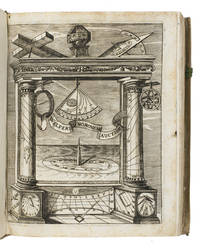
16723992Nuremberg 1672. 4to. Paulus Fürstens printed by Christoph Gerhard Contemporary parchment sewn on 3 supports with a hollow back each board with a frame of blind double fillets green cloth ties. With a finely engraved frontispiece an architectural gate with a wide variety of sundials and other astronomical instruments 2 title-pages each in a decorative frame built up from typographic ornaments 16 engraved plates 1 folding in the first part that for p. 48 repeated - at the end of vol. 2 - in accordance with the instructions to the binder and numerous mathematical illustrations and figures on 13 folding engraved plates lettered A-N in the second part. Further with letterpress tables on the integral leaves woodcut tailpieces and decorative gothic initials and headpieces built up from typographic ornaments. Set in fraktur types with incidental roman and Schwabacher. 2 volumes bound as 1. 12 88; 74 2 pp. Rare second edition 1st issue in 2 volumes extensively revised and enlarged of a mathematical study of the construction of sundials by Eberhard Welper the elder 1590-1664 first published in 1625 and here with useful additional observations and enlarged with a second part by Johann Christoph Sturm. Welper was born in Lohr near Marburg but studied in Strasbourg where he worked as a bookseller printer mathematician astrologer and astronomer. The first edition of the present work was one of his earliest publications. Sturm greatly expanded Welpers Gnomonica for the 1672 edition which was originally complete in the present two volumes. In 1681 Sturm added a third volume so the present two volumes were reissued with the third. Doppelmayer added a fourth volume in 1708.Occasionally browned but still in good condition. A rare 17th-centry work on sundials.l BMC STC 17th cen. W815 vols. 1-2; VD17 39:119761M & 39:119760D vols. 1-2 6 copies; Zimmer Astronomische Instrumente pp. 546 & 583; cf. Zimmer Astronomischen Literatur 5023 1625 ed.; not in Honeyman; Poggendorff; Wheeler gift. hardcover
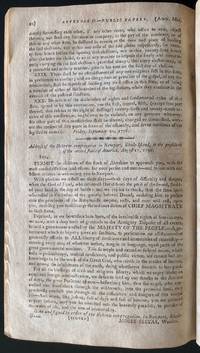
179143202Philadelphia: Mathew Carey; Carey Stewart and Co. No. 188 Market-street 1791. Original Sewn Binding without outer wrappers or boards 8vo pages 285-344 1-48 1-40 1-48 total 196 pages with different sections correctly paginated for this issue.<br> With Moses Seixas’ famous letter to President George Washington<br> Seixas wrote to President Washington on behalf of the Newport congregation whose home is the Touro Synagogue the oldest synagogue still standing in America. This letter which appears on p 40 of Appendix II and Washington's reply comprise one of the most famous statements on religious freedom of this period. <br> Here published in America’s first literary magazine George Washington’s famous phrase describing a government that "gives to bigotry no sanction and to persecution no assistance" was originally coined by Seixas in this very letter. It is a moving Biblically toned greeting to the president and was repeated by Washington in his reply assuring it a place among the most cherished in the American historical vocabulary.<br> George Washington's visit to Newport Rhode Island August 17-18 1790 ranks among the seminal episodes in the history of American Jewish religious liberty. Washington left Rhode Island off his travel itinerary the previous year in response to the state's failure to ratify the Constitution. By 1790 after becoming the last state to ratify Washington visited Newport along with members of his administration including Thomas Jefferson. <br> Moses Seixas 1744-1809 a Newport merchant warden of Kaal Kadosh Yeshuat Israel Newport Hebrew Congregation and a prominent Mason was one of the civic leaders who met with Washington. Seixas had a long history as a revolutionary patriot: he remained in the city after it was occupied by the British during the war and signed a document during the occupation pledging loyalty to the patriotic cause. <br> Additionally his brother Rabbi Gershon Mendes Seixas minister of New York's Shearith Israel Congregation known as the "patriot rabbi" was one of fourteen clerygymen officiating at Washington's 1789 Presidential inauguration. <br> Finally as a fellow Mason he and Washington would have had a natural connection. Seixas' eloquent message reads in part: <br> "Deprived as we heretofore have been of the invaluable rights of free Citizens we now with a deep sense of gratitude to the Almighty Disposer of all events behold a Government erected by the MAJESTY OF THE PEOPLE – a Government which to bigotry gives no sanction to persecution no assistance – but generously affording to ALL Liberty of conscience and immunities of Citizenship: – deeming every one of whatever Nation tongue or language equal parts of the great governmental Machine: – This so ample and extensive Federal Union whose basis is Philanthropy Mutual confidence and Public Virtue we cannot but acknowledge to be the work of the Great God who ruleth in the Armies of Heaven and among the Inhabitants of the Earth doing whatever seemeth him good." <br> Grounding religious freedom in natural rights and echoing Seixas' words Washington later replied with an echo of Seixas' language regarding religious freedom: <br> "The Citizens of the United States of America have a right to applaud themselves for having given to mankind examples of an enlarged and liberal policy: a policy worthy of imitation. All possess alike liberty of conscience and immunities of citizenship. It is now no more that toleration is spoken of as if it was by the indulgence of one class of people that another enjoyed the exercise of their inherent natural rights. For happily the Government of the United States which gives to bigotry no sanction to persecution no assistance requires only that they who live under its protection should demean themselves as good citizens in giving it on all occasions their effectual support."<br> See JE Vol. IX pp. 294-295; EJ. Vol. XIV p. 1117; J.L. Blau and S.W. Baron The Jews of the United States 1790-1840 A Documentary History Vol. 1 1963 pp. 8-10.<br> Other pieces of interest include notes on the slave trade by Benjamin Franklin and notes on the Revolutionary War. <br> “The American Museum or Repository of Ancient and Modern Fugutive Pieces &c. Prose and Poetical “title changed to “The American Museum or Universal Magazine†in January 1790 was America's first literary magazine featuring early printings of the US Constitution the Bill of Rights various State constitutions Alexander Hamilton's Report on Manufactures and parts of the Federalist Papers. <br> Complete issue in original sewn binding. Overall condition is very good with scattered darkening and foxing though paper and binding remain nice and strong with clean crisp edges including the notable page containing the address to Washington<br> A Cornerstone of American Judaica. BAMR-69-7A. Philadelphia: Mathew Carey; Carey, Stewart, and Co. No. 188 Market-street unknown
1928347h5608London: Arrowsmith. Good. 1928. First Edition. Hardcover. "Whatever place its author may ultimately occupy in future histories of England one thing is certain that in the history of the Jewish people the name of Balfour will enjoy unchallenged immortality evoking comparison with that of Cyrus for the issue of the Balfour Declaration marked the opening of a new epoch in the annals of Jewry which will be recognised as such even in the remotest centuries to come. In this little book have been gathered together all the utterances of Lord Balfour on the interpretation and implications of his Declaration on its political aspects and its practical realisation made during the last ten years." - Preface. 4 5-128 pp. 7" x 4.75". Original spine label present and intact. Front free endpaper professionaly replaced. Tanning to central portion of half-title. Prior owner's ink stamp upon title page. Duplicate spine label bound at p.128. Average external wear. Binding intact with moderate forward lean. Quarter inch notch from top of backstrip. Includes replica dust jacket preserved in glossy new archival-grade Brodart. A sound example of this jewel of Zionist history. Emanuel p.48. ASIN B000852UV4; 12mo - over 6¾" - 7¾" tall; Zionism - History Balfour Declaration Lord Balfour Arthur James Balfour Israel - History Lord Rothschild Palestine Mandate The Hebrew University . Arrowsmith hardcover
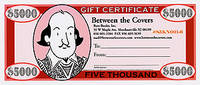
54789Unbound. A gift certificate redeemable for up to five thousand U.S. dollars $5000 worth of merchandise from Between the Covers Rare Books Inc. Individually numbered and bearing a portrait of the Bard by artist Tom Bloom. unknown
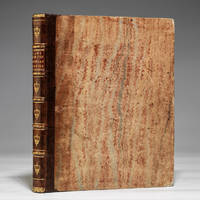
17681206031768. First Edition. CATHERINE THE GREAT. The Grand Instructions to the Commissioners Appointed to Frame a New Code of Laws for the Russian Empire: Composed by Her Imperial Majesty Catherine II. Empress of All the Russias. To which is prefixed A Description of the Manner of opening the Commission with the Order and Rules for Electing the Commissioners. London: T. Jefferys 1768. Quarto contemporary marbled boards rebacked in period-style calf-gilt red morocco spine label raised bands; pp. i-v vi-xxiii 1 3-258. $5000.First edition in English of the celebrated Nakaz of Catherine the Great drawing extensively on Montesquieu's Spirit of the Laws heralded by Voltaire and Diderot initially issued in Russia in 1767 ""the single piece of Russian legislative material best known abroad""aligned with the later American constitution for its ""shared characteristics and techniques"" highly elusive in contemporary boards.""Born into a family of obscure German aristocrats delivered to St. Petersburg at the age of 14 and married in great pomp to the feckless heir to the Russian throne Catherine found herself"" in a loveless marriage and without political support Smithsonian. In 1765 after Peter's death and several years into her reign Catherine began crafting the Nakaz working on its almost daily for nearly two years. ""Fundamentally the Nakaz which Voltaire is said to have called the finest monument of the century is a legal and a political document. It represents Catherine's ambition early in her reign to remodel Russia's laws in accordance with new principles expounded in Western Europe. The Nakaz consists of three parts containing 655 articles in all. The major part 526 articles was made public in Moscow on July 30 1767. It treats the historical development of Russia and monarchial absolutism; the nature and forms of laws; crime and punishment; social structure and religious freedom. On February 28 and April 8 1768 two supplements of 40 and 89 articles respectively dealing with police expenditures revenues and taxation were added to the Nakaz"" Dmytryshyn Economic Content 1-2. ""While she worked alongside a secretary it was Catherine herself who selected and organized the material and wrote out the finished version."" In creating the Nakaz she chose her texts carefully. Nearly 300 ""owe something to Montesquieu's Spirit of the Laws 1748"" with about 100 clauses traced to Beccaria's On Crimes and Punishments 1764 and many from Voltaire's Encyclopédie."" While the Nakaz is ""not a written constitution it nonetheless shared characteristics and techniques with later texts that were constitutions"" Colley Gun Ship and Pen 61-73 emphasis in original.Catherine was ""not out to create a constitutional monarchy"" yet her Nakaz ""was innovative and influential the Legislative Commission that met in Moscow in August 1767 to discuss the Nakaz differed from later seminal constitution-making assemblies but it also anticipated and even exceeded them. Like the convention that met in Philadelphia in 1787"" this Russian Commission assembled delegates from across the empire. Further these ""Moscow deputies were also markedly more diverse in terms of social economic religious and ethnic background than the men of Philadelphia women too received some recognition in this Moscow commission something that did not happen in revolutionary America Moreover in sharp contrast with the men of Philadelphia in 1787 not all of the Moscow deputies were white and not all of them where Christian"" Colley 73-77. ""It was doubtless because of its 'radical' content that its publication was banned in France The significance of the Nakaz centers not only in its West European content"" but also on distinctive aspects of Russian culture that ""make the Nakaz an outstanding document in Russian political economic and historical literature"" Dmytryshyn 9. The Nakaz was never enacted yet it is ""the single piece of Russian legislative material best known abroad. It secured for Catherine the encomium 'the Great'"" Yale Law School. First edition in English. Catherine's manuscript was written in French from which she produced a Russian translation First editions were published in Moscow on August 10 1767 in Russian and German: a first German edition appeared in 1769. Little is known of translator Mikhail Tatischeff other than that he was attached to the Russian Embassy in London. Engraved ornamental initials and headpieces. Mispaginated as issued without loss of text. ESTC N6651. With trace of bookplate removal; later blank free endpapers. Bookseller ticket.Text fresh and fine light edge-wear rubbing to contemporary marbled boards. A handsome wide-margined near-fine copy. hardcover
199415922J1994. An original camera clapperboard used in the creation of the classic final picture in the film trilogy adaptation of Forrest Gump which eventually won the Academy Award for Best Picture. A clapperboard is a pair of hinged boards clapped together at the beginning of a film shot in order to aid sound synchronization and at the same time record the shot number and the number of individual takes of a scene. The board lists the production name the director’s name Robert Zemekis the cameraman’s name Don Burgess the scene number the roll of film number the take number and the date of shooting. 11 inches wide by 9 3/4 inches tall. Very good condition. The film won 6 Academy Award Oscars for Best Picture Best Actor - Tom Hanks Best Director. Best Adapted Screenplay Best Visual Effects and Best Film Editing. hardcover books
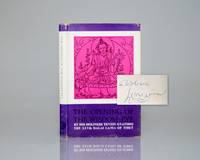
19684545Bangkok: The Social Science Association Press of Thailand 1968. First edition in English of the Dalai Lama's first book on Buddhist philosophy. Octavo original cloth. Signed by the Dalai Lama on the title page in Tibetan "with prayers." A near fine copy in a excellent dust jacket that is lightly rubbed. Housed in a custom half morocco clamshell box. Rare especially signed. The Opening the Eye of the Western Eye is a succinct thorough overview of the doctrines of Buddhism as they have been practiced for a thousand years in Tibet. The Dalai Lama here discusses the need for religious practice and the importance of kindness and compassion. Originally written for Tibetan lay people this was the Dalai Lama's first book on Buddhist philosophy to appear in English. Written for both Tibetan and Western readers Opening the Eye of New Awareness is the Dalai Lama's first religious work. It is not an edited transcript of public lectures but is His Holliness' own summation of Buddhist doctrine and practice. Completed in 1963 just four years after his escape from Tibet and four years after completing his religious education it is a work of consummate scholarship by a twenty-seven year-old geshe wise beyond his years. The Social Science Association Press of Thailand hardcover books
20831EBeverly Hills CA: National Pictures Corp n.d. Original 109 page shooting script with color rewrite pages for the classic 1953 science fiction film Invaders from Mars written by Richard Blake directed by William Cameron Menzies starring Helena Carter Arthur Franz Jimmy Hunt and Leif Erickson. Bradbound in printed studio covers. Very good lightly used copy with some minor spotting to the front cover and minor edge wear. Enclosed in a handsome custom red morocco and cloth clamshell box. Due in large part to Menzies’ innovative techniques Invaders from Mars was the first feature science fiction film to show aliens and their spacecraft in color and was rushed into production to premiere before the much-anticipated George Pal film of H.G. Wells’ novel War of the Worlds. William Cameron Menzies 1896 - 1957 worked to great acclaim primarily as a production and set designer notably for The Thief of Bagdad 1924 The Adventures of Tom Sawyer 1938 David O. Selznik’s Gone With the Wind 1939 and Alfred Hitchcock’s Spellbound 1945. Mr. Menzies won two Oscars at the very first Academy Awards in 1929 for Best Art Direction for The Dove and Tempest and in 1940 at the 12th Academy Awards won an Academy Honorary Award for “outstanding achievement in the use of color for the enhancement of dramatic mood†for Gone With the Wind. Some of his other films include The Iron Mask 1929 Our Town 1940 The Pride of the Yankees 1942 For Whom the Bell Tolls 1943 and Duel in the Sun 1946. National Pictures Corp hardcover
20831EBeverly Hills CA: National Pictures Corp n.d. Original 109 page shooting script with color rewrite pages for the classic 1953 science fiction film Invaders from Mars written by Richard Blake directed by William Cameron Menzies starring Helena Carter Arthur Franz Jimmy Hunt and Leif Erickson. Bradbound in printed studio covers. Very good lightly used copy with some minor spotting to the front cover and minor edge wear. Enclosed in a handsome custom red morocco and cloth clamshell box. Due in large part to Menzies’ innovative techniques Invaders from Mars was the first feature science fiction film to show aliens and their spacecraft in color and was rushed into production to premiere before the much-anticipated George Pal film of H.G. Wells’ novel War of the Worlds. William Cameron Menzies 1896 - 1957 worked to great acclaim primarily as a production and set designer notably for The Thief of Bagdad 1924 The Adventures of Tom Sawyer 1938 David O. Selznik’s Gone With the Wind 1939 and Alfred Hitchcock’s Spellbound 1945. Mr. Menzies won two Oscars at the very first Academy Awards in 1929 for Best Art Direction for The Dove and Tempest and in 1940 at the 12th Academy Awards won an Academy Honorary Award for “outstanding achievement in the use of color for the enhancement of dramatic mood†for Gone With the Wind. Some of his other films include The Iron Mask 1929 Our Town 1940 The Pride of the Yankees 1942 For Whom the Bell Tolls 1943 and Duel in the Sun 1946. National Pictures Corp hardcover books
1890101R86Sienna. Ca: . 1890 Two decorated wooden panels painted in polychrome tempera gold gilt and gesso with a leather spine. 330 x 250 mm. Elaborately decorated on one board with four armorial shields surrounded by incised stamps on gilt fields and gilt floral sprays on a blue field. The text below the shields reads: "INVENTARIO DELLE COSE DEL LA SAGRESTIA DEL DUOMO EDE LALTRE COSE MOBILI DELU OPARA RIFATTO LASICO DA VOLTA AL TENPO DEL UENE RABILE UOMO FRANCESCHO DI PAOLO TADDEI ANNO D. 1475." Roughly translated: Inventory of the things in the sacristy of the Duomo Ede. Taken from the last by the incomparable Frances Taddei in the year 1475. The front board has a lovely Rennaisance Madonna and Child with "Samis de Petris" below. This de may have been an attempt to attribute the painting to the artist Sano di Pietro. Beveled edges. Brass bosses at each corner. Very good. RARE. A contemporary of the famed "Spanish Forger" Icilio Federico Joni 1866-1946 was born in Siena. As a young man he worked in the shop of a gilder and art restorer. He began as a sideline to produce imitations of fifteenth century Sienese painted wooden panel book covers. He based these tempera painted wooden panels on the Tavolette in the Archivio di Stato which he probably never saw in person. It is quite clear from his autobiography 1932 that he was proud of his skill and his brilliant imitations of the ancient art of Siena. He considered them original art rather than 'forgeries'. There are probably no more than twenty examples of his work extant today. From the Bridwell Library SMU: "A skilled producer of imitation "Gothic" altarpieces he received a commission c. 1890 to create a book cover in imitation of those found on Siena's Tavole di Biccherna the elaborately gilt and painted fourteenth-century tax registers. Without ever seeing a real Biccherna he established a lucrative business of faking Biccherna covers. Joni later boasted of incidents in which the local police were alerted to books purportedly stolen from Siena Cathedral or the state archives only to discover that they were by Joni. A number of book collectors were deceived by Joni's creations and several of his works were published as Gothic originals. Today Joni's forgeries are highly valued in their own right. In his autobiography Joni discussed his methods for antiquing the covers by mixing soot turmeric chrome yellow and gilding gesso with gum arabic to produce the patina on the gold. The bosses were bathed in ammonia and the clasp plates were dipped in iodine "which rusted them in just the right way." Note that Joni's boards are simply glued onto a rough leather spine; he apparently did not know how to replicate a fifteenth-century sewing structure." Research in America has clarified Joni's role as a restorer in such works as Piermatteo d'Amelia's Annunciation Gardner Museum and the half-length figures in Fra Angelico's Annunciation Mrs E. Ford Collection. There are probably only about 50 of these known. RARE. SAFE. Hardcover. Very Good. [Sienna. Ca: ]. hardcover
1451Francfurt: Apud Haeredes Christiani Egenolphi 1563. Hardcover. Good. Quarto. viff. 42 43 iii 57 v pages. With separate title-pages to parts II and III. Poorly bound margins trimmed. In some instances catchwords and signature marks have been cut off not affecting text. Sheep somewhat worn. Kleinheyer/Schröder Deutsche Juristen aus 5. Jhdtn. 1983 147-149. Bound with: Kling M. Matrimonialium . Melchior Kling 1504-1571 from Hanau was an important 16th century German jurist and proponent of the systematic school of jurisprudence. <br/> <br/> Francfurt: Apud Haeredes Christiani Egenolphi, 1563. hardcover
1450Francfurt: Apud Haeredes Christiani Egenolphi 1559. Hardcover. Good. Quarto. iv 44ff. Sheep somewhat worn. Kleinheyer/Schröder Deutsche Juristen aus 5. Jhdtn. 1983 147-149. Bound with: Kling M. In Feudorum usus Consuetudines . Melchior Kling 1504-1571 from Hanau was an important 16th century German jurist and proponent of the systematic school of jurisprudence. <br/> <br/> Francfurt: Apud Haeredes Christiani Egenolphi, 1559. hardcover
1896056105Mecca: Hicâz Vilâyet Matbaasi Mecca AH 1314 CE 1896/97. 1896. 1st Edition . Hardcover. Very Good. 8vo - over 7¾ - 9¾" tall. Contemporary quarter purple cloth. 4to. 28 x 20 cm. In Ottoman Turkish and Arabic with sporadic Persian verses. 1 blank page 3 222 p. A label on spine slight wear to spine single leaf of index is loosely inserted. Else a very good and collectible copy "Al-Matba'a al-Miriyya" seal on colophon as a common practice of preventing counterfeits in the period. An exceptionally rare first Mecca edition of a single-volume work containing two celebrated texts representing the final nineteenth-century Turkish commentaries on the Qasîda-i Burda. Authored by Necib Bey of Antioch an Ottoman official who served in the Hijaz the volume was printed at the first press established in the region by Osman Nuri Pasha. The Qasîda-i Burda is a thirteenth-century ode of praise to Muhammad composed by the Egyptian Shadhili mystic al-Bûsîrî. The first two pages of the work are devoted to complimentary letters written for the book by the then Governor of the Hijaz Ahmed Ratib Pasha 1846-1913 and by the Arab scholars Abd al-Jalil Burade and Arif Khan Tashkendi. One of the letters is in Arabic the other in Ottoman Turkish. The final Turkish commentary on the Qasîda-i Burda produced in the nineteenth century belongs to Necib Bey of Antioch d. after 1319/1902 who served as an official in the Hijaz region. Necib Bey held administrative posts at both institutions known as al-Tekiyyât al-Miriyya The Egyptian Tekke charitable imarets established by Mehmed Ali Pasha of Kavala the Khedive of Egypt d. 1265/1849 one in Mecca and the other in Medina. As he himself states in his commentary Necib Bey received his education in Western Anatolia and travelled extensively across a wide geographical area including regions beyond Ottoman territory such as Europe and Russia marking him as a Turkish traveller and scholar of broad experience. In addition to these qualities he was also active as an educator and is known to have tutored members of the elite including Khedive Abbas Hilmi II of Egypt d. 1944 and his brother Mehmed Ali Pasha. Two works by Necib Bey are known both of which are Turkish commentaries on the Qasida-i Burda poems of Ka'b b. Zuhayr and al-Bûsîrî. The first bears the title Is'âd: Shar-i Bânet Su'âd and the second Mukhtaar Tawassul: Shar-i Qasîda-i Burda. These two works were published together in a single bound volume in 1896/97 at the Hijaz Provincial Printing House. The title Mukhtaar Tawassul derives from the fact that this work is an abridgement of the commentary entitled Tawassul by Mekkî Mehmed Efendi d. 1212/1797. The commentary entitled Is'âd takes its name from the Arabic commentary Is'âd 'alâ Bânet Su'âd written by the Egyptian scholar Ibrâhîm b. Muammad al-Bâjûrî d. 1277/1860. The commentator explains this choice of title with the statement: "This commentary being in the nature of a translation of Bâjûrî's commentary has therefore been named Is'âd after its original title." However the diversity of sources evident in the work the inclusion of autobiographical details Sufi narratives poetic examples in three languages and several critical remarks directed at the primary source clearly demonstrate that the text stands much closer to an original composition ta'lîf than to a mere translation tarjama. Gürler. ON THE FIRST PRINTING HOUSE IN THE HIJAZ: The distinctive cultural character of Meccan society as a centre for learning intellectual exchange and scholarly debate was a decisive factor in the introduction of printing to Mecca. This development was welcomed by both scholars and the local population and materialized in 1882 under the auspices of the Ottoman governor of the Hijaz Osman Nuri Pasha. Although the Ottoman government had established the first printing press in the Arabian Peninsula earlier in Sana'a in 1877 1295 AH Mecca became acquainted with printing shortly thereafter in 1300 AH 1882-83 with the founding of an official government press. The Meccan pres <br/> <br/> Hicâz Vilâyet Matbaasi, Mecca, AH 1314 [CE 1896/97]. hardcover
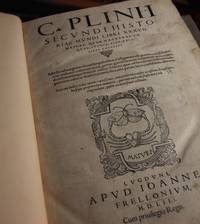
155328<p>C. Plinii Secundi Historiae mundi libri XXXVII majore quam hactenus unquam studio fide religione emedati adjectis ad marginem succinctis . . . una cum indice totius operis copiosissimo.<em> Lugduni Apvd Ioannem Frellonivm. M.D.L.III.</em></p><p>Pliny's <em>Natural History</em> is Shakespeare's source for the famous description in <em>Othello</em> of "men whose heads grow beneath their shoulders." See Kenneth Muir <em>Shakespeare's Sources </em>London 1957 p. 127.</p><p>Although there were translations of Pliny into French and English some scholars have argued that Shakespeare read Pliny in Latin. See T. W. Baldwin "A Note upon William Shakespeare's Use of Pliny" in <em>Essays in Dramatic Literature </em>London 1935 pp. 157-82.</p><p>Folio. 3 parts in one vols. A2-A4 B-C4 a-z5 A-Z5 AA-ZZ4 Con2 m4; l.; 34 679 236 p. Title-page vignette. Medium brown calf blindtooled border on both boards.</p><p>Provenance: Inverchapel bookplate.</p><p>The <em>National Union Catalog of Pre-1956 Imprints</em> lists only two known copies not including the present one.</p><p>References: NUC: 461 671-90 NP 0424260. Not in USTC.</p> John Frellonium
614444to. 7 pages approximately 1200 words in a completely legible hand on lined stationery with the embossed stamp of Evans and Cogswell Charleston. Docketed on the verso of the final leaf "July 15 1861 / James Simons / to / Governor Pickens / Reply to Letter / of Gov. P / 11 July 1861." Brigadier General James Simons's draft copy of a letter further explaining his reasons for resigning his command given in reply to a July 11 letter from Gov. Pickens that apparently had quarreled with earlier correspondence from Simons responding point by point to criticisms he feels the Governor has leveled against him over differences of opinion regarding the military defensibility of Charleston Harbor. Most if not all of the Pickens-Simons correspondence concerning this matter has been published; the James Simons papers at the University of South Carolina holds correspondence from Pickens but we have not been able to locate the original manuscripts or other drafts for the Simons portion of this correspondence. Old tideline from dampstaining with professional conservation work cleaning the paper restoring chipped areas along the lower edge through leaf-casting and completing several letters and marks with matching manuscript on four leaves. Folded for mailing or filing. 61444 9835. Following the Union Army take over of Fort Sumter by Major Robert Anderson on December 26 1860 just six days after South Carolina seceded from the Union Gov. Pickens directed Major General Schinierle to occupy Fort Moultrie Fort Johnson and Castle Pinckney and to establish a battery on Morris Island to prevent at all costs the reinforcement of Anderson's men. Simons as commander of the 4th Brigade of the Charleston Militia was second in command of the defenses for the harbor occupying the critical spot at Morris Island at the harbor's entrance. He expressed his concerns over the defense of the harbor in a six-page report to the Governor on January 1 1861: "I cannot sacrifice to matter of Etiquette questions and issues of such momentous importance as now surround us . The line of operations embraces four points 1 Fort Moultrie 2 Castle Pinckney 3 Fort Johnson 4 Morris Island. By the map which accompanies this paper it will appear that your lines of communication with these points . are directly within the range and effective power of Fort Sumter - the Citadel of the Harbour controlling every point. At the first return of fire from Fort Sumter your lines of communication are utterly cut off." He goes on to report: "Fort Moultrie - This position is wholly untenable - Lt. Col. De Saussure . gave you prompt notice of this fact on the morning after his occupation." To this Gov. Pickens responded with great offense insinuating that Simons was counseling abandonment of the harbor defenses. Simons' first letter of resignation came almost immediately on January 8 but he was prevailed upon by the Secretary of War to withdraw it. The 4th Brigade under Simons command led the first attack on Fort Sumter on April 12 1861. The controversy between Simons and the Governor continued to simmer until a few months after Anderson and his Union forces had surrendered Fort Sumter. By July in spite of Simons' successes defending the Charleston harbor he again offered his resignation. Gov. Pickens apparently wrote to refute Simons arguments. Simon replies in this lengthy manuscript letter: "I had hoped I would not have been obliged to extend this correspondence but I am sure your sense of justice will indulge me a letter further. I have assigned among other reasons for resigning that you have not shown that recognition which appeared to be due to me as a general officer. I detailed several instances but confined myself to the facts neither canvassing nor questioning your intuition or motive. You reply that you do not think my reasons for resigning are sufficient yet you adopt a line of argument to arrive at this conclusion which not only admits the facts I have stated but is founded . on a settled intention not to consult me and why Because on two occasions having been called into council & my opinion specially asked I ventured to differ from you & express opinions not in conformity with yours. In other words my rank position & counsel as a public officer were to be overlooked because I did not yield acquiescence to that which did not accord with my honest convictions . I must ask your indulgence a little longer. You say that about the 29 December I made "a regular Military Protest" against everything you had done or prepared to do & demanded a council of War. That on the 3 day of January last you endorsed on the back of my demand for a council of War that you could agree to no council of War that would drive you to any such conclusions. Permit me in justice to myself to show you the mistaken impressions under which you seem to labour. The date of my Report was 1 Jany & not 29 December. This date is important as you will see. I respectfully ask leave to correct your misapprehension also as to its being a 'regular Military Protest.' It appears to me that you are mistaken. The paper I sent to you was a Report on the defense of the Harbour of Charleston. I sent it to you because on 31 Dec. 1860 you directed Major Genl. Schinierle in you own words as follows -'You are now ordered to see and attend particularly to the objects & the commands I have detailed to you above & further purpose you are directed to call into requisition and council the valuable aid and co-operation of Brigadier General Simons.' Thus called and in pursuance of my responsibility and duty as Brigadier General I made a Report of my examination of the Harbour & my opinion thereon. That it was a Report & not a Protest I cite your excellency as both witness & judge. On the 2 Jany. You say in a letter to me 'Your Extraordinary report I received last night & have only to say that I do not pretend that the orders & disposition of the forces in Charleston Harbour are at all perfect or beyond the criticism of strict military rule.' If you thought it then 'a regular Military Protest' it seems to me that you would not have called it a report." Simons goes on to protest Gov. Pickens' actions in removing Capt. Gifford's Company from his command in late June "without giving me the least notice." He also asks for a copy of his original report which was reviewed and approved of by members of the Governor's Board of Ordnance at the time "as this document forms part of the public record of this transaction and may be of use to me in after history ." In conclusion Simons states that he regrets the "controversial character" of their correspondence and he does "disclaim any aggressive intention or spirit against yourself or your administration of public affairs. I hope I am too loyal a citizen to set so evil an example. I have been obliged to present my as it appears to me right in the record and to disclose the grounds on which I felt myself constrained to retire from my post at such a season but this does not abate my consideration for your high official station or my ardent hope for the successful termination of the Great Revolution in which we are engaged." Gov. Pickens did accept Simons' resignation. Simons went on to volunteer as a private in an artillery unit having given up his rank though he did not long serve in that capacity resuming his legal career. This letter with all of the corrections additions and deletions given here along with other letters in the Simons-Pickens correspondence was published as Address to the Officers of the Fourth Brigade Giving Them the Grounds for His Resignation; Respectfully Submitted to Them by James Simons July 1861 Charleston: Evans & Cogswell 1861; Parrish & Willingham 5048: Huntington Georgia Duke North Carolina Library Co. of Philadelphia South Carolina Historical Society. Manuscript material from Brig. Gen. James Simons is scarce with the last recent records of sales at auction being for his manuscript report of the defenses of Charleston Harbor 1 Jan. 1861 having sold at Sotheby's in 2004 $9600 and the same item at Bloomsbury NY in 2008 7500 pounds. <br/><br/> unknown books
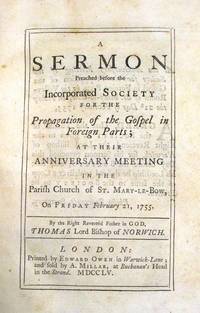
176729803London 1767. Bound in attractive contemporary or early 19th century half morocco marbled boards marbled endpapers and raised spine bands. 'Sermons' stamped in gilt on spine. Bookplate of Paul Beilby Thompson 1784-1852 the first Baron Wenlock an English Whig and Member of Parliament during the late 1820's and the 1830's. Pages 80; 77 1; 99 1; 88; 91; 119 1; 68 1; 98 1 pp each as issued. A lovely set in Near Fine condition tear to one blank margin on the 1767 Sermon and spotting on a couple of its leaves.<br/><br/> The Preachers listed chronologically are Thomas Hayter 1755 James Johnson 1758 Anthony Ellis 1759 Richard Newcome 1761 John Hume 1762 Philip Yonge 1765 William Warburton 1766 John Ewer 1767. In addition to their Sermons the pamphlets print the Society's Charter its Proceedings over the preceding year names of members and donors; the names of the Society's missionaries in Canada the American Colonies and the West Indies with their narrative reports on their work including conversions of Indians and Negroes; and a list of the Bishops and Deans who have preached before the Society beginning in 1701. The form of a bequest to the Society is usually printed at the end.<br/> The Society's efforts in the American colonies aroused great resentment among some leading American clergy particularly Charles Chauncy and Jonathan Mayhew who viewed its activities as attempts to establish the Church of England in the New World and to destroy the democratic organization of American churches. Their resistance during the 1760's paralleled political developments which would produce the American Revolution. <br/> Certainly the Sermons reflect the high-water mark of British self-assurance. Bishop Hume describes "the real state of the multitudes-- a set of thoughtless illiterate untutoured creatures." Warburton's 1766 Sermon "a statement of British manifest destiny." Gephart dismisses objections of non-Episcopalians to the Society's mission: Americans suffer from the "outrageous folly" of "Freethinking." They are "a People where wealth and Civil Faction have as usual inflamed religious zeal." And the Society of Jesus has "immerged themselves in the worst part of civil intrigues." At the same time he and his colleagues unequivocally denounce "the infamous traffic for Slaves" which "directly infringes both divine and human Law." They are "endowed with all our Faculties possessing all our qualities but that of colour; our BRETHREN both by Nature and Grace." <br/>HAYTER: ESTC T47758. JOHNSON: Goldsmiths' 9409. Sabin 36223. ELLIS: ESTC T14001. NEWCOME: Sabin 54938. ESTC N23710. HUME: ESTC N37286. Goldsmiths' 9804. YONGE: Adams American Controversy 65-28. WARBURTON: Adams American Controversy 66-61. Sabin 101276. Blockson 8984. Gephart 10084. EWER: Adams American Controversy 67-5. unknown books
186975295Washington D.C.:: The American Bond and Currency Detectory Company 1869. First edition. publisher's pebbled green gilt-lettered cloth. Small stray pen mark on the title page; neat tissue reinforcements to the inner hinges front and rear and evidence of a removal on the rear pastedown. The cloth is rubbed at the corners and extremities of the spine; tight and sound. A beautiful copy. Oblong small folio. Complete with twenty-two engraved plates many with multiple figures of registered bonds; and nine embossed chromolithograph plates of coins and coinage printed in gold silver and copper on dark maroon paper by J. Haehnlen Philadelphia. Issued under the Sanction of the United States Treasury Department and Containing Superb Illustrations in Genuine Tints Printed at the Treasury Department from the Original Dies in the Possession of the Government. The American Bond and Currency Detectory Company, hardcover
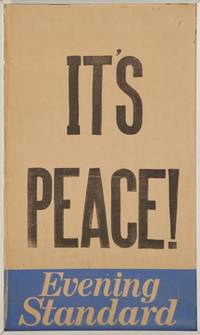
12513Used; Like New/Used; Like New. A graphically striking vintage news banner issued by the Evening Standard in two colors proclaiming peace at the end of WW2. Signed and inscribed on the verso in ink from Bob Freeman "To George and Pattie" later gifted by George Harrison presumably after his divorce from Pattie Boyd in 1977 to Ringo Starr and acquired by us from the Collection of Ringo Starr.  29 by 17 inches. In very good condition with tears professionally mended with Japanese tissue and archivally framed with the signed portion on verso left visible within a rear window on mat.  <br style="">Robert Freeman is a photographer and designer most famous for his album cover photos for The Beatles and his design work on the end credit sequences of their first two films and the related film posters and advertising materials.  He was the Beatles' most favoured photographer during the years 1963 to 1966 and shot arguably the most well known images of them. He photographed and designed the covers for five consecutive album covers of the Beatles-sanctioned UK album releases on the Parlophone label. Most of those images were also adapted by Capitol Records for the US releases they compiled from the Beatles' UK recordings.<br style=""> unknown books
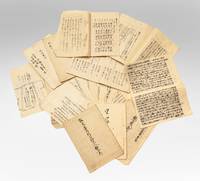
7712Several dozen manuscripts in various formats incl. long folded sheets stitched pamphlets sewn volumes and letters. Japan: ca. 1853-63.<br/> <br/> A substantial group of documents revealing internal high-level debates and discussions in response to Commodore Perry’s landings and later controversies that arose as Western powers established a foothold in Japan. This is an exceptional collection filled with top-secret information on government intrigues as the Japanese state responded to aggressive foreign expansion and dissenting groups within the government urging top-to-bottom reforms.<br/> <br/> The manuscripts touch upon pivotal events in Japan’s history:<br/> <br/> –Commodore Perry’s two expeditions July 1853 & February-March 1854 and the resulting ratification of the Treaty of Shimoda.<br/> <br/> –Japanese translations of the treaties signed with the United States Russia France and the United Kingdom from 1854 to 1858.<br/> <br/> –The assassination of Ii Naosuke in March 1860 also known as the Sakuradamon Incident which precipitated a violent backlash against foreigners under the banner of Sonno joi “Honor the Emperor expel the barbariansâ€.<br/> <br/> –General dissatisfaction with the bakufu and efforts to reform it.<br/> <br/> –The attempted assassination of Ando Nobumasa a chief councillor during this period.<br/> <br/> –The Namamugi Incident in September 1862 when the British merchant Charles L. Richardson was killed by Satsuma domain warriors.<br/> <br/> –The bombardment of Kagoshima August 1863.<br/> <br/> Among all these materials we must highlight several examples of manuscript kengen proposals and commentaries written by aristocrats with policy advice on the difficult situations faced by the Japanese state. These offer compelling perspectives on the most pressing dilemmas of the day. While they were not composed by the decision-makers these documents are filled with the minutiae and data employed in the policy-making process.<br/> <br/> All of the items are in a fine state of preservation.<br/> <br/> â§ John McMaster “Alcock and Harris. Foreign Diplomacy in Bakumatsu Japan†Monumenta Nipponica Vol. 22 No. 3/4 1967 pp. 305-367. unknown
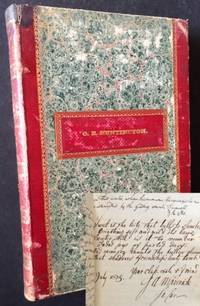
182516960New Haven CT: Yale College 1825. 1/4 leather. Very Good . The 1825 Yale College Yearbook then called "Class-book". This copy belonged to a student named Oliver Ellsworth Huntington who had this copy bound in a decorative red leather over marbled boards with his name in gilt block letters printed across the front panel. This is by far the earliest yearbook this bookseller has seen some 14 years before the advent of photography. Apparently each Yale student was given a blank book at the beginning of the school year and was expected to have his classmates fill the book in during the course of the year with handwritten tributes to the particular graduating senior. Apart from the yearbook's obvious scarcity in its own right what's also so notable is some of the classmates of Huntington who wrote tributes many of them quoted poems but many also long heartfelt digressions. Among Huntington's classmates were Samuel Augustus Maverick the legendary Texas lawyer and land baron who was an original signer of the Texas Declaration of Independence. With his fiercely independent streak Maverick was also responsible for inspiring the creation of the word "Maverick". In addition to Maverick other classmates included 1 Rev. George William Perkins Abolitionist active in the Underground Railroad; 2 Elias Warner Leavenworth Mayor of Syracuse and Congressman from NY 1875-1877; 3 William Moseley Holland Co-Valedictorian; 4 Willis Hall Co-Valedictorian and NY State Attorney General 1839-1842; 5 Rev. Richard Falley Cleveland Father of President Grover Cleveland; 6 Rev. William Twining established a young ladies' seminary in Madison Indiana which became Wabash College and was a noted Abolitionist; 7 Worthington Hooker Professor of Medicine at Yale VP of the American Medical Association 1864; 8 William Bennett Fleming Georgia Congressman 1879; 9 John Simkus Butler Author of pioneering works on the study and "curability" of insanity; 10 Seabury Ford Governor of Ohio 1849-1850; 11 William Gelston Bates Massachusetts House of Representatives 1868; 12 Simeon North President of Hamilton College 1839-1857. Given its age the book has held up very nicely and remains solid firm and VG to VG with light forgivable rubbing along the panels and a bit of wear at the spine and its crown. Huntington's son has written in ink on the front free endpaper: "The Yale College Class-book of my Father Oliver Ellsworth Huntington". The book measures 7 1/2" tall x 5" wide and includes the lengthy inscriptions of 80 some classmates between the Class of 1825 AND the Class of 1824. A wonderful piece of Americana -- and of course of Yale history. <br/><br/> Yale College hardcover books
194815956JLos Angeles: Argosy Pictures 1948. Screenwriter Frank Nugent’s personal copy of his screenplay. Original 116 page mimeographed shooting script that was for the classic John Ford directed western starring John Wayne Pedro Armendariz and Harry Carey Jr. Hardbound in full gilt-stamped blue leather with Nugent’s name stamped on the front board in the lower left hand corner. With marbled endpapers. Nugent has hand-corrected a couple of typographical errors and at one point has written in dialogue that was was missing. The Three Godfathers was the first western directed by John Ford filmed in color. Frank Nugent was a New York journalist who reviewed over 1000 films for The New York Times. Director John Ford turned Nugent into one of Hollywood’s most respected screenwriters. He wrote 11 screenplays for John Ford directed films including The Searchers The Quiet Man Fort Apache She Wore a Yellow Ribbon Wagon Master Mister Roberts The Last Hurrah The Rising of the Moon Two Rode Together Donovan’s Reef. Nugent was respected by other directors as well and he wrote The Tall Men for director Raoul Walsh Angel Face for Otto Preminger Paratrooper for Terence Young and others. Nugent was elected President of the Writers Guild of America West WGAW from 1957 to 1958 and he served as the guild’s representative on the Motion Picture Industry Council from 1954 to 1959. Argosy Pictures hardcover books