DOUGHTY Charles MontaguMareMagnum

184 825 résultats
2 vols., 8vo., Second Edition thus, with fine portrait frontispiece (original tissue guard present), numerous plates (a number in collotype and a number folding), illustrations, maps and plans in the text and large folding coloured map mounted on cloth in pocket at end of first volume, neat contemporary signature on half-title of first volume, small sticker on front paste-downs; original dark green cloth, upper boards blocked in gilt and framed in blind, gilt backs, gilt tops, black endpapers, uncut, a sharp, bright, crisp, near fine copy in unclipped dustwrapper, the wrappers moderately sunned at backstrips. EDITION LIMITED TO 500 COPIES. With the trade ticket of WH Smith of Bournemouth on front paste-down. 'Lawrence had long admired Doughty's classic and was instrumental in getting the second English edition published by the fledgling firm of Jonathan Cape in conjunction with the Medici Society' (paraphrased from O'Brien). VERY SCARCE IN THIS CONDITION, AND ESPECIALLY IN THE DUSTWRAPPERS. O'Brien A013.
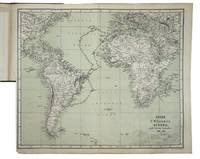
1885ABC_47212Vienna: Carl Gerold's Sohn 1885. Contemporary half brown cloth with the original publisher's printed wrappers mounted on the boards. Large 8vo. With 3 lithographed folding maps one coloured showing the route of His Majesty's Ship Aurora along the east coast of South America. First edition of an account of the 8-month expedition to circumnavigate the globe in 1884-1885 by His Majesty's Ship Aurora a vessel launched by the Kaiserliche und Königliche Kriegsmarine Austro-Hungarian Imperial and Royal Navy to Brazil and the Río de la Plata basin. This voyage commanded by Victor Bosquet was primarily intended as practical training for naval cadets but also helped to facilitate the trade between South America and the Austro-Hungarian Empire as well as political and economic interests.On 27 August 1884 the corvette Aurora sailed from Pola to Gibraltar and further via St. Cruz on Tenerife to Bahia. After a short stay of about ten days the Aurora sailed to Rio de Janeiro also passing some other places to Buenos Aires and from there via Montevideo back to Pernambuco. Thereafter the Aurora sailed back to Pola via São Miguel Ponta Delgada and Gibraltar reaching Pola's central port on 25 April 1885.The present account drawing on the reports of the commanders of the Aurora paints a detailed picture of its voyage including some hydrographic navigational and meteorological observations. These are also included in the more descriptive navigational part of the voyage. Moreover it includes some information on the places where they anchored including Bahia Pernambuco Rio de Janeiro and many more. Die Reis S.M. Corvette "Aurora" was published separately and as an appendix to volume 10 of the hydrographical journal of the Austrian-Hungarian Navy Mittheilungen aus dem Gebiete des Seewesens. Altogether a highly interesting official record of the Austro-Hungarian circumnavigation of the globe via Brazil and the Río de la Plata basin and a great source of information for the Austro-Hungarian navys trading expeditions to this region.With the library stamp of the Royal Danish maritime library "Marinens Bibliothek" on the front wrapper a stamped subject indication on the front paste-down "Sørejser. b. 1884-1886" "Sea voyages ." and an inscription in ink "Reise" on the front wrapper. Wrappers on the boards a little browned spine a little discoloured with some tears on the folds of the first lithographed map not affecting the image but otherwise in very good condition.l Borba de Moraes p. 707; WorldCat 743212274 & 780852276 3 copies. Carl Gerold's Sohn, hardcover
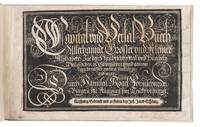
156821281Augsburg: Johann Jacob Schönig 1568. Vellum ca. 1985 with each leaf attached to a stub and the stubs side stitched in a cloth slipcase. Oblong folio 21 x 34 cm. With a richly calligraphic woodcut title-page 18 x 28 cm with text in white fraktur lettering on black with a white panel at the foot with the letterpress imprint in a fraktur type; and 9 of 10 full-page woodcuts about 17 x 25.5 cm showing alphabets in white on black one dated 1568: 8 with decorated gothic capitals versals: 22-150 mm and 1 with textura capitals textura lowercase and roman capitals all versos blank. Lacking 1 leaf. With a small and perhaps fragmentary manuscript on parchment 2 ll. 11.5 x 13.5 cm written on both sides: a Protestant copybook written soon after 1557 probably in Basle or vicinity with 7 writing samples including alphabets of capitals and minuscules the first two pages in fraktur gothic styles and the last two in humanistic styles. Sixth known copy of Johann Jacob Schönig's edition of a stunningly decorative Augsburg writing master's woodcut copybook devoted primarily to decorated gothic capitals versals printed in the period 1680-1694 from the original woodblocks of the first edition of 1568. Hans Rogel the elder 1532-1592 writing master school teacher poet wood-block cutter engraver printer and publisher at Augsburg cut the woodblocks and probably executed the lettering himself. All the lettering examples and the title-page are printed from large richly calligraphic woodcuts with their lettering in white on black. Nine of the ten examples display versals the missing leaf supplied in reproduction including complete alphabets in three sizes. The final leaf displays alphabets of textura capitals textura minuscules and roman capitals. As early as 1779 Paul von Stetten described Rogel's Capital und Versal Buech as "besonders fein geschnitten" and said that if Rogel executed the lettering himself he "ist er billig den zierlichsten Schreibmeistern beyzuzählen". He thought it good enough to be the work of Caspar Brinner 1565-1610 the greatest Augsburg writing master of the second half of the century apparently not knowing Brinner was only about three years old in 1568.All editions should apparently contain 11 leaves but many contain only 10 and some fewer. Some have also been bound with additional leaves that do not belong to the edition. There appear to be only 3 complete copies of the present edition.An early owner skilfully wrote out alphabets in the fore-edge margins of 2 leaves and phrases at the foot of one. It seems likely to be the copy owned by Jan Willem Six van Vromade 1872-1936. Lacking leaf "2" as noted professionally and unobtrusively restored in 1984 and probably rebound soon after: the tattered fore-edge margins of several leaves were restored and a couple gaps in the right border of the title-page filled in with black ink. A small brown smudge in the unnumbered first page of versals 22 mm slightly affects small bits of 4 letters but in general the woodcuts remain in good condition.l Berlin Kat. 4799; Bonacini 1548 Berlin copy; Doede 21 note; Hollstein German 34 KVK & WorldCat 4 copies: 2 lacking 1 leaf; Van Stockum Cat. bibl. J.W. Six de Vromade part 1 16-21 November 1925 lot 407 the present copy; cf. Paul von Stetten Kunstgewerbe und Handwerksgeschichte . Augsburg 1779 vol. 1 p. 23 1655/68 ed. Johann Jacob Schönig, hardcover
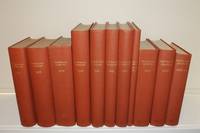
1957000186Paris France: Unifleurus; Maison de la Bonne Presse Bayard; Chrétiens dans le monde rural CMR 1957-1969. Première édition First Edition. Bound periodicals hardcover. Very Good. various. <i>Voir en bas pour la traduction en français.</i> <br /><br />Rare collection. <br /><br />This set of periodicals was originally bound for the library of one Monseigneur Maurice Baudoux 1902-1988 Officer of the Order of Canada and archbishop of Saint Boniface Manitoba Canada. He was awarded the honour of the OC for his work in the western provinces on behalf of French Canada. The binder was the Montréal-based Reliure Deshaies & Associes. <br /><br />The present listing includes 11 bound volumes of periodicals in orange/brown hardcover which contain an estimated 16500 pages in total. French language. The sizes vary from 28 - 35 cm tall. Note that there are two gaps in this collection most of 1962 and 1968. <br />The volumes are by and large in Very Good condition. Most of the covers show mild to moderate shelfwear including but not limited to scrapes and rubbing and a few are predictably shaken very thick volumes but otherwise securely bound without any major defect. <br />Internally the covers of each issue are generally somewhat worn with evidence of having been folded and the paper has aged as expected but otherwise the textblocks appear to be in Very Good to Near Fine condition with few exceptions the occasional small closed tear crease ink transfer unobtrusive notation etc. and it has been noted in one volume that three leaves are unbound. <br /><br />Please see listing images for condition details. <br /><br />Though Biblio has a limit of 8 images many photographs have been taken to show the condition of the volumes and a preview of the contents of each. <b>Almost 100 photographs are available upon request. <br /><br /></b><i>Panorama ch</i><i>rétien</i> a religious monthly magazine from Paris was created in 1957 by Father Gaston Courtois as a hybrid of the popular magazine and the Catholic monthly with the goal of bridging the spiritual and the day-to-day realities of modern living. It contains a surprising depth and breadth of articles and artwork covering diverse topics such as: modern cinema theatre music art and comics travel history and historical sites science and innovation interior decorating fashion education feminism health and medicine parenthood politics and of course religion. Profusely illustrated often in colour and peppered with vintage advertisements throughout it is a surprisingly interesting source of information and imagery for the religious and atheist alike. <br /><br />Please see listing images for a preview of contents. <br /><br /><b>Due to the large and heavy nature of the volumes the set will be shipped in two separate boxes both approximately 12 x 10 x 17 inches 30 x 25 x 43 cm and weighing approximately 35 lbs 16 kg each. Given this expect to receive a large shipping fee increase request before your order is processed and shipped. This request may be accepted or declined via Biblio and will result in the shipping or cancellation of your order respectively. <br /></b><br />En français GoogleTrans: <br /><br /><b>Recueil rare. </b><br /><br />Cet ensemble de périodiques était à l'origine destiné à la bibliothèque d'un Monseigneur Maurice Baudoux 1902-1988 Officier de l'Ordre du Canada et archevêque de Saint-Boniface Manitoba Canada. Il a reçu l'honneur du CO pour son travail dans les provinces de l'Ouest au nom du Canada français. Le cartable était le Reliure Deshaies & Associes de Montréal. <br /><br />La liste actuelle comprend 11 volumes reliés de périodiques en couverture rigide orange / marron qui contiennent environ 16500 pages au total. Les tailles varient de 28 à 35 cm de hauteur. Notez qu'il y a deux lacunes dans cette collection la plupart de 1962 et 1968. Les volumes sont dans l'ensemble en très bon état. La plupart des couvertures présentent des étagères légères à modérées y compris mais sans s'y limiter des éraflures et des frottements et quelques-unes sont secouées de manière prévisible volumes très épais mais par ailleurs solidement liées sans aucun défaut majeur. En interne les couvertures de chaque numéro sont généralement quelque peu usées avec des preuves d'avoir été pliées et le papier a vieilli comme prévu mais sinon les blocs de texte semblent être en très bon à presque fin à quelques exceptions près la petite déchirure fermée occasionnelle le pli le transfert d'encre la notation discrète etc. et il a été noté dans un volume que trois feuilles n'étaient pas reliées. <br /><br />S'il vous plaît voir les images de liste pour les détails de l'état. <br /><br />Bien que Biblio ait une limite de 8 images de nombreuses photographies ont été prises pour montrer l'état des volumes et un aperçu du contenu de chacun. Près de 100 photographies sont disponibles sur demande. <br /><i><br />Panorama chrétien</i> mensuel religieux parisien a été créé en 1957 par le père Gaston Courtois en tant qu'hybride du magazine populaire et du mensuel catholique dans le but de rapprocher les réalités spirituelles et quotidiennes de la vie moderne. Il contient une profondeur et une ampleur surprenantes d'articles et d'Å“uvres d'art couvrant divers sujets tels que: le cinéma moderne le théâtre la musique l'art et la bande dessinée les voyages l'histoire et les sites historiques la science et l'innovation la décoration intérieure la mode l'éducation le féminisme la santé et la médecine la parentalité la politique et bien sûr la religion. Abondamment illustré souvent en couleurs et parsemé de publicités vintage c'est une source étonnamment intéressante d'informations et d'images pour les religieux et les athées. <br /><br />Veuillez consulter la liste des images pour un aperçu du contenu. <br /><br /><b>En raison de la nature volumineuse et lourde des volumes l'ensemble sera expédié dans deux boîtes séparées toutes deux d'environ 12 x 10 x 17 pouces 30 x 25 x 43 cm et pesant environ 35 lb 16 kg chacune. Compte tenu de cela attendez-vous à recevoir une importante demande d'augmentation des frais d'expédition avant que votre commande ne soit traitée et expédiée. Cette demande peut être acceptée ou refusée via Biblio et entraînera respectivement l'expédition ou l'annulation de votre commande. </b><br /><br /><br />Keywords: Gaston Courtois; Jacques Duquesne; David Julien; Jean Gelamur; EÌglise catholique PeÌriodiques; Journaux et peÌriodiques religieux; Publications en seÌrie; 1950-1959; 1960-1969; Catholique Chretien; Culturel; Economie; Loisir Magasine; Paris; Politique; Societe; Vie spirituelle; mensuel; gothique; vitrail; sites historiques; momies; mode parisienne; Le petit prince; Christianisme; catholicisme; guerre; Catholic Church Periodicals; Religious newspapers and periodicals; Serial publications; 1950-1959; 1960-1969; fifties; sixties; vintage; Christian Catholic; Cultural; Economy; Leisure Shopping; Paris France; Politics; Society; Spiritual life; monthly; Parisian fashion; art; architecture; gothic; stained glass; sculpture; historical sites; mummies; the Little Prince; morbid; social commentary; Christianity; Catholicism; war; photography; nature; Becket. <br /><br /><b>ISSN 0479-4273</b> Unifleurus; Maison de la Bonne Presse (Bayard); Chrétiens dans le monde rural (CMR) hardcover
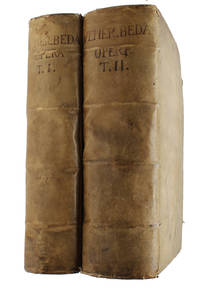
161228124Coloniae Agrippinae (Köln), Sumptibus Anton. Hierati et Ioan. Gymnici, 1612. Folio. Bound in two contemporary, uniform full vellum bindings with remains of silk-ties on boards. Some traces of use to extremities. Some pages evenly browned, some brownspotted. First two volumes richly illustrated with woodcut diagrams, musical notes, earth- and heaven-maps etc. in the text, numerous woodcut initials throughout, engraved title-page. (10) pp, columns 1-168 (84 pp.), pp. 169 - 322, columns 323 - 452 (65 pp.) + (1) f., 238 pp. + (2) ff., columns 1 - 500 (250 pp.) + (2) ff., columns 1 - 916 (458 pp.) + (1) f., columns 1 - 816 (408 pp) + (1) f., columns 1 - 852 (426 pp.) + (2) ff., columns 1 - 485 (243 pp.) + (2) ff., columns 1 - 968 (484 pp.), 55 ff. (Index).
161228124Coloniae Agrippinae Köln Sumptibus Anton. Hierati et Ioan. Gymnici 1612. Folio. Bound in two contemporary uniform full vellum bindings with remains of silk-ties on boards. Some traces of use to extremities. Some pages evenly browned some brownspotted. First two volumes richly illustrated with woodcut diagrams musical notes earth- and heaven-maps etc. in the text numerous woodcut initials throughout engraved title-page. 10 pp columns 1-168 84 pp. pp. 169 - 322 columns 323 - 452 65 pp. 1 f. 238 pp. 2 ff. columns 1 - 500 250 pp. 2 ff. columns 1 - 916 458 pp. 1 f. columns 1 - 816 408 pp 1 f. columns 1 - 852 426 pp. 2 ff. columns 1 - 485 243 pp. 2 ff. columns 1 - 968 484 pp. 55 ff. Index. <br/><br/><em>Very rare early and apparently first complete edition of the seminal works by the "Father of English History" the venrable Bede. Bede’s most famous work his "An Ecclesiastical History of the English People" Historia Ecclesiastica Gentis Anglorum begins with the invasion of the British Isles by Roman forces and is considered one of the most important historical records documenting Roman rule Anglo-Saxon settlement and the evolution of the Church on the island. With its focus on Anglo-Saxon history the work is considered a key foundational text in the forming of a national English identity. The "Ecclesiastical History" contains stories that serve as the only source documenting the conversion to Christianity of the Anglo-Saxon tribes. It tells the story of Britons from Julius Caesar’s invasion to the time of Bede himself . He tells the story of battles conversions and miracles performed by monks and bishops and details Britain’s early history from the Roman invasion. He furthermore describes the organization and establishment of Christianity in the English church and covers the personal history of Holy Ethelwald and miracles of growth within the English church such as the development of the bishopric. "Bede’s works fall into three groups: grammatical and “scientific†scriptural commentary and historical and biographical. His earliest works included treatises on spelling hymns figures of speech verse and epigrams. His first treatise on chronology De temporibus “On Times†with a brief chronicle attached was written in 703. In 725 he completed a greatly amplified version De temporum ratione “On the Reckoning of Time†with a much longer chronicle. Both these books were mainly concerned with the reckoning of Easter. His earliest biblical commentary was probably that on the Revelation to John 703–709; in this and many similar works his aim was to transmit and explain relevant passages from the Fathers of the Church. Although his interpretations were mainly allegorical treating much of the biblical text as symbolic of deeper meanings he used some critical judgment and attempted to rationalize discrepancies. Among his most notable are his verse 705–716 and prose before 721 lives of St. Cuthbert bishop of Lindisfarne. These works are uncritical and abound with accounts of miracles; a more exclusively historical work is Historia abbatum c. 725; “Lives of the Abbotsâ€. In 731/732 Bede completed his Historia ecclesiastica. Divided into five books it recorded events in Britain from the raids by Julius Caesar 55–54 BCE to the arrival in Kent 597 CE of St. Augustine of Canterbury. For his sources he claimed the authority of ancient letters the “traditions of our forefathers†and his own knowledge of contemporary events. Bede’s Historia ecclesiastica leaves gaps tantalizing to secular historians. Although overloaded with the miraculous it is the work of a scholar anxious to assess the accuracy of his sources and to record only what he regarded as trustworthy evidence. It remains an indispensable source for some of the facts and much of the feel of early Anglo-Saxon history." Encycl. Britt. Only three editions of Bede's Opera Omnia are known before Dr. Giles' edition from 1843 - 44. The first was printed in 1563 and the third in 1688. The 1688-edition constitutes the second edition of the present 1612-edition which is "According to Dr. Henry the only complete edition" Lowndes I:143. These three editions are also the only ones known to have been printed in folio though Lowndes mentions the 1688-edition as 4to. The 1612-edition is the rarest. Some of the works contained in this edition are said not to be Bede's own as some of the many scientific richly illustrated works on geography the heavens the universe music etc. bear small resemblance to his other works. Lowndes I:143 Brunet 1:731. </em> hardcover
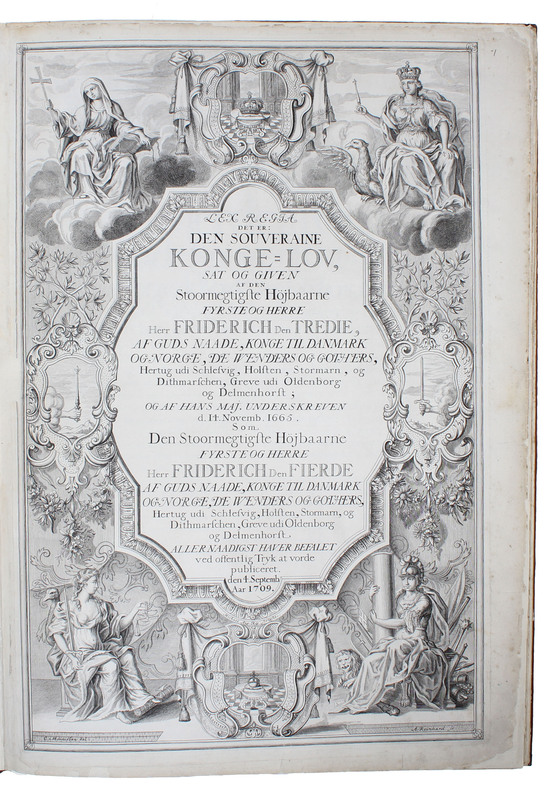
170954195(København), 1709. Folio. In contemporary full calf Cambridge-style mirror binding with blindstamped borders. Light wear to extremities. Seven leaves with minor repairs to margins, one leaf with a 15 cm long closed tear, and one leaf with an 30 cm long closed tear, all professionally executed and with no loss of imprint. Margins slightly soiled. 19 leaves, -text and frames engraved. The broad frames that all differ from each other ornamentally depict animals and plants as well as the different trades of the country. A nice copy printed on thick, heavy paper. Housed in a cardboard box.Provenance: From the collection of Danish book collector Viggo Lohse. The present copy was exhibited at 'Dansk Bibliofil-Klubs 50 års Jubilæumsudstilling' in 1992 (The 50 year anniversary exhibition for the Danish Society of Bibliophiles), no. 94.
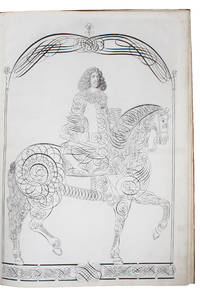
170954195København 1709. Folio. In contemporary full calf Cambridge-style mirror binding with blindstamped borders. Light wear to extremities. Seven leaves with minor repairs to margins one leaf with a 15 cm long closed tear and one leaf with an 30 cm long closed tear all professionally executed and with no loss of imprint. Margins slightly soiled. 19 leaves -text and frames engraved. The broad frames that all differ from each other ornamentally depict animals and plants as well as the different trades of the country. A nice copy printed on thick heavy paper. Housed in a cardboard box.Provenance: From the collection of Danish book collector Viggo Lohse. The present copy was exhibited at 'Dansk Bibliofil-Klubs 50 års Jubilæumsudstilling' in 1992 The 50 year anniversary exhibition for the Danish Society of Bibliophiles no. 94. <br/><br/><em>First edition of this landmark work of Danish book production and the constitution of the Danish absolute monarchy. The Royal Law established the absolute right of the Monarch to rule and it defined the line of royal succession. It was more rigorous than the other monarchal laws of Europe at the time.The text which is written by Peder Griffenfeld is engraved in copper throughout in order to prevent the possibility of re-printing pirated editions and text-counterfeiting. Frederik Rostgaard the King's state archivist who was famous for his excellent taste in books was in charge of the editing and issuing of the work. In front of the actual law text a leaf is inserted with the portrait of King Frederik III on his horse and everything except for the head of the king which was engraved after his death-mask is executed in the beloved flourishing- or scroll- manner of the time. The titles and the text are engraved throughout by Michael Røg. </em> unknown
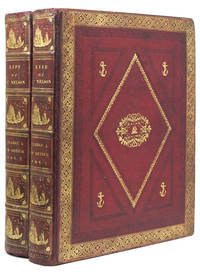
1809307574London: Printed by T. Bentley Bolt Court Fleet Street for T. Cadell and W. Davies in the Strand and W. Miller Albemarle Street 1809. First Edition. Illustrated. vi 375 1 blank; ii 511 1 blank pages. 2 vols. Imperial Quarto. Contemporary straight-grain red morocco with elaborate tooling and nautical motifs in gilt and blind; spine with five raised bands lettered and stamped in gilt. All edges gilt. Board edges worn particularly at corners joints neatly repaired. Two bookplates including famous Napoleonic collector Calvin Bullock and A.F. Woodward to front endpapers of each volume gift inscription at front preliminary "To Captain Henry Fisher R.N. with every good wish from Frances & Augustine Woodward in perfect remembrance of Feburary-1895.". Interior generally clean and bright. Handsome. First Edition. Illustrated. vi 375 1 blank; ii 511 1 blank pages. 2 vols. Imperial Quarto. Printed by T. Bentley, Bolt Court, Fleet Street for T. Cadell and W. Davies, in the Strand and W. Miller, Albemarle Street unknown
1927366144New York 1927. Reprint. 8vo. Cloth backed boards rubbed and worn but firm. Reprint. 8vo. SIGNED BY FROST on ffep Robert Frost Feb 1927. With holograph 19 lines from his play The Cow's in the Corn: A One-act Irish Play in Rhyme. written with variant second line on the following leaf. Probably done on a visit to Skidmore College in 1927.<br /> <br /> "The Cow's in the Corn<br /> A kitchen. Afternoon. Throughall O'Toole<br /> Behind an open paper reads Home Rule<br /> His wife irons clothes. She bears the family load<br /> <br /> Mrs O. Johnny hear that The cow in the corn<br /> Mr O. I hear you say it<br /> Mrs. O Well then if you do<br /> Why don't you go and drive her in the barn<br /> Mr. O.I am waiting. Give me time.<br /> Mrs. O. waiting for what God keep you always poor<br /> The cow is in the corn I say again."<br /> <br /> Robert Frost<br /> <br /> With an original 3-1/2 x 2-1/2 inches photograph of Frost laid in to the rear pastedown. and identified as Robert Frost on Skidmore Campus in 1927. unknown
1688000011508Coloniae Agrippinae = Cologne: Ioannem Wilhelmum Friessem 1688. Later edition. Hardcover. Very Good. 4 vol. 8 vol. bound in 4. Folio. 8 2-452 2; 1-238 with a section of these leaves mispaginated; 4 2-499 2; 4 2-916 1; 2 2-815; 2 2-851; 4 2-486 1; 4 2-967 a lengthy unpaginated index of words and subjects at the end of the volume plus a blank before the rear endpaper pp. Contemporary full blind-tooled pigskin contemporary ink titling on the spines with the volumes numbers; all edges decoratively stained black. Volume one with an engraved title page and its title page printed in red and black also with several in-text woodcuts and charts. The later volumes each have their own title page all volumes with woodcut initials head and tailpieces. Brunet 276. Graesse 321. NCBEL 346. Oxford DNB J. Campbell "Bede St Bede Bæda known as the Venerable Bede 673/4–735". This edition was first published in Cologne in 1612 these volumes are the second edition printed there. Saint Bede is remembered for his contributions to ecclesiastical and British historical writings. Bede wrote analytically and was fascinated by time and the creation of life as they were written about in early Christian sources. The sources available to him included Eusebius of Caesarea Orosius Eutropius and the earlier British historian Gildas. Historians label his Historia Ecclesiastica Anglis Gentorum as the greatest culmination of his writings and some point out that it helped to create the sense of a national English identity at a time when the Angles and the Saxons were still forging intertribal unity. His history of Christianity in Britain largely focuses on the years 597-731 after a brief explanation of Christianity in Roman-controlled Britain. Bede wrote in his own autobiography that his life was devoted to "learning and letters" and he was well-beloved in his own time and long after including by Britain's first king Alfred which is largely why most of his work survives today. His translations of various religious histories and lives of the Saints into Latin made these works accessible to his fellow monks and Bede even did an Old English translation of St. John's Gospel which had it survived would be the earliest lengthy work of prose in English. Bede was an author who was influenced greatly by the writers of Late Antiquity and his career is one of the most significant among those who wrote during the early Middle Ages. With a small later bookplate and an 18th century ownership mark Signet Library on each front pastedown. No other institutional markings. Boards with a few small spots of wear and yellowing overall a lovely set. Ioannem Wilhelmum Friessem hardcover
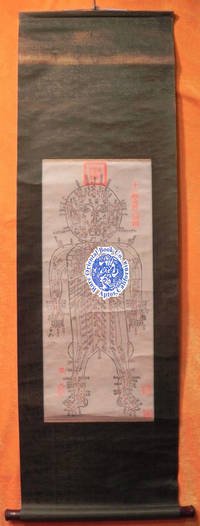
95241402China ca.1800-1840. Hanging scroll woodblock printed 35 x 17 cm. red Imperial seal at the top 4 other cinnabar red Yin Zhang seals red hand-brushed accupuncture points very excellent example silk brocade mounted. RARE & OBSCURE WORK . . . "FROM THE YELLOW EMPEROR'S Huang-DI ANCESTRAL HALL . . . DIAGRAMS OF THE 12 CLASSICA OF MARVEL CANON & . . . 8 PULSES: ACUPUNCTURE MERIDIANS" . . . THE LEGENDARY ACUPUNCTURE "QI" "POINTS" & MERIDIANS . . . Title Reads: "TWELVE CLASSICA OF MARVEL CANNON . . . ON EIGHT CHANNELS OF VITAL ENERGY PULSES" . . . WITH A LARGE YELLOW EMPEROR'S . . . RED CINNABAR YIN ZHANG CHOP/SEAL AT THE TOP . . This is a very rare 20th century reprint of the original a stunning and excellent work. It is woodblock printed by hand on hand-made Chinese mulberry paper. The image is 24.5 x 58.5 cm. mounted as a scroll with silk brocade mountings beautifully executed. . The work illustrates the most important acupuncture and acupressure "Qi" "points" eight veins in 12 channels. . The diagram shows a man and the locations of each of these "meridians" and pulses and their associated exact "Qi" places to insert the needle for maximum effect. Each of these "Qi" have been hand written using red ink. . The work illustrates a Chinese man with an the Yellow Emperor's Imperial Chinese seal above his head in red cinnabar. By placing the Emperor's Yin Zhang seal at the top of this diagram as something coming from the Yellow Emperor. . It reads: "FROM THE YELLOW EMPEROR'S Huang-DI ANCESTRAL HALL DIAGRAM OF ACUPUNCTURE MERIDIANS." . Per Ecke Volumes I & II: "Each of the meridians has a Chinese medical term. There are punctures where the needle may be pushed in. On the right eight large words Hanzi read: 'Twelve Classica of Marvel Canon On the Eight Channels of interior Pulses.' . Per the above the title woodblock printed in red at the far right reads in Pinyin: SHI ER JIN CHI JIN BAI MAI T'U: TWELVE CLASSICA OF MARVEL CANNON ON THE EIGHT CHANNELS of inferior PULSES." . Zhenjiu Xuewei acupuncture "Qi" energy points are indicated in red while copious other "Qi" or "points" are indicated by black dots where the acupuncture needle should be inserted for maximum therapeutic benefit. . PROVENANCE: The work was acquired by us directly from Prof. Richard C. Rudolph 1909-2003 the late great author professor and scholar of Chinese studies at the University of California Los Angeles. . His typical red cinnabar Yin Zhang chop/seal is found at the lower right corner above which is another unidentified collector's seal. For a photo of his chop please see photograph illus04.jpg posted to our website. . At the left margin are two other Yin Zhang which are identical to those illustrated in Ecke see below. . THE SAME EXAMPLE IS ILLUSTRATED IN ECKE Vols. 1 & 2: . As per Ecke this work was mounted as a hanging scroll the bindings are a green brocade silk of a high quality reminiscent of the Japanese style. . Per Prof. Rudolph he collected this in Chengdu during his 1948-49 book collecting trip throughout China buying books for the University of California. Google him for copious details. . CONDITION: The woodblock print has been expertly preserved in the scroll binding. As usual the scroll is backed with hand-made Washi type mulberry paper green silk front bindings with a think gold brocade cloth strip at the top and bottom in the Japanese style of scroll mounting. . The upper portion of the green silk has a bit of fading but this does not detract from the overall impression of the mounting. The print is flawless in stunning and excellent "collector's condition." . Please review the photographs posted to our website. . SCROLL MOUNTED SIZE: The mounting: 35.7 x 1 meter 13 cm. 113cm. Print sheet: 25.5 x 57.8 cm. The above dimensions differ from the exhibited un-mounted example. . PROVENANCE: Richard C. RUDOLPH 1909-2003: He was an American professor of Chinese Literature and Archaeology at the University of California Los Angeles. . This item was one of a group he purchased on a trip to China 1948-49. . HUANG-TI THE YELLOW EMPEROR 2697-2597 or 2698-2598 BCE: . Huangdi is a "Shen" deity in Chinese religion one of the legendary Chinese sovereigns and culture heroes included among the mytho-historical Three Sovereigns and Five Emperors and cosmological Five Forms of the Highest Deity. First calculated by Jesuit missionaries on the basis of Chinese chronicles and later accepted by the 20th century promoters of a universal calendar starting with the Yellow Emperor Huangdi's traditional reign dates are 2697-2597 or 2698-2598 BCE. . A large number of texts such as the HUANGDI NEIJING a medical classic and the HUANGDI SIJING a group of political treatises were attributed to him. He has been celebrated as China's greatest physician and writer of the classics on Chinese medicine practice and traditional medicine. See Veith below. . Huangdi is credited with numerous inventions and innovations ranging from the Chinese calendar the Yellow Emperor is now regarded as the initiator of Chinese culture and said to be the ancestor of all Chinese. . NOTE: Color scans of this are posted to our websit. . REFERENCE: . Tseng Yu-Ho ECKE: CHINESE FOLK ART I: In American Collections From Early 15th Century to Early 20th Century. See illustrated item #59 pp.92 & 93. . --. CHINESE FOLK ART II: In American Collections From Early 15th Century to Early 20th Century. See illustrated item #111 pp.129. Both items are exactly the same item . Per Ecke Vols. I & II: "An exact duplicate of this print is found in Korea. It is published in Folkisme Vol.1 Seoul by C.L. Strom entitled "CHART OF HUMAN BODY an illustration from the late Yi dynasty acupuncture textbook. However the source of this textbook is not given." . Note: Prof. Rudolph owned two copies of this item: the first copy he loaned to Ecke for the exhibition a single sheet print un-mounted sans collector's seals. . The second was his personal copy in green silk mounting as a scroll with his Yin Zhang Hanko/seal/chop our current listing. Shortly after the close of the exhibitions we acquired both examples along with a substantial part of his personal library. LOS ANGELES COUNTY MUSEUM OF ART: "Member's Calendar" of July 1987 vol.14 #7 discusses the exhibition of Chinese Folk Art to from August 2 -October 2 1977 organized by Ms. Ecke see that catalogue above this entry Ilza Veith: THE YELLOW EMPEROR'S CLASSIC OF INTERNAL MEDICINE. A translation of the first book on Chinese medicine HUANG TI NEI CHING SU WEN. See several entries under "acupuncture" and Huang-ti. p.58 et al. Harmut Walraven: CATALOGUE OF CHINESE BOOKS AND MANUSCRIPTS IN THE WELLCOME INSTITUTE FOR THE HISTORY OF MEDICINE. See several entries for Huang-ti and acupuncture: pp.35-38 items 67-71. wikipedia-org/wiki/Richard_C._Rudolph Not Listed in: COWDRY E.V.: A COMPARISON OF ANCIENT CHINESE ANATOMICAL CHARTS WITH THE 'FUNFBILDERSERIE' OF SUDHOFF. HSIEH E.T.: A REVIEW OF ANCIENT CHINESE ANATOMY. . . unknown
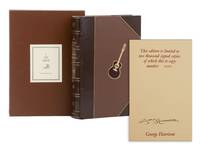
140947294Guildford Surrey: Genesis Publications Limited 1980. First Edition. Near Fine. Limited first edition #1229 of 2000 numbered copies signed by Beatle George Harrison in sepia ink. Bound in publisher's brown half calf binding over cloth boards stamped in gilt all edges gilt housed in brown cloth-covered slipcase with paper title label. Near Fine with light wear and light soiling to binding small area of damage to recto of sheet to which the frontis portrait is tipped in. Trivial rubbing to bottom edge of slipcase. A bright clean copy. A lovely piece of music memorabilia signed by the late Beatle. Genesis Publications Limited unknown
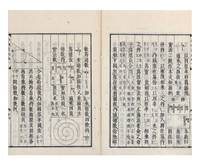
10323Numerous woodcut illustrations. Five vols. Large 8vo orig. semi-stiff patterned wrappers with orig. title-slips new stitching. Edo Kyoto & Osaka: Suharaya mohei é ˆåŽŸå±‹èŒ‚å…µè¡› 1769.<br /> <br> <br> <br /> <br /> First edition of this influential book of mathematics which inspired a number of commentaries and derivative works. Arima 1714-83 was the lord of Kurume domain in present-day Fukuoka prefecture on Kyushu. He was a patron of scholarship and for the education of his samurai he invited Confucian scholars calendrical experts and experts in military studies as well as mathematicians to the domain.<br /> <br> <br> The importance of Arima’s book stems from the fact that it “as a printed book for the first time made public important computational methods invented by Seki Takakazu which had previously been transmitted in secret†Takemasa Yasufumi æ¦æ£æ³°å² “Wasansho ShÅ«ki sanpÅ no chosha wo meguru saikentņ和算書『拾璣算法ã€ã®è‘—者をã‚ãã‚‹å†æ¤œè¨Ž Tetsugaku kagakushi ronsÅ No. 22 2020: p. 21. Seki Takakazu é–¢åå’Œ c. 1640-1708 was “the most important figure of the wasan ‘Japanese calculation’ tradition.†He was “instrumental in recovering neglected and forgotten mathematical knowledge from ancient Chinese sources and then extending and generalizing the main problems†Annick Horiuchi Britannica online.<br /> <br> <br> The bulk of our book consists of mathematical problems and topics such as: algebraic calculations; factorization; sums of infinite series; congruence; manipulation of arranged go pieces; expansion of series; permutations and combinations; indeterminate equations; sequential equations; spheres; the biggest and smallest numbers; finding the integer value; polynomial coefficient determination; and mensuration.<br /> <br> <br> Some copies of ShÅ«ki sanpÅ are misleadingly catalogued as dated 1766 based on the date of the author’s Preface.<br /> <br> <br> Very fine set preserved in a new chitsu.<br /> <br> <br> ⧠Smith History of Mathematics I p. 537. Smith & Mikami A History of Japanese Mathematics p. 182–“In this treatise Arima sets forth and solves one hundred fifty problems thus being the first noted writer to break from the old custom of solving the problems of his predecessors and setting others for those who were to followâ€â€“& see pp. 106 161 181 186 197 208 259 & 270. unknown
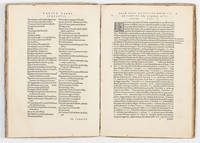
675816 p.l. 74 leaves. Folio later vellum-backed boards foot of spine defective occasional light soiling & dampstaining. Basel: H. Petri 1529. First edition of the two texts together. The De Temporum Ratione is a significant book in several ways. Most notably "this book helped to establish the custom of counting years from the birth of Christ. When we say that Queen Elizabeth II was born in 1926 not 'in the 16th year of the reign of George V' or 'in the year 2678 after the foundation of Rome' or in the '2nd year of the 481st Olympiad' we are indebted to the Venerable Bede."-Printing & the Mind of Man 16n. "Bede's greatest practical effect was on the Western calendar. His decisions beginning the year calculation of Easter names of days and months calculations of eras and so forth in most instances finally determined usage that was only refined not changed by Gregorian reform."-D.S.B. I p. 565. "The De Ratione Temporum first published in 1505 is particularly important. It contains a remarkable theory of tides based upon Pliny but also upon personal observation; first mention of the establishment of a port i.e. the mean interval between the moon's meridian passage and high water following; this interval is different in different ports."-Sarton I p. 511. Pierre Duhem described Bede's establishment of a port as the only original formulation of nature to be made in the West for some eight centuries. This is the first printing of De Natura Rerum which contains such physical science as was then known. It collects the wisdom of the ancient world on these subjects and has the special merit of referring phenomena to natural causes. It contains a particularly important section - the "De Comptu vel Loquela digitorum" - which is "our main almost our only source for the study of mediaeval finger reckoning or symbolism."-Sarton I pp. 510-11. See also Smith History of Mathematics II p. 200. This work was edited by Johannes Sichardt 1499-1552 professor of law who during the years 1526-30 lived in Basel and while teaching also edited and prepared for printing Latin manuscripts he had found in libraries in monasteries. He also served as adviser to the Basel printers Cratander Bebel and Henricus Petri. Good copy preserved in a box. Early signature of "Mallarii" on title with motto in Greek. Armorial bookplate dated 1915 of Bishop's College Cheshunt an Anglican theological college that closed in 1968. ❧ Sichardt: Bietenholz ed. Contemporaries of Erasmus Vol. III p. 247. hardcover books
05488Edinburgh: Printed for Adam Black 1814. With Two Superb Fore-Edge Paintings by the "Dover Painter"<br /> <br /> FORE-EDGE PAINTING. The "DOVER PAINTER" artist. PALEY William. The Principles of Moral and Political Philosophy. The Twenty-First Edition. Edinburgh: Printed for Adam Black 1814. <br /> <br /> With two superb fore-edge paintings executed ca. 1930 by the "Dover Painter" depicting views of "Edinburgh Castle from Grass Market" and "St. Giles Cripplegate Fore St." The distinctive treatment of the clouds and pointillistic brush strokes for detail are hallmarks of the style of the extremely skillful artist known as the "Dover Painter" the name given by Jeff Weber to the artist who produced very high quality painted fore-edges in the 1920s and 1930s.<br /> <br /> Two octavo volumes 8 3/8 x 5 1/4 inches; 213 x 133 mm. i-v vi-xxviii 1-374; viii 1-452 pp. <br /> <br /> Bound ca. 1814 in full dark blue straight-grain morocco covers decoratively paneled in gilt and blind spines with four 'double' raised bands decoratively tooled and lettered in gilt in compartments gilt board edges and turn-ins light brown end-papers all edges gilt. Near fine.<br /> <br /> With the circular blind-stamp of "The Library of Saint Mary-Of-The-Woods College" Indiana on the title-page of volume one. Two early family ink inscriptions on front blank dated January 6th 1844 and November 3rd 1882. Old booksellers description affixed to front blank.<br /> <br /> The "Dover Painter" an unknown English artist - probably worked on commission exclusively ca. 1920-1930 for Marks & Co the London booksellers. By 1928 Dawson's Book Shop in Los Angeles headed by Ernest Dawson began a relationship with Marks & Co. "a reciprocal agency agreement" that included sending crates of books to America via the Panama Canal. Several hundred fore-edges came to Dawson's. Sesslers' in Philadelphia bought and sold examples of the "Dover" painter's work as fore-edges by this and other artists turned up in the B. George Ulizio collection at Kent State University. Other fore-edge paintings were imported via J.W. Robinson Company department stores Los Angeles. The Robinson Co. books came with added new Sangorski & Sutcliffe slipcases made especially for them and sometimes included a typed identifying slip mounted on the end-leaves.more fore-edges by the "Dover Painter" can be seen at the Huntington Library. and Stanford University." <br /> <br /> A similar example is cited by Jeff Weber in his Annotated Dictionary of Fore-Edge Painting. "Paley William. The Principles of Moral and Political Philosophy. London: Printed for J. Faulder 1810 two volumes 8vo full contemporary red straight-grain morocco with an ornamental gilt border on sides richly gilt backs gilt edges. In a cloth slip case. Fore-edges: 1 view of New York in 1753; 2 Philadelphia in 1753. Boston Public Library LF109.D9 1814x". Weber. pp. 98-102.<br /> <br /> William Paley 1743-1805 was an English clergyman Christian apologist philosopher and utilitarian. He is best known for his natural theology exposition of the teleological argument for the existence of God in his work Natural Theology or Evidences of the Existence and Attributes of the Deity which made use of the watchmaker analogy. <br /> <br /> "In 1782 Edmund Law - the Bishop of Carlisle otherwise the mildest of men was most particular that Paley should add a book on political philosophy to the moral philosophy which Paley was reluctant to write. The book was published in 1785 under the title of The Principles of Moral and Political Philosophy and was made a part of the examinations at the University of Cambridge the next year. It passed through fifteen editions in the author's lifetime. Paley strenuously supported the abolition of the slave trade and his attack on slavery in the book was instrumental in drawing greater public attention to the practice. In 1789 a speech he gave on the subject in Carlisle was published. Edinburgh: Printed for Adam Black, 1814 unknown
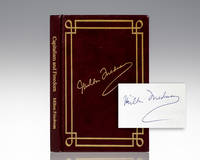
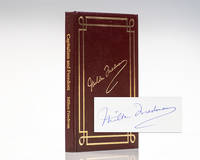
147392Chicago: The University of Chicago Press 1995. Special anniversary edition of Friedman's magnum opus. Octavo bound in full leather gilt titles to the spine front and rear panels all edges gilt silk bookmark bound in. Boldly signed by Milton Friedman on the title page. In fine condition. Milton Friedman “is regarded as a giant within the economics profession and is one of the two or three most referenced and revered economics figures in the 20th century†Pressman 161. Capitalism and Freedom was selected by the Times Literary Supplement as one of the "hundred most influential books since the war." It also placed tenth on the list of the 100 best non-fiction books of the twentieth century compiled by National Review and on Time Magazine's top 100 non-fiction books written in English since 1923 and Modern Library 100 best non-fiction books of the twentieth century. The University of Chicago Press hardcover
150901Chicago: The University of Chicago Press 1995. Special anniversary edition of Friedman's magnum opus. Octavo bound in full leather gilt titles to the spine front and rear panels all edges gilt silk bookmark bound in. Boldly signed by Milton Friedman on the title page. In fine condition. Milton Friedman “is regarded as a giant within the economics profession and is one of the two or three most referenced and revered economics figures in the 20th century†Pressman 161. Capitalism and Freedom was selected by the Times Literary Supplement as one of the "hundred most influential books since the war." It also placed tenth on the list of the 100 best non-fiction books of the twentieth century compiled by National Review and on Time Magazine's top 100 non-fiction books written in English since 1923 and Modern Library 100 best non-fiction books of the twentieth century. The University of Chicago Press hardcover
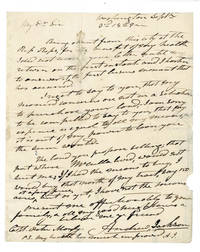
1829100289<p>Washington Sept. 3rd. 1829. 1829. Good. - Over 150 words penned on 9-3/4 inch high by 7-7/8 inch wide off-white paper. A personal letter to Capt. Peter Mosely penned by Andrew Jackson as president declining an offer to purchase some land adjacent to his plantation. "Being absent from this city at the Rip Raps Jackson's summer retreat for the benefit of my health I did not receive your letter until my return." "I regret to say to you that my monied concerns are not in a situation to purchase your land." He goes on to explain further that even were he in a financial position to do so the part he's being offered is not one which would suit him rather "I would buy that north of my tract say 150 acres at a fair price but as yet I have not the means." Signed in full "Andrew Jackson" with a postscript "P.S. My health has much improved" initialed "A.J." by him. Folded once horizontally and twice vertically for mailing with a couple of tiny holes and some stains at the folds. An archival repair to the center fold only slightly affects one letter over five lines. There is some slight chipping along the right edge. Good.</p><p>Winning fame as a Major General during the War of 1812 Andrew Jackson 1767-1845 was elected as the seventh president of the United States serving from 1829 to 1837. Although his philosophy created the rise of Jacksonian democracy which expanded equality to the common working man it only benefited white men. His policies were criticized as they excluded Native Americans and African-Americans.</p> Washington, Sept. 3rd., 1829.
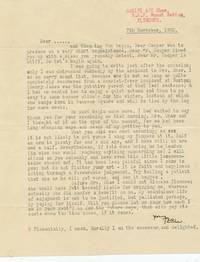
2464Lawrence refers to Charlotte Payne-Townshend Shaw reformer women's rights advocate and wife of author George Bernard Shaw. Lawrence writes to Charlotte's Shaw's doctor William Cooper who took care of Lawrence's broken wrist. In this upbeat letter with a literary reference to American author Henry James Lawrence gives an update on Charlotte as well as his own injured wrist. At the end he asks for the cost of the bill which he supposes Charlotte would have paid had she not become indisposed from an accident. In part "and then the fun began. Dear Cooper was to presume on a very short acquaintance. Dear Dr. Cooper lined you up with a class you probably detest. Dear Mr. Cooper is stiff. So let's begin again. I was going to write just after the occasion; only I was detracked suddenly by the accident to Mrs. Shaw.she is not so long or quite recovered from a scarlet-fever incident at Buxton; Henry James was the putative parent of that last sentence.she bumps down in Hanover square and will be tied by the leg for more weeks.I had wanted to say thank you for examining me that morning. Mrs. Shaw and I thought of it on the spur of the moment.What you had said was most assuring; as it is not likely to get worse I snap my fingers at it. Half an arm is plenty for one's old age and I have still and arm and a half. Nevertheless if fate does bring me to London No wise man would prophesy anything concerning me I will attend on you.It has been less painful.but do not flatter your art - it is faith and happiness acting through favorable judgement. Try telling a patient that she or he will get worse and see it happen! Before Mrs. Shaw I could not discuss finance; she would have felt herself liable for bringing me.My scandalous life of enjoyment is not to be justified but palliated perhaps by paying for itself.let me know how much I am in your debt ." The asterisk is actually the "@" symbol and points to another below the signature with the following explanation. "Financially I mean. Morally I am the assessor and delighted." In his hand he writes and signs "Yours T. E. Shaw." With envelope docketed by William Cooper explaining the letter. The letter is matted with envelope and printed photograph of Lawrence dressed in desert clothing as Lawrence of Arabia. Dr. Cooper explains that Lawrence "seeing two old people in difficulty with a car which wouldn't start he offered to help them but the handle hand crank of the car on a backfire hit him in the wrist & broke it." The incident occurred in March 1927 near Cranwell but since Lawrence did not take the needed time to allow the wrist to heal it never fully recovered. The letter shows Lawrence's wit and good humor about his own accident as well as his concern for his good friend Charlotte Shaw. unknown books
1809307574London: Printed by T. Bentley Bolt Court Fleet Street for T. Cadell and W. Davies in the Strand and W. Miller Albemarle Street 1809. First Edition. Illustrated. vi 375 1 blank; ii 511 1 blank pages. 2 vols. Imperial Quarto. Contemporary straight-grain red morocco with elaborate tooling and nautical motifs in gilt and blind; spine with five raised bands lettered and stamped in gilt. All edges gilt. Board edges worn particularly at corners joints neatly repaired. Two bookplates including famous Napoleonic collector Calvin Bullock and A.F. Woodward to front endpapers of each volume gift inscription at front preliminary "To Captain Henry Fisher R.N. with every good wish from Frances & Augustine Woodward in perfect remembrance of Feburary-1895.". Interior generally clean and bright. Handsome. First Edition. Illustrated. vi 375 1 blank; ii 511 1 blank pages. 2 vols. Imperial Quarto. Printed by T. Bentley, Bolt Court, Fleet Street for T. Cadell and W. Davies, in the Strand and W. Miller, Albemarle Street unknown books
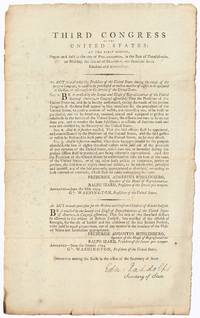
1794544490Philadelphia: Printed by Childs and Swaine 1794. Very Good. Broadside. Folio 8" x 13 ¼". Untrimmed as issued. Three slight horizontal folds modest foxing edges lightly toned very good. The rare variant printing Signed in ink by U.S. Secretary of State Edmund Randolph a Founding Father of the United States and 7th Governor of Virginia. An early act of the Third Congress setting forth provisions for building up the U.S. Navy up to 10 vessels "to be fitted out manned armed and equipped as gallies" . "for the protection of the United States." The act was issued in response to Barbary pirates disrupting American trade with Europe. It is followed by a shorter act "to make provision for the Widow and Orphan Children of Robert Forsyth." Both acts are signed and dated in letterpress by George Washington June 5th and June 7th 1794. An important variant copy signed by Edmund Randolph who served as both attorney general and secretary of state in George Washington's cabinet. Though not stated the broadside was printed in Philadelphia by Francis Childs and John Swaine printers to the Congress in 1794. Evans 27865; ESTC W28073. Printed by Childs and Swaine] unknown
01-0232London: Charles Knight 1846 1849. Vol I. With 112 engraved and partially hand-colored maps. folio. Full contemporary leather with blind and gilt stamping. Cover split at spine; leather exhibits significant rubbing and scratches. Minor int. foxing and soil. Else very good; many maps/plates fine or near fine. The maps are colored in outline. They are primarily country maps in Europe the Middle East and Asia. This volume does not have city maps. London: Charles Knight, 1846 (1849). hardcover
20222081502111907612Chintao shubbansha 2022. Soft Cover. Fine. The book is in fine condition. Chintao shubbansha paperback
19160009183CAMP COTTON EL PASO TEXAS TX. Good. 1916. On offer is a fascinating journal kept by an officer or high ranking NCO at Camp Cotton in El Paso Texas. He appears to be an officer with the 9th Massachusetts infantry fresh off training from Camp Framingham in Massachusetts who have come down to Camp Cotton. It appears that the troops were sent down to Camp Cotton to take place in the Pancho Villa Expedition attempting to hunt down Mexican Revolutionary Pancho Villa for his role in attacking New Mexico though they may have also been used to provide support for the ongoing Border War between Mexico and America. Beginning in June of 1916 and ending in September of the same year the journal documents the daily every day duties of the officer's command. Such looks into the darily Army command responsibilities in the early 20th century are not easy to come by. Such daily entries offer fantastic glimpses as to the uniform routine and daily activities of the officers and the enlisted men. One entry even goes over each detail of a meeting in which the Infantrys camp was set up:El Paso. Camp Cotton. Sunday July 2 1916. 1st meeting 11 am. Push all work till next meeting later in day. 2nd meeting 5-20 pm. Capt. Lawless will require spare parts and cleaning materials. Tops. 10 pm. Roll call chief and repeat to Regmt. Officers can buy for cash at Depot Quartermaster. Draw for Enlisted Men: 1 hat 1 cord. 1 O.T. shirt. 6 jean undershirts. 6 jean underdrawers. Belt if necessary. 3 breeches - cotton. 1 pr. Leggings. 6 pr. Socks for work. 1 pr. Shoes. 4 pr. Leggings laces. 4 pr. Shoe laces. All men must have one new outfit at all times. The above will be paid for by each man from his ____ of $4.00 for 1set 6 mos. Then $6 or $7 allowance for each 6 mos thereafter. Muster In Rolls. Col. Buck is sending the roll for correction. they must bear names of all officers and men. Ammunition 100 rds must be issued to each man. 6:30 pm. Recd 5 cases of 1200 rounds each from Capt. Lawless same as usual. At 7 pm each man recd 90 rounds which is all they belt can carry. Balance for present will be held by 1st srgt in his tent for immediate distribution. Tents must be ditched and cinders placed in Company seets. Calls Reveiller at 6am and all other calls same as those need used at Framingham. Tents Loop up early in morning drop at 9 am until further advised. Cots Request in for cots. Mess An officers mess will be established. Pay It is understood that Col. Parker is on his way here and will arrange to pay men for 8 days from Mass state funds. There are many more meetings in the new few days as the camp is set up for the soldiers arriving soon to the Camp. The men arrive a few days later around July 11th. There is an officer's meetings: 11 July. Meeting at 10 am. Meat only 2 times a day. Coffee twice a day. Muster and pay bills. Men to keep away from the citizens of the city. Physical inspection this weekend. Thereafter once a week. There is a tremendous amount of information about the nitty gritty details of running a camp full of enlisted men in the early 20th century. What to do if men go AWOL What happens when they are ready to be discharged Who will set up the latrine What supplies to order for the cook staff Who will staff the canteen and what will be served All these details come from the many notes the author took in the twice daily officers meetings held at the camp. The journal ends with notes on a 15 day hike about to take place. This hike may very well be the Infantry getting ready to hunt down Pancho Villa in Mexico though it is unknown: Revelle 4:45 am. Men carry two blankets. One man left believed in prison. Regtl surgeon will decide men who are to be excused. Carry 3 days dry components. Have men report to Capt. Doly 5:30 am. There journal is an absolute wealth of fascinating information and provides a really great amount of daily officer work and details of the life of an enlisted man on the border of the U.S. and Mexico during the Mexican Revolution. The books cover and spine are still in good condition. The covers are marbled paper and show some wear and fading. The book opens from top to bottom not from right to left. There are approximately 65 handwritten pages and the book itself is 110 pages in length. The paper is still in good condition showing only minimal wear and aging. While the binding is still intact it is no longer very tight. The book should be handled with care. The handwriting is clear throughout in pencil. There is so smudging and fading in a few pages but in general the handwriting is clear and legible. The Pancho Villa Expeditionnow known officially in the United States as the Mexican Expedition but originally referred to as the "Punitive Expedition U.S. Army"was a military operation conducted by the United States Army against the paramilitary forces of Mexican revolutionary Francisco "Pancho" Villa from March 14 1916 to February 7 1917 during the Mexican Revolution of 19101920. The expedition was launched in retaliation for Villa's attack on the town of Columbus New Mexico and was the most remembered event of the Border War. OVERALL: G; Manuscript; 8vo - over 7¾" - 9¾" tall; KEYWORDS: HISTORY OF CAMP COTTON EL PASO TEXAS BORDER WAR BORDER CAMPAIGN MEXICAN REVOLUTION PANCHO VILLA EXPEDITION MEXICO-UNITED STATES BORDER U.S.-MEXICAN RELATIONS PERSHING EXPEDITION PUNITIVE EXPEDITION U.S. ARMY 9TH MASSACHUSETTS INFANTRY CAMP FRAMINGHAM WORLD WAR ONE ERA UNITED STATES ARMED FORCES SOUTHERN BORDER RIO GRANDE RIVER HIGH RANKING OFFICER DUTIES ESTABLISHMENT OF ARMY CAMP DAILY OFFICER DUTIES AMERICANA HANDWRITTEN MANUSCRIPT DOCUMENT LETTER AUTOGRAPH WRITER HAND WRITTEN DOCUMENTS SIGNED LETTERS MANUSCRIPTS HISTORICAL HOLOGRAPH KEEPSAKE WRITERS AUTOGRAPHS PERSONAL MEMOIR MEMORIAL ARCHIVE DIARY DIARIES JOURNAL LOG ANTIQUITÉ CONTRAT VÉLIN DOCUMENT MANUSCRIT PAPIER ANTIKE BRIEF PERGAMENT DOKUMENT MANUSKRIPT PAPIER OGGETTO DANTIQUARIATO ATTO VELINA DOCUMENTO MANUSCRITTO CARTA ANTIGÜEDAD HECHO VITELA DOCUMENTO MANUSCRITO PAPEL . unknown