INDIA - THE PUNJABBiblio.com
184 825 résultats
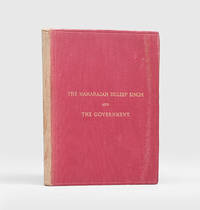
1884189408London: Printed by the Ballatyne Press "For Private Circulation" 1884. Duleep Singh reclaims his throne First and only edition privately issued of this controversial presentation of the maharajah's grievances against the British Government's claims to the Punjab. Decidedly uncommon around 14 copies traced institutionally just a couple at auction. An excellent copy of a fragile fugitive and highly desirable work here in a variant binding to the black skiver usually encountered. The child king Duleep Singh 1838-1893 Maharajah of Lahorewas carried into exile following defeat in the Second Anglo-Sikh War 1848-9 converting to Christianity in 1854 obtaining a royal audience and becoming "an immediate success" with the Queen and eventually settling in Elveden Suffolk with Bamba Müller his "part-Ethiopian part-German" ODNB wife who he had met in Cairo when returning from his mother's funeral in India; "Duleep Singh loved Elveden and rebuilt the church cottages and the school. His fame as a shooter of game was revived in the grounds of the great estate". However "amid European glamour the spirit that had tasted sovereignty was hibernating somewhere in the mind of Duleep Singh. Prompted initially by his mother then by his cousin Thakur Singh Sandhanwalia and finally by the supposed prophecies of the tenth Sikh guru Duleep Singh began a battle with the British government asserting the illegality of the annexation of the Punjab and demanded to be reinstated as maharajah. In 1886 he tried to return to India to place himself as the prophesied head of the Sikh people but was arrested at Aden. Here he was received back into the Sikh faith". From Paris he made himself the centre of various plots to overthrow British rule in the Punjab scheming with Russian and Irish revolutionaries to force the Khyber Pass but all of these conspiracies came to nothing. Increasingly dogged by ill health he sought a reconciliation with Victoria who "responded with a full pardon through the secretary of state on 1 August 1890". He died in Paris in 1893 and was carried back to his beloved Elveden and buried in the graveyard of St Andrew's and St Patrick's Church. The present work represents the historical groundwork to his campaign for reinstatement to the throne and was distributed solely to those who he felt could be of influence to that end. It was "compiled partly from historical sources and partly from private information and documents furnished" Preface by Duleep Singh himself and encompasses a sketch of the early history of the Punjab; a biographical narrative of the Maharajah; and an explanation "of the peculiar Relations in which the Maharajah stands towards the Government and the causes of the differences between them". Octavo. pp. viii 183. Original moderate red cloth over flexible boards title gilt to the front cover single fillet blind panel to both covers grey-blue decorative endpapers. Slightly rubbed the spine sunned; endpapers a little browned pale toning to the text-block else a very good copy. hardcover
19112092902138301906Not Available 1911. Soft Cover. Fine. Number of pages: 8242p Size: 23cm Not Available paperback
178044921Paris, Moutard, Panckoucke, 1780. 4to. Extract from ""Mémoires fe Mathematique et de Physique, Présentés à l'Academie des Sciences par divers Savans"", Tome IX. With titlepage to vol. IX. Pp. (2), (167-) 264 and 4 folded engraved plates. The memoir has also its own titlepage. Fine and clean. Wide-margined.
169141859Leipzig, Grosse & Gleditsch, 1691. 4to. Contemp. full vellum. Faint handwritten title on spine. a small stamp on titlepage. In: ""Acta Eruditorum Anno MDCLXXXXI"". (8),590,(6) pp. and 13 (of 15) folded engraved plates. The 2 first plates lacks, but they do not belong to the papers listed.Leibniz' papers: pp.277-281 a. 1 plate, pp. 435-439. Johann Bernoulli: pp. 274-276 a. 1 plate. Huygens: pp. 281-282. - Jacob Bernoulli: pp. 282-290 a. 1 plate.
167944323Paris, Thomas Jolly, 1679. Small8vo. (15x9 cm.). Contemp. full sprinckled calf., raisedbands, richly gilt spine. Top of spine a bit worn. Edges of covers gilt. (12),86,(1) pp. Last page ""Extrait du Privilege du Roy"". 34 fine full-page engravings (25 copper-engraved a. 9 in woodcut). A paperflw at foot of titlepage neathly repaired, no loss of paper or letters. Internally clean and fine, printed on thick, good paper.
184246883Heidelberg, C.F. Winter, 1842. Bound in a nice later hcalf. Raised bands, titlelabel with gilt lettering. In: ""Annalen der Chemie und Pharmacie. herausgegeben von Friedrich Wóhler und Justus Liebig"", Vol. 42. (6),356 pp. Mayer's paper: pp. 233-240. Volume 42 is offered bound together with vol. 41. (8),376 pp. a. 1 folded plate. (This volume contains importent cehemical papers by Kolbe, Cahours, Kopp, Wöhler, Laurent and Liebig (the first printing of Liebig's famous work on animal physiology and pathology)
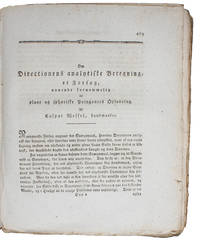
179758364Kiøbenhavn, Johan Rudolph Thiele, (1797) 1799. 4to. Uncut and unopened in original blue boards. Published in: ""Nye Samling af det Kongelige Danske Videnskabernes Selskabs Skrifter."" Vol. V. Wessel's paper: pp.469-518 and 3 folded engraved plates (the last plate inserted at p. 463). The whole volume V offered in its original binding. Engraved titlevignette. XII,670 pp., 15 engraved plates. 4 leaves with upper right corners gone, not affecting Wessel's paper.
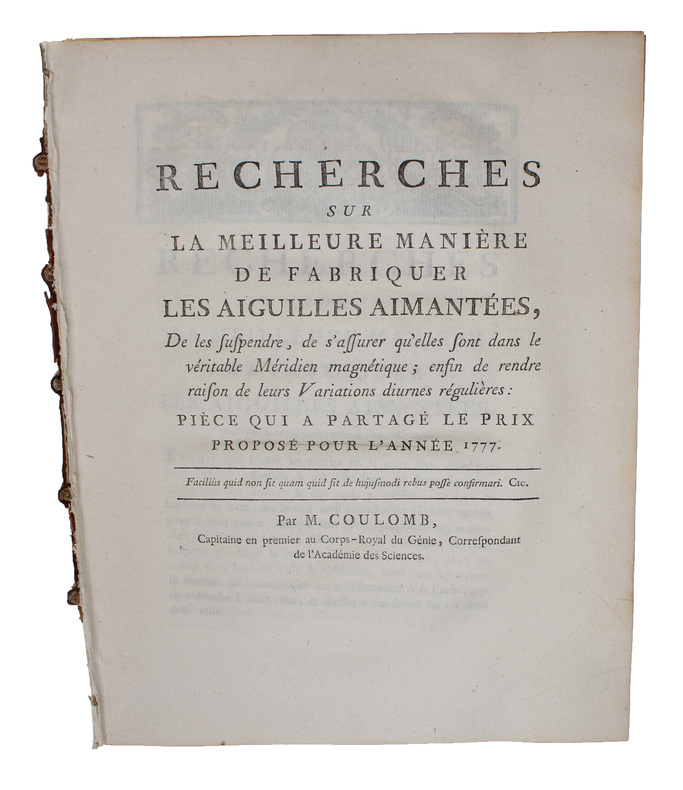
178044921Paris Moutard Panckoucke 1780. 4to. Extract from "Mémoires fe Mathematique et de Physique Présentés à l'Academie des Sciences par divers Savans" Tome IX. With titlepage to vol. IX. Pp. 2 167- 264 and 4 folded engraved plates. The memoir has also its own titlepage. Fine and clean. Wide-margined. <br/><br/><em>First printing of this monumental memoir the invention of the TORSION BALANCE dealing with the best way to construct a magnetic compass. The paper contains the design of a torsion suspension declination compass and the demonstration that the forces of torsion is proportional to the angle of twist. Coulomb received the prize awarded by the Academy for this paper drafted by the Academy in 1777 he shared the prize with Van Swinden. - "The importance of this memoir for Coulomb's career is that it CONTAINED ELEMENTS OF ALL HIS MAJOR PHYSICAL STUDIES: the quantitative study of magnetism torsion and the torsion balance friction and fluid resistance and the germ of his theories of elasticity and magnetism."DSB."Coulomb’s first writings on torsion were presented in his Academy prize-winning memoir of 1777 "Recherches sur la meilleure maniere de fabriquer les aiguilles aimantées.". his simple elegant solution to the problem of torsion in cylinders and his use of the torsion balance in physical applications were important to numerous physicists in succeeding years. In chapter 3 Coulomb developed the theory of torsion in thin silk and hair threads. Here he was the first to show how the torsion suspension could provide physicists with a method of accurately measuring extremely small forces. He showed that within certain angular limits torsional oscillation consisted of simple harmonic motion. He examined the parameters relating the angle of twist to the length diameter and elastic properties of the torsion thread. In the range of simple harmonic oscillation Coulomb demonstrated that the force of torsion was proportional to the angle of twist. He used this principle in measuring small magnetic forces and also called attention to its use in measuring other forces notably those of fluids in motion. Eventually he was able to measure forces of less than 9 x 10⁻⁴ dynes.""Coulomb’s major memoirs in electricity and magnetism are his 1777 memoir on magnetic compasses the famous series of seven electricity and magnetism memoirs read at the Academy from 1785 to 1791 and several magnetism memoirs prepared after the French Revolution. In his electrical studies Coulomb determined the quantitative force law gave the notion of electrical mass and studied charge leakage and the surface distribution of charge on conducting bodies. In magnetism he determined the quantitative force law created a theory of magnetism based on molecular polarization and introduced the idea of demagnetization basically that combinations of magnetic poles can "cancel" each other."DSB.Parkinson "Breakthroughs": 1777:P </em> unknown
167944323Paris Thomas Jolly 1679. Small8vo. 15x9 cm. Contemp. full sprinckled calf. raisedbands richly gilt spine. Top of spine a bit worn. Edges of covers gilt. 12861 pp. Last page "Extrait du Privilege du Roy". 34 fine full-page engravings 25 copper-engraved a. 9 in woodcut. A paperflw at foot of titlepage neathly repaired no loss of paper or letters. Internally clean and fine printed on thick good paper. <br/><br/><em>Extremely scarce first edition of Leclerc's important work on binocular vision in which he finds that one of the eyes has a dominant status thus announcing the discovery of the "Master-eye" - a discovery of outmost importance in the theory of shooting and elsewhere. With use of diagrams he shows that "things that can be seen clearly are seen with but one single eye.". He records and depicts a large series of experiments with binocular vision and shows geometrically the relation to the science of perspective and points out the importance of understanding the physiology of binocular vision for perspective painting in general.Sebastien Leclerc was originally an engraver who studied physics and geometry in relation to perspective theory a field of which he became famous. In 1672 he was appointed to "l'Academie de Peinture" as professor in perspective. He was also engraver to Louis XIV and was appointed professor at "l'Ecole des Gobelins". </em> unknown
169141859Leipzig Grosse & Gleditsch 1691. 4to. Contemp. full vellum. Faint handwritten title on spine. a small stamp on titlepage. In: "Acta Eruditorum Anno MDCLXXXXI". 85906 pp. and 13 of 15 folded engraved plates. The 2 first plates lacks but they do not belong to the papers listed.Leibniz' papers: pp.277-281 a. 1 plate pp. 435-439. Johann Bernoulli: pp. 274-276 a. 1 plate. Huygens: pp. 281-282. - Jacob Bernoulli: pp. 282-290 a. 1 plate. <br/><br/><em>All papers first apperance. All 5 of extreme importence in the development of the Calculus. Leibniz' 2 papers on the catenary curve paper 1-2 offered here was written at the instigation of Jacques Bernoulli. Following the example of Blaise Pascal who had initiated in 1658 a contest for the construction of the cycloid Leibniz also provoked the geometers of his time by challenging them to submit at the fixed date of mid-1691 their geometric method for the construction of the catenary curve. Leibniz later provided the answer followed by Johann Bernoulli and Huygens.'These two papers are a historical account of the origin of the study of this transcendental curve and at the same time the first physical-geometric construction showing the species-relationship between the catenary and the logarithmic curves as two companion curves; one arithmetic the other geometric. All of the differentials of the catenary curve are arithmetic means of corresponding differentials of the logarithmic curve; and all of the differentials of the logarithmic curve are geometric means of the catenary.'"The Catenary is the form of a hanging fully flexible rope or chain the name comes from "catena" which means 'chain' suspended on two points. The interest in this curve originated with Galileo who thought that is was a parabola. Young Christiaan Huygens proved in 1646 that this cannot be the case. What the actual form was remained an open question till 1691 when Leibniz Johann Bernoulli and the then much older Huygens sent solutions to the problem to the "Acta" Jakob Bernoulli 1690 Johann Bernoulli 1691 Huygens 1691 and Leibniz 1691 - these 4 1691-papers offered here - in which the previous year Jakob Bernoulli had challenged mathematicians to solve it. As published the solutions did not reveal the methods but through later publications of manuscripts these methods have been known. Huygens applied with great paper 4 virtuosity the by then classical methods of 17th century infinitesimal mathematics and he needed all his ingenuity to reach a satisfactory solution. Leibniz the papers 1-2 and Bernoulli paper 3 applying the new Calculus found the solutions in a much direct way. In fact the catenary was a test-case between the old and the new style in the study of curves and only because the champion of the old style was a giant like Huygens the test-case can formally be considered as ending in a draw." Grattan-Guiness in "From the Calculus to Set Theory 1630-1910.".The paper by JACOB BERNOULLI no. 5 offered here is a milestone papers as it marks the invention of the "SYSTEM OF POLAR COORDINATES" with points located by reference to a fixed point and a line through that point. Although newton had earlier also devised such a coordinate system in 1671 his work was not known so that the credit for the discovery generally goes to Bernoulli. Parkinson Breakthroughs 1691.Further papers contained in this volume of Acta Eruditorum:DENYS PAPIN: Mecanicorum de Viribus Motricibus sententia asserta a D. Papino adversius C.G.G. L. Leibniz objectiones. pp. 6-13. The plate lacks. - and Dion. Papini Observationes quaedam circa materias ad Hydraulicam spectantes. Pp. 208-213 a. 1 plate. This importent paper is part of the LEIBNIZ-PAPIN-CONTROVERSY.JACOB BERNOULLI: Specimen Calculi Differentialis in dimensione Parabolæ helicoidis ubi de flexuris curvarum in genere carundem evolutionibus. Pp. 13-22. The plate lacks. - and J.B. Demonstratio Centri Oscillationis ex Natura Vectis reperta occassione eorum quæ super hac materia in Historia Literaria Roterodamensi recensentur articulo.Pp.317-321.LEIBNIZ: O.V.E. Additio ad Schediasma de Medii Resistentia publicatum in Actis mensis Febr. 1889. Pp. 177-178. and O.V.E. Quadratura Arithmetica Communis Sectionum Conicarum quæ centrum babent.Pp. 178-182 a. 1 plate.TSCHIRNHAUS: Singularia Effecta Vitri Caustici bipedalis quod omnia magno sumtu hactenus constructa specula ustoria virtute superat per D.T. Pp. 517-520 </em> hardcover
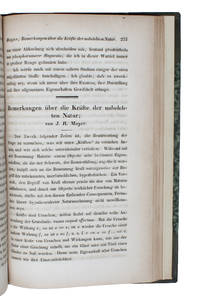
184246883Heidelberg C.F. Winter 1842. Bound in a nice later hcalf. Raised bands titlelabel with gilt lettering. In: "Annalen der Chemie und Pharmacie. herausgegeben von Friedrich Wóhler und Justus Liebig" Vol. 42. 6356 pp. Mayer's paper: pp. 233-240. Volume 42 is offered bound together with vol. 41. 8376 pp. a. 1 folded plate. This volume contains importent cehemical papers by Kolbe Cahours Kopp Wöhler Laurent and Liebig the first printing of Liebig's famous work on animal physiology and pathology <br/><br/><em>First printing of one of the most important papers in physics chemistry and physiology in the 19th century. The paper is the first to propose an equivalence of all forms of energy including heat and a conservation of total energy. Although Mayer was the first to set forth the general law of the conversation of energy the first thermodynamical law it was James Joule who first put the law on firm footing. "The paper of 1842 the paper offered set out Mayer’s definitive view on the conservation of force and established his claim to priority; historically the paper also provides insight into the processes through which Mayer arrived at his theory."DSB."Originally trained as a physician mayer did not enjoy medical practice. About 1840 he began to be interested in physics and he entered thhe field of research . In 1842 he not only presented a figure for the mechanical equivalent of heat but he also clearly presented his belief in the conversation of energy. He had some difficulty getting his paper on the subject published but Liebig finally accepted for the importent journal he edited. Though Mayer was five years ahead of Joule his paper aroused no interest and in the end it was Joule with his imposing experimental background. who received credit for working out the mechanical equivalent of heat. And it was Helmholtz who recieved credit for announcing the law of conservation of energy because he announced it so much more systematically. Yet Mayer went further than either of the other two for he included living phenomena in the realm of energy conservation a daring step in a decade when vitalism with its view that the laws of inanimate nature did not apply to living systems was still a considerable force. Mayer argued that solar energy was the ultimate source of all energy on earth both living and non-living. He further suggested that solar energy was derived from the slow contraction of the sun or by the fall of meteors into the sun in either case kinetic energy being converted to radiant energy."Asimov"After 1860 Mayer was finally given the recognition he deserved. Many of his articles were translated into English and such well-known scientists as Rydolph Clausius in Germany and John Tyndall in England began to champion Mayer as the founder of the law of the conservation of energy."Alan Lightman "Great Ideas in Physics" p. 8.Parkinson "Breakthroughs" 1842 P. - Magee "A Source Book in Physics" p. 196 ff. - Dibner: 157 listing the offprint with a different title - PMM: 330 offprint-version. - Garrison & Morton: 606. </em> hardcover
179758364Kiøbenhavn Johan Rudolph Thiele 1797 1799. 4to. Uncut and unopened in original blue boards. Published in: "Nye Samling af det Kongelige Danske Videnskabernes Selskabs Skrifter." Vol. V. Wessel's paper: pp.469-518 and 3 folded engraved plates the last plate inserted at p. 463. The whole volume V offered in its original binding. Engraved titlevignette. XII670 pp. 15 engraved plates. 4 leaves with upper right corners gone not affecting Wessel's paper. <br/><br/><em>First edition of this important first systematical treatment of the theory of complex numbers and at the same time the first work to add vectors in three-dimensional space."Wessel’s fame as a mathematician is based entirely on one paper written in Danish and published in the Mémoires of the Royal Danish Academy that established his priority in publication of the geometric representation of complex numbers. John Wallis had given a geometric representation of the complex roots of quadratic equations in 1685; Gauss had had the idea as early as 1799 but did not explicitly publish it until 1831. Robert Argand’s independent publication in 1806 must be credited as the source of this concept in modern mathematics because Wessel’s work remained essentially unknown until 1895 when its significance was pointed out by Christian Juel. The title of Wessel’s treatise calls it an "attempt" to give an analytic representation of both distance and direction that could be used to solve plane and spherical polygons. The connection of this goal with Wessel’s work as a surveyor and cartographer is obvious. The statement of the problem also suggests that Wessel should be credited with an early formulation of vector addition. In fact Michael J. Crowe in A History of Vector Analysis University of Notre Dame Press 1967 defines the first period in that history as that of a search for hypercomplex numbers to be used in space analysis and dates it from the time of Wessel whom he calls the first to add vectors in three-dimensional space." DSB. </em> hardcover
0012221Midland Maryland: Improved Order of Red Men Tribe. Fair with no dust jacket. Hardcover. On offer are two historically significant ledger books spanning 10 years maintained by Chiefs of the Improved Order of Red Men of Tioga Tribe No. 126 in Midland Maryland. PLEASE REQUEST FULL BIO ON THE RED MEN FROM SELLER excluded due to word count restrictions. The first ledger spans 1919-1923 and the second covers 1931-1936. Each ledger contains the annual Roll of Chiefs where attendance is kept for each weekly meeting. This is followed by hundreds of pages of meeting minutes wherein the intimate detail of the tribes attendance discussions motions officer nominations elections and tribe finances are meticulously recorded. Excerpts follow to give the flavour of the ledgers: .Moved and Sec. Charles Bevidge be suspended from all rights and privileges of the order carried. Moved and Sec we porospone sic class initiation until Dec 30 on account of Indusstrial condition. Carried Oct 28 1919. .Moved and second Bill of Brother Jas Albright for one load of cal be received and paid. Carried. $4.25. Moved and second that a committee of three be appointed and work in conjunction with the other lodges to see about getting a doctor on committee Bro Harry Sulser John Laslo James Albright Motion carried March 16 1920. Brother McGee reported on Halloween social to be held between Red Men and Ladies Bible class. The committee desires that the Red Men get up an entertainment and Ice cream and all members are requested to bring a parcel post Oct 18 1921. Council fire was kindled for the purpose of burying our deceased brother William C. Muir. Sachem appointed. Bros Lindsey Baiman Leese and Sarage as pallbearers. Brother Muir died at the age of 81 years Sunday evening July 23 at 5: 30 oclock July 26 1935. This was a special meeting held in celebration of the 37th anniversary and 204 Washington birthday celebration. The orders Washington Birthday Ritual was used. The slations were filled as follows: long list of names and positions of tribe members.At the close of the Ritualistic Service brother Taylor was called on and he read a history of the Tribe after which the Tribe adjourned to partake of a Banquet prepared for the occasion. Dart Ball and the other amusements were indulged in Feb 22 1936. Committee reported having visited Black Hawk Tribe at Westerport. That an open air District meeting will be held in Westernport Sat Sept 19 carried. Carnival committee reported progress Moved and Sec Resignation of Bro Hunt be accepted and his successor elected. Moved and Sec we go into election of Jr. Sagamore carried . Moved and Sec we paint the outside of building for Carnival. Carried Aug 6 1936. The ledgers are absolutely brimming with names of Officers and Members of this Red Men tribe making them as interesting to a genealogist as they are to one who studies fraternal societies Maryland in the early 20th century or the Red Men more specifically. The ledgers measure 9x14 inches. They each contain hundreds of un-numbered pages. The pages ledgers are custom printed for the Red Men by Labor Saving Lodge Books in Cedar Rapids Iowa. They contain handwriting on most pages filling in the printed fields. There is tipped in ephemera and extra pages particularly in the second ledger. Both ledgers show signs of their age. Pages are in tact but the spines are loosening and the cloth hardcovers are beginning to crack and peel. Writing is legible. Overall Fair. Note: Ask seller for a link to the 19th Century ledger of a New York tribe of the Red Men being sold separately. ; Manuscripts; Folio 13" - 23" tall; Signed by Author . Improved Order of Red Men Tribe hardcover
116536aafLondon, published at R. Ackermann's Repository of Arts, 101 Strand (printed by: William Clowes), 1823, in-4to, VIII + 120 p. + 17 plates with views all hand-coloured + 1 map, some stains on the free endpapers only, book contents and plates exceptionally clean, some dust stains mainly in the margins, handwritten on first flyleaf - E.W.P. Bonnet July 1854 - , orig. publisher’s illustrated red cloth. Spines a bit sunned, else a fine copy.
86448aaf1819, 53.5x74.5 cm, unten links mit Tusche signiert ‘Natur. fecit ...’ und datiert, verso hs. mit brauner Tinte eigenhändig in deutscher Kurrentschrift der Zeit ausführlich bezeichnet, in schöner alter Rahmen.
194816388JNew York: Random House 1948. First Edition First Printing. The novel basis for Red River the classic Howard Hawks directed 1948 Western film starring John Wayne and Montgomery Clift for which Chase co-authored the screenplay. Hardbound in original tan cloth. A rare book especially in dust jacket. Some minor offsetting from a clipping listing the film cast on the adjacent copyright and dedication pages Near fine in a clean tight copy in a near fine bright dust jacket with a few tiny mends by an expert paper conservationist. 216 pages. Enclosed in a custom clamshell box. In a career of many fine films John Wayne’s three greatest performances are considered those in The Searchers She Wore a Yellow Ribbon and Red River where Wayne plays the hard-edged cattle drive boss Tom Dunson. Red River has been selected by the Library of Congress as a national film treasure. Random House hardcover
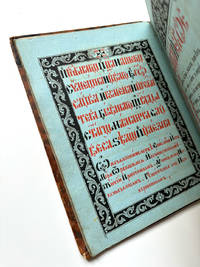
3231<p><strong>An unusually well preserved example of this mystical guidance on spiritual growth in delicate calligraphy on attractive blue paper.</strong></p><p>After twenty-five years serving as an abbot of the Monastery of Saint Mamas in Constantinople Symeon the New Theologian 949–1022 stepped down to write his spiritual instructions sharing his personal mystical experiences. His "central theme is the conviction that by applying the classical methods of mental prayer one experiences a contemplative "vision of light" . Symeon emphasised that such experience is attainable by all who earnestly immerse themselves in the life of prayer" Britannica. His mystical practices prepared the way for Hesychast mysticism "a 14th-century Eastern movement in contemplative prayer" id.</p><p>The manuscript contains a selection of Symeon's moral instructions or "Words" about monastic life as well as his poetic "Hymns of Divine Love" including an "alphabet in couplets" encouraging new monks prayers and stories of his own spiritual struggle and exploits the thoughts on mental paradise the attainment of divine purity the height of contemplation one can ascend repentance and what the attention to prayer is defining three kinds of it. The volume ends with the brief quote of St Barsanuphius about the superiority of mental labour and faith over physical rituals.</p><p>It is interesting to note that the publication of Symeon's works happened rather later and more or less around the creation of this manuscript: "very few of Symeon's works have been published in Slavonic and Russian languages" Otkrytaia pravoslavnaia entsiklopediia our translation: his works remained untranslated until the publication of the collection of spiritual opuses by Orthodox authors Dobrotoliubie Philokalia 1793 which included a list of his short moral instructions in the form of maxims. In 1852 a separate edition of Symeon's "Twelve Practical Words" in modernised Church Slavonic was printed at the Moscow University press; the "Words" from the 1852 edition have some similarities with the present manuscript but their translations differ significantly and the manuscript includes 24 "Words" instead of 12. The choice of the "Words" and other writings for this volume was most likely determined by the compiler's or scribe's personal taste.</p><p>Our text is written on lovely blue paper with a watermark showing the Yaroslavl coat of arms a bear holding a spear in a crowned roundel the abbreviation "IaMPG1" for Yaroslavl Paper Manufacture and the date "1805". The headpieces with backgrounds in black ink are calligraphed with elegant asceticism and the decorative initials in different sizes are rendered in red. As witnessed in a handful of neat marginal comments the manuscript was read yet very carefully as its pages are in near mint condition.</p><p><strong>With uncommon provenance from a 19th-c. Russian business woman.</strong> The volume was presented on June 22 1868 by "M. Maksimina" to her "beloved sister in the holy spirit and benefactress" Klavdiia Ivanovna Ganeshina. Ganeshina 1821-88 was herself a merchant and a hereditary honourable citizen of Moscow. She was one of the owners of an estate which they sold in the early 1880s to an important Moscow lace-making company. Her husband Vasilii Alekseevich Ganeshin 1799-1866 was also a hereditary honourable citizen of Moscow.</p><p><strong>Provenance</strong><br />Klavdiia Ivanovna Ganeshina gift inscription in verso of upper flyleaf from "M. Maksimina"; Ia. A. Khomiakov recent inscription in Russian on upper flyleaf.</p><p>Description<br />Octavo 21.3 x 17.7 cm. 200 manuscript ll. in black and red ink incl. ornamental title 17 headpieces and decorative vignettes and initials on blue laid paper with Yarosavl watermark.<br />Binding<br />Contemporary brown marbled calf spine with raised bands and blind stamped ornaments boards with blind-stamped ornamental frames gilt gauffered edges.<br />Condition<br />Binding a bit worn overall upper spine restored with black tape a few small wormholes traces of paper labels on spine private library shelf number in black along gutter near title; very light marginal soiling mostly to first and last pp. a few small pencil marks pagination errors without affecting the text otherwise nicely fresh internally.<br />Bibliography<br />The editors of Encyclopaedia Britannica "Saint Symeon the New Theologian" // Encyclopaedia Britannica; Drevo. Otkrytaia pravoslavnaia entsiklopediia "Simeon Novyi Bogoslov" 2023. ref: 3231</p> [Russia, early to mid-19th century]. hardcover
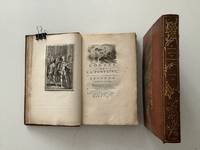
176420446AB1764. 2 volumes. Amsterdam 1764 22 : 14 cm. X 214 pages 1 leaf; VIII 254 pages 1 leaf engraved Portrait of Fontaine 2 engraved title-vignettes 77 full-page engraved plates 63 engraved text-vignettes. Red half-calf binding spine richly gilt with title in gold top edge gilt singed Blanchetiere-Bretault This rare and very beautiful Amsterdam edition is printed two years after the monumental first edition from Paris which was commissioned by Ferniers Géneraux and which is very scarce and sought after. This is the most beautiful and well-executed of the re-impressions Paris 1762 -without vignettes Amsterdam 1764 and London 1764. -"Celle d'Amsterdam 1764 2 vol. in-8. fig. copiées sur celles de l'édition de 1762 est assez belle." Brunet III:760. The illustrations of this edition are excellent and copied from the beautiful first edition" many of them are engraved and signed by C. Boily and all are after Eisen. Most of the vignettes are after Choffard. The portrait of La Fontaine is engraved by Macret after Ficquet. "Cette imitation de l'édition des fermiers généraux est assez jolie. Le portrait de La Fontaine est tantôt gravé par Savaret et tantôt par Macret suivant les exemplaires." Cohen p. 310.The illustrations of this work are considered Eisen's main work the book is considered one of the greatest works of rococo book-illustration and it has greatly inspired later tradition in this field. - Occasionally some minor spotting but allover clean with wide margens two edges uncut beautifully bound by Blanchetiere-Bretault. unknown
18931711060061New York: Henry T. Thomas New York 1893-01-01. First Edition. Hardcover. Good. Limited edition of 1000 copies. Four parts complete all published bound as one. Large folio 61 x 48 cm. Bound in 3/4 tan leather over marbled boards. Leather spine labels with gilt. Original color pictorial wrappers bound in. Some conservation efforts to wrappers particularly of part 1. Title vignette 16 vignettes as well as 16 color heliographic plates by W. S. Vanderbilt Allen. Library perforated stamp on title page limitation page and on bottom right margin of the color plate pages. Bottom blank corner of plates 1 2 and 10 chipped with loss to margin corner. "The cover title calls for 'A collection of Forty-four plates of Coaching Hunting Amateur Races and Horses in Show Rings' but the project was never finished." - Christies The Le Vivier Library of Sporting Books and Modern First Editions30 October 2012 London Sale 4354. Vanderbilt Allen was a grandson of Cornelius Vanderbilt and was trained in Paris by Gerome and Claude Monet. Refs: Bennett p. 101. Scarce portfolios. <br> This is an oversized or heavy book which requires additional postage for international delivery outside the US. Henry T. Thomas, New York hardcover
16191903070006Lutetiae Parisiorum: Typis Regiis 1619. First Edition. Hardcover. Good. 1st edition of Du Val's collected works of Aristotle. 2 volumes bound in 4. Folio 40 x 26 cm. Bound in contemporary Cambridge-style paneled calf. Rebacked and restored bindings. 6 raised bands. Title pages in red and black with engraved portrait of Aristotle. Text in Greek and Latin in parallel columns. Institutional blind stamps. Dampstaining along bottom scattered marginal staining. First title has its margins trimmed and conserved. Collated: Tome 1 part 1: 16 430 p.; T.1 p.2: 431-1251 p. 19; T.2 p.1: 3 469 p. 1; T. 2 p.2: 470-1104 p. 16. <br> According to John Lempriere's Classical Dictionary Aristotle's "treatises have been published separately; but the best edition of the works collectively is that of Duval." p. 96. Refs: Brunet I. 459. <br> Subtitle: "Veterum ac recentiorum interpretum ut Adriani Turnebi Isaaci Casauboni Julii Pacil studio emendatissima. Cum Kyriaci Strozae Patritii Florentini libris duobus Graecolatinis de Republica in supplementum politicorum Aristotelis. Sed nouissimae huic editioni omnium quae hactenus prodierunt ornatissimae accessit breuis ac perpetuus in omnes Aristotelis libros commentarius siue Synopsis Analytica Doctrinae Peripateticae non antehac visa; in qua ut in expeditiore tabella Aristotelis philosophia omnis provt ea suo ordine descripta est perspicue breuiterque indicatur & pro rerum dignitate exponitur. ; Authore Guillelmo Du-Val Pontesiano Philosophiae Graecae & Latinae in Parisiensi Acade" <br> This is an oversized or heavy book which requires additional postage for international delivery outside the US. Lutetiae Parisiorum: Typis Regiis hardcover
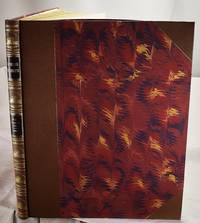
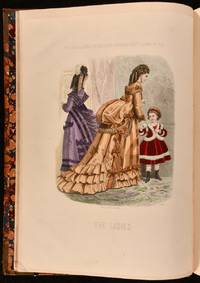
1872833F2London: Office of the Ladies 1872-1873. First edition. Leather. Very Good. 16.5" by 12". Not Stated. The first forty-one issues of the very scarce Victorian fashion periodical 'The Ladies'. Bound in three volumes and illustrated throughout with eighteen hand-coloured fashion plates. The complete 1872 run of the very scarce Victorian era fashion periodical 'The Ladies' from March 1872 to January 1873 bound in three volumes.Weekly issues each running just over twenty pages and featuring contemporary adverts to the rear and a supplement to each issue.Volume I begins with Vol I. No I. Saturday March 30th 1872 and concludes with No. 14 Vol 1. Saturday June 29th 1872. With seven hand coloured fashion plates.Volume II begins with No. 15 Vol. I Saturday July 6th 1872 and concludes with No. 27 Vol. II Saturday September 28th 1872. Illustrated with seven hand coloured fashion plates and one further plate.Volume III begins with No. 28 Vol. II Saturday October 5th 1872 and concludes with No. 41 Vol. II Saturday January 4th 1873. This volume also includes a separately paginated extra Christmas number. Illustrated with four hand coloured fashion plates and two further colour plates.With illustrations and discussions of fashionable hairstyles capes and shoes and eighteen hand coloured fashion plates each depicting two women in ideal contemporary dress. Articles discuss the popular fashions of the day - based on Parisian designs - and with discussions of 'Theatre Gossip' new operas and performances being held and notices of births and marriages. In half calf bindings with marbled paper covered boards. Rubbing to back strips board perimeters and joints with tail of front joint of volume I starting with some detaching of the leather. Head of rear joint of volume I starting. Boards holding firm. Internally firmly bound. Pages exceptionally clean and bright with the odd instance of light offsetting. Plates bright with only the odd spot to perimeters. Very Good Office of the Ladies hardcover
19712091502133700896National Palace Museum 1971. Soft Cover. Fine. The book is in fine condition. National Palace Museum paperback
19922091502135703991Nihonhyoronsha 1992. Soft Cover. Fine. The book is in fine condition. Nihonhyoronsha paperback
19832080702109502880Nigensha 1983. Soft Cover. Fine. Number of pages: 1 volume 1 commentary Nigensha paperback
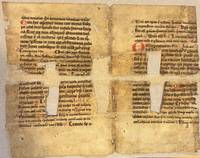
3591Southern France or Northern Italy late 13th century. Manuscript on vellum. Written space approx. 65 × 95 mm; overall leaf size ca. 90 × 125 mm. Text in two sizes of gothic textualis written in dark brown ink rubrics in red. Reused as binding waste with rectangular cut-outs consistent with sewing support slots for an early modern binding. Trimmed at one side with staining worming and losses to the text yet the passages are largely legible and the text could be identified. Manuscript on vellum. Written space approx. 65 × 95 mm; overall leaf size ca. 90 × 125 mm. Text in two sizes of gothic textualis written in dark brown ink rubrics in red. Bifolium; 4 pages. <p><br /> Unusual 13th-century breviary fragment combining the legend of Saint Cecilia with Bede’s All Saints’ Day homily.<br /> <p><p><br /> A small-format bifolium from a Latin breviary preserving a liturgical reading cycle that interweaves the Historia passionis sanctae Caeciliae virginis with Bede’s Homilia LXXI. In solemnitate Omnium Sanctorum. The texts are copied in a compact formal book hand with smaller rubricated insertions and interlinear additions in a secondary notula script. The size layout and script suggest a portable breviary produced for monastic or private devotion.<br /> <p><p><br /> The Cecilia text includes familiar episodes from the Latin Passio including Angelum Dei habeo amatorem Haec Valerianum quendam iuvenem habebat sponsum and Cantantibus organis along with the insertion Domine Iesu Christe seminator casti consilii. These segments appear in the form typical of liturgical readings not continuous narrative.<br /> <p><p><br /> Interwoven is a significant portion of Bede’s Homilia LXXI. In eadem solemnitate Omnium Sanctorum traditionally read on the feast of All Saints which begins: Laudem Domini qui superna caelorum regna spiritibus angelicis… While the Cecilia passages derive from the broader Passio tradition textual features show alignment with versions known from homiliaries. This direct juxtaposition of Cecilia’s passion with Bede’s theological reflections is unusual: we could not locate another surviving breviary containing both texts in this combination suggesting a regionally specific reading order or a customized compilation.<br /> <p><p><br /> Saint Cecilia one of the most venerated Roman martyrs was revered from the early Middle Ages as the patron saint of music virginity and spiritual marriage. Her Passio though apocryphal in parts circulated widely and was integrated into liturgical use by the 9th century. The Homiliae of Bede ca. 673–735 particularly those for major feasts remained standard reading in monastic contexts for centuries. The presence of both in this fragment suggests a breviary or homiliary adapted to a community with a particular devotion to Cecilia and access to Bede’s homiletic corpus.<br /> <p><p><br /> The script—a regular and angular gothic textualis with looped ascenders and clubbed minims—is consistent with manuscripts produced in southern France or northern Italy in the latter half of the 13th century. The rubricated initials and the textualis–notula script pairing support the same dating.<br /> <p>. unknown